Get in touch with ECOFILTRONE™ Company



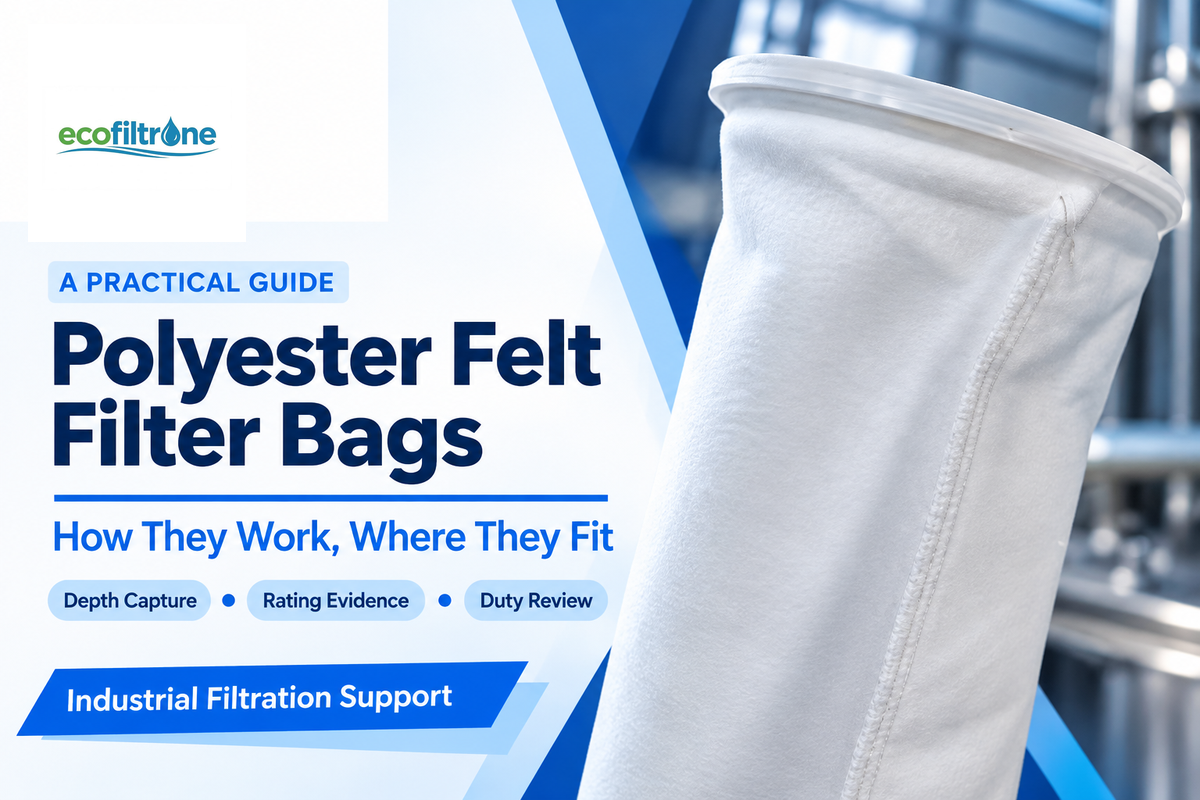
Polyester (PE) Felt Filter Bags are fibrous depth filters that remove suspended solids from liquids. A good combination considers the retention target, liquid chemistry and temperature with a compatible bag, seal and housing. The micron label alone can’t substantiate the quality of the filtered liquid or anticipate its service life.
A bag that lasts longer can still release unacceptable particles. A rapidly loading bag may be capturing the material the process needs removed. This guide explains the difference and provides a way to compare replacements using pressure, outlet quality and accepted throughput.
Quick Specs
| Media identity | Polyester needle felt; confirm the supplier’s PE/PET material code |
|---|---|
| Separation duty | Suspended particles in a compatible liquid |
| Rating basis | Particle size plus a defined retention test |
| Operating boundary | Qualified bag, collar, seal and housing combination |
| Trial outcome | Accepted liquid volume at the agreed downstream quality |
At a glance
- Needle felt traps particles through its thickness; mesh mainly separates at defined openings.
- Equal micron ratings can describe different retention performance.
- Pressure comparisons need matched flow and liquid conditions.
- Replacement economics improve only when the filtered output remains acceptable.
Understand Polyester Felt in Liquid Service
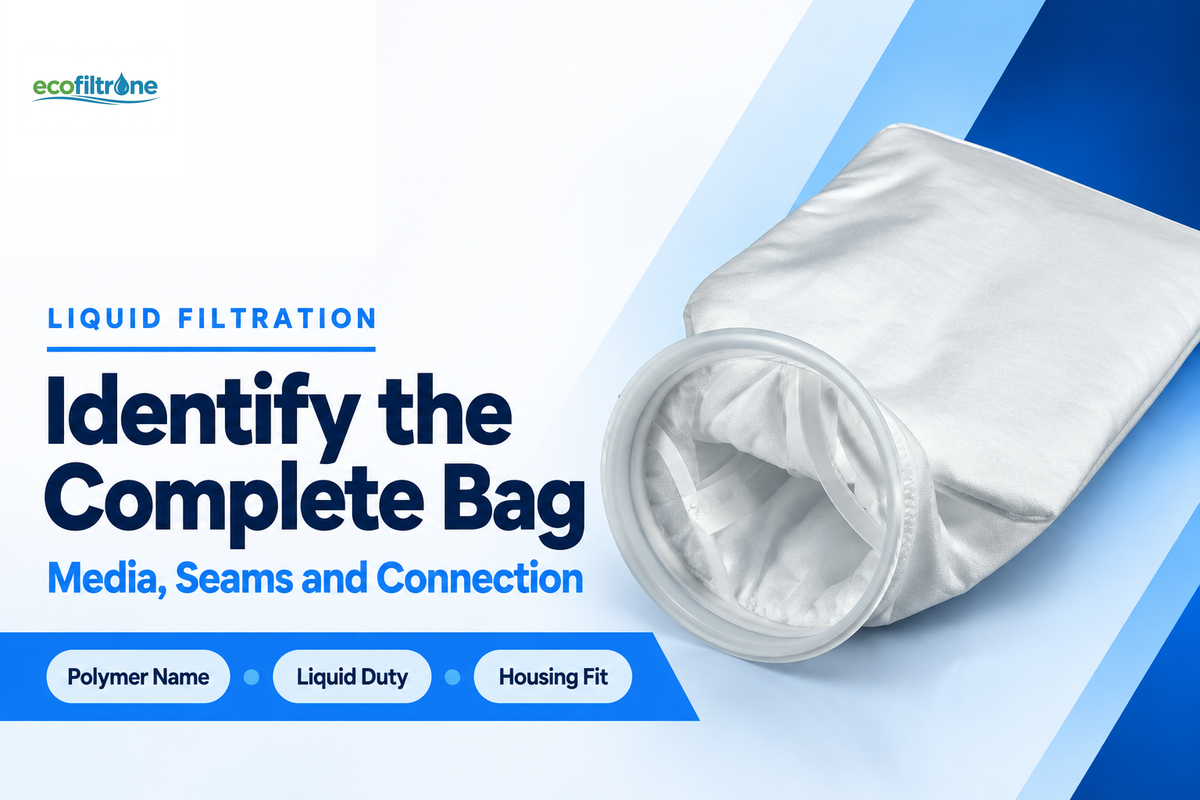
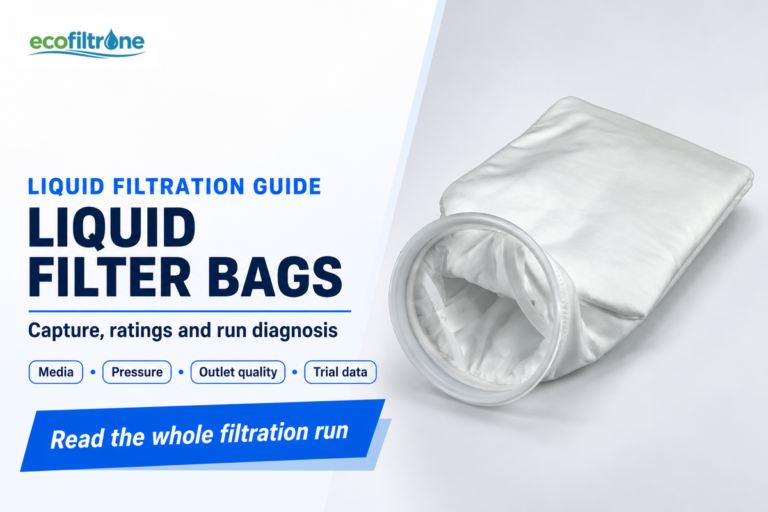
Polyester felt liquid filter bags are textile elements supported inside a liquid filtration housing. Polyester fiber intercepts suspended solids as liquid passes through the bag wall. Dissolved salts, many dissolved chemicals and dissolved colour require other treatment mechanisms; a clearer sample does not establish removal of those substances.
What is a polyester filter?
A polyester filter uses polyester as the separation material. In a liquid bag, needle felt forms a three-dimensional network that captures particles through its depth. The complete filter also includes seams and a collar or ring. Its useful performance therefore comes from the media and the installed assembly working together under actual liquid conditions.
The abbreviations require care. ECOFILTRONE identifies its bag product with PE which means polyester; polyester is also denoted with PET. In other material systems PE means polyethylene. When a purchasing system covers both packaging resins and filtration consumables, specify the polymer name in addition to the code to avoid confusion.
Dry dust-collector sleeves can also be polyester felt. Their airflow data, cage connections, and dry temperature limits don’t speak to a liquid bag’s hydraulic duty. Start with the liquid application and the actual housing connection before comparing textile descriptions.
The liquid-bag construction described in Water Technology’s filter-bag technical discussion provides the mechanism behind this distinction.
Consider an illustrative coolant loop where operators see metal fines in a sample jar. A polyester bag is a possible choice for removing the suspended fines, provided the coolant chemistry and assembly are appropriate. The buyer initially selects a dry dust sleeve because the material description says polyester. The sleeve’s connection can’t seat in the liquid housing, so its filtration claim never reaches a meaningful trial. The team selects the liquid bag and records inlet and outlet particle counts. If the outlet becomes visibly clearer while conductivity stays the same, the observations are correct: particle separation has occurred, but dissolved coolant components still flow through. The goal is to protect against fines, not to change the dissolved chemistry.
How Needle Felt Captures Particles
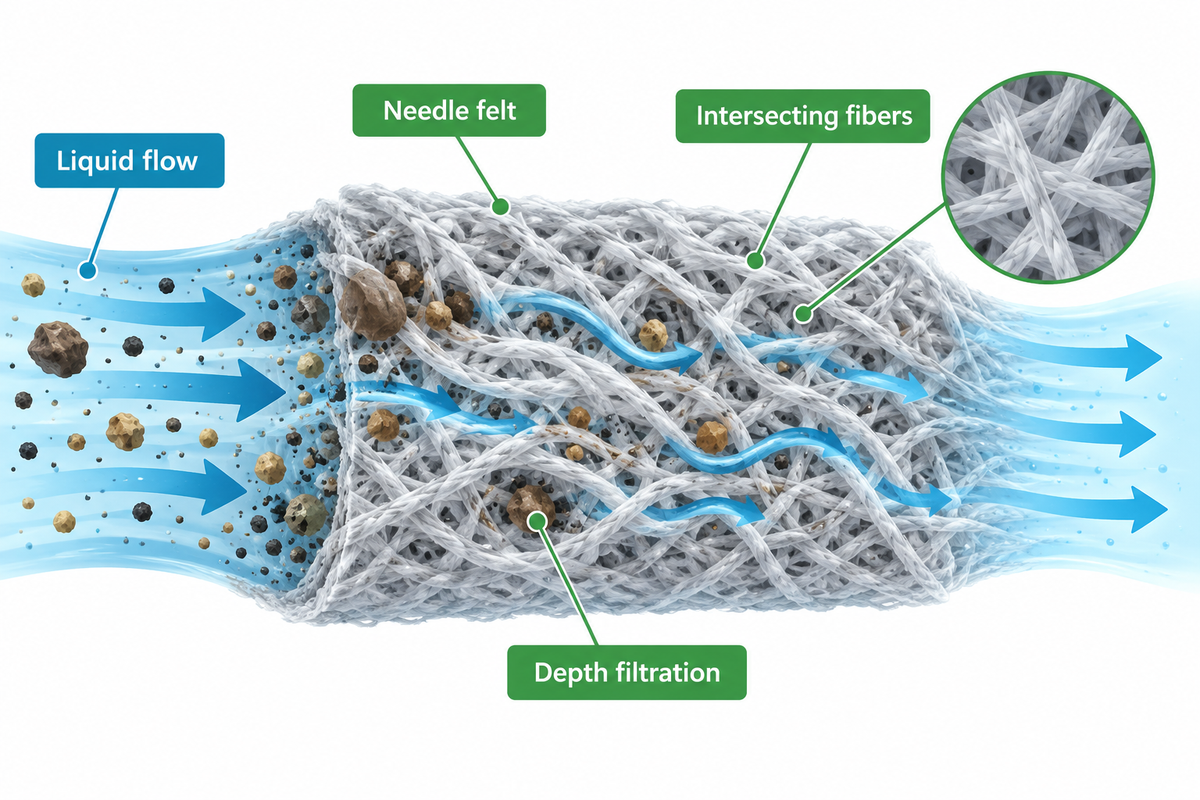
Needle felt captures particles along a network of intersecting fibers rather than through a single uniform screen opening. Different flow paths encounter different fibers and constrictions. The resulting depth filtration can accommodate a distribution of particle sizes, while progressively retained solids change resistance and may alter the capture behavior during a run.
During manufacture, needles mechanically interlock the fabric. Liquid moves through the filter media where it encounters more than the outer face, thereby helping to explain the different loading behavior of felts and woven meshes. This distinction is described by Tim Sheehan in Water Technology. This article is historical technical background and isn’t evidence to support a current supplier’s service-life claim.
A surface finish changes the exposed fibers. Manufacturers may singe the surface to reduce fiber migration, or apply a finish that changes surface smoothness. A singed finish doesn’t guarantee zero migration. For a sensitive downstream coating or polishing step, examine a flushed blank sample and the outlet under the intended operating conditions.
A weld joins compatible thermoplastic material; a sewn seam uses thread and stitch holes; neither description alone establishes the completed bag’s retention. A bond is also non-committal about whether a collar fits the housing’s sealing surface.
Gelatinous particles require further examination because deformable materials can behave differently from hard test particles. A developing cake may improve capture but also increase pressure loss. If the downstream target is missed at the beginning of the run, it’s only acceptable to wait for a cake if the process can contain and manage that initial output.
The same depth-versus-surface distinction helps when comparing bags with depth filter cartridges. Available area, flow distribution and construction change with the type of media; similar polymer names don’t make the elements interchangeable.
What a Micron Rating Does and Does Not Tell You
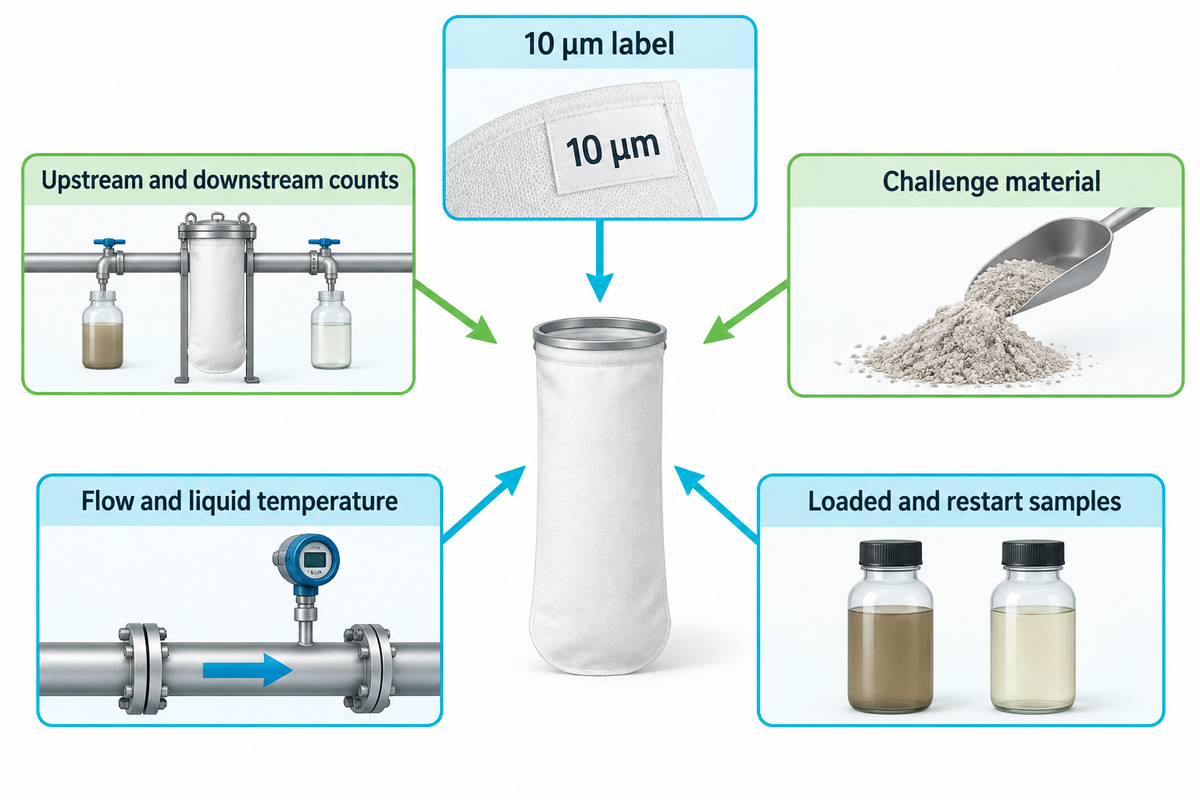
A micron rating identifies a particle-size claim, but the claim needs a retention efficiency and test basis to be considered an acceptance criterion. Two 10 micron polyester felt bags can carry different meanings and definitions and test particles. Compare the measured removal target at matched conditions, rather than treating equal labels as equivalent results.
Nominal and absolute definitions differ for various product ranges. Neither supplies a universal percentage without a stated method. A 10 micron filter bag requires that context to compare its rating. Variables such as the size channel that’s counted, particle counts upstream and downstream, and the test point in the loading cycle affect the outcome. A laboratory challenge may behave differently for a liquid of soft agglomerates versus rigid particles.
| Information | What it establishes | What remains unresolved |
|---|---|---|
| 10 µm label | The claimed particle-size reference | Retention percentage and test method |
| Upstream and downstream counts | Observed removal at the measured size | Performance at other particle sizes |
| Challenge material | What was used to load the filter | Behaviour with a different contaminant |
| Flow and liquid temperature | The tested hydraulic conditions | Performance after either condition changes |
| Loaded and restart samples | Results at additional operating states | Untested operating states or exposure periods |
Suppose a rinse line has a purchasing file with a 10 µm bag from two suppliers. The first quotation supplies a particle-retention curve; the second supplies only the label. Both may be good candidates, but the evidence is unequal. The engineer defines the particle size that threatens the downstream nozzle, agrees a sampling method, and runs both bags on the same rinse recipe. A clear-looking jar can’t decide the comparison because small particles may remain invisible. If a bag meets the chosen count limit at the start but fails after a restart, its average result conceals the event the nozzle needs protection from. The decision then concerns that observed failure rather than which quote uses the stronger rating.
The NSF/EPA protocol for physical removal of microbiological and particulate contaminants evaluates defined treatment systems under specified challenge conditions. An iterative, whole-system approach is good methodological context. The drinking water verification requirements of the protocol can not be directly translated into a typical industrial bag specification.
For the core terms, see interpreting a filter micron rating. The micron-rated liquid filter bags page can then assist in interpreting the grades of products available in the market.
Where Polyester Fits and Where It Fails
Polyester’s compatibility with chemicals depends on factors such as the mixture, concentration, and water content. It also depends on the temperature and exposure time. A chemical resistance chart is an initial screen for a particular material, rather than approval for the finished bag. The operating envelope is limited by the weakest qualified component.
A hot alkaline cleaner followed by an industrial water rinse represent different exposures, even if they’re in the same housing. A room-temperature result cannot resolve degradation during a hotter cleaning stage. Including cleaning agents and atypical peaks in the analysis, in addition to the normal process recipe, is necessary.
Bag filters in the chemical processing industry may encounter a changing mixture rather than a single neat chemical. Record the liquid environment as a process recipe, including the minor constituents. Comparing only the principal chemical name can mask the exposure that limits the assembly.
ASTM D543-21 justifies the need for actual reagent conditions when interpreting chemical resistance results, including those behind a chemical resistance chart and provides reasons for evaluation in the unstressed condition and the stressed condition. Neither approach, by itself, certifies a completed filter bag.
Match chemical-resistance evidence to “the particular reagents and concentrations to be encountered”.
ISO 175:2010 (confirmed in 2026) examines the effects of liquid chemicals on plastics. A reference to ISO 175 calls for an actual material, exposure and result. Such a reference doesn’t establish filtration efficiency or demonstrate the behavior of a loaded bag in its support basket.
ECOFILTRONE’s polyester solution lists a 120 °C reference for its product range. That catalog value must be associated with the specified assembly and specified conditions. It isn’t permission to run every polyester felt filter bag in any liquid at 120 °C, and it isn’t a differential-pressure replacement setpoint.
If the mixture falls outside the available polyester evidence, review a different material rather than extrapolate a limit. A review of a PTFE liquid filter bag is one possibility; the exact construction and complete assembly need to be reviewed in the context of the liquid. Broad chemical compatibility describes the size of a screening shortlist, not universal chemical immunity.
Polyester Felt Versus Polypropylene Felt and Nylon Mesh
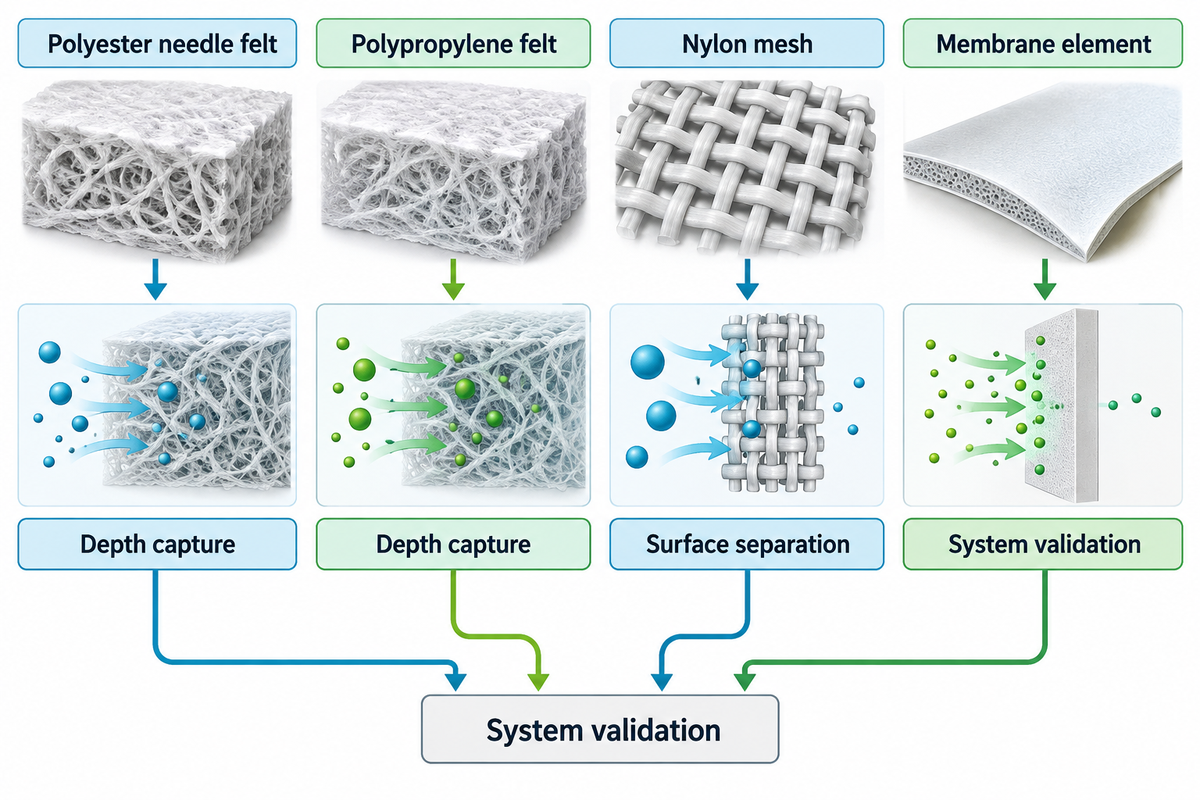
Polyester felt and polypropylene felt are depth-media candidates, while nylon mesh typically has a defined, woven, surface opening. Material selection should first preserve the required particle-removal mechanism, then pass the actual chemical and thermal review. Change of polymer, and change of felt to nylon mesh are separate decisions.
| Candidate | Useful reason to evaluate it | Deciding evidence |
|---|---|---|
| Polyester needle felt | Depth capture of a distributed solids load | Retention under the actual liquid and exposure |
| Polypropylene felt | An alternative depth medium for a different chemical duty | Complete bag compatibility and comparable retention |
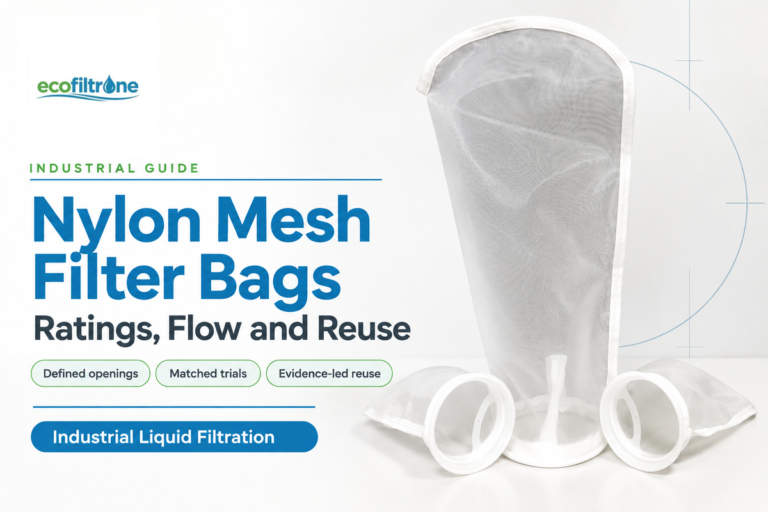
| Nylon mesh | Surface separation of particles that can be screened by an opening | Aperture, particle shape and any validated cleaning method |
| Membrane element | A tighter, defined downstream removal requirement | Specified membrane rating and system validation |
If suspended particles cover a broad size distribution and the liquid passes the polyester review, retain polyester felt on the trial shortlist. If chemistry excludes polyester, examine polypropylene felt bag options against the same outlet criterion. A chemically resistant medium is useful only if it achieves the required separation.
If the task is recovery of relatively coarse, rigid particles from a compatible liquid, nylon mesh filter bags may provide a more relevant surface comparison. Deformable or elongated particles can complicate that choice. An opening dimension can’t describe all particles’ passage in all orientations.
The felt and mesh mechanism comparison by Tim Sheehan supports making construction and polymer separate selection choices.
Appearance of fabric doesn’t mean a longer service life. Maintenance access, solids form and cleaning assumptions account for the difference. If the downstream need is for a different retention level, it’s better to consider the relevant filter membrane cartridges than to continuously select a finer bag without assessing if the bag format is compatible with the objective.
Why Good Media Can Still Let Particles Through
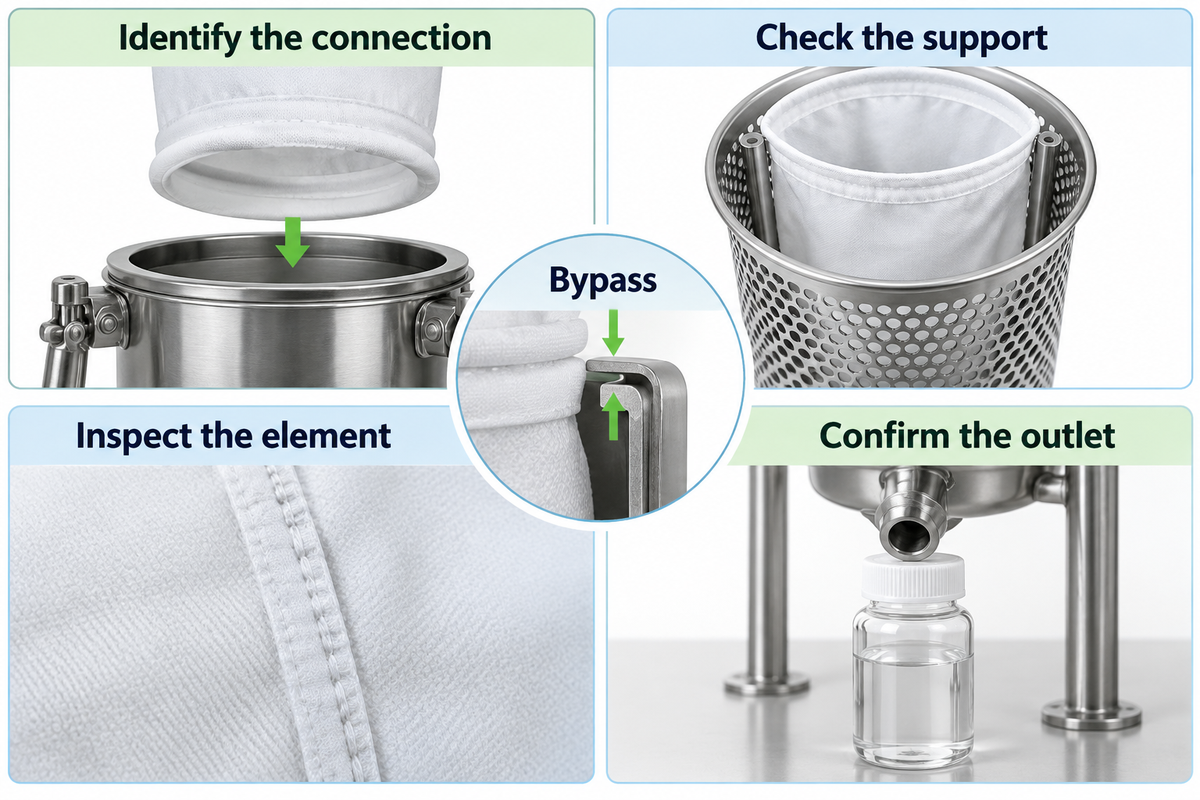
Liquid can bypass otherwise acceptable media if the collar fails to seat, a seam is damaged or the bag is inadequately supported. An appropriate design of the assembled flow path is as important as the textile. Persistent outlet particles require consideration of the support and connection arrangement rather than an automatic selection of a finer bag.
A size 2 designation is a first step to establishing a dimensional match. It doesn’t demonstrate that every ring profile or flange will seal in every nominally similar housing. A steel ring and a moulded plastic collar can need different seating arrangements. Forcing a near match can create a bypass that can’t be corrected with higher media efficiency.
- Identify the connection — match the bag drawing to the housing’s specified seating and seal arrangement.
- Check the support — inspect the basket and bag position using the equipment maker’s safe isolation procedure.
- Inspect the element — look for seam damage, collar distortion and handling damage before installation.
- Confirm the outlet — use the agreed sample method after installation and during the run.
Seal design has long been treated as its own engineering problem. US5840188A published in 1998 and assigned to Le Sac Corp, discloses a filter bag seal arrangement. The patent is historical evidence of that design problem; it is not an ECOFILTRONE invention or proof of any current bag’s performance. It isn’t ECOFILTRONE’s invention.
When a clean bag starts with poor outlet quality and little pressure loss, check the sample point and assembly before blaming solids loading. Look at the records to see if there were any recent events such as a restart or handling that may have also caused the outlet spikes. A bypass hypothesis becomes useful when the next check can distinguish it from media passage or contamination introduced downstream.
Read Differential Pressure Without Guessing Service Life
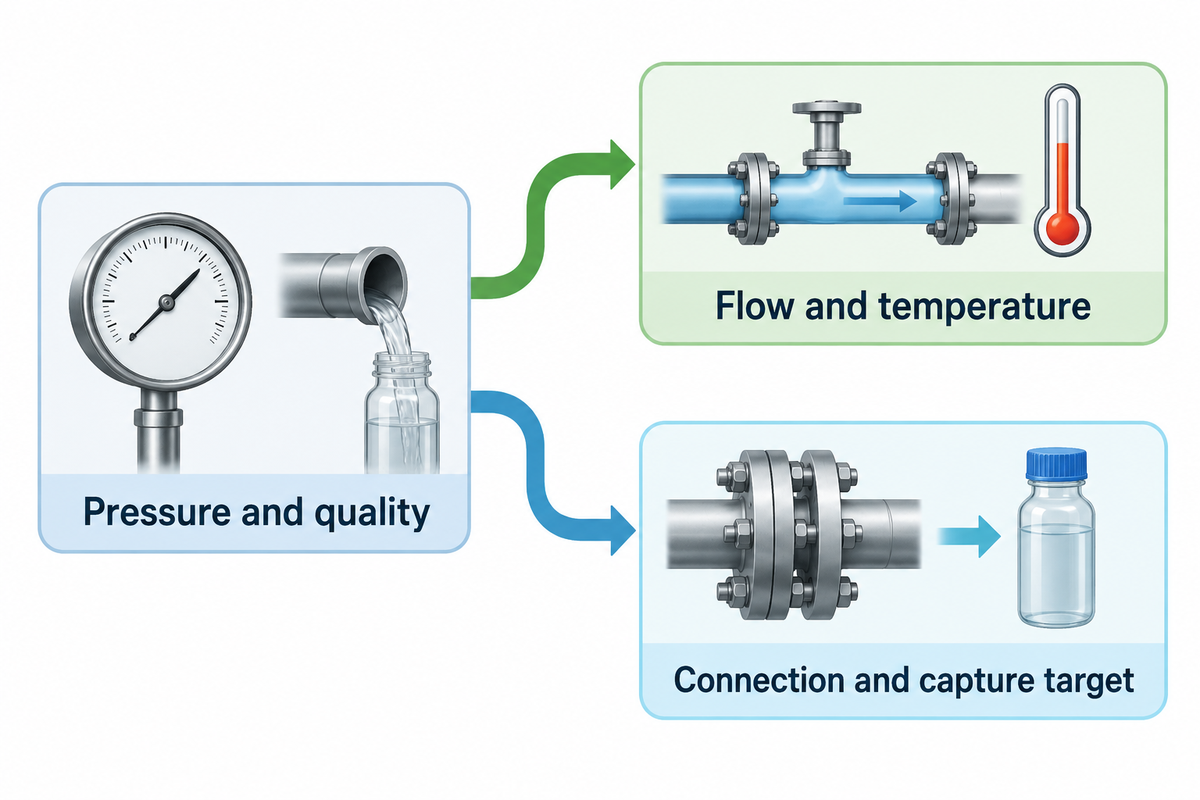
A differential pressure reading is taken across two pressure points. Flow, viscosity and temperature can change the reading even without additional retained solids. Pair a pressure trend with outlet quality and compare matched conditions before deciding whether loading, a process change or an assembly problem deserves the next inspection.
The introduction to ISO 3968:2017 explains the influence of flow and fluid properties on filter pressure loss. The focus of the book, however, is the hydraulic fluid power rather than liquid-bag life testing. The physical distinction still matters: readings across housing ports include resistance from the housing and element.
Pressure and Quality Diagnostic Map
The Pressure and Quality Diagnostic Map uses a pair of matched conditions to compare pressure observations with outlet results and decide on a next check as opposed to stating a cause.
| Observed pair | Candidate explanation | Next discriminating check |
|---|---|---|
| Pressure rises; quality passes | Solids accumulation | Compare inlet solids and accepted throughput |
| Pressure rises; quality fails | Loading plus passage or bypass | Compare particle sizes and inspect the isolated assembly |
| Pressure stays low; quality fails | Coarse retention or an unintended flow path | Check the rating basis and collar seating |
| Pressure falls abruptly; quality worsens | Flow change, damage or bypass | Check flow history, then inspect under isolation |
| Pressure rises after cooling; quality passes | Higher viscosity | Compare at the original temperature and flow |
| Pressure rises after a flow increase | Higher hydraulic resistance at higher throughput | Compare readings at the earlier flow |
| Quality spikes after restart | Release, bypass or downstream contamination | Take paired samples around the restart |
| Quality fails from a clean start | Unsuitable retention or installation | Check blank samples, connection and capture target |
| Pressure and quality appear unchanged | Stable duty or insensitive measurements | Check instrument response and sample resolution |
No continuous operation beyond the approved equipment limits is allowed. The end point for a changeout is determined by the quality requirements of the process as well as the instructions for the bag and housing. Pressure readings taken from another installation also can’t verify these requirements.
Keep inlet pressure, outlet pressure, flow, temperature and sample results on the same time line. This record lets downtime analysis be more reliable than a replacement date alone. For example, a short run after a solids surge gives a different answer from a short run under unchanged feed conditions.
Turn a Filter Bag Trial Into a Decision
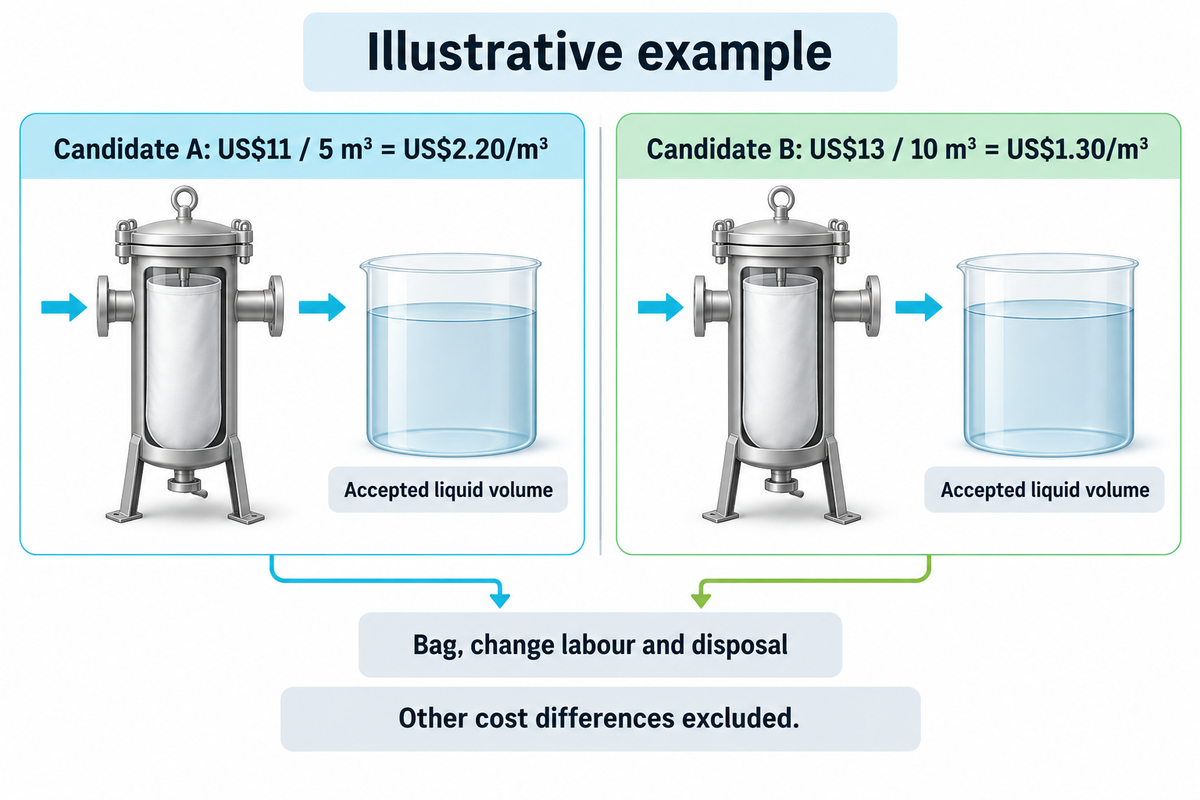
A useful filter-bag trial keeps recipe, flow and quality criteria constant, and then compares accepted throughput and cost structures of each run. Sample beginning, loaded, and intermediate conditions, and restart output. Repeat or alternate candidates across representative batches so an unusually clean feed batch does not decide the purchase.
Matched-Duty Trial Ledger
The Matched-Duty Trial Ledger records common operating conditions, downstream acceptance and included costs, so the liquid volume accepted by two candidates can be compared.
An example is shown below. These values are illustrative. The values are teaching assumptions, not ECOFILTRONE prices, trial results or guaranteed performance. Both runs use recipe R1. It’s assumed that the rinse recirculation endpoint is 0.70 bar. This value is only valid for runs performed inside an already qualified assembly. The assumed 0.70 bar endpoint is valid only inside an already qualified assembly envelope; it isn’t a general replacement recommendation.
Repeated and restart observations follow the measurement principle discussed in the NSF/EPA whole-system verification protocol; the protocol’s drinking-water requirements remain outside this illustrative industrial trial.
| Recorded field | Candidate A | Candidate B |
|---|---|---|
| Liquid recipe | Aqueous rinse R1 | Aqueous rinse R1 |
| Flow | 50 L/min | 50 L/min |
| Temperature | 25 °C | 25 °C |
| Labelled grade | 10 µm | 10 µm |
| Agreed outlet criterion | ≤100 particles/mL at ≥25 µm | ≤100 particles/mL at ≥25 µm |
| Sample states | Start, mid-run, endpoint, restart | Start, mid-run, endpoint, restart |
| Assumed pressure endpoint | 0.70 bar | 0.70 bar |
| Accepted run time | 100 min | 200 min |
| Accepted liquid volume | 5 m³ | 10 m³ |
| Bag cost | US$4 | US$6 |
| Change labour | US$6 | US$6 |
| Disposal | US$1 | US$1 |
| Included run cost | US$11 | US$13 |
| Cost per accepted volume | US$2.20/m³ | US$1.30/m³ |
In this example, a buyer prefers candidate A because its bag costs US$4 rather than US$6. The production engineer includes US$6 of change labour and US$1 of disposal for each run. Candidate A therefore costs (4 + 6 + 1) ÷ 5 = US$2.20 per accepted cubic metre. Candidate B costs (6 + 6 + 1) ÷ 10 = US$1.30 per accepted cubic metre. At 50 L/min, the assumed volumes correspond to 100 and 200 minutes. Candidate B has the better result within this cost boundary. If 2 m³ of its output fails acceptance, however, its denominator becomes 8 m³ and the result rises to US$1.63/m³. Rejected output can’t remain in the accepted-volume total.
The example doesn’t cover equal energy, flushing, product loss and downtime costs. Add other differences consistently, without charging the same loss twice. For intermittent quality failures, define how sampled results determine acceptable volume before the trial; spot samples can’t reflect the quality of all other liters.
Can Polyester (PE) Felt Filter Bags Be Washed?
Washing polyester felt bags can remove visible deposits without restoring the original retention or mechanical condition. Reuse therefore requires a method of validated cleaning and an acceptance check for the entire bag. If cleaning changes the fiber network, seam or collar, a clean appearance cannot demonstrate that the bag still meets its intended filtration requirement.
To support a replacement review, provide the composition of the working fluid, a temperature profile, the target of particle, how the housing is connected and a trial history. ECOFILTRONE can assist in selection and replacement matching; the Polyester (PE) Felt Filter Bags solution page has the product configuration discussion.
Key takeaway
Judge a polyester felt bag by accepted liquid at the required quality, supported by matched operating conditions and a compatible assembly.
FAQ
What are filter bags made of?
Liquid filter bags can use polyester, polypropylene, nylon or other media selected for the duty.
The polymer name describes only part of the assembly. Felt and mesh made from different materials capture particles differently, while collars, thread and sealing parts may introduce additional materials. Identify each wetted component when reviewing chemical compatibility. A material declaration for the textile alone does not describe every surface that contacts the liquid inside the completed bag.
What are the main types of liquid filter bag?
Common liquid-bag constructions include felt depth media and woven surface-screening mesh.
Specialized constructions can add layers, different finishes or other media arrangements. Classify the bag by its capture mechanism as well as its polymer. A housing size describes fit requirements, while a micron grade describes a retention claim. Keeping those descriptions separate helps prevent a similarly named replacement from being treated as an equivalent assembly without relevant supporting evidence.
Which polyester filter cloth specifications matter for liquid filtration?
Relevant cloth specifications describe the polymer, construction, finish and tested retention under stated conditions.
Fabric weight and thickness can help identify a textile, but neither alone establishes outlet quality. Air-permeability data from a dry application cannot directly specify liquid pressure loss. Connect the cloth description to the finished bag’s seams and connection, then compare its retention and flow evidence with the intended liquid service before approving a substitute for the existing element.
Can polyester felt bags be recycled?
Recycling depends on the collected contaminant, mixed components and the receiving recycler’s acceptance rules.
A polyester material label does not make a used industrial bag acceptable to a recycling stream. Classify the retained solids and liquid first. Follow the applicable waste route for contaminated bags and confirm acceptance before separating collars or other components.
Does food-grade resin establish the suitability of the complete bag?
Food-grade resin alone does not establish the suitability of every component or the finished bag’s intended use.
The FDA chemistry guidance for food-contact substances connects an assessment with intended article types and conditions of use. For food processing, obtain documents covering the specified bag construction, food type, contact time and temperature, and any proposed repeated use. Check the actual document holder and product scope. A generic supplier statement or unrelated resin citation cannot fill gaps concerning thread, seams, collars or other wetted parts. Match the supplied declaration to the purchased part number and keep the intended cleaning exposure within its stated scope when repeated service is proposed.
Does a finer bag always give cleaner liquid?
A finer label can help only when the complete filter captures the relevant particles under the required duty.
Smaller nominal ratings can increase resistance or shorten a run without solving bypass, dissolved contamination or an unsuitable retention definition. Identify the failing outlet measurement first. Then test a different grade against that measurement while preserving the qualified hydraulic and assembly limits.
Is polyester felt a membrane filter?
Conventional polyester needle felt is a fibrous depth medium rather than a membrane.
A description such as polyester felt liquid filter identifies a different construction from a specified membrane element. Membrane assemblies may be chosen for more tightly defined downstream retention tasks, but the precise rating and validation still matter. Check whether an element contains an added membrane layer before inferring its structure from a product name. Where the process needs validated microbial retention, assess a suitable complete treatment system rather than assuming ordinary felt provides that function. The upstream solids load may still justify a bag as a prefilter, provided the downstream system retains its required protection.
References & Sources
- ASTM D543-21: public scope and significance of chemical-resistance testing
- ISO 175:2010: effects of immersion in liquid chemicals
- ISO 3968:2017: pressure loss and fluid conditions in hydraulic filtration
- NSF/EPA treatment-system physical-removal verification protocol
- Water Technology: filter bag mechanisms and construction
- US5840188A: historical flanged filter-bag seal design
- FDA: food-contact substance chemistry guidance
Related Articles
Review your liquid filtration duty
ECOFILTRONE™ is an industrial filtration products supplier with engineering support for selection, replacement matching and customized requirements. Share the liquid, operating profile, housing details and outlet target with our liquid filter bag support team.