Get in touch with ECOFILTRONE™ Company



Updated October 2026
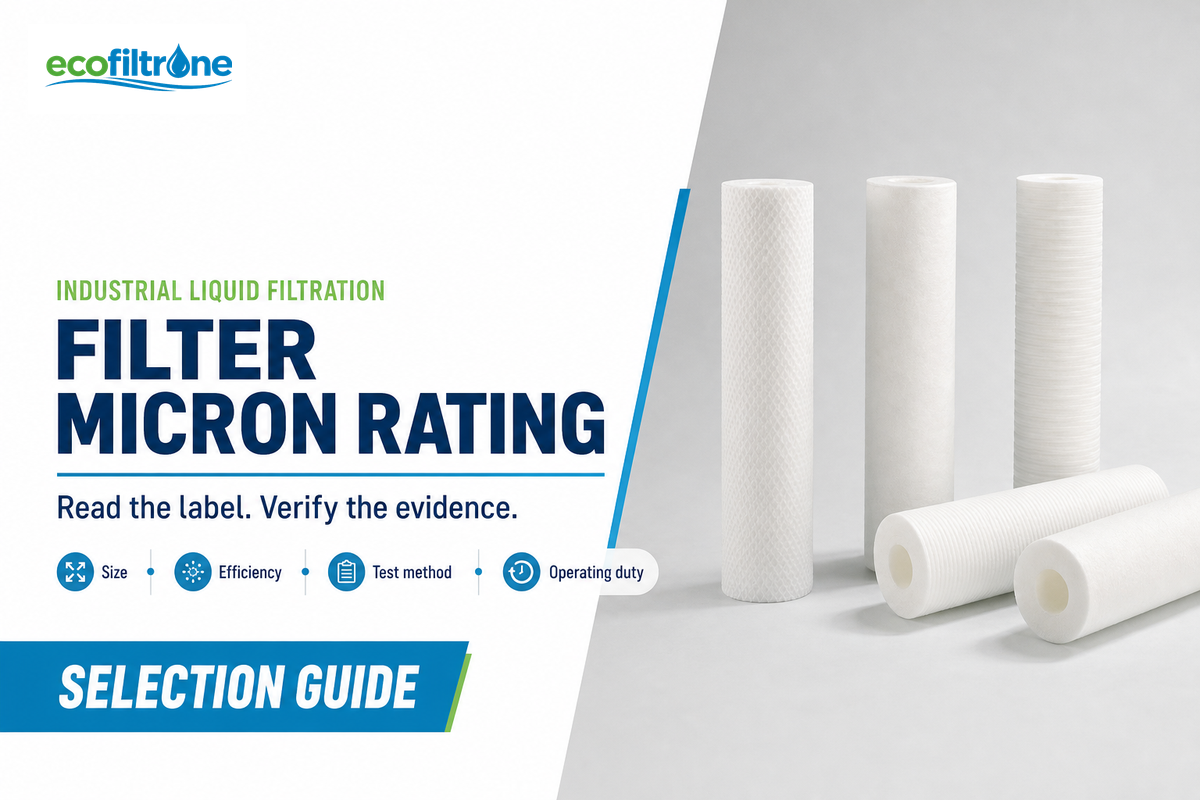
A filter micron rating helps identify a filtration requirement; however, the number on the label won’t settle a replacement purchase. A 5 micron element may have a different retention basis from another 5 micron element, even when they occupy the same housing.
Quick Specs: what to put beside the micron number
- Size
- State the threshold in µm and its measurement basis.
- Efficiency
- Request numerical retention at that size.
- Test
- Identify the method, fluid and operating conditions.
- Fit
- Confirm the exact model, seal and housing interface.
- Acceptance
- Agree the downstream limit and trial endpoint.
Filter micron rating describes a stated particle-size threshold. Compare that size with retention efficiency, test conditions and the exact element. A smaller number alone can’t establish service life, chemical removal or validated sterile filtration.
Before you compare quotations
- Equal micron labels can hide unequal efficiency evidence.
- Nominal and absolute descriptions need a numerical definition.
- Particle-count calculations require comparable sampling.
- Choose the grade against the downstream process, then test operating cost.
For an industrial water treatment or process-liquid filtration system, the pertinent question is how the element performs in the specified duty. This guide connects the size label to an evidence request, a particle-count calculation and a cost comparison using accepted filtrate volume.
What does filter micron rating mean?
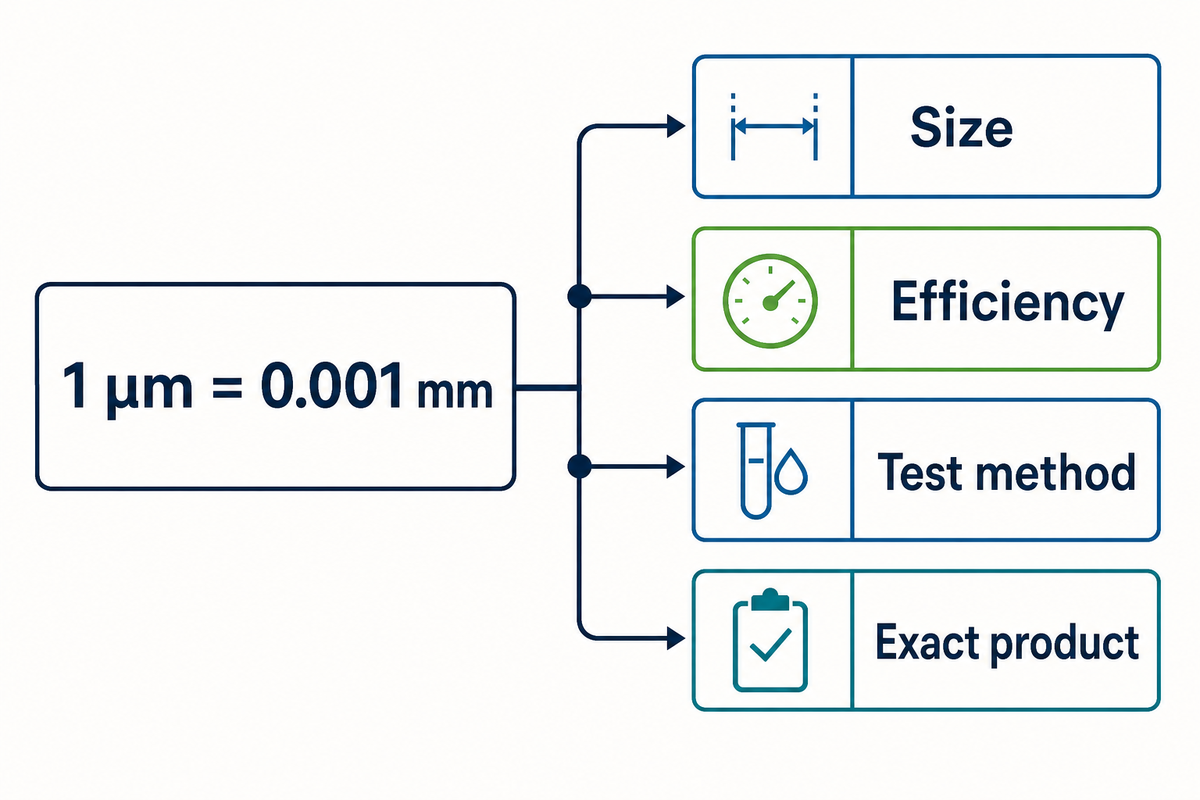
A filter micron rating identifies a particle size threshold that describes an element’s retention. A micron rating tells buyers where to start when comparing products. It won’t necessarily provide all the information about what the filter stops or every contaminant left downstream.
A micron is one-millionth of a meter. In NIST’s SI prefix table, micro is defined as 10-6; therefore one micron is 0.001 mm. The symbol is µm and “micron” is the common purchasing term for micrometre.
Size and performance are separate fields. Write “5 µm, retention ___%, tested by ___” rather than accepting a bare “5 µm” description.
The particle size being counted isn’t necessarily the physical pore size of every opening. A depth filter can trap particulate matter in a media structure, whereas a membrane can be described by a nominal pore dimension. Ask the supplier for the rating definition for that construction.
What does a 5 micron filter mean?
The label describes a 5 micron filter product at a particle threshold of 5 µm. However, the label doesn’t indicate what percentage is retained there. When specifying requirements, the buyer needs to know whether the claim is nominal or absolute, what method was used to determine the claim, and whether the results apply to the exact cartridge being offered.
Particles vary widely in size and particle shape; if water carries a mixture of sand, silt and fine particles, a single micron size can’t represent the complete loading pattern. Request the size distribution or use a representative sample to define the trial.
A 5 µm designation locates a retention claim on the particle-size scale. Buyers still need the claim’s efficiency, measurement method and product identity. When the numerical efficiency is missing, hold the performance comparison open rather than assuming that every particle above 5 µm will be removed.
Nominal and absolute micron ratings: read the efficiency claim
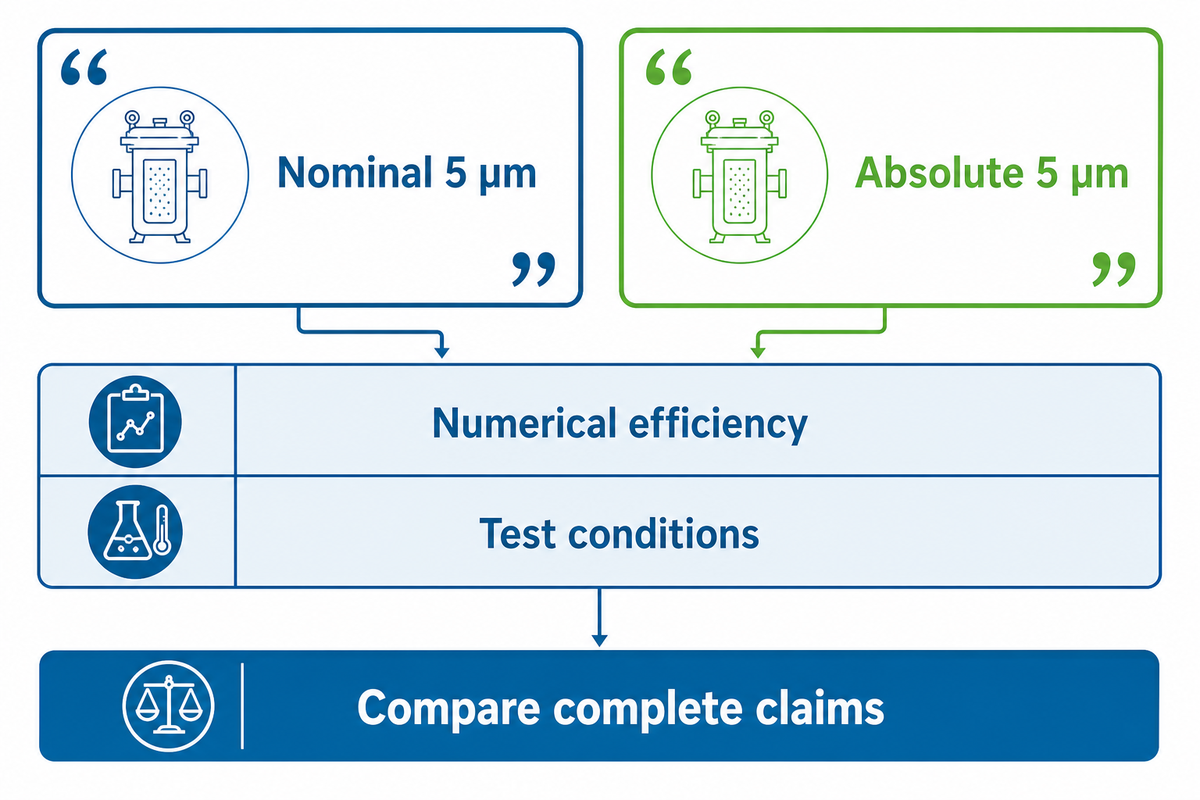
Nominal and absolute micron ratings describe differing retention claims, and their words alone don’t allow for a fair comparison. Request the numerical filtration efficiency at the stated size and applicable method. Neither a universal nominal percentage nor a guaranteed service life can be inferred from the label without the supplier’s definition.
What is the difference between nominal and absolute micron ratings?
A nominal micron rating indicates a stated retention claim that requires a definition of efficiency. An absolute micron rating, in general, is intended to show stronger retention under the defined test; however, an absolute rating requires the exact percentage, particle threshold and method. The test report defines the meaning of the description for that element.
Quotation check: If one offer says “nominal 5 µm” and another says “absolute 5 µm,” ask both suppliers for the measured efficiency and test conditions before comparing price.
Commercial ratings often use different terminology and reporting bases. A count-based percentage can’t be treated the same way as a mass-based percentage. A few large particles can contribute a significant mass, while a large number of small particles can contribute a very small mass. Hence, selecting the right filter takes into consideration the measurement to satisfy the downstream requirement.
For hydraulic-filter reports, ISO 16889:2022 defines a multipass performance method. Its stated hydraulic scope gives buyers a test context to check; it does not set a universal nominal or absolute percentage for every industrial-liquid element.
Let’s take an example of a plant that purchases replacement filter cartridges for a coating liquid. The current specification provides a size label, but the quality team rejects batches where a defined particle count increases. The procurement team receives an offer of a lower price for the same nominal rating and physical length, but with no count data. The procurement team first needs to assess the acceptance limit, request the evidence of retention for the offered model, and perform a trial with a representative liquid. A good physical fit resolves the installation. A good fit doesn’t always guarantee that the coating quality meets the requirement. The procurement team shouldn’t accept or reject the quote solely based on the wording. If the supplier can’t provide comparable retention evidence, classify the quotation as an unverified candidate.
Nominal and absolute micron descriptions need a numerical claim beside the size. At 5 µm, two elements can differ in performance, media and structure and the test conditions. Procurement should evaluate complete statements and reserve application approval for evidence that matches the installed duty and acceptance limit.
Beta ratio: calculate the particle passage budget
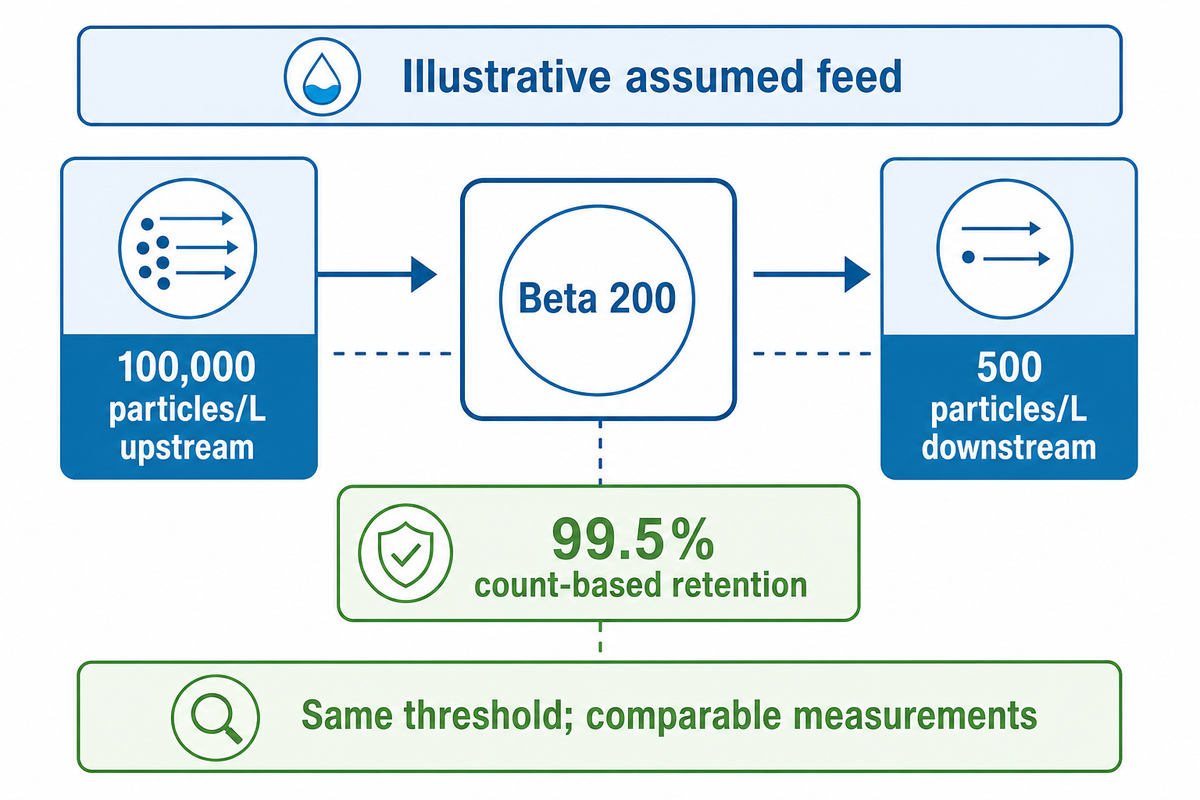
An example is given where a stated beta ratio is converted into a downstream concentration. Beta is upstream concentration divided by downstream concentration at the same particle threshold. Comparable particle-size measurements and normalized sample volumes are also required to perform the calculation. The arithmetic doesn’t mean the laboratory average is now a production acceptance limit.
ISO 16889:2022 specifies a multipass filtration-performance method for hydraulic fluid-power filter elements. Its scope is important: an industrial-water cartridge does not acquire hydraulic-test certification because a brochure mentions beta.
βx = upstream concentration ÷ downstream concentration
Retention (%) = (1 − 1/βx) × 100
The subscript x identifies the particle-size threshold. State concentration units and the calibration designation with it.
For illustration, let’s assume that similar samples contain 100,000 particles/L upstream at or above the stated threshold. Beta 200 implies 100,000 ÷ 200 = 500 particles/L downstream and 99.5% count-based retention. Beta 20 means 5,000 particles/L and 95% retention; Beta 1,000 means 100 particles/L and 99.9% retention. These calculated differences show why the efficiency claim matters alongside the micron label.
| Stated beta | Calculated retention | Calculated downstream concentration |
|---|---|---|
| 20 | 95% | 5,000 particles/L |
| 200 | 99.5% | 500 particles/L |
| 1,000 | 99.9% | 100 particles/L |
Source basis: count-ratio definition with arithmetic shown above. Illustrative assumed feed concentration is used to demonstrate this calculation.
An explanation of µm(c) and µm(b) report designations in particle counts and beta data is found in ISO/TR 22681:2019. NIST’s research on particle concentration also includes information on volume calibration and counting biases. Record the calibration, sampled volume, dilution and counting method prior to combining results.
- QA: specify the particle threshold and concentration units.
- Laboratory: document sizing, calibration and sampling comparability.
- Plant team: record flow and loading history during the trial.
- Buyer: agree the acceptance limit separately from the illustrative calculation.
At an assumed 100,000 particles/L upstream, beta 200 equals 500 particles/L downstream. This requires the same size threshold and comparable concentration measurements. The equation describes retention; it can’t establish a maximum production particle count without adequate measurements and an acceptance protocol specific to the application.
A micron filter chart for industrial liquid duties
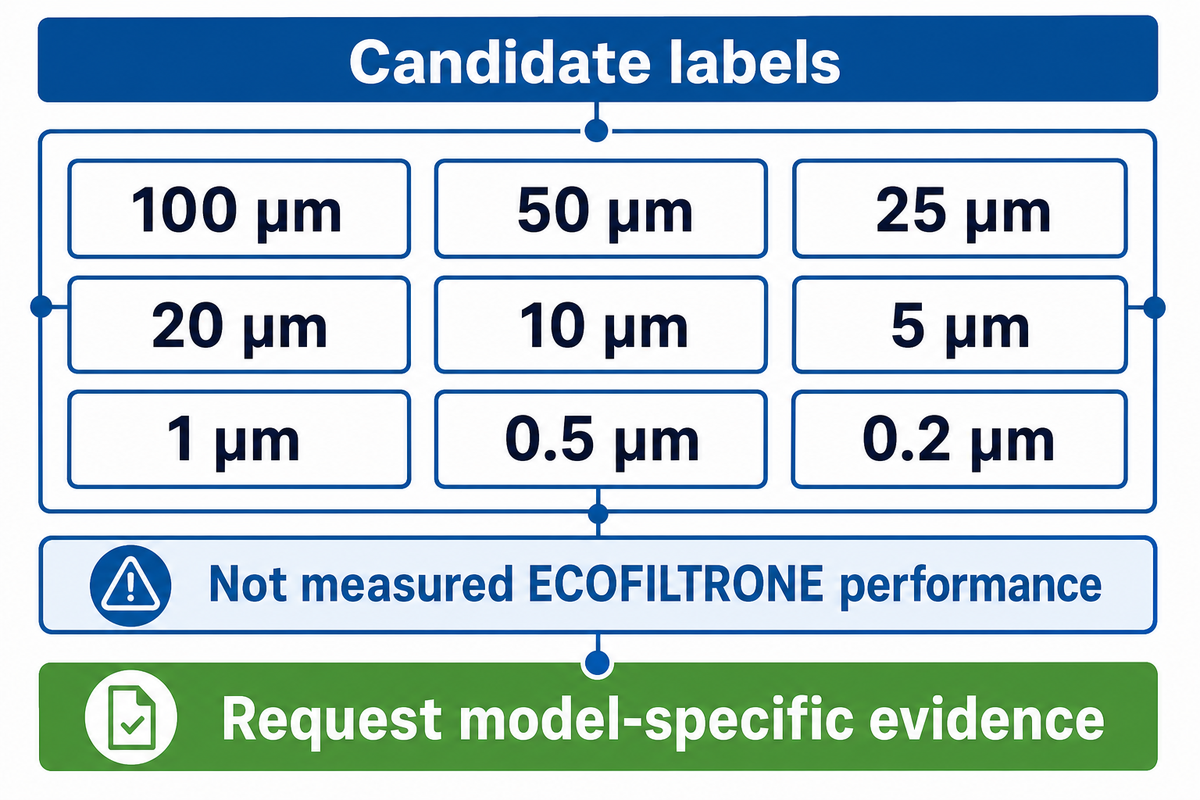
A micron filter chart is helpful for organizing trial candidates, as long as it doesn’t assign universal contaminant removal to each number. Start with the size of the particles that matter downstream, then compare efficiency, construction and operating limits. The chart below asks what evidence is needed rather than prescribing a grade for every liquid.
| Candidate label | Selection question | Evidence to request |
|---|---|---|
| 100 µm | Is a coarse solids stage sufficient for this duty? | Feed distribution and downstream tolerance |
| 50 µm | Which coarse fraction must be reduced? | Retention at the relevant threshold |
| 25 µm | Does this candidate meet the installed specification? | Exact model and rating definition |
| 20 µm | Is the required outlet quality achieved? | Representative-liquid trial results |
| 10 µm | Are the critical particles captured efficiently? | Numerical efficiency and counting basis |
| 5 µm | Does the downstream equipment require this threshold? | Equipment requirement and grade-specific data |
| 1 µm | Does tighter retention justify the hydraulic demand? | Outlet quality, flow and pressure measurements |
| 0.5 micron (0.5 µm) | Is the construction suitable for the fine-particle duty? | Media, compatibility and model-level performance |
| 0.2 µm | Is a validated membrane barrier required? | Specified challenge test and process validation |
This size chart is a selection framework. Values are candidate labels and don’t represent measured ECOFILTRONE removal results. This also doesn’t imply that all listed grades are available to all product families.
Public melt-blown PP and ECG and ECNL (PA6) product information is offered in the ECOFILTRONE catalogue. This is product information provided by the supplier and doesn’t represent independent retention data. Melt-blown depth cartridges, PP pleated retention classes and PP felt liquid filter bags should be assessed against their own specifications. Filter media and construction change the selection path. Melt-blown depth cartridges, PP pleated retention classes and PP felt liquid filter bags are alternatives.
A 2020 mulberry-wine study compared PES and PVDF membranes with 0.22 and 0.45 µm nominal pores under controlled conditions. With larger pores, early flux increased; however, much of the advantage was lost as fouling occurred. The result is specific to the studied membranes and wine. It supports the need to test for sustained throughput and isn’t a general micron filter size recommendation.
Buyer boundary: A request to “remove particles as small as 10 microns” still needs an efficiency target. Different micron sizes are trial candidates; they are not interchangeable proof of clean output.
A 1 µm candidate requires the same evidence discipline as a 50 µm candidate: defined retention, compatible construction and satisfactory outlet quality under the intended duty. A chart can narrow the inquiry, but choosing the appropriate micron rating still requires the process requirement and representative operating evidence.
1 micron versus 5 micron: decide from the process
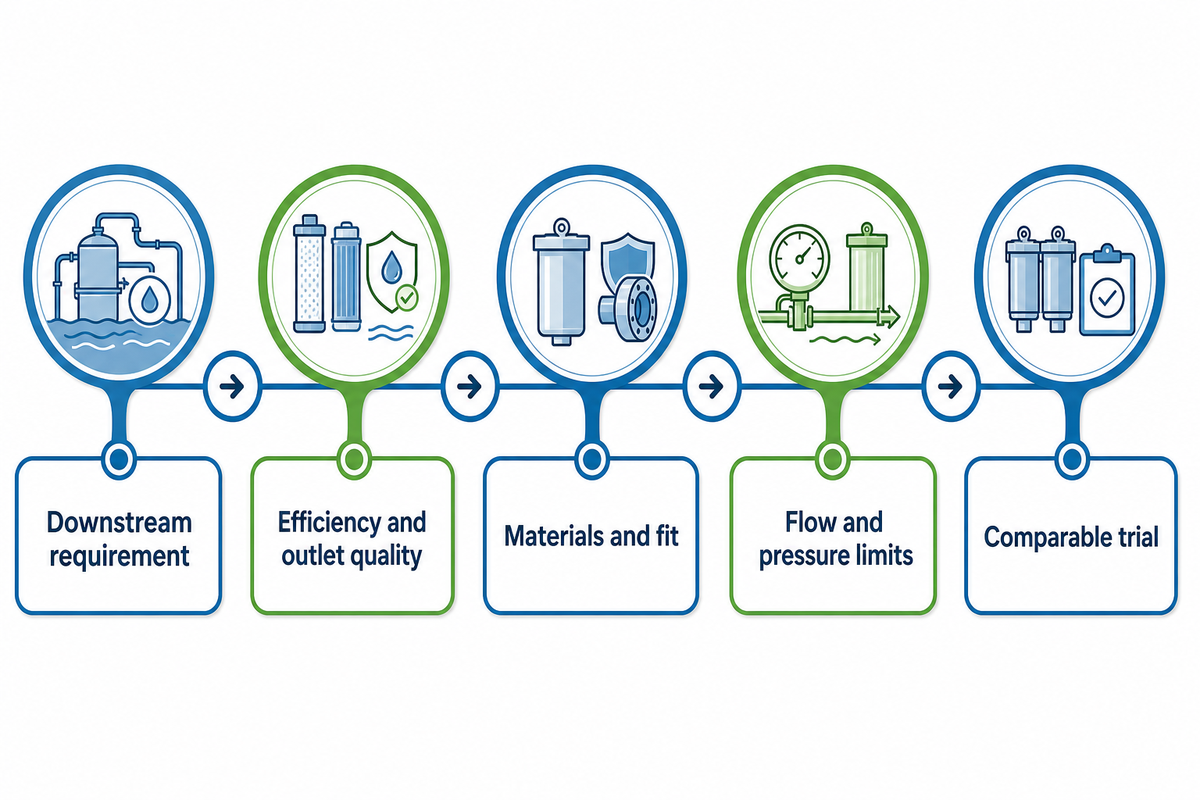
A 1 micron element is the more appropriate candidate when the demand downstream requires proven finer retention and the system can meet its demand. A 5 micron element can be sufficient to meet the acceptance criteria. The lower micron number alone isn’t in a position to decide which option is better for industrial service.
A practical selection sequence
- Obtain the downstream equipment’s particle-control requirement.
- Define the required efficiency and outlet-quality measurement.
- Check media, seals, dimensions and fluid compatibility.
- Compare normal and peak flow, clean pressure loss and the permitted endpoint.
- Trial the suitable candidates under comparable conditions.
For industrial RO pretreatment, be sure the cartridges meet the requirements of the membrane system. Also look at upstream treatment. Repeated clogging during sediment excursions can be a sign of an upstream problem, and changing the final filter to a finer grade may not solve the problem.
At an illustrative reuse water plant, the engineer is looking at filters with different micron ratings after variable performance of clarification. A candidate 1-micron filter and a 5-micron filter must be compared against the required outlet criteria, not just at identical housing flow. Trial records should include feed condition, accepted output, and pressure rise, and an upset if it’s representative and safely allowed. If both candidates pass the outlet requirement, compare run cost and usable throughput. If only the tighter candidate passes, verify that the housing and pump can operate within the approved limits. A third option is to improve upstream solids control.
Proper micron rating is an application decision. String-wound cartridge constructions require yarn and core review; changing grade doesn’t resolve an incompatible material or sealing interface.
A 1 µm versus 5 µm comparison starts with the downstream acceptance requirement. If both candidates pass a representative trial, evaluate accepted volume and operating demand. If one doesn’t pass the requirement, its lower purchase price doesn’t make it an equivalent replacement.
Pressure drop and service life: measure the trade-off
Pressure drop and service life depend on the liquid, loading, media area and operating history and on the micron rating. Compare the performance of a filter using representative conditions and mutually agreed changeout criteria. A single pressure reading or a smaller micron rating can’t demonstrate how long an element will be useful at the flow rate.
Why does a low-micron filter clog faster?
Comparing flow and pressure, area and viscosity of the process liquid helps assess why a finer filter can clog faster when it retains more incoming solids or higher resistance to flow develops in the media. This is conditional rather than absolute. A better comparison would evaluate outlet quality alongside contaminant loading conditions, available area and the micron rating.
In Li and colleagues’ 2019 pressure-filtration work, flow is compared to pressure as affected by area, viscosity of the process liquid and resistance of the media and cake. The viscosity comparison is a model prediction supported by glass-bead and water tests, rather than a cartridge-life test. Therefore, a water only flow curve needs interpretation for other process liquids.
Common measurement mistake: An inlet gauge alone does not measure filter differential pressure. Record upstream and downstream pressure at the same operating point, with consistent gauge locations.
Operators should document viscosity at operating temperature, normal and peak flow rate, pressure history and the reason for changeout. An operating run can end due to unacceptable output, insufficient flow, model-specific pressure limit or routine maintenance. Use the approved element and housing limits. There’s no universal pressure endpoint that can be inserted in all specifications.
Cost per Accepted Cubic Metre
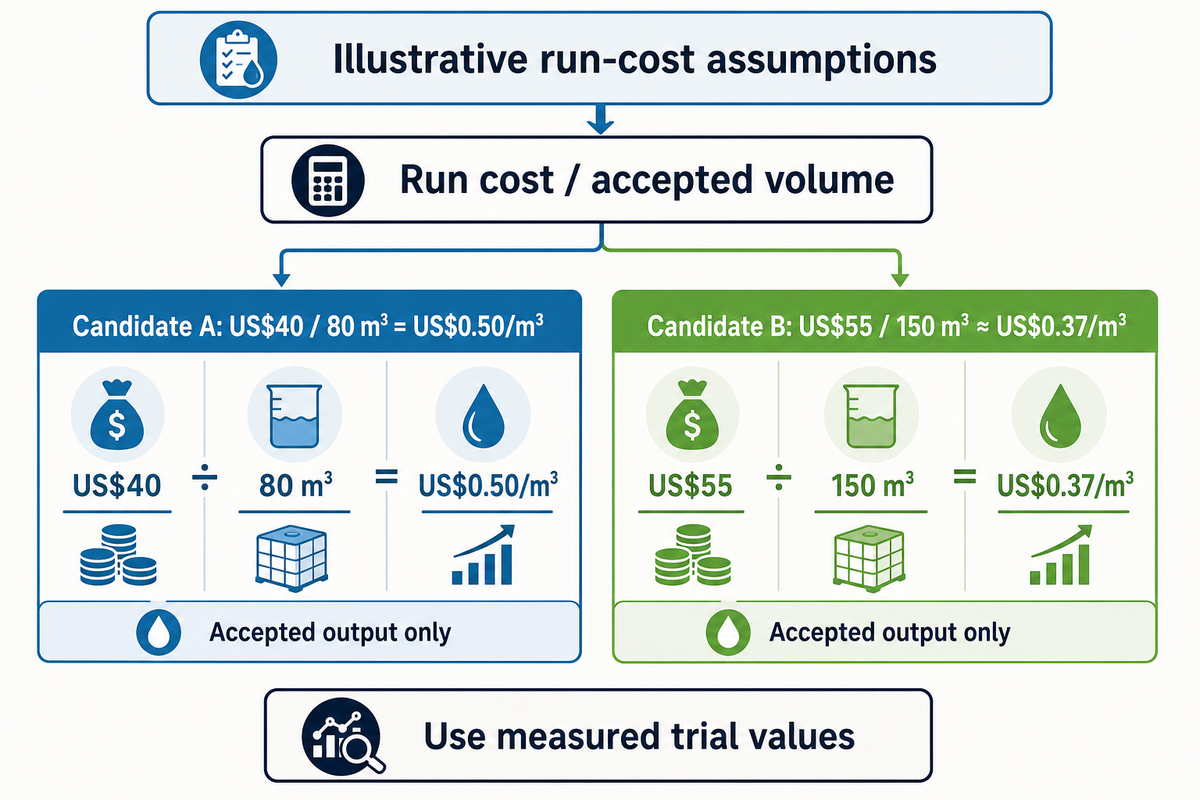
Run cost ÷ accepted filtrate volume = cost per accepted m³. Include element purchase, attributable labor, disposal, energy and downtime costs when measured. Exclude off-spec filtrate from the denominator.
Assume, only for illustration, candidate A costs US$30 plus US$10 attributable changeout cost and delivers 80 m³ accepted output. Its cost is US$40 ÷ 80 m³ = US$0.50/m³. Candidate B costs US$45 plus US$10 and delivers 150 m³: US$55 ÷ 150 m³ ≈ US$0.37/m³. The higher-priced element is cheaper per accepted volume under these assumptions.
Trial measurements will determine if that comparison is applicable. Claims that staging “extends filter life” require an observed improvement in run length and the same acceptance basis. Verify how the filter handles peak duty prior to selecting a fine filter with an attractive clean-water curve.
An illustrative US$55 run producing 150 m³ of accepted filtrate costs about US$0.37/m³. In order to evaluate that cost in finance, measured run costs and accepted volume are required. Equal micron labels, different feed conditions or omitted off-spec output make a quoted service-life comparison unsuitable for a purchasing decision.
Compare replacement quotations on the same evidence
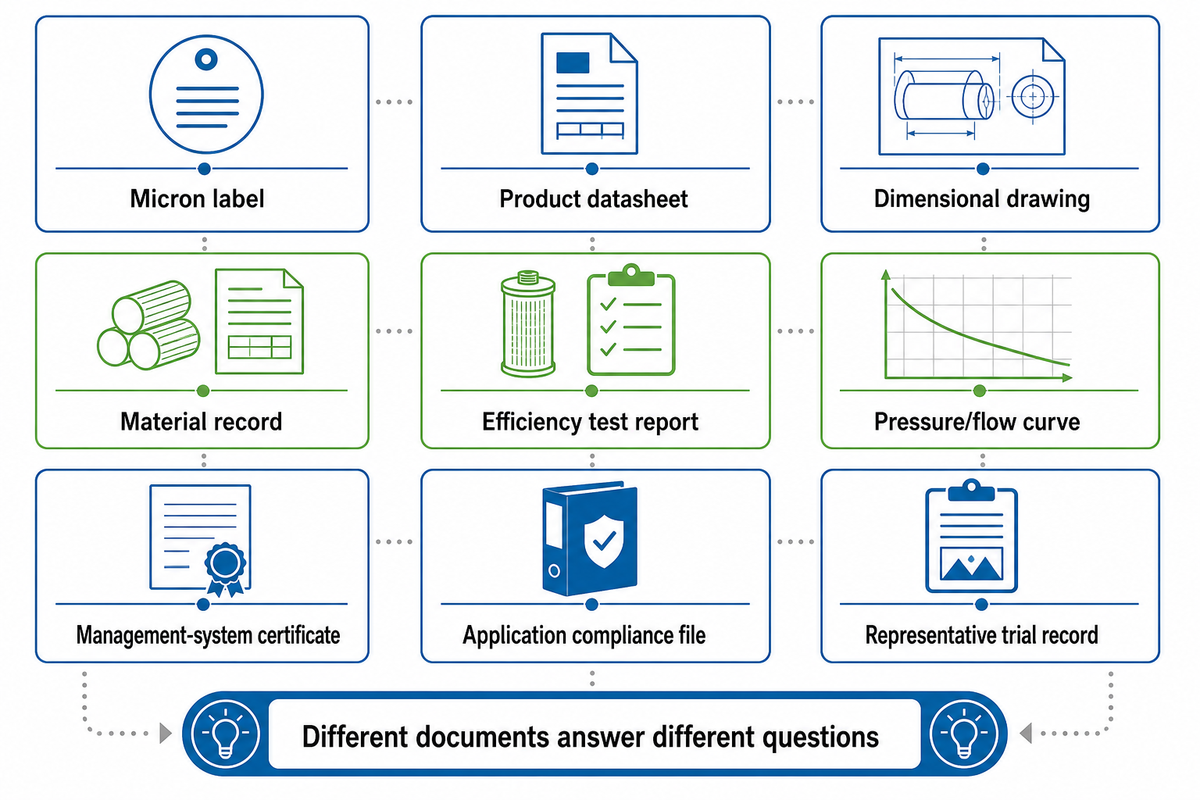
Replacement quotations are comparable if product identity, housing fit, retention evidence and operating conditions are aligned. Ask for the exact offered construction and its documented limits, then separate a dimensional candidate from an approved application match. The right micron rating is one part of the replacement specification, alongside materials and the installed duty.
| Evidence type | What it establishes | Remaining buyer check |
|---|---|---|
| Micron label | A stated size designation | Numerical retention and definition |
| Product datasheet | Offered construction and published limits | Exact model and revision |
| Dimensional drawing | Geometry and interfaces | Installed housing and seal fit |
| Material record | Documented material identity | Liquid, temperature and exposure compatibility |
| Efficiency test report | Reported retention under specified conditions | Method, calibration, model and duty relevance |
| Pressure/flow curve | Hydraulic behavior under the reported conditions | Fluid viscosity and available area |
| Management-system certificate | Named holder and stated system scope | Validity, edition and facility coverage |
| Application compliance file | Stated product/application coverage | Destination and intended-use requirements |
| Representative trial record | Observed performance in the defined trial | Acceptance criteria and representativeness |
This is a framework for procurement evidence, not an accreditation process ranking. A stronger document for one question may not answer another; process qualification is treated independently where it’s required.
A high-flow cartridge cross-reference review can identify a candidate family. The brand names of the referenced products don’t imply endorsement, authorization or equivalence. Non-standard geometry should be covered by a custom cartridge specification review.
RFQ checklist: copy these fields into the request.
| Parameter | Recommended range | Why it matters | How to verify |
|---|---|---|---|
| Particle requirement | Required µm threshold and retention % | Defines the removal claim | Method and model-bound report |
| Hydraulic duty | Normal/peak m³/h; clean and terminal ΔP in bar | Defines usable flow and endpoints | Trial and approved limits |
| Liquid condition | Composition; operating °C; viscosity in mPa·s | Checks resistance and compatibility | Fluid data and material review |
| Housing fit | Dimensions in mm/in; end type and seal | Prevents bypass or poor seating | Drawing and fit confirmation |
| Loading | Particle distribution; solids in mg/L where measured | Defines representative feed | Sampling record |
| Acceptance | Outlet criterion; accepted m³; changeout reason | Connects quality with cost | Agreed trial protocol |
| Documents | Required scope, holder, model and revision | Prevents unsupported qualification | Current exact documents |
Which documents apply to the exact filter and certificate holder?
The documents only apply to the product, organization, facility and application that they specifically identify. Check the model mapping, issuing body, holder, validity and revision before utilizing a certificate or report as procurement evidence. A management system certificate doesn’t ensure the filtration efficiency of supplied cartridges.
ECOFILTRONE™ is a Qingdao-based industrial filtration products supplier with engineering support. The pre-sales work includes application review and specification verification, replacement match and sample/trial support. During an order, the team coordinates technical confirmation, documents, inspection and shipping; after-sales support includes compatibility questions, pressure and service-life analysis, and troubleshooting.
Procurement boundary: Request the actual certificate and model-specific documents needed for the destination and duty. No blanket product certification, efficiency, lifetime or patent claim is made by this guide.
What a micron label cannot prove
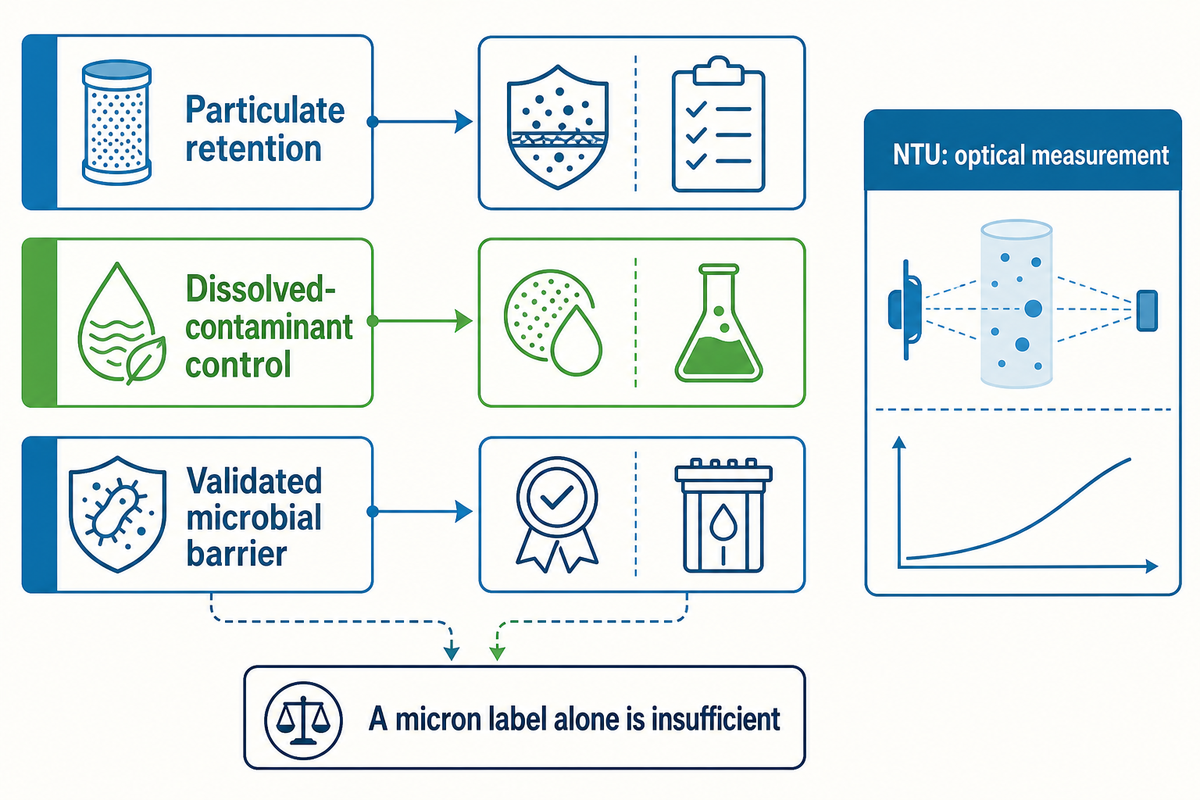
A micron label doesn’t establish dissolved-contaminant reduction, drinking water suitability or validated sterile filtration. Reduction of dissolved contaminant or drinking water suitability is based on treatment mechanisms and supporting product/process evidence. A micron rating may support a size-related claim. The filter’s micron rating can’t replace a certification check, a chemical analysis or a validated microbial retention requirement.
“For the purpose of product sterility assurance, additional process-specific studies should be performed.”
The public scope of the ASTM standard explains why application-specific validation is required. Alone, a 0.2 µm label does not indicate a validated barrier for a product and process.
The US EPA’s PFAS filter guidance distinguishes technologies such as activated carbon, ion exchange and reverse osmosis, and directs readers to exact contaminant-reduction certification. The source is focused on drinking-water products; it isn’t a certification for an industrial liquid filter or a rule that’s automatically applicable in every export market.
Turbidity is a different measurement. USGS describes turbidity in NTU using optical scattering. A turbidity value does not supply a universal conversion to µm or identify a particular particle distribution.
For process liquids, identify the target particulate, dissolved substance or biological requirement first. A cartridge filter intended to remove sediment can be useful while leaving a separate treatment problem unresolved. Ask what the filter is designed to demonstrate and which acceptance measurement verifies it.
A 0.2 µm label can’t replace process validation for a microbial barrier. Retention testing must match the product and duty, while dissolved-contaminant control requires the appropriate treatment evidence. Clear filtrate and low NTU readings answer different questions from model-specific particle retention or validated biological performance.
What is changing in filtration evidence?
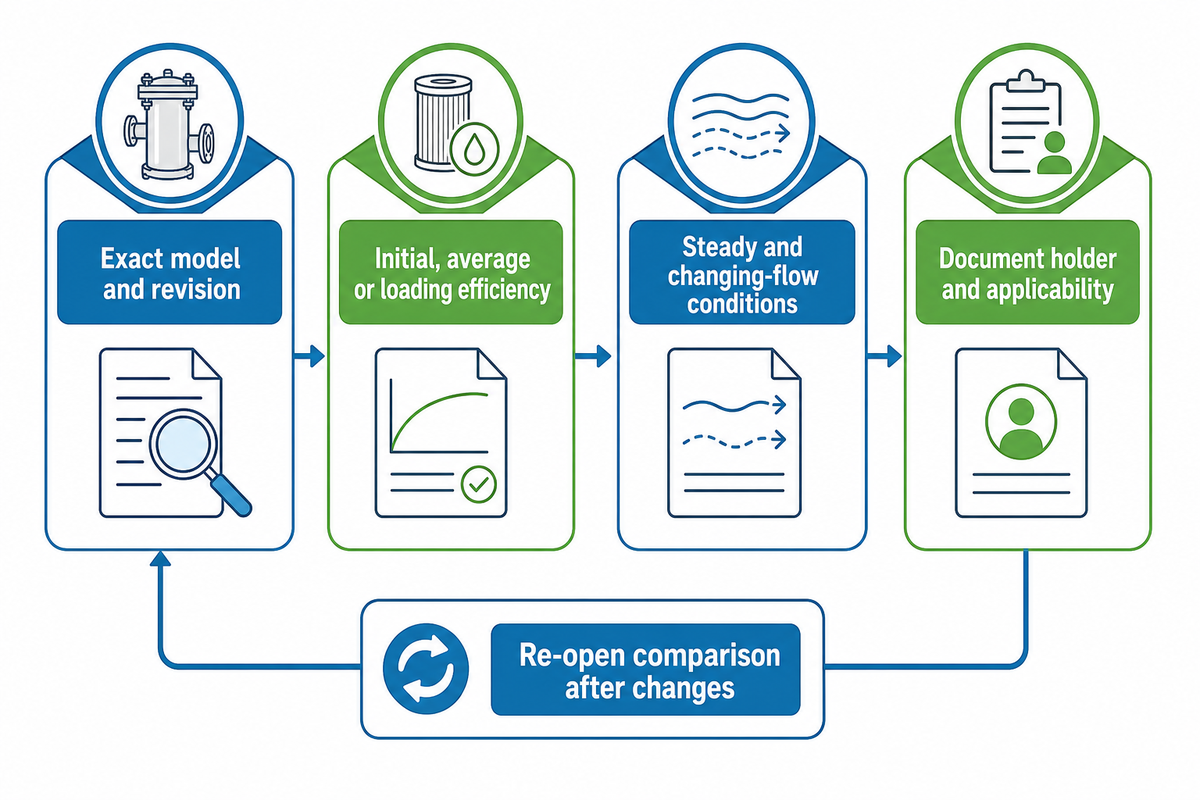
Current document editions are a purchasing issue because a dated certificate, test method and catalogue statement can refer to different scopes. Confirm the model supported by the edition of the document you’re examining. A standards update changes the evidence questions to ask; it does not automatically change a cartridge’s micron rating or certify the supplier.
As checked in October 2026, ISO’s official catalogue lists ISO 9001:2026, edition 6, published in September 2026. Buyers should ask which edition and holder appear on the actual certificate supplied. The catalogue entry does not establish ECOFILTRONE’s certification edition, transition position or product coverage.
Testing scope also matters when operating conditions change. ISO 23369:2022 specifically covers hydraulic-filter multipass testing under cyclic flow. Its existence distinguishes a changing flow history from a single steady-flow value; it does not mean the standard is mandatory for every industrial-water filter.
- Confirm the exact model and construction revision in the quotation.
- Ask whether efficiency is initial, average or reported over loading.
- Record steady and changing-flow conditions where relevant.
- Check the current document’s holder and applicability before approval.
Keeping this evidence with purchase records for a multiple plant replacement program helps prevent a later purchase from inheriting an unsupported equivalence assumption. If a construction, seal or media is changed, re-open the comparison, rather than relying on a prior part number match.
ECOFILTRONE focuses on the development of the Middle East, Southeast Asia, North Africa, South Asia and Latin America markets, promoting long-term, B2B supply relationships. Document requirements vary with product, application and destination. This document doesn’t represent local approvals, branches or performance guarantees in those markets.
Next purchasing action: Attach the operating-condition sheet and current reference drawing to the inquiry. Specify the required retention evidence and the acceptance test before agreeing that a replacement is equivalent.
Frequently asked questions
Is a 20 micron filter good?
A 20 micron filter is suitable when its verified retention and operating performance meet the intended process requirement.
Compare the required outlet quality with the offered model’s efficiency at the relevant threshold. A coarse-solids duty and a fine-particle duty can need different evidence, even with the same water source. The right filter must also match materials, available flow and housing fit. A 20 µm label alone doesn’t establish potable-water suitability or an adequate microbial barrier.
What does a 50 micron filter remove?
A 50 micron filter can reduce particulate material according to its stated retention efficiency; the number alone does not define complete removal.
Request the size distribution of the feed and the model’s retention definition before assigning a contaminant-removal claim. The size of particles matters, but shape, construction and operating conditions also affect the comparison. Dissolved salts and other dissolved substances need separate treatment evidence. A larger sediment particle may be retained without making the filtered liquid suitable for its final intended use.
What is the difference between 10 and 25 micron hydraulic filters?
10 and 25 micron hydraulic filters state different particle thresholds, but their beta data and operating limits determine the useful comparison.
Match the equipment’s cleanliness requirement, then compare efficiency at the relevant size using consistent calibration designations and test conditions. A filter described as retaining particles as small as 10 microns still needs its numerical retention claim. Confirm oil compatibility, flow history and approved pressure limits. Selecting a filter solely from the smaller number can overlook both insufficient retention evidence and unsuitable hydraulic performance.
Is a 1 micron filter better than a 5 micron filter?
A 1 micron filter is better only when its finer verified retention is needed and its operating demand is acceptable.
If a 5 micron candidate already meets the downstream requirement, compare accepted output and run cost before lowering the grade. Smaller micron ratings can be useful, but one filter can’t be judged independently of its media, area, feed loading and acceptance criterion.
How many microns should your water filter be?
The appropriate micron rating for your water filter depends on the target particles, downstream requirement and verified treatment duty.
Begin with water quality and the size of the critical particles rather than searching for a universal best micron value. Well water, municipal water and process water can contain different solids and can vary over time. The proper micron choice for a sediment stage may be insufficient for a separate water purification objective.
Ask for efficiency and representative operating data when comparing various micron ratings. A fine micron rating doesn’t automatically establish drinking water safety. Industrial systems also need material compatibility, hydraulic limits and the installed equipment’s acceptance requirement. Choosing the appropriate micron grade is therefore a system decision: select the right micron rating against a defined task, then confirm it with evidence. If the required claim concerns a dissolved contaminant or microbial barrier, request the corresponding treatment or validation documents instead of treating the water filter cartridge label as proof.
Does a 10 micron filter remove bacteria and viruses?
A 10 micron label does not establish validated removal of bacteria or viruses.
Microbial-retention claims need the appropriate tested product and process evidence. The particle rating means only what the stated efficiency and method support. Review the intended biological requirement and applicable validation with qualified technical personnel rather than assuming that a sediment-filter label demonstrates a safe microbial barrier.
Prepare a replacement filtration inquiry
Send the installed model, housing drawing, liquid conditions and required outlet quality. ECOFILTRONE™ can review filter selection, specification matching and trial requirements for an appropriate filter configuration.
Scope of this guide
The comparisons use public technical sources and transparent illustrative arithmetic. No private plant trial, certified cartridge efficiency or fixed service life is represented. Supplier-owned product descriptions establish the stated catalogue scope; certification and compliance documents require verification for the exact product and actual holder.
Technical References & Sources
- NIST Guide to the SI: units and prefixes – micro prefix and length unit basis.
- ISO 16889:2022: hydraulic-filter multipass test scope public abstract, not the licensed full standard.
- ISO/TR 22681:2019: particle-size reporting designations public abstract on µm(c), µm(b) and beta data.
- Ripple and DeRose, 2018: particle-concentration measurement – sampling volume and counting bias.
- Xiong et al., 2020: mulberry-wine microfiltration and fouling – process specific experiments; beverage company authors are included.
- Li et al., 2019: pressure-filtration experiments and modeling – glass bead/water validation and modeled viscosity effects; Sunovion Pharmaceuticals authors and funding are disclosed by the paper.
- ASTM F838-20: bacterial-retention test scope – public test scope and validation.
- US EPA: checking certified PFAS-reduction filters – treatment and product certification.
- USGS: turbidity and water – optical measurement and NTU.
- ISO 9001:2026: official catalogue entry quality-management scope and published edition; no supplier certificate inferred.
- ISO 23369:2022: cyclic-flow hydraulic-filter testing public test scope.