Get in touch with ECOFILTRONE™ Company


ISO Certified
RO Pretreatment Cartridge Filtration
RO pretreatment cartridge filtration is the final barrier in a particulate control system, but its effectiveness begins long before a micron rating is chosen.
ECOFILTRONE™ reviews feedwater, upstream treatment, design flow, housing geometry, sealing interface, flow direction, operating temperature, chemistry and differential-pressure history before making a configuration recommendation.
- Inquiry response within 24 hours
- Replacement matching and drawing review
- Sample and trial support
- Custom cartridge designs available
Request an RO Cartridge Selection Review
Industrial scope: Use this page for industrial RO plants, SWRO systems, industrial water treatment, wastewater reuse, power generation and process-water applications. It is not a residential RO pre filter catalogue.
Response
We respond to enquiries within 24 hours.
Stocked Items
Standard stocked items can be prepared in 4–5 days.
Custom Sample
Custom samples can be prepared in 7 days.
Custom Batch
Custom batch production can be completed in 14 days.
Custom MOQ
100 pieces for custom production.
Sample Policy
Free samples may be offered; the buyer pays freight and quantity is confirmed by product.
RO Pretreatment Cartridge Selection
Technical Basis: U.S. Bureau of Reclamation Report 137 · ASTM D4189-23 SDI Method
A cartridge filter in an RO plant serves to protect the membrane from any residual particulates that passed the main pretreatment barrier. It should not be sized as a disposal point for continuous high solids loading, carbon fines, media carryover, biological growth or an unstable clarification process.
Feedwater and Upstream Barrier
- Source: seawater, brackish water, surface water, groundwater, wastewater reuse or process water
- Upstream process: clarification, multimedia filtration, ultrafiltration, microfiltration, activated carbon or another treatment train
- Baseline indicators: turbidity, SDI test result, particle information and visible sediment excursions
Hydraulic Duty
- Design and normal flow rate per housing
- Number of filter elements and flow direction
- Clean inlet and outlet pressure at the stated flow
- Permitted differential pressure for the selected element and housing
Physical Interface
- Cartridge length, outside diameter and support structure
- End caps, adapter, threaded connection or twist-to-lock geometry
- O-ring or gasket location and material
- Inside-to-outside or outside-to-inside radial flow
Filtration Duty
- Micron rating and whether the specification is nominal or absolute
- Target filtration efficiency and contaminant profile
- Polypropylene, glass fiber or another filter media
- Temperature, chemical exposure, cleaning and sanitization conditions
Selection Rule
Do not choose a finer filter cartridge only because the micron number is smaller. Surface area, pleat construction, flow rate, dirt holding, feed water quality and the permitted pressure differential determine whether a finer retention rating improves protection or only shortens the operating run.
Feedwater Record
For each RO system, record the complete pre-treatment sequence, TDS, residual chlorine, any resin softener or ion-exchange stage, and design flow in m³/h or gpm. These inputs help select a filter cartridge that can reduce avoidable change-outs without shifting uncontrolled solids or fouling toward the membrane surface; the filter cartridge remains one part of the overall filtration solutions package.
“A useful selection brief gives us enough information to check fit, duty and the trial method before a production order. If the clean baseline and the housing interface are missing, a service-life estimate is guesswork.”
Cartridge Families and Duty Fit
Pretreatment context: Full-scale SWRO pretreatment study
ECOFILTRONE™ supplies industrial filter cartridges in high-flow, pleated and depth-filtration constructions. The right family of products for the application is dependent on the available filter housing, required effective surface area, contaminant loading, retention, and other operating conditions.
01
Pleated high-flow filter cartridges
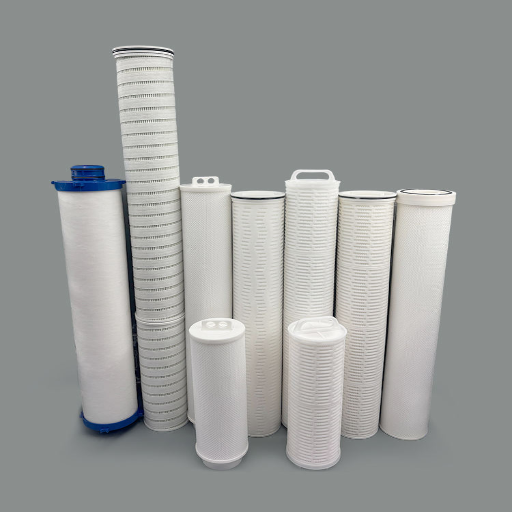
Large-diameter, single-open-end designs concentrate filtration area into fewer elements. They suit high flow applications where housing footprint, change-out time and replacement matching are important, provided the original interface and flow direction are verified.
Polypropylene and glass-fiber media families
- Inside-to-outside and outside-to-inside configurations by series
- Replacement development for selected Pall, 3M/CUNO, Parker and Pentair families
02
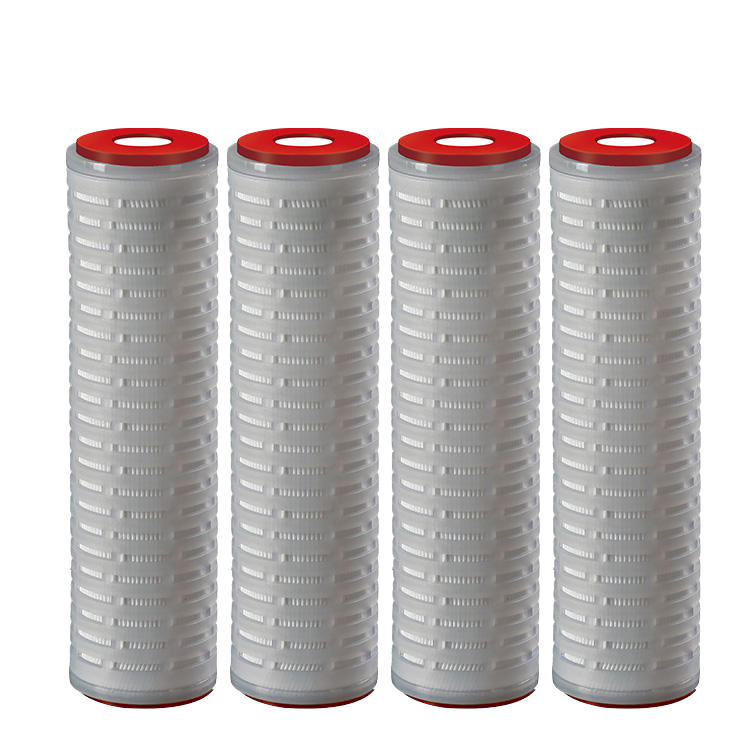
Standard pleated filter cartridges
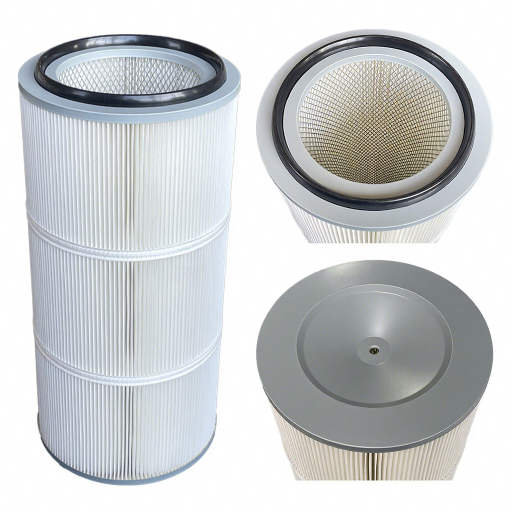
Pleated polypropylene filter elements provide a broad industrial water filtration range with multiple end-cap options. They are useful when a conventional multi-round cartridge housing is already installed and the application needs more surface area than a depth filter of similar size.
- DOE, 222, 226 and Code 7 configurations available by series
- PP and glass-fiber pleated media
- Micron and efficiency basis confirmed per product
03
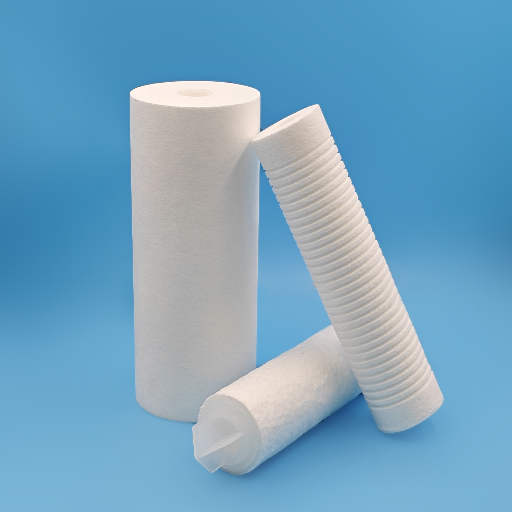
Melt-blown depth cartridges
Gradient-density polypropylene melt-blown cartridges capture solids through the depth of the media. They are often considered for sediment loading and economical pre-filtration where the selected housing, flow and pressure drop suit the duty.
- Standard and jumbo outside diameters
- DOE configurations
- 100% polypropylene construction for the confirmed series
04
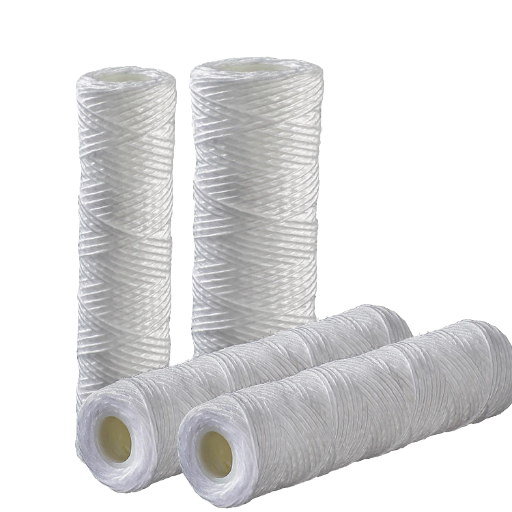
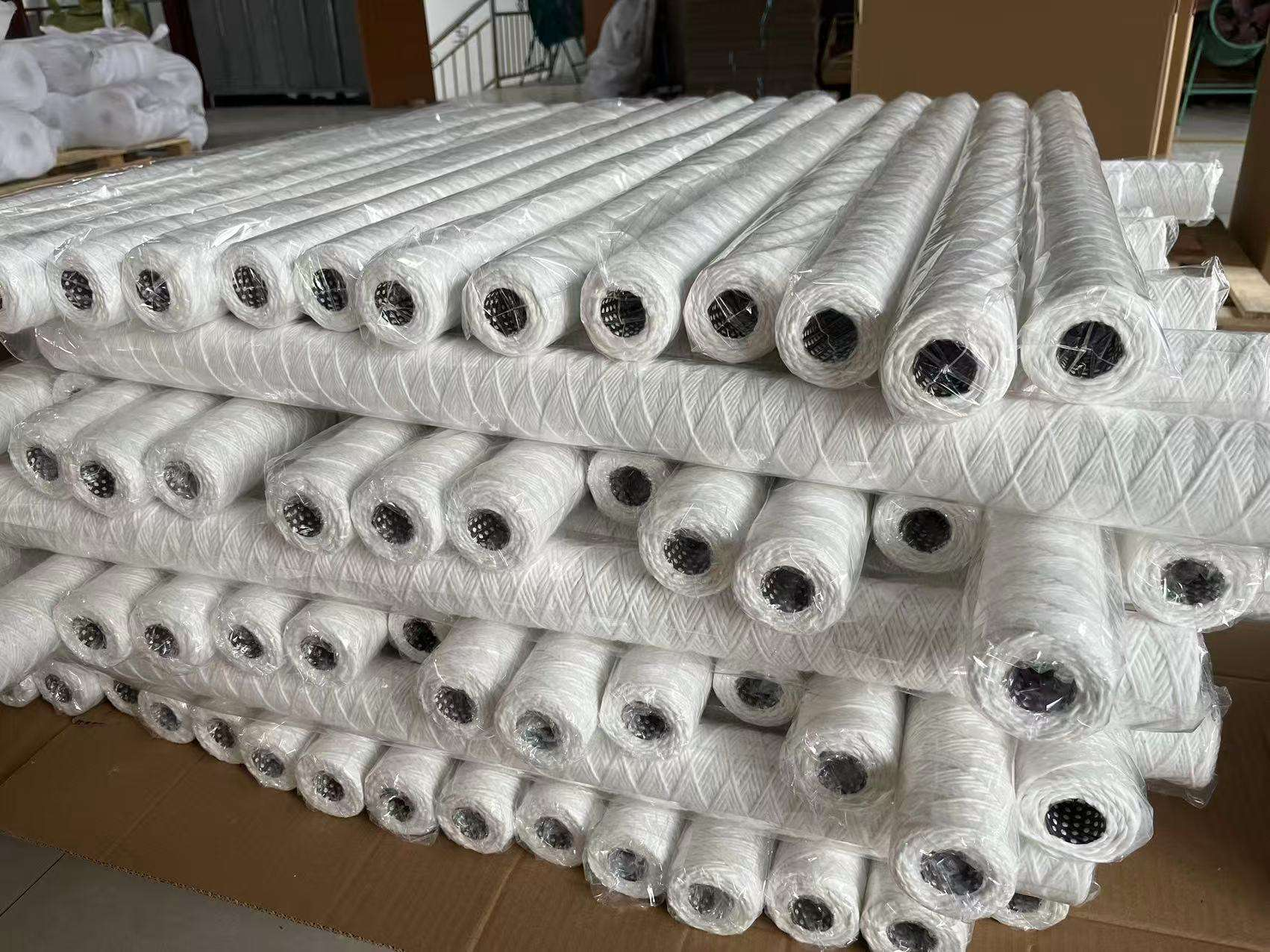
String-wound cartridges
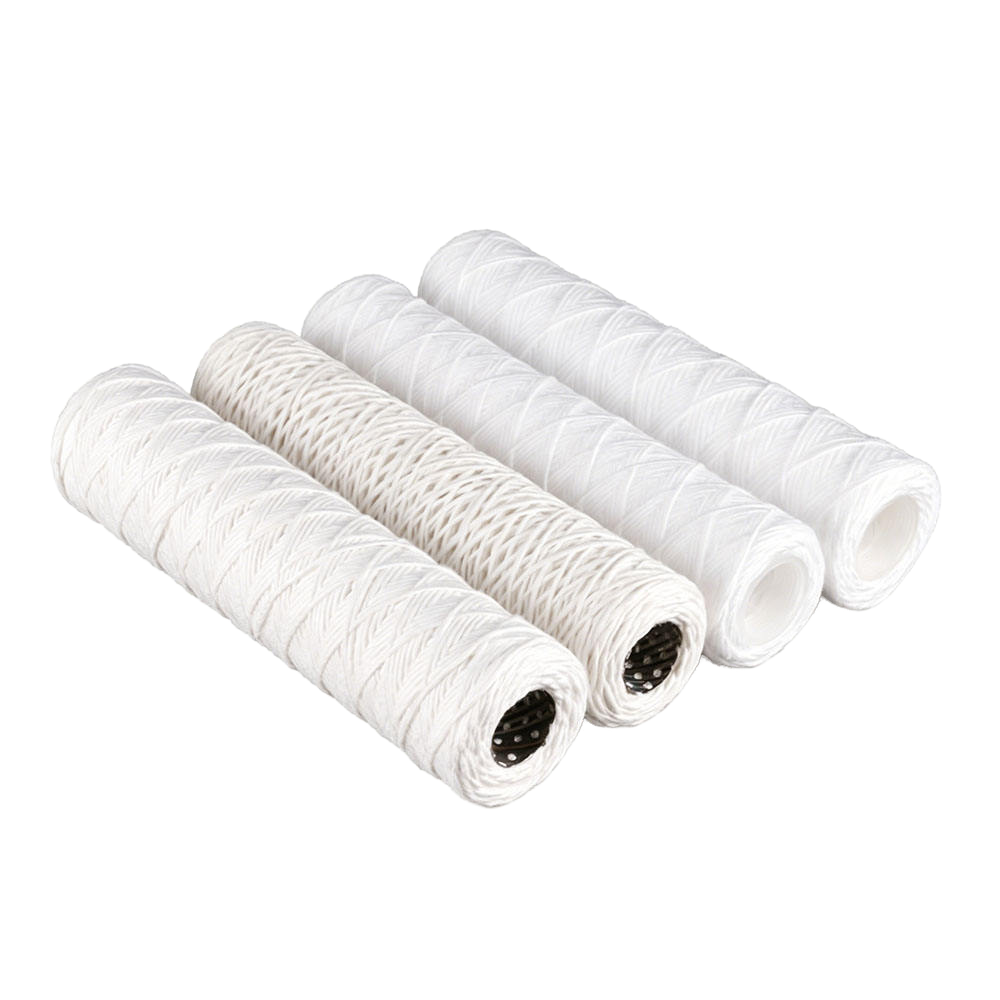
String-wound filter cartridges combine a wound media structure with polypropylene or stainless-steel support cores, depending on the selected product. They are considered when the process needs depth loading, a defined core material or a temperature range not covered by a standard melt-blown element.
- PP, cotton and glass-fiber wound families
- Core material selected for chemistry and temperature
- Dimensions and retention verified per series
Custom filter development
For an existing housing, send the original model, drawing or measured cartridge, including seal and end-interface details. We can review custom diameter, length, support cage, radial sealing, threaded connection and gradient filtration path requirements before a sample trial.
Replacement Matching and Interface Control
System-design context: U.S. Bureau of Reclamation Report 137. Replacement dimensions below are client-confirmed starting points and still require project verification.
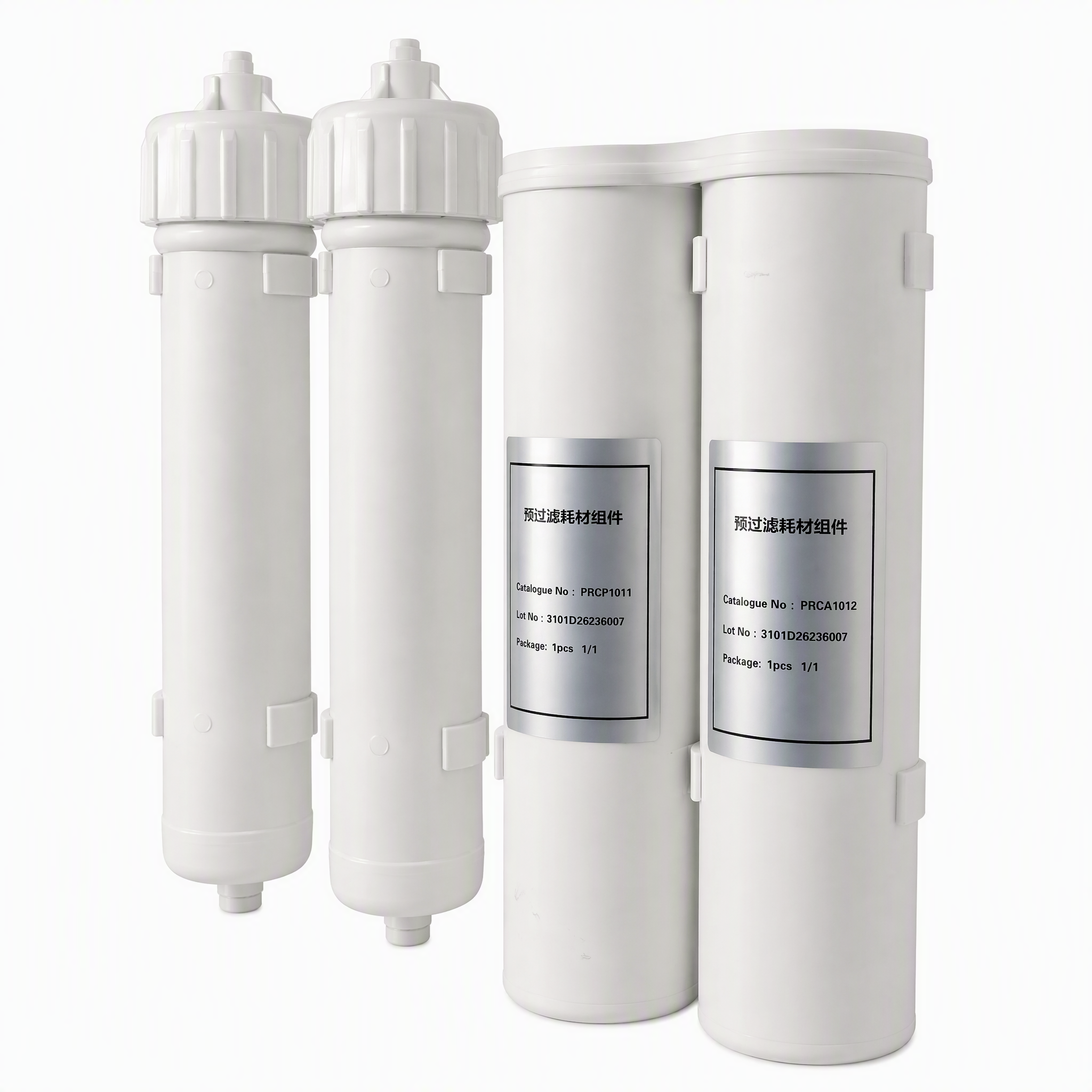
Filter cartridges are designed for specific applications and are not confirmed by off-the-shelf availability alone. ECOFILTRONE™ has tested selected families listed below, but each enquiry requires model, drawing, dimensions, sealing interface, flow direction and operating-condition verification.
| Reference family | Verified physical starting point | Matching controls |
|---|---|---|
| Pall HFU620 / HFU640 / HFU660 | 20 / 40 / 60 in; 154 mm OD; inside-to-outside flow | Single O-ring interface, EPDM or FKM selection, micron rating and duty review |
| 3M/CUNO 700 series | 40 / 60 in; 159 or 166 mm OD; outside-to-inside flow | Exact model, end geometry, seal, efficiency basis and housing drawing |
| 3M/CUNO 740 series | 40 / 60 in; 163.5 or 166 mm OD; twist-to-lock interface | Locking geometry, seal position, flow direction and operating duty |
| Parker Fulflo MegaFlow | 20 / 40 / 60 in; 154 mm OD; inside-to-outside flow | Series/model, end connection, media, retention and permitted ΔP |
| Pentair Aqualine High Flow | 40 / 60 in; 172 mm OD; large-diameter high-flow format | Original drawing, adapter geometry, seal, flow direction and chemistry |
01
1. Identify
Record the original brand, complete model and housing reference. Photographs support review but do not replace dimensions.
02
2. Measure
Confirm overall length, OD, sealing diameter, adapter, end cap, support and gasket position.
03
3. Verify duty
Compare flow, micron or efficiency basis, media, temperature, chemistry and pressure limits.
Verified Product and Replacement Ranges
Evidence boundary: Product ranges below come from the client specification workbook; ASTM D4189-23 is cited only for the SDI test method used in application review.
The table summarizes ranges established by the client specification workbook. An entry in the table establishes an available family; quotations and product datasheets define the configuration supplied.
| Cartridge family | Micron range | Length | Diameter / interface | Temperature |
|---|---|---|---|---|
| PP pleated high flow | 0.3–100 µm | 20 / 40 / 60 in | 154 mm OD; single open end with handle; inside-to-outside | Up to 80°C |
| Glass-fiber high flow | 0.3–100 µm | 20 / 40 / 60 in | 154 mm OD; single open end with handle | Up to 80°C |
| High-temperature high flow | 0.5–20 µm | 1026 / 1524 / 1540 mm | 152 mm OD; exact interface by drawing | Up to 120°C |
| PP pleated | 0.1–100 µm | 5–40 in | 69 mm OD; DOE / 222 / 226 / Code 7 by series | Up to 80°C |
| Glass-fiber pleated | 0.45 / 1 / 3 / 5 / 10 / 20 µm | 5–40 in | 69 mm OD; interface by series | Up to 80°C |
| PP melt blown | 1–100 µm | 9.75–40 in | 63 or 115 mm OD; 28 mm ID; DOE | Up to 65°C |
| PP string wound | 1–100 µm | 9.75–40 in | 63 or 115 mm OD; PP core | Up to 80°C |
| Cotton string wound | 1–100 µm | 9.75–40 in | 63 or 115 mm OD; stainless or tin-plated steel core | Up to 120°C |
Specification freeze
Before release, confirm the drawing revision, media and support material, retention basis, seal material, flow direction, temperature, chemistry, clean pressure drop at target flow, permitted differential pressure and required documents. Product-specific technical data and material documents are supplied according to the selected configuration.
Commercial Terms and Measured Cost Control
Cartridge price follows media, dimensions, end configuration, seal material, support structure, retention requirement, quantity, packaging and documentation scope. We return an enquiry response within 24 hours and confirm the exact quotation after the technical review.
Contact ECOFILTRONE
→
Commercial Item Matrix
| Commercial Item | ECOFILTRONE™ Term | What To Include |
|---|---|---|
| Standard Stocked Item | 4–5 days | Product code, quantity and required documents |
| Custom Sample | 7 days | Approved drawing or verified reference cartridge |
| Custom Batch | 14 days | Frozen specification and order confirmation |
| Custom MOQ | 100 pieces | One confirmed custom configuration |
| Sample Support | Free samples may be offered; buyer pays freight | Quantity and eligibility confirmed per product |
| Payment | 30% deposit, 70% before shipment by T/T | Final terms stated in the quotation |
Cost Per Treated Volume
- Record cartridge cost and the number of elements per housing.
- Fix the comparison at the same flow, feedwater condition and acceptance target.
- Track clean differential pressure, trend checkpoints, operating hours and treated volume.
- Add labor, disposal, shipping and unplanned intervention.
- Review downstream normalized RO performance separately; do not attribute every membrane change to the cartridge.
Controlled Cost Comparison
Base the buying decision on a controlled trial with an agreed clean baseline, constant-flow checkpoints and an acceptance record. This produces a cartridge cost per treated volume that procurement can compare on the same operating basis.
Validation, Inspection and Documentation
Production equipment varies by product line and manufacturing facility. ECOFILTRONE™ uses production lines and equipment for pleating, membrane cartridge assembly, melt-blown extrusion, string winding, end-cap welding or bonding and cartridge assembly, with inspection selected for the product requirement.
01
We verify the duty, dimensions, interface, material and retention basis before confirming a configuration.
02
Drawing and sample confirmation.
Custom replacements are verified against the approved drawing, reference element or sample plan.
03
Production follow-up.
We manage order-status updates, datasheets or drawings, inspection scope, packaging and shipping coordination during the order.
04
Product verification.
Dimensional, integrity, flow and filtration-performance checks are used according to the selected product requirements.
05
Document release.
Technical data, material certificates and/or compliance documents are only issued if they relate to the actual product and document holder.
Document scope
The document set is matched to the exact media, construction and application. Add every required material statement, test record or compliance document to the enquiry so its applicability can be checked before quotation.
From Application Review to Operating Follow-Up
Trial-Data Method: ASTM D4189-23 SDI Method
Send the Duty.
Provide source water, upstream treatment, design flow, housing or current model, temperature, chemistry and filtration target.
Review the Selection.
Compare cartridge family, media, micron or efficiency basis, surface area, flow configuration and interface.
Confirm the Specification.
Before an order is placed, datasheets, drawings and/or replacement-matching points are confirmed.
Take a Sample or Perform a Trial.
Where required, agree on fit and sealing, clean ΔP, target flow, filtrate criteria and trend checkpoints.
Produce, Inspect, Package and Ship.
We manage the production, inspection, packaging and shipping of the confirmed order.
Support Operation.
After installation, we support compatibility questions, performance follow-up, differential-pressure and service-life analysis, troubleshooting and configuration optimization.
Pre-Treatment
Application Experience
Evidence Boundary: Project facts are client-supplied. For independent SWRO design context, see U.S. Bureau of Reclamation Report 137.
ECOFILTRONE™ supplies industrial filtration customers across the Middle East, Southeast Asia, North Africa, South Asia and Latin America. The following anonymous examples demonstrate project design and delivery work without turning incomplete field records into performance claims.
Belawan, Indonesia · SWRO
An existing 8-inch housing required a custom 60-inch, large-diameter cartridge. The confirmed configuration used 169–170 mm OD, a 150–155 mm radial seal, six support cages and outside-to-inside flow.
- Eight-piece project supply
- Dimensions, radial seal, end seal and flow direction matched
- Project record centered on fit and configuration acceptance
Saudi Arabia · Custom High-Flow Replacement
The customer needed to retain the existing housing. ECOFILTRONE™ developed a 40-inch polypropylene, 5 µm cartridge with a threaded connection and high-temperature-resistant support.
- Flow-channel area and gradient path adjusted
- Sample verification passed
- 300-piece production shipment followed
Project Proof
These records show custom fit review, sample verification and production execution. The same sequence gives a new RO project a clear path from an existing housing or cartridge to an approved supply specification.
Limits of Cartridge Filtration in RO Pretreatment
Fouling-control evidence: Full-scale study of particulate, organic and biological pretreatment effectiveness
Cartridge filtration protects an RO membrane from residual particles, but it is only one barrier in the water treatment system. It is not a substitute for clarification, biological control, scale control, or other treatment barriers required in the feed water. Persistent short runs or rising membrane differential pressure should trigger a root cause analysis; the table provides alternative areas to look instead.
| Condition | Why cartridge-only action is insufficient | Next review |
|---|---|---|
| High or unstable solids load | The final cartridge becomes the primary solids-removal stage and plugs rapidly. | Clarification, multimedia filter, UF/MF performance and media carryover |
| Biological growth | A particulate cartridge does not eradicate biofouling potential in piping, tanks or the RO train. | Biological control, residence time, sanitization and pretreatment design |
| Scaling risk | Dissolved salts and hardness are not controlled by selecting a smaller micron rating. | Water chemistry, recovery, pH, softening and antiscalant program |
| Oxidant or chemical damage | Particle retention does not neutralize harmful dissolved chemicals. | Carbon, bisulfite or other chemistry control specified by the membrane design |
| Organic fouling | DOC and smaller foulants may pass a conventional cartridge stage. | Source characterization and upstream organic-control strategy |
| Unknown pressure trend | One high reading cannot separate flow change, gauge error, loading or an undersized element. | Repeat readings at comparable flow against a clean baseline |
Selection trade-offs
A smaller micron number is not always the better answer: it can be the wrong choice when flow, surface area, contaminant load and permitted pressure drop do not align. A dimensionally similar element is not necessarily interchangeable until its seal, end geometry, flow direction and operating duty are checked. Material grades are not necessarily interchangeable across different temperature and chemical duties, so these trade-offs belong in the selection review before a sample is released.
The precise location of a cartridge filter for an RO pretreatment depends on the design of the P&ID and membrane system. If plugging occurs frequently after a feedwater, dosing, storage, or upstream-filter change, then that event should be investigated before the cartridge is treated as the root cause.
RO Pretreatment Engineering & Evaluation Tools
01
RO Cartridge Selection Brief Builder
Turn operating conditions into a compact engineering enquiry. The result is an intake brief, not a cartridge-life prediction.
Launch Tool
02
Replacement Compatibility Checker
Compare the physical interface before treating an aftermarket cartridge as a replacement. Final confirmation still requires the drawing and operating duty.
Launch Tool
03
Cartridge Trial Trend Evaluator
Normalize a trial checkpoint against its clean baseline. This tool reports the observed trend and does not set a universal changeout limit.
Launch Tool
RO Pretreatment Cartridge Filtration FAQs
Independent references: U.S. Bureau of Reclamation Report 137 · ASTM D4189-23
What does a cartridge filter do in an RO plant?
It acts as a final particulate barrier before the RO membrane, catching residual particles and occasional carryover from upstream treatment. It does not replace clarification, media filtration, ultrafiltration, biological control or scale control.
Is 5 micron always the correct RO pre filter rating?
No. Five micron is a common design reference, but the selected retention must be checked against the membrane supplier’s requirement, feedwater, upstream process, flow, surface area, pressure drop and efficiency basis.
What information is needed to select a cartridge filter for RO pretreatment?
Send the feedwater source, upstream treatment, design flow, housing dimensions or model, element count, flow direction, retention target, temperature, chemistry and clean/operating differential-pressure history. Add the required documents and trial acceptance target.
How should differential pressure be used for changeout?
Record inlet and outlet pressure at a comparable flow and trend the difference from the clean baseline. The selected element and housing limit governs; ECOFILTRONE™ does not publish one universal changeout value for every cartridge.
Can ECOFILTRONE™ match Pall high-flow cartridges?
Selected Pall HFU620, HFU640 and HFU660 configurations have been tested as dimensional starting points. Final compatibility requires the complete model, length, 154 mm OD reference, seal, flow direction, retention basis and operating duty.
Can ECOFILTRONE™ match 3M/CUNO 700 and 740 series cartridges?
Selected 700 and 740 series configurations have been tested. Because the families include 159, 163.5 and 166 mm diameters, different flow directions and a twist-to-lock interface on the 740 series, the exact model and drawing must be checked.
Can one cartridge service-life figure be quoted before a trial?
No reliable universal figure can be set without feedwater load, flow, filtration area, retention basis and the permitted pressure limit. Use a sample or trial to record clean ΔP, trend checkpoints, treated volume and the agreed changeout rule.
What lead times apply to stocked and custom cartridges?
Standard stocked items can be prepared in 4–5 days, custom samples in 7 days and custom batches in 14 days after the specification is confirmed. The custom MOQ is 100 pieces.
Are free samples available?
Free samples may be offered, with freight paid by the buyer. Sample quantity and eligibility are confirmed for the specific cartridge.
What payment terms apply?
Standard payment is 30% deposit and 70% before shipment by T/T. The quotation states the final order terms.
Which documents can be supplied?
Datasheets, drawings, material information and applicable compliance documents can be supplied according to the selected product and actual document holder. Documentation must be verified for the exact configuration rather than assumed across the entire filter-cartridge range.
How is a custom replacement validated?
The sequence is drawing or sample review, dimension and interface confirmation, material and retention review, sample production, fit/seal check, clean baseline and agreed trial checkpoints. Production begins after the configured sample or specification is accepted.