Get in touch with ECOFILTRONE™ Company

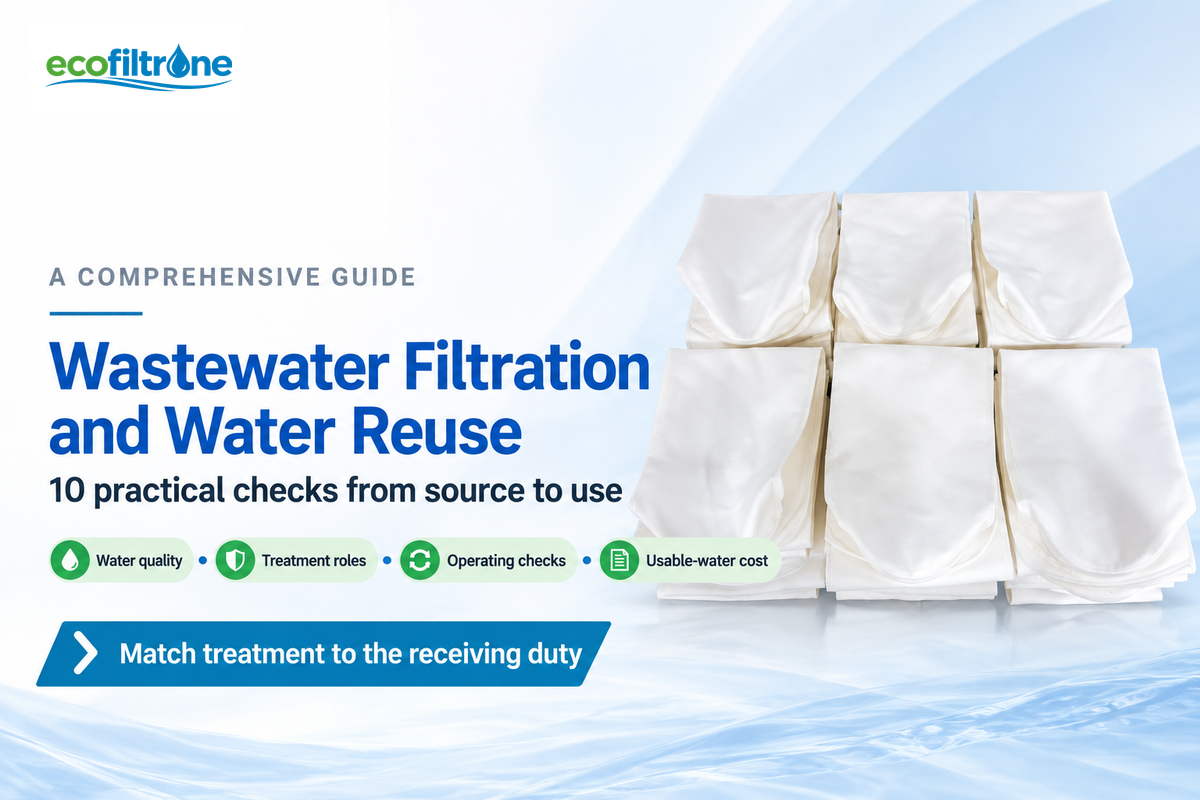
Wastewater Filtration and Water Reuse connects the elimination of pollutants to a specific task for the recovered water. A filter can capture particles, but a workable reuse project also needs suitable chemistry, microbial controls, reliable delivery and an end user who can accept the water. The end user of the water is also an important consideration. That task must be done first. Reused water has to meet the receiving process requirements, not simply leave the treatment outlet looking better.
With an industrial plant, the important question to ask is often rather narrow: can this effluent replace some of the purchased water without transferring a quality problem to the production process? This guide provides a means to ask and answer that question and to assign responsibilities for treatment and compare operational results. It also addresses other types of water reuse.
Start with three records: a source-water profile, a written end-use acceptance specification and a measured demand profile. Water that passes treatment but has no usable destination still consumes operating resources.
What does wastewater filtration contribute to water reuse?
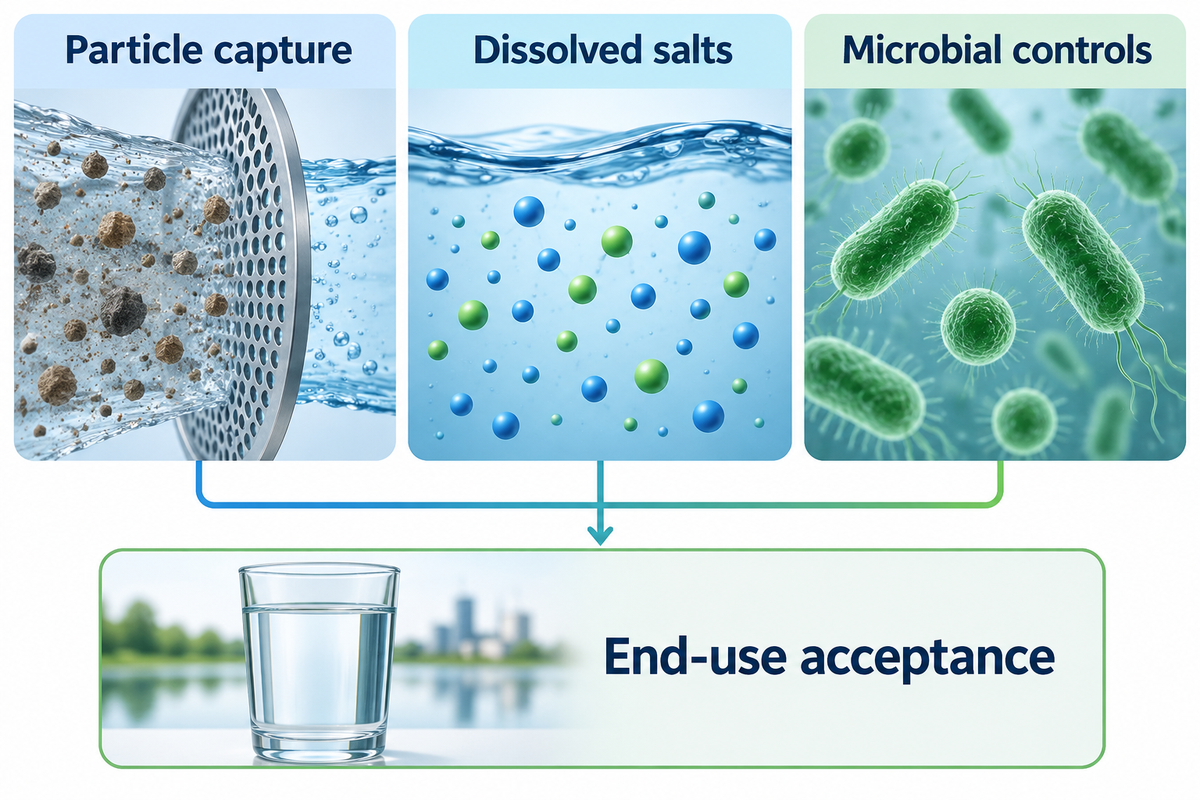
Wastewater filtration removes a defined fraction of contaminants in a reuse system. Water reuse is the broader outcome: previously used water serves an approved purpose. Thus, the treatment process must address the source, the intended exposure and the end use equipment. A filter may not capture all the particles.
Water reclamation, commonly known as water recycling, can reduce dependence on freshwater when treated effluent matches a real demand. The US EPA’s basic information about water reuse identifies sources such as municipal wastewater, industrial effluent and stormwater. Recovering water from wastewater can relieve the stress on surface water and groundwater sources. Different sources of water require different treatments; an existing discharge result is only one part of the overall assessment.
Does clear water mean reusable water?
Clear water describes appearance, not a complete acceptance test. Dissolved salts can be left behind after the removal of suspended solids. Pathogens and dissolved organic compounds require separate assessments. Treated wastewater can still contain dissolved materials even after the removal of suspended solids. A low-turbidity sample can indicate the performance of a barrier. The receiving process may still not accept the sample due to high conductivity or the presence of pathogens.
During sample handoffs, write the missing decision next to the sample results. For example: “treated wastewater meets the agreement on particles; acceptance of dissolved ions is still pending.” Writing it this way tells the production and purchasing teams what to do next, rather than telling them to accept the sample based on “clean water” results. Reuse of wastewater for drinking water requires a separately governed treatment and public-health framework. Potable reuse treatment and the operation of potable reuse systems are within that scope.
Match water reuse to the end-use duty
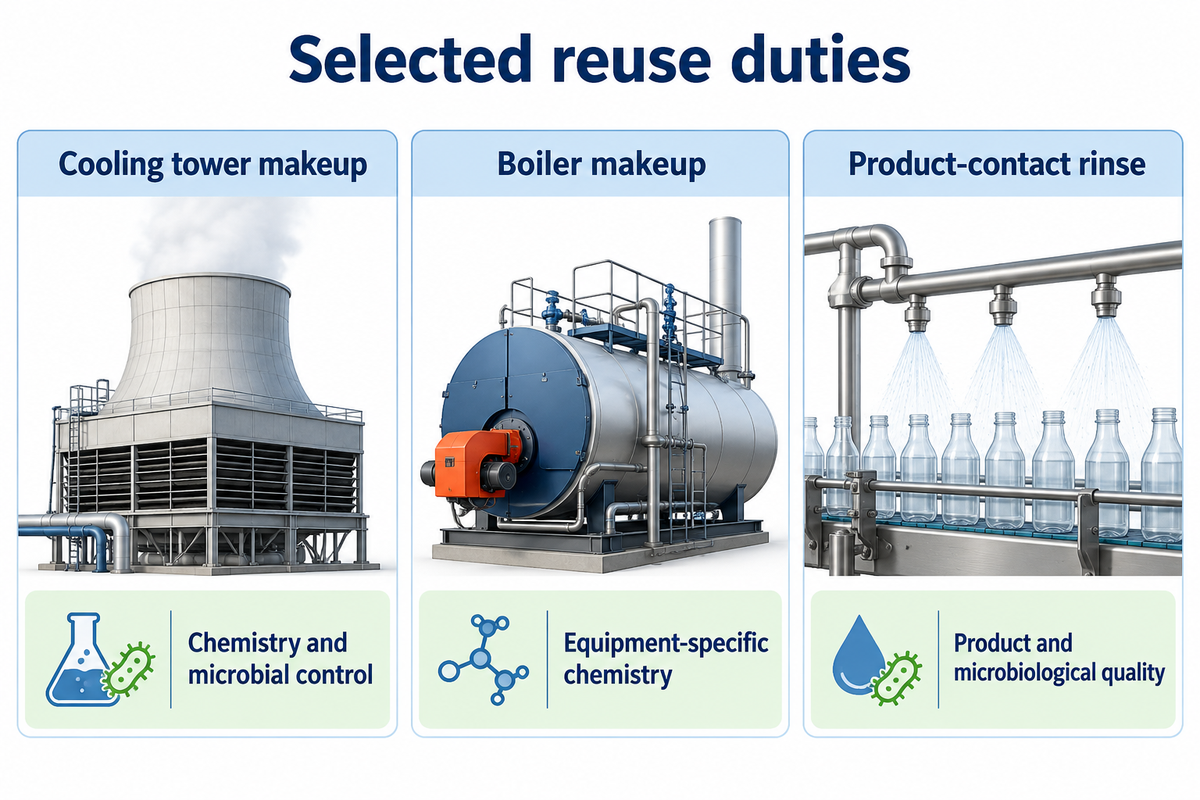
Decide on the acceptance criteria for each water sampling location. Acceptable criteria for water for one process may not be acceptable for water for a different process. There may be trade-off constraints between many processes that prevent a reuse route.
The Reuse Duty Ledger below is an aid for scoping purposes, not water quality criteria. Each row will identify who needs to approve water for reuse and the unresolved issue that could prevent delivery. The categories are based on the EPA’s industrial reuse resources, and the DOE’s application-based planning guidance. The actual values are based on local requirements and limitations of the equipment. Non-potable water for process and cooling water duties follows different acceptance routes from augmentation of potable water supplies. Water for crop irrigation also needs crop, soil and exposure assessment; a landscape-use assumption is not enough.
| Receiving duty | Constraint to investigate | Exposure or consequence | Acceptance owner |
|---|---|---|---|
| Cooling tower makeup | Salts, scaling, corrosion, solids and microbial control | Heat-transfer loss and aerosol exposure | Utilities and water-management team |
| Boiler makeup | Dissolved constituents and equipment-specific chemistry | Deposits, carryover and equipment damage | Boiler engineer and treatment specialist |
| Non-contact process water | Material compatibility and process tolerances | Equipment or process disruption | Process engineer |
| Product-contact rinse | Product requirements, chemistry and microbiological quality | Contamination or batch rejection | Quality assurance and process owner |
| Vehicle or equipment wash | Solids, residues and relevant exposure controls | Nozzle fouling, surface deposits or worker contact | Operations and site safety team |
| Toilet flushing | Non-potable quality and separate plumbing controls | Building exposure and accidental connection | Facilities and local authority |
| Landscape irrigation | Salinity, crop or soil compatibility and exposure | Soil effects and public contact | Site operator and permitting authority |
| Groundwater replenishment | Hydrogeology, source quality and authorized treatment | Receiving groundwater impacts | Water-resource specialist and regulator |
| Potable supply augmentation | Approved multi-barrier treatment and monitoring | Public drinking-water exposure | Drinking-water utility and regulator |
Which water needs can share a treatment target?
Group duties only after their acceptance requirements overlap. Duties that consume similar volumes may accept entirely different chemistry. Buying one higher-grade supply for both can increase treatment costs; distributing a lower-grade supply to both can create a production risk. Keep water used in each duty separately metered when considering the split.
Characterize the wastewater source before adding treatment
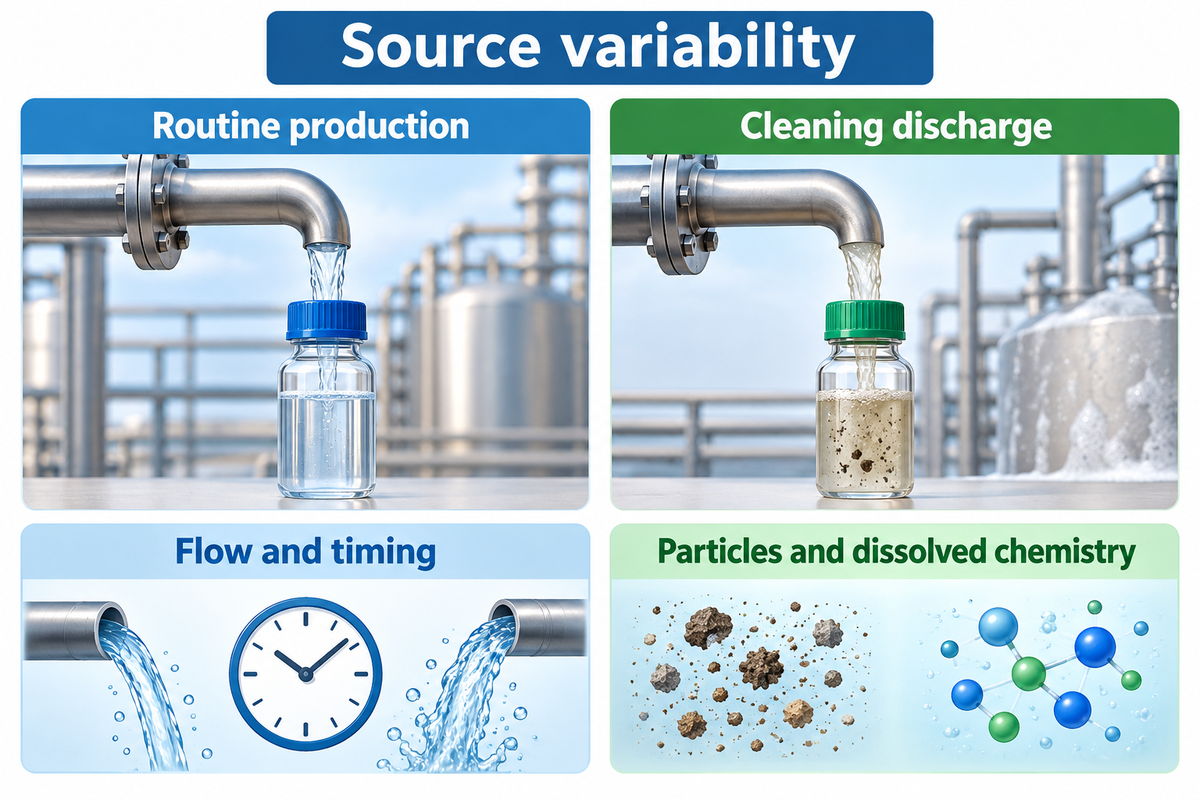
A valuable source profile illustrates the type of contaminants as well as the variability. Measure flow and the pertinent chemistry across the operating conditions which generate wastewater and relate to the treatment duty as opposed to relying on a single convenience sample. Distinguish suspended solids from dissolved solids, and differentiate changes in production that may affect either load.
The DOE’s on-site wastewater treatment guidance identifies flow, wastewater composition, reuse quality, site location and end-use demand as planning considerations. A wastewater treatment plant receiving mixed streams would need to identify the loads present in wastewater, in order to choose which additional barrier to install. For industrial wastewater, the sampling plan may need to distinguish routine production, cleaning discharge, startup and upset conditions. Select the tests to be done with the responsible treatment design engineer and the laboratory.
What belongs in the feed-water record?
- Hydraulics: measured m³/h, daily m³/day, and timing of intermittent releases.
- Particle loading: total suspended solids in mg/L, turbidity in NTU and relevant particle characteristics.
- Dissolved chemistry: conductivity in µS/cm, total dissolved solids in mg/L, hardness and source-specific ions.
- Other loads: pH, oil and grease, organics, nutrients, temperature, and microbial risks.
Imagine a factory combining a rinse stream with a periodic cleaning discharge. A composite sample shows the streams are manageable, but a cleaning event has a different pH and organic load. Operators replace cartridges more frequently, but don’t change the mixing arrangement. An appropriate investigation looks at the timing and composition of the two streams, and considers whether equalization, segregation or upstream treatment is required. This is a hypothetical or planning scenario; it isn’t based on an actual ECOFILTRONE installation. The purchasing decision is to defer a micron-rating change until the actual feed duty is understood; otherwise, a new consumable may inherit the same overload.
Produced water from natural resource extraction is another distinct source category. Water from natural resource extraction should retain its own contaminant assessment rather than being grouped with ordinary municipal water. “Waste water” on a piping diagram is overly general when determining treatment requirements.
How do treatment technologies divide the work?
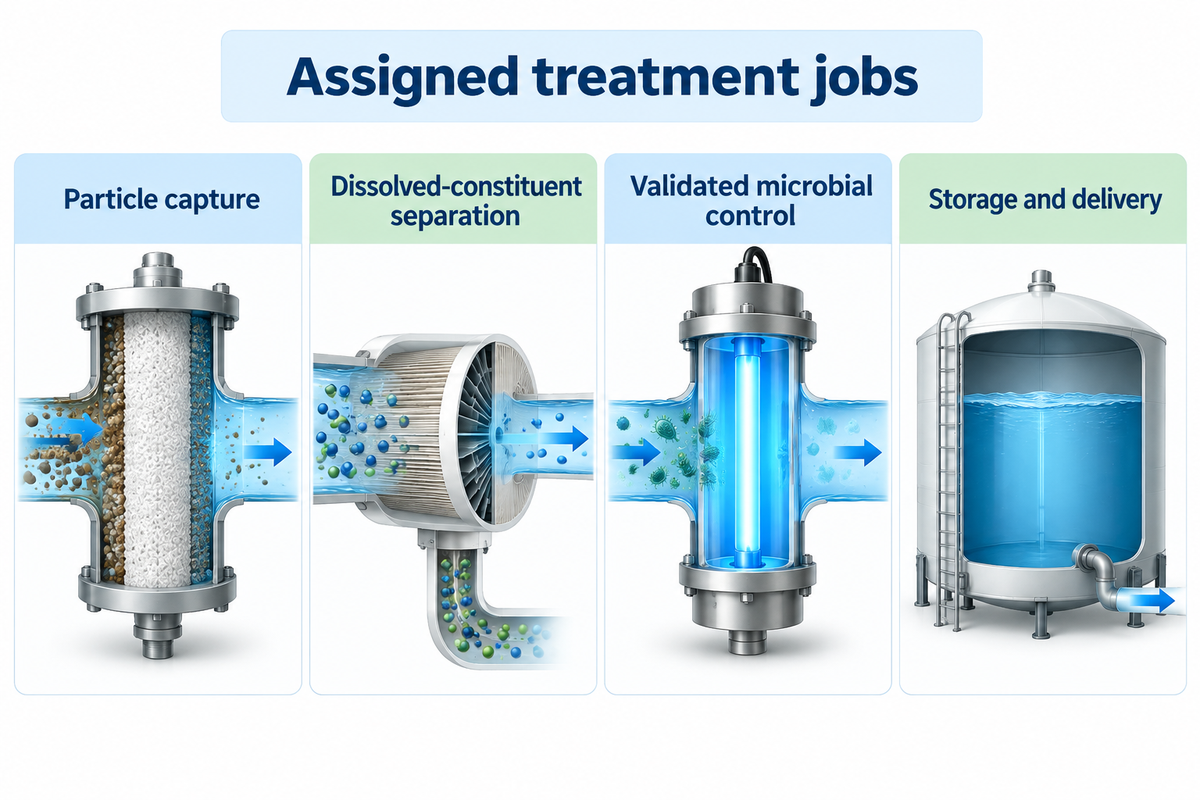
Treatment technologies work on different contaminant fractions. A reuse train could perform bulk-solids separation, biological conversion, particle filtration, dissolved contaminant removal and disinfection. The order is determined by the feed and destination. Conventional wastewater treatment may already perform several duties, so identify the remaining gap before adding another unit operation or disposable element.
The Treatment Responsibility Ladder groups operations by job rather than by a presumed universal order. Some projects omit rows; others repeat barriers. Treated wastewater reuse links water and wastewater operations, with responsibility passing from the source plant to the receiving user. A water treatment plant accepting reclaimed feed requires the same handoff. Although storage is part of the operating plan, it isn’t a treatment technology to remove contaminants.
| Operation | Main assigned job | Boundary to retain |
|---|---|---|
| Screening or straining | Remove coarse material | Does not establish dissolved-chemical quality |
| Biological treatment | Convert biodegradable loads under designed conditions | Performance depends on wastewater composition and operation |
| Clarification or flotation | Separate suitable suspended or floatable material | Residual fine particles and dissolved constituents remain possible |
| Granular-media filtration | Reduce particulate carryover | Requires a defined loading and cleaning duty |
| Bags and cartridges | Capture particles within the specified element duty | Ordinary particulate elements do not desalinate |
| Microfiltration or ultrafiltration | Provide membrane filtration for the designed separation range | Integrity and validated barrier performance matter; dissolved salts remain a separate issue |
| Nanofiltration or reverse osmosis | Separate selected dissolved constituents | Rejection is constituent-specific; concentrate needs an outlet |
| Adsorption or targeted chemical treatment | Address specified dissolved contaminants | Capacity and selectivity require source-specific verification |
| Disinfection | Control microorganisms under validated conditions | Does not substitute for all chemical-removal duties |
| Storage and distribution | Deliver suitable water when needed | Residence time, contamination pathways and demand remain operational constraints |
“The required treatment steps are dictated by the water’s final end use”
During a design review, have each proposed unit explain its purpose. If two units say “clean the water,” determine which unit removes a measurable contaminant and what failure the downstream unit is protecting against. A treatment system should be designed to remove contaminants of concern rather than to promise higher purity.
When does ultrafiltration need reverse osmosis downstream?
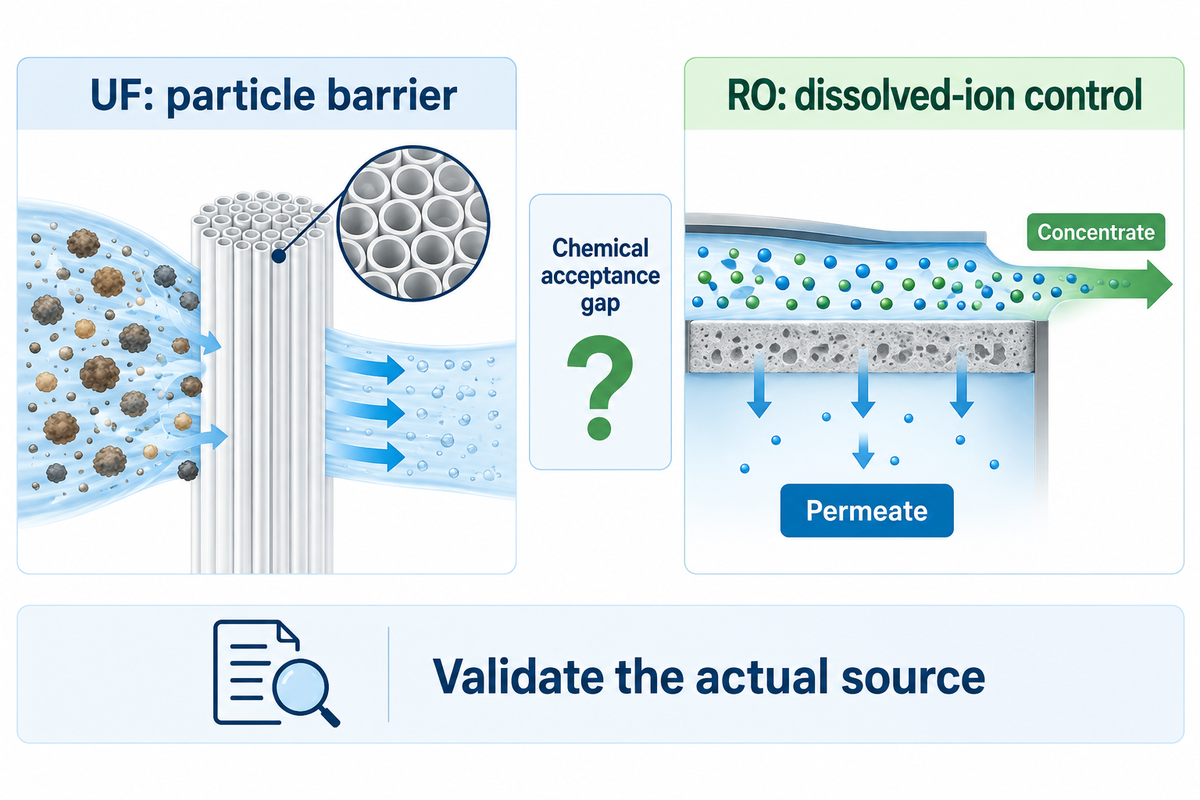
Ultrafiltration requires a downstream desalting step to manage reuse duty when UF is inadequate to control the dissolved ions. Reverse Osmosis can be used for this function. RO will remove dissolved ions, which may not be needed if the downstream user accepts the dissolved ions. Establish the Chemical Acceptance Gap before comparing the membrane options. Industrial process water may require dissolved-ion control even when particle results are acceptable.
What did one municipal-effluent pilot actually show?
Chan and Wu’s 2022 study of fiber filtration, UF and RO treated secondary municipal wastewater at Anping, Taiwan. It reported average UF permeate turbidity of 0.015 NTU. The four RO operating modes had the following average feed and permeate conductivities. These are results from that pilot, not cartridge specifications or promised industrial outcomes.
| Mode | Feed conductivity | Permeate conductivity |
|---|---|---|
| 1 | 2,843 µS/cm | 45 µS/cm |
| 2 | 2,891 µS/cm | 49 µS/cm |
| 3 | 3,148 µS/cm | 62 µS/cm |
| 4 | 2,474 µS/cm | 57 µS/cm |
The distinction shows a good particle barrier and a desalting barrier address different queries. The study utilized named equipment from other vendors; it wasn’t an ECOFILTRONE test. Its seawater-influenced municipal feed also differs from many industrial streams. Transfer the separation logic, then validate the selected treatment against the actual source.
For a cooling-water project, compare the proposed makeup chemistry with the equipment and operating limits before specifying desalting. DOE’s cooling tower management guidance explains that evaporation concentrates dissolved constituents. RO isn’t a mandatory treatment requirement for all cooling applications. Maintain the consumable duty for Cooling Tower Side stream filtration and the decision on the Tower Make-up Chemistry, separately. Likewise, RO pretreatment particle control supports a desalting process rather than replacing it.
Where do bags and cartridges fit in the treatment train?
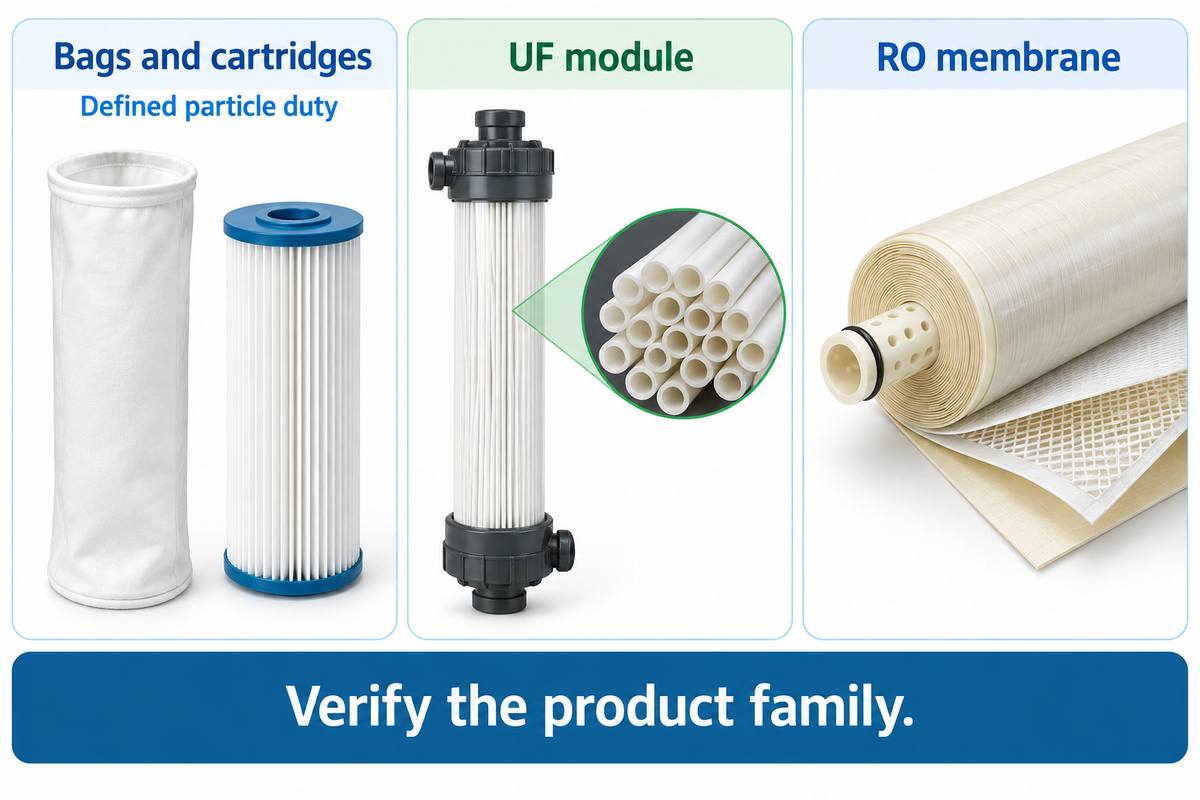
Bags and cartridges perform a defined duty of particle control in a larger water reuse system. They may minimize residual solids after upstream treatment, or protect a downstream process, depending on the element and housing specification. Keep that duty separate from dissolved-salt removal, validated microbial treatment and the overall acceptance of reclaimed water.
Water filtration, the separation of particles based on device and operating conditions, is explained in the Mechanical Filtration: Methods and Devices, by the University of Georgia. Its focus is on household treatment; the principle of separation is applicable here, while the household operating advice isn’t an industrial specification.
What should a consumable trial establish?
Compare an element at documented flow in m³/h, temperature in °C and feed condition. Record clean and loaded differential pressure in bar, runtime in h, downstream quality and reason for change out. A longer service interval helps only if the protected process continues to meet its own requirements. Preserve housing dimensions, seal arrangement and material compatibility as separate checks.
A microporous membrane cartridge isn’t automatically a UF module and a fine micron label doesn’t make a disposable element an RO membrane. Keep these product families separate in drawings and purchase descriptions. For application-specific consumable selection and replacement, please consult ECOFILTRONE’s wastewater filtration and water reuse solutions.
ECOFILTRONE provides industrial liquid filter bags and high flow, pleated, membrane, Melt Blown and String Wound filter cartridges, with engineering support for selection and matching. Complete reuse-process design, microbial validation and project permissions require the responsible specialists and authorities. Request any material or compliance document against the particular product and actual certificate holder.
Monitor reclaimed water through storage and distribution
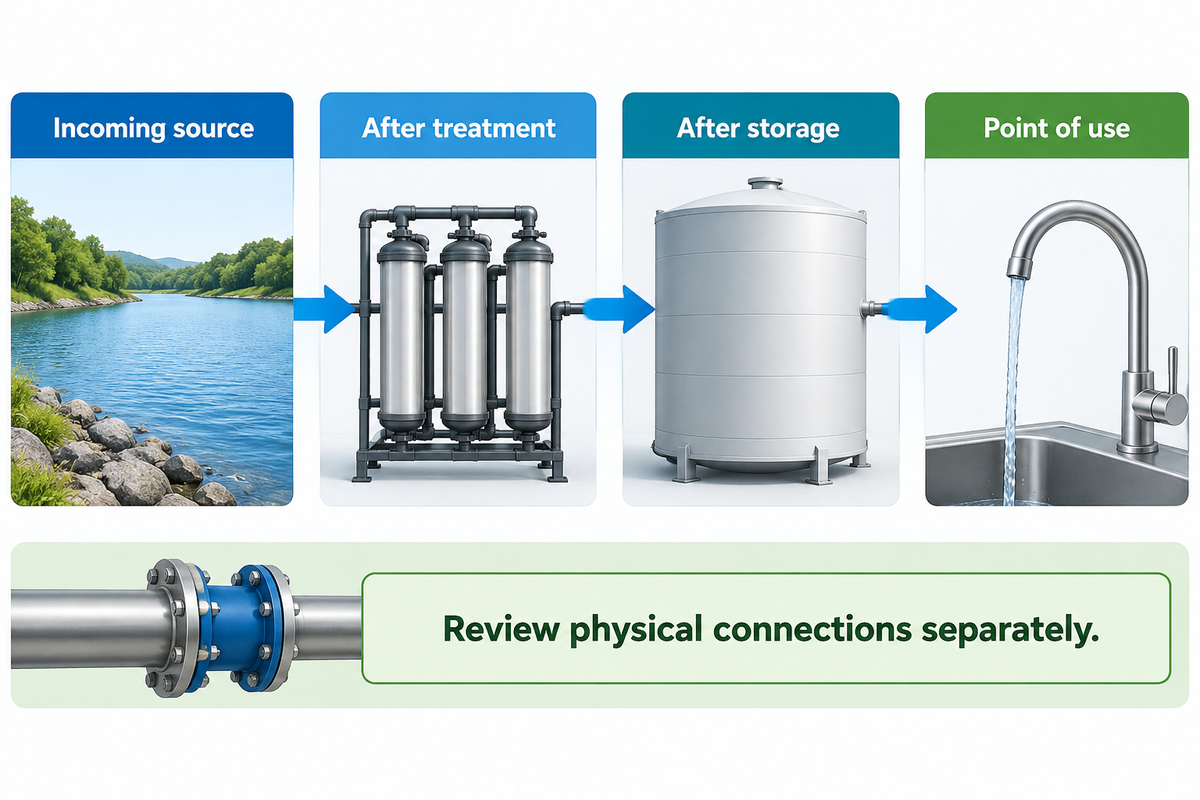
Monitor the water where each relevant failure can occur: at the incoming source, after the treatment barrier, after storage and at the point of use. Outlet acceptance alone doesn’t assure there’s no subsequent contamination or inappropriate connection. Hydraulic measurement and water quality measurement must be paired. Take corrective action based on the results and documented evidence of response when water quality falls out of specification.
The CDC cooling-tower control module for wet cooling systems identifies conditions for management concern as sediment and biofilm, as well as water age and disinfectant conditions. A low filter pressure drop doesn’t resolve these concerns. Monitoring and corrective actions belong in the site’s qualified water-management plan.
What can go wrong after the treatment outlet?
A prolonged time between treatment and use can adversely affect water quality. A sample taken before a prolonged holding period may not adequately represent the water delivered to a process line. Confirm that treated water meets the required quality after the prolonged holding period. State the sampling location, the state of the process and the residence time in hours.
In a hypothetical wash-water project, the final-treatment sample meets release criteria, but a sample from a point of use further down the line fails a microbial check. Replacing the particle cartridge doesn’t resolve the issue. As part of the site’s approved response plan, the distribution and point-of-use conditions are compared to the tank conditions, and unsuitable water is managed according to the plan. The useful purchase decision is to investigate the delivery system before paying for another filtration stage. No universal disinfectant dose or release threshold follows from this example.
Physical connections require a separate review. TCEQ’s cross-connection and backflow guidance explains that, depending on the level of system pressure, flow can reverse through connections and allow backflow of contaminants. Use qualified personnel to install and test backflow preventers in accordance with local requirements. Pipe color alone is not a complete control strategy.
Calculate cost per usable cubic meter
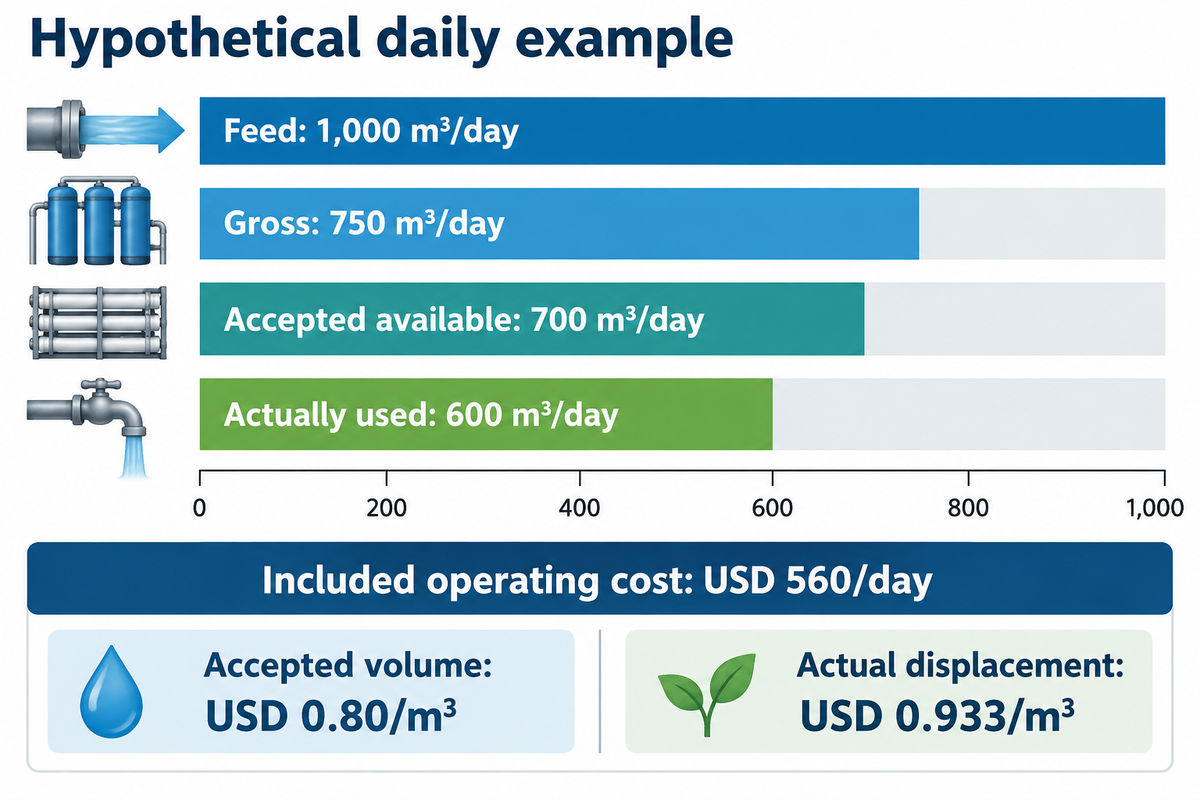
Operating costs should be measured against a specific volume of water over a defined period of time. Distinguish water that’s produced, meets quality standards and is accepted from water that’s actually used to displace fresh water. Water demand, storage and delivery constraints can separate these quantities. Using water only during one production shift can leave output from other hours without an immediate destination. A high recovery percentage does not by itself establish low water supply costs or positive project returns.
How does the denominator change the result?
A smaller useful-volume denominator raises unit cost even when daily expenditure is unchanged. Assume a hypothetical system receives 1,000 m³/day, produces 750 m³/day gross and makes 700 m³/day available after quality acceptance and operational losses. The end user actually consumes 600 m³/day that replaces freshwater. Included operating costs total USD 560/day. These invented inputs demonstrate the calculation; they’re neither a supplier quotation nor a measured client result.
- Gross production ratio: 750 ÷ 1,000 = 75%.
- Accepted Available Share of Feed: 700/1,000 = 70%
- Actual freshwater displacement share: 600 ÷ 1,000 = 60%.
- Cost per accepted available volume: 560 ÷ 700 = USD 0.80/m³.
- Cost per actual useful displacement: 560/600 = USD 0.933/m³ , rounded.
Use metered volumes for the relevant boundary; don’t assume that 50 m³/day between gross and accepted output, or 100 m³/day between availability and use, represents one loss mechanism. For actual loss mechanisms, use site measurements; the guidance of the U.S. Department of Energy (DOE) supports planning. DOE guidance explicitly compares end-use demand to reclaimed water, and, in its alternative water planning guidance, the DOE sizes storage to meet application demand.
Where are the hidden cost bottlenecks?
| Constraint | What to measure | Decision owner |
|---|---|---|
| Quality rejects or downtime | Accepted m³/day and reason for diversion | Quality assurance and operations |
| Demand and storage mismatch | Hourly demand in m³/h, usable storage in m³ and unused output | Utilities and production |
| Delivery distance and pumping | Delivered m³, energy in kWh/m³ and transfer constraints | Site engineering |
| Consumable and labor burden | Elements per period, changeout labor in h and downtime | Maintenance and procurement |
| Residuals and concentrate outlet | Residual m³/day, destination and documented handling cost | Environmental team and finance |
State if USD 560/day covers costs for power, chemicals, consumables, labor, testing and residual handling. Capital recovery and financing require a separate analysis based on a life cycle costing methodology. Compare only avoided freshwater purchase and discharge costs where those costs are actually displaced. An off-site reuse route requires confirmed delivery arrangements and necessary permits. Recycling water can reduce water consumption from an external supply, but the amount saved is the actual substitution. If the goal is to reuse large amounts of water, check if the end user can absorb that volume during the operating period.
Diagnose filter loading and water-quality failures separately
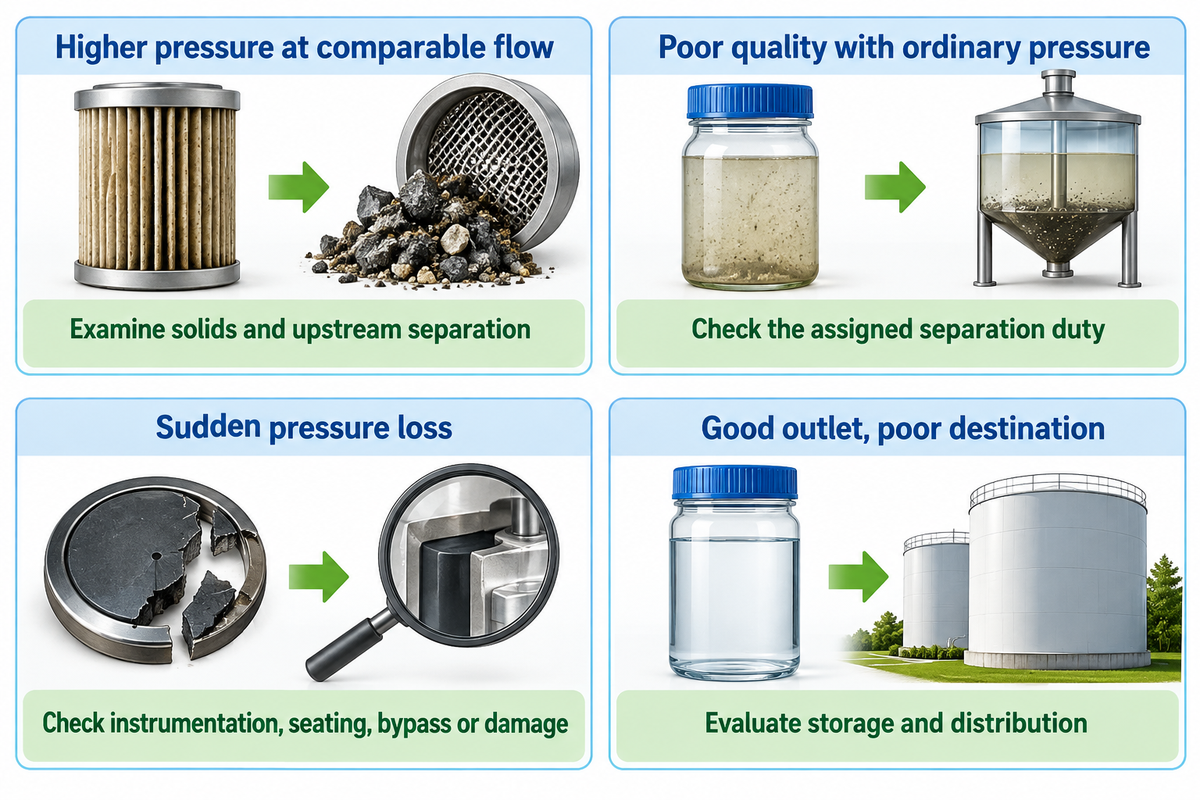
Diagnose hydraulic loading and downstream quality separately. Rising differential pressure can indicate loading under comparable flow conditions, while normal pressure does not establish acceptable water chemistry or microbial condition. Consider changes in feed and compare with the results of the receiving process.
A hypothetical operator sees runtime shorten from 72 h to 12 h after an upstream production change. For the same recorded flow of 20 m³/h, clean differential pressure remains 0.1 bar, while loaded pressure reaches the site’s hypothetical 0.8 bar investigation trigger much earlier. Those numbers aren’t recommended operating limits. They point the investigation toward changed solids loading, material characteristics or upstream treatment before a different micron rating is purchased.
Which observation should trigger which investigation?
- Higher pressure at comparable flow: examine solids, sticky material and upstream separation, while respecting the housing and element operating limits.
- Poor quality with ordinary pressure: Check if the failed parameter is even within that element’s assigned separation duty.
- Sudden pressure loss: Examine other flow changes, instrumentation, seating, bypass or damage, rather than assume a successful cleaning.
- Good outlet, poor destination: evaluate storage and distribution, and point-of-use conditions.
An operator discussion regarding rented UF/RO treatment of leachate prompted some questions on instrumentation and the interpretation of readings. It’s useful as a question list, and not validated performance evidence. It’s important to label the concentrate or waste water outlet clearly on the water balance. RO concentrate contains the constituents transferred from the feed; reducing its volume doesn’t provide an acceptable disposal route.
What is changing in industrial water reuse?
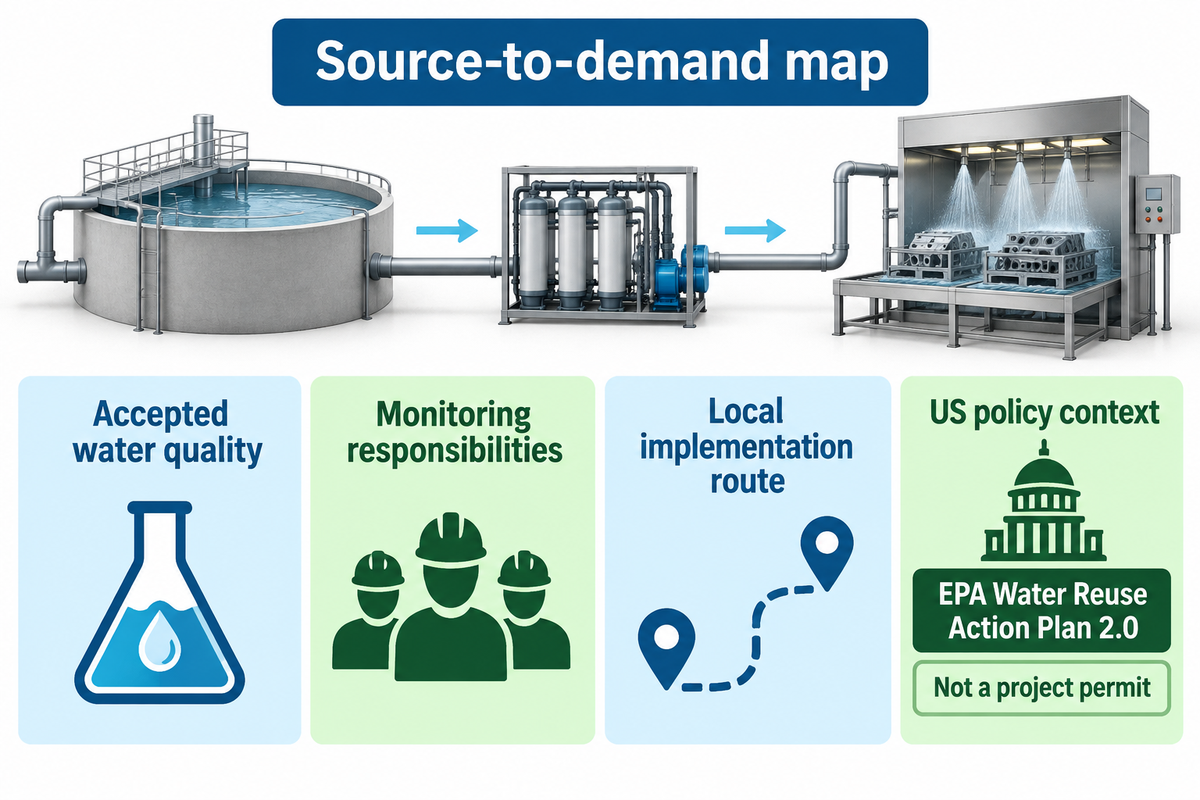
Recent activities are bringing greater attention to the appropriate integration of sources, uses and responsibilities. In the U.S., the EPA released the Water Reuse Action Plan 2.0 on April 16, 2026. This initiative is part of the broader reuse initiative and is neither a product certificate, project permit, nor an international water treatment standard.
The EPA Water Reuse Action Plan 2.0 focuses on industrial applications, the technology sector and energy. Analyze these actions in a policy context. A project also requires its own accepted water quality, monitoring responsibilities and an approved route for implementation at the local level. The EPA’s risk-based microbial treatment work, however, is a resource for the appropriate authorities, and isn’t a universal industrial operating prescription.
For a plant facing water scarcity or a water shortage, the useful next document is a source-to-demand map. Mark which alternatives to existing water supplies can actually reach each receiving duty. Reuse projects may provide alternatives to existing water sources and reduce reliance on a single supply, but reliable delivery and qualified operation determine how much freshwater demand they replace. Increasing installed treatment capacity alone doesn’t increase water available at the right time.
Water reuse and wastewater recycling need a complete source-to-user plan. Sustainable water management through reuse of water doesn’t relieve responsibility for remaining contaminants. Water reuse and recycling may conserve water resources while leaving behind concentrated salts, sludge, or other materials to be managed. In US projects, determine how applicable Clean Water Act, Safe Drinking Water Act and state requirements relate to the specific discharge or reuse arrangement with the responsible authority. Each country uses their own approval processes.
Frequently Asked Questions
What is water reuse?
Water reuse is treating used water so it can perform another defined duty. It may require treatment for removal of contaminants of concern. Filtration is one possible treatment step; reuse also includes the quality controls, storage and delivery needed to make that purpose workable.
What are the different types of water reuse?
These include different types of reuse (industrial, agricultural, etc.) as well as urban non-potable uses and groundwater recharge. Sources can be industrial effluents, greywater and stormwater. These categories don’t have consistent treatment goals. Each project has to connect its source and end-use to the applicable water-quality requirements and operating controls.
What are the water treatment techniques for reuse?
Treatment can consist of screening, clarification, biological treatment, media filtration, microfiltration or ultrafiltration, and disinfection. The necessary treatment follows the contaminants and reuse duty. For dissolved salts, reverse osmosis can be used. For particulate contaminants, particulate filters can be used. Controls on storage and distribution remain part of the operating plan.
Can ultrafiltration remove dissolved salts?
Ordinary ultrafiltration targets particles and larger contaminants within its designed separation range. Desalting, if required, should be done by reverse osmosis or other suitable treatment. Confirm the actual membrane’s characteristics, feed chemistry and required permeate quality before making a treatment selection.
What are the water quality requirements within industry?
Requirements depend on the equipment, process contact, exposure, and local approval conditions. Cooling systems need control of scaling, corrosion, suspended solids and microbial growth; boiler makeup can require much tighter dissolved-solids control. Define acceptance limits and sampling locations and methods, and describe response actions with the responsible designer and end-user. A sample that looks clean doesn’t always meet the agreed reuse specifications. Specifications also account for storage, distribution and process upsets.
Why do wastewater filters clog quickly?
Rapid loading can indicate an upstream solids upset, sticky or compressible material, incompatible media or operation beyond the intended hydraulic duty. Consider feed conditions, flow and pressure trends before changing the micron rating. Evaluate downstream quality independently of apparent filter loading.
What is the difference between direct and indirect wastewater reuse?
In potable-reuse terminology, indirect reuse includes an environmental buffer, such as an aquifer or reservoir, before further drinking-water treatment. Direct potable reuse introduces appropriately treated reclaimed water into a drinking-water supply arrangement without that environmental buffer. The meaning and approved treatment arrangements vary by jurisdiction. Neither term describes a filter cartridge, and neither can be established with a micron label. An industrial non-potable reuse project should use its own applicable classifications and approved end-use requirements.
Discuss the filtration duty
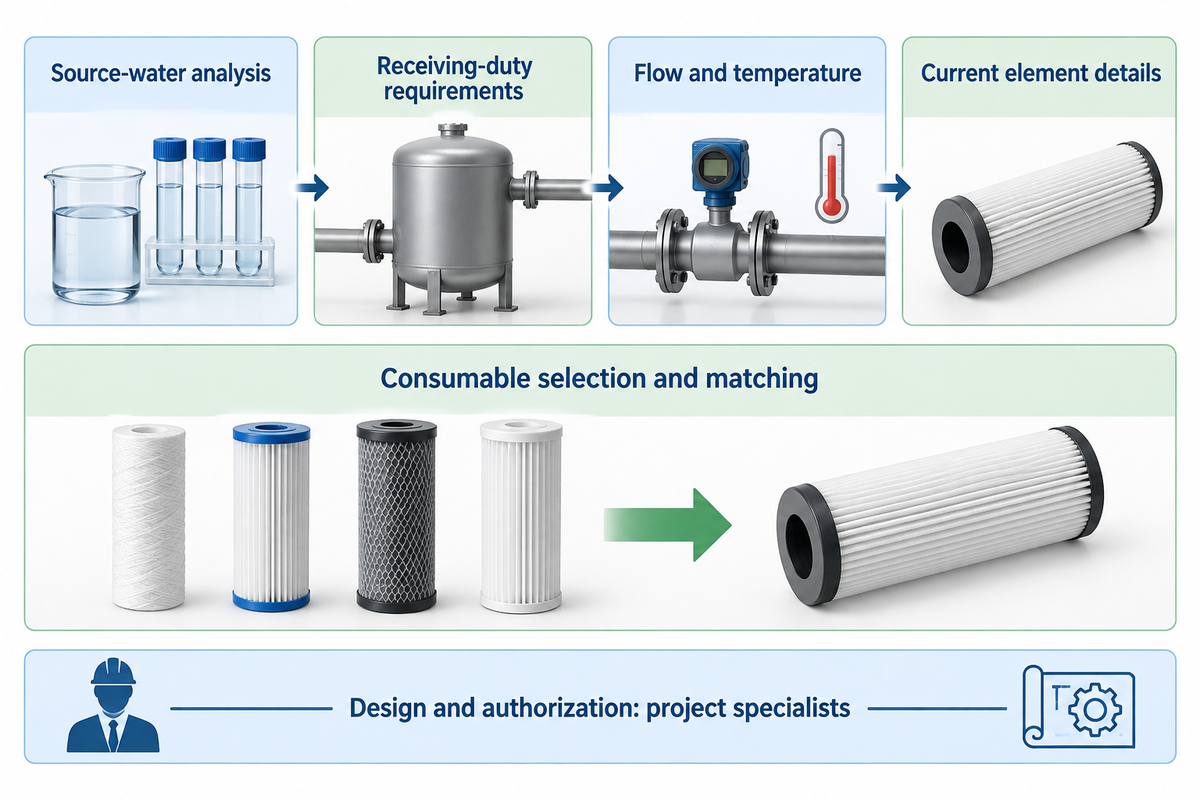
Bring your source-water analysis, receiving-duty requirements, flow, temperature and current element details to ECOFILTRONE. We can help review consumable selection, replacement matching and trial requirements within the filtration scope. Keep complete treatment design and reuse authorization with the responsible project specialists.
Related Filtration Guides
- PP pleated cartridge operating considerations
- Nylon membrane cartridge selection boundaries
- PES membrane cartridge application guide
- Glass-fiber pleated cartridge duty guide
References and Sources
- US EPA. Basic Information about Water Reuse. Definitions, Source Categories and Treatment Context.
- US EPA. Water Reuse for Industrial Applications Resources. End-use and jurisdictional context.
- US Department of Energy. Water-Efficient Technology Opportunity: On-Site Wastewater Treatment Systems. Composition, demand, location and operation.
- Chan, S.-S.; Wu, J.-H. Improving the Performance of the Reverse Osmosis Process with Fiber Filter and Ultrafiltration: Promoting Municipal Sewage Reclamation and Reuse for Industrial Processes. Sustainability, 2022, 14, 5443. Original Anping Pilot.
- CDC. Controlling Legionella in Cooling Towers. Cooling System Microbial Management Context.
- US EPA. Potable Water Reuse and Drinking Water. Direct and indirect use definitions.
- US EPA. Water Reuse Action Plan 2.0. April 2026 Policy Initiative.
- US Department of Energy. Best Management Practice #10: Cooling Tower Management. Makeup Chemistry and Concentration Limits.
- US Department of Energy. Best Management Practice #14: Alternative Water Sources. Demand and Storage Planning.
- University of Georgia Extension. Mechanical Filtration: Methods and Devices. Particle-Separation Principle; Household publication scope retained.
- Texas Commission on Environmental Quality. Cross-Connection Control and Backflow Prevention. Pressure Reversal and Physical Connections.
- John Patrin (then with Dow Water & Process Solutions), writing for FMA. Filtration systems enable industrial wastewater reuse, 2014. End-use treatment principle.