Get in touch with ECOFILTRONE™ Company


Pleated Filter Cartridges: From Media Choice to Stable Operation

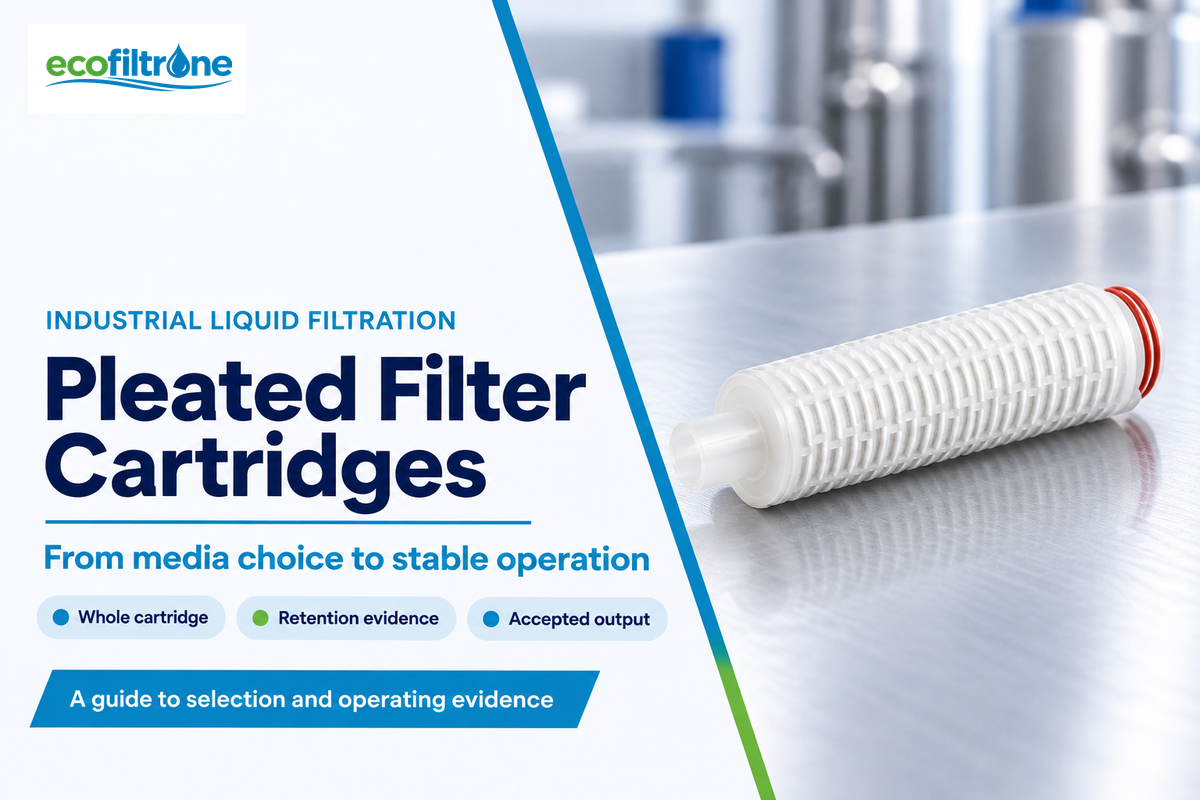
In a familiar-looking compact shape, Pleated Filter Cartridges pack filtration media into elements. That shape reveals little about whether a replacement will protect your process. Two cartridges can fit the same housing and bear the same micron label and still have different pressure drop, filtrate quality and run costs.
Pleated filter cartridges remove particles through folded porous media. Choose them by the complete cartridge, tested retention and operating duty. Hold quality criteria constant when comparing cost per accepted volume.
Quick selection facts
- Pleated describes construction; polypropylene, polyester and membrane describe different material or media attributes.
- More pleats do not automatically give better useful throughput.
- Pressure drop and downstream quality answer different operating questions.
- A compatible housing connection is only one part of replacement matching.
This guide covers industrial water and process-liquid filtration and explains how pleated cartridges work. It teaches how to evaluate evidence and interpret trials. For product families and application configurations, see the pleated filter cartridge solutions.
How Pleated Filter Cartridges Work
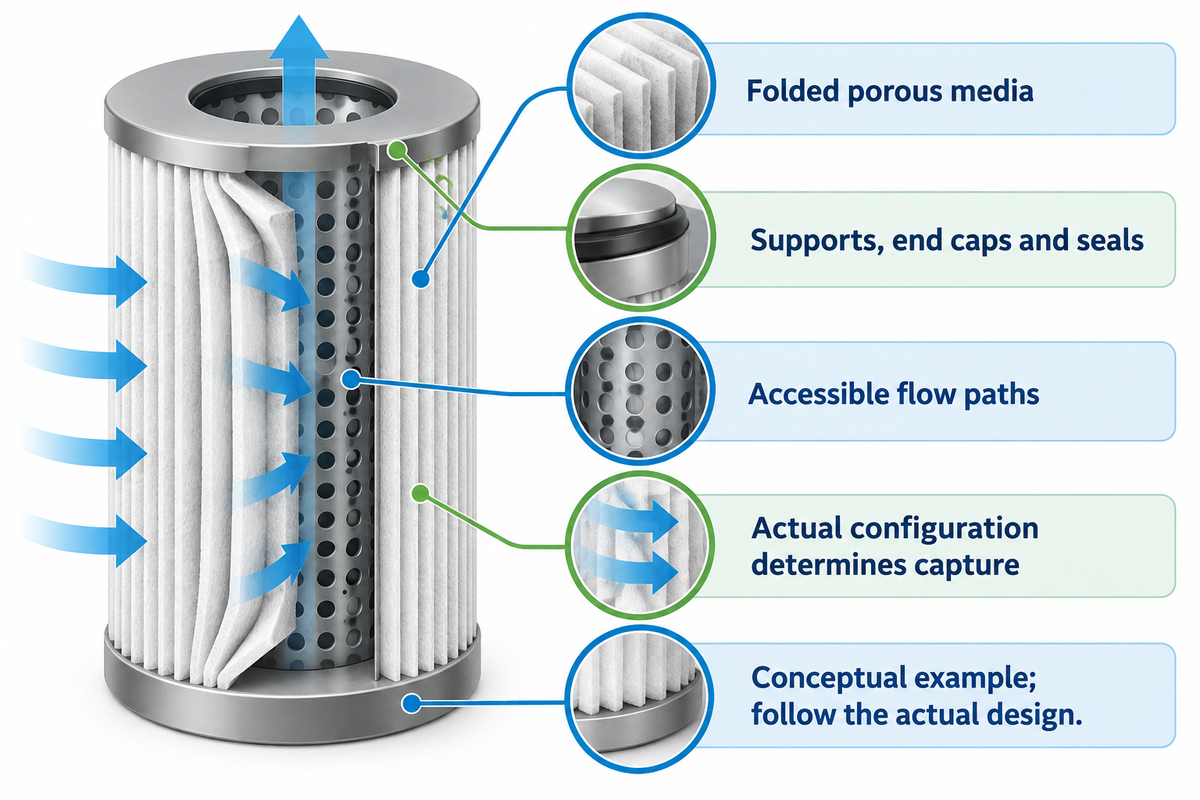
A pleated cartridge consists of a sheet or layered pack folded around a supporting core; pleated cartridge filters are made of pleated media. Liquid passes through the media, while the particles are retained in it or on the surface. The supports, end caps and seals help direct the liquid through the desired path. The pleated structure increases the surface area available within the cartridge envelope.
Particle capture can occur through the thickness of a fibrous medium or at a membrane’s filtration surface. As particles are trapped, resistance changes. Deposits trapped on the surface can form a cake; material captured deeper within the folds can also change loading behavior. The actual configuration determines which mechanism is predominant.
One of the advantages of pleated construction is its compact filtration area. For useful area to be accessible, flow paths are required. A crowded fold can obstruct a flow path and a larger surface area is useful only when the liquid reaches it under the intended duty.
Liquid passes through the pleated pack along its designed flow path. The surface of the filter is the feed location, while the filtrate is collected at the outlet. A larger filtration surface can reduce local loading only when flow distribution makes that area accessible.
The useful pleat count is “neither too few nor too many”.
The authors explain the mathematics of supported pleated membrane filters using specified fluid and fouling assumptions. Their findings illustrate a design trade-off, not a universal case for all cartridges. A 2001 Cuno patent disclosure also describes trade-offs between total area and upstream spacing which is contaminant dependent.
For an engineering comparison, the accepted output with required flow is termed as useful filtration performance. A claim of longer service life, to the extent that it’s made, ought to be evaluated with respect to the conditions of the test.
Pleated, Depth and Membrane Are Not Three Exclusive Categories
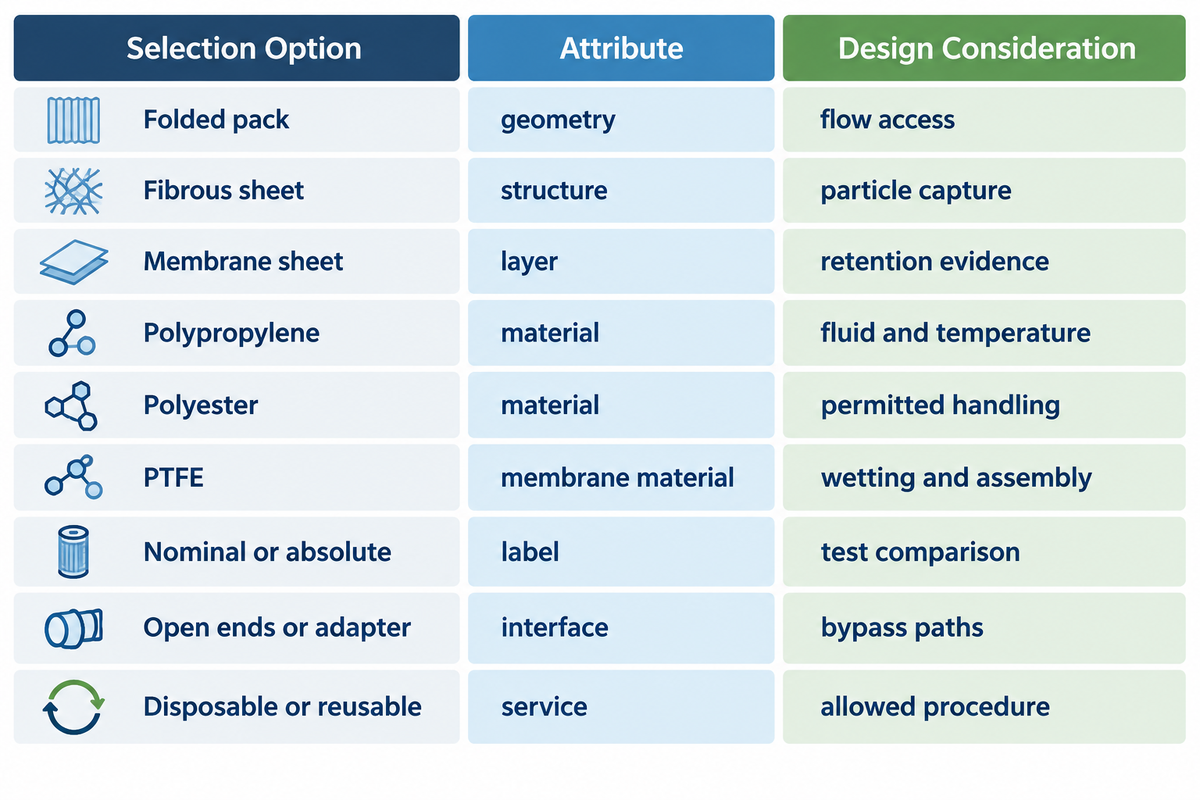
Pleating describes geometry, while depth filtration describes capture via a porous structure, and membrane describes a filtration medium. A membrane can be pleated and pleated fibrous depth products exist. Separate shape, media and intended task prior to comparisons of filtration efficiency, loading and maintenance.
The Map below separates decisions on geometry, media and intended use. A pleated design can package different media; a polypropylene cartridge can be pleated, melt blown or string wound. Comparing “polypropylene versus pleated” mixes construction and material, and can conceal performance differences.
Geometry, Media, Duty Map
| Construction or media type | Classification group | Decision it supports |
|---|---|---|
| Folded pack | Pleated geometry | Housing envelope and flow access |
| Fibrous sheet | Media structure | Loading behavior and particle capture |
| Membrane sheet | Porous separation layer | Application-specific retention and integrity evidence |
| Polypropylene | Material family | Fluid and temperature compatibility review |
| Polyester | Material family | Construction and permitted handling review |
| PTFE | Membrane material option | Wetting and complete-assembly compatibility |
| Nominal or absolute label | Supplier’s rating description | Retention-test comparison |
| Double-open-end or sealed adapter | Mechanical interface | Housing and bypass-path assessment |
| Disposable or reusable filter | Permitted service model | Replacement or validated cleaning procedure |
A buyer replacing a 5µm element should first preserve its required removal target and assembly fit. The capture mechanism is described in the depth-media selection guide.
Sediment filter cartridges are used in water treatment to reduce suspended material. A cartridge used as a solution for removing larger particles can have a different duty from a membrane that protects a sensitive final process. Various filtration tasks can be housed in a single format without a requirement for performance in common.
Choose Media Around the Liquid and the Whole Cartridge
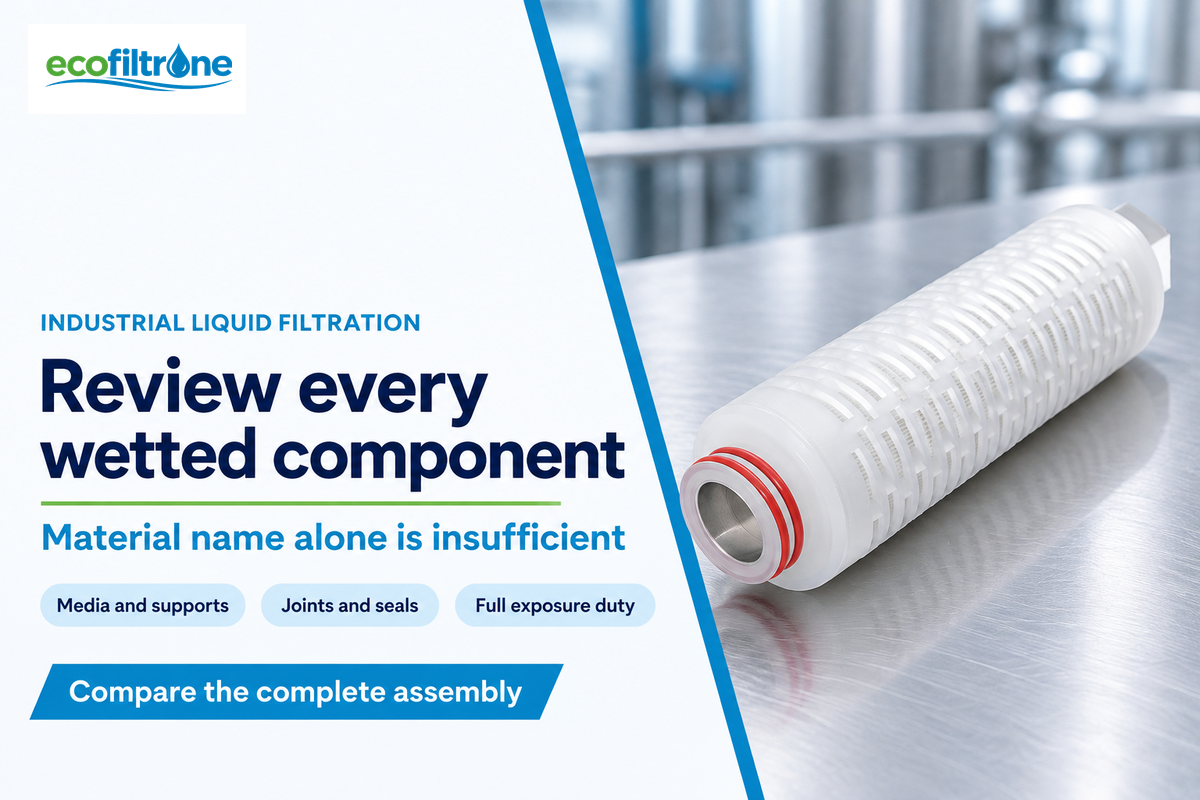
Select filter media based on the liquid’s chemistry, contaminant and operating conditions, and evaluate each wetted cartridge component. Supports, core, cage, bonded joints and seals can have different limits. The same is true for contact time and cleaning exposure, along with concentration and temperature. Physical durability and filtrate purity require their own acceptance criteria.
A pleated polypropylene filter is a candidate for particle-removal duties where its complete construction is suitable for liquid contact. Polyester, glass fiber, and membrane media provide other options. No material name alone determines compatibility. For media-specific questions, compare the polypropylene operating guide with the actual element data sheet.
Kappert and coworkers’ 2019 polymer-swelling research showed that quick exposures didn’t always explain longer-term behavior. This work studied the behavior of dense films for solvent nanofiltration. A quick material check shouldn’t be viewed as a lifetime qualification.
For sensitive process liquids, the question of what the cartridge may introduce to the filtrate adds to the uncertainty. ASTM D3861-22 addresses water-extractable matter in membrane filters. Its defined method helps to illustrate that media identity, source and lot can impact the purity of the fluid. Use relevant case studies and evidence for the application and the filtration system you are specifying.
Example: A team in procurement has two physically interchangeable cartridges for recirculating process liquid. One element runs at 20°C; the other will be exposed to 60°C during a planned cleaning cycle. Limited review of temperatures during normal production misses the exposure during the cleaning cycle. Engineering looks at seal and end-cap joints as well as supports at the cleaning concentration and contact time. Quality looks at filtrate purity as cartridges can remain intact while releasing soluble materials. This allows Procurement to evaluate candidates against one written duty instead of considering “same polymer” as an acceptable match. Neither temperature in this example is a recommended product limit.
For Procurement, a less expensive cartridge has little value if the seal or joint fails the agreed duty. Retain the complete bill of wetted materials with the selection record.
Buying high-quality pleated cartridges means specifying the outcome you need. For industrial filtration, this means achieving a stable fit and adequate retention while considering the exposure of the process liquid. The same review helps separate technically matched filtration solutions from a catalogue resemblance.
What a Micron Rating Does and Does Not Tell You
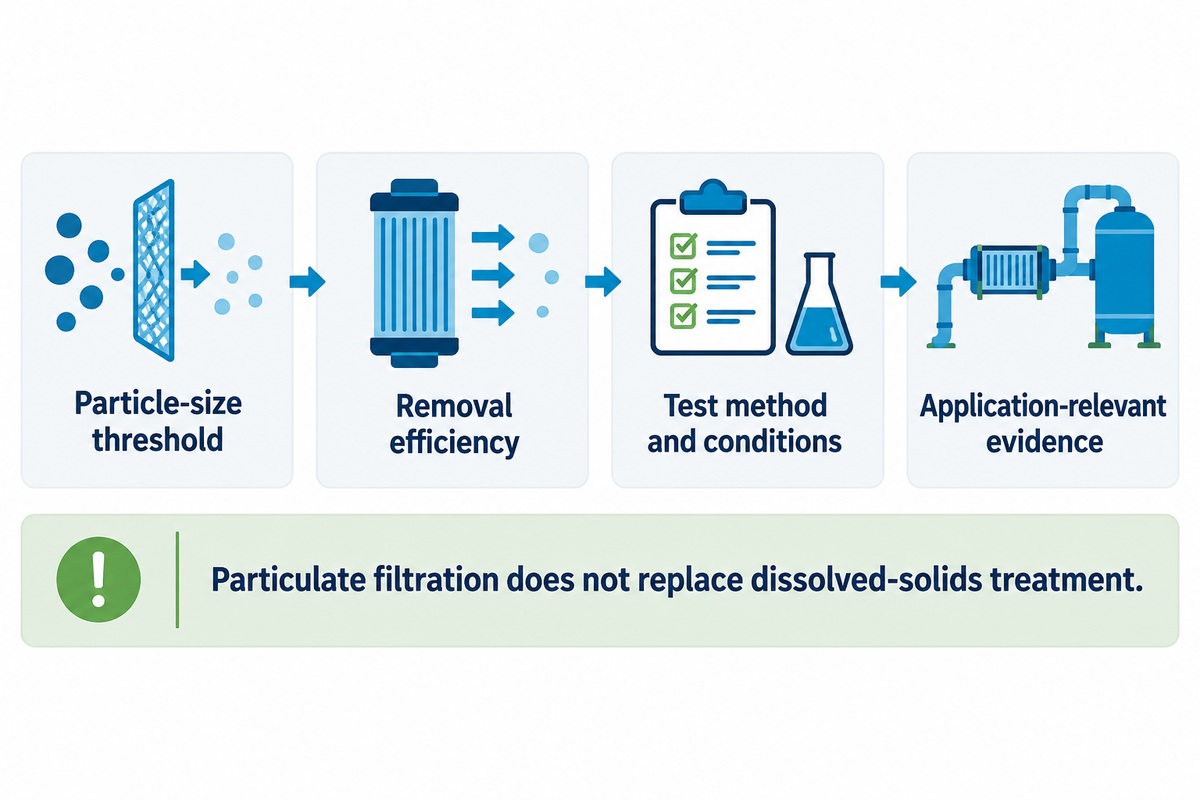
A micron rating can state a particle-size threshold; however, a useful comparison also states removal efficiency and the test method and conditions. A nominal or absolute description must be supported with a supplier’s number to state the basis for the claim. A complete element and its application must be considered instead of treating identical micron numbers as interchangeable filtration capabilities.
“Filtration accuracy” is a term often loosely defined in sales copy. Translate it into a measurable requirement. Which particles, at what size, at what removal level, under which test conditions? A label of 5µm and another of 10µm can start a discussion; neither label alone specifies your downstream water quality.
ISO 16889:2022 specifies a hydraulic-fluid-power multi-pass method that evaluates element removal, contaminant capacity and differential pressure under defined conditions. Relevant evidence demonstrates the test fluid and challenge method are to be reported with any measured result. An industrial water comparison still requires relevant evidence to support its liquid and required outcome.
Generic pleated sediment filters remove particles from water. Hardness and dissolved salts can require other treatment processes as the EPA treatment overview states. A fine filter used for particulate pretreatment won’t take over the function of reverse osmosis or ion exchange.
In a replacement review, compare the existing element’s tested retention with the candidate element’s tested retention, before adjusting the fineness. Moving from 10µm to 5µm can change resistance and loading without solving a dissolved-contaminant problem. The particle-count calculations and retention evidence go over comparisons and efficiency.
The accepted requirement by the quality team is an acceptable filtrate. A less costly or finer labeled cartridge enters the trial only when it meets the removal requirement.
High filtration efficiency is significant at a given particle size and test condition. In this regard, efficiency with flow rate and the permitted operating envelope should be taken into account. Larger filtration area can be used for resistance management, but doesn’t affect the contaminant being evaluated. Effective filtration starts with the required downstream outcome.
Read Pressure Drop Alongside Filtrate Quality
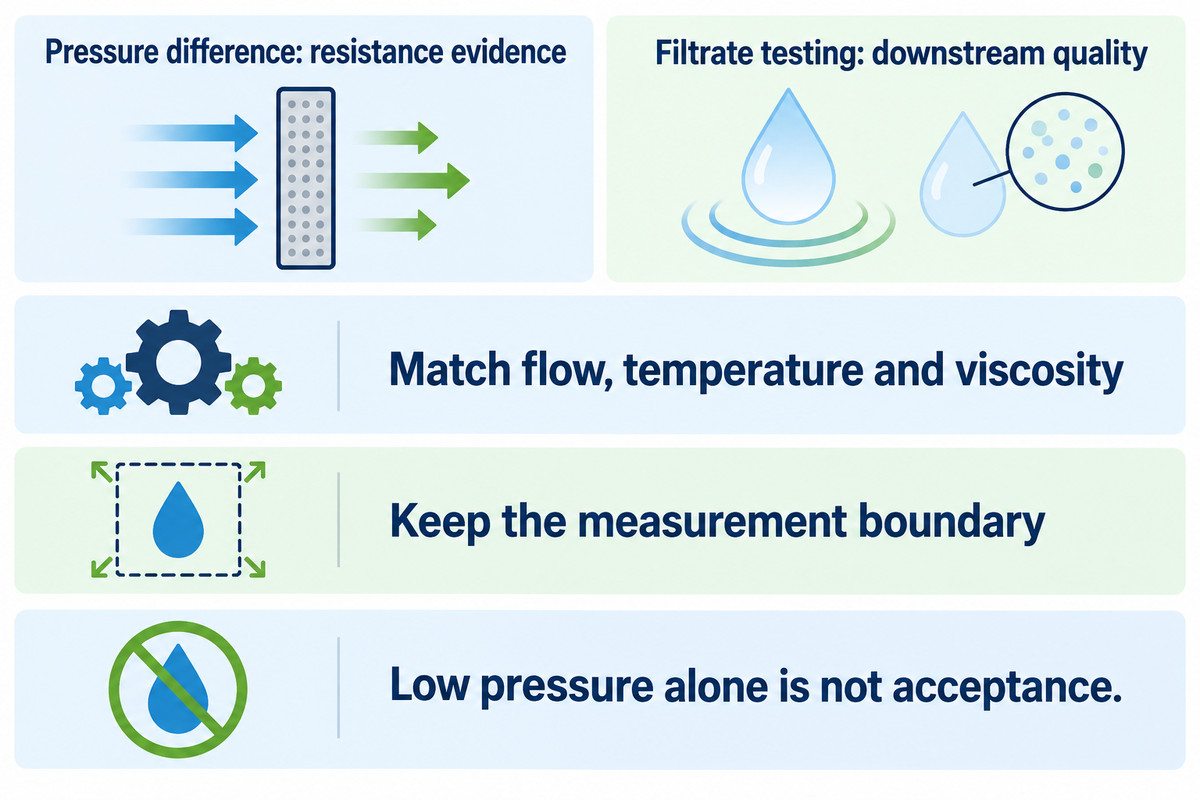
Differential pressure, measured across two pressure points, is one way to determine resistance. Filtrate testing can determine what passes downstream. Read both at similar flow, temperature and viscosity. A high pressure drop can indicate loading, but changing the duty or a test instrument can also affect the reading. A low reading alone is not an acceptance result.
Water pressure at the inlet is different from pressure loss across the filter housing. Note the measurement locations upstream and downstream, as well as if the curve includes the housing or only the cartridge. ISO 3968:2017 provides a hydraulic-filter pressure-versus-flow method that explicitly considers flow, viscosity and assembly components.
Example: a process-water line records 0.15bar clean differential pressure at 20m³/h and 20°C. After a feed change, the differential pressure reading increases and flow increases to 25 m³/h. The operator first records the new temperature, checks both instruments and compares a matched-flow reading with the baseline. If filtrate quality remains acceptable, the team can investigate loading and duty effects without calling the pressure change a proven media failure. If filtrate quality deteriorates and the pressure reading falls, the team must consider seals, installation, and unintended flow paths. Operations holds a quality point while Engineering investigates the cause; Procurement doesn’t order a larger cartridge, solely to suppress a gauge reading.
For a fair 20 m³/h comparison, the same pressure measurement boundary is used, and the temperature is recorded for each reading. Comparing one element’s clean-water curve with another element’s loaded process-liquid reading confuses two different tests. A pressure log is useful only when quality results and duty travel together.
Water filtration systems can face different filtration requirements during startup and steady production. An efficient filter must meet those requirements at the needed output, rather than merely showing low resistance. A low pressure reading with unacceptable filtrate means poor operating performance, even when pumping energy is falling.
Reliable and efficient filtration means accepted output with predictable changeouts and measured resource cost. Correct seating and intact seals help ensure that pleated media receives the intended flow rather than allowing an unintended path around it.
When to Replace, Clean or Investigate
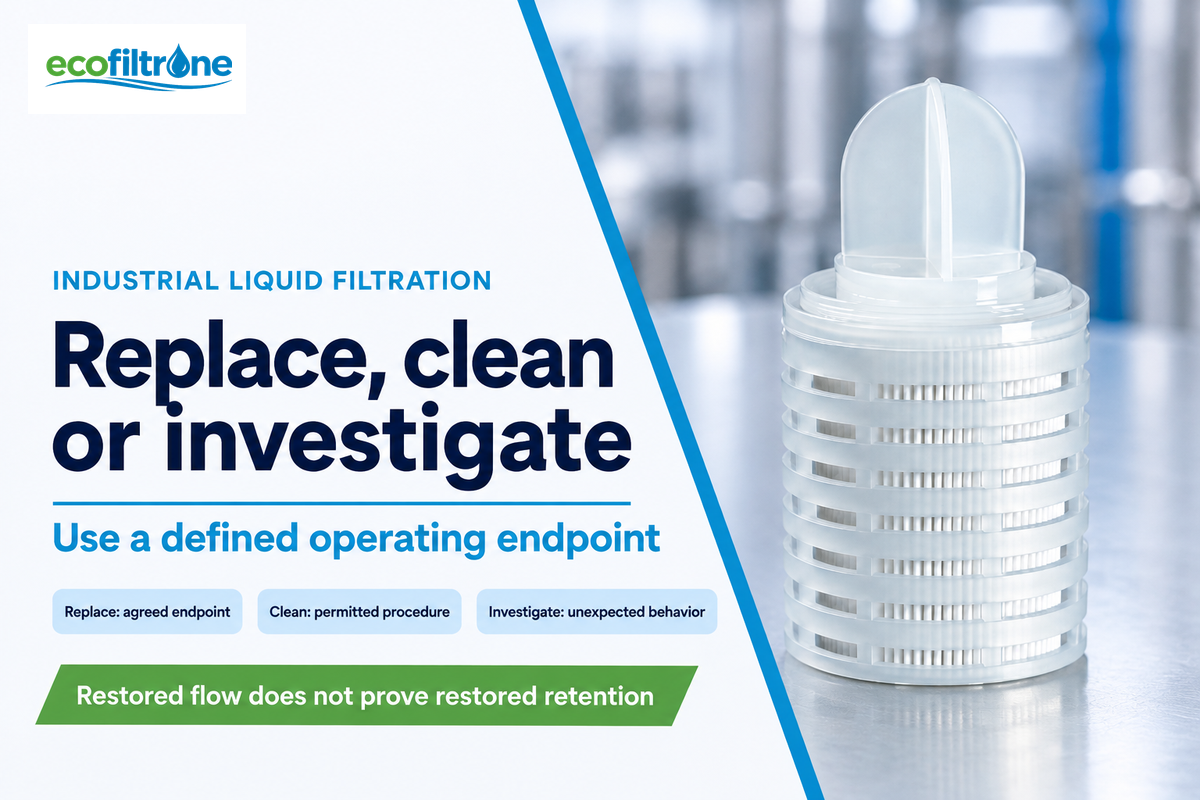
Replace a cartridge when the agreed end point of product or process is reached, and investigate if unexpected quality or pressure behavior occurs prior to accepting the resumption of production. Only clean a cartridge which is designed for a defined cleaning procedure. Visibly clean surfaces don’t establish sanitization, solids removal and restored retention.
Some pleated water filter cartridges are marketed as washable while others are replacement consumables. A pleated water filter used in industrial production needs its own allowed procedure that defines chemistry, temperature, and the handling of the pack, and the endpoint for return to service. Brushing, pressure washing or backwashing an unsuitable pack can alter the pleated filter media or seals.
Industrial pretreatment also has quality issues beyond sediment. A 2019 seawater-pretreatment study by Dehwah and colleagues showed that there was microbial regrowth within the cartridge-filter stage. For a process sensitive to biological fouling, include the relevant microbial endpoint in the operating plan. A particulate rating isn’t a substitute.
Do
- Trend pressure at comparable duty.
- Track the agreed filtrate-quality endpoint.
- Follow the exact element’s service procedure.
Don’t
- Infer retention recovery from restored flow.
- Copy a cleaning recipe from another medium.
- Extend a run after its quality endpoint fails.
For an operator, regular replacement means responding to the need in a controlled manner, not reacting as an arbitrary monthly ritual. Replacement frequency changes with feed conditions and accepted output. If procurement wants fewer changeouts, compare dirt-holding capacity and usable run volume under matched conditions before promising a longer interval.
Cartridge replacement ensures that a spent disposable element is removed from service; correct installation and an accepted startup result complete the return to production. Review the schedule depending on water quality and usage including any changes in feed loading or operating hours.
Compare Cost per Accepted Volume
Compare the total cost of filtration with the volume that meets the same agreed quality. Consider cartridge purchase, energy, labor and relevant disposal or downtime costs. A long run is valuable only while its filtrate is acceptable. Consider cost differences with respect to trial uncertainty and operating constraints. For a PP-specific worked comparison using this accepted-volume method, see the PP cartridge cost analysis.
Nadia M. Farhat and co-authors’ 2020 Dhekelia desalination-plant study evaluated seven pleated high-flow cartridge types based on produced quantity, quality and cost. The study was funded by Caramondani Desalination Plants Ltd. and KAUST. The historical plant conditions and the assumed inputs, which are described below, are separate.
The researchers collected 1 month of measurements from vessels containing seven same-type elements, with flow capped at 350m³/h. The cost model relied on both actual plant outputs and water quality observations. Cost models unique to other plants require a representation of the plant operating record.
Accepted-Volume Break-Even Test
Total included run cost ÷ accepted run volume = cost per accepted m³. Apply the same cost and quality boundaries for both the candidates evaluated.
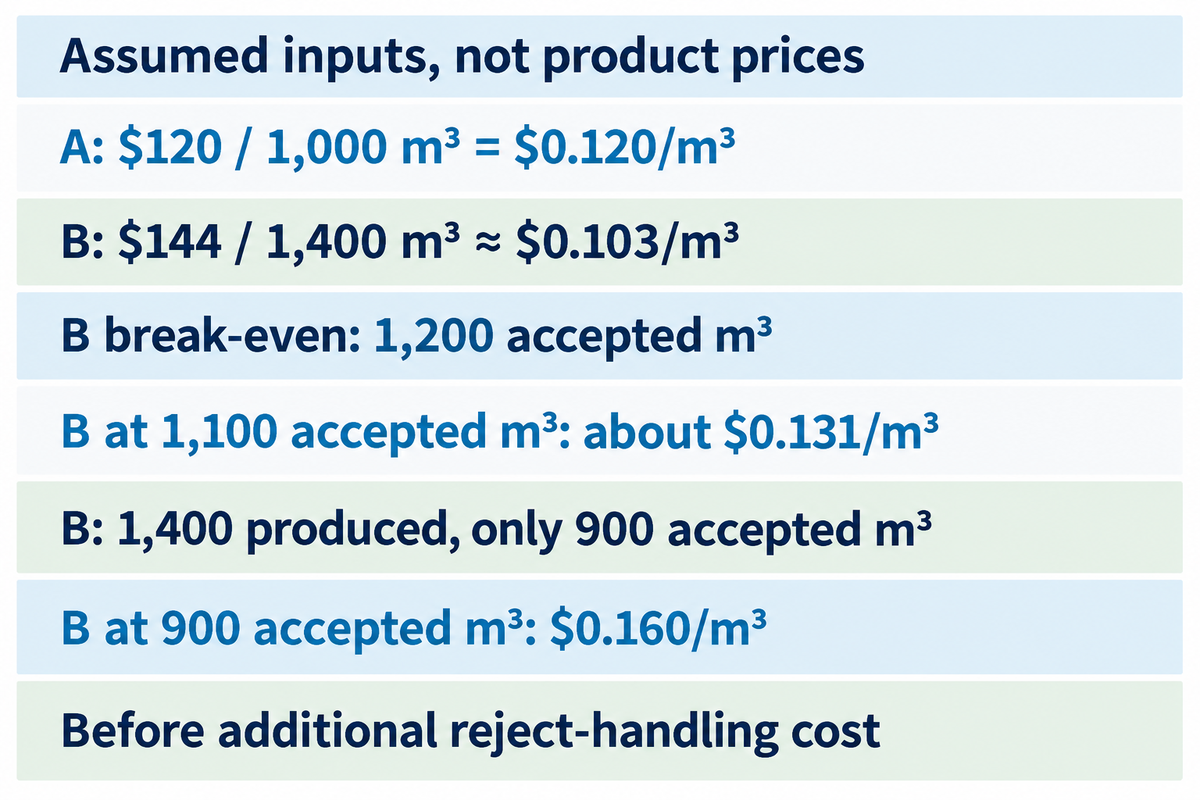
Assumed inputs: cartridge A costs $60, with $20 changeout labor, $10 disposal and $30 energy over 1,000m³ of accepted output. Its total is $120, or $0.120/m³. Cartridge B costs $90, with the same labor and disposal costs and $24 energy over 1,400m³. Its total is $144, or about $0.103/m³. B costs more to buy but less per accepted volume under these assumptions.
The break-even volume for B is $144 ÷ $0.120/m³ = 1,200m³. If B delivers only 1,100m³ of accepted output, its cost rises to about $0.131/m³ and A wins. If B produces 1,400m³ physically but only 900m³ meets the quality requirement, its cost is $0.160 per accepted m³, before any additional reject-handling cost.
This creates a concrete situation before operations and finance. B has to produce enough quality-qualified output to cover its cost. A small apparent advantage inside measurement or feed variability of the trial is reason for more analysis and not for automatic spec change. For cost-effectiveness, accepted output is more important than the price of the cartridge.
Efficient filtration balances accepted output with the resources consumed. Pleated cartridges offer a compact way to package media; the trial determines whether that construction pays off in your process. For this decision, optimal filtration means meeting the fixed quality target at a suitable operating cost, not pursuing one maximum specification.
Build a Trial That Can Support a Replacement Decision
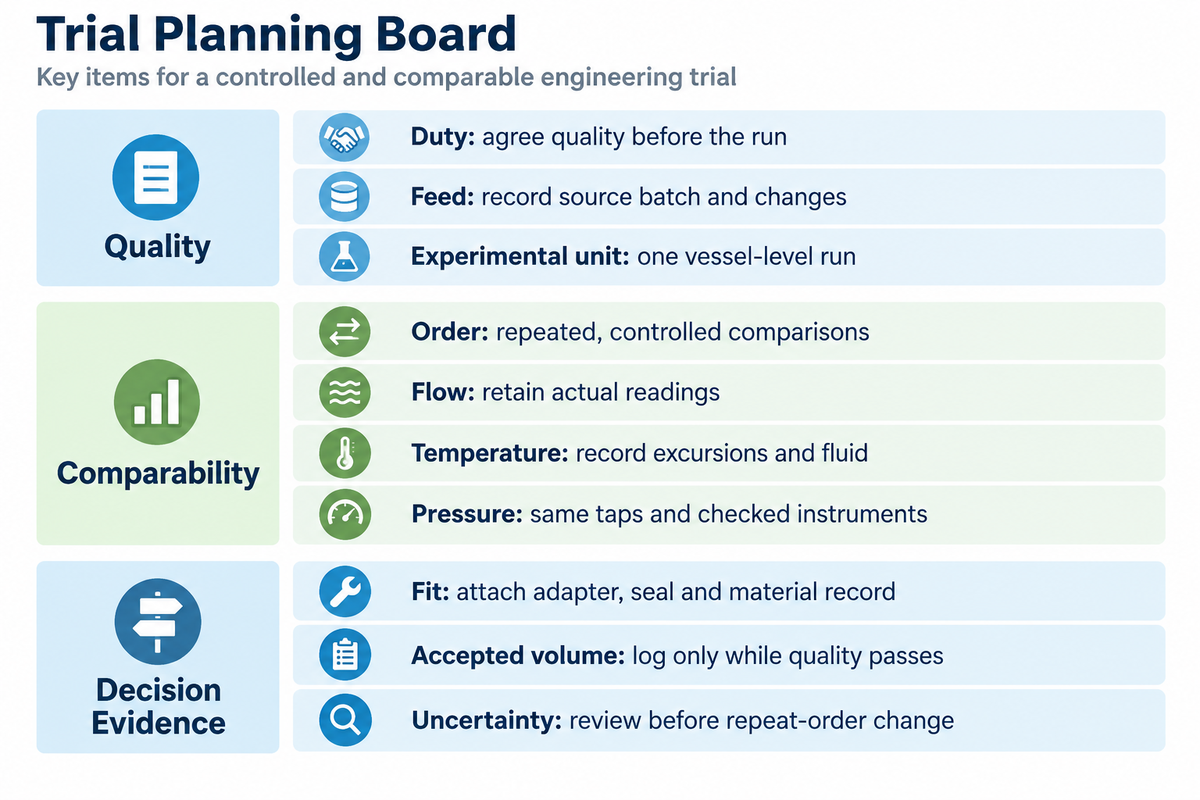
A useful replacement trial evaluates candidates under representative feed and duty and defines the target performance output before the trial. Record and investigate uncertainty. Identify the unit receiving each cartridge type, control run order or feed-batch effects and repeat comparisons to differentiate normal variation from a real difference. Separate mechanical fit from performance acceptance. For high-flow elements, extend this screening with the high-flow qualification record.
The principles of replication and randomization discussed in the NIST experimental-design principles, when applied to cartridge trials, indicate that several elements sharing one vessel and one combined outlet are not automatically several independent experiments. A vessel-level run, feed history and measurement system are part of the trial comparison.
Represent the geometry too. A.I. Brown’s 2011 UCL research on pleated membrane scale-down found differences between flat-sheet and cartridge behavior in its tested water and protein-solution systems. A small flat-sheet screening test can help evaluate media, while the intended cartridge construction still needs a representative assessment.
| Record | Example entry | Decision affected |
|---|---|---|
| Duty and accepted quality | Process-water particle target agreed before the run | Quality endpoint precedes cost ranking |
| Feed identity | Same recorded source batch; note any change | Separate cartridge effects from feed variation |
| Experimental unit | One vessel-level run per treatment observation | Avoid counting shared cartridges as independent runs |
| Order and repetition | Plan repeated comparisons with order/feed effects controlled | Assess repeatability rather than one favorable run |
| Flow | 20m³/h target, actual readings retained | Compare matched hydraulic duty |
| Temperature and viscosity | 20°C baseline; record excursions and fluid identity | Interpret resistance consistently |
| Pressure measurement | Same upstream/downstream taps; instrument checks recorded | Keep assembly losses and measurement error visible |
| Fit and construction | Adapter, seal, length and wetted-material record attached | Control physical replacement differences |
| Accepted volume and costs | Log output only while all acceptance criteria pass | Calculate cost using the correct denominator |
| Uncertainty and disposition | Review variable results before changing repeat-order specification | Distinguish screening from a supported replacement decision |
Technical package: gather relevant application document(s), retention-test basis, pressure-flow curve, wetted material list and datasheet for procurement. Specify exact product, certificate holder and scope for evidence of compliance. ECOFILTRONE supports application review, specification matching and customized configuration using the operating requirements supplied by the customer.
Write specific filtration requirements in the trial plan and compare offers. A change in filtration needs can justify a new medium or staged pretreatment, while a packaging change alone may not. Keep repeat order acceptance criteria.
What Is Changing in Industrial Filtration
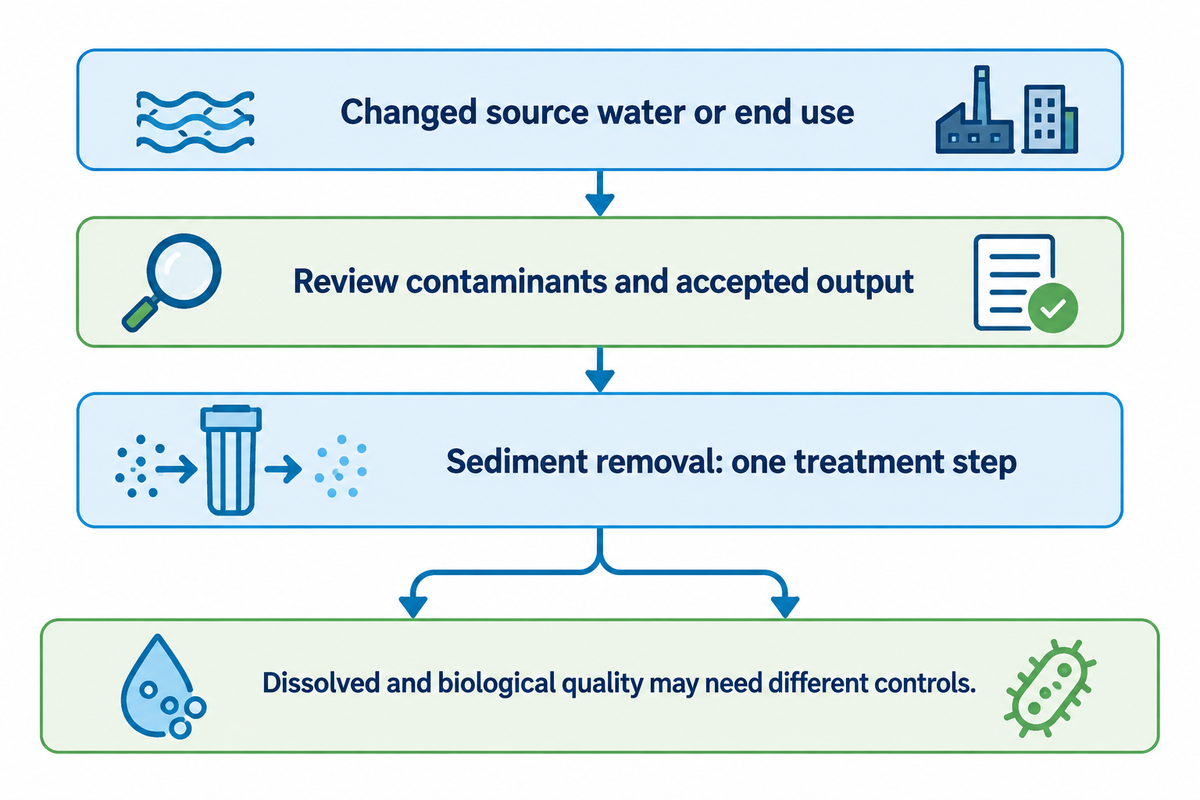
Changed water sources and water reuse can modify the filtration task even if the housing remains the same. Review contaminants and accepted output criteria when a process changes. EPA’s water-reuse guidance ties treatment and monitoring to source and intended use, which makes an old cartridge specification worth revisiting after a duty change.
The EPA reuse overview, updated in October 2026, provides that context. For a plant introducing reclaimed water, sediment removal may be one of the steps in a treatment train. In addition, dissolved contaminants and other application-specific biological quality may require different controls.
Key takeaway
Keep the accepted-output requirement fixed when comparing cartridges. Match the full construction and duty, then compare quality-qualified run volume and total cost. Reopen the selection when the feed or end use changes.
Questions About Pleated Filter Cartridges
What is a pleated type filter?
How the folded element works
A pleated filter contains porous material folded into a compact element. The folds provide filtration area, while the material and its tested retention determine what’s captured. In an industrial liquid line, the complete cartridge also includes supports, seals and end caps. The pleated shape alone doesn’t establish removal efficiency, chemical compatibility or a permitted operating temperature.
What is the difference between pleated and string wound sediment filters?
Construction and capture mechanism
Pleated describes folded sheet construction, while string wound describes yarn wound around a core. Both need a defined removal requirement and suitable materials. A wound element can capture particles through its depth; a pleated element may use fibrous or membrane media. Compare actual retention, loading and pressure loss under your duty rather than assuming one construction always performs better.
Can pleated filters be cleaned and reused?
When reuse is appropriate
Only when the exact cartridge is designed for it and its supplier permits a defined procedure. A rinse that restores flow doesn’t prove the original filtration performance has returned. Cleaning chemicals, temperature and mechanical handling can affect the media, joints and seals. Sanitization is also different from removing deposited solids. Replacement remains the appropriate route for elements specified as disposable.
How often should a sediment filter be changed?
Operating endpoints for replacement
Use the product’s permitted operating limits and your process quality endpoint. Record changing pressure loss at comparable flow and temperature. A fixed calendar interval can’t account for changes in solids loading, fluid properties or filtration demand.
How do I pick the right pleated filter cartridge?
A practical selection sequence
Begin with the contaminant and required downstream quality, then document the fluid, concentration, flow range, temperature and housing. Compare the entire cartridge construction, including seals and supports, against those conditions. Match retention evidence to the particle threshold and test method, and review a pressure curve with its test fluid stated. Confirm physical fit separately from performance. Before changing a repeat-order specification, compare the candidate with the existing element under representative conditions, control feed and order effects, and agree on quality acceptance. Review uncertainty before treating a small observed difference as a dependable improvement.
Does a finer rating always mean a better filter?
Fineness and the actual removal task
No. It must serve the required removal target without creating an unsuitable operating burden. A finer label alone doesn’t prove higher useful retention, better compatibility or lower cost.
Turn the Operating Requirement into a Cartridge Specification
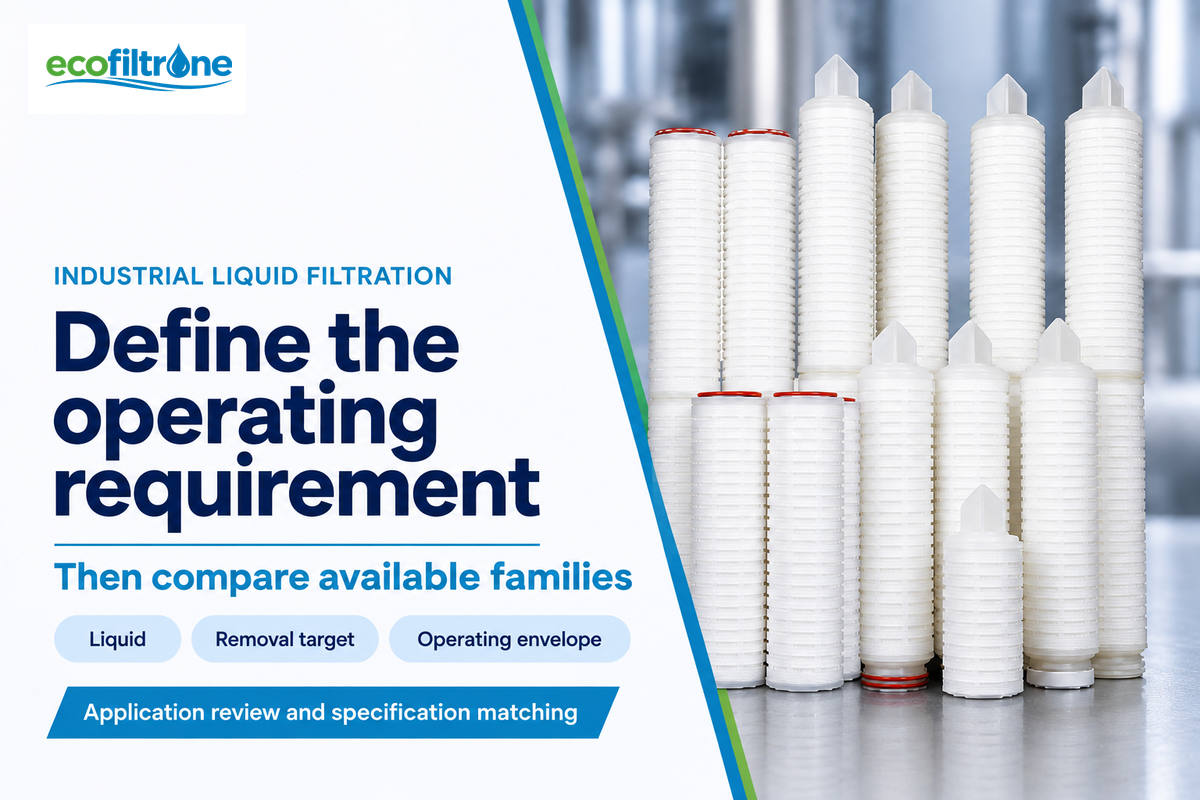
Use the guide to define your liquid, removal target and operating envelope. Then compare available families on the ECOFILTRONE solution page. Our engineering support can help with specification verification, replacement matching and trial configuration.
Technical scope: industrial waters and process liquids filtration. Named case studies retain original media, fluids and operating conditions. Examples use assumed case conditions. Product operating restrictions, compliance and evidence are for the specified cartridge and use.
References & Sources
- US EPA, IWTT treatment-technology descriptions: suspended-solids filtration context.
- Persaud et al., pleat packing density and cartridge geometry model, Fluids, 2021.
- Farhat et al., cartridge selection and replacement: quantity, quality and cost, Desalination, 2020.
- ISO, ISO 16889:2022 and ISO 3968:2017, public catalogue abstracts.
- ASTM, D3861-22 water-extractable matter in membrane filters, public scope and significance.
- Kappert et al., polymer-swelling study, 2019; university-hosted original abstract.
- NIST, experimental-design principles and experimental-unit terminology.
- Brown, A.I., pleated-membrane cartridge scale-down research, UCL doctoral thesis, 2011.
- Dehwah et al., microbial assembly and seawater pretreatment study, 2019; university-hosted original abstract.
- US EPA, treatment-technology overview and water-reuse overview.
- Filtration + Separation, Factors to consider in liquid filtration, 2015; qualitative cost and selection framework.
Related Articles
Filtration selection brief
Bring the operating details that shape the next conversation
Record what is known from the line or process. A complete specification is not required to start.
Useful inputs
- Fluid and processFluid name, process stage, and any compatibility concern.
- Filtration targetRequired result, existing rating, or the issue to solve.
- Flow and run timeTypical flow range, batch size, or expected service interval.
- Installation conditionsHousing or connection details, temperature, pressure, and available space.
Next step
Send the details you have
Use the inquiry form to start a focused discussion and add drawings or photos when they help explain the installation.
Start an inquiry