Get in touch with ECOFILTRONE™ Company



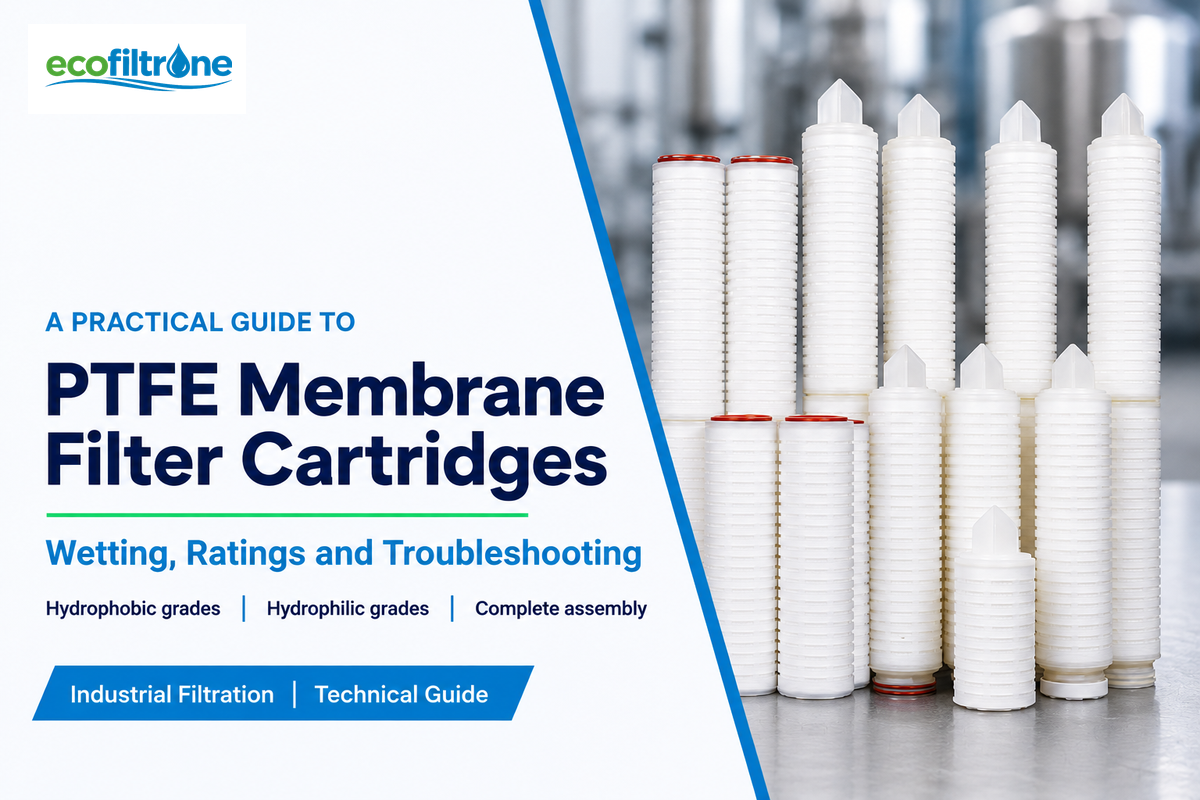
PTFE Membrane Filter Cartridges use porous polytetrafluoroethylene to separate particles from a liquid or gas stream. The distinctive feature of hydrophobic grades is the membrane’s water repelling surface. This surface property can be of great help in the cases of dry gas services, but can hinder aqueous flow. Understanding this behavior can simplify the selection and troubleshooting of problems.
Updated October 2026 · By DD
PTFE Membrane Filter Cartridges combine a porous fluoropolymer membrane with cartridge hardware and seals. Hydrophobic grades resist water entry; hydrophilic grades accept aqueous flow. Match the membrane treatment, complete assembly and retention test to the process.
Quick guide to the terms
- PTFE: the membrane polymer, not the complete cartridge construction.
- Hydrophobic or hydrophilic: the wetting behavior of the specified membrane grade.
- 0.2 or 0.22 µm: a stated pore rating that must be read with its retention method and application.
- Operating limit: the permitted combination of temperature, pressure direction and exposure time for the finished filter.
A vent filter that stops passing air after condensation and a new liquid filter that will not pass water can have different problems. Neither of these conditions automatically means the pores of the cartridge are clogged with dirt. Start with the process phase and wetting state, then compare operating readings under matching conditions.
What are PTFE membrane filter cartridges and how do they work?
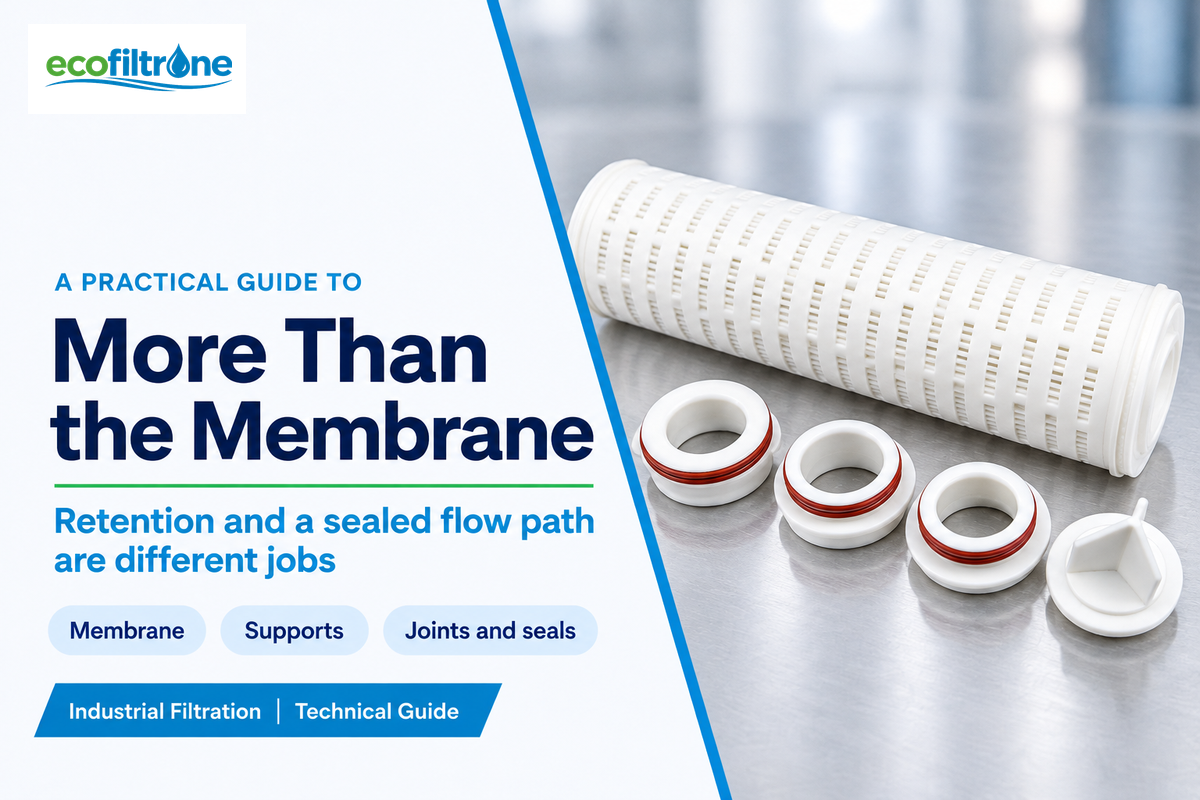
A PTFE membrane cartridge filter consists of a porous membrane that’s supported in a replaceable cartridge, and has a pleated structure that provides filtration area in a compact housing. The support layers, joints and seals help keep the fluid on the desired path.
The hardware maintains the flow path. If the end-cap joints are damaged or if a gasket isn’t properly seated, this can result in a flow path bypassing the membrane media.
Process membrane cartridges are different from dust-collector-cartridges. Dust collector cartridges are designed to separate particulate laden air using a different structure and housing, and have a different duty-cycle for cleaning. A dust-filter pulse-cleaning instruction is not a cleaning procedure for an industrial liquid membrane cartridge.
Polypropylene, most commonly PP, appears in some cartridge cores, cages, and supports. Other designs employ different kinds of materials. An O-ring made from silicone or other elastomers has its own limits with regard to fluids and temperatures. The word PTFE on a label, therefore, only partially addresses the compatibility question.
Liquid filtration and gas filtration also put different kinds of demands on the same kind of porous structure. A dry, water-repellent membrane can pass process gas while resisting aqueous liquid entry. A liquid duty needs a membrane and a preparation route that allows the intended liquid to enter the pores. ASTM F838-20 addresses bacterial retention in liquid membrane filtration; it is a different question from whether a cartridge fits and seals inside a housing.
Key takeaway
A 0.2 µm membrane and a correctly sealed cartridge perform different jobs. Evaluate retention and the complete flow path together before changing a filter rating.
Why does hydrophobic PTFE resist water?
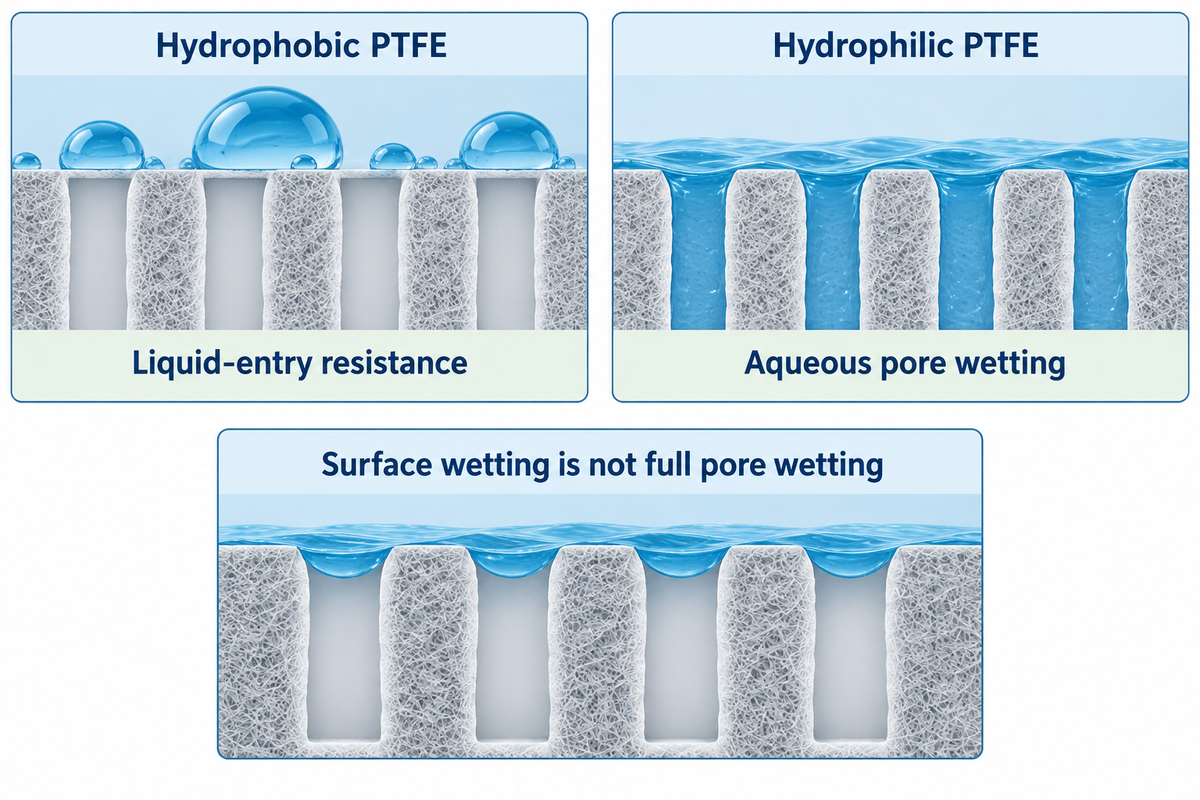
Hydrophobic PTFE resists water, because water doesn’t easily spread into low-energy porous structures. Filling the pores requires overcoming a liquid entry barrier. Surface treatment can make a PTFE membrane hydrophilic, and change its aqueous wettability, without making every finished cartridge of the same chemical and operating grade.
Wetting and chemical compatibility address different questions. A hydrophobic PTFE membrane can tolerate contact with water yet resist water flow when dry. Conversely, a low-surface-tension liquid can enter the pores readily while attacking a support material or seal. Check the membrane treatment and the entire assembly to decide if a solvent is acceptable.
Original PTFE capillary membrane research published in 2023, identifies surface wetting and wetting through the membrane wall. The study concerns membrane distillation, so its cleaning results and operating values are not cartridge preparation instructions. That distinction explains why a visible wet surface does not necessarily mean every pore is liquid-filled.
PTFE Phase-and-Flow Map
The PTFE Phase-and-Flow Map links the process phase and the state of membrane wetting to the first useful operating check.
| Duty or observed state | Mechanism to consider | First useful check |
|---|---|---|
| Dry gas through dry hydrophobic PTFE | Open gas pathways | Required gas flow and pressure basis |
| Water against new dry hydrophobic PTFE | Liquid-entry resistance | Correct grade and approved conditioning route |
| Water through hydrophilic PTFE | Aqueous pore wetting is intended | Grade identity, trapped gas and installation |
| Solvent through hydrophobic PTFE | Fluid-specific pore entry | Full formulation and assembly compatibility |
| Changing solvent/water mixture | Changing surface tension and viscosity | Composition at start, transition and finish |
| Condensate on a gas filter | Liquid covers part of the gas path | Drainage and permitted thermal arrangement |
| After liquid-based integrity testing | Liquid remains in pore pathways | Validated return-to-gas preparation |
| After approved cleaning | Residues or altered wetting state | Rinse endpoint and applicable integrity check |
| Liquid containing surfactants | Wetting behavior can change | Complete formulation and operating exposure |
For a new aqueous duty, use a hydrophilic grade when direct water wetting is required, or use the specific hydrophobic cartridge and its approved conditioning procedure. Don’t increase process pressure to force dry membrane to pass water. Laboratory syringe-filter solvent recipes are sized and qualified for different devices.
A 2024 capillary PTFE modification study illustrates how treatment changes water wetting. Specimens modified by treatment are a part of this study and not all hydrophilic PTFE products. For making a purchase decision, qualified fluid exposure and treatment should be ascertained and not ordered just by the name of the polymer.
Where are PTFE filters used, and where do they not fit?
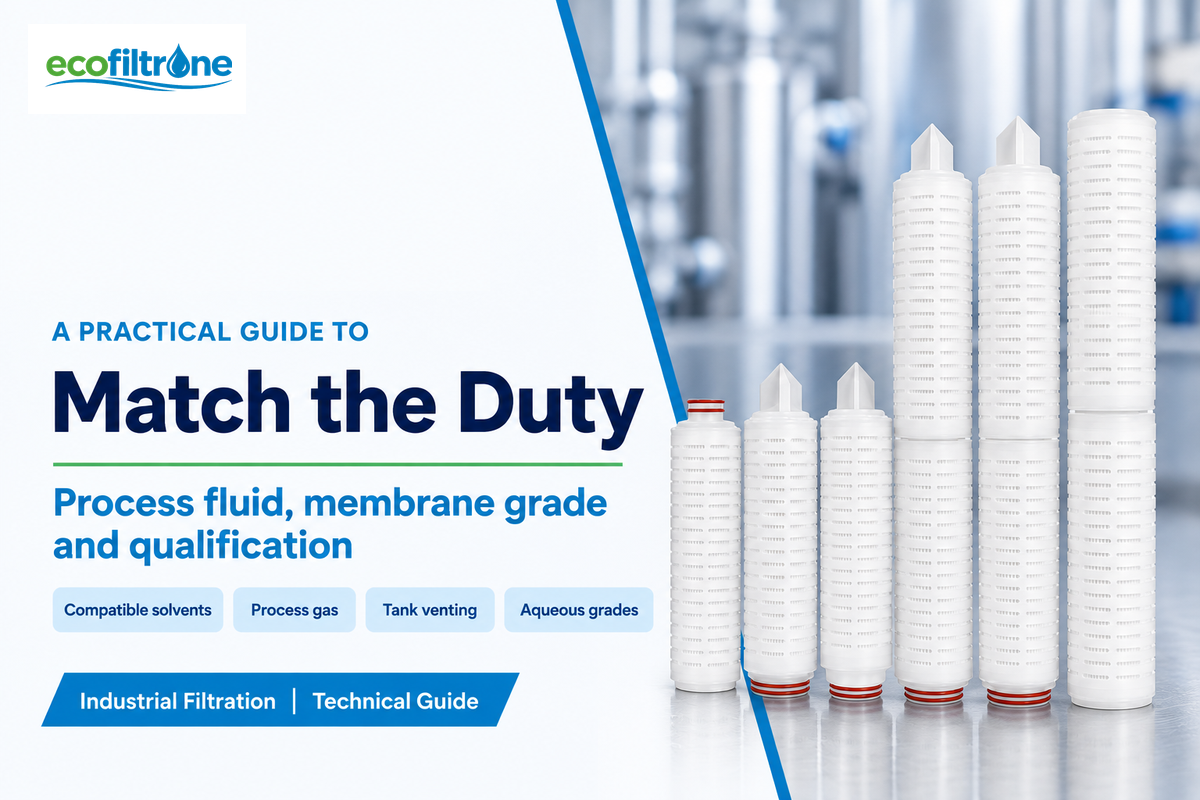
PTFE filters are used in compatible solvent filtration, process-gas filtration and tank venting. Hydrophilic grades allow the material to be used in aqueous media. The useful choice is the grade that meets the fluid, purity and retention requirement without adding an unsuitable conditioning step or creating an unnecessary pressure burden.
What are PTFE filters used for?
PTFE filters remove particles from compatible process streams and, in appropriately validated grades and systems, support microbial control. Chemical processing, fermentation gas supply and high-purity manufacturing are a few areas of application. Pharmaceutical or biotechnology service adds qualification requirements beyond the general material choice; a water-treatment prefilter and a final sterile filter have different acceptance endpoints.
For semiconductor production and for microelectronics and flat panel or LCD processes, trace contamination may be as important as particle counts. Assess the filter’s cleanliness, extractables and fluid contact materials, including any point-of-use quality requirements. A clean room packaging claim doesn’t address these process concerns.
Tank breathing is another unique task. Condensate collecting on a hydrophobic vent filter can restrict gas flow even while the membrane continues to repel water. Protective gas filters can also suffer from this problem. Jens Meyer’s 2012 article in BioProcess International outlines this problem. The physical lesson is useful; the small filter’s numerical flow performance should not be transferred to a plant vent.
PTFE is often an unnecessarily demanding choice for bulk dirt removal from ordinary water. An appropriate depth filter or a PP pleated prefiltration stage can resolve upstream solids before a fine membrane. Consider the contaminant and the quality of the filtrate required before choosing a membrane of a grade not necessary to the duty.
PTFE vs PVDF, PES and nylon: what actually changes?
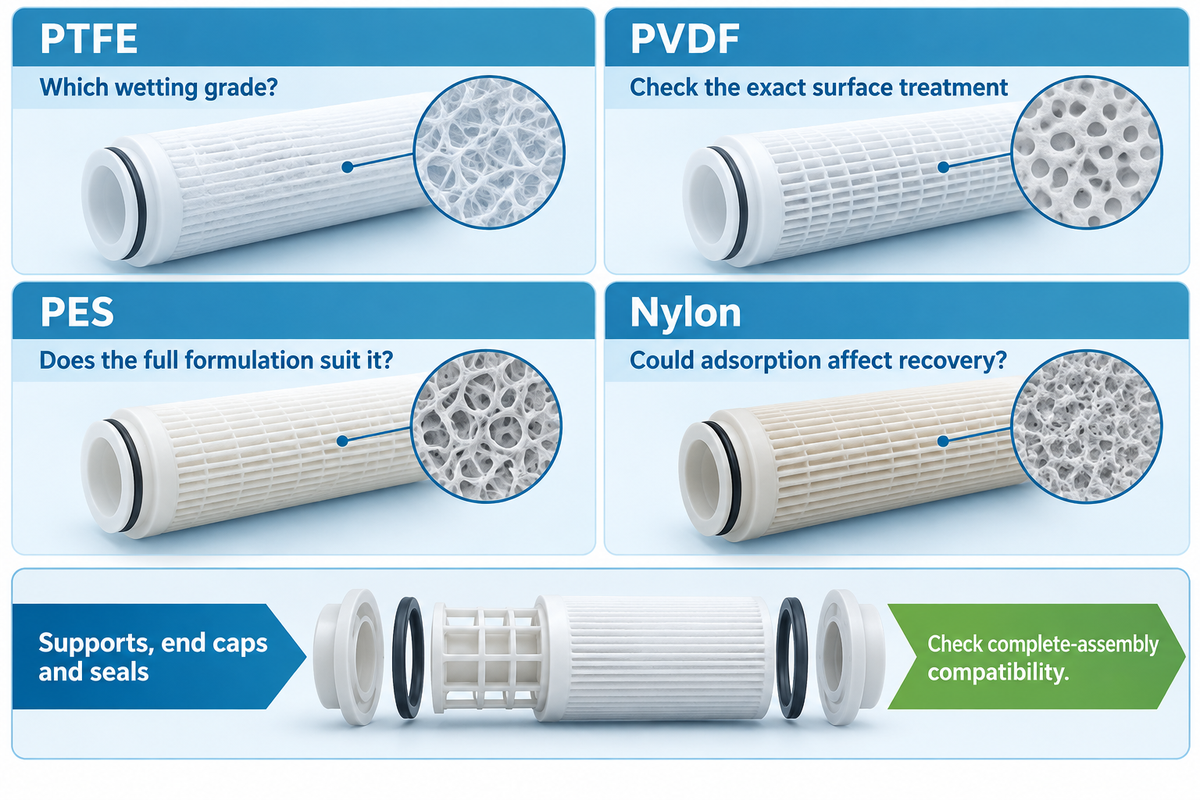
PTFE, PVDF, PES and nylon have different behaviors with regard to wetting, and interaction with the fluid and the product filtered. Surface modification and the final construction of a product can alter these tradeoffs. When comparing a grade of polymer with regard to interaction with a fluid, and quality end-point, contamination and recovery are better considered; a polymer-only ranking leaves important factors out.
What is the difference between PTFE and PVDF filters?
Untreated PTFE is very water-repellent; PVDF is provided in grades with different surface treatments and wetting behavior. Both materials find application in filtration, but the suitability for a particular solvent, aqueous mixture or biological product should be evaluated at grade level. Neither of the names settles adsorption, extractables or seal compatibility.
Kalmykov and co-authors’ 2023 study on membrane-contactor studied porous PTFE, PVDF, PES and nylon samples under exposure of defined Amine solutions. The samples showed different behaviors. The results highlight the importance of testing the actual chemistry as part of cartridge evaluation rather than assigning a universal material hierarchy to a finished cartridge.
| Material or construction choice | Useful starting point | Question that changes the choice |
|---|---|---|
| Hydrophobic PTFE | Dry gas or compatible solvent | Will an aqueous step require conditioning? |
| Hydrophilic PTFE | Direct aqueous wetting | Is the surface treatment suitable for the fluid? |
| Hydrophilic PVDF membrane | Aqueous process filtration | What are the exact grade’s binding and chemical limits? |
| Hydrophobic PVDF membrane | Grade-qualified gas duty | How is wetting and return to service controlled? |
| PES membrane | Aqueous filtration | Does polyethersulfone suit the full process formulation? |
| Nylon membrane | Compatible analytical or process liquid | Could product adsorption affect recovery? |
| PP support and end caps | Structural support | Do hardware limits cover operating temperature? |
| PFA fluid-contact parts, if specified | A different construction option | Which parts are actually PFA in the supplied assembly? |
| Seal and gasket material | Maintain the housing flow path | Will exposure cause swelling, hardening or loss of seal? |
Retention, chemical resistance and purity are separate acceptance criteria. A 2019 syringe-filter study by Puah and colleagues reported presence of brand dependent extractable impurities in methanol filtrates from PTFE and PVDF devices. The devices along with their casings were included in the study. That analytical finding isn’t an industrial prediction of cartridge contamination, however it helps to frame a purchasing question, what will the complete filter add to or remove from the product?
PVDF membrane cartridge options, PES membrane cartridge options and nylon membrane cartridge options should be compared with the same fluid contact and recovery requirements. For a 0.2 µm duty, hold the retention requirement constant, and change candidate material. Otherwise, you’re changing two requirements at a time.
How should you read pore ratings, flow and temperature limits?
A PTFE cartridge rating is a set of conditions, retention method, test fluid, flow rate, temperature and pressure direction. A water and a gas flow curve are two different measurements. The maximum temperature and maximum differential pressure also need an approved operating pair for the finished assembly.
A micron value describes a size-related rating, but its practical meaning comes from the test method and acceptance criterion. For bacterial-retention duties, ASTM F838-20 uses a defined liquid challenge method. For particle filtration, check the stated efficiency and challenge conditions. The filter micron rating guide explains that distinction in more detail.
In a flow comparison, relevant units and the same reference conditions need to be compared. Record whether L/min refers to liquid or gas; for gas, identify the stated reference pressure and temperature. Check filtration area and cartridge length as well. A 10-inch curve isn’t automatically a complete housing curve, and a high flow rate on water doesn’t predict the same flow on a more viscous process liquid.
Engineering note: read the pair
ECOFILTRONE’s published ECPTFE information lists 5.2 bar at 20°C and 2.4 bar at 80°C for maximum operating differential pressure. Use each value only with its stated temperature and series. An intermediate temperature, reverse-pressure event or steam exposure needs its own applicable limit.
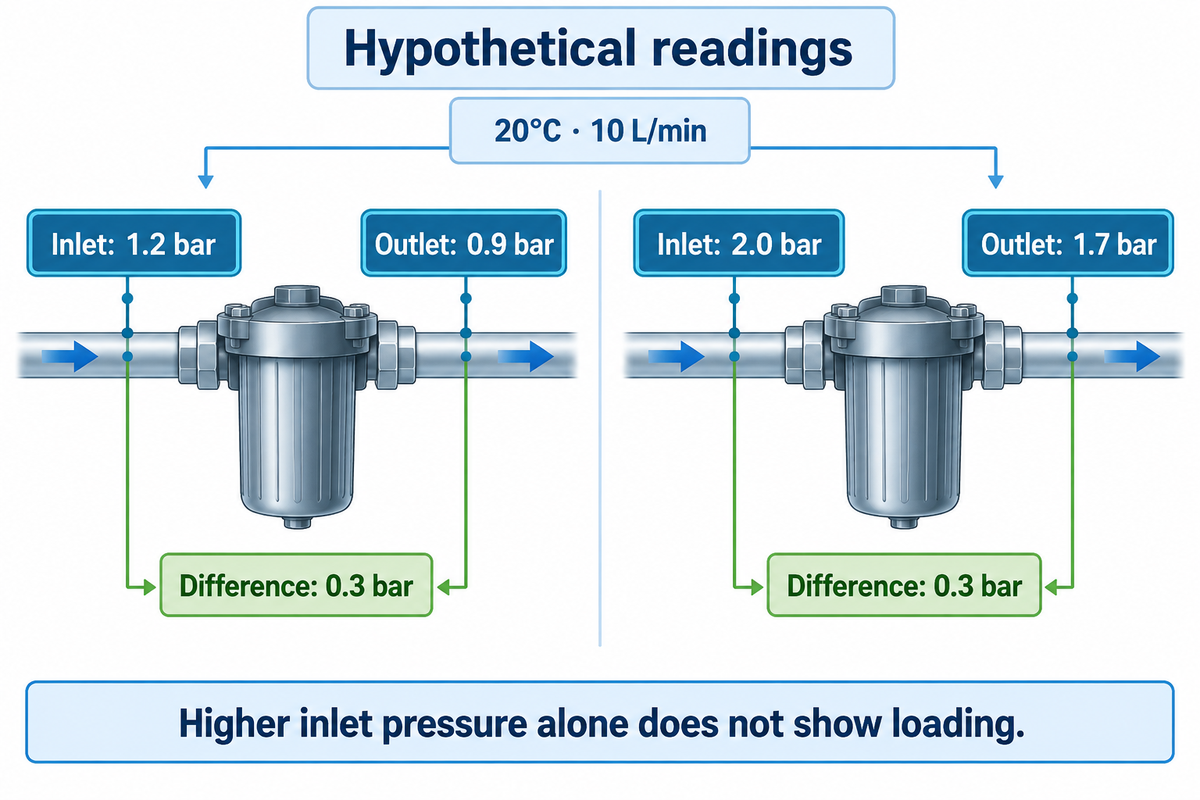
Differential pressure is the pressure across a filter. The housing pressure is a separate limit. In a filter, both sides can be highly pressurized, while the difference across a membrane remains small. A change in line pressure isn’t necessarily reflected in a change in membrane resistance.
Consider a hypothetical liquid-line reading at 20°C and 10 L/min. Inlet pressure is 1.2 bar and outlet pressure is 0.9 bar, so differential pressure is 0.3 bar. After a downstream setting changes, the readings become 2.0 bar and 1.7 bar at the same flow and temperature. Differential pressure is still 0.3 bar. The higher inlet reading alone is therefore not a reason to call the cartridge more loaded. If the outlet reading instead remains 0.9 bar while inlet pressure rises to 1.5 bar, the difference becomes 0.6 bar. Investigate that changed resistance against the established clean baseline and the specified system limits; 0.6 bar is an example reading, not a universal replacement threshold.
As a quote comparison, request the same liquid, at the same temperature, and the same targeted flow rate in both proposals. Choosing the cartridge, advertised with the highest maximum pressure, doesn’t always give a fair comparison.
What can integrity testing tell you?
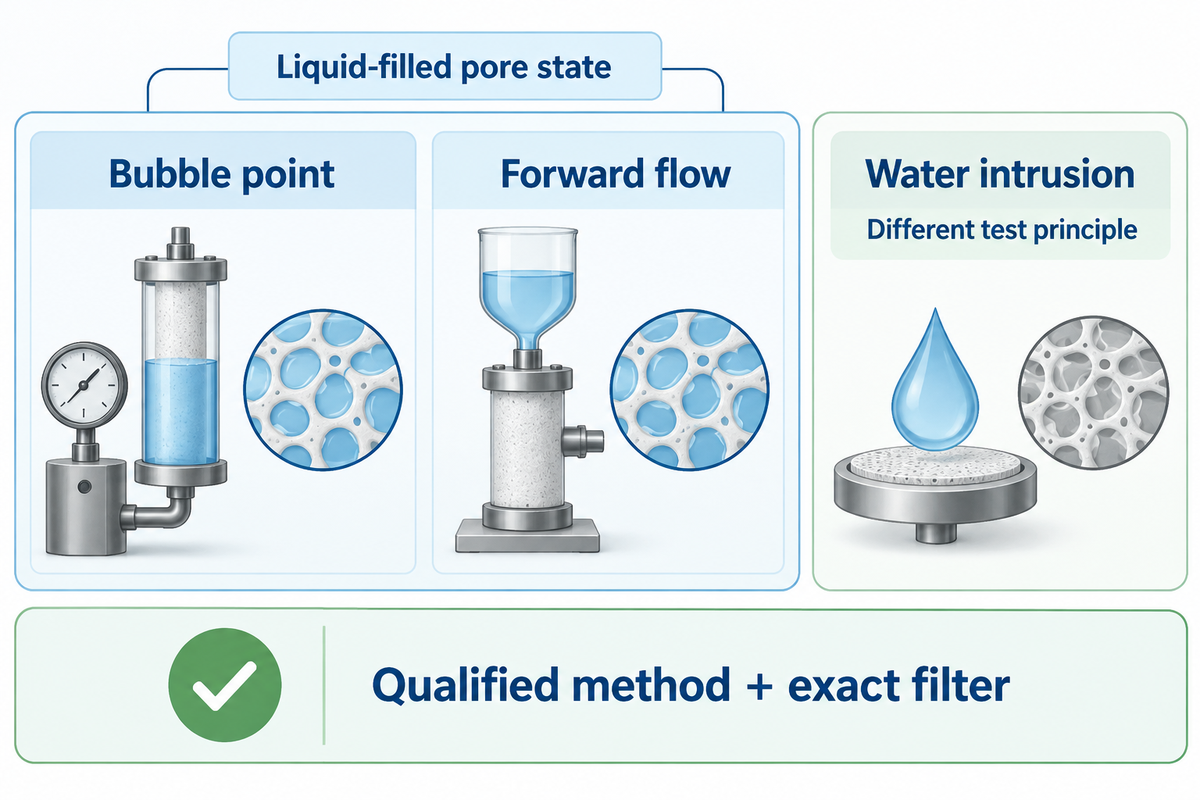
Integrity testing checks to determine if a specified filter system satisfies the defined test acceptance criteria. Bubble point, forward flow diffusion and water intrusion testing have different sets of conditions. A meaningful result requires the right method, preparation and connected test path, with acceptance limits linked to the exact filter and intended retention duty.
Can PTFE Filters Be Integrity Tested?
Yes. PTFE filters can be integrity tested using a method qualified for the particular grade and assembly. Bubble-point and forward-flow tests require an appropriate liquid-filled pore state. A suitable hydrophobic filter may instead use a qualified water-intrusion test, which works differently and avoids low-surface-tension pore wetting.
Preparation is important, because incomplete wetting can cause false failures in tests that depend on wetting. Errors due to a closed or incorrectly connected test line can also yield a wrong result, i.e., an instrument can assess the wrong volume or path. Meyer’s technical discussion of integrity test faults provides a reasoning of how, even with a system that’s plausible and appears to work, the system still may not be connected.
For liquid sterilizing filtration, distinguish standard-condition bacterial retention from end-user process validation. In ASTM’s public F838-20, it states
“additional process-specific studies should be performed.”
A 2023 study by Giglia and colleagues shows that use of a bubble-point-only test, for PES and PVDF cartridges evaluated with automated instruments, has defect-detection limitations; its measured defect sizes are not PTFE limits. The relevant lesson is to use the qualified test strategy, rather than treating every single integrity measurement as an interchangeable proof of performance.
A pharmaceutical grade PTFE membrane cartridge filter requires a product-specific validation package and a defined test method. It should be integrity tested under its qualified conditions. Before approving a 0.2 µm or 0.22 µm sterile filtration duty, the quality team needs the applicable retention, compatibility and process validation, including the actual fluid and worst-case exposure.
Why is flow falling or differential pressure rising?
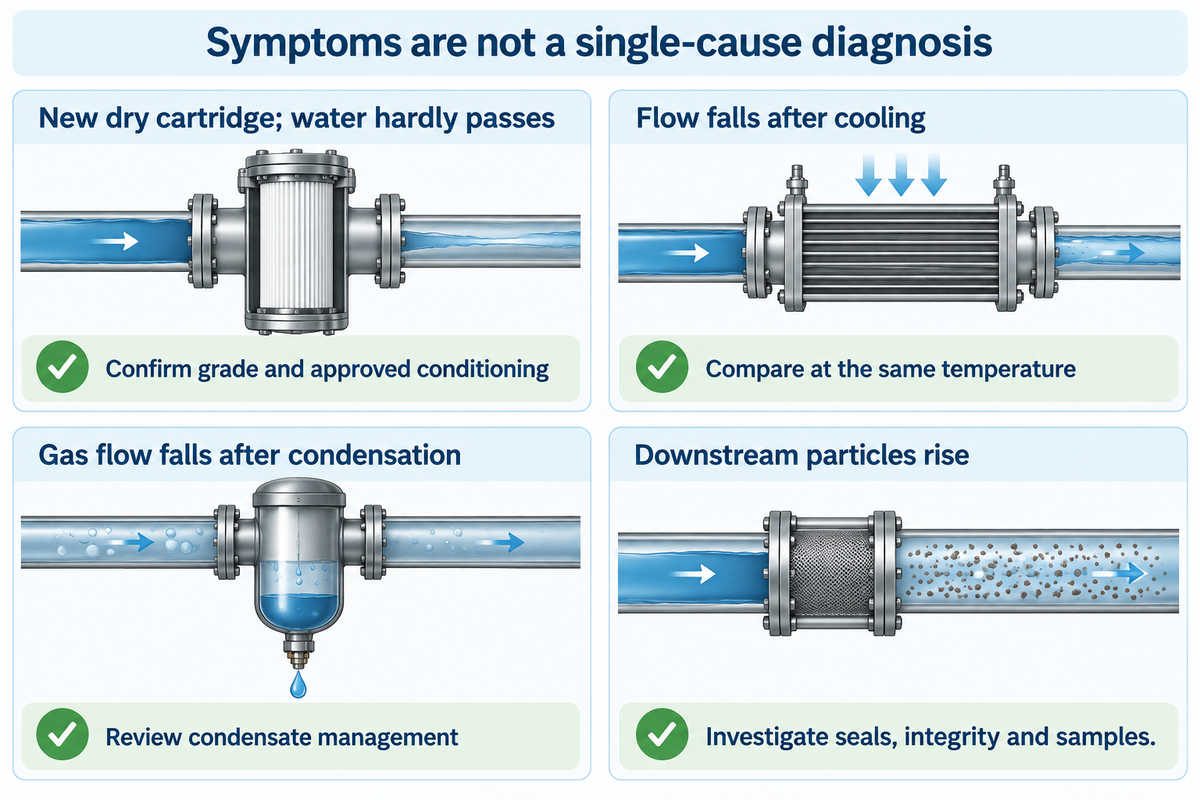
Decreasing flow or increasing differential pressure may indicate solids loading, but may also be the result of changes in fluid properties such as temperature or viscosity. Compare simultaneous inlet and outlet pressures at the same flow and fluid conditions. Use the timing of the symptoms to decide which check to perform next.
Dry Start / Loaded Run Diagnosis
Dry Start/Loaded Run Diagnosis separates start up restrictions from changes that develop during normal operation and checks the quality of the filtrate independently.
| Observed pattern | Possible explanation | Next check or action |
|---|---|---|
| New dry cartridge; water hardly passes | Hydrophobic entry resistance | Confirm grade and approved conditioning before adding pressure |
| New hydrophilic grade; erratic flow | Trapped gas or installation issue | Check approved filling/venting procedure and seals |
| Pressure difference rises at matched flow and temperature | Increasing hydraulic resistance | Inspect upstream solids and compare with clean baseline |
| Flow falls after the liquid cools | Viscosity change contributes | Compare at the same temperature before assigning loading |
| Gas flow falls after condensation | Water covers available gas pathways | Review condensate management and vent arrangement |
| Both line pressures rise equally | Changed system backpressure | Calculate the pressure difference before blaming the filter |
| Pressure difference falls; downstream particles rise | Possible bypass, damage or changed feed | Investigate seating, seals, integrity and sample conditions |
| Wetting-dependent integrity test fails after preparation | Incomplete wetting or system leakage | Check qualified setup and failure investigation procedure |
| Flow recovers after cleaning | Resistance fell; retention is a separate question | Apply approved post-cleaning acceptance checks |
| Operating readings remain normal; allowed use expires | Time, batch or cycle endpoint reached | Replace or act under the validated extension procedure |
The FDA’s historical 1993 high-purity-water inspection guide discusses pressure disturbances and filter-related contamination concerns. Its process examples are not modern operating instructions, but they reinforce a practical distinction: an acceptable pressure reading alone does not describe downstream quality or the condition of the entire water system.
Suppose a hypothetical aqueous batch ran at 20°C and 10 L/min with a 0.3 bar pressure difference. A later batch reaches only 6 L/min at 10°C with a 0.5 bar difference. The readings changed, but so did temperature and flow. Replacing the membrane immediately would discard the chance to distinguish a fluid-property change from solids loading. Record composition and the upstream filter condition, then compare against an approved reference at matching conditions. If downstream particle counts also change, investigate that quality signal separately. A new cartridge that restores flow doesn’t, by itself, explain why the earlier batch behaved differently.
Record
- Measure inlet and outlet pressure together.
- Log flow, temperature and fluid identity.
- Check filtrate quality against its acceptance endpoint.
Avoid
- Assign loading from inlet pressure alone.
- Force water through an unidentified dry grade.
- Approve reuse from recovered flow alone.
How long does a PTFE cartridge last?
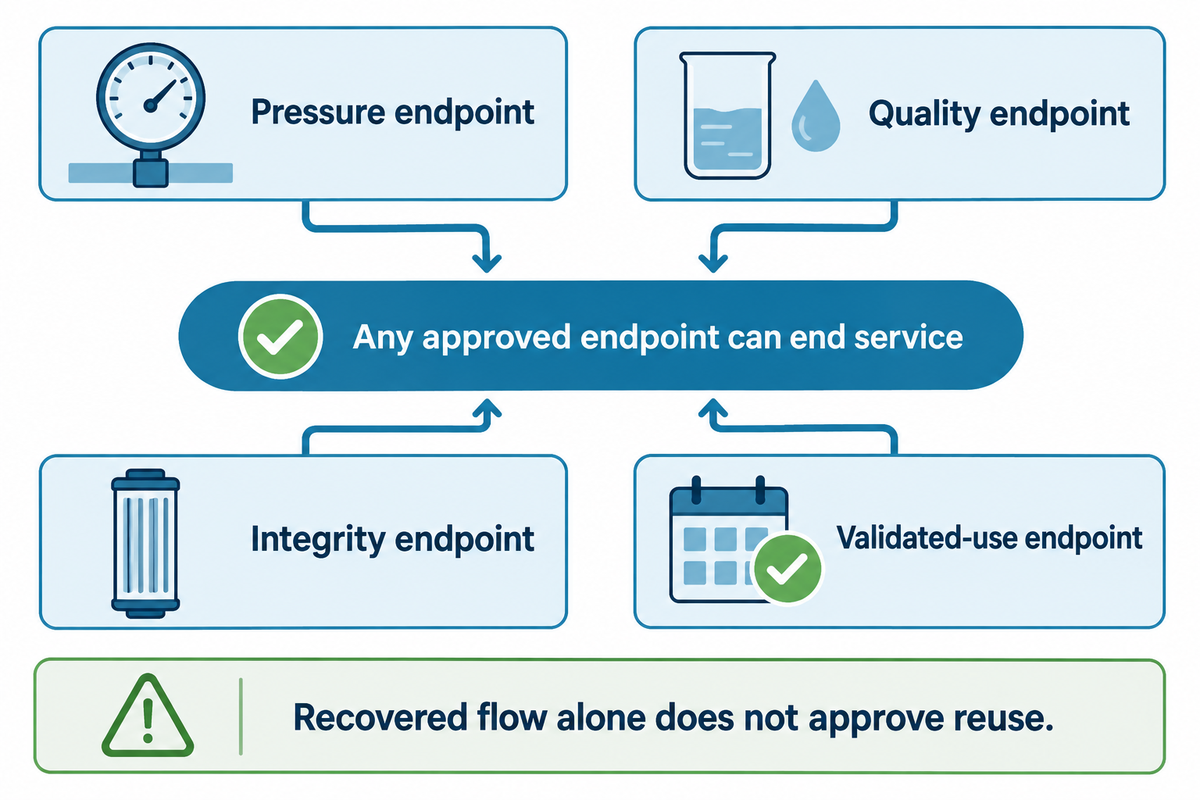
Replace a PTFE cartridge when an approved pressure, quality, integrity or validated-use endpoint is achieved. Service life is therefore an operating result, rather than a fixed number of months attached to PTFE. Track the limiting condition for the concerned duty and use the replacement criteria for the cartridge.
Upstream particle burden, filtration area, and prefiltration affect loading. Fluid exposure and permitted cleaning or sterilization cycles affect the assembly differently. A claim of long service life is useful only when it specifies the process and acceptance endpoint. For a dirt-loaded liquid, compare processed volume at the required filtrate quality as well as the replacement price.
The processes specify other use controls. Health Canada’s sterile-drug manufacturing guidance calls for liquid sterilizing-grade filters to be discarded after a single batch; continuous use beyond 1 working day requires validation. Extended-use gas filters have risk-based monitored maximum durations and cycle limits. Those requirements concern the specified drug-manufacturing scope, not every industrial water filter.
There must also be an end-point for cleaning. Yu and colleagues’ 2022 MBR membrane-aging study found that increased water flux could accompany pore enlargement after chemical aging. Changes in hydrophobicity were among the properties examined. The membranes and exposure tests were different from replaceable process cartridges. Hence, higher flow after cleaning should be taken into account with filtration performance. Ask whether the proposed reuse method preserves required retention and filtrate quality, rather than counting recovered flow as proof of a restored filter.
Industry Outlook: Replacement Decisions in 2026
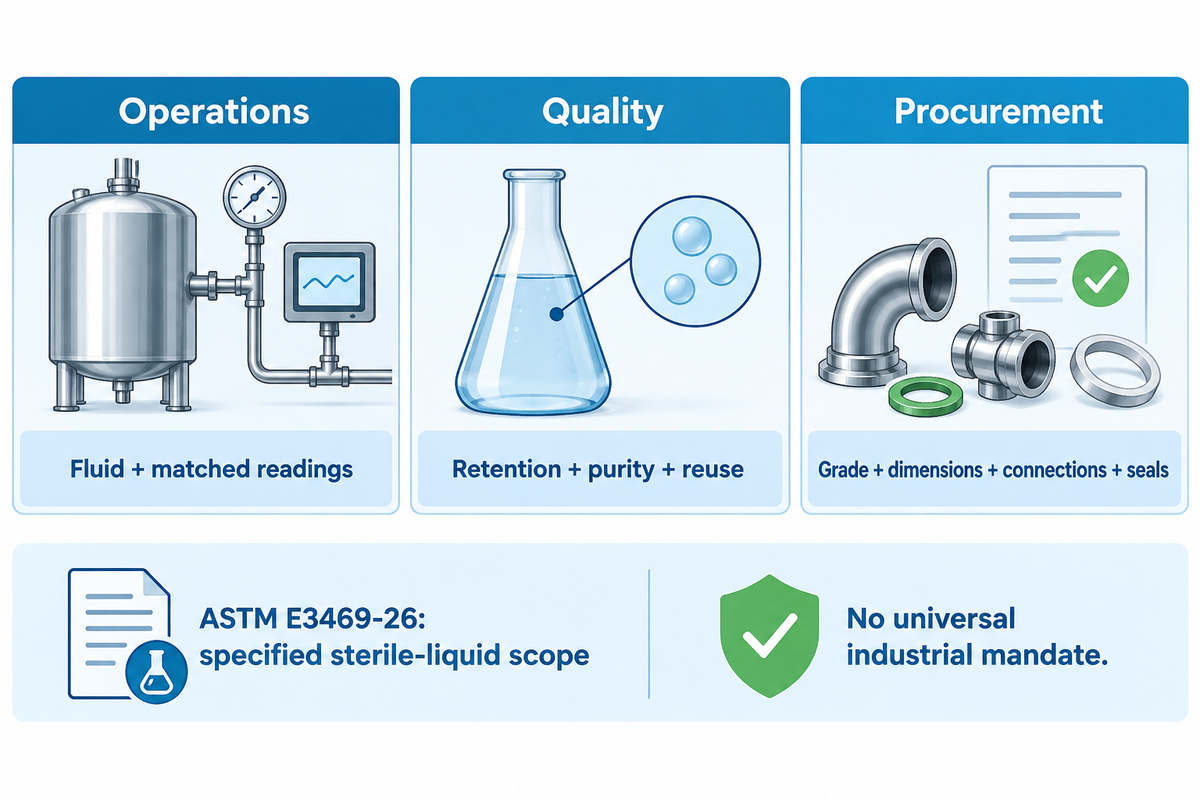
More detail is provided on process-specific validation for applicable sterilizing-liquid duties. ASTM E3469-26 brings the actual fluid and worst-case operating exposure into end-user validation. For routine industrial replacement, the enduring task remains matching the complete cartridge to the duty; for validated service, the replacement also needs the right qualification pathway.
ASTM E3469-26, published as an active practice in 2026, covers pharmaceutical, biopharmaceutical and biological products or their intermediates. It covers process conditions such as time, flux, temperature and pressure differentials. It presupposes filter selection work on chemical compatibility, binding and particle shedding. Processing Magazine’s May 2026 report describes the same new practice. This represents an evolution of specific validation, and not a new universal requirement for industrial filtration.
For a 2026 Replacement Project, break down tasks according to responsibility. Operations provides the fluid and matching condition readings. Quality defines endpoints of retention and purity and reuse. Procurement verifies the actual grade of membrane, dimensions of cartridge, end connections and seal against requirement. Similar length and micron number are the least of it.
ECOFILTRONE™ supports the review of applications, specification and replacement for liquid filtration. Once the operating problem is understood, use the ECOFILTRONE PTFE filter cartridges to review the suitable series and configuration. Product documentation and any requested compliance material should match the actual product and certificate holder.
Frequently Asked Questions
What is a PTFE membrane?
Meaning and construction
A PTFE membrane is a porous filtration layer made from polytetrafluoroethylene. Its pore structure and surface treatment determine how it interacts with the process fluid. A cartridge combines that membrane with supports, end caps and seals, so the membrane’s properties must be considered alongside the construction of the complete filter.
What are the disadvantages of membrane filtration?
Main operating tradeoffs
Membrane filtration can create pressure loss, become loaded by upstream solids and require stricter fluid compatibility control than coarse filtration. Dry hydrophobic PTFE also resists direct aqueous wetting. Prefiltration, correct membrane treatment and a defined quality endpoint help address those tradeoffs; simply choosing a larger pore doesn’t solve every cause.
Which membrane filter is best?
Choose for the fluid and endpoint
Choose hydrophobic PTFE for a compatible dry-gas or solvent duty, and compare hydrophilic PTFE, PES, PVDF or nylon for aqueous service. The best grade is the one that meets retention and product-recovery needs with acceptable extractables and assembly compatibility. Keep the duty constant when comparing materials and surface treatments, including the concentration and temperature of the complete fluid mixture.
Does a 0.2 or 0.22 µm label mean the filter is sterilizing grade?
Rating and validation
No. Sterilizing service requires the appropriate validated filter and process, including the retention method and actual operating conditions. Use the stated pore rating to identify a candidate, then evaluate its qualification for the intended liquid or gas duty.
What temperature can a complete PTFE cartridge handle?
Read the assembly limit
Use the specified temperature-pressure limits for the complete cartridge, including supports, joints and seals. PTFE polymer heat resistance isn’t a cartridge rating. Continuous operation, steam exposure and reverse differential pressure are different conditions. Match each condition to its applicable limit rather than combining separate maxima from a datasheet.
Can a PTFE cartridge be cleaned and reused?
Reuse criteria
Reuse only when the specific cartridge and process have an approved cleaning and acceptance procedure. Restored flow isn’t enough: retention, integrity, chemical exposure and permitted use duration still matter. Disposable or batch-limited duties should follow their defined replacement endpoint.
When should I use a PTFE capsule instead of a cartridge?
Device format choice
PTFE capsule filters can suit a duty that benefits from an enclosed filter assembly, while a cartridge fits a separate reusable housing. Compare connection type, hold-up volume, required flow and pressure limits for the complete devices. The same membrane name doesn’t make their operating ratings or preparation procedures interchangeable. Include the installation arrangement in the comparison: replacing a capsule changes the enclosed device, whereas cartridge replacement also requires inspection and correct reassembly of the retained housing. For a qualified process, evaluate the proposed device change against its approved procedure before treating the formats as interchangeable.
Turn the operating symptoms into a clear filter requirement
Send the fluid and concentration, operating temperature, required flow, simultaneous inlet/outlet readings and current cartridge reference. Add the required filtrate quality and any cleaning or sterilization exposure. ECOFILTRONE™ can help review the application and match the replacement configuration.
Technical scope: The technical examples provided demonstrate some working examples using assumed readings for illustrations of diagnoses. Published product ratings are affiliated with their respective series. Applicable process procedures and quality acceptance criteria take priority over a general material guide.
References & Sources
- ASTM International: F838-20, bacterial retention of membrane filters used for liquid filtration.
- Woźniak and Gryta: original capillary PTFE wetting research, 2023.
- Hou and colleagues: hydrophilic modification of PTFE capillary membranes, Polymers, 2024.
- Jens Meyer, Sartorius Stedim Biotech: Integrity Testing of Sterilizing-Grade Filters, BioProcess International, 2012.
- Kalmykov and colleagues: Stability of Porous Polymeric Membranes in Amine Solvents for Membrane Contactor Applications, 2023.
- Puah and colleagues: original fluoropolymer syringe-filter extractables study, RSC Advances, 2019.
- Giglia and colleagues, EMD Millipore: Defect Detection Sensitivity of Bubble-Point-Type Tests, 2023.
- U.S. Food and Drug Administration: High Purity Water System, historical inspection guide, July 1993.
- Health Canada: sterile-drug manufacturing guidance, production-specific technologies.
- Yu and colleagues: Chemical Cleaning and Membrane Aging in MBR for Textile Wastewater Treatment, 2022.
- ASTM International: E3469-26, end-user sterilizing filtration validation.
- Processing Magazine: report on ASTM’s new validation standard, May 15, 2026.