Get in touch with ECOFILTRONE™ Company



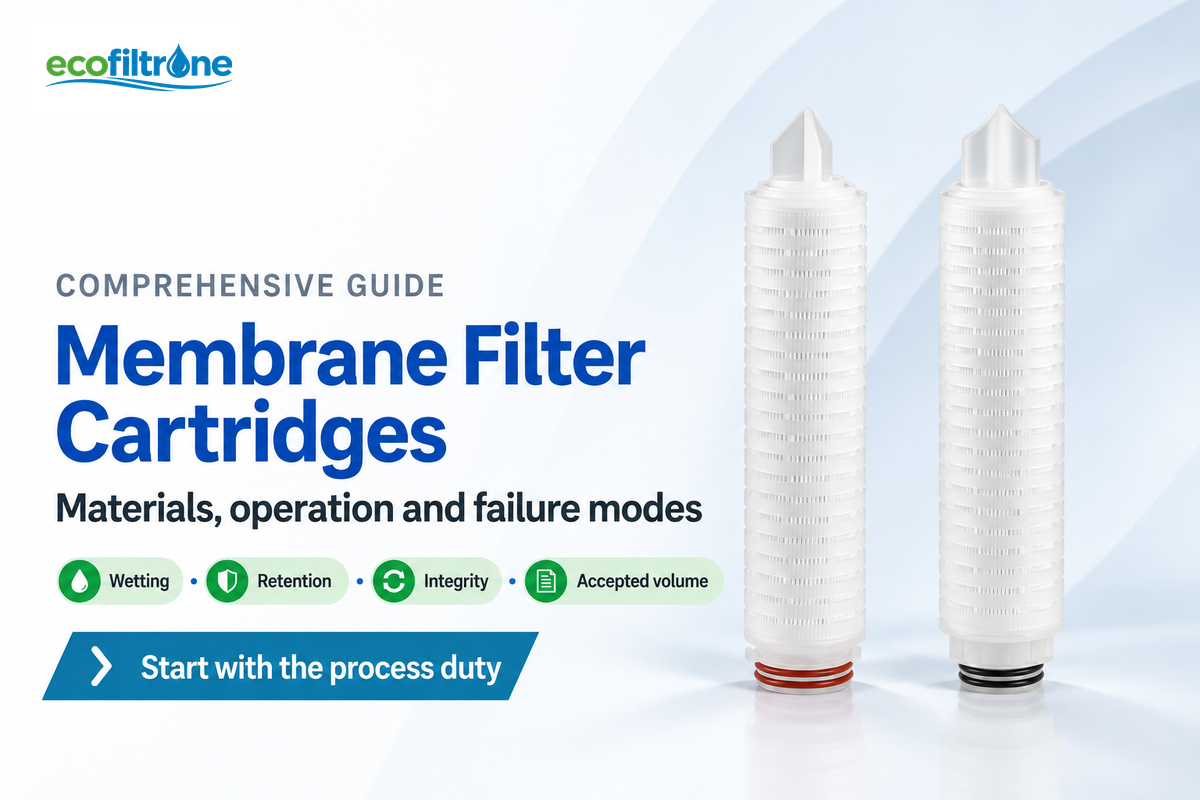
Membrane Filter Cartridges use a porous membrane to retain a defined particle or microbial challenge while allowing liquid to pass. The useful specification combines the retention result with fluid compatibility, flow, temperature and the complete cartridge construction. Judge outlet quality against the required particle, microbial or other process measurement.
This guide covers industrial liquid service: what the membrane can remove, how the main materials differ, and how to interpret wetting, pressure and integrity results. Gas filtration requires different service operations. In cases where pharmaceutical examples are provided, their validation is restricted to that area.
Updated October 2026 · Author: DD
Start with the process result
Specify what must be removed, what must remain in the liquid, and how the outlet will be accepted. Then check the wetted assembly, establish a clean operating baseline and compare replacement options over accepted output.
What do membrane filter cartridges actually remove?
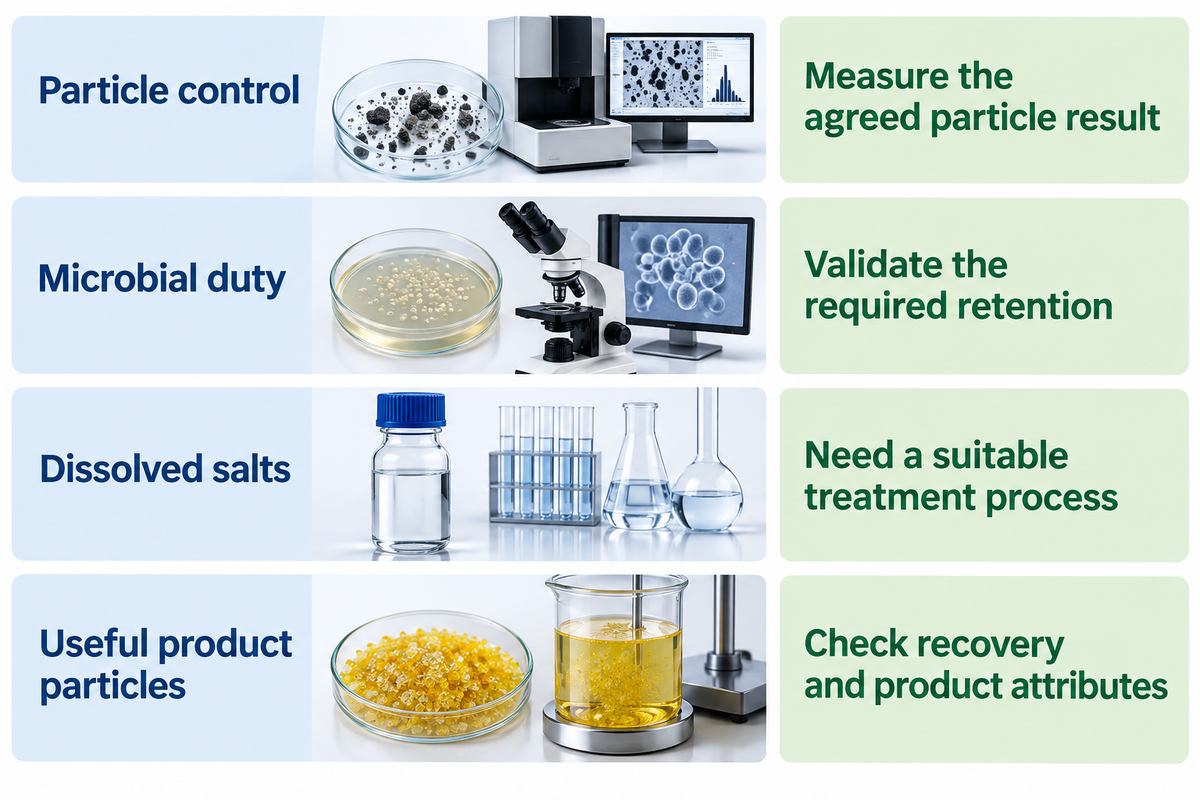
Porous membrane cartridges retain suspended particles and, for suitably validated grades, selected microbial contaminants. Ordinary microfiltration doesn’t provide the dissolved salt rejection of reverse osmosis. Define the contaminant and the required outlet measurement before choosing the medium. Otherwise, a cartridge can filter exactly as designed and still leave the water quality problem unresolved.
The University of Georgia’s microfiltration bulletin separates the removal of suspended materials from the removal of dissolved constituents such as nitrate and sodium. In a water treatment train, a sediment water filter may protect later equipment from fouling while not performing its purification function. In reverse osmosis (RO) systems, the purpose of the pretreatment is different from the purpose of the desalination, even though both use replaceable elements.
| Process question | What to establish | How to judge the outlet |
|---|---|---|
| Unwanted particles in process water | Particle-size distribution and required retention basis | Particle measurement or another agreed quality test |
| Microbial reduction or sterile filtration | Organism, challenge conditions and validated process | Relevant retention, integrity and process controls |
| Dissolved salts or a dissolved impurity | A treatment process suited to that constituent | The specific dissolved-constituent measurement |
| Useful particles are part of the product | Which product fraction must pass through | Recovery and product attributes alongside removal |
For a product-containing liquid, “cleaner” can mean losing the material you wanted to keep. The FDA-published scope of ISO 13408-2:2018 excludes sterilizing filtration of fluids intentionally containing particles larger than the filter pores, and excludes virus removal from that standard’s scope. Determine if the particles are contamination or product before making a rating decision.
Dissolved unwanted substances can remain in the filtered liquid while water molecules pass through the membrane. An acceptance test must be based on the actual filtration requirements. Different tests can yield different results; examples include conductivity tests and tests for particles and/or microbial contamination.
PES, PTFE, PVDF and nylon: choose the wetting behavior
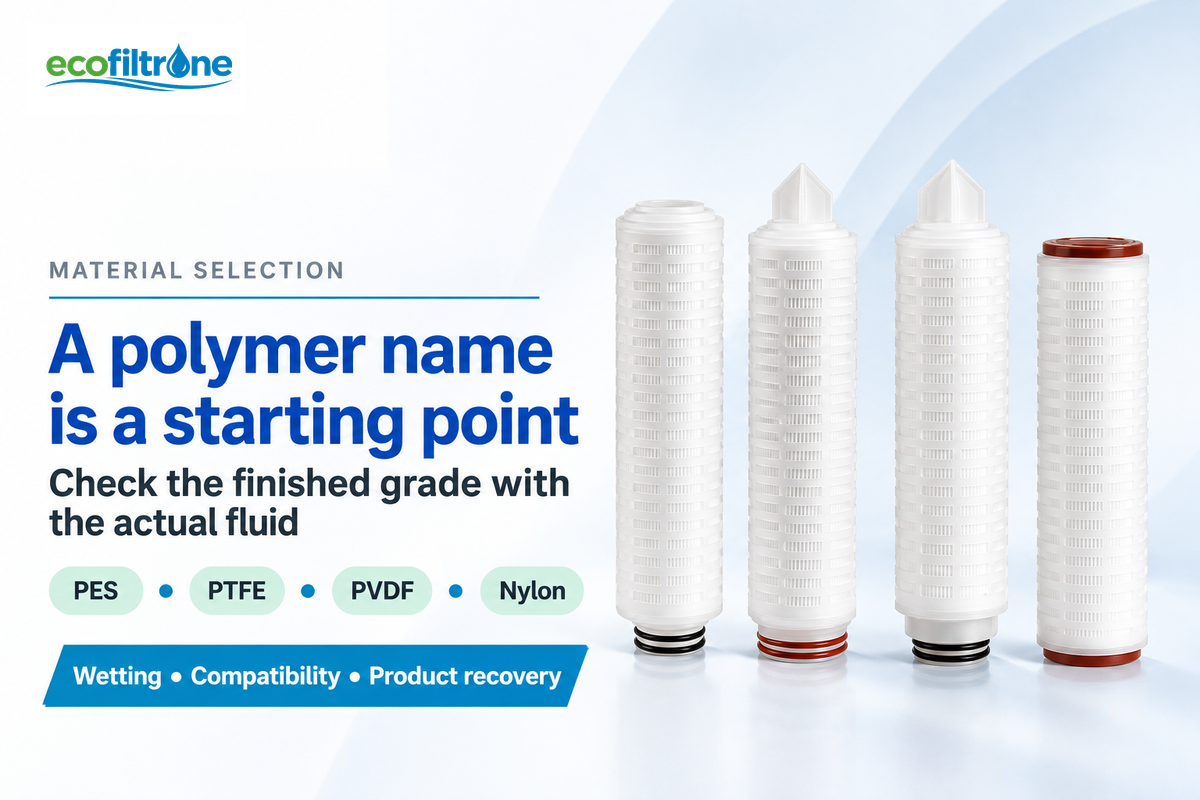
PES, PTFE, PVDF and nylon describe membrane polymers, and the finished grade determines their interaction with process liquid, retention and wettability. Start the material comparison with aqueous or solvent wetting and chemical compatibility, then assess product recovery. Compare product recovery and flow using the actual process liquid and the objective of the process.
| Material | Useful starting question | Check before accepting the grade |
|---|---|---|
| PES — polyethersulfone | Does this hydrophilic grade wet readily with the aqueous solutions being processed? | Pore structure, adsorption, cleaning exposure and complete construction |
| PTFE — polytetrafluoroethylene | Is the selected grade hydrophobic or hydrophilic? | Approved liquid wetting route, solvent exposure, seals and supports |
| PVDF | Is this a hydrophilic liquid grade or a hydrophobic grade? | Surface treatment, product interaction and actual-fluid performance |
| Nylon | Will the liquid wet the membrane, and can product binding matter? | Recovery of valuable components and compatibility over contact time |
According to Cytiva’s material-selection guide, hydrophobic PTFE membranes resist aqueous wetting and nylon can bind proteins. These can help determine membrane-level considerations. Materials that are exposed to aggressive chemicals must be of a compatible grade. Use the gas-service procedure for a vent; liquid prewetting instructions are for the liquid-duty service.
Which membrane filter is best?
Select the assembled grade that achieves the necessary retention, compatibility, and product recovery at an acceptable flow. Compare the candidates with the actual fluid and a common test method. Polymer names may assist, but won’t rank finished cartridges with different pore structures, surface treatments and operating conditions.
Imagine a team filtering an aqueous protein-containing buffer before a later process step. The operator wants a short filtration run, while quality staff want the intended protein to remain in solution. A membrane chosen only for rapid water flow leaves the second requirement unanswered. The team can first screen wetted materials, and then compare recovery and pressure over a defined sample volume, using the actual buffer. A change to the membrane may address the flow, but could alter the product interaction, thereby requiring both measurements. Procurement should retain the exact grade and surface treatment in the record; a later replacement with the same polymer name does not necessarily reproduce the trial. This is a planning example, not a reported customer example.
That tradeoff is evident in a 2022 comparison of hydrophilic PVDF and PES filters. Two flat-sheet grades differed in water permeability and protein-fouling behavior; matching initial flux changed the comparison. The samples also differed in structure: one used asymmetric polyethersulfone. The result advocates for testing the duty rather than declaring a universal polymer winner. For more detailed discussions on materials, see the PES membrane filter cartridges guide and PTFE membrane filter cartridges guide.
As the PVDF membrane filter cartridges guide notes, members of the PVDF membranes family may also vary in their surface treatment. The nylon membrane filter cartridges guide addresses some product-binding and compatibility questions for that material.
Pore size and retention: define the result before the rating
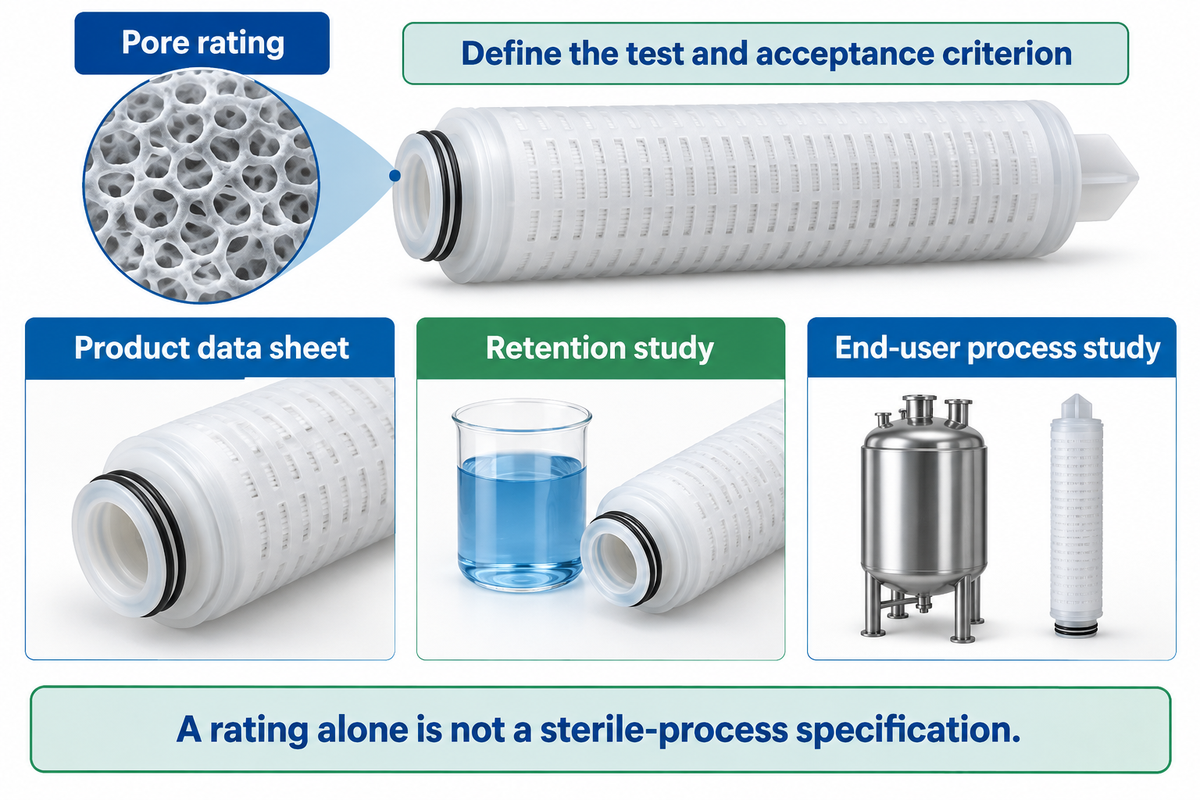
A micron rating becomes useful once the retention method, challenge and acceptance criterion are defined. Nominal and absolute ratings should be taken in context of the manufacturer’s stated test, rather than used to compare filter efficiency. For a microbial duty, confirm the applicable validation evidence and process conditions in addition to the pore-size designation.
A 0.2 micron rating doesn’t prescribe a complete specification for a sterile-filtration filter. It does not identify the organism, challenge concentration, fluid, contact time or integrity-test correlation. For a given filtration challenge, the membrane can have a different pore distribution and flow path, and describing a micron as a nanometer wouldn’t provide that information.
The microbial retention within process-specific validation is described in the public scope of ASTM E3469-26. A product data sheet, retention study and end-user process study are separate documents. The retention study contains its challenge test, and the process study describes the intended operating window.
Loading, in general, is a separate consideration. A depth medium may retain particles within its structure, while the final membrane stage provides a defined finer retention duty. Putting a fine pleated filter cartridge directly onto a heavily loaded feed may consume its capacity quickly. Suitable pre-filters can reduce that load, but their rating must still allow the final process target to be met.
Feeds should be well-characterized to select the pre-treatment stage. A final outlet sample may be taken to assess the entire train. An improvement in apparent clarity doesn’t necessarily indicate a microbial result. For related considerations, loading mechanisms are discussed in the depth filter cartridges guide, and rating is covered in the 0.2 micron filter cartridges guide.
Check the complete cartridge, housing and wetted path
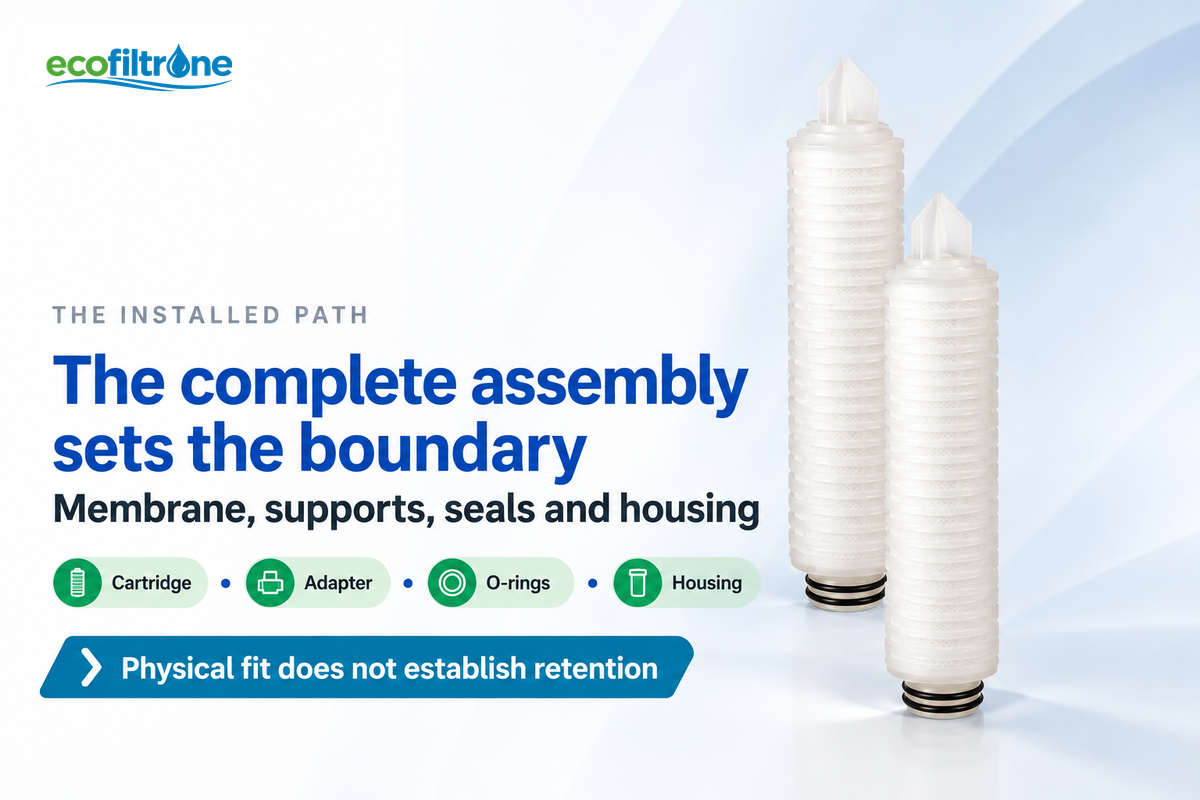
A membrane cartridge may perform in its housing, depending on the complete wetted path. Matching adapters, sealing geometries, support layers, core, end caps and elastomers should be considered, in addition to the membrane. A cartridge, which is of the nominal length, may still permit bypass.
Consider the liquid path from inlet to outlet, via the intended filter media. List all paths the liquid may take to cross a seal instead of using the membrane. Critical Process Filtration’s installation guidance states that incorrect seating and sealing can cause bypass, and that incorrect integrity-test values may result from a poor fit. Fit therefore is a question of the installed system, and can’t be solely resolved by looking at the dimensions of the off the shelf items.
| Part of the path | Information to confirm | Consequence of a mismatch |
|---|---|---|
| Membrane and multi-layer supports | Materials, grade and permitted exposures | Changed retention, interaction or structural condition |
| Core, cage and end caps | Construction and temperature-dependent limits | Assembly can limit service before the membrane does |
| Adapter and O-rings | Exact mating geometry and elastomer | Bypass can defeat the intended retention path |
| Housing and connected fittings | Permitted pressure, temperature and flow direction | Another component can set the operating limit |
A polypropylene support component and seals exposed to corrosive chemicals or repeated cleaning must be listed separately from the membrane. The same applies to seals exposed to corrosive chemicals or repeated cleaning. In pharmaceutical manufacturing, the FDA equipment guidance also connects contact-surface suitability with product quality. That requirement is broader than checking the membrane polymer alone.
Keep a drawing or a precise reference for the installed end connection. The Code 7, 222 and 226 end-cap guide explains why replacement matching needs the sealing arrangement as well as the length.
Start liquid service wet and compare flow at matching conditions
In liquid service, prove that the correct wetting and venting conditions are met before treating a low flow rate as evidence of fouling. Compare later pressure drop with a clean baseline under matching flow, liquid and temperature, using the original pressure taps. Unless the baseline is comparable, an apparent change in membrane resistance may be attributable to changes in liquid viscosity, or other factors.
Hydrophobic PTFE can repel water, so forcing an aqueous start is not a sound substitute for the cartridge’s approved wetting procedure. Some grades can use a compatible prewetting fluid. Others can be modified for aqueous wetting. You must check the rinse and residual-fluid requirements for the product. Hydrophilic grades also require proper installation and removal of trapped gas.
The pressure relationship has a physical basis. A study of viscosity in membrane microfiltration states that fluid flow is proportional to the difference in pressure and inversely proportional to the viscosity of the fluid and the total resistance to the flow. At a common flow and fluid viscosity, a greater pressure difference is consistent with greater hydraulic resistance. A higher flow, other things being equal, corresponds to a greater pressure difference.
Matched-Flow Resistance Ratio
Ratio = later pressure drop ÷ clean-baseline pressure drop
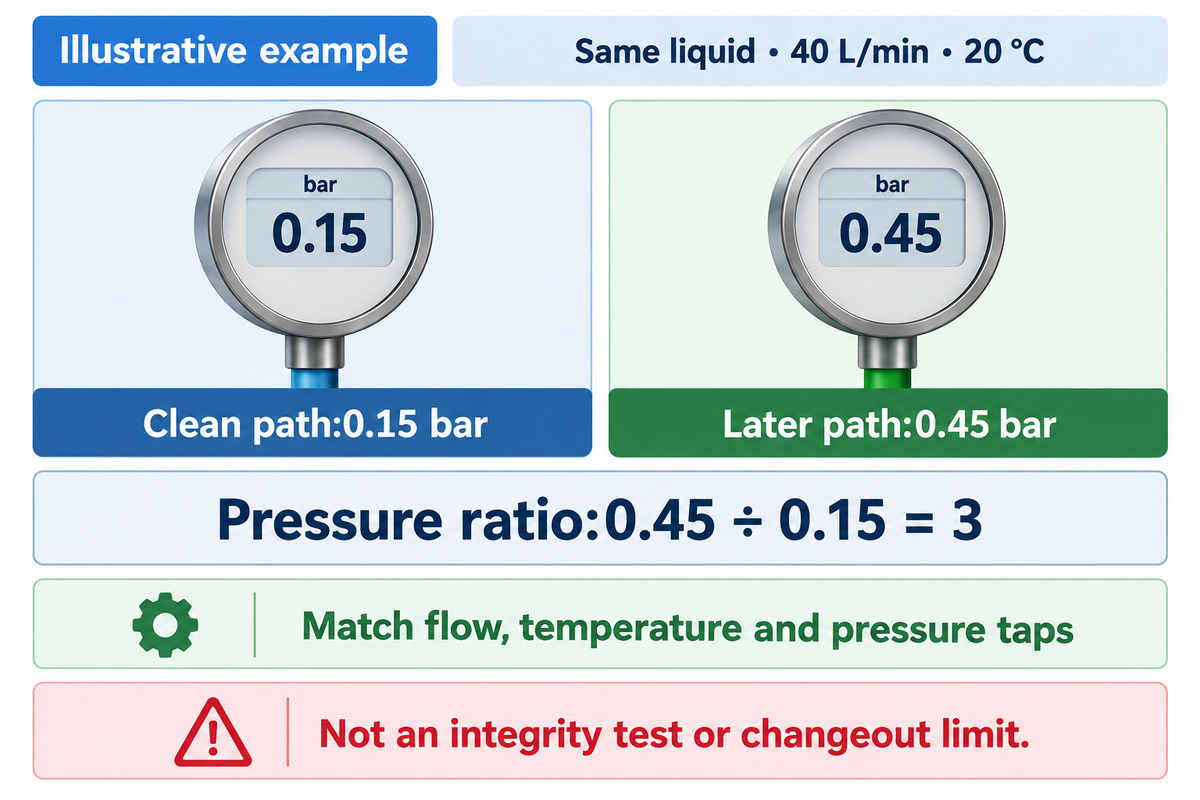
Use matching flow, liquid composition, temperature, pressure taps and installed assembly. The ratio describes the measured hydraulic path. It isn’t an integrity test or a cartridge changeout limit.
Let’s look at a hypothetical case at a flow rate of 40 L/min. Consider an illustrative run held at 40 L/min with the same liquid at 20 °C. The clean installed path reads 0.15 bar, and a later reading at those same conditions is 0.45 bar. Thus a difference of 0.3 bar was noted. The flow rate was the same in both cases. The 0.15 bar path is referred to as the baseline. The ratio of the measured path pressure to the baseline is 0.45 ÷ 0.15 = 3. The measured path required a pressure difference of three times the baseline to maintain flow of 40 L/min. Before calling this membrane fouling, the operator confirms the valve positions and gauges and checks that the feed composition has not changed. A ratio of 3 is an observation in this assumed example, not permission to operate up to a new limit. The outlet acceptance limits and documented limits govern further action.
If composition or temperature was different, perform a new matched comparison or use a validated correction method. Never add pump pressure merely to recover a previous flow without checking the complete assembly limit. A near-zero baseline also makes a ratio unstable; check gauge resolution and use the actual pressure/flow record instead.
Read integrity tests alongside process validation
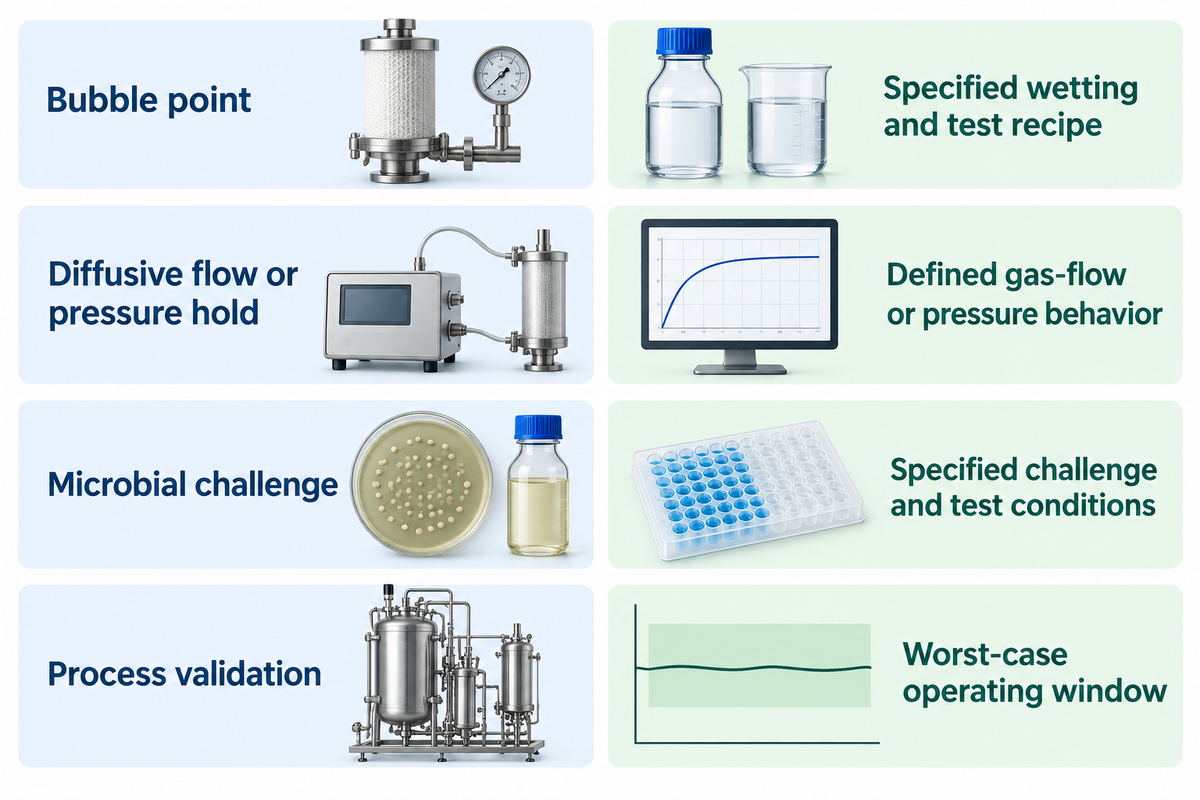
Integrity testing evaluates the filter against a defined test method and specification. Microbial challenge testing evaluates retention under stated conditions. Process validation establishes whether the intended operation produces the required result.
Passing an integrity test does not by itself establish every aspect of the filtered product’s quality.
| Evidence | Question answered | Information that must travel with it |
|---|---|---|
| Bubble point | Does the wetted filter meet its specified bubble-point criterion? | Exact grade, wetting fluid, temperature, tester and recipe |
| Diffusive flow or pressure hold | Does the defined gas-flow/pressure behavior meet the specification? | Test pressure, area or system volume, stabilization and limits |
| Microbial challenge | Does the filter retain the specified challenge under the test conditions? | Organism, fluid, exposure and acceptance basis |
| Process validation | Does the intended process preserve the required filtration result? | Worst-case operating window and product-specific controls |
In Giglia and colleagues’ 2023 controlled-defect study, some defects escaped bubble-point-only rejection in the tested 10-inch cartridges and three automated testers. The authors, affiliated with EMD Millipore, a Merck company, supported pairing complementary methods. Results are reliant on the filters, defects and test settings. They aren’t generalized detection thresholds.
Before declaring a cartridge failed, check the approved recipe, wetting and seating. Should the required criterion of cartridge integrity not be met, the filter and corresponding product must be investigated as part of the site’s Investigation procedure. Repeating a test until a favorable result is obtained doesn’t explain an initial test failure.
As stated by the ASTM public E3469-26, prior filter selection work is assumed for process specific bacterial validation. Compatibility and product binding must be established.
“Test methods and guidance for filter selection, therefore, are not included in this practice.”
For application to sterile drugs, the filtration guidance by Health Canada links filter validation to actual liquid or justified surrogate and process parameters. A cartridge described as “integrity tested” still awaits a relevant test specification.
Diagnose fouling and decide when to replace the cartridge
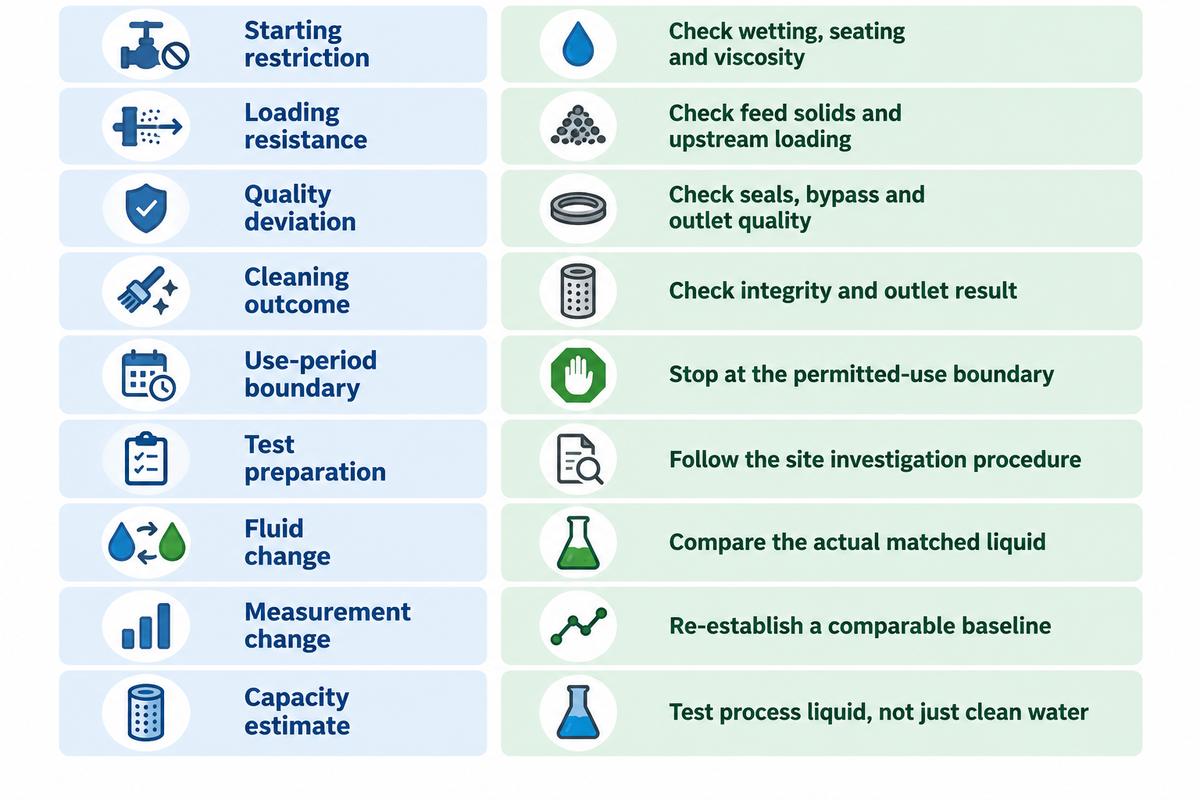
Cartridge replacement should be done based on the first limiting condition in the operating and quality record. Resistance, outlet quality, integrity criteria, damage or the expiration of a permitted use time may be the basis for a decision. Take pressures together with flow, feed condition and product measurements, rather than treating every short run as membrane fouling.
| Run category | Observation | Check first | Decision supported |
|---|---|---|---|
| Starting restriction | Low flow immediately after installation | Wetting, venting, seating, valves and viscosity | Resolve startup before attributing the result to loading |
| Loading resistance | Pressure rises at matched conditions | Feed solids, upstream pre-filtration and throughput | Assess loading against the documented pressure limit |
| Quality deviation | Quality changes with little pressure change | Seals, bypass, feed change and relevant integrity result | Investigate outlet quality independently of resistance |
| Cleaning outcome | Flow returns after cleaning | Permitted cleaning history, integrity and outlet result | Qualify reuse on more than restored flow |
| Use-period boundary | Capacity remains but allowed use ends | Validated time, batch or exposure restriction | Stop at the permitted-use boundary |
| Test preparation | Initial integrity criterion is not met | Approved test recipe, wetting and seating | Investigate preparation and test validity through the site procedure |
| Fluid change | Flow changes after a new liquid or concentration | Viscosity, chemistry and product interaction | Make a matched-fluid comparison before judging resistance |
| Measurement change | Different gauges or pressure taps are used | Gauge range, resolution and measurement boundary | Re-establish a comparable baseline |
| Capacity estimate | Clean-water flow differs from product flow | Actual liquid, acceptance target and permitted use | Base the trial on the process liquid rather than the water curve |
The installed limit can be located externally to the cartridge. One 2013 cell-culture-medium filtration study stopped its trial due to the tubing-connection pressure limit. The practical lesson is to identify the limiting component in your own path; its numerical stopping pressure is not a specification for another installation.
How often should I replace my membrane filter?
Replace a membrane cartridge when its operating limit or documented use period is reached, or its required quality or integrity is compromised. Replacement frequency follows the exact cartridge and liquid duty. Use the manufacturer’s operating limits and the site’s validated or documented use period, then track pressure, flow and outlet results. A calendar lifespan copied from another application can’t validate that the current filter is still good.
In sterile-drug production, Health Canada’s guidance specifies filter disposal after a single batch and limits continuous use unless longer use is validated. Those limits shouldn’t be extrapolated to other industrial situations, such as water filter replacement. They also show why remaining hydraulic capacity and permitted service life can be different.
What are the disadvantages of membrane filtration?
Membrane filtration can be limited by feed loading, wetting and binding, incompatible components, and the cost of qualifying or replacing the assembly. A finer grade may shorten the run without improving the required result. Establish prefiltration and a relevant trial before increasing membrane area or changing the material to be used; measure product loss.
Compare replacement cost per accepted volume
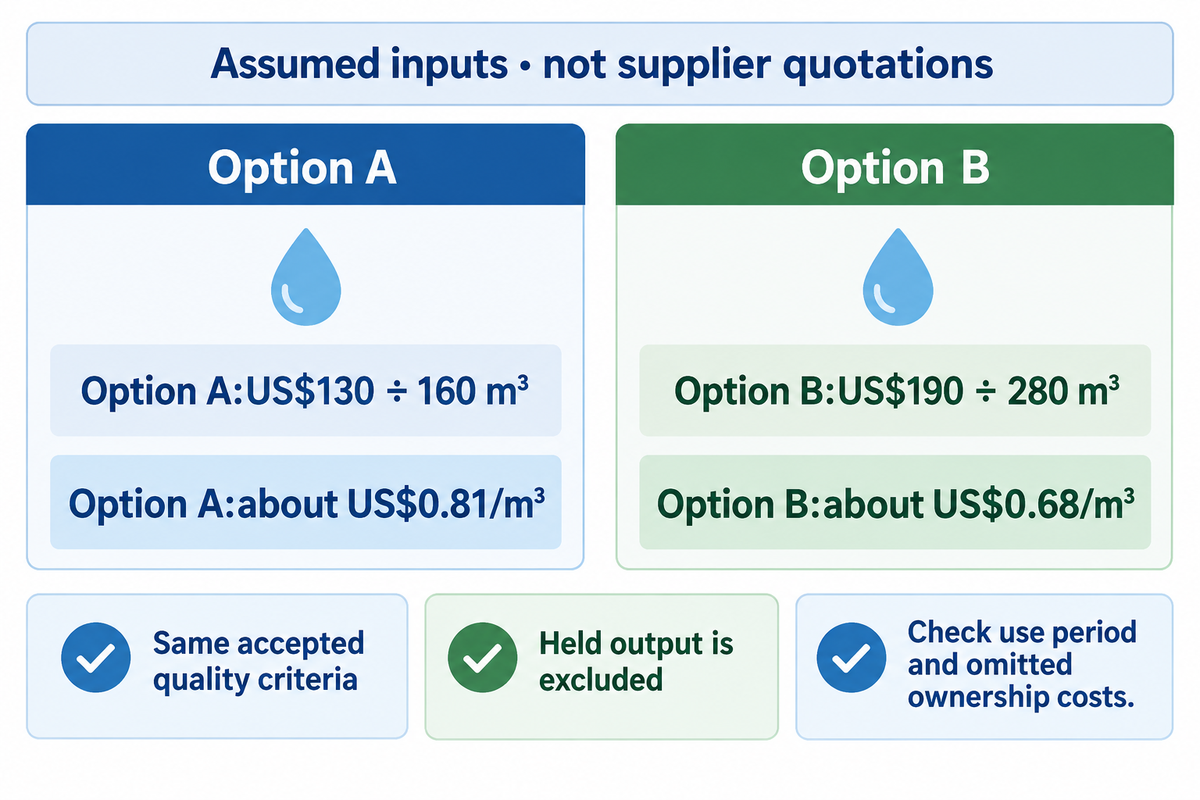
Compare recurring replacement cost over the volume that meets the agreed acceptance criteria. In the numerator, include the cost of the cartridge and changeout, and in the denominator, exclude unresolved or rejected output. The lower the purchase price is, the more useful it is, if its run capacity, allowed use and end result also meet the requirement.
Public prices are context sensitive. On October 21, 2026, Filtersource’s WaterTEC0.2-9.75PE listing showed US$75.43 for a 9.75-inch, 0.2-micron PES double open-end cartridge with EPDM. Cary’s 21BZUS listing showed US$233.110 for each of six units of a 10-inch ultra-high-purity PES cartridge with DOE/EPDM, purchased in lots of six. These seller views differ in grade, length and purchasing terms; they don’t define a market range.
| Input or result | Option A | Option B |
|---|---|---|
| Cartridge cost per changeout | US$100 | US$160 |
| Labor and disposal per changeout | US$30 | US$30 |
| Accepted volume per changeout | 160 m³ | 280 m³ |
| Recurring cost per accepted m³ | (100 + 30) ÷ 160 = US$0.8125 | (160 + 30) ÷ 280 ≈ US$0.6786 |
Suppose a plant compares those two assumed options after each has met the same quality criteria. Option A costs less to buy, but its US$130 changeout cost is spread over 160 m³. Option B spreads US$190 over 280 m³. The comparison therefore favors B on this limited recurring-cost measure, at about US$0.68 per accepted cubic metre versus US$0.81. Finance should next test whether the assumed output is achievable within the permitted use period and whether downtime, energy, rinse liquid or product loss changes the result. If the output of Option B remains on hold after a quality assessment, then that volume cannot support the lower cost. Replace every assumed input with trial or operating records before making a purchase decision.
Keep this calculation distinct from a complete ownership-cost study. It hasn’t considered the housing, instrumentation, and validation costs, as well as all site overheads. For pharmaceutical and biotechnology duties, allowable exposure and batch rules may limit usable output before the cartridge reaches its hydraulic capacity. The relevant denominator is accepted output under those conditions.
Turn the process duty into a supplier brief
A useful supplier brief translates the process duty into terms that can be compared to an exact cartridge. The brief should include the liquid and its constituents, the removal target, flow and temperature, pressure and temperature history, contact time, and the type of connection. Define how the trial will be accepted so that replacement matching doesn’t stop at physical fit.
| Requirement | Provide | Decision enabled |
|---|---|---|
| Liquid composition | Components and concentration, including cleaning exposure | Wetting and chemical compatibility |
| Useful product fraction | Ingredients or particles that must remain in the liquid | Product recovery and binding assessment |
| Removal target | Target contaminant and required outlet measure | Retention and acceptance basis |
| Flow requirement | Normal operating flow and expected variation | Hydraulic comparison and trial conditions |
| Temperature window | Operating and cleaning temperatures with exposure duration | Complete assembly suitability |
| Pressure history | Upstream/downstream conditions, flow direction and transients | Installed path and direction-specific limits |
| Use and cleaning history | Contact time, batch pattern, cleaning and sterilization cycles | Permitted exposure and reuse assessment |
| Installed hardware | Reference, drawing, length, adapter and seals | Replacement geometry and sealing |
| Trial and documents | Acceptance tests, integrity criteria and required product documents | Product evidence versus process validation |
ECOFILTRONE™ is an industrial filtration products supplier based in Qingdao, China, with engineering support for selection, replacement, and customized configuration. Its liquid-filtration portfolio serves water treatment, chemical processing and other process applications. For available configuration, see the membrane filter cartridges solution page.
Request relevant data sheets, drawings, material information and compliance documents for the proposed product and application. Check the actual document holder and scope. A quality-management certificate (if issued) and supplier support do not complete process validation. FDA’s Equipment Questions and Answers states CDER does not maintain an approved equipment list.
Industry outlook: ask for process-specific proof
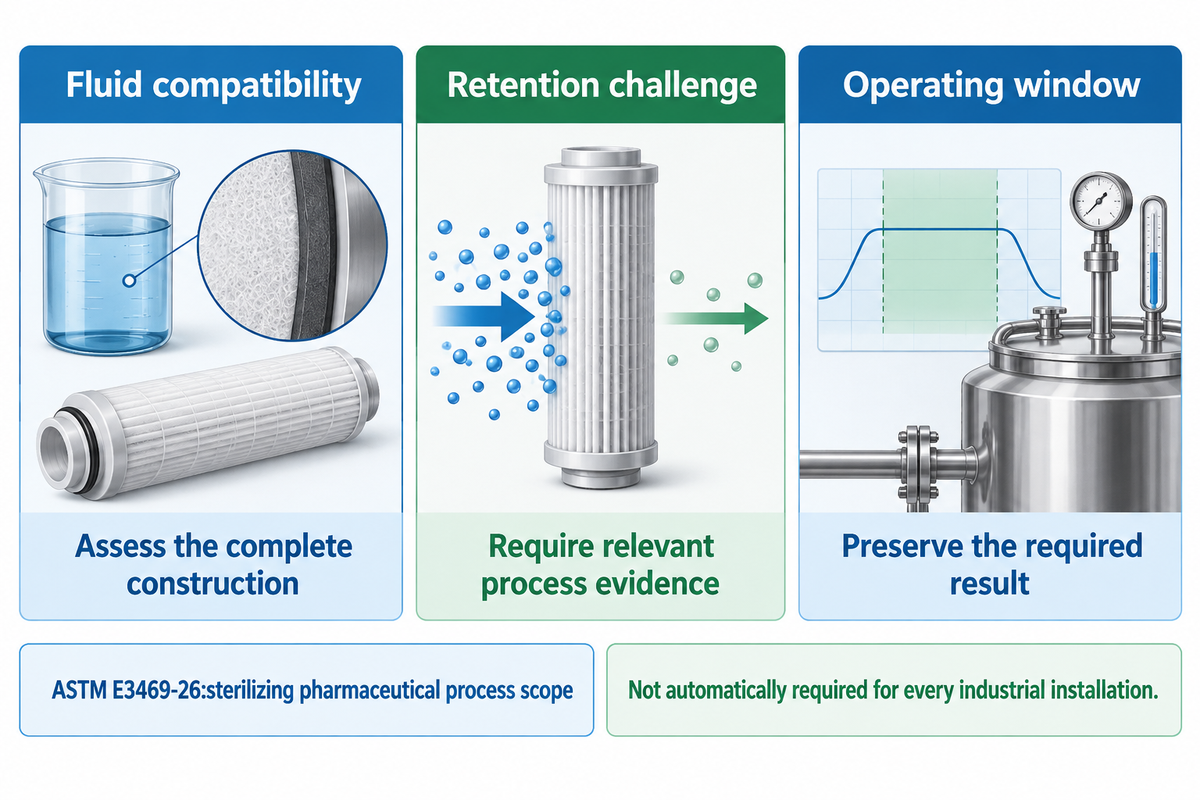
Practical standards development for challenging filtration projects is a clearer separation of evidence for selecting the best cartridge and evidence for process retention validation. ASTM E3469-26, shown active and updated April 28, 2026, addresses end-user sterilizing filtration of pharmaceutical, biopharmaceutical and biological products. It gives process buyers a reason to request validation evidence as a separate deliverable.
The public description of the standard stipulates that actual process fluid, or a suitable surrogate when necessary, be coupled with specified membrane material and composition. Worst-case process conditions include time, flux, temperature and differential pressure. The development concerns how evidence is assembled; it does not establish a new universal cartridge operating limit.
For a new sterile liquid project, split the three following questions into separate reviews. Has the construction been assessed for the fluid and its important constituents? Does the retention evidence address the challenge? Does the functioning window maintain that result? The relevant evidence should be provided prior to allowing the trial or replacement. The filter vendor can support this work, while the end user remains responsible for the actual process.
For standard, industrial water filtration, the same approach of defining the end result is also useful; the Pharmaceutical standard is, however, not automatically required for every installation. State the end use and the relevant acceptance criteria in the enquiry. A water purification project requiring control of a dissolved salt may require a different treatment step, while a project requiring particulate control may benefit from better upstream loading control and the proper use of cartridges.
No market growth forecast is needed to make that decision. Actionable change is to request evidence at the proper level, and retain the tested grade, assembly and operating conditions in the replacement record. A supplier’s reference to a standard should lead to a specific document and scope, not stand in for them.
Frequently asked questions
Are Membrane Pleated Filter Cartridges suitable for sterile filtration?
Sterile filtration requires a suitable validated filter and a process that preserves the required retention result.
Check the exact grade rather than relying on a membrane name or micron label. The supporting evidence must address the challenge, process fluid and intended operating window. Installation, wetting, integrity testing and downstream controls also belong in the assessment. For pharmaceutical use, review the applicable process requirements with the responsible quality function before accepting a replacement or changing its conditions.
Can a membrane pleated cartridge be cleaned and reused?
Reuse is appropriate only within a documented procedure for the exact cartridge and intended duty.
The membrane, supports, bonds and seals all experience the cleaning chemistry and exposure cycle. Restored flow can show that a restriction has changed, but it doesn’t establish retention or acceptable product quality. Record prior use and cleaning history, then apply the required integrity and outlet checks. Don’t exceed the permitted exposure or validated use period to obtain another run.
What types of fluids can be filtered using a membrane pleated cartridge?
Suitable grades handle process water, beverages and selected chemical or biological liquids; gas service requires a separate grade and operating assessment.
Match the complete filtration system to the actual fluid composition, concentration and temperature. In the food and beverage industries, useful ingredients and sensory attributes may matter alongside particle removal. An ultrapure water duty can require outlet measurements beyond a particle rating. In biotechnology, product recovery can require a separate binding assessment. A membrane water filter cartridge chosen for one stream shouldn’t be transferred to another solely because the housing dimensions and nominal rating match.
Can membrane pleated filter cartridges be customized for specific applications?
Customization can address cartridge dimensions, adapters, seals and the required filtration configuration.
ECOFILTRONE offers application review and customized configuration support. Send the liquid, retention goal, operating window, housing drawing and acceptance requirements. Those details allow a proposed replacement cartridge to be checked against the intended duty before a trial is agreed.
Are PES Pleated Filter Cartridges suitable for high-temperature applications?
Use the temperature and pressure limits for the exact assembled PES cartridge and exposure cycle.
The membrane polymer alone doesn’t define a complete cartridge limit. Supports, end caps, bonds and seals also contribute, and continuous hot-liquid service differs from a short sanitization exposure. Specify the fluid chemistry, time at temperature, flow direction and differential pressure when checking the documentation. Include any cleaning agent and cumulative sterilization history in the review. A replacement that shares a PES membrane may still use a different construction, so compare the proposed grade with the original approved operating window rather than borrowing a temperature from a general material chart.
What is the pore size of a pleated membrane cartridge?
Choose the pore rating against the required particle or microbial result and its stated test method.
The same nominal size can appear on products with different retention evidence and structures. Confirm the challenge and acceptance basis in the product documentation. The rating must support the intended duty within the complete process, rather than simply being the smallest available number.
What are the limitations of PVDF Pleated Filter Cartridges?
PVDF limitations include grade-specific wetting, product interaction and compatibility of the complete cartridge.
A hydrophilic liquid grade and a hydrophobic grade have different starting conditions. Product adsorption and extractables also need consideration where they can affect recovery or the outlet specification. A broad chemical-resistance description leaves the supports, bonds and seals to assess separately. Compare suitable candidates using the actual liquid, defined flow and relevant outlet tests. If a trial shows adequate clean flow but unacceptable product recovery, choosing the same polymer with a different rating alone may leave the original problem unresolved. Retain the tested grade and construction in the replacement record.
References & Sources
- Microfiltration Techniques and Devices University of Georgia, 2025; general process distinction
- Comparative Evaluation of the Performance of Sterile Filters for Bioburden Protection and Final Fill in Biopharmaceutical Processes Na and colleagues, Membranes, 2022; specific flat-sheet comparison
- Defect Detection Sensitivity of Bubble-Point-Type Tests for Sterilizing-Grade Membrane Cartridge Filters Giglia and colleagues, Membranes, 2023; EMD Millipore affiliation
- Effects of Viscosity on Submerged Membrane Microfiltration Systems Membranes, 2022; pressure, viscosity and resistance relation
- ASTM E3469-26 ASTM International, 2026; public scope and Section4.3
- GUI-0119, Production and specific technologies Health Canada; sterile-drug filtration guidance
- Current Good Manufacturing Practice Requirements: Equipment FDA, Question2; equipment-selection responsibility
- The optimization of a rapid low-cost alternative of large-scale medium sterilization Monteil and colleagues, BMC Proceedings, 2013; system-specific trial limit
- Recognition14-512: ISO13408-2:2018 scope FDA; published health-care sterilizing-filtration scope
How ECOFILTRONE uses this guide
ECOFILTRONE supports liquid-filtration selection and replacement matching for industrial processes. This guide connects membrane wetting, integrity evidence and accepted-volume cost so that a technical enquiry starts with the process duty. The study results cited here belong to their named authors; example calculations are stated assumptions. Product-specific documents and operating conditions remain part of each application review.
Have a liquid-filtration duty to review? Send the fluid, operating window, installed reference and acceptance requirements to ECOFILTRONE.