Get in touch with ECOFILTRONE™ Company


Membrane Filter Cartridges
Membrane Filter Cartridges for Process Liquids and Gases: PES, PTFE, PVDF and Nylon
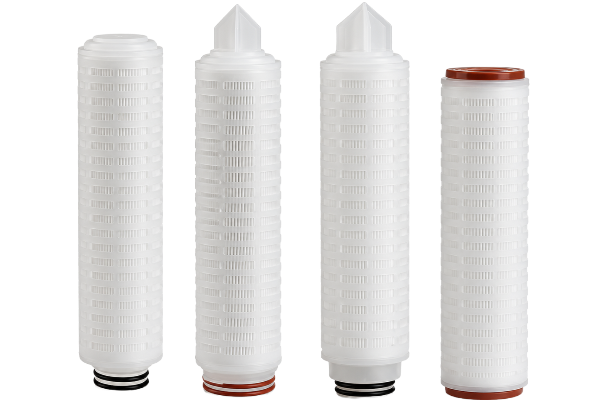
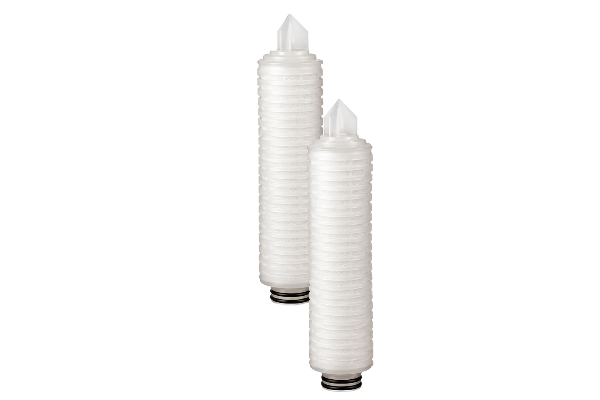
ECOFILTRONE™ builds membrane filter cartridges on our own pleating, assembly and end-cap welding lines in Qingdao, China, with PES, PTFE, PVDF and nylon membranes in ten catalogue series. We match the membrane, pore rating, length and end cap to your fluid and your existing housing, then return a written quote within 24 hours.
Send your model number or a photo of your current cartridge. The dimensional match is confirmed in the same reply.
Hover to Pause
Response
Quote within 24 hours
Dispatch
Stock items ship in 4–5 days
Capability
Liquid ratings 0.04–10 µm
Dimensions
69 mm OD, 5–40 in lengths
Membrane Filter Cartridges at a Glance
These numbers apply to every cartridge ECOFILTRONE™ builds in-house. Each one is confirmed in writing with your quote.
-
01
Membranes
PES, PTFE, PVDF and nylon, in hydrophilic and hydrophobic grades
-
02
Catalogue series
10 series, single-layer and double-layer
-
03
Pore ratings
0.01 µm for gas up to 10 µm for liquids; 0.22 µm and 0.45 µm in all four membranes
-
04
Outside diameter
69 mm (2.72 in)
-
05
Lengths
5–40 in (127–1016 mm)
-
06
Maximum temperature
80 °C (176 °F); 100 °C (212 °F) for the ECPTFE series
-
07
Maximum differential pressure
4.0 bar (58 psi) at 20 °C; 2.0 bar (29 psi) at 80 °C
-
08
Lead time
Quote within 24 hours; 4–5 days for stock items; 14 days for custom batches
-
09
Applications
Pharmaceutical, beverage, fine chemical and compressed gas production lines
-
10
Samples
Free samples, freight paid by the buyer; custom samples in 7 days
Membrane Filter Cartridge Manufacturer: Pleating, Welding and Testing
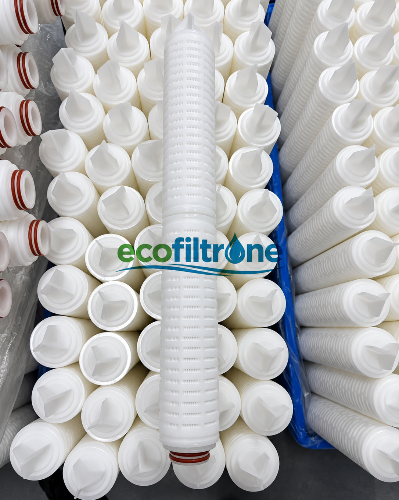
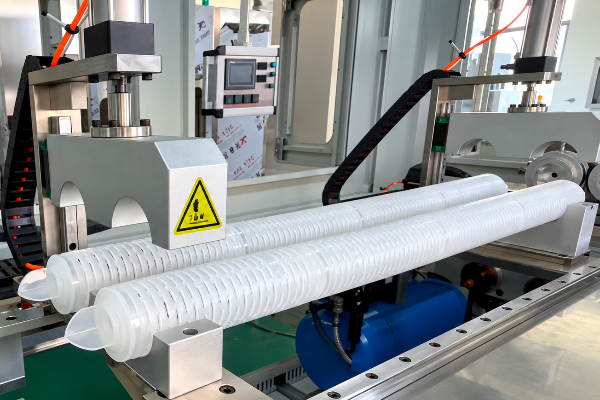
A membrane cartridge fails in service for three reasons: a membrane that does not suit the fluid, a pleat pack collapsed by differential pressure, or a poor seal that lets liquid bypass the element, as illustrated by this third-party patent. We have complete control over all three stages, on our own lines for pleating, membrane cartridge assembly and end-cap welding or bonding. We check dimensions, integrity, flow and filtration performance against each product’s requirements.
“Because we operate the pleating, assembly and end-cap lines, modifying a membrane, length or end-cap is work done on our line as opposed to work directed to be done at another facility.”
— ECOFILTRONE™ Engineering TeamPleated membrane filter cartridge construction
SEC. 01 Membrane pack
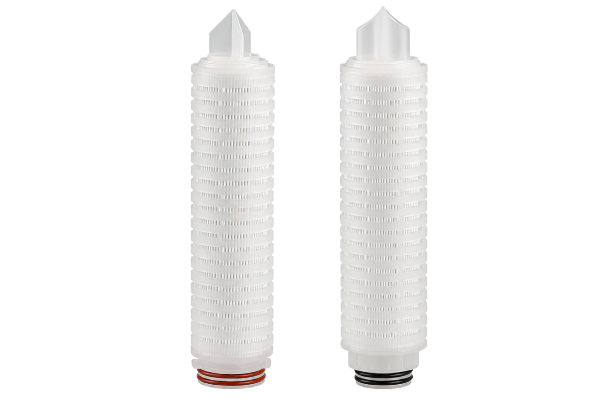
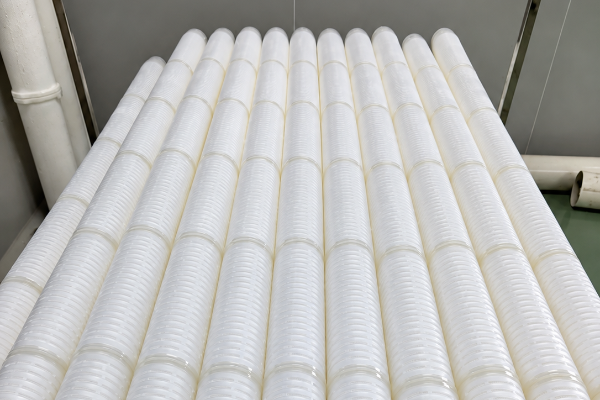
PES, PTFE, PVDF or nylon membrane pleated between support and drainage layers, which puts up to 0.65 m² (7.0 ft²) of filtration area inside every 10 in of a 69 mm cartridge.
SEC. 02 Polypropylene hardware
The cores, outer cages and end caps are made from polypropylene. Hardware in the ECPTG gas series has a reinforced core and is oxidation resistant, and hardware in the ECPTFE series is rated for both oxidation and heat.
SEC. 03 Support layers
The ECPC nylon series uses PET and PP for support structures, and contains no glues, adhesives, or wetting agents.
SEC. 04 Membrane structure
Single-layer, double-layer (ECPAD and ECPT), or extremely asymmetric PES (ECPAB), depending on how much load the cartridge has to carry.
Hydrophilic vs hydrophobic membranes
Selecting the wrong wetting behavior is the fastest way to a cartridge that will not pass liquid. The table below will help you find which of our membranes wet out in water and where each one belongs.
| Wetting behaviour | Our membranes | Where it fits | What to plan for |
|---|---|---|---|
| Hydrophilic | PES (ECPAA, ECPAB, ECPAD), PVDF (ECPVA), nylon (ECPC), hydrophilic PTFE (ECP) | Aqueous liquids, beverages, protein solutions, acids and alkalis (ECP) | Wets out in water; no alcohol pre-wet before start-up |
| Hydrophobic | PTFE (ECBTG, ECPTG, ECPT, ECPTFE) | Compressed air, nitrogen, tank vents, aggressive solvents | Repels water; needs a low-surface-tension pre-wet before it will pass an aqueous liquid |
Liquid and gas formats
The same 69 mm platform carries both duties, which keeps your spares list short across a plant. Liquid ratings run from 0.04 µm on PES up to 10 µm on hydrophobic PTFE, while the ECPTG and ECPTFE gas cartridges carry a 0.01 µm gas rating alongside a 0.22 µm liquid rating.
Upon determining that your duty is either liquid or gas, you then have to decide on the membrane. Take a look at the five membrane families below to assist you in this.
Membrane Filter Cartridge Types by Membrane Material
Chemical compatibility, protein binding and whether the membrane wets out in the fluid determine membrane choice, so membrane choice precedes pore size. For each family below, a product page is provided with details of the entire series.
01
PHASE // 01
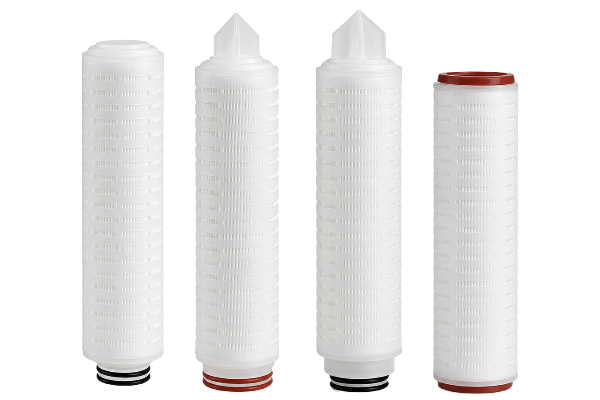
PES Membrane Filter Cartridges
Hydrophilic polyethersulfone with 0.65 m² (7.0 ft²) of membrane per 10 in and extractables below 20 mg per 10 in on ECPAA.
- Series: ECPAA, ECPAB (high asymmetric), ECPAD (double layer)
- Ratings: PES 0.04–1.2 µm
- Fluids: aqueous drug solutions, biologics, beverages
- Limits: 80 °C; 4.0 bar at 20 °C
02
PHASE // 02
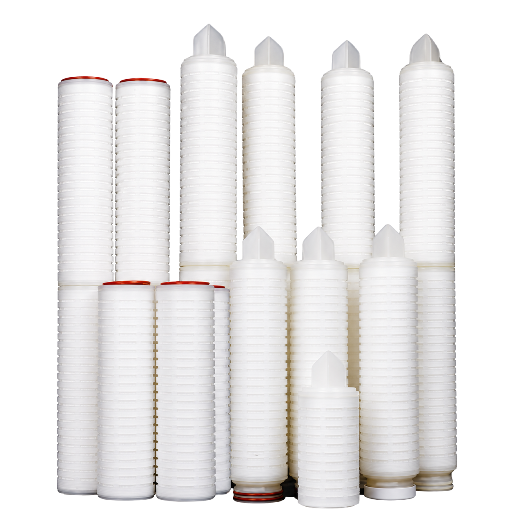
PTFE Membrane Filter Cartridges
Our PTFE line of pleated filter cartridges covers gases, vents and aggressive chemicals. Included is a grade of hydrophilic PTFE for use with aqueous acids and alkalis.
- Series: ECBTG, ECPTG, ECPT, ECPTFE, ECP
- Ratings: PTFE 0.01–10 µm (0.01 µm gas rating)
- Fluids: compressed air, nitrogen, solvents, oxidisers, corrosive liquids
- Limits: 80 °C; ECPTFE to 100 °C
03
PHASE // 03
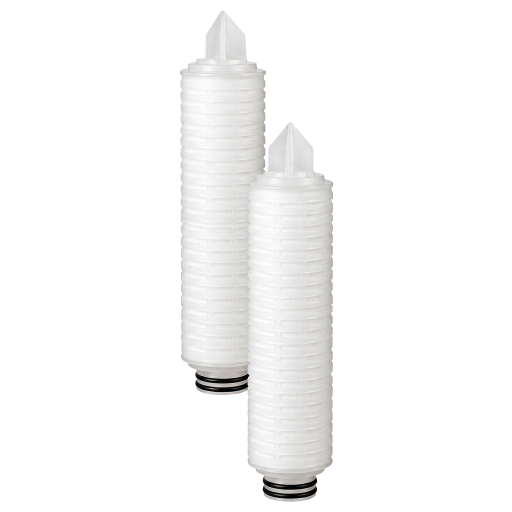
PVDF Membrane Filter Cartridges
Hydrophilic PVDF with low protein binding, also available with a single open end for sanitary housings.
- Series: ECPVA
- Ratings: 0.1–0.65 µm
- Fluids: food and beverage, protein solutions, cell-culture clarification
- Limits: 80 °C; 4.0 bar at 20 °C
04
PHASE // 04
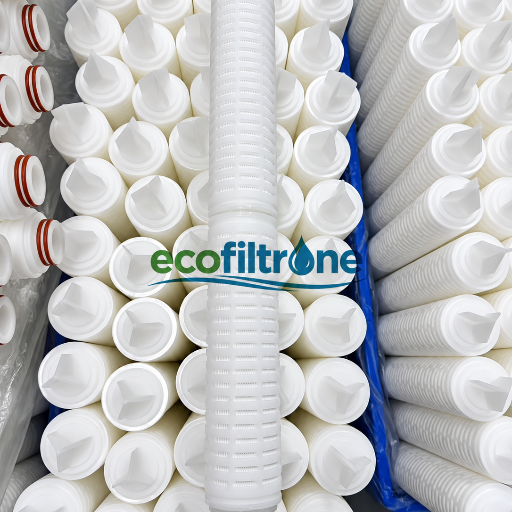
Nylon Membrane Filter Cartridges
Absolute-rated, naturally hydrophilic nylon, made without glues or wetting agents, for solvent and blended streams.
- Series: ECPC
- Ratings: 0.22–1.2 µm
- Fluids: organic solvents and water–solvent blends, pharmaceutical, beverage and process liquids
- Sizes: 69 mm OD, 5–40 in
- Limits: 80 °C; 4.0 bar at 25 °C
05
PHASE // 05
0.2 Micron Filter Cartridges
“0.2 micron” is what buyers look up; our catalogue rating for this class is 0.22 µm, offered in all four membranes.
- Series: 0.22 µm models of PES, PTFE, PVDF and nylon
- Ratings: 0.22 µm; paired 0.45 µm prefilters available
- Duties: final particle filtration before filling, vents, and gas lines
- Limits: by membrane, per the table below
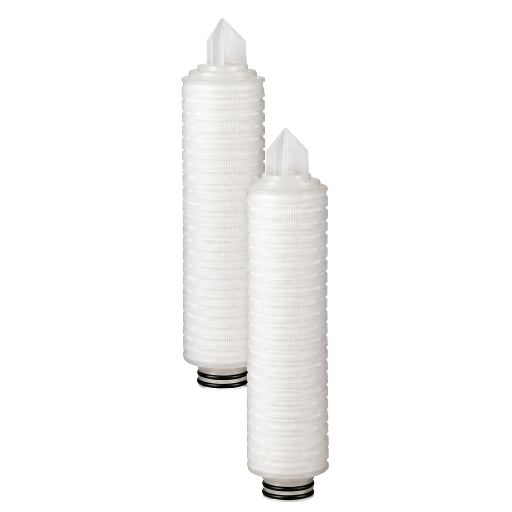
Membrane selection matrix by fluid, chemistry and temperature
This short list can help you choose one or two series to sample. The membrane, PP hardware and O-rings all need to be compatible with your fluid, and a sample run on your own fluid settles the final choice.
Fluid or duty
Membrane
Series
Ratings (µm)
Max temp
Hardware
Aqueous drug solutions and biologics
Hydrophilic PES
ECPAA
0.1–1.2
80 °C
PP
Fine polishing of low-solids process water
Hydrophilic PES
ECPAA
0.04–0.1
80 °C
PP
High-solids beverages such as wine and beer
High-asymmetric PES
ECPAB
0.22, 0.45, 0.65
80 °C
PP
Heavily loaded liquids that need longer service life
Double-layer PES
ECPAD
0.22+0.1 up to 0.65+0.45
80 °C
PP
Protein solutions and cell-culture clarification
Hydrophilic PVDF
ECPVA
0.1–0.65
80 °C
PP, single open end option
Organic solvents and water–solvent mixes
Nylon
ECPC
0.22–1.2
80 °C
PET and PP support
Strong acids, alkalis and oxidising liquids
Hydrophilic PTFE
ECP
0.22, 0.45
80 °C
PP
Solvents and corrosive liquids with a pre-wet step
Hydrophobic PTFE
ECBTG
0.1–10
80 °C
PP
Compressed air, nitrogen and corrosive gas
Hydrophobic PTFE
ECPTG
0.01 gas, 0.22 liquid
80 °C
Oxidation-resistant PP, reinforced core
Tank vents and fermentation feed air
Hydrophobic PTFE
ECPTFE
0.01 gas, 0.22 liquid
100 °C
Oxidation- and heat-resistant PP
Pore size to filtration task
The trade-off is simple: a tighter rating than the duty needs loads faster and increases changeouts. Start from the particle you must remove and work outward. These are the ratings we stock for each task.
Rating
Filtration task
Membranes offered
0.01 µm (gas)
Compressed air, nitrogen and tank vent filtration
Hydrophobic PTFE (ECPTG, ECPTFE)
0.04–0.1 µm
Fine polishing of process liquids and purification of low-solids water
PES; PTFE and PVDF at 0.1 µm
0.22 µm
Final particle filtration before filling; vents and gas lines on the liquid rating
PES, PTFE, PVDF and nylon
0.45 µm
Yeast and fine particle removal in beverages ahead of bottling
PES, PTFE, PVDF and nylon
0.65 µm
Prefilter that protects a 0.22 µm or 0.45 µm final stage
PES, PVDF and nylon
1.2 µm
Coarse membrane prefilter after a depth stage
PES and nylon
1–10 µm
Particle and contaminant removal from corrosive liquids and solvents
Hydrophobic PTFE (ECBTG)
Get a Series Shortlist with Your Quote
Haven’t figured out the right row? Send your fluid, temperature, flow rate, viscosity and solids load, and we will reply with a series shortlist as well as a quotation. You can also try running the membrane series selector first.
End Caps, Hardware and Housing Fit
A cartridge that does not seat properly in a housing leaks: fluid bypasses the membrane, however good the membrane is. Single-open-end 222 and 226 adapters look alike but are not interchangeable: each seals on a different O-ring size, and 226 styles usually add locking tabs, so the wrong end cap fails at the seal from the first run.
-
01
PES, PVDF, nylon and ECP PTFE series use a PP core, cage and end caps rated to 80 °C (176 °F), with the end-cap code and O-ring material matched to the filter housings you already run.
-
02
The ECPTG gas series adds oxidation-resistant PP and a reinforced core that holds its shape at higher differential pressure, on the same 69 mm (2.72 in) outside diameter.
-
03
ECPTFE vent cartridges use PP components rated for oxidation and for continuous service at 100 °C (212 °F).
-
04
A single-open-end ECPVA design fits sanitary housings for food, beverage and protein service applications.
-
05
O-rings are checked for compatibility separately, as a seal can increase in size when immersed in a fluid that the membrane can tolerate.
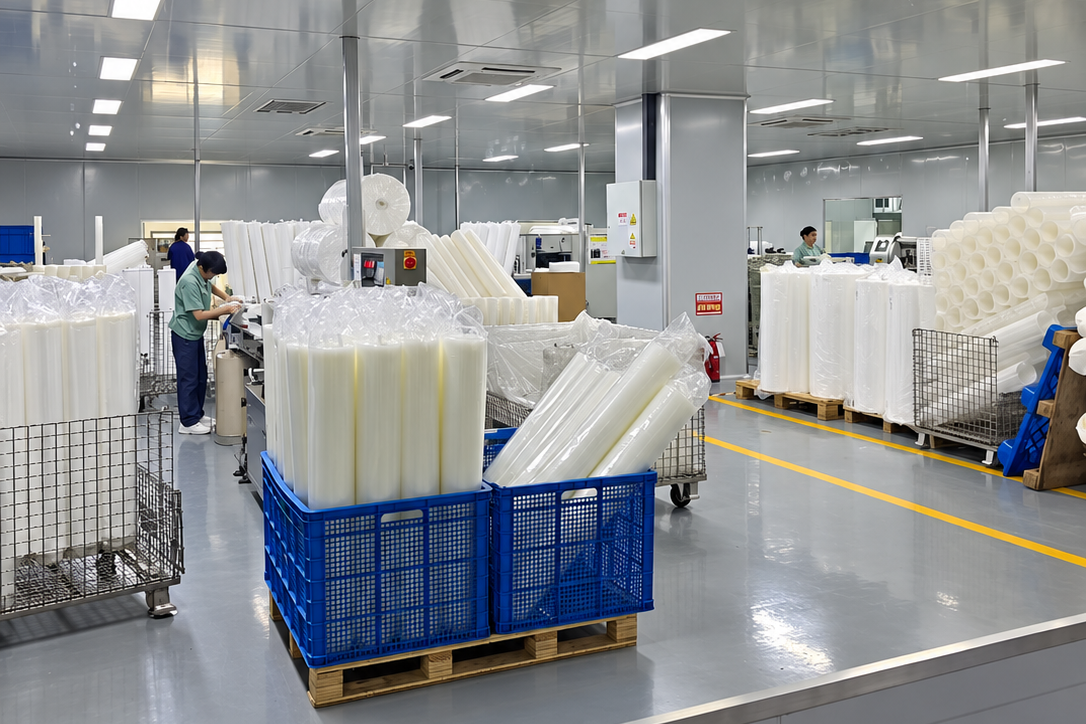
// Technical Assessment & Support
Before ECOFILTRONE™ quotes anything, we confirm against your housing drawing that the end cap and O-ring will seat. Send your current model number, and the dimensional answer comes back with the quote within 24 hours.
Looking for a pleated membrane filter cartridge replacement? Send us the model number or a photo of your current cartridge along with its end cap. We confirm a dimensionally compatible, direct replacement for models we have checked, and let you know before giving you a price quote if a different end cap is needed.
Membrane Filter Cartridge Specifications
The following values are what we build to across the membrane filter cartridge range. With each quote we provide series-level datasheets and drawings.
| Specification | What we build to |
|---|---|
| Membranes | PES, PTFE, PVDF and nylon |
| Pore ratings by membrane | PES 0.04–1.2 µm; PTFE 0.01–10 µm; PVDF 0.1–0.65 µm; nylon 0.22–1.2 µm |
| Ratings stocked in every membrane | 0.22 µm and 0.45 µm |
| Outside diameter | 69 mm (2.72 in) |
| Lengths | 5, 10, 20, 30 and 40 in (127, 254, 508, 762 and 1016 mm) |
| Maximum operating temperature | 80 °C (176 °F); 100 °C (212 °F) for ECPTFE |
| Maximum differential pressure | 4.0 bar (58 psi) at 20 °C; 2.0 bar (29 psi) at 80 °C |
| ECPTFE differential pressure | 5.2 bar (75 psi) at 20 °C; 2.4 bar (35 psi) at 80 °C |
| Filtration area per 10 in | 0.65 m² (7.0 ft²) for ECPAA, ECPAB and ECPVA; 0.56 m² (6.0 ft²) for ECPAD |
| Extractables per 10 in | Below 20 mg for ECPAA; below 25 mg for ECPAD |
| Hardware | PP core, cage and end caps; PET and PP support on ECPC nylon |
| Standard lead time | 4–5 days for stock items; 14 days for custom batches |
Operating limit check
You can check operating limits for a series by entering your operating temperature and differential pressure before you order.
Pricing, MOQ, Samples and Lead Times
Price is built from six inputs: membrane, pore rating, length, end cap, quantity and Incoterm. There is no fixed list price for membrane cartridges, so every figure comes back in a written quote within 24 hours.
Term
What we commit to
What it covers
Quotation
Within 24 hours
Series recommendation, datasheet and price for your stated duty
Stock items
Ship in 4–5 days
Confirmed in-stock membranes, ratings and lengths
Custom samples
Ready in 7 days
Non-stock rating, length or end cap built for trial
Custom batch production
14 days
Production run after the sample or drawing is approved
Minimum order
Standard MOQ set per product; trial orders accepted; custom production from 100 cartridges
Mixed trial quantities on stock series
Samples
Free samples; the buyer pays freight
Stock series for a trial on your own fluid
Payment
30% deposit, 70% balance before shipment
All production orders
Incoterms
EXW, FOB, CFR or CIF
Named port or plant confirmed in the quote
How a quote is built
-
01
We read your fluid, temperature, flow rate and current cartridge, and check for any potential membrane or O-ring conflict.
-
02
We decide on the series, rating, length and end cap, and state the number of cartridges per housing.
-
03
The quote gives the information you requested: unit price by quantity break, lead time and the Incoterm you asked for.
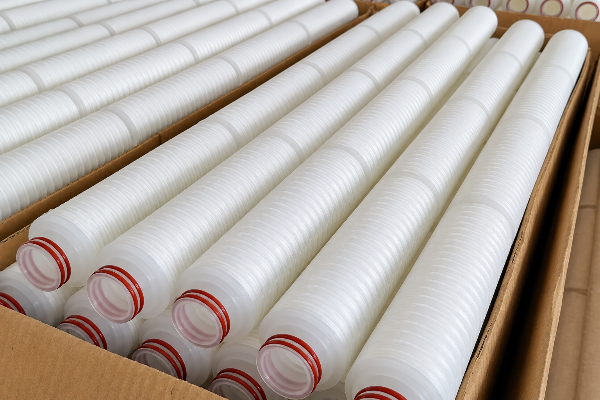
Request Pricing and Samples
Want to test before you commit? Ask for free samples of a stock series; you pay only the freight, and custom samples are ready in 7 days.
Inspection and Documents Supplied with Each Order
When switching supplier, the risk buyers raise most is a cartridge that looks right but leaks or bypasses on the line. This is often because dimensions, seals and membrane are rarely checked together. Therefore, ECOFILTRONE™ performs the four checks below on every order, prior to shipping.
-
Dimensional check
69 mm (2.72 in) outside diameter, ordered length from 5–40 in, and end-cap geometry against the drawing for the ordered model.
-
Integrity check
Membrane and seal integrity is checked as the product specification requires.
-
Flow check
Flow rate and clean pressure drop against the series datasheet; the rated limit of the element is 4.0 bar (58 psi) at 20 °C.
-
Filtration performance
Removal performance is verified where the product specification requires it.
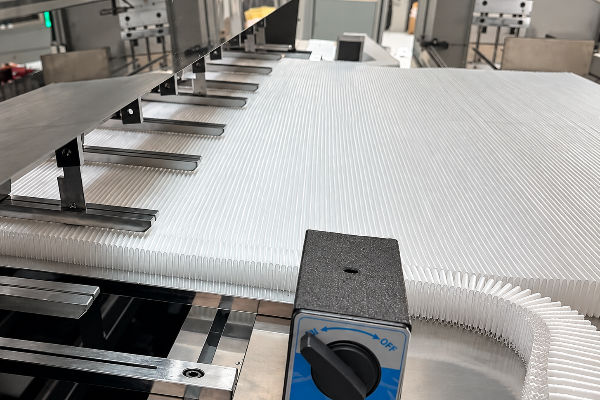
Documents you receive
- Technical data sheet and drawing for each ordered series.
- Material certificates and compliance documents are available upon request, and will be issued after verification against the specific product and certificate holder.
- Inspection results for the ordered batch.
Documents are only half of the risk picture. The other half is choosing the right series before production begins, which is why the next section puts that check first.
Which documents do you require for your receiving inspection? They will be listed in the quote, so nothing is missing when your shipment arrives.
From Filtration Duty to Repeat Supply in Six Steps
Most cartridge problems happen at the selection stage rather than during production. Therefore, we are responsible for the first two steps that follow.
01
1. Send the duty
— the fluid, temperature, flow rate, solids load and the cartridge currently in operation.
02
2. Application review
— we look over the membrane, pore rating, hardware and O-ring against the chemistry you provide, and we make the compatibility call.
03
3. Written quote in 24 hours
— series, datasheet, price and lead time in one document.
04
4. Sample trial
— free samples of stock series, or custom samples in 7 days, run on your own fluid.
05
5. Production and inspection
— custom batches in 14 days, with dimensional, integrity and flow checks before packing.
06
6. Shipment and follow-up
— EXW, FOB, CFR or CIF, then differential-pressure and service-life review on your first changeouts.
Specification choices that lower cost
| Choice | What to specify | Why it lowers cost |
|---|---|---|
Pore rating |
The most open rating that still removes your target particle |
A tighter membrane blinds sooner and raises changeout frequency |
Prefilter stage |
0.65 µm or 1.2 µm membrane, or a depth stage, ahead of a 0.22 µm final filter |
Keeps load off the most expensive cartridge in the train |
Single vs double layer ECPA |
A single layer unless the duty needs the ECPAD second layer |
Single layer carries 0.65 m² per 10 in against 0.56 m² for double layer |
Cartridge length |
One 40 in element where the housing takes it, instead of four 10 in elements |
Fewer O-ring seats to leak and less changeout labour |
End cap |
The code that matches your existing housing |
Avoids a housing change on a replacement order |
Industries Using Our Membrane Filter Cartridges
The same ten ECOFILTRONE™ series are used for both liquid and gas applications in different production plants.
-
Pharmaceutical process filtration
PES and nylon cartridges for prefiltration and process filtration of aqueous and solvent-based pharmaceutical liquids.
-
Biologics and protein solutions
PES ECPAA (0.04–1.2 µm) and PVDF ECPVA (0.1–0.65 µm), both with 0.65 m² of membrane per 10 in, for protein solutions where binding losses cost yield.
-
Food and beverage
High-asymmetric PES ECPAB and PVDF for wine, beer and bottled water, at 0.45 µm and 0.65 µm ahead of filling.
-
Fine chemicals and solvents
Hydrophobic PTFE ECBTG and hydrophilic PTFE ECP for oxidisers, acids, alkalis and corrosive reagents.
-
Compressed air and gases
ECPTG PTFE at a 0.01 µm gas rating for compressed air, nitrogen and corrosive gas lines.
-
Electronics and high-purity water
PES and nylon at 0.1–0.45 µm for polishing in high-purity water treatment and rinse lines.
-
Tank vents and fermentation feed air
ECPTFE hydrophobic PTFE at up to 100 °C (212 °F), with a 0.01 µm gas rating for vent and feed-air lines.
When a Membrane Cartridge Is the Wrong Choice
A membrane is a fine final stage, but as a bulk solids remover it’s not effective. In the following five cases, a different element or a stage located in front of the membrane costs you less.
-
Situation
High-solids or turbid feed
Why it works against youThe membrane surface blinds quickly and changeouts multiply
What to do insteadPut a depth filter or a PP pleated filter cartridge ahead of the membrane. In bioprocess work, a published prefiltration guide reports that a layered prefilter stage ahead of a 0.22 µm final membrane raised its throughput 2–5 times and cut filter cost per batch by 30–60%; your gain depends on your solids
-
Situation
Liquid above 80 °C
Why it works against youStandard PP hardware is rated to 80 °C (176 °F)
What to do insteadUse ECPTFE, rated to 100 °C (212 °F), or cool the stream before the filter
-
Situation
Only particles of 10 µm and above need removing
Why it works against youA membrane costs more per litre than the duty requires
What to do insteadUse a depth element, such as a melt blown or string wound filter cartridge
-
Situation
Hydrophobic PTFE fed with an aqueous liquid
Why it works against youWater will not pass a dry hydrophobic membrane at normal pressure
What to do insteadPre-wet with a low-surface-tension liquid, or switch to hydrophilic PTFE (ECP) or PES
-
Situation
Hot caustic cleaning on PVDF
Why it works against youIn published tests on PVDF hollow-fibre membranes, sodium hydroxide attacked the polymer, and the attack sped up with concentration and temperature
What to do insteadChoose hydrophilic PTFE (ECP), which our catalogue lists for acids and alkalis, or send the cleaning recipe for a check
Request a Membrane Filter Cartridge Quote
Open the quote form and include the details below, and a written quote comes back within 24 hours. A photo of your current cartridge is often enough for us to match the end cap.
Request a Quote
Stock series samples are free. You only pay shipping.
-
Name, work email and company
-
Fluid, operating temperature and flow rate
-
The existing pore rating you use or the particle you need to eliminate
-
Length, end cap and housing model
-
Quantity per order and per year
-
Please include a photo or model number of your current cartridge (JPG, PNG or PDF)
A membrane cartridge captures particles on the surface of the media, with pore ratings from 0.01 µm to 10 µm in our range. A depth filter, such as a melt-blown or a string-wound filter, captures particles through its thickness and handles higher solids at coarser ratings. Most process lines employ a depth filter first and a membrane cartridge as the final filter.
Use hydrophilic PES, PVDF, nylon or hydrophilic PTFE for water-based liquids, as they do not require a pre-wet. Hydrophobic PTFE is ideal for air, gases and vents, as it allows the passage of gas while blocking water. Hydrophobic PTFE can also filter liquids, but only after a pre-wet with a low-surface-tension solvent.
Start with chemistry: the membrane, PP hardware and O-rings must all be rated for your process fluid at your operating temperature, and a failure in any one of the three ends the run. Then choose the most open pore rating that removes your target particle, and the length that fits your housing, counting how many 10 in equivalents a batch will load before the pressure drop climbs. Our series selector gives a first shortlist, and a sample test on your liquid confirms flow, throughput and seal behaviour before you commit to production volumes.
Use 1.2 µm or 0.65 µm as prefilters, 0.45 µm for yeast and fine particles in beverages, and 0.22 µm as a final particle filter before filling. Use 0.1 µm or 0.04 µm only for fine polishing of low-solids liquids, because those ratings load fastest. For gas, the PTFE 0.01 µm gas rating is the usual choice.
In practice, yes. Our catalogue rating for this class is 0.22 µm, offered in PES, PTFE, PVDF and nylon.
Treat them as replaceable elements in particle duty, as it is difficult to fully remove trapped solids from pleated membrane elements. Where you plan in-place flushing, send the flushing chemical, concentration and temperature, and we verify them against the membrane, hardware and O-ring limits. Hot caustic is the common trap for PVDF.
Service life is set by the solids reaching the membrane, not by a calendar. The practical changeout signal is differential pressure: plan it before the element reaches its limit of 4.0 bar at 20 °C or 2.0 bar at 80 °C. A prefilter stage is the cheapest way to extend it.
An absolute rating indicates that the membrane retained particles of the stated size in the supplier’s defined test, while a nominal rating indicates that only a fraction of them was captured. Rating definitions and test conditions vary between suppliers. Compare ratings on your own fluid with a sample run rather than relying on the label alone.
Nylon (ECPC) and PTFE are generally the preferred membranes for organic solvents and water–solvent mixtures. PES cannot be used with strong polar solvents, for example, NMP and DMF. Send us the solvent and operating temperature and we will check the suitability of the membrane, hardware and O-rings before quoting.
Our cartridges are 69 mm in outside diameter and 5–40 in long, with end caps matched to the housing you run. Send the model number or a photo of your current cartridge, and we confirm a dimensionally compatible, direct replacement for models we have checked. The 222 and 226 styles are not interchangeable, so we confirm the end cap first.
Standard MOQ is set per product, and trial orders are accepted on stock series. Custom production starts from 100 cartridges. Stock items ship in 4–5 days and custom batches in 14 days.
Yes. Free samples of stock series; you pay the freight. Custom samples take 7 days.
Payment is a 30% deposit, with the 70% balance due before shipment. We quote EXW, FOB, CFR or CIF, with the named port or plant confirmed in the quote.