
Get in touch with ECOFILTRONE™ Company



A High Flow Filter Cross-Reference links a proposed alternative with the original filter part number. The value of that link depends on supporting documentation such as configuration, drawings, performance conditions and application requirements. A good match gives greater clarity when making a purchase; it doesn’t give permission to install.
The evidence described above is sometimes hard to interpret when a label, datasheet and/or quotation appear to be at odds with each other. This booklet gives a preliminary assessment on some applications in process and water treatment and industrial filtration. Results of auto oil-filter and motorcycle lookups are included in a different product area.
Start with the decision
Are you identifying a candidate, comparing its documents, requesting a conditional quote, or accepting a configuration for a particular application? State that purpose before calling a filter an equivalent. Each decision needs a different level of detail.
What a High Flow Filter Cross-Reference Can Prove
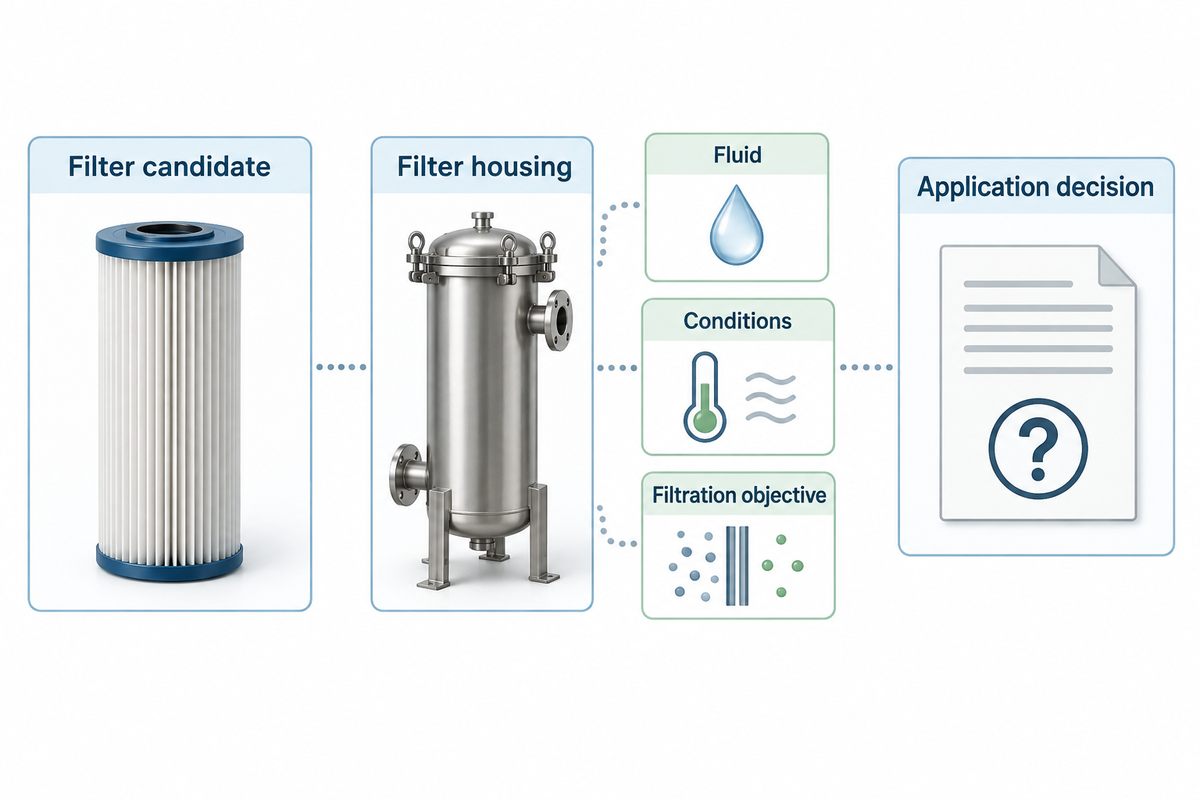
Cross-references support finding candidates for an existing filter. Suitability of the candidates should be established by comparing the candidates to the particular housing, fluid and conditions and the purpose of filtration.
In the world of procuring equipment, the term equivalent should identify what is being compared. Is the physical interface equivalent? Is the performance of particle removal equivalent? Is the material of construction equivalent? A supplier may be stating one of these while the buyer may be assuming all of these. Place the intended meaning next to the part number where both the supplier and the buyer can see it.
For example, a maintenance buyer may need an alternative during a supply disruption and the first question is to determine whether available information justifies requesting a sample or quote. On the other hand, a plant engineer who needs to release the same item for service has a different question. Treating both types of situations as “matches” obscures the work remaining to be done.
This difference is illustrated by Schroeder Industries in their hydraulic-filter lookup: they identify functional alternatives, and include a caution that a manufacturer’s specification may vary or change without notice. Hence it’s good practice to retain supporting documents, rather than simply save a screenshot of the two relevant codes.
Also review a chained reference. If one association links A to B and a different association links B to C, review C against the original requirement. The intermediate association may have been made for a different, narrower purpose.
From Lookup Result to Defensible Evidence
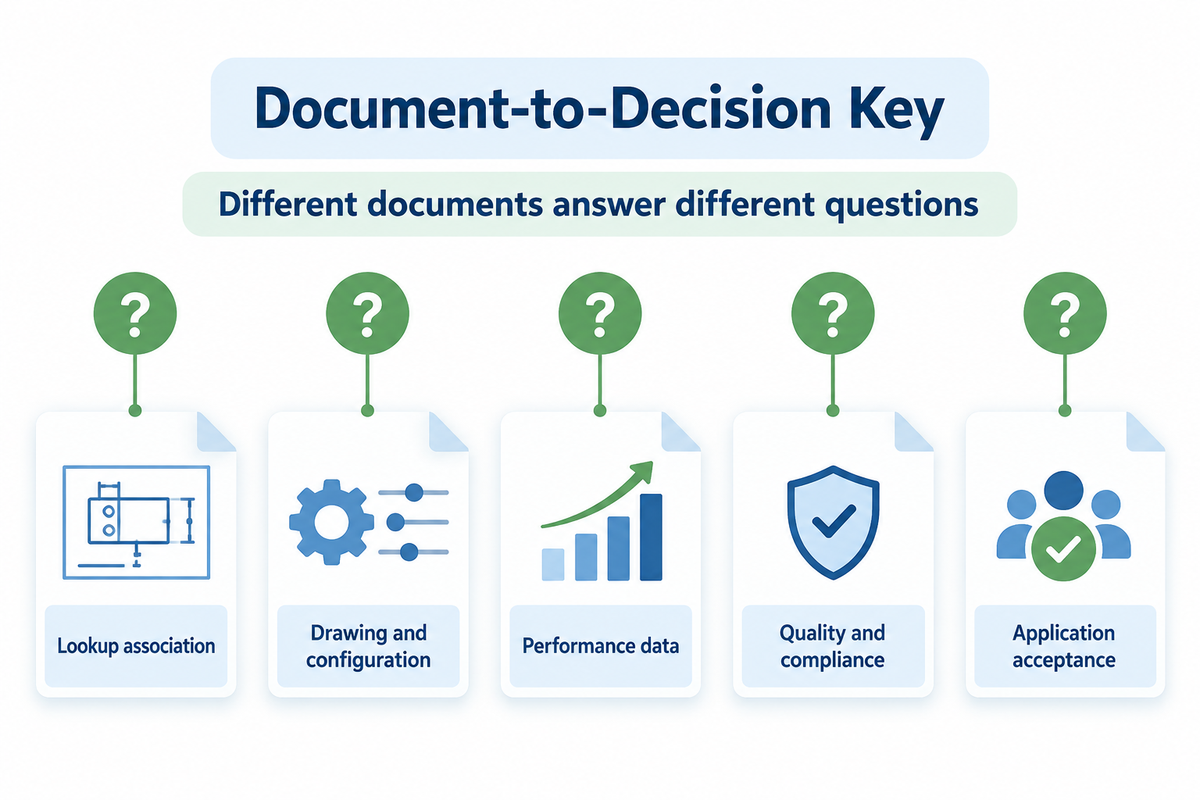
The Document-to-Decision Key separates the questions different documents answer. Use this as an aid, not a mandatory sequencing of questions to be answered.
How do you cross reference filters?
Identify the complete original part number, identify a proposed alternative, and compare the documents that pertain to an exact configuration. State what’s different and what isn’t answered. Decide based on this what quotation, further technical review, and application acceptance are warranted by the person responsible for making that decision.
| Evidence in hand | Question it helps answer | What to resolve next |
|---|---|---|
| Lookup association | Which candidate should we investigate? | Full offered code and the basis of the association. |
| Applicable drawing and configuration | Which interface and materials are being offered? | Fit, tolerances and compatibility with the actual housing and duty. |
| Performance data with conditions | What was measured or specified, and how? | Relevance to the process fluid and required filtration outcome. |
| Quality and compliance documents | Which organization, material, model or use is covered? | Holder, supply-chain traceability, scope and current applicability. |
| Application acceptance record | What configuration and conditions did the responsible team accept? | Changes, exclusions and outstanding conditions before repeat use. |
Source basis: The basis for the statement was a synthesis of original manufacturer’s literature and the ISO’s management system scope. The five classes are ECOFILTRONE’s framework and not a certification standard.
A drawing can be provided before a lookup, and some applications require additional evidence. Name the unanswered question. Procurement can advance a conditional quotation while quality personnel clarify a certificate, so long as the quotation isn’t mistaken for application acceptance.
Read the Whole Part Number and Its Revision

Read the complete original part number and proposed alternatives, and document revisions that pertain to the configurations. Find ordering information.
Keep manufacturer, series, complete code, option suffixes, and document identifier together. A lot number identifies a batch of product. A drawing revision identifies a revision of a drawing. Recording one doesn’t replace the other.
As an example, product listings for Solventum’s High Flow cartridges include a table with different seal materials along with corresponding HFM codes. Pall’s Ultipleat ordering literature includes a seal-code table. The takeaway is to review each manufacturer’s key, as opposed to assuming a universal meaning for a final letter.
A quotation line such as “40-inch PP high flow” can be a starting point for an initial discussion, but leaves a lot of configuration options open. Ask the supplier to provide the complete code offered and say which drawing they’re using to make the comparison. If a seal or end fitting is customized, request that detail to be added to the quotation.
For terminology, refer to our article on cartridge end connections and seals. Use a connection name to initiate the discussion and use applicable interface details to resolve the fit question.
Be sure to verify if a newer document applies before selecting the newer document. Recent family brochures and an older drawing for the exact installed configuration may serve different purposes. For example, a drawing may show a particular installation configuration, but a later revision to that document may change that configuration. Ask the issuer of the document if a later revision governs that configuration.
Normalize Numbers Before Comparing Claims
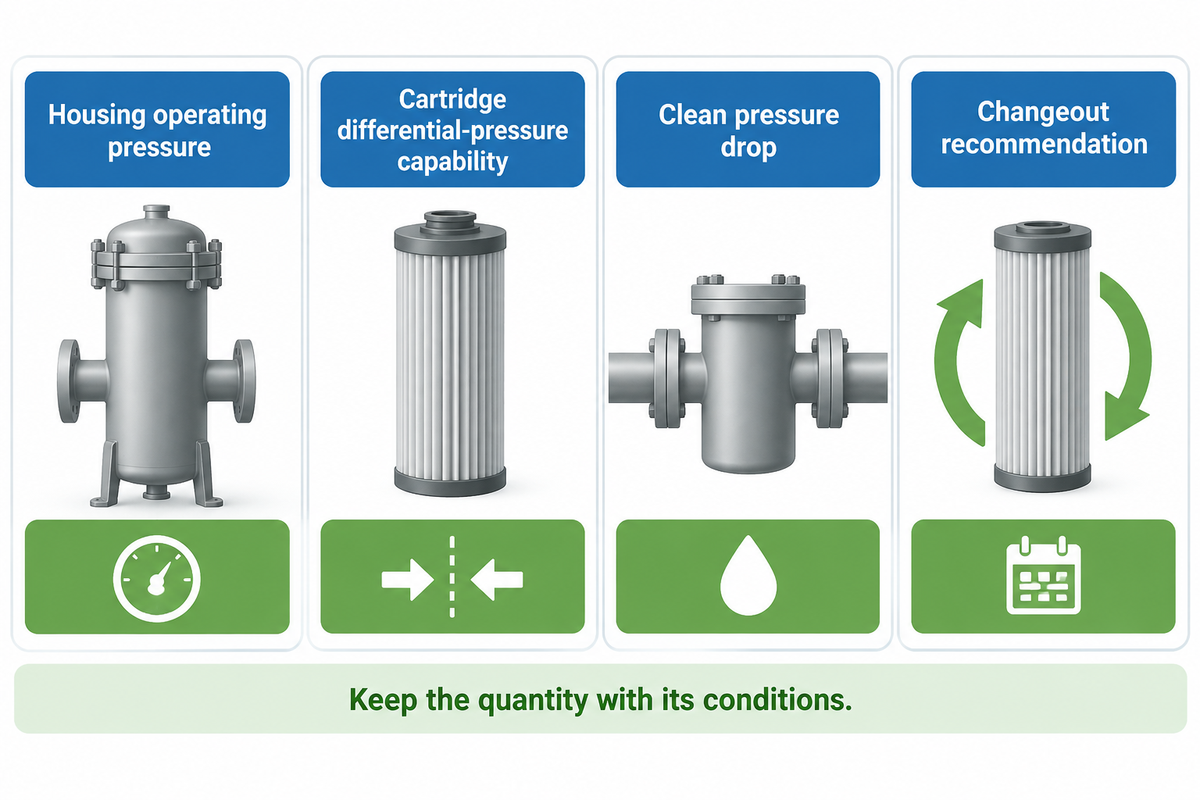
Comparable numbers must be expressed in the same quantity, units and conditions. Convert as necessary, but keep the original expression and conversions for future explanation.
NIST’s definition of the inch gives an exact conversion: 1 in = 25.4 mm. Therefore, 40 in = 1,016 mm. This does not tell you anything about the sealing reference for a nominal cartridge.
Solventum’s listing for HFM40PPA40C uses “40 in” in the product title while its table lists an overall length of 39.76 in and 101 cm. Read those as published catalogue fields that need the correct dimensional context. A rounded conversion or a title alone can’t establish the installation datum, and the difference isn’t evidence of a manufacturing defect.
Care must be taken when dealing with pressure. Housing operating pressure, cartridge differential-pressure capability, clean pressure drop and a recommendation for change answer different questions. Place the quantity name next to the number. Keep temperature, flow direction, fluid and the relevant assembly scope.
Read performance footnotes too. Pall’s October 2021 PIUHFENg table uses a 99.98% particle count heading, but a note places the 2 micron grade at 99% and other notes qualify coarse-grade testing. Use current applicable literature and confirm before relying on these historical figures for a purchase comparison.
For a detailed explanation of micron rating and efficiency, you have to trace the rating to its methodology and context. A micron label is a very basic description of the performance of the filter.
The examples that follow illustrate why the field name is important, in addition to the field value. Each of the real-product entries illustrated belongs to the named source and configuration; none is a recommended operating setting for an alternative cartridge.
| Document field type | Published example | How to read it |
|---|---|---|
| Unit definition | NIST: 1 in = 25.4 mm exactly. | Converts a stated length; supplies no product tolerance. |
| Calculated conversion | 40 in × 25.4 mm/in = 1,016 mm. | An arithmetic result, separate from a nominal cartridge label. |
| Overall length | Solventum HFM40PPA40C: 39.76 in; 101 cm. | Retain the exact catalogue code; ask for the applicable interface drawing. |
| Nominal dimensions | Pall code 640: 6 in / 152.4 mm diameter × 40 in / 1,016 mm nominal length. | The ordering table explicitly labels dimensions nominal. |
| Cartridge differential limit | Pall polypropylene/CAS: 3.44 bard at 82°C; 50 psid at 180°F. | Normal inside-out flow and compatible fluid; confirm current applicability. |
| Media-dependent limit | Pall glass fiber/HT: 3.44 bard at 121°C; 50 psid at 250°F. | Wet-hydrocarbon temperature notes further restrict the listed media. |
| Test-table heading | Pall: 99.98% by particle count. | Read the grade and modified-test-procedure notes with the heading. |
| Grade exception | Pall note 6: 2 micron at 99% efficiency. | Keep this exception attached to the affected grade. |
| Housing operating rating | Eaton TOPCART HF announcement: 150 psi / 10 bar; temperatures up to 250°F / 120°C. | Housing information, not a cartridge differential-pressure rating; use applicable design documents. |
Source basis: NIST’s inch definition; Solventum’s named variant listing; Pall PIUHFENg, October 2021, including compatible-fluid and grade footnotes; Eaton’s 30 July 2025 housing announcement. Confirm current documents for a real purchase.
Resolve Conflicting Cross-Reference Documents
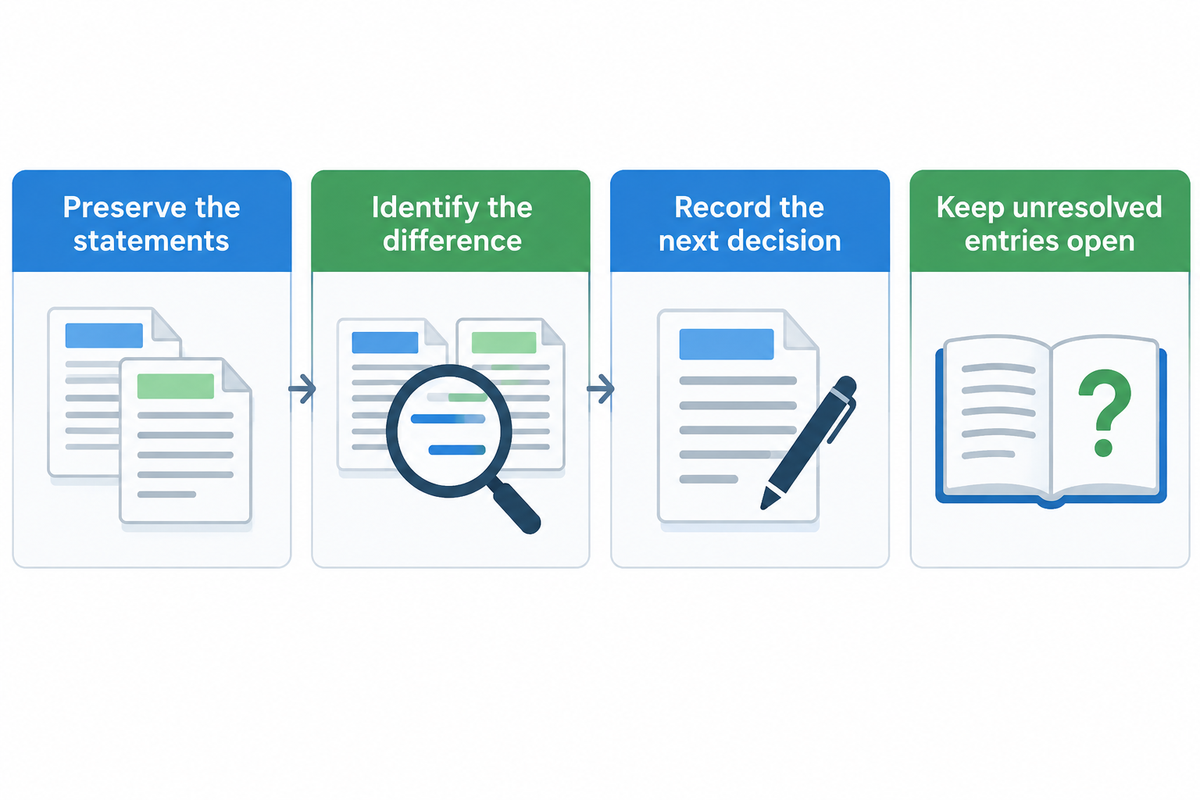
Both statements should be kept visible until the conflict is resolved. First ask if they describe the same configuration and quantity. Then give the unresolved statement to the individual who has the authority to resolve the conflict.
The following is an example of a completed Conflicting Datasheet Resolution Log. Document names, cartridge values and associated manufacturers are fictional and aren’t related to any actual manufacturer, customer or tested product.
| Field | Statements received | Disposition and owner |
|---|---|---|
| Length | Brochure: nominal 40 in. Drawing A: overall length 1,010 mm. | Different definitions. Supplier engineering to identify the housing sealing datum and applicable tolerance; fit remains unresolved. |
| Pressure | Housing sheet: operating pressure. Cartridge sheet: differential-pressure limit. | Different quantities. Plant engineer to compare each against its own duty requirement; neither value replaces the other. |
| Revision | Quotation identifies seal option A. Attached drawing identifies option B. | Configuration mismatch. Supplier to correct the offered code or document before the buyer releases that detail. |
| Measured dimension | Two inspection reports give different readings. | Quality team to compare the measurement definition, method and uncertainty against the applicable tolerance; difference alone is not a rejection rule. |
| Test scope | Media report supplied; quotation offers a finished cartridge. | Supplier to identify which finished-product characteristics the report covers and what additional application evidence is needed. |
Source basis: Editorial example based on NIST measurement guidance and cartridge literature. It provides no installation tolerance, operating limits or acceptance threshold.
Distinguish specified limits from observations. NIST engineer George Orji explains how the interpretation of measurements requires the definition of a measurand, the appropriate model and uncertainty. The examples Orji gives pertain to nanoscale measurements; the moral of this story is to ask what the measuring instrumentation actually measured before stating that two separate measurement reports are inconsistent.
Don’t average incompatible specifications to arrive at an acceptable middle value. Nor does selecting the smaller of unlike pressure figures provide a basis for establishing compatibility. Note the reasoning provided by the issuer and record what’s applicable from your configuration and who accepted the disposition. Leave unresolved entries open in the technical record.
Where a Documentary Match Must Stop
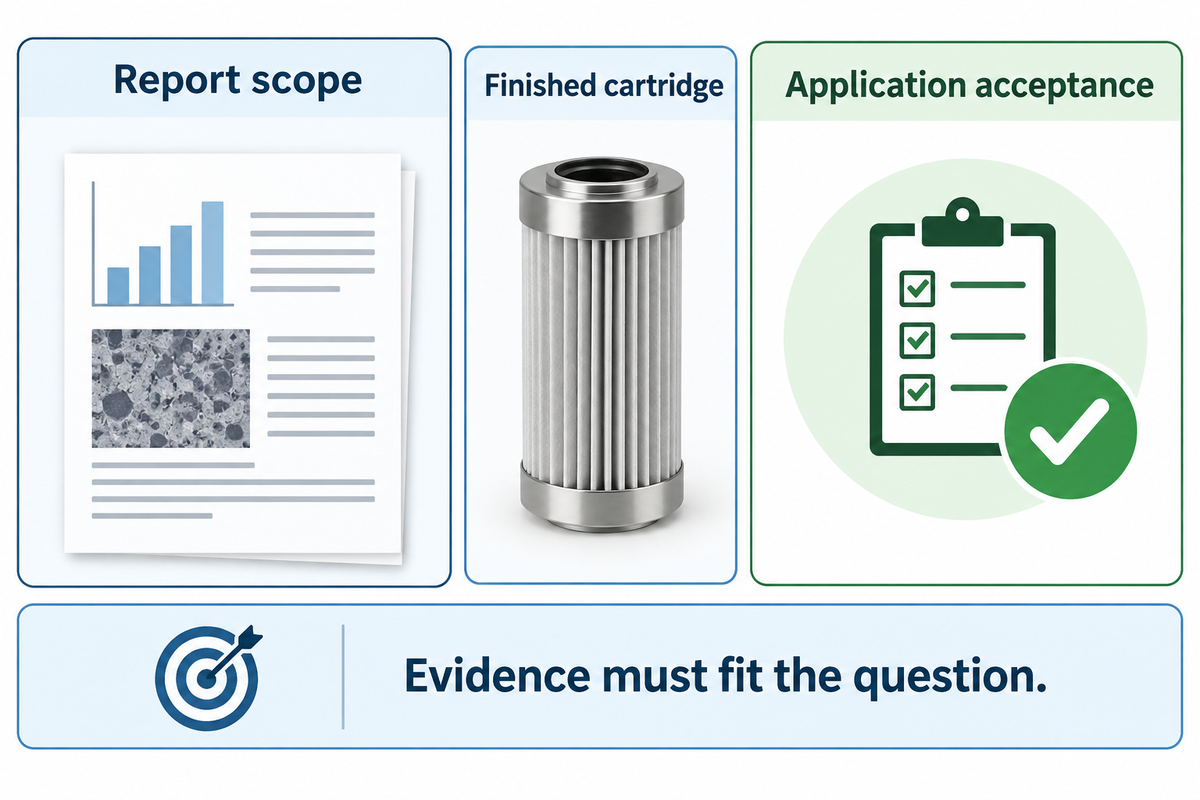
A completed document comparison describes the candidate and its evidence. Application acceptance is owned by the responsible technical team who must verify that the requirements of that service have been met.
Dimensional Drawings provide insight into an interface. Test Reports describe the sample, method and results covered in that report. Neither should silently acquire a broader meaning when included in a replacement proposal.
In Ernest Mayer’s comparison of porometry and glass-bead testing, agreement depends on the media and test conditions. Porometry and particle-challenge results address different aspects of filter media. His article also describes limitations in extending the comparison to cartridges. It’s useful context for reading a report, rather than proof that two finished elements will perform alike.
When a documentary gap requires physical or operating verification, use the separate high-flow cartridge qualification record and guidance on PP high-flow replacement trials. These resources provide guidance on qualification and trial implementation beyond what’s provided in this document reading guide.
The scope of new verification will depend on the service and any applicable evidence. A routine water-treatment cartridge replacement and a validated critical process may require different actions. One isn’t likely to prescribe the same verification package for all customers, hence the distinction is important.
Ask for Evidence That Belongs to the Offered Cartridge

Match the scope of a document to the claim being made. Take into account the named organization, site, material, or model, the issuer, the version and the terms of use.
A quality-management certificate concerns the stated organization’s management system. A material declaration concerns the materials and supply scope it identifies. A performance report is on the specimen and test conditions. A product listing may be only on specified models or uses. More pages in a folder don’t answer the missing connection between the documentation and item offered.
ISO describes ISO 9001 as a quality-management-system standard. Its current page lists the 2026 edition and directs certified organizations to their certification body about transition timing. Ask about the actual certificate’s status and scope; a new standard edition is not, by itself, a reason to label every older certificate invalid.
Some material documents can originate from an upstream producer. Trace them through the supplied component and configuration rather than rejecting them because they name a different organization from the reseller. The connection must be specific enough for the question being answered.
ECOFILTRONE can share technical information, material documentation, and compliance files based on the product and service requested. Verify each actual certificate holder and covered product before using it in an approval package. This guide makes no blanket certification claim for the product portfolio.
Use a Cross-Reference for the Right Buying Decision
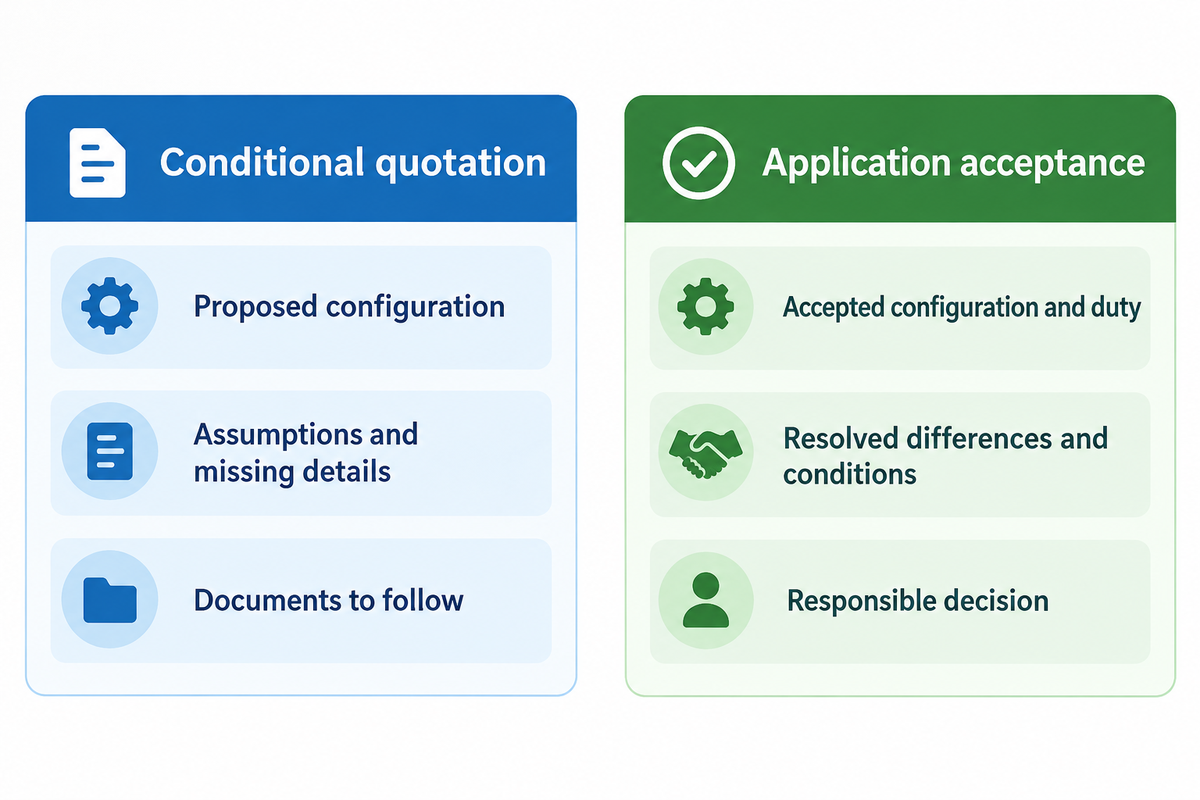
A cross-reference is helpful when it pushes a specific buying decision along. Indicate what can occur now and what’s still missing for the next step to occur.
Which high flow filter cross-reference is best?
The best resource for your task identifies its product scope, provides a traceable candidate and a means to address exact-code questions. A large directory is useful for searching; a relevant drawing and a clear answer to an unresolved field are more useful when making a technical decision.
With an aftermarket offer, record the brand offered, as well as the original manufacturer’s code. An online result can begin the comparison. The exact configuration, applicable documents and other information keep the comparison moving. This differentiation is useful in power-generation water treatment as well as in other services for the industrial process.
Conditional quotation
- Names the proposed configuration.
- Lists assumptions and missing technical details.
- Identifies which documents will follow and when.
Application acceptance
- Names the configuration accepted for the duty.
- Records resolved differences and remaining conditions.
- Identifies the responsible acceptance decision.
Procurement needs a comparable offer. Personnel of Quality need records with the correct scope. The plant engineer needs to have confidence that the operating requirement is met. One person may cover several roles. However, a short commercial description shouldn’t silently address all the questions of these persons.
Some records, for example an inspection result of the production lot, are available only when that lot is produced. Agree what’s required before offering a quotation, before shipment and before application release. Don’t require a future batch record as if it were an existing design datasheet.
To identify a candidate or discuss a possible replacement, our cross-reference solution page can help. Our High Flow Filter Cross-Reference solution page addresses the commercial part of the request. This guide addresses evidence questions related to the request.
Keep a Cross-Reference Current After Changes
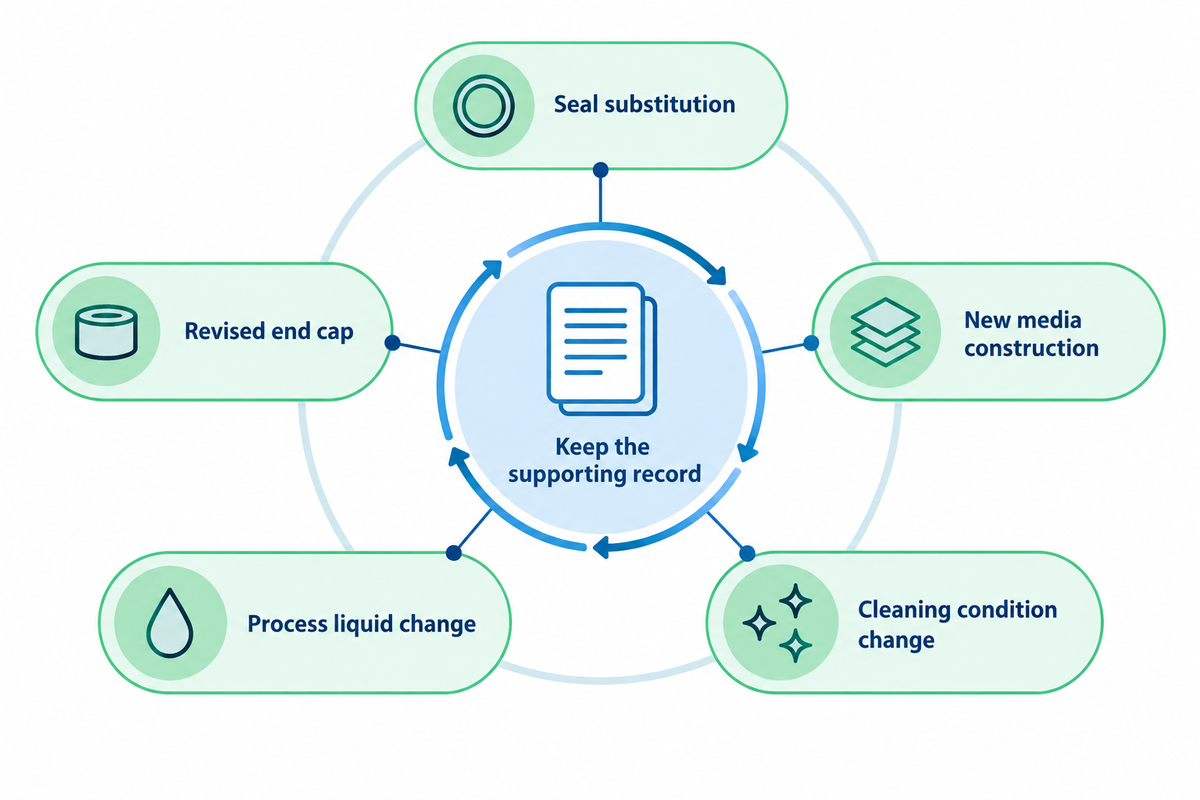
Once a candidate is accepted, keep the supporting records and documentation together. Be sure to revisit affected questions when the product, housing, fluid or duty changes.
Useful change triggers include a seal substitution, a revised end cap, new media construction, a process liquid change, or a different cleaning condition. Indicate what changed and define which of the earlier comparisons or acceptances depended on it. Review the affected scope and don’t assume that everything is still acceptable or that an entirely new assessment is necessary.
NASA’s configuration management guidance offers general engineering principles. These include maintaining product and document identities, updating their status, and recording the disposition of discrepancies. This guidance isn’t a filter standard. As a workable solution, for example, a revision record can be left behind that explains to the next buyer what was compared and the rationale for the decision.
New products deserve their own scope. Eaton’s 2025 TOPCART HF announcement pairs those housings with LOFPLEAT HF cartridges and describes Inside-Out Flow. A familiar “high flow” label should therefore prompt an exact family check when the product range changes.
Key takeaway
A useful cross-reference connects a named cartridge, the documents that describe it and the decision those documents support. Keep the unresolved question visible until the responsible person can close it.
ECOFILTRONE™ is an industrial filtration supplier in Qingdao, China that provides product-selection and replacement-matching support for industrial water and process applications. Send the original code, offered configuration, and the particular field you need clarified.
Discuss a cross-reference question
Frequently Asked Questions
Does a matching family name mean the cartridges are interchangeable?
A matching family name identifies a starting point for comparison.
Compare the complete offered code, seal and end configuration with the housing requirement. Then review materials and performance under the relevant conditions. A family can contain different options, and a supplier’s description of an alternative may cover only certain characteristics. Ask which differences were assessed before using the result for a purchase or application decision.
Should I choose the lowest pressure value in the documents?
The pressure quantity and its conditions must be identified before values are compared.
A housing operating-pressure rating and a cartridge differential-pressure limit describe different loads. Keep each value attached to its component, temperature, flow direction and fluid conditions. Resolve an unclear field with the document issuer and responsible engineer. Selecting the smaller unrelated number does not settle the cartridge’s suitability or provide a universal operating setting for the system.
Can an ISO 9001 certificate replace cartridge performance evidence?
An ISO 9001 certificate addresses its stated quality-management-system scope.
Review the actual holder, site, issuer and certificate status, then request product evidence for the characteristic being evaluated. Material suitability, dimensions and particle-removal performance are separate questions. Their supporting documents should identify the relevant product or material and conditions. Verify the connection to the offered cartridge rather than treating a general company certificate as a performance report.
What should I send if the original filter label is unreadable?
Housing identification and any retained purchasing records can help recover the original configuration.
Add clear photographs and available drawings. Mark uncertain details explicitly. Ask the supplier which additional information is needed before it proposes an exact configuration; do not turn an estimated dimension into a confirmed part identity.
Which documents can be agreed before the production lot exists?
Design requirements and required delivery documents can be agreed before production.
An applicable drawing, material specification and relevant existing performance information may support technical discussion before an order. Inspection results for the actual future batch require that batch to be produced and inspected. Agree the document list, scope and delivery point with the supplier. If an existing report covers another configuration, ask which characteristics carry over and which need further evidence. Keep a conditional commercial offer separate from the later decision to accept the supplied item for the application.
Does a different measurement automatically mean the cartridge fails?
Different readings require interpretation against the same defined requirement.
Check the measurement reference, method, uncertainty and applicable tolerance. Ask the quality team to assess the difference. A unit conversion alone cannot decide whether two observations describe a conforming interface.
When should an accepted replacement record be reviewed again?
Review the affected evidence when the configuration or application changes.
A new seal, different media, revised interface or changed process condition can affect an earlier decision. Keep the previous record so the responsible team can identify what depended on the changed feature. Ask the supplier for the applicable revision and a clear description of the change. Then document the resulting review and any additional conditions. Reusing a familiar part number is easier to assess when its configuration history is available alongside the purchasing information.
References & Sources
- NIST: SI Units, Length exact inch definition.
- George Orji, NIST: What To Do When Measurement Methods Produce Different Answers general measurement interpretation.
- ISO: ISO 9001 management-system scope and current edition information.
- Ernest Mayer, International Filtration News: Filter media pore size comparison between porometry and glass bead challenge testing media-level test comparisons.
- NASA Systems Engineering Handbook, Section 6.5: Configuration Management general configuration and discrepancy-record principles.
Editorial note: This guide synthesizes public technical references, literature supplied by the manufacturers, and ECOFILTRONE-supplied business information. The evidence ladder is an editorial tool; the filled conflict log is hypothetical. No original cartridge test, independent certification of the product portfolio, or approval of a particular replacement is claimed. Source and edition information was verified in October 2026.