Get in touch with ECOFILTRONE™ Company


ECOFILTRONE™ · Industrial liquid filtration
PES Membrane Filter Cartridges
PES Membrane Filter Cartridges for Industrial Liquid Filtration
Match your liquid filtration duty to ECPAA, ECPAB or ECPAD before placing a replacement or custom order. Our PES membrane filter cartridges combine series-specific ratings and polypropylene hardware with engineering support for specification checks, housing matching and sample trials.
We need your fluid, filtration objective, operating conditions and current cartridge details. Our application support team helps you choose the most appropriate candidate, confirm the configuration and determine the documents your application needs, so a trial begins with clear acceptance criteria.
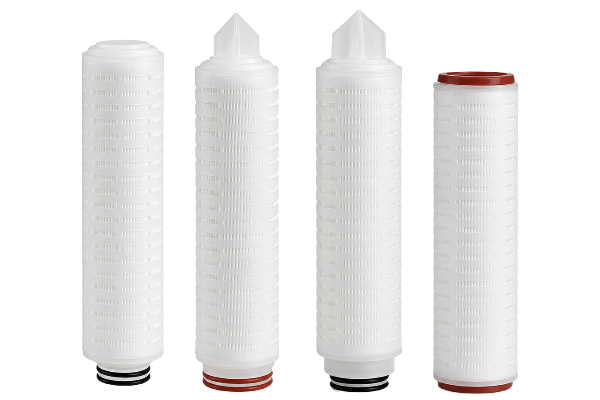
PES Cartridge Range at a Glance
SPEC_01
Three PES series
ECPAA, high-asymmetric hydrophilic ECPAB and double-layer ECPAD.
SPEC_02
Series-specific grades
ECPAA spans 0.04–1.2 µm; ECPAB offers 0.22, 0.45 and 0.65 µm; ECPAD uses paired ratings.
SPEC_03
Cartridge dimensions
We supply a 69 mm diameter range with lengths of 5–40 in, subject to connection confirmation.
SVC_04
Quotation response
We return quotations within 24 hours.
SVC_05
Sample support
Samples are free; customer pays freight.
SVC_06
Stock and custom supply
We dispatch stock orders in 4-5 days and prepare custom samples in 7 days.
PES Cartridge Series and Application Fit
Applications are reviewed for aqueous process filtration, food and beverage filtration, industrial water treatment and product-specific pharmaceutical requirements. Inquiries may be initiated with an application description. Decisions will be made on the basis of the supporting evidence for the intended use, the selected membrane filter, its complete assembly and process conditions.
SYS.REQ
A pore label can not release a process batch on its own. The process starts with determining the step: particulate removal, bioburden reduction or a validated sterilizing filtration step, and then identifying the associated fluid and acceptance criteria.
PHASE // 01
ECPAA PES
Our ECPAA ratings are 0.04, 0.1, 0.22, 0.45, 0.65 and 1.2 µm. This range gives your trial several filtration grades to compare against its particle or microbial objective.
Select the rating against the fluid and acceptance criterion rather than treating the finest pore size as the default.
Area: 0.65 m² per 10 in cartridge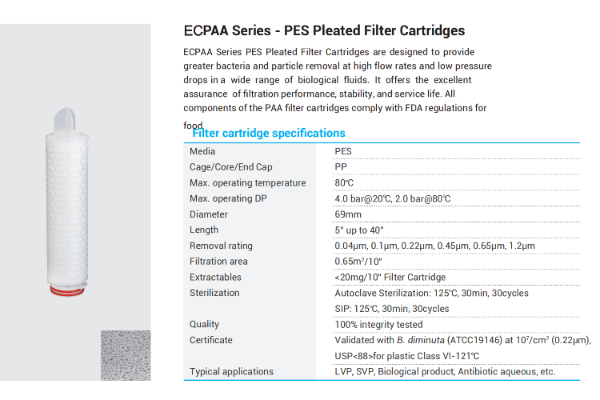
PHASE // 02
ECPAB asymmetric PES
Our ECPAB series uses a high-asymmetric hydrophilic PES membrane with 0.22, 0.45 or 0.65 µm ratings. Its application position includes food and beverage bioburden reduction and protection of a downstream final filter.
Use a representative liquid trial to check retention, differential pressure and recovery.
Area: 0.65 m² per 10 in cartridge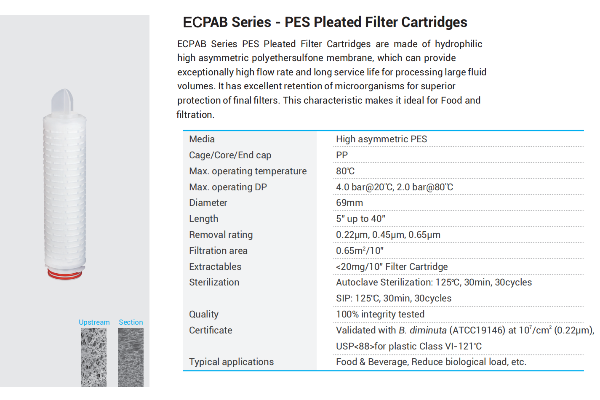
PHASE // 03
ECPAD double-layer PES
Our ECPAD series has double-layer hydrophilic PES support and paired ratings: 0.22+0.1, 0.22+0.22, 0.45+0.22, 0.45+0.45 and 0.65+0.45 µm.
These are configuration labels, not numbers to add or an assumed flow direction.
Area: 0.56 m² per 10 in cartridge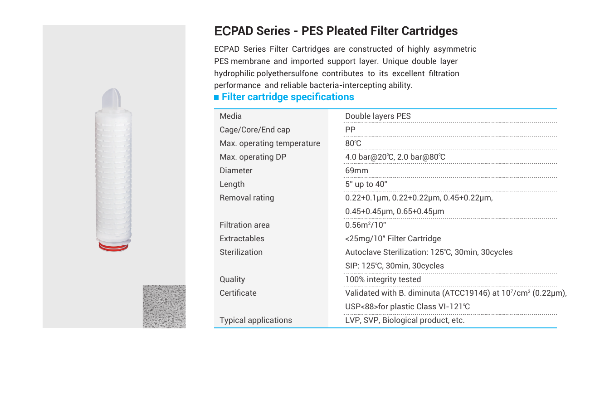
PES Duty-to-Validation Map
| Duty | Trial question | Evidence before acceptance | Next step |
|---|---|---|---|
| Particle removal from an aqueous liquid | Does the chosen grade meet the required particle endpoint at the actual load? |
Defined inlet/outlet samples, particle criterion and measured pressure drop |
Compare candidate grades with the same feed and sample points |
| Food or beverage bioburden reduction | Does filtration reduce the specified biological load without unacceptable product loss? |
Microbial criterion, product recovery and applicable contact documentation |
Review ECPAB and the downstream final-filter duty separately |
| Product-specific sterile filtration | Does the exact configuration meet validated process requirements? |
Grade-specific retention evidence, correlated integrity limits and product/process validation |
Have the process quality owner define acceptance before the trial |
| High-purity water at point of use | Do the sampling locations represent the upstream system and the downstream point? |
Separate upstream/downstream monitoring; distinct bacteria and endotoxin criteria where required |
Record where each sample was taken |
Membrane and Wetted Materials
Our PES filter cartridge range uses polyethersulfone membrane media with polypropylene cage, core and end cap components. During specification checks, our team reviews the complete cartridge, including the connection and seal requirements, because compatibility involves every wetted material rather than the membrane alone.
The candidate for aqueous liquid filtration is hydrophilic PES. Chemical compatibility requires consideration of the complete assembly, and a low protein binding request needs a defined acceptance method. Product recovery must be measured against the method of acceptance. Formulation economics may hinge on recovery results rather than selection of the polymer alone.
Complete-assembly compatibility
Item
Information to send
Trial or confirmation field
Process fluid
Composition, concentration, pH and temperature
Exposure condition and representative fluid
Cleaning and sanitization
Chemical, concentration, contact time and cycle
Assembly compatibility and retained integrity
Product recovery
Valuable component and test method
Recovery, adsorption and hold-up recorded separately
Mechanical fit
Housing drawing, current end connection and seal material
Approved configuration and installation check
Process Note 01
A larger filtration area is not always better for product recovery. Comparative experimental work on commercial PES and PVDF filters found membrane performance varied with fluid and operating conditions; those results support a representative trial, not a universal material ranking or a prediction for these series.
Process Note 02
There are differences in cartridge manufacture, design, construction and treatment among products. We assess interchangeability using drawings, material specifications and performance in an agreed trial. Matching two pore ratings alone does not prove interchangeability.
Filtration Grades and Sterilization Conditions
Removal rating and sterilization conditions are always separated in technical confirmations. Removal serves its purpose with the grade in question. Steam-in-place or autoclave cycles, as designed for the available process equipment, must meet the requirements of the cartridge configuration.
A buying specification such as “0.2 µm sterile filter” is not interchangeable with the exact 0.22 µm grade and validation package. A smaller pore size does not automatically establish a qualified sterile filtration process or improve flow rates or extend service life.
Series grade selection
- ECPAA: 0.04, 0.1, 0.22, 0.45, 0.65 and 1.2 µm.
- ECPAB: 0.22, 0.45 and 0.65 µm in high-asymmetric PES.
- ECPAD: 0.22+0.1, 0.22+0.22, 0.45+0.22, 0.45+0.45 and 0.65+0.45 µm; keep the paired notation in the order specification. Each is to be described by paired notations.
Thermal cycle confirmation
The listed autoclave and steam-in-place conditions are 125°C for 30 minutes, up to 30 cycles. The maximum operating temperature is 80°C; a sterilization temperature is not a continuous liquid-service rating.
- Confirm the intended heating, cooling and pressure conditions for the exact assembly before applying a thermal cycle. The standard bacterial-retention test in ASTM F838 does not supply installation-specific steam pressure limits or qualify a cleaning cycle.[2]
Selection rule
Keep the operating envelope, sterilization cycle and product acceptance criteria as separate items on the technical confirmation.
Refer to the PES Service Condition Check for the conditions listed on your request and forward engineering review requests for any items not covered by the conditions.
PES Filter Cartridge Specifications
A cartridge that fits poorly can interrupt the line because sealing depends on matching the housing geometry. ECOFILTRONE™ reviews the 69 mm cartridge diameter, required length and end connection with your housing information before replacement selection.
| Specification | ECPAA | ECPAB | ECPAD |
|---|---|---|---|
| Membrane | PES | High-asymmetric hydrophilic PES | Double-layer hydrophilic PES support |
| Cage / core / end cap | PP | PP | PP |
| Removal rating, µm | 0.04 / 0.1 / 0.22 / 0.45 / 0.65 / 1.2 | 0.22 / 0.45 / 0.65 | 0.22+0.1 / 0.22+0.22 / 0.45+0.22 / 0.45+0.45 / 0.65+0.45 |
| Membrane area per 10 in | 0.65 m² | 0.65 m² | 0.56 m² |
| Outer diameter | 69 mm | 69 mm | 69 mm |
| Length range | 5–40 in | 5–40 in | 5–40 in |
| Maximum operating temperature | 80°C | 80°C | 80°C |
| Maximum operating differential pressure at 20°C | 4.0 bar | 4.0 bar | 4.0 bar |
| Maximum operating differential pressure at 80°C | 2.0 bar | 2.0 bar | 2.0 bar |
| Listed extractables per 10 in cartridge | <20 mg | <20 mg | <25 mg |
| Listed autoclave conditions | 125°C / 30 min / 30 cycles | 125°C / 30 min / 30 cycles | 125°C / 30 min / 30 cycles |
| Listed steam-in-place conditions | 125°C / 30 min / 30 cycles | 125°C / 30 min / 30 cycles | 125°C / 30 min / 30 cycles |
The values shown represent differential pressure across the cartridge. They are not a housing pressure rating or a universal terminal changeout limit. The two temperature points do not represent and will not define an interpolated operating curve.
The extractables entries are listed values; confirm the test method and application acceptance basis when requesting the technical package. We verify replacement dimensions and configuration with your current element information and housing drawing.
SYS.REQ //
Use the exact series and grade in your request, then confirm the seal, operating conditions and required documents before order approval.
Send your housing drawing for a configuration check.PES Cartridge Pricing and Lead Times
The quote includes series, removal rating, length, connection and sealing requirements, quantity, and the documents requested. In order to simplify the request for quotation process and avoid requesting the same information several times, these information fields should be included in each quotation.
- Quotation We return quotations within 24 hours.
- Sample policy Samples are free; customer pays freight.
- Stock order For stock orders, we dispatch in 4-5 days.
- Custom sample For custom samples, we prepare them in 7 days.
- Custom bulk production For custom bulk production, we complete it in 14 days.
- Custom order minimum Our custom order minimum is 100 cartridges; trial orders are accepted by product.
- Payment Our payment terms are 30% deposit, 70% before shipment.
Batch Release Cost Worksheet
A lower price of cartridge does not mean a lower batch cost. The total defined cost for a given period of production, averaged with respect to the batches accepted, should be determined, using the acceptance basis as described above. The same currency and batch definitions should be used for both the alternatives.
The Cost per accepted batch = (cartridges + Testing + Labor + Other allocated costs + product loss) ÷ accepted batches. Labor and product loss must be excluded from Other allocated costs because they are accounted for individually.
| Illustrative input, currency units | Option A | Option B |
|---|---|---|
| Cartridges | 80 | 60 |
| Testing | 40 | 60 |
| Labor | 60 | 70 |
| Other allocated costs | 20 | 10 |
| Product loss | 0 | 0 |
| Total cost | 200 | 200 |
| Accepted batches | 5 | 4 |
| Cost per accepted batch | 40 | 50 |
Use the Batch Release Cost Worksheet to compare your inputs. A trial that cannot meet its acceptance criterion is the wrong choice regardless of its calculated unit price.
This is an estimate for illustrative purposes only and does not represent product pricing, a performance forecast or a customer’s actual numbers. As shown, Option B has a lower cartridge cost, but no batch-cost advantage in this scenario. Adjust and complete the assumptions with your product purchasing and trial records.Integrity Testing and Order Documentation
We provide product-specific technical documents, material documents and applicable compliance documents according to your product and application requirements. Our technical review confirms the requested grade, configuration and document scope.
The PES series listings state 100% integrity testing and describe a B. diminuta ATCC 19146 challenge at 107/cm² for the 0.22 µm grade. Request the corresponding test conditions and reports for the exact ordered configuration; this statement does not extend sterilizing-grade qualification to every rating or paired grade.
Evidence matched to the duty
01
Cartridge Identity
Series, exact rating, materials, length, connectors and seals.
02
Integrity
The method of testing, the wetting fluid and temperature used in testing, acceptance limit, and correlation with retention evidence.
03
Retention
Challenging condition and the organism used in testing the grade, followed by validation tests for product and process.
04
Application Documents
Documentation for materials or product contact, with the actual document holder and product scope specifying intended use.
Compliance Notice
ASTM F838-20 uses a standardized bacterial challenge to evaluate membrane retention and explicitly calls for additional product and process-specific work. A validation gap leaves batch release unresolved because a standard challenge does not establish every product-fluid exposure condition; the listed 100% integrity testing does not remove that responsibility.
Next Steps
We will provide a technical confirmation and follow up on trial performance. The acceptance criteria will be defined by your process quality representative, who authorizes use. A generic comparison with another supplier’s filter does not replace grade-specific product and process validation.
Application Review, Samples and Supply
ECOFILTRONE™ personnel will perform the support functions for specification review, sample planning, order confirmation and operating follow-up.
-
Define the Fluid:
Provide fluid composition, the end point, temperature, flow and the position of the filter in the process.
-
Confirm the Cartridge Configuration:
We compare our series with your info provided, to assess the fit and the requirements for connections and seals.
-
Review the Sample & Documentation:
Our technical confirmation and sample support follow your product acceptance criteria.
-
Review the Quote:
Our order confirmation, at the time of the order as defined in the product specification, is for the quantity, configuration, and supporting documents, and contains the supply terms.
-
Order Production:
Orders receive production follow-up, inspection, packaging and shipping coordination in accordance with the terms confirmed.
-
After-Sales Service:
Our after-sales service includes installation compatibility support, assessment of differential pressure and service life, troubleshooting, and optimization of filtration configuration.
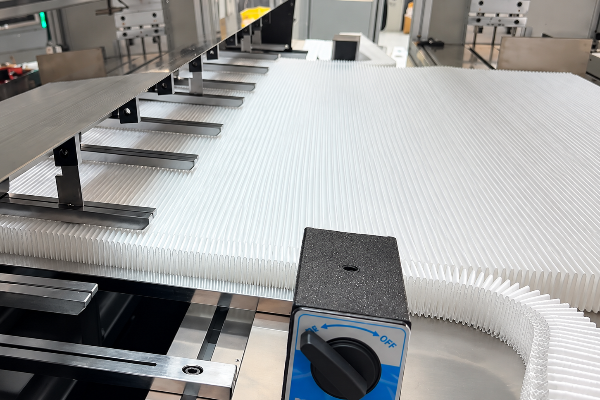
Hidden Bottleneck Map for a PES Trial
| Possible bottleneck | Measurement or record | Decision from the trial |
|---|---|---|
| Fluid resistance and particulate loading | Actual fluid, temperature, flow, inlet/outlet pressure and processed quantity | Review prefiltration or sizing from measured performance rather than membrane area alone |
| Product recovery | Feed and filtrate assay, flush volume and unrecovered hold-up | Accept the recovery result or revise the grade and trial method |
| Retention and qualification | Sample location, acceptance criterion, integrity method and applicable retention package | Close the evidence gap before approving process use |
| Supply transition | Approved drawing, trial disposition and confirmed order configuration | Keep the replacement order consistent with the qualified trial |
Refer to the actual results and acceptance limits, and record the owner’s name and disposition. A visual examination of the filtrate may not resolve uncertainty regarding product recovery or qualification; a trial records measured results for process and quality management.
ECPAA, ECPAB and ECPAD Product Details
-
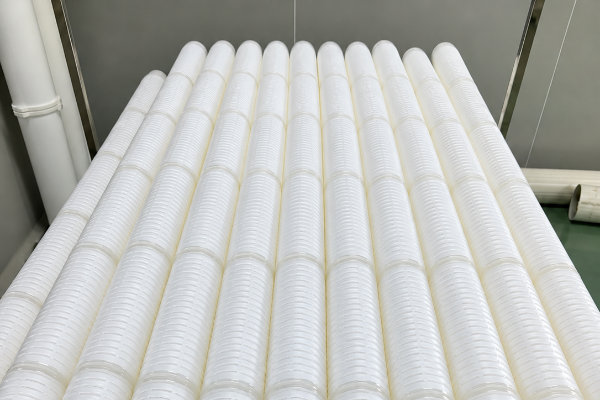 01
ECPAA
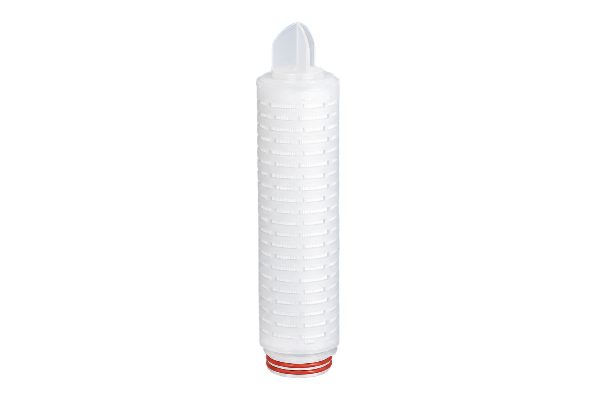
ECPAA series product view. Use the ordered grade and length to identify the required element.
-
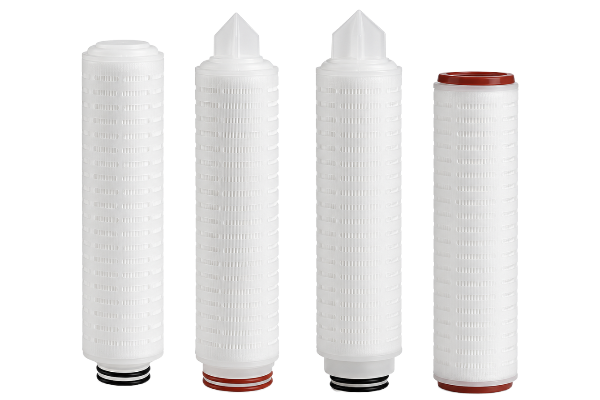 02
ECPAB
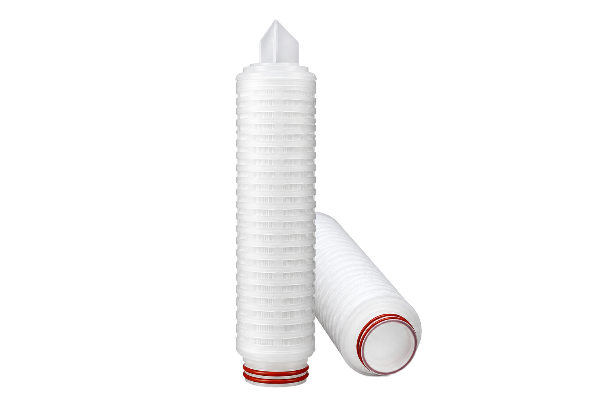
ECPAB series product view. Match the end configuration to the housing drawing during technical review.
-
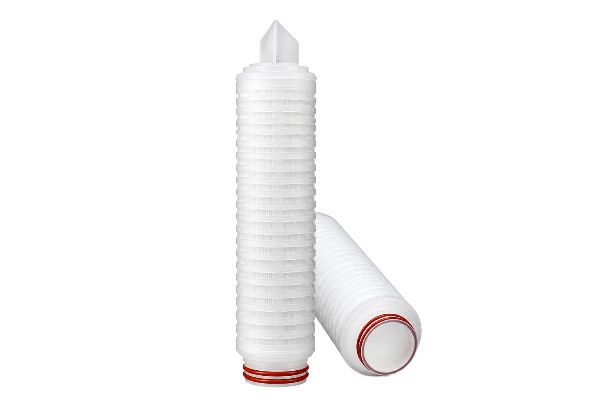 03
ECPAD
ECPAD series product view. Keep the paired membrane rating in the technical confirmation.
Technical Resources
Download the ECOFILTRONE product catalogue from here. Send us your existing element reference or drawing for a configuration check and quote.
Alternative Media for Different Duties
PES liquid filtration is not always the best answer for every process. It may require evaluation of the medium, upstream protection and complete assembly against the fluid, contaminant and acceptance criterion to confirm suitability.
Selection Issue
A hydrophilic liquid cartridge and a hydrophobic gas filter are not interchangeable.
Where to look instead
Review an application-specific hydrophobic PTFE or other gas filtration configuration.
Selection Issue
The membrane and every wetted component need compatibility confirmation.
Where to look instead
Review suitable PTFE, PVDF or other media and assembly options against actual exposure.
Selection Issue
A membrane bearing the full upstream load risks premature fouling.
Where to look instead
Review PP pleated filter cartridges or glass-fiber pleated cartridges for a defined prefiltration stage.
Selection Issue
The listed PES operating limit is exceeded.
Where to look instead
Request a different qualified cartridge configuration for the actual temperature and pressure.
Our product selection support covers industrial water treatment and process filtration. Cite the reasons which led to the conclusion that PES is not adequate and we will evaluate other options.
Evaluate OptionsTechnical Tools for PES Membrane Selection & Validation
PES Duty Validation Map
Assess your process parameters and validate the operational duty of PES membrane filters. Ensure optimal performance across various industrial filtration environments.
Access ToolBatch Release Cost Worksheet
Calculate the economic impact of batch releases and optimize your filtration costs. Quantify potential savings in high-volume processing.
Access ToolPES Service Condition Check
Verify chemical compatibility and temperature thresholds for your specific application. Prevent premature filter degradation by matching service conditions accurately.
Access ToolSpecifications
Please submit your fluid, filtration objective, required rating, operating temperature and pressure, flow demand, and cartridge dimensions, housing and connection. Also, provide the quantity. Our team will review the PES series and configurations required for your technical confirmation.
We return quotations within 24 hours. For a replacement, include the current element reference or housing drawing; for a trial, include the acceptance criterion and required document package.
PES Membrane Filter Cartridge FAQs
What is a PES membrane filter cartridge?
It is a cartridge using a polyethersulfone membrane as the filter medium, supported by a cartridge assembly. Our ECPAA, ECPAB and ECPAD series use polypropylene cage, core and end cap components; their membrane structure, ratings and area differ by series.
Does a 0.22 µm rating mean the cartridge is suitable for sterile production?
A rating alone is insufficient. The listed B. diminuta challenge statement is scoped to the 0.22 µm grade; ASTM F838 bacterial-retention evidence must be considered alongside the exact cartridge’s integrity limits and product/process-specific validation.
For a production change, identify the process fluid, exposure conditions, acceptance criterion and responsible quality owner before the sample trial. Compare the proposed configuration with the documented process requirements, including the relevant test methods; an equivalent size or rating is not proof that another cartridge’s qualification transfers.
How should I interpret ECPAD paired ratings?
Keep the specified pair, such as 0.45+0.22 µm, intact in the enquiry and order. Do not add the numbers, assume the layer order or assign a bacterial-retention qualification from the pair; confirm the exact configuration and relevant evidence.
Can you match an existing cartridge?
We support replacement matching using your existing reference, housing drawing and operating conditions. Our listed diameter is 69 mm and length range is 5–40 in; the connection and seal still need confirmation before matching or ordering.
Can I request samples before a custom order?
Samples are free; customer pays freight. We prepare custom samples in 7 days; trial orders are accepted by product, and the custom order minimum is 100 cartridges.
Send the existing element reference or required configuration with your trial request. Record the feed fluid, operating conditions and target result so the sample is assessed against the intended duty; the accepted configuration can then be carried into the bulk order’s technical confirmation.
What are your payment terms?
Our payment terms are 30% deposit, 70% before shipment.
Which PES series should I select?
Start with the fluid and filtration endpoint. ECPAA offers 0.04–1.2 µm grades, ECPAB offers high-asymmetric hydrophilic PES at 0.22, 0.45 and 0.65 µm, and ECPAD offers paired double-layer ratings; use the duty map and a representative trial to narrow the choice.
Does PES filtration remove endotoxin from water?
Do not treat bacterial retention as proof of endotoxin removal. The FDA’s historical water-system inspection guide explains that point-of-use 0.2 µm filtration does not necessarily remove endotoxin; define the required water-quality endpoint and sampling plan separately.
Can I use the cartridge continuously at 125°C?
The listed maximum operating temperature is 80°C. The 125°C entry refers to autoclave or steam-in-place conditions of 30 minutes and 30 cycles; it does not establish continuous liquid service at that temperature.
What do you need for a quotation?
Send series or duty, exact rating, length, connection, seal requirements, fluid, operating conditions, quantity and required documents. We return quotations within 24 hours and review configuration details with you.
What are your lead times?
We dispatch stock orders in 4-5 days, prepare custom samples in 7 days and complete custom bulk production in 14 days. Confirm whether the requested configuration is a stock or custom item during quotation.
Which technical documents should I request for a 0.22 µm trial?
Request the exact grade’s datasheet and drawing, applicable materials documentation, integrity-test method and acceptance limits, and the corresponding retention evidence. Define product/process validation with your quality owner; ASTM F838 standard testing is not a substitute for that responsibility.