Get in touch with ECOFILTRONE™ Company

Nylon Membrane Filter Cartridges use a porous nylon membrane to filter liquid. Performance is determined by the liquid, the complete cartridge assembly and operating conditions. Understanding those relationships helps explain a short filter run, a changed laboratory result or a pore-size claim that says less than expected.
A clear filtrate can have the wrong composition. Low pressure can coexist with a sealing problem. Before buying a finer grade or replacing a membrane material, establish which result matters: particle control, ingredient recovery, analytical consistency or a validated microbial outcome.
By DD · Updated October 2026
Start with the result
Use the pore rating to frame particle-retention questions, the operating record to investigate flow changes, and analytical controls to investigate composition. Keep each type of evidence attached to the question it actually answers.
How Nylon Membrane Filtration Works
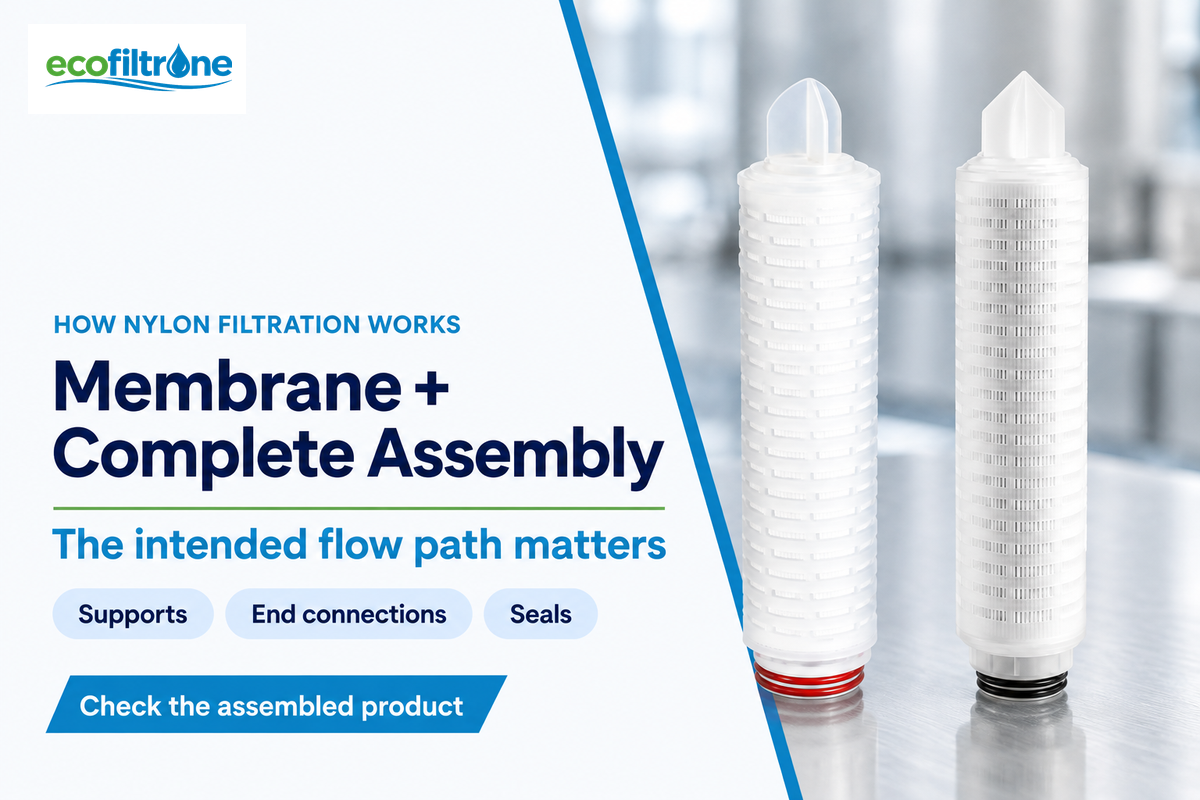
Nylon membrane filtration separates liquid from material retained by a porous barrier. In an industrial cartridge, that membrane operates inside an assembled element with supports, end connections and seals. The liquid has to follow the intended filtration path; the membrane material alone doesn’t describe the performance of that complete assembly. Assess filter quality against the required result and the evidence for that result.
What is membrane filtration used for?
Membrane filtration is used to control particles or other retained material in a liquid stream, according to the membrane process and its demonstrated retention. Nylon microfiltration is one application in this broad range. Industrial water treatment, process liquids and laboratory filtration have different targets, so the required filtrate result should define the specification.
For a particulate-control duty, distinguish the membrane stage from an upstream depth filter. A prefilter can reduce the solids burden reaching the final element; the suitable arrangement still follows the feed and the downstream quality requirement. The wider pleated filter cartridge range gives rationale for those upstream decisions.
Picture a maintenance team receiving a laboratory membrane disc report with a replacement cartridge request. The disc diameter in mm describes that laboratory format. It doesn’t specify the cartridge connection fit, sealing and effective area. Ask which assembled product was tested before comparing the reported flow or retention with a plant need.
Hydrophilic Wetting and What It Changes
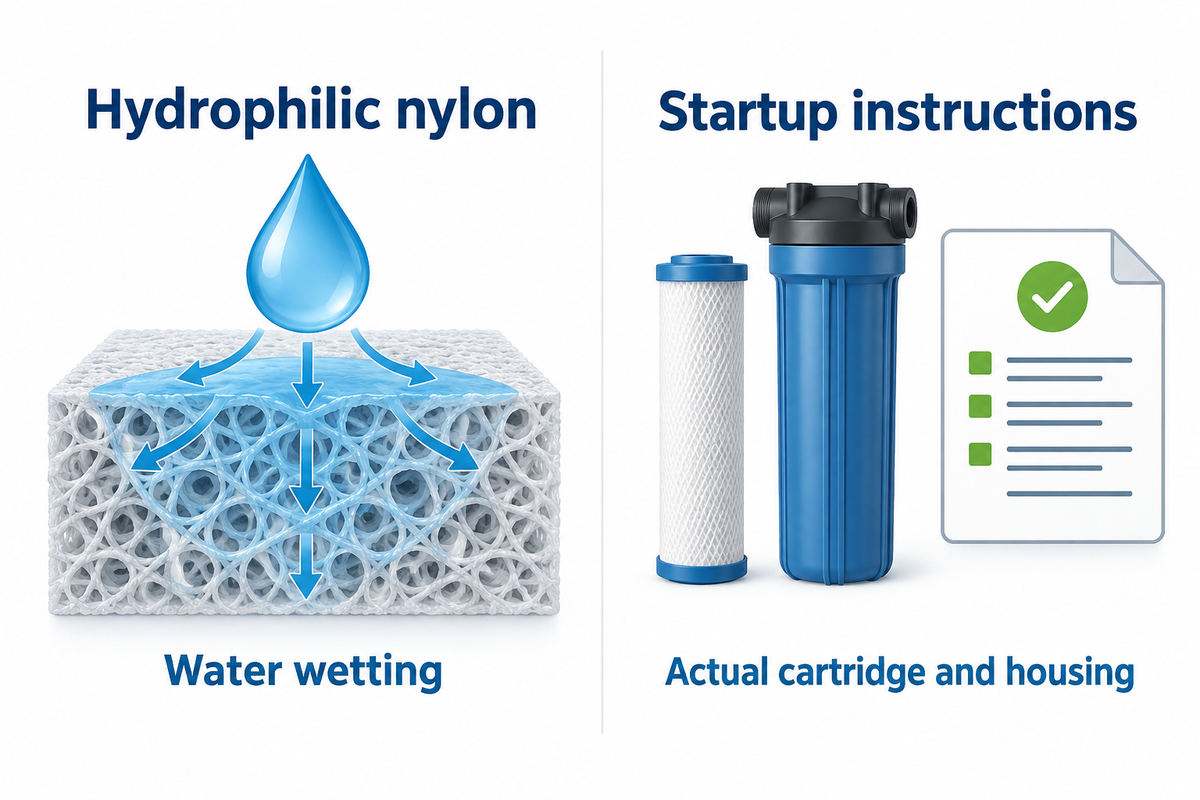
Hydrophilic nylon has the useful material property of being wetted by water. This enables it to be used for aqueous filtration. Wettability defines how liquid comes into contact with the membrane surface. There are a few additional questions at the time of startup. Startup involves additional questions: is the cartridge installed correctly, is the air trapped, and are conditioning and the approved direction of flow correct? Those operating steps belong to the instructions for the actual cartridge and housing.
Nylon is often described as naturally hydrophilic or hydrophilic in nature. This description shouldn’t be expanded to a promise about all fluid blends. A membrane can wet while another wetted component is incompatible with the fluid. A polyester support, where present, also needs evaluation; its presence should be established from the actual assembly documentation.
At startup, decreased flow may cause a technician to believe the pore size is too fine. The first useful record typically includes the part number, fluid, temperature and the step in the startup sequence. If the change began immediately after installation, review those details before treating accumulated particulate as the established cause.
Before skipping conditioning
Check the specified startup procedure even for a hydrophilic membrane. Easy water wetting doesn’t set a rinse volume, a flushing endpoint or permission to operate a housing with trapped air.
Pore Size, Retention and Application Boundaries
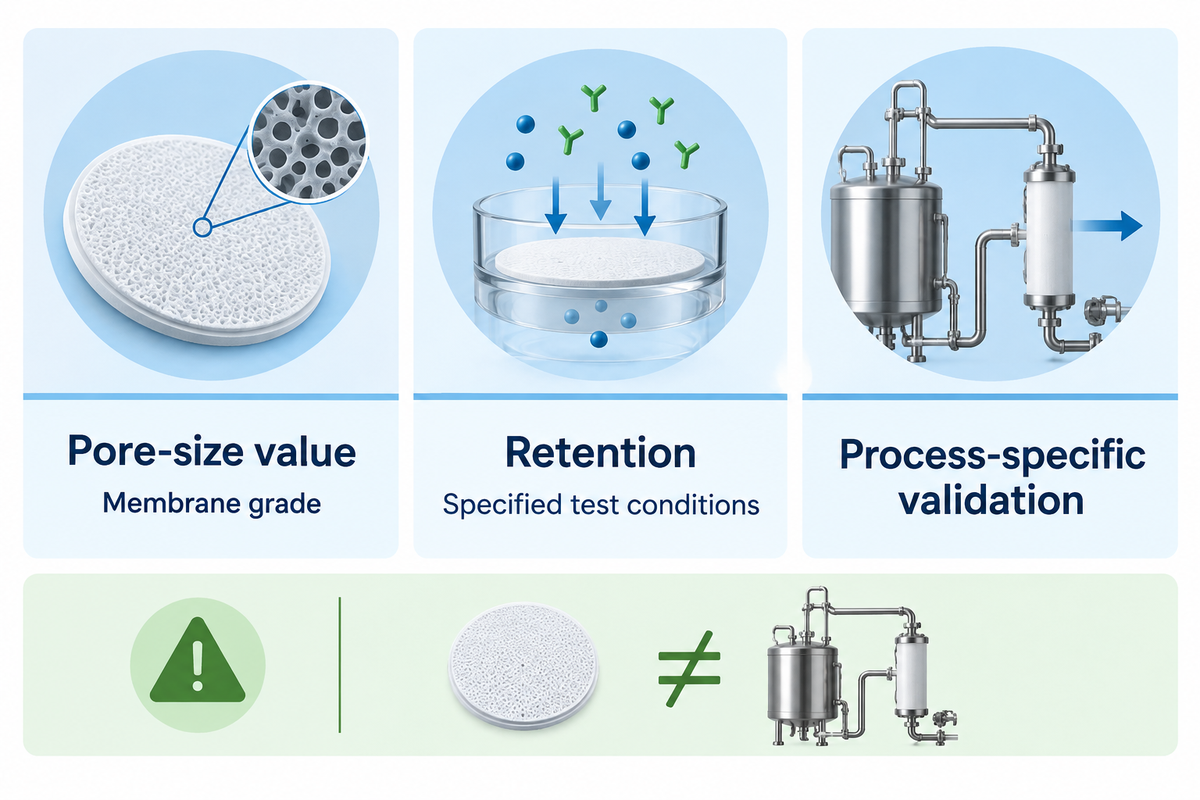
A pore-size value identifies a membrane grade, while retention describes an observed result under specified test conditions. Application suitability requires the required filtrate quality and appropriate evidence. A comparison of two micron labels is a rudimentary assessment; test method, challenge material, and the complete filtration path determine the significance of that comparison.
What is a 0.22 micron filter used for?
A 0.22 micron filter is used for fine particle control and, in appropriately validated applications, bacterial-retention duties. The 0.22 µm marking alone doesn’t establish a sterile process. A pharmaceutical sterilizing-filtration application requires a suitable filter and process-specific validation, including the fluid and conditions under which it will operate.
FDA guidance on drug production and process controls discusses validation requirements for products intended to be sterile. That is a drug-manufacturing context, rather than a general claim that all industrial water needs sterilizing filtration.
| Observation | Useful interpretation | Next evidence |
|---|---|---|
| Micron label, such as 0.22 µm | Identifies a declared grade | Rating method and challenge conditions |
| Clear appearance | No visible haze in that sample | Particle measurement and retention efficiency at the required sizes |
| Particle count | Sampled particles at instrument channels | Sampling method, baseline and instrument checks |
| Low differential pressure | Low measured pressure difference now | Flow rate, temperature and gauge locations |
| Stable flow | Delivered volume per time is steady | Pressure trend and filtrate quality |
| Bubble point result | Response under a defined wetting/test protocol | Applicable method and correlated acceptance limits |
| Chemical concentration | Measured amount of a specific constituent | Analytical recovery and sample preparation controls |
| A compatibility chart | Material screening under stated conditions | All wetted components and actual fluid exposure |
| A quality-system certificate | A holder has a defined certified scope | Product-specific conformity or validation evidence |
There are limits to the scope of integrity testing. In a 2023 study by Giglia, Alembath and Hersey, automated bubble-point-only results had limitations in detecting defects in the tested PES and PVDF cartridges. The authors who worked for EMD Millipore/Merck supported diffusion testing, as a complement. Their test doesn’t determine acceptance limits for a nylon cartridge.
When procurement compares a 0.22 µm offer with a 0.45 µm alternative, ask what outcome must change and how it will be measured. Our filter micron rating guide provides more details about micron ratings for various filter families. A smaller number shown by itself leaves the acceptance criterion unresolved. Particle exclusion should be evaluated in terms of the particle size that’s of interest to the following process.
Nylon, PES, PVDF or PTFE: Compare Fluid Behavior
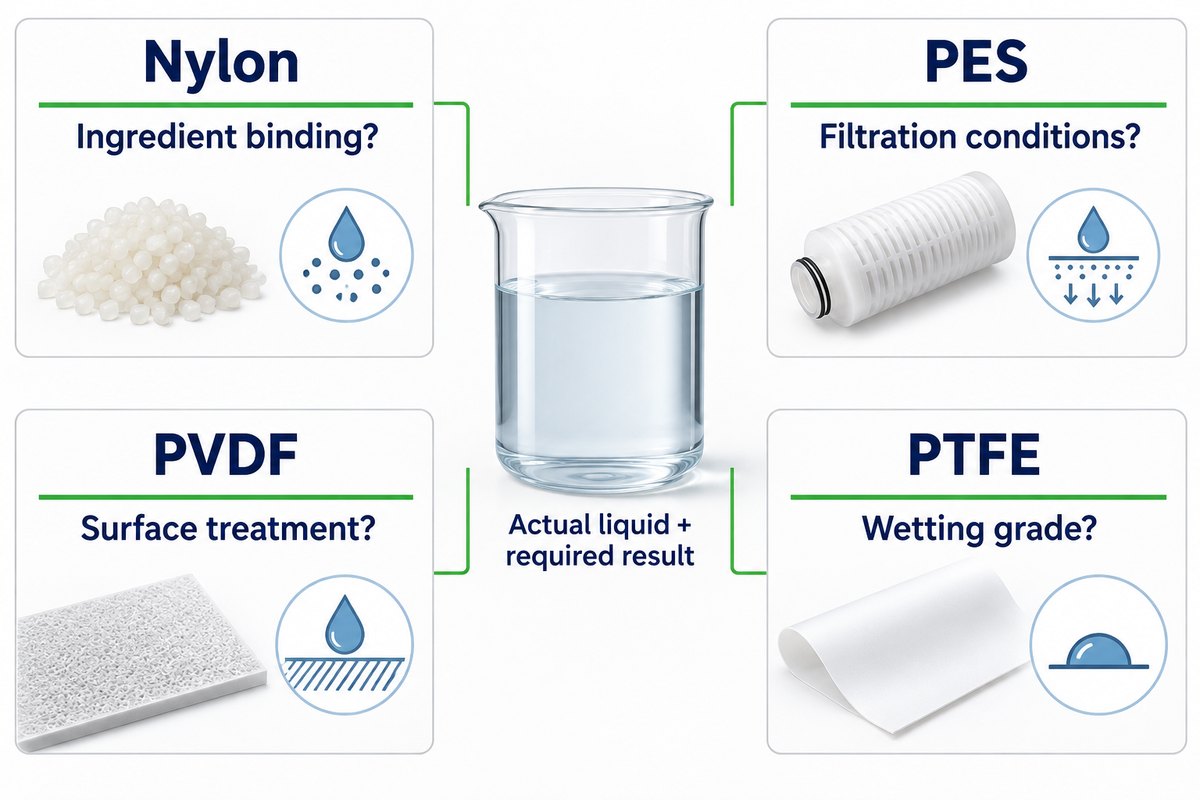
Nylon, PES, PVDF and PTFE should be evaluated against the actual liquid and required result, rather than a universal best-material list. Many factors including wetting, binding, chemical exposure and construction of an assembly can affect the outcome. A good comparison keeps operational and analytical conditions similar enough to account for the reason why one candidate performs differently than others.
| Candidate | Question to resolve | Evidence that makes the comparison useful |
|---|---|---|
| Nylon | Does ingredient or analyte binding change the required result? | Recovery and background checks with the actual liquid and membrane grade |
| PES membrane filter cartridges | How do wetting, formulation and filtration conditions interact? | Comparable assembly trials at matched operating conditions |
| PVDF membrane filter cartridges | Which surface treatment and product construction are being offered? | Grade-specific data rather than a polymer-name assumption |
| PTFE membrane filter cartridges | Is the offered grade hydrophobic or modified for aqueous wetting? | Documented wetting procedure and whole-assembly fluid compatibility |
What are the key differences between PTFE and Nylon filters?
Nylon is generally associated with water-wettable membrane grades, while conventional PTFE membranes are hydrophobic; modified PTFE grades also exist. Their practical differences include wetting behavior, chemical compatibility and interactions with the filtered components. A filtration solution has to meet the liquid’s composition requirements as well as its particle target. Check the offered grade and all wetted parts before deciding which filter fits a particular aqueous or solvent-containing liquid.
Solvent names don’t provide adequate compatibility information. Record the entire blend and the concentration, relevant pH, contact time and temperature. Other constituents like seals and bonding agents can alter the overall assembly’s behavior from that of the membrane. Mechanical strength and chemical resistance are separate specification questions; neither substitutes for the other.
In a protein-containing formulation or beverage stream, the objective may be preserving a dissolved component. A material sold for another application’s high binding may not be a good choice for that objective. Describing a membrane as inert doesn’t mean it’s compatible with all dissolved constituents. Agree on the result to measure before assuming that a polymer substitution will improve yield.
Adsorption: When a Clear Filtrate Loses Ingredients
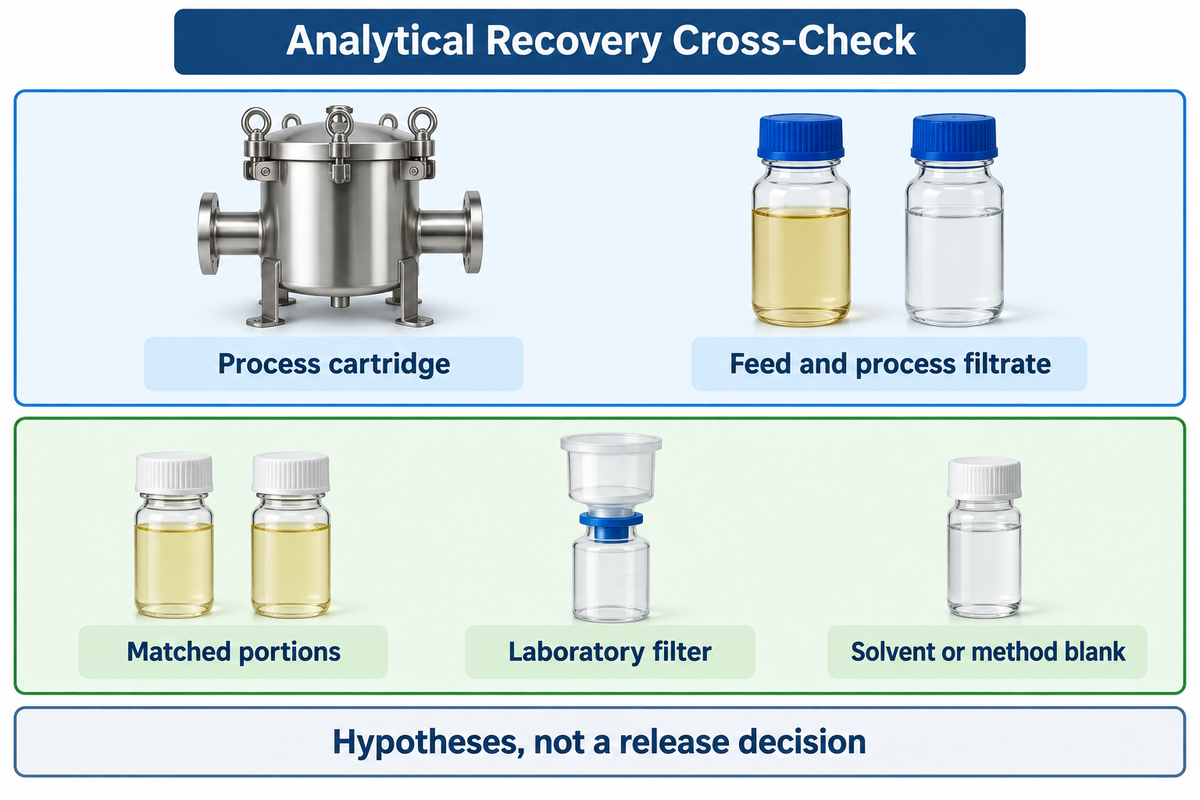
Adsorption can alter a filtrate without making the solution turbid. Dissolved components may interact with a nylon membrane, and the resulting measurement also depends on sample preparation. Investigate both the process cartridge and any laboratory filter used before analysis. Otherwise, an analytical preparation loss can be misinterpreted as a process loss.
Aichinger and colleagues’ 2020 study found analyte- and filter-dependent losses during syringe filtration of a complex Alternaria extract. Reid and colleagues’ 2026 PFAS study analyzed recovery under specific laboratory filter and solution conditions. Neither study offers a general nylon-cartridge loss percentage for industry.
The reverse direction deserves attention too. Tran and Doucette’s 2006 laboratory membrane-disc study identified nylon-derived oligomers that contributed analytical background. Its public abstract reports that rinsing reduced rather than eliminated that interference. A new signal therefore deserves a blank check as well as an adsorption check; the paper isn’t a test of ECOFILTRONE cartridges. In an HPLC workflow, include mobile phases and preparation materials when investigating that background.
Analytical Recovery Cross-Check
Use the following comparisons to frame your investigation with the laboratory. The laboratory chooses appropriate controls, replication and acceptance limits for its method. This editorial cross-check generates hypotheses; it isn’t a validated recovery method or a release decision.
| Comparison | Keep comparable | Question the comparison can investigate |
|---|---|---|
| Feed and process filtrate | Timing, containers and validated analytical preparation | Is there a reproducible process-stage difference? |
| Matched portions before and after laboratory filtration | Analyte, matrix and preparation conditions | Does sample preparation change the measured result? |
| Solvent or method blank | Containers, laboratory filter and analytical sequence | Is the method introducing background? |
| Alternative preparation accepted by the laboratory | Method suitability and reporting basis | Does the difference persist using another suitable preparation? |
| Repeat with controlled handling | Hold time, temperature and dilution | Could handling or analytical variability explain the change? |
Hypothetical example: Let’s say a formulated liquid is measured at 100 mg/L in a suitable reference preparation. After a filtration plant run, a sample processed through a laboratory syringe (filter) is measured at 80 mg/L. A matched portion prepared by another method accepted by the laboratory is measured at 99 mg/L. Based on this data, an apparent 20 mg/L deficit exists and should be further investigated. The apparent 20 mg/L deficit is a reason to investigate laboratory preparation before blaming the process cartridge. The two reported results differ by 19 mg/L; that arithmetic isn’t a correction factor for future samples. The quality specialist would look into method recovery and uncertainty, while the plant manager wouldn’t consider changing the production hardware based on the first result. These values are meant to illustrate a point, not make a claim.
Determine which component should be kept, and which component should be removed. Han and colleagues’ 2012 laboratory estrone study, for instance, focused on adsorption for contaminant removal and, therefore, presents a different objective from product preservation. It doesn’t support continuous treatment capacity or regeneration of an industrial cartridge.
Flow Rate and Differential Pressure: Read Operating Changes
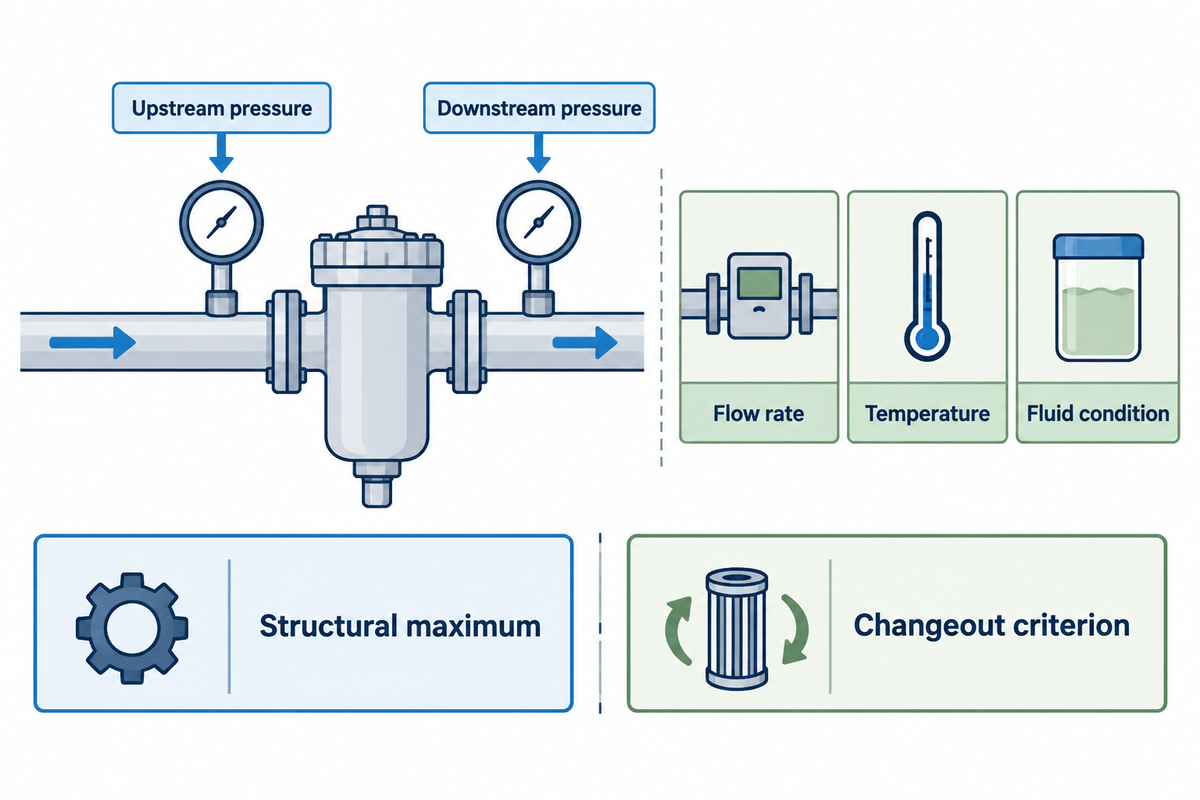
Differential pressure is the difference between upstream and downstream pressure at the measurement points. Along with that reading, consider flow rate, temperature, and fluid condition. An increase in differential pressure can be indicative of increasing resistance. However, a number of other factors can cause a change in the operating point, and confuse a before and after comparison.
A 2008 sterile-filtration case study by Anderson, Sharma and Rathore examined interacting hold temperature, concentration, hold time and pH effects on fouling. The case study contains formulation-specific information and reasons why batch history is important when developing troubleshooting records. These results aren’t a general nylon-filter cleaning recipe.
Hypothetical example: a maintenance log records 100 L/min at 25 °C and 0.20 bar differential pressure on one run. A later entry shows 80 L/min at 15 °C and 0.30 bar. The second entry may look like a simple filter blockage, but flow and temperature changed. Before assigning the difference to loading, the engineer would review the fluid’s viscosity information, pump and valve settings, and measurement reliability. Restoring a comparison means the system is restored to the approved operating conditions, as opposed to forcing the system to match the example numbers. The plant manager needs the reason for lost throughput; purchasing needs to know whether replacing an element would address that reason. These values are hypothetical observations, not recommended operating limits.
Transient events deserve their own entry. The historical FDA High Purity Water System inspection guide, July 1993 describes rapid valve closure causing pressure reversal and filter ballooning. In some cases, a steady gauge reading taken after a suspected surge or reverse differential can miss the event. It is important to review the assembly’s documented limits and the site’s operating procedure.
Keep two limits separate
A structural maximum differential pressure describes an assembly limit under stated conditions. A changeout criterion describes when a particular process should stop using the element. Don’t treat the maximum as a universal routine replacement trigger.
4-Route Nylon Fault Isolation
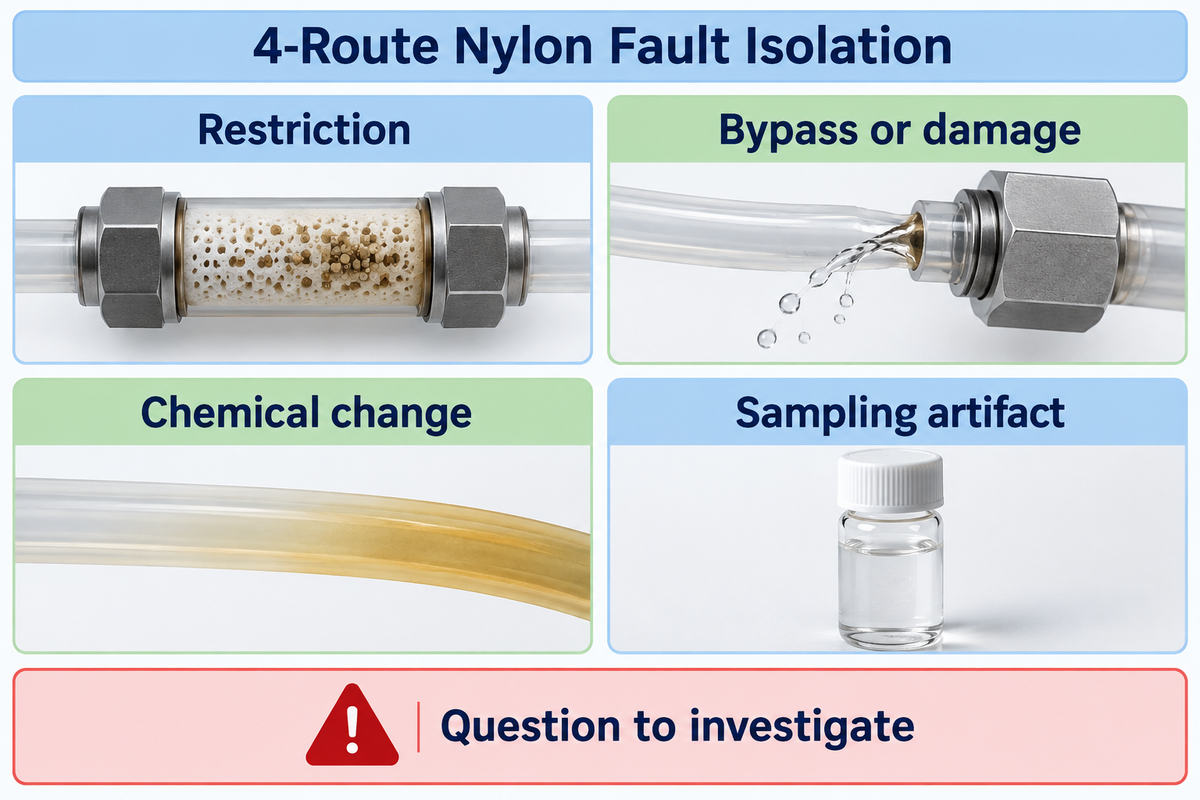
The 4-Route Nylon Fault Isolation table sorts observations into restriction, bypass or damage, chemical change, and sampling artifact. Begin with the observed result and collect evidence that can separate competing explanations. The routes can overlap and aren’t exhaustive; a named route is a question to investigate, not a confirmed explanation. A formulation-specific sterile-filtration case study illustrates why interacting operating parameters require investigation rather than a single presumed cause.
| Route and observation | Possible explanation to investigate | Useful check or escalation |
|---|---|---|
| Restriction: pressure rises at unchanged flow | Accumulating solids, aggregation or changed viscosity | Compare feed, temperature and upstream filter history |
| Restriction: low flow from startup | Air, incomplete wetting, an obstruction or excessive system resistance | Review startup record and valve state under the site procedure |
| Restriction: performance changes after a batch hold | Formulation or temperature history changed | Compare hold time, composition and batch records |
| Bypass/damage: sudden downstream particles | Seal seating, installation, a damaged element or sampling contamination | Hold affected material under the quality procedure; inspect after isolation |
| Bypass/damage: quality worsens after a valve event | Transient pressure or reverse differential may have occurred | Review event timing and qualified pressure history |
| Bypass/damage: integrity result changes | Filter defect, test-system leak, wetting or protocol differences | Check the test setup and approved method before diagnosing the element |
| Chemical change: new odor, deformation or background | Fluid interaction with membrane, support or another wetted part | Escalate fluid composition and exposure history to the responsible engineer |
| Sampling artefact: lower measured ingredient concentration | Process loss, sample-filter adsorption or method bias | Use the Analytical Recovery Cross-Check with the laboratory |
| Sampling artefact: an unexpected blank signal | Container, solvent, filter extractables or analytical background | Compare method-appropriate blanks and identify the source |
Hypothetical example: The quality team found downstream particles after a cartridge change, and differential pressure (DP) remained close to its previous value. Purchasing a finer membrane immediately would leave installation and sampling explanations unresolved. The team holds the affected material per quality procedure, checks the sample method, and evaluates whether the correct element and seals were installed. Any housing inspection follows shutdown, isolation, depressurization and the site’s handling procedure. If a seal problem is found, that explains a possible bypass route; if the inspection is inconclusive, the investigation continues. This example shows the evidence required before a purchase is made. It isn’t meant to report a customer incident, or to show that low DP indicates a seal failure.
ESCALATE SUSPECTED LOSS OF CONTAINMENT, chemical ATTACK OR MICROBIAL CONTROL THROUGH RESPONSIBLE SITE PERSONNEL. A TROUBLESHOOTING TABLE CANNOT AUTHORIZE CONTINUED PRODUCTION OR PRODUCT RELEASE. For critical filtration applications, agree on escalation and release responsibilities before an abnormal result occurs. Keep the failed result, element identity and operating history together so engineering, quality and the supplier review the same event.
Cleaning, Reuse and Replacement Decisions
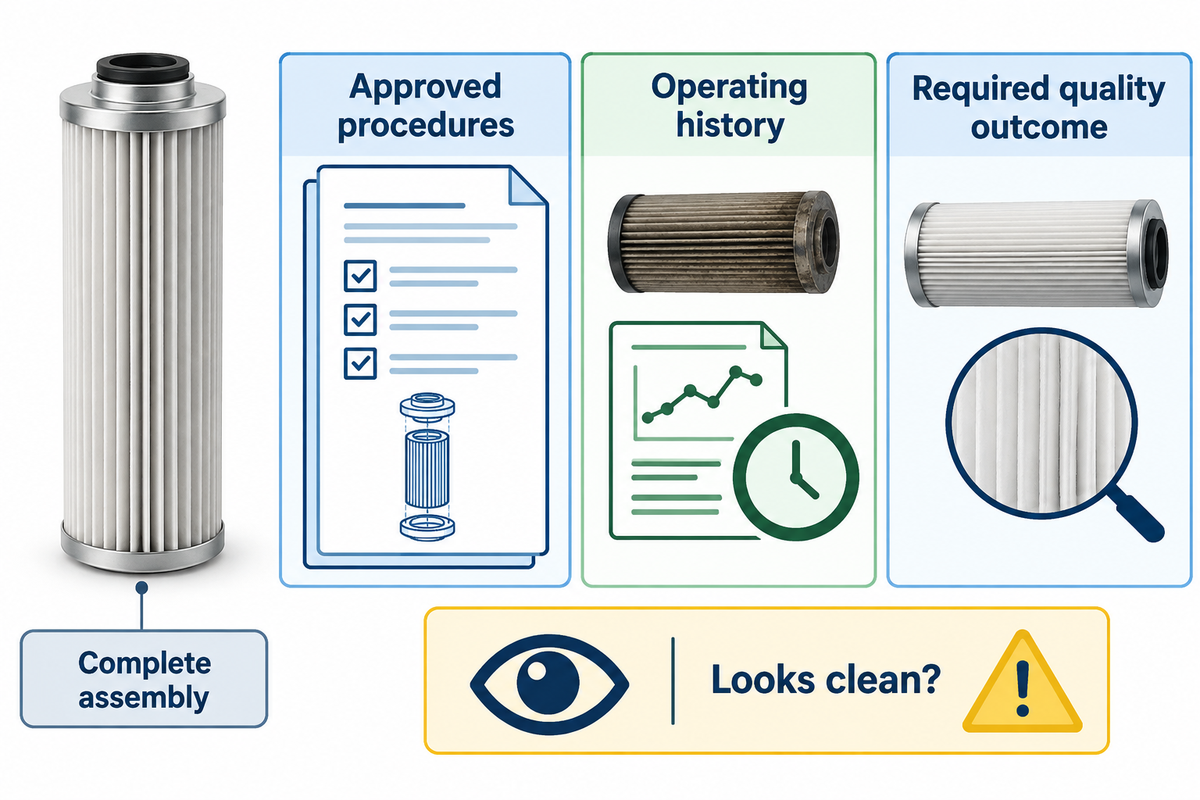
Cleaning or reusing a nylon cartridge is a product and process decision. Comply with the approved procedures for the complete assembly and site’s requirements for its duty. Filtrate quality, integrity where applicable and chemical exposure need an acceptable outcome.
A MAINTENANCE TEAM CONSIDERING ANOTHER RUN SHOULD IDENTIFY THE REASONS FOR THE PREVIOUS RUN ENDING. IF SEALS ARE DAMAGED, INVESTIGATE THAT DIFFERENTLY FROM LOADING PROBLEMS OR UNEXPLAINED ANALYTICAL RESULTS. Carry the recorded differential pressure, temperature and processed volume into that decision. DO NOT RESET AN ELEMENT’S HISTORY SIMPLY BECAUSE IT LOOKS CLEAN.
Ask the manufacturer or responsible supplier about the exact cartridge configuration before proposing a cleaning agent, steam cycle or reverse flow. A polymer compatibility note isn’t a whole element cleaning procedure. In pharmaceutical water systems, FDA’s historical inspection guide describes developing operating and cleaning/sanitization procedures during validation; that context supplies no universal nylon-cartridge cleaning recipe. Applicable product documentation must be referred to for steam temperature, exposure time and permitted cycles; this guide gives no universal values.
Replacement planning can also include upstream protection. If particles repeatedly exhaust the final membrane stage, review the feed and prefiltration arrangement rather than assuming a stronger or finer final membrane is the only option. Record the reason for changeout so a future replacement can be assessed against the same operating and quality criteria. A durable outer component can be part of an element that has reached its process-specific end point.
Industry Outlook: Process-Specific Evidence
In 2026, ASTM published a practice focused on end-user sterilizing-filtration validation. ASTM E3469-26 provides a framework for sterilizing-filtration validation of pharmaceutical, biopharmaceutical and biological products. For teams in the applications, this supports a practical distinction between selecting a membrane and validating its use in a process.
The public ASTM E3469-26 summary, updated April 28, 2026, assumes compatibility and ingredient-binding investigations before bacterial-retention testing. It clearly states that filter-selection test methods are not part of this approach. Its references include F838; the practice should not be described as replacing F838 or as a requirement for every industrial water application.
“Process validation of sterilizing filtration is required by industry standards and regulatory agencies”
For a pharmaceutical project, define the intended fluid and process window with the validation team before treating a commercial pore grade as a complete answer. For an industrial water particulate-control duty, the acceptance criterion is kept with that duty. Adding a pharmaceutical label to a selection without the process evidence isn’t helpful. A dairy or biotech project likewise needs its own defined product-contact and quality requirements. For a semiconductor water application, establish the required contaminant measurements before carrying across evidence from another duty.
Published membrane-modification research is another source of ideas, but a novel research membrane is a separate design. A coating, an electrospun layer or a laboratory cross-flow setup shouldn’t be seen as a feature of a standard nylon pleated cartridge. Ask what was manufactured and tested at what scale before incorporating a research finding into a commercial product specification.
ECOFILTRONE™ provides support for application reviews, specification checks and replacements for industrial liquid filtration. For dimensions and available configurations, use the nylon membrane filter cartridge solution page. For any operating questions, send the fluid and operating details for engineering support and state the problem and the expected outcome.
Frequently Asked Questions
Can nylon membrane filter cartridges be cleaned?
Cleaning is possible only where the cartridge’s approved instructions and its process duty permit it.
An element is suitable for extended use only under its approved reuse conditions. A visual assessment alone doesn’t establish that endpoint. Identify the deposit or failure mechanism, review all wetted materials, and check the site’s requirements for reuse. Improved flow after washing doesn’t establish acceptable retention or composition. Obtain the applicable cleaning method and acceptance criteria from the responsible supplier and site team; don’t improvise a solvent, steam exposure or backwash sequence from membrane chemistry alone.
Why are nylon membrane filter cartridges not working?
A nylon cartridge can appear ineffective because of restriction, bypass, fluid interaction or a misleading sample result.
Begin by defining the failed result: low flow, rising pressure, downstream particles or changed chemistry. Compare the element identity, installation and operating history, then check the reliability of the measurements. The same symptom can have several explanations. The four-route table organizes starting checks, while the laboratory comparisons help investigate analytical bias. Product release and any decision to continue operating remain with the responsible site personnel.
Can nylon membrane filter cartridges be recycled?
A used nylon membrane cartridge needs an accepted waste route for its complete construction and contamination history.
A cartridge may contain several materials, so a nylon recycling symbol or general polymer statement doesn’t settle disposal. Record the retained contaminants and identify any hazardous or controlled residue before contacting the site’s waste contractor. Confirm whether the receiving facility accepts that used assembly. Follow the applicable waste rules and site procedure, and keep disposal evidence with the maintenance record rather than assuming every nylon-labelled element can enter ordinary plastics recycling.
Why do you need a nylon membrane?
A nylon membrane may fit an aqueous filtration duty when its retention and fluid interactions meet the required result.
Choose it against the liquid, component recovery and whole-assembly requirements. Another material may fit better when the measured result or compatibility assessment favors that alternative.
Are nylon membrane filter cartridges safe?
Suitability comes from matching the specific cartridge, liquid, operating conditions and intended application.
“Safe” needs a defined duty. A water particulate-control application, a food-contact process and pharmaceutical sterilizing filtration have different evidence requirements. Identify the complete wetted assembly, exposure conditions and required filtrate quality first. Check the relevant product documentation and any compliance statement for the actual model, intended use and certificate holder. A quality-management certificate covers its stated organization and scope; it doesn’t by itself establish sterile filtrate, food-contact suitability or universal chemical compatibility.
For a changed formulation, a new cleaning exposure or an unexplained quality result, involve the responsible engineer and quality team before continuing under an old approval. The guide’s examples help frame questions, but they don’t provide process approval, pressure settings or release criteria. ECOFILTRONE™ can assist with specification verification and application review based on the details supplied for the operating requirement.
How ECOFILTRONE™ uses this guide
We supply industrial filtration consumables and assist with selection, replacement and application-specific configurations. This nylon guide separates membrane behavior from assembly performance and laboratory sample handling. The cited studies concern their stated materials and test conditions; the numerical scenarios are hypothetical. Product-specific technical and compliance documents are assessed against the actual product, application and document holder.
References & Sources
- Aichinger et al. (2020): laboratory filtration and Alternaria compound recovery original experimental study.
- Reid et al. (2026): PFAS adsorption during laboratory syringe filtration original experimental study.
- Tran and Doucette (2006): nylon 66 membrane-disc extractables public primary abstract reviewed.
- Han et al. (2012): estrone adsorption in nylon microfiltration membranes public primary abstract reviewed.
- Giglia et al. (2023): automated bubble-point testing of PES/PVDF cartridges industry-authored original experiment.
- FDA: drug production and process controls questions and answers sterile-drug context.
- FDA (July 1993): High Purity Water System inspection guide historical pressure-transient example.
- Anderson, Sharma and Rathore (2008): Filter Clogging Issues in Sterile Filtration formulation-specific case study.
- ASTM E3469-26: public scope and significance pharmaceutical, biopharmaceutical and biological-product validation.
- ASTM (May 13, 2026): new pharmaceutical sterilizing-filtration practice official announcement and attributed quotation.