Get in touch with ECOFILTRONE™ Company



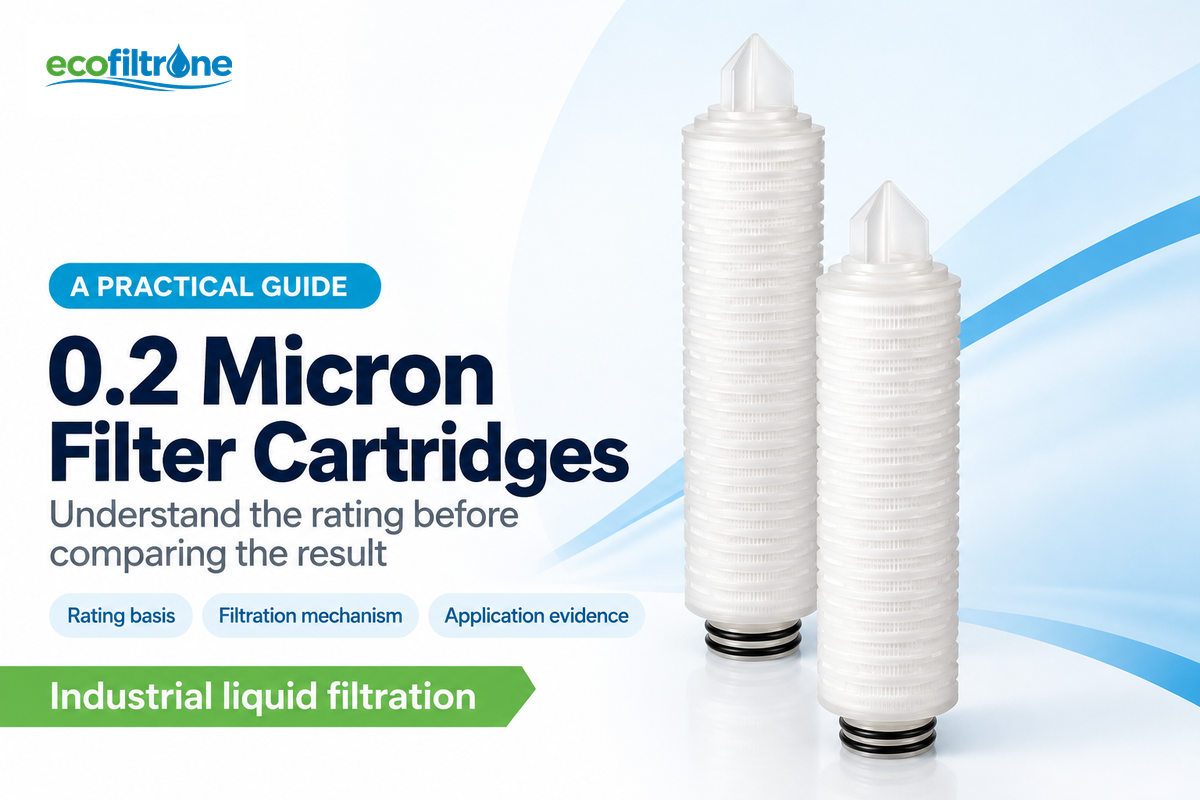
0.2 Micron Filter Cartridges separate fine contaminants from a liquid, but the number alone tells you surprisingly little about how a particular cartridge works. A membrane, a pleated particle filter and an electropositive medium can carry the same label and do different jobs. Understanding that difference prevents an expensive replacement based on a small number printed on a box.
At a glance
- Size conversion: 0.2 µm = 200 nm.
- Read together: rating basis, filtration mechanism and target contaminant.
- Separate claims: particle retention, microbial retention, integrity and supplied sterility.
- Application inputs: liquid composition, flow, temperature and differential pressure.
0.2 Micron Filter Cartridges are fine-filtration elements whose removal performance follows their construction and test basis. A label of 0.2 µm is equivalent to 200 nm. That said, not every cartridge is interchangeable. Match the mechanism to the contaminant to be removed and the result desired.
What Does the 0.2 Micron Label Describe?
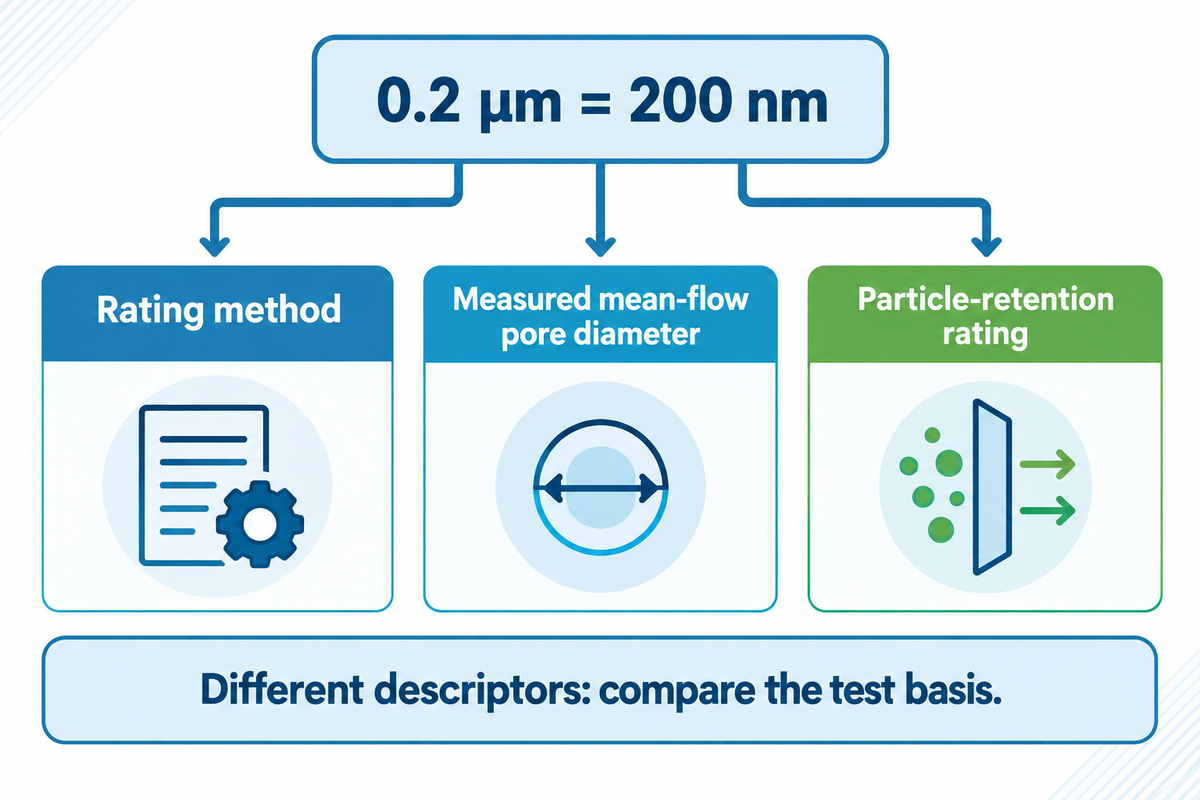
A 0.2 micron label describes a size designation equivalent to 200 nanometers. For 0.2 micron filtration, the practical significance is in the stated rating method. The stated rating method describes what was challenged, how retention was assessed and under what conditions. For industrial liquid service, read the size together with the filter construction rather than treating it as a complete performance specification.
A micron, or micrometre, means one millionth of a meter. That, by definition, is true. The behavior of a real filter is more complicated because a porous medium contains a distribution of openings and flow paths. A membrane’s measured mean-flow pore diameter, a supplier’s particle-retention rating and the size of a challenge organism are different descriptors.
Na and colleagues illustrated this distinction in a 2022 study of two 47 mm flat-sheet filters sold with the same 0.22 µm designation. Their measured mean-flow pore diameters were 0.30 µm and 0.26 µm. Those values describe the measurement used in that experiment; they aren’t a reason to relabel either product or assume the largest opening has been measured. The useful lesson is to keep the label and the measurement method together.
Nominal and absolute micron ratings also require their stated efficiency basis. “Absolute” on a particle filter can refer to retention efficiency at a designated particle size. It doesn’t mean that all the physical pores in a filter were measured. Our guide to nominal and absolute filter ratings explains those rating calculations in more detail.
A 0.2 µm designation equals 200 nm, while a laboratory pore measurement may describe a particular flow-weighted property. Comparing filters requires matching a descriptor and test basis. In the absence of these, a smaller number drawn from a different measurement can’t be of much help to the consumer.
The Same Rating Can Cover Different Filter Types
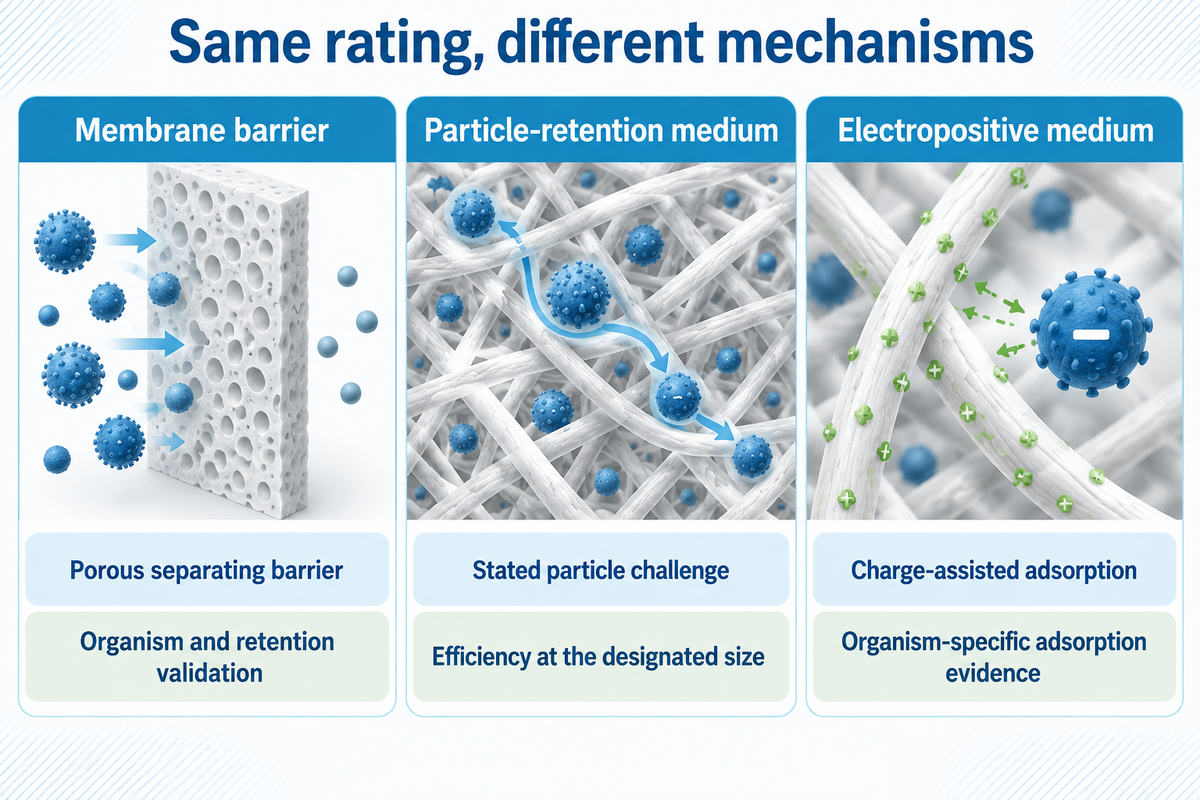
The same 0.2 micron rating can be applied to membrane cartridges, fine particle cartridges, and electropositive adsorptive media. Membranes use a porous barrier; particle filters are defined by measurement of retention; and electropositive media provide a capture basis by way of charge. These mechanisms have different application boundaries even when a catalogue uses the same size designation.
Pleating describes geometry, not a single filtration mechanism. Filter media can share the same pleated shape. A pleat can increase the available media area within a cartridge, and the media itself can be polypropylene or a polyethersulfone membrane. Wound and melt-blown depth elements can also be found in filtration trains, and their suitability for a given final duty is determined by their own rating rather than the appearance of a similar cartridge.
Argonide is a strong example. Its NanoCeram product page describes an electropositive attraction, an average pore size of 2-3 µm and a 0.2 micron absolute rating. The rating is a manufacturer statement about their medium. A larger average pore size and finer retention describe different properties, and NanoCeram is Argonide’s technology and not an ECOFILTRONE membrane specification.
Same-Rating Mechanism Crosswalk
| Comparison point | Membrane barrier | Particle-retention medium | Electropositive medium |
|---|---|---|---|
| Primary description | Porous separating barrier | Retention of a stated particle challenge | Charge-assisted adsorption and capture |
| Meaning of the label | Specified membrane grade and validation basis | Efficiency at the designated particle size | Published retention rating for that medium |
| Physical pore comparison | Use the named pore measurement | Do not infer every opening from efficiency | Adsorption can capture below average pore size |
| Microbial claim | Read organism and retention validation | Keep particle efficiency separate | Read organism-specific adsorption evidence |
| Fluid interaction | Wetting, compatibility and product binding | Loading and medium compatibility | Fluid chemistry and adsorption conditions |
| Flow comparison | Same fluid, area and pressure basis | Same challenge and loaded condition | Same fluid and tested loading conditions |
| Integrity assessment | Product-specific method and limits | Method appropriate to construction | Method appropriate to construction |
| Supply condition | Sterile supply is a separate designation | Clean packaging is not sterile supply | Clean packaging is not sterile supply |
| Replacement decision | Match the complete application | Match the required retention endpoint | Match the required adsorptive endpoint |
Example: A water-treatment purchaser receives two offers for 20-inch 0.2 µm cartridges. One is a particulate-retention element; the other is offered for a validated microbial duty. Both fit the drawing. Operations prefers the offer with the higher quoted flow, while quality needs the existing microbial endpoint preserved. The first useful comparison is the type of retention claim. The offers can then be compared based on unit price and length of the cartridge. A particle-efficiency curve can be used to evaluate the particulate duty. The microbial duty requires a relevant product and process evaluation. Procurement can then compare suitable alternatives, rather than ask quality to accept a different job because the two labels look alike.
For a more extensive discussion of one membrane family, see PES membrane behavior in liquid filtration. Material choice comes after the mechanism and the desired result are clear.
What Does a 0.2 Micron Water Filter Remove?
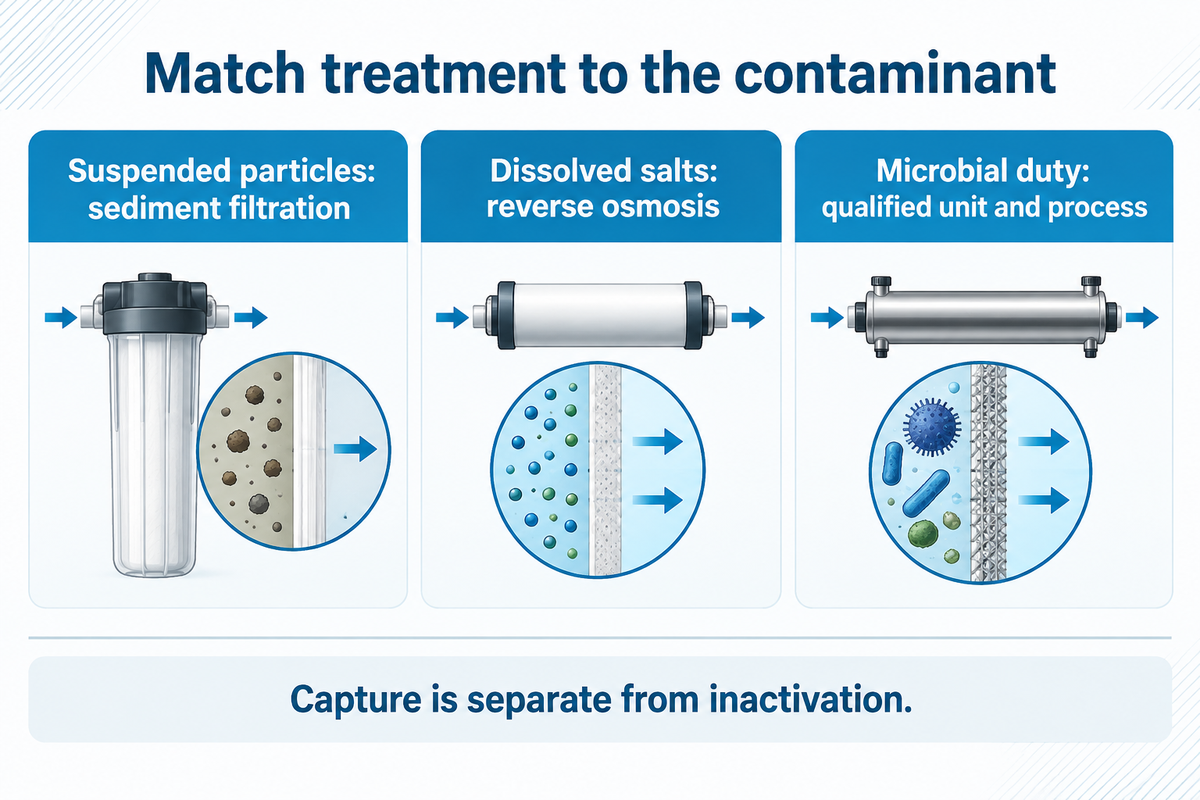
A properly designed 0.2 micron water filter can capture fine suspended particles and can serve a bacterial retention function when that unit and the associated process are qualified. Ordinary micro-filtration doesn’t desalinate water. Virus removal, dissolved-chemical removal and sterile-filtrate performance require their own treatment mechanism and application evidence.
Which impurities do water filter cartridges remove?
Water filter cartridges remove the contaminants targeted by their media: sediment elements retain suspended particles, activated carbon adsorbs certain substances, and suitably qualified membranes serve a defined microbial duty. Each stage has its own assigned endpoint.
Commercial and residential treatment systems separate contaminants through the same underlying physical mechanisms, although their duties and validation requirements differ. Incoming water can contain solid debris, clay, microorganisms and dissolved substances at the same time. A sediment filter targets suspended material. Reverse osmosis addresses a different separation duty, including dissolved salts. Activated carbon filters can reduce particular dissolved substances such as chlorine through adsorption; their performance follows the carbon medium and operating conditions. A carbon block composite isn’t simply a membrane with a different colour.
In its comparative analysis of household treatment systems, the CDC defines these mechanisms more clearly and helps bring out the associated physics. Still, industrial water filtration depends on the application-specific specification for the cartridge selected. Water that’s clear to the eye and a low total dissolved solids reading measure quality in different ways.
The FDA describes a specific contaminated-media investigation in its current good manufacturing practice questions and answers. Its response explicitly avoids making routine 0.1 µm media filtration a general expectation. The application problem, rather than a universal smaller-number rule, governs the corrective action.
Bacterial retention also involves more than treating every organism as a rigid sphere. A 2010 study by Lee and colleagues found different passage behavior among bacteria with similar hydrodynamic diameter but different geometry under the tested conditions. That finding supports why the challenge organism and conditions are important. It is not a prediction that every modern 0.2 µm cartridge will behave like those model filters.
Capture and inactivation are separate, too. Ikner and colleagues’ 2011 study of an electropositive virus sampler for laboratory concentration reported filter retention separately from recovery after subsequent laboratory processing. A recovery percentage from that workflow is not the percentage left in the filtrate, and adsorption should not be described as killing the captured organism. Those findings also don’t transfer to an unrelated cartridge.
Suspended solids, dissolved salts and microorganisms present different separation problems. A 0.2 µm microfiltration stage can address a defined particulate or qualified microbial duty, while reverse osmosis and adsorption serve other purposes. Using one general micron label as a measure of water purity hides those differences.
Is a 0.2 Micron Filter the Same as 0.22 Micron?
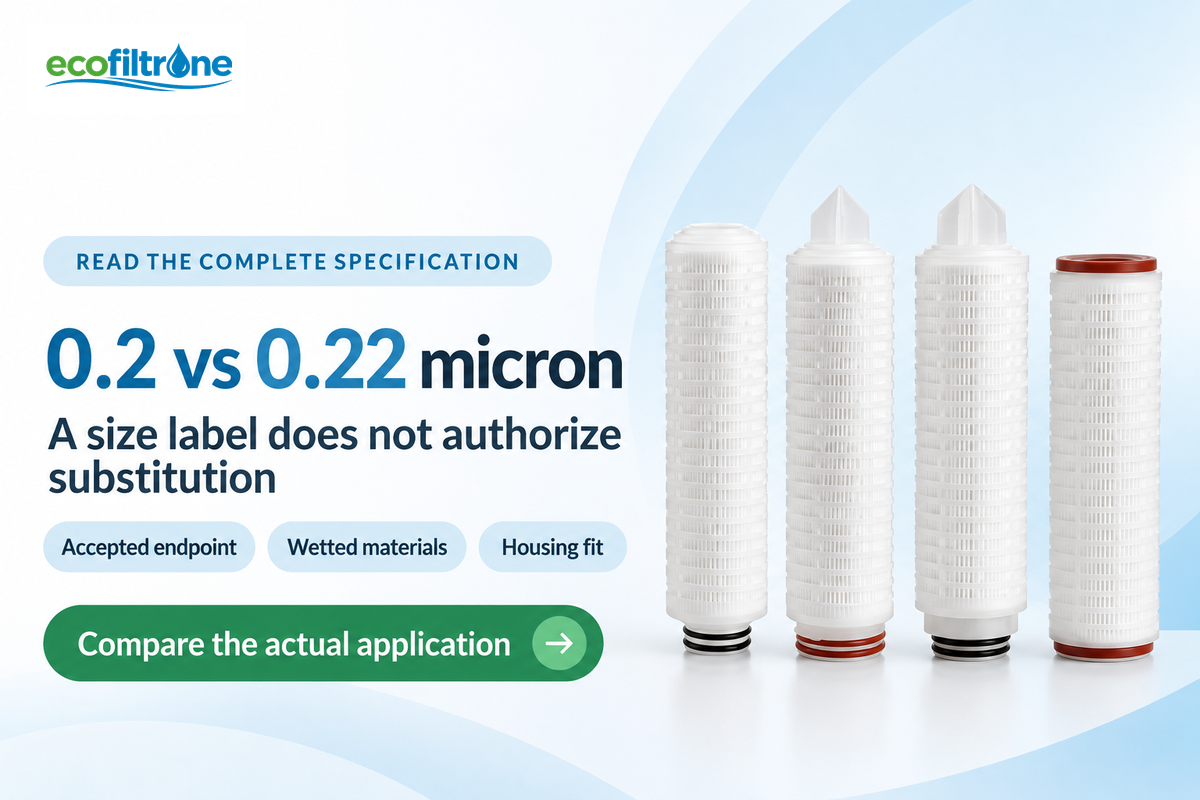
No: 0.2 and 0.22 micron designations don’t warrant a cartridge substitution. Both occur in fine membrane filtration, including products offered for microbial-retention service, but equivalence is an application decision. The offered construction, relevant retention validation and operating conditions must suit the same required result.
What is a 0.22 micron filter?
A 0.22 micron filter is a fine-filtration product carrying a 0.22 µm size designation. In a sterilizing-grade membrane product, bacterial-retention validation supplies the relevant performance context. The same label alone doesn’t describe every material, complete cartridge configuration or intended process. Read it as one part of the specification.
The numerical difference is 0.02 µm, or 20 nm. Turning that difference into a blanket ranking misses the practical question. A 0.2 µm particle filter and a 0.22 µm validated membrane may have very different intended duties. Conversely, two suitably validated membranes can meet the same specified application requirement without identical material, pore structure or clean-water flow.
According to Na and colleagues, the two 0.22 µm filters in their flat-sheet study were hydrophilic PVDF and PES. Differences in structure and water permeability were observed, but both demonstrated no passage of bacteria in the challenge test. A shared test endpoint can coexist with different hydraulic behavior. The study does not provide a universal PVDF-versus-PES ranking or a full-cartridge flow prediction.
Physical fit is also a consideration. Length, diameter, open end configuration and seal material decide whether the element matches the filter housing. A 222 arrangement isn’t interchangeable with every double-open-end installation. Conditions and the liquid to be treated must also be considered. Membrane compatibility alone leaves a part of the wetted assembly unverified.
Our nylon membrane application guide explains material interactions in greater detail. For a replacement, first maintain the accepted filtration duty, and then ensure that material and assembly compatibility are met.
The difference between 0.20 µm and 0.22 µm is 20 nm, but substitution requires more than that arithmetic. Matching the process endpoint, membrane construction and complete wetted assembly produces a useful comparison. Selecting only the smaller printed value can exchange a validated duty for an unrelated particle rating.
Retention, Integrity and Sterile Supply Are Different Claims
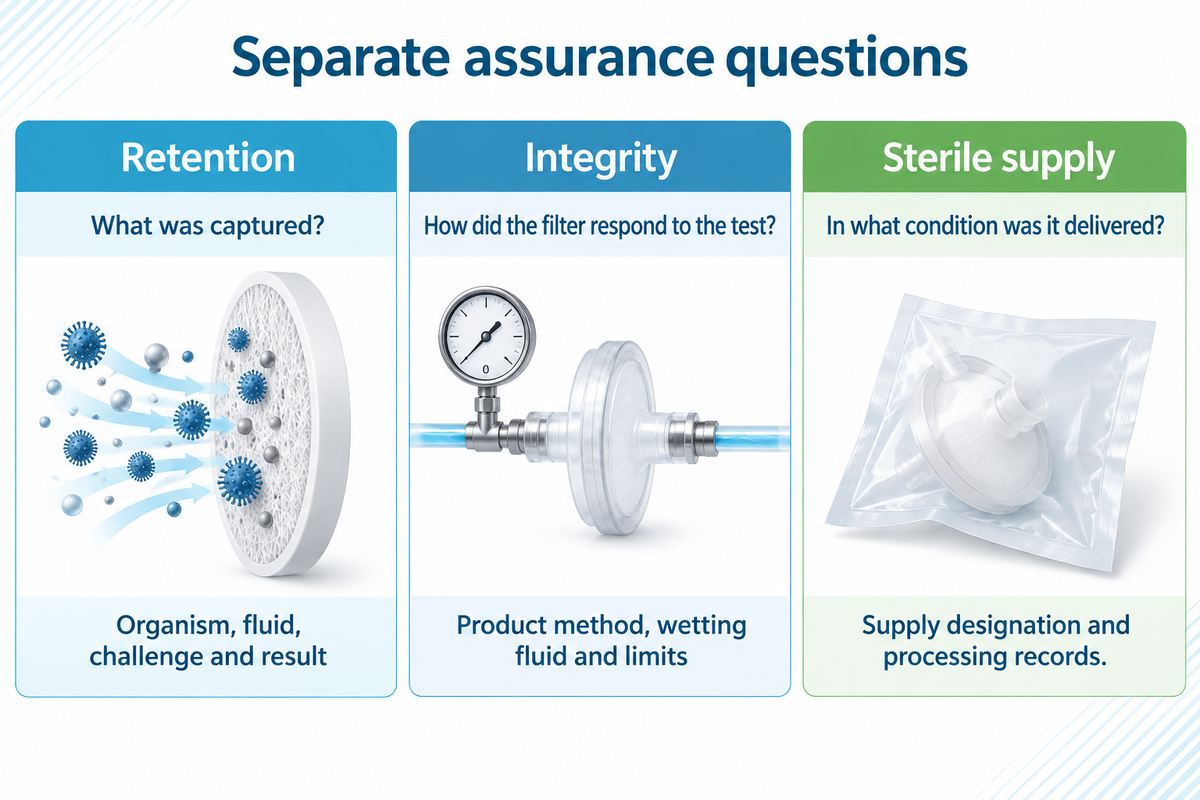
Retention describes what a filter captures under defined conditions. An integrity test assesses the filter with a specified test method. Sterile supply describes the condition in which the cartridge is delivered. A filtration system may need all three, but each addresses a different operational question and belongs in a different part of the specification.
ASTM F838-20 describes a bacterial-retention test using Brevundimonas diminuta. For intended-process validation, one also needs to consider the relevant fluid and operating parameters. In that regard, the standard challenge and application assessment integrate as part of the same process.
“For the purpose of product sterility assurance, additional process-specific studies should be performed.”
Giglia, Alembath and Hersey studied automated bubble-point testing in 2023. Regarding the three testers and two 10-inch filter types studied, bubble-point testing didn’t detect every engineered defect. They suggested supplementing it with gas-liquid diffusion testing. All three authors were from EMD Millipore/Merck; their findings are particular to the configurations tested and shouldn’t be generalized.
Which claim belongs to which evidence?
| Statement | Question answered | Relevant evidence |
|---|---|---|
| Particle efficiency | How much of a particle challenge is retained? | Defined size, efficiency and particle test |
| Bacterial retention | How did the filter perform against the organism? | Organism, fluid, challenge and result |
| Process validation | Does filtration work in this intended process? | Application-specific worst-case assessment |
| Bubble-point result | How did this membrane respond to this test? | Product method, wetting fluid and limits |
| Diffusion result | How much test gas passed under specified conditions? | Specified method and acceptance criterion |
| Sterile supply | In what condition was this cartridge delivered? | Supply designation and applicable processing records |
| Material compliance | Does a material meet the stated contact requirement? | Applicable material and document scope |
| Adsorptive removal | What was captured by the medium? | Contaminant and fluid-specific adsorption test |
| Inactivation | Was biological activity reduced? | Specific inactivation assessment |
For quality teams, the consequence is concrete: an integrity-test record is kept with the relevant retention and process records, while supply condition remains a separate record. A material certificate for a food-contact component is a separate claim from a microbial performance claim. Combining them under “certified 0.2 micron” loses the information needed to accept the cartridge.
Microbial Challenge Units: Read the Test Correctly
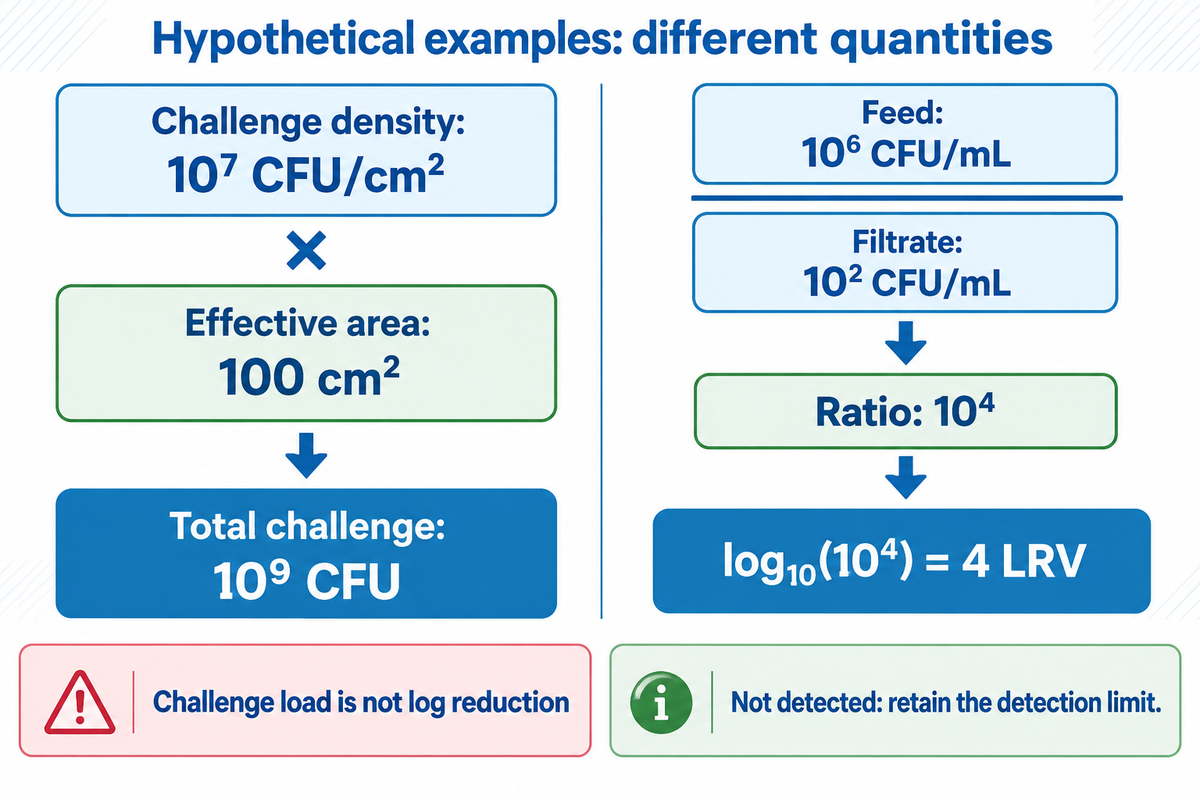
Challenge and log reduction measures are two separate concepts. CFU/cm² describes the viable challenge applied per unit of effective filtration area. A log reduction value, or LRV, is the base-10 logarithm of the feed-to-filtrate concentration ratio measured on a consistent basis.
ASTM E3469-26 states that for the process-specific bacterial retention validation, a challenge of a minimum of 1 × 10⁷ CFU/cm² is required of the effective filtration area. CFU stands for colony-forming units. The area term defines the challenge with respect to the effective filtration area. The exponent 7 does not guarantee a seven-log reduction.
Microbial Claim Unit Check
| Quantity | Expression | Interpretation |
|---|---|---|
| Challenge density | CFU/cm² | Challenge per effective area |
| Effective area | cm² | Area used in the challenge calculation |
| Total challenge | Density × area, in CFU | Total viable challenge load |
| Feed concentration | For example, CFU/mL | Measured concentration before filtration |
| Filtrate concentration | The same concentration units | Measured concentration after filtration |
| Concentration ratio | Feed ÷ filtrate | Units cancel on a consistent basis |
| Log reduction | log10(feed ÷ filtrate) | Dimensionless reduction metric |
| Not detected | Reported with the method’s detection limit | Not an instruction to divide by zero |
| Application conclusion | Defined acceptance criteria | Connects the result to the intended duty |
Example: a quality reviewer is comparing two hypothetical reports. Report A lists a challenge density of 10⁷ CFU/cm² across 100 cm². Multiplying gives 10⁹ CFU total challenge. That calculation says how much challenge was applied, not how much passed through. Report B gives feed and filtrate concentrations of 10⁶ and 10² CFU/mL on a consistent basis. Their ratio is 10⁴, so log10(10⁴) = 4 LRV. The reviewer now has two different quantities, not competing scores of nine and four. Neither number alone settles acceptance. The actual report must connect its organism, fluid, sampling basis and result to the required application.
Giglia and colleagues define LRV using the feed-to-permeate concentration ratio in their theoretical analysis, equation 8. When an assay is reported as “not detected,” the sampling and detection limits have to be taken into account. Saying that an LRV is infinite would be to substitute a bounded measurement with an unbounded and unjustified value.
Multiplying 10⁷ CFU/cm² by 100 cm² gives 10⁹ CFU of challenge, whereas a concentration ratio of 10⁴ gives 4 LRV. Challenge load and reduction answer different questions. A useful microbial comparison keeps both quantities and the assay’s reporting limits attached to the result.
Why Filtration Results Change During a Run
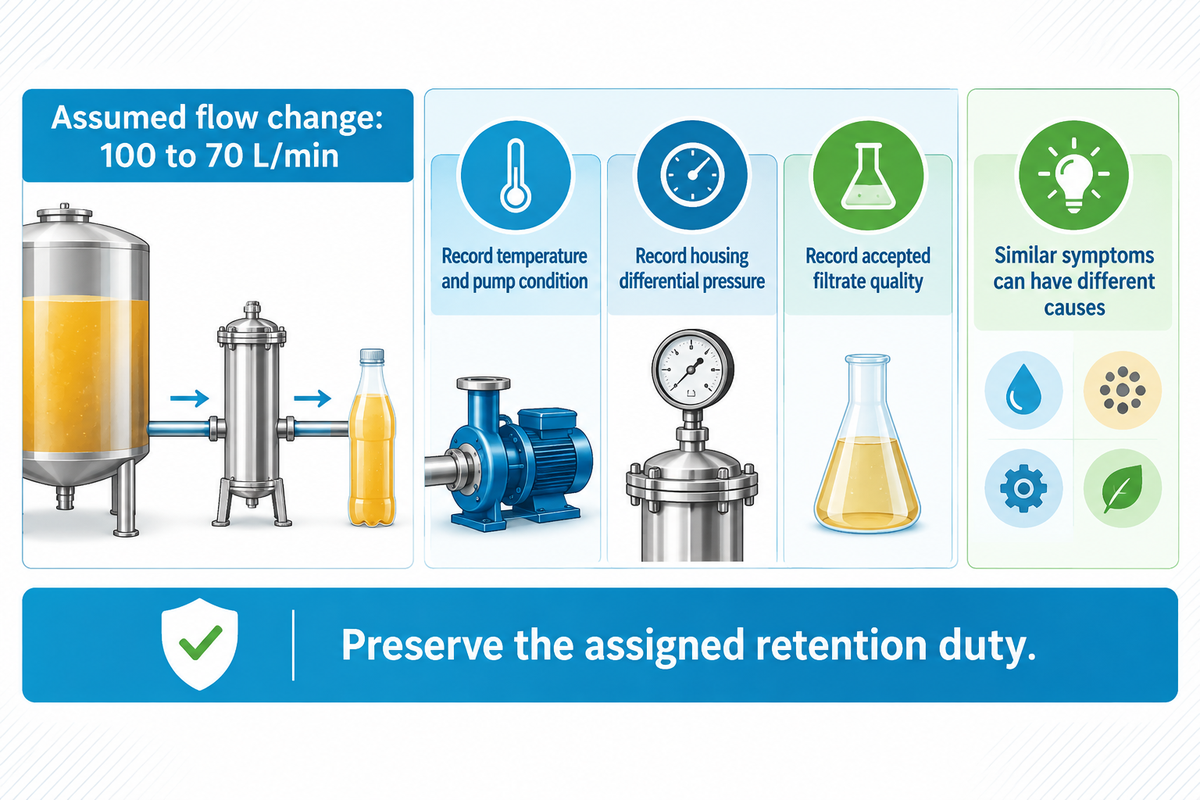
Filtration behavior is changed by variations in the feed, fluid properties and medium, as well as the assembled flow path. Accumulated material can clog the flow path and increase resistance, while viscosity or flow changes alter pressure demand. Compare results obtained across the same boundaries and at matched operating conditions.
Why does a fine filter lose flow?
A sharp decline in flow in a filter can be due to an increase in system resistance or a drop in driving pressure. A fluid can foul a medium through several interactions. Loading is one possible cause, but restriction, incomplete wetting or fluid viscosity could produce similar symptoms. The useful first distinction is whether flow, temperature, differential pressure and filtrate quality changed together under comparable conditions.
Dippel and colleagues studied the effect of pleat geometry, filtration pressure and fluid viscosity on filter devices on an industrial scale. Their 2021 report noted additional resistance was contributed by pleats and spacer material beyond the membrane. The reported flow rate must remain attached to the test liquid and pressure conditions. A clean water curve doesn’t always describe the process liquid or loaded cartridge. More membrane surface area doesn’t eliminate resistance in the rest of the device.
Example: a beverage operator sees flow fall from an assumed 100 L/min to 70 L/min after a batch change. The team initially blames the 0.2 µm element. A matched record would include liquid temperature, pump condition and the pressure difference across the actual cartridge housing, alongside the required product-quality result. If the new liquid is more viscous, comparing it with the previous batch’s flow at another temperature answers the wrong question. If loading has increased, upstream protection needs examination. Installing a coarser final element just to restore the flow would change the assigned retention duty. The useful objective is stable accepted output, rather than recovering a gauge reading at any cost.
Filter bags or a suitable sediment cartridge may protect a downstream stage when their duty matches the feed. Upstream filtration can remove a coarse fiber or metal fragment before a finer stage handles its assigned duty. A fixed 5 µm or 0.45 µm prefilter recipe can’t be assigned to every process from the final rating alone. Dirt holding capacity, actual solids load and product compatibility determine the attainability of fewer filter changes.
For filtration troubleshooting, keep observations and conclusions separate. Adverse results downstream may involve the membrane, sealing bypass or contamination after filtration. Increasing pressure may add stress to a system, leaving the quality problem unresolved. Use the selected manufacturer’s operating limits, not a pressure value borrowed from another product family.
Industry Outlook: Read the Evidence for Your Actual Application
The useful development for microbial-critical applications is greater attention to process-specific validation. ASTM’s 2026 E3469 practice addresses end-user sterilizing filtration of pharmaceutical, biopharmaceutical and biological products. Industrial users should keep within the scope of the practice; the real task is to assess each claim and ascertain that the cartridge and the actual duty are in line, rather than to use a blanket checklist.
ASTM announced E3469’s approval on May 13, 2026. Its framework considers worst-case contact time, flux, temperature and differential pressure with the process fluid or an appropriate surrogate. It also assumes prior selection work on chemical compatibility, active-ingredient or preservative binding and particle shedding. These are relevant when valuable product should pass through while unwanted material is left behind.
A purchasing team replacing water filter cartridges for general particle control has a different acceptance problem from a pharmaceutical quality team validating sterile filtration. Food and beverage contact requirements introduce their own material and application questions. Giving these industrial applications one generic “best 0.2 filter” answer would conceal the actual trade-off.
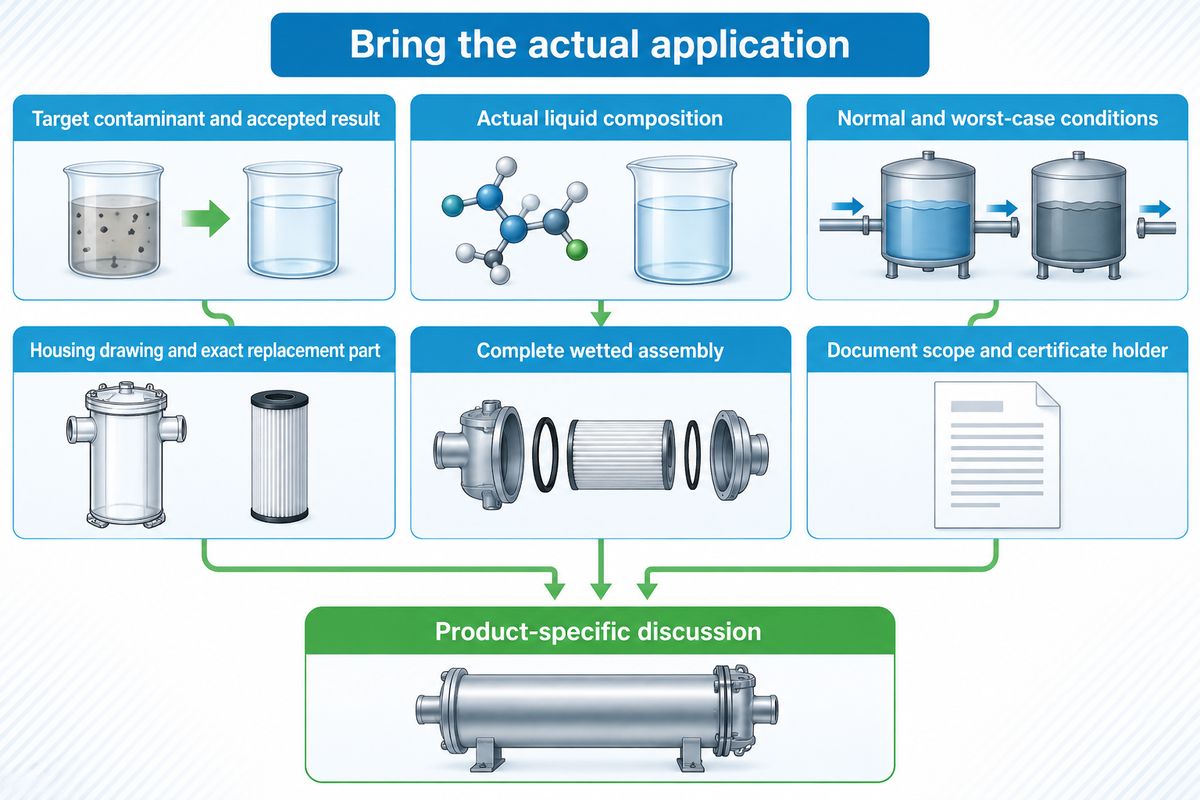
For an application review, bring the target contaminant and accepted result, actual liquid composition, normal and worst-case operating conditions, existing housing drawing, and the exact replacement part. Confirm what product configuration and certificate holder each supplied document covers. Provide the complete wetted assembly as opposed to only the membrane name. This is the time to resolve open technical questions, prior to evaluation of quotations.
ECOFILTRONE™ supplies industrial liquid filtration products with engineering support for application review, specification verification and replacement matching. For various product families and configuration options, use our 0.2 micron membrane cartridge configurations page. This document explains how to read the filtration claim. The application review turns that understanding into a discussion for a specific product.
Provide both the operating conditions and the result your process needs to achieve. ECOFILTRONE™ can review the filter family, the configuration in question, and related documentation. Discuss your filtration application prior to considering two similar micron labels as the same specification.
Frequently Asked Questions
What is a cartridge filter in water treatment?
Read the answer
A cartridge filter is a replaceable filtration element installed inside a housing. The element performs its assigned separation duty; it’s one stage in a treatment system. A 0.2 µm cartridge may address fine particles or a qualified microbial duty, while other stages handle dissolved substances or different contaminants. Its role follows the assigned process requirement.
Do I need to do anything special when I install new cartridges in my RO or RO/DI system?
Read the answer
Yes. Follow the exact cartridge and housing instructions for installation, conditioning and any required flushing. Keep seals correctly seated and protect the downstream RO membrane or deionization stage from installation contamination. The appropriate sequence and flush volume belong to the specific product and system; a universal volume would ignore those differences.
How can I judge the quality of a 0.2 micron filter cartridge?
Read the answer
Judge quality by traceable construction, the applicable retention basis, assembly compatibility and repeatable accepted performance in the intended duty. A clear part identification and relevant supporting records are more useful than a broad “high quality” description. Compare the same operating conditions and required output before assigning value to a quoted flow or price.
What is reverse osmosis?
Read the answer
Reverse osmosis is pressure-driven membrane separation used to reduce dissolved substances, including salts. A microfiltration cartridge performs a different duty. Removing fine suspended particles doesn’t make a 0.2 µm element a desalination membrane.
When should I replace my filters?
Read the answer
Replace an element at the agreed process endpoint or applicable manufacturer’s limit, whichever requires action first. Relevant endpoints can include differential pressure, accepted flow, product-quality results or a defined hygiene requirement. Keep the measurement conditions consistent: a colder, more viscous liquid can change pressure without the same change in loading. A fixed calendar interval copied from another application overlooks feed variability, production schedules and the consequence of losing the required retention performance.
What is the best micron rating for a water filter?
Read the answer
The best rating is the one that meets the assigned contaminant-removal duty at acceptable operating conditions. Choosing the smallest available number can add resistance while leaving dissolved contaminants or other treatment requirements unaddressed.
How many microns should your water filter be?
Read the answer
Choose the micron rating from the target contaminant and required outlet result, then match the construction and capacity to the feed. A prefilter protecting equipment and a final microbial-retention stage have different jobs. For an existing system, preserve its validated or accepted endpoint when evaluating replacements. Cartridge fit alone is insufficient: the liquid, complete wetted materials, flow demand and relevant operating limits still have to match the assigned application.
This compendium provides synopses of publicly available standards, primary research, and pragmatic interpretation for filtration in industrial liquids. The examples assume certain input conditions. External study results remain with their authors and tested products; they are not ECOFILTRONE™ performance claims. Pharmaceutical and household references retain their stated application scope.
References & Sources
- ASTM F838-20 – public Scope and Significance and Use
- ASTM E3469-26 – end-user sterilizing-filtration validation, public summary
- ASTM International – pharmaceutical standard approval announcement, May 13, 2026
- Na et al. (2022) – comparative evaluation of sterile filters in biopharmaceutical processes
- CDC, household water-treatment system comparison.
- U.S. Food and Drug Administration, current good manufacturing practice questions and answers, Production and Process Controls.
- Lee et al. (2010), geometry-dependent bacterial passage through tested filters, abstract.
- Ikner et al. (2011), electropositive virus-sampler concentration study.
- Giglia et al. (2023), bubble-point defect-detection study.
- Dippel et al. (2021), fluid dynamics in pleated membrane filter devices, abstract and preview.