Get in touch with ECOFILTRONE™ Company



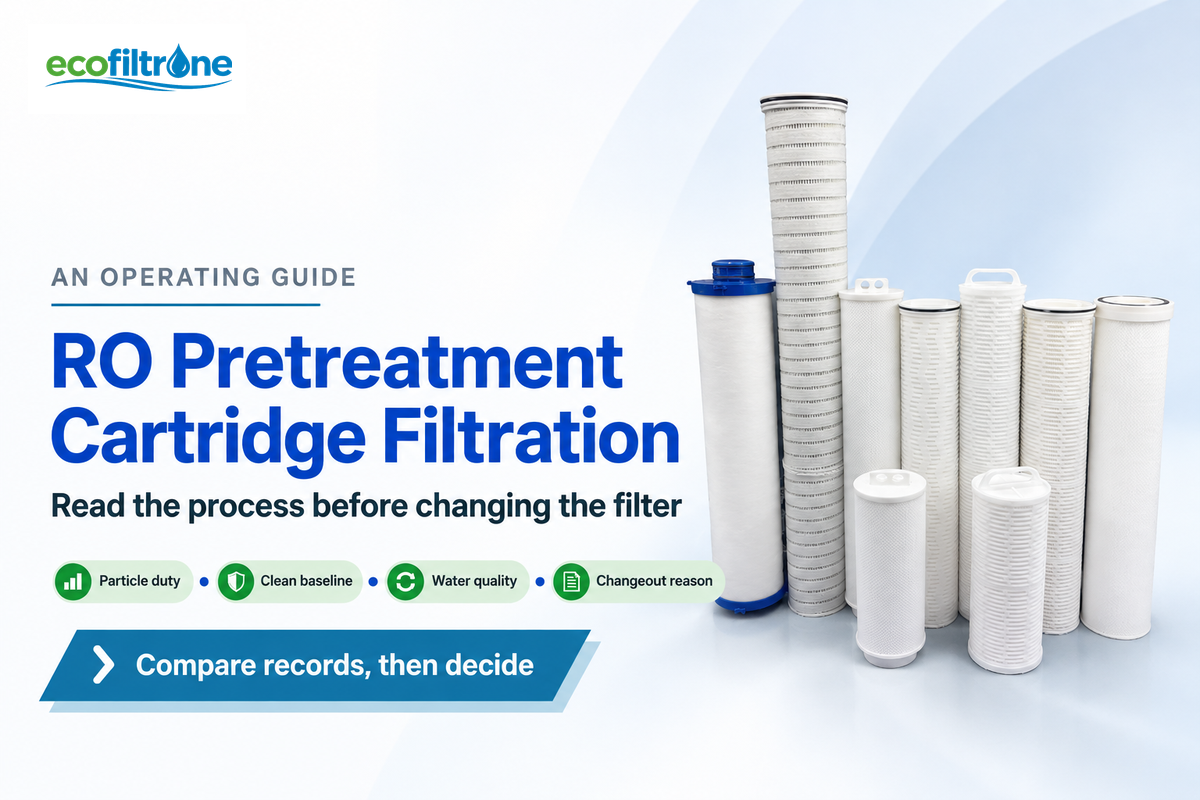
RO Pretreatment Cartridge Filtration uses a replaceable particle-control element upstream of a reverse osmosis membrane. Its function can be easily described, but judging its performance requires a different approach and takes more than a micron rating or a pressure gauge. A clean looking cartridge can pass unwanted particles, while a loaded one can be capturing an upstream disturbance exactly as intended.
RO Pretreatment Cartridge Filtration removes suspended particles within the selected filter’s retention capability before water reaches the RO stage. Match the cartridge to the feed, then track pressure loss, actual flow and downstream quality together.
Start with these operating distinctions
- A lower pressure drop can accompany particle breakthrough. Check water quality as well as hydraulics.
- Sediment filtration, chlorine removal and dissolved-salt rejection are different treatment duties.
- A cartridge baseline and normalized RO membrane performance are separate records.
- Replace cartridges against the selected equipment limits and process criteria; use run history to plan maintenance.
| Item | Working basis |
|---|---|
| Duty | Final or intermediate particulate barrier within the actual pretreatment train |
| Selection record | Particle rating plus efficiency/test basis, construction, flow and fit |
| Cartridge condition | Inlet/outlet pressure difference at a comparable flow and temperature |
| Water-quality check | A method appropriate to the feed, sample point and process requirement |
| Changeout basis | Documented equipment limits, quality criteria and operating procedure |
This guide is for operators, maintenance personnel, and purchasers working with systems for commercial and industrial water treatment, seawater desalination and water reuse. It explains what to observe in reverse osmosis plants before changing the filter specification. Product configuration and replacement are covered on our RO pretreatment cartridge application support page.
What does RO pretreatment cartridge filtration remove?
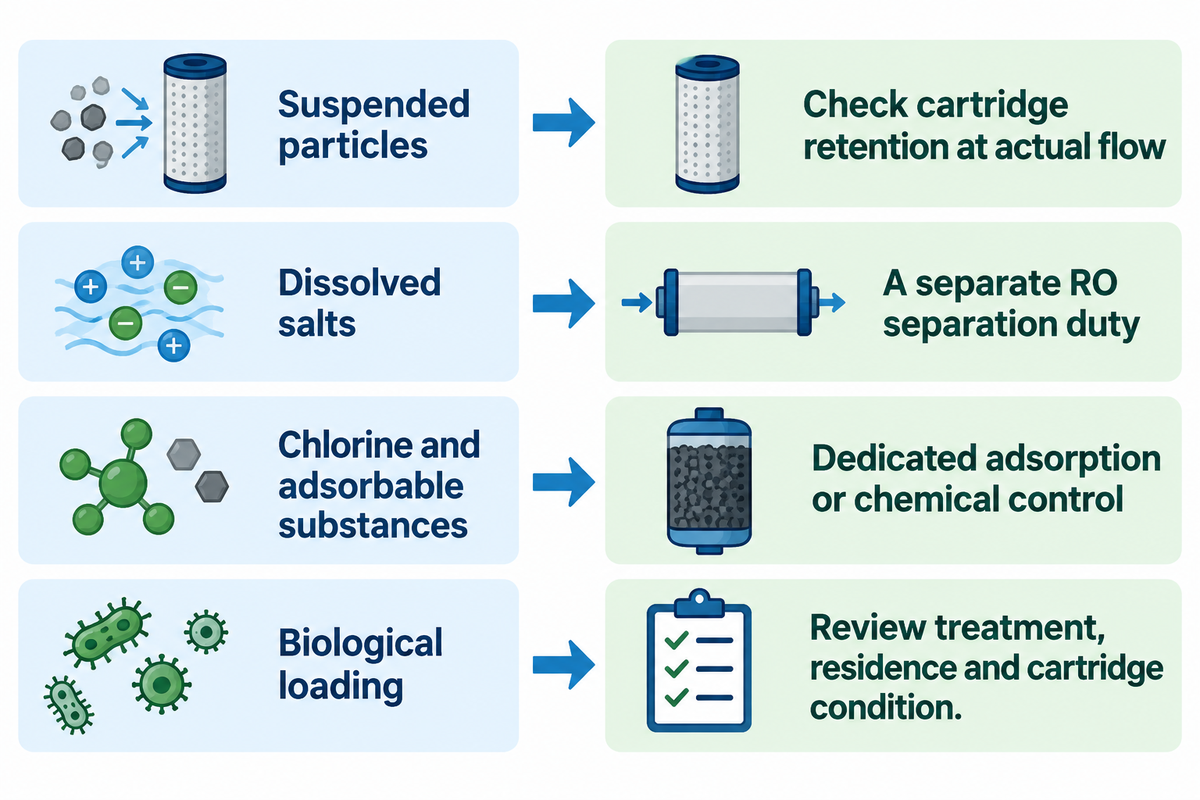
A conventional sediment cartridge captures suspended solids according to its tested retention capacity. It catches part of the particulate load that’s left after the previous treatment or that’s introduced farther downstream. Dissolved salts require a different separation mechanism. Reverse osmosis pretreatment also includes other functions like carbon adsorption, chemical conditioning and disinfection; therefore, a sediment element can’t replace the entire train.
Why can conductivity stay the same after a sediment cartridge?
Conductivity can stay the same because sediment filtration leaves dissolved salts in the water. Think of a cartridge as a controlled passage through a porous medium. Water can cross the medium. Whatever is retained remains on or in the medium. The filtered water contains everything that passes through the medium including a colloid that’s below its retention capability and/or dissolved substances that are beyond the treatment scope of the cartridge. In the EPA treatment technology overview, RO and nanofiltration are described as pressure driven membrane processes for the removal of dissolved solutes.
The distinction is important when a water treatment plant is considered to have more than one problem. Sand or rust suggests a particle control question. Dissolved calcium contributing to calcium carbonate scaling suggests a chemistry and recovery question. An oxidant like chlorine requires a membrane-compatible chemical control program. Buying a finer sediment filter to solve all three can add restriction without addressing the actual contaminant. Chemical conditions that damage the membranes still require their own treatment and control.
An activated carbon filter has an adsorption duty. Granular activated carbon and carbon cartridges therefore need their own loading, contact and maintenance bases. A carbon filter isn’t interchangeable with a polypropylene sediment element merely because both fit a water filter housing. EPA’s WaterSense water-purification guide distinguishes filtration from adsorption and membrane treatment.
For a beverage utility line, the question is whether a rising cartridge load is due to incoming solids or an upstream change. Taste and odor observations from household drinking water maintenance do not answer that industrial question. To control a material, name the material, and state the process consequence of allowing it to pass.
| Control target | Treatment question |
|---|---|
| Suspended particles | Does the selected cartridge retain the relevant size fraction at the actual flow? |
| Dissolved salts | What dissolved-solute separation duty belongs to the RO stage? |
| Chlorine and adsorbable substances | Which dedicated adsorption or chemical-control stage addresses the measured substance? |
| Biological loading | How do the treatment program, residence history and cartridge condition fit together? |
Where does the cartridge fit after media filtration or UF?
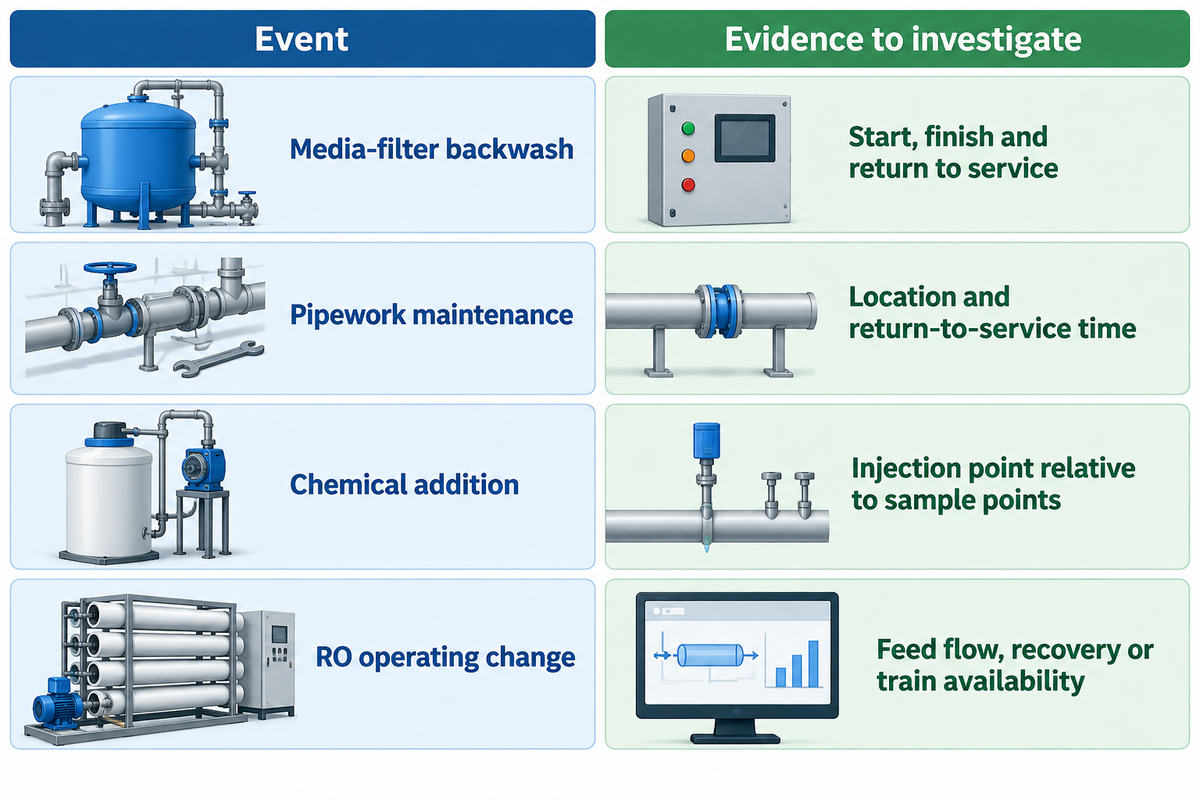
A guard cartridge is normally placed after upstream particle removal stages and is placed before the RO feed equipment that it protects. The exact position of a guard cartridge is based on the process layout, i.e. the position of tanks and the placement of chemical dosing and interconnecting pipework. Draw this layout first. A cartridge placed after ultrafiltration may have a different exposure as compared to a cartridge placed after media filtration.
What can enter the feed between UF and the cartridge?
Particles can enter at the influent, or upstream, with carryover. They can enter along the piping and other equipment. Biological growth can occur along this pathway as well. Reductions can be provided by Media filtration, microfiltration (MF) and ultrafiltration (UF). They don’t eliminate the piping between the treatment stages. Storage and maintenance openings, as well as downstream equipment, provide different operating histories. Trace each pre-treatment stage to the last step prior to the RO stage. The EPA small-system handbook describes cartridges as polishing stages, and relates their performance to feed conditions.
| Location or event | Record | Use in the review |
|---|---|---|
| Water source | Source switch, rainfall or intake event and time | Compare with incoming particle/quality changes |
| Coagulation and flocculation | Dose or chemical change and operating time | Review carryover with the treatment team |
| Media-filter backwash | Start, finish and return to service | Look for a time-linked load change |
| MF or hollow fiber UF | Operating event and relevant integrity/quality record | Separate upstream barrier performance from cartridge condition |
| Intermediate tank | Residence, cleaning or unusual level history | Include the period between treatment stages |
| Pipework maintenance | Location and return-to-service time | Trace a possible new particle source |
| Chemical addition | Injection point relative to sample points | Interpret the water actually sampled |
| Cartridge change | Exact element identity and restart time | Anchor the next baseline |
| RO operating change | Feed flow, recovery or train availability | Avoid comparing different demand states |
Example scenario: A surface-water plant notices cartridge runs get shorter after a media-filter backwash. Procurement proposes a higher-capacity replacement, while operations wants to change the backwash return sequence. The useful first move is to align the backwash timestamps with cartridge inlet quality and pressure records. Samples taken only during steady operation may not capture short, transient conditions. If the load increase repeatedly follows return to service, the team has a reason to investigate that upstream event before comparing cartridge families. No temporal link between backwashing and cartridge loading would warrant a review of other factors, including flow changes and source-water conditions. A more expensive element should earn its place through a controlled comparison rather than absorb an unidentified process upset indefinitely.
How do micron ratings and cartridge construction affect selection?

A micron rating is a particle-size reference. In cartridge selection, other considerations include removal efficiency, test conditions, and construction. Nominal and absolute ratings are defined and tested differently by suppliers. Compare pleated, melt-blown and string-wound elements at matched flow, fit and feed conditions.
What filtration rating do I need before an RO membrane?
Begin with the approved RO feed requirement and a documented removal-efficiency basis for the selected cartridge. Maintain the operating basis for the replacement. Two 1 micron pleated cartridges in Table 6-5 of EPA’s 2003 handbook have surface areas of 30 and 40 square feet. These historical test elements (rated at one micron) provide a basis for comparison, but aren’t specifications for current products. Flow, turbidity, and particle size affect element performance.
Spun, wound and pleated filter comparisons in Afkhami and colleagues’ 2021 household-water study used specified challenge conditions; some also changed stage counts. Its findings should not be reduced to “pleated always lasts longer,” nor should its washing procedure be applied to a disposable industrial cartridge.
| Field | What it describes | Decision it supports |
|---|---|---|
| Micron rating | Particle-size reference | Relate the element to the particle-control duty |
| Efficiency basis | Removal percentage and stated test method | Compare ratings on a common basis |
| Pleated construction | Folded media and supporting structure | Review area, loading and hydraulic performance |
| Melt-blown construction | Fiber depth structure | Review the specific retention/loading data |
| String-wound construction | Wound medium and core arrangement | Review construction consistency and fluid compatibility |
| Membrane cartridge | A specified membrane medium and pore/test basis | Separate it from an RO membrane module |
| Material | Medium, core and end components | Review compatibility with actual water and treatment chemicals |
| Dimensions and interface | Length, diameter, end cap and seal arrangement | Match the housing and sealing geometry |
| Flow/pressure curve | Hydraulic behavior under stated test conditions | Compare the intended operating point |
| Changeout limit | Documented operational criterion | Plan maintenance for the selected assembly |
For a replacement comparison, one should begin with the complete identification of the element being tested rather than substituting several variables simultaneously. A cartridge 5 micron label alone provides too little information for comparing two water filtration systems. Keeping the established rating while testing a documented alternative construction can make the first comparison easier to interpret; a change in rating needs its own process rationale.
A stainless housing describes the enclosure, not the material contained in it. Identifying a part as cellulose or PVDF doesn’t mean a retention or compatibility basis is established. “Compatible with RO” should describe the proposed duty and operating conditions, rather than replace that information. See our guide to polypropylene pleated cartridge construction for a more detailed explanation of this product family.
What do SDI, turbidity and pressure drop actually tell you?
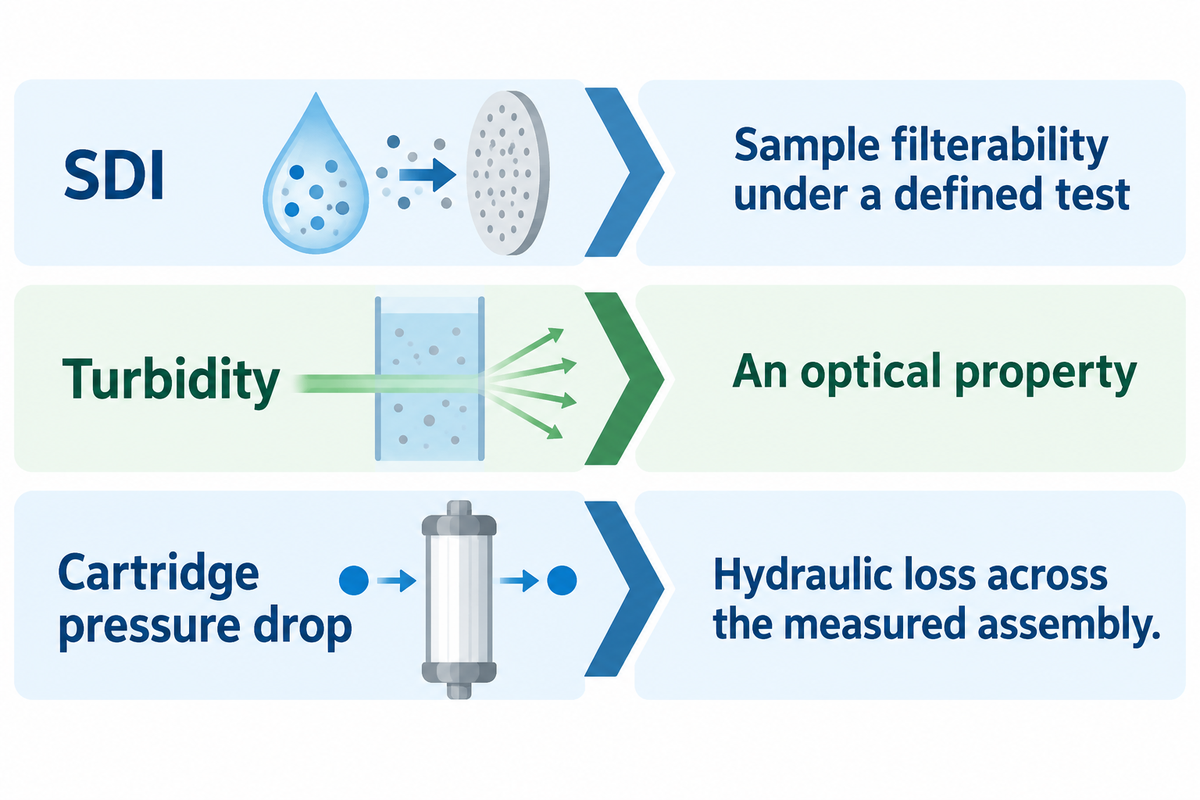
SDI indicates sample filterability under a defined test, turbidity describes an optical property, and cartridge pressure drop describes hydraulic loss across the measured assembly. Use these terms for their respective meanings. A favorable change in one measure doesn’t preclude the need to examine another if performance of a reverse osmosis system changes with respect to a new feed condition.
For low turbidity waters (< 1.0 NTU) within the scope of ASTM D4189-23, use the silt density index (SDI). For most UF and RO effluents, select a more suitable validated monitoring method rather than applying SDI automatically. When comparing SDI results, take into account filter manufacturer and test temperature.
“The SDI can serve as a useful indication of the quantity of particulate matter in water.”
Why can low SDI coexist with a membrane-fouling problem?
A low SDI describes the tested sample’s filterability; membrane behavior also reflects the feed and operating conditions. SDI showed fouling-indication value in the literature-based regression in Cha and colleagues’ 2012 analysis, which also questioned its theoretical limitations. Interpret the applicable test alongside feed characteristics and the membrane operating record.
A low SDI doesn’t preclude the presence of incoming particles, a system problem, biological activity, or a separate membrane issue. Maintain the accepted level of quality while resolving unaddressed issues. Improving an already favorable indicator doesn’t resolve the root cause.
What clean baseline is needed to assess cartridge service life?
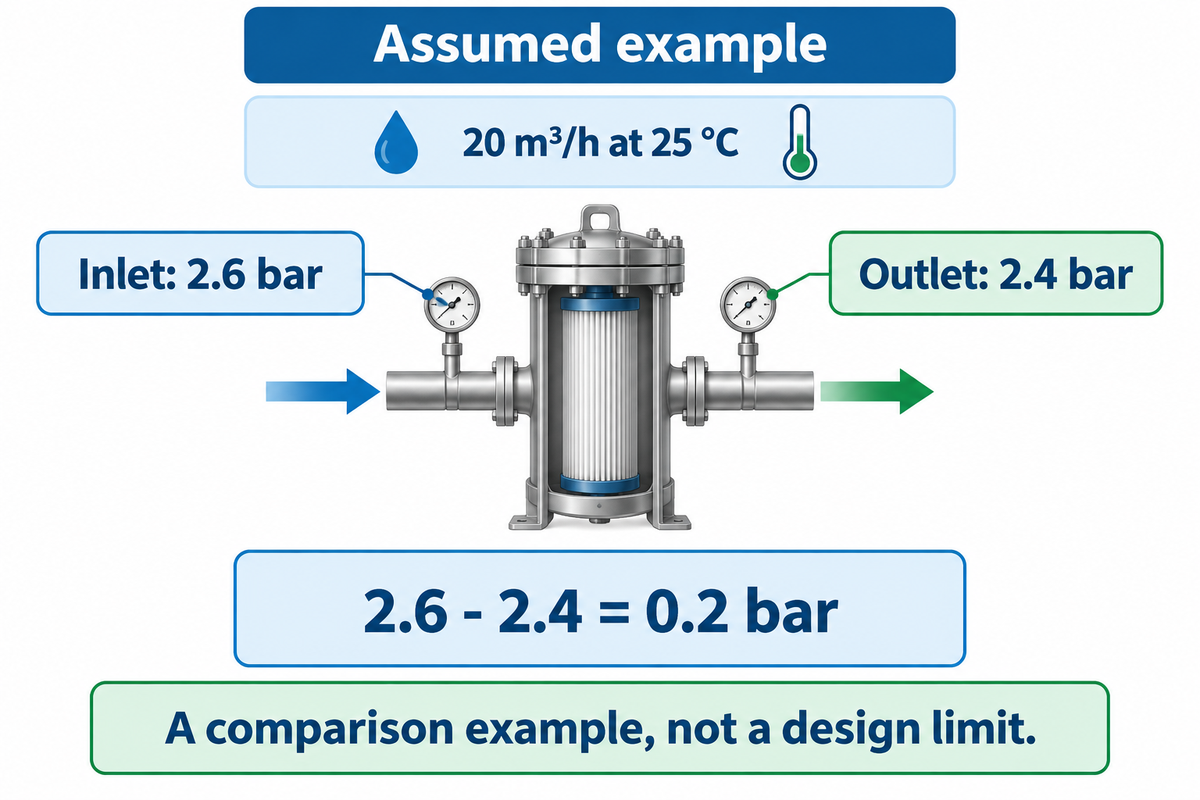
Monitor cartridge inlet and outlet pressures, flow, and water temperature after the selected system has been installed and stabilized. Indicate measurement locations and operating conditions. Repeat readings under similar conditions. These baseline measurements help interpret changes. Water quality downstream of the measured system remains an acceptance condition.
Connect cartridge-system gauge readings to the water quality of the system post replacement. The monitoring techniques described in the EPA’s 2010 Toolbox Guidance, sections 8.5.5 and 8.6 focus on drinking water treatment; hence the RO changeout pressure will vary from system to system.
| Record field | How to enter it | Why it matters |
|---|---|---|
| Cartridge identity | Model, rating/test basis, lot and quantity | Keeps replacement runs distinguishable |
| Housing and seals | Housing identification and installed interface | Connects hydraulic and fit records |
| Tap locations | Sketch inlet and outlet gauge positions | Defines what the pressure difference includes |
| Inlet pressure | Value and unit, such as bar or psi | Retains the first measured value |
| Outlet pressure | Same unit and reading time | Retains the second measured value |
| Differential pressure | Inlet minus outlet at that time | Tracks loss across the defined assembly |
| Actual flow | Measured flow rate and unit, such as m³/h | Separates loading from demand changes |
| Water temperature | Reading in °C or °F | Adds comparison context |
| Operating state | Active train, pump/valve condition and recovery | Marks a changed system state |
| Quality sample | Location, method, result and time | Pairs hydraulics with the intended filtration outcome |
| Upstream event | Relevant timeline entry | Links a possible disturbance |
| Decision boundary | Applicable equipment and plant criteria | Defines when a response is required |
Example with assumed readings: A newly installed set runs at 20 m³/h and 25 °C, with 2.6 bar at the inlet and 2.4 bar at the outlet. The measured assembly loss is 2.6 − 2.4 = 0.2 bar. Later, the gauges show 2.7 and 2.4 bar, or 0.3 bar loss, but flow has risen to 30 m³/h. Maintenance should first compare at the original flow and a comparable temperature before treating the difference as retained-solids loading. These examples illustrate subtraction and a comparison, not an acceptable pressure or flow for another housing. The operator also checks the downstream quality result, because a plausible hydraulic reading alone leaves the retention outcome unresolved.
Keep a second record for the reverse osmosis membrane. ASTM D4516-19a addresses comparison of reverse osmosis systems at standardized conditions: pressure, temperature, conversion and feed concentration affect permeate flow and salt passage. For that comparison, use the appropriate membrane/system procedure. A cartridge pressure subtraction is not a normalization calculation for an RO system.
Which pressure readings belong in the same comparison?
Compare inlet and outlet readings taken at the same time, and note flow and temperature readings. Keep the location of the pressure taps constant.
How often should RO prefilters be replaced?
Replace industrial RO prefilters when the selected assembly reaches its documented changeout criterion, downstream quality requires action, or the plant’s maintenance procedure calls for replacement. Use operating history to plan stock and labor. A calendar may also be used to help with that, but it should follow the process and equipment basis rather than a replacement household interval.
In a 2022 Water Technology report by Brad Buecker and Katie Perryman, an upstream microfilter reduced a power plant’s cartridge-replacement frequency. The authors have a ChemTreat connection, and the improvement reflects that site’s operating history. Other plants may have different replacement frequencies.
Document the reason for each change, how long elapsed between changes, and the amount of treated volume. The endpoint for when a run ended because of pressure loss is different from when a run ended because of a quality event or a planned shutdown. Combining those endpoints to draw a “longer life” conclusion would be misleading. Compare the energy-saving proposal against the plant’s operating state and the treatment outcome. The EPA Small Systems Handbook provides similar guidance, indicating that operators should consult the selected manufacturer for recommendations on pressure drop.
Example scenario: A maintenance manager prefers a cheaper cartridge, while a production supervisor wants fewer interruptions. Their trial holds the accepted water-quality requirement constant while comparing elements. They record why each run ends. For purchasing, the cost of an element, changeout labor and disposal, and the interruption to production associated with the run are considered. A longer run is attractive only while the water stays within the accepted criteria and the assembly remains within its operating limits. A cartridge that controls more solids may reach its pressure criterion sooner. The team agrees on the endpoint before starting the trial, and evaluates costs per unit of accepted treated-water volume instead of run length.
Why might a calendar change be due before a pressure alarm?
There are examples where a change is required before the pressure criterion is met: at an agreed maintenance interval, or when another accepted process criterion requires action. Record that endpoint separately from pressure limited runs. Any washing or reuse procedure for a disposable element must match its medium, end-cap bond and seal arrangement. A cleaning result for one pleated medium element applies to that configuration only.
Troubleshoot rapid clogging and changes in RO performance
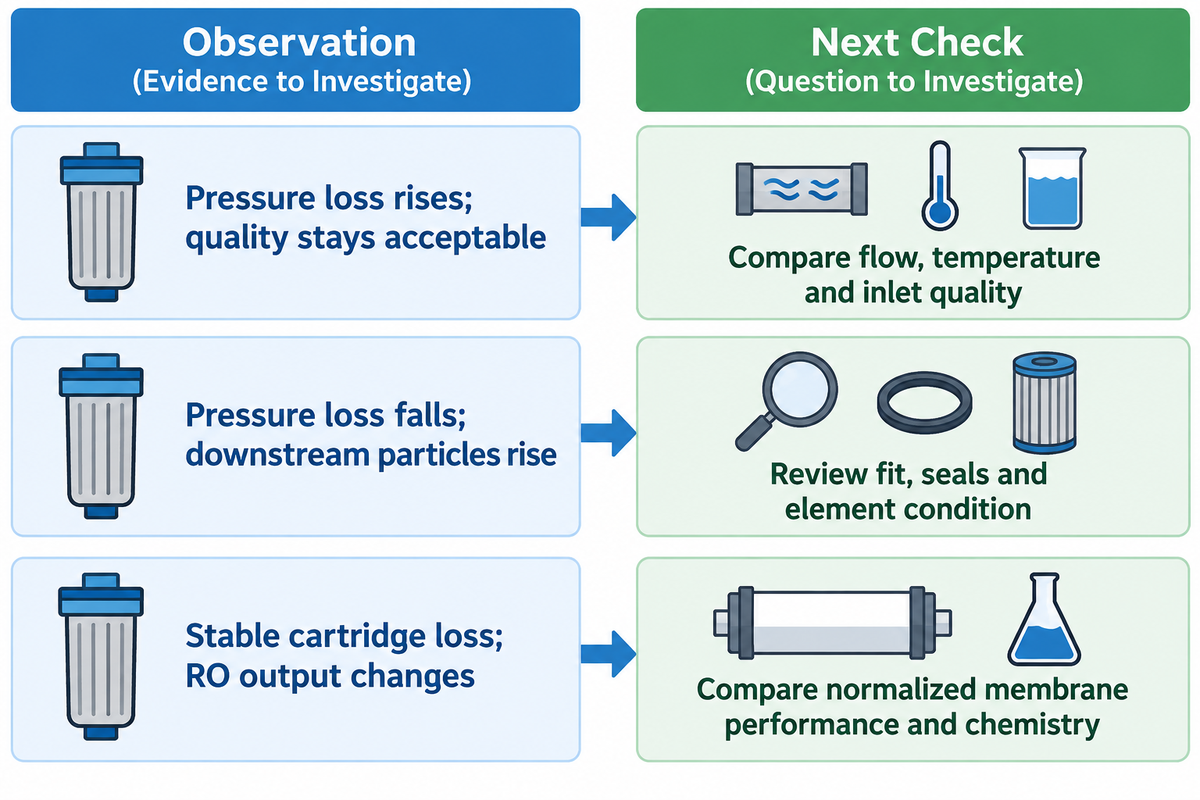
Troubleshoot a changing cartridge trend first by examining measurement conditions and paired water quality results. Check the history of upstream events. There may be several problems that cause similar results. Separate local cartridge issues from membrane fouling or scaling, or changed Reverse Osmosis (RO) conditions, and collect the evidence that distinguishes the leading possibilities.
Plugged cartridges and low-pressure particle breakthrough are different faults. The EPA metal-finishing wastewater field manual, Table 17 associates low-pressure breakthrough with seals, holes or particles too small for the selected medium. The table below turns this historical industrial distinction between hydraulic condition and retention into an operating review.
| Observed pattern | Possible explanation | Next observation |
|---|---|---|
| Pressure loss rises; quality stays acceptable | Increased retained load or changed hydraulic conditions | Compare actual flow/temperature and upstream inlet quality |
| Pressure loss rises after a process event | Time-linked carryover or altered feed | Align samples with the Upstream Event Timeline |
| Pressure loss falls; flow also falls | Lower throughput changes hydraulic loss | Compare at the baseline operating state |
| Pressure loss falls; downstream particles rise | Possible bypass, media damage or a changed particle population | Review fit, seals and element condition under the plant procedure |
| New element; low loss; poor retention | Wrong element, fit problem or particles beyond its capability | Match installed identity and interface to the approved duty |
| Stable cartridge loss; RO output changes | Membrane issue or changed RO operating conditions | Compare normalized membrane performance and feed chemistry |
| Shorter runs with biological indicators | Possible cartridge/housing biological loading | Review appropriate biological results and residence history |
| Different gauges disagree | Instrument or pressure-tap issue | Check instrument condition and the defined measurement points |
| Pressure/quality readings taken at different times | An apparent correlation created by sampling timing | Collect paired observations in the same operating state |
Biofouling from storage and pipelines can affect downstream reverse osmosis (RO). Therefore, the biofouling of filter housings and biofouling from the cartridge itself should be included in the biological review. Song and colleagues’ 2020 seawater-desalination study provides a disinfectant comparison which is specific to the study conditions. Use the existing site treatment program and material compatibility review, rather than copying a published biocide dose.
When RO permeate flow declines while cartridge readings remain stable, keep both records open. Temperature, recovery and feed concentration can change membrane performance, and impact RO permeate flow, without a new cartridge blockage. Replacing the guard element may be required for its own maintenance reason, but the membrane trend still needs its own assessment.
What should you check when differential pressure falls suddenly?
Check actual flow and the instruments first, then pair the pressure observation with downstream quality. Reduced throughput and particle breakthrough call for different follow-up. A seal or media problem remains one possible explanation when quality worsens; the next inspection or sample must distinguish it from alternatives.
What recent pretreatment research changes about monitoring
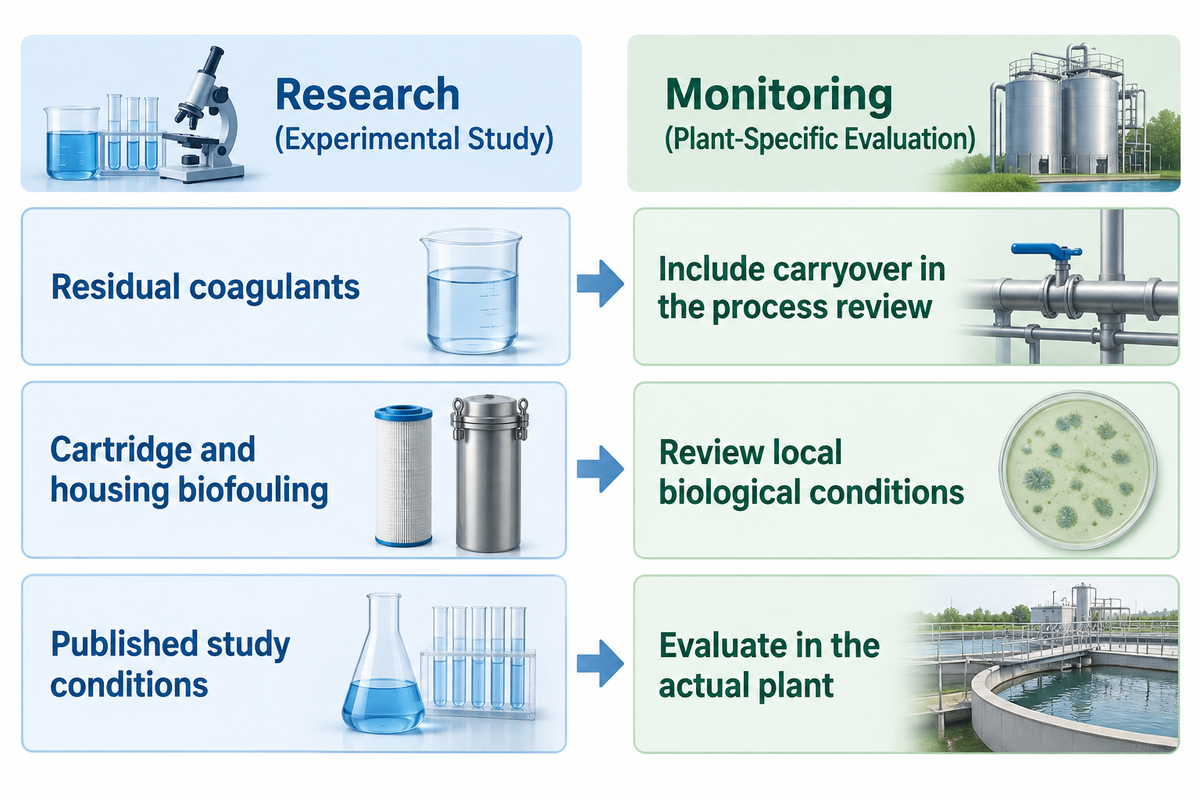
Particle indicators should be monitored in conjunction with membrane behavior and chemical carryover. Recently published research supports this operating approach and includes factors related to the studied feed and treatment, and measured outcomes. Replacement criteria are plant specific. Therefore, published research should be evaluated in the plant of interest.
Residual iron- or aluminium-based coagulants worsened fouling through different mechanisms in the experimental configuration of Ding and colleagues’ March 2026 coagulation–RO study. Consider carryover when considering a chemical change. Keep coagulation choices aligned to the established process design. A sediment cartridge controls particles rather than dissolved residuals.
What can the 2026 coagulation study add to a monitoring plan?
Add chemical carryover and its timing to the process review when a chemical-treatment change coincides with altered membrane behavior. Keep disinfection and downstream biological behavior in the same process review, too. Changes to chlorination or antiscalant or other chemical programs should be documented in the event log with the injection point. The plant’s process team can then assess chemistry, membrane compatibility and biological conditions together. The cartridge specification covers only the part of the investigation supported by its defined filtration duty.
Turn the operating record into an application review
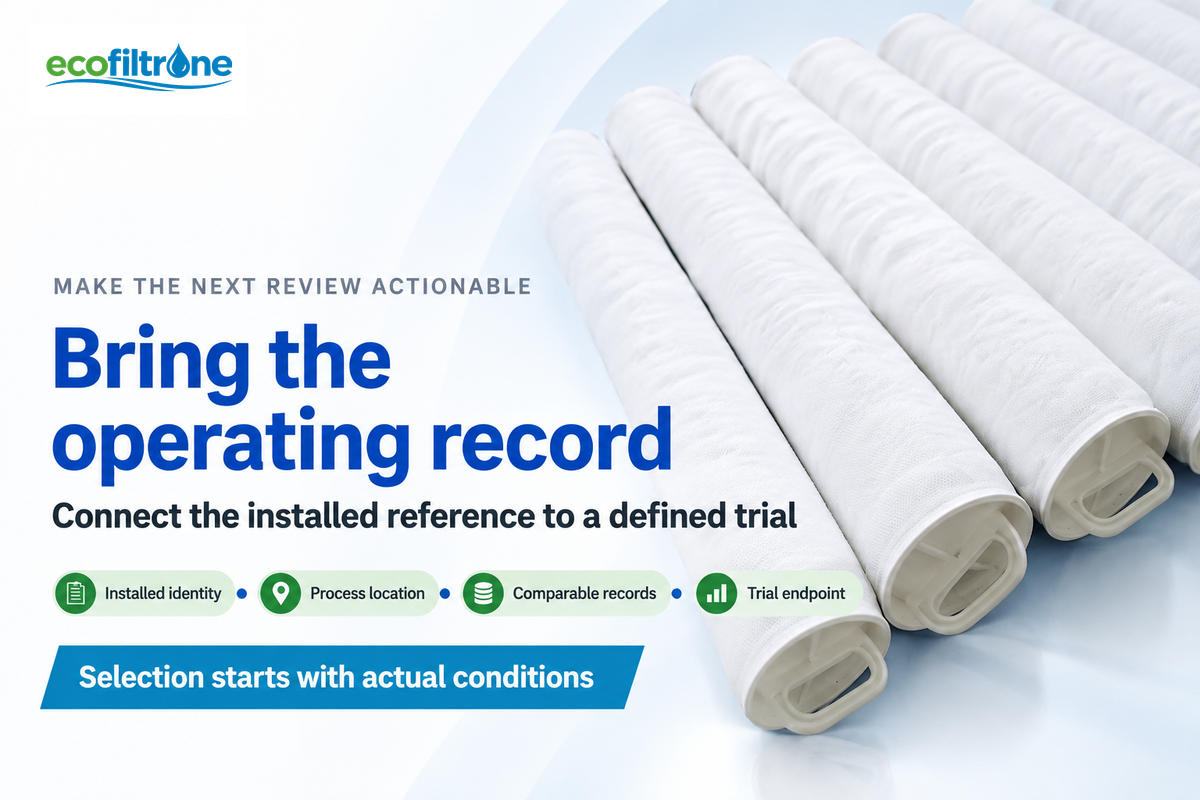
When evaluating applications, begin with the cartridge identity in question and the problem that the next run is expected to resolve. Supply the process location, feed information and comparable operating records before changing specifications. ECOFILTRONE supports RO cartridge selection and replacement matching; a clear operating question helps relate that support to the next best comparison.
| Team | Starting record | Decision before the next run |
|---|---|---|
| Operations | Clean-Baseline Record and event timeline | Which operating state will be compared? |
| Maintenance | Housing, interface and changeout history | What fit and replacement procedure applies? |
| Water-quality team | Sample locations, methods and accepted criteria | Which result would end the comparison? |
| Process engineer | RO feed chemistry and normalized performance | Is the issue within the cartridge’s duty? |
| Procurement | Installed reference and candidate documentation | Which specification is actually changing? |
| Finance | Consumables, labor and interruption records | Which costs belong to the same accepted-volume basis? |
What information makes an application review actionable?
The combination of the installed cartridge, the operating conditions and a defined trial endpoint provides a basis for the application review. In the application description provide cartridge dimensions, end connections, seals and the relevant materials of construction. Include normal and peak flow, temperature, upstream treatment, observed pressure trends and replacement endpoint. Indicate whether the feed is from municipal water treatment or some other source, to ensure the review covers the actual process treatment history. For chemical or high-purity applications, add the required product-specific technical and compliance documents.
We provide a range of high flow, pleated, membrane, melt-blown and string-wound filter cartridges as well as industrial liquid filter bags. Our engineering support covers specification checks, replacement matching and trial follow-up. Send your operating data through Discuss an RO cartridge application.
Frequently asked questions
Is a prefilter necessary for RO?
Yes, an RO system generally needs pretreatment appropriate to its feed and membrane requirements. The cartridge is one possible particle-control stage within that arrangement. Upstream media or membrane filtration, chemical conditioning and other controls perform different duties. Assess the complete train, including the water path between treatment and the RO unit, rather than deciding from the presence of one cartridge alone.
What is an RO pre-filter?
An RO pre-filter is a filtration stage installed before the reverse osmosis membrane. In an industrial cartridge application, it commonly provides a replaceable barrier to suspended particles. The term also appears in household systems with carbon stages, so identify the actual medium and function. A sediment cartridge, adsorptive carbon element and RO membrane perform different treatment duties even when a seller groups them under one system. Record the element’s location as well as its label: a prefilter immediately after a media filter sees a different water path from one installed after a storage tank. That location helps interpret the material collected during a run.
How often should I replace RO pre-filters?
Replace them according to the selected equipment’s changeout criteria, water-quality requirements and maintenance procedure. Track the clean baseline, actual flow and the reason each run ends. A planned calendar interval can then follow the plant’s operating history. Industrial cartridge life follows the actual feed, equipment criteria and maintenance program. Read low pressure alongside downstream quality.
Does UF remove dissolved salts?
No, conventional UF is primarily a barrier for particles and larger retained material rather than a desalting process. Reverse osmosis uses a different separation mechanism for dissolved salts. Adding a sediment cartridge after UF supports a defined particle-control duty; it doesn’t convert the UF stage into an RO-equivalent treatment.
What would happen if there were no pretreatment?
Unsuitable feed could reach the RO unit with particle, scaling, chemical or biological burdens the membrane system wasn’t designed to handle. The likely consequence follows the feed and operating conditions. Pretreatment should address those specific burdens; a single sediment cartridge can’t perform every chemical and membrane-protection function.
Which pretreatment is the most suitable?
The most suitable pretreatment matches the measured feed problems and required RO feed conditions, with a defined treatment duty for each stage.
Our perspective on cartridge operating records
ECOFILTRONE™ is an industrial filtration products supplier based in Qingdao, China. We wrote this guide to help teams connect cartridge selection with operating observations and replacement follow-up. The record formats are our practical synthesis of public technical sources; individual research findings remain attributed to their authors.
References & Sources
- US EPA, Overview of Drinking Water Treatment Technologies
- US EPA, WaterSense at Work, 7.1 Water Purification, March 2024
- US EPA, Small Drinking Water Systems Handbook, cartridge filtration section and Table 6-5, 2003
- US EPA, LT2ESWTR Toolbox Guidance, sections 8.5.5–8.6, 2010
- US EPA, Metal-finishing wastewater field manual, Table 17
- ASTM D4189-23, Silt Density Index, public scope and use
- ASTM D4516-19a, Standardizing RO Performance Data, public scope and use
- Cha et al., Factors Affecting SDI, 2012 abstract in EPA HERO
- Afkhami et al., Low-cost cartridge filter assessment, 2021 abstract
- Song et al., Cartridge biofouling potential, 2020 abstract
- Buecker and Perryman, Using Membranes to Protect Membranes, Water Technology, 2022
- Ding et al., Coagulation Pretreatment and RO Membrane Fouling, 2026 abstract and figure captions