Get in touch with ECOFILTRONE™ Company
Nylon Mesh Filter Bags: Filtration, Ratings and Reuse

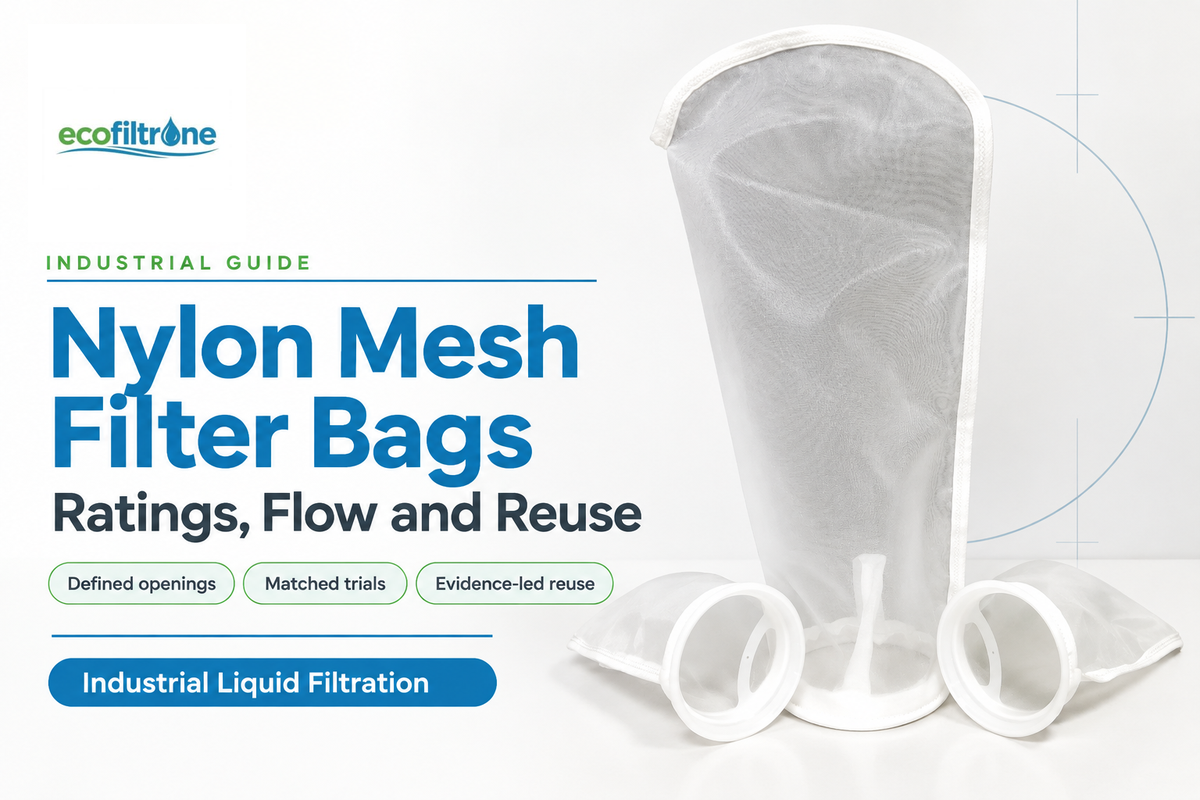
Nylon mesh filter bags trap suspended particles from liquids using woven filter media. The specifics of the opening matter, but so do the particles, the sealing interface of the bag, and the operating conditions. This guide covers industrial liquid filtration and bag use. This writing covers the parameters just mentioned and how to assess a bag after it has been used.
By XCX · Updated October 20, 2026
Nylon mesh filter bags mainly screen particles at woven openings. Select a defined aperture and retention basis, confirm the complete bag fits the duty, and assess pressure, flow and outlet quality together. Reuse depends on acceptable cleaning and retained function.
Quick Specs: What a Bag Description Should Tell You
- Media: nylon type, monofilament or multifilament construction, and opening specification.
- Rating: geometric opening or measured retention, including the test conditions.
- Assembly: dimensions, seam, ring or collar, support basket and sealing interface.
- Duty: liquid composition, temperature, flow and the applicable differential-pressure limits.
- Reuse: permitted cleaning method and the process owner’s acceptance criteria.
Key takeaways: Familiarize yourself with the rating definition prior to comparisons. Distinguish a heavier solids load from a finer particle population. Be aware of deterioration in outlet quality even when pressure looks normal. Release a bag when evidence of its condition and performance warrants.
How Nylon Mesh Filter Bags Capture Particles
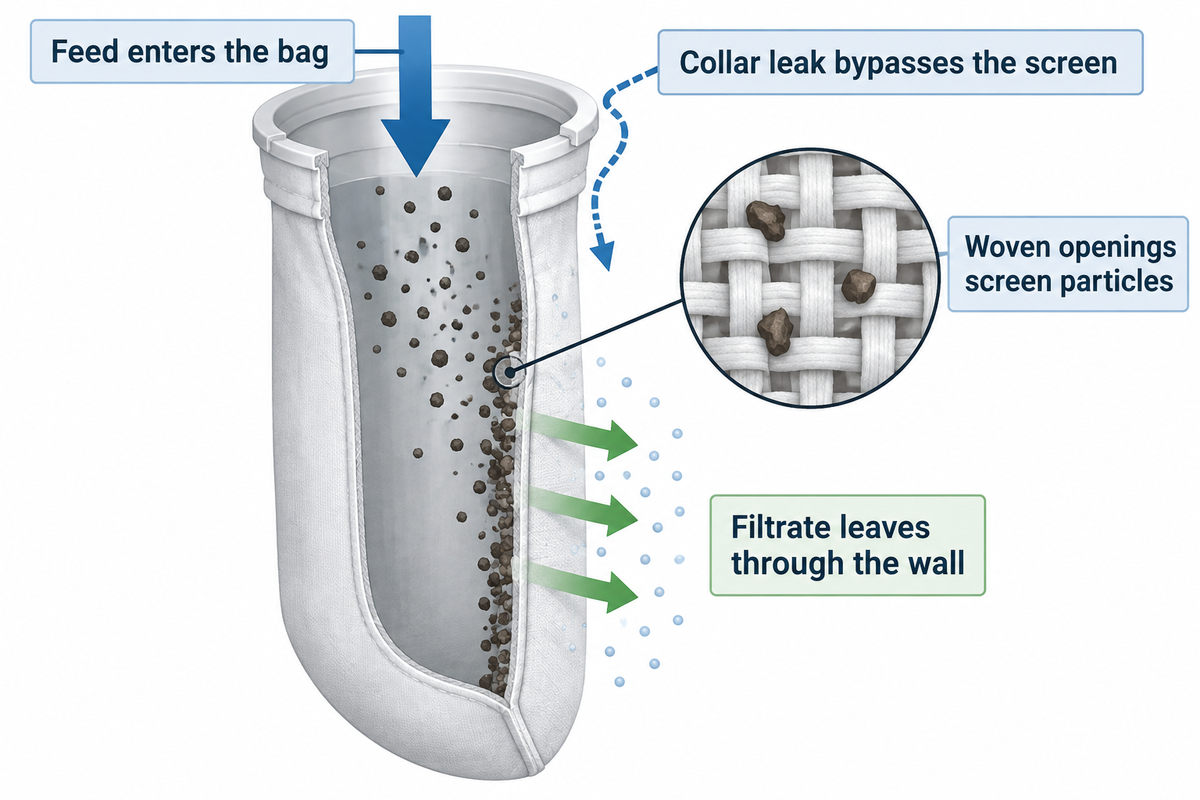
A nylon mesh filter bag functions as a surface screen; liquid passes through the woven openings while particles that cannot pass collect on the fabric. In a typical supported liquid bag housing, the feed enters the bag and filtrate leaves through the bag wall. A leak around the collar provides a route that bypasses the screen.
“Mesh bags” may also mean containers that hold another filter medium. An aquarium media holder, for example, may hold granules while those granules perform treatment. This is different from specifying the bag itself as the particle barrier.
How are nylon mesh filter bags made?
Nylon mesh filter bags are made from woven fabric. Once the fabric bag is created, an opening or collar is added to the top. In Nylon monofilament the fibers are arranged in a grid. Multifilament yarns are composed of bundles of finer filaments. Filter mesh bags also include arrangements for the seam, top and handle which need to be appropriate for the housing and the process.
Different design and construction features affect how two fabric structures can be joined together. A reusable fine mesh strainer bag with a drawstring can not automatically be interchanged with a ring-sealed bag. Ask for specific information about the fabric, seam, and top construction of the quoted item. A material name or family code will not give that information.
Wim Callaert’s technical explanation of liquid bag media describes woven monofilament mesh as a two-dimensional surface filter. Loading complicates that simple picture. Bächle and colleagues’ 2021 fabric experiments found that particles interacting with fine woven cloth changed its resistance. An initially open screen can develop deposits and blocked pores; its clean-water behavior does not describe every loaded condition.
Mesh Size to Microns: Read the Rating Correctly
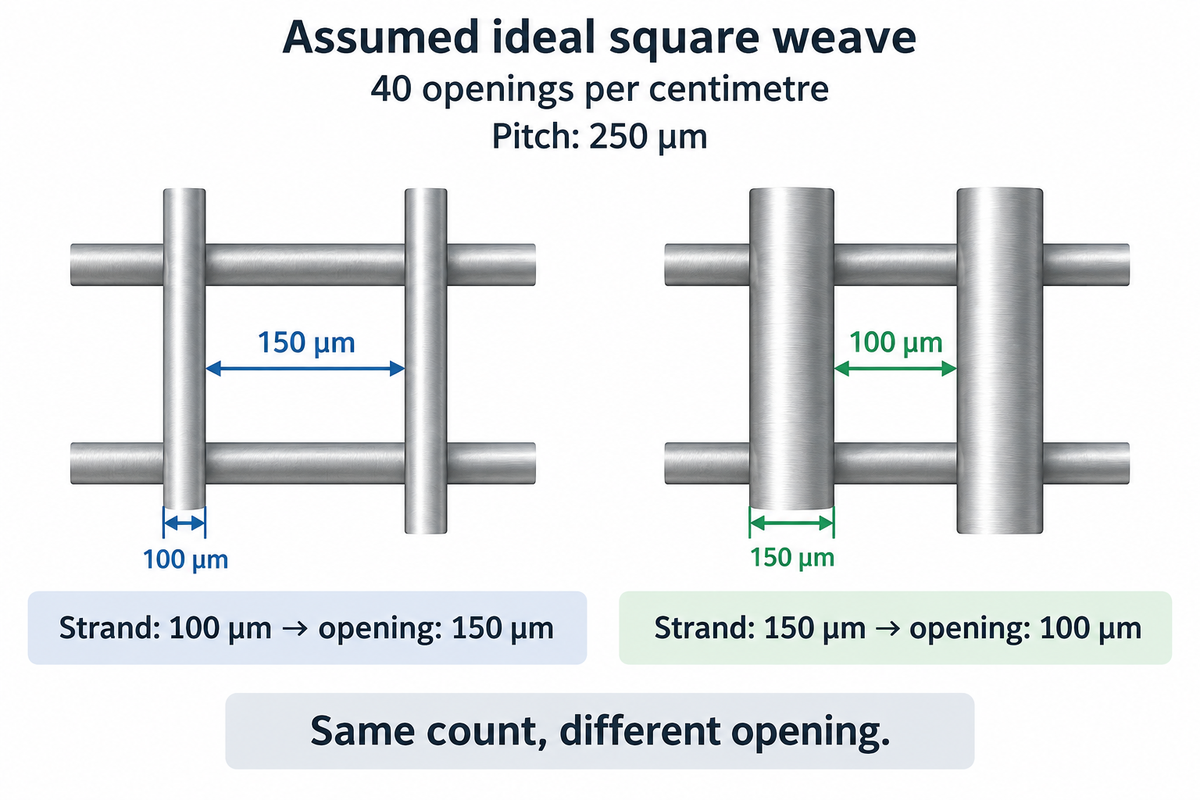
Mesh counts the number of openings along a given length; micron indicates length. Space is left between strands due to strand diameter and weave. A defined pore opening needs a separate description of retention as well. Shape of the particle, conditions of the test and the path assembled affect what comes out.
As a result, “100 mesh” and “100 micron” address different inquiries. Before contrasting a fine mesh filter bag with some other alternative, work out whether the number describes count, opening or a tested micron rating. Contrast various micron ratings on the same retention basis. A claim of uniform pore size alludes to fabric geometry; an efficiency claim alludes to a measured separation result.
Worked example: Assume an ideal square weave with 40 openings per centimetre. Its pitch is 10 mm ÷ 40 = 0.25 mm, or 250 µm. With a 100 µm strand, the ideal clear opening is 250 − 100 = 150 µm. With a 150 µm strand, it becomes 100 µm. The count has stayed the same. Real fabric specifications additionally need their construction and tolerances.
Length conversion is simpler: 75 µm = 0.075 mm, 100 µm = 0.100 mm and 200 µm = 0.200 mm, using NIST’s micro and milli prefixes. The micron-to-millimetre converter handles that arithmetic. It cannot convert an unspecified mesh count into an opening or establish filtration efficiency.
What is the filtration efficiency of the Nylon Filter Bags?
Filtration efficiency for nylon filter bags is the fraction of a specific particle population that is removed under defined conditions. Mesh openings by themselves yield no universal percentages. For micron filtration, equal consideration must be given to the tested particle size or size band, the counting or mass method, liquid, flow, loading stage, and the complete assembly of the bag for an efficiency comparison. Under these matched conditions, two values of the efficiency may be compared.
Both nominal and absolute ratings need definitions from the supplier. Ask for the efficiency associated with the stated particle size and the test method. A finer number can change loading behavior, but may not necessarily solve the downstream problem that led to the purchase.
Nylon Mesh vs Felt: Match the Capture Mechanism
Nylon mesh and felt should be compared against the particles that must be removed and the material that should remain in the final product. Monofilament mesh provides a woven screening surface; needled felt, a matrix of entangled fibers. The key distinction is behavior under the proposed duty, and not a universal material ranking.
Nylon monofilament mesh
- Screen particles at a defined woven opening.
- Inspect surface loading and any pore blockage.
- Consider cleaning only for a construction and duty that permit it.
Needled felt
- Capture particles through an entangled fibre matrix.
- Assess loading within the available media depth.
- Confirm the product’s replacement or reuse instructions.
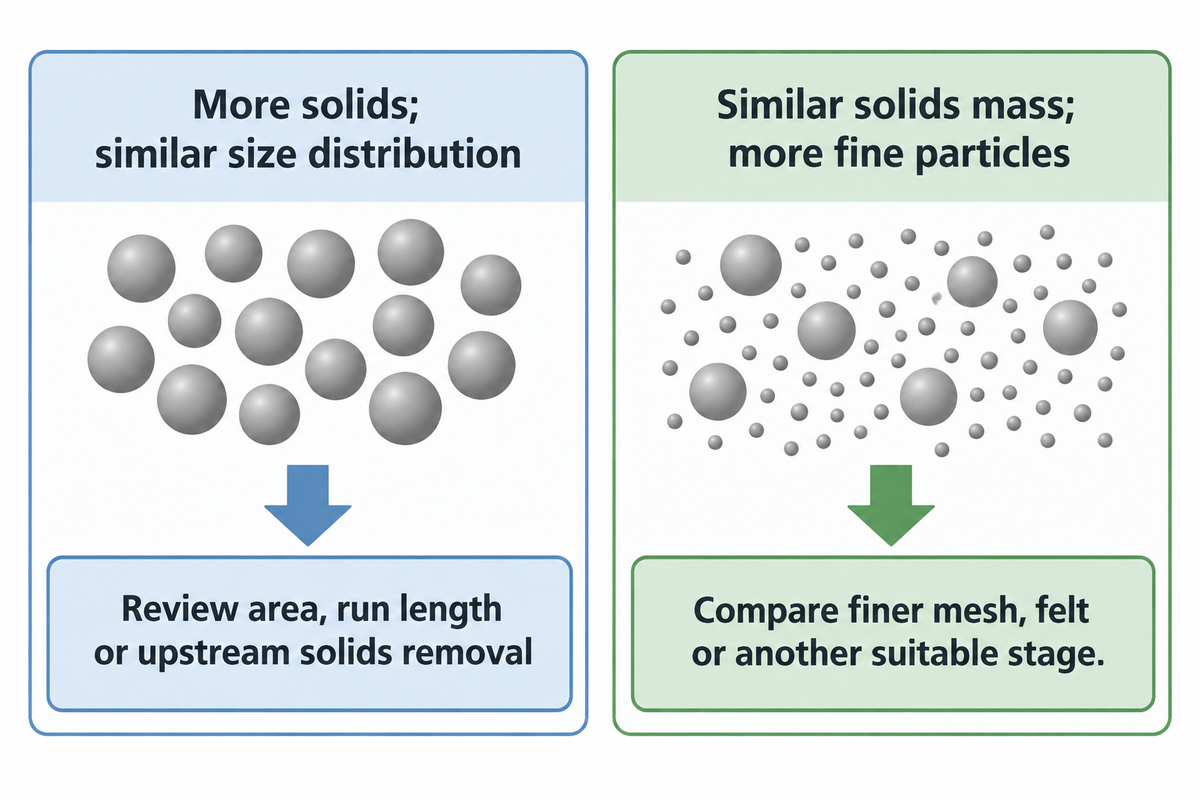
Distinguish changes in solids concentration from changes in particle-size distribution. The first relates to the total quantity of material; the second can relate to what is captured on a given size of screen.
| Feed observation | Candidate response | Evidence that decides |
|---|---|---|
| Stable concentration; coarse target particles | Trial a defined-opening mesh against the outlet objective | Required particles retained without removing valuable product |
| More solids; similar size distribution | Review area, run length or upstream solids removal | Loading per bag and acceptable quality through the run |
| Similar solids mass; more fine particles | Compare finer mesh, felt or another suitable stage | Size-resolved outlet results and resulting pressure demand |
| Both concentration and size distribution change | Test the expected operating envelope | Paired feed/outlet observations at representative conditions |
Example: a heavier feed. Assume water at 40 L/min changes from 200 mg/L to 400 mg/L of suspended solids while the particle distribution stays similar. Incoming solids rise from 8 g/min to 16 g/min. If the chosen opening still meets the outlet requirement, selecting a finer screen does not remove the extra loading problem. An operator may need more available area or a different upstream arrangement, while procurement needs the comparison to include change frequency and handling. Now change the assumption: the concentration stays at 200 mg/L, but the fine fraction increases. Keeping all other conditions the same as before, we may expect a different result at the outlet. That second problem calls for a retention trial, rather than simply allowing longer runs.
The liquid filter bag media range separates those product families. Polypropylene felt filter bags and polyester felt filter bags remain candidates to compare when their particular chemistry, temperature and retention basis suit the duty.
Chemistry, Temperature and the Complete Bag
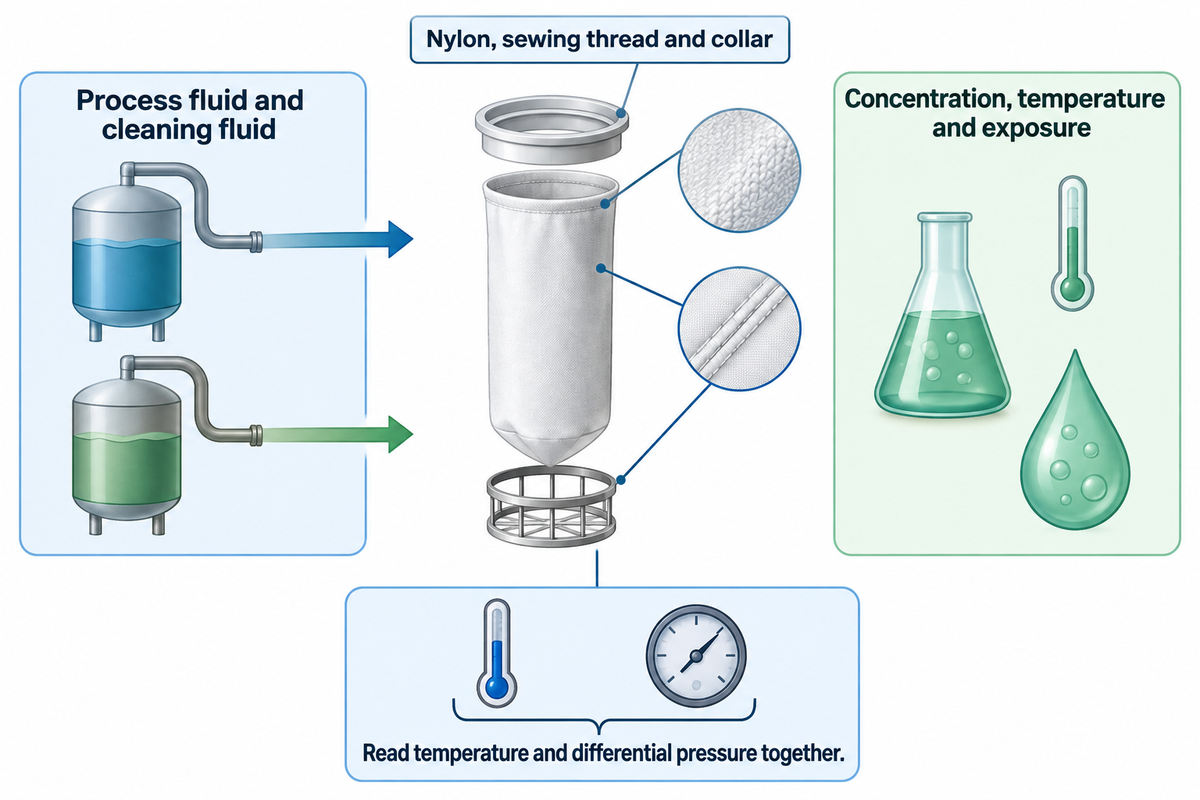
Chemical compatibility includes the actual liquid, its concentration, temperature, exposure, and the complete wetted construction. Take into account the different conditions imposed by the process fluid and the cleaning fluid. Evaluate the nylon, sewing thread, collar and other wetted construction items and what the condition may be after the intended service and cleaning sequence.
Active entry ASTM D543-21 outlines some ways to evaluate plastics when they come in contact with chemical reagents. It describes some factors such as concentration, exposure time, stress, and temperature, which affect the relationship between plastics and chemical reagents. It is a valuable testing principle rather than a nylon mesh filter compatibility list or an acceptance of a finished bag.
When reviewing a data sheet, temperature and differential-pressure conditions must be read together. A high-pressure housing will not increase the allowable differential pressure of a bag. A room temperature pressure limit cannot be combined with a separately listed maximum temperature.
When performing a solvent duty, you need to provide the supplier with the composition and cleaning sequence. For a food grade nylon filter, have the quality owner confirm the applicable material and use documentation. Descriptions such as “food-grade nylon” or “good chemical compatibility” need application-specific detail to be of any use for purchasing. Identify if a stainless steel handle or other component in the wetted assembly contacts the liquid.
Why Filter Bag Sizes and Seals Affect Retention
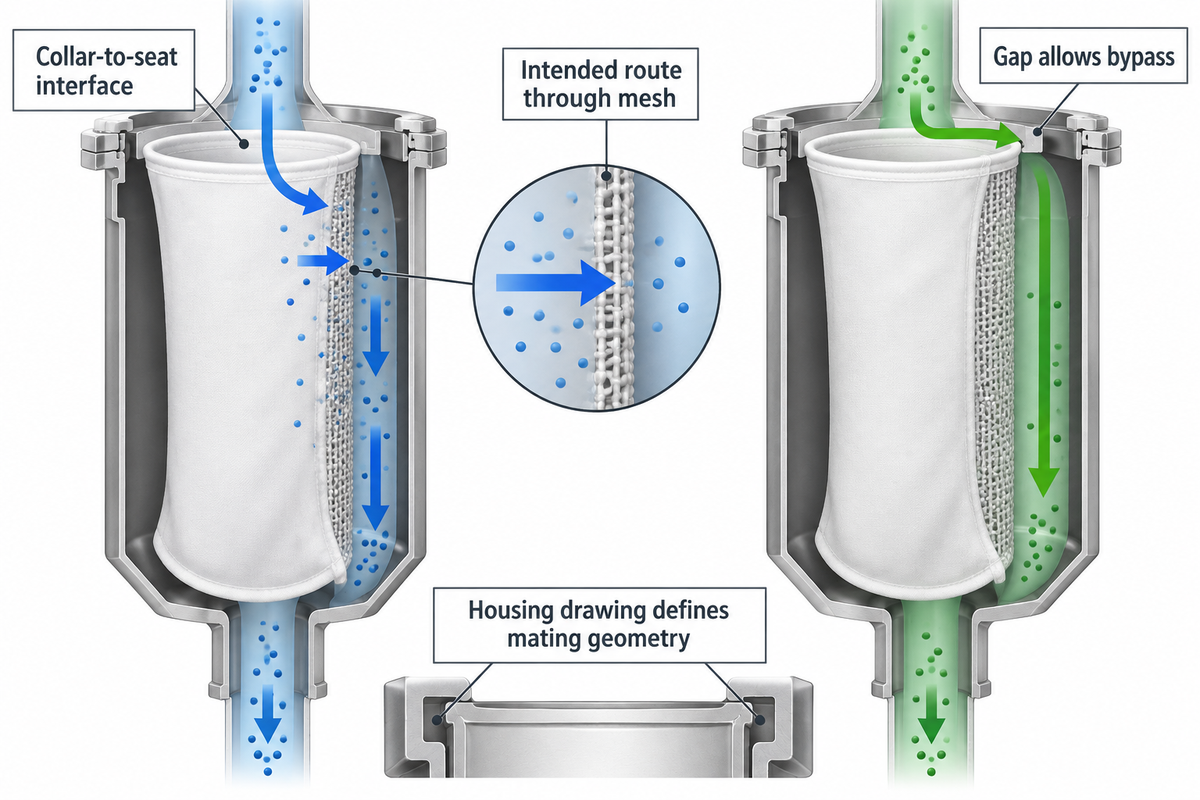
Filter bag sizes represent part of the fit requirement, but it is the collar-to-seat interface that determines if liquid follows the intended path. A bag may fit inside a vessel, but still leave a bypass at the opening. Analyze the ring profile, seating, support and closure as an assembly before changing the filter mesh. Even high-quality nylon filter media cannot eliminate a gap at the collar.
Lessons learned from bag closing devices, gaskets, rupture and bypass are illustrated in the EPA’s historical Small Drinking Water Systems Handbook (2003). While the assembly lessons remain pertinent, evaluations of drinking water in the document do not constitute performance approvals of the current industrial nylon bag.
Consider the material, steel or plastic rings, position of the seam, and the kind of support basket required. A drawstring filter bag for straining in an open arrangement does a different sealing task. Filter bag size references assist in performing dimensional checks. The housing drawing determines mating geometry.
Read Pressure, Flow and Particle Breakthrough Together
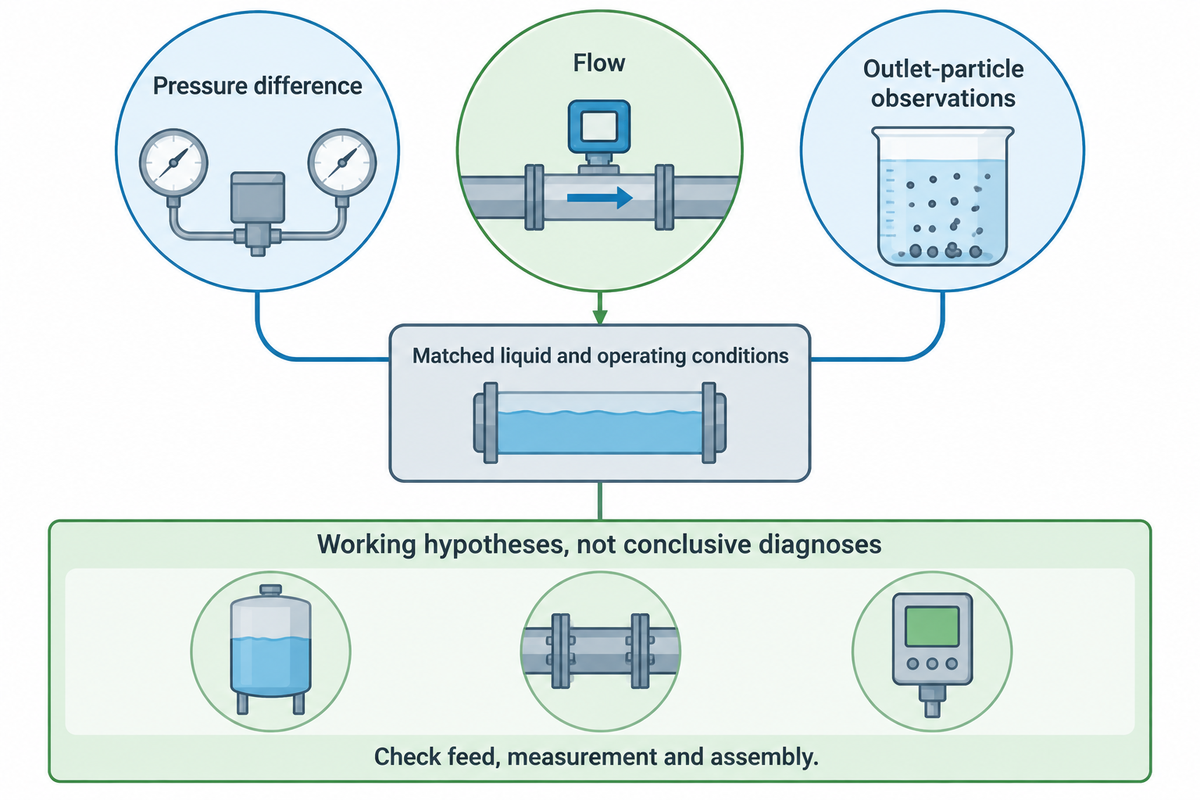
Pressure, flow and outlet-particle observations describe different aspects of a filtration run. Compare them with an appropriate baseline at matched liquid and operating conditions. An increasing differential pressure may occur with loading, and deterioration of the outlet may happen by several mechanisms. Neither reading identifies the cause by itself. Investigate bag blowouts and consider support and seam condition.
“Turbidity is the measure of relative clarity of a liquid.”
Optical clarity is advantageous when matched with the product objective. It is not a substitute for a particle-size-specific retention measurement. Particle counters have their own measurement chains. Instrument response, volume measured, and particles lost along sampling surfaces can affect a comparison.
Mesh Fault Signature Map: 9 Signal Patterns
The Mesh Fault Signature Map relates integrated operating signals to the next check; its entries are working hypotheses as opposed to conclusive diagnoses.
| Observed combination | Possible explanation | Next check |
|---|---|---|
| Pressure difference rises; flow falls; outlet meets target | Increasing resistance from loading | Compare feed solids and the approved changeout limits |
| Pressure rises at similar flow; liquid is colder | Changed liquid properties as well as possible loading | Compare temperature and viscosity before assigning cause |
| Outlet particles rise; pressure changes little | Finer feed, bypass, damage or measurement change | Check paired feed samples, measurement method and assembly |
| Pressure suddenly falls; outlet worsens | Damage or a newly opened bypass path | Follow the site response procedure; inspect bag and sealing route |
| Flow falls without a corresponding bag-pressure change | A restriction or supply change elsewhere | Review pump, valves and measurement locations |
| Outlet deteriorates immediately after a bag change | Seating, part mismatch or residual material | Check installed identity, collar engagement and sampling cleanliness |
| Outlet results shift after a sampling-method change | Measurement bias or recovery differences | Run the method comparison and suitable blanks |
| Cleaned bag has lower pressure but worse outlet quality | Changed media, seating or remaining contamination | Apply the reuse acceptance checks below |
| Shorter runs coincide with a heavier feed | More solids arriving per unit time | Compare concentration and flow before blaming bag consistency |
Example: a reassuring pressure reading. Assume inlet pressure is 2.0 bar and outlet pressure is 1.7 bar at 50 L/min. The measured difference is 0.3 bar. That arithmetic alone says nothing about whether the required particles are being retained. If the outlet becomes dirtier while those readings stay similar, first compare the feed and the measurement method. A changed particle population may explain the result; a collar problem may also allow liquid around the screen. An operator needs the site’s response instructions, while the quality owner needs a defensible sample comparison. Moving to a finer micron mesh before those checks can leave the actual problem in place and add pressure demand.
Cleaning and Reuse: Prove Performance After Each Cycle
Reusable nylon mesh bags need a way to clean them that gets rid of the relevant contamination while preserving filtration function. Decide the release criteria for the product and duty. Inspection and operating checks may be part of a qualified routine; however, a universal number of washes or a universal lab retest after every cycle can not be set because of the word “reusable.”
A 2020 review of woven filter cloth cleaning explains the competing goals of residue removal and gentle treatment. A rinse that improves flow may leave material behind; an aggressive wash may affect the fabric or assembly. The permitted procedure therefore needs the supplier’s construction limits and the process owner’s cleanliness and outlet requirements.
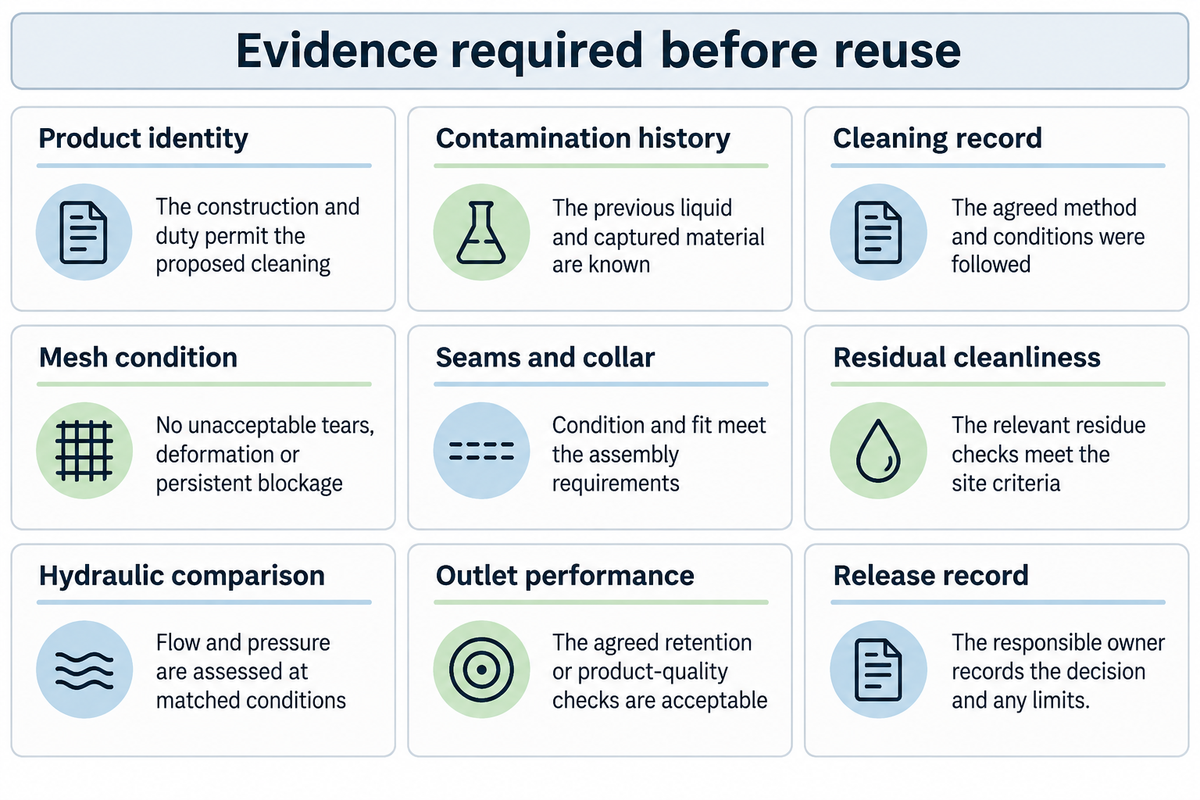
Reuse Acceptance Ladder: 9 Release Checks
The Reuse Acceptance Ladder separates evidence associated with cleaning, physical condition and filtration function, so that each release decision has a stated basis.
| Evidence object | Release basis | When to hold the bag |
|---|---|---|
| Product identity | The construction and duty permit the proposed cleaning | Instructions prohibit reuse or the item cannot be identified |
| Contamination history | The previous liquid and captured material are known | History or cross-product contamination is unresolved |
| Cleaning record | The agreed method and conditions were followed | Exposure or deviations cannot be reconstructed |
| Mesh condition | No unacceptable tears, deformation or persistent blockage | Damage or opening changes are suspected |
| Seams and collar | Condition and fit meet the assembly requirements | Seam damage, distorted ring or poor engagement remains |
| Residual cleanliness | The relevant residue checks meet the site criteria | Appearance is the only evidence for a critical residue |
| Hydraulic comparison | Flow and pressure are assessed at matched conditions | A changed liquid or flow prevents comparison |
| Outlet performance | The agreed retention or product-quality checks are acceptable | Quality worsens or the measurement is unreliable |
| Release record | The responsible owner records the decision and any limits | The applicable acceptance decision is incomplete |
Example: flow recovery without quality recovery. Assume a new bag and a cleaned bag both run at 40 L/min with a 0.1 bar pressure difference. For the same specified particle-size band, inlet concentration is 1,000 particles/mL. The new bag’s outlet contains 10 particles/mL, giving (1,000 − 10) ÷ 1,000 × 100 = 99% removal. The cleaned bag’s outlet contains 40 particles/mL, giving 96%. Those hypothetical results would require investigation even though the hydraulics match. Check the measurement and feed comparison before concluding that cleaning changed the bag. The quality owner sets the acceptable result; this example sets no release percentage. Finance should also count cleaning, inspection and rejected-trial work before assuming that another use reduces total cost.
For food and beverage duties, the quality owner must also consider relevant residues and cross-product contamination. Particle capture and pressure recovery would not replace those acceptance criteria and product documentation.
Compare Nylon Filter Bags on a Matched Trial
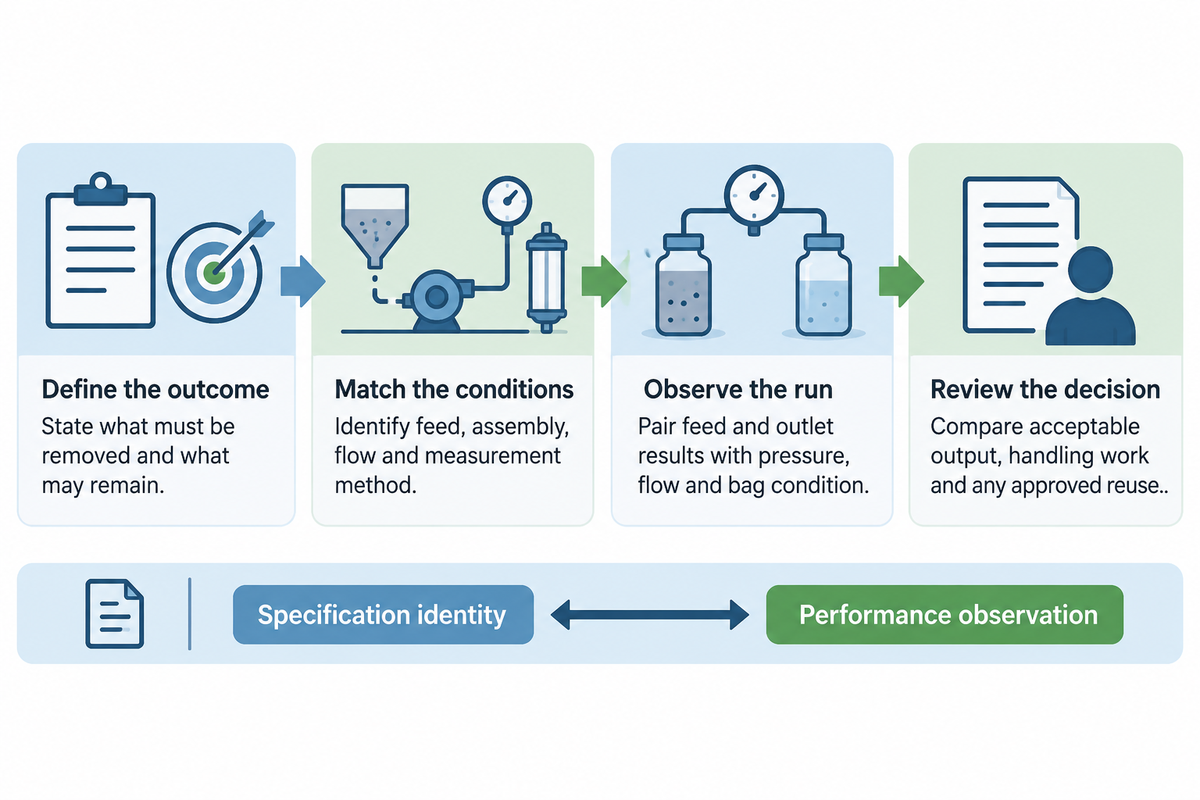
A matched trial compares candidates against the same outlet objective and representative operating conditions. Both contenders should be observed initially and as they load against the same outlet objectives. Identify the complete bag and housing and keep the measurement method consistent. An operating comparison should not be settled based on a lower price or a matching micron label.
Agree on what changes in operating conditions are relevant: feed composition, particle distribution, concentration, temperature, and flow. Specify the current data-sheet revision, media construction, opening or retention basis, dimensions and sealing arrangement. Limits should also be set for the pressure envelope. Compare multiple mesh options only when the intended quality target is clear.
- Define the outcome: state what must be removed and what may remain.
- Match the conditions: identify feed, assembly, flow and measurement method.
- Observe the run: pair feed and outlet results with pressure, flow and bag condition.
- Review the decision: compare acceptable output, handling work and any approved reuse.
Studies by NIST show the value of considering timing, measured volume and particle recovery. Use instrument checks, blanks and consistent sampling; without such practices, seemingly good results may be attributable to the measurement chain.
Purchasing should stipulate the necessary material and use documents, independently from the performance results. As noted in ISO/CASCO, management-system and product certification cover different objects; the practical implication here is that company-level certificates cannot supply the bag’s retention curve or approve a cleaning process.
What Better Nylon Mesh Filtration Evidence Looks Like
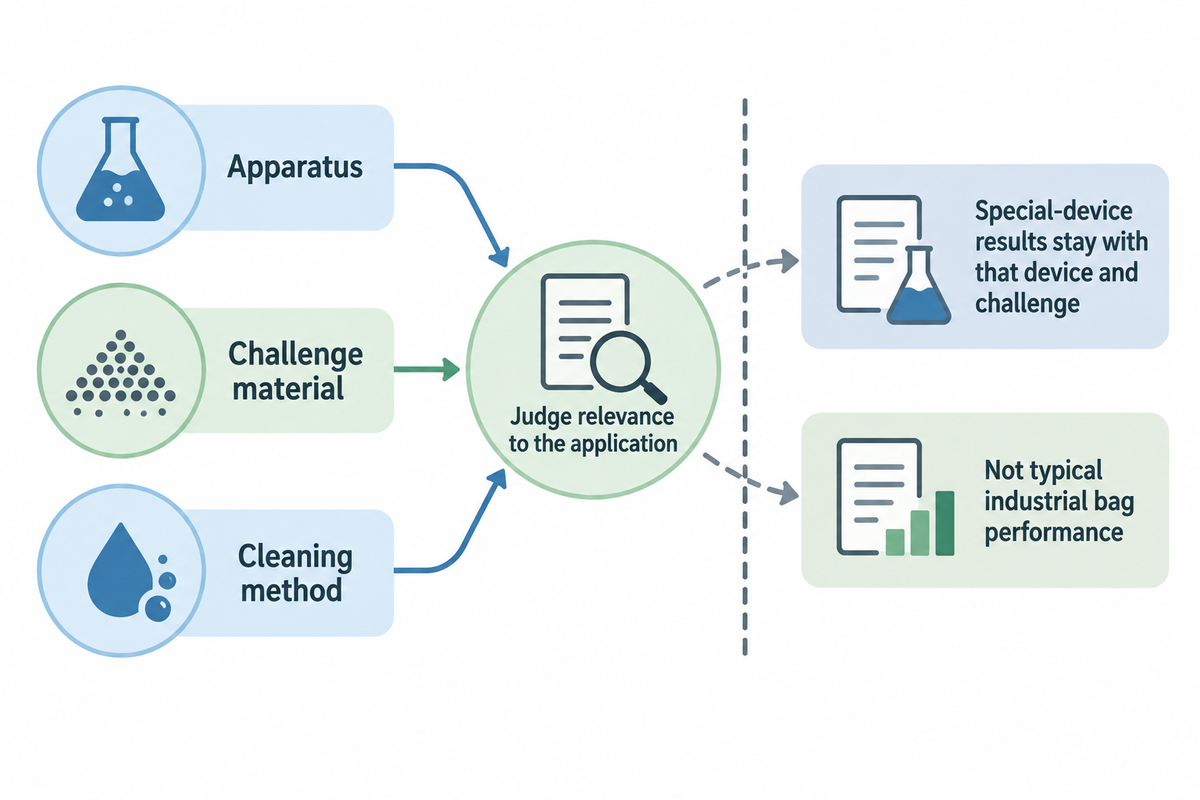
Better evidence for filtration would be information on the apparatus, the challenge material, and the cleaning method along with the characteristics of the medium being tested. This would help a prospective user to judge the relevance of the test results to the application for which the medium is to be used. Percentage retention figures, a new design, or a broad market forecast cannot answer such questions.
A December 2025 study of a fish-inspired filter reported using a 100 µm polyamide screen and 2 mm synthetic test fibers in its initial washing-machine-oriented laboratory comparison. The researchers said fibers were found on the filter after the cleaning cycle, and disclosed a related patent interest. This study provides a good example for this guide, as it illustrates the importance of analyzing flow paths, the material retained in the filter and the cleaning process. Results of this study should be attributed to the device and challenge, and not to typical industrial nylon bags.
Take the specification and the observations during the trial to the supplier. ECOFILTRONE™ supports application review, replacement, and specification as well as customizations. The nylon mesh filter bag solution page covers commercial considerations and provides the information required for a product discussion.
Nylon Mesh Filter Bag FAQs
What are the main applications of nylon filter bags?
Nylon filter bags screen suspended solids in suitable industrial water and process-liquid duties.
Applications include process-water straining, equipment protection and selected food, beverage or chemical operations. The important qualification is the actual liquid and particle-removal objective. A nylon bag may remove coarse unwanted solids while allowing useful material to remain, but its suitability still depends on chemistry, temperature, construction and the required outlet quality. State those conditions before selecting a bag from an application list.
Which sizes are offered for nylon mesh filter bags?
Nylon mesh bags come in standard and custom dimensions, with product-specific top and seam arrangements.
Compare the bag diameter, usable length, collar profile and support-basket arrangement against the housing drawing. A shared size number does not define every sealing detail, and a bag that physically fits can still seat incorrectly. Use the supplier’s current dimensional reference and identify the existing housing when requesting a replacement. Confirm the complete configuration before ordering a batch.
How long does a nylon filter bag last?
Service life depends on loading, operating conditions, physical condition and acceptable outlet performance.
Record flow, feed concentration, particle characteristics and the reason each bag was removed. A shorter run may reflect a heavier feed, a change in fine particles, damaged media or another system change. Compare those observations at representative conditions before assigning a calendar interval. If reuse is permitted, track cleaning and release decisions as well; an additional wash is useful only when the bag remains acceptable for the intended process.
Can nylon mesh remove dissolved contaminants?
A mesh opening screens particles; dissolved substances generally need a different separation mechanism.
Specify whether the target is a suspended solid or a dissolved substance. A bag holding an adsorbent is a different treatment arrangement from a bare woven screen.
What types of nylon filters are available?
Nylon filters include different woven constructions and membrane products with distinct filtration tasks.
Confirm whether the item is a monofilament bag, a multifilament construction or a membrane element. A nylon membrane filter cartridge belongs to a different product family; the shared polymer name does not make its pore rating, assembly or application interchangeable with mesh filtration bags.
Is a drawstring bag equivalent to a ring-sealed filter bag?
The two top arrangements serve different mounting and sealing requirements.
A drawstring can secure a strainer filter in an appropriate open arrangement. A ring or collar is designed to mate with a particular housing seat. Compare the intended liquid route, mechanical support and closure instructions before substituting one for another. An intact nylon mesh filter can still give an unacceptable outlet result if the installed arrangement allows liquid around it.
Discuss your filtration duty with ECOFILTRONE™
Bring the liquid composition, operating temperature, flow, housing details and outlet-quality target. Ask for specification confirmation and a suitable sample or trial arrangement.
References and Sources
Source scope matters: The EPA handbook is historical, the 2021 fabric study and 2025 special-device study have specific experimental conditions, and the trade article is supplier-affiliated. The diagnostic map and reuse ladder are the key engineering synthesis in this guide.
- NIST: Metric (SI) Prefixes
- USGS: Turbidity and Water
- EPA: Small Drinking Water Systems Handbook (2003), filtration-media and bag-filtration sections
- ASTM D543-21: Public Scope and Significance and Use
- Wim Callaert: Criteria to Consider When Choosing Bag Filtration Technology, Part I (2020)
- Bächle et al.: Interaction of Particles and Filter Fabric in Ultrafine Filtration (2021)
- The Challenge of Cleaning Woven Filter Cloth in the Beverage Industry (2020)
- Hamann et al.: A Self-Cleaning, Bio-Inspired High Retention Filter for a Major Entry Path of Microplastics (2025)
- Ripple and DeRose: Primary Determination of Particle Number Concentration (2018)
- ISO/CASCO: Attestations of Conformity
Filtration selection brief
Bring the operating details that shape the next conversation
Record what is known from the line or process. A complete specification is not required to start.
Useful inputs
- Fluid and processFluid name, process stage, and any compatibility concern.
- Filtration targetRequired result, existing rating, or the issue to solve.
- Flow and run timeTypical flow range, batch size, or expected service interval.
- Installation conditionsHousing or connection details, temperature, pressure, and available space.
Next step
Send the details you have
Use the inquiry form to start a focused discussion and add drawings or photos when they help explain the installation.
Start an inquiry