Get in touch with ECOFILTRONE™ Company

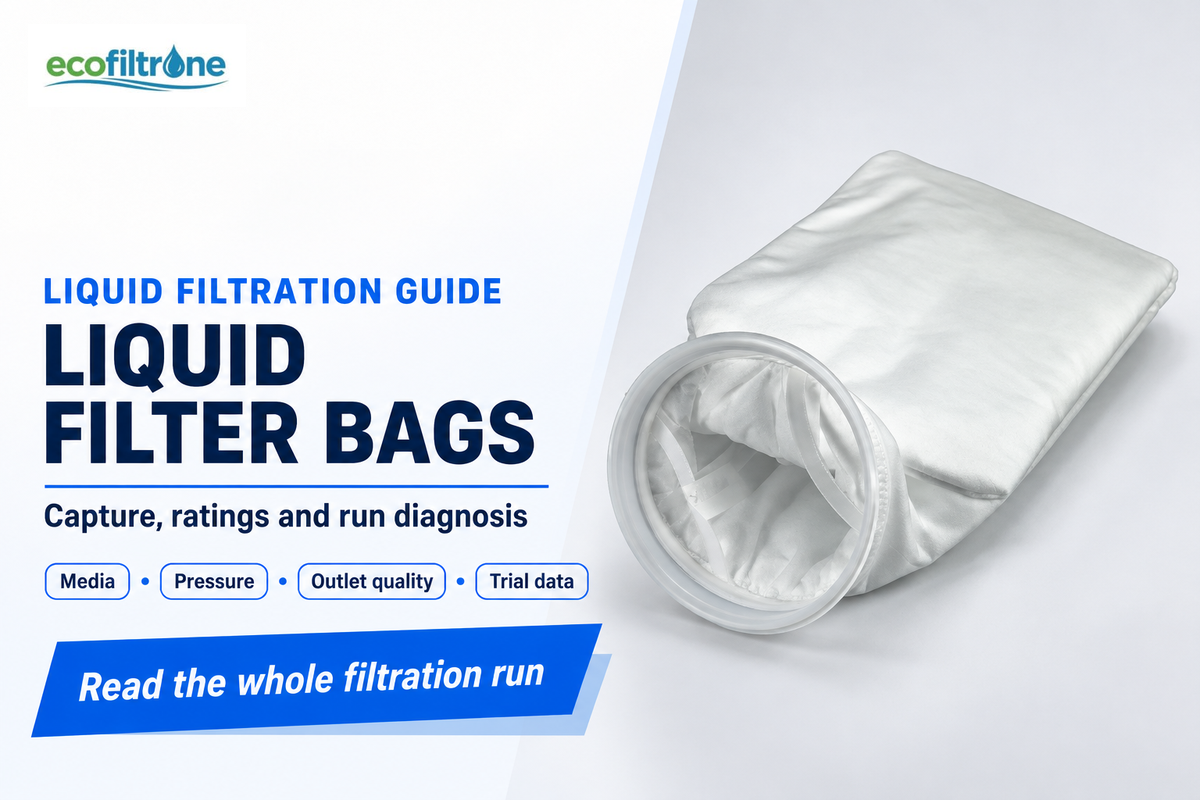
Liquid Filter Bags remove suspended solids as liquid passes through a supported fabric or a layered medium. A bag that appears correct on a purchase order can still perform poorly if the rating, collar, support basket or operating duty is different from the original installation. Knowledge of these separate functions enhances the utility of pressure readings and used bag inspections.
By XCX · Updated October 2026
Liquid Filter Bags capture particles through surface or depth filtration. Micron rating describes a size reference; retention also needs a test basis and a sealed flow path. Compare pressure, flow and outlet quality together.
Before interpreting a filter run
- A finer micron label can’t correct a bypass around the media.
- Clean resistance and the rate of dirt accumulation are different measurements.
- Zero differential pressure can coexist with a pressurized housing.
- Longer service hours can produce less acceptable liquid when flow is lower.
For support in other respects including available constructions and dimensions, use the ECOFILTRONE liquid filter bags solution page. The operating descriptions that follow explain what generally happens between installation and changeout.
How Liquid Filter Bags Capture Solids
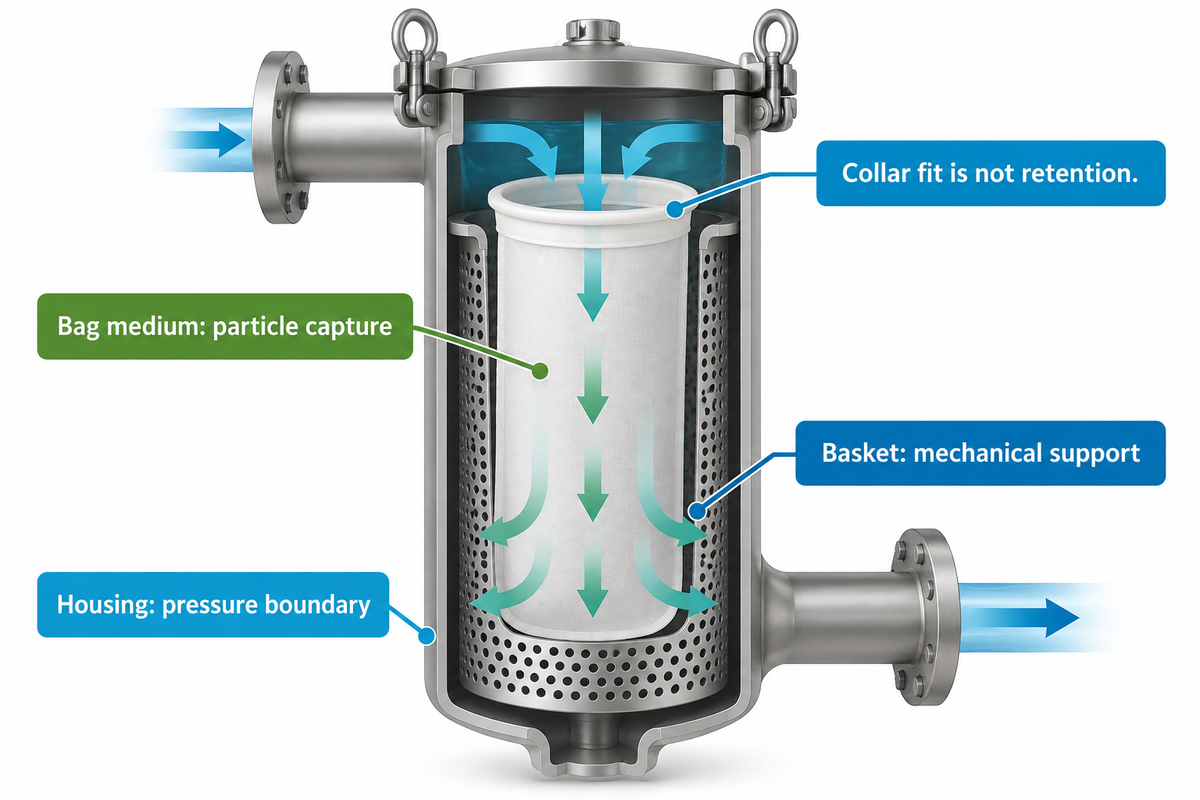
In a process known as filtration, liquid passes through a permeable bag medium that captures the suspended solids. Capture occurs at the surface, within the media depth, or across several layers. It’s critical that the liquid flow through the medium rather than around it.
The basket carries the mechanical load that a flexible bag cannot carry alone. The filter housing contains the pressurized liquid, while the bag provides the selected filtration path. A steel ring or molded collar is an interface component, not a measurement of particle retention. The feature that makes the bag fit the vessel is different from the feature that makes it capture the required solids.
Ordinary particulate bags are good for process debris, rust, scale and other suspended matter. They aren’t desalination elements. Mark Reinsel’s treatment process discussion in Water Online separates particulate filtration from treatment of dissolved contaminants. A dissolved constituent may require a chemical, adsorptive, ion-exchange or membrane process to be selected for that constituent.
A useful first inspection question is therefore about the unwanted material: is the problem a particle in the liquid, a separate oil phase, or a dissolved substance? A liquid filter bag and a dust-collection bag may share a material name, but gas filtration equipment and liquid pressure vessels have different duties. Process filtration isn’t determined by a match of the word “filter.”
Felt, Mesh and Multilayer Media: Different Capture Paths

Felt, woven mesh and multilayer bags differ in how liquid is interfaced with the collecting structure. Felt offers a three dimensional fibrous path, and a monofilament mesh a defined opening between filaments. Layered structures present a combination of several different paths. The selection of paths is determined by the material of construction and behavior of the contaminant, rather than a universal ranking.
Polypropylene felt bags and polyester felt bags are a couple of examples of bags typically used for depth-style capture. Needled fibers make a particle interception path throughout the thickness of the bag, as opposed to a path only available on the external opening of the bag. The dirt holding capacity depends on how the captured solids build up in the bag.
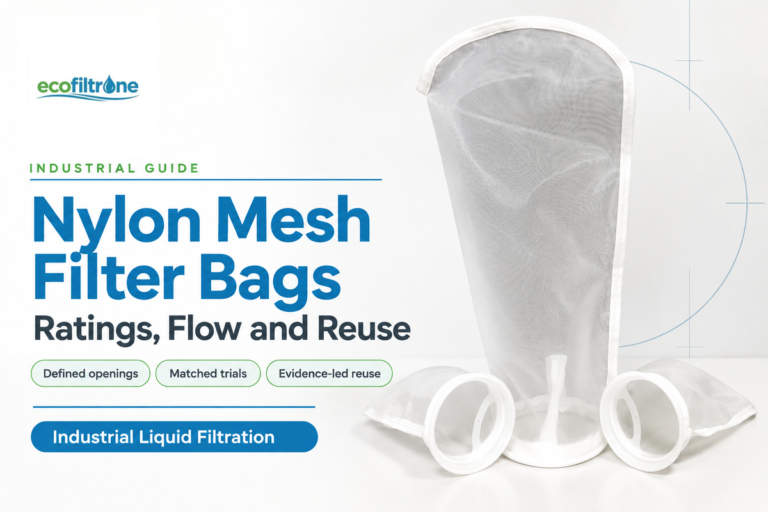
Woven media requires both a construction description and a polymer name. A study recorded by National Taiwan University about filter-cloth calendering describes flow paths through fabrics that are either tightly or loosely woven. That study analyzes certain types of cloth and explains why “woven” alone makes an inadequate performance claim. For a product-specific evaluation, construction options of the nylon monofilament mesh maintain the opening grade, seams and details of a collar.
Are you filtering gels or agglomerates?
Gels and agglomerates require an assessment of capture that includes the behavior and the shape the collected layer takes on. A soft mass can change shape under pressure, while a rigid test particle cannot. Particle size alone therefore gives an incomplete comparison when paints and coatings, resins or organic slurries create a compressible deposit.
A 2011 soft-particle filtration study recorded by Chalmers found that model dextran and manganese dioxide material deformed and filled voids in the filter cake. Resistance to flow changed over time. The result provided a possible mechanism on how the cake develops and matures over time, but doesn’t predict the service life of a commercial bag. Retained solids become part of the flow path, so a used bag can behave differently compared to its clean starting condition.
More layers do not automatically rank one product above another. A cellulose-perlite filter study separated improved dye adsorption from particle retention; it was not a polypropylene or polyester bag trial. Consider the needed removal mechanism and its measured performance jointly.
There is a separate decision on Chemistry. Related ASTM D543-21 guidance on chemical resistance describes comparisons with regard to reagent concentration, exposure time, temperature and stress. A polymer name cannot take the place of these. Detailed polyester felt specifications and PTFE construction limits belong in the relevant product review.
Micron Ratings and the Evidence Behind Retention
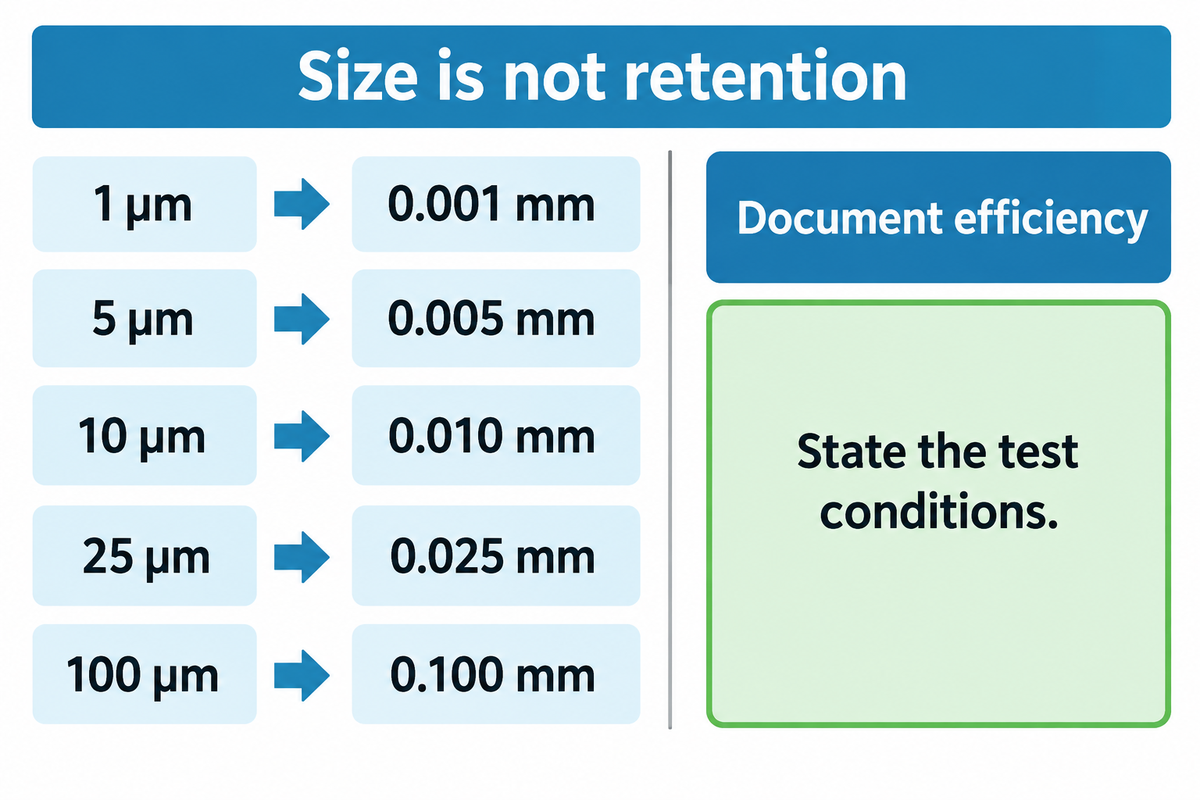
A micron rating consists of two readings: the reference particle-size, and retention performance associated with that reference. A 1 micron label does provide a dimensional target, but doesn’t guarantee that every particle will be removed. Compare efficiency, test conditions and assembly details alongside the number printed on the bag.
The National Institute of Standards and Technology SI prefix table states that micro means 1/1,000,000, and milli means 1/1000. One micrometre equals 0.001 millimetre. The conversion is exact; it doesn’t turn an opening size into a filtration-efficiency percentage.
| Micrometres | Millimetres |
|---|---|
| 1 µm | 0.001 mm |
| 5 µm | 0.005 mm |
| 10 µm | 0.010 mm |
| 25 µm | 0.025 mm |
| 100 µm | 0.100 mm |
Source: NIST SI prefixes.
What is the difference between nominal and absolute filtration?
Nominal and absolute filtration describe retention using stated efficiencies and test bases; the terms don’t provide for one single overall percentage across suppliers. An absolute-rated product still requires its documented particle challenge, efficiency and operating conditions. A nominal-rated product also requires a definition before two alternatives can be compared fairly.
A report should connect the named product, particle size and measured removal to the test liquid, flow and loading condition. The US 40 CFR 141.719 bag-and-cartridge challenge-testing provisions, for example, describe a defined whole-assembly test for a specified drinking-water treatment purpose. They also require a match of filter and housing construction and testing at the manufacturer’s maximum design flow.
“Challenge testing must be conducted at the maximum design flow rate for the filter as specified by the manufacturer.”
They also study behavior during startup, at 45-55% of terminal pressure drop, and at terminal condition. They are not a general changeout schedule for every industrial liquid filtration system. A high-efficiency bag specification should also retain its own test basis.
A 25 µm label is a size reference; it cannot resolve differences in efficiency, seam construction or test duty. In dimensions, 0.025 mm is the same for both bags, even if measured retention differs. The filter micron rating guide further substantiates this.
Housing Fit and the Route Around the Media
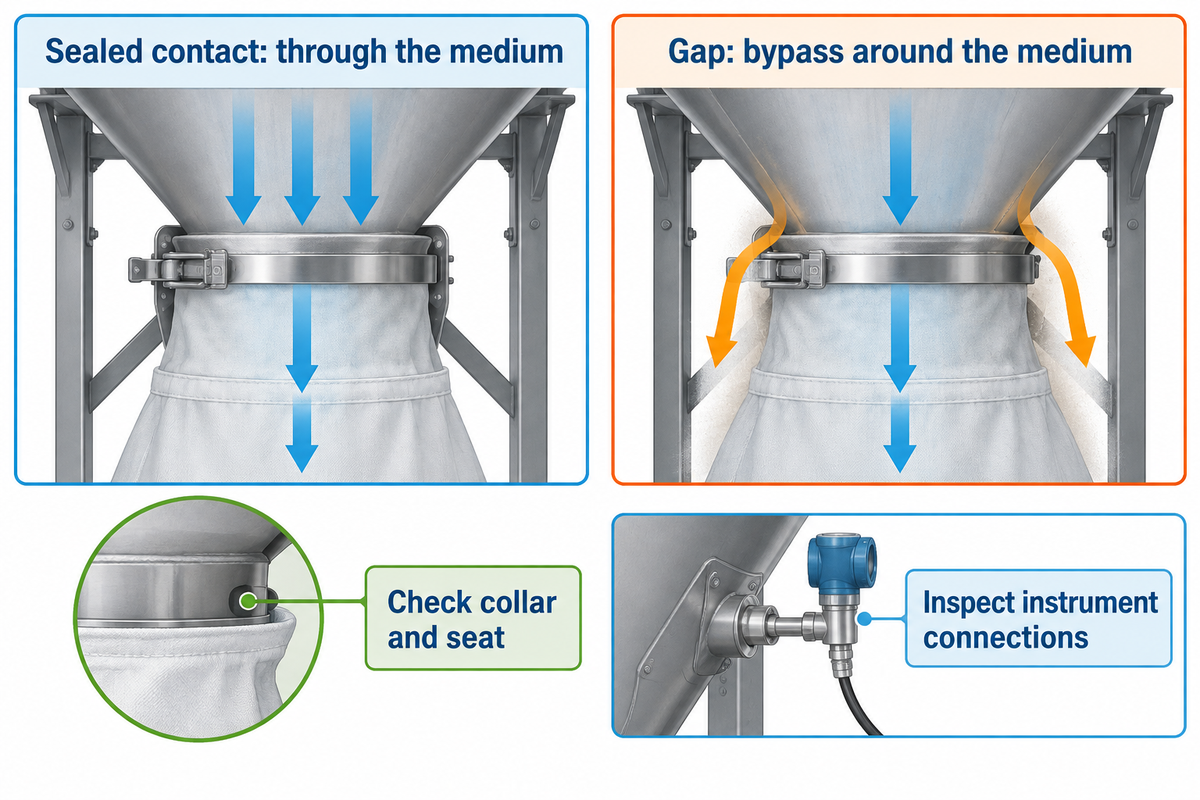
Housing fit includes the bag body, collar contact, support basket and vessel seat. A replacement bag can match a familiar size code, but may seal differently. Seal failure occurs when a particle slips through an unintended gap and bypasses the selected media, so changing the micron rating won’t repair that route.
Start with the appropriate housing model and bag drawing approved by the client. The body should fit in its basket with no unsupported folds or contact with a damaged edge. The collar should engage the seat. A molded flange and steel ring may require different interfaces; neither design is always better.
Signs of tearing, an uneven deposit of particulate matter around the mouth, displaced collar or unexpected clean area may be reason for further inspection, but don’t prove a failure mechanism. Instrument connections and bypass pipes are also in the scope of inspection.
Historical government verification discussed below relates to a pressure gauge path, not just a flow through filter medium. Current Virginia bag-and-cartridge filtration provisions employ pressure gauges with sampling taps before and after each filter medium. That is a useful observation pattern, although the rule applies to its specified drinking-water systems.
Flow, Viscosity and Differential Pressure
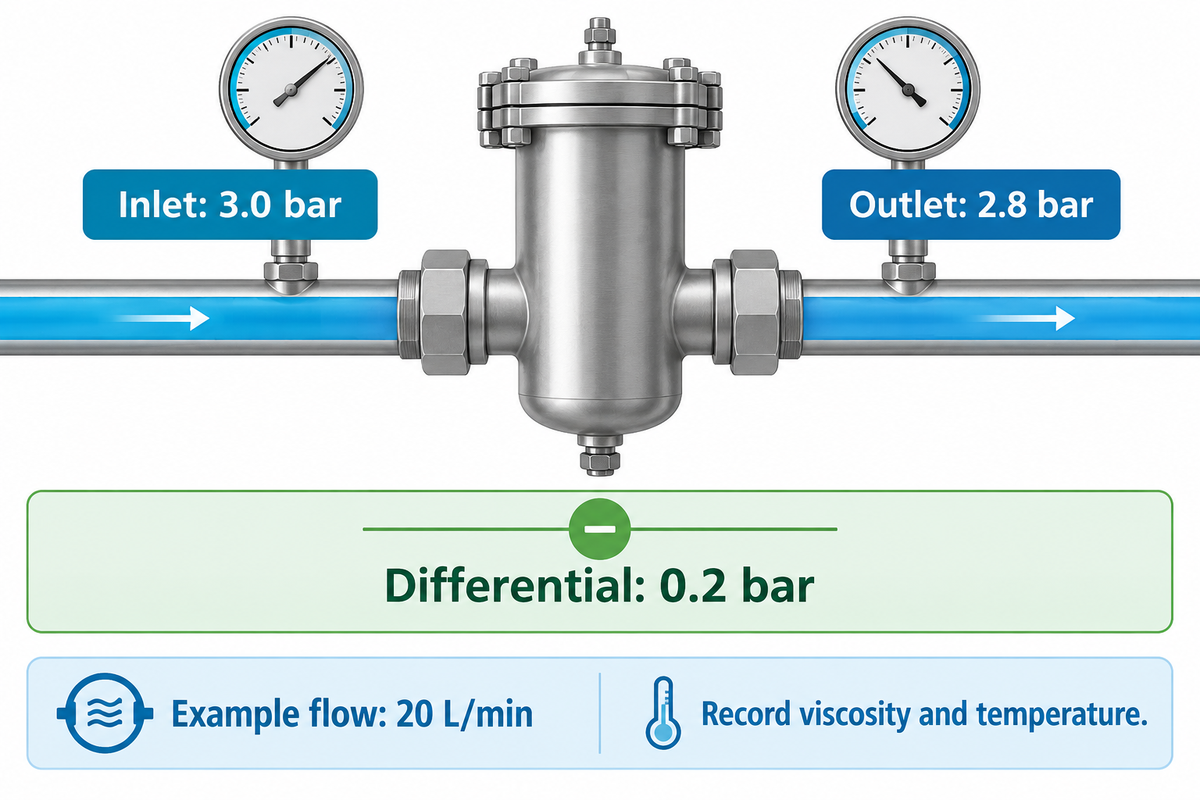
Differential pressure measures the resistance between two measurement points of the same fluid flow. What appears to be solids loading may be something else entirely and should be considered in the context of a trend with a comparable baseline.
Example: an inlet gauge reads 3.0 bar and an outlet gauge reads 2.8 bar at 20 L/min. Differential pressure is 3.0 minus 2.8, or 0.2 bar. If a later matched-duty reading is 0.6 bar, the increase is 0.4 bar. The change can’t be attributed solely to captured dirt if the property of the fluid or flow changed between the two readings.
More driving pressure is required for a given flow with increased viscosity. Viscosity can be modified by temperature. Different feed batches can change both the viscosity and solids. A flow curve for clean water thus requires the test temperature and the fluid prior to it being applied to another liquid. Jim Elsey’s Pumps & Systems article explains the importance of fluid properties and distinguishes clean and dirty pressures. It suggests strainer values that aren’t bag-filter limits.
Collected solids add a second changing structure. A soft cake can compact, and a collection of particles can form bigger agglomerates. More pressure may compress a deposit rather than increase the flow.
The measured-duty approach used by the US Department of Energy takes into account both the flow and head and the duty the system actually requires. For measurement, it means to record both flow and pressure, rather than rely on one pressure gauge and assume it provides a complete result. The existing inlet to outlet pressure calculation on the site does the subtraction.
A rise from 0.2 bar to 0.6 bar at the same 20 L/min is a different observation from a rise during a flow increase. A temperature record, such as 20 °C at the first reading and 40 °C at the second, flags another changed condition before the filter is blamed.
9-Observation Pressure, Quality Fault Map
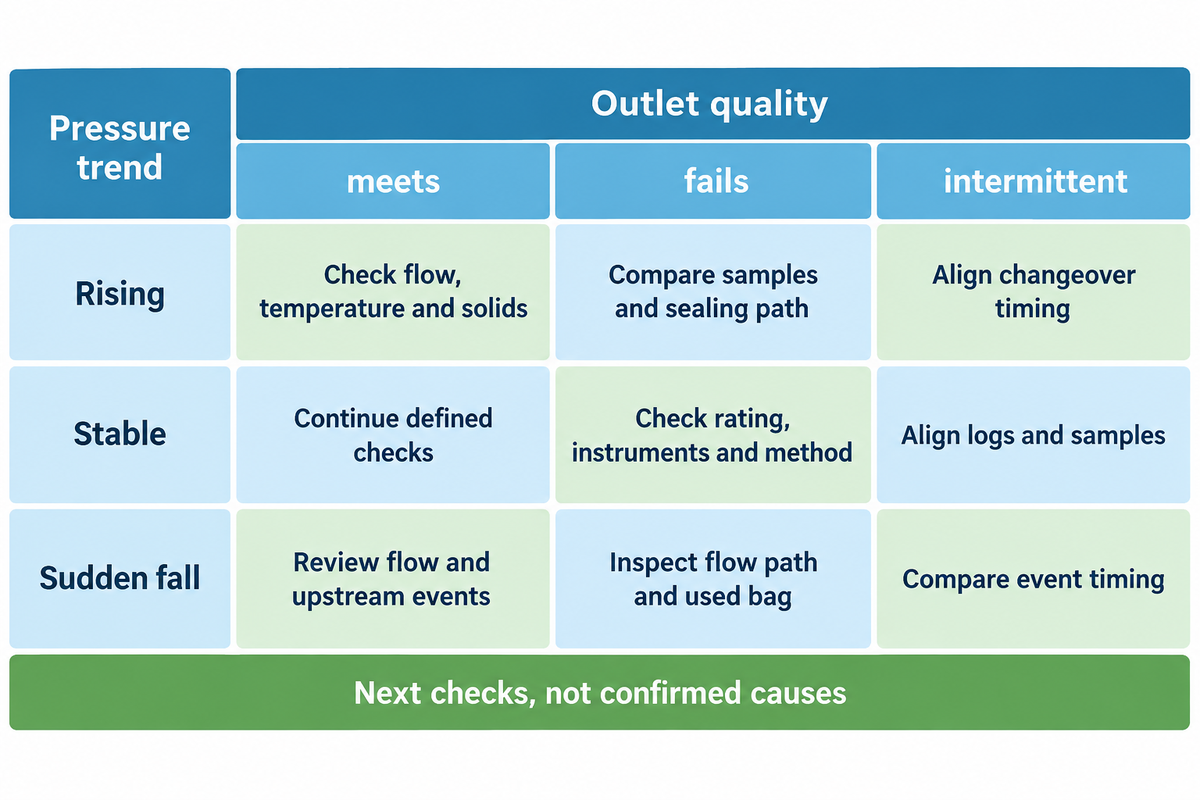
The 9-Observation Pressure, Quality Fault Map couples an observed pressure trend with an outlet quality result to determine the next check. It doesn’t resolve the root cause of the failure nor does it provide a probability failure assessment. A defined quality standard and time-aligned readings taken from the same operating period are to be used initially.
Quality might mean a particle count at a stated size, turbidity in the chosen reporting unit, visible defects under an agreed inspection, or a process-specific analytical limit. Those endpoints aren’t interchangeable. The US Geological Survey’s turbidity method description identifies several suspended and dissolved contributors to an optical reading. Keep the sampling location, handling and measurement method constant.
| Pressure trend | Outlet result | Possible explanation | Next observation |
|---|---|---|---|
| Rising | Meets endpoint | Loading, thicker fluid or increased flow | Compare inlet solids, flow and temperature with the clean baseline. |
| Rising | Fails endpoint | Loading plus retention loss, changed feed or bypass | Pair feed/outlet samples; examine the used bag and sealing path after isolation. |
| Rising | Intermittent failure | Feed pulses, startup effects or changing parallel-unit duty | Align sample times with flow changes and unit changeovers. |
| Stable | Meets endpoint | Consistent operation within the observed interval | Continue the defined pressure and quality checks; retain the run record. |
| Stable | Fails endpoint | Inadequate capture, a bypass or an analytical mismatch | Check rating basis, instrument connections and the chosen quality measurement. |
| Stable | Intermittent failure | Short events hidden by averaged pressure readings | Increase time alignment of logs and samples before changing media. |
| Sudden fall | Meets endpoint | Reduced flow, pump change or valve movement | Review actual flow and upstream events; do not assume the bag cleaned itself. |
| Sudden fall | Fails endpoint | Tear, displaced seal, instrument-path bypass or lower flow | Check the complete flow path and used element under the maintenance procedure. |
| Sudden fall | Intermittent failure | Unstable supply, air or a changeover event | Compare event logs, flow and sample timing across the transition. |
Synthesis of methods from the cited monitoring requirements and discussions of technical operation reveals a relative trend; the table provides no absolute pressure limit.
A historical EPA/NSF verification of a Rosedale bag-plus-cartridge system shows why the wider boundary matters. On January 20, 2000, three test trains had headlosses of 6 psi, 6 psi and 5.5 psi, with particle-count log reductions of 1.4, 0.81 and 1.4. The report attributed the poorer second train result to a faulty pressure differential gauge that allowed feed water to bypass into the filtered stream.
The two 6 psi readings didn’t represent the same removal result. This historical combined system case supports the examination of an instrument’s fluid path as well as the bag. It doesn’t establish a 6 psi changeout limit, predict a failure rate, or describe an ECOFILTRONE installation.
Bag Filters, Cartridges and Membranes in a Treatment Train
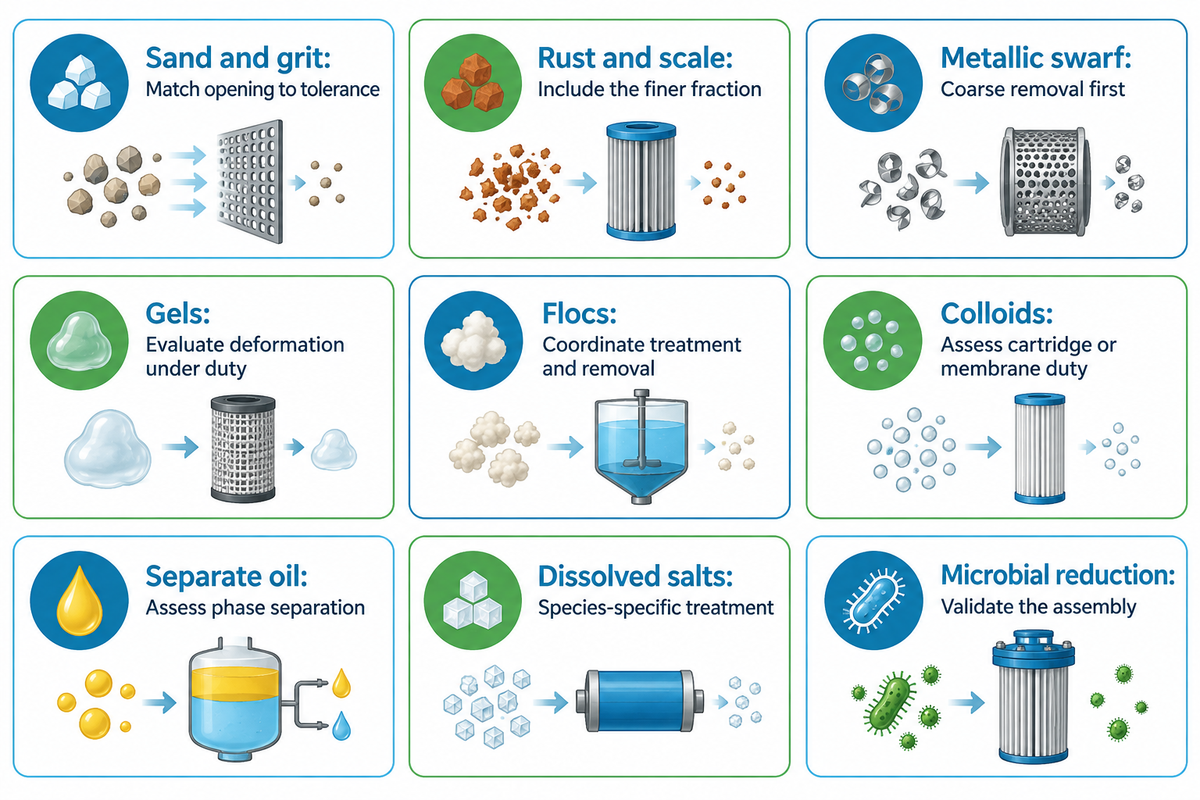
Bags, cartridges and membranes should be assigned a removal task, rather than arranged in an automatic, progressive, coarse-to-fine configuration. An upstream bag can reduce suspended loading on a later stage. A finer bag will not solve every dissolved-contaminant problem, and a membrane’s function must be identified by its type and tested duty.
| Material or task | Process direction | Boundary to retain |
|---|---|---|
| Sand and grit | Straining or bag capture | Relate the selected opening to downstream tolerance. |
| Rust and scale particles | Particulate filtration | Include the finer fraction and changing feed loading. |
| Metallic swarf | Coarse removal before finer collection | Magnetic separation addresses only responsive material. |
| Paint gels and soft solids | Evaluate capture under the process liquid and pressure | Deformation can change retention and cake resistance. |
| Flocs | Coordinate chemical treatment and solids removal | Handling can change the material being filtered. |
| Fine colloids | Evaluate a suitable cartridge or membrane stage | The ordinary bag label is not a colloid-removal guarantee. |
| Separate oil phase | Evaluate phase separation or a purpose-designed oil medium | Particulate capture and oil removal are different tasks. |
| Dissolved salts | Evaluate ion exchange, reverse osmosis or another species-specific process | A smaller ordinary bag rating is not desalination. |
| Microbial reduction | Use an assembly and treatment train validated for that objective | A generic micron number is not drinking-water validation. |
Task classification synthesized from the cited physical-treatment discussion and scoped bag/cartridge validation requirements.
Basket strainers can remove coarse debris before a fine element, but another stage also consumes available pressure. Cartridge construction can add area or a different retention path without making every cartridge superior to every bag. Microfiltration and ultrafiltration address different functions from reverse osmosis; the term “membrane” alone doesn’t specify dissolved-salt removal.
Changeout, Inspection and Reuse Decisions
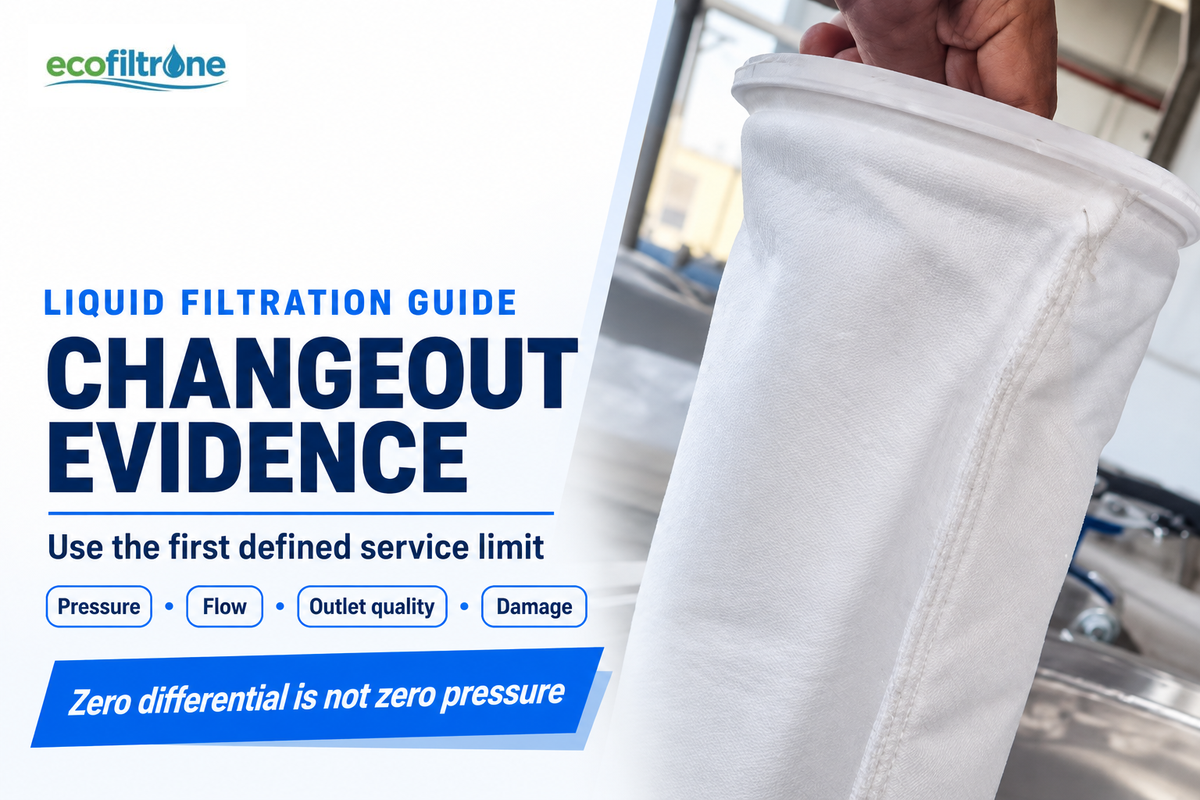
Changeout should follow the limiting endpoint for the bag, housing and process: the approved pressure condition, loss of required flow, an unacceptable outlet result, damage, or other service limit. A product maximum is not automatically a recommended changeout setting. The first limiting condition can occur before the bag appears full.
How often should filter bags be changed?
Filter bags should be changed when the defined pressure, flow or outlet condition endpoint is reached rather than after a universal number of hours. Establish the limiting endpoint for the actual assembly and process and note the reason for change. A planned replacement interval can assist changeout planning after a service pattern has repeated.
A dirty feed batch can shorten a run even with a replacement bag. Conversely a low flow can extend clock time and reduce production. Check the used element for irregularities, uneven loading, tears and abrasion, collar distortion and local deposits. These can help determine a loading issue. They’re most helpful with paired measurements taken before removal.
Opening requires isolation, depressurization and verification under the site’s maintenance procedure and housing instructions. Example: 3 bar upstream and 3 bar downstream gives 0 bar differential pressure, while both sides remain pressurized. The US stored-energy control provisions in 29 CFR 1910.147 address isolation and verification within their workplace-servicing scope. A zero differential reading isn’t an opening permit.
Reuse requires a product intended for cleaning, a compatible method of cleaning, and retention of performance. Washing out visible dirt does not establish restored retention or seam strength. Replace depth-media bags designed for single use; don’t assign a universal reuse-cycle count to mesh. Food and beverage service may impose additional process and contact-material requirements.
A 0 bar differential reading describes equality between two points. It says nothing by itself about either point’s pressure relative to atmosphere. Retaining that distinction prevents an otherwise useful filtration-performance log from being mistaken for proof that a vessel has been depressurized.
From Trial Data to a Replacement Decision
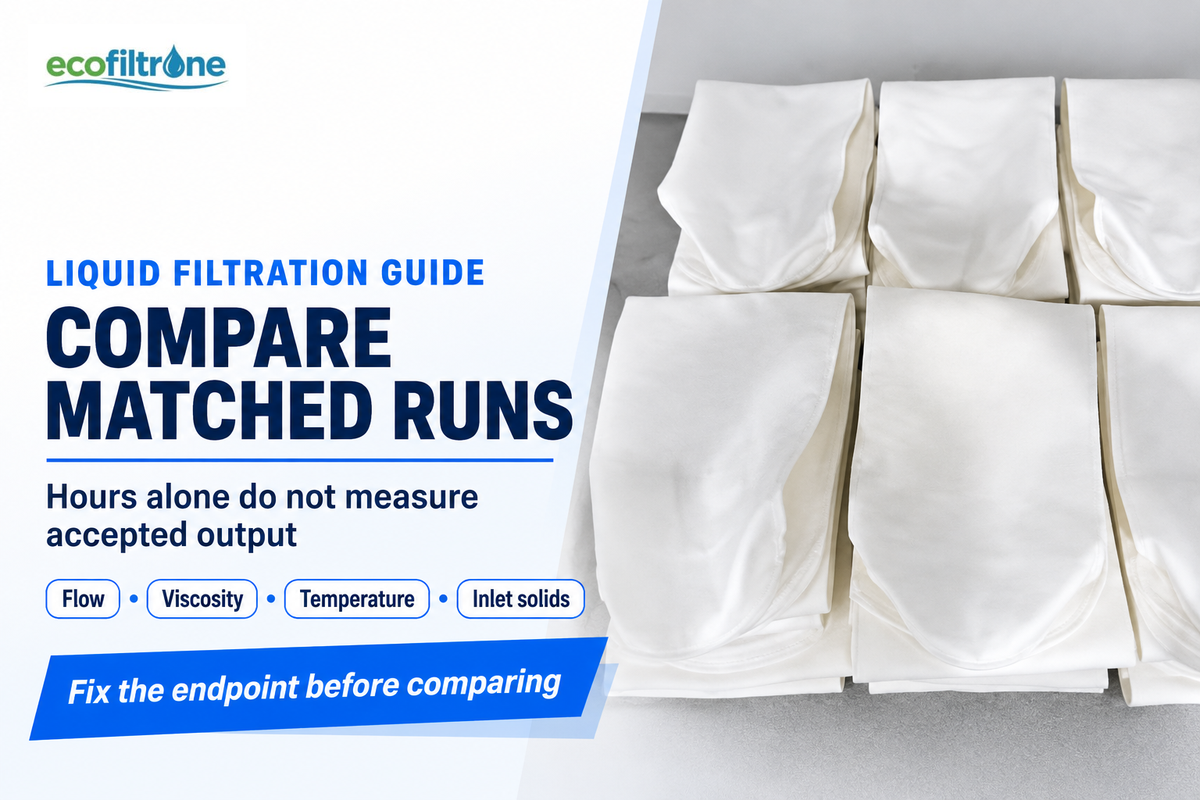
For a replacement comparison to be valid, the same end point needs to be accepted, and the comparable operating conditions have to be established, before the price or the service hours are evaluated. Keep the sample method the same, and compare complete bag-to-housing matches, and separate the starting resistance from the loading behavior. A successful trial results in the acceptance of liquid at the specified duty, with a recorded reason for stopping.
4-Confounder Trial Screen
The 4-Confounder Trial Screen checks flow, viscosity, temperature and inlet solids before attributing a run difference to the bag.
| Control | Record together | Why a difference matters |
|---|---|---|
| Flow | Actual flow and accepted volume | Lower flow can extend hours without increasing throughput. |
| Viscosity | Fluid identity and viscosity at the test condition | A thicker liquid changes resistance. |
| Temperature | Liquid temperature with the pressure reading | Temperature can change viscosity and material suitability. |
| Inlet solids | Loading, size distribution and contaminant form | A changed feed can change cake formation and run length. |
The four controls are a starting screen, not an exhaustive experiment. The quality metric, sampling protocol, housing arrangement and stopping rule also stay fixed. Sample processing itself can alter an analytical comparison, as the US Geological Survey’s filtration study showed for dissolved trace elements in natural water samples.
Example: assume constant flow and acceptable outlet quality throughout both runs. Run A processes 20 L/min for 8 h: 20 × 8 × 60 = 9,600 L. Run B processes 10 L/min for 12 h: 10 × 12 × 60 = 7,200 L. Run B lasts longer on the clock but produces less acceptable volume. For changing flow, sum the accepted interval volumes or use suitable totalizer records; keep rejected or unmeasured intervals separate.
Accepted volume is still not a direct measure of dirt capacity or total cost. Feed solids, retained mass, bag price, labor, interruptions and product loss, among other things, answer different questions. A lower purchase price can be useful only after the required product quality and duty have been matched.
- Define the endpoint: state the accepted outlet result, measurement method and stopping rule.
- Match the duty: fix the assembly and record the four controlled conditions.
- Compare the runs: separate clean resistance, loading behavior and accepted volume before deciding.
ECOFILTRONE supports application review, OEM replacement matching, specification checks and custom configurations for industrial filter bags. For replacement discussions, the process findings for the runs in question, along with drawings and details of the existing housing, can be useful. Product-specific PTFE media and assembly details can be relevant if the proposed change involves a different chemical or high-temperature duty.
At a constant flow of 20 L/min, an accepted 8 h interval means 9,600 L. This volume takes on meaning only with its flow and quality premises. Removing those premises turns a useful comparison into an unsupported claim about service life, loading capacity or savings.
What to Watch as Filtration Duties Change
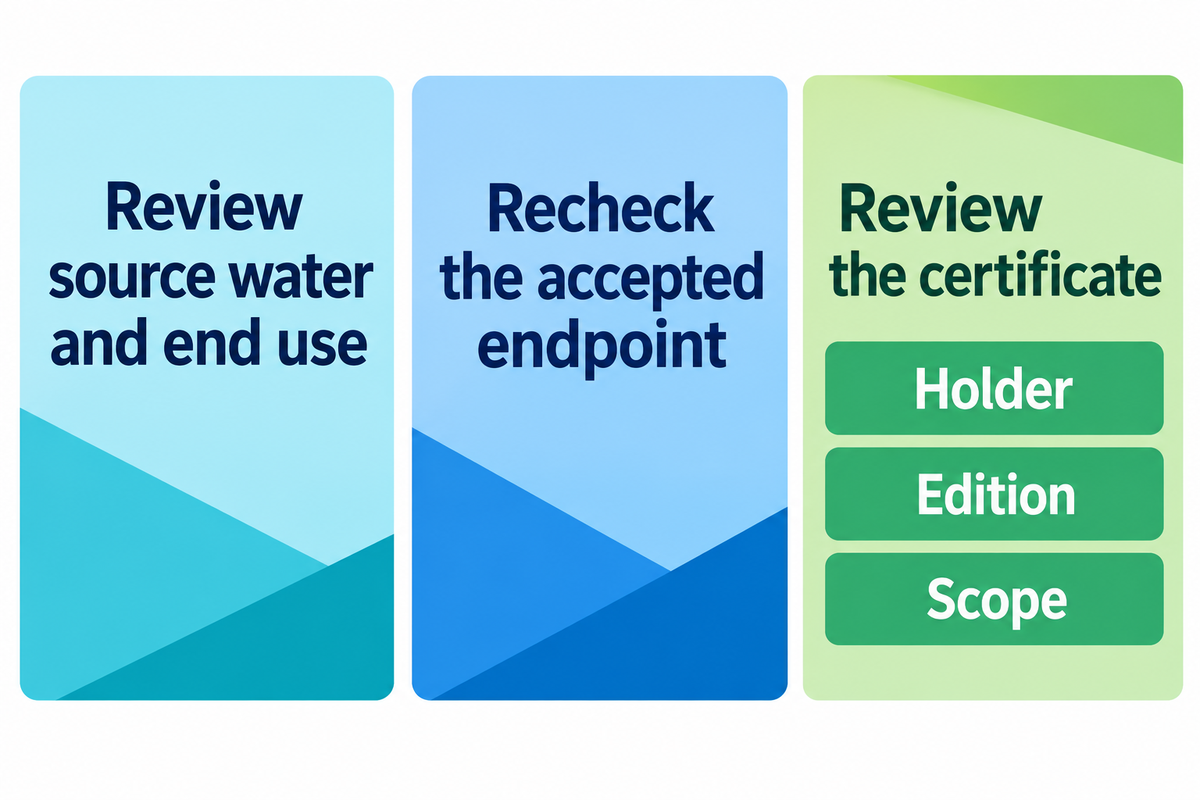
Updated sources, objectives and supplier records warrant a fresh examination prior to repeating a replacement duty. The right question to ask is what has changed: feed chemistry, solids, temperature, product-quality target or the supporting documents. The previous successful bag run describes the previous duty.
The US Environmental Protection Agency’s industrial water-reuse resource hub includes examples of manufacturing, energy production and supply and food and beverage production and cooling. Its current resources include a 2025 microbial-treatment-target framework and industrial reuse activity in 2026. Making a distinction between source water and end use is practical. The change of freshwater with some other source may change what’s present at the filter and what the next process requires.
It’s a reason to review the duty record, rather than an indication of how many filter bags a factory will consume. When the feed changes, check the accepted endpoint and compare with the previous one. Where a new contaminant is dissolved, adding a finer particulate bag may leave the relevant problem unchanged. If solids have increased, loading behavior and the pressure budget need re-evaluation.
Some of the supplier records have changed, as well. ISO announced ISO 9001:2026 on 16 September 2026. The official quality management system revision announcement does not mention a new universal particle-retention grade. A supplier review should maintain the actual holder of the certificate, edition, scope and status in addition to the product’s own technical evidence.
For any new initiative or campaign replacement, keep the following questions together in the technical confirmation: the specified bag, the required result, and the current supporting documents for each. An issuance of a standard doesn’t, by itself, name a supplier’s certificate edition or set an immediate transition deadline. Each process filtration application remains tied to its liquid, housing and required outlet result.
Liquid Filter Bags FAQ
What are bag filters used for?
Liquid bag filters remove suspended solids and can protect downstream equipment or filtration stages.
Typical tasks include collecting rust, scale, process debris and solids carried in industrial water or other compatible liquids. The chosen media must suit the contaminant and the fluid. A bag can serve as a prefilter, but dissolved salts, a separate oil phase and microbial targets may require different or additional treatment mechanisms.
What micron filter bag should I use?
Choose the rating that meets the defined outlet requirement at the required flow and accepted pressure condition.
Start with the unwanted particle range and the downstream process tolerance, then compare the bag’s retention test basis. A smaller printed number can increase resistance without correcting a collar bypass or a dissolved-contaminant problem. Use paired feed and outlet observations to judge capture rather than selecting the finest available label by default.
What is the most common filter bag size?
Size #2 is a common industrial catalogue format, often described as roughly 7 in diameter by 32 in long.
The size name is only a starting reference. Actual body dimensions, collar geometry and basket support must match the housing design. Suppliers can use slightly different dimensions within a familiar trade-size description. A bag that appears close in diameter or length can still seat incorrectly, leave unsupported material or create an unintended bypass path.
Should liquid filter bags be sealed?
The collar must seal at its intended housing seat while the bag body remains permeable to liquid.
The sealing interface directs feed through the selected medium. It does not mean closing off the entire bag or relying on the vessel lid to correct an incompatible collar. The ring, seat and support basket form one assembly.
Do water filter bags work?
Water filter bags work for suitable suspended-particle removal when the media, rating and housing match the duty.
Their success is judged against the required outlet result, flow and service endpoint. A visible improvement in clarity does not mean dissolved salts have been removed or that drinking-water microbial requirements have been met. Those objectives need the appropriate treatment process and, where applicable, validation of the complete assembly. Keep the feed conditions and quality measurement fixed when comparing replacement bags, because a changed water source can change both loading and the meaning of the result.
Do liquid filter bags expire?
Use the specified product’s shelf-life and storage instructions, and reject contaminated or storage-damaged bags.
An unopened package is not a substitute for the required storage conditions. Keep the product identity and batch information with the bag. Examine the media, seams, collar and packaging before installation; do not assign every construction the same expiry period.
Where are liquid filter bags manufactured?
The manufacturing location is specific to the ordered product and producer, and should be identified through its origin and production records.
ECOFILTRONE is an industrial filtration products supplier based in Qingdao, China. A supplier’s office address and the production site for a particular bag answer different questions. Product selection and technical confirmation should retain the actual manufacturer or facility information needed for the order, together with material and application records. Certifications also need the correct holder and scope; a brand name alone does not establish that a certificate covers the supplied product.
Key takeaway
A liquid filter bag comparison needs a defined removal task, a matched housing and a measured run. Keep flow, pressure and outlet quality together before changing the micron grade or ranking replacements by service hours.
Discuss the filtration duty
ECOFILTRONE helps with application review, specification checks, OEM replacement matching and customized filtration requirements. Technical confirmation can include datasheets, drawings, samples and the operating observations relevant to the selected product.
About this operating guide
ECOFILTRONE supplies liquid filter bags and other industrial filtration consumables, with support for selection and replacement matching. This guide explains capture, pressure and trial interpretation using the cited technical literature and clearly labelled arithmetic examples. Historical third-party tests remain attributed to their original systems; the examples aren’t ECOFILTRONE field-test results.
References & Sources
- Water Online: Industrial Water Treatment for Inorganic Contaminants – Mark Reinsel, 2016.
- National Taiwan University: Effect of calendering of filter cloth on cake filtration – original research abstract, 2006.
- Chalmers research record: Nonlinear filtration behavior of soft particles – original research abstract, 2011.
- Frontiers in Chemistry: Multi-Layer Filters, Adsorption and Filtration Mechanisms – Onur and colleagues, 2018.
- ASTM D543-21: Resistance of Plastics to Chemical Reagents – public scope and significance.
- National Institute of Standards and Technology: Metric SI Prefixes.
- 40 CFR 141.719: Additional Filtration Toolbox Components — bag-and-cartridge challenge-testing provisions.
- Virginia Administrative Code 12VAC5-590-883: Bag and Cartridge Filtration.
- Pumps & Systems: Best Practices for Strainer Location, Jim Elsey, 2019.
- US Department of Energy: Match Pumps to System Requirements – Pumping Systems Tip Sheet 6, 2005.
- US Geological Survey: National Field Manual, Turbidity – Method Description, 2005.
- EPA/NSF: Rosedale Bag and Rigid Cartridge Filter System Verification Statement – Historical combined system testing.
- 29 CFR 1910.147: Control of Hazardous Energy – maintenance scope, stored energy and isolation verification.
- US Geological Survey: Filtration and Dissolved Trace-Element Measurements – original research abstract, 1996.
- US Environmental Protection Agency: Industrial Water Reuse Resources.
- International Organization for Standardization: ISO 9001:2026 Publication Announcement — 16 September 2026.