Get in touch with ECOFILTRONE™ Company



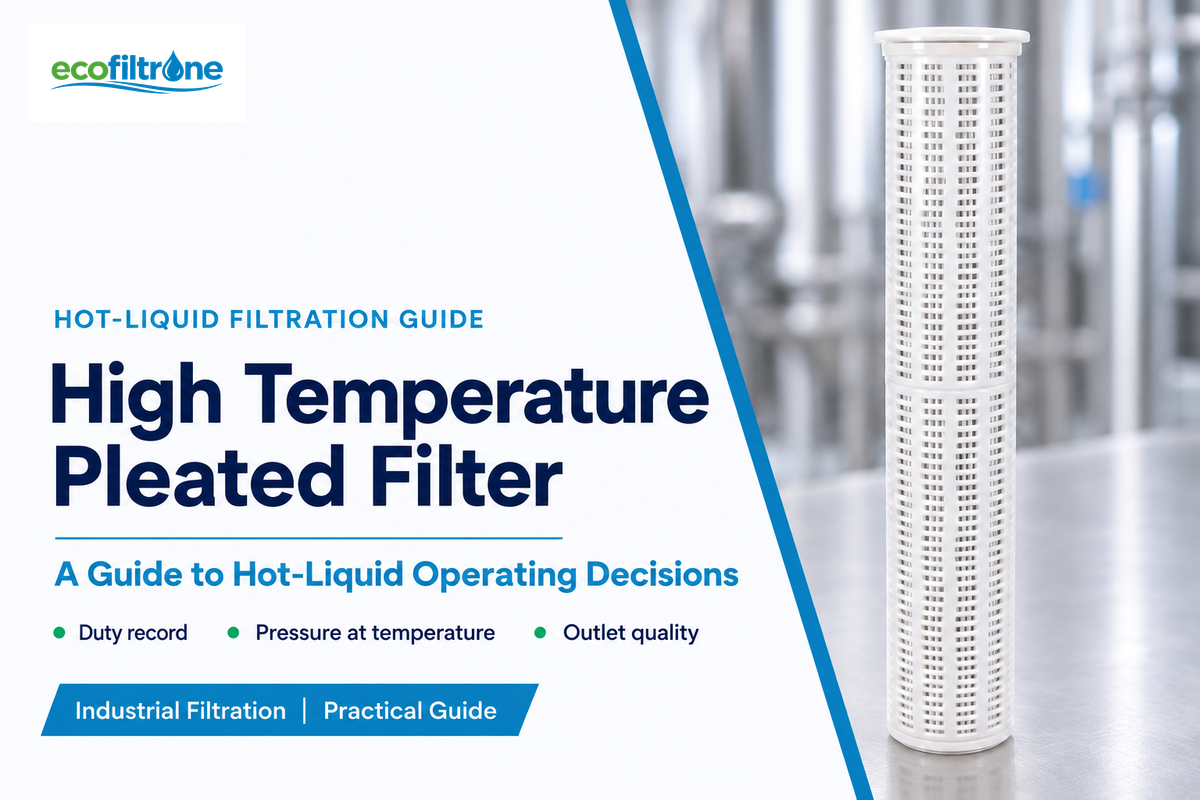
A High Temperature Pleated Filter for Liquid Service is a pleated cartridge with a complete construction that meets the requirements of the process fluid and operating conditions. Typically, the selection of one starts with an assessment of the operating state, that is, the state of the fluid, the requirements for particle removal and the cleaning cycle. Membrane identity and an air filter’s heat rating, however, leave much of this decision unanswered.
Quick checks for liquid service
- Duty: continuous filtration, brief excursion and cleaning exposure recorded separately.
- Assembly: membrane, support, core, cage, joints, end caps and seals.
- Pressure: line pressure, measured differential pressure and direction-specific limits kept distinct.
- Acceptance: required outlet quality at the intended flow and fluid condition.
A High Temperature Pleated Filter needs a liquid-compatible assembly and a pressure limit stated at the working temperature. Separate continuous duty from steam cycles, then compare flow, pressure drop and outlet quality under the approved process conditions.
Key points
- Separate maximum temperature and maximum pressure entries aren’t a combined operating point.
- Steam-rated cartridges still need a continuous-duty rating for the intended fluid.
- A lower pressure drop can follow a process change; it doesn’t automatically mean better filtration.
- Useful trials record outlet quality as well as mechanical fit and pressure.
High Temperature Pleated Filters: Liquid Cartridges vs Air Panels
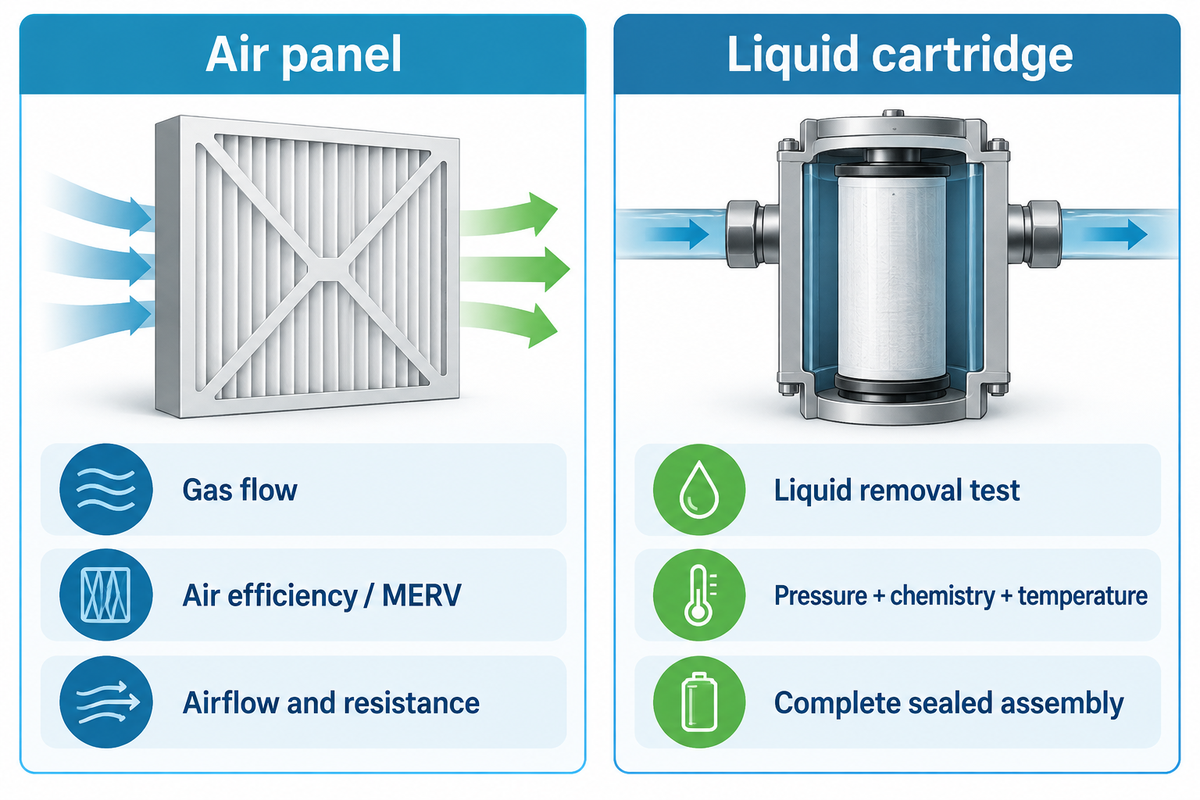
Liquid cartridges and high-temperature air panels answer different filtration needs. Air panels capture airborne particles through a framed medium; liquid cartridges work inside a housing with fluid-contact components and seals. Begin a liquid comparison with the process fluid, the required removal performance and the operating conditions, rather than an air-efficiency classification.
A concrete example is Parker’s Hi-E® 40 H air-filter datasheet, which says the “filter is a medium efficiency pleated filter specially constructed for use in systems involving elevated operating temperatures.” That description identifies a framed air-service product; it does not establish a sealed liquid cartridge’s operating envelope.
When filter media is pleated, the folds increase the medium’s area within a given package. The surrounding construction determines how that area is supported and sealed. An air filtration panel may have a steel frame and fiberglass media, while a liquid filter designed for chemical service may use a membrane with a polymer core, end fittings and O-rings.
Air-panel duty
- Gas flow through a framed panel.
- Air-efficiency results such as MERV.
- Airflow and resistance at the stated test conditions.
Liquid-cartridge duty
- Liquid flow through a sealed cartridge assembly.
- Particle-removal efficiency under a stated liquid test.
- Pressure, chemistry and temperature for the complete assembly.
MERV is an air-filter efficiency classification. Liquid specifications must provide the particle size, efficiency basis and test conditions. Our guide to interpreting a micron rating provides more detail on why a micron number, as provided, isn’t sufficiently clear and may leave the user to interpret the removal requirement.
A maintenance buyer at an automotive plant replacing a hot water cartridge may receive an offer for a high temp pleated air filter because the folded medium looks similar. The offer should immediately leave the liquid comparison. A drawing to show how the cartridge seals in the housing will help. A comparable example would be the HSE’s pressure equipment guidance. It also starts with a discussion on equipment suitability and the fluids in conjunction with safe operating limits. HSE considers the complete system and context, keeping a heat-resistant medium from being mistaken for a complete hot-liquid assembly.
Continuous Temperature, Peak Exposure and Steam Cycles
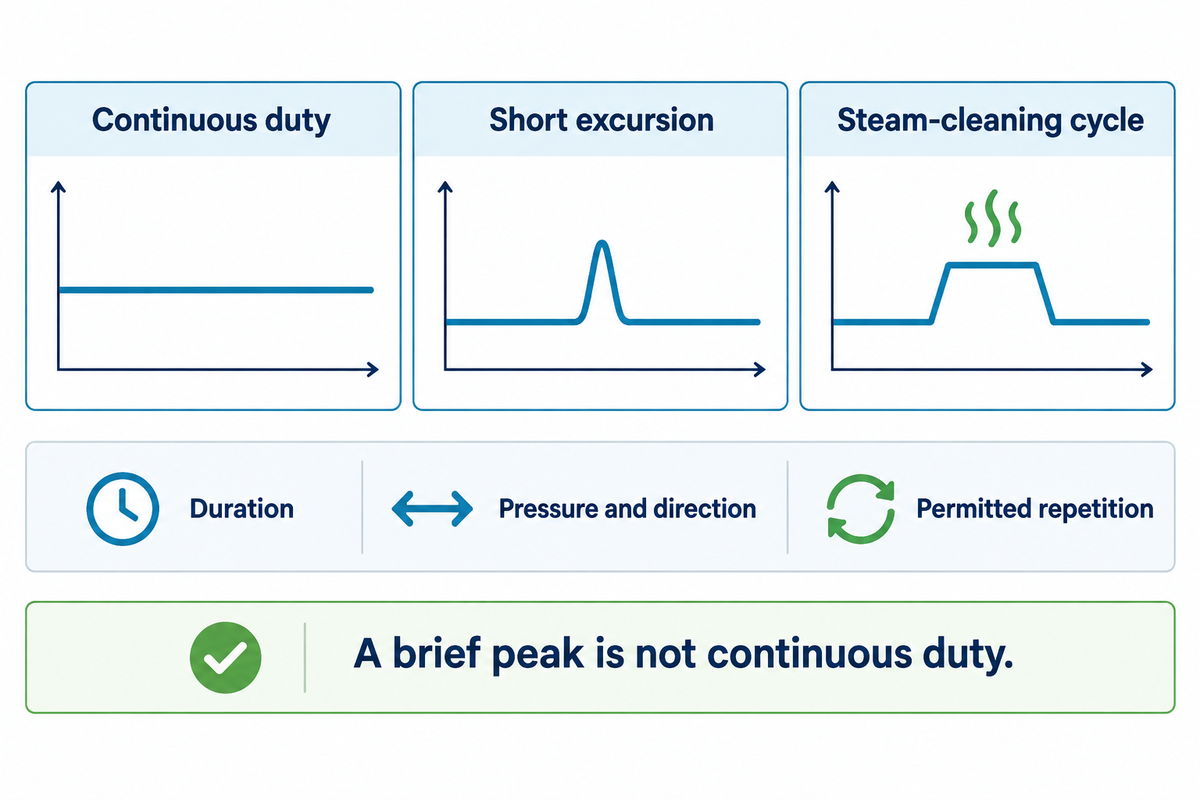
Continuous temperature, a short excursion and a steam-cleaning cycle are separate service conditions. Each needs its own duration, pressure, flow direction and permitted repetition. Match the cartridge to the conditions encountered during production and cleaning; a brief high-temperature exposure doesn’t establish the same continuous liquid duty.
Pall’s Emflon PFRW gas-filter datasheet separates continuous gas service from autoclave and steaming conditions. That gas-only example shows why the headings and footnotes matter. Pall lists direction-specific steam differential-pressure conditions rather than a universal zero-pressure rule. The hotter steam entry belongs to a specified exposure, not to an unrestricted liquid operating temperature.
Hot-State Duty Record
The Hot-State Duty Record allows us to capture data from operations and use it during selection. This record carries information related to normal filtration, excursions, and cleanings to ensure that every temperature is captured with regard to its pressure, duration and fluid.
| Record field | What to enter | Decision it changes |
|---|---|---|
| Operating state | Normal filtration, startup, excursion or cleaning | Which rating applies |
| Process liquid | Composition, concentration and relevant contaminants | Chemical compatibility |
| Temperature | Normal value and each excursion in °C | Continuous versus short exposure |
| Duration | Time at each state in minutes or hours | Permitted exposure |
| Repetition | Cleaning events and expected thermal cycles | Cumulative duty |
| Flow | Required rate and start/stop pattern | Hydraulic comparison |
| Pressure boundary | Inlet and outlet readings with tap locations | What the measured drop includes |
| Flow direction | Forward operation and possible reverse events | Which structural limit applies |
| Cleaning chemistry | Agent, concentration, temperature and rinse condition | Compatibility beyond production fluid |
| Outlet requirement | Particle/quality acceptance and sampling method | Whether the filtrate meets the process need |
For example, let’s say we have an approved process that filters a warm liquid continuously and receives a separate cleaning treatment.
In some cases, the membrane can survive the brief exposure to the cleaning temperature, and an unsuitable assembly can be chosen when purchasing only against the cleaning temperature. Production hours, cleaning time and repeated starts have to be shown separately on the duty record. An acceptable condition for cleaning requires a compatible seal and housing. The review by the supplier then considers the overall sequence instead of a single peak on a thermometer.
Global Filter’s GPFA Datasheet has the maximum temperature at 185 °C with a differential pressure of 4.1 bar at 20°C listed separately. Those entries illustrate the reading problem: the 20 °C pressure value isn’t a pressure allowance at 185 °C. Without a hot pressure limit, selection has to be made with the operating envelope before service.
A high temp pleated filter still requires a complete duty description. High-temperature filters are exposed to both production and cleaning, and extreme temperatures must be defined with a value and duration. The phrase high-temperature environments is too general to define an assembly.
Media, Hardware and Seals: Compare the Whole Assembly

Compare a high-temperature liquid filter as a complete assembly. The medium, supporting layers, core, cage, end caps, joints and seals all contact or support the process. Even a compatible membrane can arrive in an unsuitable assembly if its hardware, bonding system or seal doesn’t suit the same chemistry and operating temperatures.
Parker’s Fluoroflow Select uses all-fluoropolymer construction, while Pall’s Emflon PFRW combines PTFE membranes with polypropylene support and hardware. These are different products for different duties, not a controlled comparison of polymers. The practical lesson is to read the complete bill of materials rather than transfer a resin’s advertised heat resistance to a cartridge.
| Component type | Role in the assembly | Condition to match | Useful selection record |
|---|---|---|---|
| Membrane or filter medium | Provides the required separation | Fluid chemistry and retention endpoint | Medium identity and test basis |
| Support layer | Supports the pleated medium | Hot fluid and repeated exposure | Support material |
| Drainage layer | Provides flow paths | Flow distribution and contamination | Layer construction |
| Core | Supports the inner flow path | Forward differential pressure | Core material and supported limit |
| Cage | Supports the outer geometry | Handling and reverse differential pressure | Cage construction |
| End cap | Locates and seals the cartridge end | Hot geometry and housing fit | Drawing and material |
| Joint or bond | Connects the assembly | Production and cleaning chemistry | Joining method |
| O-ring or gasket | Seals the housing interface | Fluid, temperature and compression | Exact seal grade and dimensions |
| Adapter | Matches the housing connection | Locking arrangement and thermal movement | Adapter code and drawing |
| Assembly cleanliness | Limits added contamination | Purity-sensitive process requirements | Applicable cleanliness/chemical-release records |
PBT is a polymer designation, while glass fiber names a different material. For a PBT/glass-fiber construction, identify the medium and every supporting component from the specific assembly description. Apply the same chemistry, retention and cleaning review when comparing a metal element with a polymer-supported cartridge.
PTFE wetting deserves a separate check. Entegris’ hydrophobic liquid-filter manual describes prewetting for most aqueous chemicals and flushing before process exposure. Prewetting is a use procedure, not a statement that the membrane has received a permanent hydrophilic treatment. Use the relevant product procedure: solvent choice, flushing and chemical transitions introduce compatibility and safety requirements of their own.
For a polypropylene-based alternative, the polypropylene cartridge construction guide covers its material and operating context. The glass-fiber cartridge guide addresses a different media route. Neither a fiberglass medium nor a stainless steel component, by itself, sets the complete cartridge’s hot operating limit.
Purity-sensitive food processing, pharmaceutical and high-purity-water duties also need attention to what the assembly can release into the liquid. Particle retention and chemical cleanliness are different acceptance questions. Include the application-specific extractables, leachables or flushing requirement where relevant; dimensional fit alone doesn’t settle either.
GPFA’s 185 °C maximum temperature belongs to its documented PTFE/PFA assembly, including the specified seal construction. Replacing the support or O-ring creates a different assembly configuration. Carry the complete material identity into the comparison, so the medium’s chemistry doesn’t stand in for the cartridge’s operating envelope.
Compatibility checks include corrosion for metallic components and evaluation of polymer parts and joints. Components must withstand the approved production and cleaning sequence. Heavy-duty descriptions can’t replace the selected assembly’s pressure temperature information.
Differential Pressure: Read the Hot Operating Point
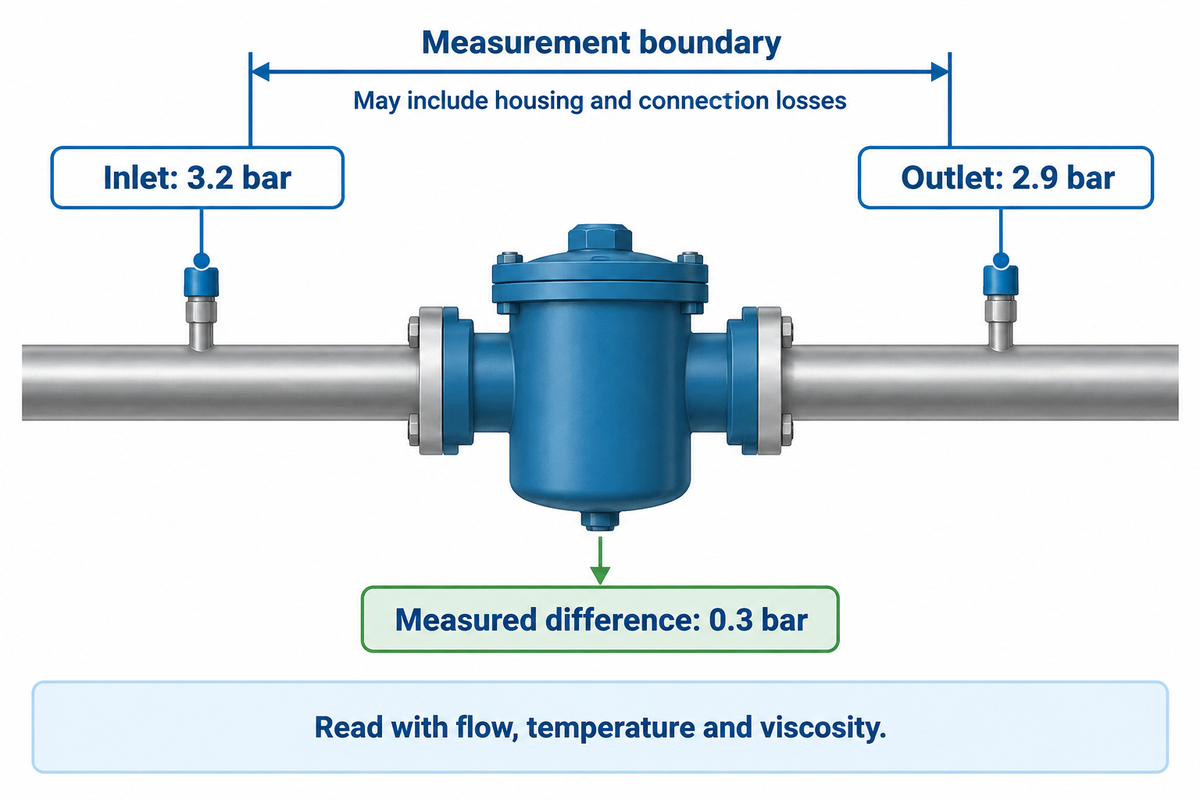
Differential pressure is the difference between the measured inlet and outlet pressures. Interpret it alongside temperature, flow, viscosity and the measurement boundary. Keep the housing’s line-pressure limit separate from the cartridge’s differential-pressure limit, and distinguish both from the planned changeout setpoint and the clean starting pressure drop.
Example: a process log shows 3.2 bar at the inlet and 2.9 bar at the outlet. Subtraction gives a measured differential pressure of 0.3 bar. That result describes the two tap locations. If they span the housing and its connections, the reading includes those losses; it isn’t automatically the pressure drop across the medium alone. Safe operation uses the applicable assembly and housing limits at that temperature.
ISO 3968:2017 evaluates differential pressure versus flow for hydraulic filters, including different viscosities. Its measurement scope is a useful reminder to compare like conditions. Cold-water curves and hot process-liquid readings need a fluid-appropriate comparison rather than a direct visual match.
The following manufacturer example keeps every pressure number beside its temperature and direction. It’s a data-sheet reading exercise, not an ECOFILTRONE specification table.
| Published option and direction | Temperature | Maximum differential pressure |
|---|---|---|
| Standard, forward | 24 °C | 5.5 bar |
| Standard, forward | 75 °C | 3.8 bar |
| Standard, forward | 125 °C | 2.0 bar |
| Standard, forward | 150 °C | 1.0 bar |
| HT option, forward | 24 °C | 6.8 bar |
| HT option, forward | 75 °C | 5.1 bar |
| HT option, forward | 125 °C | 3.4 bar |
| HT option, forward | 180 °C | 1.0 bar |
| Reverse, as listed | 24 °C | 3.4 bar |
| Reverse, as listed | 121 °C | 1.0 bar |
Source: Parker Fluoroflow Select 2025 data sheet. The forward HT option is listed for 4-,10- and 20-inch lengths. Use the named configuration and its published conditions; don’t interpolate a new operating point from this table.
Temperature can change viscosity, and a changed flow can alter resistance. Consequently, a lower hot-state pressure drop may reflect changed fluid or demand while the contamination load stays similar. Read the trend with flow and outlet quality. Purchasing comparisons based on pressure drop alone can reward a cartridge that passes more unwanted material. Compare filtration efficiencies in an operating environment matched to the relevant fluid and sampling basis.
At 150 °C, Parker publishes 1.0 bar for the standard forward option; at 180 °C, the 1.0 bar entry belongs to its HT option. Pressure values become useful when the named configuration and temperature stay attached. The selected changeout limit remains a separate operating decision below the applicable structural constraint.
High-density pleat arrangements also need a usable flow path. Compare the specified assembly’s hydraulic data and removal performance rather than treating tightly packed media as a performance rating.
A Hot-Liquid Trial That Separates Fit from Performance
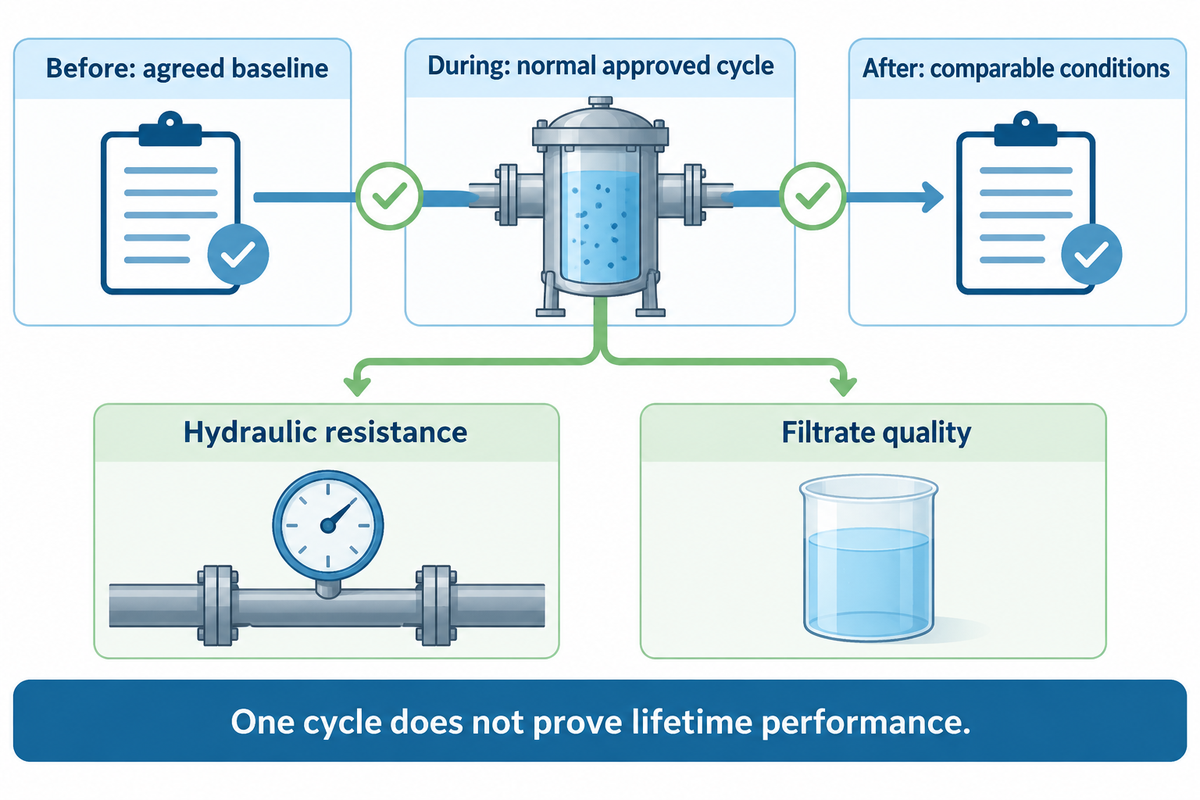
A useful hot-liquid trial checks whether the cartridge fits, whether the system remains within approved conditions and whether the filtrate meets its agreed quality requirement. Record those outcomes before, during and after a normal approved process cycle. Acceptance needs a defined sample method and operating context, not just a cartridge that installs easily.
Return-to-Baseline Trial
The Return-to-Baseline Trial assesses operating and outlet quality records before and after a normal process cycle. It is executed under comparable conditions and prior approval, after the plant and supplier agree the exact cartridge configuration, the existing safe operating envelope and the required outlet result. Baseline records include the condition of the process fluid, flow rates, inlet and outlet pressures, and sampling locations. During the normal process cycle, the observer captures temperature states and various operating conditions. Upon return to comparable conditions, the same observations are made to see if there has been a shift in performance.
An apparent improvement may vanish when conditions are matched. For example, an operator records a lower pressure drop across the cartridge element after a hot cycle, but the pump is delivering less flow than before. Considering the two readings together can mix a process change with a cartridge change. Returning to the agreed baseline removes the ambiguity; the outlet sample, then, addresses if the required separation has been maintained. The comparison is to make an acceptance decision for that service duty. It is understood that one run of a hot cycle does not guarantee lifetime performance.
Flow and thermal cycling are to be captured and recorded separately. Evaluation of hydraulic filter elements under cyclic flow, contaminant capacity, particle removal and element differential pressure is in ISO 23369:2022. For a process trial, record the starts and stops of the pump and pulsations. The relevant product and process procedures dictate what is done with these events and what actions are taken.
The 2020 cartridge study by Farhat and colleagues states the comparable evaluations of water quality, water production and operating costs.
While its large-scale seawater application is different from hot-liquid filtration, the multi-outcome approach is beneficial: a longer run is only relevant as long as the required output is acceptable.
A 0.3 bar reading calculated from 3.2 bar inlet and 2.9 bar outlet has a clear meaning only at the recorded flow and fluid state. Making that pressure reading along with an agreed sample from the outlet gives the trial two observations: hydraulic resistance and the quality of filtrate. Neither observation replaces the other.
Filters offer a good result when the agreed requirement from the outlet is satisfied at the operating condition. Reliable performance is assessed against that requirement. Specially designed adapters may solve a fit issue, leaving the question of compatibility of the material and retention open.
Troubleshooting Pressure Drop, Bypass and Short Runs
A changing pressure drop is an observation, not a complete fault diagnosis. Start with process changes, instrument readings and outlet quality. Loading, changed viscosity, altered flow, wetting problems, bypass and damaged media can produce different combinations of symptoms. Keep suspected leakage or damage within the site’s isolation, cooling and maintenance procedures.
“Has anything changed in the application?”
Bodle and Jett point out an unexpected differential pressure drop without a decrease in process demand or a drop in process flow as a possible indication of a breakthrough or of the media failing. The use of conditional wording is important. A decrease in process demand can also lead to a drop in pressure. Measurements of pressure alone don’t confirm particle retention.
For an aqueous process, poor initial wetting of a hydrophobic membrane can resemble an oversized hydraulic restriction. Entegris’ manual addresses that startup issue through product-specific wetting and flushing instructions.
| Observation | Context to inspect | Next decision |
|---|---|---|
| Pressure rises gradually | Comparable flow, temperature and liquid | Review loading against the approved changeout criterion |
| Pressure rises after cooling | Viscosity and process demand | Compare at the documented fluid condition |
| Pressure falls unexpectedly | Flow, bypass position and outlet quality | Investigate a changed process or possible loss of filtration |
| Clean starting drop is high | Flow, installation, wetting and housing losses | Resolve the starting condition before judging service life |
| Runs become shorter | Upstream contamination and changed chemistry | Review the full process record |
| Visible leakage or suspected damage | Site alarm and isolation procedures | Take the system out of service through the approved procedure |
There’s no point in increasing pressure to force a dry membrane through an uncertain situation as a substitute for performing the correct preparation procedure.
Disposable and washable are different service descriptions. Cleaning a cartridge requires an allowed method and a way to judge the restored filtration performance. Lower pressure drop after cleaning does not mean restored retention. Likewise, repeated short runs may provide justification for upstream separation or a different filtration arrangement rather than a more heat resistant replacement.
Global Filter lists 35 psid as the GPFA recommended changeout differential, separately from the 60 psid maximum differential at 20 °C. Different entry, different purpose. The plant’s approved operating criteria must fit the selected assembly and duty; a structural maximum is not automatically a target for routine changeout.
Filter life must be recorded with the reason the run ended. Attempts to reduce maintenance by extending an interval still require the same acceptable output. High-efficiency separation and a low starting pressure drop answer different performance questions.
Operating Records for Cost and Replacement Decisions
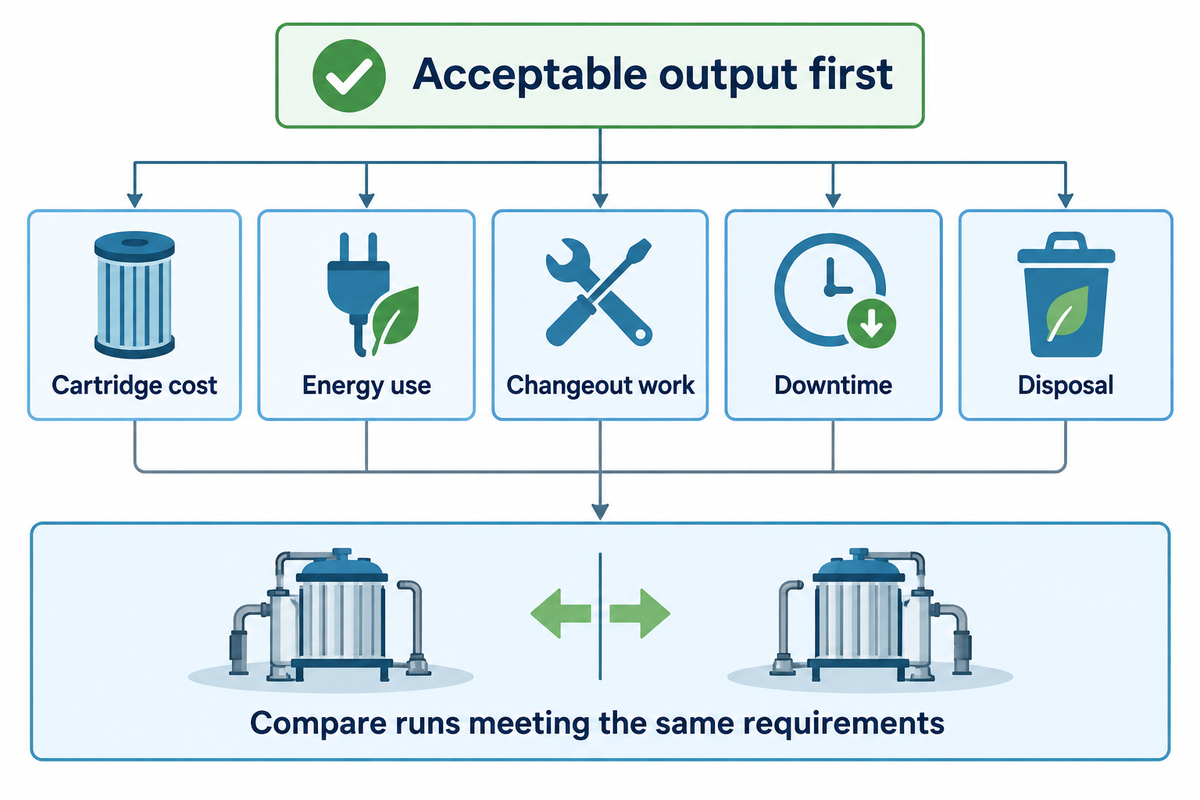
Replacement decisions work best when maintenance, quality and procurement share the same duty record. Compare cartridge cost alongside acceptable output, energy use, changeout work, downtime and disposal. Filtration helps protect processes by maintaining the required liquid quality. Longer runs and lower purchase prices are useful only when the compared runs meet the same production and quality requirements.
Farhat and colleagues’ 2020 desalination study found that higher energy cost could favour more frequent cartridge replacement. The conclusion challenges the assumption that the longest possible run is always the least expensive. Its historical tariffs and reported savings belong to that installation; the transferable question is how rising resistance changes the plant’s own operating cost.
The pump life-cycle cost executive summary by the U.S. Department of Energy, Hydraulic Institute and Europump similarly compares alternatives on a consistent output basis and includes energy, maintenance, downtime and disposal. For a cartridge review, retain the plant’s measured data and cost records rather than importing a pump-system life expectancy or an old tariff.
Maintenance owns the operating and changeout history; quality owns the outlet acceptance and sampling basis. Procurement carries those agreed fields into the replacement request with the current part drawing and quantity. That handoff helps an engineer distinguish a dimensional replacement from an equivalent filtration result.
Key takeaway
Choose the complete cartridge against the recorded hot-liquid duty. Preserve the pressure-temperature pairing, agree the outlet requirement and compare replacement runs at comparable conditions.
ECOFILTRONE™ supports application review, specification verification, replacement matching and customized filtration requirements. For specific configuration and quotation, use the high-temperature cartridge solution page. Carry the completed operating record into that discussion, including normal and cleaning exposure, pressure conditions, flow, seal configuration and the required filtrate quality.
Broader comparisons of construction routes start with ECOFILTRONE™ pleated filter cartridges. Our technical-support discussion can then focus on the actual operating requirement and the applicable product documents.
Review a hot-liquid replacement
Bring the duty record, existing cartridge drawing and outlet requirement. ECOFILTRONE™ can help check the proposed configuration and replacement match.
Frequently Asked Questions
Are pleated water filters better?
Pleated cartridges are useful when the required particle removal and process conditions suit their construction.
A pleated cartridge puts folded filter media into a compact element, but the useful result is acceptable filtrate at the required flow. Compare the stated removal efficiency, contaminant load and clean pressure drop with the alternative. A depth cartridge or an upstream solids-removal stage may suit a different loading pattern. For hot water, the complete assembly and seal need the appropriate continuous-duty conditions as well. Pleat area alone is a poor basis for choosing between them.
How do you clean pleated filters?
Clean a pleated filter only when its manufacturer permits cleaning and specifies an appropriate method.
The method needs to match the medium, assembly, process residues and housing. Follow the site’s isolation, cooling and depressurization procedure before maintenance. After an allowed cleaning process, evaluate both flow resistance and the required filtrate quality under comparable conditions. A disposable cartridge should be replaced rather than assumed washable. Repeated cleaning also belongs in the service history because the cleaning chemical and its temperature add another exposure to the assembly.
When should high temperature pleated filters be replaced?
Replace them at the approved changeout condition or when the required filtration result or assembly condition becomes unacceptable.
Track the pressure trend together with flow, temperature and outlet quality. The operating criterion should be established for the selected cartridge and process, rather than copied from another manufacturer’s structural rating. An unexpected change deserves investigation even when a calendar interval has not elapsed. Retain the reason for each replacement, including loading, outlet failure, a process change or scheduled maintenance, so the next service-life comparison uses a consistent basis.
Does a higher micron rating mean better filtration?
No. A larger micron number generally refers to a larger stated particle size, not better removal.
Compare the efficiency and test basis at the required particle size. Nominal and absolute descriptions also need their supporting definitions. Select against the process’s outlet requirement rather than the number alone.
Can a steam-rated cartridge run continuously at the steam temperature?
No. A specified steam exposure and a continuous process-fluid rating describe different duties.
Read the steam condition with its duration, cumulative exposure, direction and permitted pressure. Then read the continuous duty for the intended fluid and assembly. Pall’s Emflon PFRW, for example, is a gas/vent product whose datasheet separates continuous gas service from steaming. Its steam table is not a continuous hot-liquid specification. A liquid process also needs its own chemistry, seal and housing conditions addressed. Cleaning may expose the cartridge to a different fluid and pressure direction from production, so keep both states in the duty record. The highest printed temperature should never erase the headings and footnotes that define how that temperature may be used.
Does physical fit prove a replacement is equivalent?
No. Physical fit establishes only the dimensional and connection match.
A replacement also needs the appropriate material construction, seals, liquid-removal performance and operating envelope. Use the agreed outlet requirement and comparable process records to assess performance after installation.
Industrial liquid cartridges will be addressed in this chapter. Manufacturer examples will retain their named products and conditions. The two operating-record methods are proposed ways to organize the review of an application; the approved methods of operation of the plant and the applicable instructions for use of the product govern operation.
References & Sources
- Introduction to pressure equipment. UK Health and Safety Executive.
- ISO 3968:2017: Hydraulic fluid power, filters, differential pressure versus flow. International Organization for Standardization, public catalogue.
- ISO 23369:2022: Filtration performance under cyclic flow. International Organization for Standardization, public catalogue.
- Cartridge filter selection and replacement: Optimization of produced water quantity, quality, and cost. Farhat and colleagues, Desalination, 2020; original abstract at TU Delft.
- Preventing Filter Failure Through Differential Pressure Monitoring. Joe Bodle and Jay Jett, International Filtration News.
- Pump Life Cycle Costs: A Guide to LCC Analysis for Pumping Systems, Executive Summary. U.S. Department of Energy, Hydraulic Institute and Europump,2001.