Get in touch with ECOFILTRONE™ Company


ECOFILTRONE ECFB Series
Micron-Rated Filter Bags, 1–200 µm
ECOFILTRONE supplies micron filter bags for industrial liquid filtration in PP felt, polyester felt and nylon monofilament mesh. The correct starting rating depends on the retention objective, fluid, solids load, process stage and complete bag-to-housing fit, not on the micron number alone.
- 1–200 µm page range
- Quotes within 24 hours
- Free samples; customer pays freight
- Trial orders accepted
Media routes
PP felt, PET felt and nylon mesh
Catalogue sizes
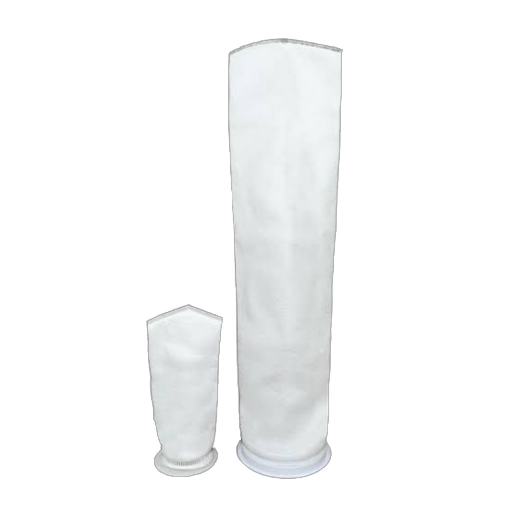
Size #1, #2, #3, #4 and #5
Temperature limits
80 °C PP · 120 °C PET · 160 °C nylon
Operating DP
Up to 2.0 bar at 20 °C
Custom sample
7 days after specification approval
Custom MOQ
100 pieces; standard-item minimums vary
Micron-Rated Liquid Filter Bags for Process Duties
The goal is to start with the coarsest rating that meets the downstream cleanliness objective, and then examine it under actual flow, solids and change-out conditions. Finer filter bags can remove smaller target particles, but they can also load sooner and raise differential pressure faster.[6]
Often, a single micron number is mistakenly used as a complete specification. Because a 100 micron felt filter and a 100 micron mesh route can use different media structures, rating bases and seals, the wrong choice creates a bypass or premature-changeout risk. ECOFILTRONE qualifies each micron liquid filter bag against the fluid, solids, flow, temperature, housing fit and trial acceptance evidence.
Clarification and prefiltration
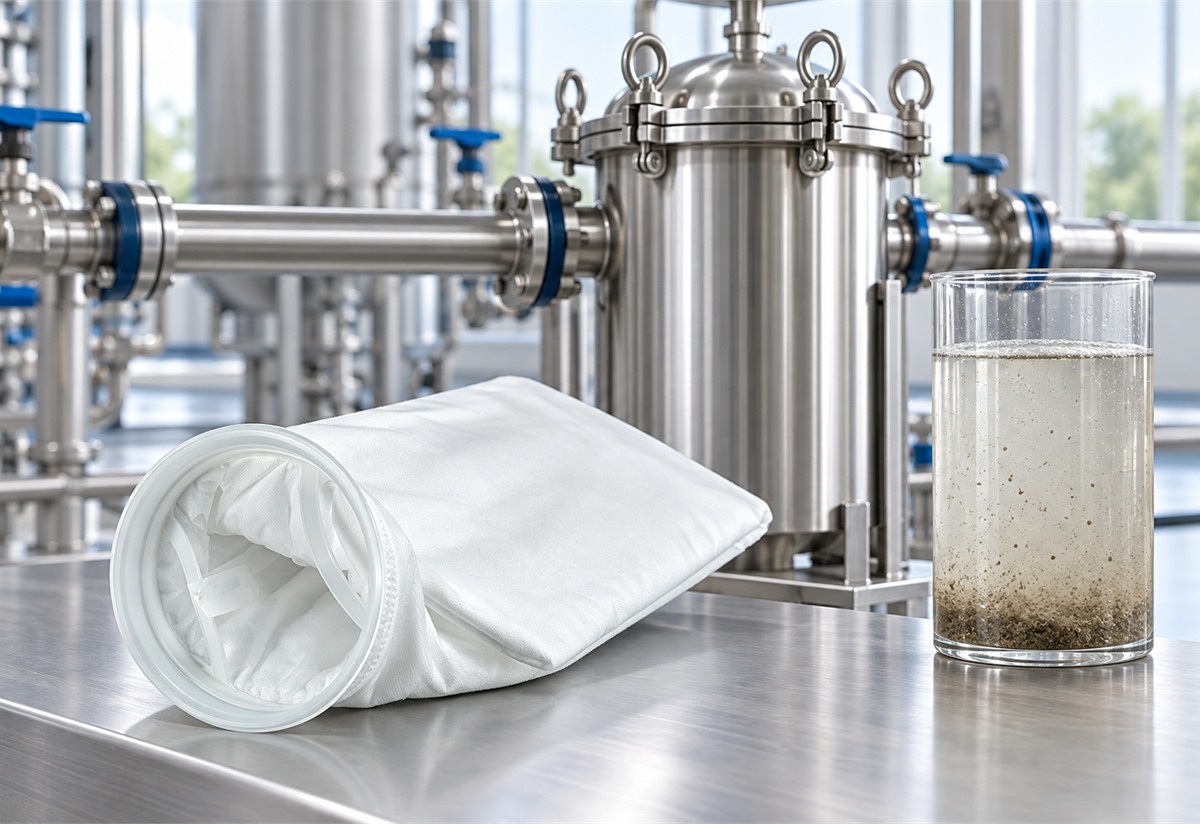
A starting band should be set based on the particle profile, downstream limit and process stage. For coarse prefiltration, a 100 micron bag or 200 micron filter bag may sit early in the train, while a 5 micron filter bag may sit later.
Water and process liquids
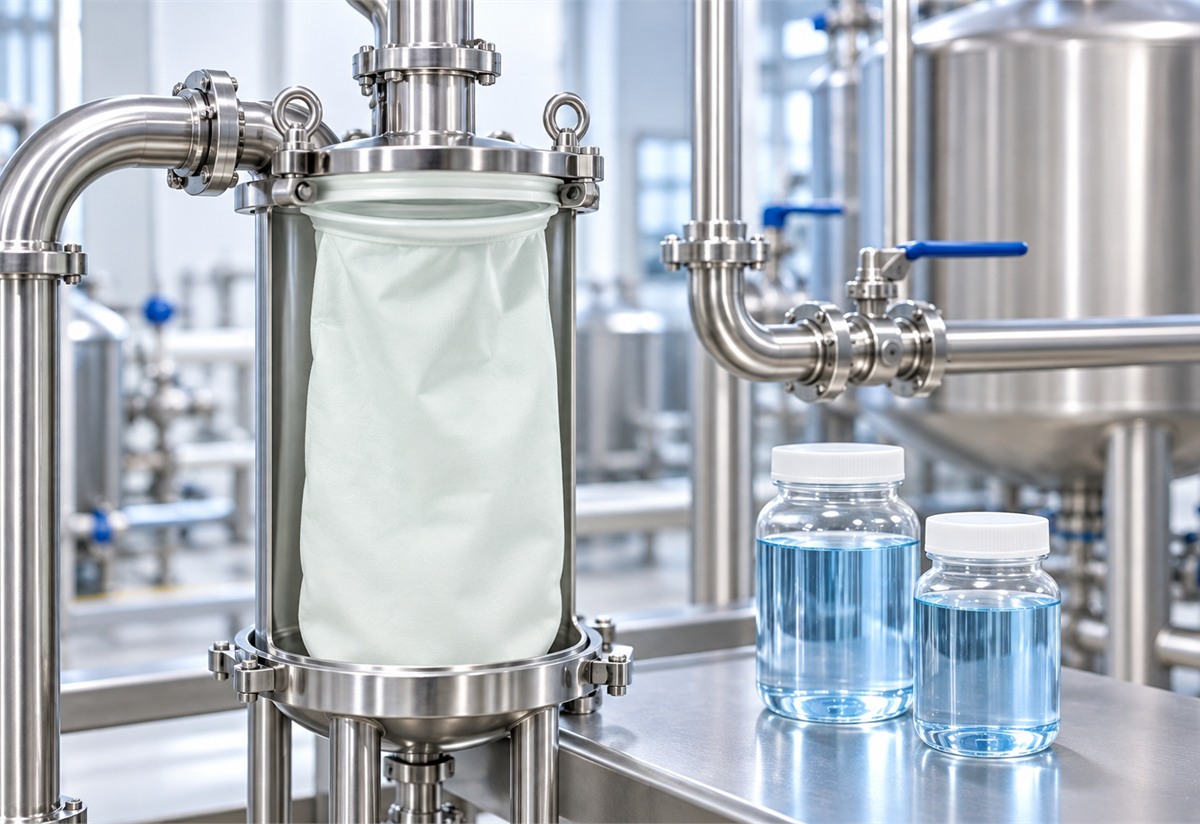
A 1 micron water filter bag is a particulate filter, not a disinfection claim. Water chemistry, viscosity, temperature, bacteria or virus control requirements and the next process step must be assessed separately.
Replacement qualification
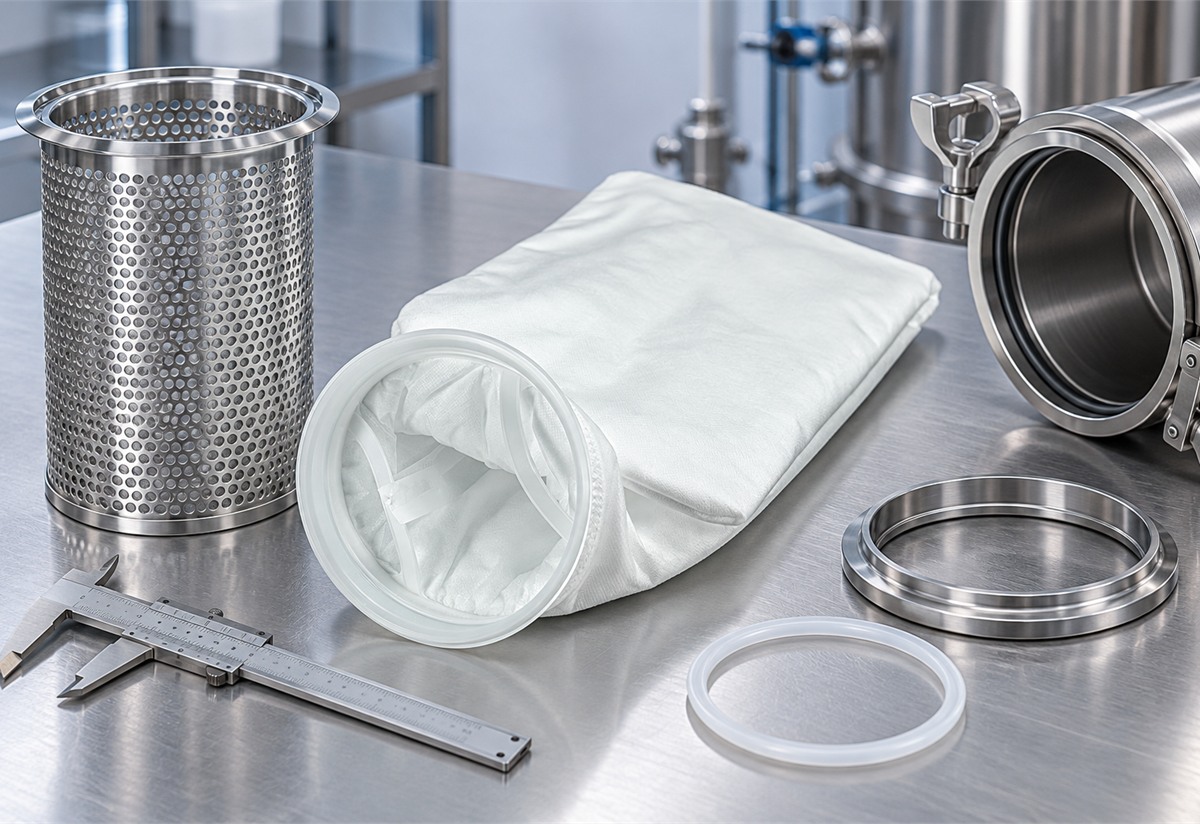
A common assumption is that bags from another brand or manufacturer are interchangeable when their micron rating matches. They are not interchangeable unless the media, nominal or absolute basis, seam or weld construction, ring material, filter housing interface and support basket also match.
PP, PET and Nylon Media Routes
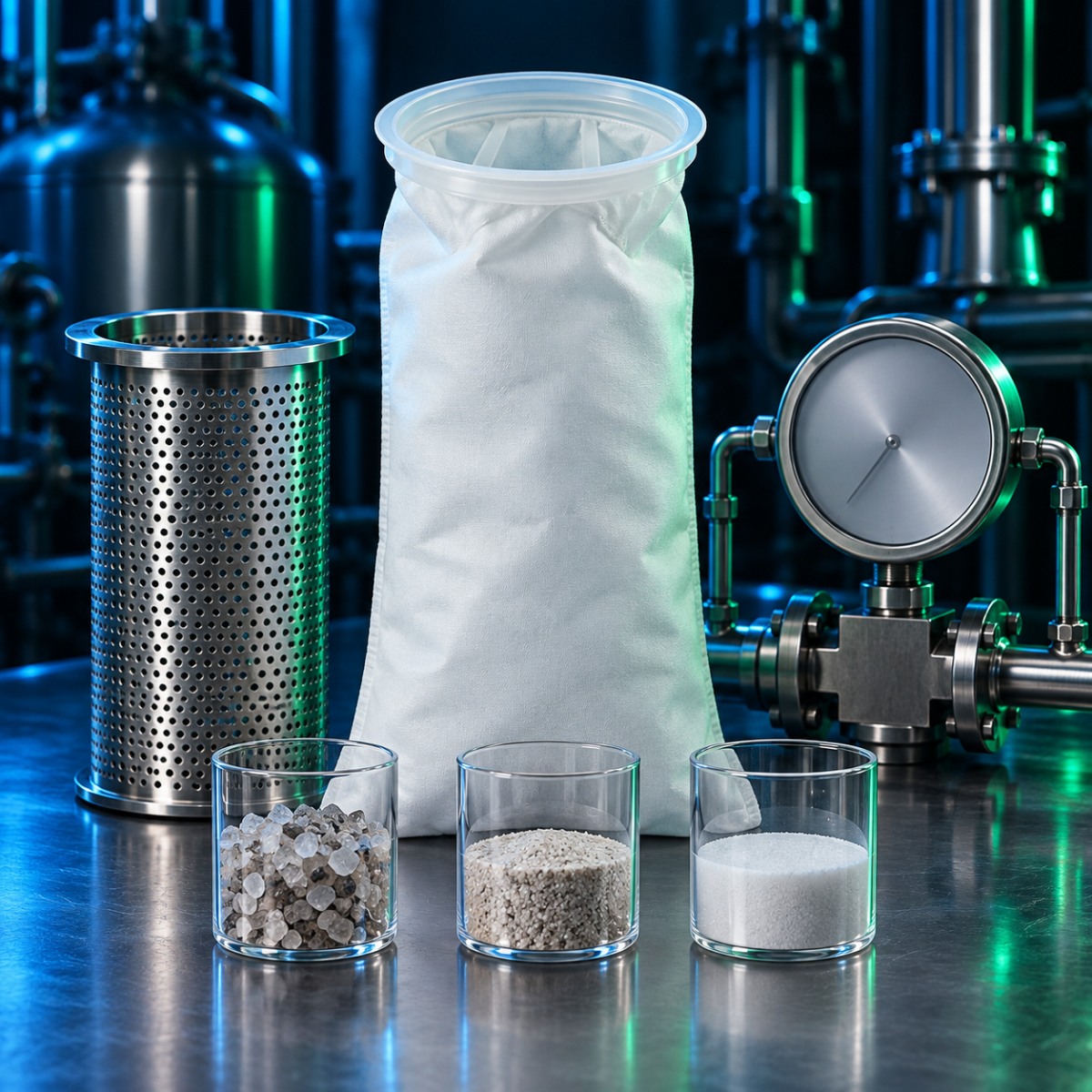
Media choice changes how particles are captured and how the bag responds to temperature, chemical exposure and cleaning. For these reasons, polypropylene felt, polyester felt and nylon mesh need to be qualified separately.[6] The catalog temperature is a material operating limit, so the RFQ should also state the liquid name and concentration, exposure time, and the chemicals used for cleaning.
80 °C Max
Polypropylene felt
PP felt provides a depth-filtration route for liquid duties that fit its chemical and temperature envelope. The ECFB catalogue lists a maximum operating temperature of 80 °C.
120 °C Max
Polyester felt
Polyester felt is another depth-media route when PET chemistry and heat resistance fit the process. The catalogue maximum operating temperature is 120 °C.
160 °C Max
Nylon monofilament mesh
A mesh filter bag retains particles mainly at the surface and can suit coarser classification or cleaning-led duties. The catalogue maximum operating temperature is 160 °C.
Media qualification inputs
Send the full liquid name, concentration, pH, operating and cleaning temperatures, exposure duration and cleaning method. If the liquid comes from food processing, metal finishing or another industry duty, include the applicable cleanliness, migration or contamination limit. Those inputs are checked together; a temperature rating alone does not establish compatibility.
// ECFB_QUALIFICATION_PROTOCOL_V1
The 1–200 µm Rating Qualification Matrix
Use this matrix to refine the candidate routes for the RFQ. Final selection and availability are fixed in the written quotation after the rating basis, particle distribution, process data and ECFB configuration are reviewed. The matrix is therefore an RFQ starting point, while measured operating conditions and water-quality results establish the trial baseline.[6]
| Starting rating | Candidate media route | Useful process position | Confirm before order |
|---|---|---|---|
| 1 µm | PP or PET felt | Fine particulate polishing | Efficiency basis, solids load, flow and microbiological boundary |
| 5 µm | PP or PET felt | Fine clarification or downstream protection | Current filter result, terminal DP and expected change frequency |
| 10 µm | PP or PET felt | General fine process filtration | Particle-size distribution, viscosity and clean DP |
| 25 µm | Felt; mesh by confirmed construction | Clarification or staged prefiltration | Nominal/absolute basis and downstream acceptance limit |
| 50 µm | PP/PET felt or nylon mesh | Industrial water and process prefiltration | Surface vs depth route, seal, housing and trial criteria |
| 75 µm | Felt or nylon mesh | Intermediate solids control | Particle shape, loading variability and bag support |
| 100 µm | Nylon mesh or felt | Coarse clarification and screen-like retention | Opening/rating convention, ring and cleaning plan |
| 150 µm | Nylon mesh | Coarse particle capture | Exact mesh construction, dimensional fit and flow |
| 200 µm | Nylon mesh | Coarse prefiltration or product recovery | Particle shape, open area, housing and downstream stage |
Interactive tool
Micron Rating Qualification Checklist
Write an RFQ brief from the fluid, target, flow, solids, temperature, housing and change-out inputs. The checklist evaluates if all the data are present without providing a guaranteed recommendation for a product.
Same number, different result
It is often assumed that the same micron number means the same result. Micron rating is one product descriptor; felt or mesh structure, test method, particle shape, seam, seal ring and bag filter housing can change the observed filtration result.
Pricing, Lead Times and Order Terms
Price is dependent upon media, micron rating, bag size, ring, seam or weld construction, quantity and any special request. Send the specification and quantity band; an engineer-reviewed quotation comes back within 24 hours on business days.
Free sample
Confirmed timing or term Sample is free; customer pays freightScope: Media/rating/size subject to confirmation
Custom sample bag
Confirmed timing or term 7 daysScope: Starts after the specification is approved
In-stock rating and size
Confirmed timing or term 4–5 daysScope: Applies only after stock is confirmed in the quote
Custom bulk order
Confirmed timing or term 14 daysScope: Starts after specification and order approval
Custom minimum order
Confirmed timing or term 100 piecesScope: Standard-item minimums vary by product and specification
Payment
Confirmed timing or term 30% deposit; 70% before shipmentScope: Recorded in the written quotation
Bronze total-cost check
Lowest unit price doesn’t always mean lowest total cost. Compare unit price together with bags used per month, labor per change, planned downtime, disposal, lost liquid and trial risk. Enter your plant figures before comparing the total across quotations.
Bag, Seal and Housing-Integrity Inputs
Filtration is a system result. The media performs its job only when the bag construction, top seal, housing and support basket keep liquid on the intended path and support the bag as differential pressure rises.
Construction record
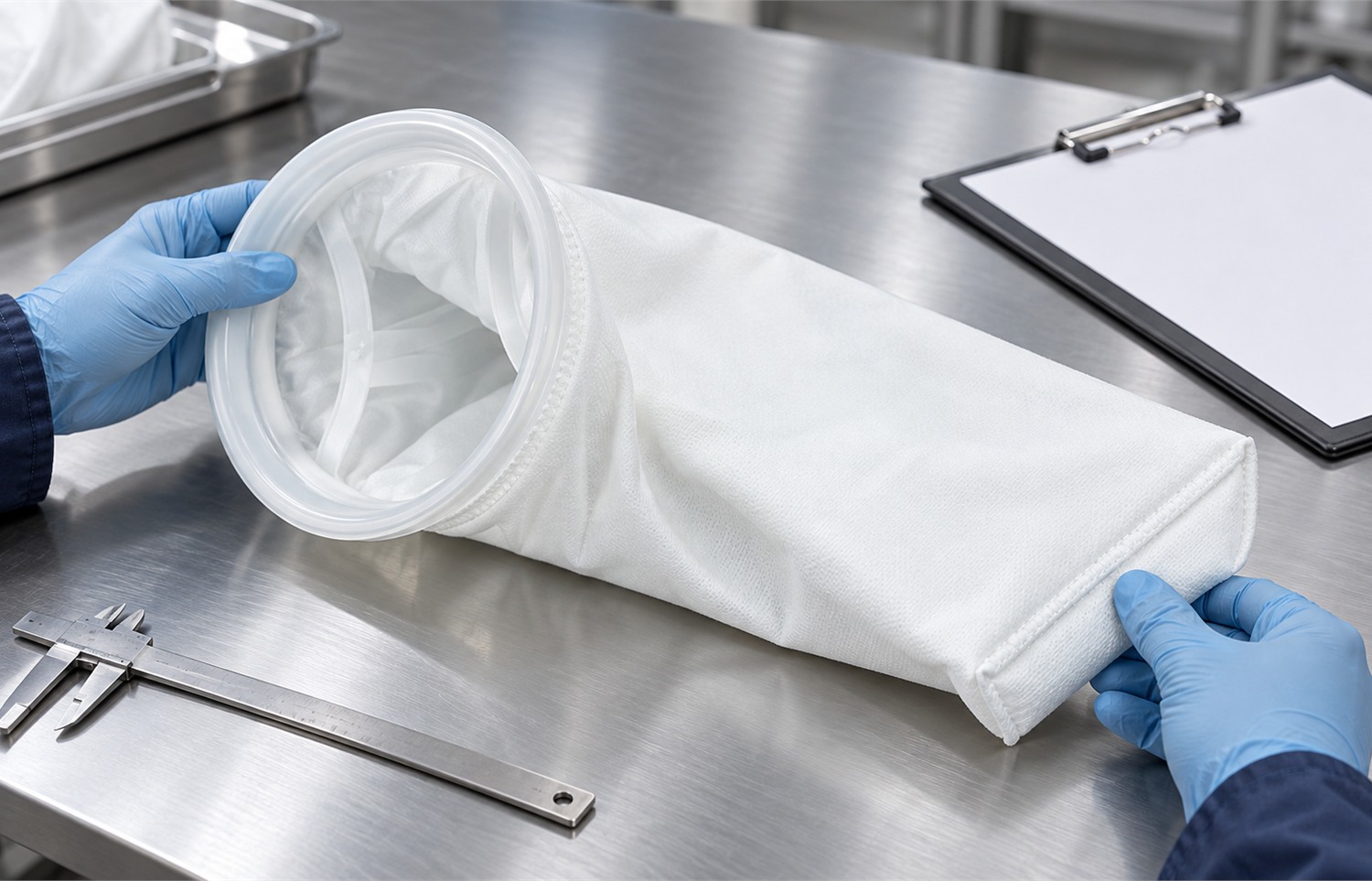
The rating basis (media), seam or weld construction, ring and bottom materials, and dimensions should be indicated in the order record. A sewn seam and a welded construction are not treated as interchangeable without review.
Housing interface
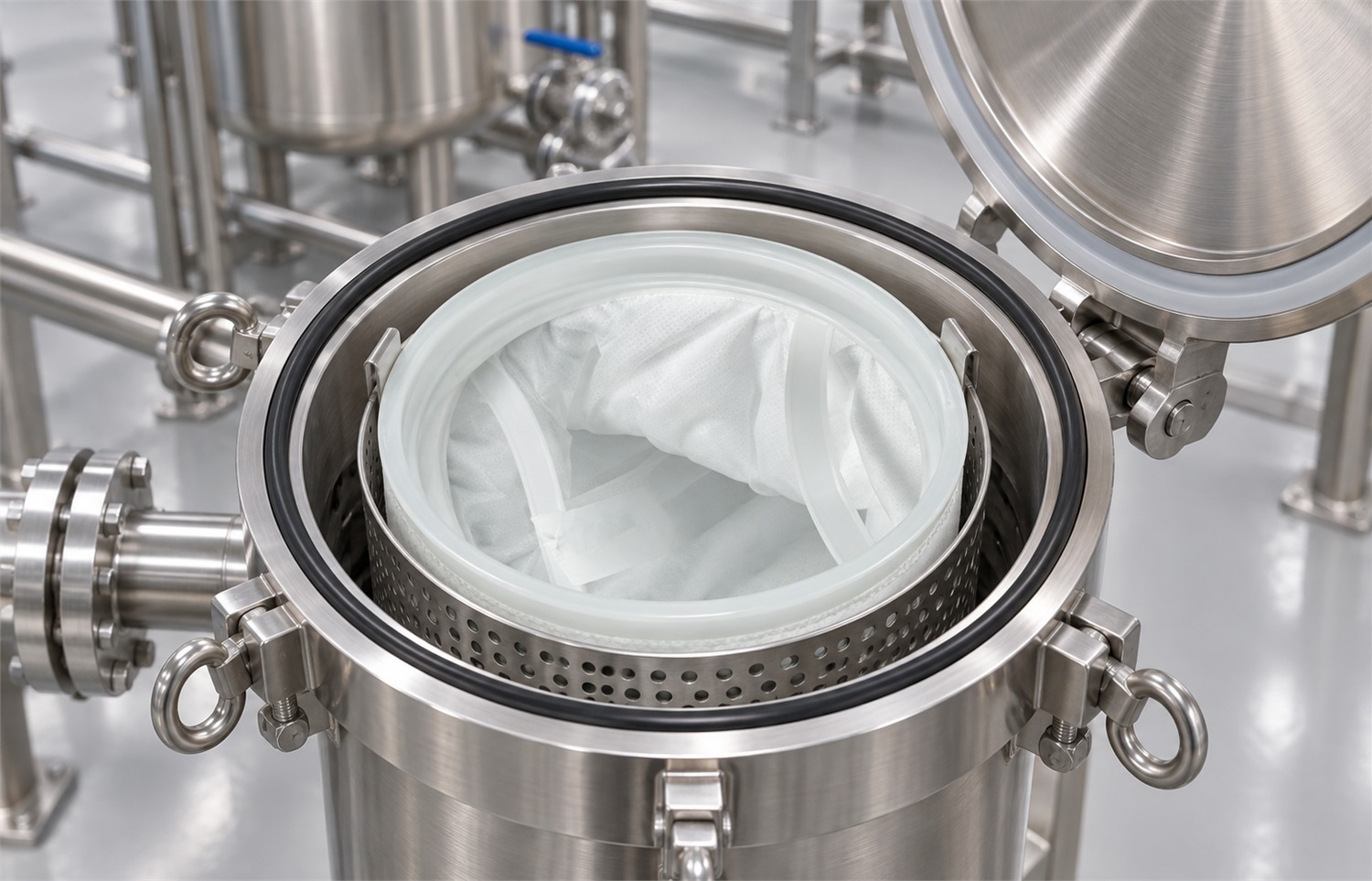
Check collar profile, compression, basket support and housing closure. A dimensional match is the first check, while sealing contact and basket condition complete the fit review.
Pilot acceptance record
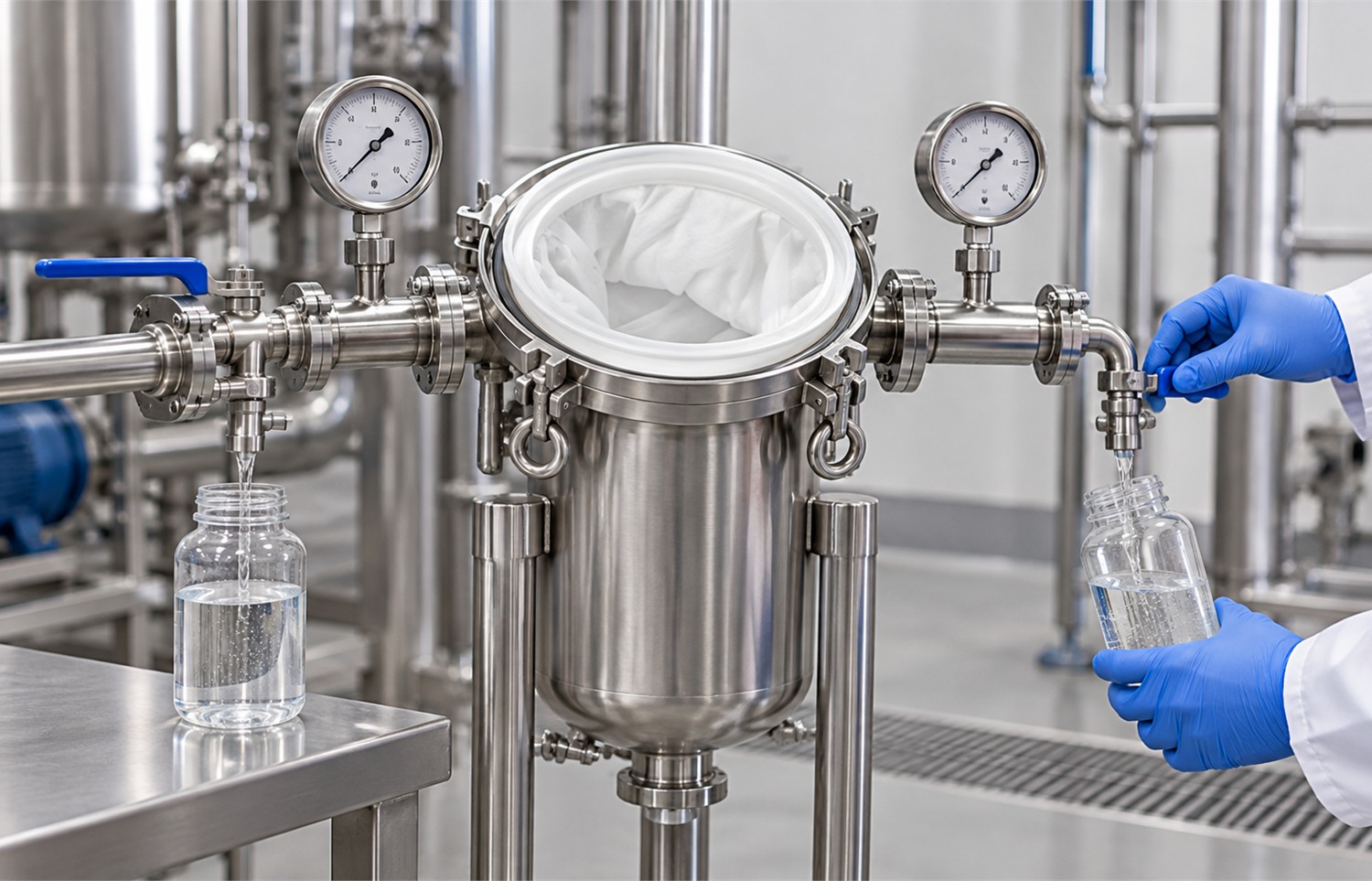
Record flow, clean and terminal differential pressure, influent and effluent turbidity or particle count, run duration and the reason for change-out across a complete filter run.[6]
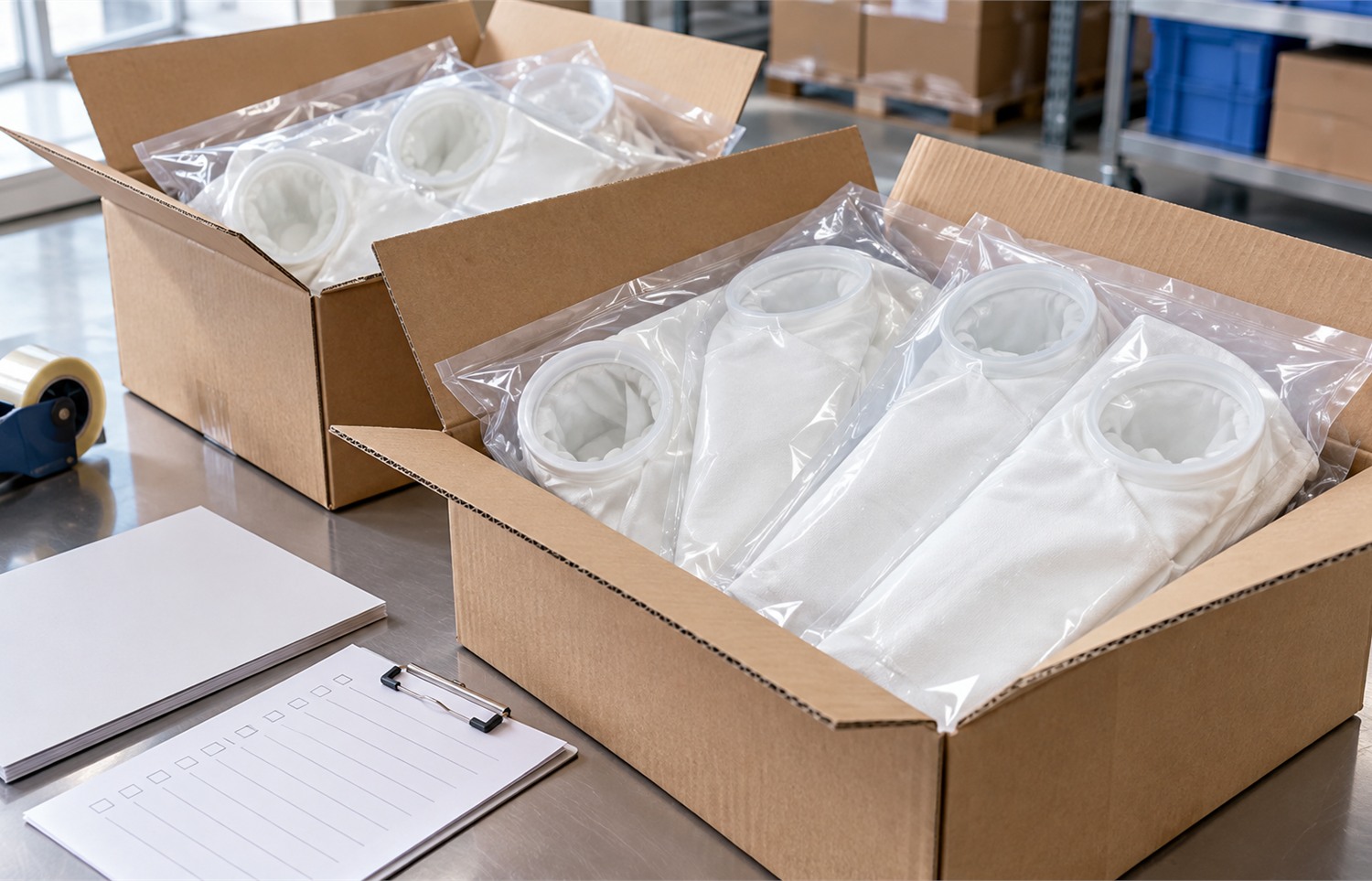
Shipment documents
We provide technical data, material certificates and compliance documents according to the product and application requirements confirmed for the order.
A micron number should not replace a complete process specification. Mechanical fit is considered complete with the verification of diameter, usable length, ring geometry, sealing contact and basket support.
From Rating Qualification to Shipment
1
Define the duty.
State the target particle or downstream condition. Provide current filter result. Specify flow, fluid, temperature and solids information.
2
Confirm the system.
Add the filter housing, basket, bag size, ring or flange, clean DP and the current change-out trigger.
3
Shortlist the route.
We examine PP felt, PET felt or nylon mesh and choose the rating band to be trialed.
4
FIX THE ORDER RECORD
The written quotation states the confirmed media, micron rating, size, construction, quantity, lead time and documents.
5
Run the trial.
Track the agreed process measurements through a complete run instead of judging the bag from appearance alone.
6
Release the order.
Trial findings, specification approval and quantity determine the production path and shipment coordination.
The 10-Input RFQ Map
| Input | What to send | Decision it supports |
|---|---|---|
| 1. Retention objective | Target particle or downstream condition | Starting micron band |
| 2. Current filter | Type, rating basis and observed result | Comparison baseline |
| 3. Liquid | Name, concentration and pH | Material screen |
| 4. Temperature | Operating and cleaning cycle | Media limit check |
| 5. Flow | Normal, minimum and peak rate | Area and DP review |
| 6. Solids | Loading, variability and particle shape | Depth vs surface route |
| 7. Housing | Model or measured opening and basket | Mechanical fit |
| 8. Seal | Ring, collar or flange details | Bypass control |
| 9. DP criteria | Clean value, system limit and change-out trigger | Trial acceptance |
| 10. Order | Sample, trial or production quantity | Availability, MOQ and lead time |
MICRON-RATED FILTRATION
Where a Finer Rating Works Against the Process
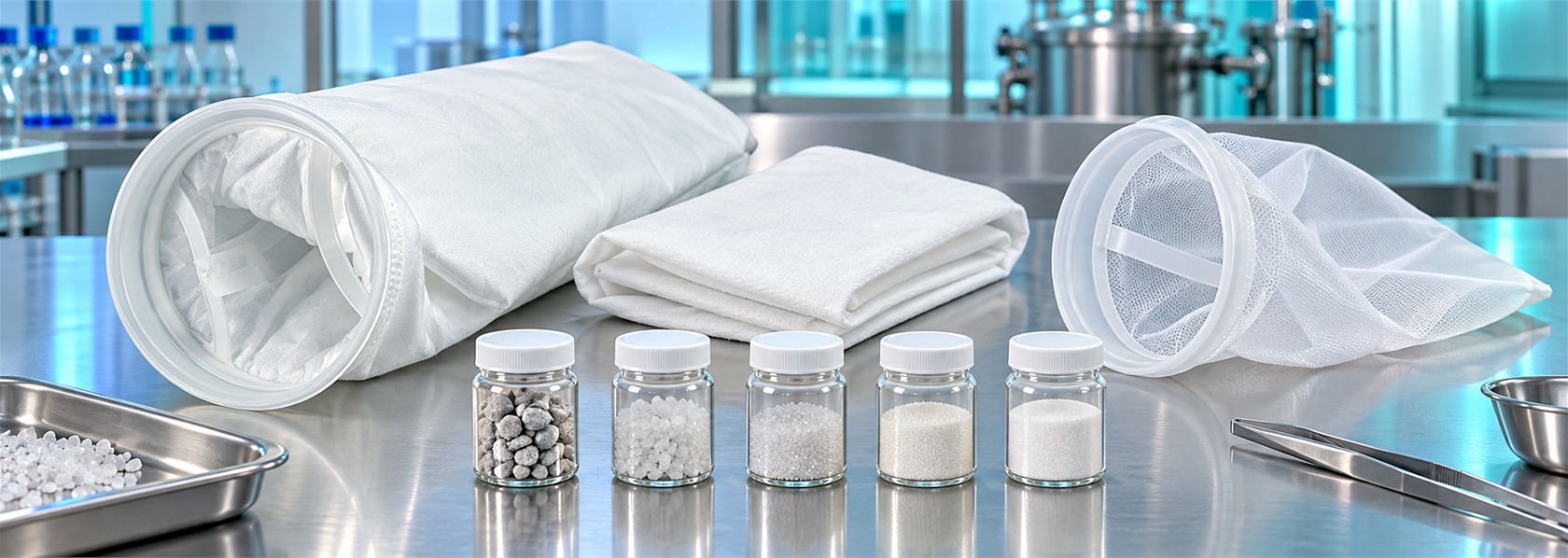
Lower is not always better. Selecting a rating finer than needed can increase process resistance and shorten the time to the buyer’s change-out condition, shifting cost to labor and increasing process waste. The trade-off belongs in the pilot record, not in an unsupported promise about bag life.[6]
High solids load enters a fine bag
Why it works against the process
The surface or depth fills early and DP can rise quickly.
Better route
Add a coarser stage or test a coarser starting rating.
A 1 µm bag is used as a safety claim
Why it works against the process
Micron rating alone does not establish bacteria, virus or disinfection performance.
Better route
Define the required safety step and its validation separately.
Same micron, different construction
Why it works against the process
Rating basis, media, seam and seal can change the result.
Better route
Compare the complete bag and housing configuration.
Maximum DP becomes the change-out target
Why it works against the process
The housing or process may have a lower practical limit.
Better route
Set the trial trigger from system limits and measured performance.
Micron-Rated Filter Bags (1-200 µm) Engineering Tools
Micron Rating Qualification Checklist
Build a review-ready RFQ brief for a 1–200 µm liquid filter bag. This checklist reports missing inputs; it does not issue a guaranteed micron, material, efficiency, compatibility or microbiological-safety recommendation.
ECFB Filter Bag Size Fit Check
Dimensional Verification Protocol
Compare measured bag-body diameter and usable length with ECFB catalogue Sizes #1-#5. The nearest dimensional reference is a screening result, not a collar, seal, basket or housing-fit approval.
Differential Pressure Converter
Convert a measured differential pressure among bar, psi and kPa, then compare it with an exact ECFB catalogue condition. The result is unit and catalogue context only; it is not an efficiency claim or a change-out recommendation.
Micron Filter Bag FAQs
What does a micron rating tell me about a filter bag?
It identifies a particle size reference for the filter media. Ask whether the rating is nominal or absolute, and under what test conditions it was determined. The micron number, media construction and removal efficiency are not the same.
Is a lower micron rating always better?
No. Finer ratings can remove smaller particles, but they can also load sooner and raise differential pressure (DP) faster. Start with the coarsest rating that can meet the downstream demand, then assess it in a controlled test.[6]
Should I change from 5 µm if the bag loads in about a week?
Don’t change a rating based on runtime alone. Review flow, solids concentration, particle distribution, clean and terminal DP, media area, process target and the reason for change-out before comparing a 5 micron bag with a coarser route.
Can I clean and reuse a 1 µm filter bag?
Reuse depends on the media, contaminant, cleaning chemistry, temperature and post-cleaning integrity. Return a one micron filter bag to service only after the buyer validates cleanliness, structure and filtration performance for that process.
Can a 1 micron water filter remove bacteria or viruses?
Used alone, a 1 micron water filter bag is a particulate-filtration component. The stated rating does not define or validate disinfection, sterilization or removal of bacteria or viruses. Define and validate those safety requirements separately.
What is the difference between felt and monofilament mesh?
Felt provides a depth path through a fibrous material, while monofilament mesh acts more like a surface screen. Particle shape, solids concentration, plan for cleaning, temperature and the basis for the required rating determine which route to take for the test.
What are the ECFB filter bag sizes?
The catalogue references are Size #1 Ø180 × 420 mm, #2 Ø180 × 810 mm, #3 Ø105 × 230 mm, #4 Ø102 × 380 mm and #5 Ø150 × 520 mm. Confirm the collar, basket and housing interface before replacement.
What is the maximum operating differential pressure?
The ECFB catalogue limit is 2.0 bar at 20 °C. It lists 1.0 bar for PP at 80 °C, PET at 120 °C and nylon at 80 °C. Use the lowest applicable limit among the bag, housing, basket and process.
How fast can an order ship?
Quotes return within 24 hours. Custom samples run 7 days, confirmed in-stock ratings and sizes ship in 4–5 days, and custom bulk orders run 14 days after specification and order approval.
Can I request a free sample or a trial order?
Yes. Samples are free and the customer pays freight. Trial orders are accepted; custom filter bags have a 100-piece minimum for bulk orders, while standard-item minimums vary by product and specification.
What information is needed for a quote?
Send the target, current filter, fluid and chemical concentration, temperature, flow rate, solids, bag size, ring or flange, filter housing, clean and terminal DP, change-out trigger and quantity. Use the qualification checklist to prepare the brief.
Technical Engineering Support
Need assistance selecting the right micron rating and media for your specific fluid process? Our filtration engineers provide comprehensive flow rate analysis and material compatibility assessments to optimize your change-out cycles.
Custom Filtration Solutions
Beyond standard Size 1 to Size 5 dimensions, we manufacture custom filter bags tailored to unique industrial housings. We offer bespoke collar designs, reinforced seams, and specialized composite filter media to meet stringent downstream purity demands.