Get in touch with ECOFILTRONE™ Company


PVDF Membrane Filter Cartridges: Materials, Performance and Failure Modes

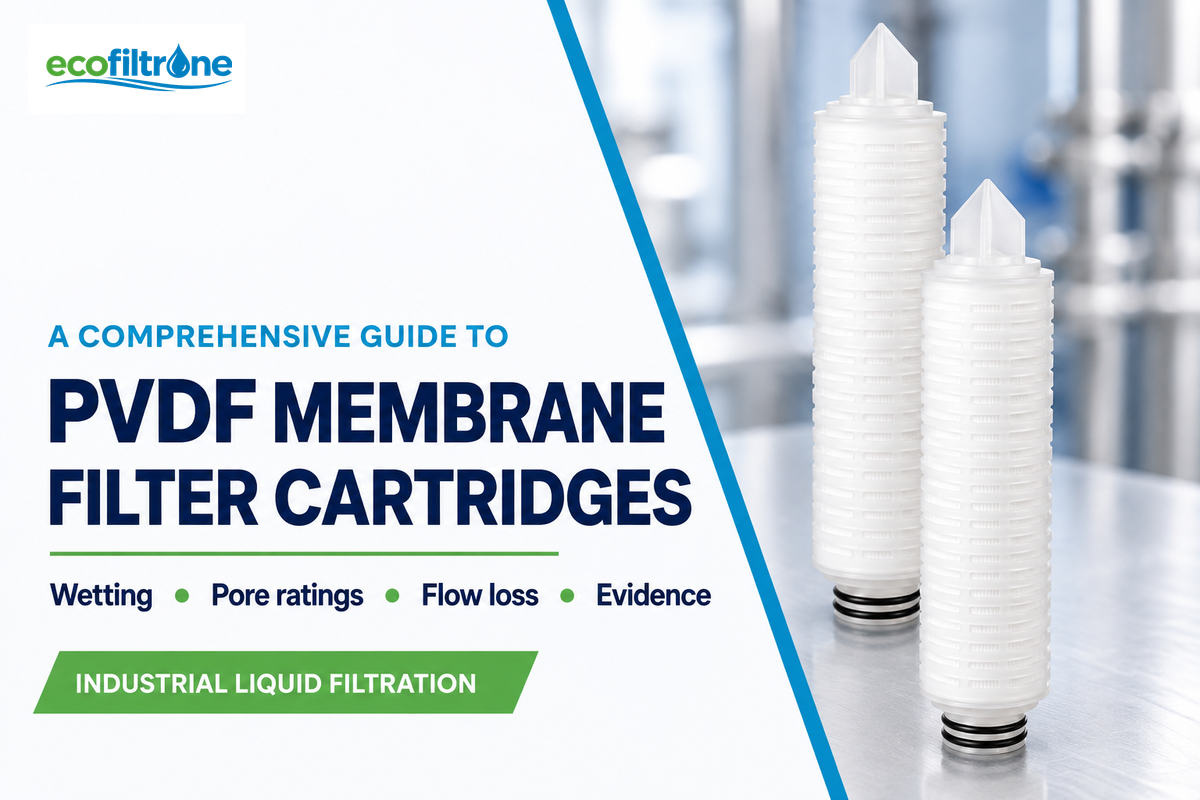
PVDF Membrane Filter Cartridges use a porous polyvinylidene fluoride membrane to separate selected particles from a liquid. Their behavior depends on the membrane surface, the pore structure, and the final assembly. Understanding these differences can provide insight into why apparently similar filters can behave differently, e.g. wet or lose flow, retain different amounts of the product, etc.
A cartridge can fit the housing and still behave differently in service. One process requires reliable control of fine particles; another requires the recovery of a dissolved product; a third process requires a validated microbial barrier. Each requirement poses a different question to the filter. This manual presents methods for understanding the filter and operating behavior, and for evaluating results.
At a glance
Start with the liquid and the material to remove or preserve. Then distinguish wetting, pore rating, useful flow and outlet quality. A hydrophilic surface helps water enter a membrane; a retention test describes separation; an integrity test checks specified physical characteristics. Successful filtration needs those pieces to agree.
What Are PVDF Membrane Filter Cartridges?
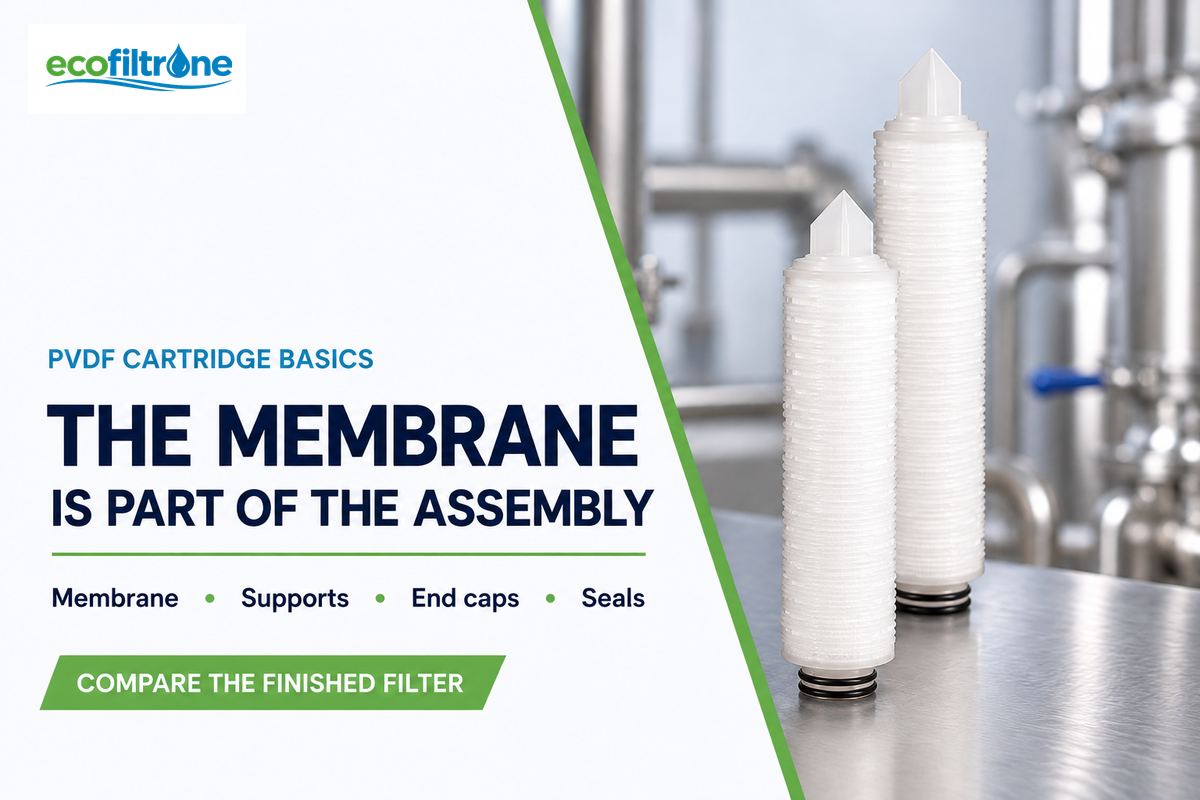
A PVDF membrane filter cartridge is a completed filter element containing a porous PVDF filtration layer, usually in a pleated membrane arrangement, around a core. Supports, end caps and seals complete the element. The membrane surface influences the separation behavior, and the element determines how it connects and contains process liquid.
In a PVDF pleated element, each pleat packs filter membrane area into a compact volume, and feed travels through the filtration layer and the supporting structure before reaching the outlet. Porous filters have a pore network that interacts with particles, while dissolved substances can also interact with the membrane surface. Hence, “what passes through?” and “what binds to the filter?” are two separate questions.
PVDF identifies the polymer, not the entire device. A flat laboratory disc, a syringe filter, pleated filter cartridge and hollow-fibre module can all contain PVDF, but can use different flow paths and operate with different principles. Meissner’s SteriLUX product literature, for example, offers hydrophilic PVDF in discs, capsules and cartridges. Such a variety warrants a membrane-sheet measurement to be accompanied by its test format.
A filter housing drawing answers the fit question. A fluid-specific performance assessment answers the separation question. Neither replaces the other when a replacement element is proposed. A cartridge filter comparison needs both. For the broad range of membrane materials and formats, ECOFILTRONE’s membrane filter cartridge families offer a first step.
Na and colleagues compared two 47 mm flat-sheet filters in their 2022 study. Those discs were useful research objects, but their measurements describe the tested sheets and fixtures. An installed cartridge adds supports, pleating, end seals and a different flow path to the comparison. The study’s methods describe the tested forms.
Hydrophilic and Hydrophobic PVDF: Why Wetting Changes Service
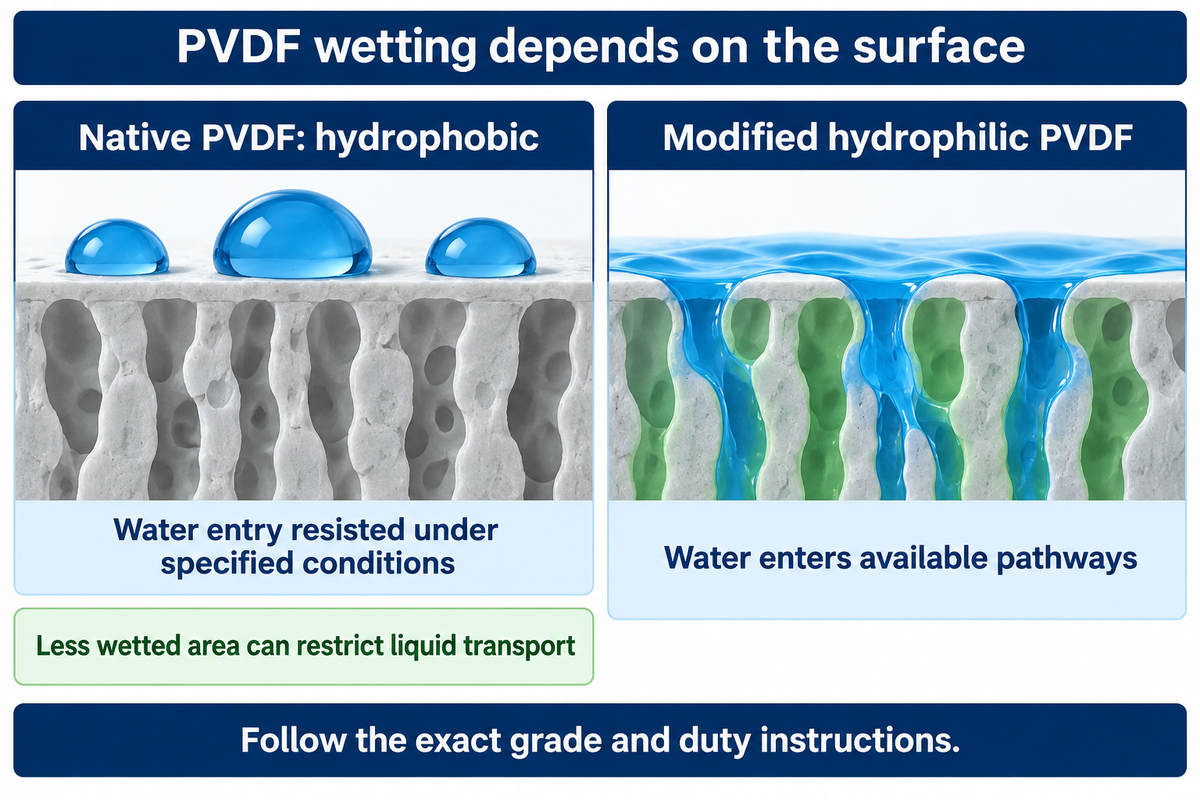
PVDF wettability is dependent on the final membrane surface and the liquid in contact with it. In a native state, PVDF is hydrophobic. Manufacturers can modify the membrane to yield hydrophilic grades. For an aqueous process to use the membrane area as intended, water must enter the available pathways, with preparation carried out in accordance with the exact filter and duty.
What is the difference between hydrophilic and hydrophobic PVDF filters?
Hydrophilic PVDF filters have surfaces which are more easily wetted by water. Hydrophobic PVDF filters, on the other hand, resist the entry of water under specified conditions and may be used for other liquids, gases or vents. The difference is more of behavior on the surface than a difference in the meaning of the PVDF polymer. Composition of the fluid and the supplier’s instruction for use remain important.
Water left outside incompletely wetted pathways leaves less area for liquid transport. An initial high restriction can therefore raise a wetting question before it raises a dirt-loading question. Hydrophilic modification also alters membrane structure and surface interactions. It doesn’t give all hydrophilic PVDF membranes the same flow or adsorption behavior. A published PVDF preparation experiment shows how processing and additives alter membranes.
Hypothetical startup: The operator installs a replacement filter for an aqueous batch and, on start up, sees poor flow, before a significant volume has passed. Confirming the grade, approved preparation and housing venting is more informative than assuming the feed has already clogged the membrane. The same observation could also be due to a valve, an installation problem or the liquid’s viscosity.
Hydrophilic and hydrophobic grades require their own set of instructions. A generic alcohol pre-wetting recipe is inadequate as a default, because liquids, seals, product and process may behave differently. Cytiva’s integrity-test wetting discussion explains the importance of using the right liquid for complete wetting for interpretation of test results.
Do
- Identify the finished membrane grade.
- Match preparation to the intended liquid.
- Record startup flow and outlet observations.
Don’t
- Treat every PVDF surface as water-wettable.
- Apply a different filter’s solvent procedure.
- Raise pressure simply to force initial flow.
What Pore Size and Membrane Area Actually Tell You
Pore size describes aspects of a membrane, while effective area and fluid resistance aid in determining useful flow. A micron rating requires its retention method and conditions. Membrane area helps to normalize a flow measurement, but service throughput also depends on wetting, viscosity, contamination and loading. Comparing those quantities individually prevents an attractive label from becoming an unsupported capacity assumption.
A 0.45 µm grade and a 0.2 micron grade describe different filtration targets, but the number alone doesn’t define a universal percentage removal. The distinction between nominal and absolute claims requires the stated method. Our filter micron rating guide elaborates on rating terminology.
| Quantity | What it describes | What to compare alongside it |
|---|---|---|
| Pore rating, µm | Declared separation grade | Test particles or organisms and retention method |
| Pore-size distribution | Range and structure of pathways | Measurement method and membrane orientation |
| Porosity, % | Void fraction measured for the material | Thickness and connected pore structure |
| Effective area, m² | Area available for filtration | Usable wetted area and cartridge construction |
| Flow rate, L/h | Liquid delivered per unit time | Fluid, temperature and differential pressure |
| Flux, L/m²/h | Flow divided by membrane area | Comparable fluid and operating conditions |
| Differential pressure, bar | Pressure difference across the element | Flow, viscosity and accumulated loading |
| Throughput, L | Volume processed before a defined endpoint | Endpoint, feed quality and accepted filtrate |
| Product recovery, % | Defined amount recovered after filtration | Assay, hold-up, adsorption and rejected fractions |
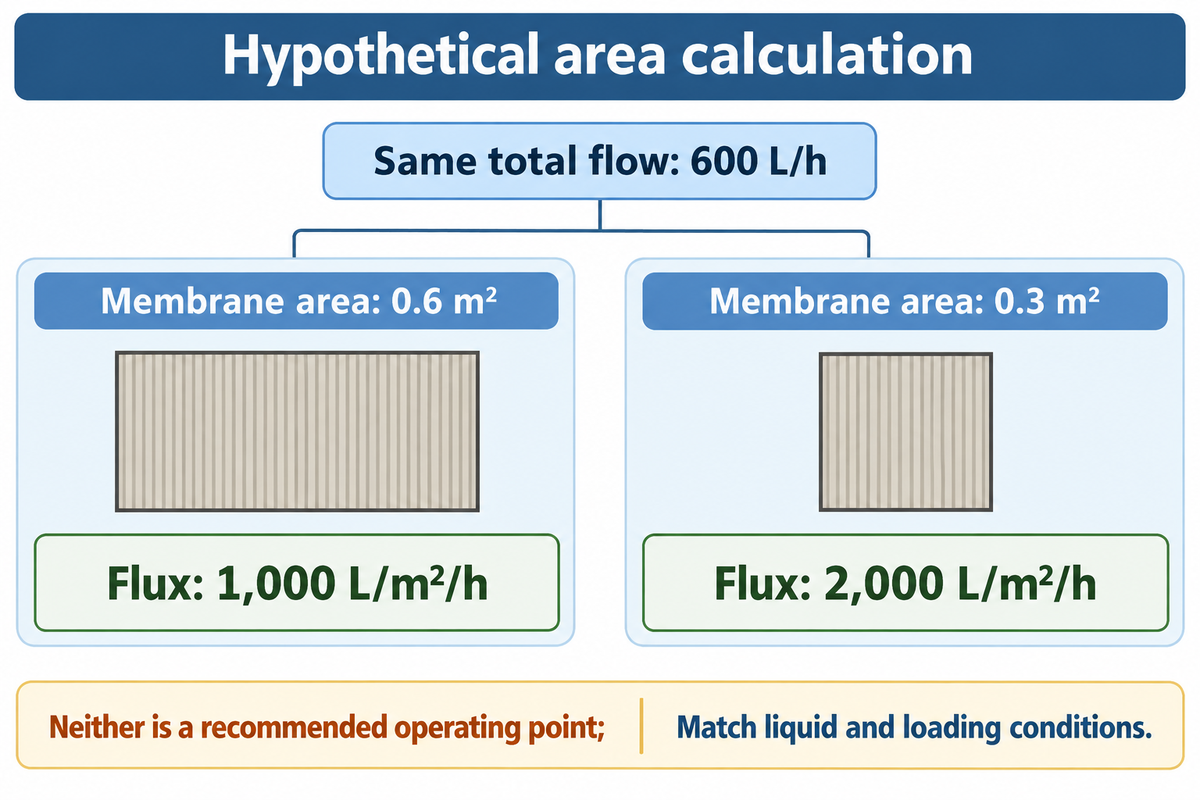
Hypothetical area calculation: 600 L/h through 0.6 m² gives a flux of 1,000 L/m²/h. At the same total flow, 0.3 m² would give 2,000 L/m²/h. Neither case represents a recommended operation point. The calculation simply makes different areas comparable; a suitable design still needs the actual liquid and loading behaviour.
Pressure comparisons also need context. A clean-water curve describes its stated temperature and test liquid. A viscous process liquid or partially loaded membrane won’t follow that curve automatically. Both “high flow” and “low pressure drop” claims need the curve conditions and the endpoint used to judge the trial. Meissner lists a 0.1 µm grade within its SteriLUX range; that number identifies one offered grade, rather than a universal starting point for a process.
Two nominal 0.22 µm sheets in Na et al.’s study had measured mean pore diameters of about 0.30 µm and 0.26 µm under the authors’ characterisation method. A measured mean pore diameter and a retention grade describe different things; matching the printed grade doesn’t make two pore structures identical.
PVDF versus PES, PTFE and Nylon: Compare the Finished Filters
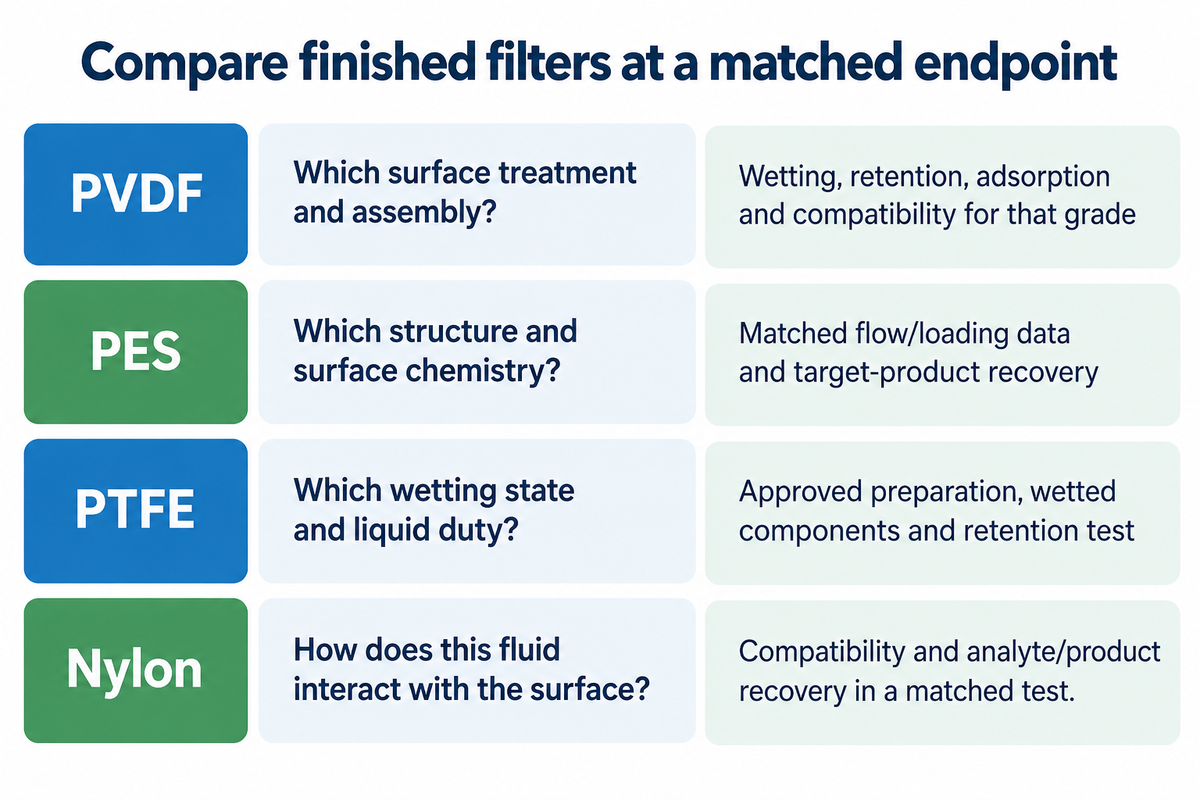
A fair comparison of PVDF, PES, PTFE and nylon starts with the same liquid being treated to the same endpoint by finished filters. Within a polymer family there can be differences due to surface treatment, pore structure, supports and seals. For membranes, compare useful flow, retention, recovery and quality of the filtrate.
| Filter family | First comparison question | Evidence needed for the intended fluid |
|---|---|---|
| PVDF | Which surface treatment and assembly? | Wetting, retention, adsorption and compatibility for that grade |
| PES | Which structure and surface chemistry? | Matched flow/loading data and target-product recovery |
| PTFE | Which wetting state and liquid duty? | Approved preparation, wetted components and retention test |
| Nylon | How does this fluid interact with the surface? | Compatibility and analyte/product recovery in a matched test |
Na et al. used hydrophilic PVDF and PES membranes from the same manufacturer. Water permeability and fouling behavior change with the test fluid and operating condition during the comparison. The results provide visibility into methods used, not an order that all cartridges must follow. Buyers comparing PES membrane cartridge options with PTFE membrane cartridges must have an equally clear description of the intended function.
Hypothetical recovery problem: Two filters deliver similar particle control, but a key product component is lower in the filtrate in the trial of one filter. State inlet and outlet assay results, sampled volumes and the volume of liquid retained. Adsorption, selective retention, housing hold-up and sampling effects are some possible reasons. Replacing the membrane on the basis of a “low protein binding” label alone doesn’t explain the loss.
A 2021 study of low-concentration therapeutic antibodies indicated that selective loss of high-molecular-weight species during hydrophilic PVDF filtration is a concern with the tested filters and formulations. It shows that measurement of the component of interest is warranted in cases where low protein binding is part of the product description.
Filtrate quality is an additional comparison. A 2022 filter study showed that effects on protein formulations are also dependent on the five non-PVDF materials. PVDF wasn’t tested. The question is what the actual assembly releases into the actual fluid, in addition to what it removes; “low extractables” requires a defined test and relevant exposure.
Equal-area trials reduce one potential comparison error. At 600 L/h a 0.6 m² element and a 0.3 m² element have different fluxes even before their membrane chemistries are considered. Keeping the fluid, area basis and endpoint visible aids the interpretation of PVDF versus PES.
Why a PVDF Filter Loses Flow or Loses Product
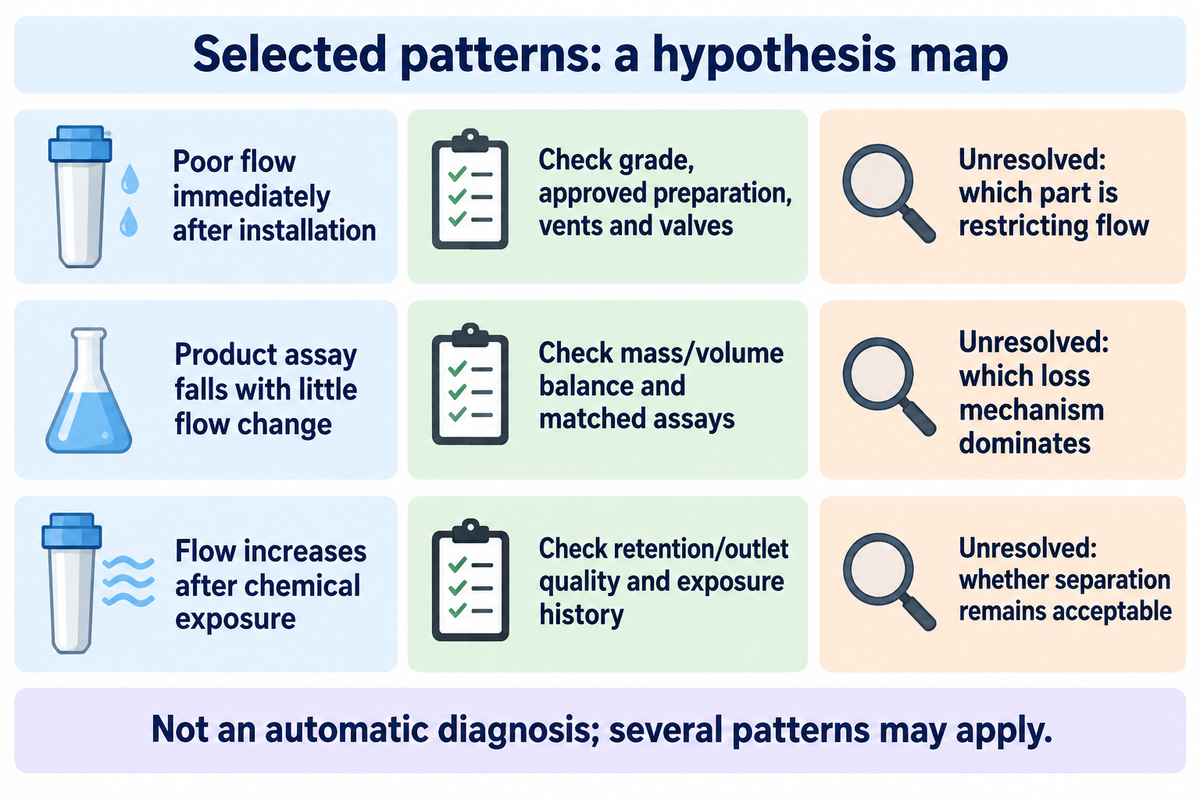
Problems with PVDF filters may be caused by inadequate wetting, particle accumulation and adsorption, installation faults and/or changes in the membrane after exposure. Timing helps organise the investigation: Restriction may be present at the time of element start-up or it may develop as processed volume is passed through the element. Quality of the outlet is an essential observation. Diagnosis may not be possible from a flow or pressure trace alone.
PVDF Wetting, Loading Fingerprint
The Wetting-Loading Fingerprint pairs the timing of a change with pressure, flow and outlet quality observations to identify the next area for investigation.
Use the table as a hypothesis map, not an automatic diagnosis. Operations records the pattern, maintenance checks the flow path, and quality checks whether the filtrate still meets its endpoint. Several rows can apply to the same event.
| Observed pattern | Possible explanation | Next useful check | Still unresolved |
|---|---|---|---|
| Poor flow immediately after installation | Incomplete wetting, trapped gas or restricted flow path | Grade, approved preparation, vents and valves | Which part is restricting flow |
| Restriction develops as volume passes | Particle accumulation or pore blockage | Matched-condition flow/pressure trend and feed samples | Foulant identity and location |
| Flow changes with feed temperature | Changing viscosity or another process change | Compare at equivalent fluid conditions | Whether loading also changed |
| Feed becomes visibly dirtier | A different solids burden | Upstream process and pre-filter condition | Actual particle distribution |
| Pressure appears normal, outlet fails | Bypass, unsuitable retention or another contamination path | Seals, installation and relevant outlet test | Location and mechanism of failure |
| Product assay falls with little flow change | Adsorption, selective retention or liquid hold-up | Mass/volume balance and matched assays | Which loss mechanism dominates |
| Integrity test fails after preparation | Wetting/test-condition problem or physical defect | Approved investigation for that test and filter | Whether the membrane is damaged |
| Flow increases after chemical exposure | Cleaning, changed wetting or membrane alteration | Retention/outlet quality and exposure history | Whether separation performance remains acceptable |
| Particle result passes, product quality changes | Another contaminant, interaction or release into the liquid | Relevant chemical/product-quality investigation | Whether the filter caused the change |
What are the disadvantages of membrane filtration?
Membrane filtration can trade a fine separation for sensitivity to feed loading, interactions with the surface of the media, and the operating conditions. Fouling can reduce throughput; adsorption and/or retained liquids can affect product recovery; and unsuitable exposure can alter performance. These limitations depend on the process. An acceptable particle result leaves other product quality parameters and endpoints affected by dissolved impurities to their own controls.
Let’s consider two hypothetical batches. The first batch has poor flow from the first liter; the second batch runs normally and slows down after 300 liters. The first case requires an assessment for startup and installation. The second case requires an evaluation of loading history. Neither of these cases points to a singular cause for the performance issue. Where particulate loading dominates, an appropriate depth filter upstream of the membrane may be more beneficial, rather than purchasing a finer element in the last stage.
Review the existing pretreatment before changing a melt blown filter or PP pleated element. Record where the burden is placed and where samples were taken. If activated carbon is in the train, note its location and don’t assume the rest of the observations are due to membrane effects.
A 10-inch cartridge with an acceptable-looking pressure trace still needs the relevant outlet and integrity evidence. Giglia and colleagues’ cartridge experiment showed that the sensitivity of automated bubble-point testing depended on the tested system. Process observations guide investigation; they don’t replace an approved release decision. The authors describe the tested cartridges and instruments.
Chemical Exposure, Cleaning and Temperature: What Changes First?
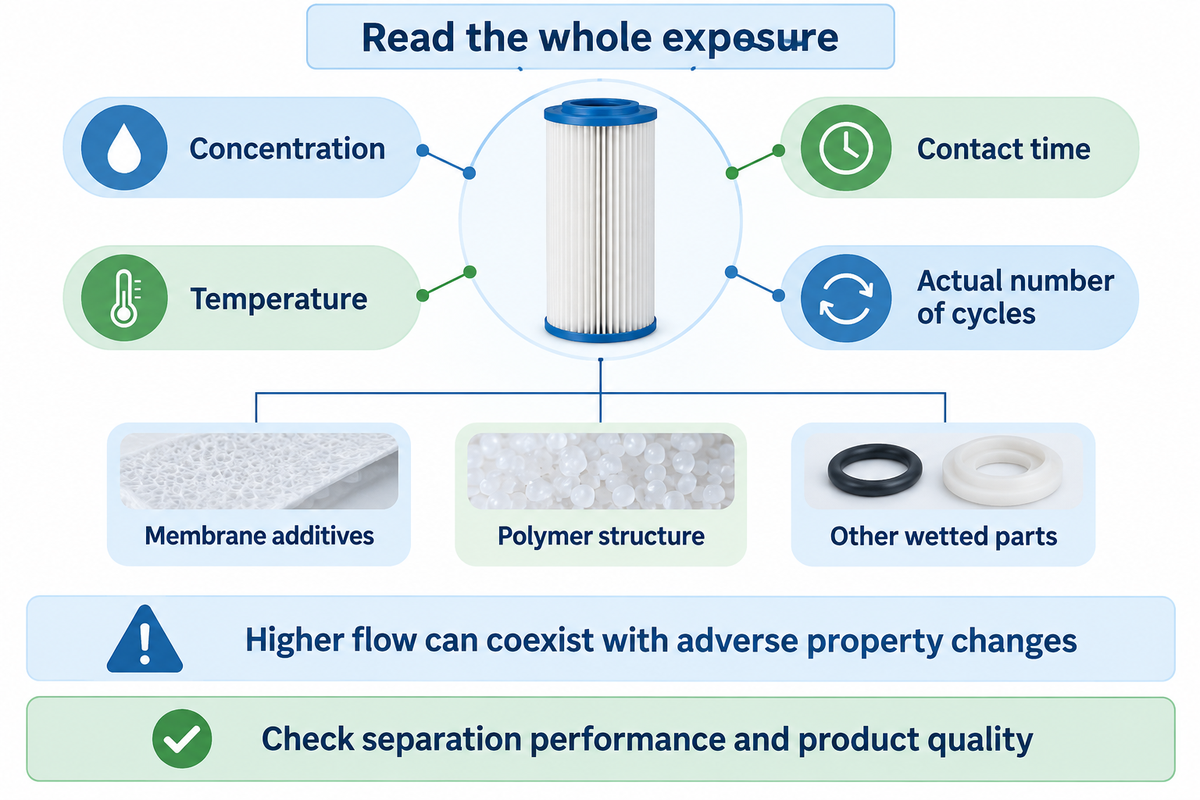
Chemical exposure can change membrane additives, the polymer structure and other wetted parts, and the changes don’t necessarily occur in a step-wise fashion. The contact time, concentration and temperature of the cleaning solution are to be considered together. Improved flow after cleaning calls for a paired check of separation performance and product quality before accepting a recovered filter.
The chemical resistance of PVDF is only part of the problem. A cartridge can consist of polypropylene support and bonded joints and a different gasket material. Organic solvents, as well as process and cleaning liquids, can come in contact with these materials. Therefore, a claim of broad chemical compatibility should be limited to the filter examined and its exposure history.
Cole-Parmer’s chemical-resistance database explicitly limits its listed behaviour ratings to a 48-hour exposure period and warns about suitability. That scope is a useful reminder to distinguish a chart screening from a complete assessment of a repeated cleaning cycle or continuous process. Read the database’s stated conditions before applying its ratings.
Historical experiments show why the direction of a flow change can mislead. Wu et al.’s 2018 study, indexed in the United States Environmental Protection Agency’s research database, compared PVDF membranes made by different processes. Ageing affected additives and membrane structure, with permeability changing direction while mechanical properties deteriorated. The experiment belongs to its authors; it wasn’t a client cartridge test.
In Rabuni et al.’s study, water flux was reported to increase under some cleaning conditions alongside adverse changes in membrane properties. For a purchasing team, the important distinction is between “flow returned” and “the filter still delivers acceptable filtrate after the intended exposure.” Continuous liquid temperature, differential-pressure limits and time-limited steam treatment are specific to the product.
A 48-hour material chart rating doesn’t apply to all subsequent cleaning exposures. Recording the concentration, temperature, contact time, and actual number of cycles helps answer compatibility questions. Filter service life is an outcome of this duty, not a fixed property of PVDF.
Integrity and Microbial Retention Answer Different Questions
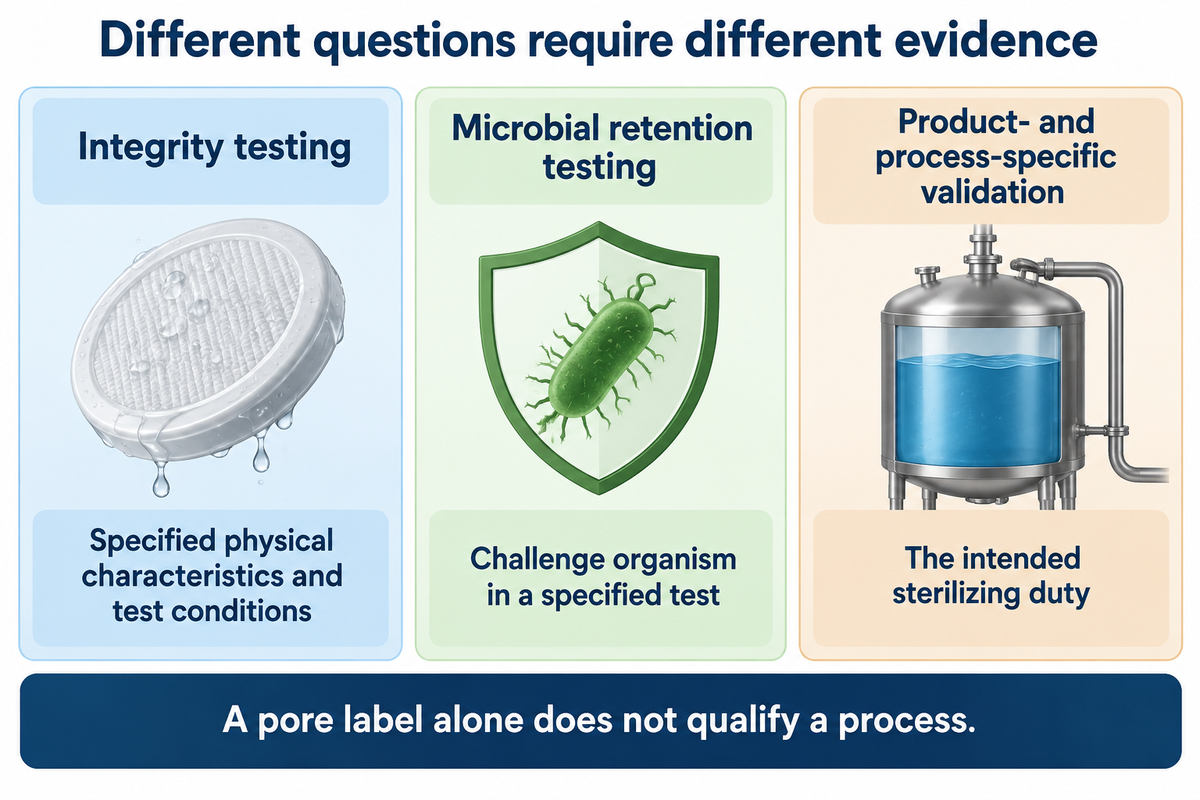
Integrity testing assesses defined physical characteristics of a filter under specified test conditions. Microbial retention testing assesses its ability to retain the challenge organism in a specified test. Product- and process-specific validation relates the filter to its intended sterilizing duty. Each has specific methods, limits and meaning.
ASTM F838-20 defines the active test method for determining the retention of bacteria in membrane filters used in liquid filtrations. It gives a public scope and, thus, differentiates it from product- and process-specific validation. A grade label, a supplied sterile condition, and a validated filtration process describe different characteristics.
“This test method is designed to assess the retentivity of a sterilizing filter under standard challenge conditions.”
Bubble-point testing is dependent on the nature of the wetted membrane, the test liquid and the test system. Giglia et al. (2023) evaluated specific 10-inch sterilizing grade PVDF and PES cartridges, using three automated integrity testers. The authors recommended the use of bubble-point testing in combination with gas-liquid diffusion testing. The authors were affiliated with EMD Millipore/Merck, and the findings of the research should be read within the scope of the equipment and method used.
An approved investigation should be conducted after a failed reading, including whether the membrane was fully wetted, and if the proper test parameters were employed. Repeatedly changing test conditions until a reading is passed defeats the purpose of the test. Likewise, achieving a passing reading under one set of test conditions doesn’t prove that process liquid performance is achieved under all exposure conditions. A sterile filtration duty requires that process-related control requirements be kept as part of the assessment.
PDA has published Technical Report No. 26 (Revised 2025): ‘Sterilizing Filtration of Liquids’. That report is of interest to pharmaceutical users; it’s a technical paper and not a certification of an ECOFILTRONE product. PDA’s release identifies the report and its intended field.
Nominal 0.2 µm and 0.22 µm labels may be seen in sterilizing-filter discussions, but the filter’s retention validation and process qualification determine the outcome. A buyer requiring critical microbial control would need the grade-specific validation package, including bacteria relevant to that defined assessment, and process qualification rather than a pore number alone.
How to Read Published PVDF Filter Evidence
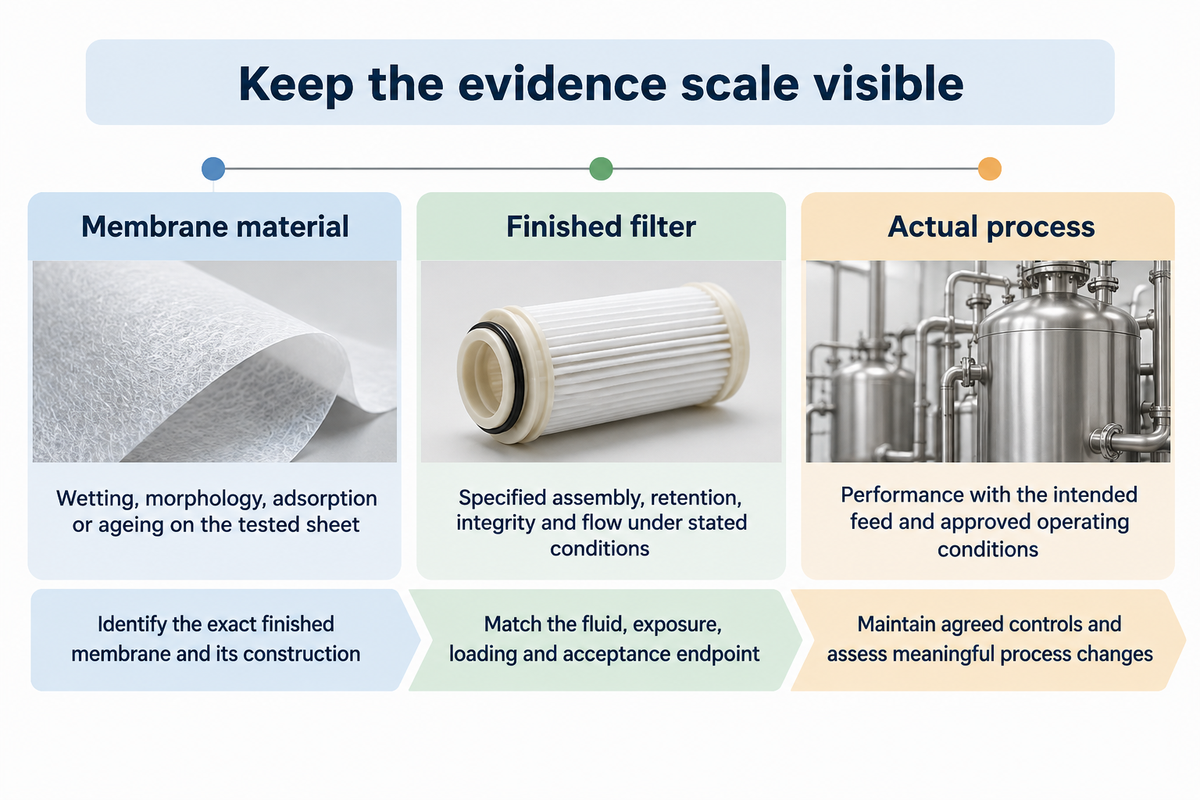
Published PVDF results become useful when the tested object, fluid, conditions and endpoint match the question being asked. A membrane-sheet study explains mechanisms; a finished-device test adds assembly behavior; an actual process assessment includes the feed and production conditions. Keep those scales visible so a useful observation doesn’t turn into an unsupported product promise.
3-Scale PVDF Evidence Boundary
The 3-Scale PVDF Evidence Boundary separates material behavior, finished-filter performance and process suitability before it moves between them.
| Scale | Useful evidence | Bridge to the next decision |
|---|---|---|
| Membrane material | Wetting, morphology, adsorption or ageing on the tested sheet | Identify the exact finished membrane and its construction |
| Finished filter | Specified assembly, retention, integrity and flow under stated conditions | Match the fluid, exposure, loading and acceptance endpoint |
| Actual process | Performance with the intended feed and approved operating conditions | Maintain agreed controls and assess meaningful process changes |
The distinction is especially helpful when a paper reports a useful result without testing a pleated cartridge. A small flat-sheet experiment can reveal a surface interaction, and doesn’t study every flow-path, seal or assembly effect in the production housing. Conversely, a clean-water cartridge curve describes a finished object, but it leaves the actual contaminant burden to the process assessment.
How is a membrane filter cartridge classified?
A membrane filter cartridge can be classified by various criteria including polymer, surface treatment, retention grade, construction and intended duty. Each of those describes a different aspect of the product. The rating method defines the claimed performance. Length or connector style defines fit. A description such as sterilizing grade requires its own supporting validation.
Dimensional drawings and performance comparisons should be side by side when determining product replacement. Procurement can confirm the intended object; engineering can compare the fluid path; and quality can identify the endpoint that determines acceptance. A 10-inch cartridge and a 47 mm lab disc can have the same polymer and nominal rating, but answer different evidence questions. Neither becomes interchangeable due to the material label.
The vendor claims are associated with their named products. A Durapore® membrane filter specification belongs with that named product family. A SteriLUX datasheet identifies its specified grade. A published patent describes the invention disclosure. None of these references establish that another vendor uses the same membrane treatment, holds the same patent or has the same product approval.
Have the filter cartridge manufacturer and supplier identify the tested construction and the method behind the relevant claim. An explicit drawing and a performance specification answer different aspects of a replacement evaluation. Requesting both gives a more complete comparison.
Where PVDF Fits in Industrial Liquid Filtration
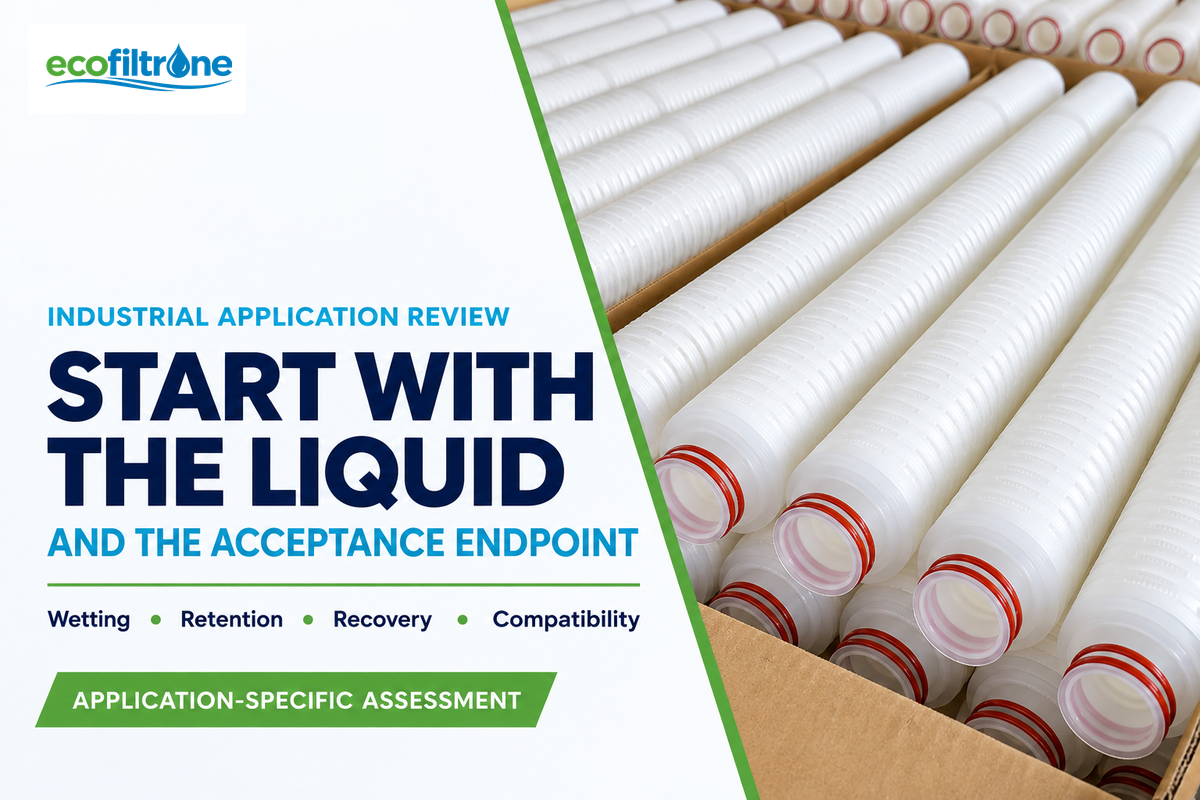
PVDF could find use in industrial liquid filtration where the final membrane grade, fluid compatibility and separation target are aligned. Fine-particle control, microbial control and recovery-sensitive fluids place different demands on the filter. Heavy feed loading and dissolved salts raise additional process questions. First determine the process, then assess the requirements for the filter and supporting evidence.
Systems such as industrial water treatment and high-purity water often require particulate control at a defined point in the process. Water filters used before sensitive equipment have to be evaluated against the incoming solids and the requirements downstream. A PVDF microfiltration membrane doesn’t perform the dissolved-ion separation required by water desalination.
In Buecker and Perryman’s Water Technology feature on pretreatment, particulate MF/UF is distinguished from other processes in the membrane family by mentioning examples involving treatment systems and hollow fibers, rather than a universal cartridge arrangement. Research on PVDF hollow fiber membrane distillation is a different process altogether; the shared polymer doesn’t allow for a pleated-cartridge claim for the mentioned desalination results.
Liquids from food and beverage, including those from bottled water, require application-specific particle or microbiological endpoints. If a duty states mold and yeast, define the organisms involved and the appropriate product validation; don’t infer product performance from a pore label. Pharmaceutical liquids raise product recovery and validated sterilizing-filtration questions. Particular emphasis in microelectronics and semiconductor processes might address contamination and ultra-pure filtrate. A common pore label doesn’t equate the duties.
ECOFILTRONE provides industrial liquid-filtration consumables with engineering support for application review, specification verification and replacement matching. Once the duty is defined, the PVDF membrane filter cartridge configurations page is where to review the product solution. Consider feed, flow, relevant outlet end point, and exposure history in combination.
Key takeaway
Choose the evidence that matches the task: wetting for startup, loading and outlet data for useful throughput, assembly-specific compatibility for exposure, and the appropriate validation for microbial-control duties. The membrane name starts the comparison; the intended liquid and acceptance endpoint finish it.
Need help determining a proposed replacement? Discuss your liquid-filtration application with ECOFILTRONE. State your current filter reference and what you hope to achieve.
Frequently Asked Questions
Can PVDF cartridges be sterilized and reused?
Sterilization and reuse depend on the exact cartridge and its validated procedure.
A membrane’s heat resistance and a finished cartridge’s approved treatment are different matters. Supports, seals, joints and prior chemical exposure also enter the decision. Follow the specified method, cycle limits and acceptance checks for that grade and process. A treatment described for another PVDF product isn’t a reuse instruction, and successful treatment doesn’t by itself establish acceptable retention or product quality afterward.
What is the shelf life of a PVDF filter cartridge?
Use the expiry and storage conditions specified for the finished cartridge.
The relevant information belongs to the supplied product, its packaging and any sterile condition, rather than PVDF as a polymer. Check the label, lot documentation and storage instructions, including whether the package has been opened or damaged. A shelf-life statement also describes storage before use; it doesn’t predict operating service life once the filter encounters the process liquid, loading and cleaning history.
How do I know if PVDF is the right filter material for my application?
Compare the finished grade against your liquid, separation target and acceptance endpoint.
Define what must be removed and what must remain in the filtrate. Then evaluate wetting, all wetted components, useful flow, recovery and the intended exposure. Critical microbial-control or product-quality duties require the appropriate validation as well. A matched assessment against a suitable PES, PTFE or nylon alternative is more useful than a broad claim of chemical resistance or low binding without the test conditions.
Is a Western blot PVDF membrane the same as an industrial liquid filter?
No. The applications use different product formats and performance requirements.
A Western blot membrane is intended for an analytical workflow. An industrial cartridge needs its own assembly, retention, compatibility and operating documentation. The same polymer name doesn’t make the devices interchangeable.
Are 0.2 µm and 0.22 µm PVDF ratings interchangeable?
Those labels alone are insufficient to approve an interchangeable replacement.
Different suppliers may use the labels within their filtration ranges, but the declared rating must be read with its retention test, grade and intended duty. For a critical process, compare the actual validation and assembly alongside dimensions and connectors. A 0.2µm designation doesn’t establish that every organism or product component behaves the same way across two filters.
Na et al.’s nominal 0.22 µm flat-sheet comparison illustrates the underlying issue: similar grade labels accompanied different membrane structures and measured characteristics. Treat a replacement as a defined comparison of finished products and process requirements, rather than an arithmetic rounding decision.
When do PVDF membrane filter cartridges need replacement?
Replace them at the approved process or product-specific endpoint.
The endpoint can involve differential pressure, useful flow, outlet quality, exposure limits or an integrity result. Apply the relevant procedure; a promise of long service life can’t substitute for those observations.
References & Sources
- Na et al., comparative evaluation of sterile filters Membranes, 2022; full primary article hosted by the United States National Library of Medicine.
- Development of hydrophilic PVDF using vapour-induced phase separation Membranes, 2020; primary article hosted by the United States National Library of Medicine.
- Schick et al., loss of soluble high-molecular-weight species during filtration Journal of Pharmaceutical Sciences, 2021; publisher abstract and visible results.
- Impact of extractables/leachables from filter materials on protein-based products AAPS PharmSciTech, 2022; original study of five non-PVDF materials.
- Giglia et al., defect detection sensitivity of bubble-point-type tests Membranes, 2023; EMD Millipore/Merck-affiliated authors, primary article hosted by the United States National Library of Medicine.
- Wu et al., chemical ageing of PVDF membranes made by different methods Journal of Environmental Sciences, 2018; abstract indexed by the United States Environmental Protection Agency.
- Rabuni et al., physical and chemical cleaning of PVDF membranes Chemical Engineering Science, 2015; abstract in the King Fahd University of Petroleum and Minerals research repository.
- ASTM F838-20, bacterial retention of liquid-filtration membranes ASTM International; public scope and significance sections.
- Release of Technical Report No. 26, revised 2025 Parenteral Drug Association, 11 November 2025.
- Buecker and Perryman, using membranes to protect membranes Water Technology, 2022; technical feature with ChemTreat affiliations disclosed.
- Li et al., scaled PVDF hollow-fibre membrane-distillation modules Membranes, 2022; abstract hosted by the United States National Library of Medicine.
Filtration selection brief
Bring the operating details that shape the next conversation
Record what is known from the line or process. A complete specification is not required to start.
Useful inputs
- Fluid and processFluid name, process stage, and any compatibility concern.
- Filtration targetRequired result, existing rating, or the issue to solve.
- Flow and run timeTypical flow range, batch size, or expected service interval.
- Installation conditionsHousing or connection details, temperature, pressure, and available space.
Next step
Send the details you have
Use the inquiry form to start a focused discussion and add drawings or photos when they help explain the installation.
Start an inquiry