Get in touch with ECOFILTRONE™ Company



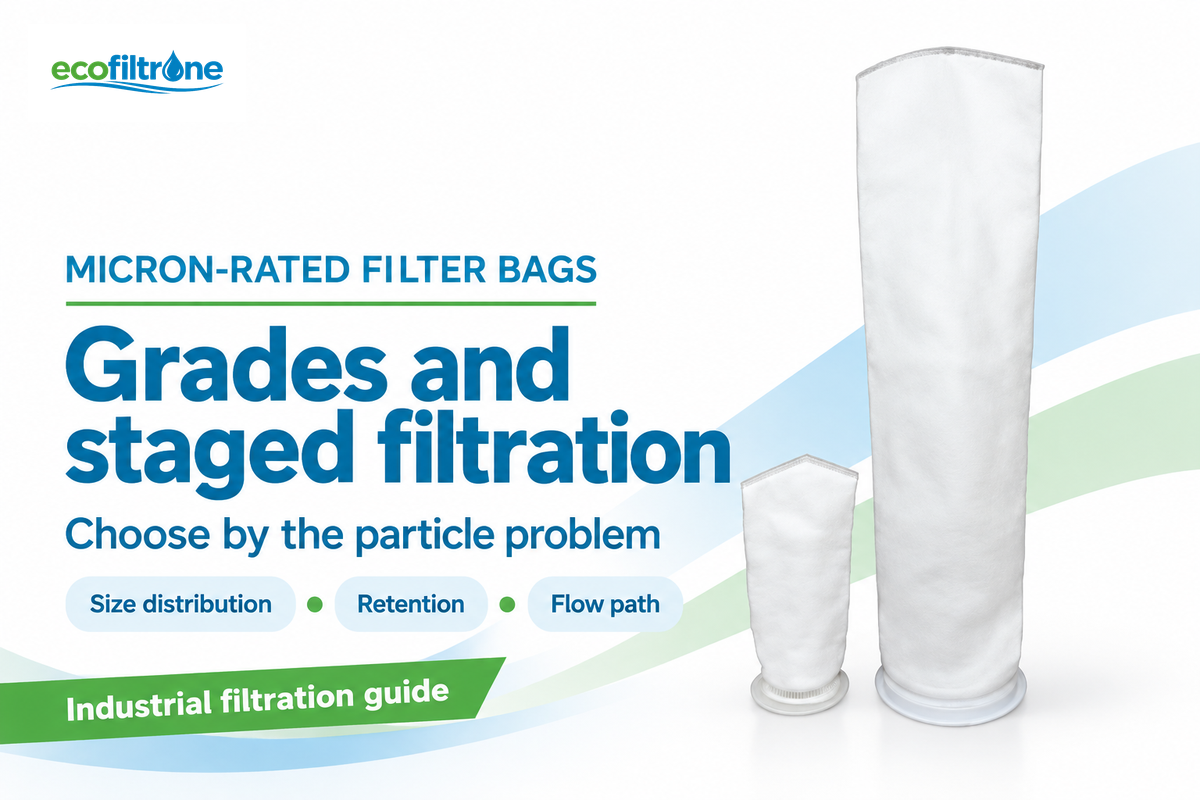
Micron Rated Filter Bags (1-200 µm) are liquid filtration bags labelled by particle size. Generally, start with the coarsest grade that meets the downstream particle removal target, and compare the performance of a finer grade. A 200 µm bag addresses a different size fraction compared to a 5 µm bag. The ideal choice depends on which particle causes the process problem.
Micron-Rated Filter Bags (1-200 µm) cover coarse separation through fine particulate filtration. Lower micron numbers identify finer nominal grades. Select the endpoint first, then use the feed distribution to decide whether an upstream stage has useful work to do.
Micron-rated filter bags: read the 1–200 µm range
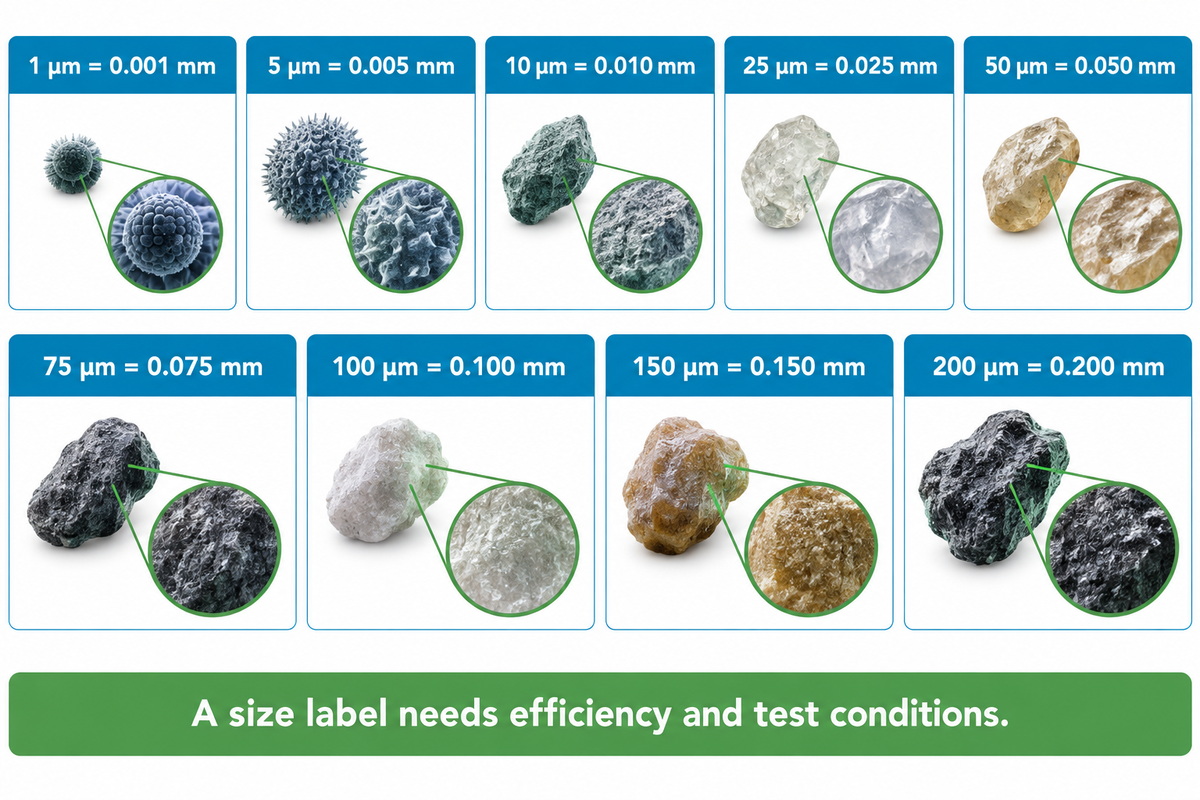
A micron is one-millionth of a metre, so the 1–200 µm range spans 0.001–0.2 mm. Smaller numbers represent smaller particle sizes, and higher values describe larger sizes. A filter bag micron rating becomes applicable when the removal efficiency and the test conditions are defined for that size.
Conversion to and from metric units follows BIPM definitions of SI prefixes. For replacement filters, a 50 micron bag is finer than a 100 micron bag in a comparable product family. Switching suppliers adds another question: What proportion of particles does each filter capture at its stated rating?
Use the micron rating guide to determine candidate grades. The millimetre column is a unit conversion. The decision column describes what needs to be investigated rather than rigidly assigning grades to a given industry. Micron ratings affect the size range. The retention curve shows how the filter captures that population.
| Label | Equivalent size | Trial question |
|---|---|---|
| 1 µm | 0.001 mm | Does moving below 5 µm resolve the measured fine-particle defect? |
| 5 µm | 0.005 mm | Can the fine endpoint be met without selecting 1 µm? |
| 10 µm | 0.010 mm | Does the finer candidate improve the result achieved at 25 µm? |
| 25 µm | 0.025 mm | How much of the feed lies above this boundary? |
| 50 µm | 0.050 mm | Are retained solids useful product, contamination or both? |
| 75 µm | 0.075 mm | Is an intermediate grade worth testing between 50 and 100 µm? |
| 100 µm | 0.100 mm | Does coarse removal protect the next stage at the required flow? |
| 150 µm | 0.150 mm | Is the feed fraction below 200 µm large enough to justify tightening? |
| 200 µm | 0.200 mm | Is there enough larger debris to give this stage a useful role? |
Grades vary according to medium and construction. For the difference between a nominal rating and an absolute rating, consult the filter micron rating and efficiency guide. Maintain a constant basis for comparison when assessing adjacent grades.
Felt and mesh: why equal micron numbers are not interchangeable
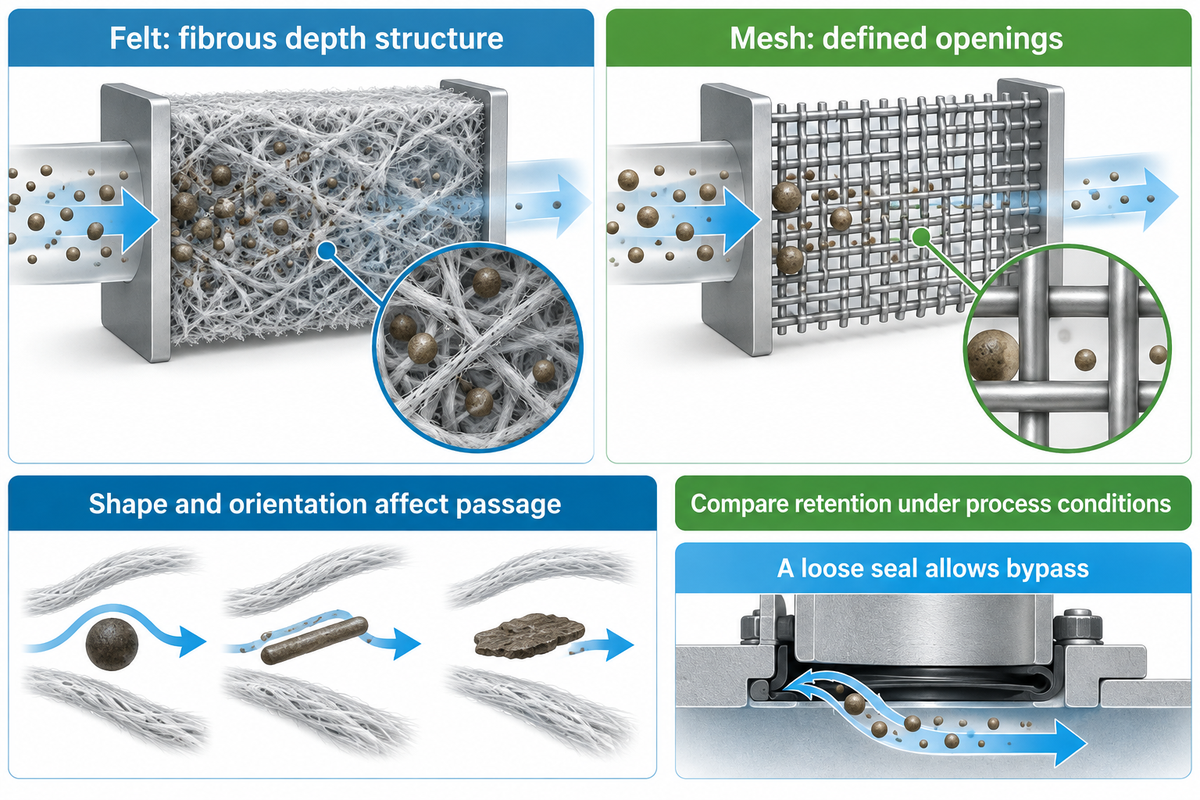
Felt bags retain particles within a fibrous structure, while monofilament meshes, in general, separate at defined openings. Equal micron numbers therefore describe candidates that can behave differently as solids accumulate. Compare filtration media and retention, and evaluate if both candidates yield the same downstream result under intended process conditions.
Polypropylene and polyester felt provide depth-media routes. Nylon monofilament mesh has a woven surface through which liquid passes. These filter media capture particles through different structures. A nominal bag can retain a distribution of particles of different sizes through its internal passages and deposited solids. A mesh aperture gives a geometric opening, but particle shape and orientation still affect passage.
“‘Nominal’ is not worse than ‘absolute’.”
A more restrictive specification can be useful when the process calls for it, as described by Eaton. Finer filtration, without improvement in the finished liquid, can add more resistance or bag changes.
ISO 16889:2022 covers multipass testing of hydraulic fluid power filter elements. For industrial liquid duty, compare retention at the reported test conditions rather than treating micron labels as equivalent retention specifications.
For a replacement comparison, keep sealing geometry, support geometry and bag size comparable. Bag filter housings must seal and support the construction under consideration. A steel ring that fits loosely can allow liquid around the media; changing to polyester bags with a smaller micron number would leave that bypass path in place. See the operating instructions in the liquid filter bags for housing fit and change-out checks. The Nylon Mesh filter bag guide provides more detail on the construction of nylon mesh and its reuse.
1–5 micron filter bags: protect the fine-particle endpoint
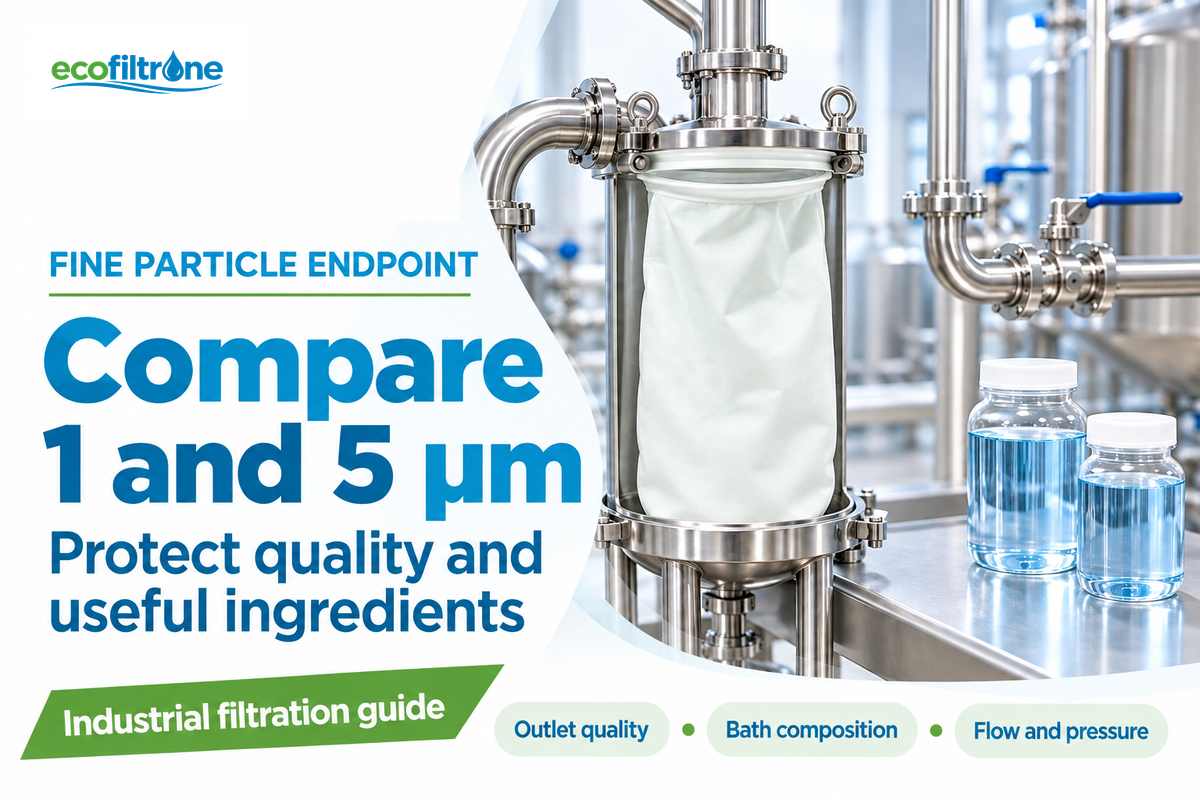
Using the 1-5 µm band is justified if the unresolved defect involves fine particles and a coarser candidate leaves the downstream result beyond the acceptance limit. Begin with the existing qualified grade, or compare 5 µm with 1 µm within a suitable product family. Judge fine filtration on liquid leaving the system, while considering flow and pressure.
When should I use a 1 micron versus a 5 micron filter bag?
Using 1 micron for fine particulate removal would be justified if a 5 micron candidate leaves the relevant particle population above the process limit and the finer bag supports the required flow. Keep 5 micron when it already meets that limit with acceptable changeouts. Compare efficiencies at the critical particle size, since nominal or absolute labels don’t describe the entire test.
Suppose the finishing bath has specks on parts after treatment and the maintenance team suggests a 1 µm filter because the current bag is marked 5 µm. Quality staff compare the specks to solids samples from the housing outlet. If the defect is from particles formed after that, changing the bag grade doesn’t address the correct location. If the particles pass through the current media, a finer candidate is a good choice for further testing. During this comparison, keep the same bath chemistry and flow, and monitor the quality of the finished product at the same step as in production. Record the change in the bath constituents as well as the specks.
Fine polishing is useful when the remaining particles affect the finished product. Capturing finer particles can also remove constituents that emulsions and formulated liquids need to keep suspended. A machining-forum contributor discussing coolant filtration reported unwanted changes when filtering very finely. The report is an individual observation, so use it to plan a composition check rather than to prescribe a universal coolant grade.
A 1 µm particulate bag serves a different function than a validated microbial-removal system. For sensitive processes, differentiate particle removal and microbiological control.
10–25 micron filter bags: examine the middle of the distribution
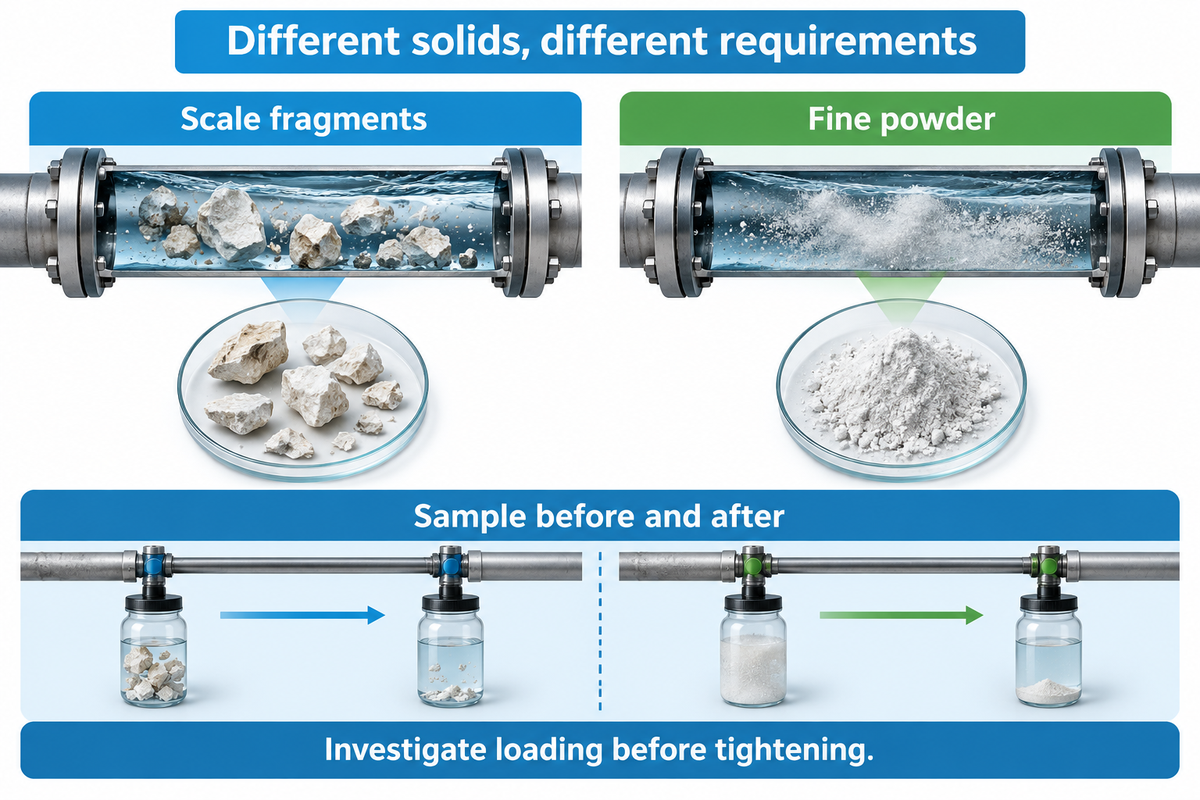
The 10-25 µm range can be used to assess an unwanted fraction that lies between coarse debris and a fine cut-off point. Compare the 25 µm cut if it’s the coarser of the two candidates consistent with the quality target, and 10 µm if the downstream sample still contains particles associated with the defect.
Broad application names offer little help here. Two process water streams at the same site can carry different solids. One stream may carry scale fragment solids; the other may carry production-related fine powder solids. Their process requirements differ even if they use the same filter housings and nominal flow rate.
Separate the sampling question into unwanted fractions and the material that should remain. In food and beverage processing, removing visible debris can be useful while stripping intended suspended ingredients changes the product. For a liquid product containing solids, compare the material that has been retained to the formulation and product specification. Food production adds product and contact requirements; a micron label states the particle size, and the requirements address suitability of the whole product.
When 25 µm reaches the cleanliness target but clogs quickly, the next comparison should investigate loading and media area. Directly moving to 10 µm will introduce an even finer capture to a system already challenged by solids. Sample before and after the current position to decide if there’s an adequate amount of coarse material upstream to remove. Canadian public-water guidance also warns that bag filters do not load linearly; this supports observing loading behaviour during the trial rather than inferring service life from a grade change.
50–100 micron filter bags: find out what the coarse fraction contains
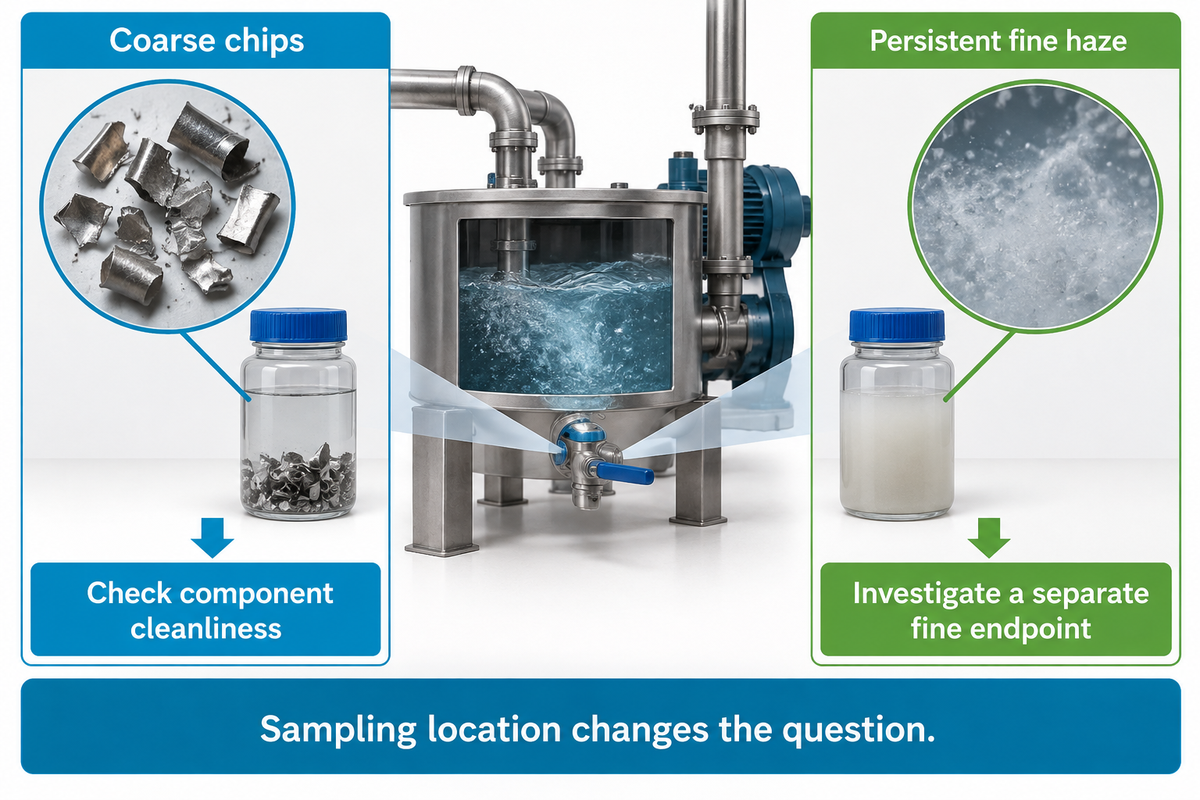
Coarse media of 50 to 100 µm can remove a coarse fraction before finer treatment, if the coarse fraction is present and if it’s unwanted. Particle examination can assist in differentiating hard debris from soft agglomerates and/or useful suspended material. Tightening the grade from 100 to 50 µm shifts the range of candidate capture; the benefit is achieved by removing the specific solids of concern.
Imagine a recirculating wash line that intermittently receives chips, along with a persistent fine haze. A 100 µm stage captures chips that would be directed to a downstream component. The haze isn’t captured because the particles of the haze follow a different path through the filtration system. Selecting 50 µm just because the tank still looks cloudy mixes those two objectives. An operator can collect a retained-solids sample and compare outlet particle measurements with the component’s cleanliness requirement. If chips are controlled and the haze is of no concern, the coarser stage has accomplished its task. If the haze causes rejects, investigate a separate fine endpoint instead of assuming that every smaller label will solve it.
Hard, magnetic swarf may require a separation step different from a bag. Soft agglomerates may change size during pumping. Particles shouldn’t be considered a fixed population of spherical particles just because an instrument reports a micron size.
For coarser bags, consider the distribution that actually arrives at the housing. A sample taken from a tank prior to mixing, a sample taken after pumping, and a sample collected late in a batch can address different questions. Public-water Canadian design guidance states that particle counts are best represented as a snapshot. The same sampling limitation should be considered for an industrial case.
150–200 micron filter bags: define the first-stage job
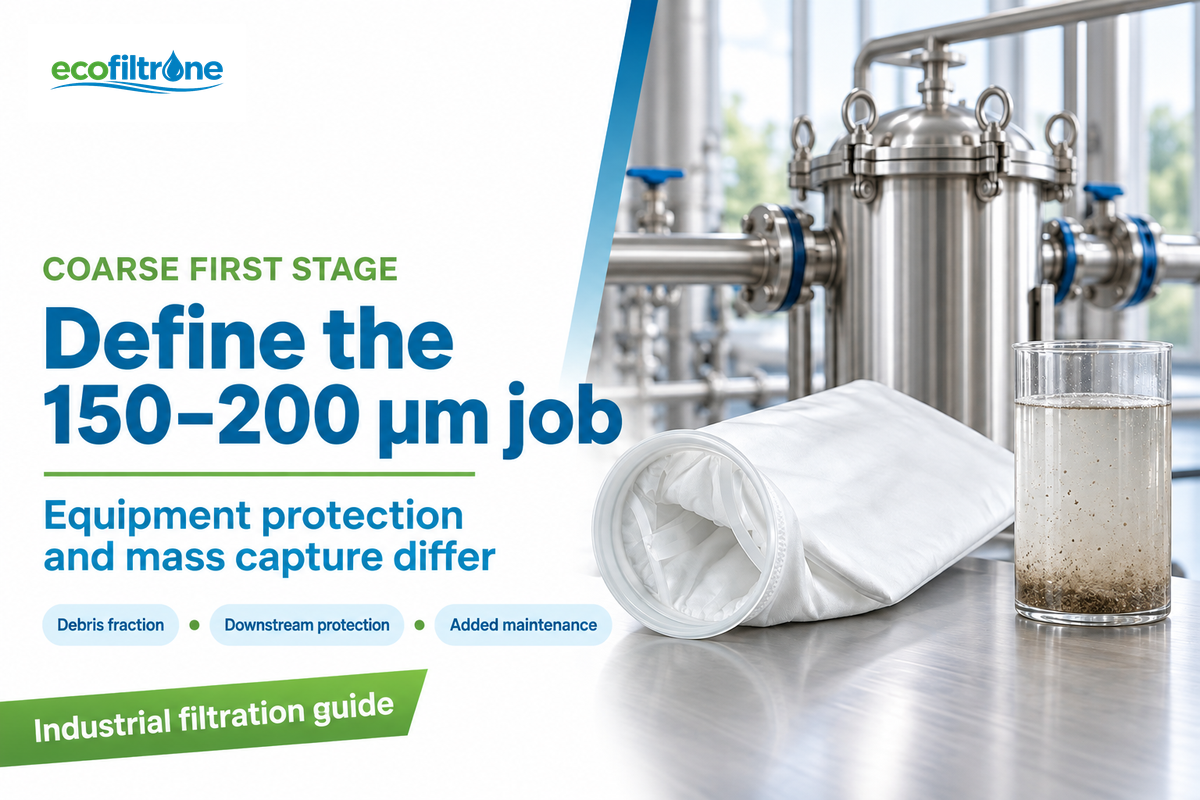
A 150–200 µm bag is a coarse-filtration candidate when incoming debris above that range threatens downstream equipment or imposes avoidable loading on a finer stage. Start at 200 µm when the target debris is coarser than that boundary; compare 150 µm if the remaining coarse fraction still causes the identified problem.
What will a 200 micron filter remove?
A 200 micron filter is designed to target coarse suspended particles and retain larger particles, with actual retention depending on its rating and media. For rigid particles and a suitable mesh, the opening helps describe separation. Flexible fibres, deformable particles and nominal felt media require a different interpretation of what passes through under operating pressure.
Large debris can be visually striking while contributing little of the mass that a 5 µm final bag would collect. First, identify the fraction you need to capture. A few large fragments in the inlet sample don’t prove that a 200 µm prefilter would capture most of the load. Weighing size fractions gives the answer more directly, if sampling and analysis allow it. NIST explains why size distribution matters when converting particle mass into particle number; a count alone does not describe how much mass the coarse fraction carries.
In a similar vein, an initial coarse stage may protect equipment rather than extend the life of the bag. Keep these effects separate when making a purchase. A coarse stage that relieves downstream blockages, even if it collects little mass, may be warranted. On the other hand, adding a housing creates an additional maintenance point, and may increase equipment resistance even if little coarse material is present.
Particle size distribution: calculate which stage takes the load
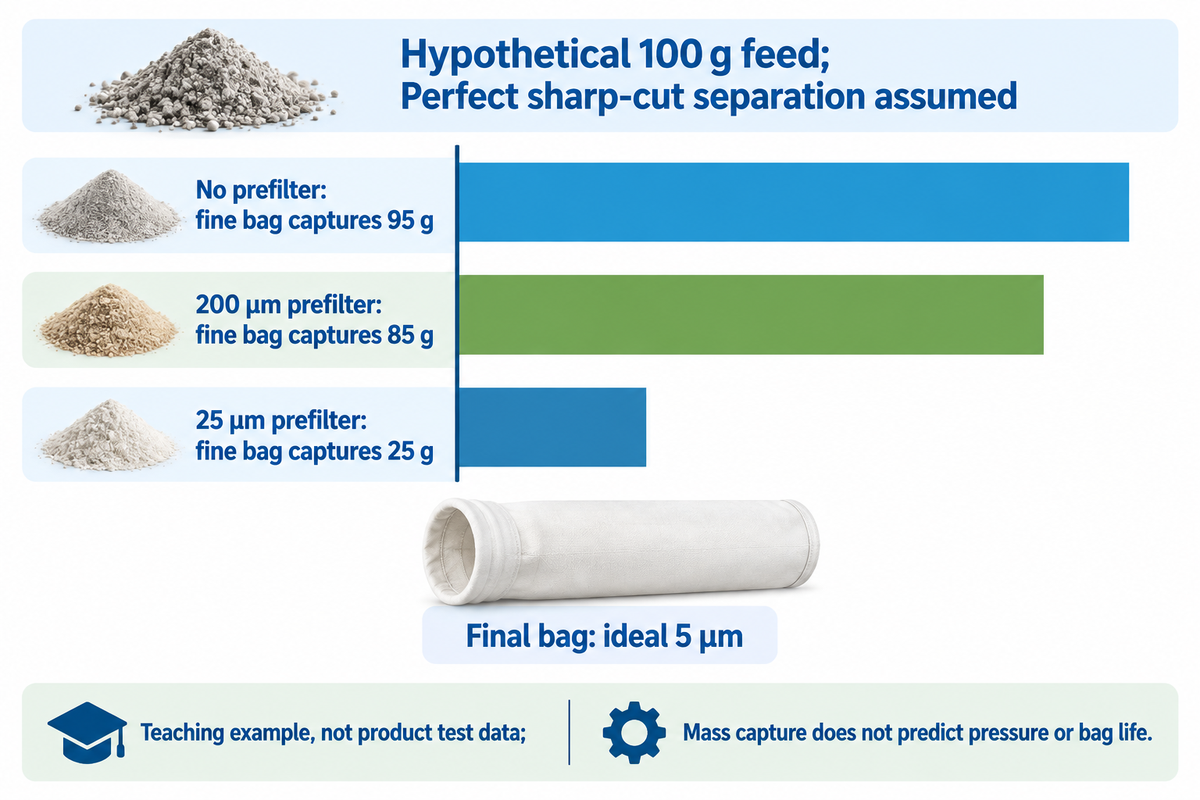
The 100-Gram Grade Split makes assumptions about feed mass to give an idea of what each ideal stage collects. In the examples given, a 25 µm prefilter collects much more mass than a 200 µm prefilter. The calculation compares mass allocation; measured pressure behaviour must be assessed separately.
Assumed inputs: 100 g of suspended solids, already expressed on a mass basis; stable particles that don’t break or aggregate; perfect sharp-cut separation at each stated boundary; no bypass or losses. These are teaching assumptions; the results presented aren’t from an ECOFILTRONE test. Real filtration efficiency varies with particle size and operating conditions.
| Particle diameter d | Feed mass | Ideal 200 µm stage | Ideal 25 µm stage |
|---|---|---|---|
| d ≥ 200 µm | 10 g | Collects | Collects |
| 25 µm ≤ d < 200 µm | 60 g | Passes | Collects |
| 5 µm ≤ d < 25 µm | 25 g | Passes | Passes |
| d < 5 µm | 5 g | Passes | Passes |
A lone ideal 5 µm bag captures 10 + 60 + 25 = 95 g. With the 200 µm stage ahead of it, the fine bag collects 60 + 25 = 85 g. Replacing that prefilter with an ideal 25 µm stage transfers 70 g upstream and leaves 25 g for the fine bag. The final sub-5 µm fraction passes through all three arrangements.
The total mass which reaches the fine bag is 90 g after the 200 µm prefilter or 30 g after the 25 µm prefilter. Each of these totals includes the 5 g which is below the final cut and passes through rather than being captured.
For a real assessment, multiply the mass in each size interval by the measured retention fraction of the proposed upstream bag at that interval. Add these retained amounts and take the remaining distribution through the downstream retention curve. The information provided by a supplier on a single nominal number isn’t adequate to perform this calculation.
Check the basis of a distribution before using it. Equal-density spheres with diameters of 10 and 100 µm differ in volume by a factor of 1,000, so a small number of large particles can carry substantial mass. Different particle densities break the equivalence of volume and mass. The NIST study on particle measurement describes the importance of size distribution for relating mass to particle numbers.
Measurement methods are important, as well. Agimelen and colleagues’ study of needle-shaped particles shows how a spherical laser-diffraction model can create artificial fine-particle modes. A suspicious fine peak warrants a method and shape check before it drives selection of a finer bag.
Removing coarse material changes the mixture forming the next cake, so captured mass does not translate proportionally into pressure reduction or bag life. Capturing mass doesn’t directly correspond to a reduction in pressure or increase in bag life. Hennemann and colleagues’ 2021 filtration research links distribution width to cake porosity and resistance using brewing suspensions and a glass-bead model.
Series or recirculation: two different routes through filter bags
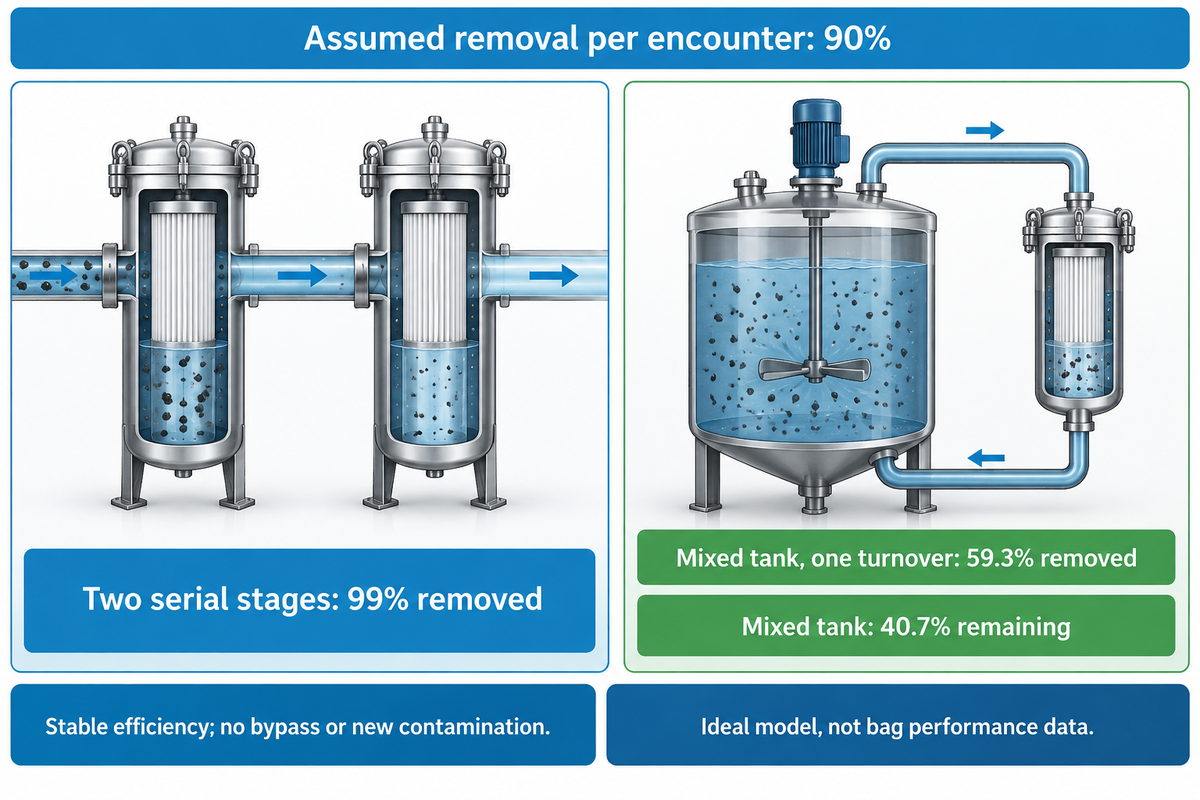
Two successive stages contact a parcel of liquid. A recirculation loop draws from a tank that contains untreated particles. With an assumed constant 90% removal of the same particle class at each stage, two serial stages remove 99%. With the preceding model, two successive stages remove 99% of the same class particles. A completely mixed tank following the same model removes 59.3% after one turnover.
Assumed inputs: the same target particle class throughout; 90% removal per encounter; stable efficiency and particles; no bypass, new contamination or settling. For the tank calculation, liquid mixes perfectly and returns to the same constant-volume reservoir. A micron label isn’t the efficiency input.
In the serial example, the first stage leaves 10% of the incoming target particles. The second stage removes 90% of that remainder, leaving a fraction of 0.10 × 0.10 = 0.01. It’s assumed that the second stage truly has the stated efficiency for the population reaching it. Two different grades may have very different retention curves.
For the mixed tank, the remaining concentration follows C/C₀ = exp(−ηQt/V), where η is the removal fraction per pass, Q the circulating flow, t elapsed time and V tank volume. A hypothetical 1,000 L tank circulating at 100 L/min reaches one turnover in 10 min. At η = 0.90, exp(−0.90) gives 40.7% remaining. Pumping one tank volume doesn’t make every particle pass through the bag once.
Nathan Madding’s research at UNC Charlotte focuses on this exponential-dilution framework relating to swimming pool water recirculation. While Madding’s work incorporates modeling and some experimental analysis, it isn’t true industrial bag-filter performance testing. Dead zones, continuing process contamination and changing filtration efficiency alter the tank result.
For a batch tank that must reach a particle limit before transfer, quality staff need a representative tank sample at the release point. A clean sample taken immediately after the filter describes the outlet, while the tank can still contain a higher concentration. Maintenance needs the circulating flow actually achieved as the bags load. Procurement staff can make a meaningful distinction on the basis of whether a finer grade changes the per-pass removal or a different flow arrangement affects how quickly the bulk liquid reaches the treatment stage. Define an acceptable tank result and transfer time simultaneously before procuring more filter housings.
When does a staged filtration train justify another housing?
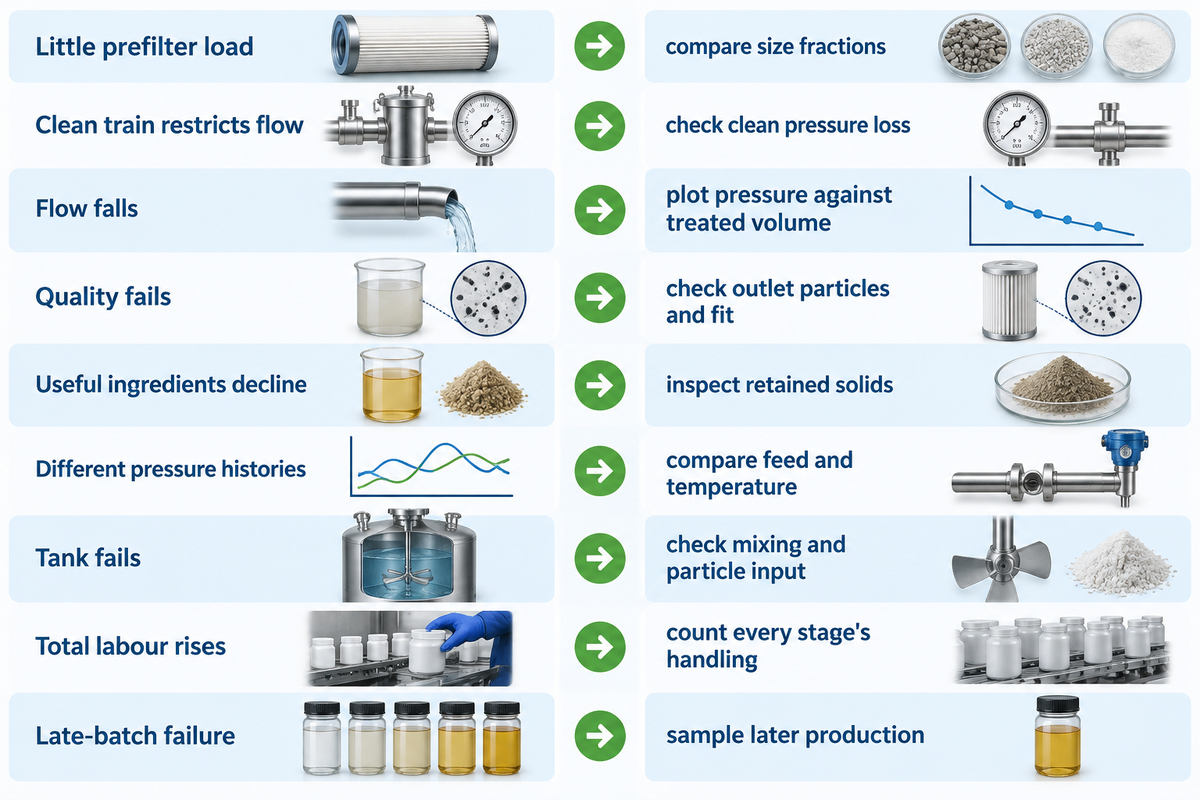
Compare staged filtration on the basis of downstream quality, pressure across each stage, achieved flow and the total maintenance burden. Take the current working arrangement as the baseline and change one candidate stage at a time. Reliable data from the same bag, housing and process conditions can reduce repeated trials; changed conditions require a fresh comparison.
The staged filtration bottleneck map separates nine observations that are usually lumped together as “the bag clogs.” Plant staff can now identify the limiting step. Quality staff can protect the end point, and purchasing can evaluate the total replacement burden versus the cost of one bag.
| Observed pattern | Likely constraint to investigate | Next comparison |
|---|---|---|
| Fine stage loads; coarse bag remains lightly loaded | Little removable coarse mass | Compare incoming size fractions with the prefilter’s retention curve |
| Clean train already restricts required flow | Insufficient pressure headroom | Compare clean pressure loss at matched flow and temperature |
| Flow falls as a stage loads | Increasing resistance | Plot that stage’s differential pressure against treated volume |
| Quality fails with modest pressure change | Capture or sealing problem | Check outlet particles and housing fit before tightening the grade |
| Quality passes but useful ingredients decline | Unwanted product removal | Compare retained solids with the formulation |
| Similar mass gives different pressure histories | Cake structure or viscosity change | Compare feed composition, temperature and size distribution |
| Outlet sample passes; tank sample fails | Incomplete bulk treatment | Check mixing, turnover and continuing particle input |
| Final bag lasts longer; total labour increases | Work shifted upstream | Count changes and handling time across every stage |
| Trial works only early in a batch | Changing feed or operating conditions | Sample the later production period before accepting the arrangement |
Keep a matched record for baseline and candidate: liquid identity and temperature, solids sampling point, media and rating, instantaneous flow and cumulative volume, differential pressure by stage, quality result and each changeout. Record time spent changing bags separately from time spent waiting for production to resume. Use applicable manufacturer’s limits for the bag, housing and process. Canadian public-water guidance notes nonlinear bag loading; closer observation at the end of a run is more useful than extrapolating the first few readings.
For maintenance, “longer final-bag life” is only one outcome. Add the upstream replacements, handling time, disposal and interrupted production. Filtration + Separation’s discussion of process-filter selection includes those operating costs. A cost-effective train can use more than one grade, but extra stages must earn their place through useful removal or equipment protection.
Accept the candidate when it meets the same filtration quality target with a worthwhile operating improvement. If the fine stage improves while the new prefilter consumes the saved labour, revise the arrangement. Shorter maintenance intervals at the coarse stage can cancel the labour saved downstream. If loaded bags restrict flow, compare resistance at the required production rate; a high flow duty can reach its hydraulic limit before the outlet quality fails. More media area can reduce clean resistance, but its geometry and support must be designed to handle the intended operating conditions.
Carry the selected micron range into a product review

ECOFILTRONE™ supports the review of applications, selection and replacement of filters in industrial water treatment and process filtration. Bring the trial results, liquid conditions and bag-to-housing details to the Micron-Rated Filter Bags (1-200 µm) solution page for product customization.
To choose the right configuration of filter bags for industrial service, include media, dimensions, collar material and operating conditions. Carbon steel and polymer rings need their own compatibility check. Product-specific technical and compliance documents are confirmed against the supplied product and the actual certificate holder.
Frequently asked questions
Which is finer, a 100 or 200 micron filter bag?
A 100 micron bag is the finer candidate within a comparable rating system.
The smaller micron number refers to the smaller particle size, so 100 µm is half the dimensional value of 200 µm. Compare bags with the same media family and rating definition before expecting a particular improvement. A nominal felt bag and a mesh opening may use different rating bases, and the result also changes with particle shape, seals and operating conditions.
Can micron-rated filter bags be washed and reused?
Some suitable mesh bags can be cleaned; reuse depends on the complete bag and process.
A surface deposit on nylon mesh may be removable, whereas particles lodged within felt media can be difficult to release. Cleaning must preserve the opening structure, seam and collar while removing the contamination that matters to the application. Compare the cleaned bag with the process acceptance criteria before reuse, and follow the supplier’s product-specific instructions. There’s no universal number of cleaning cycles.
Are polypropylene filter bags suitable for every chemical liquid?
No. Polypropylene compatibility must match the full liquid and exposure conditions.
Chemical name alone leaves out concentration, temperature and contact time, all of which affect material selection. Cleaning chemicals add another exposure that the filtration bag must tolerate. Check the media together with its seam, collar and any other wetted components. Polyester felt or another material may be a better candidate for a particular duty, but changing the fibre requires its own compatibility assessment.
Can a supplier customize a filter bag?
Customization can address fit, media and construction after the operating requirements are defined.
Provide housing dimensions, sealing geometry, the existing bag identification and liquid conditions. ECOFILTRONE reviews customized filtration requirements and sample or trial support. The proposed combination and its availability are confirmed during technical review.
What is the best micron rating for industrial filtration?
The useful starting point is the coarsest suitable grade that meets the downstream cleanliness target.
Find the right filter by connecting the particle population to the process defect. If a current 25 µm candidate meets the quality limit, selecting 5 µm adds finer capture that may have no useful role. If the fine fraction causes rejects, test a finer candidate while checking flow, pressure and useful ingredients retained in the liquid. For a staged train, assess the prefilter against the mass and type of solids it actually receives. The right filter bag is the one that meets the defined endpoint under the intended operating conditions with an acceptable total maintenance burden.
Will a filter bag remove dissolved salts?
Ordinary particulate filter bags do not remove dissolved salts by size exclusion in this micron range.
Dissolved-ion removal calls for an appropriate treatment process, such as a suitably designed membrane or ion-exchange system. Bag filtration can remove suspended solids ahead of that process when the pretreatment duty is correctly specified.
Numerical examples in the document use assumptions to illustrate grade selection and flow paths. They aren’t case studies or performance guarantees of the products.
References & Sources
- BIPM: SI prefixes.
- Eaton: Considerations on bag filtration, Filtration + Separation, 2020.
- International Organization for Standardization: ISO 16889:2022, Hydraulic fluid power filters, multi-pass evaluation, public scope.
- NIST: research on measuring particle number concentration, 2025.
- Agimelen, Mulholland and Sefcik: Modelling of artefacts in estimations of particle size of needle-like particles from laser diffraction measurements, 2016.
- Hennemann, Gastl and Becker: Influence of particle size uniformity on the filter cake resistance of physically and chemically modified fine particles, 2021.
- Nathan Madding: A Quantitative Analysis of Swimming Pool Recirculation System Efficiency, UNC Charlotte, 2015.
- Government of Canada: Design Guidelines for First Nations Water Works.
- Filtration + Separation: Factors to consider in liquid filtration, 2015.