Get in touch with ECOFILTRONE™ Company



Working specification
Medium: PTFE fibre felt or a specified membrane construction. Duty: particulate removal from an industrial liquid. Rating: particle size in µm plus capture efficiency. Operating record: flow in m³/h, differential pressure in bar or psi, temperature in °C, viscosity in mPa·s. Assembly: media, seam, ring, seal and supporting basket.
Their usefulness comes from matching the construction to the liquid, the required capture performance and the complete filter housing. PTFE Liquid Filter Bags remove suspended particles from liquids through a specified PTFE medium. Chemical resistance can leave the wrong choice when poor wetting, a leaking top seal, or rapid cake formation controls the result.
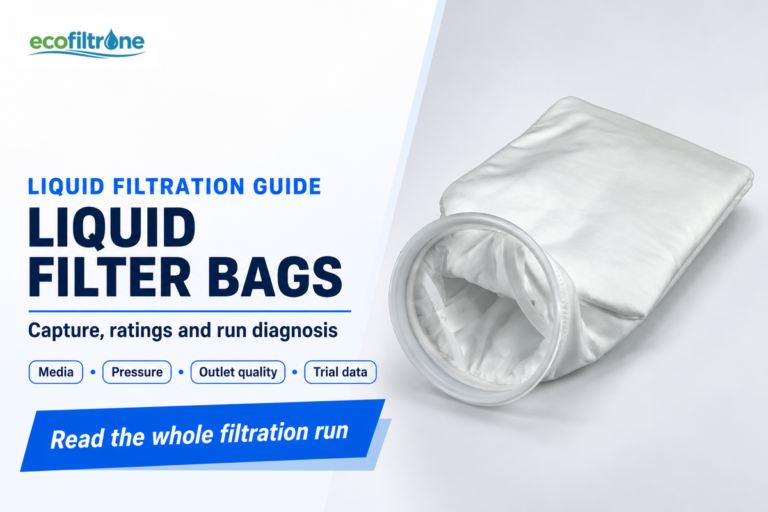
PTFE Liquid Filter Bags use a PTFE medium to capture suspended particles. Select the construction and capture efficiency first, then assess the complete assembly under the intended liquid conditions. Chemical resistance alone doesn’t determine service life.
Key takeaways
- PTFE felt, a PTFE membrane and a membrane-coated fabric have different structures.
- A micron number needs an efficiency and test basis.
- Clean-start pressure drop, gradual loading and sudden changes point to different checks.
- A useful comparison counts liquid meeting the same downstream quality requirement.
PTFE Liquid Filter Bags: Start with the Construction
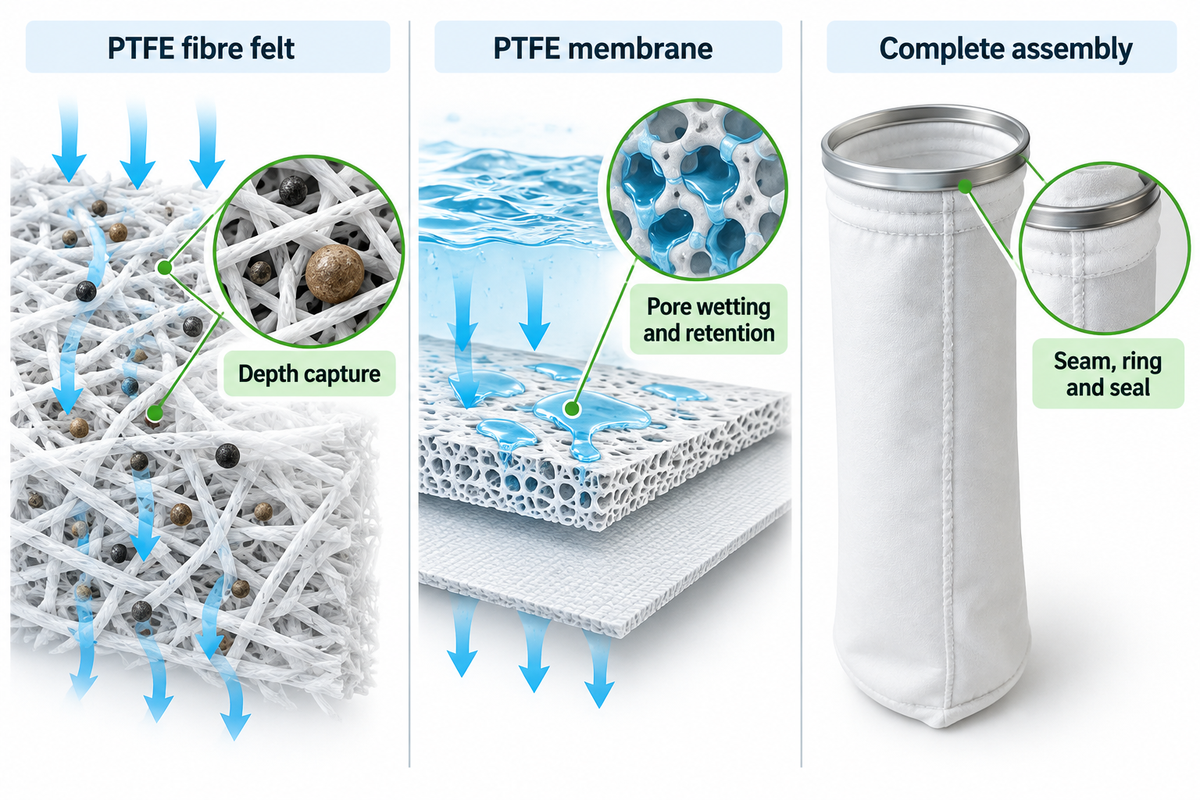
PTFE liquid filter bags are shaped filter elements whose specified filtration medium contains polytetrafluoroethylene. Fibrous felt captures particles by a depth of medium, and a membrane introduces a porous layer with its own wetting and retention behavior. PTFE identifies the polymer, and the construction defines how the element operates.
What is a PTFE/Teflon bag filter made from?
PTFE felt bags use PTFE fibres formed into a depth-filter medium, together with a seam and a top ring or collar. Other parts may be of different materials. Membrane versions add a distinct porous layer, sometimes carried on a support. The description of the construction has to name the filtering layer and parts which come in contact with the liquid.
Needled felt offers depth filtration: particles can embed in the fibrous structure rather than collecting on just one surface. Fibre arrangement, thickness and the challenge particles affect filtration performance. The wider family of liquid filter bag constructions includes mesh and other types of media. White fabric and a trade name don’t identify the complete construction.
PTFE Construction-to-Behavior Map
The PTFE Construction-to-Behavior Map connects each component to the filtration behaviour it can influence.
| Component or feature | Behaviour to understand | Useful specification |
|---|---|---|
| PTFE fibre felt | Depth capture and resistance through the fibrous layer | Media grade and measured capture efficiency |
| PTFE membrane | Pore wetting and retention at the membrane layer | Membrane type and liquid-use instructions |
| Backing fabric | Mechanical support and its own chemical exposure | Backing polymer and construction |
| Bag seam | Joint strength and potential particle escape | Sewn or welded construction for that model |
| Sewing thread | A wetted material separate from the main fabric | Thread material |
| Top ring or collar | How the bag locates and seals in the vessel | Profile, material and dimensions in mm |
| Gasket or seal | Liquid containment and the bypass path | Seal material and compatible seat geometry |
| Support basket | Support against deformation under load | Basket model and bag fit |
| Complete vessel | Pressure, temperature and hydraulic limits | Housing identification and manufacturer’s limits |
The rating of a pore, expressed in micrometers, is different from the dimension of a collar, expressed in millimeters. Keeping both on the specification helps eliminate a replacement that, while fitting the vessel, changes the capture medium and performance or a medium that isn’t sealing properly.
Chemical Compatibility Depends on the Whole Assembly
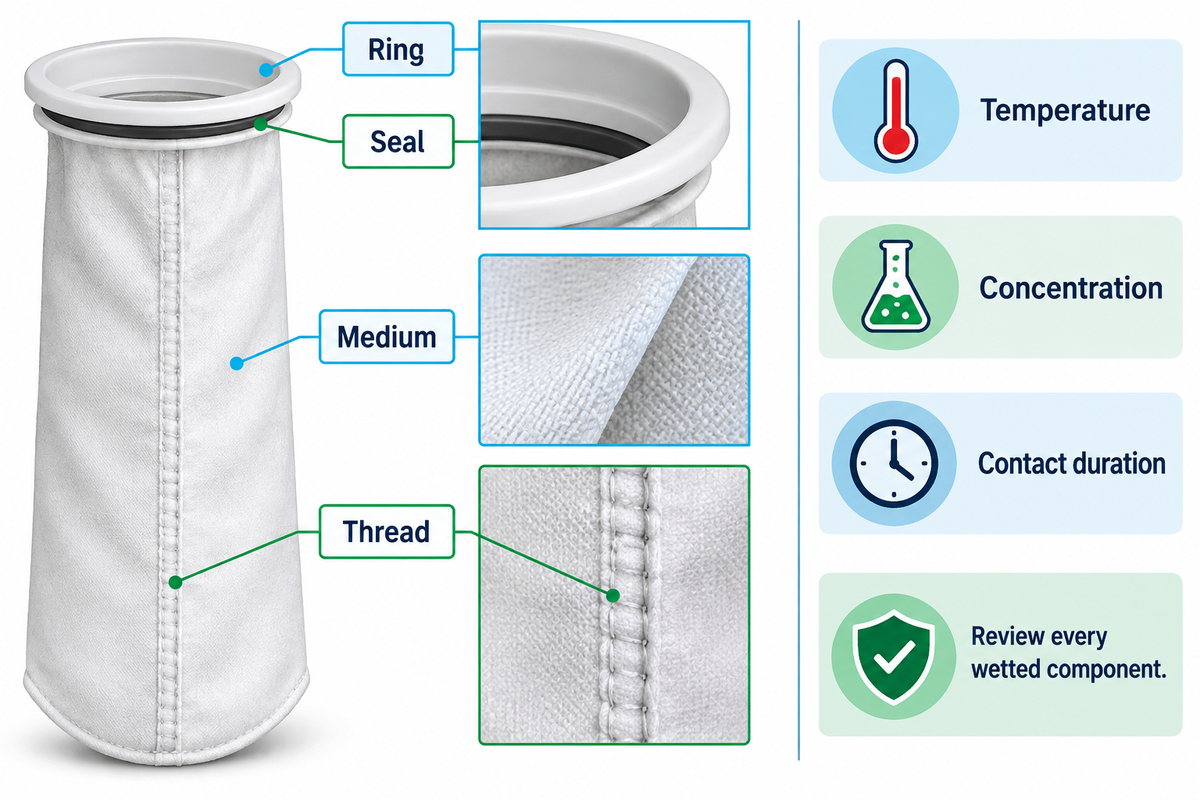
Chemical compatibility is an assembly decision. The medium can be in direct contact with liquids, and other components such as the thread or a sealing ring, at various mechanical loads. The temperature, concentration and duration of contact with the liquid affect that assessment. In chemical processing, an apparently suitable PTFE filter can fail its duty because another wetted component has a lower operating limit.
Describe the full stream, including contaminants and cleaning liquids, rather than only the main solvent; pH levels help describe an aqueous stream, but concentration and temperature still matter. Corrosive liquid can dissolve or chemically attack a metal ring. The PTFE fabric can remain intact. Abrasion from hard sediment is a different mechanical problem than a chemical attack.
High-temperature service needs a rating for the complete liquid filtration assembly. Extreme operating conditions require review of cleaning exposure as well as normal production. The polymer temperature figure can’t replace the vessel, seal and seam limits. Extreme temperatures can change liquid viscosity and the usable limits of seals; operation must stay within each component’s specification. The 3M DF Series system literature, for example, treats media compatibility and housing gasket limits separately. Its flow curves identify the element and support basket being measured.
Flammable, low-conductivity liquids need a system-level electrostatic hazard assessment as well as compatibility checks. The UK Health and Safety Executive identifies charge separation during liquid transfer as a possible ignition source, with suspended solids capable of increasing charge accumulation. Beyond its PTFE designation, the system requires qualification.
Aggressive chemicals can support special materials, for example, if a general-purpose medium is compromised. If the existing bag stays chemically sound and fails through solids loading, chemical resistance has not yet answered the replacement question.
Water Flow and PTFE Wetting: Check the Actual Medium
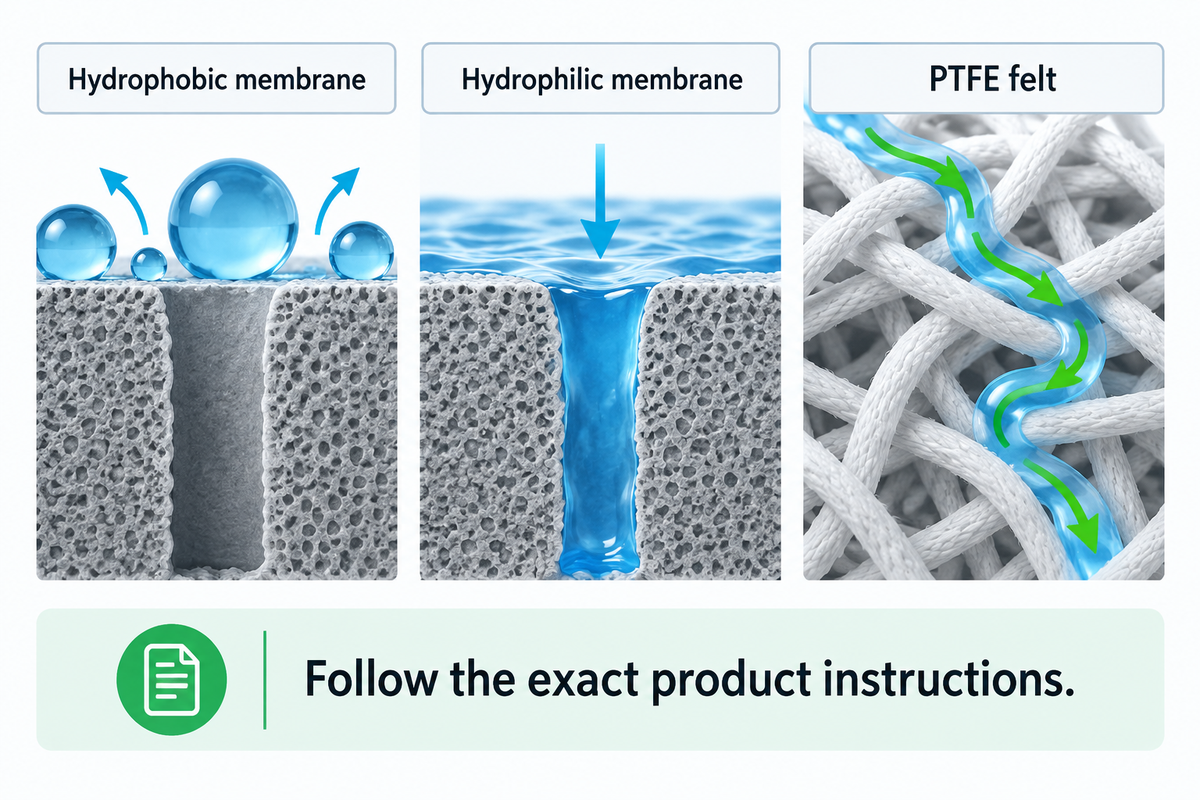
The flow of water through PTFE mediums is dependent on the structure and surface condition of the medium. Hydrophobic membranes can resist the initial water entry into their pores. The membrane can be made hydrophilic by a treatment. PTFE felt is a fibrous construction, hence a prewetting of the membrane can’t be assumed for every liquid bag.
Can Water Pass Through PTFE Filter Bags?
Yes, a PTFE filter bag designed and qualified for its liquid duty can pass water. The construction matters: a hydrophobic membrane may require a manufacturer-specified wetting procedure, while hydrophilic membrane grades are designed for aqueous service. Felt bags need their own product instructions. Increasing pressure is not a substitute for identifying the medium and its permitted start-up conditions.
Wetting means the liquid has entered the pore structure. Compatibility means that the materials are chemically tolerant to the liquid. Those are different things. In the 2023 study by Woźniak and Gryta, capillary PTFE membranes operated in membrane distillation, where wetting can compromise separation.
Removing particulates from a liquid stream is a different task.
Wastewater composition and contact time can change how membranes wet. In their 2020 membrane-contactor study, Brennan and others observed wetting of the tested PTFE and polypropylene membranes during wastewater contact. Evaluating felt-bag service life instead requires matched completed bags in the intended liquid service.
For water treatment, the starting point is the exact medium and its liquid instructions. Advice for PTFE membrane cartridges belongs to that product form. Oil filtration, coolant and mixed-solvent filtration applications have different liquid properties, even if the polymer name is the same.
Micron Rating Needs an Efficiency and Test Basis
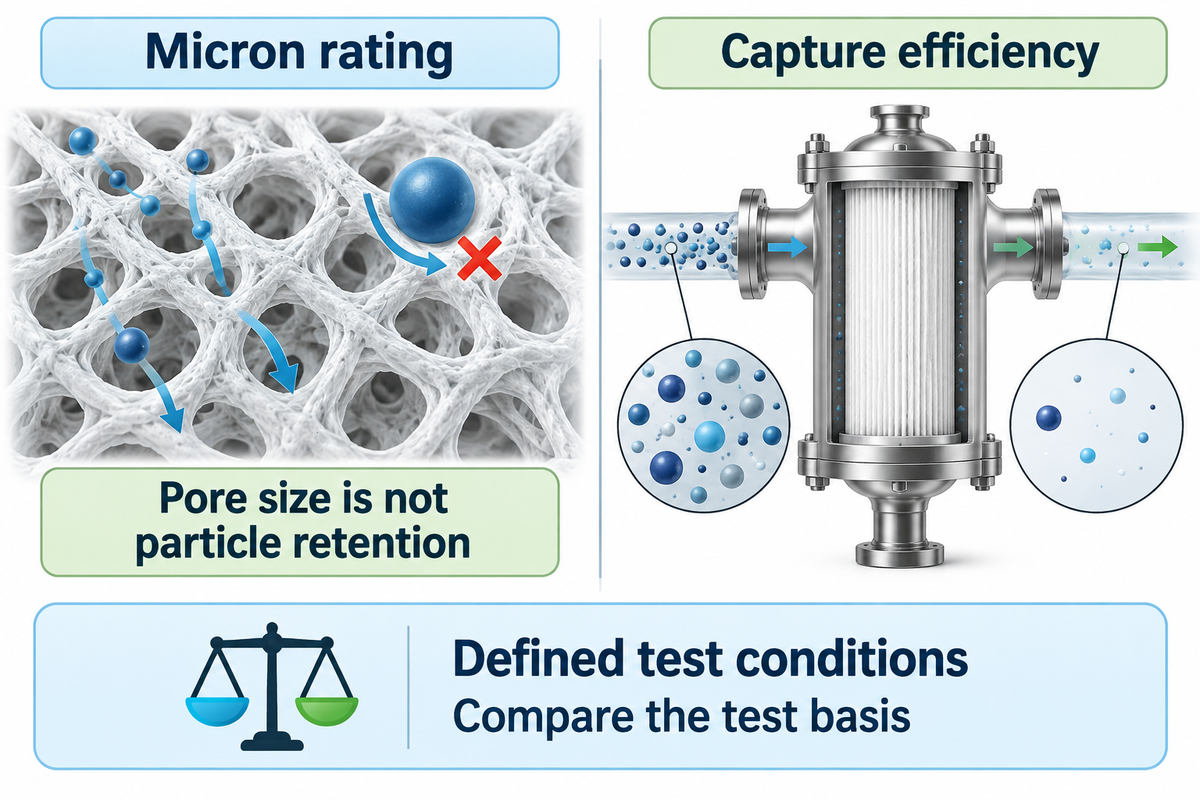
Micron ratings describe reference sizes of particles. Filtration efficiency refers to the fraction that’s captured under defined test conditions. Both have to be taken into account to fully evaluate liquid filter bags. Nominal and absolute values require their definitions, together with the challenge material, test flow and performance criterion. Matching the printed micron number alone can change the quality down the line.
What is the difference between nominal and absolute micron ratings?
Nominal ratings state a level of particle removal. An absolute rating is defined by a maximum-particle or high-capture test. Manufacturers can give different meanings to these definitions. Consequently, when products are compared, the removal efficiency at the rated size and the test method are critical, along with descriptions of the basis, rather than relying on the label alone. Likewise, high-efficiency descriptions require a basis.
“Efficiency is a value: the percentage of capture actually achieved in that micron range.”
Consider two products, both 1 micron. If their measured capture percentages differ, they can’t be regarded as equivalent replacements for the same particulate requirement. The difference between micron rating and capture efficiency is more significant than the adjective used on the label.
ASTM F316-03(2019) provides bubble-point and mean-flow-pore methods for membrane filters. Its public technical explanation distinguishes calculated effective pore size from actual particle retention. Pore-size and particle-challenge results answer different questions; the acceptance requirement should name the relevant one.
A 1 µm selection is compared to a 5 µm selection against the same downstream particle requirement. Using the smaller number by default can introduce a resistance without solving a seal leak, a dissolved contaminant, or a quality issue outside the medium’s capture mechanism.
Pressure Drop: Separate the Baseline from a Loading Trend
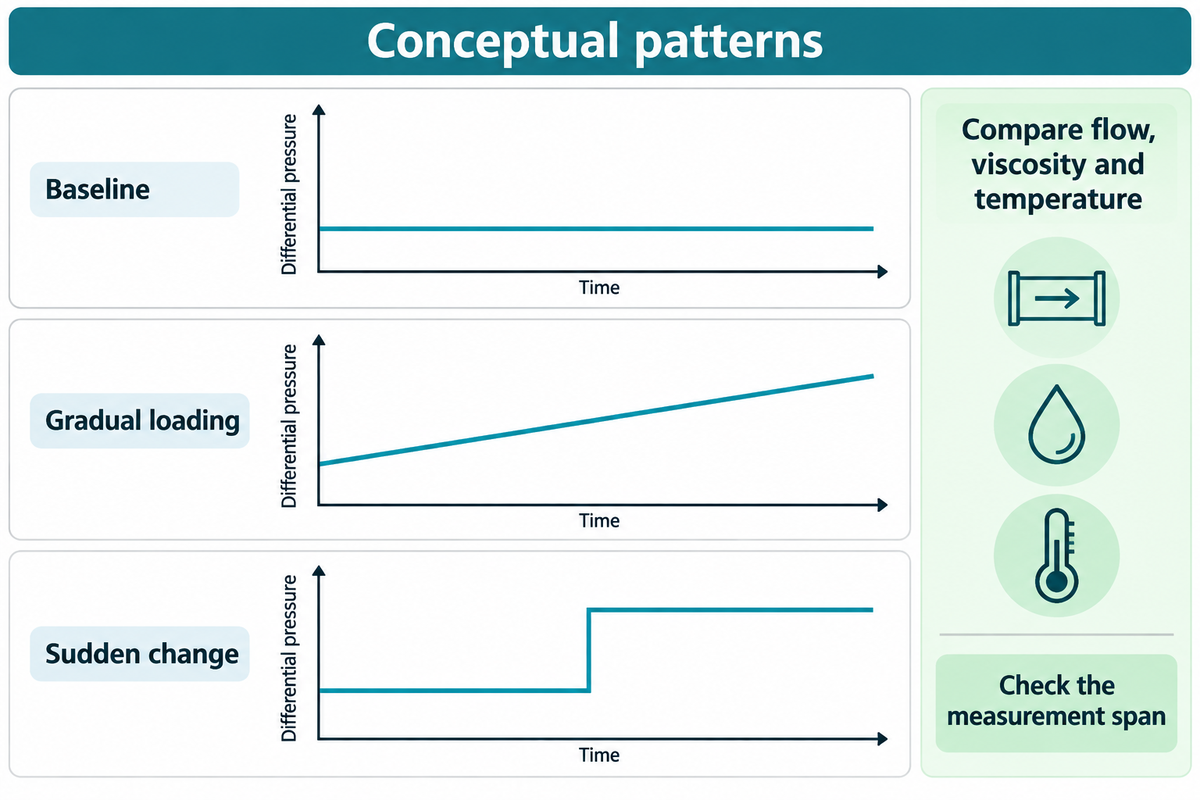
Differential pressure is the difference between the upstream and downstream pressure. A sudden change during operation needs its own check. A gradual increase over time might be due to deposit build up. Sudden changes need checks distinct from gradual loading trends. Flow rate, viscosity and temperature belong beside each reading so the operating record remains comparable.
What Causes High Differential Pressure in Bag Filters?
An increased differential pressure can be caused by restrictions in the medium, a viscous liquid, excessive flow, a loaded bed of solids or a problem in the installation. The timing helps to differentiate them. Start-up resistance points toward the clean system and liquid conditions. A progressive increase suggests accumulating resistance. The permitted changeout limit comes from the particular bag and housing instructions.
Baseline, Trend, Step-Change Diagnostic Map
The Baseline-Trend-Step-Change Diagnostic Map helps organize observations based on timing and pairs each hypothesis with a potential check that could confirm or disconfirm it.
| Observation | First hypothesis | Discriminating check |
|---|---|---|
| High pressure drop on a new bag | Clean restriction or changed liquid | Compare temperature, viscosity and flow with the baseline |
| Low initial flow with a membrane | Wetting or installation condition | Match the exact medium to its liquid start-up instructions |
| Gradual pressure rise at steady flow | Accumulating solids resistance | Review feed-solids and filtrate-quality trends together |
| Sharp rise after a batch change | Different liquid or solids behaviour | Compare batch composition and temperature records |
| High reading after gauge replacement | Measurement inconsistency | Review gauge range, units and measurement points |
| Falling flow with little pressure change | Restriction outside the measured section | Review the system’s pressure and valve records |
| Particles downstream from start-up | Rating mismatch or bypass | Compare capture specification and inspected top-seat fit |
| Sudden pressure drop with dirty filtrate | Loss of retention or an opened bypass path | Use the site’s safe shutdown and inspection procedure |
| Similar loading after a material change | Feed solids still control the run | Compare accepted throughput at matched liquid conditions |
Loading curves also reflect liquid properties. Increased viscosity, a different solids mixture or a compressible cake can also increase resistance without changing the bag material. In a yeast-suspension membrane study for example, cake compression limited the benefit of increased pressure. Treat that as a reason to check the mechanism, rather than as a PTFE bag operating limit.
Record pressure in one consistent unit, such as bar or psi, and identify whether the measurement spans the bag alone or the wider assembly. Loading trends can’t be stated from two readings, 10 m³/h and 20 m³/h, without accounting for the changed flow. Both of these readings are comparison conditions and not ratings for bag flow.
PTFE vs Polypropylene and Polyester Felt: Match the Failure
Select a medium to address the failure that limits the current run. PTFE is deserving of review when liquid duty damage occurs to another suitable medium or requires a different material. Polypropylene felt and polyester felt remain candidates when their complete assemblies tolerate the process conditions and achieve the required particle capture. Price doesn’t select the better fit.
Premature blinding by soft solids gives a different question: will another structure or filtration area handle the load more effectively? Changing polymer while keeping an unsuitable capture target and the same solids burden can leave the loading problem intact.
Retain a polypropylene felt filter bag when it meets liquid compatibility and quality requirements. Polypropylene construction still contains its seam, collar and seals. For polyester felt filter bags, the same assembly review applies. High temperature, cleaning exposure and mechanical durability require product-specific limits for either material.
Chemical soundness and mechanical integrity of pressure-retaining elements require review in service. Cost-effective filtration keeps a chemically sound, correctly supported element in service until its defined quality or pressure criterion is reached. “Exceptional chemical resistance” and “excellent dirt-holding capacity” describe various features. Neither phrase replaces the measured run record needed to protect equipment and reduce avoidable downtime.
Housing Fit and Seals: Find Bypass Before Blaming the Media
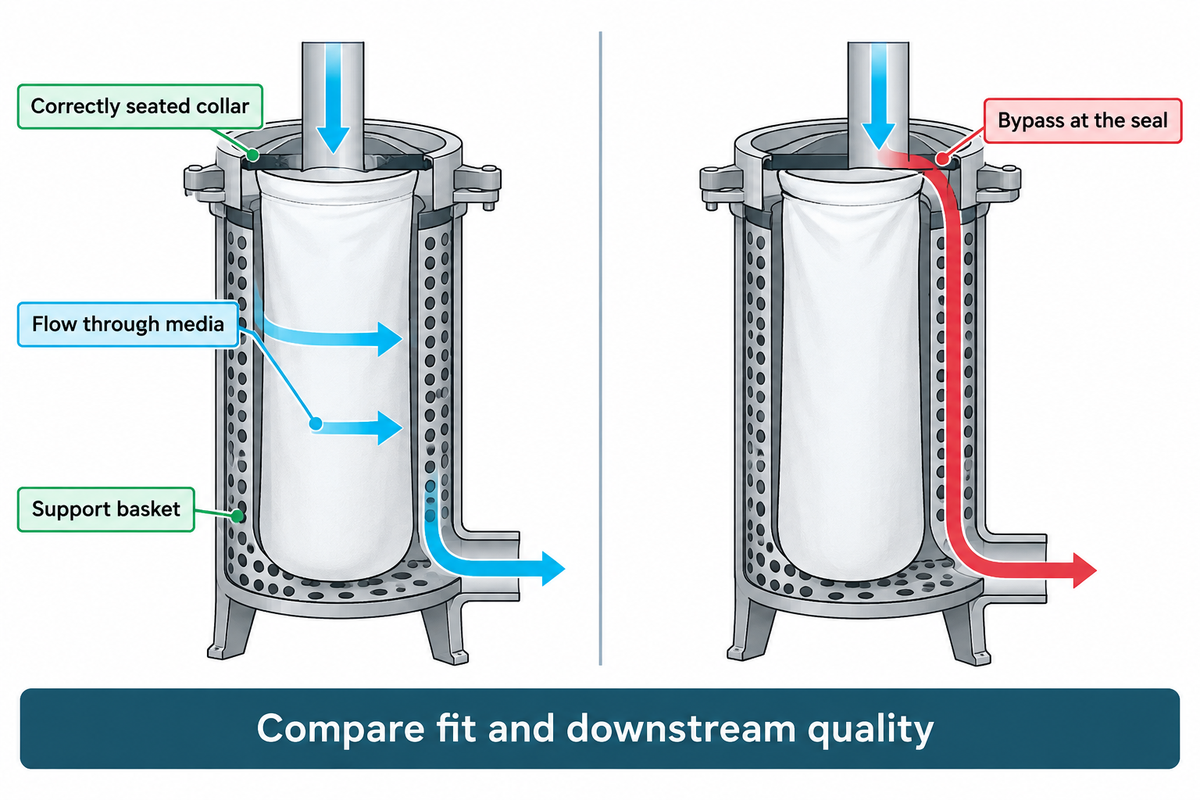
Bypass allows liquid to go around the intended filter media. Bags can remain intact while liquid goes around an incorrectly seated collar or an incorrect seal. Reliable filtration needs an appropriately sized bag, support basket and housing seat. Labels showing sizes narrow the options, but it’s the shape of the sealing element that ultimately closes the flow path.
During the site’s approved shutdown and isolation procedure, inspection should cover the collar contact, seal condition, seam and basket support. Folds against the basket and damaged seating surfaces change the assembly. Replacing the bag with a more chemically resistant fabric leaves the installation defect uncorrected.
Manufacturer bag-housing guidance connects correct fit with seal and gasket condition. Tim Sheehan’s technical discussion of liquid bags, written while he was a technical sales consultant and product manager at Hayward Industrial Products, treats sealing and bypass as part of performance, rather than attributing every downstream particle to the medium. Inspection findings belong with the filtration record so a replacement trial does not repeat an existing fault.
Collar dimensions in mm and pressure readings in bar describe different acceptance checks. Both are necessary along with downstream quality to ensure consistent filtration. Rising pressure (alone) can’t show all bypass paths.
Run Cost: Compare Accepted Liquid at the Same Quality
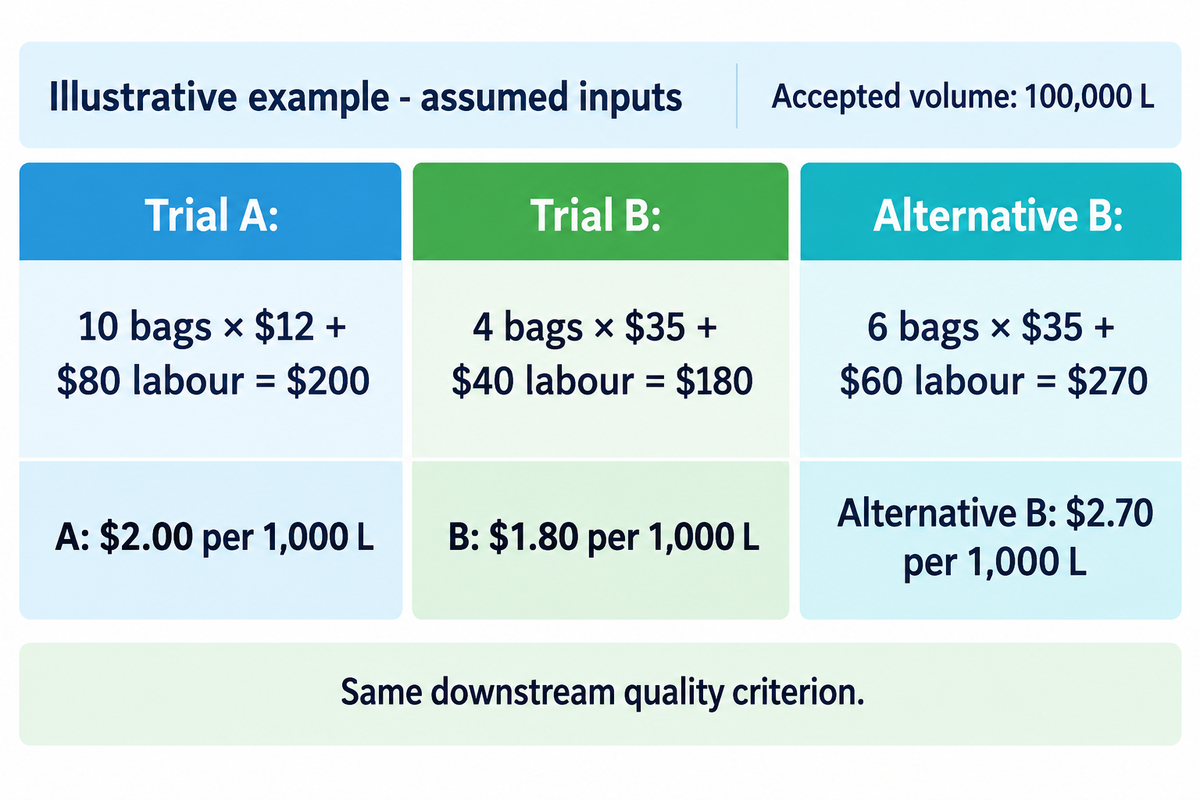
Comparing run cost per accepted volume at the same quality requirement should include consumption of bags and changeout labor. Tim Sheehan’s 2004 bag-versus-cartridge discussion treats disposal and changeout labour as separate cost items. Its historical savings figures are not used in the assumed PTFE examples below. Liquid that doesn’t meet the downstream requirements shouldn’t be considered accepted. This prevents a run that doesn’t meet the requirements from appearing to be cost effective.
Example: two trials each produce 100,000 L of accepted liquid. Trial A uses 10 bags at $12 each plus $80 in changeout labour: $200 total, or $2.00 per 1,000 L. Trial B uses four bags at $35 each plus $40 labour: $180 total, or $1.80 per 1,000 L.
In this example, the more expensive bag is cheaper because fewer bags and less labor compensated for the higher purchase price. The filtration solution earns its cost advantage through the completed run. If Trial B instead needs six bags with $60 labour, its total becomes $270, or $2.70 per 1,000 L. The decision would reverse, even if keeping the same unit price.
The example separates unit price from the measured run result. To evaluate cost, the complete, included cost must be considered. To evaluate performance, similar liquid and changeout conditions must be considered. The same accepted-liquid criterion must be considered for quality. Downtime, energy and disposal may be considered if evaluated consistently. Reprocessed liquid may not be considered twice, as new accepted volume.
Record 100,000 L against the same product-quality limit in both trials. Longer lifespan is helpful only if the additional throughput is accepted and the system operates within its limits. High-performance labels don’t supply measurements.
Trial Evidence: Decide Whether the PTFE Bag Has Earned Approval
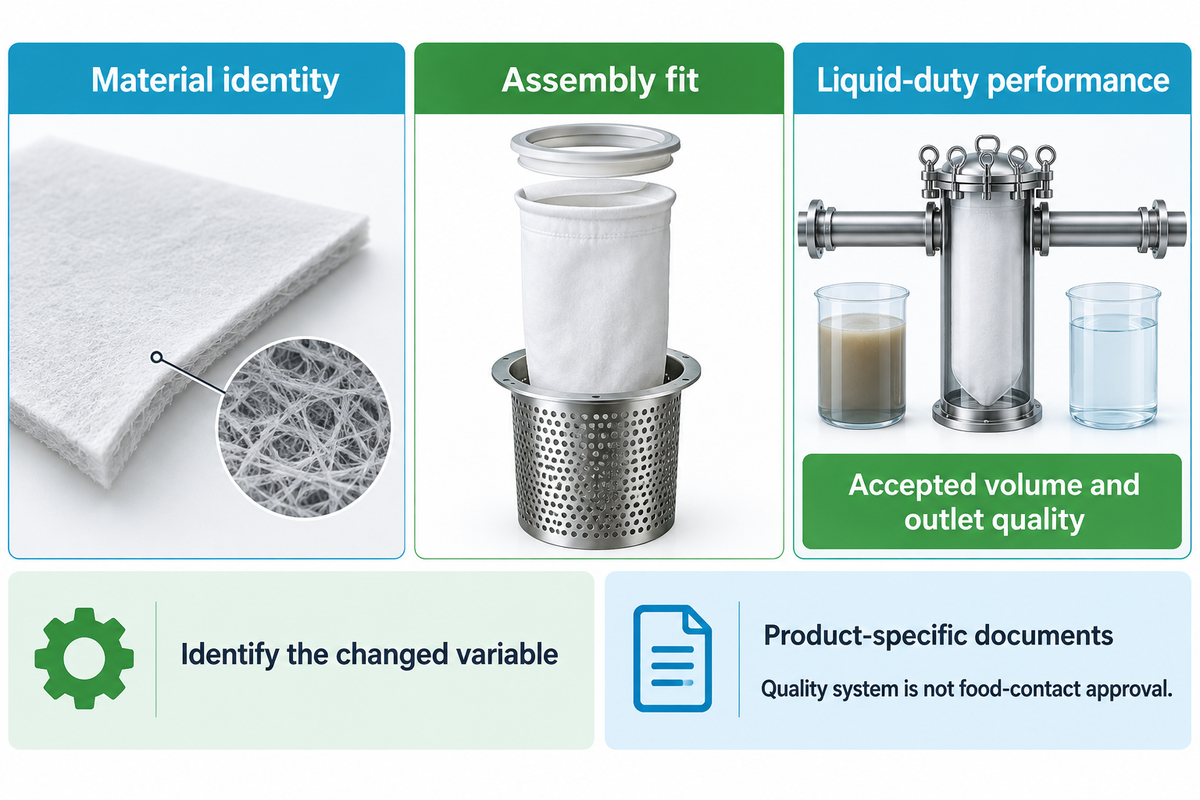
Useful PTFE trials separate the identity of the material, the fitness of the assembly and the performance of the system. The bag must first match the intended construction and vessel. The run must be defined by a downstream quality criterion, and have an end state. Approval of the stated duty is related to the success of the trial. A successful trial in one liquid doesn’t qualify every other industrial use.
For any test samples, determine the medium and wetted materials, the manufacturer’s temperature and differential pressure limits, the capture-efficiency basis, and the planned cleaning or disposal method. For critical applications, request the relevant lot and product documents. “Compliant” needs a named requirement and the correct certificate or declaration holder.
In general, a quality-management certificate is different from food-contact suitability. 21 CFR 177.1550 permits specified perfluorocarbon-resin uses subject to its conditions. Finished assemblies also include their other contact materials and intended use. ISO 9001 concerns a quality-management system, rather than approval of every finished bag for food processing.
Acceptance criteria for trace analysis need to be developed separately. For the sampling of wastewater PFAS, the EPA recommends avoiding contact with PTFE and other listed fluoropolymers, where practicable. Wastewater PFAS sample-contact materials follow the analytical method; industrial bag duties use their own application criteria.
Keep the inlet condition, flow and pressure history, accepted volume, outlet quality and reason for ending the run together. Repeating a trial is most useful when the changed variable is identifiable. ECOFILTRONE™ supports application review, replacement matching and sample/trial requests for filtration needs. The next step for a duty-specific product discussion is the PTFE Liquid Filter Bags solution page.
PTFE Liquid Filter Bag FAQs
The selection of a PTFE bag poses questions regarding reuse, documentation and the purpose of filtration. The following answers pertain to liquid bags and their assigned duties. Material names don’t clarify the cleaning route, disposal classification or dissolved-contaminant requirement; those are determined by the complete product and liquid it contains.
Are liquid filter bags reusable or disposable?
Reuse and replacement
Use a bag as disposable unless its manufacturer provides a suitable cleaning and reuse specification for the intended liquid duty. Cleaning can change retained contamination, fabric condition and seam integrity. Even clean-looking bags need to meet the same capture and quality requirements. Reuse should follow a defined inspection and acceptance process, rather than visual appearance alone.
Are there approved food and beverage filter bags?
Food-contact documentation
Yes, liquid bags are available with documentation for specified food and beverage applications. Approval must match the finished product, all contact materials and the intended conditions of use. Neither a PTFE resin reference nor an ISO 9001 certificate alone qualifies the whole assembly. The buyer’s required jurisdiction and process determine which declarations or test documents are relevant.
Do liquid filter bags expire?
Storage life
Follow the product’s stated shelf life and storage instructions. There’s no single expiry period for every PTFE bag assembly because seals, packaging and other components can differ. Keep unused bags protected from contamination and damage, with their lot identification intact. An old unopened package still needs review against the specified storage conditions and the intended application before use.
Are custom liquid filter bag sizes available?
Custom dimensions
Yes, custom liquid bag dimensions are available for suitable product configurations. Replacement bags need the ring or collar geometry and basket fit as well as length and diameter. Extra fabric area is useful only when the housing supports the element and the intended flow path remains sealed.
Are liquid filter bags recyclable?
Disposal after service
Used liquid filter bags often need a controlled disposal route because the captured material and retained liquid affect their classification. Recycling feasibility also depends on the assembled materials, contamination and a suitable local recovery service. PTFE fabric identity alone is insufficient to choose a disposal route. Keep the product identity, process-liquid description and relevant waste documentation with the used-filter record. That makes the material history available when the site or waste contractor determines handling requirements. Bags used with aggressive chemicals shouldn’t enter an ordinary clean-plastic collection stream simply because their main polymer is identifiable.
What is the difference between filtration and reverse osmosis?
Different separation duties
Liquid bag filters remove suspended particulate according to their measured capture performance. Reverse osmosis uses a pressure-driven membrane process for dissolved substances and other specified contaminants. Bag filtration can provide pretreatment, but replacing a bag’s micron rating doesn’t turn it into a reverse osmosis membrane.
Do you have a liquid duty to assess? ECOFILTRONE™ can help review the application, match a replacement and discuss sample/trial requests. Share the operating conditions for a product-specific discussion.
Technical Scope: This manual covers industrial applications of liquid filtration. Named examples of research retain their original membrane or lab context. The cost example uses assumed inputs. Selection and acceptance remain linked to the specified bag assembly and liquid duty. Updated October 2026.
References & Sources
- ASTM F316-03(2019): membrane pore-size methods, public technical description.
- Woźniak and Gryta (2023): capillary PTFE membrane wetting in membrane distillation.
- Brennan and others (2020): membrane contactors treating rendering condensate
- Katagiri and colleagues: alcohol concentration and yeast-cake microfiltration properties.
- Chris Lehmann (2018): filter ratings and efficiency.
- Tim Sheehan (2004): liquid bag media, flow area, and sealing.
- Health and Safety Executive: earthing and transfer of flammable liquids.
- 21 CFR 177.1550: perfluorocarbon resins.
- Environmental Protection Agency: Sampling of Wastewater for PFAS