Get in touch with ECOFILTRONE™ Company



Updated October 2026
PES membrane filter cartridges use a membrane to filter liquids. However, the name of the polymer only partially describes the membrane. The final membrane structure, as well as the liquid and the contaminants present in the system, plays a critical role in the outcome. This guide explains those connections so that operating teams can interpret a flow decline, a recovery shortfall or an integrity result before changing a filtration system.
Guide at a glance
- Media: polyethersulfone; water-wettable grades use a hydrophilic finished membrane.
- Format: assembled pleated cartridge, distinct from a laboratory disc.
- Useful measurements: flow, differential pressure, temperature and accepted target mass.
- Duty: particle control or defined microbial filtration; acceptance follows the exact grade and process.
PES Membrane Filter Cartridges pass liquid through a porous polymer membrane. Retention, flow and recovery reflect the finished membrane and operating conditions. Compare exact grades on the same test basis, then track the accepted product across the whole run.
Key points
- A higher initial flow can change the apparent fouling comparison between two membranes.
- Lost target mass and membrane adsorption are different measurements.
- Micron rating, microbial retention and integrity testing describe different parts of the filtration task.
- Startup filtrate and stable production filtrate deserve separate observations.
How PES Membrane Filter Cartridges Work
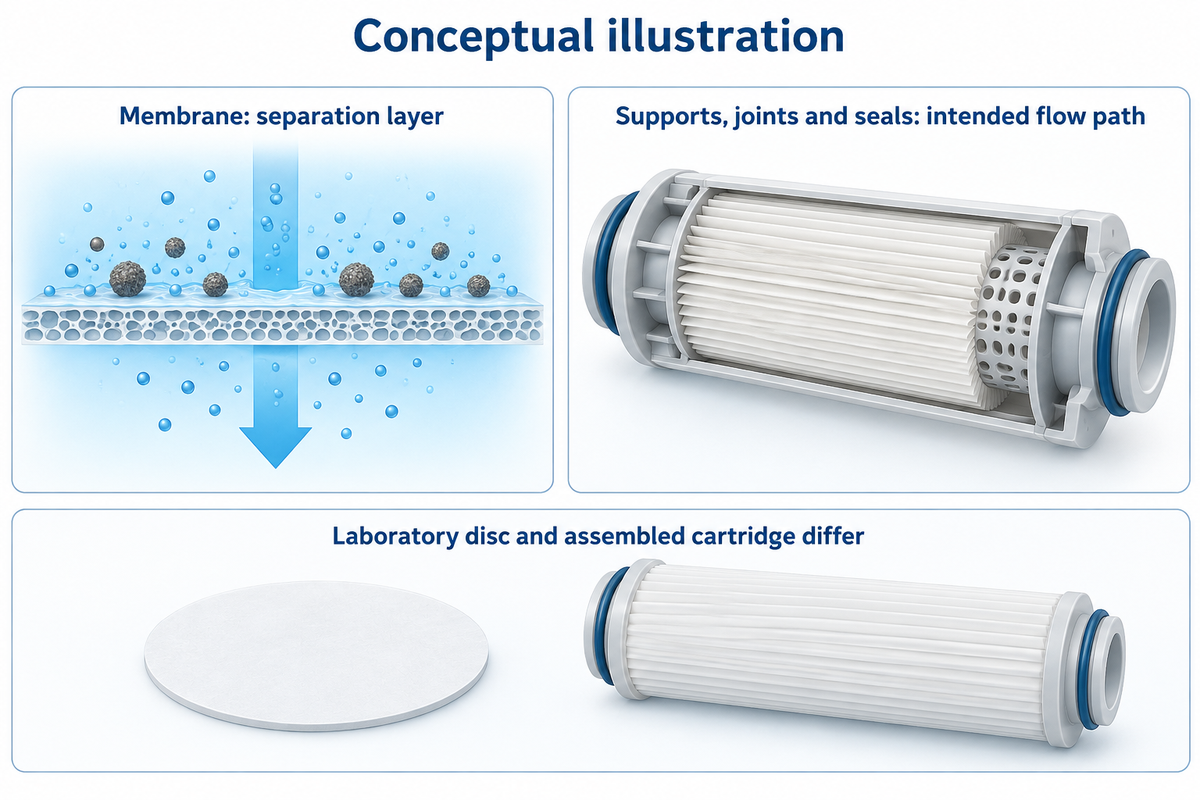
A PES membrane filter cartridge directs liquid through a porous membrane held within a sealed assembly. Folding the membrane into pleats provides filtration surface area within a compact element. The membrane controls separation, and supports, joints and seals maintain the intended liquid path.
A bypass around the liquid path changes the outcome even if the membrane remains intact, since the bypassing liquid does not flow through the separation layer used to define the membrane’s retention behavior. The route makes a difference.
Polyethersulfone membrane filter products include several forms. A loose disc requires a separate holder; a PES pleated filter cartridge, on the other hand, arrives as an assembled element with its own interfaces. Neither the word PES nor the presence of a membrane makes a product an ultrafiltration element: microfiltration and ultrafiltration describe different separation duties, so a membrane’s polymer chemistry and the contaminant-removal task should be analyzed in different dimensions when a comparison is done for two different products.
What is the difference between a depth filter and membrane filter?
A depth filter captures material through a thicker porous structure, whereas a membrane filter separates material using a defined membrane layer. It’s depth filtration that commonly takes the bulk loading role before a finer membrane stage. The better comparison is to the contaminant being removed and the downstream requirement, rather than determining if the two products fit in a similar housing, because it’s the housing that says little to nothing about how a medium captures its target, or what the downstream process requires.
The PP pleated filter cartridge guide explains a different media construction used in liquid filtration. Prefiltration can protect a downstream membrane from avoidable particulate loading; it also adds another place where liquid or valuable material can remain.
Are the polyethersulfone (PES) membranes asymmetric or symmetric?
PES membranes can have symmetric or asymmetric structures; the finished grade determines which construction is present. An asymmetric PES membrane has a pore-size gradient through its thickness. A highly asymmetric PES membrane can combine a more open upstream region with a finer separation region, so layer orientation and the intended flow direction matter.
In a 2022 study by Jimin Na and colleagues, the researchers studied the morphology and assessed the performance of two commercial flat-sheet filters. Measured pore structure and finished-surface properties belong to particular membranes. As such, a comparison of maintenance begins with the exact assembly identity, not a photograph of similar-looking pleats.
| Term | What it describes | How it changes interpretation |
|---|---|---|
| PES | Polyethersulfone membrane chemistry | Start with the finished grade rather than the polymer name alone. |
| Hydrophilic finish | How the finished membrane wets with water | Separate normal liquid wetting from the integrity-test conditioning method. |
| Asymmetric pore structure | A pore-size gradient through the membrane | Keep the manufacturer’s intended flow direction and grade identity. |
| Pleated construction | Membrane folded into a compact cartridge | Compare effective filtration area and support design. |
| Micron rating | A pore or retention designation | Use the stated test basis and endpoint. |
| Particle removal | Retention of a defined particulate challenge | Keep the challenge distribution and measurement method. |
| Microbial reduction | Reduction under a defined biological challenge | Distinguish general filtration from a validated sterilizing duty. |
| Chemical compatibility | Response of all wetted materials to exposure | Include concentration, temperature and time. |
| Integrity tested | A result from a specified method | Keep the test liquid, acceptance criteria and exact device together. |
A laboratory disc of 47 mm and a 10-inch cartridge provide different physical test objects. Keeping this distinction in a technical conversation prevents a disc experiment from being construed as a cartridge specification. The practical features of PES are most useful when the media, assembly and filtration task remain identifiable together.
What Does the Pore Rating Actually Tell You?
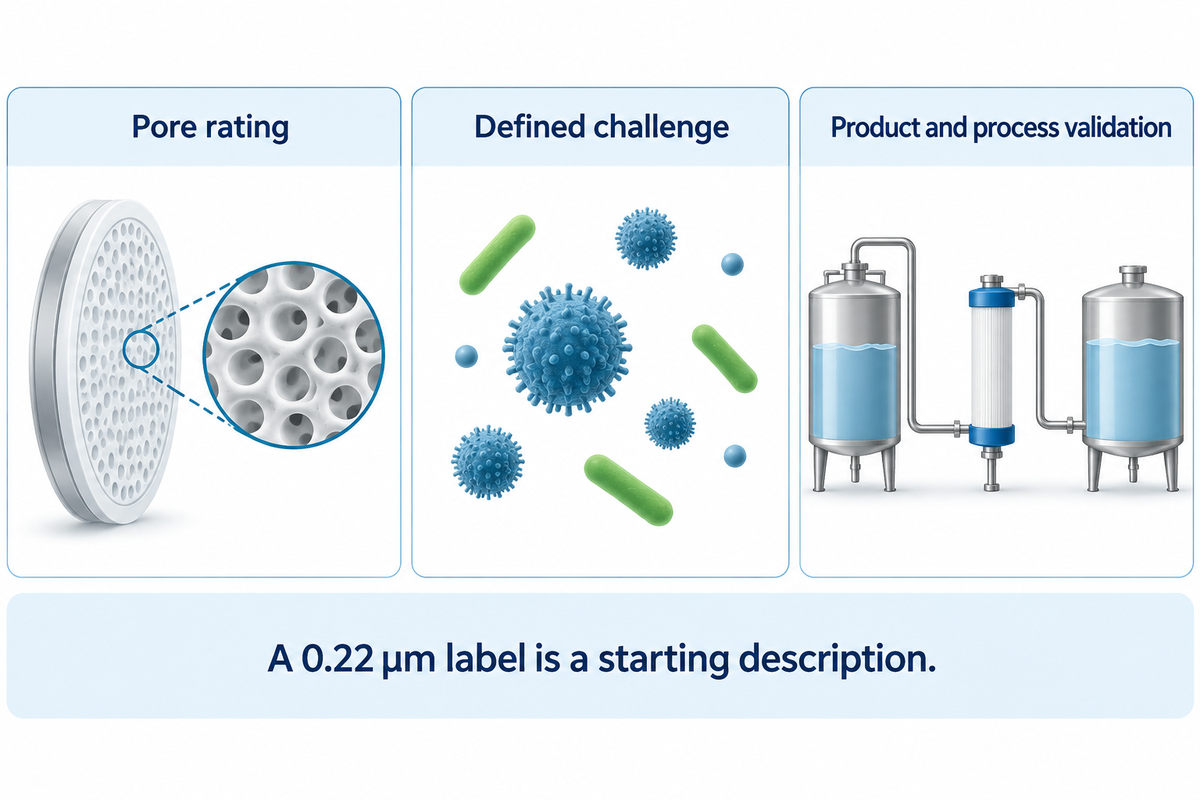
A pore rating identifies a size or retention designation, while effective filtration describes removal under a stated test. Labels such as 0.1 µm, 0.2 µm and 0.45 µm help organize products, but the challenge material and acceptance endpoint determine the actual removal claim.
For a microbial filtration task, the grade-specific retention basis connects the organism and challenge conditions to the result; a particle removal number and a biological retention claim may appear together on a datasheet without describing the same endpoint.
Pore size refers to the size of the openings; porosity refers to how much of the membrane is void space. Two membranes can bear the same micron label and differ in pore distribution, thickness and liquid resistance. The distinction between a rating label and a defined retention result is covered in the filter micron rating guide.
ASTM F838-20 uses Brevundimonas diminuta in a standard bacterial challenge. Its published scope and significance also suggest that product- and process-specific bacterial retention validation studies are warranted using the intended process parameters and product solution or surrogate. A 0.22 µm label is therefore a starting description; a sterile filtration duty includes the liquid, exposure and validated process conditions.
Consider a food and beverage operator replacing a final filter. Both offers show 0.2 microns, but one describes general particle removal and the other a defined microbial challenge. At first, a purchasing comparison appears simple, given that nominal sizes are similar. However, differences become evident when quality is taken into account. The process needs microbial stabilization of the actual beverage, with defined exposure and downstream handling. A better comparison matches the intended removal challenge. Operations still needs the required flow, but a higher clean-water flow does not resolve the microbiological question. This also avoids choosing the faster element for a different challenge.
For a 0.22 µm PES grade, note the retention method beside the rating. The size label describes a product designation; the challenge and process conditions describe what is removed. Treating nearby micron labels as automatic equivalence isn’t prudent.
Wetting and Compatibility Depend on the Whole Assembly

Wetting refers to liquid entering the membrane pores; chemical compatibility defines the behavior of the whole wetted assembly during exposure. Hydrophilic PES is a finished membrane property, not a complete compatibility verdict. The liquid contacts more than the membrane, and the exposure history includes process solution, preparation fluids and any specified cleaning or sterilization cycle, so a material that remains suitable during production still needs to be considered in the context of the other fluids and cycles prescribed for that assembly.
The background of historical patent US7537718B2 distinguishes naturally hydrophobic PES material from methods used to obtain hydrophilic membranes. Finished hydrophilic behavior is therefore a property to associate with the supplied grade. The patent is background material, not an ECOFILTRONE™ patent or a performance test of our products.
How do I determine if my filter is compatible with my application?
Correlate the total liquid formulation and exposure conditions with all wetted surfaces of cartridge and housing, including membranes, support materials, end caps, bonds, and seals. Record concentration, temperature and contact time for normal operating conditions and for preparation or cleaning. Then distinguish mechanical/material compatibility from the amount of material that could migrate into the liquid.
A 2019 sterile-filter capsule study, available as a public abstract, indicated that membrane-related extractables scaled with membrane area and polypropylene-related extractables with polypropylene contact area. With the short-term conditions studied, a component approach to scaling may be applicable. Extractables are materials released during a defined extraction; process leachables concern material migration under actual process exposure. Neither term is a synonym for membrane failure.
A chemical-compatibility chart naming only PES leaves the other contact materials outside the comparison. Likewise, “broad chemical compatibility” needs an exposure context. Thermal stability of the polymer does not set the allowable temperature of a sealed assembly. Food contact documentation and a reference to FDA 21 CFR need the applicable material, provision and holder identified together; this guide makes no blanket product-compliance claim.
Keep three preparation contexts separate: Wetting for liquid flow, conditioning for an integrity test and cleaning or sterilization. A fluid suitable for one context is not automatically the prescribed fluid for the others, particularly when the integrity method relies on a particular liquid’s wetting behavior and uses acceptance criteria established with that liquid rather than with the production formulation. For a 10-inch cartridge, the seal and the support remain part of that same exposure review. An increase in the length of cartridge doesn’t transform a media chart into an assembly assessment.
PES and PVDF: Compare the Actual Duty
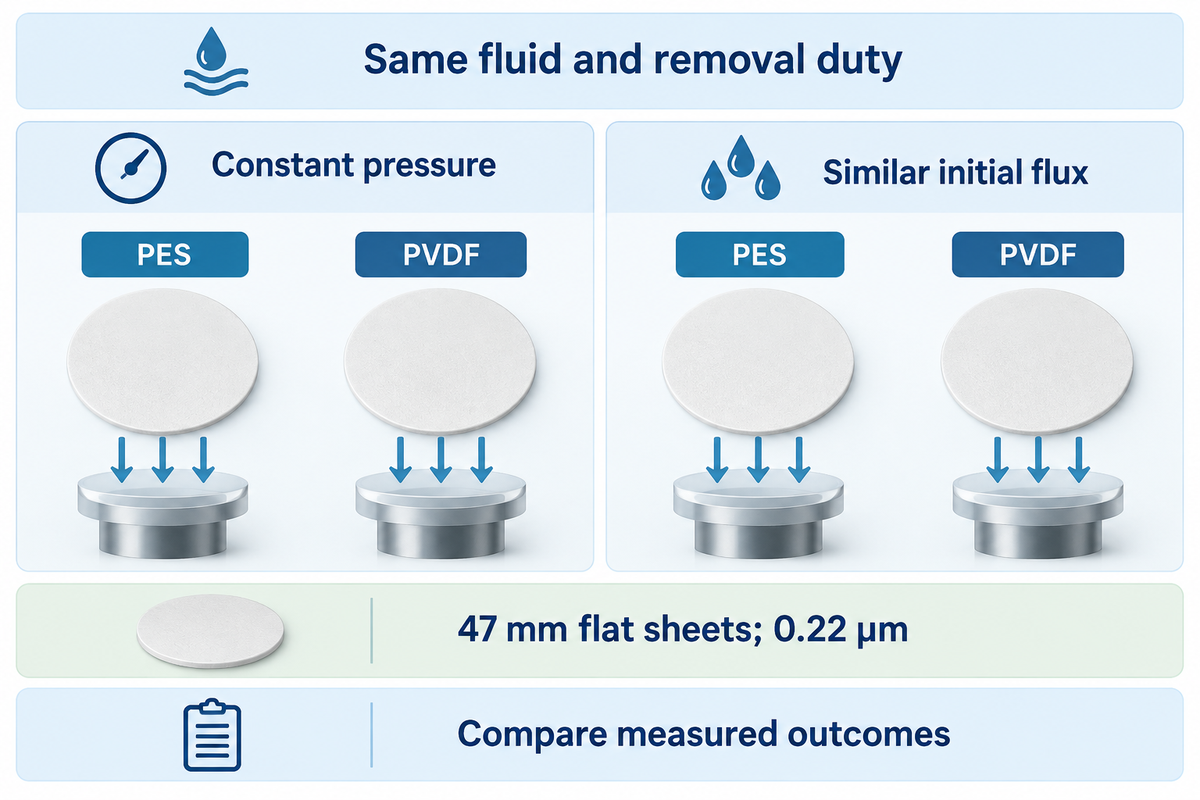
PES and hydrophilic PVDF should be considered as finished filter grades and compared on the same liquid and measurement basis. The identity of the polymer alone doesn’t determine the better filter for recovery or throughput. A true comparison establishes the removal duty and differentiates equal-pressure testing from equal-initial-flux testing prior to performance assessment.
What is the difference between PES and PVDF filter membranes?
PES and PVDF are different polymers, and both are available in water-wettable, finished grades. The membrane treatment, morphology, and assembly influence their filtration behavior. For protein-containing liquids, the useful distinction is the measured flux, adsorption and recovered product under comparable conditions, rather than a universal claim that one polymer always binds less protein or lasts longer.
Na and colleagues tested two kinds of 47 mm flat-sheet 0.22 µm filters from the same manufacturer. In their protein experiments, the PES filter showed greater flux decline at constant pressure. After the researchers adjusted conditions to obtain similar initial fluxes, the decline became more similar. The authors connected the behavior to permeate drag as well as the test conditions. Results described the behavior of tested membranes and fluid, and don’t describe an ECOFILTRONE product comparison.
“The results demonstrate the importance of choosing the appropriate filter considering the process type and target removal/transport product”
Separately, a host cell impurity filtration study revealed that a model BSA solution didn’t emulate the behavior of host impurities in the therapeutic virus process. Care should be taken in choosing an appropriate comparison fluid for culture media and other complex liquids. A model protein is useful in defining a question of interest but the filtration performance may change with formulation.
Imagine an engineering team comparing two liquid filter cartridges for a protein-containing process. The faster element initially processes more liquid, then loses a larger fraction of its starting flow. Operations says that’s shorter life, while finance says higher output in the time it runs. Neither description settles product recovery, so quality adds accepted target mass and the required product attributes to the comparison, alongside the time and pressure basis that operations used and the output boundary that finance needs to value. They’ve separate endpoints for throughput, resistance change, and acceptable output. Its review also records whether the test held pressure constant or matched initial flux. That small change in the comparison sheet can explain a disagreement that initially looked like a simple materials dispute.
For another membrane chemistry, check out the PVDF membrane filter cartridge range. High flow rates make sense only with the accompanying fluid, temperature, pressure difference and area basis. A 47 mm disc result illustrates a mechanism; an assembled cartridge still needs a comparison at its own scale.
Track Product Recovery with a Mass Balance
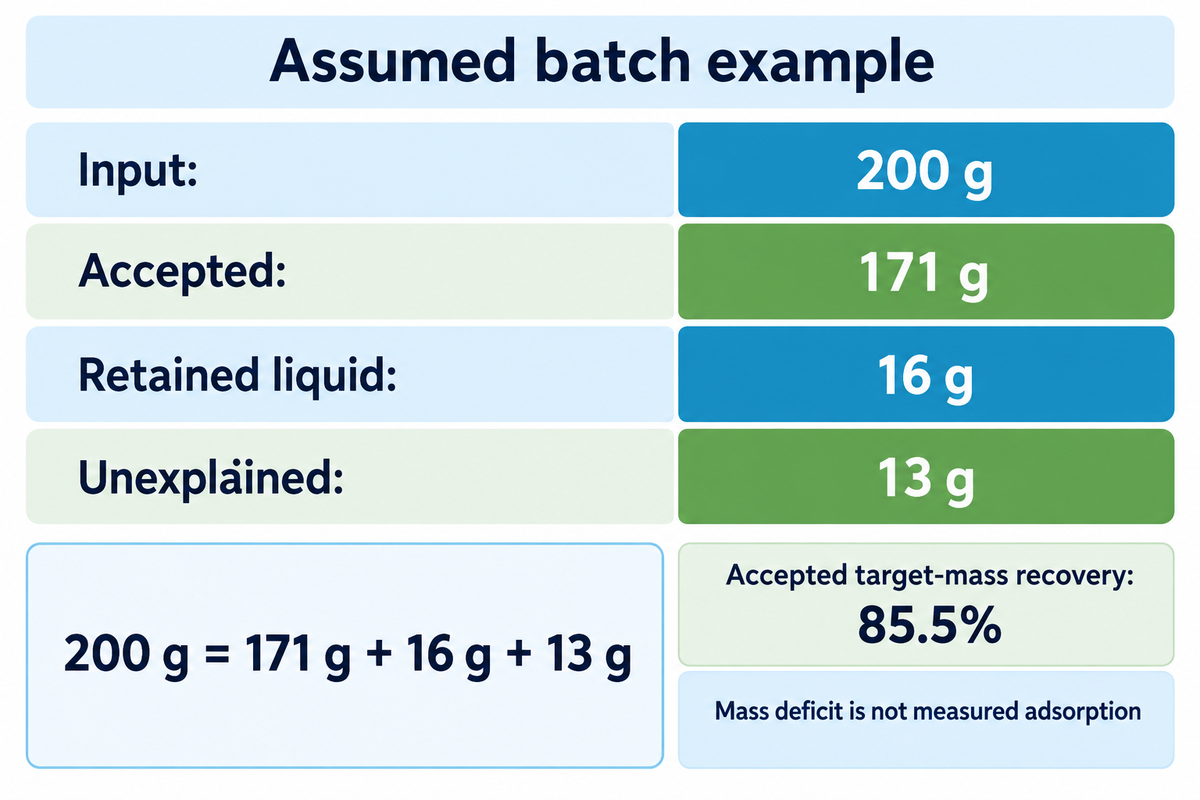
Product recovery is the accepted target mass collected divided by the target mass introduced, both within the same measurement boundary. Volume also matters. A mass balance accounts for the collected product and measured retained liquid, then leaves any unexplained difference unresolved until additional measurements identify where the target material went.
3-Location Product Balance
Use three locations: incoming feed, accepted filtrate and measured retained liquid. Define which samples, drains and line volumes fall within the boundary before calculating. A retained volume counted in the housing shouldn’t be counted again as a separate line loss, and a sample withdrawn before the accepted-product measurement should be positioned in the same balance rather than disappear from the calculation when the final assay is entered. Each location should be counted only once. Na’s study measured adsorbed BSA separately after filtration; a process mass deficit is a different observation from a direct adsorption measurement.
Example, assumed inputs: a batch introduces 100 L containing 2.0 g/L of the target, so input mass is 200 g. Accepted filtrate is 90 L at 1.9 g/L, giving 171 g. A separately measured retained-liquid pool contains 8 L at 2.0 g/L, or 16 g. Accepted target-mass recovery is 171 ÷ 200 × 100 = 85.5%. The remaining 200 − 171 − 16 = 13 g is unexplained within these measurements. Finance can distinguish the 16 g still located in retained liquid from the 13 g requiring investigation. Neither quantity automatically becomes a membrane-adsorption figure. Sampling, analysis, precipitation, unmeasured liquid and adsorption remain different possible explanations.
The incoming 100 L, accepted 90 L and retained 8 L leave a 2 L difference in volume. That is a reason to reconcile the liquid boundary, not permission to assign 13 g to that volume at an assumed concentration. Recovering the measured target also doesn’t guarantee product quality. An assay-based mass result doesn’t evaluate all acceptance criteria for the liquid.
- Define the boundary. Name feed, accepted filtrate and retained-liquid locations.
- Calculate target mass. Multiply each measured concentration by its corresponding volume.
- Reconcile the remainder. Keep unexplained loss separate from tested causes and product acceptance.
First-Filtrate/Steady-Run Comparison
Separate the initial displacement fraction from the stable operating fraction. Record the volume of each and the concentration with the assay and dilution correction. A startup-only concentration change points to a different investigation from a sustained lower recovery. Preparation-liquid displacement or hold-up is one possible explanation for startup behavior; adsorption and other mechanisms need their own measurements.
Given the assumed batch of 90 L at 1.9 g/L, there’s 171 g of accepted target. Reporting only 1.9 versus 2.0 g/L would hide the missing volume. Accepted target-mass recovery is 85.5%, with 13 g of target mass remaining unexplained; product quality requires a separate assessment.
Read Flow Loss Before You Blame the Cartridge
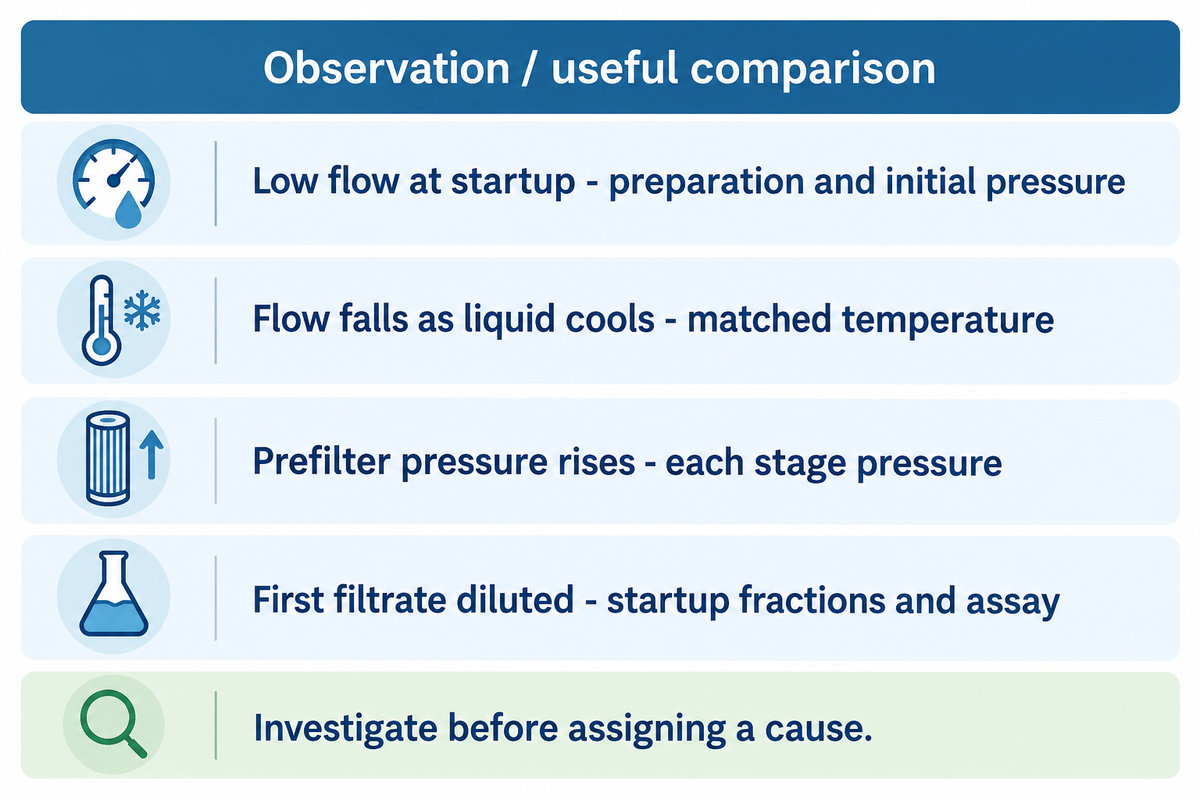
Decreased flow may be attributed to changes in the relationship between driving pressure, liquid resistance and the filtration path. Membrane fouling is just one of many explanations for decreased flow. Other process variables such as feed composition, temperature, pump control and other filter stages may also yield a different interpretation. Read synchronized observations before deciding that the cartridge has reached the end of its useful run.
Why do PES membrane filter cartridges fail?
Excessive loading, poor exposure, damage, bypass and insufficient definition of duties can cause PES cartridges to stop meeting their tasks. Low flow, alone, can’t identify which of the above causes occurred. A useful failure review relates the symptom to fluid conditions, installation, pressure readings, and the exact test result, and compares these to the product’s operating conditions. Then, the review looks at the product’s specified operating conditions to see whether the observed failure is consistent with them.
A laboratory user discussion describes a syringe filter that passed water but gave very low flow with the process mixture. The comments offered competing explanations, not a resolved cause. For industrial work, the useful lesson is the question itself: what changed between the reference fluid and the actual fluid?
| Observation | Record beside it | Next interpretation |
|---|---|---|
| Low flow from startup | Preparation, fluid identity and initial pressure difference | Investigate wetting, installation and fluid resistance before attributing fouling. |
| Flow falls during a run | Time, volume, feed condition and pressure difference | Look for loading alongside changes in the feed. |
| Flow falls as liquid cools | Fluid temperature and available viscosity data | Compare at a matched temperature before comparing cartridge life. |
| Pump setting changed | Inlet/outlet readings and control mode | Separate a changed driving force from changed filter resistance. |
| Prefilter pressure rises | Pressure readings across each stage | Identify which element is consuming available pressure. |
| Water test looks normal | Water temperature and test conditions | A water result and process-fluid result answer different questions. |
| First filtrate is diluted | Startup fractions, retained preparation liquid and assay | Review startup displacement separately from steady-run recovery. |
| Concentration stays low | Accepted volume and all measured mass locations | Test alternative loss mechanisms; keep the balance boundary consistent. |
| Unexpected integrity result | Test program, wetting liquid, temperature and units | Review method conformity before declaring product damage. |
High dirt-holding capacity and long service life are meaningful only against a defined feed and endpoint, because loading capacity for a dirty feed describes a different task from clean-water permeability, and neither measurement alone describes how much acceptable process liquid reaches the receiving vessel. A high-efficiency prefilter may reduce downstream loading while adding its own resistance and hold-up. The glass fiber pleated filter guide covers another option of upstream media; replacing a downstream membrane without evaluating the upstream situation may leave the actual restriction in place.
A comparison involving a 0.45 µm prefilter and a 0.22 µm final membrane needs separate pressure observations across the stages. The whole train’s pressure change cannot locate the restriction by itself. Note temperature and the identity of the process fluid, as changes in operating basis may cause apparent cartridge-life changes.
What Integrity Testing Can and Cannot Prove
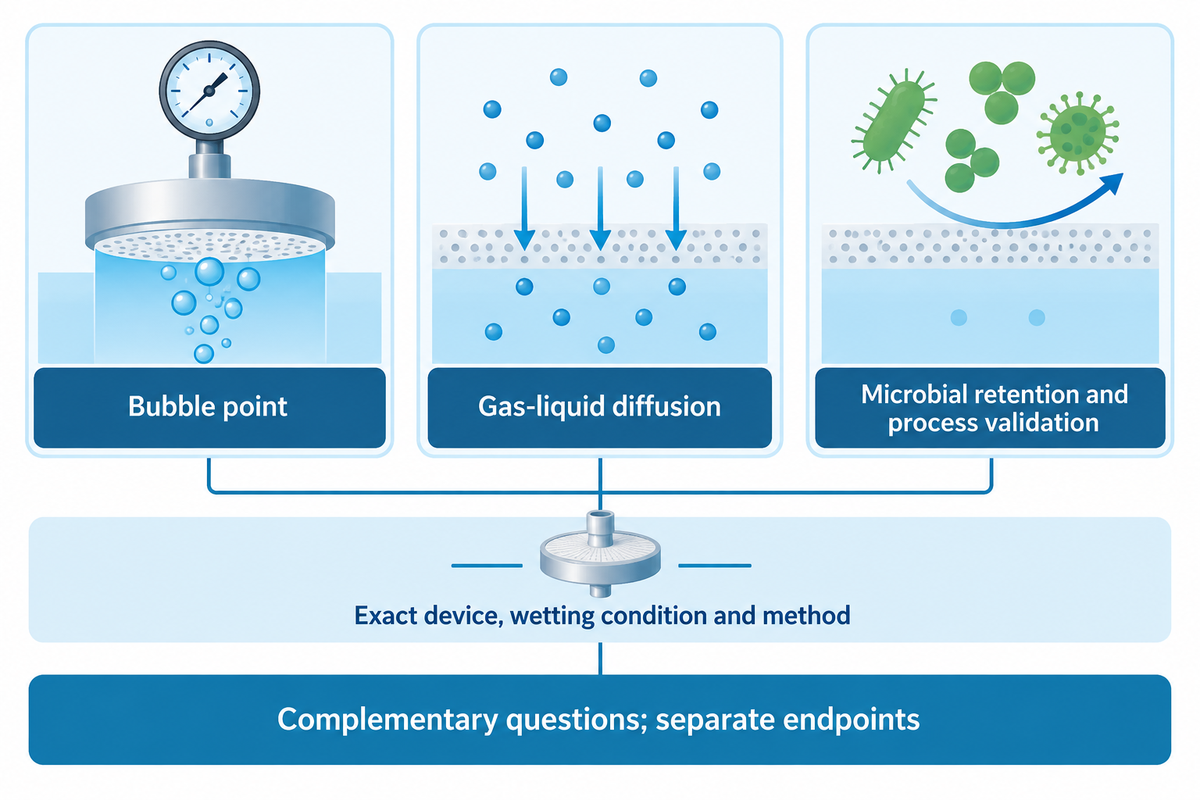
Integrity testing is concerned with the behavior of a filter for a given test method and acceptance criteria. Bubble point and gas–liquid diffusion measure different aspects of that behavior. The interpretation is specific to the device, wetting condition, and test method. Microbial retention and product-process validation remain separate tasks, linked through the relevant grade-specific qualification work.
In Giglia, Alembath and Hersey’s 2023 cartridge study, automated bubble-point reporting was insensitive to some controlled defects until a gross-leak or invalid-result condition occurred. They studied 10-inch cartridges, and three automated integrity testers, supporting the use of complementary diffusion tests, as opposed to treating a bubble-point pass as a universal defect screen. The authors were employed by EMD Millipore, so the study’s commercial affiliation belongs with its interpretation.
Magnus Stering’s integrity-testing failure-mode analysis discusses incorrect programs, test conditions and units. A test report showing an unexpected result merits consideration of the inputs prior to drawing conclusions about physical damage. A report tied to the actual grade and test conditions is more useful than a product description containing only “Integrity tested.”
The FDA’s historical high-purity-water inspection guide also describes a system-level trap: point-of-use filters can mask upstream microbial contamination, and reduced microbiological contamination need not mean reduced endotoxin contamination. The 1993 documentation is of historical and technical interest and should not be considered current practice.
A bubble-point test of a 10-inch cartridge and a complementary diffusion test provide answers to related, but distinct, integrity questions. The 2023 experiment shows why the test method and the device matter together. Product-contact acceptance, upstream system condition and a validated microbial duty still require their own defined endpoints.
Build a Usable PES Operating Record
A PES operating record contains the liquid, the installed assembly, operating conditions and measured results, and points to an acceptance criterion. Keep observations separate from explanations so that another person can reconstruct the comparison. An operator’s flow concern, a quality team’s retention concern and finance’s recovery concern can then be reviewed using the same run boundary.
For the assessment of PES pleated cartridge filters, record the exact grade and assembly identity, housing/interface, upstream filtration, fluid formulation, temperature, flow, inlet and outlet pressure, processed volume, and accepted volume. Capture target assay and observations of retained liquid, and integrity test methods and results. Retain history of storage and exposure, and don’t assume a high-performance material label describes the element’s condition.
Different industries use different acceptance endpoints. A review of the beverage industry may be concerned with defined microbial stabilization and attributes of the product; microelectronics may be concerned with contamination and high-purity liquid processing. A clean room environment describes the surrounding area and not all of the quality attributes of the filtrate. In critical applications, a process-specific endpoint is required.
ECOFILTRONE™ supports industrial customers with application review, specification verification and replacement matching. For a detailed discussion of product-series configurations, see our PES membrane filter cartridges solution page.
Key takeaway
A PES cartridge review needs a defined removal task, comparable operating conditions and accepted-product measurements. Keep the 0.22 µm label, flow result and integrity result attached to their separate meanings before combining them in an application decision.
Frequently Asked Questions
Does a 0.22 micrometre PES filter make every liquid sterile?
No. Sterile filtration requires a qualified grade and a validated process.
A micron label organizes the product range. Bacterial retention involves a specified challenge, and the intended product solution can affect performance. ASTM F838-20 describes standard challenge testing and calls for additional product- and process-specific work. Downstream handling and system condition also remain part of a sterile process. A cartridge substitution therefore needs more than a matching pore designation.
What is the difference between pore size and porosity?
Pore size describes openings; porosity describes the void fraction of a material.
Flow through a membrane reflects more than the nominal size of an opening. The pore distribution, membrane thickness, morphology and fluid conditions all matter. Two filter media can share a similar micron label while showing different permeability or retention behavior. For precision filtration, the useful comparison includes the stated retention method and the flow-test conditions alongside the size designation.
Can a PES cartridge remove dissolved salts?
A conventional PES microfiltration cartridge is not a desalination membrane.
Dissolved salt ions are a different separation target from suspended particles and microorganisms. A cartridge used ahead of reverse osmosis can protect a downstream stage by controlling suitable particulate loads, while the desalination duty remains with the appropriate separation process. For filtration applications involving a dissolved substance, start with the required separation mechanism rather than choosing a finer-looking micron number.
What is the difference between hydrophilic and hydrophobic membrane filters?
Hydrophilic surfaces wet readily with water; hydrophobic surfaces resist water wetting.
The finished membrane treatment matters alongside the base polymer. A hydrophilic membrane used for aqueous service still has a specified preparation method. An integrity test may prescribe its own conditioning liquid and temperature. Keep routine wetting, test conditioning and cleaning as separate procedures, each tied to the supplied cartridge grade.
What are the differences between PES and CA filters?
PES is polyethersulfone; CA is cellulose acetate. Compare the finished grades for the intended liquid.
The polymers differ chemically, but the material name alone is a weak basis for ranking product recovery. Both finished-media design and the complete assembly influence the practical comparison. Protein binding, retention, preparation, exposure conditions and extractables each answer a different question.
For an aqueous process containing a valuable component, compare accepted target mass under representative conditions. A generic low-binding description doesn’t locate every source of loss. Where chemical exposure is involved, the seal and plastic hardware also belong in the review. For beverage applications, a useful comparison tracks the liquid’s required attributes alongside target recovery; a favorable CA laboratory result and an industrial PES test carried out on another liquid would leave the operating basis unmatched. Keep the same liquid, acceptance endpoint and operating basis when comparing the options; otherwise a difference in the test can be mistaken for a difference caused by the polymer.
What determines a PES cartridge’s shelf life?
The exact product’s storage specification and condition determine its shelf life.
Packaging integrity, storage history and the supplied grade matter. Use the manufacturer’s stated expiry and storage conditions, including any sterilized-state restrictions.
Is there a universal sterilization protocol for PES filters?
No. Sterilization conditions belong to the complete cartridge and its specified procedure.
Polymer thermal stability doesn’t define the allowable treatment of every support, joint and seal. Cycle exposure and previous use can matter as well. Follow the exact grade’s approved method and acceptance requirements; a process intended for another membrane or assembled device isn’t an interchangeable instruction.
What is the proper orientation of a PES membrane cartridge?
Install the cartridge in the direction specified for its exact construction and housing.
An asymmetric polyethersulfone membrane can have different upstream and downstream regions, while the assembled element has its own support and sealing arrangement. The manufacturer’s direction marks and installation instructions control orientation. A photograph of a laboratory membrane sheet isn’t a reliable guide to an assembled filter element.
Review Your PES Filtration Duty
Share your liquid, current element identification and operating record with ECOFILTRONE™. Our team can support application review, replacement matching and specification confirmation for industrial filtration solutions.
Technical scope: This guide integrates published filtration research with proposed recordkeeping methods. The numerical batch example employs assumed values. Published experiments retain their tested format and authorship; product selection and operating procedures adhere to the supplied grade and application.
References & Sources
- Comparative Evaluation of the Performance of Sterile Filters for Bioburden Protection and Final Fill in Biopharmaceutical Processes Jimin Na and coauthors, Membranes, 2022; full text hosted by the U.S. National Library of Medicine.
- ASTM F838-20: Standard Test Method for Determining Bacterial Retention of Membrane Filters Utilized for Liquid Filtration ASTM International, official public scope and status.
- US7537718B2: Hydrophilic polyethersulfone membrane and method for preparing same historical patent record, 2009; Google Patents.
- PES sterile-filter capsule extractables and component scaling, public abstract Ina Pahl and coauthors, Sartorius Stedim Biotech, 2019; indexed by the U.S. National Library of Medicine; abstract reviewed.
- Evaluation of Host Cell Impurity Effects on the Performance of Sterile Filtration Processes for Therapeutic Viruses original research, 2022; full text hosted by the U.S. National Library of Medicine.
- Defect Detection Sensitivity of Bubble-Point-Type Tests for Sterilizing-Grade Membrane Cartridge Filters Sal Giglia, Anand Alembath and Joseph Hersey, 2023; EMD Millipore-affiliated authors.
- Failure Mode Effects Analysis for Filter Integrity Testing Magnus Stering, Sartorius Stedim Biotech, Pharmaceutical Technology, April 2016.
- High Purity Water System (7/93) U.S. Food and Drug Administration, historical inspection reference.