Get in touch with ECOFILTRONE™ Company

Cotton String Wound Filter Cartridges: A Buyer’s Guide to Selection and Validation

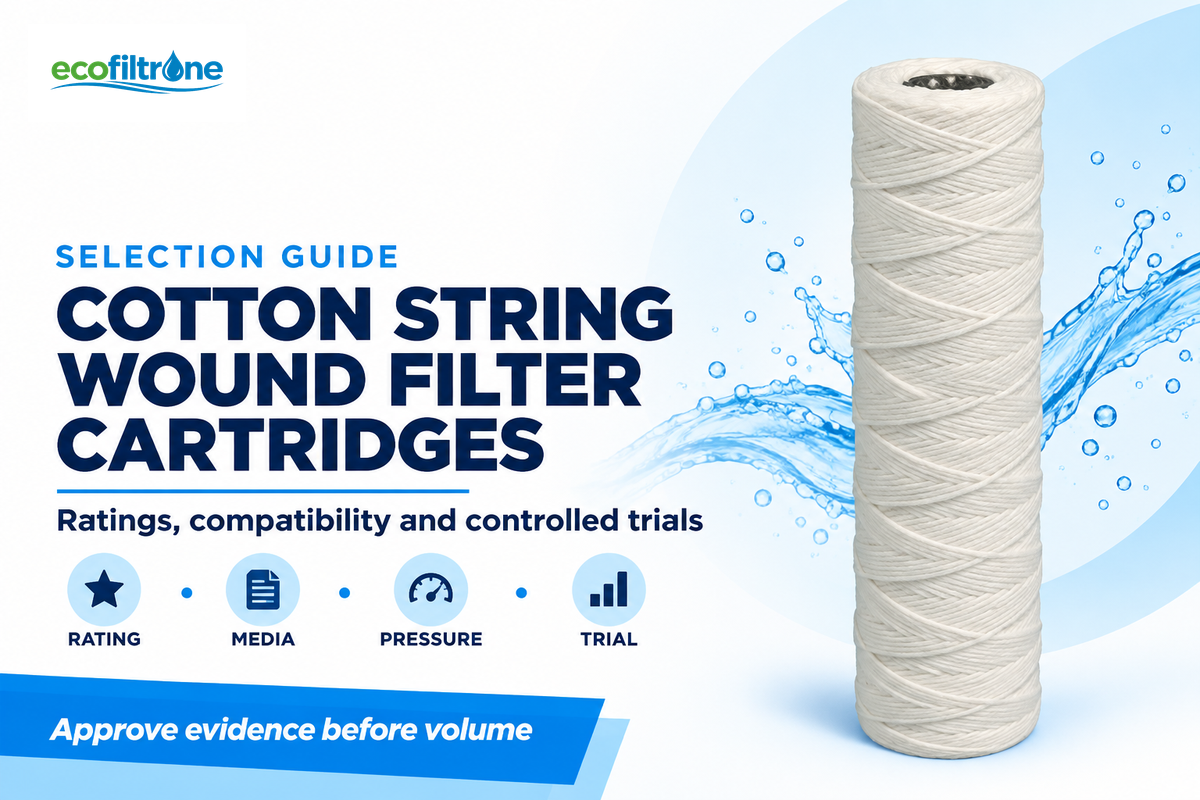
COTTON string wound filter cartridges are depth-style elements made by winding cotton textile yarn around a porous inner core. These string wound sediment filter cartridges can support sediment removal in water filtration and industrial process duties, but a high quality label and nominal micron number don’t define a complete operating specification or reliable filtration performance.
A defensible application begins with the fluid, temperature, core, housing, required outlet quality and evidence behind the rating. This example shows how engineering, quality and procurement can perform an evaluation of a string wound cartridge filter, without assuming one construction is always the best.
Why a Cotton Label Is Not a Complete Specification
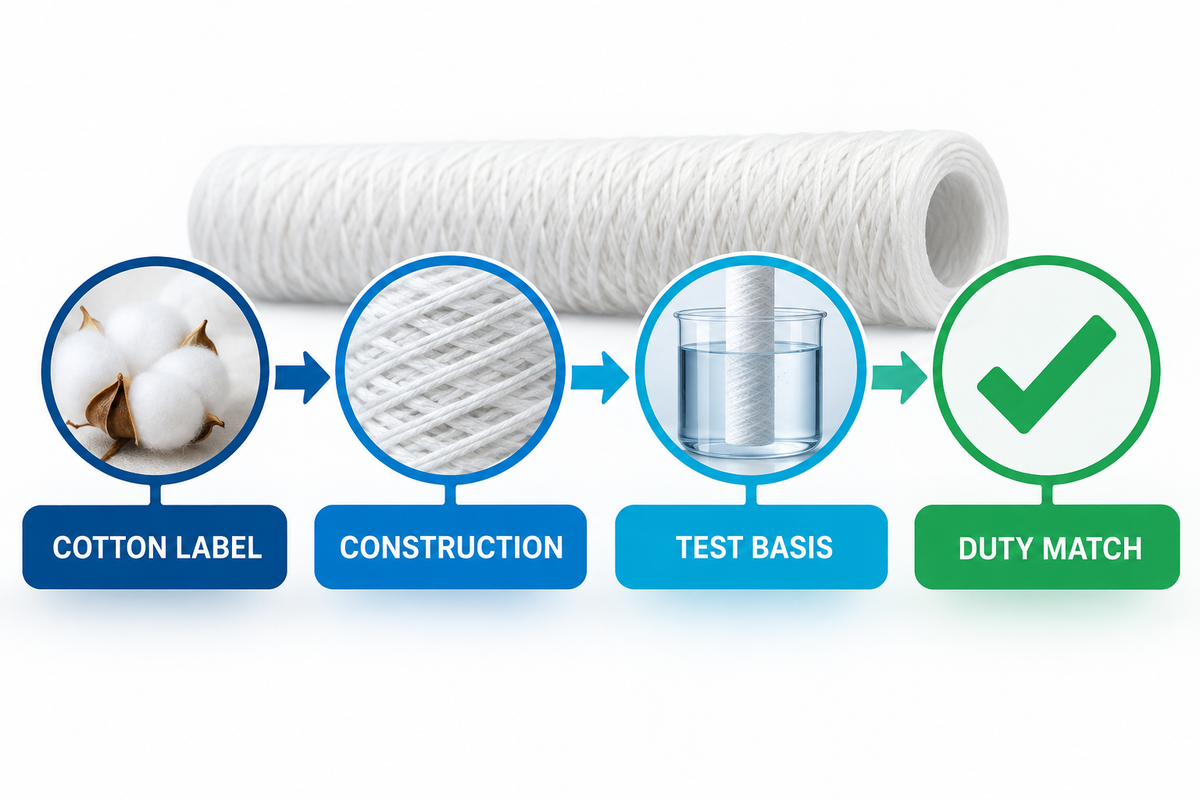
Two different cartridge filters can be made from the same cotton description and nominal rating, with different yarn grades and winding patterns, cores and test methods, and operating limits. Those differences can affect clean pressure drop, dirt holding capacity, loading behavior, media migration, and service life.
Search results for this topic are dominated by product pages. Use these to identify construction options available, and then request controlled evidence to support a claimed value before accepting the literature rating as satisfactory for your process. ECOFILTRONE options are described in the cotton string wound filter cartridge options.
How Wound Depth Capture Works, and What a Nominal Micron Rating Proves
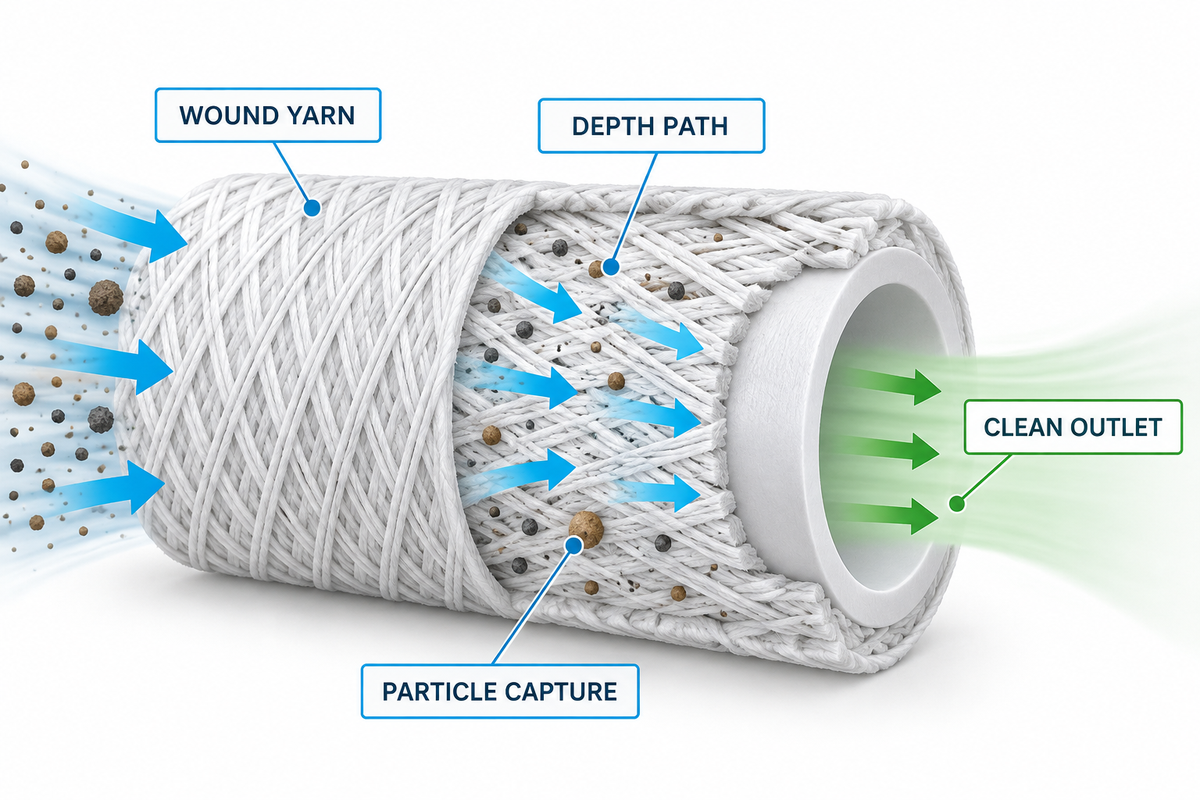
In a wound cartridge, depth filtration occurs as liquid must travel through multiple yarn layers before it reaches the core. Larger particles may be captured in the more open outer structure, while smaller particulate may continue to flow through and be captured much further downstream. Parker describes this behavior as successive layers capturing part of the contaminant load. 1
The key word is nominal. Nominal micron rating is a rough estimate at the supplier’s stated test conditions. It isn’t an absolute cutoff, and it doesn’t mean every particle at or above the label size would be removed.
| Evidence level | What to request | Decision value |
|---|---|---|
| 1. Label | Nominal micron designation | Useful only for an initial shortlist |
| 2. Efficiency | Removal efficiency at the stated particle size | Shows what “nominal” means for that product |
| 3. Test basis | Test fluid, challenge particles, flow, temperature, and endpoint | Makes supplier results comparable |
| 4. Hydraulic data | Clean pressure-drop curve and maximum differential pressure | Supports housing and pump checks |
| 5. Process trial | Pressure, outlet quality, throughput, and changeout data | Confirms suitability under the buyer’s conditions |
| 6. Lot evidence | Certificate and raw-material traceability | Binds the tested construction to delivered goods |
| 7. Change control | Supplier notification commitments | Protects the approved baseline |
| 8. Incoming check | Dimensions, markings, packaging, and condition | Detects shipment or identity drift |
| 9. Release decision | Named engineering and quality approval | Creates an auditable disposition |
Nominal sizes provide a basis for classification among elements. Manufacturers of elements typically distinguish between nominal elements and higher-efficiency elements. Pentair lists nominal sizes for its CW series, but the short product page does not define a universal efficiency method.6 Eaton’s overview separates nominal and higher-efficiency families rather than treating every polypropylene or wound element as equivalent.8
Complete a Five-Layer Compatibility Check Before Selecting Cotton
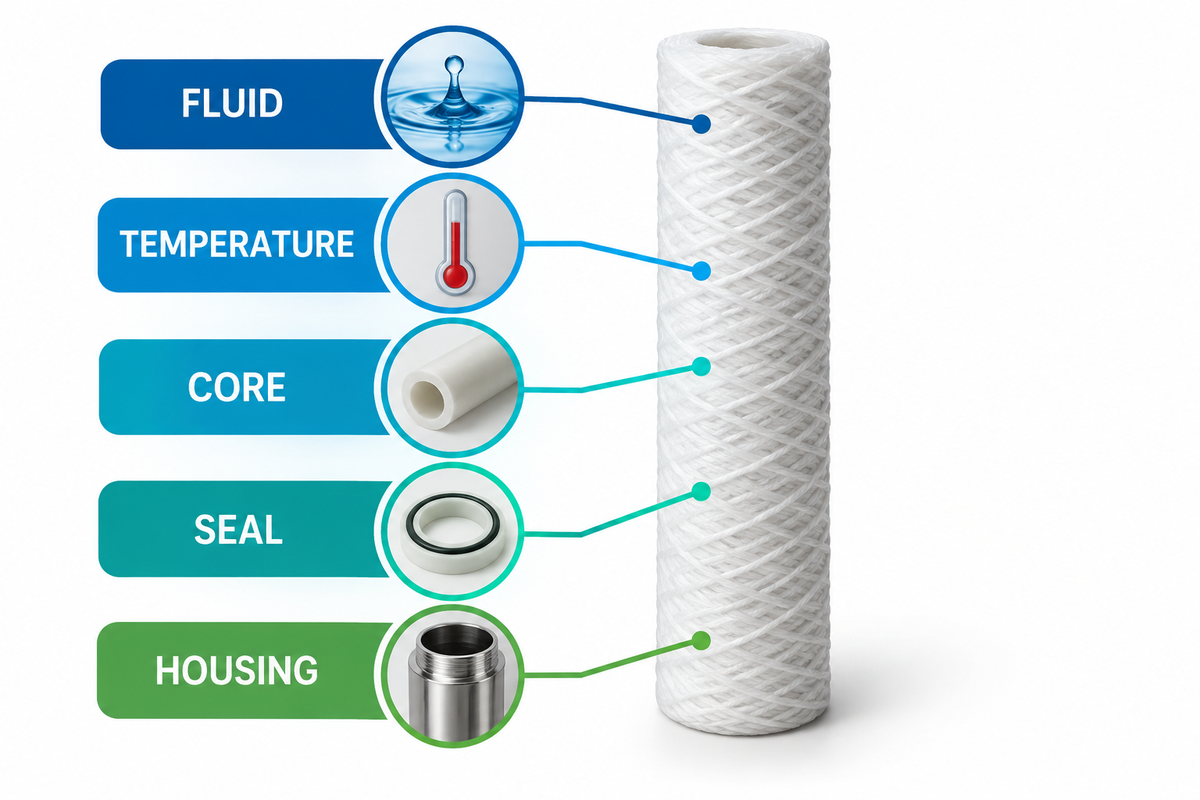
Compatibility is a system question. A yarn may tolerate a fluid, but the core, seal, adhesive, end treatment, and/or housing may not. Examine the complete construction at normal operation, startup, cleaning, and upset conditions.
- For the fluid, identify composition, concentration, pH, viscosity, dissolved components, solids, and cleaning chemicals. What chemicals are required for cleaning?
- Specify natural, bleached, or another controlled cotton grade and disclose finishes or processing aids where cleanliness matters.
- For the core, verify polymer or metal grade, collapse resistance, surface area effects, and compatibility at maximum temperature and differential pressure.
- For seals and ends, match gasket material, double-open-end or single-open-end configuration, adapters, and bypass-prevention features.
- For housing duty, confirm length, outside diameter, flow per element, pressure rating, installation clearance, and sealing surface condition.
Published limits vary with configuration. Parker, 3M, Eaton, and United Filters cite various limits for identified cotton-and-core combinations including bleached cotton and metal or polymer cores. 1245 Such variations make it unsafe to use the rule “cotton handles X°C.”
Compare Cotton Wound, Polypropylene Wound, and Melt-Blown Options
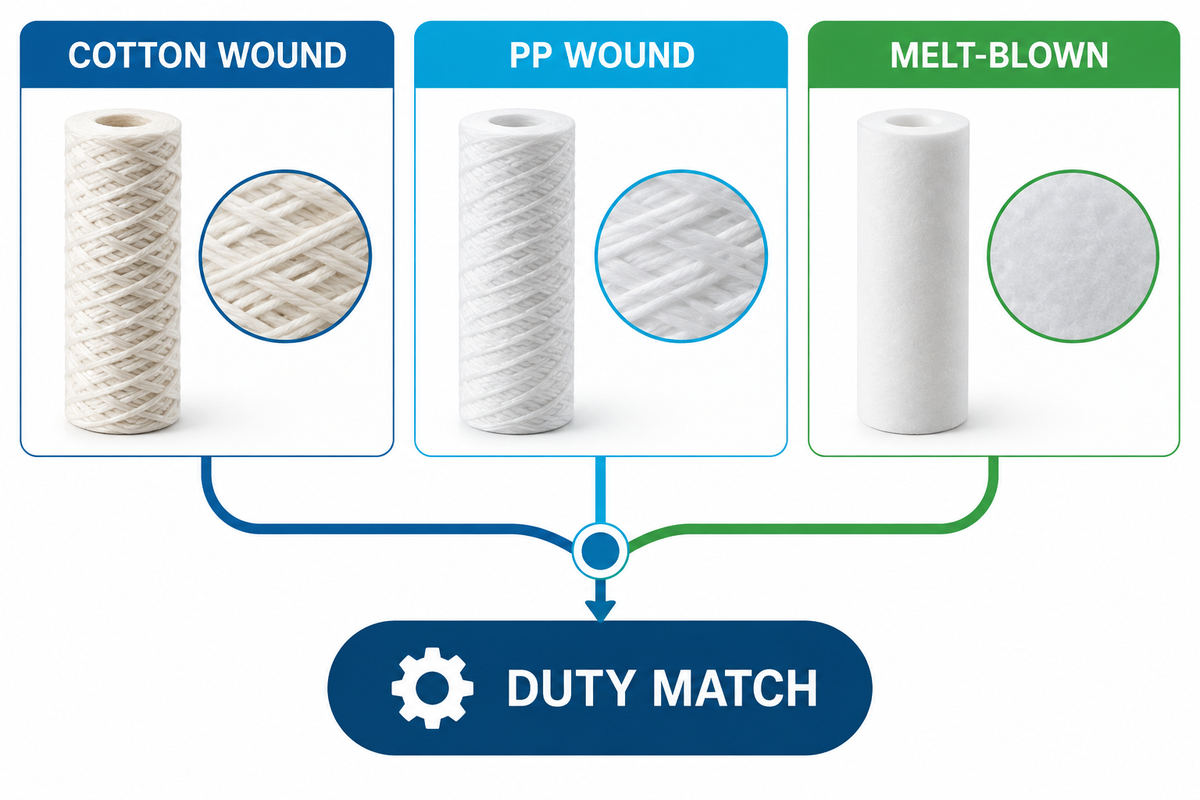
Start with the duty rather than the material name. Cotton wound media may be shortlisted with some cores if compatibility with temperatures and fluids matches. Polypropylene string wound media may suit a broad chemical envelope, while fiberglass belongs to a different shortlist. A melt-blown depth filter may offer dense structure, low impurity content, and a different pressure-drop profile. None proves a long-lasting or cost-effective winner for every solvent, edible oil, residential, photographic, or process-water line.
| Decision factor | Cotton wound | Polypropylene wound | Polypropylene melt-blown |
|---|---|---|---|
| Construction evidence | Yarn grade, winding, and core must be stated | Yarn, winding, and core must be stated | Fiber bonding, support structure, and efficiency must be stated |
| Compatibility | Check fluid, treatment, core, and temperature | Check polymer grade, core, and temperature | Check polymer, additives, and process temperature |
| Rating comparison | Nominal label needs test context | Nominal label needs test context | Efficiency varies by family and grade |
| Best next proof | Like-for-like trial at fixed flow, temperature, housing, and contaminant load | ||
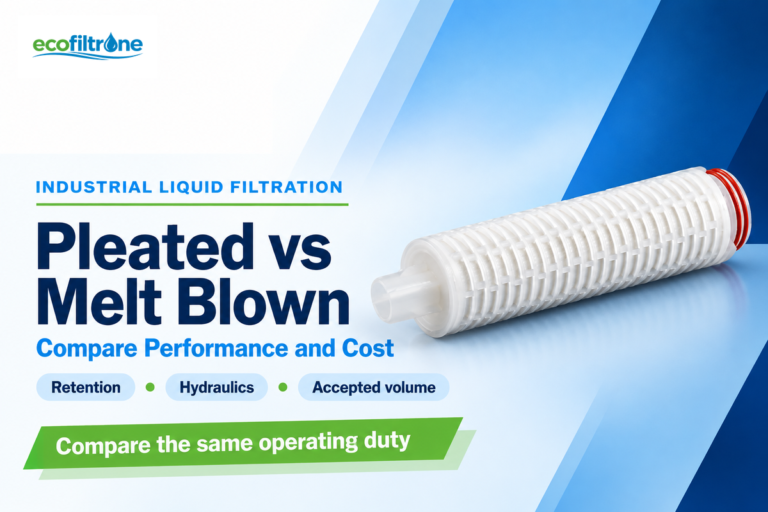
Eaton and 3M comparative documents show that the construction and test basis may change performance, but comparisons of that nature in supplier documentation don’t establish a universal ranking. 79 Buyers may also review the related ECOFILTRONE guides on melt-blown depth cartridges and polypropylene pleated cartridges.
Match Core, Seal, Length, and Housing Interface
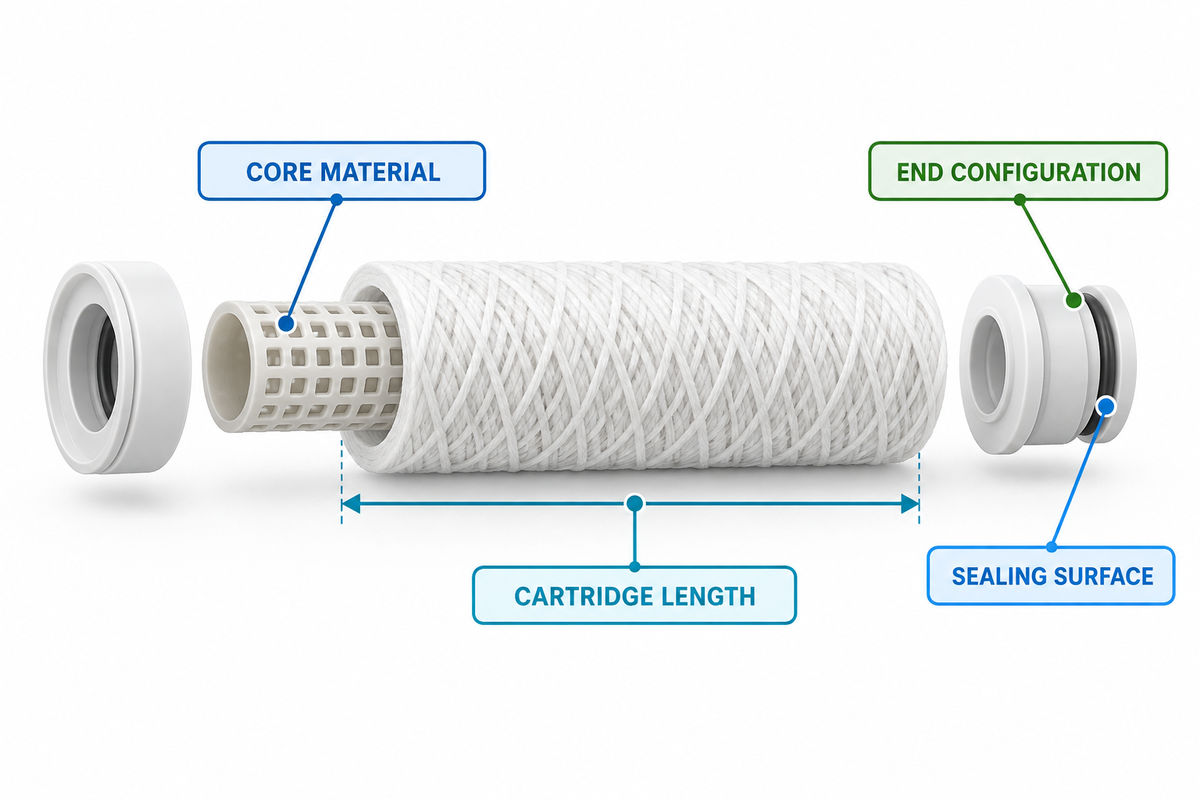
For cotton, the core carries the wound structure as differential pressure rises. Supplier literature shows polypropylene, tin-plated steel and stainless steel for different product lines. Specify the exact inner core, the outside diameter (OD), dimensions, maximum differential pressure and temperature, and derating for the ordered construction.
Also check the length, OD, end configuration, and seal material. A correct media choice can still produce poor outlet quality if the element does not seal in the housing or if the gasket is damaged.
Read Differential Pressure and Outlet Quality Together
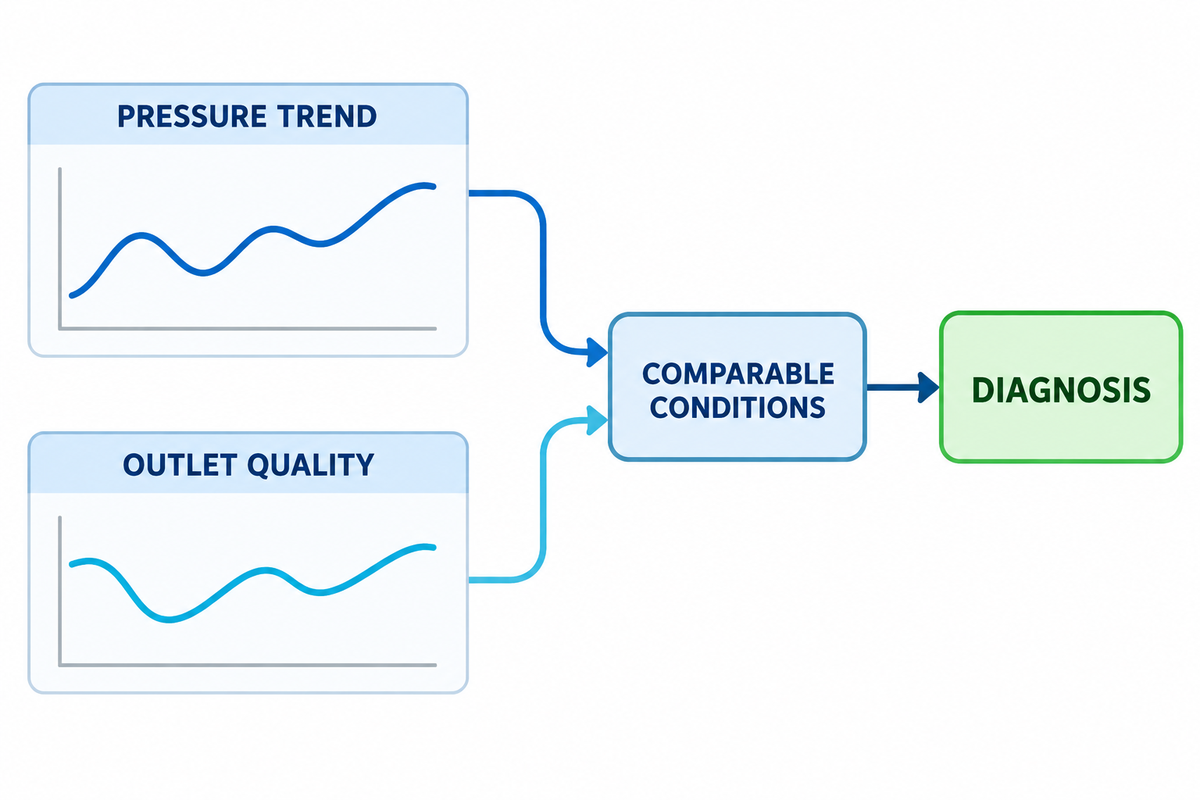
Differential pressure indicates how much resistance there’s in the system. Outlet quality indicates if the filtration objective is achieved. Both should be monitored at identical flow, temperature and viscosity conditions. Raw pressure alone can confuse a colder, more viscous batch with cartridge loading.
| Pressure trend | Outlet quality | Likely interpretation | First checks |
|---|---|---|---|
| Gradually rising | Stable | Normal loading may be occurring | Normalize for flow and viscosity; compare throughput |
| Rapidly rising | Stable or worse | Solids excursion, undersizing, viscosity change, or plugging | Check feed, valves, flow, temperature, and upstream events |
| Stable or low | Worse | Bypass, seal failure, damage, channeling, or unsuitable rating | Inspect seating, seals, element integrity, and sampling |
| Falls after rising | Worse | A new low-resistance path may have opened | Stop and inspect for bypass or structural failure |
Use the supplier’s validated changeout limit for the precise cartridge and housing; 3M’s product-family sheet illustrates why that guidance must stay configuration-specific. Parker, 3M, and Eaton publish different product-specific guidance, so a single universal pressure threshold would be misleading. 1, 2, 9
Run a Controlled Incoming Trial Before a Bulk Order
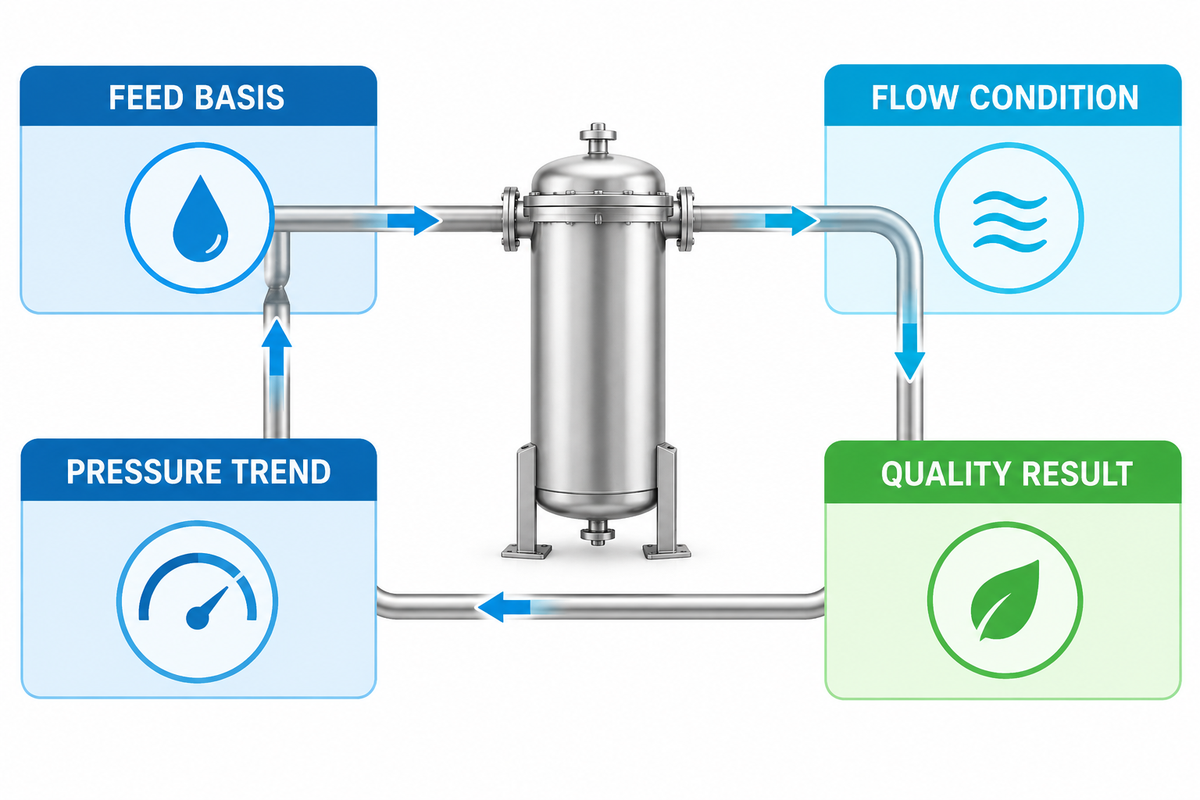
A durable filtration solution needs more than a sample that “looks good” and requires further scrutiny. Define precision and acceptance criteria before installation. Then compare the candidate with the incumbent under matched conditions and record the tested lot alongside the results; Pall’s Oenoclear compliance certificate illustrates lot/date-code traceability to supplier materials and production records.
| Block | Record |
|---|---|
| Identity | Supplier, part number, revision, lot, media, core, seal, length, and rating |
| Fixed conditions | Housing, fluid, temperature, flow, contaminant load, and sampling method |
| Baseline | Clean differential pressure, inlet quality, outlet quality, and initial flow |
| Trend | Pressure, flow, outlet particle data or turbidity, and cumulative throughput |
| Stop rules | Validated pressure limit, outlet-quality failure, leakage, damage, or media release |
| Disposition | Approve, conditionally approve, reject, or extend testing; name approvers |
Request a Supplier Evidence Pack, Not Just a Datasheet
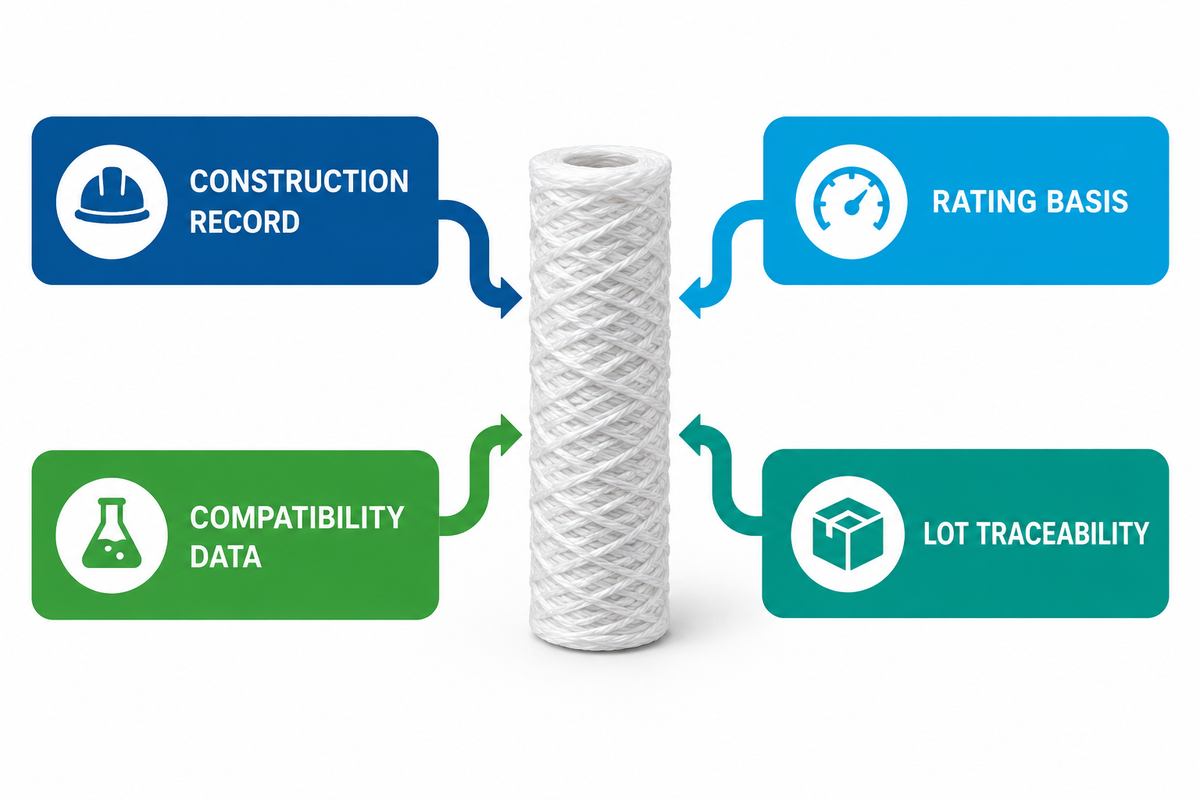
Request specifications, material declarations, drawings, rating basis, pressure-flow data, operating limits, compatibility, a certificate of conformity, lot traceability, and change-notification process. For food and beverage, potable-water treatment, or regulated service, request the specific certificates and model scopes.
NSF explains that certification claims vary by product and by the reduction claim tested.11 A generic “NSF material” or “FDA grade” statement is not the same as certification of the ordered cartridge or the complete filtration system. The compliance documentation for Pall’s products demonstrates the type of wetted-material and lot traceability that can be requested by a customer, without implying that the same status is applicable to a cotton wound cartridge.10
Frequently Asked Questions
How do cotton string wound filter cartridges work?
Liquid passes through several layers of cotton yarn wound on a perforated core. Particles can be captured at different depths, not just on the outer surface. Actual capture is dependent on the winding pattern, yarn, flow, contaminant shape, and loading state, so the entire construction of the cartridge should be evaluated rather than cotton yarn alone.
What does a nominal micron rating mean for a wound cartridge?
It is an approximate retention designation under a supplier’s test basis, not an automatic absolute cutoff. Ask what percentage of particles of the stated size was removed, what test fluid and particles were used, what flow and differential pressure were used. A separate filter micron rating guide explains this evidence boundary in more detail.
When should cotton be compared with polypropylene wound or melt-blown media?
When considering material, compatibility, temperature, solids loading, pressure drop, outlet cleanliness, and service cost, alternatives should be compared. Preparation of a short list should be accomplished by use of documented product limits. Controlled evaluations should be performed with the same housing, flow, temperature, fluid, and sampling. Don’t choose a universal winner from material names alone.
How should differential pressure and outlet quality be used together?
Pressure shows resistance, while outlet quality shows separation performance. An increase in pressure with no change in quality often indicates loading. Worsening quality with little pressure increase can point to bypass, a sealing problem, damage, channeling, or an unsuitable rating. Before comparison of values, pressure should be normalized for flow, viscosity and temperature.
What evidence should a cartridge supplier provide?
Request a controlled specification, exact media and core identity, dimensions, rating method, efficiency data, pressure-flow curve, temperature and differential pressure limits, compatibility guidance, lot certification, traceability and change notifications. Any regulatory or certification statement should identify the exact model, configuration, standard, and claim scope.
Approve the Evidence Before Approving Volume
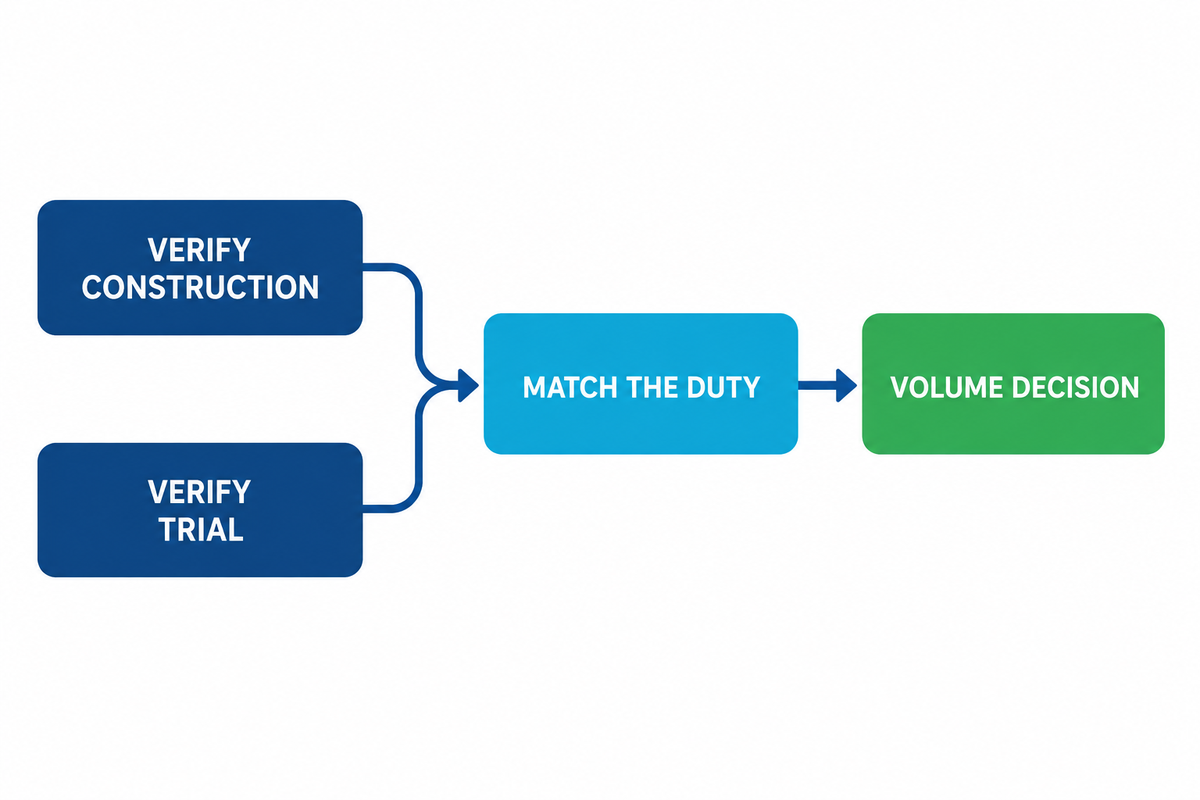
The cotton string wound cartridge shouldn’t be approved because of a familiar looking label. Approval should be based upon evidence that the construction and trial results match the duty. If documentation is lacking, request the information, or contact ECOFILTRONE to determine the construction and quality of the cotton string wound cartridge. If the risk is material, a controlled trial should be performed before committing to volume.
References & Sources
- Parker HONEYCOMB HFT technical sheet
- 3M Micro-Klean D Series
- 3M Micro-Klean CS Series
- Eaton LOFWIND
- United Filters string wound filters
- Pentair Pentek CW Series
- 3M Betapure AU technical document
- Eaton industrial process cartridge overview
- Eaton LOFTREX M technical sheet
- Pall compliance-document example
- NSF filtration-system standards overview
- ISO 16889 filtration performance test overview
- ISO 23369 reproducible filtration test overview
- 21 CFR 211.72 filtration boundary for injectable drugs
Filtration selection brief
Bring the operating details that shape the next conversation
Record what is known from the line or process. A complete specification is not required to start.
Useful inputs
- Fluid and processFluid name, process stage, and any compatibility concern.
- Filtration targetRequired result, existing rating, or the issue to solve.
- Flow and run timeTypical flow range, batch size, or expected service interval.
- Installation conditionsHousing or connection details, temperature, pressure, and available space.
Next step
Send the details you have
Use the inquiry form to start a focused discussion and add drawings or photos when they help explain the installation.
Start an inquiry