Get in touch with ECOFILTRONE™ Company




Updated October 2026
Large Diameter (Jumbo) Melt Blown Cartridges can reduce the elements in a filtration layout, but diameter alone isn’t a performance specification. The correct choice starts with the housing interface, then connects peak flow, fluid properties, contaminant load, filtration efficiency, and the allowable differential-pressure rise.
This guide provides the path to assess a process duty from an existing housing to a trial specification of a cartridge. It shows where comparison shopping stops, meaning a retrofit decision is made based on data rather than the word “jumbo.”
Industry suppliers may call large elements a water filter cartridge or melt blown water filter, but industrial filtration systems need a duty-specific flow rate and acceptance limit for melt blown sediment service. The same duty-specific evidence is required for a proposed sediment melt blown water filter used in a documented particulate pre-filtration stage.
Quick specs to collect: actual outside diameter, overall and effective length, end interface, seal material, core or cage, peak flow, fluid viscosity and temperature, clean differential pressure, micron-efficiency basis and allowable terminal differential pressure.
Large Diameter (Jumbo) Melt Blown Cartridges are specified as part of a housing and process system. Compare candidates under identical peak flow, fluid condition, retention target and pressure budget, then confirm fit, outlet quality and loading behavior in a controlled trial.
Key points
- A wider element can still have excessive installed pressure loss.
- “Jumbo” doesn’t define one universal diameter or end interface.
- Equal micron labels aren’t comparable without efficiency and test conditions.
- Cost should be compared per accepted process volume, not per cartridge.
Decision rule: treat jumbo as a form-factor family. Confirm the drawing and operating evidence for the exact cartridge and housing combination before comparing flow, service life or cost.
Why “Jumbo” Is a System Decision, Not Just a Wider Cartridge
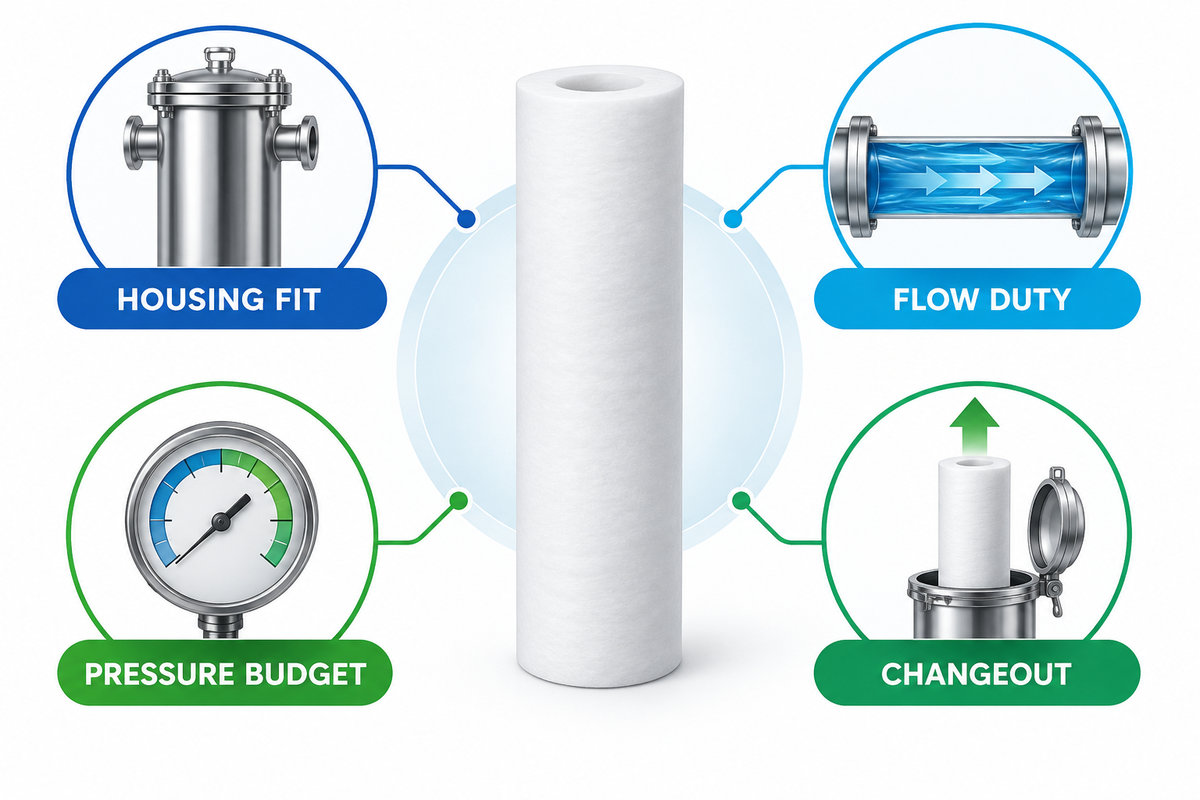
Supplier literature uses “large diameter,” “jumbo,” and “Big Blue” for more than one geometry. Reviewed product families include formats around 4.5 inches and other large-format designs around 6 inches, so the label can’t establish interchangeability.
An increase in outside diameter can reduce the number of elements in a housing by allowing for increased media volume. It can also affect the distribution of flow, sealing, support, lifting clearances, and the disposal volume. Increased outside diameter doesn’t always reduce the installed pressure drop. None of those effects proves lower installed pressure drop or longer service life without duty-specific data.
“This third edition cancels and replaces the second edition (ISO 16889:2008), which has been technically revised.”
| The label may suggest | The project still has to verify |
|---|---|
| A wider element | Actual outside diameter, effective length and housing clearance |
| More media volume | Media construction, loading behavior and collapse support |
| Higher flow potential | Clean curve at the stated fluid viscosity and temperature |
| Fewer cartridges | Required element count at peak flow and allowed differential pressure |
| Longer changeout interval | Contaminant capacity and a monitored terminal condition |
A form factor organizes the investigation; it doesn’t replace the investigation.
Start With the Housing Interface
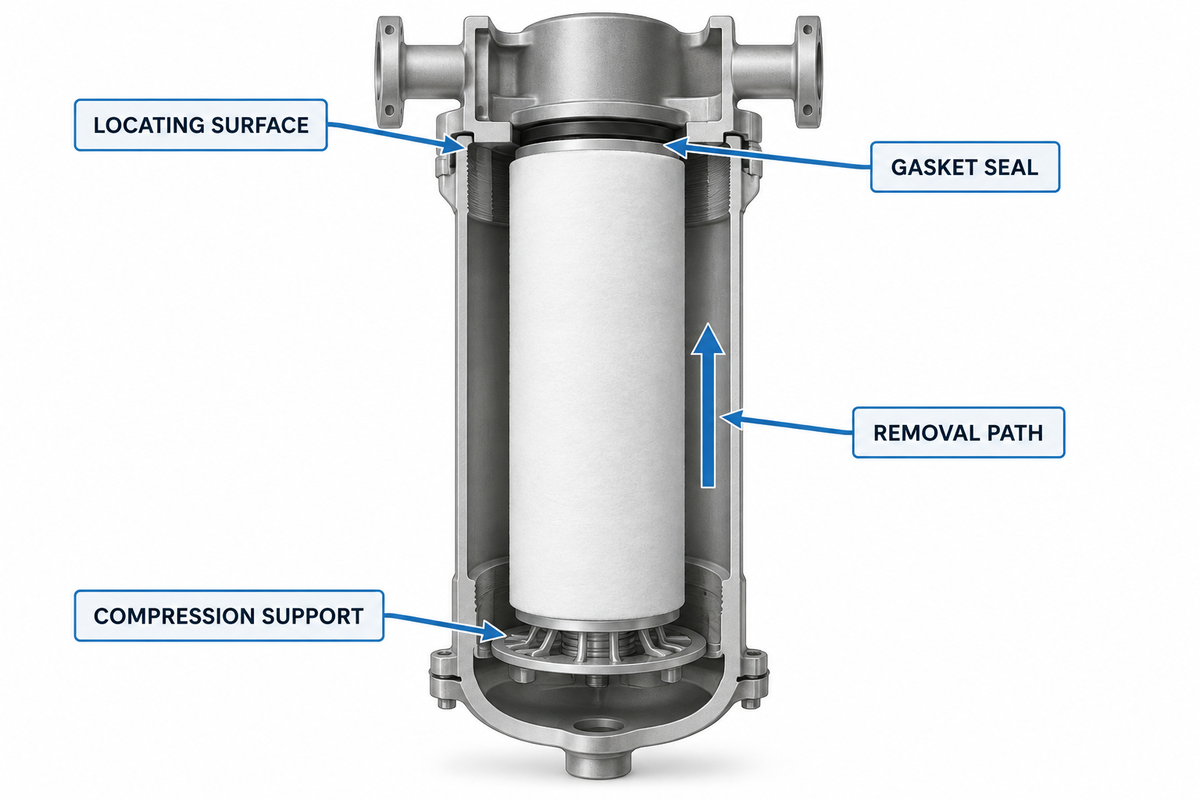
A cartridge that fits by nominal diameter may still leak, bind during installation or not be properly supported. A housing drawing and the removed element should be the basis for the analysis, rather than a product name found on an old purchase order.
Which dimensions must be confirmed before ordering?
Record the maximum outside diameter, effective filtration length, overall length, inside diameter or core interface, end-cap shape, gasket material and gasket location, then place every measurement on a revision-controlled drawing with tolerances and the direction of installation. Identify the housing tube sheet, locating cup, spring or compression plate, center post, lid clearance and extraction path, and ask the supplier to mark which surfaces locate the cartridge, which surfaces create compression, and which dimensions control removal clearance during a loaded-element changeout.
The drawing must state overall height, and each sealing dimension must be provided. Product specifications and part numbers are useful if their revision matches the drawing provided.
Jumbo Fit Envelope
- Outside diameter and allowable housing clearance
- Overall length and effective media length
- Double-open-end, single-open-end or proprietary end interface
- Knife edge, flat gasket, O-ring or other seal geometry
- Core, cage or coreless construction and required support
- Seal material, fluid compatibility and operating temperature
Why do seal geometry, end style and support matter?
The seal creates the boundary between unfiltered and filtered fluid. A diameter match cannot compensate for the wrong gasket face, missing compression or an end cap that does not seat on the housing interface.
Support also matters because melt-blown depth media can deform under differential pressure. Ask for the permitted direction of flow, collapse or differential-pressure limit, and whether the quoted configuration requires a core or external cage. A patent describing possible media or core construction isn’t evidence that a supplier’s commercial cartridge carries a particular rating.
Translate Peak Flow Into a Pressure-Drop Budget
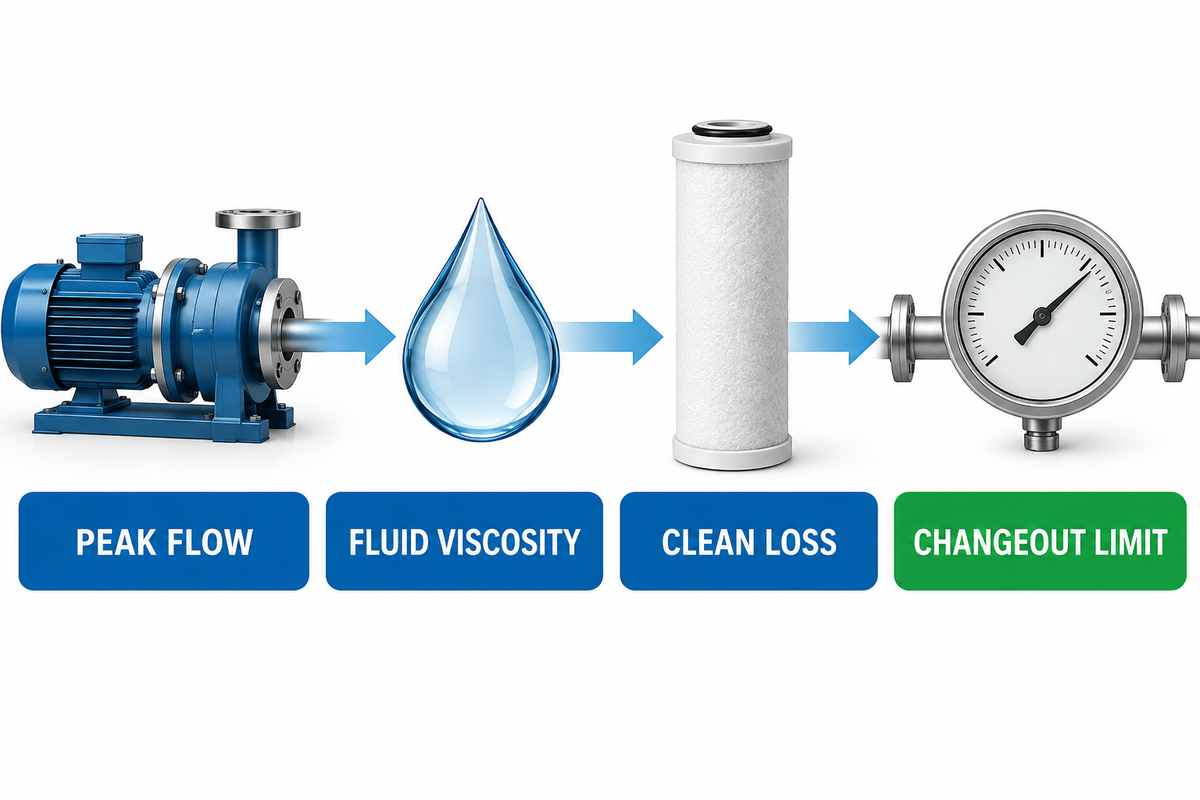
Average flow conceals the condition most likely to cause a poor retrofit. Size the filtration stage for the highest sustained and credible short-duration flow, then state the fluid temperature and viscosity at that condition.
Why is average flow the wrong sizing input?
Differential pressure changes with flow and viscosity. A Dutch Filtration instructional chart illustrates different pressure losses under a 1 gpm flow when viscosity changes from 1 to 4 cP. That relationship is a warning against applying a clean-water curve to a more viscous process fluid.
Ports, valves, housing internals and pipework also consume pressure. If the available pressure is fully consumed by cartridge, the installed system may not meet the target even when the element follows its laboratory curve.
Three-Part Pressure Budget
- Clean element loss: supplier curve for the exact length, micron grade, fluid and temperature.
- Usable loading rise: differential-pressure increase available before the chosen stop rule.
- System reserve: allowance for housing internals, valves and pipework variation and measurement inaccuracies.
Which clean and loaded pressure points belong in the specification?
Request clean differential pressure at normal and peak flow. Specify from where the pressure is measured. State the maximum system differential pressure and the project’s change out criterion. The change out criterion must be below the limit of the weakest applicable housing, seal, cartridge or process limit.
Don’t extrapolate a curve outside the tested range of flow, viscosity, temperature, and pressure. Depth media can compress as load increases, changing permeability; a clean curve therefore does not prove loaded behavior or total throughput.
Procurement objection: “The larger diameter should automatically lower pressure drop.” It may increase available area, but fine media, viscous fluid, loading, small ports or restricted internals can dominate the installed result. Require a curve and verify it during the trial.
Select Micron Rating Without Treating Labels as Equivalent
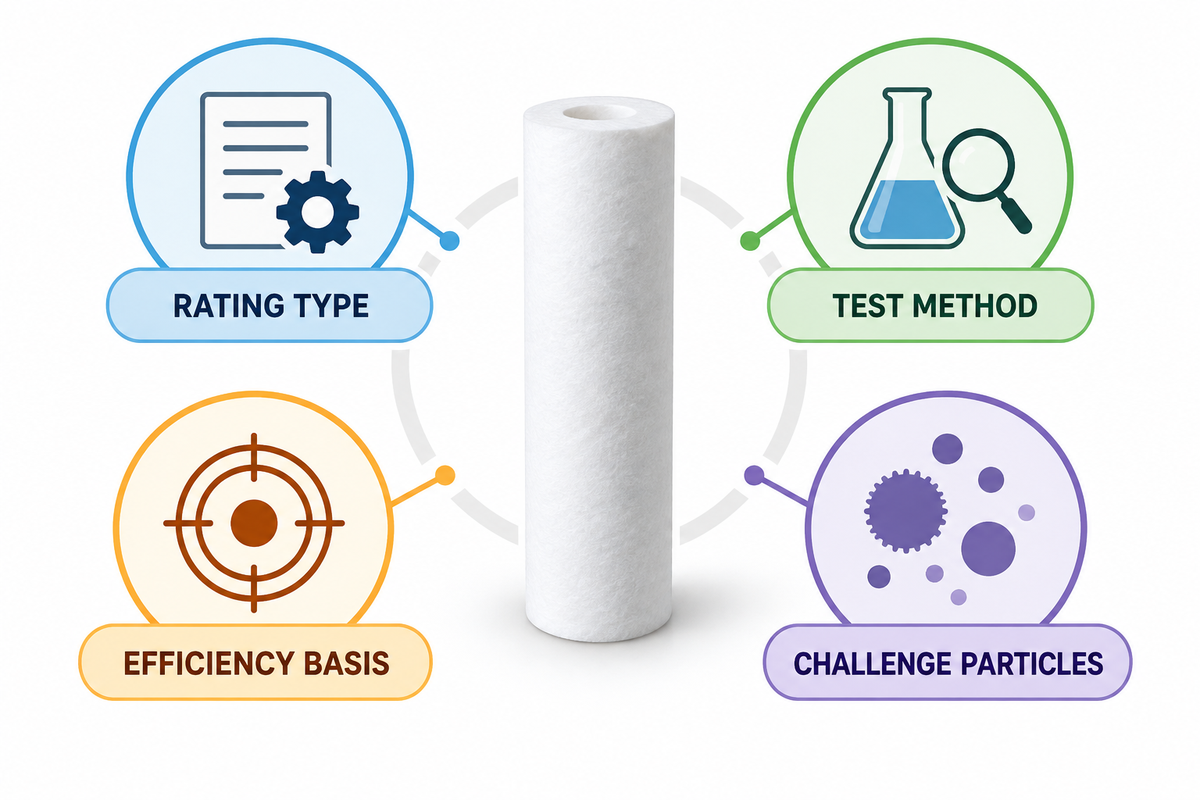
A micron number without an efficiency definition is of little use. The term “nominal” is used variously by different suppliers. An absolute or beta ratio statement requires a named test method, a stated particle challenge and reported test efficiency to be of any use.
When a 20 micron label and a 5 micron melt blown filter grade appear in competing specifications, a generic micron melt blown filter description is not enough; each claim needs an efficiency basis. Filter design and multi-layer construction may alter performance, therefore the comparison should be at the test-result level.
What does a nominal rating actually tell you?
It identifies a supplier’s declared grade, but it doesn’t create a universal retention percentage. Ask the supplier to state the removal efficiency at the quoted particle size and the test conditions used to establish it.
Why can two equal micron labels perform differently?
Factors including fiber diameter distribution, density gradient, the thickness of the test media, stabilization and the test method can affect measured values. Even when two data sheets print the same micron value, their efficiency curves and their contaminant holding capacity may be different.
| Rating evidence to request | Why it matters |
|---|---|
| Nominal, absolute or beta-ratio basis | Prevents unlike rating conventions from being treated as equivalent |
| Efficiency at the specified particle size | Turns a label into a measurable retention statement |
| Test fluid, temperature and flow | Defines the conditions behind the result |
| Test standard and report identity | Allows technical review of method and scope |
| Initial and final sample results | Shows whether outlet quality remains acceptable through loading |
ISO 16889:2022 is a current multi-pass method for hydraulic-fluid filter elements; its scope must not be presented as universal certification for water-treatment melt-blown cartridges. Use a standard only when its scope matches the quoted application and the supplier can connect the report to the exact product.
Match the Cartridge to the Contaminant and Process
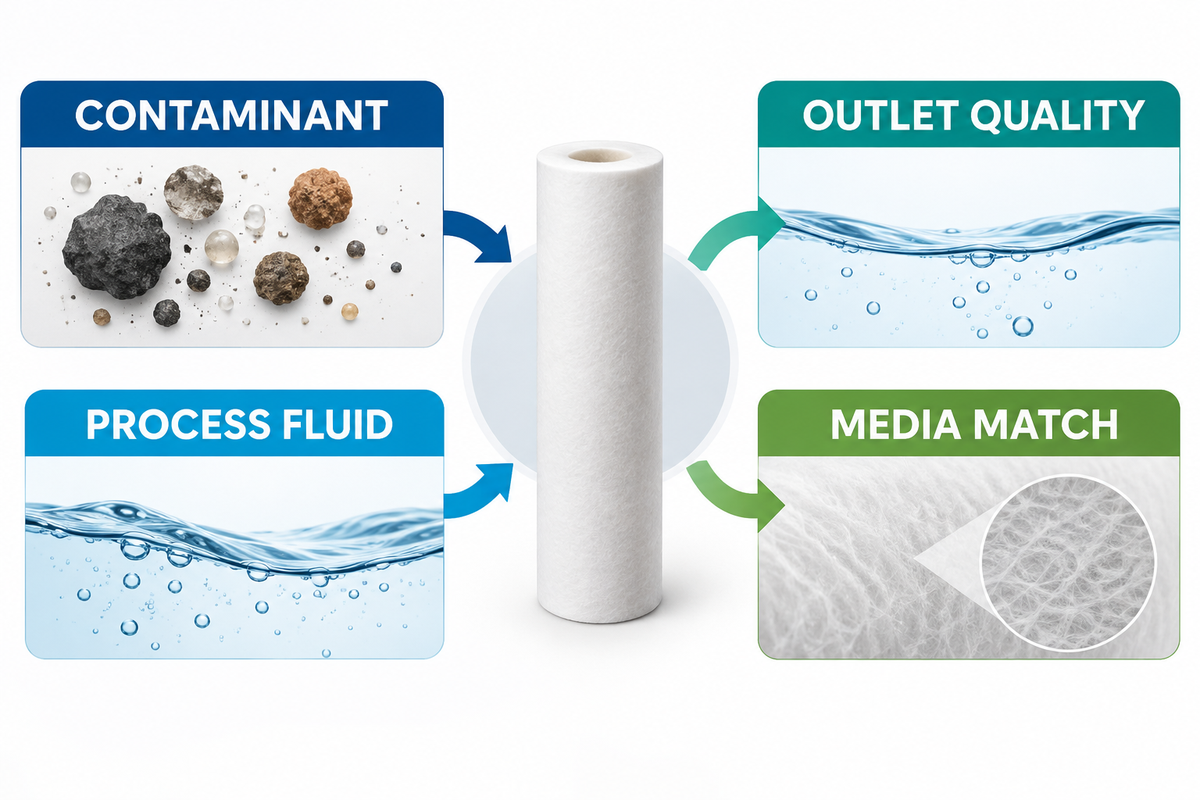
Depth capture is achieved by the use of melt-blown media. Particles can be captured throughout the porous structure rather than only at its outer surface. Gradated density allows for more even distribution of loading, but whether or not the media is suitable depends on the contaminant and fluid.
When does graded-density depth capture help?
Graded-density depth capture is used to retain particles of several sizes in a feed. The process benefits from particle loading across the entire media thickness. Coarser upstream zones can capture larger particles while finer zones retain smaller particles, however, a trial is still necessary to confirm the quality of the outlet and the usable throughput.
Which fluid properties and process conditions change the decision?
A number of factors influence the choice of models. Viscosity, temperature, chemistry, solids concentration, particle deformability, peak flow and downstream sensitivity all change the selection. Each of these should be specified at the operating condition for which the pressure curve and retention evidence are provided.
University extension guidance separates mechanical filtration by the physical size and form of contaminants, which helps in defining the problem of incoming particles before selecting a pore-size label.
Describe particle size distribution, solids concentration, shape of particles and whether solids are hard, gelatinous or deformable. Include viscosity, normal and upset temperatures, pH and chemicals, batch or continuous, and sensitivity of downstream equipment.
Common industrial duties include chemical processing, plating baths and DI water pre-filtration. Food and beverage or potable water service needs its own material, hygiene and certification review; a particulate cartridge statement does not establish those additional requirements.
Indicate if the filter media polypropylene is virgin and if the cartridge media polypropylene contains additives, a core or a supporting cage. Depth filtration may protect a downstream membrane, but the trial must demonstrate that the chosen element reduces particulates to the agreed outlet limit.
| Process evidence | Selection implication |
|---|---|
| Broad particle distribution and high solids load | Evaluate graded-density depth loading and staged prefiltration |
| Deformable or gelatinous material | Trial outlet quality and pressure rise; dry particle assumptions may mislead |
| Viscous fluid | Obtain a corrected pressure curve rather than using water data |
| Elevated temperature or aggressive chemistry | Verify polypropylene and seal compatibility at the stated concentration and exposure |
| Critical downstream equipment | Define a measurable outlet-quality limit and sampling plan |
| Intermittent batches | Record batch identity and normalize throughput before comparing runs |
| Variable feed solids | Trend an incoming-quality indicator with differential pressure |
| Fibrous contamination | Inspect surface blinding and consider staged removal |
| Very fine target particles | Verify efficiency and expect a tighter pressure budget |
Scope boundary: a particulate micron rating does not prove microbiological safety or removal of dissolved chemical contaminants. Those claims require product-specific certification and a test scope that names the relevant hazard.
For a deeper explanation of fiber formation, graded-density media and common failure diagnosis, see our melt blown filter cartridge guide. This article stays focused on large-format system integration.
Compare Standard and Large-Diameter Layouts
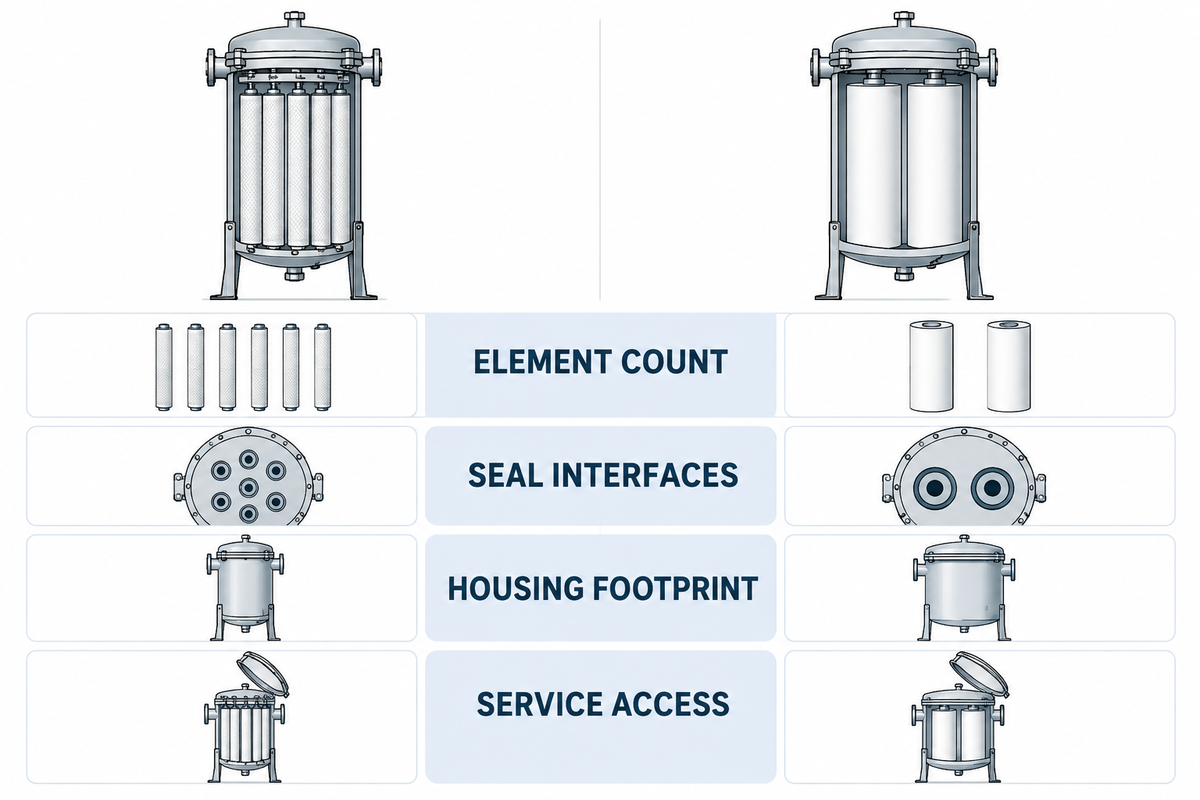
Replacement searches tied to US Filter, Ametek, Selecto, or Waterpik should not be treated as evidence that a cartridge matches an industrial jumbo housing or duty.
The useful comparison isn’t one cartridge versus one cartridge. The useful comparison is two complete layouts, both achieving the same peak flow and outlet quality, while being within the same pressure budget.
| Element Consolidation Worksheet | Standard layout | Jumbo layout |
|---|---|---|
| Elements per housing × housings | Enter verified count | Enter verified count |
| Total seals and element interfaces | Count | Count |
| Installed footprint and service clearance | Measure | Measure |
| Clean system differential pressure at peak flow | Measure or calculate | Measure or calculate |
| Elements handled per changeout | Count | Count |
| Drain-down, opening and replacement time | Trial | Trial |
| Spent-media mass or disposal volume | Record | Record |
| Validated throughput before stop rule | Trial | Trial |
Fewer interfaces may simplify maintenance and inventory, but a heavier wet cartridge or restricted extraction path can offset the benefit. Forum reports about stuck housings and difficult service access are useful prompts for inspection, not performance evidence.
Calculate the cost per accepted volume rather than the purchase price per element. Include cartridges, labor, downtime, cleaning, disposal and rejected product. When the throughput trial isn’t yet complete, consider any savings as a target rather than a given.
Validate a Retrofit Under Controlled Conditions
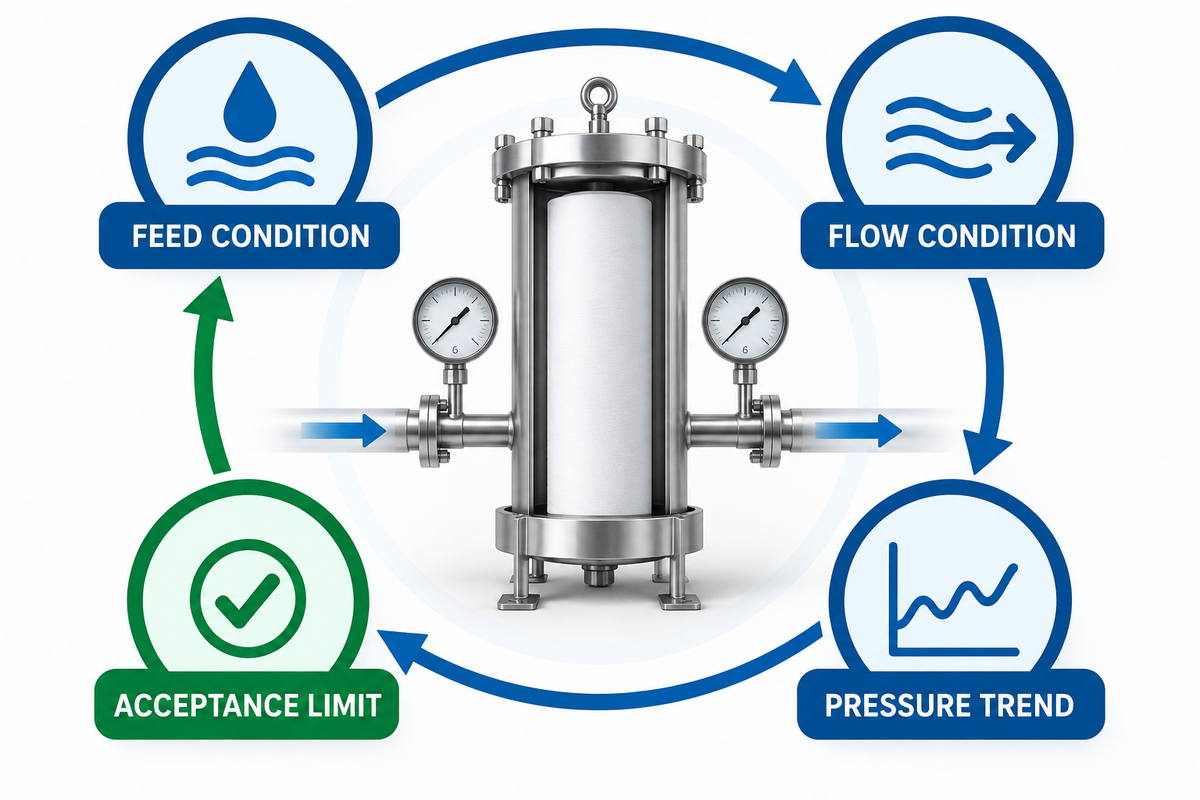
A controlled trial should change the cartridge layout while holding duty and acceptance criteria as constant as possible. If feed solids, flow and outlet-quality limits all change together, the effect of the cartridge can’t be isolated.
Jumbo Retrofit Evidence Record
- Existing and proposed cartridge identifiers, housing-interface drawings, loaded-element extraction clearance, element count and lot numbers
- Normal, peak and transient flow; fluid temperature and viscosity
- Feed solids or a practical incoming-quality indicator
- Clean differential pressure at defined measurement points
- Differential-pressure trend versus operating time or processed volume
- Outlet-quality metric, sampling location and acceptance limit
- Cumulative accepted throughput and reason for stopping
- Seal inspection, bypass evidence, deformation and removal notes
What must remain fixed during the trial?
Measure at the same locations, use the same calibrated instruments, sampling method and outlet quality limit. Record changes in the feed, cleanings and flow changes. Retain enough process data to show why loads from different batches are comparable during a trial.
Which measurements prove fit, capacity and outlet-quality performance?
Fit is determined by seating the element correctly, forming a seal, and removing the element without damage. Hydraulic performance is shown by clean and rising differential pressure at recorded flow. Capacity is the accepted processed volume or contaminant load up to the stop rule. Filtration performance is the agreed outlet quality over that interval.
A pressure-rise trigger can indicate loading, but the changeout rule should also protect outlet quality and mechanical limits. The appropriate endpoint belongs to the validated system; it isn’t a universal value copied from another housing.
U.S. Environmental Protection Agency guidance likewise connects cartridge-filter pressure drop with accumulated particle load and replacement timing. The application scope is drinking-water treatment, so this source supports the monitoring principle rather than a universal industrial changeout number.
Build an RFQ That Can Be Checked
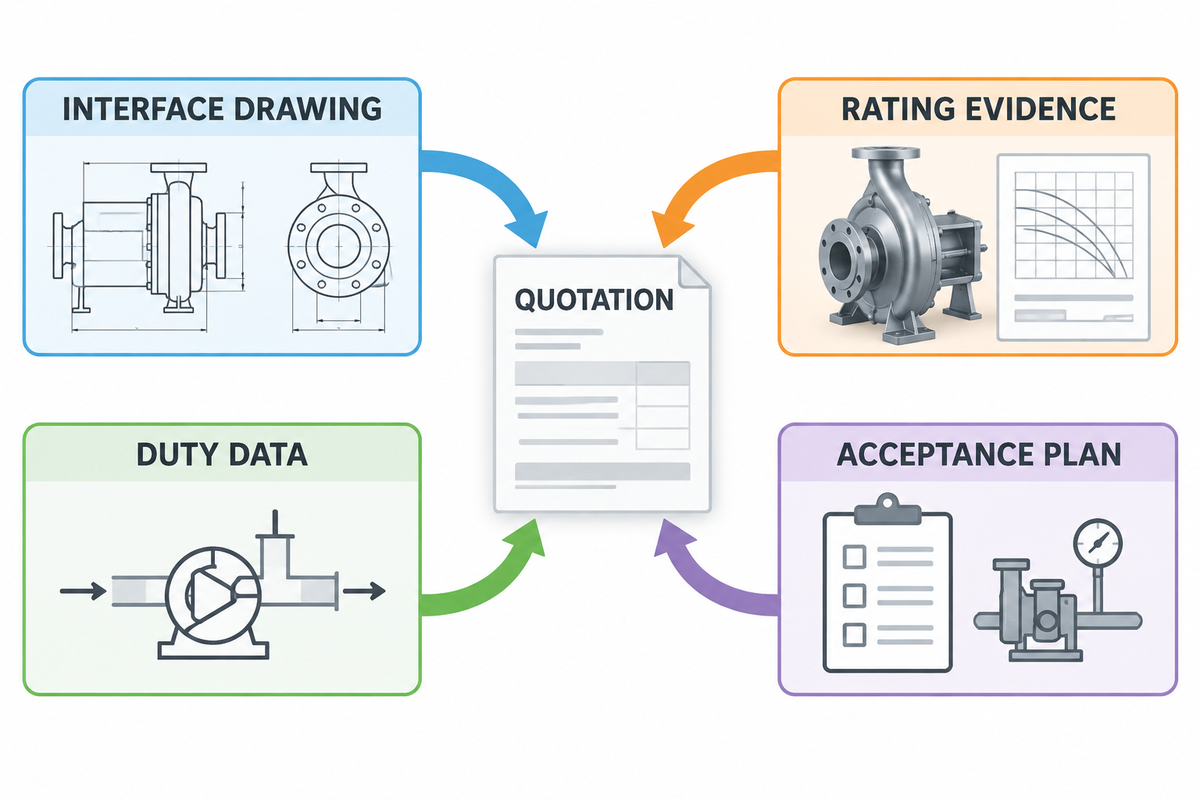
A useful request for quotation lets the supplier identify missing data and answer with a specific configuration. Attach evidence instead of compressing the project into “jumbo PP cartridge, 5 micron.”
- Housing manufacturer, model, drawing, photographs and internal clearances
- Connection size, direction of flow, typical flow, peak flow and available pressure.
- Fluid identity, viscosity, temperature, pH and chemical concentration
- Solids concentration, particle-size information and contaminant description
- Required outlet-quality metric and sampling or test method
- Micron grade with efficiency definition and requested test basis
- Cartridge dimensions, end interface, seal material, core and support
- Clean differential-pressure curve and allowable cartridge differential pressure
- Proposed changeout rule, current throughput and maintenance constraints
- Packaging, labeling, lot traceability and documentation requirements
Ask the quotation to identify every assumption and every deviation from the request. A technical drawing, product code and revision-controlled data sheet make subsequent approval and reordering far safer than a description alone.
Frequently Asked Questions
Are jumbo melt blown cartridges always 4.5 inches in diameter?
Answer
No. Suppliers use large-diameter or jumbo labels for different geometries, including 4.5-inch-class and larger formats. Specify the actual outside diameter, overall length, effective media length, end interface, gasket position and housing clearance from a controlled drawing for the exact assembly. A shared marketing label doesn’t establish interchangeability, sealing or the available filtration area.
Can a jumbo cartridge replace several standard cartridges?
Answer
Potentially, but the equivalent count must be calculated at the same peak flow, fluid condition, pressure budget and outlet-quality requirement. Compare complete layouts, including housings, seals, piping restrictions and service clearance. A controlled trial should then confirm clean differential pressure, rising pressure under load, accepted throughput, outlet quality and practical changeout work.
How should changeout differential pressure be selected?
Answer
Set it below all relevant housing, seal, cartridge and process limits, then validate that outlet quality remains acceptable up to that point. Define the upstream and downstream measurement locations, operating flow, instrument accuracy and response to rapid pressure rise. The final rule may also include processed volume, time or an outlet-quality limit when pressure alone can’t protect the process.
Can micron ratings be compared across manufacturers?
Answer
Only when the efficiency definition, test method, reported efficiency, particle size, challenge material, flow and fluid conditions are comparable, with each value identified as nominal or tied to a stated efficiency and with the sampled fluid, contaminant and acceptance limit recorded beside the result so the purchasing team can distinguish a documented performance claim from a label that only looks equivalent. Equal micron labels by themselves are insufficient.
Which data should be supplied for a retrofit quotation?
Answer
Supply the housing drawing, cartridge interface, peak flow, fluid properties, contaminant evidence, required rating basis, pressure limits, seal requirements and current changeout performance.
Next Step: Confirm the Commercial Configuration
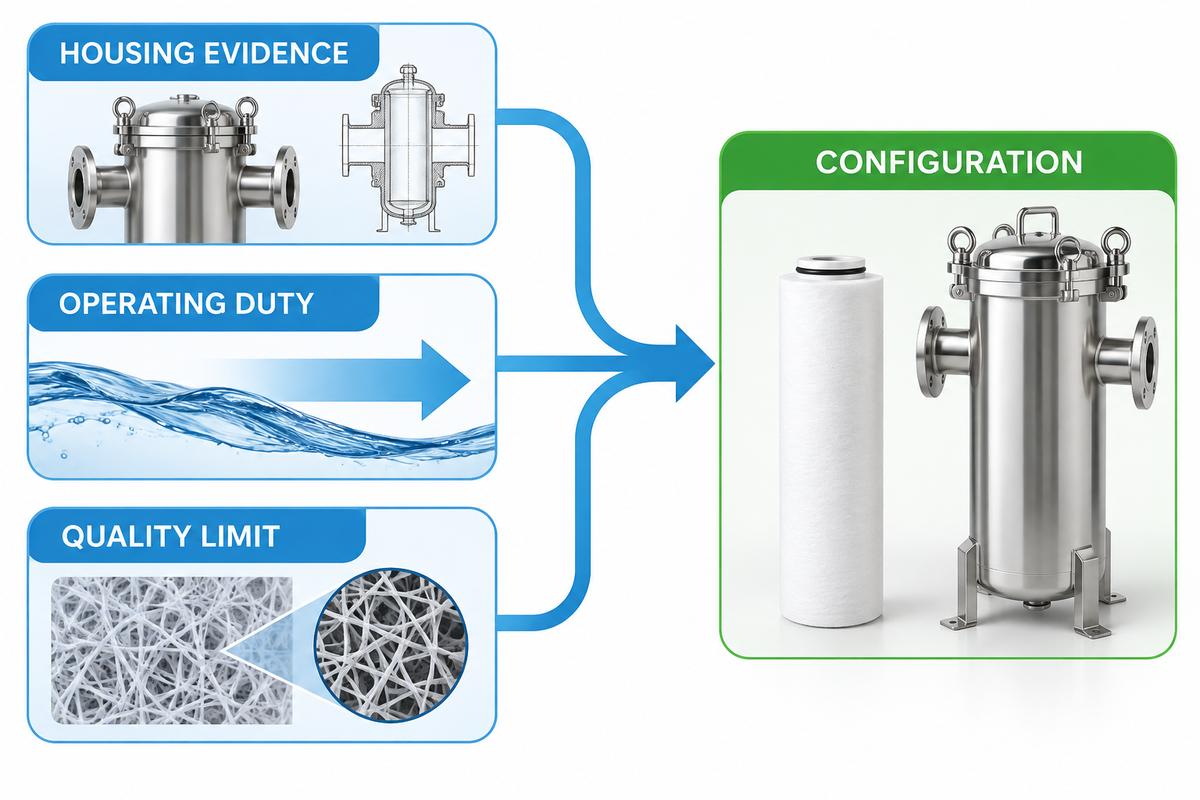
The best next step is to review the drawing and define the duty. Send the housing interface, process conditions and required outlet result so the proposed cartridge can be tied to a checkable configuration rather than a generic label.
Review ECOFILTRONE’s large diameter jumbo melt blown cartridges, or contact our filtration team with your housing drawing and operating data.
Related Filtration Resources
- Depth filter cartridge options
- High-flow filter cartridge systems
- Liquid filter bags for high-solids duties
References & Sources
- University of Georgia Extension – Mechanical Filtration Methods and Devices
- ISO, ISO 16889:2022
- North Dakota State University Extension – Filtration: Sediment, Activated Carbon and Mixed Media
- Memtec America Corporation — US5733581A: Apparatus for making melt-blown filtration media having integrally co-located support and filtration fibers; melt-blown fibrous web and process reference
- U.S. Environmental Protection Agency – LT2ESWTR Toolbox Guidance Manual