Get in touch with ECOFILTRONE™ Company


Large Diameter (Jumbo)
Melt Blown Filter Cartridges
ECOFILTRONE™ enables buyers to evaluate large requests for water and process filtration. Prior to confirming a design, we consider the proposed polypropylene filter cartridge with respect to the housing, fluid, suspended sediment, the operating conditions and the request documentation.
Request a Configuration Review & Quote Jump to RFQ Inputs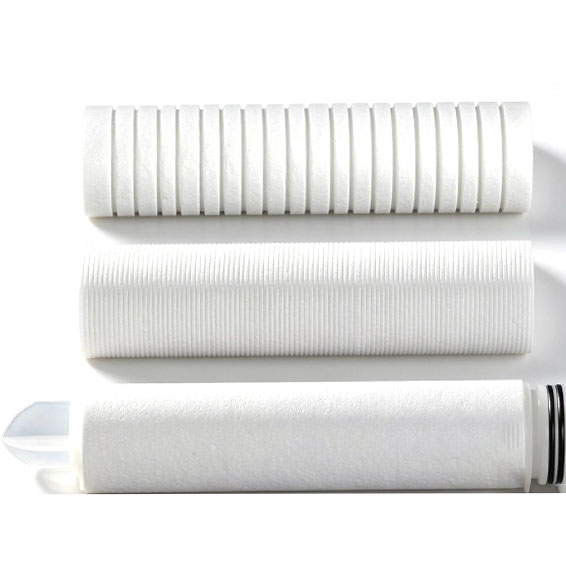
01
Replacement matching
Send the installed cartridge reference, housing model, dimensions, photographs, or drawing.
02
Application review
Share the liquid, solids condition, target retention, flow rate, temperature, and differential pressure limits.
03
Custom configuration
We review media, diameter, length, end style, core, seal, labeling, inspection, and packaging needs.
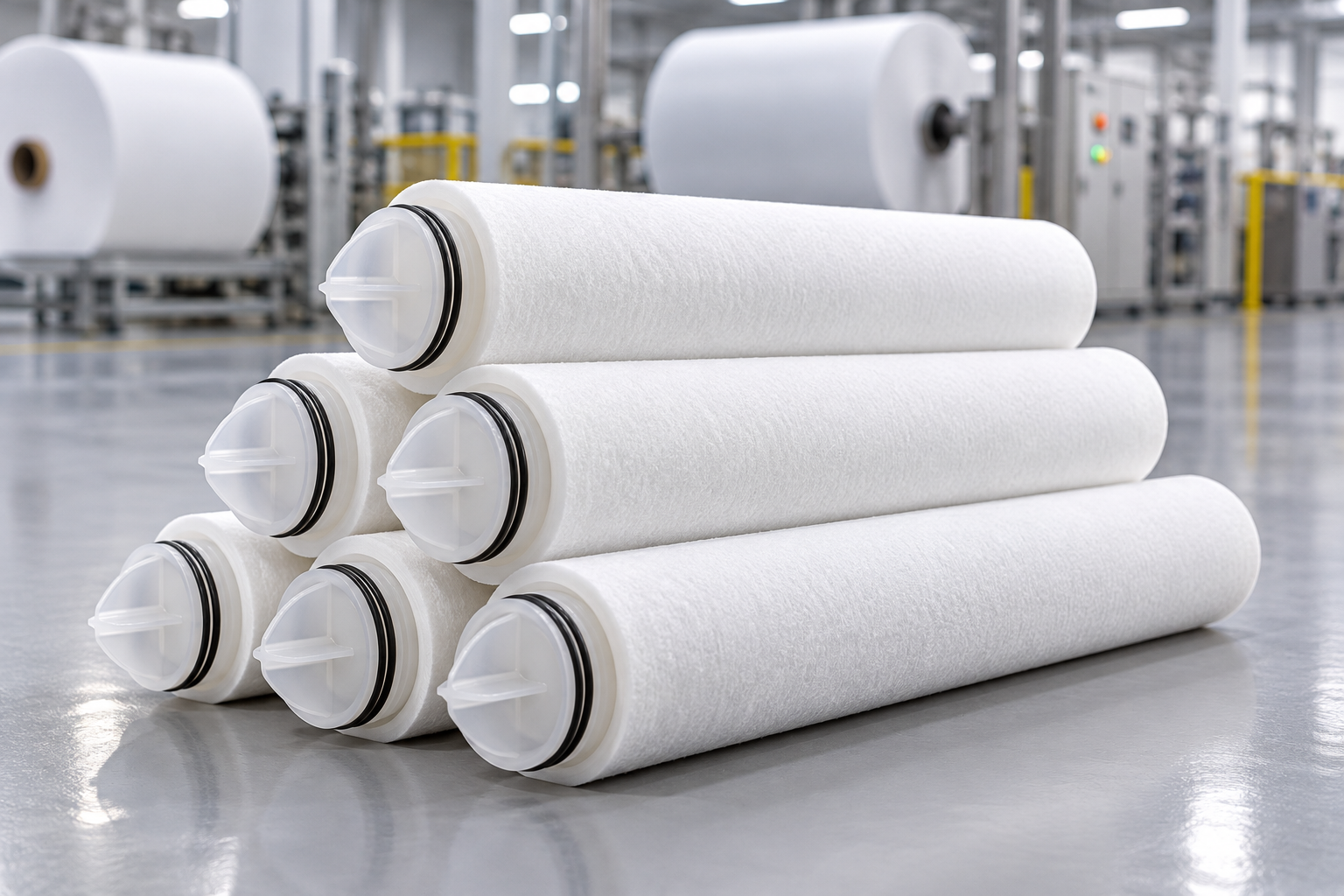
Large-Diameter Depth Filtration for Industrial Pretreatment
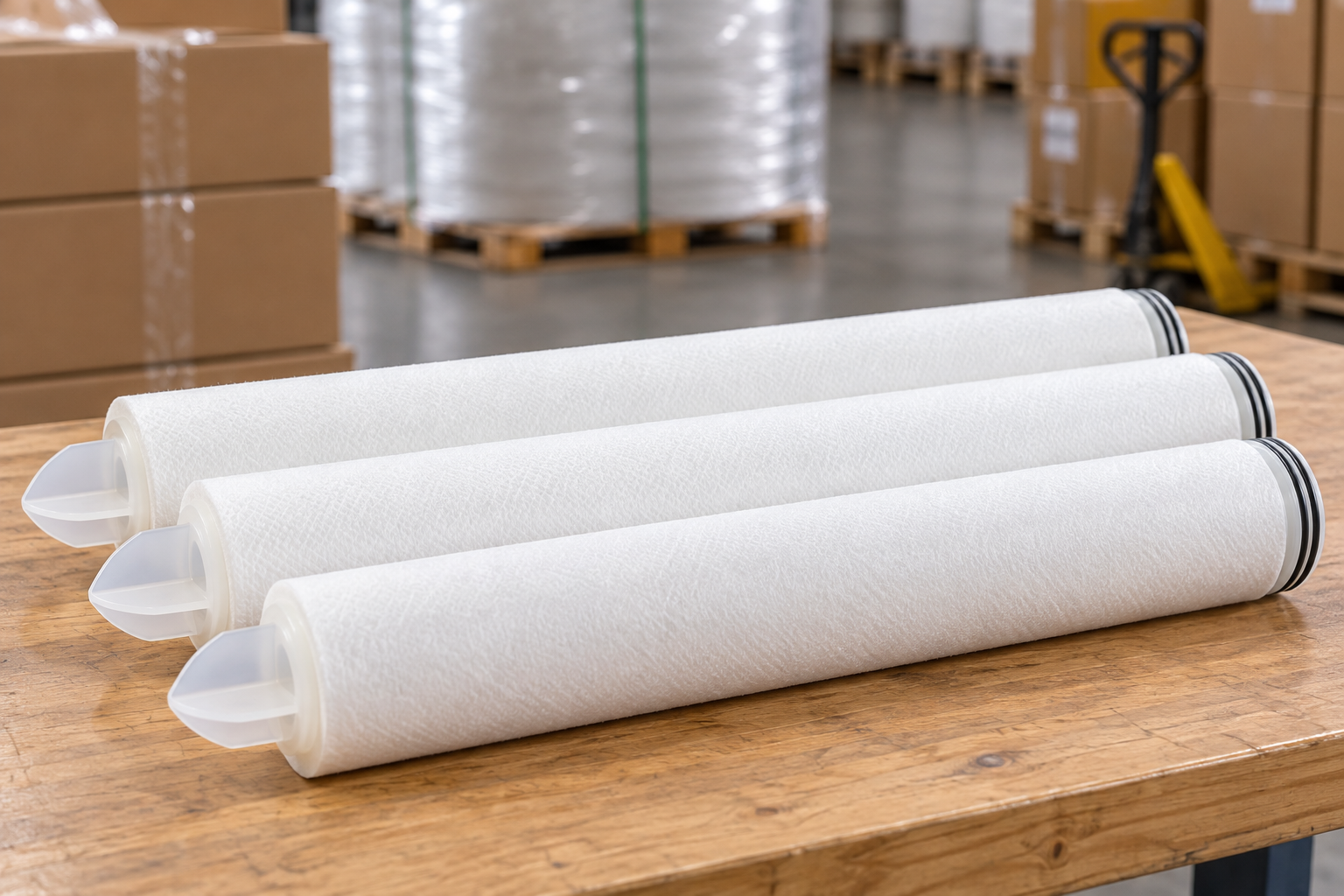
Melt blown filters use thermally formed fiber to filter through a porous structure. In a PP melt blown filter, particle capture occurs through filter media depth, as compared to a standard melt blown filter, in which particle capture occurs at a single, flat surface.
Verified PP Series melt blown cartridge configuration
Media
PP
End cap / core
PP
Max temp
65°C
Max diff. pressure
2.0 bar at 20°C
Diameter
OD 63 mm or 115 mm; ID 28 mm
Length
9.75 in up to 40 in
Removal rating
1 to 100 μm
Construction
Fused without chemical glues; three-layer, loose outside and tight inside structure
Naming boundary
The 115 mm option supports large-diameter positioning; “Jumbo” is a market descriptor, not the official PP Series name in the supplied sheet.
What the format does, and does not prove
- A large diameter format can provide a different media volume and housing arrangement than a standard slim cartridge.
- A micron rating alone does not prove filtration efficiency, high retention, dirt-holding capacity, or service life.
- Physical fit does not prove hydraulic, chemical, seal, or performance equivalence.
- A sediment cartridge does not establish removal of contaminants or microbial hazards.
Health Canada identifies source-water quality, filtration rate, pretreatment, filter media, run length, temperature, and integrity as variables that affect filtration results.1 This is why ECOFILTRONE™ treats a jumbo filter cartridge as a configuration to verify, not a universal answer for every water system.
Inputs Needed to Review a Jumbo Melt Blown Configuration
Configuration Review Inputs make the trade-off visible: a dimensional match is not a substitute for evidence about loaded pressure loss, retention, integrity, or fluid contact. Guidance from Health Canada and the test outputs described by ISO 16889 show why these variables are not interchangeable.
01
Fluid and contaminant
- Liquid identity, pH, viscosity, and chemical composition
- Suspended solids or turbidity information
- Particle-size distribution and target particulate control
02
Hydraulic conditions
- Normal, minimum, and maximum flow rates
- Initial and terminal differential pressure
- Operating temperature, pressure, and water-hammer exposure
03
Housing interface
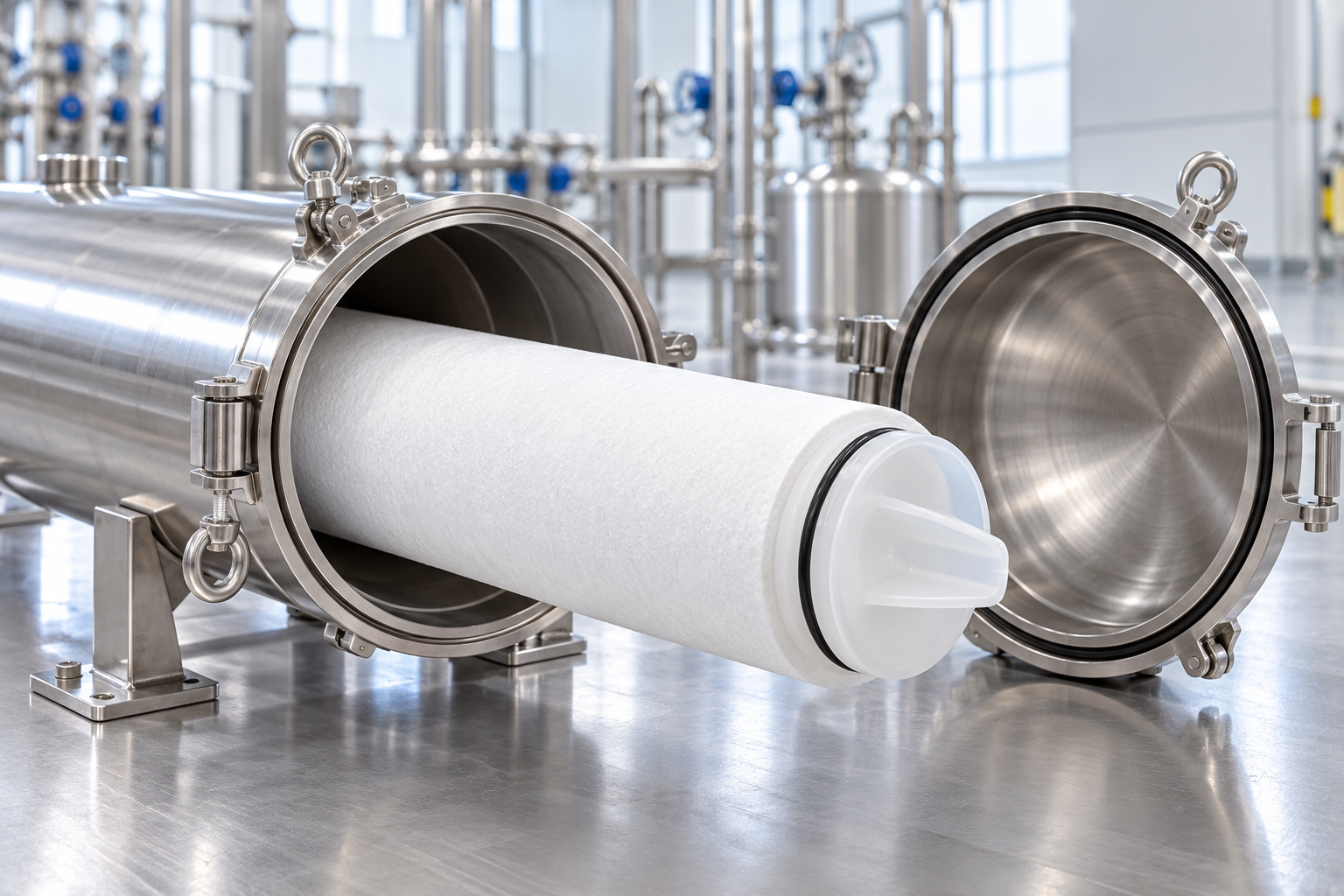
- Outer and inner diameter, overall length, and seating depth
- DOE or SOE end configuration, core, gasket, and seal material
- Flow direction, support arrangement, and housing reference
Engineering note: A smaller pore size is not automatically the better selection. If it adds restriction without solving the actual particle-control task, the cartridge may reach the change-out condition sooner.
Next step
Send these inputs with your current cartridge reference. We will flag missing data before a configuration is quoted.
Send Configuration InputsMelt Blown vs. Pleated and String Wound Jumbo Cartridges
The correct comparison is not “jumbo vs. standard” in isolation. The correct comparison is the selected cartridge, housing, contaminant, liquid, rate, and the operating limits considered as a single filtration system; ISO 16889 illustrates why removal, capacity, and differential-pressure outputs must be reported separately.
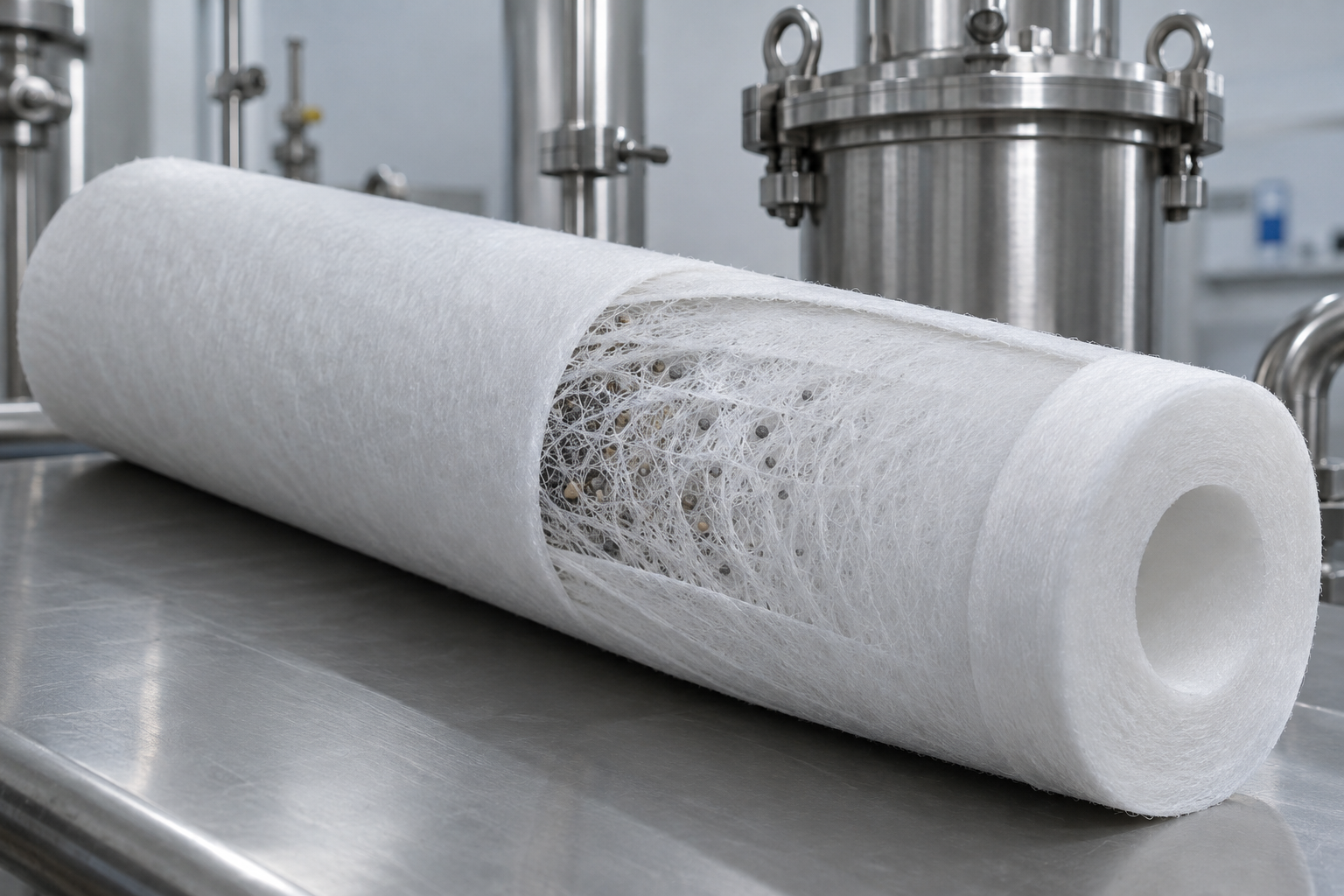
Melt-blown depth filter
- Construction Thermally formed polypropylene fiber; a gradient density design may be offered by a selected model
- Decision focus Particulate loading through media depth and an economical disposable format
- Verification needed Rating basis, efficiency, capacity, pressure loss, dimensions, and chemical compatibility
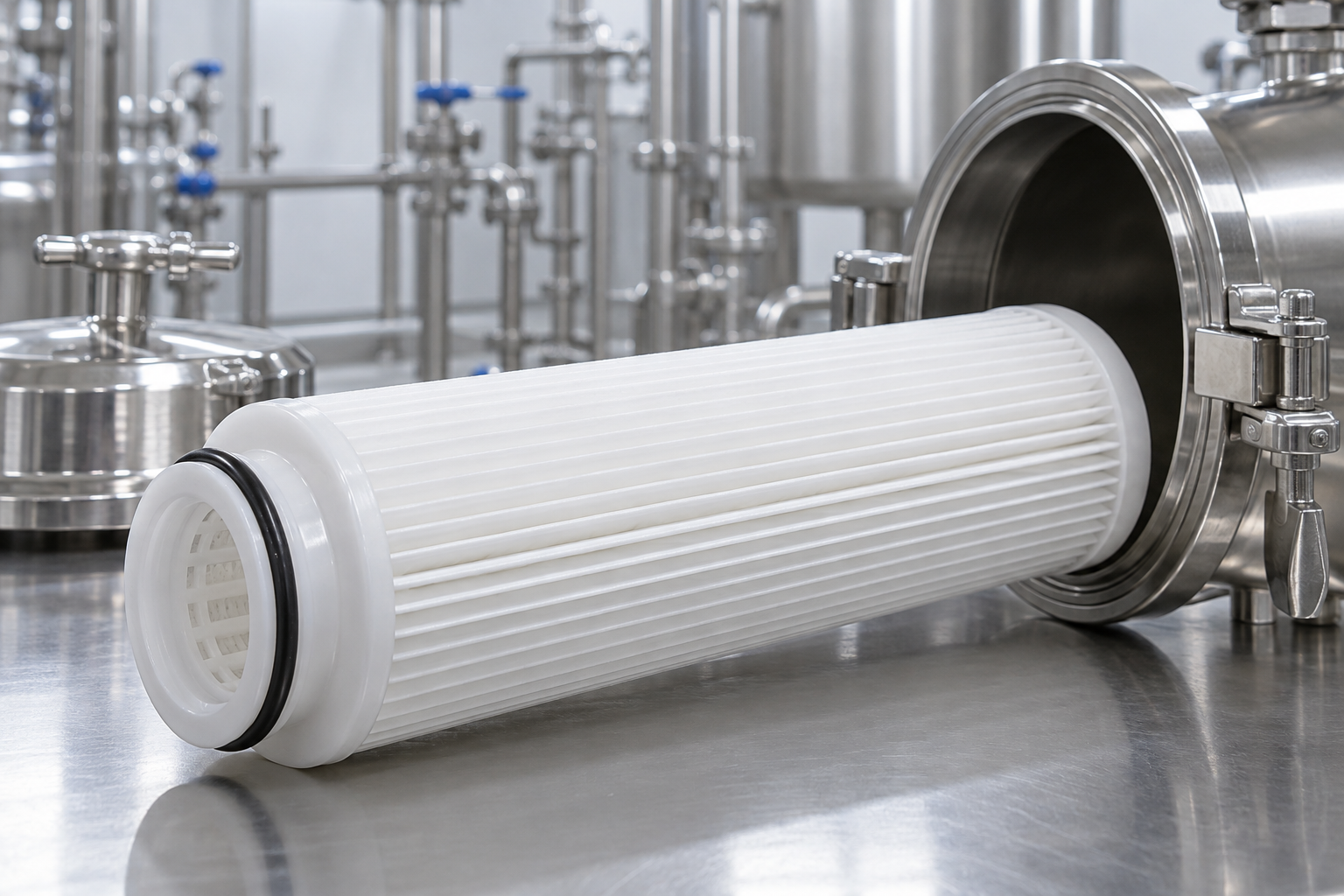
Pleated cartridge
- Construction Pleated filter media with increased effective area
- Decision focus Surface area, cleanability where applicable, and defined retention performance
- Verification needed Media grade, pleat support, integrity, differential pressure, and seal interface
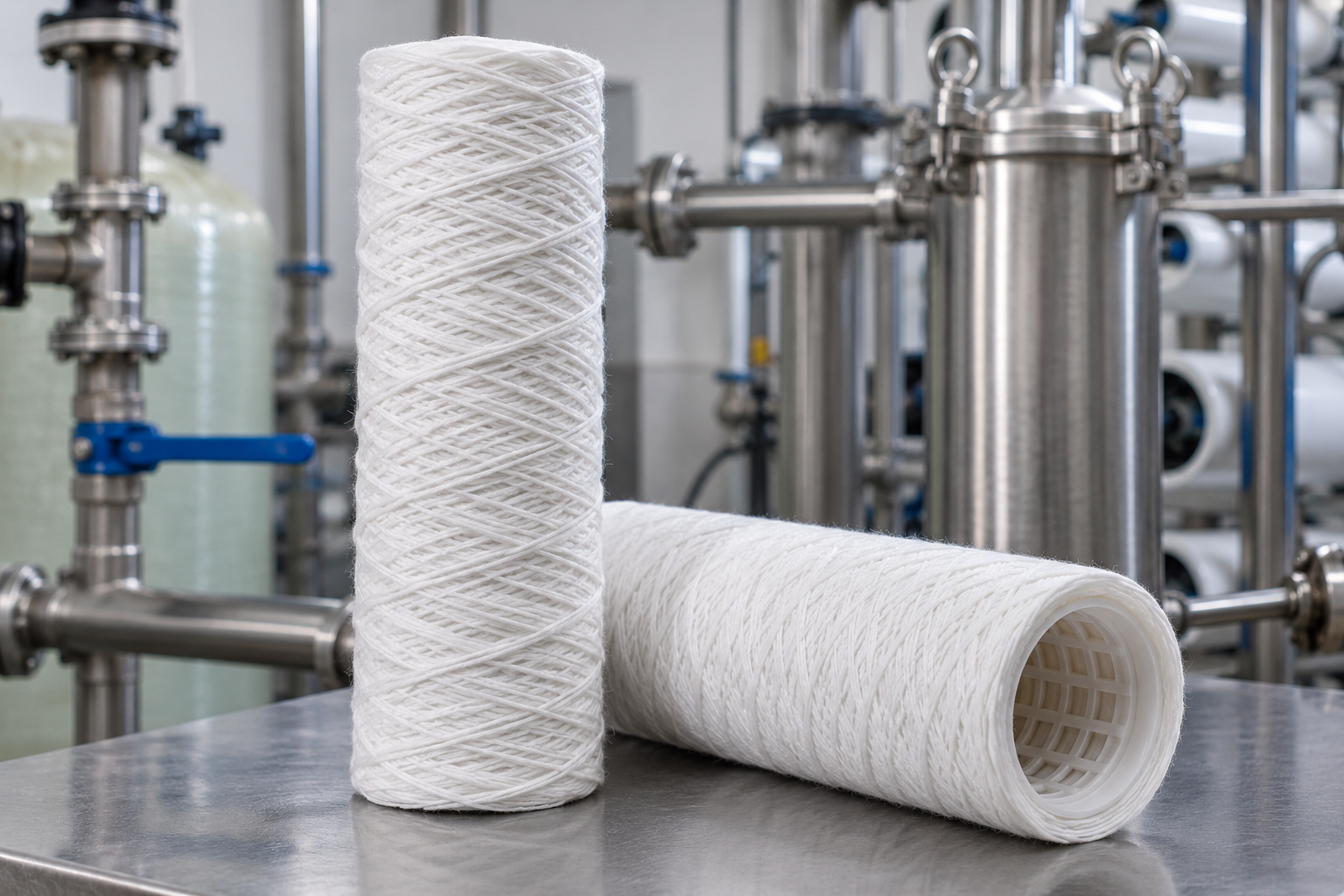
String wound depth filter
- Construction Yarn wound around a supporting core
- Decision focus Layered depth structure and fluid compatibility
- Verification needed Fiber/core materials, density, extractables, rating basis, and collapse resistance
Comparison outcome
ECOFILTRONE™ can compare melt blown, pleated, and string wound options against the same submitted duty. Ask for a media-format review instead of choosing from a label alone, or compare the adjacent string wound depth filter options before submitting the duty data.
Configuration and Compatibility Checklist
The risk is an apparently compatible cartridge that fails the actual duty because one interface or operating variable was missed. ECOFILTRONE™ reviews the complete input set, while ISO 16889:2022 is referenced only to show that capacity, removal and differential pressure are separate measured characteristics.
SYS_DATA // VERIFIED
What to submit
Requested PP grade, core, end components, and seal
Why it matters
Media compatibility does not automatically qualify the mounting seal.
What to submit
Micron value plus nominal or absolute basis and required efficiency
Why it matters
Equal micron labels may not represent equal retention efficiency.
What to submit
OD, ID, length, seating depth, and tolerances
Why it matters
“Big Blue” or 4.5-inch language is not enough to confirm fit.
What to submit
Flow, viscosity, clean pressure loss, and terminal differential pressure
Why it matters
Low pressure at startup does not predict loaded performance.
What to submit
Collapse requirement, end bond, bypass control, and test request
Why it matters
Dimensional compatibility does not prove operational equivalence.
What to submit
Contact application, market, document type, and certificate holder
Why it matters
FDA, CFR, food-contact, drinking-water, or pharmaceutical status must be configuration-specific.
Industries We Support
ECOFILTRONE™ offers chemical and metal recovery from industrial wastewater and process water, seawater reverse osmosis and ultrafiltration membrane pretreatment, desalination, wastewater treatment and reuse, power generation, oil and gas, petrochemical and chemical processing, food and beverage, pharmaceutical and life sciences, and electronics/high purity water.
Water and membrane pretreatment
Use the review to define suspended particulate control ahead of a membrane or process stage. A prefilter may reduce the particulate burden.
Chemical processing
Submit chemical composition, concentration, temperature, and seal requirements. Compatibility is not a substitute for a fluid-specific review.
Regulated contact applications
Identify the product-contact, sanitation, extractables, leachables, and document requirements. Suitability is confirmed only for the selected grade.
CFG.
Replacement Matching and Custom Configuration
For a Jumbo Spun Filter or Big Blue Enquiry
Include the exact housing model and installed element dimensions. Terms such as jumbo spun filter, water filter cartridge, Big Blue, and PP describe a market category; they do not uniquely identify a compatible part, as this end-cap compatibility guide illustrates for DOE and SOE configurations.
SYS.SEQ // 01
01
Review
We examine the application, installed housing, current element, and reason for replacement.
SYS.SEQ // 02
02
Verify
We compare material, size, end configuration, micron basis, fluid, and operating limits.
SYS.SEQ // 03
03
Confirm
We provide relevant datasheets or drawings and identify which fields require configuration-specific confirmation.
SYS.SEQ // 04
04
Trial
Sample or trial support can be discussed when the operating risk warrants an evaluation before routine supply.
SYS.SEQ // 05
05
Follow up
We review differential-pressure trends, observed filter life, compatibility, and troubleshooting feedback.
Quality Documentation Without Overclaiming
ECOFILTRONE™ can provide company registration documents and ISO 9001 quality-management-system information subject to the actual certificate holder. Technical data, material statements, inspection records, and compliance files are reviewed against the selected product and application requirement.
SYS_REQ // DOCS
Document request checklist
A phrase such as “177.1520 compliant polypropylene” or “FDA grade” is not applied across the range without configuration-specific evidence.
- Datasheet and dimensional drawing
- Material declaration or certificate where available
- Inspection scope and filtration-performance evidence requested
- Applicable food-contact, CFR, or other market requirement
- Packaging, labeling, traceability, and shipping documents
DATA ANALYSIS
Change-Out Decisions Need Operating Data
Change-Out Trend Log
According to Health Canada guidance, filter performance depends on operating factors; service life here depends on contaminant loading rate, fluid, flow, pore structure, effective area, and the terminal differential-pressure rule. ECOFILTRONE™ does not have a universal service life, or high dirt holding capacity for an unverified model.
Record clean-system pressure and flow after installation.
Measure upstream and downstream pressure at consistent flow conditions.
Record differential pressure, operating hours, and relevant feed changes.
Use the housing and process limit, not a generic calendar, to set the approved change-out point.
This log helps identify cartridge loading versus pump changes, valve position, viscosity, instrumentation error, and/or bypass of the housing. It also helps determine the next configuration review’s basis.
RULE 01
A lower micron number is not always a better process choice.
RULE 02
A larger diameter is not necessarily evidence of longer service life.
RULE 03
A physical fit is not always proof of filtration equivalence.
Ordering and RFQ Checklist
We examine each submitted field to determine where a drawing, sample, material record, efficiency test, or operating limit is still required. The checklist is usually not adequate on its own, but it prevents a quotation from being based on a photograph or trade name.
01
Process
Industry, filtration stage, upstream treatment, downstream equipment
02
Fluid
Composition, pH, viscosity, temperature, and chemical compatibility concern
03
Contaminant
Sediment description, turbidity or solids data, particle range, target retention
04
Operating data
Flow, pressure, differential pressure, batch/continuous duty, change-out history
05
Hardware
Housing model, cartridge diameter/length/ID, end style, core, seal, photographs
06
Commercial
Quantity, delivery destination, labeling, packaging, documentation, trial need
Jumbo Melt Blown Engineering Tools
RFQ Builder
Configuration & Quote
Compatibility Checklist
Interface Validation
Differential Pressure Log
Trend Tracking
FAQ: Frequently Asked Questions
No. Confirm diameter, housing design, end configuration, and hydraulic limits against the installed system; this end-cap design guide shows why cartridge configuration matters.
Not automatically. Rating basis and allowable differential pressure determine usefulness.
The wide range of liquid filtration applications for polypropylene includes some alkali and chemical processing duties, but the complete cartridge and seal require fluid-specific confirmation.
We can review an original reference, sample, drawing, or housing data for replacement matching. The result is a proposed configuration, not a claim of affiliation or universal interchangeability.
Compliance is not assumed across a product category. State the regulation, contact conditions, required evidence, and market so the relevant material and finished configuration can be checked.
Possible causes include unexpected particulate load, a grade that is too fine, flow or viscosity changes, poor pretreatment, uneven distribution, seating problems, or a mismatched density depth structure.