Get in touch with ECOFILTRONE™ Company


Custom and OEM Filter Cartridges: 6 Gates From Requirements to Repeat Orders

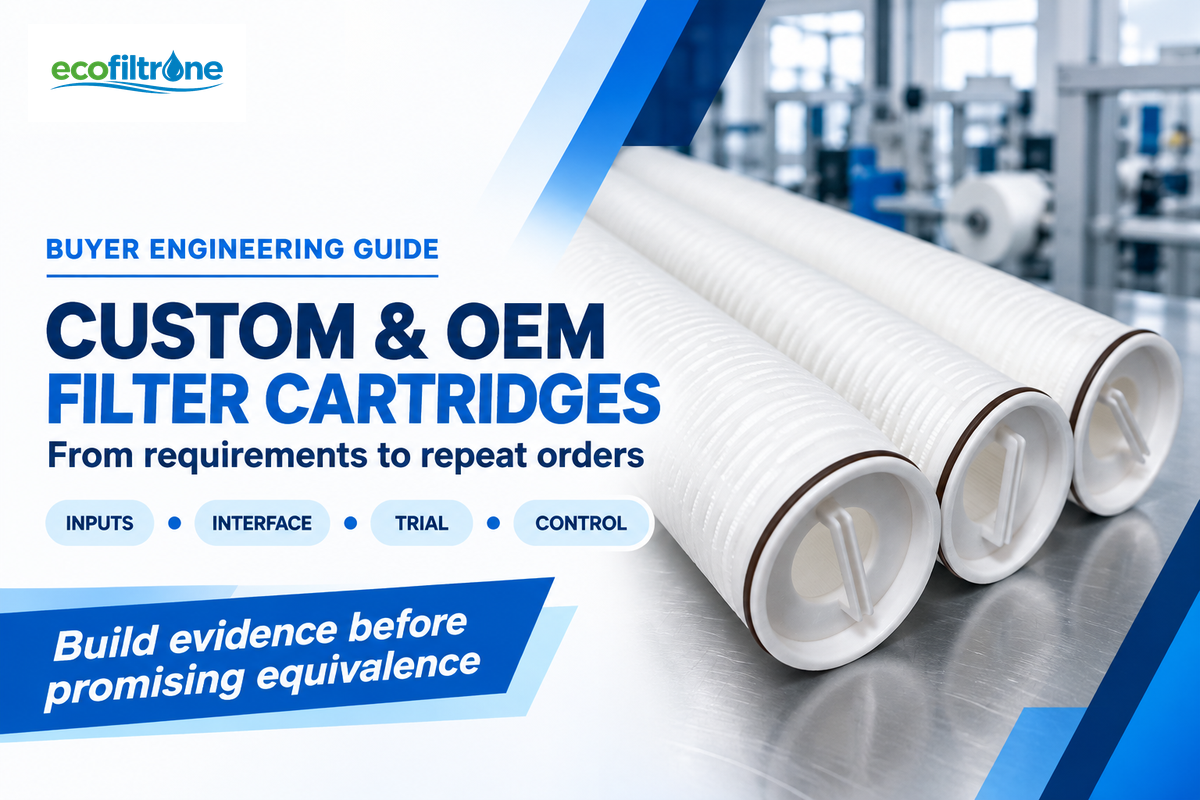
A guide to engineering and procurement · Custom filtration · OEM supply
Custom and OEM Filter Cartridges should begin with a controlled requirement, not a catalog request. Use a standard cartridge when its documented fit, materials, operating window, and performance evidence cover the requirement. Use replacement matching when an installed element must be reproduced or cross-referenced under controlled evidence. Choose custom engineering only when the requirement set cannot be met by a documented catalogue configuration.
OEM tells who owns or controls a specification, and doesn’t prove uniqueness. Likewise, identical micron labels and nominal dimensions don’t prove interchangeability. It isn’t proper to assume equivalency or performance, until a project connects the application, interface, test basis, approved samples and repeat order controls.
Choose the Right Development Route Before Requesting a Quote
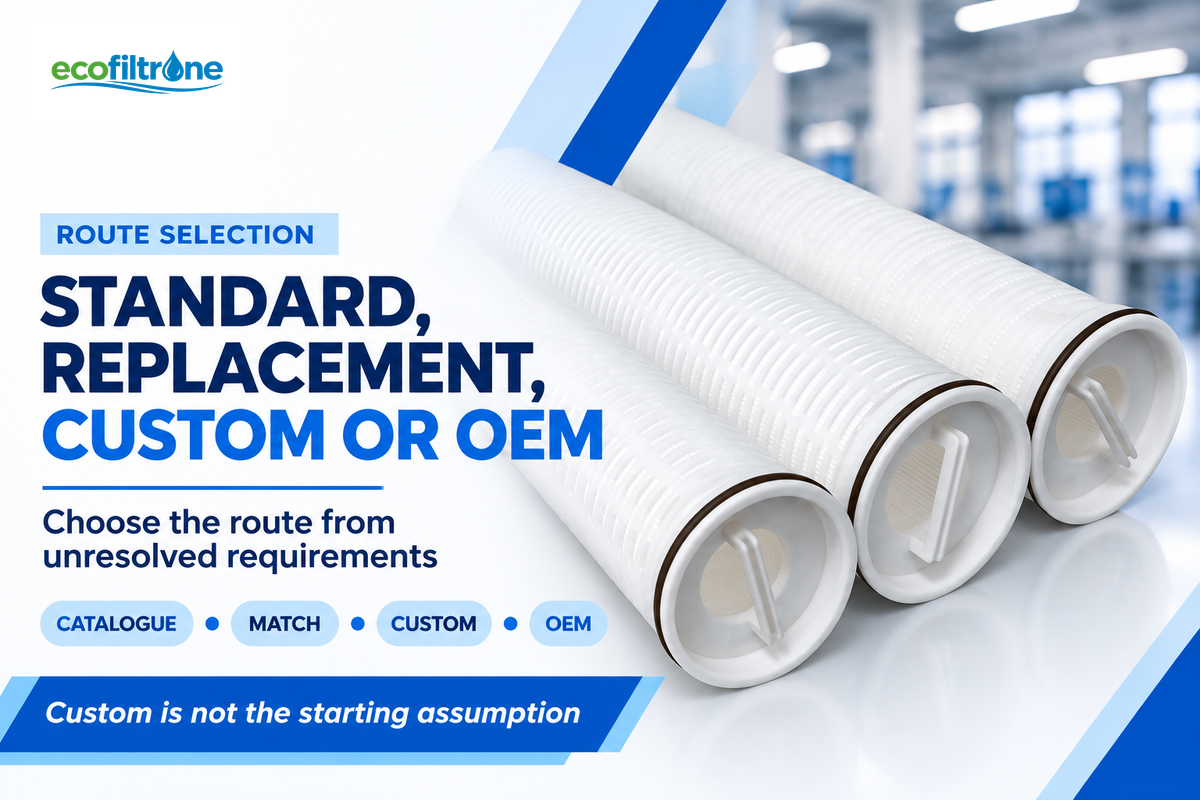
When is a standard cartridge no longer enough?
A standard cartridge is no longer enough when a documented requirement for fit, sealing, chemical compatibility, operating limits, retention evidence, traceability, or commercial control remains unmet. Custom is not the starting assumption; it is the result of a catalogue item or replacement match being ruled out.
| Route | Use it when | Evidence to request | Main risk |
|---|---|---|---|
| Catalogue | A published configuration covers the duty and interface | Current datasheet, material declaration, rating method, drawing | Assuming a catalogue label proves the application result |
| Replacement match | An installed part must be cross-referenced | Controlled drawing, sample identity, housing record, comparison plan | Matching length and micron label while missing the seal or construction |
| Custom design | A controlled technical requirement is outside available configurations | Input pack, feasibility record, prototype plan, approval criteria | Moving unknowns into a costly trial |
| OEM/private label | The buyer controls branding, specification, documentation, or supply terms | Specification ownership, change rules, label and packaging files | Confusing commercial ownership with technical differentiation |
Routes can be combined. Source For example, an OEM filter can use standard internal construction with a buyer controlled pack, or a “Custom” filter can be entirely supplier branded. Record the reason for selecting the route, so procurement can compare routes.
The same logic can be applied to industrial filter cartridges, replacement filters, and other specialized filtration cartridges. It keeps cartridge filtration decisions tied to the requirement rather than treating all filter products equivalently.
Build a Supplier-Ready Cartridge Input Pack
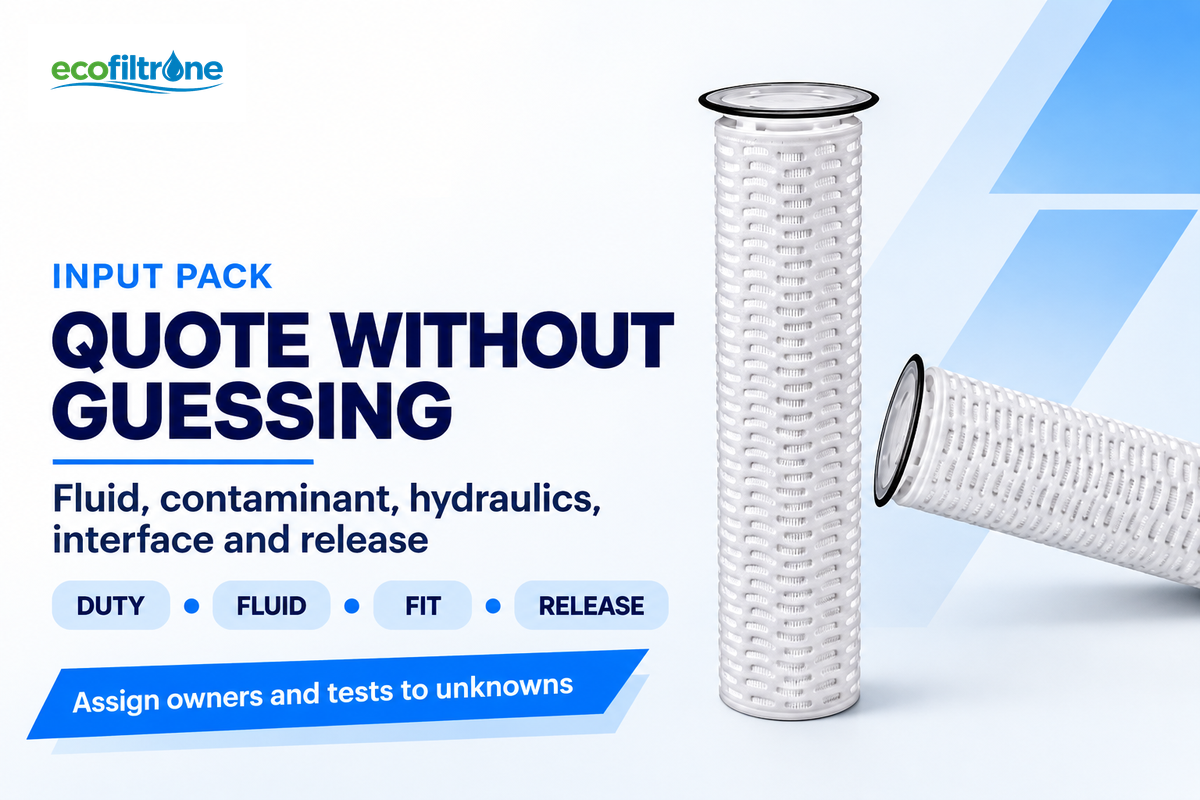
What data should a buyer send before design starts?
Send the filtration duty, fluid composition, contaminant evidence, flow range, temperature, viscosity, allowable pressure differential, housing and seal details, cleaning exposure, required output measure, and commercial constraints. Indicate whether values are measured, specified, estimated or unknown. An unknown is acceptable if there’s an owner and a test plan. Source A guessed value isn’t acceptable.
| Input category | Minimum fields | Evidence source | If unknown |
|---|---|---|---|
| Process duty | What the stage protects; required outlet condition | Process specification or quality plan | Define the decision measure before design |
| Process fluids | Composition, concentration, pH, temperature, cleaning chemicals | Safety data, batch record, laboratory result | Run chemical compatibility review |
| Contaminant | Identity, size distribution, loading, deformability, variability | Particle data, microscopy, operating history | Plan representative sampling |
| Hydraulics | Minimum/normal/maximum flow rate, viscosity, clean and terminal pressure drop | Instrument history and validated system limit | Define a controlled bench or process trial |
| Interface | Length, diameter, end caps, adapter, seals, flow direction, clearance | Drawing, housing record, physical sample | Resolve before prototype release |
| Commercial | Forecast, prototype quantity, lot size, packaging, private label, timing | Procurement forecast | Quote assumptions explicitly |
| System context | Upstream stages, downstream equipment, bypass routes, duty cycle | Filtration system drawing | Map the process boundary |
| Maintenance | Change method, cleaning limits, access, retained records | Maintenance procedure | Define a safe installation trial |
| Release | Approver, decision date, required certificates, deviation path | Quality plan | Assign authority before sampling |
A complete pack allows a supplier to relate particle removal, contaminant removal, and filtration efficiency to the actual liquid filtration solutions under review. For industrial water treatment or water treatment work, identify the targeted contaminant and the manner of measuring it.
Also describe the arrangement of the equipment: a single housing, a multi-cartridge arrangement, a strainer-plus-cartridge train or some other multi-stage configuration. Liquid flows through these arrangements differently, so the proposal must identify the relevant filtration equipment and filter cartridge housings.
Freeze the Interface Without Pretending It Is Independent of the Media
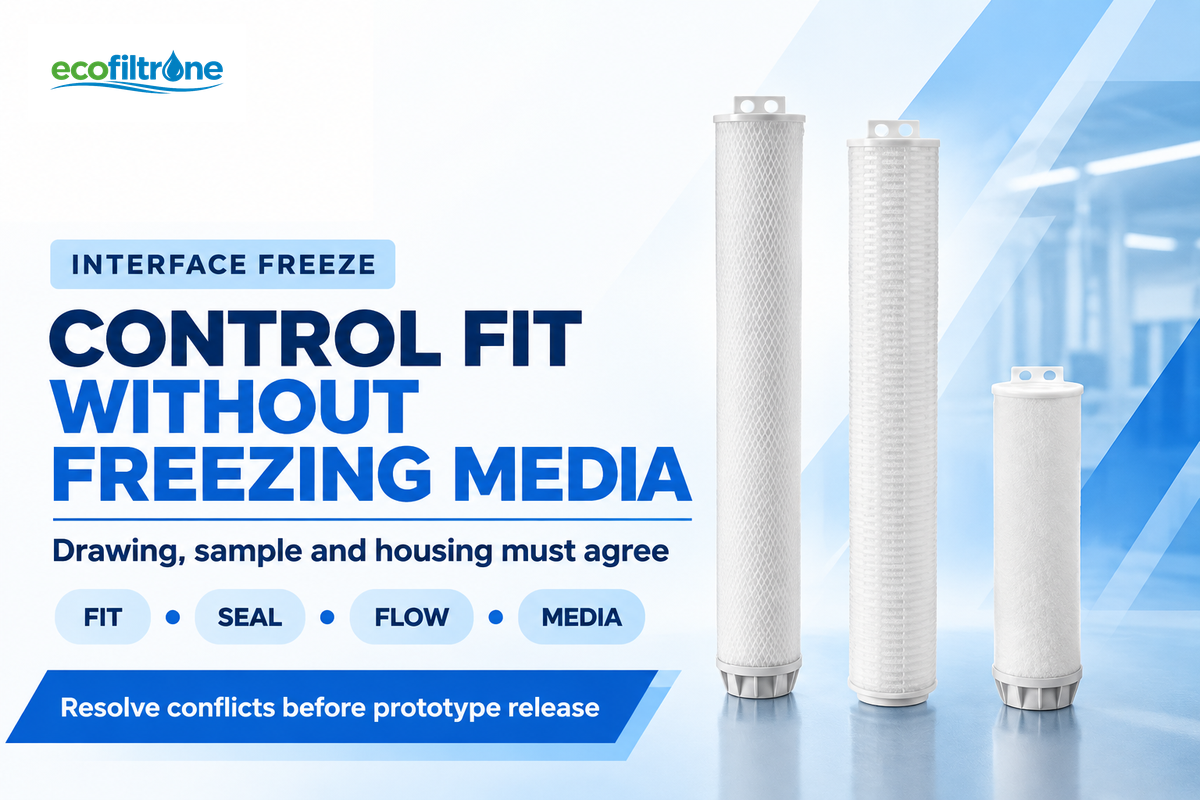
Start by controlling the existing cartridge housing connection: envelope dimensions, end-interface geometry, seal location, support, installation clearance, and intended flow direction. A field account of installed filters failing a test because of filter and housing leakage illustrates why seating and sealing belong in the evidence pack, although it does not establish a universal failure rate. Source 4
Interface Freeze Checklist
- Identify the governing drawing revision and the measured sample.
- Record the manufacturer and model of the housing, the tube-sheet or adaptor, the closure and the quantity installed.
- Define overall length, outside and inside diameter, end-cap type, seal material, groove or knife-edge geometry, and tolerance ownership.
- Photograph orientation, support, compression, and installation clearance.
- Resolve all conflicting information for a legacy part number, drawing, sample, and housing.
Don’t “freeze” the complete design as if geometry, filter media, and validation were unrelated. There’s published research on pleated filters where geometry, material permeability, flow and deformation are interrelated. 5 External fit can be controlled early, but pleat layout, support, useful surface area, and media selection still require an application-feasibility loop.
Indicate use of conventional filter housings or high-flow hardware or low-flow point-of-use assembly. A pressure rating belongs to the complete controlled assembly; it is not created by calling one component an industrial filter.
Compare Proposals With Evidence, Not Matching Labels
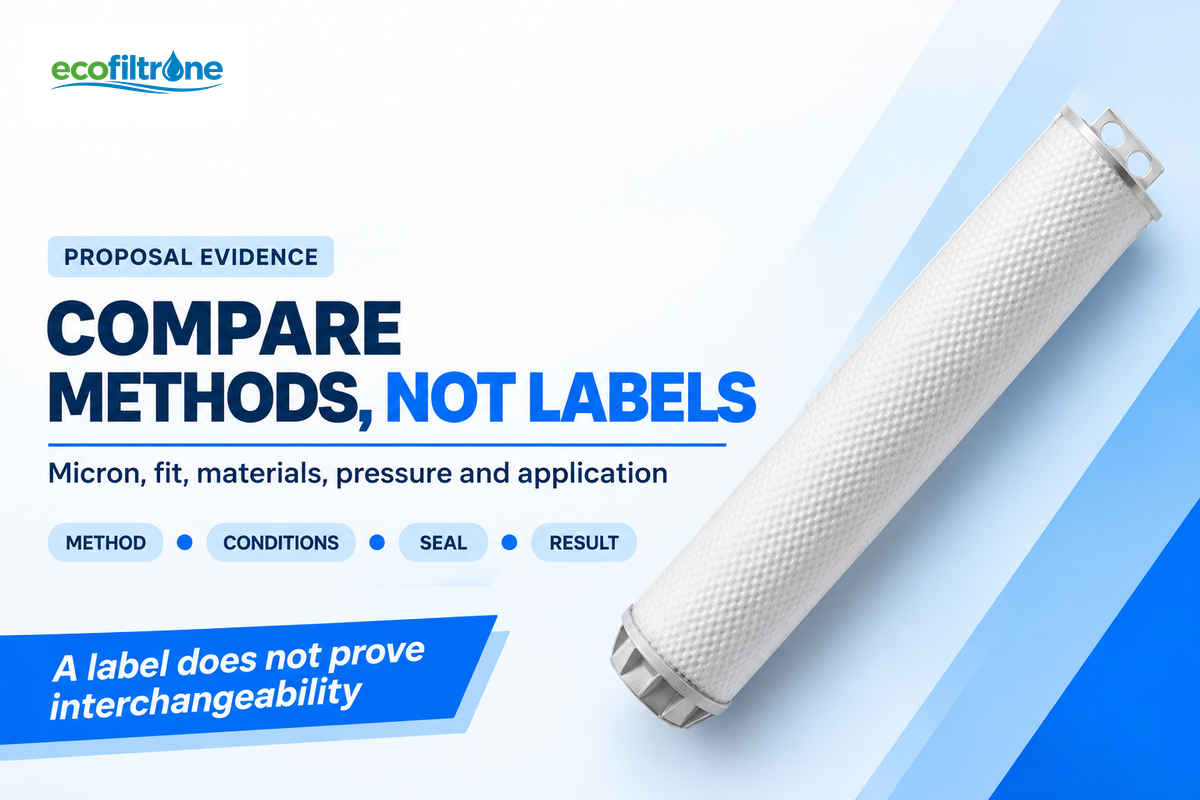
Does the same micron rating make two cartridges interchangeable?
No. A micron rating is incomplete without its convention, challenge contaminant, efficiency, flow, viscosity, and test method. Source Interchangeability also depends on materials, component construction, clean pressure drop, sealing geometry, dimensions, integrity, and the intended application. Analyze the data, not just the numbers on the filter.
ISO 16889, for example, is a multipass method for hydraulic-fluid filter elements; its defined scope is evidence that a stated result belongs to a method and application, not permission to transfer that result to every industrial liquid filtration duty.1 A Parker catalogue likewise reports one cartridge result under identified single-pass conditions, including test dust, water, and flow per cartridge length.2
| Proposal field | Declared only | Method-backed | Sample-backed | Application-validated |
|---|---|---|---|---|
| Fit and seal | Nominal dimensions | Controlled drawing and tolerances | Measured sample in identified housing | Installed fit and leak/bypass check |
| Micron/efficiency | Label | Method, challenge, efficiency curve | Candidate-lot test result | Process-relevant output result |
| Pressure drop | Single clean value | Curve with fluid and conditions | Candidate measurement | Normalized process trend |
| Compatibility | Generic material name | Documented material assessment | Exposure sample | Process-fluid trial and product-quality review |
Use the same scope discipline for certifications. A certification may cover a material, component, management system or a product. What object, revision, test and claim does it cover? Before using it as proposal evidence, evaluate it critically.
Scope discipline must be used in proposal language. “Industrial filtration” or “industrial filtration systems” may cover different industrial applications, from chemical processing to water filtration. Compare exact specifications and conditions before treating industrial liquid filter cartridges as substitutes.
When a supplier proposes cleanable and reusable construction, request documentation showing cleaning and inspection to prove reuse. Where it promises longer service life, require equal-condition evidence rather than inferring life from more surface area or a high flow label.
Turn the Prototype Into a Controlled First Article
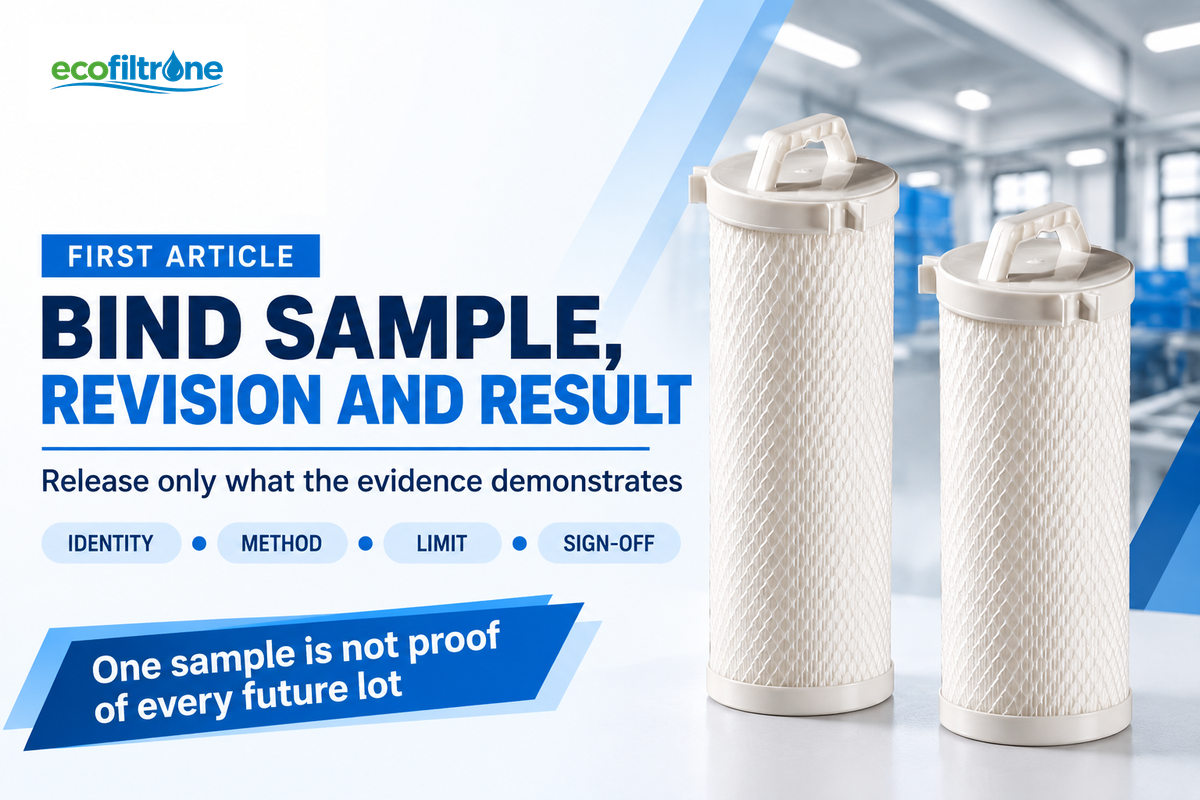
What belongs in first-article acceptance criteria?
Bind the approved drawing and bill-of-material revisions to an identifiable sample and lot. List the test method, conditions, and project specific acceptance criteria. Include raw test results, fit and sealing evaluations, deviations, and name the approval authority. The release must state what can be produced and what the first article doesn’t prove. Source
Identity
Part number, revision, sample ID, lot, media, support, end caps, adhesive or bond, seals, packaging and label.
Method
Test assembly, housing, fluid, challenge, instruments, sample point, flow, temperature, viscosity and duration.
Decision
Project limits, result, deviations, disposition, approver, release scope and retained sample or record.
A first article isn’t proof of what every subsequent lot will be. It proves what the identified sample showed when tested under the conditions recorded. Process controls, change notification, routine inspections, and lot traceability protect the approved state afterward.
Run the Trial Against a Defined Operating Window
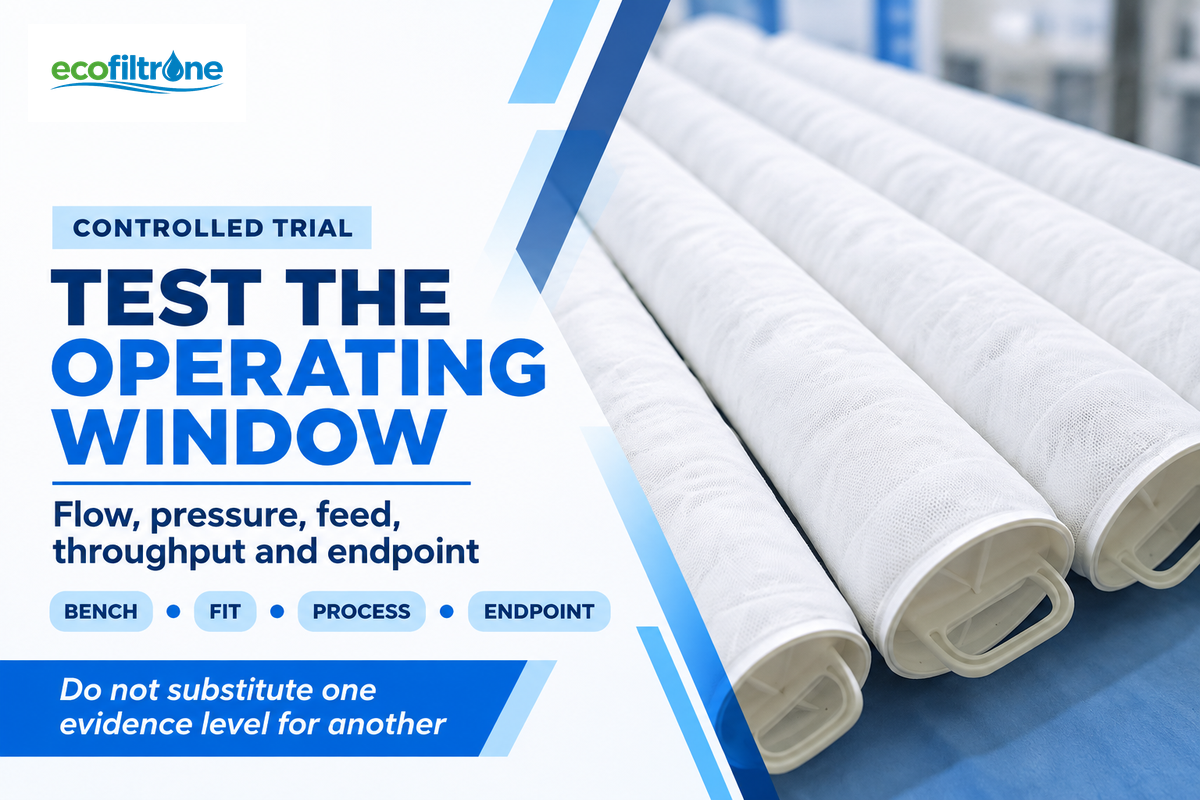
Separate four evidence levels: a supplier datasheet describes a declared configuration; a bench test controls selected variables; a housing-fit check addresses installation; and a process trial observes the cartridge in the intended duty. None should be silently substituted for another. Source
| Level | Can support | Cannot support by itself |
|---|---|---|
| Document review | Materials, dimensions, declared limits, test basis | Actual process performance |
| Bench evidence | Comparison under a controlled challenge | Transfer to a different fluid or loading pattern |
| Housing fit | Installation, compression, seal and bypass observations | Retention or service-life claim |
| Process trial | Result within the recorded operating window | Unlimited extrapolation or unchanged future lots |
Record flow, temperature, viscosity, feed condition, cumulative throughput, upstream and downstream pressure, differential pressure, sample location, output measure, and endpoint. The output measure must be commensurate with the process and risk. Particle retention and adsorption exhaustion, sterile filtration, water purification, and product contact compatibility don’t share a universal endpoint.
A trial for sediment or particulate loading may track pressure and outlet particles, while another filtration application may require a different assay. High-flow and low-flow results can’t be conflated unless the method shows they’re comparable.
In application-specific membrane work, integrity testing can confirm a defined relationship between a filter and its validated process. However, this should not be generalized to every cartridge filter. 3 Where the duty involves activated carbon, dissolved solids, microorganisms, extractables, or a high-purity product, add the corresponding measure instead of assuming a clear sample or stable pressure proves success.
Protect Repeat Orders With a Four-Level Change-Control Ladder
Which supplier changes require buyer approval?
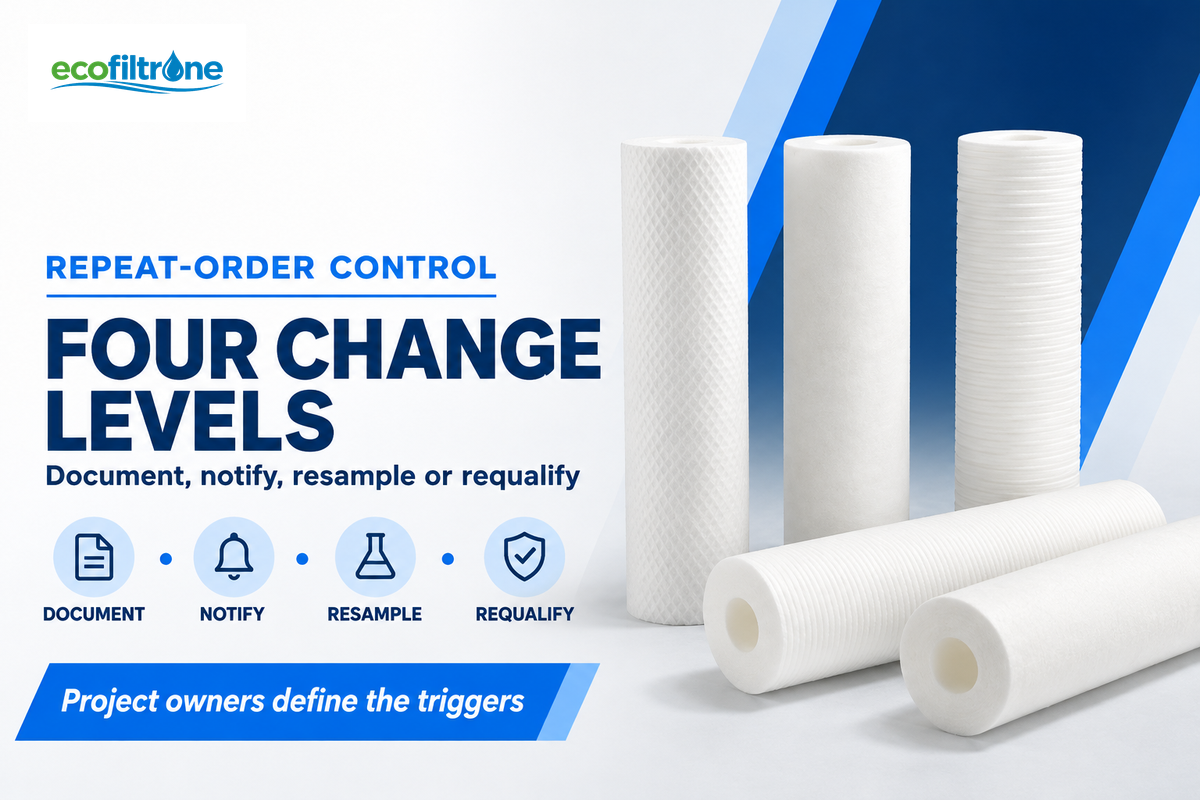
The process of approval is dependent on the governing drawing, quality agreement and purchase requirement. Classify the proposed change by the evidence it could invalidate. Source A simple spelling change may require no action other than correction of the documentation. A spelling correction may need documentation only; a new media source, resin, seal, bond, tooling, process, inspection method, or manufacturing site may require notification, new samples, or requalification.
- Level 1 — document: no product or evidence impact; retain the internal record.
- Notify the buyer when the approved specification is unchanged, but traceability or controlled manufacturing information changes.
- Level 3- Resample. Fit, appearance, material identity, or a verified characteristic could change; submit representative parts and the affected checks.
- Level 4- Requalify. The change could affect compatibility, filtration performance, integrity, pressure behavior, or the approved application result; repeat the relevant validation.
When evidence changes, “same specification” isn’t sufficient. The supplier should link the change notice to the related part numbers, lots, dates, previous and new states, risk assessment, justifying data and the planned first shipment.
Use a Buyer-Supplier Responsibility and Evidence Map
| Decision | Buyer owner | Supplier owner | Release evidence |
|---|---|---|---|
| Application requirement | Process engineering/operations | Challenges gaps and feasibility | Approved input pack |
| Materials and construction | Defines restrictions and required claims | Proposes controlled bill of materials | Drawing, material list, compatibility disposition |
| Test method and limit | Quality defines the decision need | Provides method capability and results | Approved protocol and raw result |
| Deviation | Accepts, rejects, or limits use | Documents cause and containment | Signed deviation record |
| Routine lot release | Procurement enforces purchase controls | Manufactures, inspects, and traces | Agreed lot documents |
Names must still be associated with shared responsibility. The buyer has control over the application and release decision. The supplier is responsible for the truthful construction, manufacturing control and providing evidence. Both have to resolve assumptions before they become production facts. Source
Send an RFQ Package That Can Be Quoted Without Guessing
Attach the input sheet, interface drawing and sample reference, latest cartridge information, prototype quantity, forecast, decision schedule, acceptance plan, packaging and private label files, required repeat order records and request the liquid filter manufacturer to provide proposed construction, departures, open questions, evidence plan, sample timing, tooling or qualification costs and price assumptions.
Do not force competitive pricing by hiding uncertainty. A low unit price is not comparable when one proposal includes new tooling, testing, or controlled documentation and another assumes an off-the-shelf replacement. Normalize scope before comparing wholesale pricing; scoped work should be compared at the unit level.
Custom filter manufacturing proposals should also state whether the supplier specializes in custom filter design or is adapting an existing platform. This affects tooling, evidence and lead time and the scope of the liquid filtration proposal. Source
Decision Framework: Six Gates From Need to Repeat Order
| Gate | Required evidence | Stop condition |
|---|---|---|
| 1. Route | Cartridge Development Route Matrix | No documented reason for the custom or OEM route |
| 2. Inputs | Supplier-Ready Input Pack | Critical unknowns have no owner or test |
| 3. Interface | Approved drawing/sample/housing record | Fit, seal, or governing-source conflict remains |
| 4. Proposal | Evidence-Weighted Scorecard | Claims cannot be compared by method and conditions |
| 5. First article | Acceptance Pack | Revision, raw result, deviation, or sign-off is missing |
| 6. Repeat order | Change-Control Ladder and lot traceability | An evidence-impacting change lacks disposition |
Frequently Asked Questions
What is the difference between a custom filter cartridge and an OEM filter cartridge?
A Custom cartridge is designed or modified because of a specific application requirement that can’t be satisfied by an off-the-shelf configuration. An OEM cartridge is supplied to an equipment maker or against that maker’s controlled specification. OEM status doesn’t guarantee a unique design or better filtration performance.
Should a buyer send a drawing or a physical sample?
Send both when possible. A drawing shows controlled dimensions and tolerances, while a sample provides construction or interface details not shown on the drawing. If there’s a contradiction, state which takes precedence, and name the housing used for fit verification.
What records should accompany repeat orders?
Require the current revision, lot identity, agreed inspection or test results, approved deviations, and change notification. Add certificates only if scope supports an application or purchase requirement.
Can ECOFILTRONE match an existing cartridge?
ECOFILTRONE can evaluate a part number, drawing, physical sample, housing details, process conditions and evidence requirement to determine a feasible route. A visual or dimensional match doesn’t guarantee equivalence; all missing inputs and validation steps must be identified prior to release.
Start With the Evidence Pack
Send input packs, drawings or samples, and request approval, provide prototype and forecast volumes, on the ECOFILTRONE™ custom and OEM filter cartridge page. Feasibility and evidence scope should be reviewed before performance or interchangeability is promised.
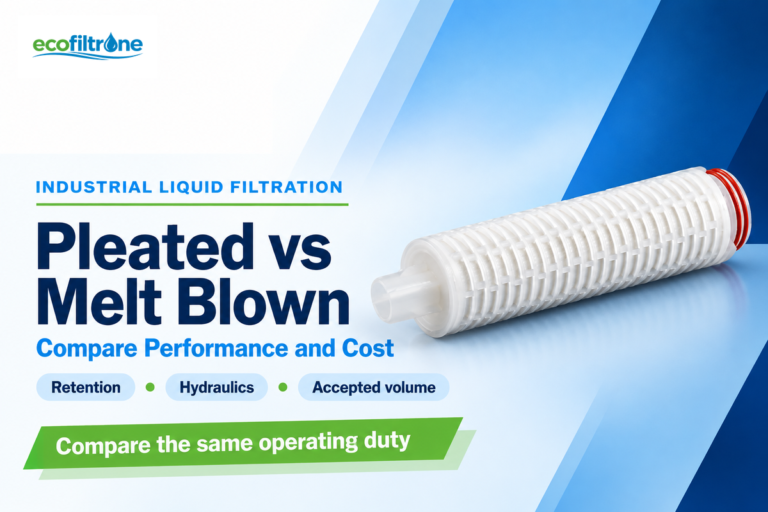
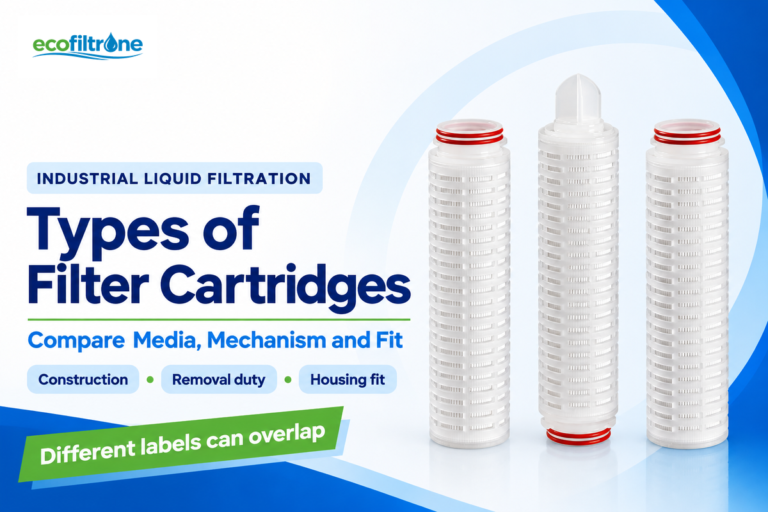
Related selection background is available in the filter micron rating guide, PP pleated filter cartridge guide, and melt blown cartridge range.
For manufacturing background, see About ECOFILTRONE™.
References & Sources
- ISO 16889: Hydraulic fluid power filters, Multipass method for evaluating filtration performance.
- Parker Industrial Process Filtration catalogue: product-specific test conditions.
- Critical Process Filtration: in-process filter integrity testing.
- Eng-Tips field discussion: filter and housing seal failure identified after installation testing.
- Forschungszentrum Jülich record: flow through commercial pleated membrane filter cartridges.
- U.S. Federal Register: application-specific cartridge-filter challenge-test provisions.
- U.S. National Institute of Standards and Technology: acceptance sampling and lot disposition.
Filtration selection brief
Bring the operating details that shape the next conversation
Record what is known from the line or process. A complete specification is not required to start.
Useful inputs
- Fluid and processFluid name, process stage, and any compatibility concern.
- Filtration targetRequired result, existing rating, or the issue to solve.
- Flow and run timeTypical flow range, batch size, or expected service interval.
- Installation conditionsHousing or connection details, temperature, pressure, and available space.
Next step
Send the details you have
Use the inquiry form to start a focused discussion and add drawings or photos when they help explain the installation.
Start an inquiry