Get in touch with ECOFILTRONE™ Company



Updated November 2026
Tangential flow filtration (TFF) is a type of membrane process in which the feed flows parallel to the membrane instead of straight into it. Some of the liquid passes through as permeate, and the rest, along with the retained material, is swept along and recirculated. This process is utilized in labs and biopharmaceutical plants to concentrate proteins and replace buffers.
Dead-end filtration performs a different function. TFF supports concentration and diafiltration of retained products, whereas a membrane filter cartridge removes particles from a low-solids liquid. Each of these modes can produce a useful permeate. Many sterile processes run both in series, as a TFF loop can concentrate a batch without sterilizing it.
Quick Specs: Tangential Flow Filtration
| Also called | Cross-flow or crossflow filtration |
| Flow path | Along the membrane surface, recirculating or single-pass |
| Streams out | Permeate and retentate |
| Driving force | Transmembrane pressure (TMP) |
| Main jobs | Concentration, diafiltration, cell harvest |
| Sterilizes the product? | No |
Tangential flow filtration moves the feed across a membrane rather than into it. Pressure pushes solvent and small molecules through as permeate, while larger molecules remain in the retentate. A 30 kDa membrane for a 150 kDa antibody is a common example.
What Is Tangential Flow Filtration?
TFF stands for tangential flow filtration, a size-based membrane separation used to purify and concentrate a biomolecule or any other liquid product. The name describes the flow: most of the feed travels tangentially across the filter surface rather than into it, which washes away much of the cake that would blind a dead-end filter.
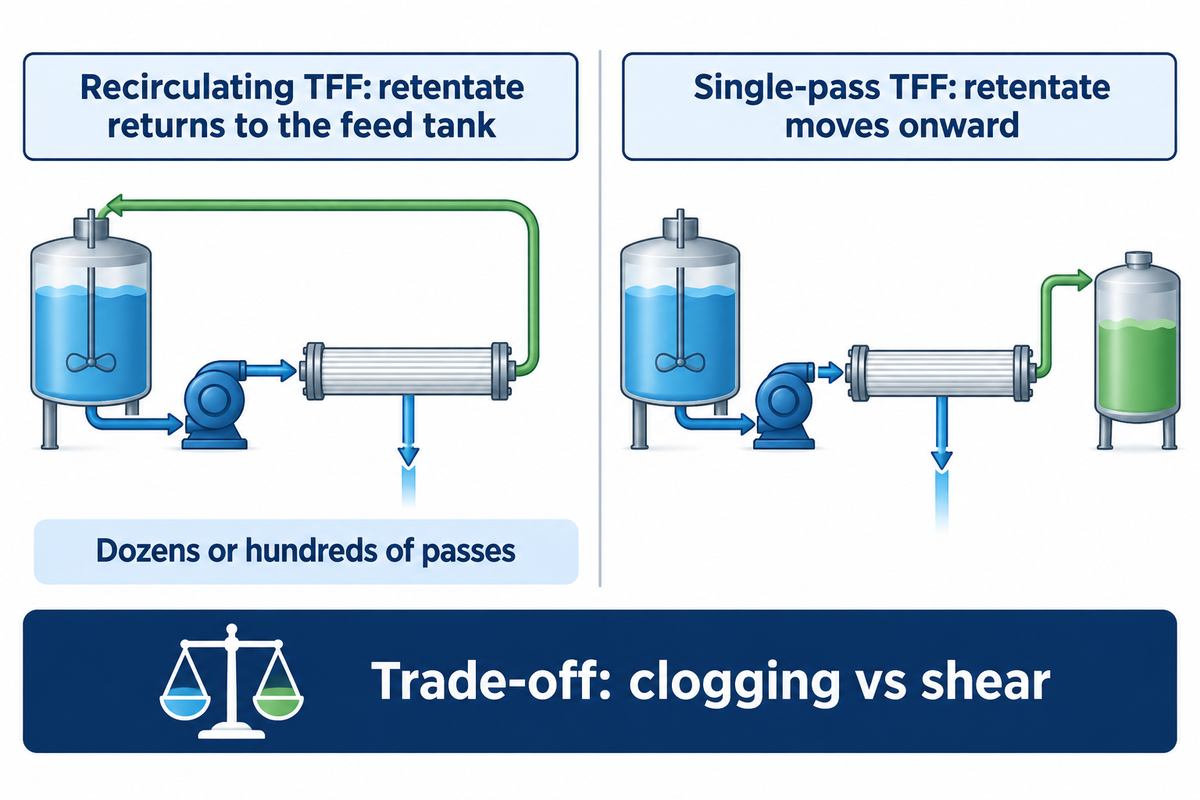
In recirculating TFF, retentate is returned to the feed tank for another pass. Single-pass TFF sends retentate onward without returning it to the tank. A conventional recirculating step uses dozens or hundreds of passes. Repeated pump passes expose molecules such as proteins to shear, so there’s a trade-off between clogging and shear in TFF. That trade-off influences TFF equipment choice in bioprocessing.
Is Cross Flow Filtration the Same as Tangential Flow Filtration?
Yes. Cross-flow filtration and tangential flow filtration describe the same operating mode with feed moving along the membrane and pressure driving permeate through it. Protein purification usually uses the term TFF. In water and food processing plants, cross flow or crossflow is the more common name, and reverse osmosis also uses this flow arrangement.
“Tangential” means parallel to a surface. The description of tangential flow as a 90 degree angle has the geometry reversed since 90 degrees to the membrane is dead-end flow.
How TFF Works: Flux, Transmembrane Pressure and Crossflow
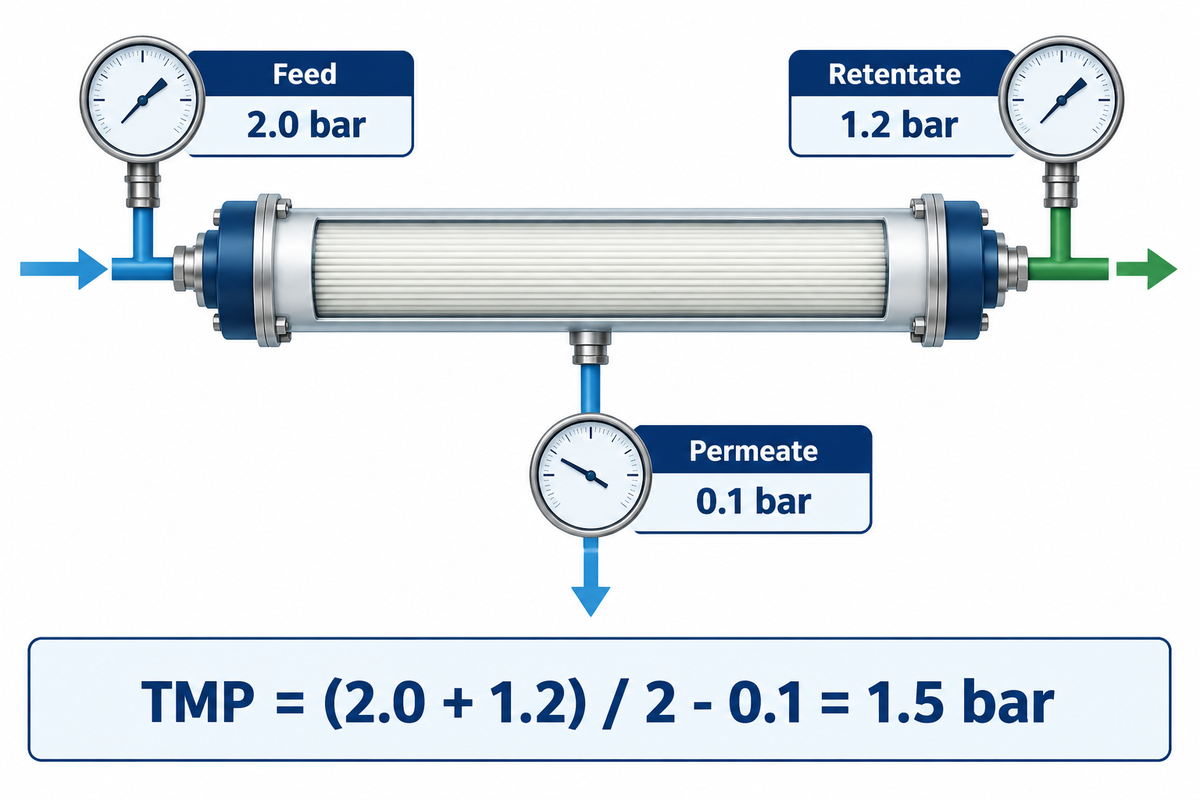
A pump drives feed along the membrane and transmembrane pressure pushes liquid through it. The two main controls in TFF processes are crossflow and TMP. Crossflow sweeps retained material off the surface, TMP sets the push, and the result is reported by flux in liters per square meter per hour.
There are three streams in the step. Feed enters the module and permeate leaves it through the membrane. Retentate leaves the module along the membrane to recirculate. TMP is typically calculated as the average of inlet and outlet retentate pressures minus the average permeate pressure, which is generally close to atmospheric pressure.
📐 Worked example: TMP from three gauges
Example readings: feed 2.0 bar, retentate 1.2 bar, permeate 0.1 bar. TMP = (2.0 + 1.2) / 2 − 0.1 = 1.5 bar. Keep a record of these three readings at every flux step so you can create a diagram of flux vs TMP using your own feed. That flux excursion is where process optimization usually starts.
Why Is Transmembrane Pressure Important in TFF?
Transmembrane pressure sets how hard liquid is pushed through the membrane, so it drives both throughput and fouling. Raising TMP lifts flux to a plateau. Going beyond the plateau results in additional pressure packing the layer onto the membrane instead of adding output, which is why operators raising pressure to improve flow often lose ground. Stable flux at a moderate TMP is a better measure of process efficiency.
Published limits vary widely by duty. One single-use cassette system, in a 2011 article by two Pall employees, needed up to 3.5 bar on the feed, using a diaphragm pump, because peristaltic pumps could not reliably reach it and lower TMPs of 1–1.7 bar require longer processing times. A vesicle study worked at only 3–5 psi.
The module average also hides some information. A Biotechnology Progress study measured an axial pressure drop of 58 psi across a process cassette using 150 kDa bovine IgG. A hollow fiber rig at 650 mL/min showed positive TMP at the inlet, zero mid-module and negative TMP at the outlet. Treat a single TMP number as a control setting and test scale-up on the real module.
Tangential Flow Filtration vs Dead-End Filtration
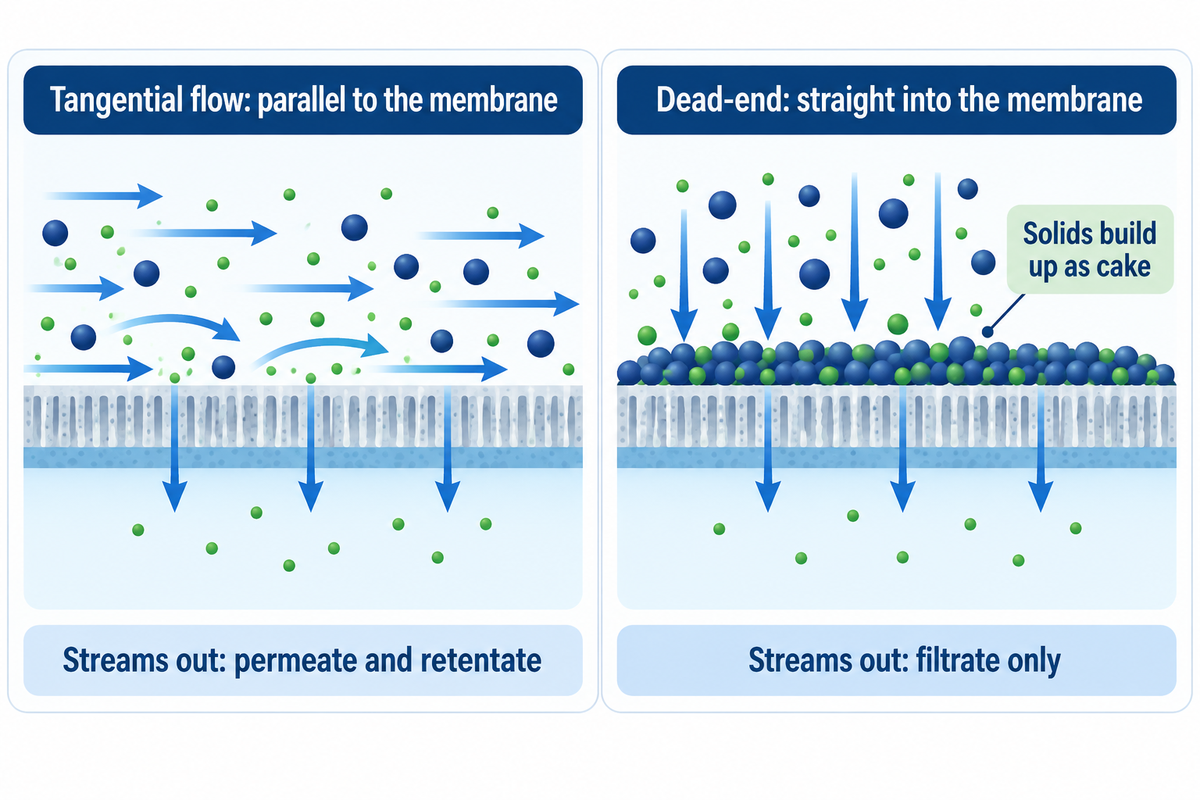
Membrane filtration operates in two flow modes. Conventional recirculating tangential flow filtration returns the retentate to the tank, while dead-end filtration directs the feed to the filter, which retains solids as liquid passes through. Use TFF to concentrate or exchange buffer. Use dead-end filtration to clean up a low-solids liquid where the filtrate is the product.
| Point | Tangential flow | Dead-end (normal flow) |
|---|---|---|
| Flow path | Parallel to the membrane | Perpendicular, straight into it |
| Streams out | Permeate and retentate | Filtrate only |
| Retained material | Swept along, then recirculated or sent onward | Builds up as cake or in the depth |
| Usual product | Retentate, sometimes permeate | Filtrate |
| Pump exposure | Dozens to hundreds of passes when recirculating | One pass |
| Shear | Over 9.05 Pa damaged vesicles in one study | Avoids repeated passes; pumps and valves can still add shear |
| Buffer exchange | Yes, by diafiltration | Not with a cartridge; dead-end ultrafiltration can dilute and re-concentrate |
| Equipment | Pump, valve, three pressure readings, tank | Housing or capsule and a pressure source |
| Rating | kDa for ultrafiltration, µm for microfiltration | Usually µm |
The difference that surprises most readers is that crossflow doesn’t stop fouling. A wastewater membrane study found flux declined faster with higher feed concentration and lower tangential flow, yet tangential flow had almost no effect on the decline rate at pseudo steady state. And the case against normal flow is fast polarization, fouling and low flux, not poor retention.
The 3-Question Retain-or-Remove Test
The 3-Question Retain-or-Remove Test is a quick check that directs a filtration job to dead-end, TFF, or both. Answer the questions in order and stop at the first clear answer.
- Is the product held back or passed through? With product retained, the common choice is TFF. Unlike dead-end ultrafiltration, it keeps polarization low at higher volumes.
- Must volume or buffer change? If yes, start with TFF. A dead-end cartridge changes neither. Dead-end ultrafiltration can do both by adding buffer and re-filtering, but fouls quickly.
- Will the solids blind a filter before the batch ends? If yes, add cross flow or a prefilter stage. If the feed is clean, and only particles or microbes need to be removed, a dead-end cartridge is sufficient, without a pump loop and its hold-up.
Concentration and Diafiltration: How Many Diavolumes?
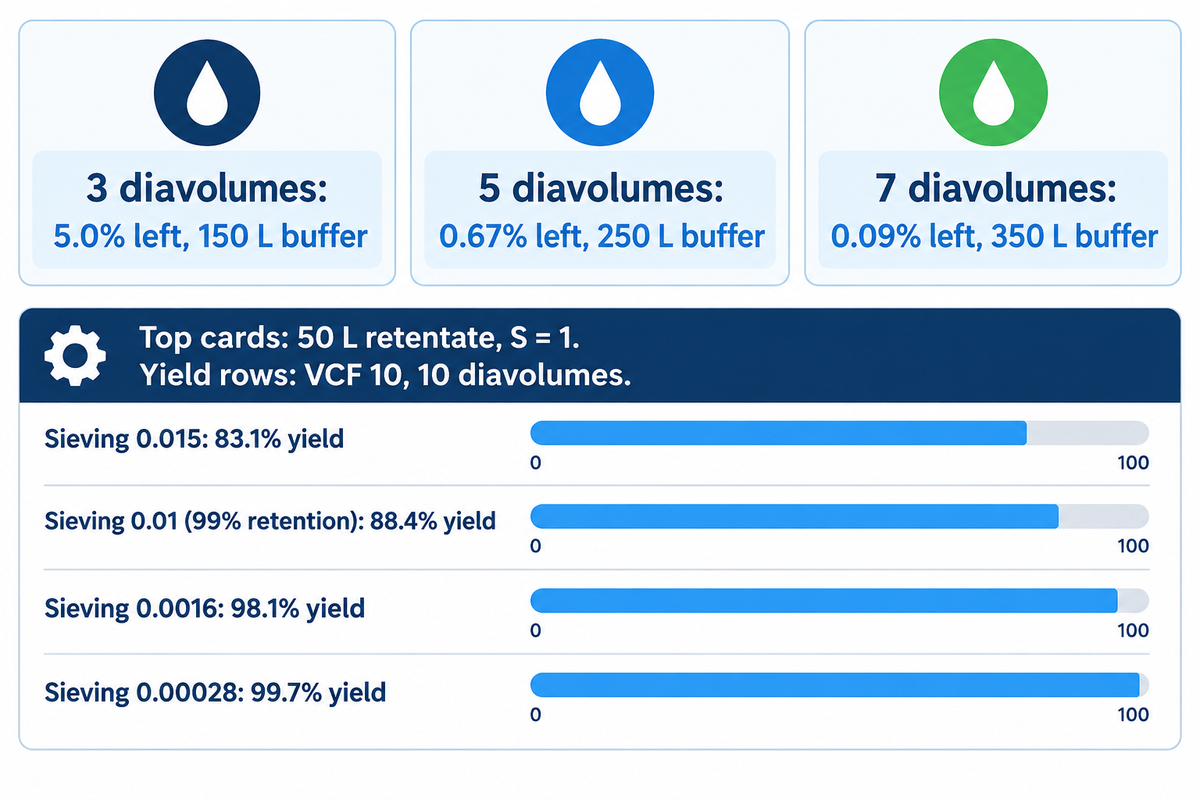
Five diavolumes remove about 99.3% of a freely passing solute at constant volume, and seven remove about 99.9%. A diavolume is equal to one retentate volume of fresh buffer. That buffer needs to be prepared and stored. Concentration and diafiltration plans therefore need to account for tank size.
The constant-volume equation is C = C0 × e^(−SN), where S is the sieving coefficient and N the number of diavolumes. With S = 1 for a freely passing solute, the table that follows is a direct calculation.
| Diavolumes (N) | Solute left | Solute removed | Buffer for 50 L |
|---|---|---|---|
| 3 | 5.0% | 95.0% | 150 L |
| 5 | 0.67% | 99.33% | 250 L |
| 7 | 0.09% | 99.91% | 350 L |
Real clearance can lag that curve. Some small ions may not sieve at unity due to Donnan effects with a charged product, and solutes that bind the product wash out more slowly. Concentrating before diafiltration reduces the buffer bill since N is counted against the smaller volume. A 20 L polyclonal bovine IgG trial, on the stainless-steel comparison system, performed 10× concentration, five volumes of buffer, and a final 2× concentration. It tracked the critical parameters at each stage: flux, concentration factor, conductivity and diafiltration volume.
Why a 99% Retention Membrane Can Still Lose 12% of Your Product
Retention compounds across a run. A 2024 Biotechnology Progress paper calculates only 88.4% protein yield for a membrane with 99% retention at a volume concentration factor of 10 and 10 diavolumes. Keeping permeate loss under 2% at those settings takes a sieving coefficient below 0.0016.
The paper’s figure matches Y = VCF^(−S) × e^(−S × N). The table uses that formula with the sieving coefficients reported for a 150 kDa antibody on composite regenerated cellulose. The numbers are sieving yields only, on these inputs.
| Case | Sieving coefficient | Yield |
|---|---|---|
| 100 kDa membrane, 150 kDa antibody | 0.015 | 83.1% |
| 99% retention | 0.01 | 88.4% |
| Under 2% loss limit | 0.0016 | 98.1% |
| 30 kDa membrane, 150 kDa antibody | 0.00028 | 99.7% |
Product recovery is a separate number. In a separate Biotechnology Progress mass balance on an 88 cm² cassette, 8.6 g of protein went in and 6.6 g came out in the retentate, with none in the permeate. Without a flush, 1.9 g stayed in the tubing and on the membrane. So plan a recovery flush and count hold-up volume. The bovine IgG trial above reported recovery above 96% after flushing. The Pall authors credited low-point design features for higher recovery on the single-use system.
Choosing a TFF Membrane: Cut-Off, Material and Format
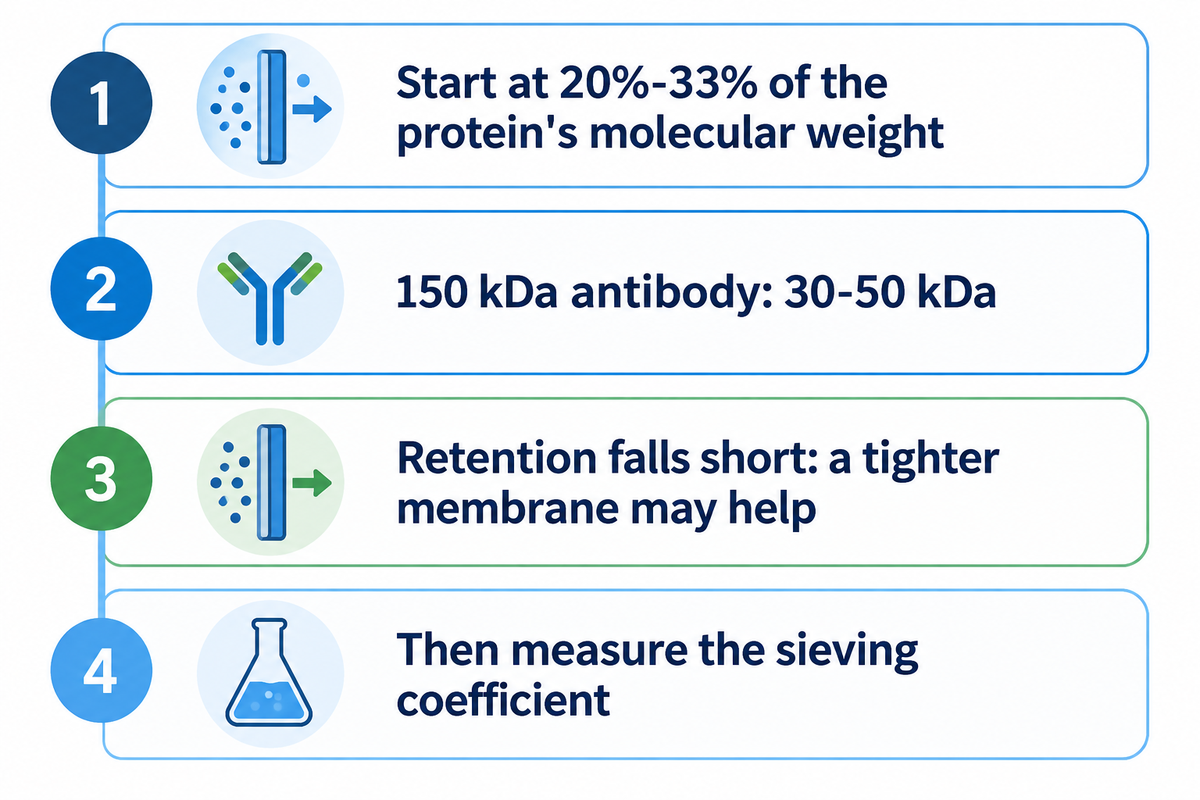
Start with a nominal molecular weight cutoff (MWCO) at 20%-33% of the protein’s molecular weight and assess retention on your own feed. For example, for a 150 kDa antibody, that would be 30-50 kDa. Polymeric ultrafiltration membranes are usually rated this way in kDa, while pore size in µm relates to microfiltration.
What Membrane Cut-Off Should You Use for TFF?
A good starting point is to use 20-33% of the product’s molecular weight, which is the typical UF/DF rule of thumb. If retention falls short, a tighter membrane may help, but it can reduce flux, requiring longer runs or more membrane area. Then measure the sieving coefficient of your feed, because that determines the loss.
A rating is actually softer than it seems. MWCO is defined under one French standard as the minimum molecular weight of a solute that’s 90% retained, a level far short of the retention a UF/DF yield needs. Shape matters too: 300 kDa membranes have passed dextrans above 2000 kDa. To separate two solutes, plan on a factor of about 10 in molecular mass. If you’re transitioning from cartridge ratings, what a micron rating means doesn’t apply to kDa directly.
Material and format come next:
- Regenerated cellulose or PES. The 2022 single-pass review notes PES ultrafiltration membranes are in general more susceptible to fouling and may require more extensive cleaning than regenerated cellulose.
- Charge. Electrostatic interactions can also impact sieving, and the 2024 paper reports that charge-modified membranes cut sieving of like-charged proteins, though it describes none as commercially available.
- Cassette or hollow fiber. Pharmaceutical Manufacturing in 2008 quoted Pall’s TFF marketing director saying cassette geometry needs lower velocity than older designs of hollow fiber, with areas between 200 cm² and 2.5 m². According to the same source, those cassettes can be stacked for scalability up to 20,000 L. The true test is flux and recovery on your own feed.
- Single-use or reusable. Single-use TFF systems skip cleaning validation and suit multiproduct sites and contract manufacturers. The BioProcess International authors, both Pall employees, flag cost as a constraint. Their precalibrated sensors required no recalibration, and manifolds went on in about 10 minutes.
What Tangential Flow Filtration Is Used For
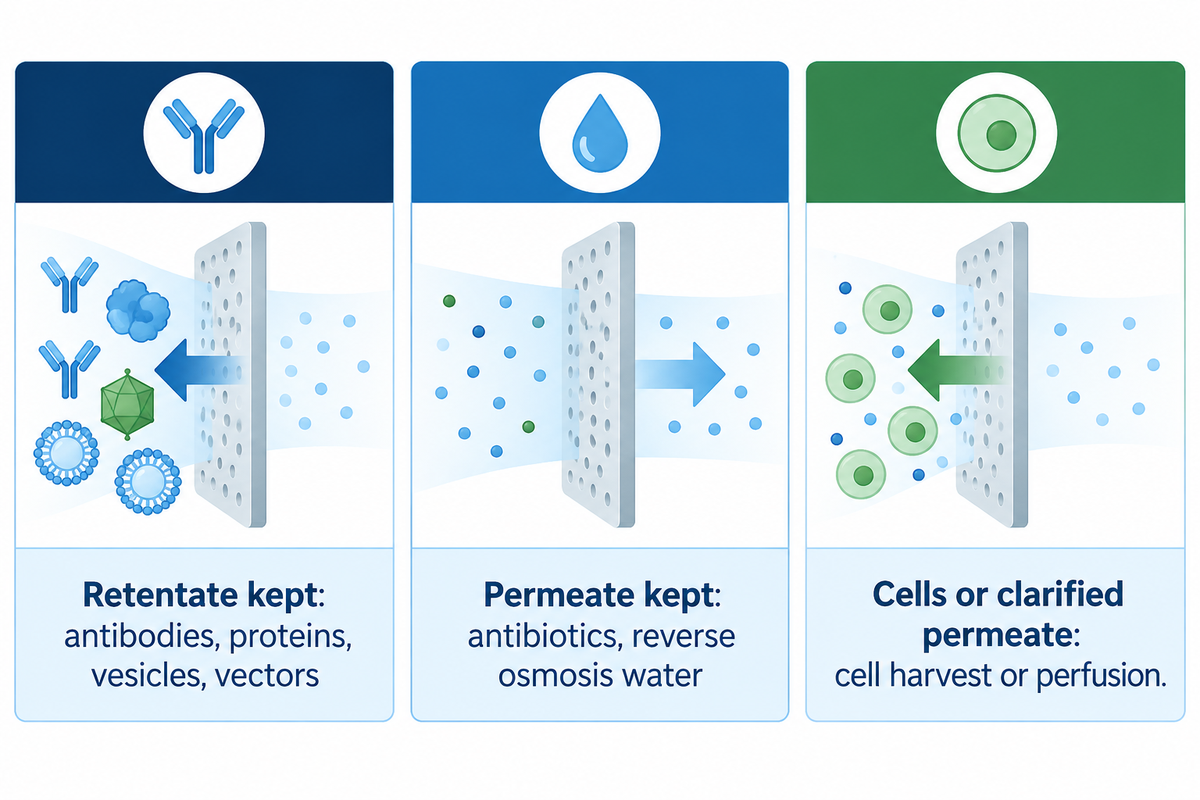
Tangential flow filtration is used mainly to concentrate biologics, exchange their buffers and harvest cells, and cross-flow membranes also run water, food and fermentation duties. Protein concentration and buffer exchange for antibodies are widely employed purification applications. In biopharmaceutical manufacturing, TFF is one of the unit operations around chromatography. Downstream bioprocessing of an antibody often ends with final formulation by ultrafiltration and diafiltration.
| Job | Product kept | Membrane class | Main concern |
|---|---|---|---|
| Monoclonal antibody UF/DF | Retentate | Ultrafiltration, about 30 kDa | Yield, viscosity at high concentration |
| Recombinant protein | Retentate | Ultrafiltration, 20–33% of molecular weight | Aggregation from shear |
| Small extracellular vesicles | Retentate | 750 kDa in one study | Vesicle damage, leakage |
| Viral vectors | Retentate | Ultrafiltration | Fragile capsids, pump choice |
| mRNA and lipid nanoparticles (LNPs) | Retentate | Ultrafiltration | Particle stress in the loop |
| Vaccines and virus-like particles | Retentate | Ultrafiltration | Same fragility as vectors |
| Cell harvest or perfusion | Cells or clarified permeate | Microfiltration | Cell viability, fouling |
| Microbes from water samples | Retentate | Microfiltration or ultrafiltration | Recovery shifts with membrane and water |
| Antibiotics from fermentation liquor | Permeate | Microfiltration or ultrafiltration | High solids blinding a filter |
| Reverse osmosis water | Permeate | Reverse osmosis | Particles reaching the membrane |
In marine water tests, PVDF may suit bacterial cells better and PES may suit viruses, with recovery shifting by water sample. Some vesicle protocols add size exclusion chromatography after TFF to polish the retentate. An RO pretreatment cartridge protects the cross-flow membrane from particles that got past the main treatment step.
Cartridge Filters Before and After a TFF Step
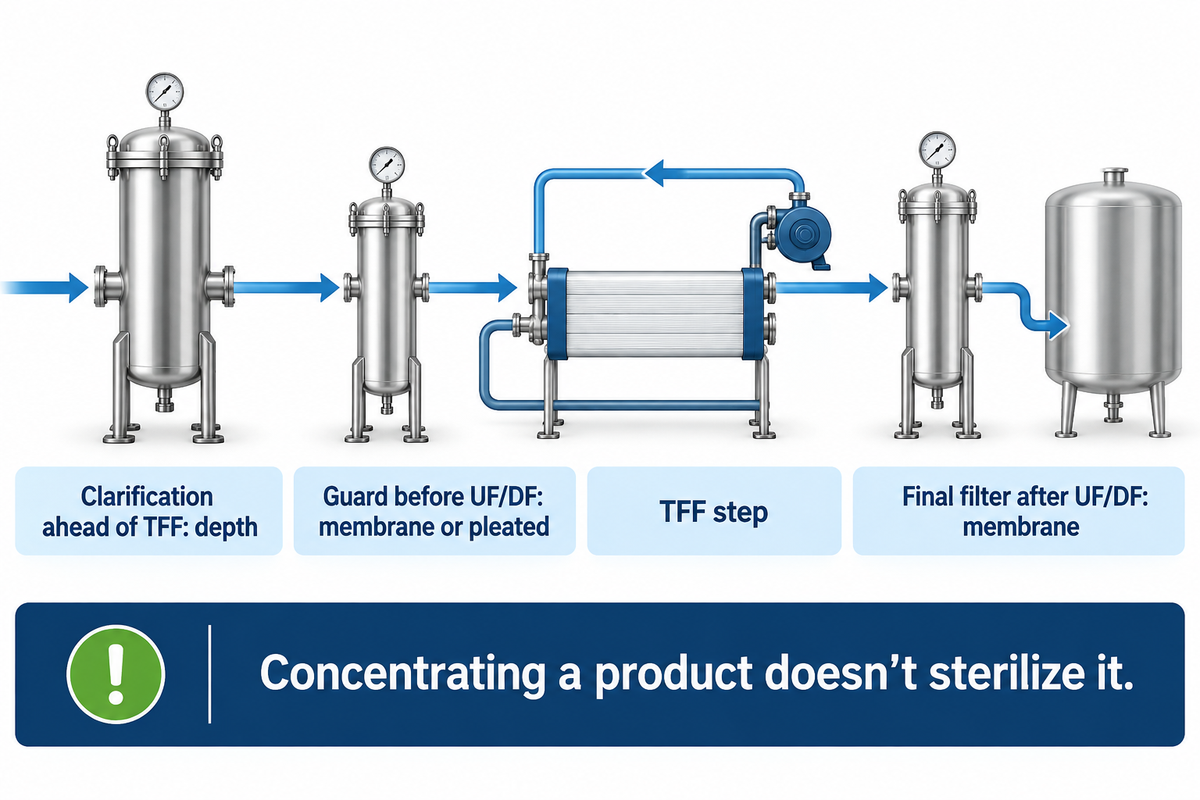
For a product that can be sterile filtered, a TFF step usually sits between two dead-end filters: a prefilter that protects the membrane, and a 0.2 µm filter that finishes the batch. Concentrating a product doesn’t sterilize it, and therefore, the workflow keeps that final filtration even if the TFF step ran clean. Cell products are clear exceptions.
| Position | Job | Cartridge type | Starting rating |
|---|---|---|---|
| Clarification ahead of TFF | Take out cell debris and solids | Depth | Set by solids load, then step down |
| Guard before UF/DF | Protect channels, cut bioburden | Membrane or pleated | 0.45 µm or 0.2 µm |
| Final filter after UF/DF | Retain bacteria before filling | Membrane | 0.2 µm, validated for the product |
| Ahead of RO or UF in water | Protect the membrane from particles | Pleated or depth | Set by the feed and pretreatment |
A 0.2 µm rating is a strong barrier with a known exception. ASTM F838 challenges a filter with 10⁷ bacteria per cm² of filtration area and says other species may be a worse case. FDA gives one example:
“It has been shown that Acholeplasma laidlawii is capable of penetrating a 0.2 micron filter, but is retained by a 0.1 micron filter.”
FDA also notes that it does not expect or require firms to routinely use 0.1 micron filters for media preparation. For a GMP manufacturing step, a Pall product manager told BioPharm International that what decides the claim is a process-specific bacterial challenge, not the printed rating. Our pharmaceutical sterile filtration guide has more background, and our sterile filtration screening covers the cartridge, fluid or gas, housing, operating envelope and documentation you need before a configuration is proposed.
ECOFILTRONE makes dead-end depth, pleated and membrane cartridges for prefiltration and process filtration, and our catalogue doesn’t list TFF systems or TFF membranes. Our PES and PVDF cartridge range runs at 0.04–1.2 µm in PES and 0.1–0.65 µm in PVDF, plus PTFE at 0.1–10 µm for liquids (0.01 µm is a gas rating) and nylon at 0.22–1.2 µm, with 0.22 µm and 0.45 µm available in all four. They’re 69 mm OD in 5–40 in lengths, rated to 80 °C, with a maximum differential pressure of 4.0 bar at 20 °C and 2.0 bar at 80 °C, and 0.65 m² per 10 in on the main series. A listed membrane and pore rating define a candidate, not a validated sterilizing-grade filter for every process.
For a prefilter position we also build double-layer PES, from 0.22+0.1 up to 0.65+0.45 µm. Upstream, depth filter cartridges and pleated filter cartridges handle the solids. Our catalogue rating is 0.22 µm where buyers often search for 0.2 µm, and 0.2 micron filter cartridges explains why the two aren’t automatic swaps. When you send an RFQ, list the fluid, batch sizes, housing and end cap, and whether the position is a prefilter or a final filter, plus the documentation your process needs.
Common TFF Problems: Fouling, Shear and Product Loss
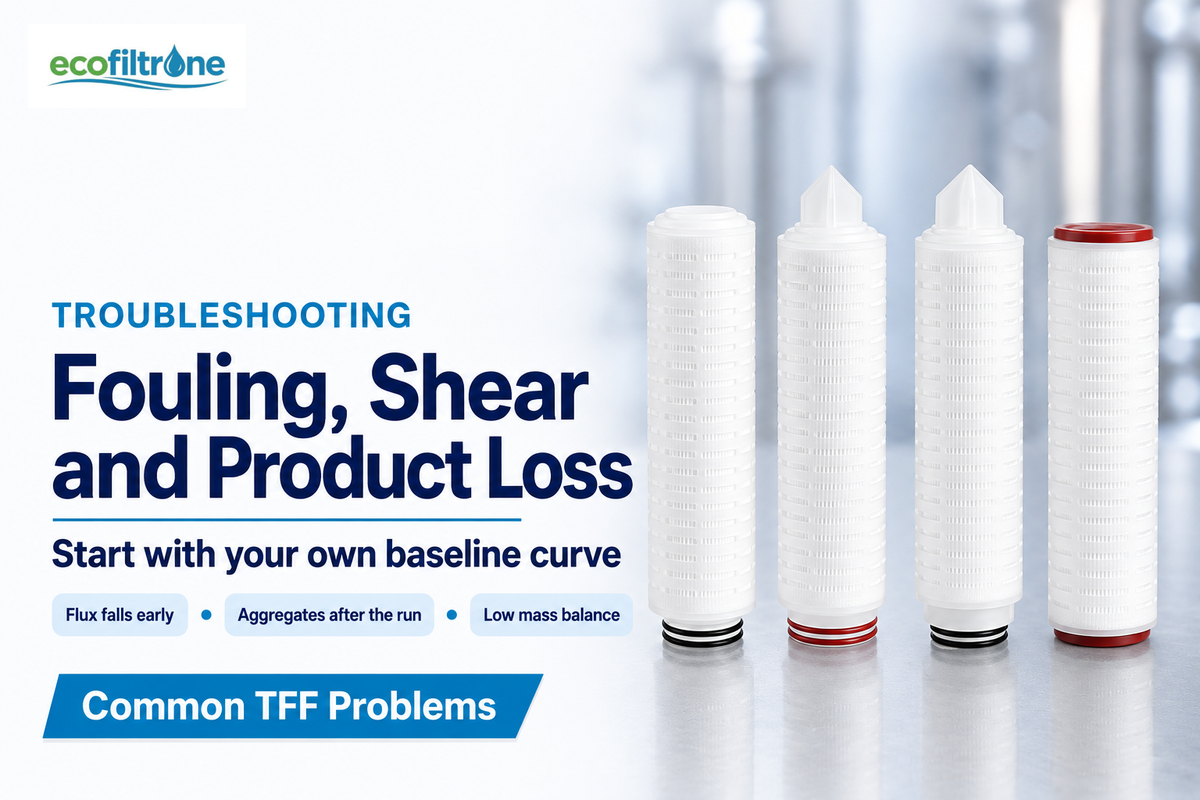
Most TFF issues are due to membrane fouling, shear from the pump, or product left in the system. Flux falls as concentration climbs: a single run of bovine IgG dropped from 28 to 2 L/m²/h. That’s partly expected and explained by physics. Compare the run against your own TFF baseline curve first, since some changes in performance are normal and expected.
| Symptom | Likely cause | First check |
|---|---|---|
| Flux falls early | High feed concentration, low crossflow, particles | Prefilter condition and crossflow rate |
| Product in permeate | Cut-off too open, buffer effects | Sieving on a smaller cut-off and in your buffer |
| Aggregates after the run | Shear; damage appeared above 9.05 Pa in one vesicle study | Pump type, passes and shear rate |
| Low mass balance | Hold-up, adsorption | Flush volume and low-point drain |
| Water flux not restored after cleaning | Residual fouling or mismatched test conditions | Compare flux at matched temperature and pressure |
Cleaning chemistry depends on the type of fouling. Organic fouling is removed with caustic and minerals are removed with acid, within the limits set by the membrane maker. Automation helps performance and reliability here, since automated systems hold the TMP and log the data trend that indicates a run has drifted.
How Long Does a TFF Membrane Last?
A reusable TFF membrane should be replaced when it fails one of its limits, i.e. retention, integrity, cleanliness or flux, or reaches its validated reuse count. A single-use module intended for one batch should be replaced when that batch ends. No general figure applies. Formulatrix’s own specification lists a permeate volume of 300 mL for one chip format. On multiproduct sites, the risk of cross-contamination often decides if a cassette is dedicated or single-use.
TFF System Cost and Who Makes It
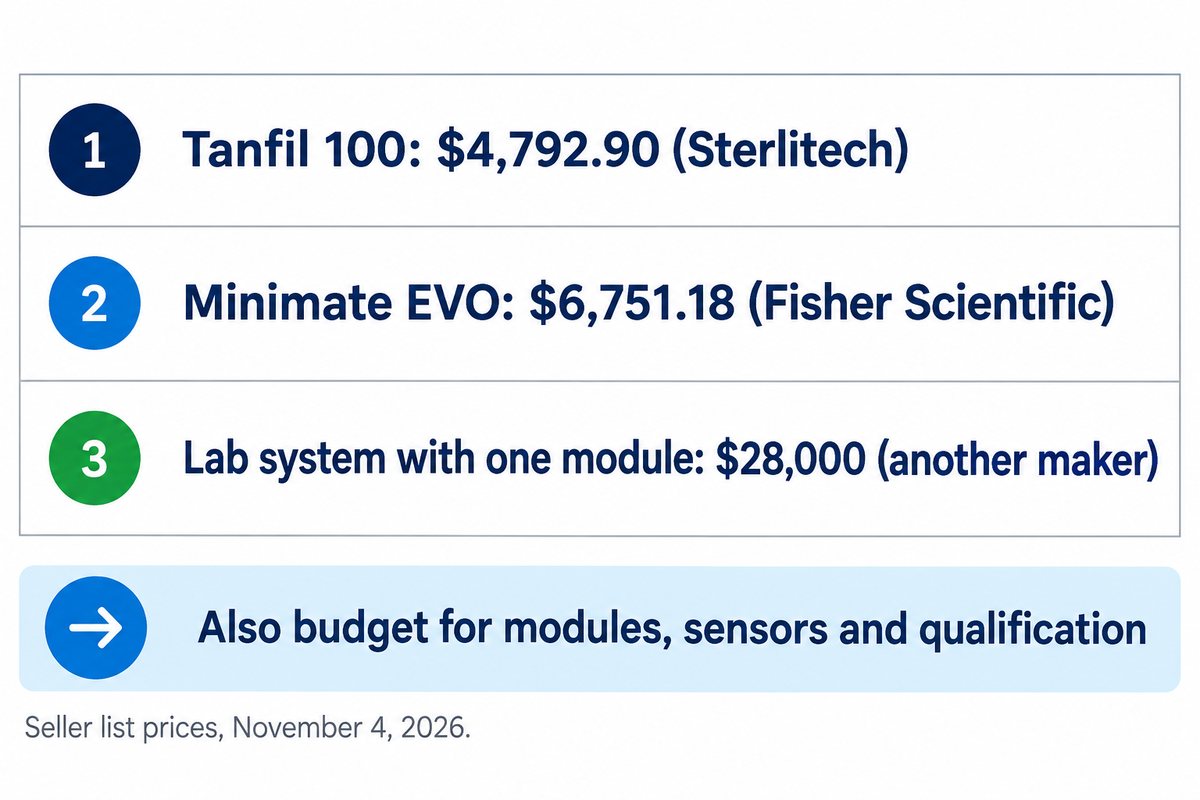
Listed lab TFF systems run from $4,792.90 to $28,000. Sterlitech lists the Tanfil 100 at $4,792.90, Fisher Scientific lists the Cytiva (formerly Pall Lab) Minimate EVO at $6,751.18, and another maker lists a lab system at $28,000 with one module. Prices are as of November 4, 2026, and configurations differ.
Compare those figures with an academic 2021 estimate of €4,000–8,000 without automatic control, €20,000–30,000 for simple automated systems and €100–600 per membrane module. Budget for what a list price leaves out, such as modules, sensors and qualification. For a manufacturing skid, request a configuration specific quote. Makers named in that paper are Merck Millipore, Pall, Repligen and Sartorius; Repligen also sells the KrosFlo® line. Older trade articles name Merck Millipore’s Pellicon, Sartorius’s Sartocon and Pall’s T-Series cassettes.
What Is Changing: Single-Pass TFF and Continuous Processing
Continuous biomanufacturing is raising interest in single-pass TFF, which concentrates a flowing feed without a recirculation loop. ICH Q13 has applied to chemical entities and therapeutic proteins since its EMA effective date of July 10, 2023, so continuous manufacturing now has a shared regulatory guideline.
Lower feed flow and modules in series provide sufficient residence time for the liquid to reach its concentration in a single pump pass. The following numbers need their conditions attached:
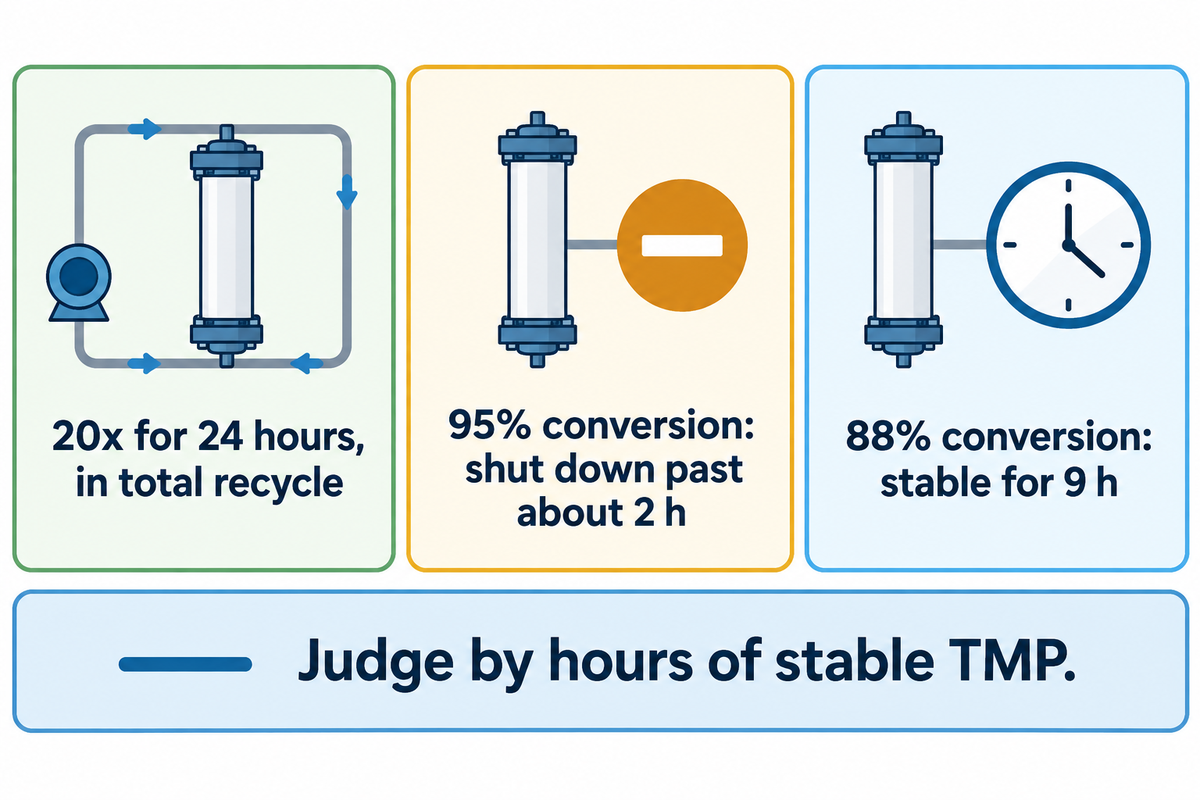
- A 2025 antibody study held 20x for 24 hours at under 30 kPa on clarified, sterile-filtered culture fluid with no evidence of fouling, but in total recycle, and its authors say true single-pass data will be needed.
- A vibrating module study, also in total recycle, at 95% conversion had to shut down after TMP climbed fast past about 2 h, while 88% conversion stayed stable for 9 h.
- The 2025 study also cites work where the performance of single-pass TFF depended strongly on the depth filter used for clarification.
This matters when designing the next process: in that work, the clarification depth filter strongly affected single-pass performance. For an in-line step being planned for 2027, trial the module and clarification filter together, and judge by hours of stable TMP rather than peak concentration factor. Most of the effort and time in this scale-up work will go to process development and process control, and a move from batch still means requalifying the step.
Frequently Asked Questions
What does TFF stand for?
TFF stands for tangential flow filtration, also called cross-flow filtration. It gets its name because most of the feed flow moves tangentially across the membrane rather than into it.
Feed flows along a membrane while pressure pushes smaller molecules through it. Elsewhere the same letters could mean other things, so check the context on a data sheet or paper before reading it as a filtration term.
What is the difference between TFF and dead-end filtration?
TFF sweeps feed across the membrane and keeps two streams, while dead-end filtration pushes all feed through and leaves one filtrate.
As such, TFF can concentrate a product or change its buffer at scale. A dead-end cartridge can remove particles or microbes from a liquid you plan to keep, with much simpler equipment.
What are the benefits of TFF over other filtration methods?
TFF can concentrate a product or exchange its buffer at scale. It can also handle feeds that would blind a dead-end filter and do desalting.
It offers greater flexibility for duty and module design, but costs more in pumps, shear exposure and hold-up. For a low solids and clean liquid a dead-end filter is simpler.
Does TFF sterilize a product?
No. TFF can’t sterilize.
For products that can be sterile filtered, a validated 0.2 µm filter follows the step, with its own bacterial challenge data.
How do you clean TFF membranes?
Flush the product out, then perform a caustic clean for organic fouling and an acid clean for mineral scale, within the pH and temperature limits of the manufacturer.
Bleach oxidizes thin-film membranes, so check compatibility first. Measure water flux before and after as a hydraulic check, at matched temperature and pressure. Residue and integrity tests cover what flux can’t show. Single-use modules eliminate the cleaning step, but each batch pays for a new module.
Are TFF parameters transferable between membrane suppliers?
Only as a starting point. Suppliers rate cut-off by their own test method, so the same nominal kDa can sieve differently.
Re-run retention and flux on the new module before you move a process.
Key takeaway
Tangential flow filtration changes volume and buffer, and dead-end filters clean and finish the batch. Budget yield on the sieving coefficient, because 99% retention is not 99% yield.
If you’re considering filters around a TFF step, send us the fluid, ratings and housing, and we’ll match PES, PVDF, pleated or depth cartridges and provide a quote.
About This Analysis
Prepared by Qingdao ecofiltrone Industrial Technology Co., Ltd. The yield rows and diavolume table on this page are our calculations from the equations in the cited papers, using the inputs shown. Prices are seller list prices dated November 4, 2026.
References & Sources
- Cross-flow filtration, Wikipedia
- Single Pass Tangential Flow Filtration: Critical Operational Variables, Fouling, and Main Current Applications, Separation and Purification Technology, DTU
- Intramodule pressure profiles and protein accumulation during tangential flow filtration, Biotechnology Progress
- Single-Use Tangential Flow Filtration in Bioprocessing, BioProcess International
- Optimized Tangential Flow Filtration for Efficient Isolation of Highly Pure and Bioactive sEVs, PubMed
- Co-current filtrate flow in TFF perfusion processes, Biotechnology and Bioengineering
- Effect of permeate flux and tangential flow on membrane fouling for wastewater treatment, Separation and Purification Technology
- Diafiltration overview, ScienceDirect Topics
- Buffer effects on protein sieving losses in ultrafiltration, Biotechnology Progress, 2024
- An Efficient Method to Determine Membrane Molecular Weight Cut-Off, Membranes
- Molecular Weight Cut-off overview, ScienceDirect Topics
- Tangential Flow Filtration Explores New Niches, Pharmaceutical Manufacturing
- Evaluation of Tangential Flow Filtration for the Concentration and Separation of Bacteria and Viruses in Contrasting Marine Environments, PubMed Central
- Standard Test Method for Determining Bacterial Retention of Membrane Filters (F838) ASTM International
- CGMP questions and answers: control of components and drug product containers and closures, US FDA
- Sterile Filtration Techniques for Optimal Microbial Retention, BioPharm International
- Automated tangential-flow diafiltration device, HardwareX, RWTH Aachen University
- ICH guideline Q13 on continuous manufacturing, European Medicines Agency
- Integration of Single Pass Tangential Flow Filtration and High Performance Countercurrent Membrane Purification, Biotechnology and Bioengineering, 2025
- Inline Protein Concentration by Vibratory Single Pass Tangential Flow Filtration, PubMed Central