Get in touch with ECOFILTRONE™ Company


Pharmaceutical and Sterile Filtration: A Guide to Process Control

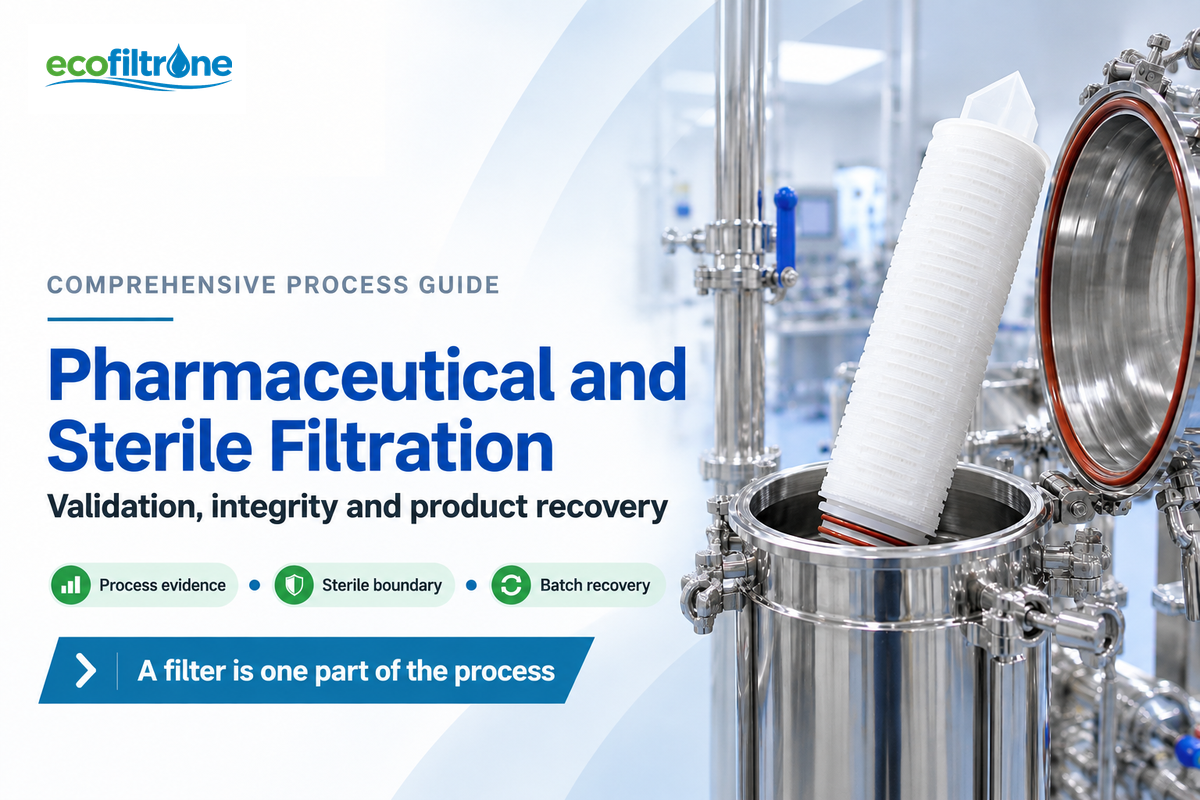
Pharmaceutical and Sterile Filtration uses filtration to control particles, microbial contamination and other defined process risks in pharmaceutical production. Sterilizing liquid filtration combines a validated filter process with protected downstream handling. This guide covers process boundaries from filter selection through evaluation and product recovery.
Guide at a glance
Scope: liquid process filtration and the adjoining sterile boundary. Audience: production, quality, engineering and procurement. Working tools: an event timeline, a fault matrix and a recovery-adjusted cost example. Operating limits: the approved product, assembly and process determine them.
Pharmaceutical and Sterile Filtration separates defined contaminants from process fluids. A 0.2 µm label identifies a rating; validated retention, product quality and aseptic handling determine the process outcome.
Key points
- A passing integrity test answers a question about a particular filter and test condition.
- Standard filter qualification and drug-process validation have different purposes.
- Recovered active mass can change even when the collected liquid volume looks satisfactory.
- Investigating the earliest abnormal event helps separate membrane, test-system and downstream causes.
What does pharmaceutical and sterile filtration do?
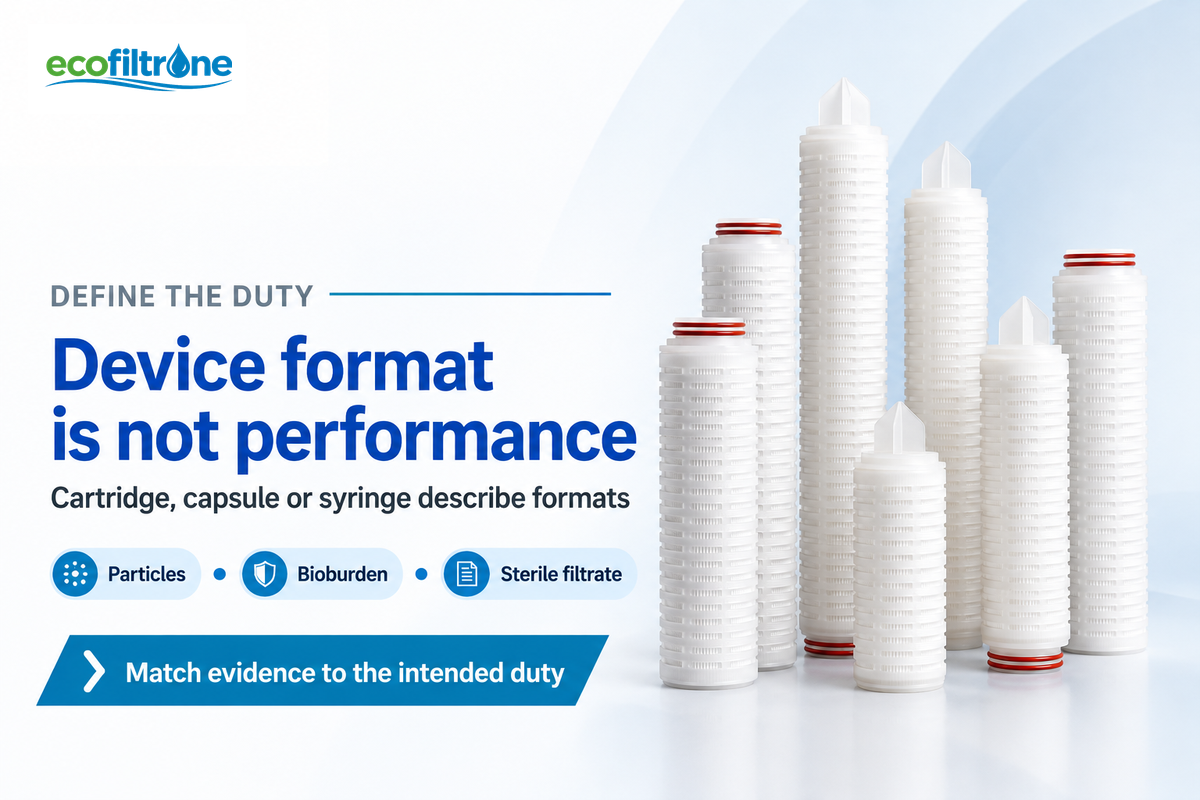
Pharmaceutical filtration controls different process duties such as clarification, particle removal, bioburden reduction and validated sterilizing filtration. In the pharmaceutical industry, these types of filtration require evidence aligned to their purpose. A filter used to purify an intermediate and a final sterile filter before aseptic filling serve different roles in the manufacturing process.
What is a membrane filter used for?
A membrane filter separates material from a liquid or gas through a selective barrier. In pharmaceutical manufacturing, the duty can be particle removal, microbial control, or other defined separation. Its usefulness depends on the membrane, the complete device and the process fluid; therefore, the filter format and required separation performance should be defined separately.
A device format (i.e. cartridge, capsule or syringe) differs from performance (i.e. bacterial retention) under stated conditions. Membrane filtration also differs from an upstream depth filter which captures suspended solids using a fibrous structure. These types of filters can be in the same filtration system, but each has a different role. Filter media and device format should be in view when records are compared. The same distinction applies when a laboratory syringe is replaced by a process-scale assembly.
FDA’s aseptic-processing guidance discusses sterilizing liquid filtration and expressly separates that discussion from virus removal. A bacterial retention claim also leaves dissolved impurities and endotoxin control as separate questions. A microorganism is a biological contaminant; a dissolved impurity calls for its own separation objective. Assign each contaminant to the process step that controls it, rather than asking one pore size to stand for the whole purification strategy. FDA guidance, sterilizing filtration.
| Duty | Useful process question | Evidence to connect |
|---|---|---|
| Clarification and particle control | Which solids affect the next operation? | Feed condition, particle result and loading behavior |
| Bioburden reduction | How is the load controlled before the critical step? | Defined microbial-control objective and monitored process |
| Sterilizing liquid filtration | Does this product and process meet its sterile-filtrate objective? | Retention validation, integrity strategy and aseptic boundary |
| Gas and vent protection | How is the vessel protected while gas moves? | Gas duty, assembly integrity and wetting risk |
| Other purification duties | Which dissolved or viral impurity requires control? | Evidence for the particular removal mechanism |
Product specifications may give a nominal grade as 0.2 micron, while technical product descriptions may be in µm. The micron rating and particle-capture guide is provided separately. Keep the filtration duty in the purchase request; “sterile” doesn’t give enough information to the engineering and procurement departments to proceed.
When is sterile filtration preferable to terminal sterilization?
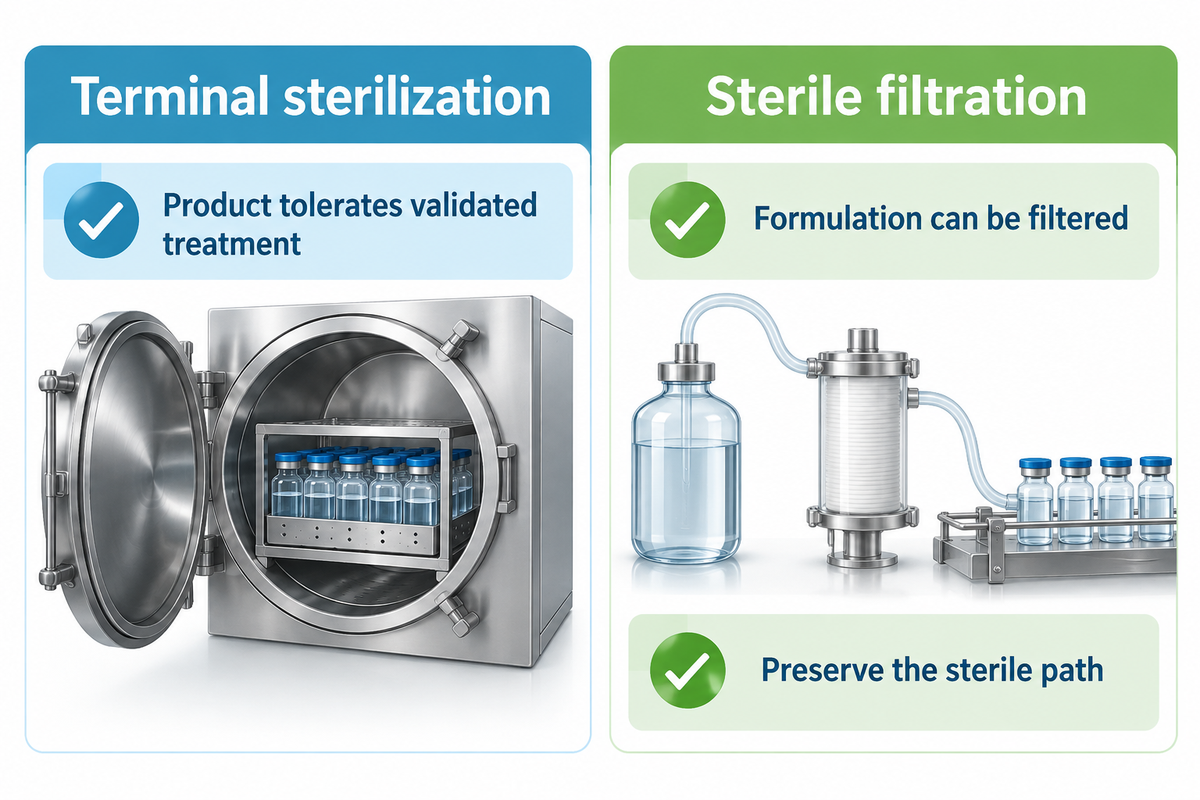
When the final container and product can tolerate a validated process, terminal sterilization is the preferred route. Sterile filtration becomes a route to assess when terminal treatment is unsuitable and the formulation can be filtered without unacceptable change. The filtered liquid then needs an aseptic processing route that preserves its integrity through filling and closing.
Heat sensitivity is part of the assessment. A suspension, an intended particulate formulation or a product whose active ingredient binds strongly to the filter may need another manufacturing approach. Altering a filtration step may change the composition of the final product. Pharmaceutical ingredients, along with excipients, container system, and route should be assessed together. Health Canada’s sterile-drug production guidance describes the various route and product quality conditions.
Terminal route
- Assess treatment of the product in its final container.
- Connect treatment tolerance with product quality.
- Maintain the validated container and process conditions.
Filtration and aseptic route
- Assess the formulation’s filterability and retention needs.
- Connect filter exposure with composition and recovery.
- Maintain the sterile path through filling and closure.
For pharmaceutical products, regional documents use both terminal sterilization and terminal sterilisation. The spelling variants don’t impact any engineering constraint. If a proposed change is justified only by a cheaper filter or a shorter cycle, the process team still needs to show how the revised route maintains the required product quality.
How do filter integrity tests fit the process timeline?
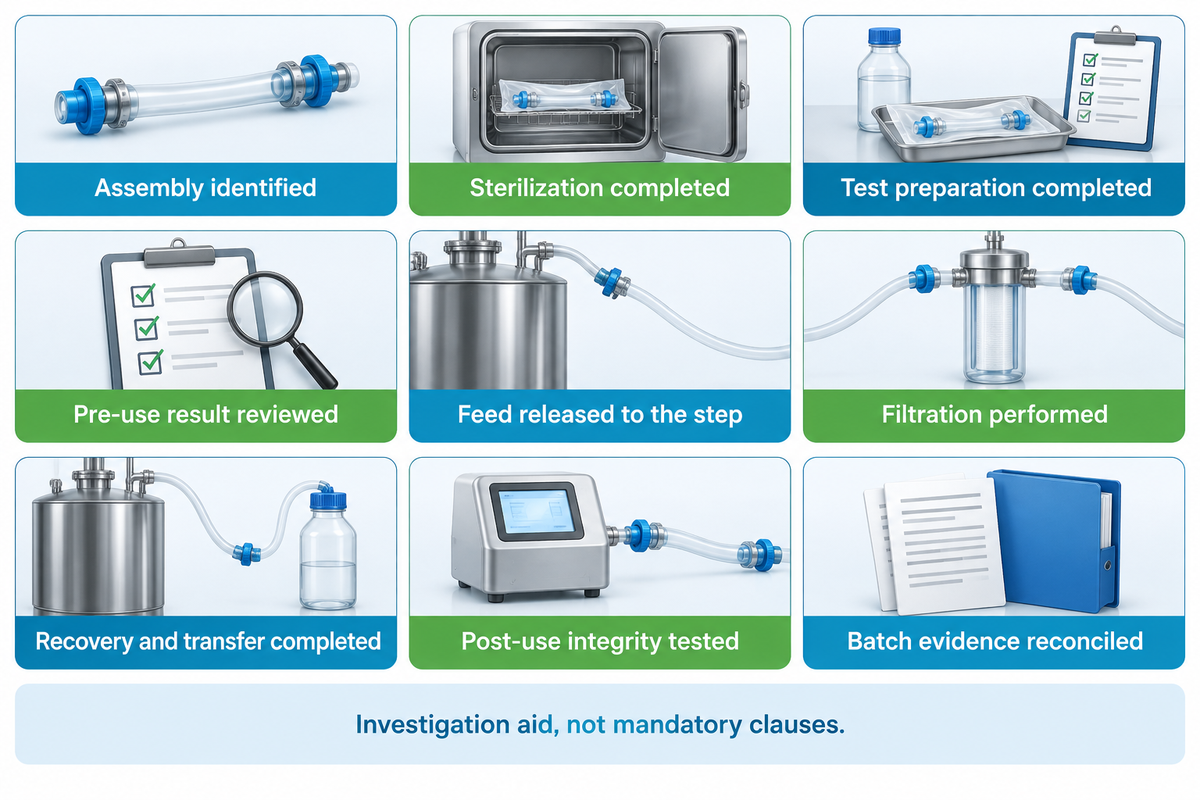
Filter integrity testing lends itself to the clearest meaning when its result is related to a process event. An installation check, a pre-use post-sterilization integrity test and a post-use test occur after different exposures. Their records help identify when a problem could have arisen and which part of the assembly or sterile path needs investigation.
Pre-use post-sterilization integrity testing, often called PUPSIT, assesses the sterilized assembly before product filtration. Health Canada’s Annex 1 guidance also recognizes constrained cases, such as very small-volume processes, where a thorough risk assessment and suitable controls justify an alternative approach. The exception belongs in the approved process rationale; it is not a general exemption based on convenience.
9-Event Sterile Boundary Timeline
The nine events recorded by batch for investigation aren’t mandatory standard clauses. A site’s sequence may include additional steps or a justified alternative arrangement. The process risk assessment identifies its critical control points; a generic timeline shouldn’t assign that status to every record.
| Event | Record to connect | Question it helps resolve | Responsible function |
|---|---|---|---|
| 1. Assembly identified | Filter, lot, seals and flow-path identity | Was the intended assembly installed? | Engineering and production |
| 2. Sterilization completed | Approved cycle and assembly exposure | Was the intended sterilized state established? | Production and quality |
| 3. Test preparation completed | Wetting fluid, temperature and instrument setup | Was the integrity method applied under its qualified conditions? | Production and validation |
| 4. Pre-use result reviewed | PUPSIT result or justified alternative controls | What was known before the product entered? | Quality and production |
| 5. Feed released to the step | Feed identity, hold history and required quality results | Did the feed match the validated process assumptions? | Process team and quality control |
| 6. Filtration performed | Pressure, flow, time, volume and interruptions | Did the batch remain within its approved envelope? | Production |
| 7. Recovery and transfer completed | Recovered material, transfer route and interventions | Where did product and the sterile boundary go? | Production and engineering |
| 8. Post-use integrity tested | Test conditions, result and preserved assembly | What does the used filter’s result establish? | Production and quality |
| 9. Batch evidence reconciled | Deviations, downstream records and quality disposition | Have the unresolved events been assessed together? | Authorized quality function |
In a 2023 study by Giglia, Alembath and Hersey, minimum defect diameters producing a failing bubble-point outcome were approximately 30-60 µm, dependent upon filter and test conditions. Some defective devices still passed the test. All laser-holed filters failed the formal diffusion test. Researchers at EMD Millipore, an affiliate of Merck, assessed two 0.2 µm cartridge designs with three automated integrity testers. The 10-inch, or 25.4 cm, devices had controlled laser defects of 20-100 µm and filtration areas of 0.54m² and 0.69 m². The authors support complementary testing while retaining bubble point’s role in assessing pore-size rating.
Evaluation of a purchasing proposal to remove a test involves assessment of the impact of changes to the entire test strategy. Artificial defects and specific instrument settings were studied. Treat the paper as a reason to examine the qualified method’s sensitivity, not as a replacement defect limit.
How formulation and loading shape the filtration train
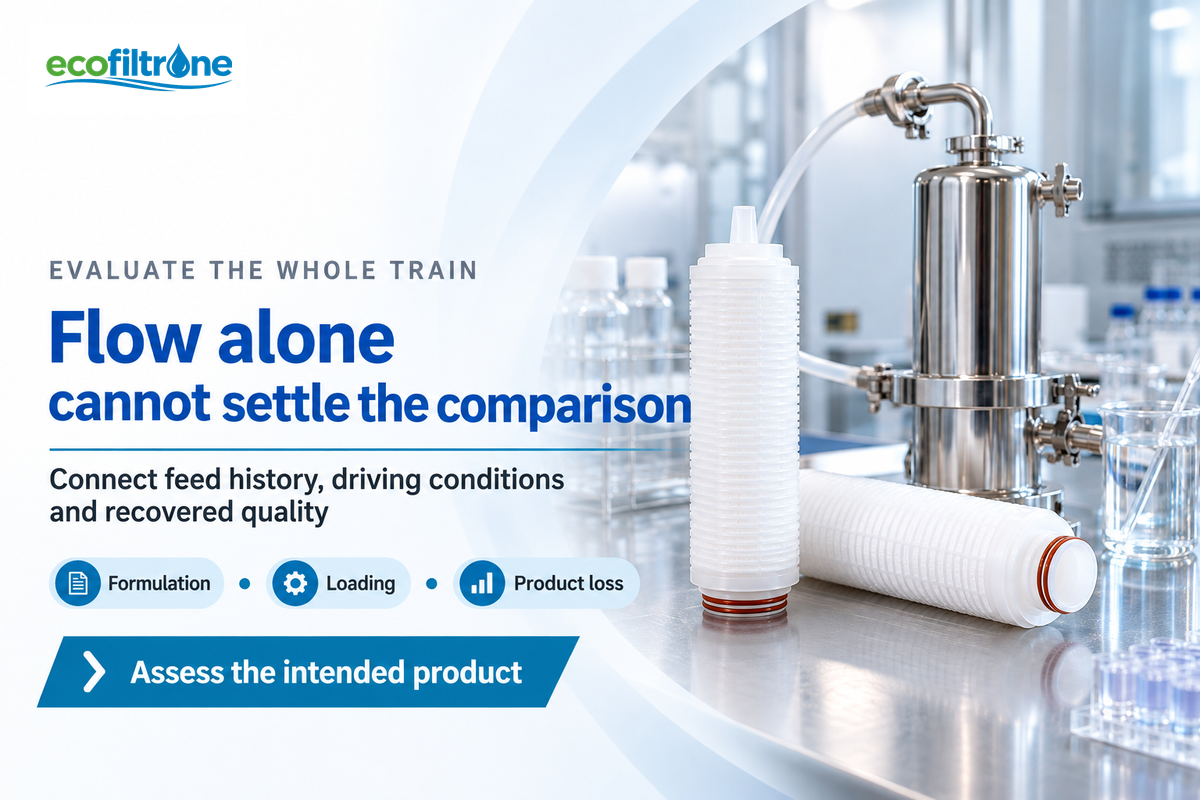
Formulation and loading influence the behavior of a filter with a product, including throughput, adsorption and chemical compatibility. A membrane’s interaction with clean water can be useful to characterize a membrane, but a drug solution can behave differently with the membrane. Measured flows can provide useful information, but comparisons are more informative if the driving conditions, feed history and recovered product quality are considered along with the measured flows.
In Na and colleagues’ 2022 comparison, flux declined by 28.0% and 76.6% after 10 min with 5 g/L bovine serum albumin at 60 kPa. The two 47 mm flat-sheet, 0.22 µm filters came from one manufacturer. Both passed bacterial-retention assessment, but permeability, adsorption and fouling differed; matching initial flux greatly reduced the contrast in flux decline. Polyethersulfone, or PES, and PVDF are common biotech membrane materials; their behavior also reflects construction, surface treatment and test conditions, so comparisons are formulation-specific rather than universal polymer rankings. Those observations are relevant to model fluid systems, and do not reflect production situations.
Certain feed conditions may account for filter issues. A 2008 monoclonal-antibody case study by Anderson, Sharma and Rathore looked at hold temperature, hold concentration, hold time, and hold pH. In that study, the hold time strongly affected throughput. The authors noted that some products may be governed by other conditions and that similar filtration curves may result from different fouling mechanisms. Before assuming that the next batch needs more filter area, look at the age and history of the feed.
Product loss and chemical migration run in opposite directions. Adsorption leaves a formulation component on the filter; extractables and leachables are concerned with substances that may migrate from product-contact materials into the liquid. The European Medicines Agency’s sterilization guideline, Table 3, treats sorption, solution compatibility and extractables/leachables as separate evidence items. It conditions the relevance of leachables data on extractables indicating that toxic constituents may leach.
A prefilter may protect the final membrane from an upstream load, while adding contact materials, retained liquid and another unit to trace. Analyze that whole train with the formulation, including solvent exposure and intended constituents, such as cell culture media. Our other guides discuss PES membrane behavior and nylon membrane behavior in more detail. A lower element price has little value if the added stage removes a required component or increases an unresolved loss.
What does sterilizing-filter validation establish?
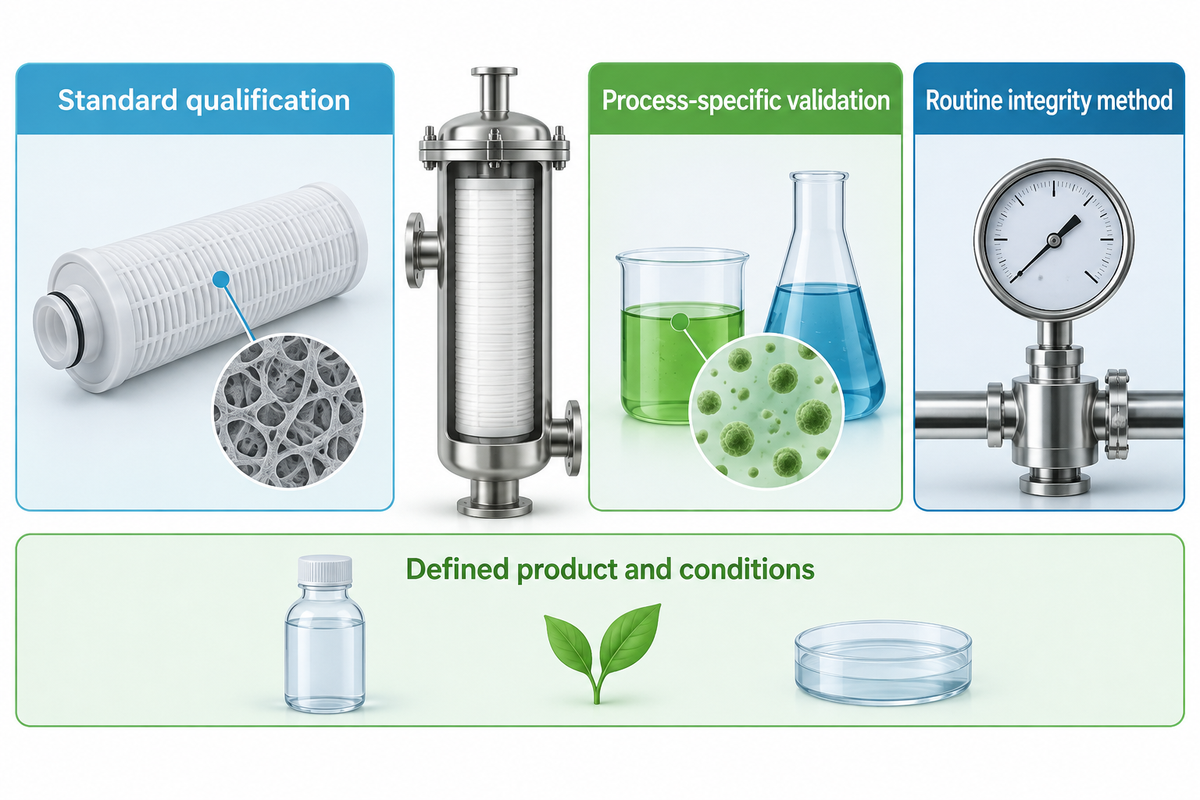
Sterilizing-filter validation connects a specified filter with the intended product and process conditions. It addresses retention and product interaction, as well as test strategy within that defined use. Standard qualification supplies part of the evidence, while the process owner establishes how those results apply to the formulation, assembly and approved manufacturing envelope.
How does filter validation work?
Separation validation links the required separation with evidence for the product, filter and process. The assessment considers product quality, retention performance, worst-case use and the routine integrity method. Evidence from supplier studies is valuable, while the drug manufacturer resolves issues related to the process.
Product interference with a study’s detection or test system needs to be addressed in the validation rationale. Routine integrity limits also need the appropriate correlation with retention performance. These are different from the observation that a filter passed one test after a batch.
Health Canada’s guidance states a nominal pore size of 0.22 µm or smaller for the stated Sterilizing-filtration route, along with validation appropriate to the product and process. ASTM F838-20 assesses membrane bacterial retention under standard challenge conditions; product- and process-specific validation is a separate task. ASTM E3469-26 outlines an end-user validation framework and assumes previous filter-selection studies have been conducted on compatibility, binding and particle shedding.
Each individual result must be grouped with its relevant studies and methods within the body of evidence being evaluated. Keep units attached because they aren’t directly comparable. A challenge loading in CFU/cm² counts organisms applied per effective filtration area; a log-reduction value is a dimensionless retention result.
| Question | Evidence to connect | Routine consequence |
|---|---|---|
| Does the filter retain the target under intended use? | Applicable product/process retention assessment | Operate within the established envelope |
| Does contact change product composition? | Sorption, compatibility and chemical-migration assessment | Control the specified materials and exposure |
| Is the study result interpretable? | Method suitability and product-interference rationale | Use qualified analytical and test conditions |
| What does routine integrity testing mean? | Method, fluid, limits and retention correlation | Apply the approved test to the identified assembly |
| What happens after the membrane? | Sterilized contact path and aseptic handling controls | Review transfers, interventions and closure records |
A production-process change requires the identified filter and its associated validation package, beyond a generic “sterilizing grade” statement.
Investigate abnormal results before changing the filter
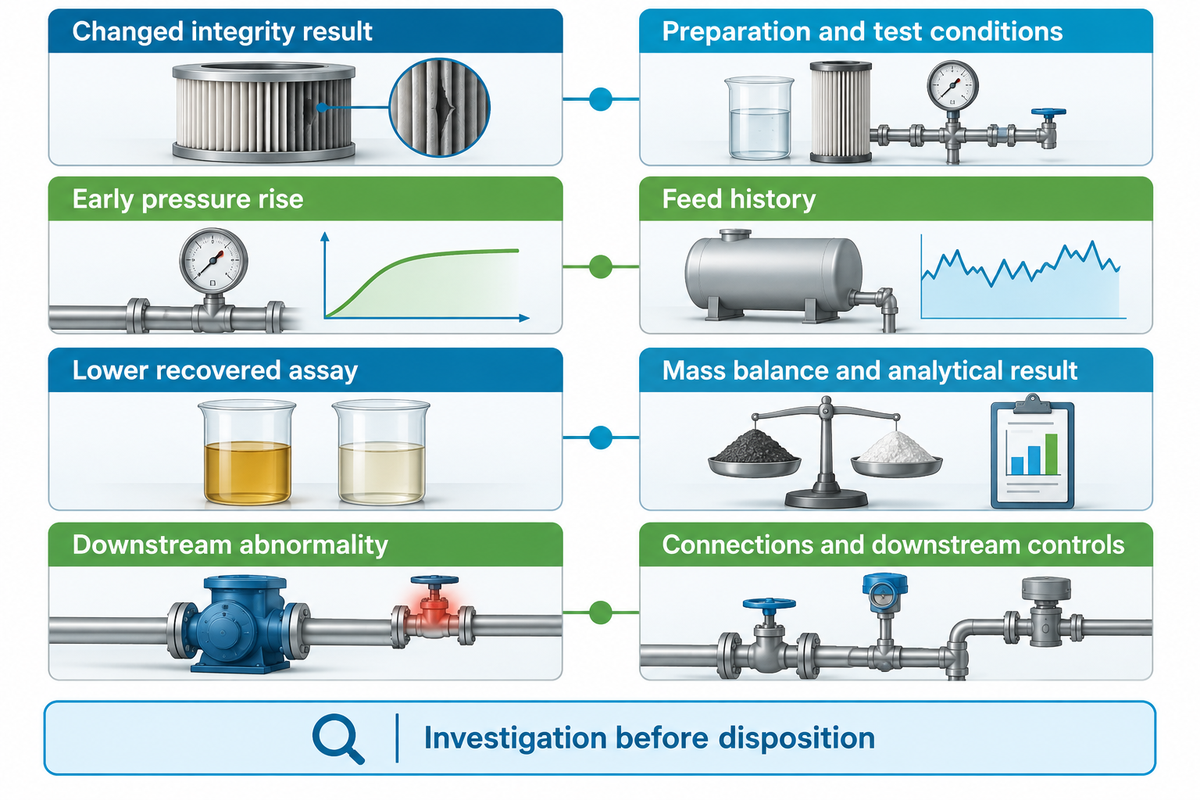
Abnormal results should be separated from their causes, and relevant records should be preserved. Different types of evidence may be required, depending on the cause, e.g. assembly leakage, instrument setting, feed fouling, contamination, downstream contamination. Replacing a cartridge or obtaining a later passing result should be in accordance with an approved and documented investigation, and the abnormal result should be recorded.
Incomplete wetting may give false failed results. Product residues or test fluid may also give abnormal results. Cytiva has a technical discussion of wetting and integrity testing which discusses these. These are possible causes; copying product-specific flushing parameters to an unrelated assembly isn’t to be done.
Start with the earliest departure from the approved record. A change in test results after the change of a wetting fluid vs. a pressure increase after a longer feed hold call for different evaluations. The test file and assembly identity should be frozen prior to a change in conditions, so evaluations made before and after the change can be compared.
| Failure type | Hypothesis to distinguish | Record or evidence to examine | Decision boundary |
|---|---|---|---|
| Integrity result changes with wetting | Incomplete wetting or fluid effect | Approved preparation and original test conditions | A later pass does not explain the first result by itself |
| Gas flow is abnormal | Assembly leak, instrument connection or membrane defect | Test system, seal identity and preserved assembly | Distinguish flow paths before assigning membrane damage |
| Pressure rises earlier than expected | Changed feed or increased fouling | Feed history and pressure-versus-volume record | Increasing area is a process change to assess |
| Flow falls without the expected pressure pattern | Supply, pump or control change | Instrument and process records | The filter is one possible cause |
| Recovered assay is lower | Adsorption, dilution, sample loss or degradation | Mass balance and analytical result | Collected litres alone are insufficient |
| Post-use test follows an interruption | Exposure during stop, restart or transfer | Event sequence and approved hold conditions | Review the interruption as well as the final test |
| Downstream microbial result is abnormal | Filter passage or contamination after filtration | Retention evidence, connections and downstream controls | Preserve multiple hypotheses until assessed |
| Vent performance changes | Wetting, blockage or wrong gas-service condition | Vent identity and vessel-pressure history | Use the qualified gas/vent assessment |
| Product-contact materials change | New chemical or physical interaction | Change record, compatibility and migration evidence | Matching dimensions alone does not close the change |
A table organizes an investigation, not an automatic disposition. For example, a redundant downstream filter has its own identity, testability and validation role. Health Canada’s guidance states that a validated multi-filter arrangement for a sterilizing unit is different from a redundant backup arrangement. In either case, upon failure of the primary filter, an investigation and associated testing of the secondary filter is required.
Do
- Preserve the first abnormal result and assembly identity.
- Compare test conditions with the qualified method.
- Connect feed, interruption and downstream records.
Don’t
- Assign every failed result to a damaged membrane.
- Keep retesting without the approved investigation path.
- Use a replacement element to explain away the earlier batch event.
Several processing records and retained test files provide the opportunity to reduce investigation delay. Quality determines what further work and disposition is appropriate for a given situation.
What protects the sterile path after the membrane?
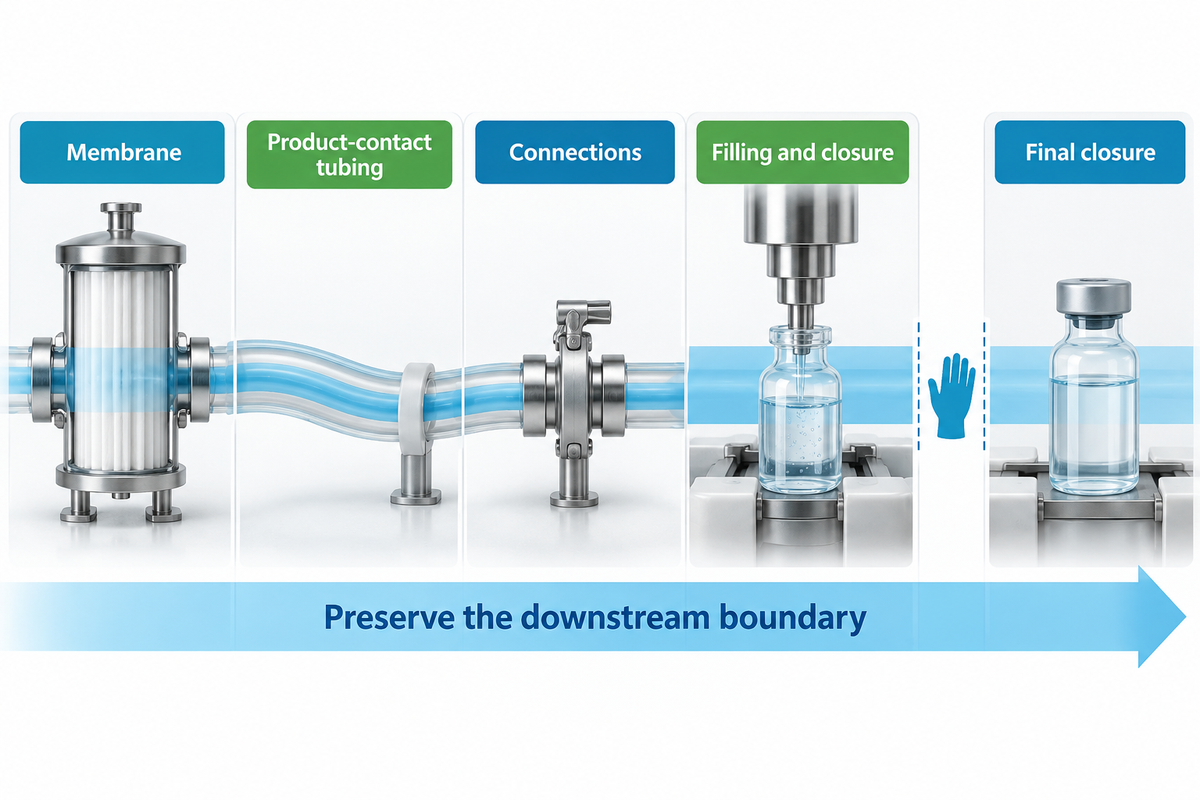
The path of process material (the “sterile path”) includes product contact tubing and connections, filling and closure equipment, and the final closure of the product. Preserving sterility along that path is part of aseptic processing, including during filter wetting, testing, recovery and transfer. System design addresses the state of the membrane and downstream contamination events, which should be documented and controlled separately.
Liquid and gas movements during preparation must be considered alongside product transfer. A 2016 practitioner case by Mok and colleagues describes different downstream boundaries for integrity testing and line conditioning using Merck’s own barrier-filter products. Its product-specific pressures and test recipes belong to those studied assemblies.
Liquid and gas duties also differ. An unintended wetting of a hydrophobic vent filter may not produce the same results as a wetted liquid membrane. Consider the actual use and inspection strategy for a gas or vent filter. Water for injection and purified water systems have their own controls on quality and distribution. A local membrane forms a part of this system.
Laboratory filtration techniques, including syringe filters used with a small sample, should be assessed against the production process. Replacing a small syringe device with a large housing changes retained volume, contact materials and handling. When a replacement meets the dimensions, include the sterile path and the change control implications in your review.
How do throughput and recovered product affect batch cost?
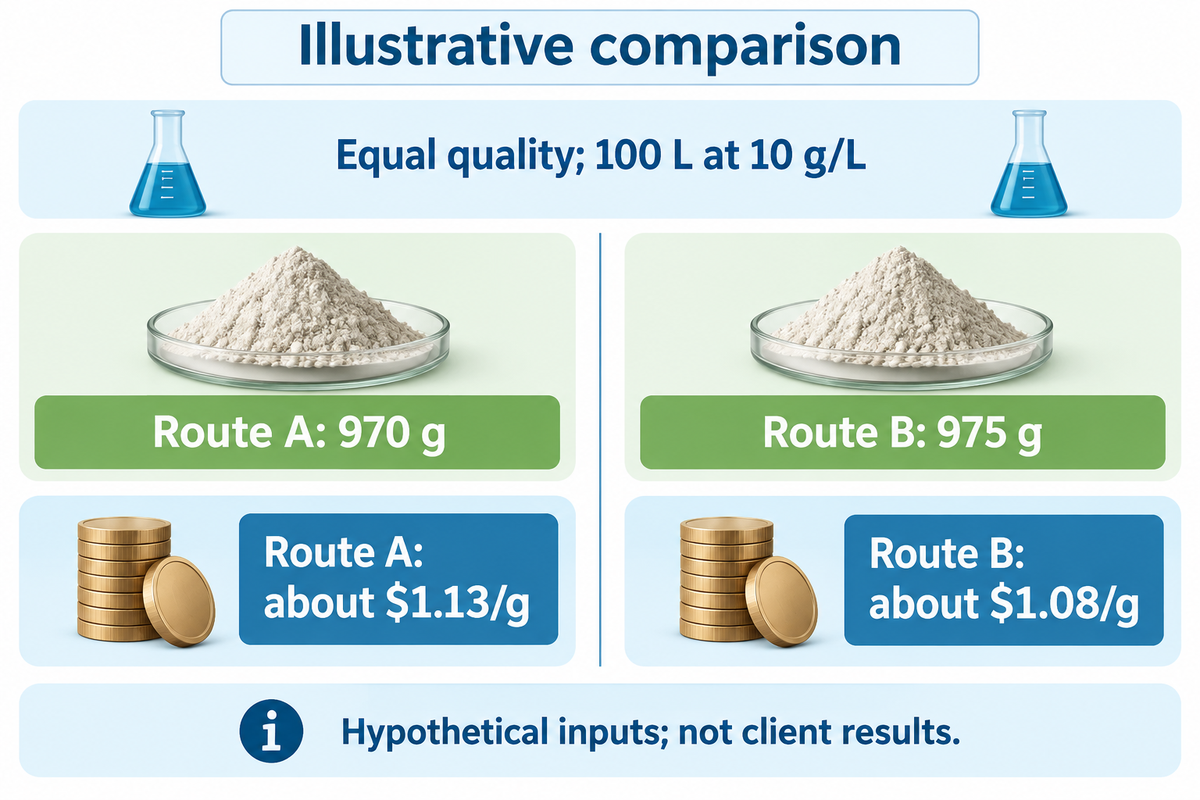
Compare batch economics only after candidate routes meet the necessary quality and process-acceptance criteria. For the product-interaction evidence behind that prerequisite, EMA’s sterilization guideline, Table 3, distinguishes sorption and solution compatibility from retention testing. Then assess the active mass present in the liquid and the volume of liquid collected. Retained liquid, adsorption, dilution, sampling and discarded fractions can alter the acceptable product, even if both routes accomplish the same nominal batch volume.
Recovery-Adjusted Batch Comparison
The example assumes two routes of equal quality, where each processes a 100 L feed at 10 g/L containing 1,000 g of active mass. Retained liquid contains active mass at the feed concentration; adsorption is an additional, separately counted loss. There’s no dilution, degradation, or other loss. Samples and rejected fractions are equal and excluded from the comparison. Monetary values are for illustration only and don’t represent measured results from ECOFILTRONE.
| Input or result | Route A | Route B |
|---|---|---|
| Feed volume and concentration | 100 L at 10 g/L | 100 L at 10 g/L |
| Feed active mass | 1,000 g | 1,000 g |
| Unrecovered retained liquid | 2 L | 0.5 L |
| Active mass in retained liquid | 20 g | 5 g |
| Additional adsorption loss | 10 g | 20 g |
| Collected volume | 98 L | 99.5 L |
| Recovered active mass | 970 g | 975 g |
| Active-mass recovery | 97% | 97.5% |
| Filter-related incremental cost | $200 | $300 |
| Assumed value of lost active | $30/g | $30/g |
| Value of lost active material | $900 | $750 |
| Loss cost plus filter cost | $1,100 | $1,050 |
| Cost per recovered active mass | About $1.13/g | About $1.08/g |
Route A recovers 1,000 − 20 − 10 = 970 g; Route B recovers 1,000 − 5 − 20 = 975 g. The cost calculations are ($200 + 30 g × $30/g) ÷ 970 g and ($300 + 25 g × $30/g) ÷ 975 g. The corresponding collected-liquid concentrations are about 9.90 g/L and 9.80 g/L under the stated assumptions; an actual batch requires measured assay. The example favors Route B within this narrow cost scope, although its adsorption loss and filter expense are higher. Different product values or measured losses can reverse that result.
For measured batch recovery, use the sum of each accepted fraction’s volume multiplied by its assayed concentration. Samples and discarded fractions must be accounted for. A buffer chase adds volume, so litres collected need not track active mass. Keep any already-counted material cost out of the loss calculation to avoid double counting.
This calculation considers the difference in filtration costs, not the total costs to manufacture a batch. Finance can supply the loss value. Production can reconcile the movement of the product. Quality can verify which collected fractions and routes are acceptable. A saving based on lower sampling or unassessed recovery may leave the quality prerequisite unresolved.
Who owns filter evidence and change approval?
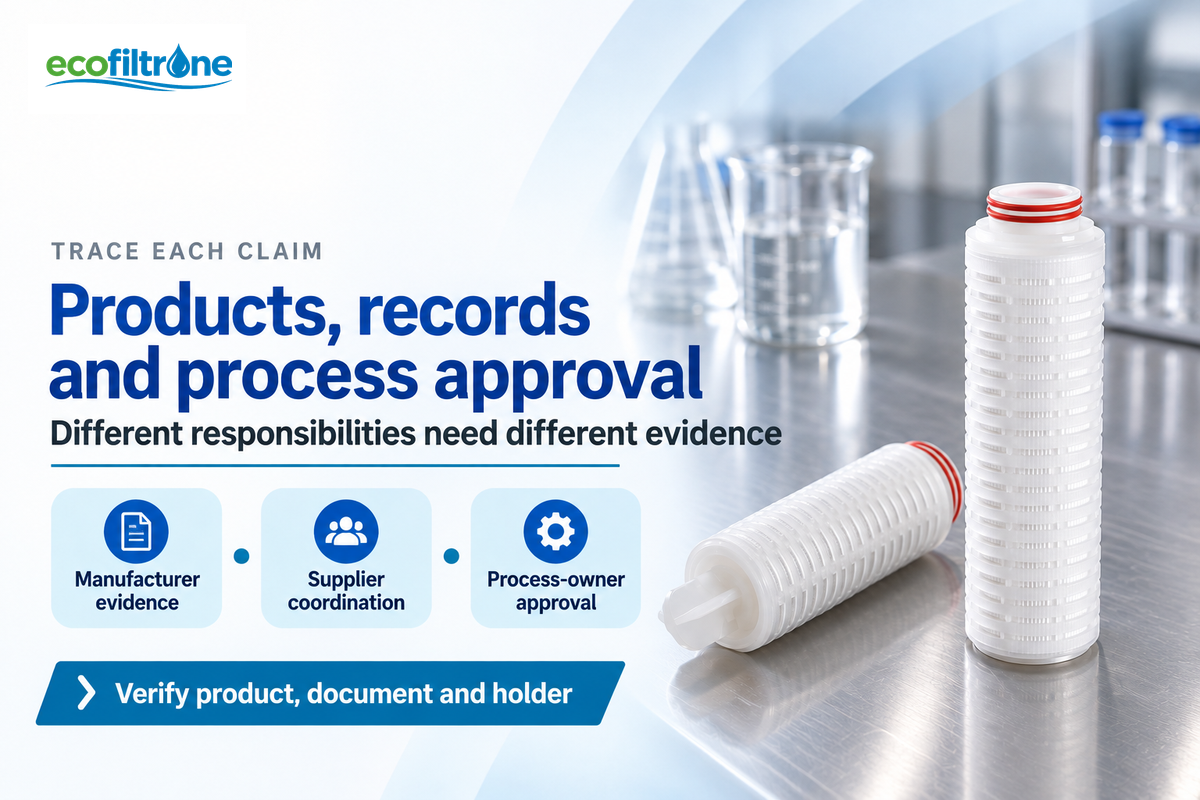
Filter manufacturers provide evidence for identified products and materials; suppliers coordinate the relevant product records; the pharmaceutical process owner evaluates applicability and approves changes through its quality system. Procurement must be able to verify each claim to the document, product, and scope. Different questions are answered by a company certification and a validated drug-filtration process.
ECOFILTRONE™, based in Qingdao, is a supplier and engineering support services company for filtration products. We review customer filtration applications and help determine the most appropriate filtration consumables and replacements and confirm specifications with regard to the requirements of the intended application. For pharmaceutical applications, please refer to our Pharmaceutical and Sterile Filtration solution page to discuss product candidates and supporting records.
Datasheets, records, drawings and compliance documents should identify the product and the certificate holder. If ISO 9001 certification is part of supplier qualification, check its named organization, scope and validity. A quality-management certificate addresses that certified management-system scope; product sterilizing performance and the drug process require their corresponding evidence.
The integrity study is Merck-affiliated, and the membrane comparison comes from university researchers; neither is an ECOFILTRONE product validation. Sartorius and Cytiva publish product-specific information for their products. Matching a material name or external dimension is only one part of evaluating a replacement.
Information on our membrane cartridge families page should assist the process owner in assessing change without replacing the process owner’s change assessment. For a proposed item, compare its records to the intended duty, product-contact assembly and the approved process envelope.
What the 2026 validation practice changes for process teams
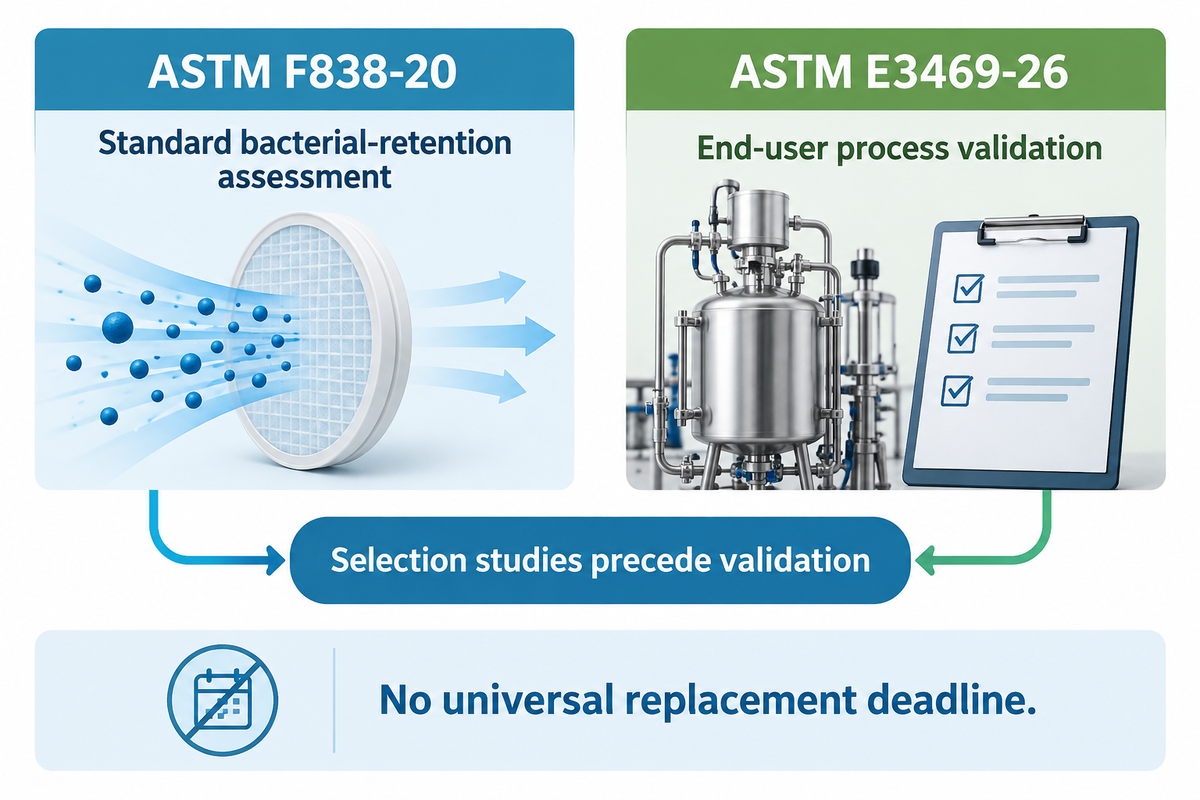
ASTM E3469-26 gives an end-user framework for studying sterilizing-filtration retention under intended product use conditions. Filter-selection studies precede validation. ASTM announced the new practice on May 13, 2026.
“Process validation of sterilizing filtration is required by industry standards and regulatory agencies.”
E3469-26 relates to liquid sterilization and relevant pharmaceutical, biopharmaceutical and biological processing at the steps defined. Compatibility, binding and particle-shedding studies are selection prerequisites. Process teams can map evidence to the prerequisites.
The publication is a standards development, not a universal replacement deadline. Review a proposed new filter, a changed formulation or a changed exposure envelope through the applicable quality and regulatory process. Capture what changes, what evidence remains applicable and what questions need new evaluation. This creates an evidence request for procurement and a pathway for production to implement the change.
Frequently asked questions
Can you re-use pharmaceutical filters?
Filter reuse requires a justified, validated process covering the intended repeated use.
Health Canada’s sterile-drug guidance expects filters to be discarded after a batch and limits use to one working day unless validated otherwise. It also recognizes justified, validated campaign use within a contamination-control strategy. Assess the applicable product, exposure, storage and integrity requirements through the quality system before changing an established filter-use practice.
What is the difference between a 0.2 and a 0.22 µm rated microporous membrane?
FDA’s guidance treats 0.2 and 0.22 µm as interchangeable nominal rating designations in its stated context.
The designation describes a rating, while the identified membrane construction, retention evidence and intended use establish process relevance. Two products carrying those nominal labels can still differ in adsorption, flow and assembly design. Review the applicable product and process evidence rather than treating the last decimal digit as a complete sterile-filtration specification.
What type of integrity testing is required for pharmaceutical filters?
The integrity method and acceptance criteria must suit the specified filter, fluid and validated process.
Relevant methods include bubble point, diffusive flow and pressure hold where appropriate. Apply the required pre-use and post-use strategy under the governing guidance and approved process. Interpret an abnormal result through the quality investigation. The cartridge study discussed in this guide supports complementary methods for its tested devices and instruments, rather than a universal test recipe.
What is sterile production in pharmaceuticals?
Sterile production controls contamination while establishing and preserving the required sterile state of a medicinal product.
Its manufacturing route can involve terminal treatment or aseptic handling of sterile components and product. Filtration is one possible operation within that route. The final container, closure and subsequent handling remain part of the assessment.
How do you prevent contamination during filter changeouts?
Filter changeouts follow an approved procedure that controls product contact, assembly identity and the sterile boundary.
Plan the intervention through the site’s quality system, including isolation, handling, sterilization status and the tests needed before processing resumes. The exact sequence depends on the qualified assembly and production stage. Preserve the identity and records of the removed filter when a deviation is involved. A dimensionally matching replacement can introduce different materials or performance, so include the change assessment rather than treating installation fit as full equivalence. Required downstream controls still apply after the new element is installed.
Do single-use systems remove the need for validation?
Single-use systems still require evidence that the complete assembly suits its intended product and process.
The assessment includes product-contact materials, sterilization, connections, integrity strategy and handling. Supplier product records contribute to that assessment, while the process owner determines applicability and manages changes to the approved use.
Which standards and regulations govern pharmaceutical filtration?
FDA and Health Canada provide jurisdiction-specific drug guidance; ASTM F838 and E3469 address different filtration-validation tasks.
This guide uses FDA aseptic-processing guidance, Health Canada’s sterile-drug production guidance and the European Medicines Agency’s sterilization guideline for their stated scopes. ASTM F838-20 concerns standard bacterial-retention testing, while ASTM E3469-26 provides an end-user validation framework. Their roles differ from a supplier’s quality-management certification. The process owner should identify the governing requirements and current editions in its controlled records, then connect supplier evidence to the proposed filtration step. Adding a standard number to an order does not complete that assessment.
ECOFILTRONE provides candidate selection, replacement and matching as well as product record coordination support. For an application review, provide the timeline for the events, filtration duty of the product and the evidence question that hasn’t been resolved, so production, quality and procurement can define the requirement, and consider a change to the approved process.
Scope and transparency: This guide summarizes public technical sources and process-management principles. It provides an example of cost. ECOFILTRONE’s supplier and engineering support role is different from the pharmaceutical manufacturer’s role for validation and quality disposition. Product-specific documents are reviewed against the identified item, application and actual holder.
Related reading
For the material and rating questions behind this guide, use the linked rating, PES and nylon articles above. Product ranges and application discussions are available through the linked membrane-family and pharmaceutical solution pages.
Filtration selection brief
Bring the operating details that shape the next conversation
Record what is known from the line or process. A complete specification is not required to start.
Useful inputs
- Fluid and processFluid name, process stage, and any compatibility concern.
- Filtration targetRequired result, existing rating, or the issue to solve.
- Flow and run timeTypical flow range, batch size, or expected service interval.
- Installation conditionsHousing or connection details, temperature, pressure, and available space.
Next step
Send the details you have
Use the inquiry form to start a focused discussion and add drawings or photos when they help explain the installation.
Start an inquiry