Get in touch with ECOFILTRONE™ Company



Updated October 2026
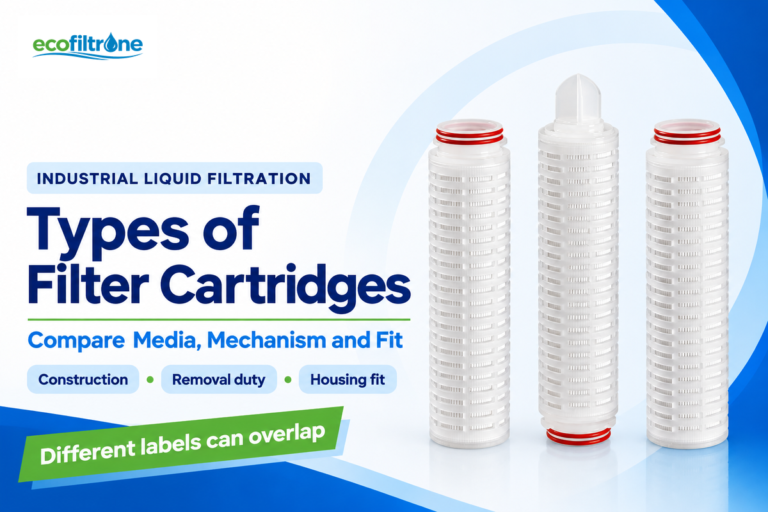
For a pleated vs melt blown filter cartridge comparison, begin with two elements: an adequately graded pleated element where media area and pressure margin are key, and an element of graded depth melt-blown structure for a broad suspended particle load. Compare both at the required retention and operational flow. The better replacement delivers acceptable water at a lower total operating cost.
Pleated vs melt blown filter cartridge selection depends on retention, hydraulic duty and cost per accepted volume. Choose the grade that meets all three. Melt-blown media can also be pleated, so check the finished construction.
Comparison at a glance
- Scope: liquid particulate filtration for industrial water and process service.
- Rating: compare micron size together with removal efficiency and test method.
- Hydraulics: compare pressure drop at the same flow, fluid and temperature.
- Replacement: confirm dimensions, seals, end caps and allowable operating conditions.
Pleated and melt blown filter cartridges: the actual difference
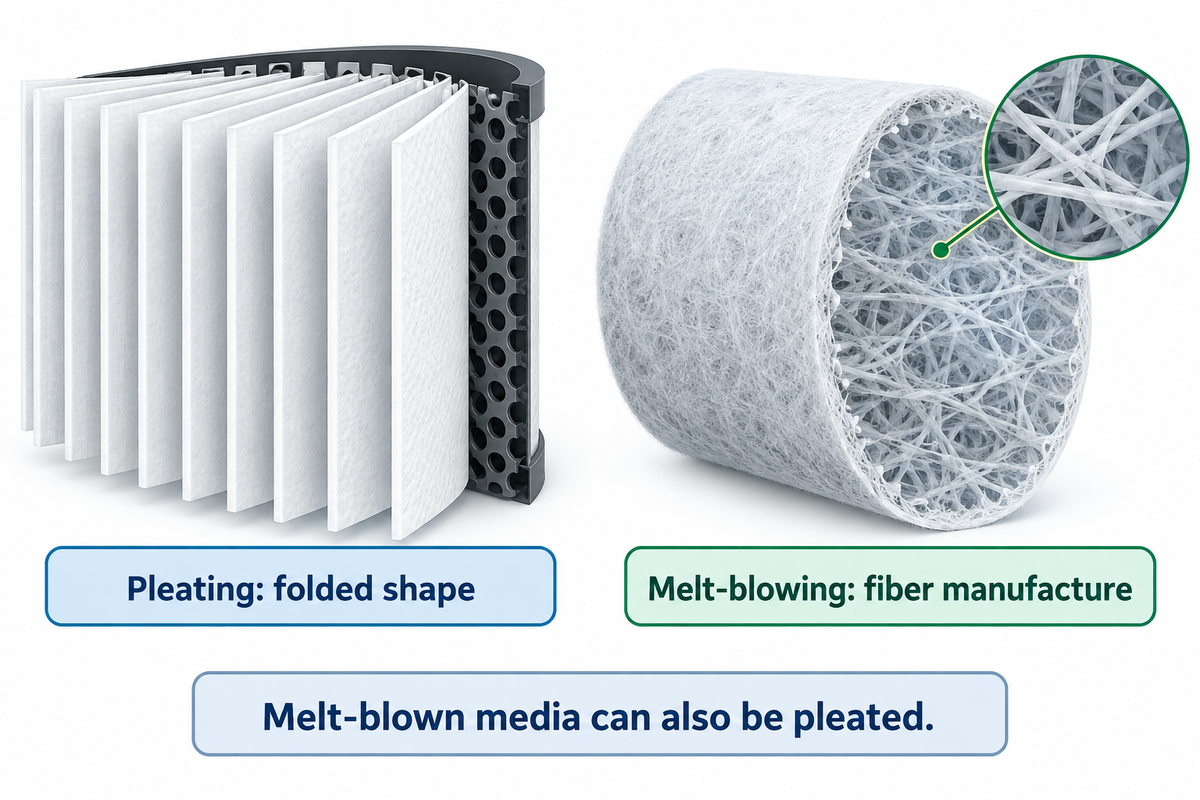
Pleating describes a folded shape; melt-blowing describes how polymer fibers are manufactured. A conventional melt blown filter cartridge is usually a cylindrical depth element, whereas a pleated cartridge folds a sheet around a support. The two descriptions overlap when melt-blown media is formed into pleats.
What is a melt blown filter?
A melt blown filter uses fine fibers taken from molten polymer. Polypropylene fibers are prevalent in this type of filter. In graded-depth designs, larger particles collect toward the outside while finer particles enter smaller passages deeper in the media. Capture may occur throughout the entire depth; the distribution is dependent on pore structure and the incoming solids.
Pleated filter media incorporates a large surface area in a cartridge envelope. The sheet may be a membrane or fibrous depth media. Pall’s melt-blown range includes several geometries, and Parker Poly-Mate X combines melt-blown and spunbonded polypropylene in a pleated-depth construction. These support the argument that “surface vs. depth” is an inadequate buying strategy.
What Is the Difference Between Pleated and Melt Blown Filters?
For purchasing, distinguish conventional cylindrical melt blown cartridges from the particular pleated filter being offered. Then, compare the performance of the finished filter element against the same performance criteria. A label like “PP, 5 micron” leaves a number of decisive fields open.
| Comparison field | Conventional melt-blown depth cartridge | Pleated cartridge |
|---|---|---|
| Construction | Fibrous cylindrical depth structure | Folded sheet, depth media or membrane |
| Capture location | Particles enter the porous media | Depends on the sheet and finished construction |
| Media area | Depends on diameter, length and internal structure | Folds add sheet area within the envelope |
| Micron rating | Nominal or efficiency-defined grades exist | Nominal or efficiency-defined grades exist |
| Efficiency basis | Match particle size, method and removal percentage | Return the same test basis |
| Clean pressure drop | Use the actual grade’s flow curve | Use the actual grade’s flow curve |
| Dirt holding capacity | Match test contaminant and terminal pressure | Match the same contaminant and endpoint |
| Cleaning allowance | Follow the exact finished-product instructions | Pleats alone do not authorize washing |
| Replacement fit | Confirm dimensions and sealing surfaces | Confirm dimensions, cage and end-cap format |
| Cost comparison | Installed cost per accepted service volume | Same calculation, including any cleaning cost |
Why the same micron rating can hide different filtration
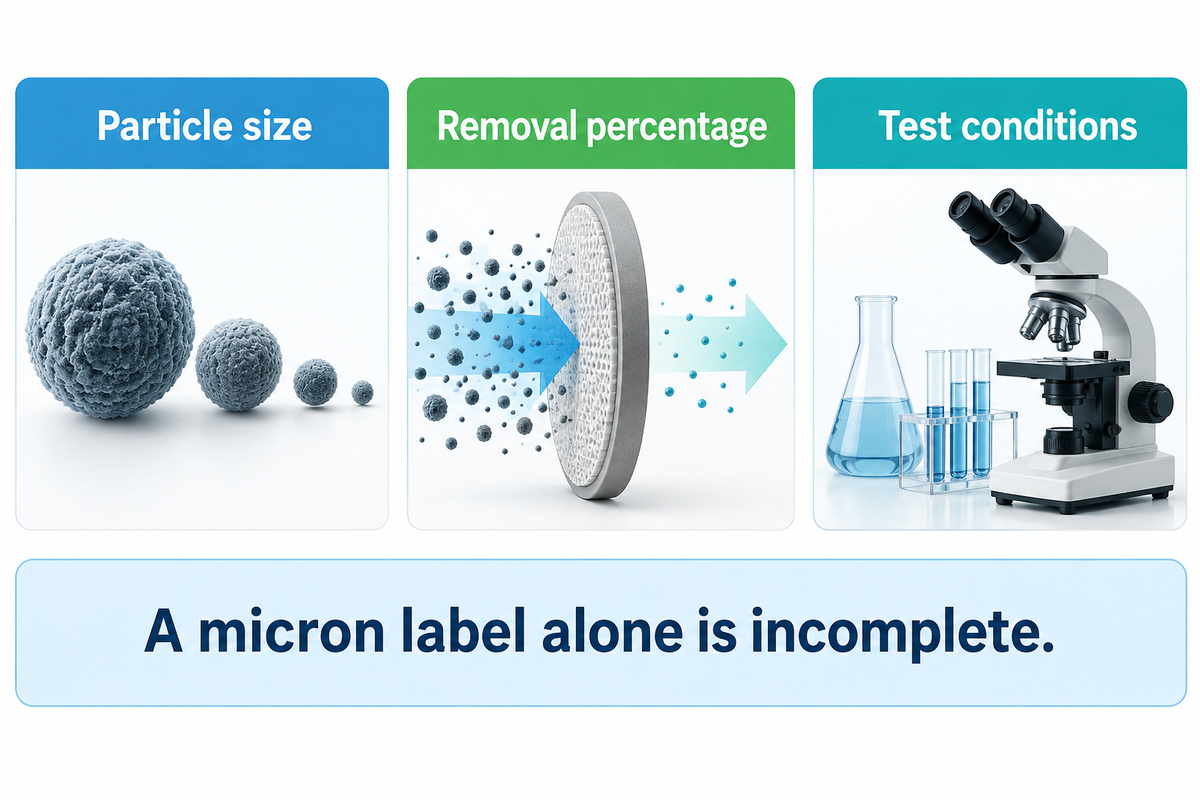
Two cartridges labeled 5 µm can remove different proportions of particles at that size. Consider the stated efficiency, method of counting, and the conditions of the test before evaluating the price. An absolute label requires a definition: a supplier’s test basis determines the meaning of that grade for your liquid and target contaminant.
For example, Pentair’s P Series page lists nominal 1, 5 and 25 µm grades. Parker’s Poly-Mate X family specifies 99% efficiency at its stated micron rating. These are different specification formats. Ask both suppliers to return a removal curve or grade definition on an equal basis.
Measurement basis matters too. Bogdanowicz and colleagues’ 2023 microplastic study found similar particle-count removal but different volumetric efficiencies in short tests of melt-blown depth and pleated cellulose samples. Its 30-minute experiments weren’t service-life trials. For water filtration specifications, identify whether filtration efficiency is measured by particle number or mass, and which size range must meet the limit.
ISO 16889:2022 describes a multipass test for hydraulic-fluid-power filter elements. A reference to that method should identify the tested product and conditions; it is not a general certificate for industrial water purification. Our guide to interpreting filter micron ratings explains the rating terminology in more detail.
Flow rate, pressure drop and filter core limits
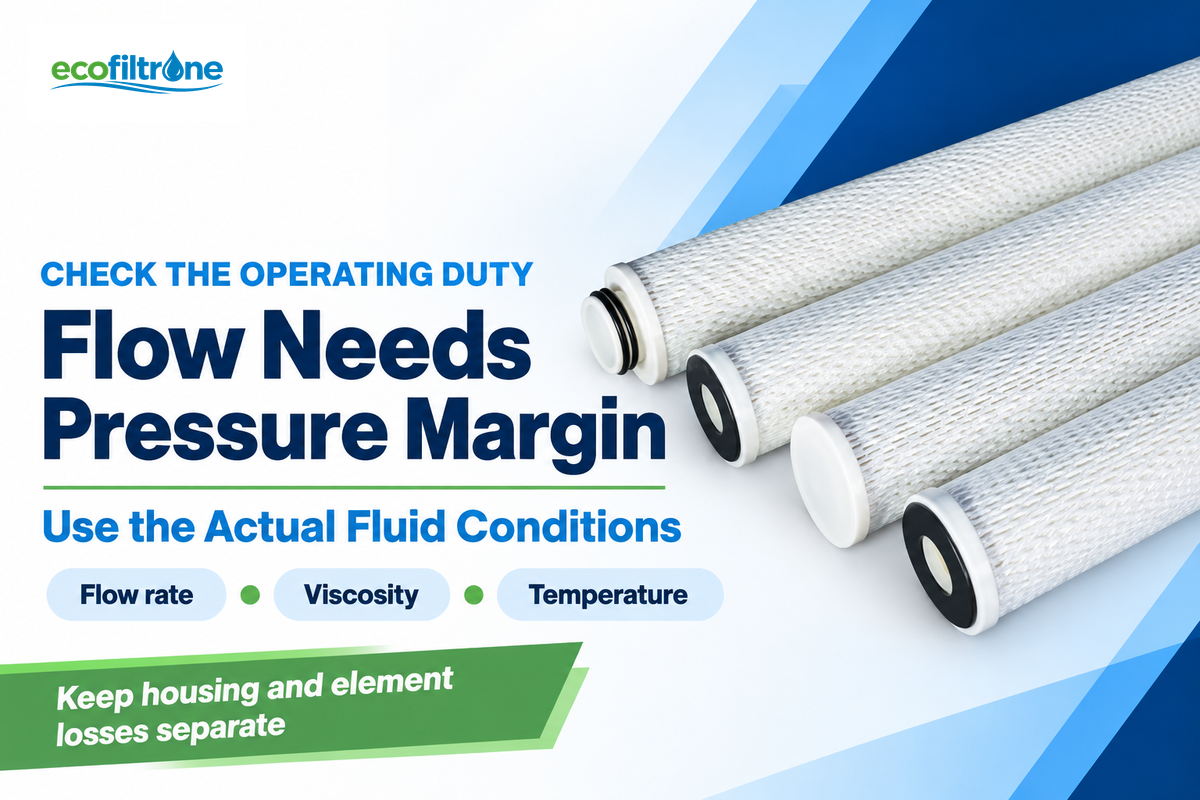
Compare clean pressure drop at the same flow rate and liquid viscosity and temperature, then assess the allowable loaded condition. More pleated area can reduce flow through each unit of media, but media resistance and cartridge construction still matter. The filter core, cage and seals must tolerate the intended operating duty. For a product-specific example, Parker’s Poly-Mate X specification lists a changeout pressure differential and a maximum operating temperature.
Consider a skid requiring 20 m³/h to be divided among 10 equally loaded elements. The comparison would be 2 m³/h per element, not the maximum flow the element can handle. Ask for each candidate’s clean curve at that duty and your actual process fluid. You should consider how increased viscosity would consume the available pressure margin. What looks good on a warm water curve may require more elements or a different grade. Keep the housing loss separate from the element loss, and check that the pump can maintain the required flow without exceeding the equipment limits.
A pressure drop through a filter isn’t the same as the operating pressure of the system. When talking about higher flow, there should be a compatible filter housing and seal arrangement. High flow rates on a catalog page don’t remove these constraints.
Dirt holding and service life: which cartridge lasts longer?
The cartridge that delivers more acceptable filtrate before reaching a defined quality or operating limit under comparable feed conditions is typically the longer lasting of the two. Pleated construction can provide more media area; a depth filter can distribute captured solids internally. Neither advantage guarantees the greater service volume in every application.
Reported dirt holding is useful only with the test dust, flow and terminal differential pressure. A high dirt-holding capacity measured with one particle distribution may not be indicative of sticky solids or changes in the wastewater stream. Farhat and colleagues conducted a 2020 full-scale desalination study in which they assessed seven cartridge types based on produced-water volume, quality and operating cost. The cost of electricity also affected the economic replacement point.
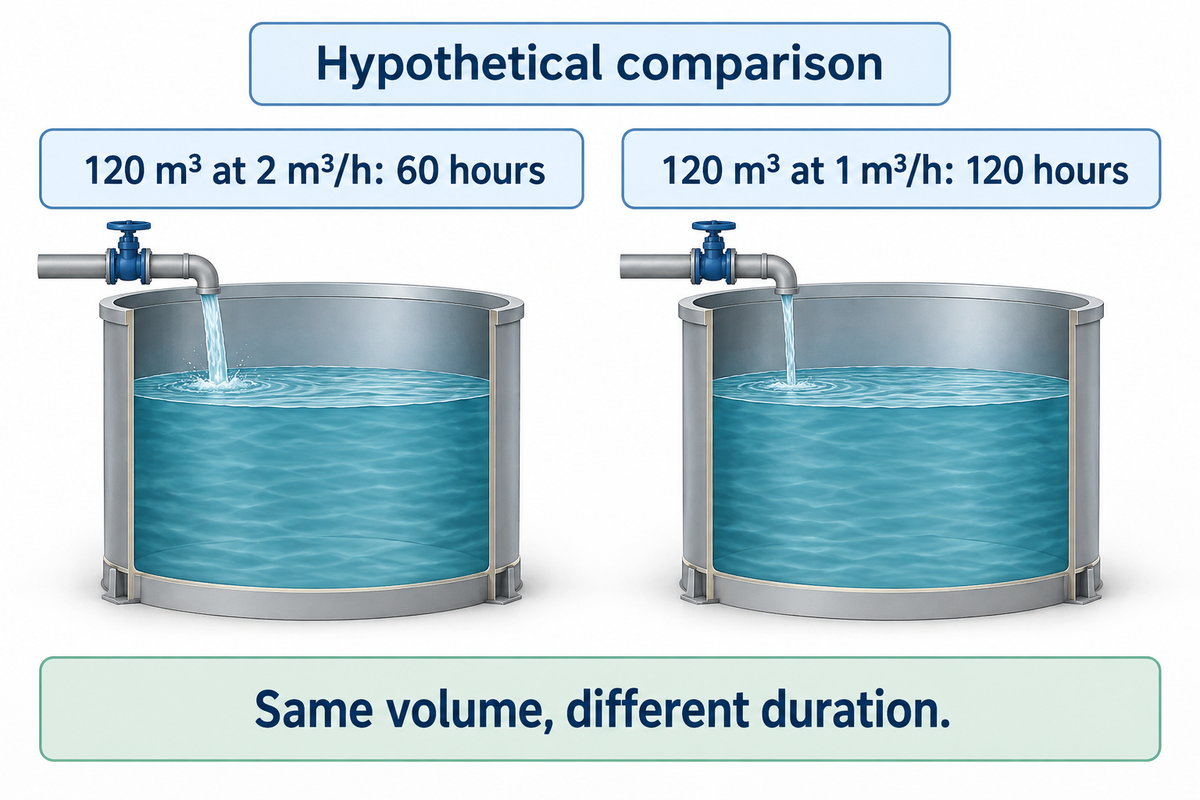
Changes in production rate are masked by calendar days in the filtration process. A hypothetical 120 m³ run at 2 m³/h lasts 60 hours; the same volume at 1 m³/h lasts 120 hours. The second example isn’t twice the treatment capacity. Record the accepted volume alongside the flow and the reason for changeout. If a “longer life” offer includes water produced beyond the quality limit, that volume shouldn’t be taken into consideration.
Detailed loading diagnosis belongs in our melt-blown cartridge operating guide; use the comparison here to decide which candidate deserves a controlled trial.
Can pleated cartridges be cleaned and reused?
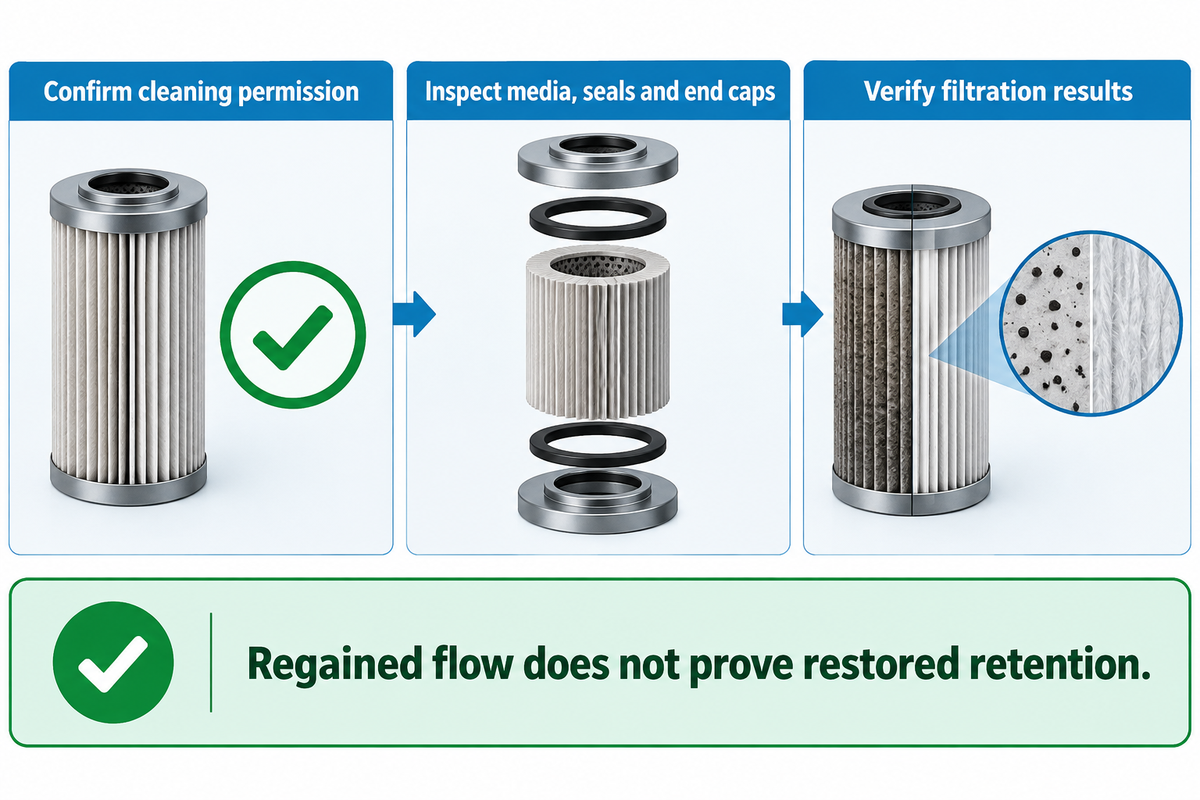
Some grades of pleated cartridges can be cleaned and reused, while others are disposable. Decide from the finished cartridge’s instructions, material and required post-cleaning performance. Removal of visible dirt from the surface of the filter doesn’t mean that its retention, seals and/or application-specific cleanliness have been restored.
The material exception is clear in UGA Extension’s household-water bulletin, which identifies pleated paper cartridges as non-reusable for household and well water treatment. Separately, an Ulster University research record describes the successful regeneration of some pleated samples for household water. These results shouldn’t be generalized to all cases.
Parker states that their named Poly-Mate X design is backwashable. For an industrial cleaning proposal, obtain the applicable procedure and acceptance criteria for the model offered. Include cleaning labor, liquid consumption and disposal in the cost. Where microbiological quality is of concern, retain the plant’s validated hygiene controls. A rinsed sediment element isn’t a sterilizing filter.
Do
- Confirm cleaning permission for the exact grade.
- Inspect media, seals and end caps after cleaning.
- Verify the agreed filtration results before reuse.
Don’t
- Infer reuse from the presence of pleats.
- Apply a household washing method to process media.
- Count regained flow as proof of restored retention.
Selecting a cartridge for RO and industrial water treatment
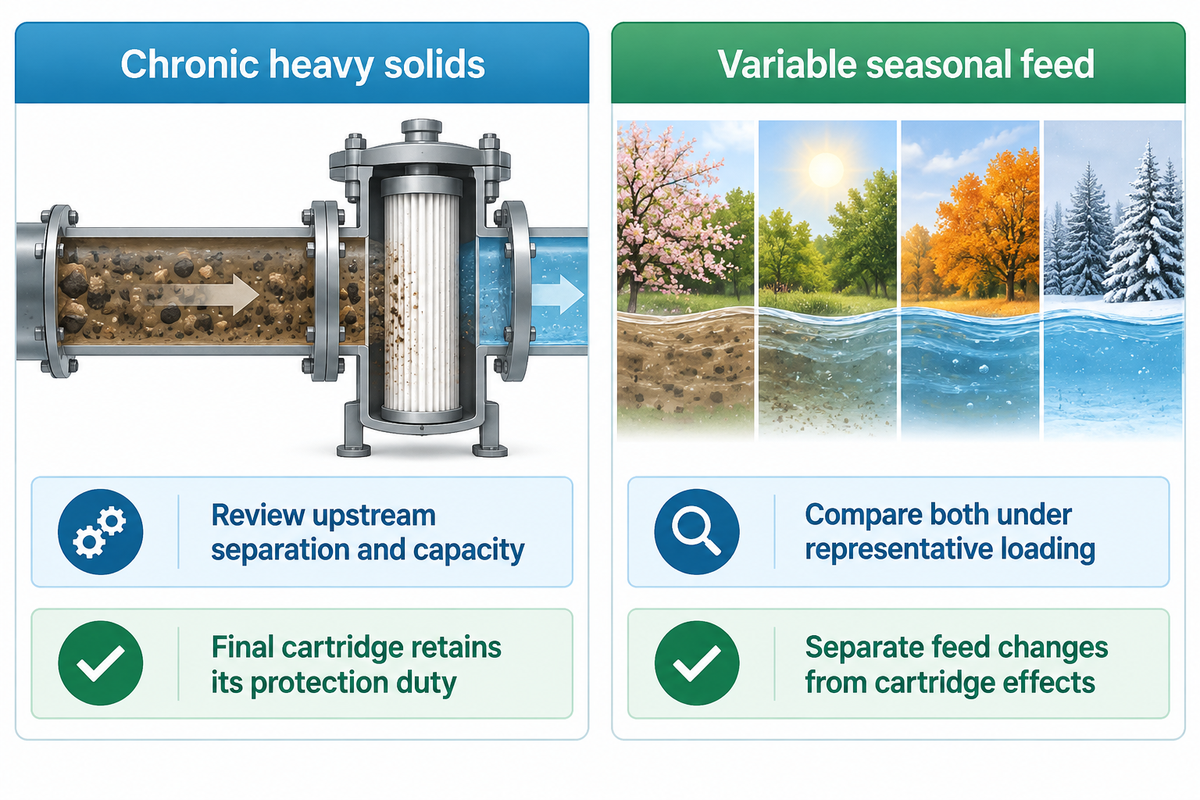
Determine the final cartridge in reverse osmosis (RO) pretreatment around the membrane system’s specified protection requirement. Use feed analysis to choose trial candidates, and address chronic bulk solids upstream. Changing from melt-blown to pleated or choosing a coarser rating does not fix an overloaded pretreatment system.
Suppose a coastal plant sees rapid cartridge plugging after an upstream media-filter backwash. Buying a more expensive pleated element may increase the interval, but first examine the solids arriving during the rinse and return-to-service period. Wes Byrne, in his discussion of RO treatment errors, details how failures in media-filter operation can result in solid-bearing upstream feeds being passed to downstream cartridge elements. Keep the required final retention grade while investigating the source. Compare candidates during representative feed windows, including that transient if it is part of normal operation. A clear-water trial, as described, addresses a different operating question.
| Operating condition | Candidate direction | Condition before approval |
|---|---|---|
| Low solids, limited pressure margin | Evaluate a suitable pleated grade | Curve supports required flow at actual viscosity |
| Broad suspended sediment distribution | Evaluate graded-depth melt-blown media | Filtrate meets the specified removal target |
| Variable seasonal feed | Compare both under representative loading | Separate feed changes from cartridge effects |
| Chronic heavy solids | Review upstream separation and capacity | Final cartridge retains its protection duty |
| Strict fine-particle limit | Choose an efficiency-defined grade in either construction | Method and particle-size interval match the requirement |
| Viscous process liquid | Compare media area and measured resistance | Allowable flow and pressure are confirmed |
| High changeout labor cost | Trial a candidate with higher accepted volume | Cost advantage persists across comparable runs |
| Proposed wash-and-reuse service | Consider only a documented cleanable product | Post-cleaning quality and integrity meet the application |
| Uncertain end-cap or seal fit | Hold the substitution for drawing review | Dimensions and sealing interface match |
| Biological fouling concern | Review the wider pretreatment and hygiene program | Particulate performance is not the sole quality endpoint |
A typical sediment pre-filtration targets suspended impurity and not dissolved salts. RO pre-filtration also integrates into a larger treatment system; Dehwah and colleagues observed microbial regrowth in cartridges used for seawater pretreatment. Their finding does not rank these two constructions, but it explains why particle removal alone cannot stand in for biological control.
When does a pleated filter cartridge pay back?
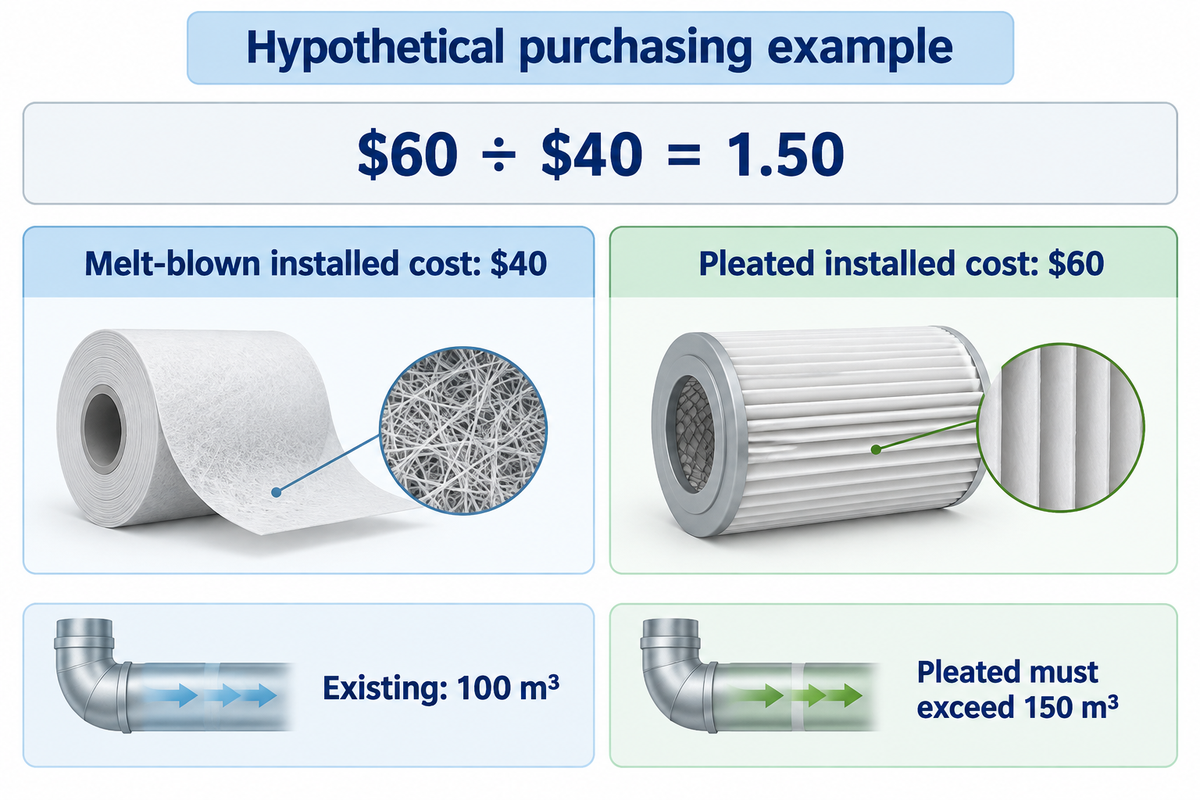
A pleated cartridge reduces installed-cartridge cost per accepted volume when its service-volume advantage exceeds its installed-cost premium. Compare equivalent water quality and hydraulic load. Apparent savings near the threshold warrant further measurement.
Cartridge Premium Threshold
Cartridge Premium Threshold is the accepted-volume multiplier needed to offset a higher comparable cartridge change cost.
It’s calculated as pleated installed change cost ÷ melt-blown installed change cost. “Accepted volume” means water that meets all pre-determined application quality criteria, not every cubic meter that flows through the outlet. For a full-cost comparison, consider energy, cleaning, waste disposal, and loss in product quality, consistently.
Here’s a hypothetical purchasing example in US dollars. A melt-blown element costs $20 and a pleated alternative costs $40. Assume each change adds $20 in labor and handling, giving installed costs of $40 and $60. Dividing $60 by $40 gives a threshold of 1.50. If the existing cartridge delivers 100 m³ of accepted water, the pleated alternative must exceed 150 m³ to reduce this cost component. At 150 m³, they break even at $0.40/m³. At an assumed 180 m³, the pleated case would be $0.333/m³ before any differences in energy or other omitted costs.
| Labor and handling per change | Melt-blown installed cost | Pleated installed cost | Required accepted-volume multiplier |
|---|---|---|---|
| $0 | $20 | $40 | More than 2.00× |
| $20 | $40 | $60 | More than 1.50× |
| $60 | $80 | $100 | More than 1.25× |
Repeat the comparison over representative feed conditions. NIST’s experimental-design guidance explains how time, operators and other nuisance factors can alter measured results. If uncertain service-volume measurements fall on both sides of your threshold, keep collecting matched data. The arithmetic can be exact while the operating inputs remain uncertain.
“Block what you can, randomize what you cannot.”
Check polypropylene media, seals and replacement fit
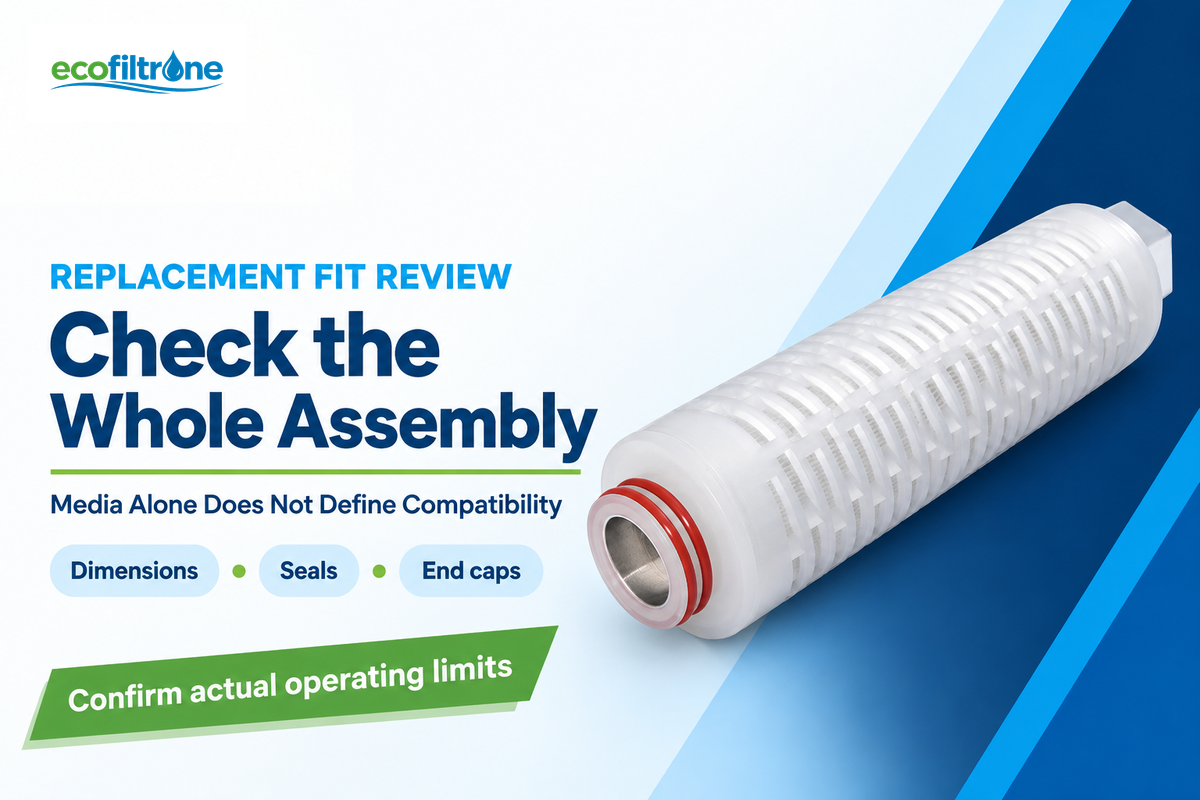
Cartridge dimensions, end-cap interface, seal material and operating limits together determine replacement fit. An element made from polypropylene can also include a different gasket, support or connecting element. For specific applications, review the whole assembly against the process fluid, temperature and pressure, especially when changing the type of cartridge.
Compatibility for the actual service concentration and temperature should be assessed for chemical industry service, not the polymer name alone. For food and beverage filtration applications, it’s necessary to specify the product documentation and specify the intended contact conditions. The company’s quality management system certificate and a product-specific compliance document address different concerns.
Nominal 10-inch and 20-inch descriptions are useful identifiers, not dimensional drawings. Verify actual lengths, diameters and tolerances prior to approving a replacement. To aid in the identification of the interface for technical review, consult the end-cap configuration reference.
Compare supplier offers with a matched specification
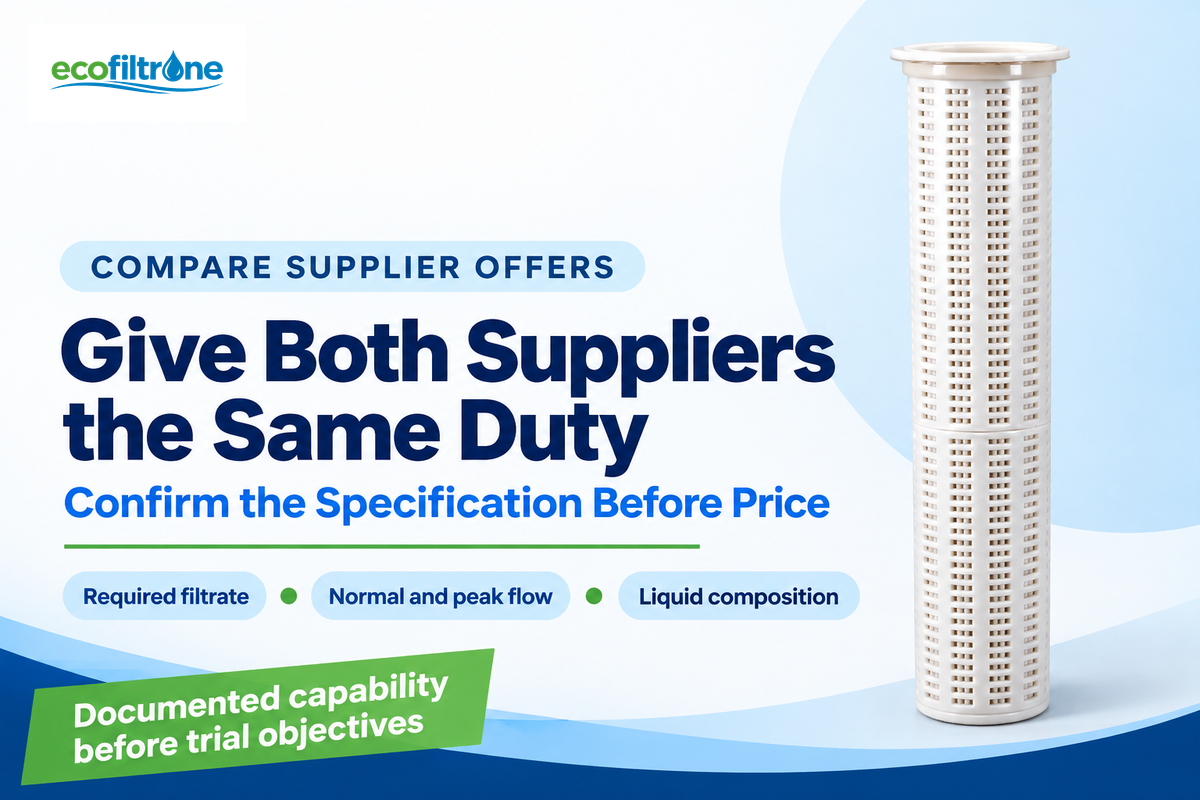
Maintain the same operating duty for both suppliers and evaluate their prices only after they have both provided comparable responses. Begin with the required filtrate quality, normal and peak flow, liquid composition and the housing, if any, in which the element is installed. Separate documented filtration capabilities from proposed trial objectives so procurement, engineering and maintenance are approving the same replacement. The full-scale desalination cartridge study provides a published example of comparing produced-water volume, quality and operating cost together.
ECOFILTRONE™ is a Qingdao-based industrial filtration supplier with engineering support. We provide application and specification review, and matching replacements. Support can be provided for customized configurations, samples and trials. The industrial liquid filter bags are part of our product portfolio, if the filtration solution requires an alternate element format. Our market focus is the Middle East, Southeast Asia, North Africa, South Asia, and Latin America.
Useful information to provide includes the current cartridge model, drawing or photographs, seal details, and operating records. Identify the required technical, material, and compliance documents. We coordinate technical reviews, inspections and confirmations during the course of an order, and support compatibility checks, differential-pressure analysis and service life checks. Required documents are checked for the specific product and actual certificate holder.
Engineering and quality review
- Agree on removal target and test method.
- Confirm curves, dimensions and materials.
- Define accepted filtrate and trial conditions.
Procurement and maintenance review
- Compare the same documented duty.
- Include changeout and handling costs.
- Agree on supply terms and performance follow-up.
Use the 3-Crossover Cartridge Test before switching
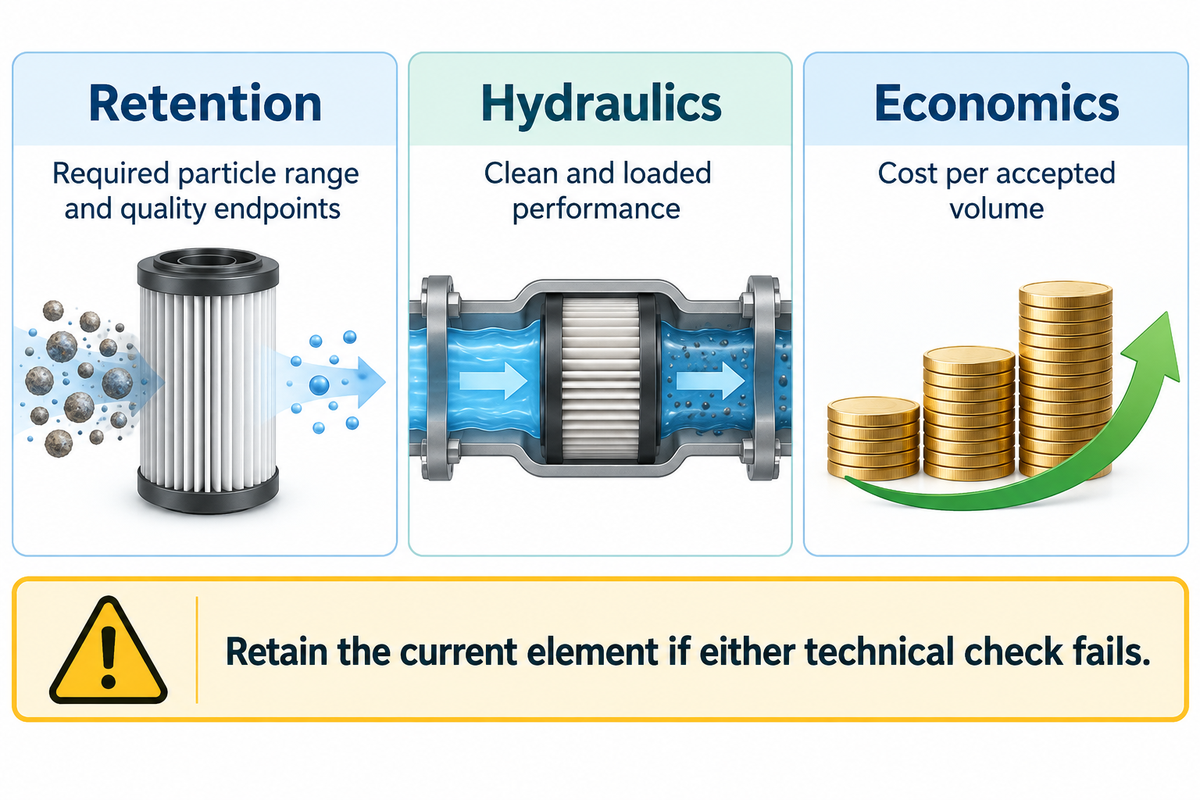
3-Crossover Cartridge Test is an editorial decision method: check acceptable retention, workable hydraulics and lower relevant cost before approving a substitution. Perform checks in that order. An acceptable price won’t improve poor filtrate quality or insufficient flow, and an otherwise acceptable candidate still requires a reason to replace the element, economically.
- Retention: compare the required particle range, efficiency basis and all applicable quality endpoints.
- Hydraulics: confirm clean and loaded performance at your operating flow and fluid conditions.
- Economics: compare costs per accepted volume across representative, matched operating conditions.
Retain the current element if the candidate fails either technical check. Trial a technically suitable alternative when its expected service volume could justify the premium. Approve a change only after the measured benefit holds within the uncertainty of comparison. Review our pleated cartridge configuration options to select a candidate for this review.
Frequently asked questions
What are pleated filter cartridges?
Read answer
A pleated filter cartridge folds a sheet of filtration media around a supporting structure to place more media within the cartridge envelope. The sheet can use different materials and retention grades. Pleating describes its shape; it doesn’t by itself establish a micron efficiency, a cleaning allowance, chemical compatibility or a guaranteed service life.
What is a melt blown filter cartridge?
Read answer
A melt blown filter cartridge uses fine polymer fibers produced from molten material. Conventional cylindrical designs capture particles within a porous depth structure, often with a density gradient. However, melt blown media can also appear in other geometries. Check the finished product specification rather than assuming every cartridge made by this process performs identically.
What is the benefit of a density gradient?
Read answer
A density gradient can distribute captured material through different parts of a depth filter rather than concentrating all loading at one face. Its practical benefit depends on the particle distribution, the structure and the operating conditions. It doesn’t establish a stated removal efficiency or guarantee longer life than a particular pleated alternative under the same duty.
Does a sediment cartridge remove dissolved salts?
Read answer
A sediment cartridge targets suspended particles. Dissolved salts need a treatment process designed for dissolved contaminants, such as an appropriately specified membrane system. Choosing fine filters for sediment doesn’t turn either pleated or melt blown media into desalination equipment.
Why does a new cartridge clog too quickly?
Read answer
Rapid plugging can reflect heavy incoming solids, an unsuitable grade, inadequate filter area or changed fluid conditions. It doesn’t establish that the other construction will solve the problem. Record flow, temperature, clean and loaded differential pressure, feed changes and filtrate quality. Compare these observations with the selected cartridge and housing limits, then decide whether the candidate element, cartridge count or upstream treatment needs review. Keep the required downstream protection when changing the rating.
Can a string-wound filter replace either type?
Read answer
Possibly, when its specified retention, materials, hydraulic performance and dimensions meet the same duty. String wound filters use another media construction. Wound filter cartridges should be compared by their exact grade and supporting evidence before a replacement is approved.
What should I send for replacement matching?
Read answer
Send the installed element model, dimensions, end-cap and seal details, plus a drawing or clear photographs. Include the liquid composition, temperature, operating and peak flow, required filtrate quality, and observed differential pressure at changeout. Identify whether the existing rating is nominal or efficiency-defined. These details let the supplier compare a proposed replacement against the actual application instead of matching only a catalogue name. State any required material or compliance documents and the certificate holder scope that must be checked. Include any agreed sample acceptance conditions.
Compare your replacement options
Share the installed cartridge details, operating flow and required filtrate quality with ECOFILTRONE. We can review the application, check the proposed replacement specification and discuss sample or trial requirements for your liquid filtration needs. Include the changeout conditions so the comparison addresses performance and operating cost together.
This comparison uses published technical data along with an Editorial Decision Method. Named product specifications belong to their respective manufacturers. The cost example uses hypothetical data and isn’t a quotation or an ECOFILTRONE customer result.
References & Sources
- Bogdanowicz et al., Performance of filters applied for removal of microplastics from water, 2023
- Farhat et al., Cartridge filter selection and replacement, 2020
- UGA Extension, Mechanical Filtration Methods and Devices, reviewed 2026
- Afkhami et al., Assessment of low-cost cartridge filters, 2021
- Dehwah et al., Microbial assembly in seawater reverse osmosis pretreatment, 2019
- NIST/SEMATECH e-Handbook, Randomized Block Designs
- ISO 16889:2022, public scope and edition record
- Wes Byrne, Mistakes to Avoid in RO Treatment Systems, 2011