Get in touch with ECOFILTRONE™ Company



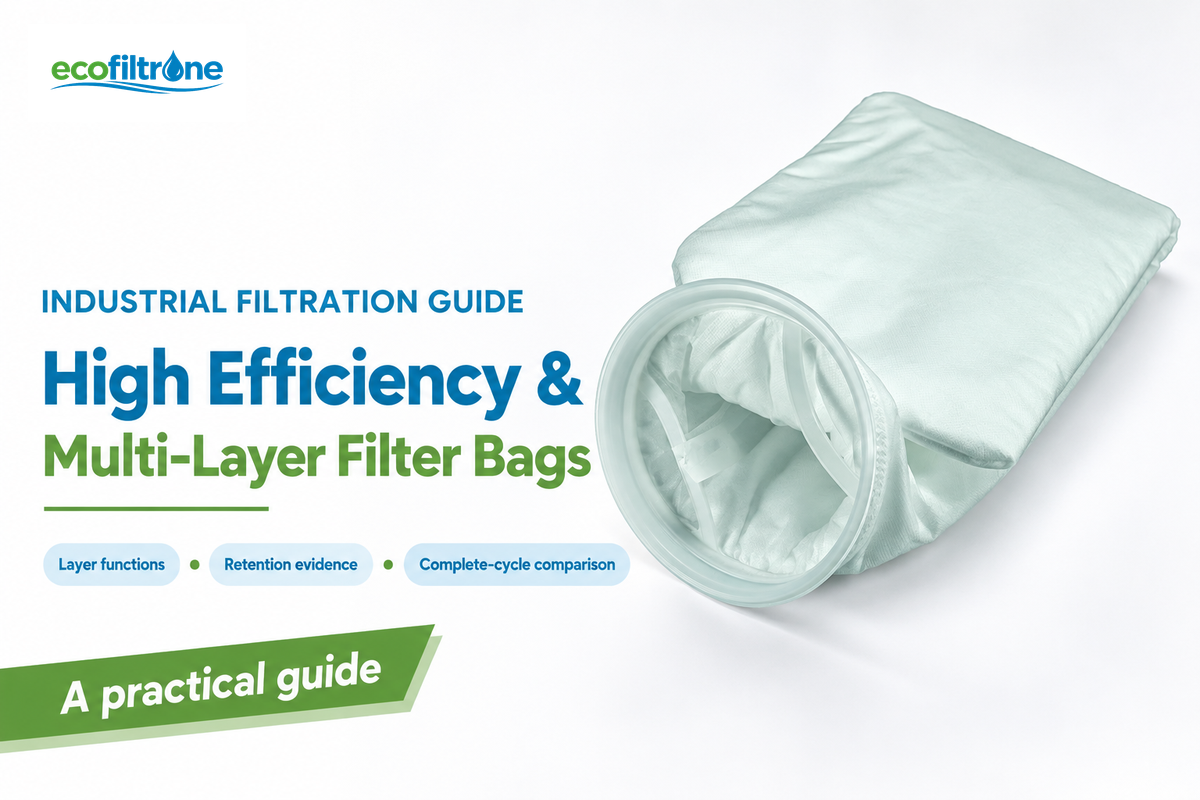
High Efficiency and Multi-Layer Filter Bags refer to two related ideas: how a bag is built and how well it removes particles. Understanding this connection explains how a bag can run longer and produce less acceptable liquid or show a minor pressure rise while the outlet quality changes.
Quick guide
Service: industrial liquid filtration. Construction: media with separate capture, support or protection functions. Performance: particle removal at a stated size and liquid duty. Comparison basis: acceptable output through the operating cycle.
High Efficiency and Multi-Layer Filter Bags combine staged media construction with a measured retention requirement. Compare layers by their functions. Judge particle removal. Assess usable output over a complete filtration cycle.
Key takeaways
- A cover or support layer may protect the assembly without providing a finer particle cut.
- Efficiency belongs to a particle size, measurement method and operating condition.
- Pressure drop and outlet quality answer different questions.
- Startup, loaded operation, endpoint and restart observations reveal different parts of a filter run.
For available constructions and application matching, see our high efficiency and multi-layer filter bag solutions. The following guide helps to interpret their behavior.
Layer Functions and the Direction of Liquid Flow
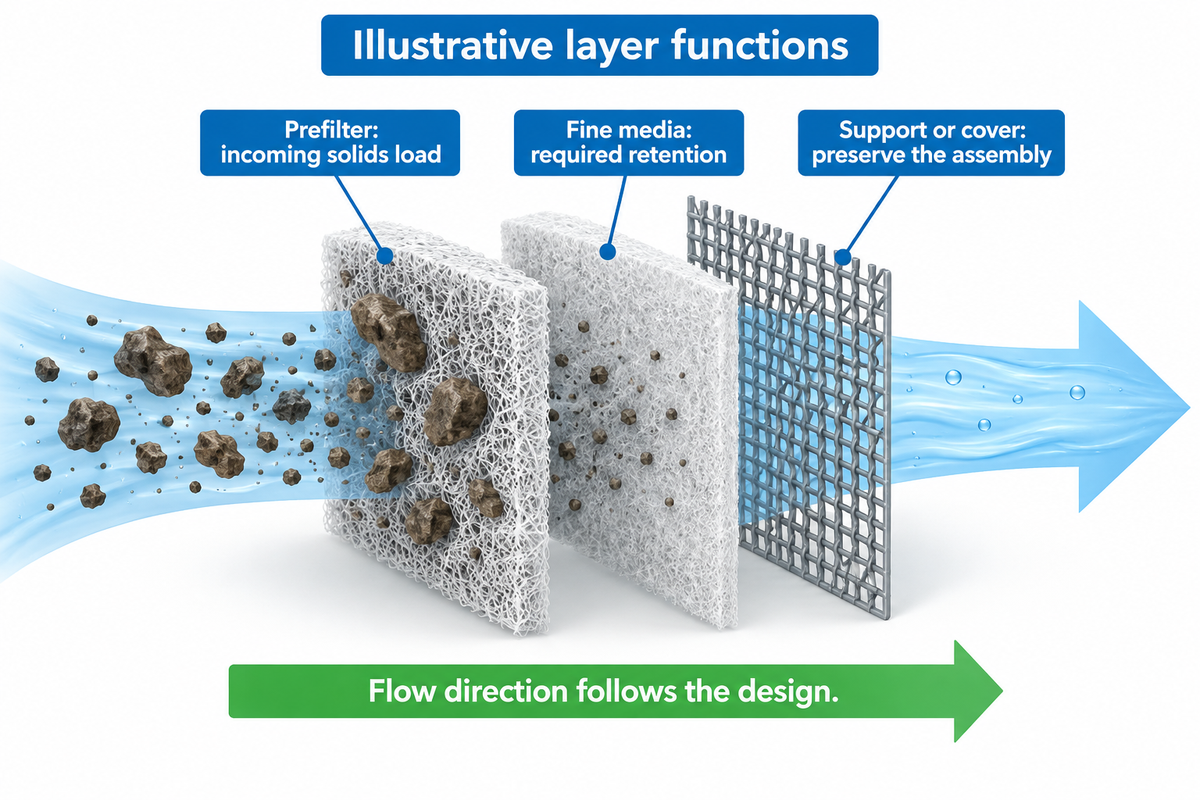
The components of multilayer filtration bags work like a sequence of workstations; each has a job to do, and the order of the components matters. A prefilter, for example, handles part of the incoming solids load, and finer media provide the required retention. Supporting or covering layers may help preserve the assembly. Count the functions and compare the number of layers.
How do multilayer filter bags work?
Multilayer filter bags pass liquid through an arranged combination of media so that capture and supporting functions can be shared. A staged construction can place a prefilter ahead of finer media, while another layer controls fiber migration. The direction of the flow follows the design of the bags. Thus, upstream and downstream describe the service positions of the components more appropriately than inner and outer.
Eaton references a pleated prefilter, final filter layers and a webbed cover in its LOFCLEAR 500 description. Each of these is a functional element of this device. For an industry explanation of staged capture, see the discussion of graded meltblown media by Callaert. The descriptions of layered construction and graded meltblown media help readers interpret a construction drawing without assuming every multilayer bag uses the same design.
| Feature | Job to identify | Observation to connect |
|---|---|---|
| Prefilter | Receives the feed before finer retention media | Where coarse material first accumulates |
| Fine retention medium | Provides the specified particle-removal duty | Outlet particle counts at the target size |
| Graded media depth | Distributes capture through a stated arrangement | Loading pattern through the used media |
| Cover layer | Contains or protects the underlying media | Fibers or fragments in downstream samples |
| Supporting layer | Helps maintain the intended media shape | Distortion after the operating cycle |
| Flow orientation | Places the media in the intended service order | Drawing arrows and installed arrangement |
| Seam or bonded joint | Closes the media into the bag form | Local damage or a concentrated solids track |
| Sealing interface | Directs flow through the media assembly | Condition of the fitted interface |
| Basket and housing | Support and locate the complete bag | Support contact and installation compatibility |
The table separates assembly and media functions. It doesn’t describe a nine-layer structure. Quality control can use the outlet observations while maintenance notes physical conditions and procurement identifies the correct drawing revision.
When extra layers are added to a quotation, each layer must be assigned a function before payment. An additional retention layer, for example, solves a different problem from an additional support layer. More basic aspects of bag construction are covered in our liquid filter bags guide.
Filtration Efficiency Claims Need a Retention Curve
A retention curve relates particle size to removal efficiency. Comparing two high-efficiency grades starts with the same size threshold, counting basis and liquid duty. A single micron label leaves out the proportion removed, while a single efficiency percentage leaves out the size of the particles being measured.
For matched upstream and downstream concentrations, count-based removal is (1 − downstream concentration ÷ upstream concentration) × 100, expressed as a percentage. Both concentrations must use the same sample-volume basis and particle-size definition.
A cumulative count at or above 10 µm is different from a count in a narrow 10–15 µm bin.
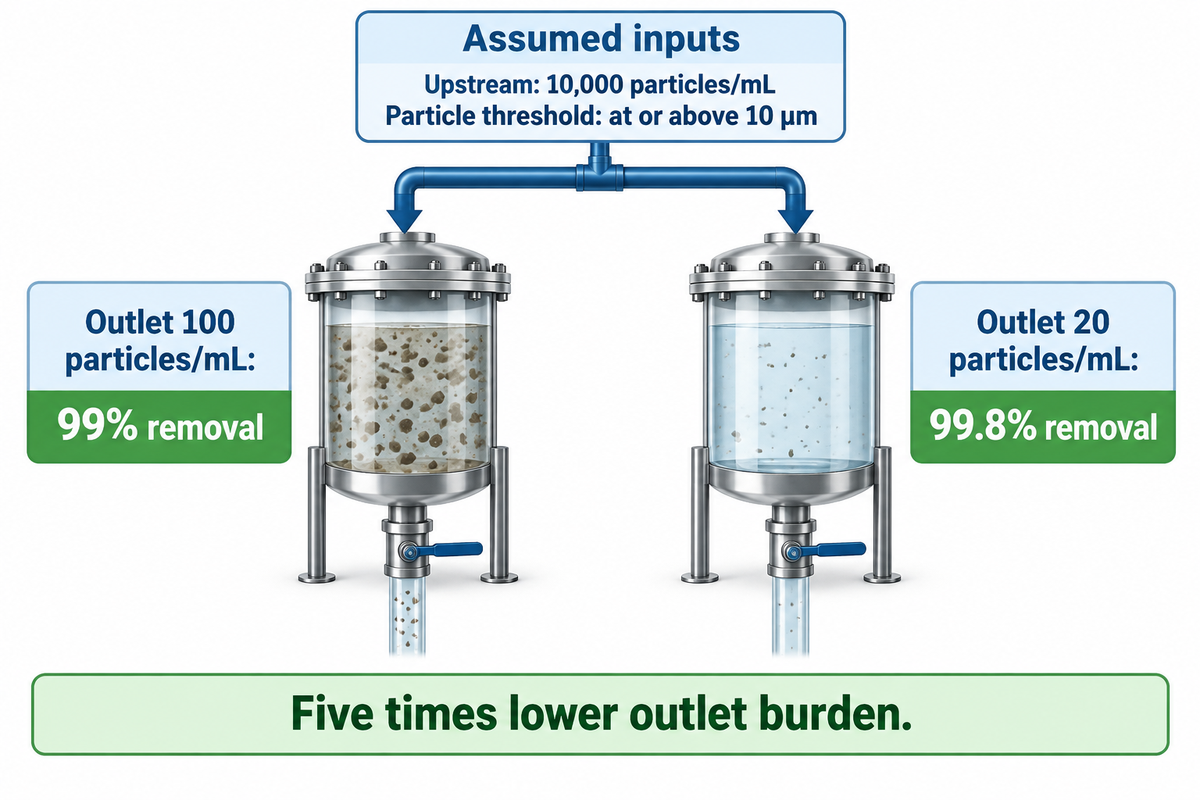
Assumed inputs: a process-water trial measures 10,000 particles/mL upstream and 100 particles/mL downstream, both at or above 10 µm. Removal is (1 − 100 ÷ 10,000) × 100 = 99%. A second result of 20 particles/mL gives 99.8% at the same upstream concentration. The outlet burden is five times lower even though the efficiency figures differ by only 0.8 percentage points.
In the lower range of the counting method, sample volume and repeatability become important. Finding zero particles in a small sample isn’t the same result as finding zero particles in a large sample. Report the detection limit and uncertainty with the result. A small difference between two curves may be smaller than the measurement uncertainty.
Two major test methods emphasize the importance of procedure. ISO 16889:2022 addresses hydraulic fluid power filter elements using multipass testing, including removal, capacity and differential-pressure characteristics. For drinking-water treatment credit, 40 CFR 141.719(a) specifies challenge conditions for the complete bag or cartridge assembly, including maximum design flow and discrete challenge-particle measurement. Use the method applicable to the actual duty.
When a quoted 10 micron polypropylene bag and another grade carry the same nominal label, compare their results at 10 µm under matched conditions before choosing the cheaper one. See our filter micron rating definitions for definitions of absolute and nominal terms.
The Three-Stage Retention Profile
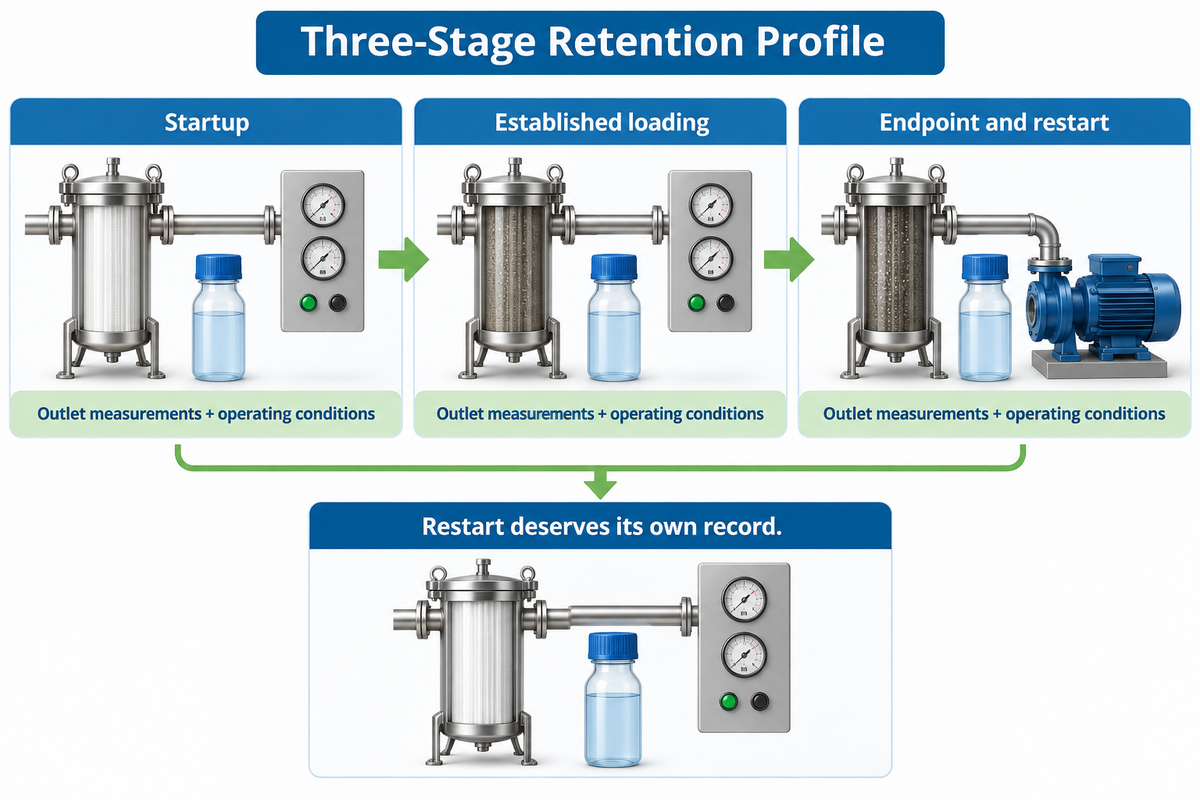
Three operating stages make a filter comparison easier to interpret: startup, established loading, and the agreed-upon ending point. The Three-Stage Retention Profile below joins outlet measurements to operating conditions at each stage. Note observations of restarts and repeated units, as a complete cycle from one bag still represents only that bag and run.
The filter drinking-water rule cited above contains startup, intermediate and end-cycle challenges, then takes the lowest interval removal result for the filter case. Here the three-step format is an editorial method of organizing industrial trial data. It doesn’t stipulate the drinking-water procedure for a process-water case.
| Record | Startup | Established loading | Endpoint and restart |
|---|---|---|---|
| Bag and lot identity | Record grade, bag ID and production lot | Keep the same identification | Separate replacement bags and repeat runs |
| Elapsed operation | Record time from first flow | Record time at sampling | Record endpoint and any stopped period |
| Cumulative liquid volume | Start a volume total | Record total volume at each sample | Separate total and accepted volume |
| Flow rate | Record L/min or m³/h | Match the intended comparison rate | Record flow changes and restart ramp |
| Liquid temperature | Record °C | Track drift during loading | Note endpoint and restart temperature |
| Feed concentration | Measure the chosen particle-size range | Repeat with the outlet sample | Identify a changed feed before comparing removal |
| Outlet concentration | Use the defined sampling method | Repeat at comparable conditions | Include first-filtrate observations after restart |
| Differential pressure | Record clean assembly pressure drop | Use the same pressure-tap positions | Record the actual endpoint pressure drop |
| Quality acceptance | Apply the agreed outlet limit | Track any out-of-limit periods | Count only volume meeting the agreed release rule |
| Sampling confidence | Record sample volume and method | Keep repeatability and detection-limit data | Report uncertainty and compare repeat units |
Example: A hypothetical quality limit is 50 particles/mL at or above 10 µm. At a set flow of 60 L/min, bag A produces 20 particles/mL at startup, 30 particles/mL during loading and 80 particles/mL at the endpoint. Bag B produces 35, 40 and 45 particles/mL at these stages. Bag A performs better at startup; bag B stays below the stated concentration limit at all sampled stages. It’s assumed that the feed conditions are the same for both bags.
The samples don’t identify the exact point where bag A crossed the limit. Accepted-volume accounting therefore requires a sampling and release rule rather than classifying all the liquid before the final sample as acceptable. The quality team sets the sampling and release rule to compare the costs.
A restart adds another observation. The archived 2012 NSF/EPA bag and cartridge test protocol includes a five-minute shutdown after its terminal microbial challenge, followed by first-filtrate, five-minute and ten-minute restart samples without further challenge-spore injection. That historical drinking-water procedure shows why a restart deserves its own record; it isn’t evidence that every industrial bag releases particles after stopping.
Feed Conditions That Change How Layers Load
The composition of the feed determines which part of a multi-layer assembly does the work. Mixed coarse and fine solids, a narrow particle-size distribution and soft gels present different capture tasks. Interpret a capacity result alongside the feed description, including concentration changes and liquid viscosity, rather than transferring one test liquid’s result to another process.
In an issue of International Filtration News, Eaton product manager Wim Callaert writes about how various operating conditions, including media types and the removal of particles, influence bag retention.
“Conditions during filtration … have a significant effect on the retention capability of the filters.”
A 2023 University of Delaware depth-filtration thesis offers a related transferability lesson. A model fitted yeast data semi-quantitatively but did not fit mammalian-cell-culture filtration results. The study is about depth media used in bioprocessing. Its relevance to this discussion is the importance of matching feed and model assumptions rather than borrowing performance numbers from other feeds.
When are multilayer filter bags used?
Multilayer filter bags are used when a liquid duty benefits from separating prefiltration, fine capture and supporting functions within one bag assembly. Industrial water treatment and process filtration are common applications. One reason to test a staged construction is to meet a defined outlet quality requirement or address a loading problem with the current bag.
Imagine a resin line where the laboratory comparison utilized water at 20 °C, and production uses a more viscous liquid at 35 °C. The laboratory rankings shouldn’t set the production run length. Start the comparison at the actual production temperature and flow, document the resin condition, and track acceptable filtrate volume. If the production filtrate doesn’t meet spec, determine the reason. A water-only capacity advantage may offer little value if production stops early on pressure or product quality.
For a feed dominated by coarse debris, a finer multilayer grade may add expense without addressing the main task. Our polypropylene felt filter bags guide addresses the issue.
Capacity Gains Versus Added Flow Resistance
More dirt capacity is helpful when it produces an increased quantity of acceptable liquid before an operating limit is reached. The tradeoff is the resistance of the complete assembly at the required flow. Compare usable volume and outlet quality against pressure drop so that a longer run isn’t rewarded for passing material that should have been removed.
Parker claims an increased dirt capacity for its Fulflo XLH all-polypropylene high efficiency filter bags. Take that as a named product claim, and compare the offered grades at the same endpoint. Multiplying a capacity claim directly into service life would omit feed loading, flow changes and the quality limit. The separate capacity, removal and pressure measurements in ISO 16889:2022 illustrate these different performance dimensions in hydraulic-filter testing.
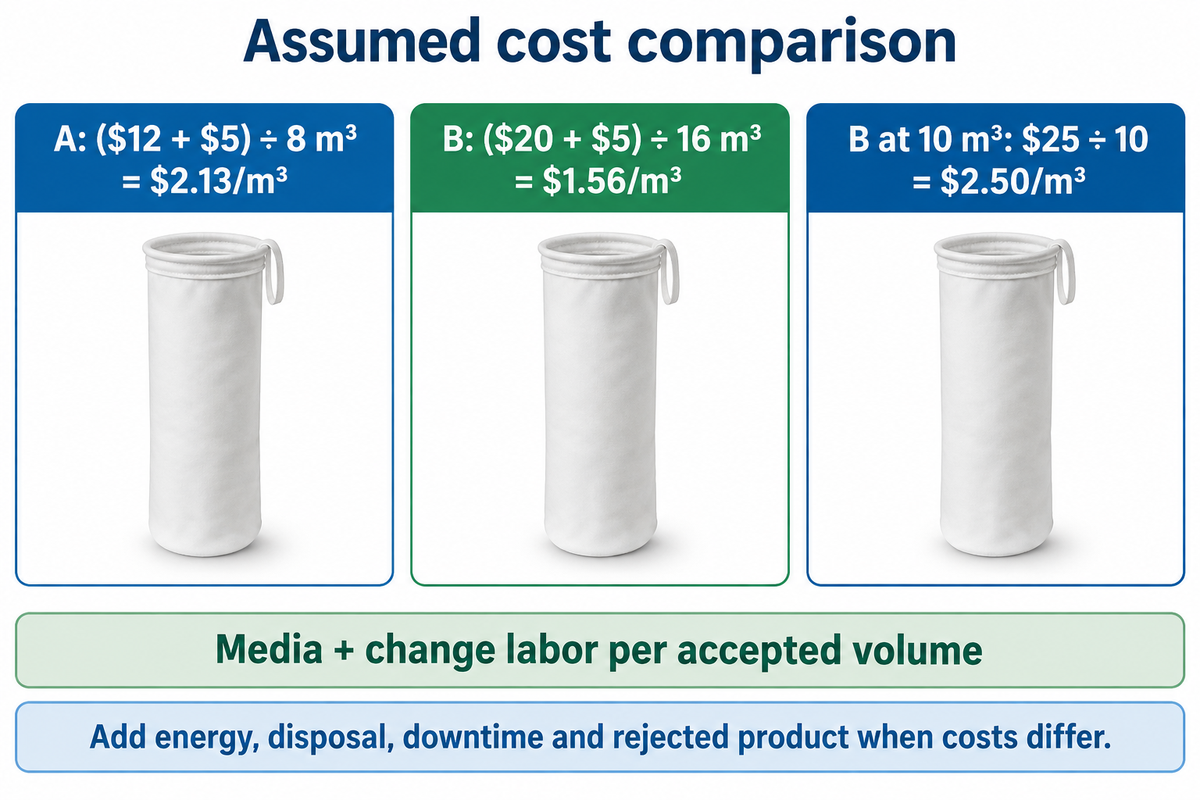
Assumed cost comparison: candidate A costs $12 per bag and produces 8 m³ of accepted liquid per run; candidate B costs $20 and produces 16 m³. Both need 10 minutes of change labor at $30/hour, or $5 per change. Media plus change labor is ($12 + $5) ÷ 8 = $2.13/m³ for A and ($20 + $5) ÷ 16 = $1.56/m³ for B, rounded to cents.
If B produces only 10 m³ before the same quality endpoint, its result becomes $25 ÷ 10 = $2.50/m³. That would change the purchasing decision. Energy, disposal, downtime and rejected product are outside this small example; add those costs when they differ between candidates.
Procurement notices the higher bag price first. Operations notices the number of changes, and Quality notices the accepted output. Using the same volume denominator allows the three teams to talk about the same output. Recording the time needed to produce that volume, rather than comparing run hours alone, allows a fair comparison between process lines operating at different flow rates.
Compare on a shared basis
Do: use the same outlet limit, duty and cost boundary for both grades.
Avoid: comparing one bag at a pressure endpoint with another at a product-quality endpoint.
Retention Changes That a Pressure Gauge Cannot Explain
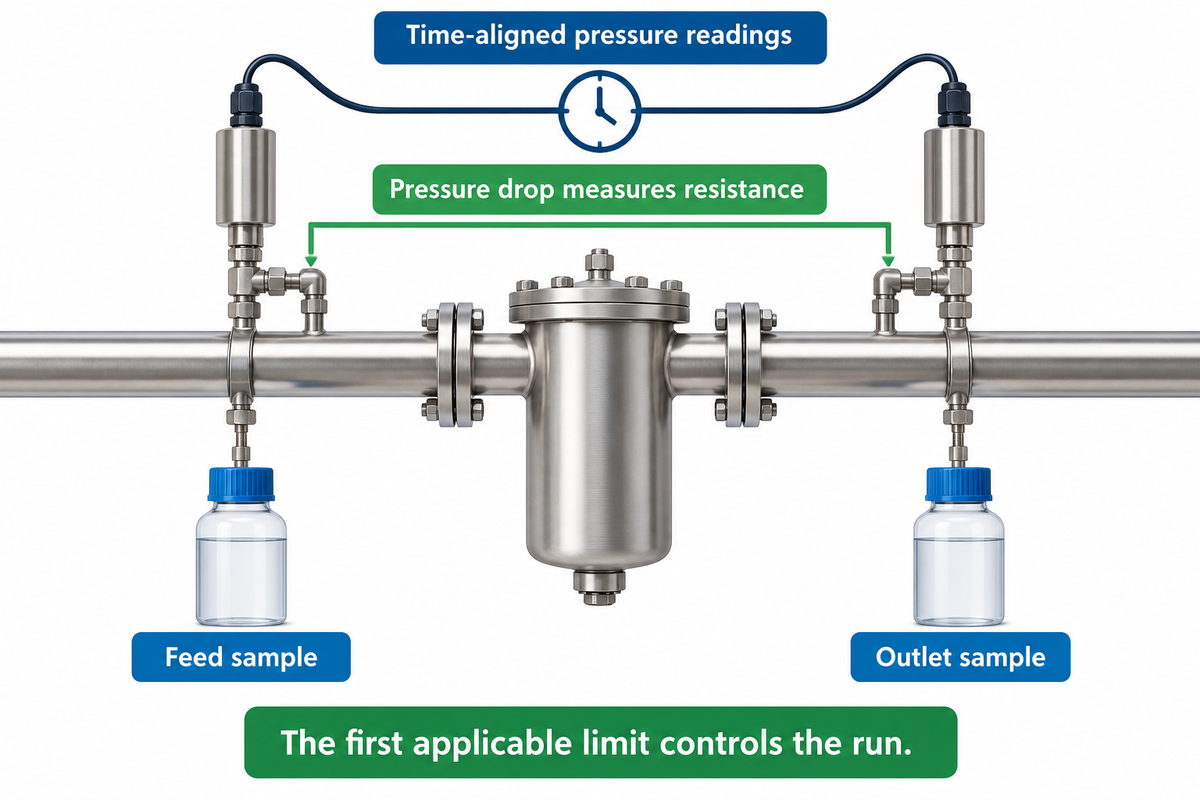
Pressure drop measures resistance across the chosen pressure taps, but doesn’t directly measure particle removal. Pair time-aligned pressure readings with feed and outlet samples before attributing a quality change to the filter media. Changes in liquid condition or assembly behavior can also be mistakenly attributed to a change in retention.
Brittany Nixon’s depth-filtration troubleshooting article discusses bioprocess monitoring, including pressure, filtrate weight or volume, and effluent turbidity. It identifies the distinction between system pressure drop and pressure drop across an individual stage. Measurement distinctions of that type are useful when multiple filters share a filtration system.
An example is a downstream sample that changes immediately after a restart. This sample should be recorded with the restart record, not simply with the highest pressure reading of the day. Compare the feed sample of the same time period. If the feed sample has a higher concentration, then it’s possible for the outlet sample to have an increased concentration as well, even if the removal fraction is the same.
A low pressure difference and rising outlet counts require a review of the measurement system, assembly and media. If outlet counts are acceptable, a high pressure difference may indicate a resistance limit of the media, but this doesn’t ensure the remaining safe life of the media bag. Use the approved limits for the bag, housing and process. The first applicable limit controls the run.
Pictures of damaged joints are more valuable tied to the bag ID and the sample time than as examples of “poor filtration.”
Multilayer Bags, Felt Bags and Cartridges at the Same Duty
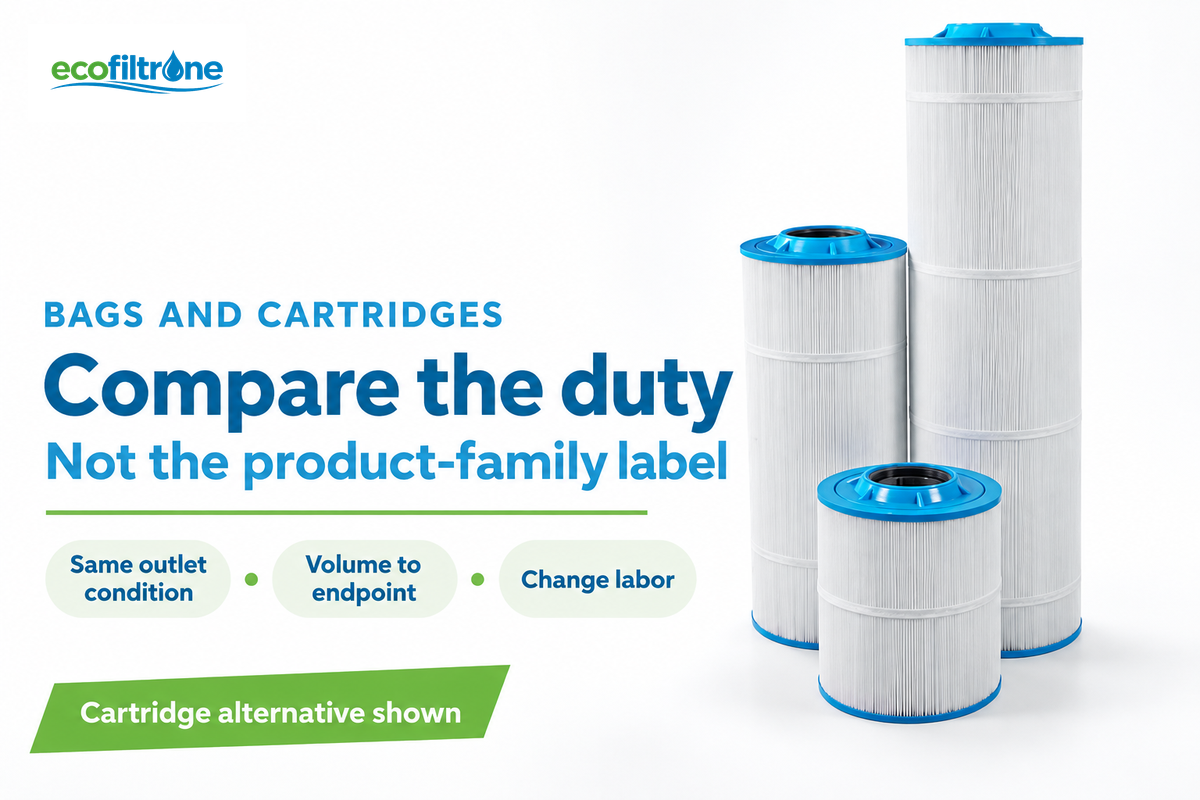
Ranking individual grades against the same liquid duty rather than ranking bags, felts, and cartridges as whole families would be more helpful. There’s considerable overlap among the families in construction, media, and retention. The comparison should be against the result, the usable volume, and the operating burden.
Needlefelt, monofilament and meltblown media all perform distinct functions within liquid filtration. Callaert’s technical discussion delineates these structures and describes graded meltblown structures. Our nylon mesh filter bags guide covers the mesh alternative without treating it as a finer version of felt.
Use the current accepted product as the baseline for comparison. Once the reference product has been set, compare the candidate products against it by fixing the outlet condition, measuring clean resistance and volume to endpoint, and recording change labor. Use the three-stage retention profile to standardize the results. If a candidate product requires a different housing, include that in the cost comparison as well.
Results from air filtration use different test media and operating conditions. These shouldn’t be included in a liquid bag comparison. Likewise, effective filtration in process water does not establish the same result in paint or a biological feed.
For a stable coarse-particle duty, keep the simpler grade in the trial. For a fine-particle duty with variable loading, compare a staged bag with the relevant cartridge grade. Choose the filtration solution that meets the duty for the required cycle, rather than the highest number of layers.
A Comparable Evidence Package for Supplier Discussions
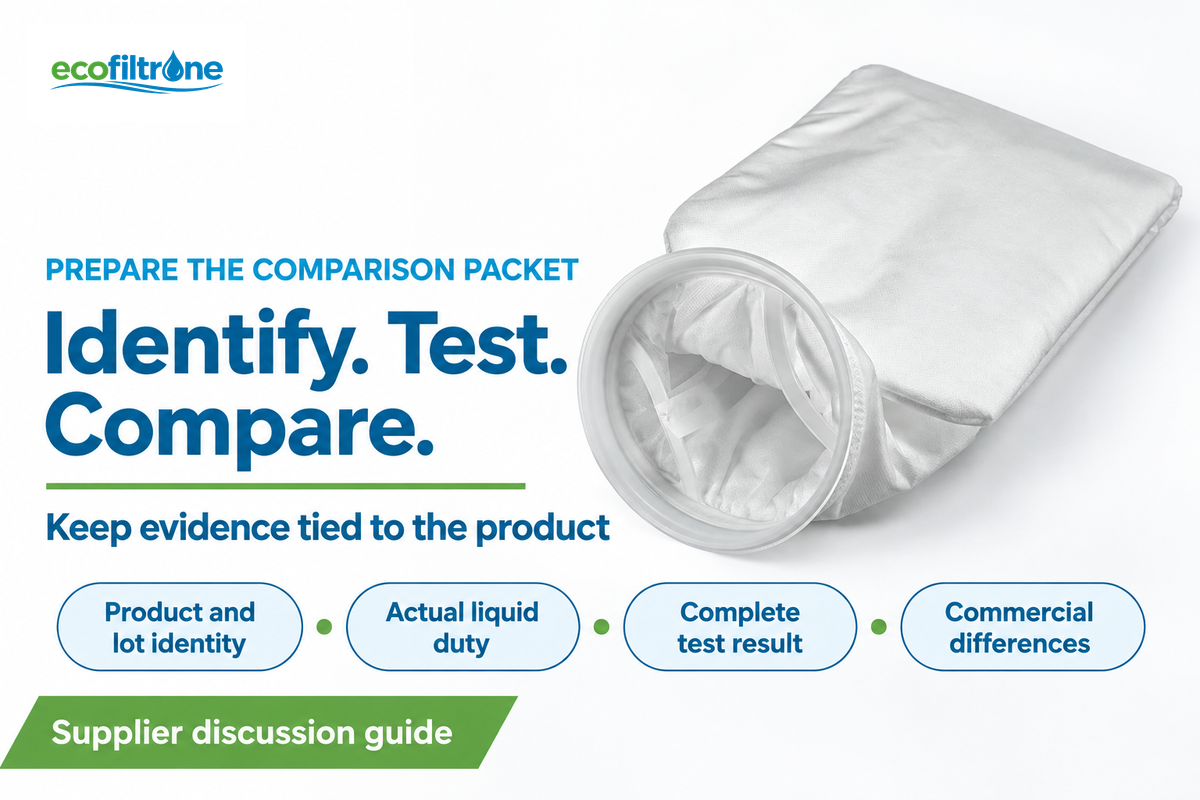
An effective supplier comparison includes the exact product identity, test assembly, feed, measurements and accepted-output results. Keeping those documents together allows a change in grade or production lot to be identified. Purchasing can compare similar documents while operations and quality can trace an acceptable result to the conditions that created it.
The archived NSF/EPA protocol tests multiple complete units and recommends different production runs where possible. That addresses a question a single curve can’t answer: how representative is this tested unit? For an industrial assessment, agree upon a repeat unit and lot plan that is in proportion to the process, and report the spread of results, rather than the best result.
Prepare the comparison packet
- Identify: grade, media, bag size, drawing revision, bag ID and production lot.
- Describe the duty: liquid, temperature, flow, feed particles and required outlet quality.
- Attach the result: complete assembly, test method, cycle record, restart observations and measurement uncertainty.
- Resolve the commercial difference: accepted volume, replacement labor and any housing change.
Ask the supplier how the filter bags are manufactured and which offered constructions were tested. Confirm that the compliance and material documents name the appropriate product and certificate holder. Keep a material declaration separate from the filtration performance result of an assembly.
ECOFILTRONE™ is an industrial filtration product supplier, located in Qingdao, China, with engineering support to select, replace and adjust products to meet customer needs. We work with clients to confirm the specification and, if needed, provide samples or try out the product. We follow up on differential pressure and service life of the product. Bags are available through application review and product matching; the next useful input is your operating record and not a layer-count goal.
Multilayer Filter Bag Questions
Are high-efficiency and multilayer filter bags the same?
No. High efficiency describes removal performance; multilayer describes construction.
A bag can contain several layers for support, protection or staged capture. Their number tells you how many components are present, while a retention result tells you how the tested assembly performed. Compare the named grade at the relevant particle size and liquid duty. Both descriptions can apply to one bag, but they answer different questions.
How are multilayer filter bags made?
Manufacturers assemble the media layers, form the bag and create its sealing interface.
Cutting, joining and assembly methods follow the chosen materials and design. Some constructions combine a prefilter, fine retention medium and supporting cover, while others arrange their functions differently. The product drawing identifies the layers, joins and intended flow direction. For an offered grade, the construction record should correspond to the actual bag supplied for testing and production.
What multilayer filter bag do I need for process water?
Choose the grade that meets your outlet particle requirement through the intended operating cycle.
Begin with the particle fraction you need to remove and the accepted outlet condition. Then match the liquid, flow, temperature and housing interface. A trial should track feed and outlet samples alongside pressure and accepted volume. Where loading varies, include those feed changes in the comparison so that a good startup sample doesn’t become the sole basis for bag selection.
Can I reuse a loaded multilayer bag?
Only when the product has an approved reuse method.
Cleaning must preserve the media assembly and required retention. Follow the specified reuse limits and checks; visual cleanliness alone is insufficient.
Does a higher layer count guarantee better filtration?
No. Layer function and performance at the actual duty matter more than the count.
Extra layers may provide support, protect fine media or distribute captured solids. They also affect the flow path and resistance. A layer devoted to containing fibers has a different purpose from a fine retention medium. Compare outlet quality, clean pressure drop and accepted volume for the proposed grades. A lower-count construction that meets the requirement throughout its run can be a better purchase than a higher-count alternative that reaches the operating endpoint earlier.
Discuss your filtration duty
Send ECOFILTRONE™ your liquid, flow, temperature, current bag reference and outlet requirement. We can review the application and help match a suitable construction for comparison.
This reference document contains some named methods and techniques, and practical comparison examples. Worked examples include stated assumptions and aren’t ECOFILTRONE™ product test results. Drinking water and bioprocess references are retained within the scope of their application.
References & Sources
- ISO 16889:2022, Hydraulic fluid power filters, multipass evaluation International Organization for Standardization.
- 40 CFR 141.719, Microbial toolbox options for meeting Cryptosporidium treatment requirements U.S. Environmental Protection Agency, Electronic Code of Federal Regulations.
- Generic Protocol for the Product Specific Challenge Testing of Bag and Cartridge Filter Systems NSF International under a cooperative agreement with the U.S. Environmental Protection Agency, March 2012, archived protocol.
- Criteria to Consider When Choosing Bag Filtration Technology, Part I International Filtration News; Wim Callaert, Eaton, 2020.
- Mechanistic modeling of primary depth filtration in downstream bioprocessing University of Delaware; Tristan Myers, 2023.
- Trouble-shooting Depth Filtration Pharmaceutical Manufacturing; Brittany Nixon, 3M Purification, 2012.