Get in touch with ECOFILTRONE™ Company



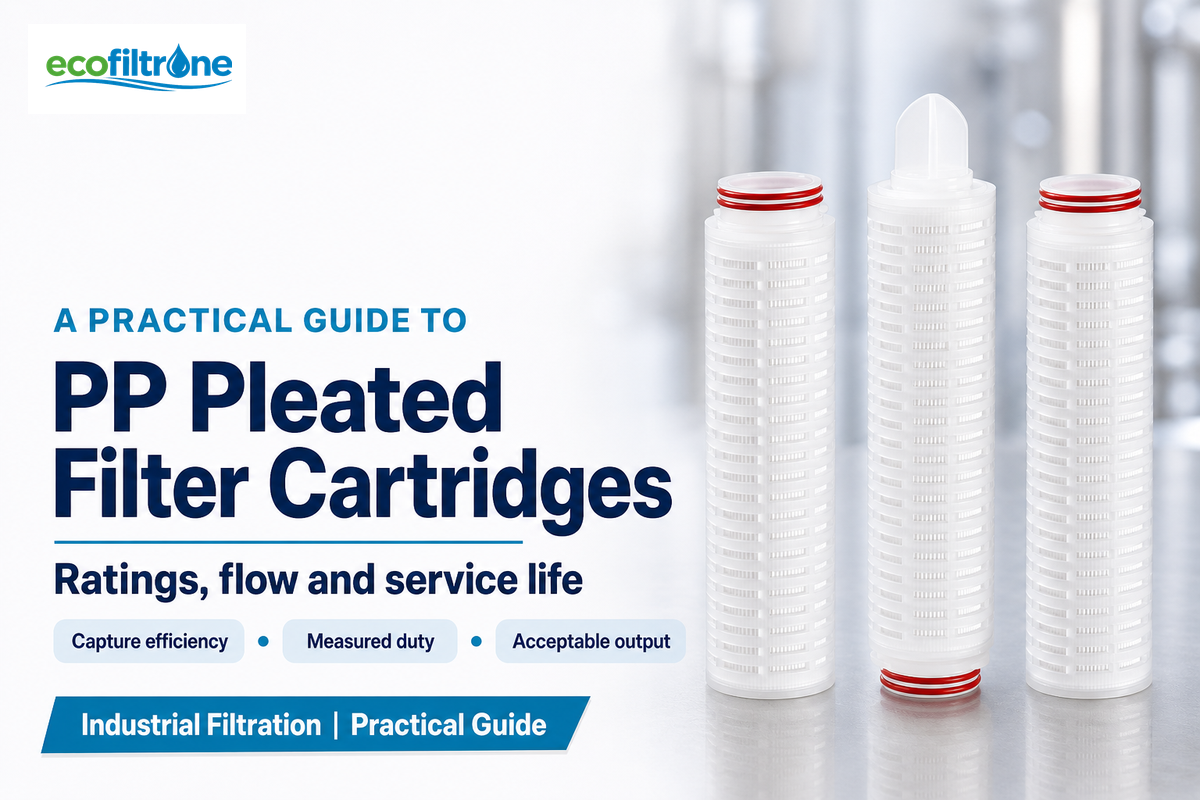
PP Pleated Filter Cartridges are polypropylene elements that capture suspended particles in industrial liquids. A familiar 5 micron label can still leave a buyer with unanswered questions: how efficiently does the cartridge retain that size, at what flow, and for how much acceptable output? Members of the filter family can vary significantly, and the performance of one unit doesn’t necessarily reflect the performance of another.
Quick reference
- PP means polypropylene; pleating describes folded media.
- A micron rating needs a stated capture efficiency and test basis.
- Record differential pressure alongside measured flow and outlet quality.
- Compare replacement cost against acceptable filtrate volume.
- Dimensions, temperature limits and cleaning permission belong to the exact cartridge model.
Updated October 2026
PP Pleated Filter Cartridges use folded polypropylene media to remove suspended particles. A micron label alone does not establish efficiency or service life. Compare the tested rating, operating pressure drop and acceptable output under matched duty.
Key points
- Pleated cartridges can contain depth media, including melt-blown media.
- A larger media area doesn’t guarantee a longer filter run.
- Low pressure drop can accompany low flow or inadequate retention.
- A more expensive cartridge can have a lower cost per acceptable cubic metre, but that must be demonstrated under comparable conditions.
How PP Pleated Filter Cartridges Work
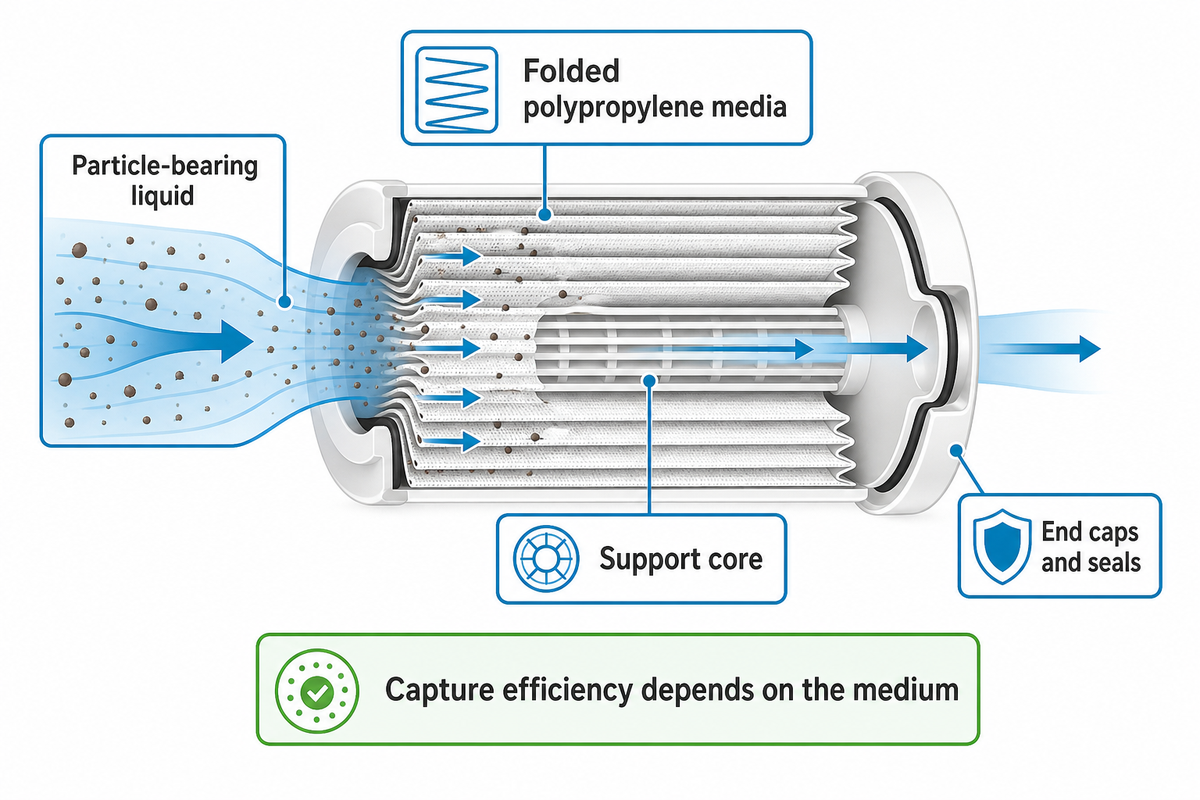
Polypropylene pleated cartridges capture particles as liquid flows through a porous filter medium. Folding the medium allows more material to fit in a cylindrical element. Particle capture depends on that medium’s structure and the stated efficiency, while supports, end caps and seals maintain the intended flow path through the cartridge.
What is a PP filter?
A PP pleated cartridge filter uses polypropylene as a filtering material. In a pleated cartridge, fiber media is folded around a support core and connected to end caps. PP determines the polymer, but it doesn’t say where capture predominantly occurs, at the surface or through the thickness of the medium.
- Material: polypropylene filter media and the documented materials of the remaining assembly.
- Geometry: folds, support spacing and the available flow passages.
- Retention: tested efficiency at a specified particle size.
- Flow path: liquid crossing the medium rather than travelling around a seal.
A cartridge is constructed from several parts, so a PP fiber description cannot establish the chemical compatibility of an O-ring or an adhesive. Some assemblies use thermal or hot-melt bonding; others use different methods of joining. The supplier’s material declaration should describe the product supplied rather than an assumed categorization.
Common mistake: calling every pleated polypropylene filter a membrane. Pleated depth media is a documented construction; a folded sheet is not automatically a membrane with a sharply defined pore size.
The University of Georgia’s mechanical-filtration guide distinguishes suspended particles from dissolved chemicals. Liquid filtration with a polypropylene filter cartridge used for fine filtration can reduce particulate loading before another treatment stage, but dissolved salts require an appropriate separate process. An adequate separate process should address dissolved salts.
The 5 micron particle-removal requirement should be specified with its efficiency and test conditions. Polypropylene specifies a material; pleated geometry defines packaging. Neither label alone proves that outlet water meets a process specification, even when the cartridge physically fits the existing housing.
Pleated Media, Surface Area and Dirt Loading

Pleated media adds geometric surface area. However, useful filtration area depends on the passages between folds and how contaminants load the medium. Crowded pleats, support resistance and blocked flow paths can limit area utilization. A high dirt holding capacity claim requires a stated test challenge and terminal condition.
Liquid must reach the filtering sheet before it can use the area shown in a brochure. A support layer keeps passages open, and the filtration media controls particle capture. A microfiber or non-woven sheet can have graded layers, and pleated design and depth filtration can occur in the same element.
- Ask whether the quoted area includes material that becomes inaccessible as the element loads.
- Read dirt holding capacity against the challenge material and the test’s final differential pressure.
- Check whether results describe the cartridge alone or a complete housing.
- Compare area claims only after matching cartridge length, grade and test duty.
US6315130B1 explains and gives examples of support and diffusion layers, and shows that maximum packed area may not be the best. The named inventor is Daniel K. Olsen, and the first assignee is Cuno with 3M later listed. It isn’t ECOFILTRONE technology or new market development.
Buying implication: an area advantage is a reason to investigate, not a measured service-life advantage. Request loading and pressure data under a comparable duty before paying for a promised high contaminant holding benefit.
Think of a process carrying soft, deformable debris rather than the rigid challenge dust used in a product test. Even with the same mass inflow, the deposit may obstruct passages in a different way. The useful comparison is the acceptable volume delivered before the agreed endpoint, rather than a claim that one shape always lasts longer.
For nominally 10” cartridges, equal outer length doesn’t mean equal effective media area or loading behavior. Filter material, supports and the contaminant challenge remain. A comparison limited to square meters gives the purchaser no information about the outlet quality or usable run length.
Micron Ratings: Nominal, Absolute and Beta Ratios
A micron rating identifies the particle-size reference; filtration efficiency states how much of the specified particle population is removed. Nominal and absolute definitions are what the manufacturer determines and defines by test method. Beta ratios specify count relationships, but are still size-specific, and therefore test condition-dependent results.
What is a micron cartridge filter?
A micron cartridge filter is described by a particle-size rating in micrometres. One micrometer is equivalent to one millionth of a meter. Without efficiency or retention definitions, the label is incomplete. Two 5 micron cartridges may remove different proportions of the particles being counted.
An absolute filter label also calls for the relevant test definition. A microfiltration requirement should state the particle threshold and acceptance criterion rather than depend on category description.
Purdue University’s filter explanation defines beta as upstream particle concentration divided by downstream concentration. Its examples concern engine oil, so they establish the arithmetic rather than qualifying a PP water cartridge. Use the same size threshold, sampling basis and comparable sample volumes on both sides.
Illustrative particle-count example
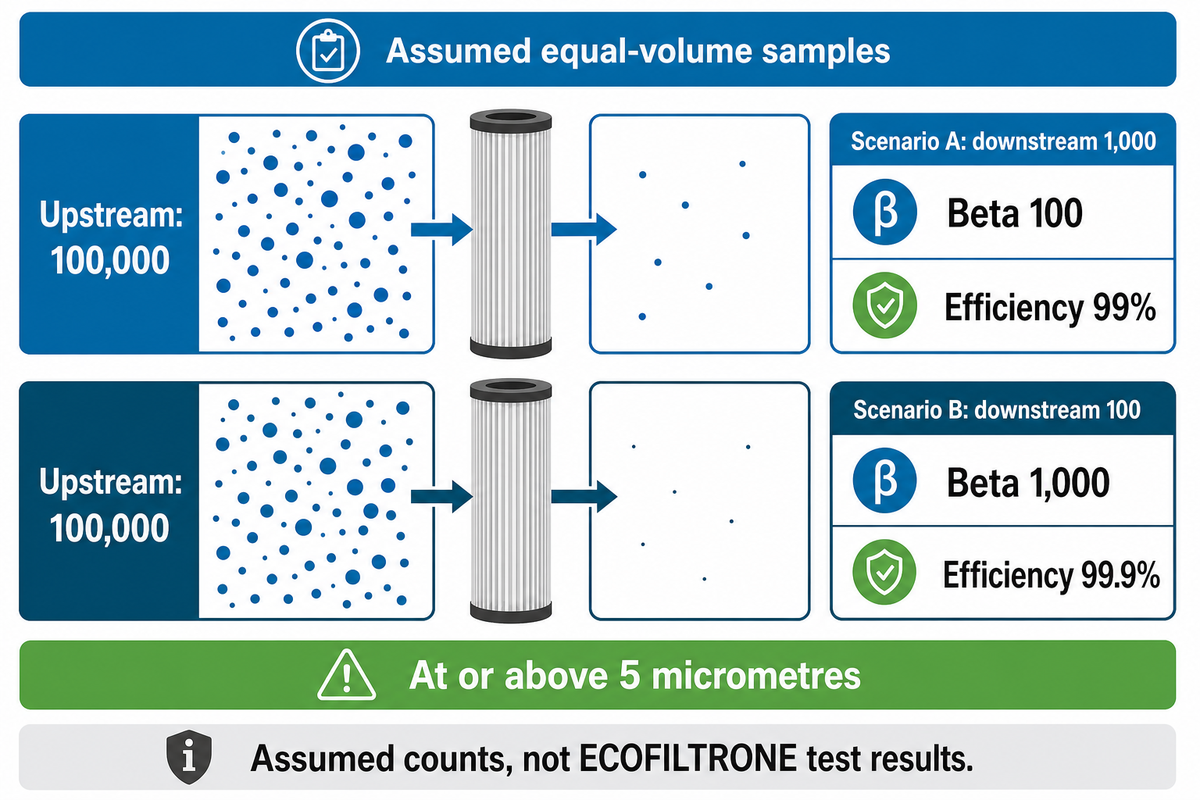
Assume equal-volume samples contain 100,000 upstream particles and 1,000 downstream particles at or above a stated 5 micrometre threshold. Beta = 100,000 / 1,000 = 100. Efficiency = (1 – 1/100) × 100% = 99%. With 100 downstream particles, beta = 1,000 and efficiency = 99.9%. These assumed counts aren’t ECOFILTRONE test results.
| Size reference | Beta ratio | Calculated efficiency | Downstream fraction | Limitations / Not suitable for |
|---|---|---|---|---|
| ≥5 µm | 2 | 50% | 1/2 | Does not define retention below 5 µm |
| ≥5 µm | 10 | 90% | 1/10 | Not a cartridge qualification |
| ≥5 µm | 20 | 95% | 1/20 | No loading or life conclusion |
| ≥5 µm | 75 | 98.67% | 1/75 | Efficiency rounded to two decimals |
| ≥5 µm | 100 | 99% | 1/100 | Cannot prove removal at 1 µm |
| ≥5 µm | 200 | 99.5% | 1/200 | Requires a stated test basis |
| ≥5 µm | 1,000 | 99.9% | 1/1,000 | No universal nominal conversion |
| ≥5 µm | 2,000 | 99.95% | 1/2,000 | No guarantee in another liquid |
| ≥5 µm | 5,000 | 99.98% | 1/5,000 | No sterilization claim |
The official ISO 16889:2022 summary describes a hydraulic-filter multi-pass test. The reference to this standard should preserve the hydraulic scope and the particle-size convention. It cannot verify all industrial liquid cartridges or replace other application-specific filtration performance evidence.
Measurement limit: a result below an instrument’s reporting limit is not proof of zero particles. Record the detection limit and whether a sample represents startup, the middle of a run or its endpoint.
Beta 100 removes 99% of the count at the specified threshold, and doesn’t mean 100% removal, nor does it mean the same efficiency for all particle sizes. A purchasing comparison must state the threshold, efficiency and method together. A finer number with an undefined test basis is weaker evidence compared to a result of a test which was documented in detail.
Pleated vs Non-Pleated Melt-Blown and String-Wound Cartridges
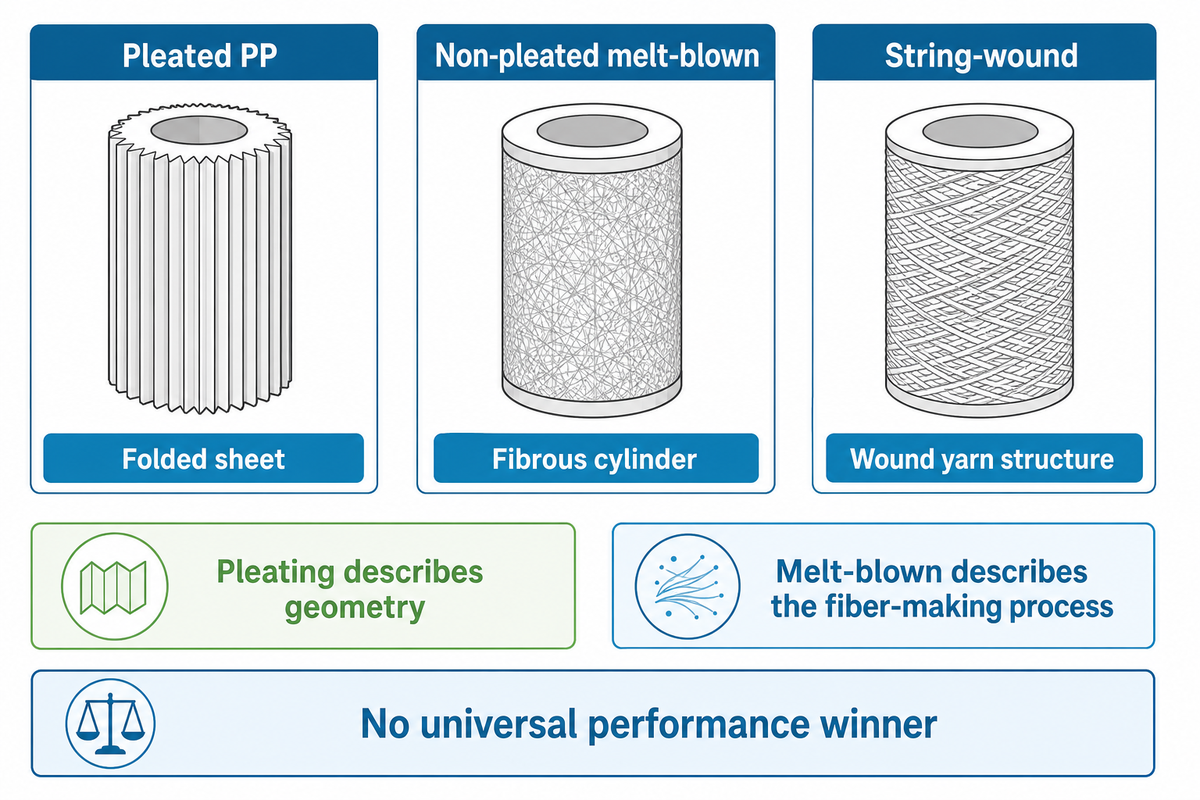
According to documented data and behaviour of media in the field, compare pleated cartridges with non-pleated melt-blown cylinders and string-wound elements. Pleating describes geometry, and melt-blown describes the process of how fibers are made. Therefore, a pleated cartridge can contain melt-blown depth media, and the construction names alone can’t determine a universal performance winner.
The Datasheet for Parker’s Poly-Mate X offers one example of pleated melt-blown polypropylene media. That product’s documented backwashing capability is a model-specific feature. It doesn’t mean that all pleated filter cartridges are washable, and it certainly doesn’t mean that cleaning restores the original retention.
| Question | Pleated PP | Non-pleated melt-blown | String-wound | Limitations / Not suitable for |
|---|---|---|---|---|
| Geometry | Folded sheet | Fibrous cylinder | Wound yarn structure | Geometry does not specify efficiency |
| Depth loading | Possible with depth sheet | Depends on graded structure | Depends on yarn and winding | No universal depth-versus-surface split |
| Micron comparison | Require efficiency | Require efficiency | Require efficiency | A 5 µm label alone is incomplete |
| Flow comparison | Match fluid and grade | Match fluid and grade | Match fluid and grade | Water at 20 °C may not represent the process |
| Loading endpoint | Document terminal condition | Document terminal condition | Document terminal condition | No common calendar-life assumption |
| Assembly review | Sheet, supports, caps, seals | Media, core and interface | Yarn, core and interface | Media material is not the whole assembly |
| Shedding review | Ask for relevant evidence | Ask for relevant evidence | Ask for relevant evidence | Appearance cannot prove cleanliness |
| Reuse permission | Exact model procedure | Exact model procedure | Exact model procedure | No generic cleaning approval |
| Economic comparison | Cost per accepted m³ | Cost per accepted m³ | Cost per accepted m³ | Unit price is an incomplete boundary |
When a wound element is replaced with a pleated polypropylene cartridge, keep the outlet acceptance requirement fixed. If a different nominal grade passes more particles, a longer run would not be an equal-quality improvement. Changing both construction and rating at once makes the reason for the result harder to identify.
Construction details of melt-blown depth filter cartridges and string-wound filter cartridges are available on their respective product pages. A comparative trial should answer which candidate is more likely to meet the same filtration duty with an acceptable operating burden.
Common mistake: treating a recovered flow rate after washing as proof of recovered capture efficiency. The remaining filtration medium, joints and seals still need an appropriate acceptance check.
A request for a 5 µm replacement can be met by several constructions, but the same printed grade does not demonstrate equivalent retention. Evaluate the test definition, measure the hydraulic and loading behavior, and then select the construction that fits the job.
Flow Rate, Viscosity and Differential Pressure
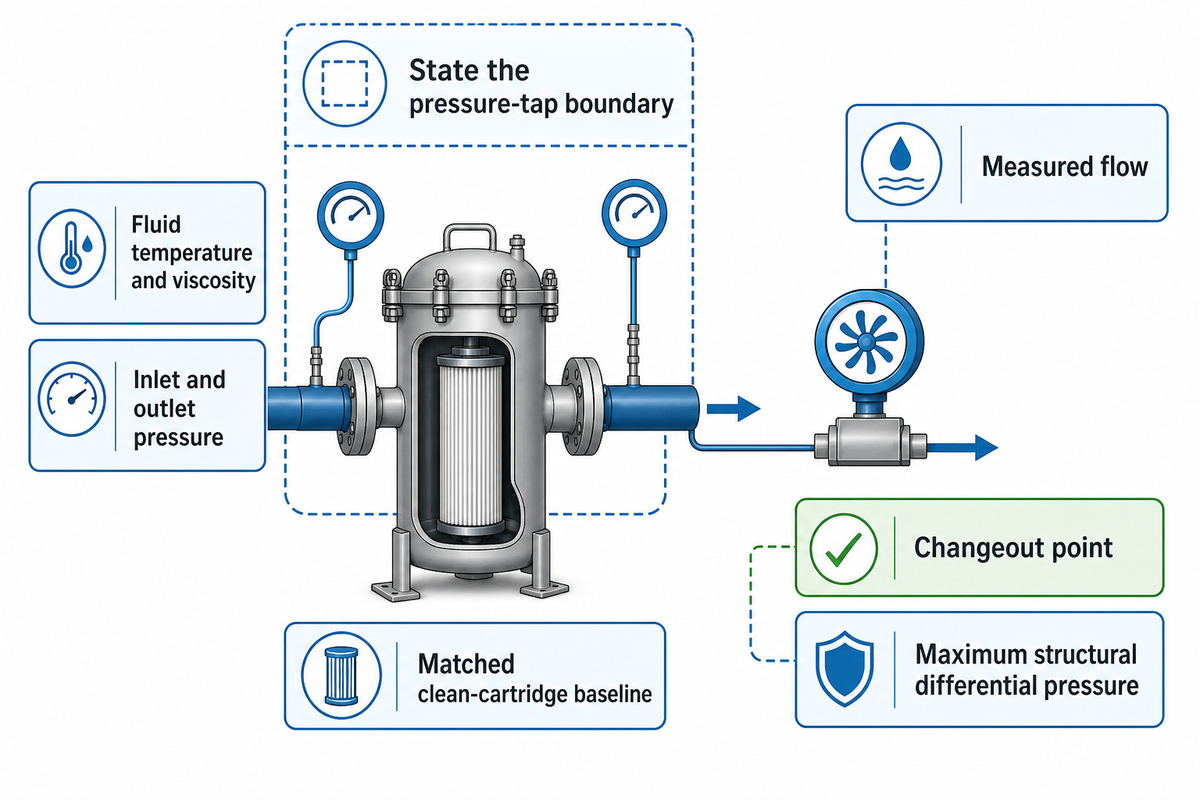
Cartridge pressure drop must be analyzed along with measured flow rate and fluid condition. Resistance can increase with greater viscosity or flow, and significant dirt loading may not occur. Compare clean-cartridge baselines at matched temperature and duty, and distinguish element loss from the loss across the entire filter housing and connected piping.
The public ISO 3968:2017 summary addresses pressure differential as a function of flow and viscosity for hydraulic-filter assemblies. It supports the measurement relationship in that scope. Recording a matched baseline is recommended comparison practice, not a claim that ISO imposes a universal PP water-filter procedure.
Why are PP pleated filter cartridges not working?
A PP pleated cartridge may be ineffective due to inadequate flow or inadequate particle retention. High initial pressure loss may reflect flow, viscosity, cartridge grade or housing restrictions. Poor outlet quality may require checking the rating, sampling method and possible bypass. A single gauge reading can’t be used to distinguish the cause of high loss.
- Record measured flow, fluid temperature and viscosity where relevant.
- Identify the pressure-tap positions and any piping or valve loss included.
- Compare both inlet and outlet readings under matched operating conditions.
- Keep the cartridge’s recommended changeout point separate from its maximum structural differential pressure.
Assuming an aqueous process is compared on two days, at 20 °C and 40 °C, a difference in viscosity can affect initial pressure even if the cartridge is clean on both days. A buyer should examine the temperatures, flow and pressures to determine if there’s a filtration advantage. The temperatures are for illustration only and aren’t for operating approval.
Do
- Compare the same fluid and measured flow.
- Identify the pressure measurement boundary.
- Use the model’s documented limits.
Don’t
- Interpret one downstream gauge as differential pressure.
- Turn high flow marketing into a sizing rule.
- Use a structural limit as a routine replacement target.
A high flow rate claim and a low pressure claim may describe different tests. For chemical and petrochemical filtration duties, an organic solvent or viscous batch may also change compatibility and hydraulic review. Solvent filtration requires evidence for the complete assembly rather than a generic PP resistance statement.
A clean-filter comparison at 20 °C is useful only when the flow, fluid and pressure boundary are also stated. An upper differential pressure defines a different question from that of initial resistance. Treating both as one high pressure rating can lead to unsuitable selection or a misleading service-life comparison.
Service Life: Read Pressure and Filtrate Quality Together
A PP cartridge’s service life ends when it no longer satisfies the agreed quality or operating requirement within its documented limits. Pressure trend is used to assess loading, while measured flow and outlet quality are used to verify assessment. Calendar age by itself can’t determine long service life or successful retention.
3-Signal Operating Review
A 3-Signal Operating Review pairs differential pressure, measured flow and outlet quality to determine the next operating review, rather than to pronounce fault.
| Pressure observation | Measured flow | Outlet quality | Next evidence to collect | Limitations / Not suitable for |
|---|---|---|---|---|
| Rising | Comparable | Meets requirement | Loading history and agreed endpoint | Viscosity changes can also increase loss |
| Rising | Falling | Meets requirement | Feed load, fluid state and restrictions | No universal remaining-life estimate |
| High just after replacement | Comparable | Meets requirement | Grade, flow curve and measurement boundary | Not evidence of a fully loaded cartridge |
| Low | Low | Meets requirement | Process demand and pump/control state | Low pressure does not prove spare capacity |
| Low | Comparable | Fails requirement | Rating, sampling, seal fit and flow path | Bypass is possible, not confirmed |
| Sudden decrease | Changed | Uncertain | Time-matched gauges and sample | No diagnosis from pressure alone |
| Little change | Comparable | Worsens | Incoming particle distribution and retention | Quality can change without large pressure change |
| Any trend | Unrecorded | Any result | A measured operating baseline | Runs cannot be compared hydraulically |
| Any trend | Comparable | Below reporting limit | Detection limit and suitable quality metric | Non-detection is not zero particles |
The 2010 Toolbox Guidance Manual of the US Environmental Protection Agency, in sections 8.6.1-8.6.2, covers pressure and water-quality monitoring for bags and cartridge filters. It also recognises that very low incoming turbidity can make the difference across a filter too small to interpret. That historical drinking-water guidance illustrates a monitoring limitation; its setpoints and requirements aren’t transferred to the industrial PP duty.
Common mistake: assuming leakage is certain when pressure falls. A changing flow or a misleading instrument can produce a different explanation. Check the evidence before attributing the loss of filtration efficiency to an end cap, seal or damaged medium.
Prior to any comparisons, the measurement that’s to be referenced should be agreed upon by the maintenance and quality teams. Particle count at a stated threshold is different from turbidity, and a sample collected at the start of a cycle may not reflect the end of the cycle. Record sampling conditions along with each sample result.
At a 5 µm reporting threshold, a low downstream count needs the instrument’s detection limit and the sample basis beside it. The 3-Signal Operating Review enables the next measurement; it doesn’t certify cartridge integrity, confirm zero contamination or predict a fixed lifespan from pressure alone.
Comparing Cost per Cubic Metre of Acceptable Filtrate
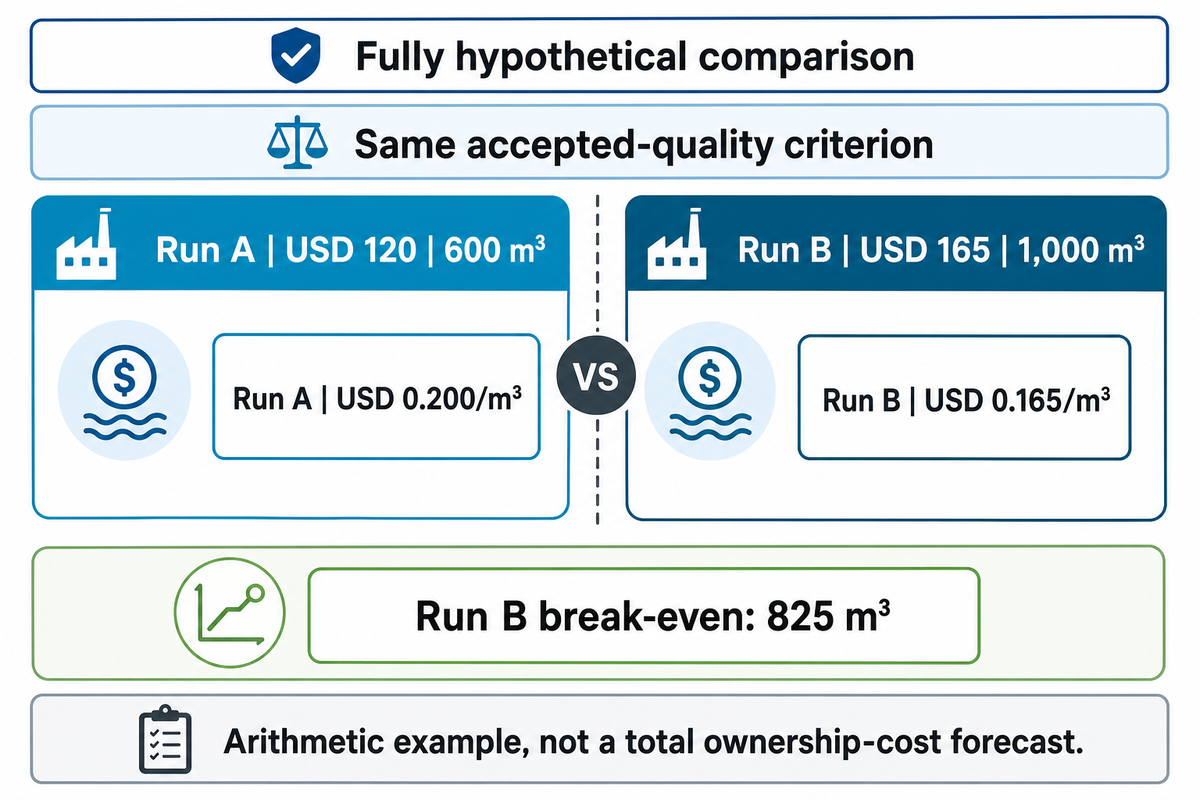
Compare cartridge operating cost against the volume that meets the same outlet-quality criterion. Purchase price, replacement effort and any attributable operating losses belong inside an agreed cost boundary. A cheaper element or a longer run can still be uneconomic if acceptable throughput falls or the comparison uses different duty conditions.
Two-Run Evidence Pair
A Two-Run Evidence Pair documents two cartridge cycles against the same outlet-quality criterion and records operating conditions and operating costs.
Farhat and colleagues’ 2020 Desalination study examined seven high-flow cartridge types at a full-scale seawater plant from the perspective of quantity, quality and operating cost. The economic price of electricity influenced the optimal replacement time. Historical plant results support measuring the trade-off; they aren’t recent market prices or ECOFILTRONE savings.
| Assumed cycle measure | Run A | Run B | Interpretation |
|---|---|---|---|
| Cartridge and allocated replacement cost | USD 120 | USD 165 | Assumed totals, not quotations |
| Acceptable filtrate | 600 m³ | 1,000 m³ | Assumed accepted volume, not all pumped water |
| Cost per acceptable volume | USD 0.200/m³ | USD 0.165/m³ | Cycle cost divided by accepted volume |
| Run B break-even volume | A held at USD 0.200/m³ | 825 m³ | USD 165 / USD 0.200 per m³ |
Under these assumptions, A costs USD 120 / 600 m³ = USD 0.200/m³. B costs USD 165 / 1,000 m³ = USD 0.165/m³. B’s higher total cost is offset by its larger accepted volume. Holding A’s unit cost constant, B must deliver 825 m³ to break even; below that volume, B is more expensive on this simplified basis.
- Equal quality: use the same acceptance metric, sampling method and reporting limits.
- Comparable duty: record flow, fluid temperature, viscosity and incoming solids; acknowledge remaining differences.
- Equal cost boundary: include the same labour, disposal and allocated replacement activities in both totals.
- Separate attribution: count downtime or rejected water only when the cartridge change can reasonably explain that loss.
The example excludes energy, capital, freight, taxes, cleaning and downstream damage, unless they’re included in both assumed totals. It is an arithmetic exercise, not a total ownership-cost forecast. A real example would use measured accepted volume instead of multiplying an assumed lifespan by a catalogue flow rate.
Hidden cost bottlenecks
Loading variable solids can swamp comparisons, and media choice becomes secondary. Poorly located pressure taps can hide housing loss; an insensitive quality measurement can count unsuitable output as acceptable. Pump controls can change flow instead of increasing electrical demand, so pressure rise alone does not establish a fixed energy penalty.
“it is important not to automatically adopt every modification”
Keinan’s plant-design discussion explains that cartridge cleaning must be evaluated case by case because its economics depend on replacement frequency and available cartridges. A separate 2020 WaterTechOnline feature credited to Amiad identifies replacement labour, downtime and disposal as cost categories. Both sources have commercial affiliations; their project outcomes aren’t a guarantee for another plant.
With USD 165 divided by USD 0.200/m³, the break-even volume would be 825 m³. The volume answers the arithmetic question, but changes to input or outlet quality, or the absence of a cost in the analysis can reverse the conclusion. A record of the plant’s operation is required in addition to the analysis.
Industrial Water Reuse: What Changes for Cartridge Filters?
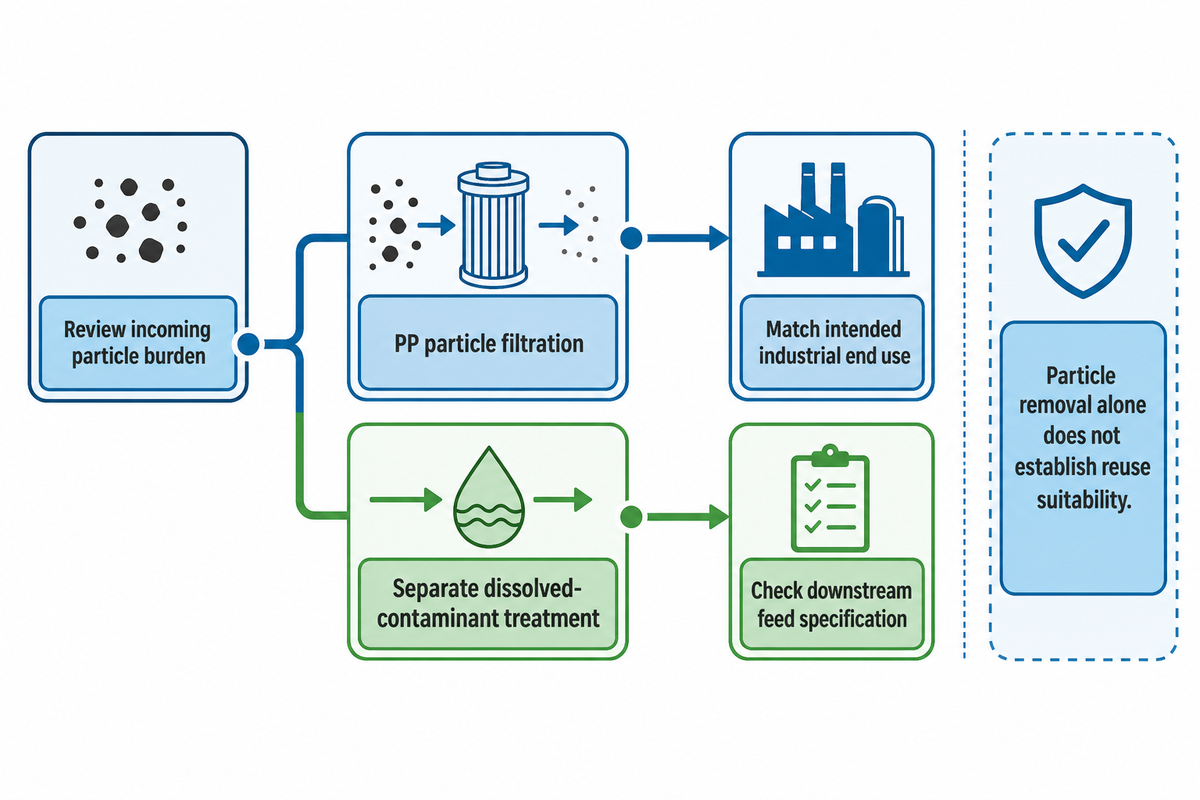
Water reuse changes the particle-filtration review when the incoming stream and required end use change. A PP pre-filter can be a part of a treatment train, but particle removal alone doesn’t make it suitable for water reuse. Identify the range and type of contaminants, as well as downstream treatment and variability prior to assigning a cartridge duty.
The US Environmental Protection Agency’s 2026 Water Reuse Action Plan update reports planned and ongoing reuse work; this is US policy context, not evidence of PP cartridge demand growth in the Middle East, Southeast Asia or other markets, and it doesn’t result in a universal PP certification.
- Review the incoming particle burden when the source or upstream process changes.
- Keep dissolved-contaminant treatment separate from particle filtration.
- Match the acceptance criterion to the intended industrial end use.
- Check the downstream system’s actual feed specification.
An operator using reclaimed water for a process may encounter variable suspended solids even with comparable average turbidity. A large particle excursion may shorten a cartridge run; however, a dissolved contaminant change may require a different treatment response. Documenting the change of the source may prevent an apparent cartridge problem from being assigned to the wrong part of the process.
When a PP cartridge is insufficient: an unmet dissolved-salt requirement, an unvalidated microbial requirement or an incompatible liquid needs another treatment or material review. A 0.45 micron label does not independently prove those outcomes.
For RO pretreatment applications, follow the feed-quality requirements of the membrane system and don’t assume a single prefilter grade always applies. Food and beverage water treatment likewise requires the appropriate process and product documents; polypropylene material alone doesn’t demonstrate food contact compliance.
A 5 µm cartridge and a dissolved-salt treatment stage address different contaminant concerns. Reuse planning needs to preserve this distinction when the feed source changes. A stable cartridge pressure reading can’t determine that all the chemical and biological requirements for the intended end use have been met.
Turning Operating Evidence into a Replacement Decision
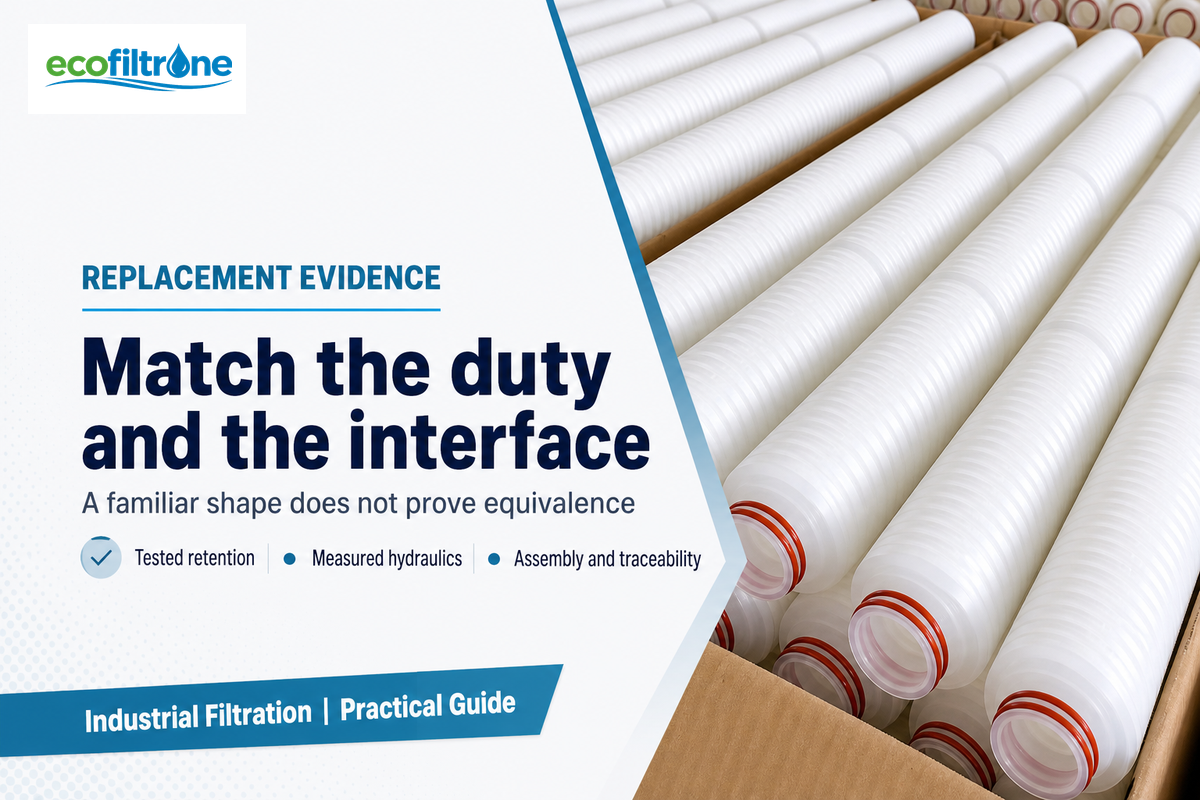
The tested retention requirement, actual liquid, housing fit and operating record support a replacement decision. Evidence should be presented to the supplier prior to reviewing specific models. Product configuration, dimensional matching and quotation then become a separate commercial step, supported by the measurements rather than inferred from a familiar category name.
JNC’s CLEAL PP product instructions illustrate the importance of interface and manufacturer’s conditions. JNC’s instructions are for JNC’s product and don’t endorse an approval for a different supplier’s cartridge. A physically similar element can still differ in the sealing path or retention definition.
- Quality: particle threshold, efficiency definition, method and acceptance metric.
- Hydraulics: measured flow, fluid state, clean pressure loss and the recorded changeout endpoint.
- Assembly: dimensions, end-cap interface, supports, seals and joining materials.
- Traceability: exact model, batch identification, manufacturer where relevant, and the holder and scope of any certificate.
Claims of excellent chemical compatibility need the actual fluid, concentration and temperature. Aqueous duty, an alkali solution, strong acids and corrosive liquids aren’t in the same compatibility category. Oxidizing conditions can change the review: the question is whether the specific liquid can oxidize a component under the intended duty.
Material alternatives also need a specific purpose. A PES or PTFE membrane may be considered when the process needs a different separation function; hydrophobic PTFE materials may require a different application review from a PP fiber medium.
When not to approve a replacement
Stop the product decision when retention basis is missing, the interface isn’t matched, or the liquid is out of documented compatibility. A solvent-compatible medium doesn’t approve a complete cartridge when the seal, end cap, or joint isn’t verified. An unsupported cleaning instruction also introduces uncertainty regarding the assembly and how the product may be used.
Evidence first: resolve the missing measurement or document before treating a model as equivalent. Fiber shedding, retained deposits and altered seals need suitable evidence; appearance and recovered flow alone cannot prove acceptable filtration.
ECOFILTRONE™ is an industrial filtration supplier in Qingdao, China, with application review, specification verification and replacement matching services. The next step to discuss a specific configuration is to review the PP Pleated Filter Cartridges solution page. The guide provides the operating questions, and the solution page provides the product questions.
For a 5 µm replacement request, provide an efficiency definition and actual duty with size. A supplier can then assess the configuration against the housing and process. Any compliance document still needs the exact product and certificate holder checked; a company-level certificate cannot establish cartridge retention.
Key takeaway
Specify the particle threshold and tested efficiency, compare pressure at the measured duty, and count only acceptable filtrate in the cost calculation. A 5 µm label alone cannot resolve those decisions.
Frequently Asked Questions
Can PP pleated cartridges be cleaned?
Cleaning needs exact-model permission and a suitable retention check.
Some products are designed for regeneration, while others are intended for replacement. Follow the original manufacturer’s documented procedure for the supplied model and liquid. Removing visible dirt or recovering flow doesn’t prove that the medium, joints and seals still deliver the required particle retention. Cleaning economics also depend on labour, acceptable output and replacement cost. Avoid transferring a household washing method or another product’s backwashing instructions to an industrial cartridge.
Which is finer, 20 micron or 5 micron?
A 5 micron designation is the smaller size reference; compare efficiency too.
The 5 micron label refers to a smaller particle size than 20 micron. It doesn’t automatically prove better removal at every size or under every condition. Compare the capture efficiency, nominal or absolute definition and test method before treating the two as interchangeable. A finer grade can also change hydraulic resistance or loading behaviour, so check whether the smaller threshold is required by the downstream process.
How long do PP pleated cartridges last?
Useful life depends on duty, outlet quality and the agreed endpoint.
There’s no defensible universal month-based lifespan for the category. Incoming solids, particle characteristics, measured flow, fluid viscosity and the cartridge’s media affect the run. Record acceptable treated volume and pressure history together, while checking outlet quality at representative stages. Replace or investigate according to the exact product’s documented limits and the process requirement. A longer calendar interval isn’t an improvement when flow is lower or the output no longer meets the same criterion.
Where are PP pleated filter cartridges made?
Confirm origin for the exact supplied cartridge.
Manufacturing locations vary by brand, model and supply chain. Ask the supplier for the applicable manufacturer and origin documentation; a supplier’s office address alone doesn’t identify the production facility.
When does a PP cartridge need another treatment stage?
Add or change treatment when the unmet contaminant requirement lies outside particle filtration.
Identify the property that remains outside specification before choosing another stage. Dissolved salts are different from suspended particles, and a PP particle cartridge doesn’t independently establish dissolved-salt removal. A process with a microbial or other validated retention requirement needs the relevant treatment and product evidence rather than a material label. Heavy or variable solids may also justify reviewing upstream treatment when replacement frequency becomes excessive.
Keep media choice separate from assembly compatibility. A PTFE membrane or another membrane material isn’t an automatic upgrade: the intended separation, liquid interaction and housing conditions still need review. Define the acceptable output, then ask whether each treatment stage addresses its assigned duty. Evidence of low pressure drop or visually clear water can’t resolve every unmet quality requirement.
Discuss your measured filtration duty
Send the current rating, flow, liquid conditions and changeout observations for an application and replacement review.
Evidence note: Manufacturer examples and third party studies retain their original ownership and application limits. The particle counts and USD cost comparisons are hypothetical. No ECOFILTRONE plant trial, interview, product certification, or verified savings is claimed.
References & Sources
- University of Georgia, Mechanical Filtration Methods and Devices, reviewed 2026.
- Google Patents, US6315130B1, third-party pleated-filter patent, published 2001.
- Purdue University extension, filter capture-efficiency explanation, oil-filtration context.
- International Organization for Standardization, ISO 16889:2022, public hydraulic-filter test summary.
- International Organization for Standardization, ISO 3968:2017, public pressure-flow-viscosity summary.
- US Environmental Protection Agency, Toolbox Guidance Manual, 2010, sections 8.5–8.6, historical drinking-water context.
- Farhat et al., Cartridge filter selection and replacement, Desalination 473, 2020, original accessible abstract and previews.
- Boaz Keinan, Sharing Operational Experience Is Critical in RO Plant Design, Pumps & Systems, 2017; IDE Technologies affiliation.
- The End of Single Use Filters?, WaterTechOnline, 2020; credited to Amiad.
- US Environmental Protection Agency, Water Reuse Action Plan 2.0 update, 2026.
For application confirmation, drawings and operating follow-up, see ECOFILTRONE filtration support services.