Get in touch with ECOFILTRONE™ Company

Chemical Filtration for Petrochemical, Amine & Oil and Gas
ECOFILTRONE supplies chemical filtration cartridges and liquid filter bags for industrial process streams, utilities and pretreatment duties. Our engineering support separates the contaminant problem from the product choice, checks wetted-material compatibility and matches a proposed element to the installed housing. The result is a shortlist for consideration, sampling and plant validation.
Quotes within 24 hours
Stock orders in 4–5 days
Customized samples in 7 days
Free samples; customer pays freight
Process Duty Sizing
Start with the duty, not the catalog. Send the fluid name and concentration, operating temperature, target contaminant, flow and pressure data, installed housing details, and the result you need from the filtration step.
Quotation response
Within 24 hours
Stock orders
4–5 days
Customized sample
7 days
Customized batch
14 days, confirmed with the quotation
Trial policy
Trial orders accepted; custom orders from 100 pieces, subject to the quoted product
Sample policy
Samples are free; the customer pays freight
Payment terms
30% deposit and 70% before shipment
Chemical Filtration by Duty and Contaminant
Variations in fluids and solids loads in petrochemical and oil and gas industries create different service demands. Filter selection depends on whether the filter is protecting downstream equipment, polishing a product, recovering solids, guarding a carbon bed or preparing water for other treatment.
Application
Process Feed and Transfer
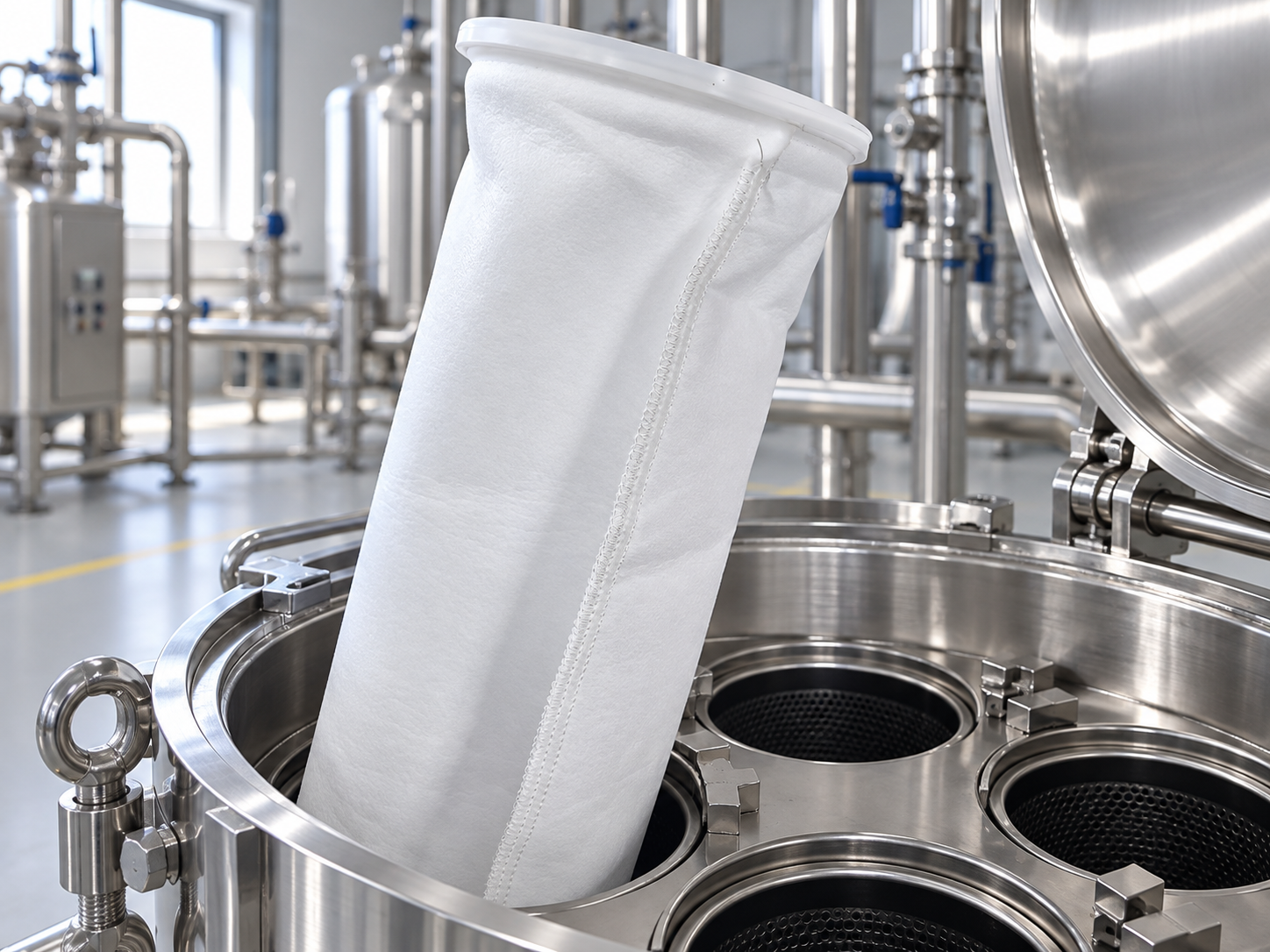
Rust, pipe scale and sediment are debris that are removed from process stream before they build up on equipment and clog process lines. A staged arrangement is useful when an upstream cartridge is blinded quickly by the solids load.
- Bulk-chemical transfer and loading
- Feedstock clarification
- Intermediate process streams
- Tank recirculation and cleanup
Application
Amine and Glycol Circuits
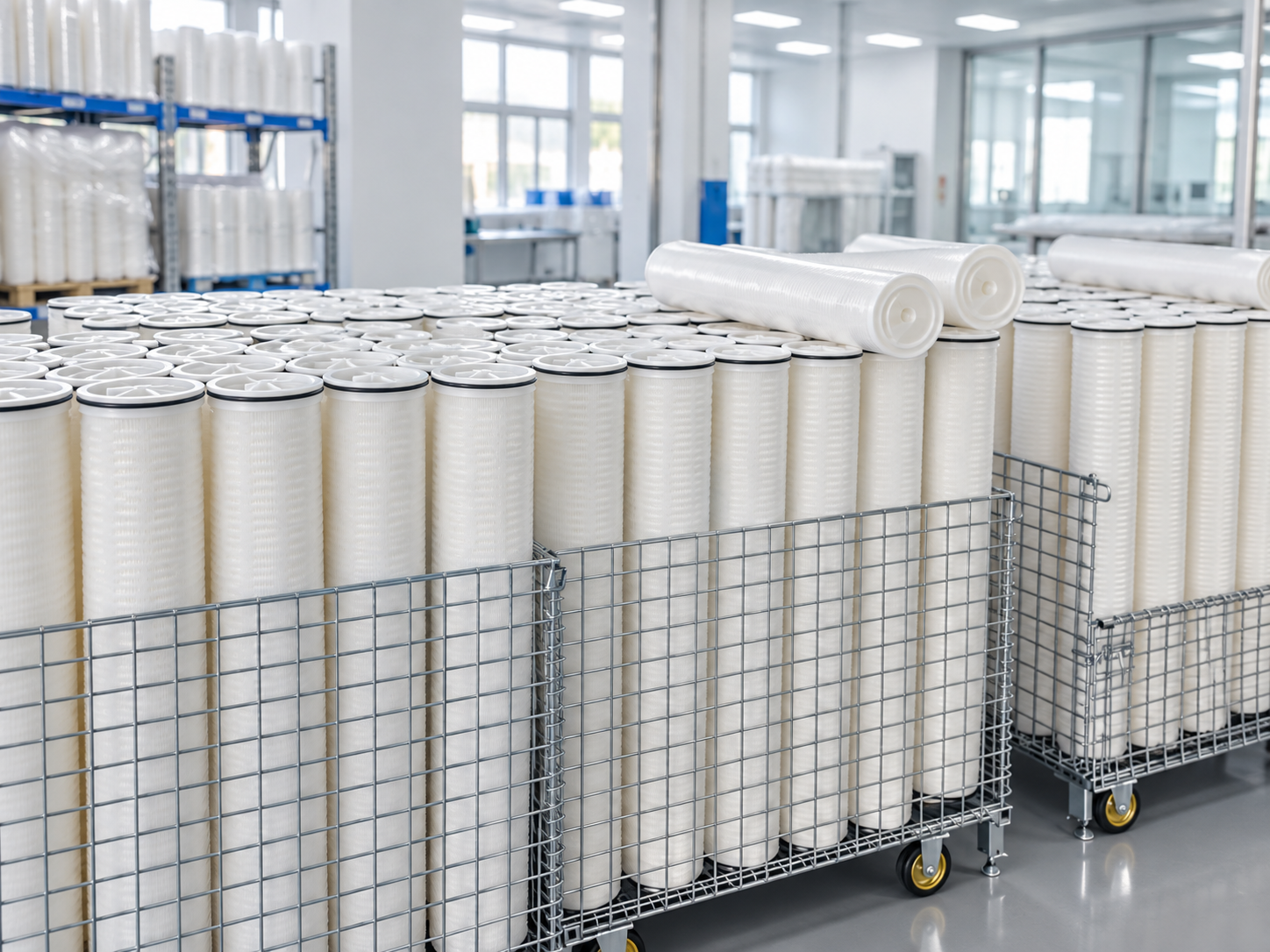
An amine filter cartridge can support particulate control, but a dissolved contaminant such as a heat-stable salt requires a separate treatment method.
- Rich- or lean-amine particulate control
- Carbon-fines polishing
- Glycol-loop solids removal
- Side-stream or full-flow review
Application
Utilities and Water Services
Utility-water quality can affect boilers, cooling systems, membranes and process cleaning. Available cartridge and bag filter units cover water treatment for industries, reverse-osmosis and ultrafiltration pretreatment, wastewater and water reuse.
- Boiler and cooling-water filtration
- Reverse-osmosis pretreatment
- Wastewater solids capture
- Water-reuse polishing
Contaminant Questions That Change the Shortlist
| Observation | What it may indicate | What we ask next |
|---|---|---|
| Visible grit, rust or pipe scale | Inorganic suspended solids with a broad particle-size distribution | Solids loading, largest particles, target downstream protection and acceptable pressure drop |
| Soft or deformable material | Gel, agglomerate, wax, polymer or biological material that may behave differently from hard test dust | Temperature, viscosity, shear response and whether material must be retained or removed |
| Fine black material after carbon service | Activated-carbon fines that can migrate downstream | Carbon grade, bed condition, polishing-filter location and current changeout trigger |
| Rising pressure without obvious solids | Fine particulate, gel formation, precipitation or a compatibility problem | Pressure trend, fluid analysis, temperature changes and used-element examination |
| Dissolved ionic contaminant | A problem outside ordinary particulate cartridge removal | Concentration, analysis method and the responsible process-treatment specialist |
Data Package for an Industrial Filtration Solution
| Data group | Minimum useful detail | Selection consequence |
|---|---|---|
| Process location | Unit, equipment tag, upstream source, downstream user and purpose of the filtration step | Separates equipment protection, product purification, recovery and waste-service duties |
| Fluid condition | Chemical name, concentration, viscosity, temperature range, dissolved gas and known corrosive components | Sets the compatibility review for media, support, core, end caps and seals |
| Contaminant condition | Particle analysis, solids loading, appearance, hardness, deformability and whether the material is valuable | Guides surface versus depth filtration, area and staged prefiltration |
| Hydraulic condition | Normal and maximum flow, operating pressure, clean differential pressure and terminal limit | Checks area, support strength, flow direction and the expected pressure trend |
| Installed hardware | Housing drawing, element dimensions, seating interface, seal and current model | Prevents a cartridge with similar dimensions from being treated as a verified replacement |
| Acceptance method | Fit check, leak or integrity requirement, filtrate test, pressure limit, time or throughput target | Turns the proposed filtration solutions into a controlled plant trial rather than a catalog substitution |
Refinery, Natural Gas and Rotating-Equipment Context
Gas Sweetening and the Amine Circuit
In gas processing and gas treatment, amine solutions are used to remove acidic components from a sour gas stream. Plant design determines absorber, regenerator and amine-solution circulation conditions. Other solvent formulations used in gas treating can also be used for gas sweetening.
- H2S and carbon dioxide are process contaminants, not cartridge-filter particle targets.
- Corrosive solids and degradation products can still create a particulate-control duty to remove solid contamination.
- An amine circuit requires independent determinations for the control of solids, carbon service and dissolved impurity.
Refinery Process Liquids
A refinery can place liquid filtration systems around transfer, catalyst handling, intermediate storage, utilities and final purification. A suitable filtration solution depends on what needs to be protected or removed rather than the general term “petrochemical.”
- Use upstream protection to keep debris from fouling a nozzle, exchanger or separator.
- Only use product polishing after it is determined what clarity and test methods are required.
- Use stringent compatibility review for corrosive or mixed chemical service.
Activated Carbon and Fines
An activated carbon filter performs a different function from the downstream carbon filter used to catch released fines. Therefore, carbon filtration requires a defined goal and an appropriate filter media (combination) with a pressure-based plan.
- Confirm what function the carbon step is intended to perform, i.e. adsorption or particulate control.
- Place the polishing duty where solids carried by the carbon bed can be removed.
- Do not use a service life claim from another plant as the trial acceptance limit.
Compressor, Turbine and Separator Protection
Oil and gas operations also use liquid filters in lubricating oil, seal fluid, fuel and hydraulic support systems around a compressor or turbine package. Each filtration system must be reviewed against the cleanliness requirements of the package supplier.
- Separate liquid-process filtration from gas-intake or ventilation filtration.
- Always record the equipment tag and protected component on the specification.
- Match the housing, bypass arrangement and plant-approved terminal pressure.
Five-Input Chemical Compatibility Brief
A material name alone on a data sheet is just the beginning. Many factors can affect compatibility, such as concentration, type and condition of the other chemicals present, contact time, temperature, pressure, mechanical loading, and the other wetted parts of the system.
Fluid Identity and Concentration
Provide the chemical name or formulation, Safety Data Sheets (SDS) and normal concentration ranges. Include cleaning agents, flush fluids, additives and upset compositions that may contact the cartridge.
1
2
Temperature and Exposure
State normal, start-up, cleaning and maximum temperatures and indicate if exposure is continuous or intermittent. A brief, hot, fluid flush and continuous hot service are two different questions.
Flow, Pressure and Direction
State normal, startup, cleaning and maximum temperatures, plus whether exposure is continuous or intermittent. Share clean flow, operating pressure, differential-pressure limit and flow direction. These factors influence the media area and support structure, and determine if the element matches the housing.
3
4
Contaminant and Filtration Objective
What must be removed or recovered, what its size and loading are, and what downstream problem is being addressed? Used element observations and particle analysis can help in the review.
Full Wetted-Material Stack
Further aspects of the review cover support layers, core, cage, end caps, adhesive/bond, seal material, and any metal components in the configuration.
5
Process-Point Filtration Map
The same plant may require a coarse bag filter at one point, a depth cartridge at another, and a membrane-grade cartridge elsewhere. This map links the filtration duty to a practical product family without treating it as a final specification.
| Process point | Primary objective | Candidate family | Qualification focus |
|---|---|---|---|
| Tank transfer or bulk loading | Capture visible debris and protect downstream equipment | Liquid filter bag, melt-blown cartridge or string-wound cartridge | Solids capacity, viscosity, housing size and disposal route |
| Pump or heat-exchanger guard | Reduce particulate reaching narrow passages and moving parts | Pleated, melt-blown or wound cartridge | Particle-size target, differential pressure, bypass risk and element strength |
| Catalyst or product recovery | Retain a valuable solid or clarify the filtrate | Filter bag or selected cartridge configuration | Particle deformability, recovery method, cake behavior and required clarity |
| Rich-amine solids control | Remove corrosion debris and suspended solids entering the loop | Depth or pleated cartridge selected for the installed housing | Solids load, iron sulfide exposure, flow, temperature and changeout criteria |
| Activated-carbon polishing | Capture carbon fines released from carbon service | Downstream polishing cartridge | Fine-particle efficiency, pressure trend and carbon-bed condition |
| Fuel, lubricant or hydrocarbon polishing | Control suspended contamination before use or transfer | Pleated, depth or high-flow cartridge | Hydrocarbon compatibility, viscosity, static-control needs and rating basis |
| Membrane-system pretreatment | Reduce particulate load before reverse osmosis or ultrafiltration | High-flow, pleated or depth cartridge | Upstream treatment, solids variability, flow distribution and membrane vendor limits |
| Wastewater and water reuse | Capture residual solids before discharge, reuse or polishing | Filter bag, high-flow cartridge or staged depth filtration | Solids load, biological material, chemical cleaning and waste classification |
Amine Loop Contaminant Control Stack
Suspended Solids
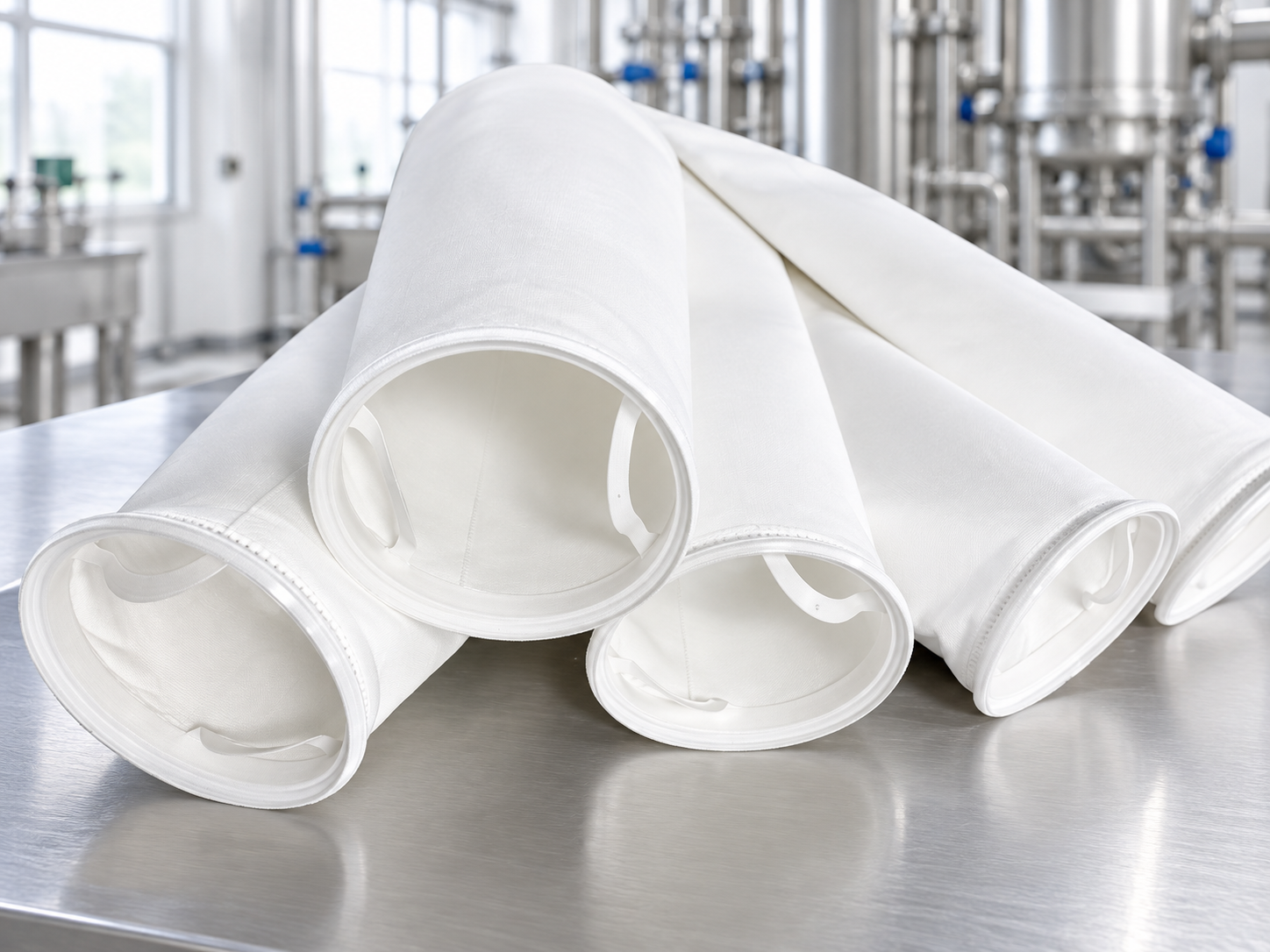
Filter media, rating and housing may be suitable for targeting corrosion products and process debris. The element should be selected against the actual solids load and allowed differential pressure.
Activated-Carbon Service
Activated carbon may be suitable for selected soluble or surface-active contamination. However, the use of activated carbon may result in fines and require a subsequent polishing step.
Dissolved Heat-Stable Salts
Contrary to a common assumption, one cartridge cannot address every amine contaminant. A particulate cartridge chosen to address dissolved heat-stable salts addresses the wrong contaminant class. Processes such as ion exchange, electrodialysis and other solvent reclamation techniques require a separate specialist evaluation.
System boundary: ECOFILTRONE supports consumable selection and replacement matching. The plant owner or responsible process engineer sets the amine-treatment scheme, bypass arrangement, safety controls and operating limits.
“We don’t start an amine review by deciding on a micron number. We first separate suspended solids, carbon fines and dissolved contaminants, then check where a cartridge can do useful work.”
Cartridge and Filter Bag Specification Range
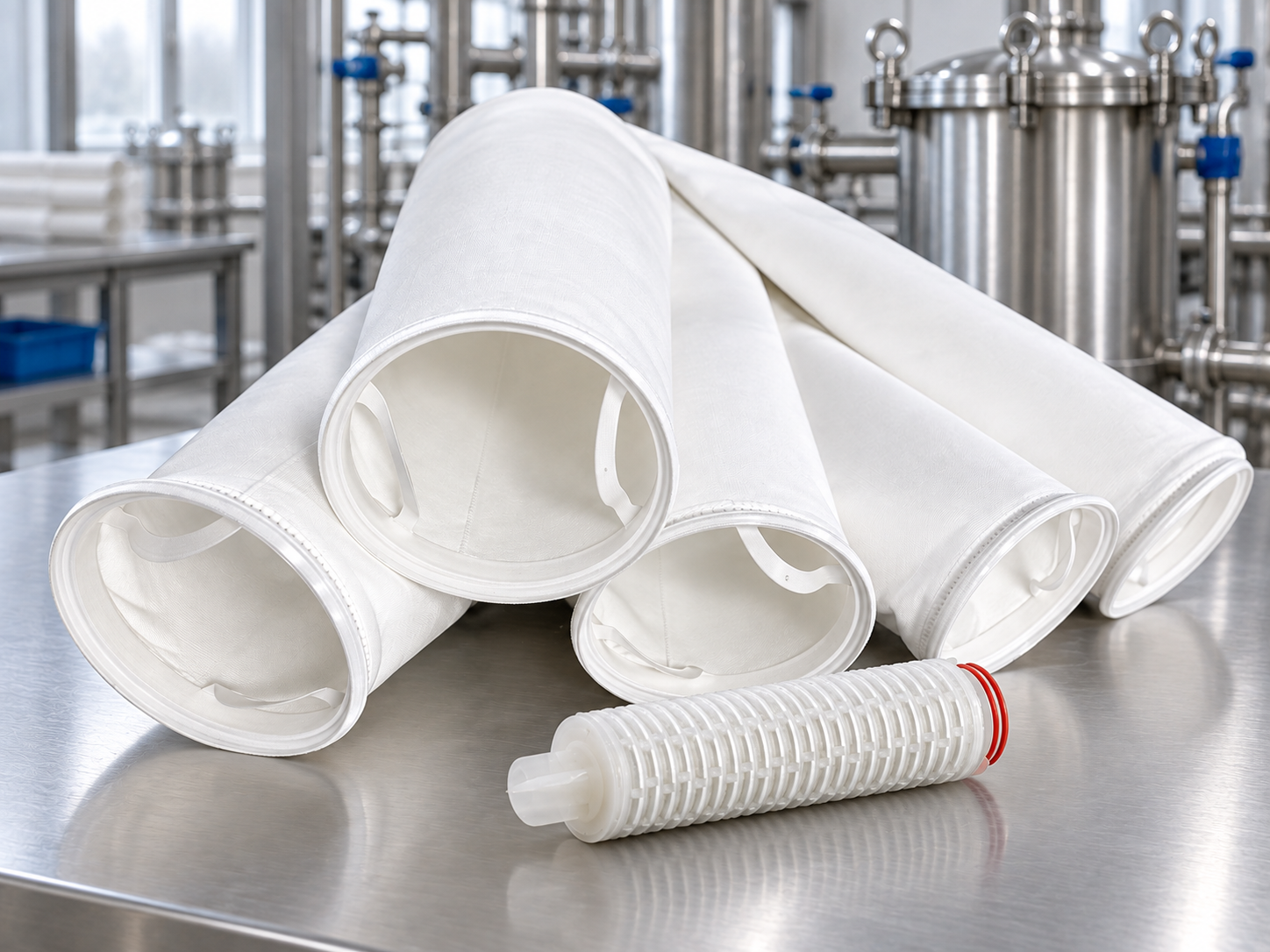
ECOFILTRONE provides a broad line of cartridges, including high-flow and pleated elements, membrane cartridge products, melt-blown and string-wound elements, as well as industrial liquid filter bags. The quoted series, materials and complete assembly must still be checked for the process fluid and housing.
| Product family | Micron range | Length and diameter | Configuration | Maximum listed temperature |
|---|---|---|---|---|
| PP pleated cartridge | 0.1–100 µm | 5–40 in; Ø69 mm | DOE, 222, 226 and Code 7 options | 80°C |
| PES membrane cartridge | 0.04–1.2 µm, depending on series | 5–40 in; Ø69 mm | Series-specific end configuration | 80°C |
| PP melt-blown cartridge | 1–100 µm | 9.75–40 in; Ø63 or Ø115 mm | DOE is the main configuration | 65°C |
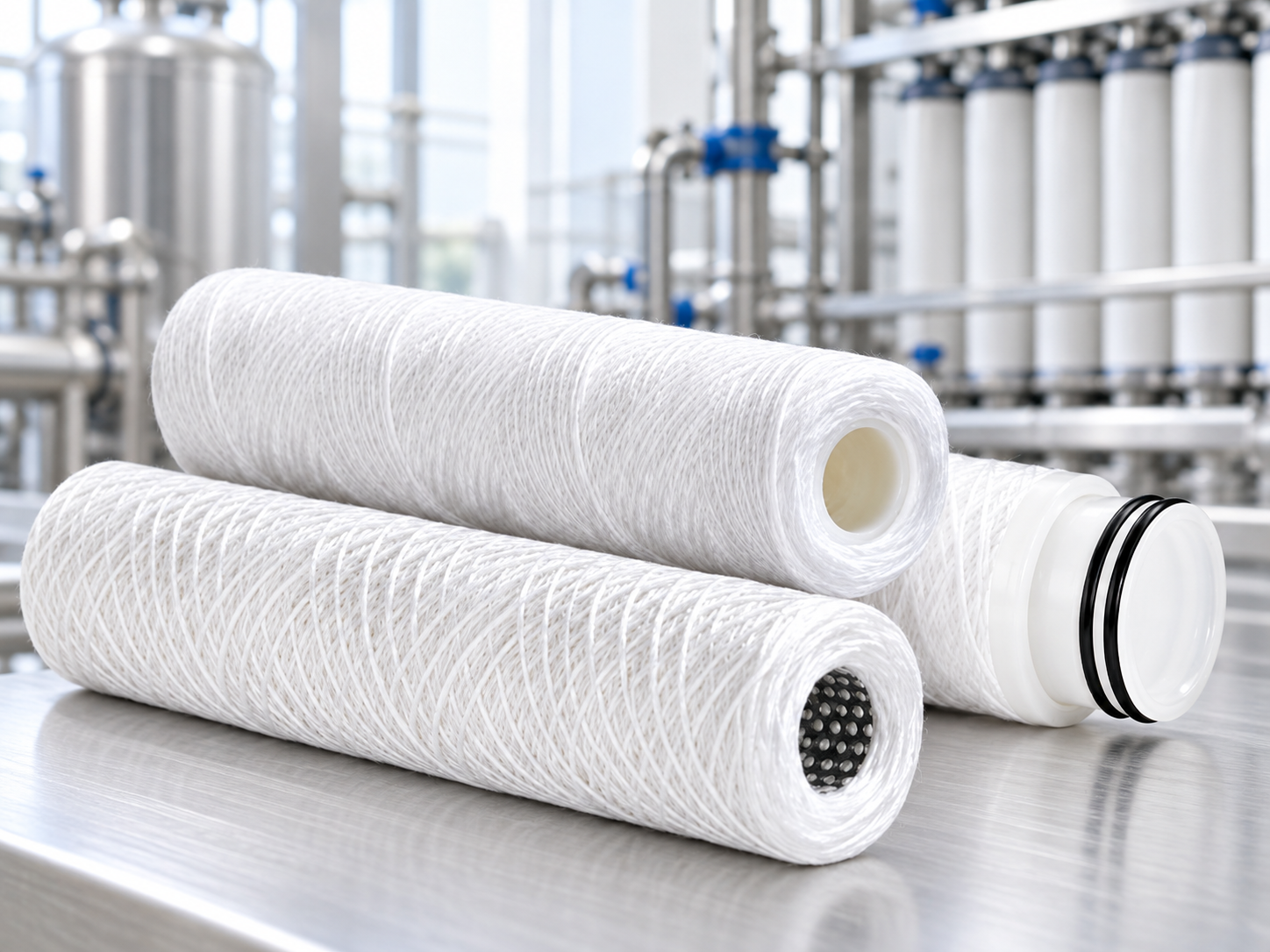
| PP string-wound cartridge | 1–100 µm | 9.75–40 in; Ø63 or Ø115 mm | PP core | 80°C |
| Cotton string-wound cartridge | 1–100 µm | 9.75–40 in; Ø63 or Ø115 mm | Stainless-steel core available | 120°C |
| Fiberglass string-wound cartridge | 1–100 µm | 9.75–40 in; Ø63 or Ø115 mm | Stainless-steel core | 200°C |
| PVDF membrane cartridge | 0.1, 0.22, 0.45 or 0.65 µm | 5–40 in; Ø69 mm | Single-open-end or sanitary-housing adaptation | 80°C |
| PA66 nylon membrane cartridge | 0.22, 0.45, 0.65 or 1.2 µm | 5–40 in; Ø69 mm | Series-specific end configuration | 80°C |
Product Family Trade-Offs
Pleated construction provides a defined media area in a compact element and can support finer particulate duties. Depending on the rating basis, element design, fluid viscosity, solids load and available pressure drop, element selection may require further review.
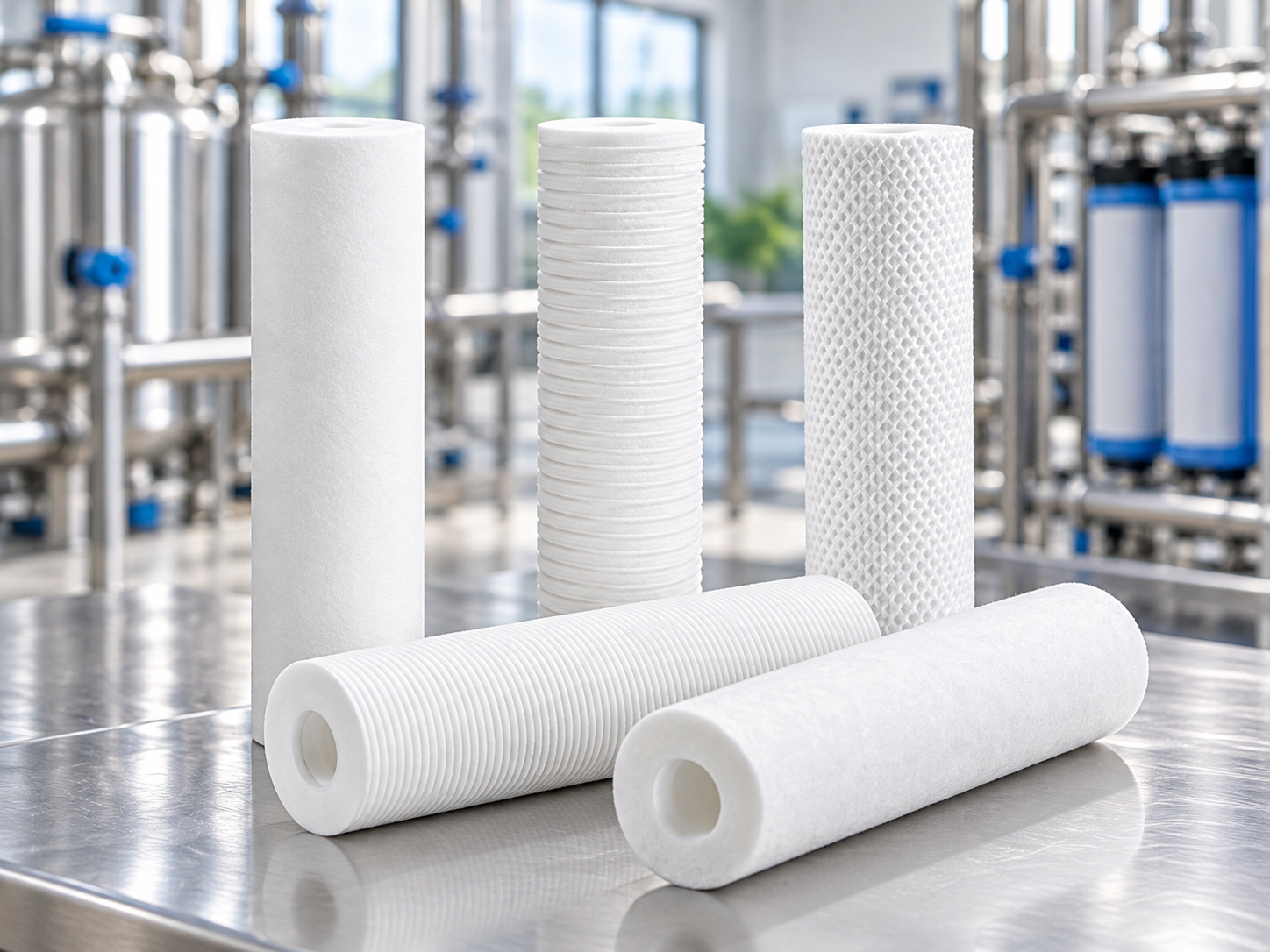
If a general depth filtration duty is to be assigned to a cartridge, then melt-blown media in PP can be considered. It should not be selected based on a “100% PP” description alone, as end-treatment, core and geometry, as well as chemical exposure still need to be considered.
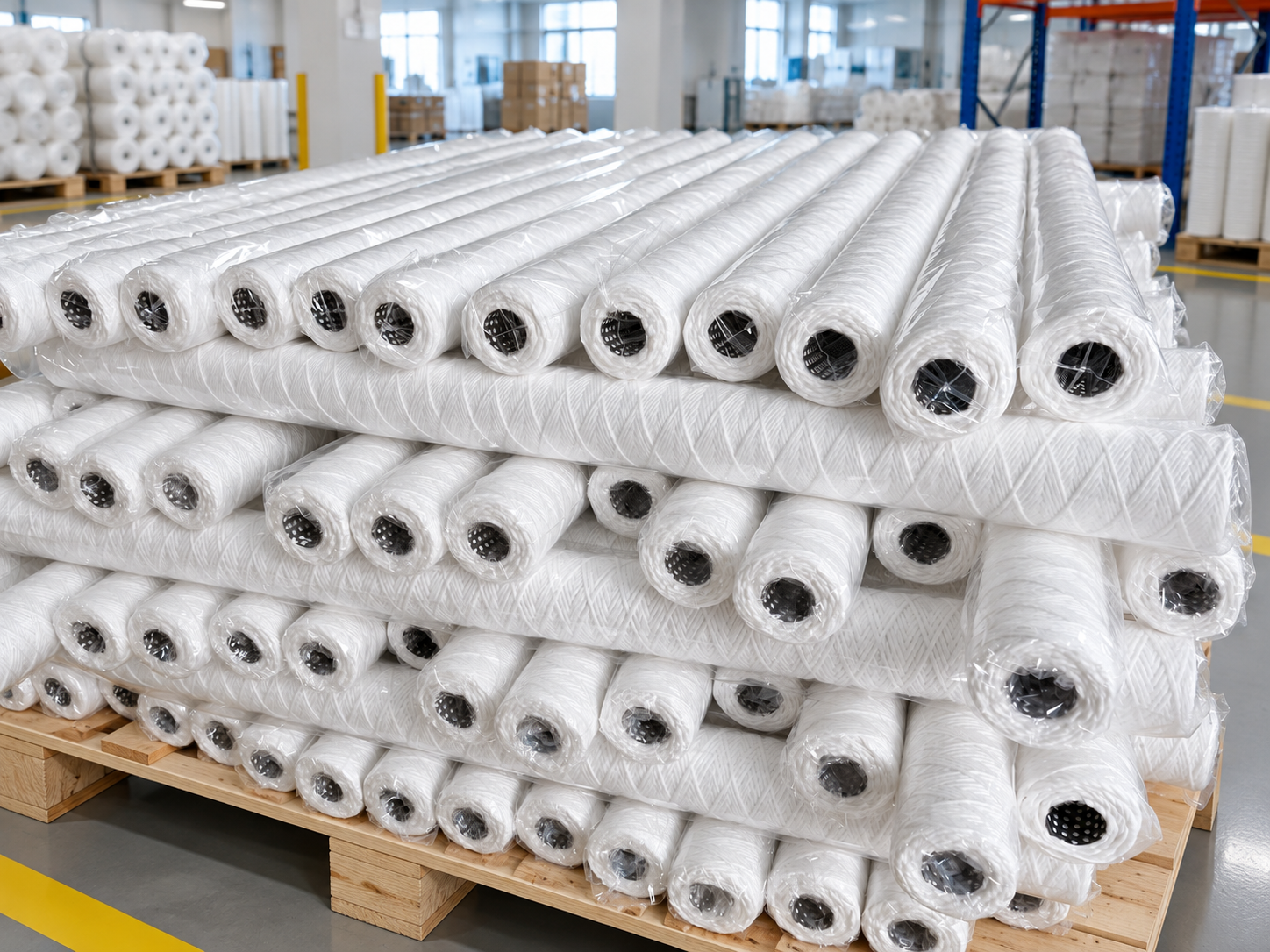
Wound cartridges can offer several yarn and core combinations, including PP, cotton, fiberglass and stainless steel in the confirmed range. The open structure, winding pattern, temperature and chemical compatibility of both yarn and core need to be reviewed for the duty.
Filter bags can serve as a practical first stage for high solids loading or large debris when a cartridge stage needs protection. Factors like ring style, bag size, construction (felt or mesh), micron basis, seam, chemical compatibility, and spent-bag handling should be included in the specification.
Specification Note
A temperature ceiling is not a compatibility approval. The listed maximum belongs to the cataloged family and does not override chemical concentration, pressure, seal, bonding, support-layer or exposure-time limits.
Use a Named Test Basis
ISO 16889:2022 describes a multi-pass method used to evaluate particulate removal, contaminant capacity and differential-pressure characteristics for hydraulic filter elements. It is one example of why a complete comparison needs more than a micron label.
Keep the Duty in View
It is critical to evaluate laboratory data and frame the decision. Only then should the element be validated to perform in service.
A similar micron label is not a substitute for a verified performance basis. A replacement carries bypass and pressure risk because dimensions and micron labels do not define full assembly performance. ECOFILTRONE™ provides product-specific construction and fit review, while ISO 16889:2022 supplies one named test basis for particulate performance.
Total Cost and Procurement Planning
Many factors can affect the operating cost of a filtration step. Element count, labor, production access, differential-pressure behavior, stock risk, changeout consequences and disposal can also affect total cost.
No generic payback is claimed. A percentage saving, life extension or return period needs comparable operating data from the same duty; the page does not substitute a market estimate for plant evidence.
Verified Procurement Facts
Quotation and Trial
- We return quotations within 24 hours.
- We accept trial orders; the minimum order depends on the product.
- We accept customized orders from 100 pieces, subject to the quoted product configuration.
- Samples are free, and the customer pays freight.
Lead Time and Payment
- We schedule stock orders in 4–5 days.
- We schedule customized samples in 7 days.
- We schedule customized batch orders in 14 days, confirmed with the quotation.
- Payment is 30% deposit and 70% before shipment.
Product Verification and Inspection
ECOFILTRONE supports application review, filter selection, specification verification, replacement matching and customized configuration. For the named duty, we confirm the proposed product against the supplied data before the order proceeds.
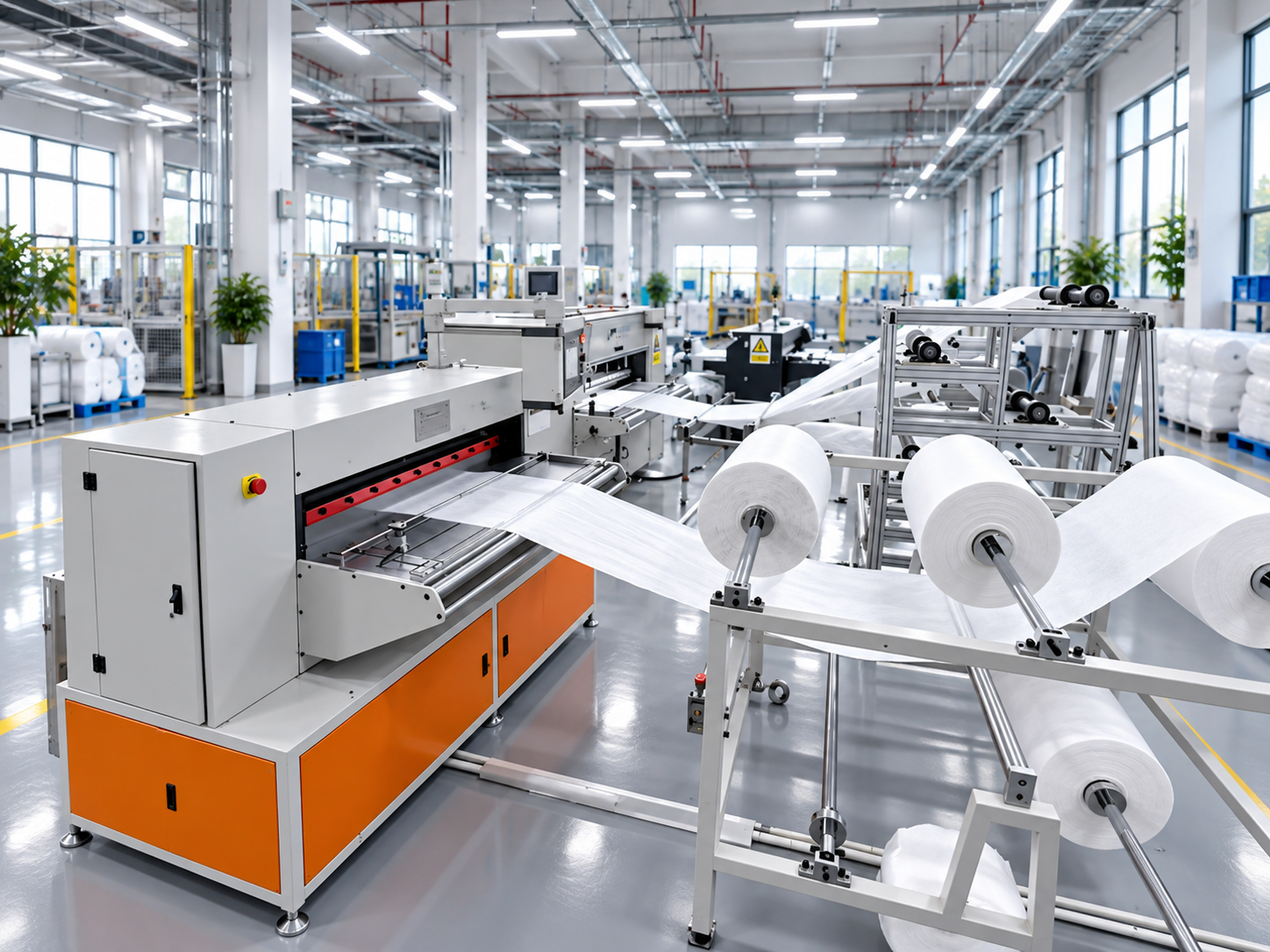
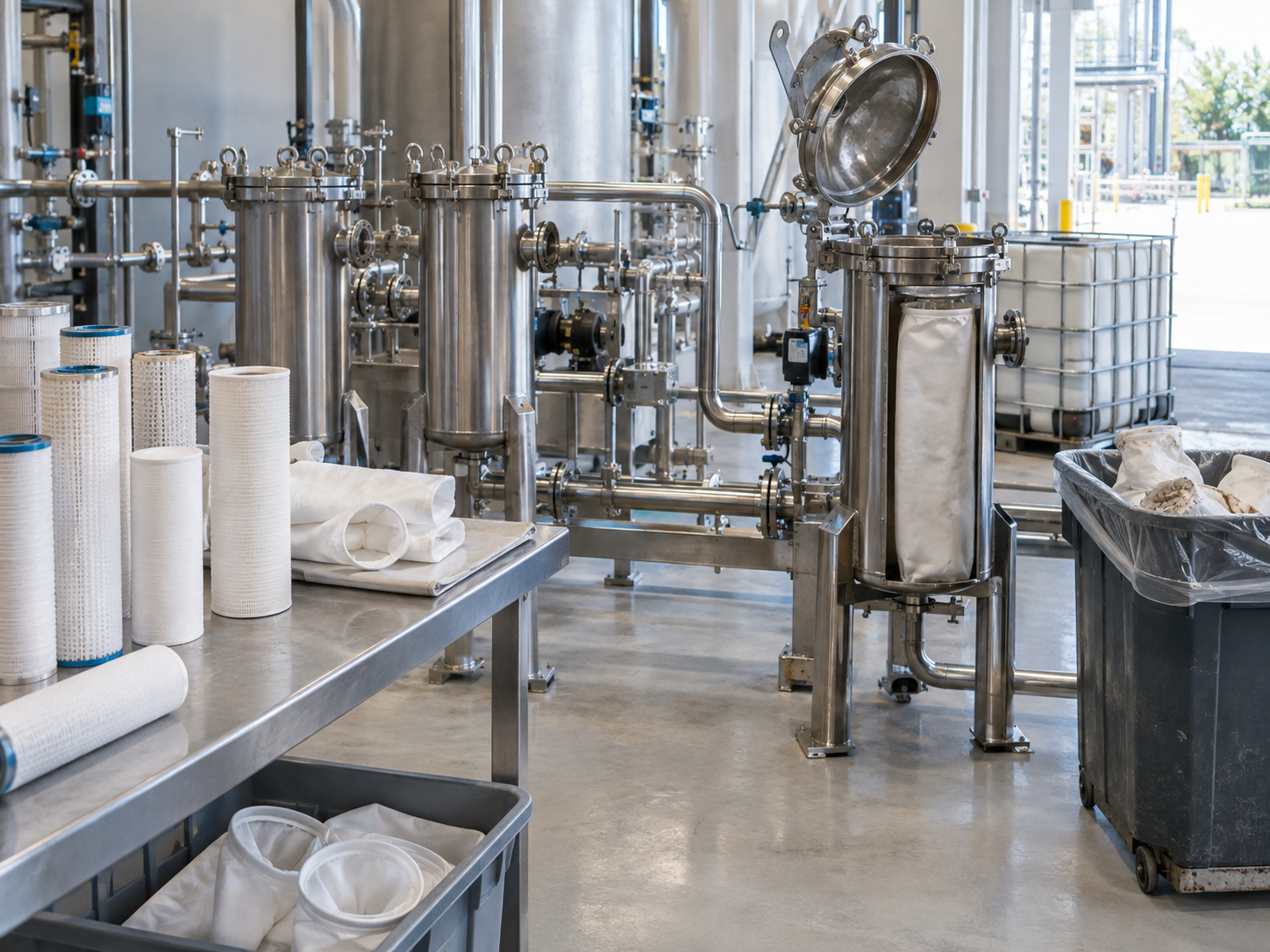
Production processes can vary with different product lines and facilities. Available processes include media pleating, membrane cartridge assembly, melt-blown extrusion, string winding, filter-bag cutting and sewing, end-cap welding or bonding, and final cartridge assembly.
Testing and inspection equipment is used for dimensional checks and for verification of integrity, flow or filtration performance as specified in the requirements. The exact inspection and document package are confirmed for the quoted item.
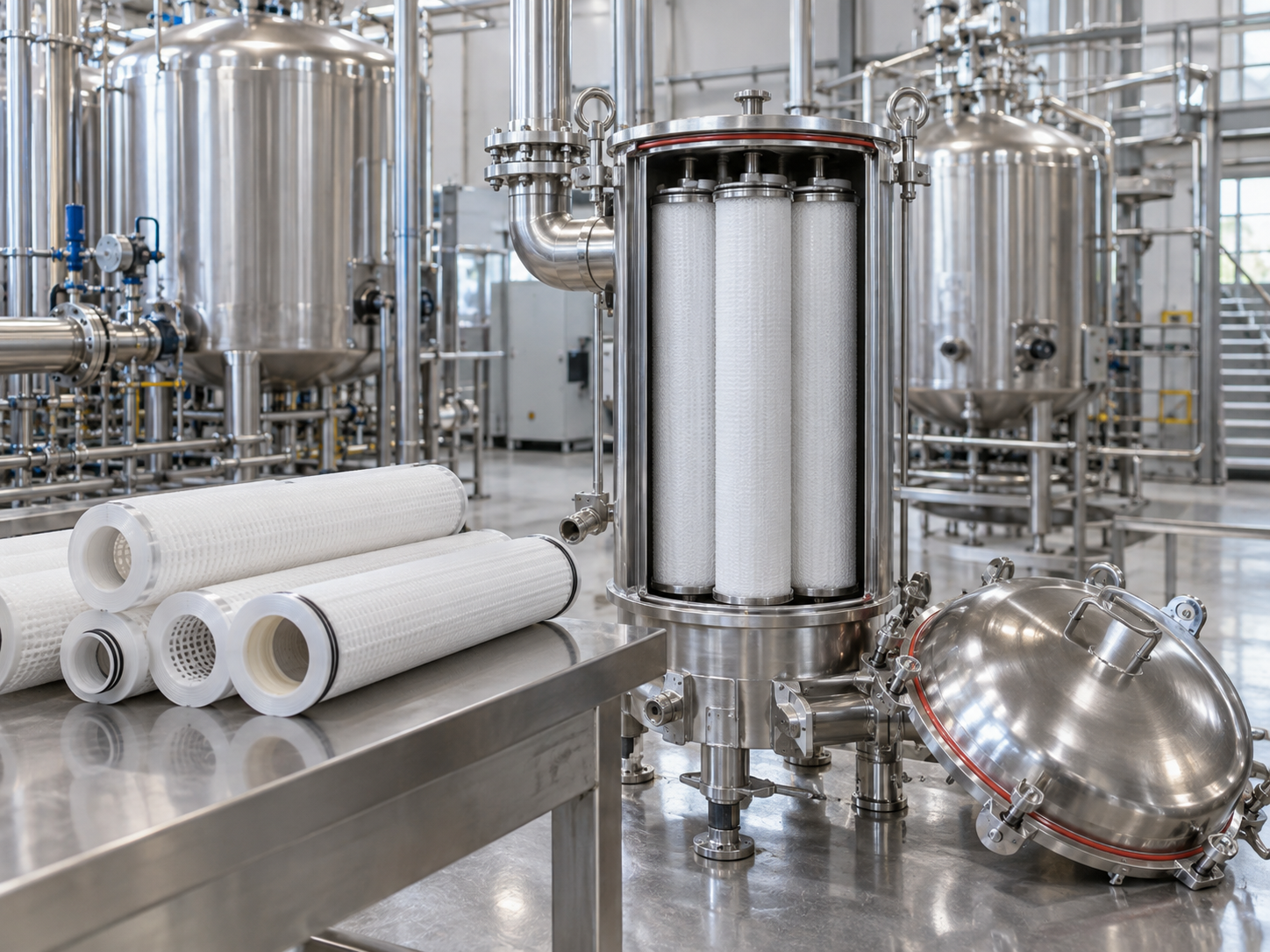
Application review.
The engineering review covers the fluid, contaminant, operating conditions and purpose of the filtration step.
Specification check.
The comparison includes media, dimensions, end configuration, seal, core, rating and listed operating limits.
Technical confirmation.
Applicable data sheets or drawings identify any open point before production.
Production follow-up.
The order team confirms the requirements for inspection, packaging and shipping.
After-sales support.
Operating feedback is used to refine the configuration of the element and housing.
For a quoted item, we can provide technical data, material documentation and applicable compliance files according to the specific product and application. Certification files are supplied only after the actual certificate holder and product coverage are verified.
Request a Product-Specific Document CheckThis page does not claim ISO 9001 certification. Ask for a Product-Specific Document Check so the quotation and files refer to the same item, construction and certificate holder.
Request a Product-Specific Document CheckReplacement Match and Trial Workflow
A replacement cartridge should be matched as a complete interface, not by brand reference or outside diameter alone. For each review, we use the element, housing and operating conditions to build a match record.
Use the high-flow filter cartridge cross-reference for the family and physical-fit screen, then return to this page for chemical-duty and material-compatibility review.
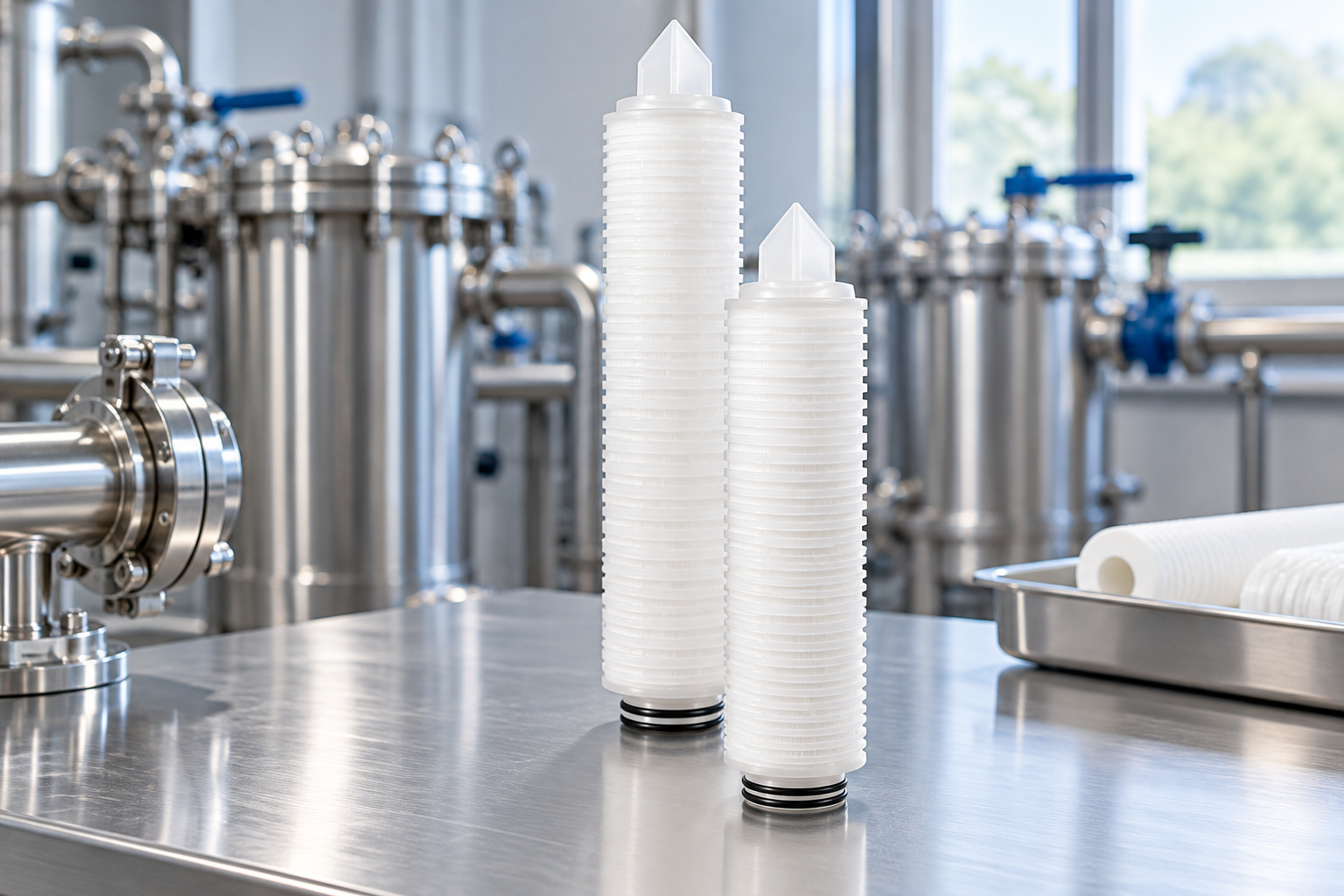
Cartridge-to-Housing Match Checklist
| Match field | Evidence to send | Why it matters |
|---|---|---|
| Element dimensions | Overall length, outside diameter and critical seating dimensions | Prevents interference, bypass or incomplete compression |
| End configuration | DOE, 222, 226, Code 7 or product-specific interface photos and drawing | Controls seating, flow path and extraction |
| Seal system | Material, size, position and any backup or flat gasket | A dimensional fit is incomplete if the seal is incompatible or misplaced |
| Flow direction | Housing drawing or marked inlet and outlet | Some high-flow and supported elements are directional |
| Rating and efficiency | Current data sheet, test basis or agreed process target | Prevents a nominal-for-absolute substitution |
| Operating duty | Fluid, concentration, temperature, flow, pressure and differential-pressure limit | Confirms that mechanical and material limits are reviewed together |
- Agree the installation and acceptance checks.
- Record the clean differential pressure and stable operating flow.
- Define sample points and a plant-approved stop condition.
- Keep the current qualified element available for controlled fallback.
- Track time, throughput, flow and differential pressure.
- Record process changes that affect solids or viscosity.
- Compare filtrate or downstream condition with the agreed method.
- Photograph and inspect the used element at changeout.
Use the Replacement cartridge Match tool to create an installed-element record, or use the Amine Filtration Shortlist tool to identify contaminant classes before element selection.
Access Match ToolsLimits and Escalation Points
A cartridge or bag filter is only beneficial when its separation mechanism correlates with the problem. Send the following to the responsible process, safety or waste specialist before selecting a consumable.
| Situation | Why a consumable shortlist is not enough | Next step |
|---|---|---|
| Dissolved salts, ions or fully soluble degradation products | Ordinary particle filtration does not remove a dissolved species simply by using a finer nominal rating | Confirm the analysis and evaluate ion exchange, electrodialysis, distillation or another suitable process |
| Unknown exothermic, reactive or hazardous chemistry | Material compatibility and process safety cannot be approved from a generic product table | Complete a plant engineering and safety review before selecting the consumable |
| Unverified housing interface | A cartridge that appears similar can seat incorrectly, bypass or be damaged during startup | Measure the element and housing, confirm flow direction, and run a controlled fit check |
| Solids load overwhelms a fine cartridge | Premature differential-pressure rise can make a fine element uneconomic or unstable | Add coarse prefiltration, increase area or review a bag, depth or high-flow arrangement |
| Captured material has uncertain waste status | Disposal obligations can depend on the contaminant, filter construction, treatment and local law | Characterize the spent media and obtain instructions from the responsible environmental team |
| No agreed acceptance method | Service life alone can hide changes in flow, loading, product quality or terminal pressure | Define fit, pressure, filtrate and operating acceptance criteria before the trial starts |
Specification Note
Spent-media boundary: a common assumption is that removed filter cartridges, bags and activated carbon are ordinary waste. Classification and handling depend on the captured material, the media and local requirements.
Engineering Tools for Chemical & Petrochemical Filtration
Amine Filtration Shortlist
Determine optimal filtration stages for amine sweetening systems to mitigate foaming and protect contactor internals.
Five-Input Chemical Compatibility Brief
Verify filter media and housing material resistance against aggressive petrochemical fluids to ensure operational safety.
Replacement Cartridge Match Checklist
Streamline OEM crossover processes with exact dimension and micron rating matching to reduce downtime during change-outs.
Chemical Filtration FAQs
What information is needed to select a chemical filter cartridge?
Send fluid and concentration, normal and max temperature, contaminant and removal goal, flow, pressure, allowed differential pressure, housing details, current element and requested documents. Include cleaning or upset fluids that may contact the filter.
Can a finer micron cartridge solve a short service-life problem?
Not automatically. A finer element can raise differential pressure sooner, so the review should include solids loading, area, rating efficiency, pretreatment and the actual changeout trigger.
Does an amine filter cartridge remove heat-stable salts?
Typical particulate cartridges are used to remove suspended solids and can polish carbon fines, but should not be presented as removing dissolved heat stable salts. Those ionic contaminants need a separate solvent-treatment review.
Where does a carbon-fines polishing filter go in an amine system?
It is evaluated downstream of activated carbon service, so released fines do not continue in the service loop. The responsible engineer must confirm location, flow fraction, rating and operating limits for the actual plant.
How should two micron ratings be compared?
Compare nominal or absolute basis, efficiency or beta ratio, test method, contaminant, fluid and differential-pressure conditions. ISO 16889:2022 is one named multi-pass test basis, but it does not make every process cartridge interchangeable.
Which seal material should be used for a replacement cartridge?
The exact chemical composition, concentration, temperature and exposure should be reviewed against the seal. Send the current seal specification and housing interface rather than selecting a seal by habit (EPDM or FKM).
What is the lead time for stock and customized filters?
We schedule stock orders in 4–5 days, customized samples in 7 days and customized batch orders in 14 days. The quotation confirms the product configuration, quantity and schedule.
Can we place a trial order before a batch order?
Yes. We accept trial orders according to the product and customized orders from 100 pieces, subject to the quoted product configuration; samples are free while the customer pays freight.
Which documents can be supplied with an order?
We can provide applicable technical data, drawings, material documentation and compliance files according to the specific product and application. Certificate coverage and the actual certificate holder are verified before a certification document is supplied.
How are payment and quotation handled?
We return quotations within 24 hours. Payment is 30% deposit and 70% before shipment, with the product specification and any required document package confirmed in the quotation.
What is amine gas treating?
Amine gas treating is a process that removes hydrogen sulfide (and other acidic components) from sour gas. One of the associated treatments is the removal of suspended solids. Cartridge filtration supports suspended-solids control; however, it does not replace the amine treatment process.
Which cartridge families are used for process-liquid filtration?
The shortlist may include pleated, membrane, melt-blown, string-wound or high-flow cartridges, plus filter bags for selected solids loads. Choice of element is based on contaminant behavior and chemistry, process and service conditions, existing element, required rating basis, and cost.