Get in touch with ECOFILTRONE™ Company



Mesh to micron conversion uses a sieve series to match a mesh designation with a nominal opening. In the U.S. series, No. 100 has a nominal opening of 150 µm and No. 200 has a nominal opening of 75 µm. For woven cloth sold by count, the clear opening also depends on the wire or filament diameter. See Gilson’s nominal sieve size chart.
Quick reference
- 100 mesh and 100 µm describe different things. The nominal opening of U.S. sieve No. 100 is 150 µm.
- Closest to 100 µm on the numbered chart: No. 140 at 106 µm. The next smaller numbered opening is No. 170 at 90 µm.
- Getting a bag? Specify the aperture or retention test, along with the construction, ring profile and operating conditions.
A sieve label gets you to the right chart row. A bag order adds two questions: what does the number describe on this product and what will the assembled bag and housing do in your liquid?
US Mesh to Micron Conversion Chart
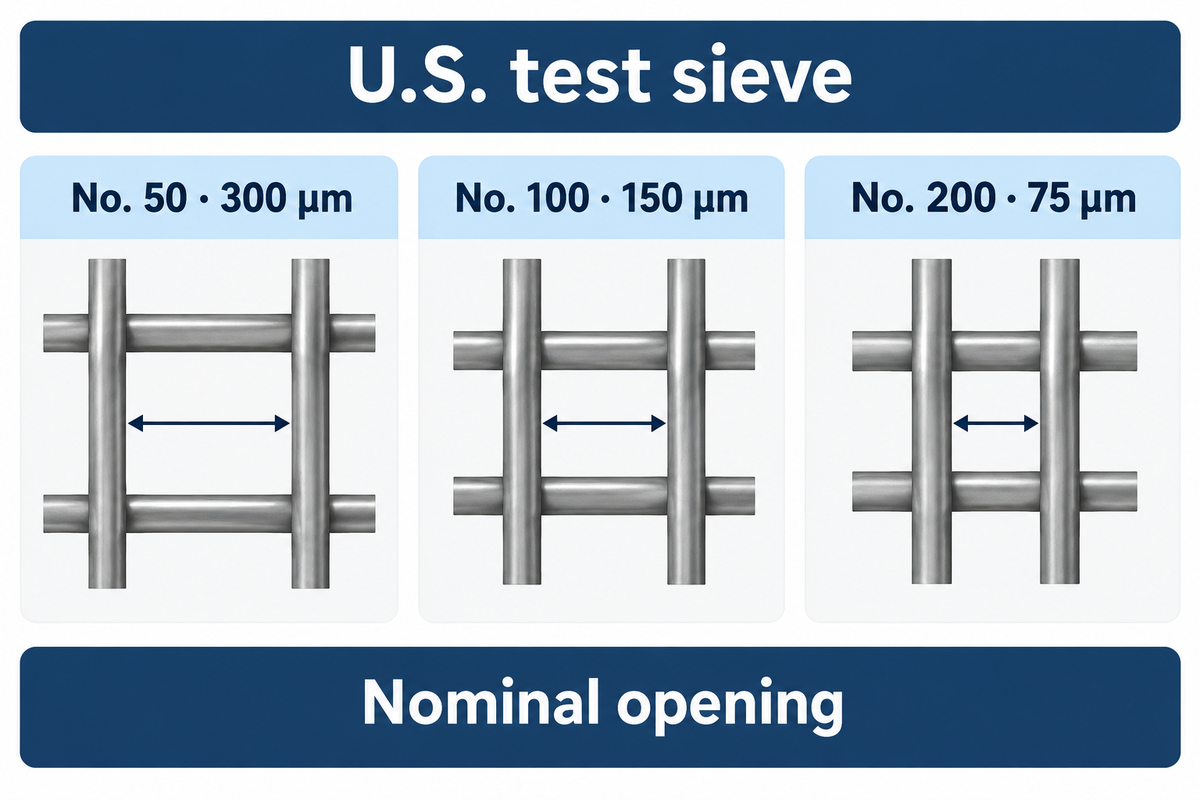
Find the U.S. mesh size in the left column and then read the nominal opening in microns or millimeters. In this series, No. 50 has a nominal opening of 300 µm and No. 100 has a nominal opening of 150 µm. These values describe the gap across the opening. To compare the nominal openings across the series, use the table.
| U.S. sieve number | Opening (µm) | Opening (mm) |
|---|---|---|
| No. 16 | 1180 | 1.180 |
| No. 20 | 850 | 0.850 |
| No. 30 | 600 | 0.600 |
| No. 40 | 425 | 0.425 |
| No. 50 | 300 | 0.300 |
| No. 60 | 250 | 0.250 |
| No. 70 | 212 | 0.212 |
| No. 80 | 180 | 0.180 |
| No. 100 | 150 | 0.150 |
| No. 120 | 125 | 0.125 |
| No. 140 | 106 | 0.106 |
| No. 170 | 90 | 0.090 |
| No. 200 | 75 | 0.075 |
| No. 230 | 63 | 0.063 |
| No. 270 | 53 | 0.053 |
| No. 325 | 45 | 0.045 |
| No. 400 | 38 | 0.038 |
| No. 450 | 32 | 0.032 |
| No. 500 | 25 | 0.025 |
The chart follows Gilson’s U.S. alternate sieve designations. Haver & Boecker’s ASTM E11 sieve reference also provides nominal openings for different designations. When you are copying a row into a specification, especially if the equipment uses a different mesh scale or a supplier’s own wire mesh chart, keep the series with the number.
ASTM E11-24 identifies woven wire test sieve cloth and mesh sieves used for particle size analysis. It separately examines the average opening, maximum opening, and variation across the cloth. The maximum opening matters to the process because particles can pass through an oversize opening.
What Mesh Count and Microns Measure
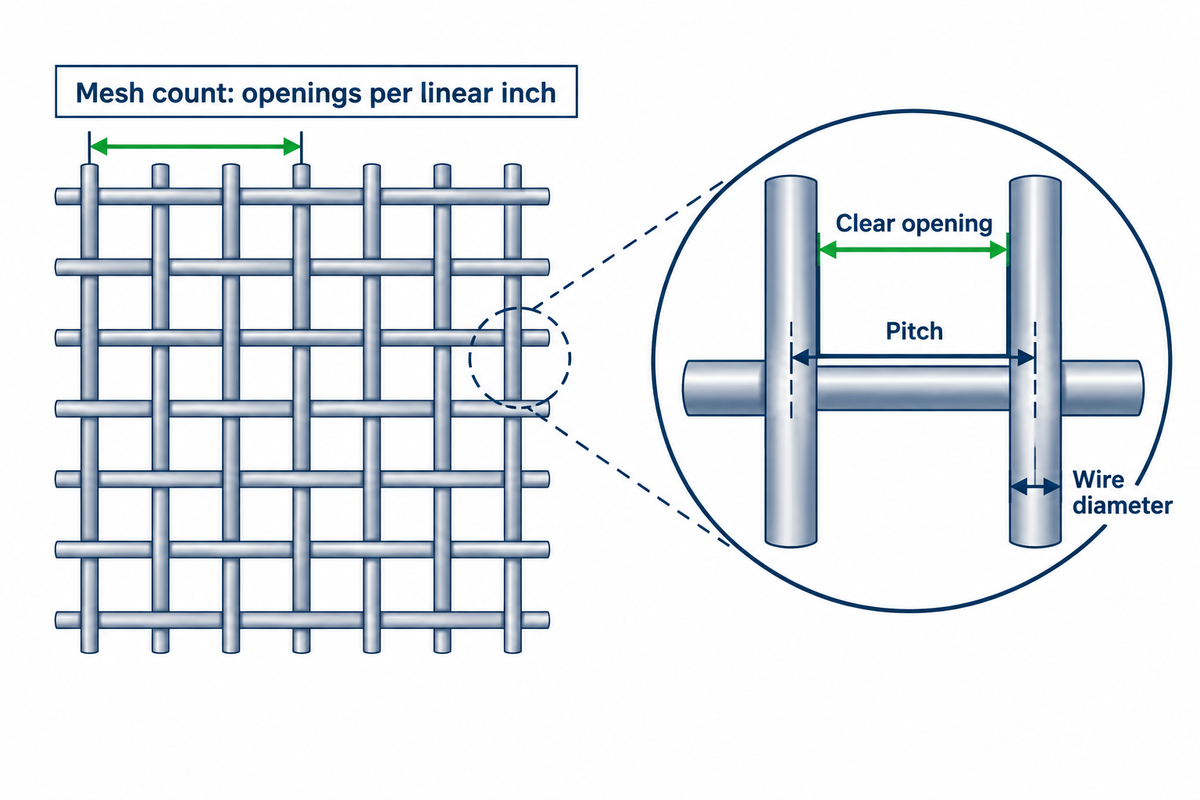
A mesh count is the number of openings per linear inch on a screen cloth. Count the openings in one direction along the weave. A micron is a measure of length. On a square screen, the clear opening is the width of the hole between two neighboring strands.
Pitch runs from the center of one strand to the center of the next and includes the opening and thickness of the strand.
The U.S. sieve number is tied to a nominal aperture designation. A higher mesh designation means a smaller nominal opening in this U.S. series. Compare No. 50 with No. 100 by the chart. Two sheets of industrial wire cloth may share the same count but use different wire diameters, resulting in different openings. Read the heading on a supplier’s data sheet before treating two numbers as equivalents.
Micron is another word for micrometer. Divide by 1,000 to convert microns to millimeters. NIST’s tables of measurement units give the length relationships for converting between microns and inches.
How to Calculate an Opening From Mesh Count
For a regular square weave, subtract the wire diameter from the pitch, as NIST did in their sieve calibration study. First divide the length of one inch by the count along that direction. Use the same unit for both pitch and wire diameter. In microns, the ideal clear opening equals 25,400 divided by the count per inch, minus the wire diameter in microns.
Square-weave formula Clear opening (µm) = 25,400 / mesh count − wire diameter (µm)
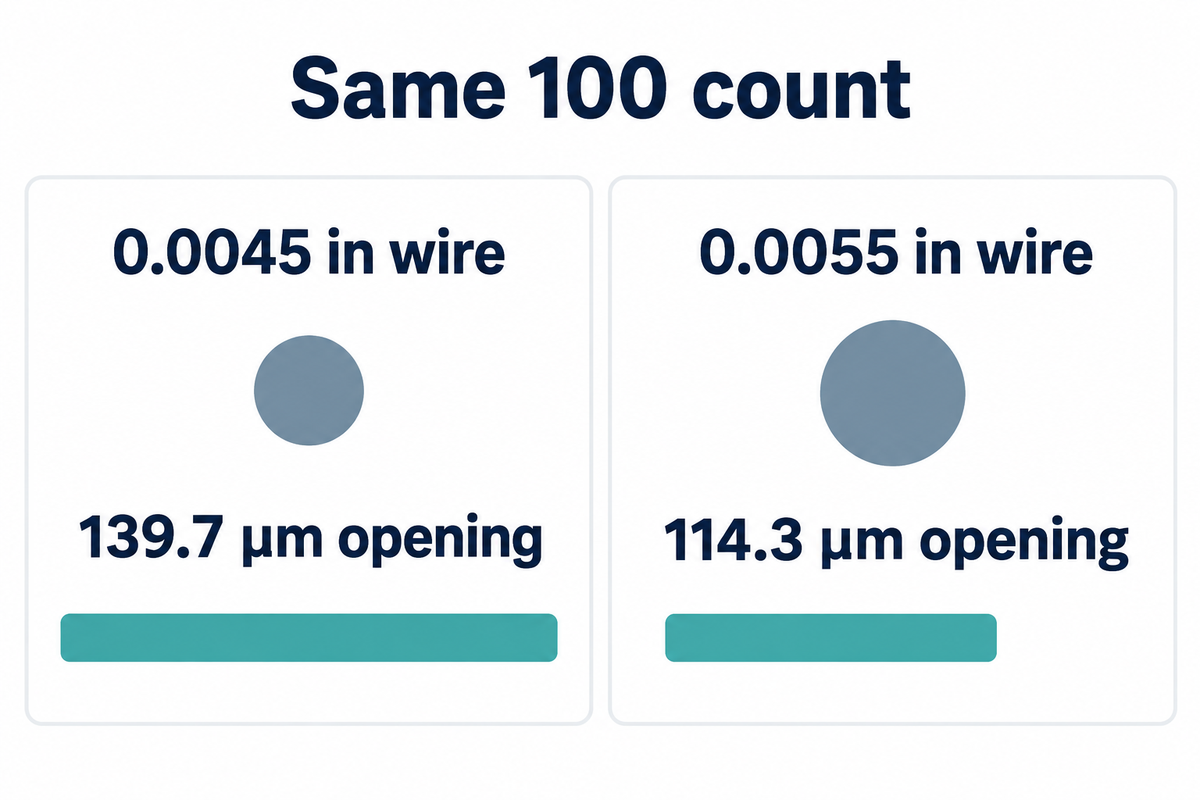
Howard Wire’s worked examples contain two cloths with 100 openings per inch. Divide one inch by the count to obtain their shared pitch. The table shows that step and the two resulting openings. Changing the wire from 0.0045 in to 0.0055 in leaves less of that pitch available as a gap.
| Wire diameter | Opening calculation | Clear opening (µm) |
|---|---|---|
| 0.0045 in | 0.0100 in − 0.0045 in = 0.0055 in | 139.7 |
| 0.0055 in | 0.0100 in − 0.0055 in = 0.0045 in | 114.3 |
For rectangular mesh, read both directions. When a manufacturer chooses to perforate sheet metal instead of weaving cloth, compare the specified hole diameter and pitch. Dutch weave uses a different arrangement of wire count and diameter across its directions, as described in ASTM E2814-22 on industrial woven filter cloth. Use the product’s specified opening size or retention test method for that weave.
How to Go From Microns Back to Mesh
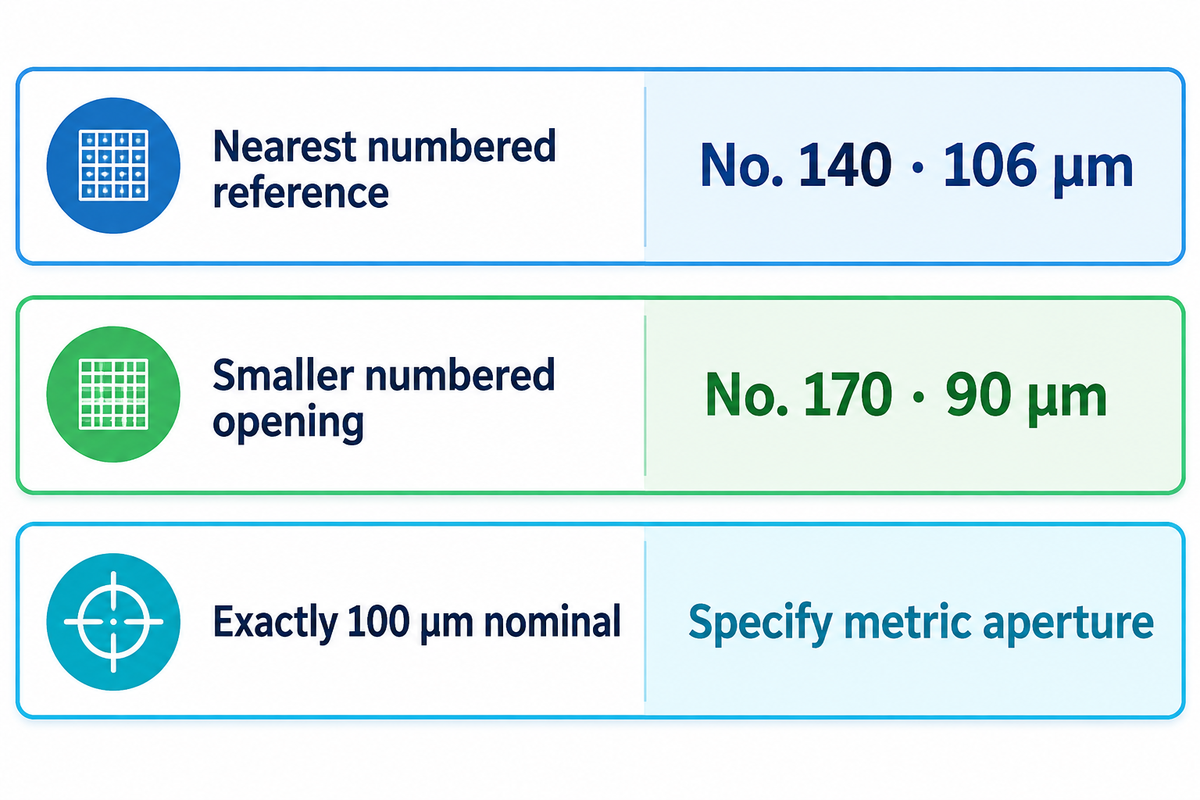
Start with the two numbered openings that bracket the target. For 100 µm, Gilson’s U.S. rows give No. 140 at 106 µm and No. 170 at 90 µm. No. 140 is closer by absolute difference. No. 170 is the smaller nominal choice.
Gilson’s comparison chart gives 100 µm in the ISO metric column without a U.S. alternative number on that row.
| What you need | What to specify |
|---|---|
| Nearest numbered reference | Use No. 140 (106 µm). Its nominal opening is 6 µm from 100 µm. |
| A numbered opening nominally smaller than 100 µm | Use No. 170 (90 µm). Confirm the applicable tolerances when the limit applies to individual openings. |
| Exactly 100 µm nominal | Order by the stated metric aperture. Write down the applicable series or cloth specification and measurement method. |
For example, a laboratory replacing a reference sieve can order by the approved series and number. If a process drawing specifies a maximum opening, it needs a limit, a measurement method and an acceptance tolerance.
Can You Use a Mesh Chart for Filter Bags?
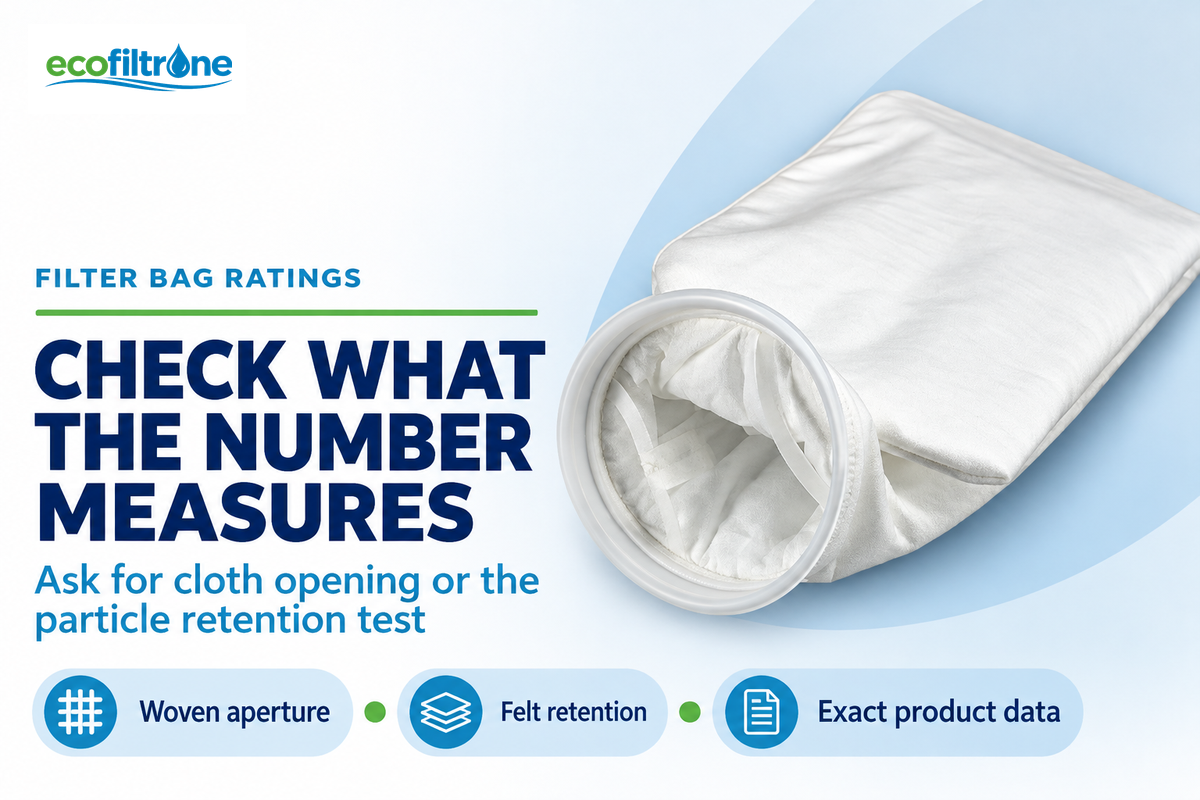
Use the chart as a starting point for woven mesh when you know the sieve series or can obtain the cloth’s specified aperture. For felt, compare the supplier’s micron rating with the test method and the stated retention at the particle size.
Felt captures particles within a fibrous layer. A data sheet for a felt product may identify a grade and a retention test instead of an opening size.
You may request a woven nylon liquid filter bag rated at 100 µm. If your drawing specifies a 100 µm opening, ask the supplier to confirm the nominal aperture and tolerance of the exact cloth. Felt can carry the same micron rating on its data sheet. For a performance-rated bag, check what fraction of the target particles the supplier reports removing, and under what test conditions. Ask for a product drawing or test document tied to the exact item rather than comparing labels from unrelated products.
| Label on the document | What the number measures | What to check |
|---|---|---|
| U.S. test sieve designation | Nominal opening in woven wire test sieve cloth | Standard series and opening tolerance |
| Woven mesh bag aperture | Clear opening in the specified cloth | Weave, aperture tolerance, seam and bag-to-housing fit |
| Felt bag micron grade | Particle retention rating under a stated convention | Test method, target particle size and reported efficiency |
ECOFILTRONE’s nylon mesh bag specifications cover woven constructions, sealing options and sizing inputs. Its micron-rated liquid filter bag table lists both nylon mesh and felt as candidates at 100 µm. Since the alternatives use different media, be sure to specify whether the quote refers to an opening size or a retention rating.
How to Test a Replacement Bag
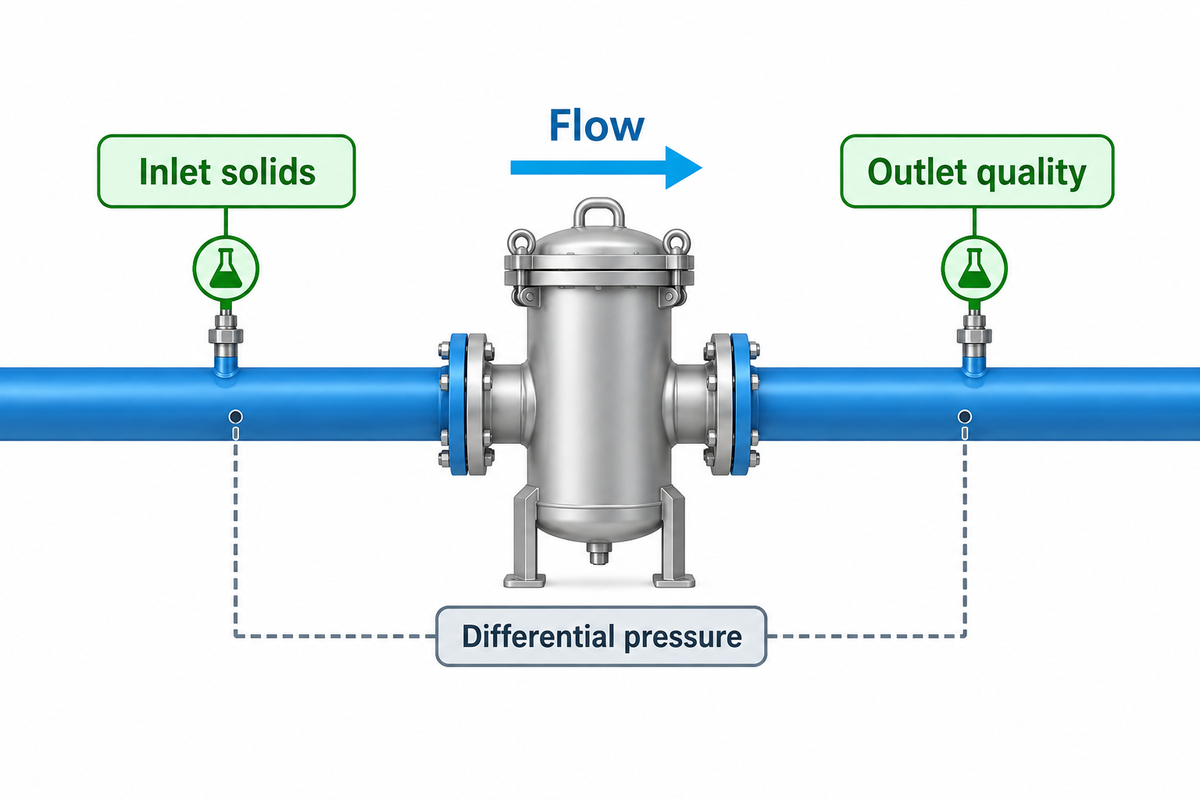
When changing the specified aperture, compare the installed bags under the same conditions and record the outlet quality and pressure drop. Control the housing and flow target, and take inlet and outlet samples at comparable locations in each run. Record the temperature of the fluid, solids content and the sampling method so a change in the feed isn’t mistaken for a change in filtration performance.
| Field | Record for both candidates | What it helps you decide |
|---|---|---|
| Inlet solids | Sampling time, particle size method and inlet concentration or count | Whether the bags saw a comparable load |
| Outlet quality | The same test method and reporting limit at start and near the agreed endpoint | Whether the filtrate meets the acceptance criterion through the run |
| Flow | Actual flow at each sampling point and volume processed before changeout | Whether the comparison represents the required duty |
| Differential pressure | Upstream and downstream readings taken together, plus clean baseline and endpoint | Whether the bag stays within the trial’s hydraulic limit |
If the inlet report uses laser diffraction, record that alongside its particle size data. A NIST study of microfine aggregates found that particle shape helped explain differences between size distributions from laser diffraction and X-ray microcomputed tomography. Using the same measurement technique throughout the bag trial makes the inlet and outlet measurements easier to compare.
Differences in feed samples were noted in the study of three olive mill wastewater streams. After settling and prefiltration through a bag with a 200 µm opening, the samples contained 870, 1,700 and 15,000 mg/L of suspended solids. In the third stream, Bottino and colleagues noted poor retention of fine solids. The reported concentrations are those measured after settling and bag prefiltration. Use paired measurements around your own bag to assess its performance.
In a coolant trial, inspect the seal and the seam if coarse fragments appear in the outlet sample. They can go around the cloth if the bag doesn’t seat properly. In a paint trial, compare the outlet agglomerates and the pressure rise at the targeted flow. Two bags can meet the same outlet target and still reach the changeout criterion at different processed volumes.
What to Put on a Filter Bag Order
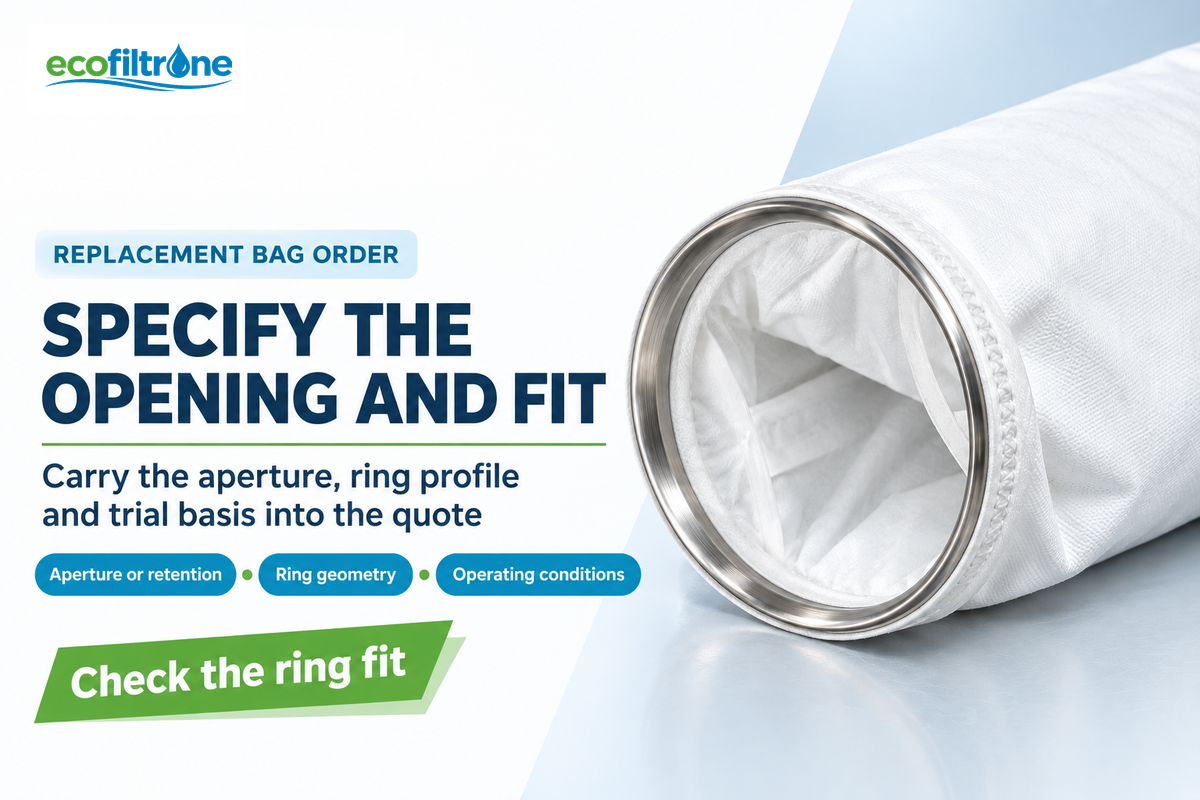
Put the aperture or retention requirement, material, fit and operating conditions on separate lines. For a 100 µm woven bag, let the supplier know whether 100 µm is a nominal opening or a measured maximum. Replacement bags are usually matched to an existing housing. Provide the make and model and include a ring drawing or a clear photo of the existing seal.
Even if a bag slips into a basket, it still requires the right ring profile to seat. Measure the ring and seat when the housing model isn’t available.
| Order field | Example for a woven replacement | Evidence to request |
|---|---|---|
| Opening or retention | 100 µm nominal opening in the woven cloth | Written aperture and tolerance for the quoted cloth |
| Media and construction | Nylon monofilament mesh for the stated liquid | Material, weave, seam and compatibility information |
| Housing interface | Match existing bag length, diameter, ring profile and support basket | Dimensions or drawing for the proposed assembly |
| Operating and acceptance conditions | Use the existing duty as the trial basis | Flow, liquid temperature, outlet test and differential-pressure endpoint |
Refer to the liquid filter bag ring and fit chart when checking a housing. For a quote that gives only “100 mesh,” obtain the clear opening in microns and compare it with your 100 µm requirement. If outlet quality determines the final decision, compare the installed trial bags’ results with your requirements before changing media.
Frequently Asked Questions
How many microns is 100 mesh?
A U.S. No. 100 test sieve has a nominal opening of 150 microns, or 0.150 millimeters. In a sieve stack, this screen can sit below No. 50. Material that gets through the upper screen can then be collected on No. 100 if it’s too coarse to pass that finer screen.
What is 325 mesh in millimeters?
The nominal opening for a U.S. No. 325 test sieve is 0.045 millimeters. Its opening is 45 microns, and dividing microns by 1,000 gives millimeters. A drawing dimension of 0.045 millimeters expresses the same opening as 45 microns. The millimeter notation can be easier to use when the drawing already gives the other dimensions in millimeters.
Which is finer, 50 mesh or 100 mesh?
No. 100 is finer in the U.S. test sieve series. It has a nominal opening of 150 microns, compared with 300 microns for No. 50. That’s half the nominal opening width. In a stack with both sieves, No. 50 goes above No. 100. The material caught on the lower sieve has passed the first screen and remained on the second.
What is finer, 100 mesh or 400 mesh?
No. 400 is finer in the U.S. test sieve series. Its nominal opening is 38 microns, compared with 150 microns for No. 100. The smaller aperture changes which portion of the sample the sieve can retain during a test.
What is the formula for calculating microns?
Multiply millimeters by 1,000 to get microns. For example, 0.150 millimeters equals 150 microns. If you need to estimate the opening of a regular square weave, divide 25,400 microns by the mesh count per inch to get pitch, then subtract the wire diameter in microns. A count of 100 with a wire diameter of 104 microns leaves a clear opening of 150 microns. The gap and the pitch are both lengths, which is why both must be expressed in microns before the subtraction.
How many microns is 500 mesh?
Gilson lists a nominal opening of 25 microns for U.S. No. 500 test sieves. That nominal aperture is 0.025 millimeters. At this size, specify how the sample is prepared and how the lab will check whether particles have blinded the sieve during a test.
Does a 100 mesh nylon filter bag have the same opening as a No. 100 test sieve?
Not necessarily. The nominal openings match only if the nylon bag’s cloth specification states 150 microns. A No. 100 U.S. test sieve uses that nominal opening. A bag label can give a count per inch without telling you the opening width. Request the aperture and tolerance for the cloth used in the quoted bag. For example, a quote that gives only the mesh count and ring size still leaves the aperture open. If removal efficiency matters, add the target particle size and an agreed test method.
Matching a nylon mesh bag to your process? Send ECOFILTRONE your target opening, fluid and operating flow, plus a photo or drawing of the existing ring. Include the outlet requirement if you’re comparing mesh to a rated felt bag. These details help the team assess the media and fit.
References & Sources
- ASTM E11-24, Standard Specification for Woven Wire Test Sieve Cloth and Test Sieves
- Gilson, Sieve Sizes: In-Depth Guide to U.S. and Metric Sizes
- W.S. Tyler, A Calculator for ASTM E11 Standard Sieve Designations
- NIST Handbook 44, Appendix C, General Tables of Units of Measurement
- Howard Wire Cloth, Mesh Count, Opening Size and Microns
- Doiron and Stoup, Uncertainty and Dimensional Calibrations, section 13
- ASTM E2814-22, Standard Specification for Industrial Woven Wire Filter Cloth
- Bottino et al. (2020), Treatment of Olive Mill Wastewater through Integrated Pressure-Driven Membrane Processes
- NIST, Shape and Size of Microfine Aggregates: X-Ray Microcomputed Tomography vs. Laser Diffraction