Get in touch with ECOFILTRONE™ Company


Filter Chemical Compatibility Chart: PP, Polyester, Nylon, PES, PVDF, and PTFE Selection Guide

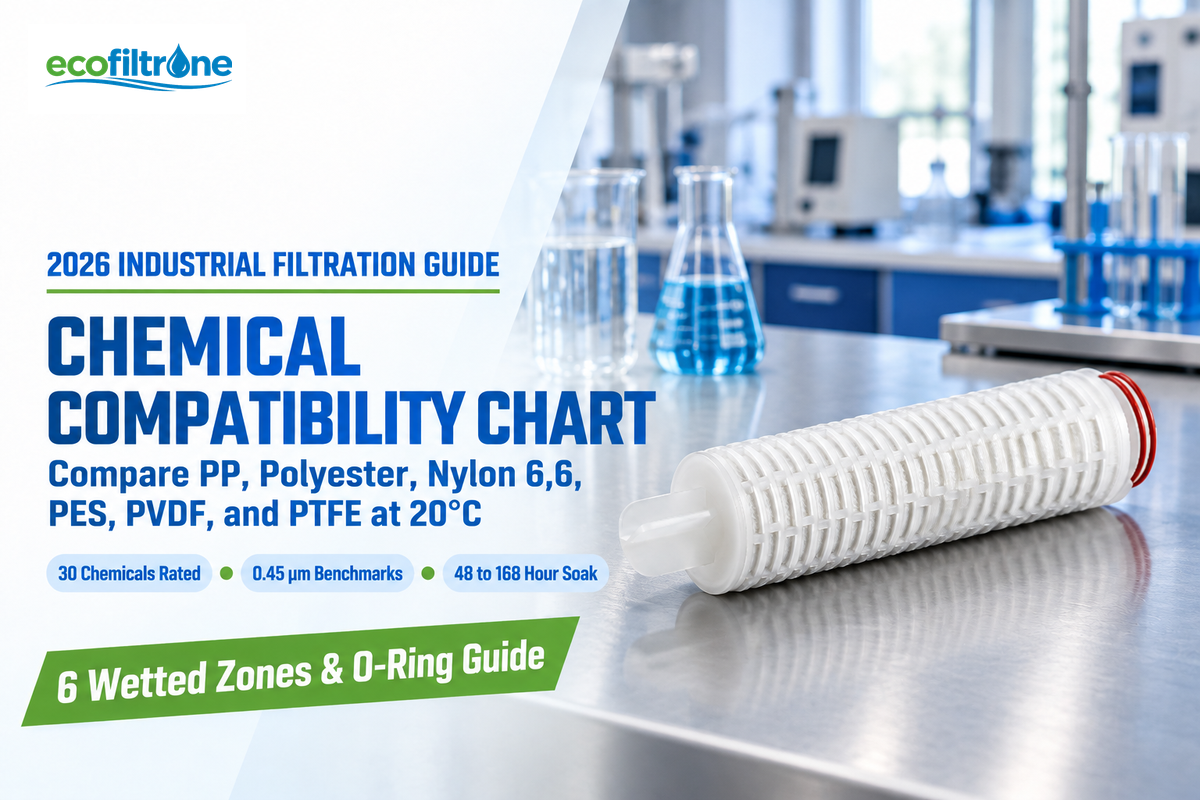
Industrial Filtration Material Selection Guide · 2026 Edition
A chemical compatibility chart for industrial filtration rates how filter membranes, depth media, support cages, and O-ring elastomers withstand specific acids, bases, oxidizers, and organic solvents. Published data such as the Sterlitech Membrane Chemical Compatibility Chart and Sigma-Aldrich Filter Component Guide analyze pure reagents in static immersion at 20°C (68°F). Process engineers must therefore derate polymer ratings whenever operating temperature, reagent concentration, or differential pressure increases.
Using a table from a general plastic sheet to select filter media has been known to result in premature element failure. Microporous membranes are just 200 µm thick and have high void porosity, thus exposing a large surface area to liquid. Even trace polymer swelling or softening that goes unnoticed in a pipe wall can constrict 0.22 µm pores and collapse a pleated cartridge. To establish appropriate chemical compatibility, it is required to check every wetted component. This guide summarizes data and published literature from the NIH/PMC, the US EPA, Sterlitech, Restek, and Cole Parmer, to support your material selection scope.
How to Read a Filter Chemical Compatibility Chart Beyond 20°C
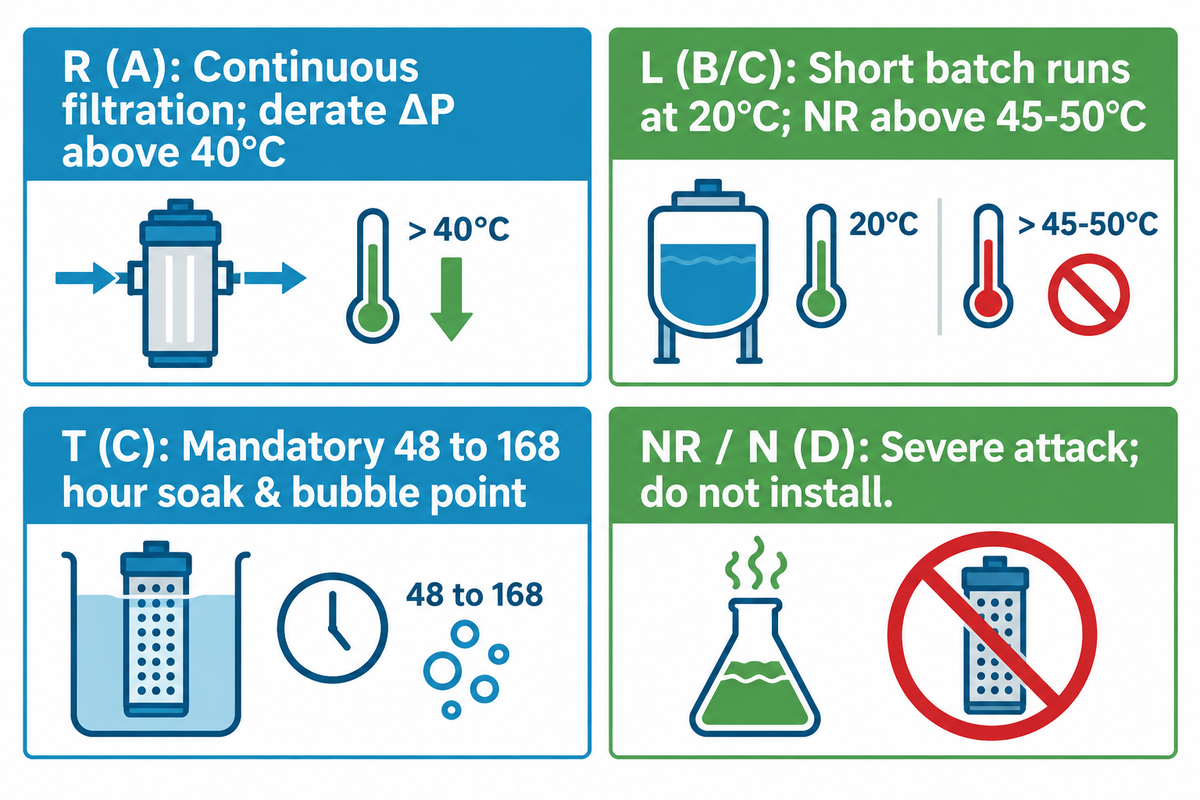
To read a filter chemical compatibility chart accurately, first check the 20°C (68°F) baseline test temperature and translate the rating code into a pressure-temperature boundary. Standard tables evaluate unstressed polymer strips soaked in a pure reagent for 48 to 168 hours. Above 25°C or at pump pressure, a room temperature rating shifts to rapid structural breakdown.
How do you read a filter chemical compatibility chart when temperature and chemical concentration rise above room temperature (20°C)?
When temperature and chemical concentration rise above 20°C, treat every room-temperature rating as an upper ceiling rather than a guaranteed operating window. Per ASTM D543, standard plastic chemical resistance tests run for 7 days (168 hours) at 23±2°C without hydraulic stress. Every 10°C increase above 23°C accelerates reagent diffusion into the polymer matrix. Elevated heat also reduces the mechanical yield modulus of filter cages and cores.
There is a variation in the rating codes published by different membrane and equipment suppliers in each chemical resistance chart. The chemical behavior listed in vendor tables reflects static laboratory immersion rather than dynamic flow. Before comparing any product across datasheets, align the two primary rating systems used in liquid and gas filtration:
| Filtration Code (Sterlitech / Restek / Sigma) | Database Code (Cole-Parmer) | Observed Polymer & Elastomer Behavior at 20°C | Engineering Rule Above 40°C or High ΔP |
|---|---|---|---|
| R — Recommended | A — Excellent | No measurable attack, negligible weight change, and negligible dimensional swell over 48 to 168 hours. | Suitable for continuous filtration; apply thermal differential pressure derating above 40°C. |
| L — Limited Resistance | B — Good / C — Fair | Moderate effect: minor softening, slight discoloration, or moderate dimensional swelling occurs at 20°C. | Valid for short batch runs at 20°C only; downgrade to NR above 45°C to 50°C unless soak-tested. |
| T — Test Before Application | C — Conditional | Sensitive to impurity trace levels, concentration shifts, or mechanical stress cracking under pressure. | Never assume compatible; mandatory 48 to 168 hour plant fluid soak and bubble-point check required. |
| NR / N — Not Recommended | D — Severe Effect | Rapid dissolution, chain scission hydrolysis, severe craze cracking, or severe dimensional swelling. | Do not install under any temperature, concentration, or exposure duration. |
, are consistent.
As emphasized in the Cole-Parmer Chemical Resistance Database and EAI Water compatibility guidance, factors such as temperature and hydrodynamic shear govern real-world survival. Also, factors like temperature cycling and cleaning chemical concentration affect membrane life. A polymer that appears suitable at 20°C may fail at 65°C due to accelerated permeation and loss of tensile strength.
Master Filter Chemical Compatibility Chart by Chemical Family (Acids, Bases, Solvents, Oxidizers)
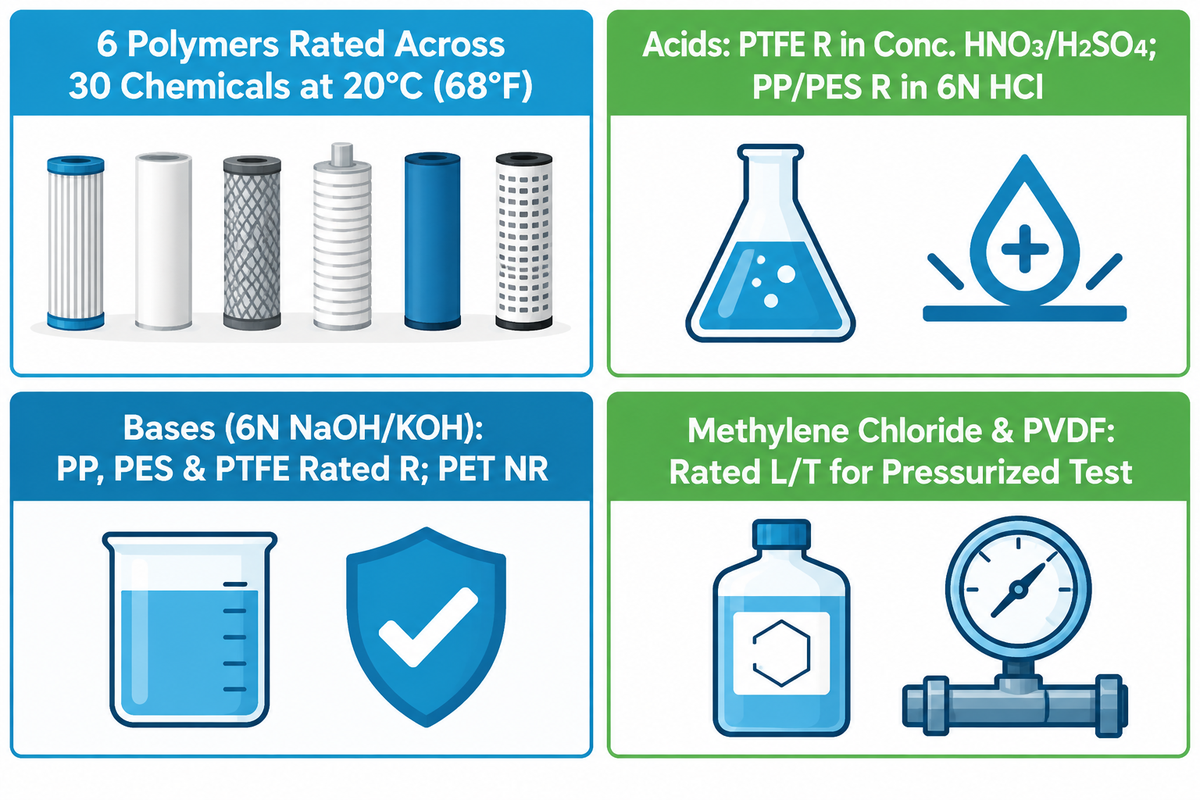
A master filter chemical compatibility chart compares six primary filtration polymers—PP, Polyester (PE/PET), Nylon 6,6, PES, PVDF, and PTFE—across 30 industrial chemicals at 20°C (68°F). All ratings are from published membrane tables, believed to be reliable. Primary sources include Sterlitech, Restek, Sigma Aldrich, and the 2026 NIH/PMC study (PMC13162256).
In the matrix below, every conditional cell (L or T) is preserved as published and is not promoted to R. This information is an initial screening tool for process engineers and technical teams. Since commercial streams exhibit wide variation in trace co-solvents, no individual chart can guarantee accuracy or completeness without field testing.
| Chemical Substance & Tested Condition (20°C) | Chemical Type / Category | PP | Polyester (PE/PET) | Nylon 6,6 | PES | PVDF | PTFE | Primary Reference |
|---|---|---|---|---|---|---|---|---|
| Hydrochloric Acid (HCl), 6N | Mineral Acid | R | L | NR | R | R | R | Sterlitech / Restek |
| Hydrochloric Acid (HCl), Concentrated | Mineral Acid | R | NR | NR | L | R | R | Sterlitech / JYFiltec |
| Sulfuric Acid (H2SO4), 6N | Mineral Acid | R | L | NR | R | R | R | Sterlitech / Restek |
| Sulfuric Acid (H2SO4), Concentrated | Oxidizing Acid | NR | NR | NR | NR | L / T | R | Sterlitech / JYFiltec |
| Nitric Acid (HNO3), 6N | Oxidizing Acid | L | L | NR | L | R | R | Sterlitech / Restek |
| Nitric Acid (HNO3), Concentrated | Oxidizing Acid | NR | NR | NR | NR | L | R | Sterlitech / JYFiltec |
| Hydrofluoric Acid (HF), 6N | Mineral Acid | R | NR | NR | L | R | R | Sterlitech / Restek |
| Phosphoric Acid (H3PO4), Concentrated | Mineral Acid | R | L | NR | R | R | R | Restek / Sterlitech |
| Acetic Acid, Dilute Aqueous | Organic Acid | R | R | L | R | R | R | Sterlitech / Restek |
| Acetic Acid, Glacial | Organic Acid | R | L | L | R | R | R | Restek / Sterlitech |
| Citric Acid (Aqueous CIP) | Organic Acid | R | R | L | R | R | R | PMC13162256 / JYFiltec |
| Formic Acid, Aqueous | Organic Acid | R | L | NR | L | R | R | Sigma-Aldrich / Restek |
| Sodium Hydroxide (NaOH), 6N | Strong Base | R | NR | L | R | R (20°C) / L (Hot) | R | Sterlitech / PMC13162256 |
| Potassium Hydroxide (KOH), 6N | Strong Base | R | NR | L | R | L | R | Sterlitech / PMC13162256 |
| Ammonium Hydroxide (NH4OH), 6N | Weak Base | R | L | R | R | L / T | R | Sterlitech / Restek |
| Hydrogen Peroxide (H2O2), Aqueous | Oxidizer | R | L | NR | R | R | R | Restek / Sterlitech |
| Sodium Hypochlorite (NaOCl), Aqueous | Halogen Oxidizer | L | L | NR | R | R | R | Sterlitech / JYFiltec |
| Isopropanol (IPA) / Ethanol / Methanol | Alcohol | R | R | R | R | R | R | Sterlitech / Restek |
| Ethylene Glycol | Glycol | R | R | R | R | R | R | Sterlitech / Restek |
| Acetone | Ketone | R | L | R | NR | NR | R | Sterlitech / Restek |
| Methyl Ethyl Ketone (MEK) | Ketone | R | L | R | NR | NR | R | Sterlitech / Sigma-Aldrich |
| Cyclohexanone | Ketone | R | L | L | NR | NR | R | Sterlitech / Restek |
| Ethyl Acetate | Ester | L | L | R | NR | NR / L | R | Sterlitech / Restek |
| Butyl Acetate | Ester | L | L | R | NR | L | R | Sterlitech / Restek |
| Tetrahydrofuran (THF) | Cyclic Ether | L | L | R | NR | NR | R | Restek / Sterlitech |
| Toluene | Aromatic HC | L | R | R | NR | R | R | Sterlitech / Melko |
| Xylene | Aromatic HC | L | R | R | L / NR | R | R | Sterlitech / Restek |
| Hexane | Aliphatic HC | R | R | R | R | R | R | Sterlitech / Restek |
| Methylene Chloride (Dichloromethane) | Chlorinated HC | L | NR | L | NR | L / T | R | Restek (L) / Sterlitech |
| DMF / DMAc / NMP / DMSO | Dipolar Aprotic | R | NR | R (DMF/DMSO) | NR | NR | R | Restek / PMC13162256 |
Note on Methylene Chloride and PVDF: Sterlitech lists static PVDF membrane resistance as R at 20°C, while Restek rates PVDF syringe filters as L (Limited). We list L/T so engineers can test pressurized housings before continuous service.
Polypropylene (PP) Filter Cartridges and Bags: Acids, Alkalis, and Oxidizer Limits
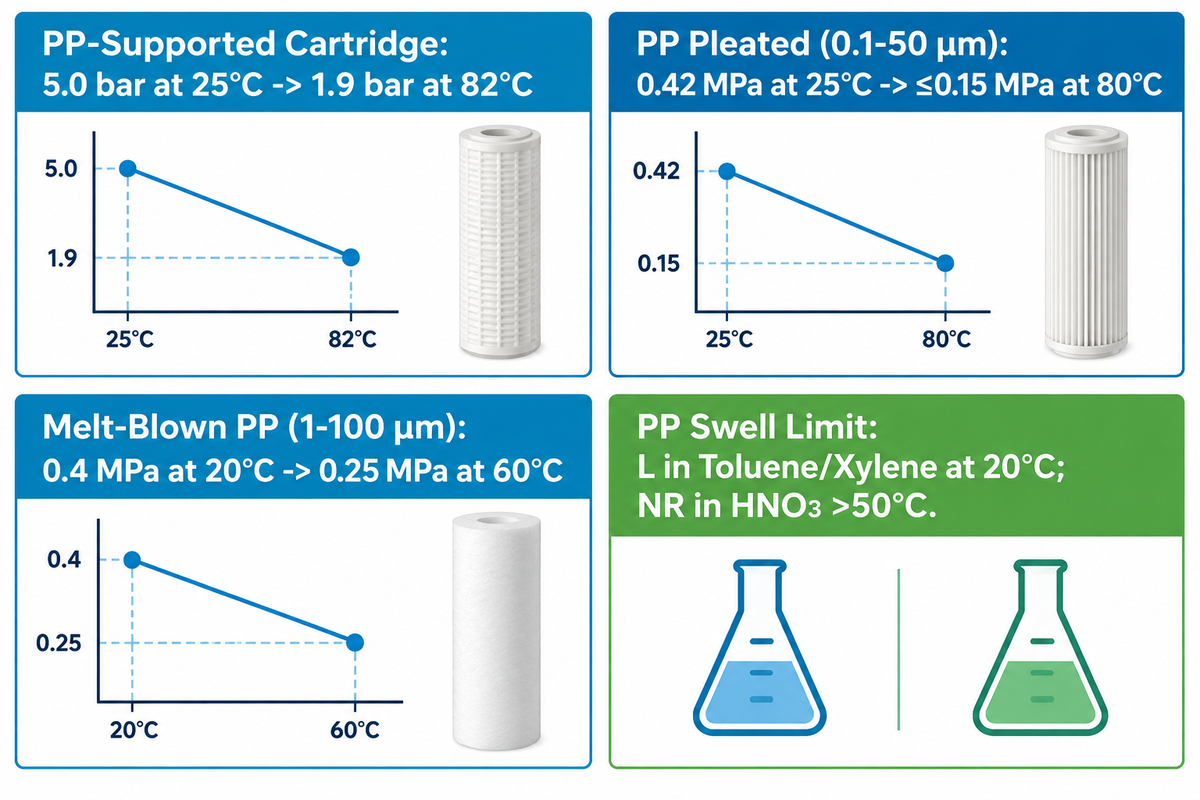
Polypropylene (PP) is the workhorse polymer for aqueous acid, alkali and ketone filtration up to 80°C in cartridges and 90°C in filter bags. PP being a saturated polyolefin without ester or amide linkages, makes it resistant to hydrolytic attack across pH 1 to 14 at 20°C. However, PP swells in aromatic and chlorinated hydrocarbons, and is attacked by hot concentrated nitric or sulfuric acid.
In the 2026 NIH/PMC experimental benchmark (PMC13162256), 0.45 µm polypropylene membranes (200 µm thickness) had a uniform pore structure and a contact angle of 105°. Water LEP was 320±10 kPa and the vapor flux was 14±2 kg·m⁻²·h⁻¹. When specifying PP pleated filter cartridges or melt-blown polypropylene depth filter cartridges, engineers should consider thermal pressure derating:
- Per Membrane Solutions cartridge specifications, a PP-supported pleated cartridge (≥0.74 m² area, 68.5 mm OD) handles 5.0 bar forward differential pressure at 25°C. At 82°C, that limit drops to 1.9 bar.
- ECOFILTRONE™ PP Pleated cartridges (0.1–50 µm, 69 mm OD, 10–40 in, ≥0.6 m²/10 in area) sustain a max ΔP of 0.42 MPa at 25°C. At max 80°C, allowable ΔP drops to ≤0.15 MPa.
- ECOFILTRONE™ Melt-Blown PP depth elements (1–100 µm) derate from a max ΔP of 0.4 MPa at 20°C down to 0.25 MPa at 60°C.
- In toluene, xylene, and methylene chloride, PP is rated L (Limited) at 20°C due to polymer swelling and softening. In 6N nitric acid, PP is rated L at 20°C and shifts to NR above 50°C.
PTFE vs PVDF Membrane Filters: Aggressive Solvents, Oxidizing Acids, and Hot Caustics
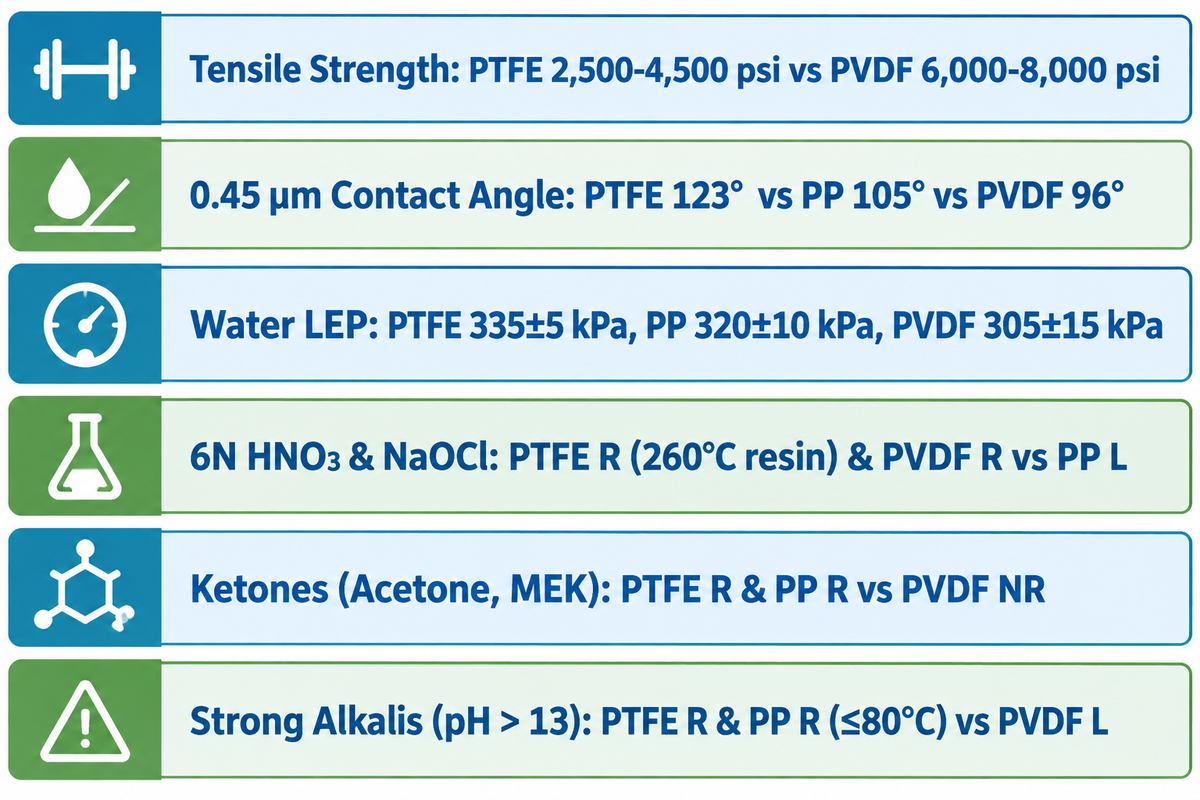
Select PTFE for universal resistance across concentrated oxidizing acids, hot caustics, ketones, and dipolar aprotic solvents up to 260°C (500°F resin limit). Select PVDF for 6N oxidizing acids, chlorinated water, and non-ketone streams up to 150°C (302°F resin limit). Do not use PVDF for Acetone, MEK, DMF, DMSO or hot concentrated Caustic NaOH.
Which filter membrane or cartridge material (PP, Polyester, Nylon, PES, PVDF, or PTFE) should be selected for strong oxidizing acids like concentrated nitric acid and sulfuric acid?
For concentrated nitric acid and concentrated sulfuric acid, PTFE is the only polymeric membrane rated R (Recommended) for continuous service. At 6N concentration at 20°C, PVDF is rated R in both 6N nitric acid and 6N sulfuric acid. Under those same 6N nitric acid conditions, PP and PES drop to L (Limited), while Nylon 6,6 is NR due to rapid amide bond cleavage.
Engineers must also tell the difference between unlaminated PTFE (PTU) and laminated PTFE (PTL) on Sterlitech’s membrane chart. In HF, 6N or concentrated HNO3, 6N or concentrated H2SO4, methylene chloride, THF, toluene, and xylene, PTL drops from R to L or N because its backing polymer is attacked. Additionally, Ready Plastics and NIH/PMC (PMC13162256) show sharp differences in suitability between PTFE and PVDF:
| Parameter / Chemical Environment | PTFE Membrane (0.45 µm Benchmark) | PVDF Membrane (0.45 µm Benchmark) | PP Membrane (0.45 µm Benchmark) |
|---|---|---|---|
| Polymer Backbone & Tensile Strength | Fully fluorinated (–CF2–CF2–); 2,500–4,500 psi | Alternating (–CH2–CF2–) dipole; 6,000–8,000 psi | Aliphatic polyolefin hydrocarbon |
| Pore Structure & Contact Angle (PMC13162256) | 0.45 µm fibril network; 123° contact angle | Hydrophobic matrix; 96° contact angle | Symmetric pores; 105° contact angle |
| Liquid Entry Pressure (LEP) & DCMD Flux | 335±5 kPa LEP; 29±4 kg·m⁻²·h⁻¹ flux | 305±15 kPa LEP; 11±3 kg·m⁻²·h⁻¹ flux | 320±10 kPa LEP; 14±2 kg·m⁻²·h⁻¹ flux |
| 6N Nitric Acid & Sodium Hypochlorite | R (Inert up to 260°C / 500°F resin limit) | R (Strong oxidant & halogen stability) | L (Oxidizes above 50°C or in NaOCl) |
| Ketones (Acetone, MEK) & Aprotic Solvents | R (Zero swelling or dissolution) | NR (Dissolves or swells catastrophically) | R (Compatible at 20°C to 50°C in Acetone/MEK) |
| Strong Caustic Alkalis (pH > 13, Hot NaOH) | R (Inert across pH 1 to 14) | L (Dehydrofluorination embrittlement when hot) | R (Strong alkali resistance up to 80°C) |
Notice the hydraulic restriction on virgin PTFE. Unmodified 0.45 µm PTFE has a 123° contact angle and a water Liquid Entry Pressure of 335±5 kPa. Aqueous acid solutions will not flow through hydrophobic PTFE at low pump pressure. Engineers must either pre-wet hydrophobic PTFE with isopropanol (IPA) or specify surface-modified hydrophilic PTFE.
PES and Nylon 6,6 Membranes: Aqueous Streams, Alcohols, and pH Hydrolysis Boundaries
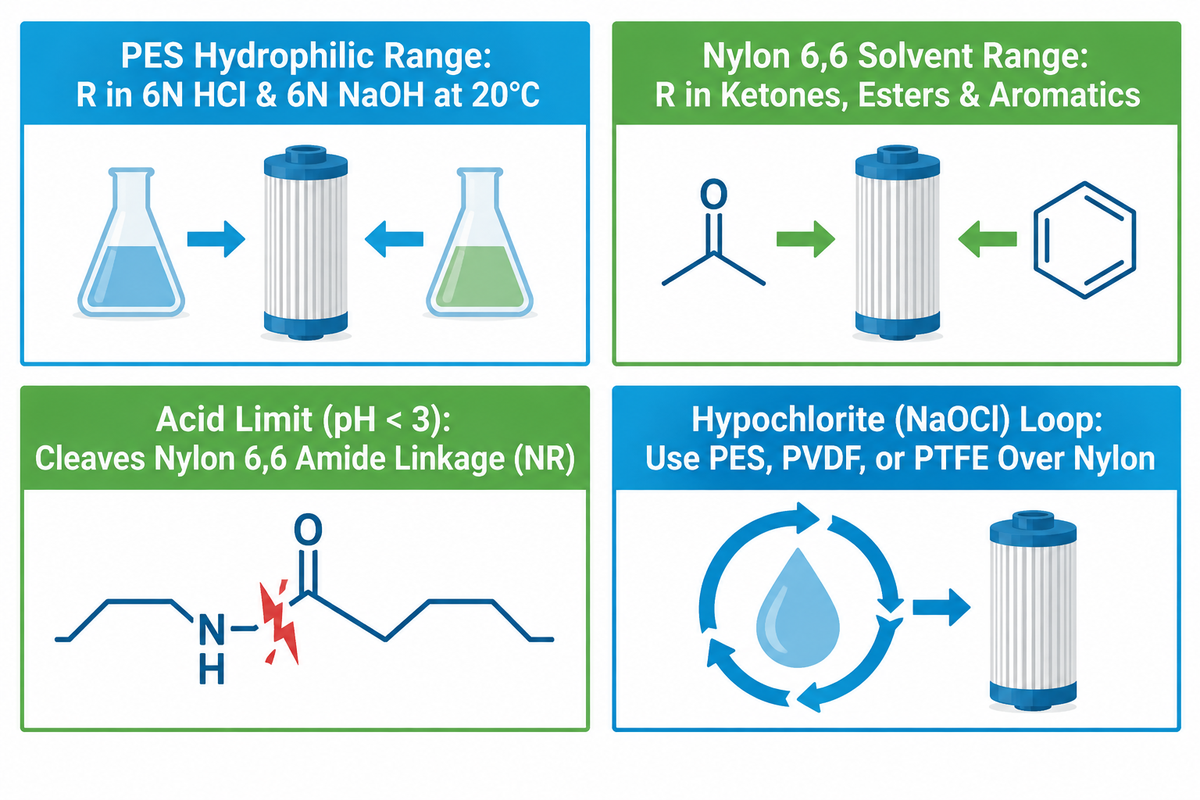
Polyethersulfone (PES) and Nylon 6,6 (Polyamide) are naturally hydrophilic membranes that wet out in water without alcohol pre-flushing. However, they occupy opposite ends of the chemical compatibility spectrum. PES tolerates broad aqueous pH (6N HCl and 6N NaOH = R at 20°C) while failing in ketones and esters. Conversely, Nylon 6,6 excels in ketones, esters, and aromatics (R) while failing in mineral acids and chlorinated water.
According to the US EPA compatibility guidance, PMC13162256, and Sterlitech, engineers must take three chemical boundaries into consideration when choosing between PES and Nylon 6,6:
- Mineral acids (HCl, H2SO4, HNO3, H3PO4) at pH < 3 protonate and cleave the amide linkage of Nylon 6,6. Dilute acid CIP cycles lead to progressive chain scission and embrittlement of the Nylon 6,6 membrane.
- Polyamide membranes are very sensitive to free chlorine and sodium hypochlorite (NaOCl). When sanitation loops use hypochlorite, select PES, PVDF, or PTFE instead of Nylon.
- PES can give high flux in aqueous buffers and alcohols at high pH. However, ketones, esters, methylene chloride, DMF and DMSO cause rapid stress cracking or dissolution (NR) in PES.
Polyester (PET) and Specialty Depth Media: High-Temperature Oils vs Alkaline Hydrolysis
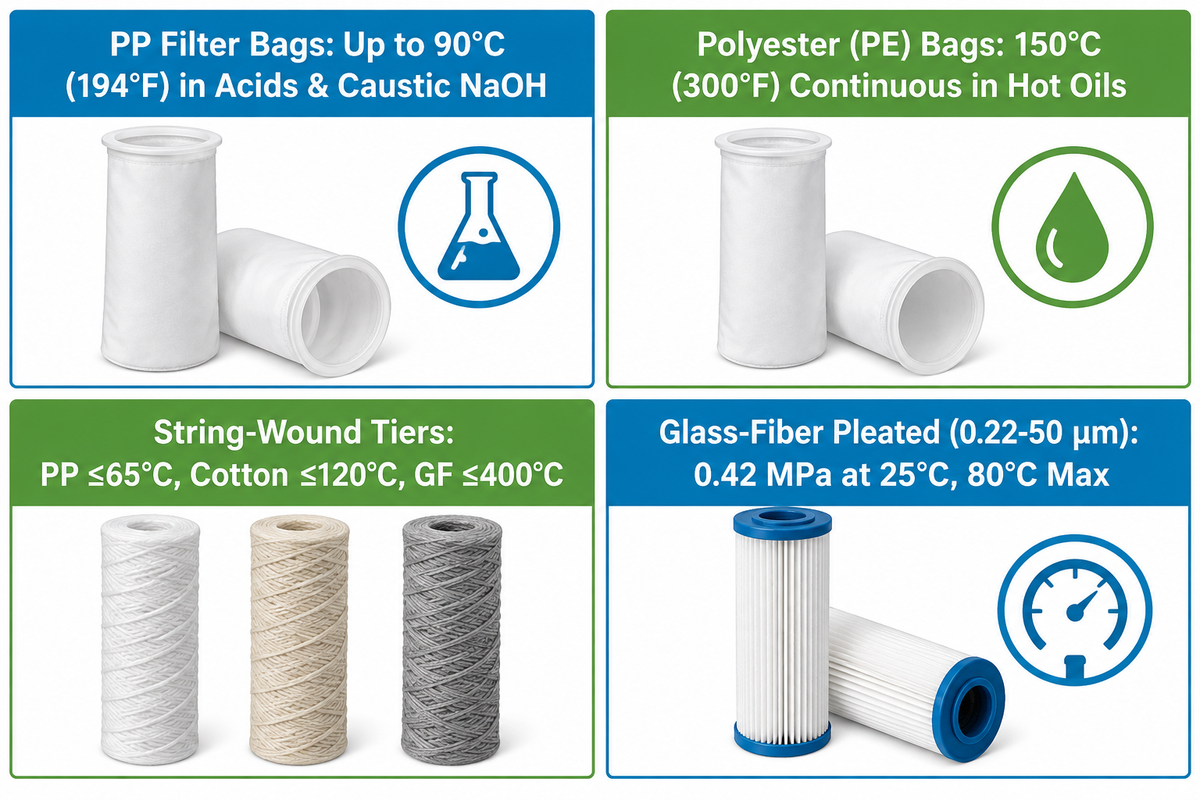
Polyester (PE/PET) filter bags and depth media outperform polypropylene in hot hydrocarbon oils, aromatic solvents, and continuous temperatures up to 150°C (300°F). However, polyester suffers irreversible ester hydrolysis in caustic alkaline effluents (pH > 13, such as 6N NaOH or KOH = NR). It also degrades in high-temperature steam or water above 100°C.
As documented in the Melko Filtration PP vs. PE Filter Bag Comparison and in PMC13162256, every chemical industry plant must match fiber polymer and core hardware together. Review both string-wound depth filter cartridges and glass-fiber pleated filter cartridges when temperatures exceed polyolefin limits:
- PP filter bags operate up to 90°C (194°F) and are used in acid pickling baths, caustic washes (NaOH, KOH), and ketone-bearing coatings.
- Polyester (PE) filter bags withstand continuous temperatures up to 150°C (300°F) and thermal surges up to 170°C–190°C in lubricating oils and aromatic solvents. When using hot PE bags, always use a stainless steel ring rather than a PP collar.
- ECOFILTRONE™ String-Wound elements cover three thermal tiers: PP yarn (≤65°C), Bleached Cotton yarn (≤120°C with SS304 core), and Glass Fiber yarn (≤400°C with SS304 core).
- ECOFILTRONE™ Glass-Fiber Pleated cartridges (0.22–50 µm) operate up to max 80°C at 0.17 MPa and handle a max ΔP of 0.42 MPa at 25°C.
Comparing PP, Nylon, PES, PVDF, and PTFE Across Four Organic Solvent Classes
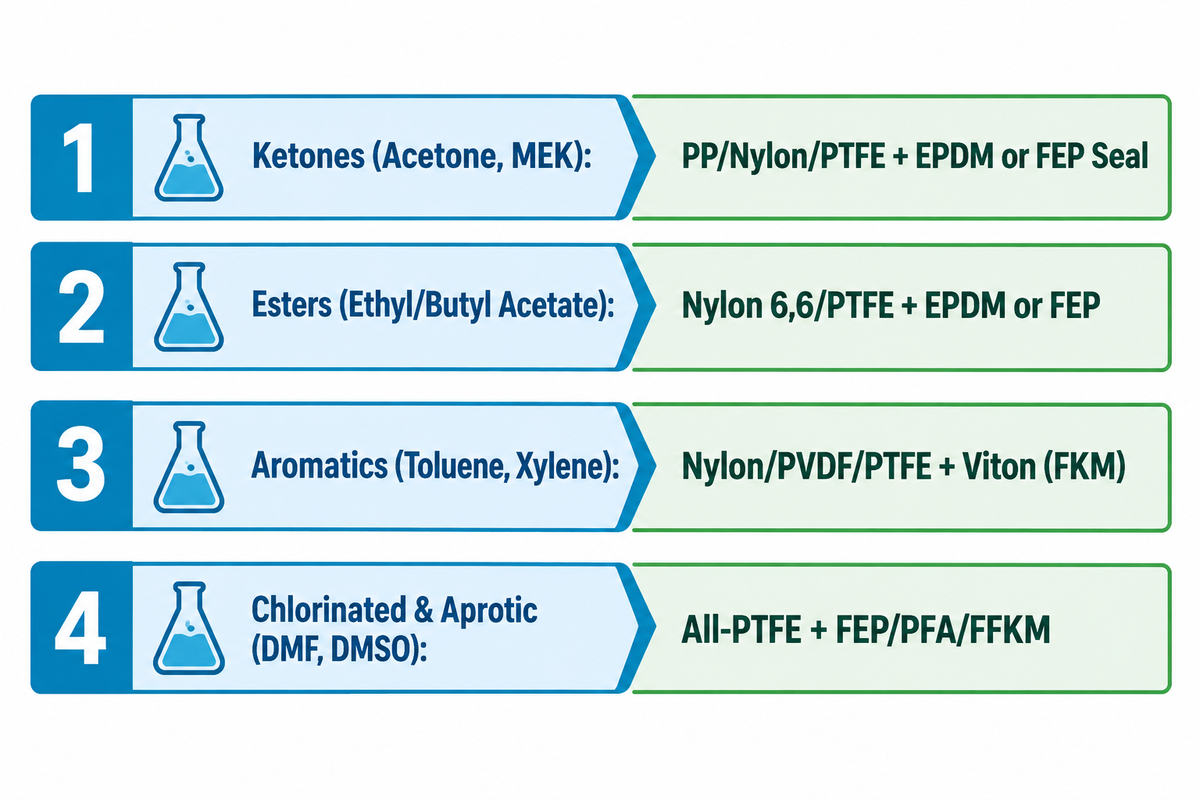
Of the four major organic solvent classes (ketones, esters, aromatics and chlorinated/aprotic solvents), PTFE is the only universal compatible polymer (R in all four classes). Nylon 6,6 provides a cost-effective hydrophilic option across ketones, esters, and aromatics ( R at 20°C). PP handles ketones and aliphatic hydrocarbons (R) but swells in aromatics and chlorinated solvents (L).
How do polypropylene (PP), Nylon, PES, PVDF, and PTFE compare in chemical resistance against organic solvents (ketones, esters, aromatics, and chlorinated hydrocarbons)?
To determine polymer survival in organic solvents, engineers compare polarity between the solvent and the polymer chain. In the PMC13162256 screening of 22 membrane materials for organic solvents and extreme pH service, only 12 candidates met baseline stability criteria. Non-polar polyolefins (PP) resist polar ketones (acetone, MEK = R) but absorb non-polar aromatics (toluene, xylene = L). Polar fluoropolymers (PVDF which typically costs less per pound than PTFE stock per Ready Plastics) resist aromatics (R) but dissolve in ketones and aprotic solvents (NR). PES fails (NR) in all four non-alcohol solvents classes.
| Organic Solvent Class & Representative Fluids | PP | Nylon 6,6 | PES | PVDF | PTFE | Recommended Filter & O-Ring Pairing (20°C–50°C) |
|---|---|---|---|---|---|---|
| 1. Ketones (Acetone, MEK, MIBK, Cyclohexanone) | R | R (L in Cyclohexanone) | NR | NR | R | PP, Nylon, or PTFE media + EPDM or FEP/PTFE-encapsulated O-ring (Never Viton/NBR). |
| 2. Esters (Ethyl Acetate, Butyl Acetate, Cellosolve Acetate) | L | R | NR | NR / L | R | Nylon 6,6 or PTFE media + EPDM or FEP/PTFE-encapsulated O-ring. |
| 3. Aromatic Hydrocarbons (Toluene, Xylene, Benzene) | L | R | NR | R | R | Nylon, Polyester, PVDF, or All-PTFE + Viton (FKM) or FEP-encapsulated O-ring (Never EPDM). |
| 4. Chlorinated & Dipolar Aprotic (Methylene Chloride, TCE, DMF, NMP, DMSO) | L (Chlorinated) / R (DMF/DMSO) | L (CH2Cl2) / R (DMF/DMSO) | NR | L / T (CH2Cl2) / NR (Aprotic) | R | All-Fluoropolymer PTFE cartridge + FEP/PFA-encapsulated or FFKM O-ring. |
Why PTFE Cartridges Still Fail: Matching Support Layers, Cages, and O-Ring Elastomers
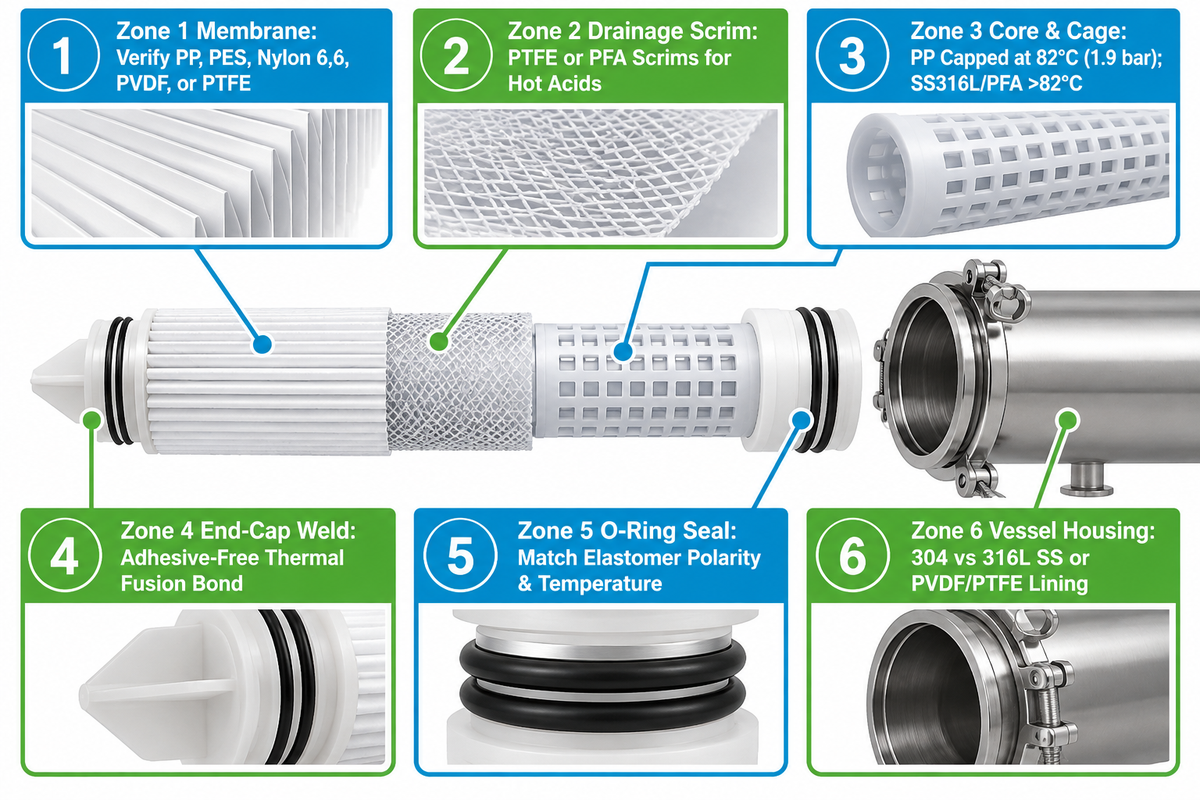
A PTFE membrane filter cartridge still fails in aggressive chemicals when its support mesh, core/cage hardware, or 222/226 O-ring elastomer is incompatible. Standard PTFE membrane cartridges are constructed using polypropylene (PP) support layers and Viton or Buna-N O-rings. Above 82°C in oxidizing acids, PP hardware softens, while in acetone or MEK a Viton O-ring swells and leaks.
Why can a PTFE or PVDF membrane filter cartridge still fail in aggressive chemicals if the support layers, cage, or O-ring seals (EPDM, Viton/FKM, Silicone, FEP-encapsulated) are incompatible?
A pleated filter cartridge is a composite mechanical assembly rather than a single sheet of membrane. As documented by LNG Filters and USPTO Patent US6913786B2, chemical behavior during handling and pressurized filtration depend on every structural part. An attack on any seal or cage causes immediate bypass leakage, even if the PTFE membrane is intact.
To prevent multi-component failure and housing corrosion during permanent installation, the Six-Zone Wetted Assembly Audit should be performed across various cartridge designs prior to the release of a purchase order:
- Zone 1 (Primary Filtration Membrane): Verify the membrane polymer type (PP, PES, Nylon 6,6, PVDF or PTFE) at peak temperature and concentration.
- Zone 2 (Upstream and Downstream Drainage Layers): Standard PTFE cartridges use non-woven PP support scrims; specify PTFE or PFA scrims for hot oxidizing acids.
- Zone 3 (Inner Core and Outer Cage): Standard PP cages cap operating temperature at 82°C (1.9 bar max forward ΔP per Membrane Solutions). Upgrade to a 304 or 316L stainless steel core or all-fluoropolymer PFA hardware (US6913786B2) above 82°C.
- Zone 4 (End-Cap Thermal Bond): Use adhesive-free thermal fusion welding for solvents where polyurethane and epoxy potting glues leach and crack.
- Zone 5 (Cartridge O-Ring and Gasket Elastomer): Use the elastomer compound with the temperature and chemical matrix below to match solvent polarity.
- Zone 6 (Filter Housing Vessel Metallurgy): Verify 304 vs. 316L stainless steel, or use PVDF/PTFE-lined housings to prevent chloride pitting from corrosion.
| O-Ring Elastomer Material | Continuous Temperature Range (Conquest Seal / JYFiltec) | Recommended Chemical Service (R) | Incompatible Fluids Causing Swell or Failure (NR) |
|---|---|---|---|
| NBR (Nitrile / Buna-N) | -34°C to +100°C (-30°C to +120°C per JYFiltec) | Petroleum oils, aliphatic hydrocarbons (hexane), water, dilute neutral salts. | Ketones (acetone, MEK), aromatic hydrocarbons, halogenated solvents, strong acids, ozone. |
| EPDM (EPR) | -57°C to +150°C (134°C steam SIP rated) | Ketones (acetone, MEK), alcohols, caustic NaOH CIP, citric acid, steam SIP. | Petroleum oils, diesel, mineral lubricants, hexane, toluene, xylene (swells to twice its size). |
| Silicone (VMQ) | -54°C to +204°C (-60°C to +230°C per JYFiltec) | High-purity air/gas venting, potable water, mild aqueous buffers, low-pressure food service. | Ketones (acetone, MEK), hydrocarbons, concentrated acids/alkalis, high-pressure dynamic seals. |
| FKM (Viton® Fluoroelastomer) | -26°C to +204°C (-20°C to +200°C per JYFiltec) | Mineral acids (concentrated H2SO4 and HCl), aliphatic & aromatic hydrocarbons (toluene, xylene), oils. | Ketones (acetone, MEK), low-MW esters (ethyl acetate), amines, hot concentrated NaOH bases. |
| FEP/PTFE-Encapsulated / FFKM | 0.5 mm seam-less PTFE/FEP shell; Parker family range -73 C to 320 C | Universal chemical resistance across ketones, esters, aromatics, hydrofluoric acid, and strong oxidizers. | Molten alkali metals and elemental fluorine gas; encapsulated rings suit static seals only. |
DO: Match O-Ring Polarity to Solvent Class
Specify EPDM O-rings (-57°C to +150°C) for polar ketone solvents like acetone and MEK. Upgrade to 0.5 mm FEP/PTFE-encapsulated O-rings when filtering mixed ketone-plus-aromatic solvent streams.
How to Validate Conditional (‘T’ or ‘Limited’) Ratings: 48-Hour Soak and Bubble-Point Testing
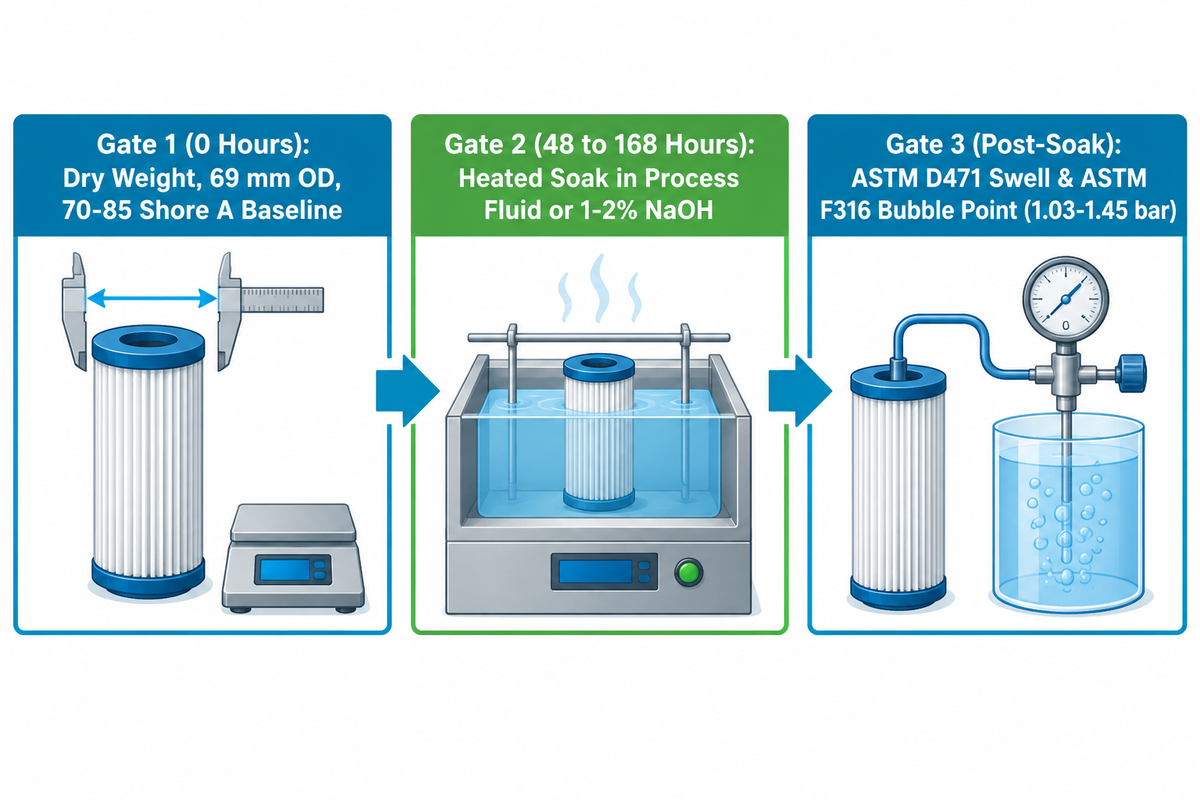
Validate any conditional (“T” or “L”) chart rating—or any multi-component chemical blend—by conducting a 48 to 168 hour static immersion soak at actual process temperature. Follow the soak by testing for dimensional, weight, and bubble-point integrity. Never approve a filter element solely on visual inspection after a short dip in room temperature.
What immersion soak test protocol and post-exposure integrity checks (bubble point, weight/dimensional swell, differential pressure) verify a conditional (‘T’ or ‘Limited’) rating on a chemical compatibility chart?
Practical engineering knowledge requires combining three laboratory standards for plant qualification. The primary purpose of ASTM D543 (7 days / 168 hours at 23±2°C) is evaluating plastic reagent resistance. ASTM D471 measures elastomer liquid swell, while ASTM F316 and ASTM F838 govern membrane pore-size and bubble-point integrity. Follow this Three-Gate Conditional Rating Soak Protocol to lock your filter specification.
- Gate 1 (Pre-Exposure Baseline at 0 Hours): Record dry weight, outer diameter (such as 69 mm OD), durometer hardness (70 to 85 Shore A per Conquest Seal), and clean bubble-point pressure.
- Gate 2 (Heated Process-Fluid Immersion for 48 to 168 Hours): Submerge the complete filter assembly in the actual plant stream or pharmaceutical CIP solutions (1–2% NaOH and 0.5–1% citric acid per JYFiltec) for 48 to 168 hours at peak temperature.
- Gate 3 (Post-Exposure Swell and Bubble-Point Verification): Measure the wet volume swell at ASTM D471, dry and weigh the O-rings to confirm plasticizer extraction. Flush the cartridge, wet with water or IPA, and determine the ASTM F316 bubble point (e.g., 1.03-1.45 bar IPA bubble point for 0.45 µm PE membranes as given in Sterlitech).
2025–2026 Chemical Filtration Trends and Five-Input Cartridge Selection Workflow
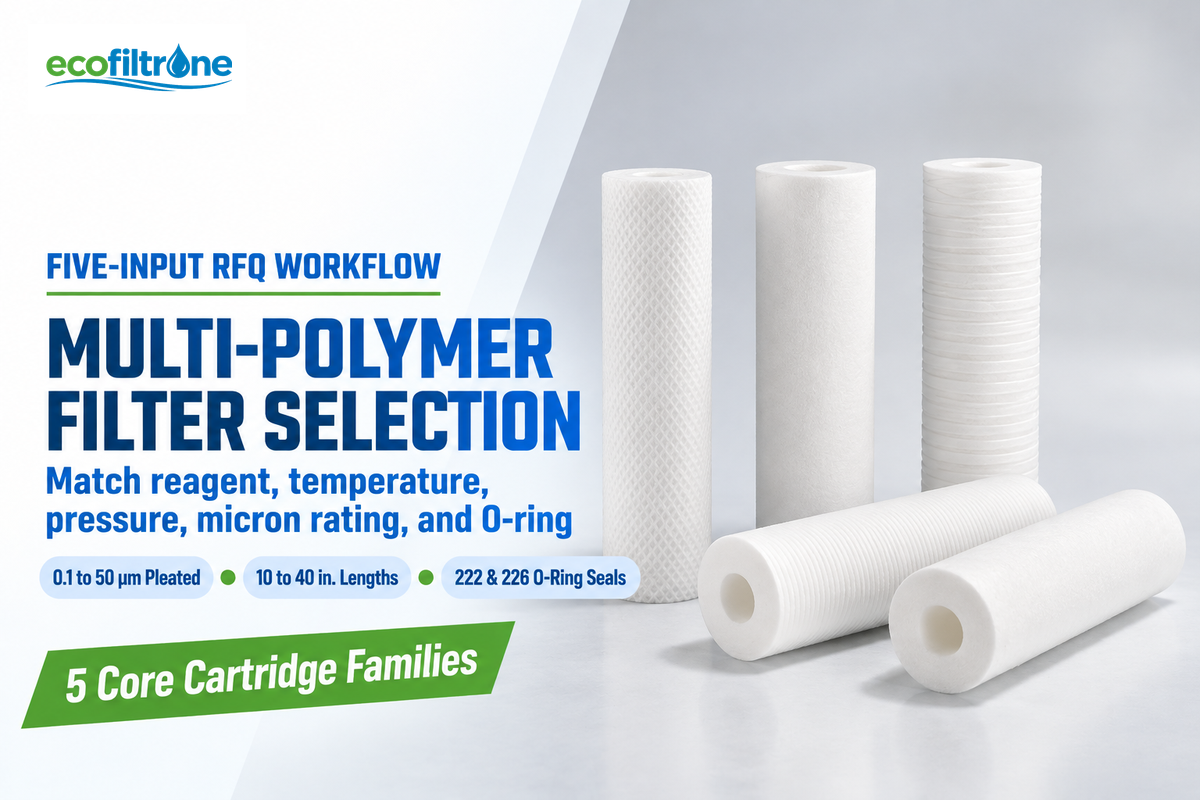
In 2025 and 2026, industrial chemical filtration procurement is shaped by two engineering shifts. Plants are standardizing on adhesive-free thermal-welded multi-polymer cartridges and evaluating PFAS-free membranes under EU REACH and US EPA frameworks. Rather than defaulting to PTFE for every line, engineering teams use a structured five-input specification workflow.
Which industrial filter cartridge manufacturers provide chemical compatibility selection support and multi-polymer cartridges (PP, PES, PTFE, PVDF, Nylon) for chemical and petrochemical processing?
Industrial filtration manufacturers such as ECOFILTRONE™, Pall, Parker, Eaton and 3M, offer multi-polymer cartridges and bags made from PP, Polyester, Nylon 6,6, PES, PVDF, and PTFE. ECOFILTRONE™ provides direct application support through its five-input chemical compatibility brief for petrochemical and chemical filtration, and also offers HFA high-flow PP and glass-fiber replacement filter cartridges.
Across 5 core cartridge families, ECOFILTRONE™ verified product specifications cover PP Pleated (0.1–50 µm, ≥0.6 m²/10 in area) and Melt-Blown PP (1–100 µm, 0.25 MPa at 60°C). String-Wound, Glass-Fiber Pleated, and HFA High-Flow PP/GF Replacement elements (152.4 mm / 6 in OD, 60 m³/h per 40 in element, max 80°C PP / 121°C GF) complete the lineup.
According to Sterlitech’s 2026 PFAS-Free Membrane Review and Fluorocarbon UK’s 2026 PFAS Engineering Outlook, plants segregate chemical filtration into two clear tiers:
- PFAS-Free Substitutable Streams: High-purity Polypropylene (PP), PES, and Nylon 6,6 maintain an R rating in alcohols, dilute acids, caustics, and ketones at ≤50°C. PE membranes also cover 100 designs from 1 nm to 1.0 µm, fluoropolymers free.
- Essential-Use Fluoropolymer Streams: Virgin PTFE and PVDF membranes are essential for user safety and service life for streams containing hot oxidizing acids (concentrated HNO3 and H2SO4), aggressive chlorinated or aprotic solvents, or continuous operating temperatures greater than 260°C.
Five-Input Chemical Compatibility Brief Checklist (Copy for Engineering RFQ)
- Chemical Composition and Concentration: List the primary reagent, carrier solvent, and trace co-solvents or CIP sanitizers (such as caustic NaOH, citric acid, or sodium hypochlorite).
- Normal and Peak Operating Temperature: Specify both continuous filtration temperature (such as 20°C to 80°C) and short-term 121°C or 134°C steam SIP temperature.
- Operating Line Pressure and Maximum Changeout ΔP: Confirm startup differential pressure and recommended change-out pressure (such as 35 psid / 2.4 bar).
- Micron Rating and Wetting Requirements: Indicate 0.1, 0.22, 0.45, 1.0, 5.0 or 50 µm, and state if aqueous streams demand hydrophilic media.
- Housing Interface and Seal Preference: Indicate your cartridge code (DOE, 222/Flat, 222/Fin, 226/Fin), length (10, 20, 30, or 40 in.), and O-ring elastomer (EPDM, Viton FKM, Silicone, NBR, or FEP/PTFE-encapsulated). For custom configurations, an RFQ is required based on the micron rating, element length, and seal compound.
Key Engineering Takeaway: The six zones that come in contact with the process fluid (membrane, drainage scrim, support core, end-cap weld, O-ring, and housing) must always be qualified together. The full assembly should be qualified at its process limit (peak process temperature) rather than relying on a 20°C chart rating.
Frequently Asked Questions About Filter Chemical Compatibility Charts
When should engineers choose hydrophilic PTFE over standard hydrophobic PTFE cartridges?
Standard hydrophobic PTFE resists water entry up to 335±5 kPa and requires alcohol pre-wetting. Use surface-modified hydrophilic PTFE for aqueous acid and caustic services to provide immediate flow and eliminate the need for IPA flushing.
Why is PVDF incompatible with acetone and MEK when PTFE handles them easily?
Although both are fluoropolymers, polyvinylidene fluoride (PVDF) has alternating CH2 and CF2 groups along its polymer chain. That structure creates a strong dipole moment. Polar ketones, esters, and dipolar aprotic solvents like acetone, methyl ethyl ketone (MEK), DMF, and DMSO rapidly solvate and swell the PVDF matrix. In contrast, polytetrafluoroethylene (PTFE) has a fully fluorinated carbon backbone. Its dense fluorine sheath shields the carbon chain from solvent attack. As a result, unlaminated PTFE remains chemically inert across virtually all organic solvents up to 260°C (500°F), whereas PVDF is capped at 150°C (302°F) and fails in ketones.
Can I use an EPDM or Viton O-ring in a filter cartridge for mixed solvent and acid streams?
Neither EPDM nor Viton (FKM) is universally compatible across mixed solvent-and-acid streams. EPDM (-57°C to +150°C) resists polar ketones like acetone and MEK, caustic NaOH alkalis, dilute acids, and 134°C steam SIP. However, EPDM swells to twice its size in petroleum oils, diesel, toluene, and xylene. Conversely, Viton (-26°C to +204°C) handles aromatic hydrocarbons, oils, and mineral acids (concentrated H2SO4 and HCl) well, but swells rapidly in acetone, MEK, ethyl acetate, and concentrated NaOH. For mixed streams containing both ketones and aromatics, specify 0.5 mm FEP/PTFE-encapsulated O-rings or perfluoroelastomer (FFKM) seals.
How does elevated temperature change polypropylene filter cartridge chemical resistance and pressure limits?
Elevated temperature accelerates chemical oxidation and polymer creep while reducing the mechanical yield strength of polypropylene cages. In ECOFILTRONE™ polypropylene pleated cartridges, maximum differential pressure is 0.42 MPa at 25°C, but drops to ≤0.15 MPa at 80°C. Similarly, melt-blown polypropylene cartridges derate from 0.4 MPa at 20°C down to 0.25 MPa at 60°C.
What is the difference between a chemical storage compatibility chart and a filter material compatibility chart?
The charts prevent fires and harmful reactions from mixed reagents in storage cabinets. Filter material charts rate how process fluids affect polymer, cage, and O-ring materials.
Need a Verified Filter Media & O-Ring Specification for Your Chemical Stream?
Send us your chemical composition, concentration, operating temperature, and differential pressure. Our filtration engineers will check all six wetted assembly zones and recommend the correct PP, Polyester, Nylon, PES, PVDF, or PTFE element.
References & Sources
- National Institutes of Health (NIH) / PubMed Central (2026). Systematic Evaluation of 22 Polymeric and Ceramic Membrane Materials Across Five Aggressive Environments and DCMD Validation. https://pmc.ncbi.nlm.nih.gov/articles/PMC13162256/
- US EPA. Compatibility with Materials Used in Well Construction, Sampling, and Remediation (EPA 540/S-95/503). https://nepis.epa.gov/Exe/ZyPURL.cgi?Dockey=2000BC7T.TXT
- Sterlitech Corporation. Chemical Compatibility Chart for Membrane Filters (CA, Nylon, PE, PES, PP, PTFE, PVDF at 20°C / 68°F). https://www.sterlitech.com/chemical-compatibility-chart
- Restek Corporation. Syringe Filters Solvent Compatibility Chart (GNSS2122). https://discover.restek.com/articles/gnss2122/syringe-filters-solvent-compatibility-chart
- Sigma-Aldrich / MilliporeSigma. Chemical Compatibility of Filter Components (Membranes, Housings, and O-Ring Elastomers at 20°C). https://www.sigmaaldrich.com/US/en/technical-documents/technical-article/analytical-chemistry/filtration/chemical-compatibility-of-filter-components
- Cole-Parmer Instrument Company. Chemical Compatibility Database (A/B/C/D Ratings at 20°C / 68°F). https://www.coleparmer.com/chemical-resistance
- Curbell Plastics, Inc. Chemical Resistance of Plastics Material Selection Chart. https://www.curbellplastics.com/resource-library/material-selection-tools/chemical-resistance-of-plastics/
- Membrane Solutions. Hydrophobic & Hydrophilic PTFE Microfiltration Cartridge Technical Specifications (5.0 bar @ 25°C vs 1.9 bar @ 82°C). https://www.membrane-solutions.com/ptfe_Micro.htm
- Conquest Seal. O-Ring Material Selection & Continuous Temperature Range Guide (FKM, NBR, EPDM, Silicone, FFKM). https://conquestseal.com/o-rings-material
- JYFiltec. Filter O-Ring Material Selection (NBR, EPDM, Silicone, Viton FKM, PTFE Encapsulated). https://www.jyfiltec.com/en/news/filter-o-ring-material-selection/
- Melko Filtration. PP Bag Filter vs. PE Filter Bag: How to Choose the Right Material (90°C vs 150°C). https://www.melkofiltration.com/PP-Bag-Filter-vs-PE-Filter-Bag-How-to-Choose-the-Right-Material-id00925935.html
- Stanford Advanced Materials (2025). ASTM D543: Standard Practices for Evaluating the Resistance of Plastics to Chemical Reagents (168-Hour Immersion Protocol). https://www.samaterials.com/blog/astm-d543-resistance-of-plastics-to-chemical-reagents.html
- Akron Rubber Development Laboratory (ARDL). ASTM D471 Standard Test Method for Rubber Property-Effect of Liquids. https://ardl.com/test_method/astm-d471/
- Pharmaceutical Technology. “Relationship Among Pore-Size Ratings, Bubble Points, and Porosity” (ASTM F316 & ASTM F838). https://www.pharmtech.com/view/relationship-among-pore-size-ratings-bubble-points-and-porosity
- United States Patent and Trademark Office (USPTO). US Patent US6913786B2: All-Fluoropolymer Filter Cartridge Assembly . https://patents.google.com/patent/US6913786B2/en.
Filtration selection brief
Bring the operating details that shape the next conversation
Record what is known from the line or process. A complete specification is not required to start.
Useful inputs
- Fluid and processFluid name, process stage, and any compatibility concern.
- Filtration targetRequired result, existing rating, or the issue to solve.
- Flow and run timeTypical flow range, batch size, or expected service interval.
- Installation conditionsHousing or connection details, temperature, pressure, and available space.
Next step
Send the details you have
Use the inquiry form to start a focused discussion and add drawings or photos when they help explain the installation.
Start an inquiry