Get in touch with ECOFILTRONE™ Company

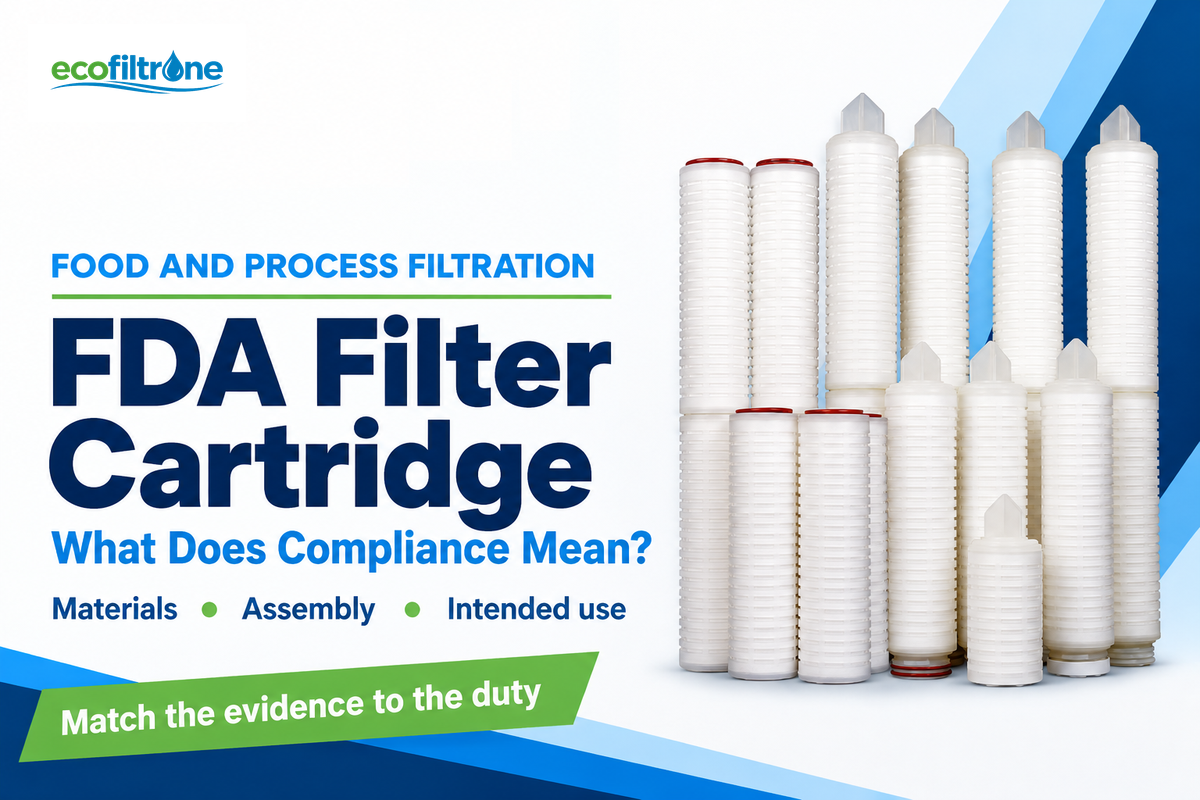
An fda filter cartridge claim concerns the materials that contact food and the conditions in which they are used. For industrial liquid filtration, match the complete cartridge specification to its authorization basis and intended duty. That gives a food-contact purchasing decision a more useful foundation than a general FDA approval label.
A resin declaration may be helpful; however, your liquid also contacts seals and end caps, among other components. Food contact suitability, particle removal and control of microorganisms address different questions. Separating them aids quality teams’ document review and purchasing’s ability to compare similar offers.
What Does FDA Compliant Mean for a Filter Cartridge?
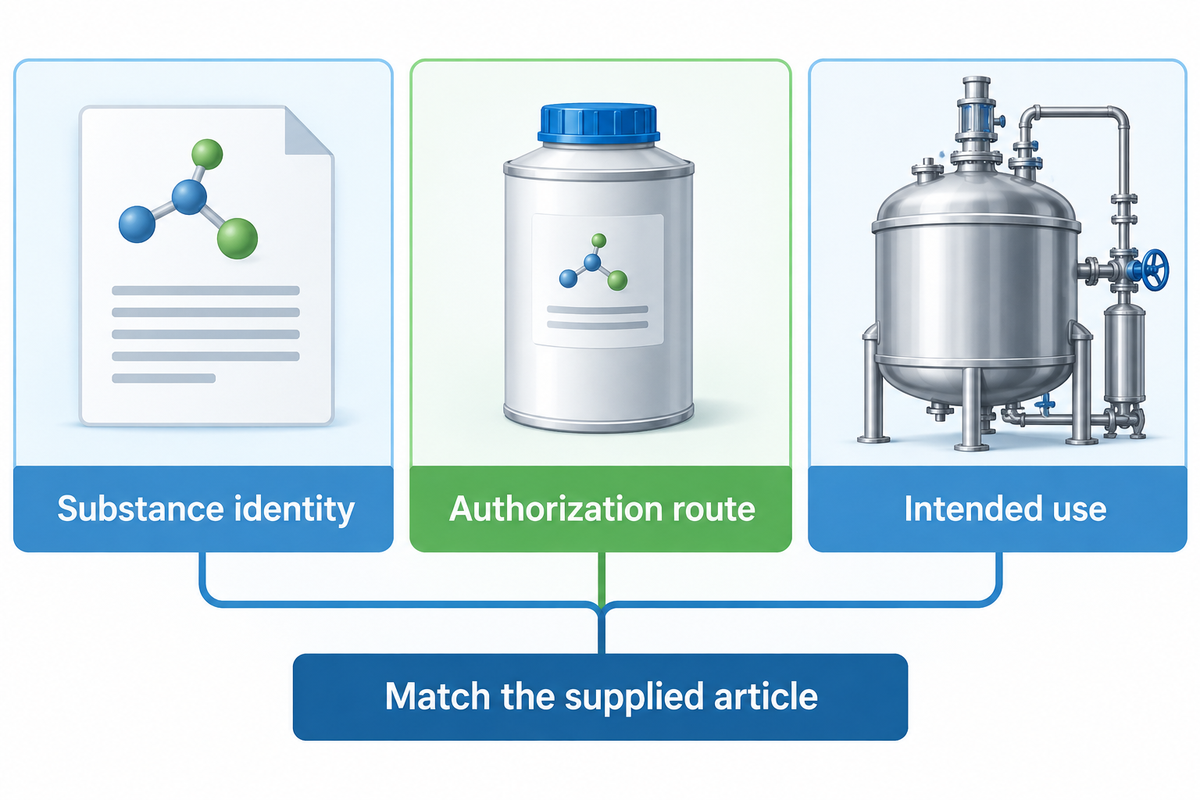
For a liquid filter, “FDA compliant” generally describes a food-contact materials claim that needs a defined scope. The relevant substance identities, authorization routes and intended uses must match the supplied article. Connect an FDA-compliant claim to an exact model and configuration, including the materials that come into contact with food.
The component guidance of the U.S. Food and Drug Administration describes routes such as the applicable laws and regulations, generally recognized as safe status, prior sanctions, threshold exemptions and effective food contact notifications. An FCN is effective for its identified manufacturer, substance and conditions of use. When relying on an FCN, the food contact substance (FCS) must be obtained from the manufacturer covered by that notification.
“FCNs are proprietary to the manufacturer for which the notification is effective, therefore, the FCS must be obtained from that manufacturer.”
That makes a difference if the replacement supplier offers a “comparable” polypropylene filter. Procurement requires traceability to the covered substance supplier, as well as matching dimensions. Request the regulatory basis and use limitations in the declaration or letter of guaranty, with the purchased model identified.
What are cartridge filters?
Cartridge filters are replaceable elements that are installed inside a filter housing. Liquid passes through a depth medium, pleated structure or membrane that separates the material according to the element’s design. The housing and sealing arrangement define the flow through the medium; an incorrectly matched seal can create a bypass path even if the right medium is used.
Which Food-Contact Rules Apply to Cartridge Components?
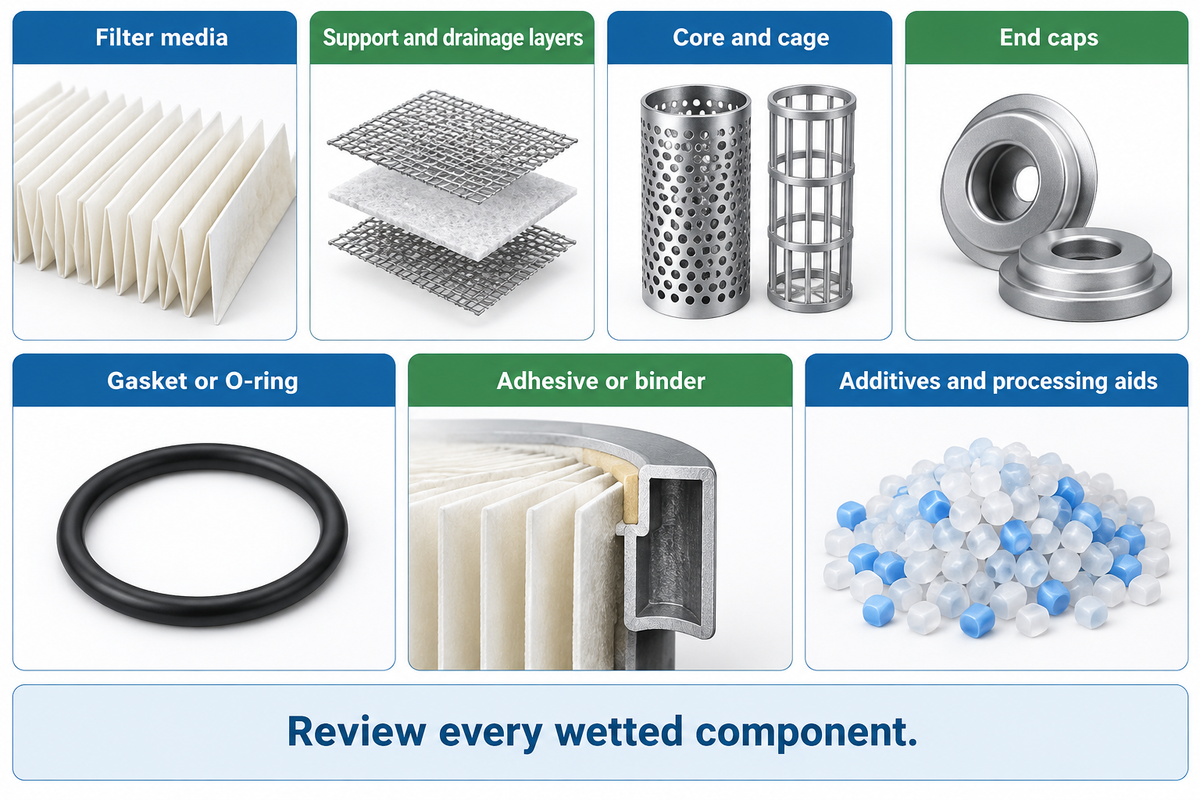
Applying food-contact rules depends on the nature of the component and its intended use. Within the Code of Federal Regulations, 21 CFR Part 177 includes provisions for certain olefin polymers, polyethersulfone resins and repeat-use rubber articles. These provisions are defined and limited; the material label is just a starting point for matching.
For example, 21 CFR 177.1520, 177.2440 and 177.2600 address different material groups. Section 177.2260 includes use-specific finished-filter extraction requirements for covered resin-bonded filters. Section 177.2550 concerns specified reverse-osmosis membranes; it isn’t a general permission for every membrane filter.
| Item to match | Record to obtain | Decision when it changes |
|---|---|---|
| Filter media | Exact material grade and authorization basis | Review formulation and use limits before substitution |
| Support and drainage layers | Wetted-layer material list | Include hidden layers in the contact review |
| Core and cage | Material, construction and model code | Recheck both contact status and mechanical limits |
| End caps | Material and connection drawing | Confirm housing fit and wetted composition |
| Gasket or O-ring | Compound identity and liquid compatibility | Approve a seal change separately from the media |
| Adhesive or binder | Joining method and applicable contact basis | Include bonded materials in the assessment |
| Additives and processing aids | Supplier declaration covering the formulation | Check the supplied grade, not just the base polymer |
| Substance manufacturer | Traceability where manufacturer-specific authorization applies | Recheck an FCN match after a source change |
| Actual food-contact duty | Liquid, time, temperature and repeated-use conditions | Compare the proposed duty with the documented scope |
Let’s look at an example of a beverage buyer changing a 10-inch element. The new quote matches the polypropylene media and connector, but changes an EPDM O-ring to silicone. A purchasing comparison based on length and micron rating would miss this difference. Quality should check the seal compound against the beverage and cleaning chemicals and link the accepted seal to the order code. Maintenance can confirm the connector and compression fit from the drawing. Once these match, Procurement can check price and lead time of the accepted configuration. Keeping the seal code on the repeat order specification would prevent the next “equivalent” quote from reopening this question.
Which Cartridge Material Fits the Liquid and Process?
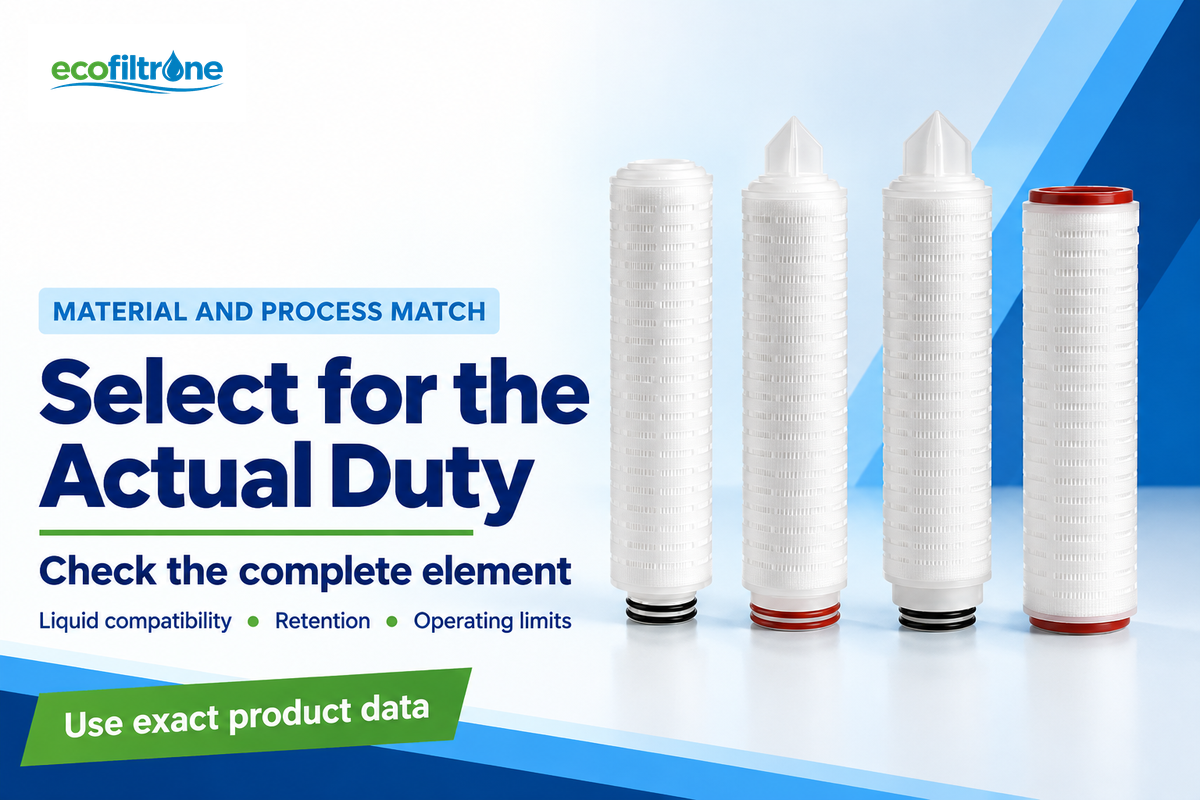
Depth, pleated and membrane constructions are candidates for different separation duties and the liquid and the cleaning cycle narrow the material choice. A sediment prefilter, a clarification element and a final microbial control membrane all have different functions. Evaluate all media, wetted supports and seals together and specify retention and operating limits for the complete element.
What material is used for filters?
Industrial elements include polypropylene media and membranes made of PES, nylon, PTFE or PVDF. Depth constructions include melt blown filter cartridges and string wound filter cartridges. A pleated polypropylene element folds a sheet into pleats; membrane cartridges add their own pore structure and support. Select among these families using the exact product’s data.
For upstream solids removal by depth filtration, assess melt-blown depth cartridges against the required outlet quality and changeout workload. For a pleated option, assess polypropylene pleated cartridges against the proposed flow and pressure drop. Assess membrane cartridge families when a defined membrane duty is required.
Claims involving high dirt holding capacity, low extractables and extended life require a stated test or operating basis. More pleat area may be useful; however, dirt holding capacity depends on the challenge and the endpoint used. Compare high flow filter options at the same liquid viscosity, temperature and required filtrate quality. For RO pretreatment in water treatment, determine the protection required by the downstream equipment and then select the prefilter.
A supplier’s description of a polymer as inert is too broad for a cleaning specification. Which specific chemicals, at what concentrations and under what exposure conditions, can the complete element tolerate? Rejecting an unsuitable option at this stage is less disruptive than redesigning a cleaning cycle after the cartridges are installed.
FDA Compliance, Sterile Filtration and NSF Certification Compared
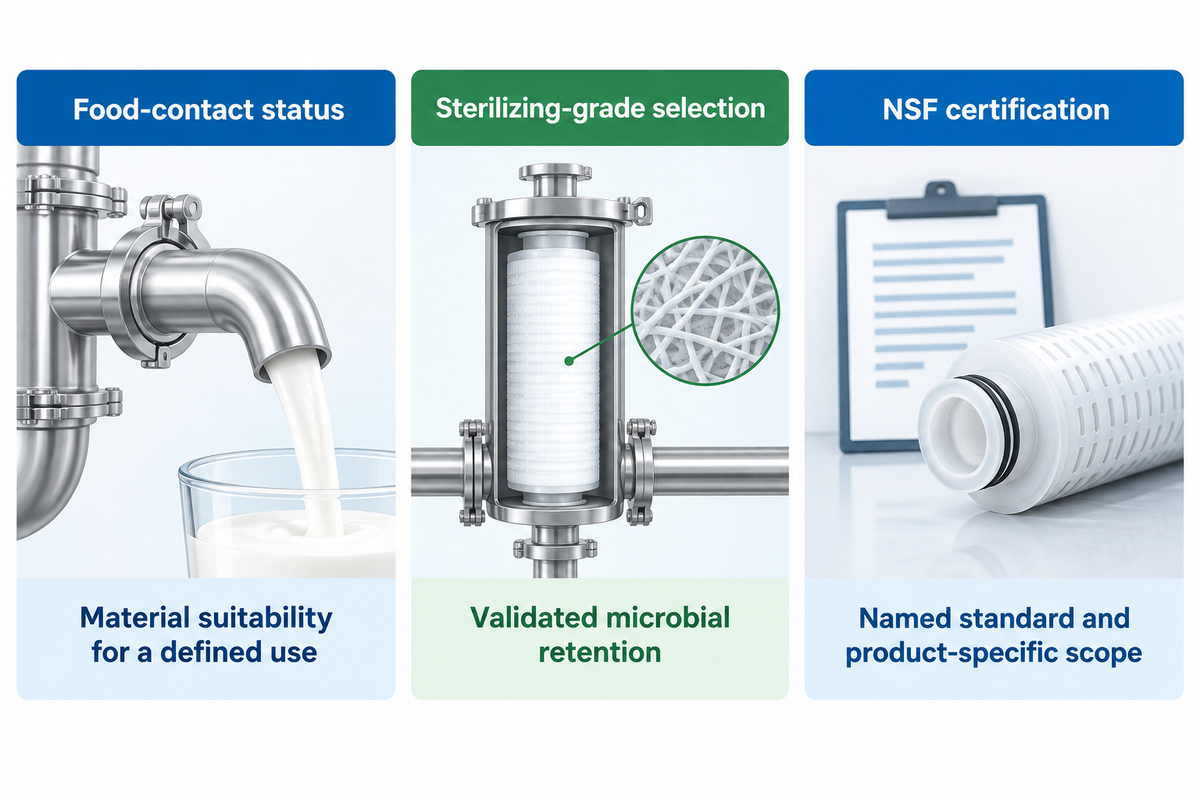
Food-contact status addresses material suitability for a defined use. Sterilizing-grade selection concerns validated microbial retention and the process that maintains it. NSF certification has a product-specific scope under a named standard. Keep these evidence paths separate when comparing filtration products, even when several claims appear on the same technical sheet.
| Claim | Question to resolve | Purchase record |
|---|---|---|
| Food grade | Which food-contact use is covered? | Defined material and intended-use declaration |
| FDA compliant | Which authorization applies to the supplied substances? | Applicable provisions or notification and limitations |
| FDA-approved | What exactly is described as approved? | Named regulatory action and its actual subject |
| NSF certified | Which listed model, standard and claim? | Current product listing and certified scope |
| ISO 9001 | Which certificate holder and activities? | Certificate scope, holder and validity details |
| USP Class VI | Which material or article was tested? | Identified test report and specimen |
| Absolute rated | Retention of what challenge, by which method? | Rating definition, efficiency and test conditions |
| Low extractables | Measured with which liquid and exposure? | Test conditions, results and applicable limits |
| Sterilizing grade | Which validated retention duty and process? | Product-specific validation and integrity-test requirements |
NSF explains that NSF/ANSI 42 covers aesthetic drinking-water claims, 53 addresses health-effect contaminants and 401 covers specified emerging contaminants. Certification claims vary by product. A food-contact declaration for an industrial cartridge should therefore be reviewed separately from a drinking-water system’s contaminant-reduction listing.
A 0.2 micron label needs a defined retention claim. FDA’s component-control questions and answers describe a particular bacterial passage problem and explicitly avoid making routine 0.1-micron filtration a universal requirement. Process organisms and validation matter more than treating a smaller number as an automatic upgrade.
Use the distinction between nominal and absolute micron ratings to read efficiency claims. Even “99.9% removal” needs the challenge material and conditions attached. For pharmaceutical filtration requirements, specify whether the step is non-sterile prefiltration or a validated final duty. Food and pharmaceutical operations may use similar-looking hardware while requiring different release evidence.
How Do Temperature and Cleaning Change the Selection?
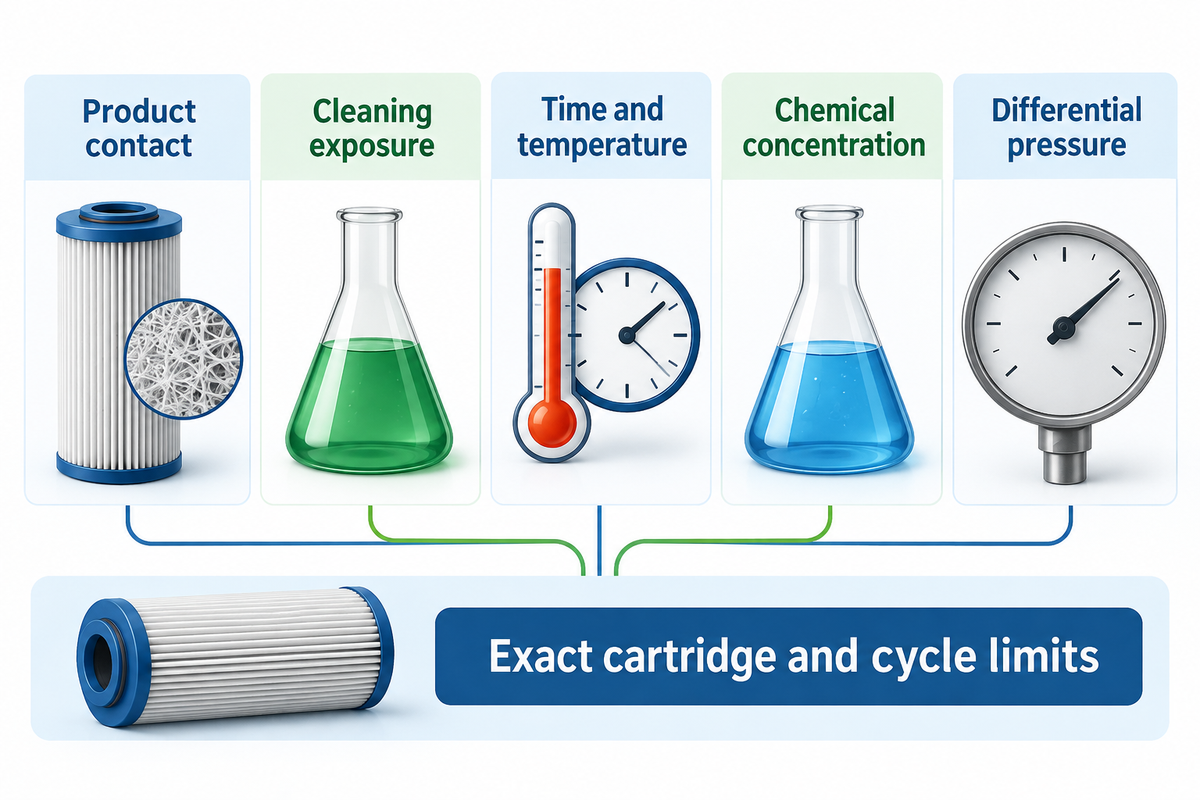
Product contact conditions and cleaning exposure should be analyzed separately. The cartridge’s operating limits may depend on time, temperature and chemical concentration. The complete cartridge has differential-pressure limits. Hot water cleaning or steam sterilization requires defined conditions and cycle limits for the exact cartridge.
A historical example shows why these details belong together. Pall’s May 2014 PREcart PP II sheet lists a forward differential-pressure limit of 5.0 bar at 25°C, 2.0 bar at 80°C and 1.5 bar at 90°C for compatible fluids. Those are that product’s published conditions, not limits for all polypropylene pleated filter cartridges or an ECOFILTRONE specification.
Cleaning can also change separation behavior before a visible failure occurs. Teella and colleagues’ 2015 study examined PSf/PES hollow-fiber membranes and reported changes in permeability, retention and adsorption after caustic treatment. Its experimental treatment isn’t a cleaning recipe for a food-grade cartridge. Use the selected element’s instructions and the site’s qualified procedure.
Suppose a plant moves a cartridge from 25°C process water to an 80°C rinse stage. The element still fits, and the purchasing description still says “FDA compliant filter.” Operations now need to review the hotter duty, its duration and the differential pressure reached during the rinse. Quality must check whether the documented contact conditions still match. Maintenance should confirm the seal and housing limits as well. If the existing model lacks a suitable operating envelope, specify a cartridge for the new duty before ordering. Reusing the old stock code without reviewing these conditions transfers an unresolved process change into the next production run.
Food-equipment requirements also cover cleaning and control of contamination. 21 CFR 117.40 includes cleanability and protection against allergen cross-contact. Record first-use conditioning and flushing instructions separately from repeated cleaning instructions. Keeping a filter clean and correctly handled is a separate operating task from choosing the food-contact materials.
How Much Does a Food-Grade Filter Cartridge Cost?
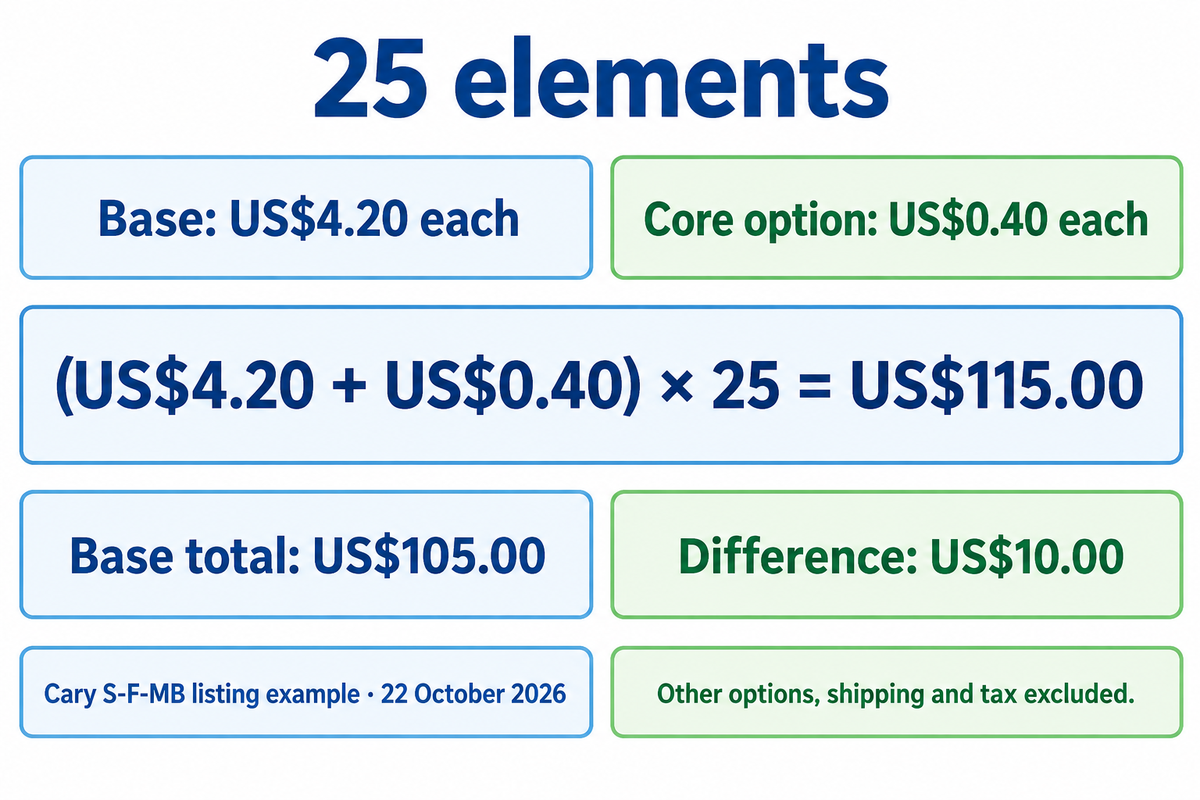
The Cary Company’s listed examples start at US$4.20 each for its S-F-MB depth cartridge at 25 units and US$233.11 each for its specified PES cartridge at six units, checked on 22 October 2026. These are dated examples of the seller’s products and shouldn’t be used to represent a comparable market price.
How much is a filter cartridge?
Cartridge price examples reflect the complete model and the configured options. The S-F-MB example is a 2½” x 20” melt blown filter sold in case lots of 25. Its 21BZUS example is a 10” 0.2-micron PES element of double-open end construction with EPDM seals, sold in case lots of six. A membrane is a different product than a sediment element, so their prices address different purchasing duties.
For a configured-cost example, take 25 S-F-MB elements at the displayed base price and select only the listed heavy-duty core option, US$0.40 per element. The arithmetic is (US$4.20 + US$0.40) × 25 = US$115.00, compared with US$105.00 for the base selection. That’s a US$10.00 difference before other selected options and any shipping or tax charges. End connections, seals and packaging can change the result again. A buyer comparing the base listing with another supplier’s fully configured offer should first align those items. Finance then has an order-level comparison; quality still needs to accept the proposed configuration for the application.
For a recurring operating cost, add replacement frequency, labor and production interruption, using your own site records. High retention efficiency and extended life claims are valid only if linked to the actual challenge and quality endpoint. A cost-effective choice maintains the required filtrate quality without an unacceptable changeout burden. A current quote is required before purchase; third-party listings aren’t ECOFILTRONE prices.
Use the 3-Layer Food-Contact Match Before Ordering
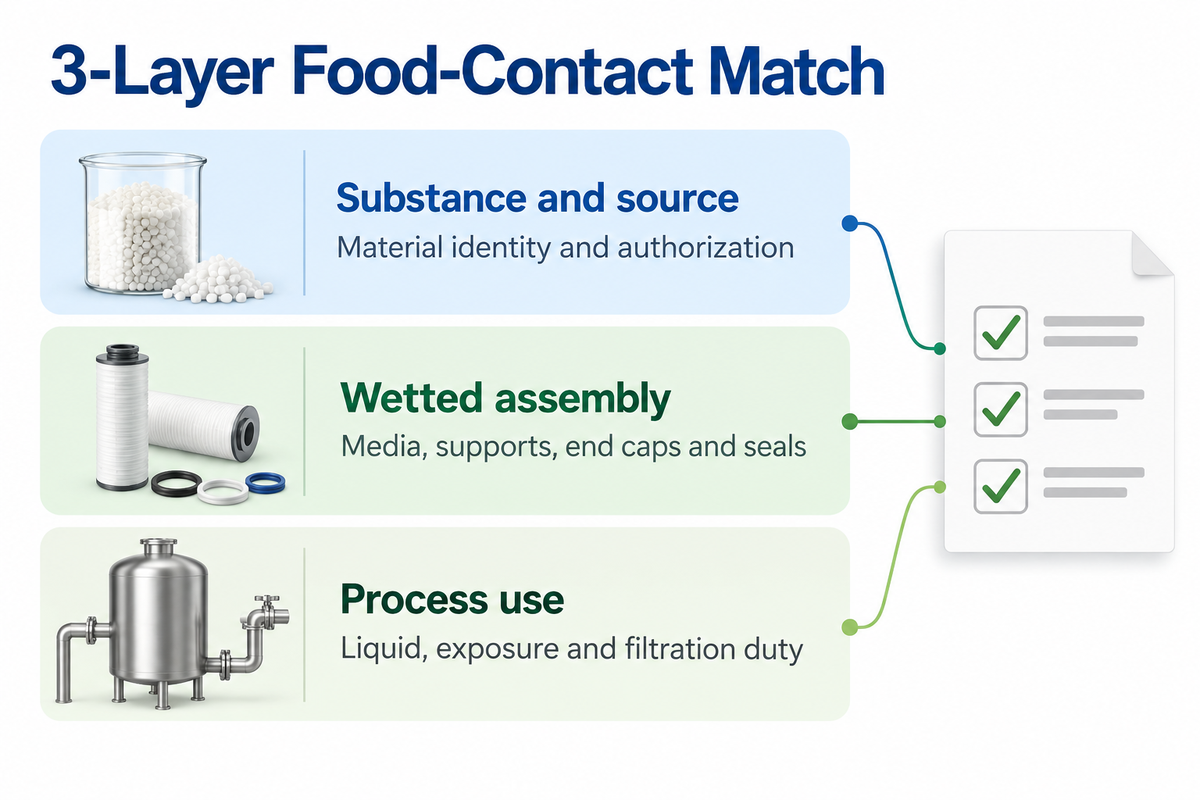
The 3-layer Food-Contact Match connects substance authorization, the purchased wetted assembly, and the actual process use. Each layer should be analyzed independently. This purchasing approach helps quality, maintenance, and procurement teams identify unresolved parts of an offer without treating an isolated certificate as approval for the entire assembly.
- Substance and source: identify the constituent materials and authorization route. For an FCN, identify the covered manufacturer and substance.
- Wetted assembly: match the declaration with the medium, supports, end caps, joining method, and seals as described in the order code. Maintenance checks the housing interface.
- Process use: match liquid, contact temperature and time, exposure to cleaning, and required filtration performance. Operations records the accepted envelope.
Refer disagreements to the responsible party. The supplier and quality department handle an ambiguous resin source; quality and maintenance assess changed O-rings; process engineering reviews a new cleaning temperature. Procurement can hold the affected specification item while the responsible party resolves it, instead of going through the entire sourcing process again.
Attach to the enquiry: product or liquid description; required removal duty; normal and maximum process conditions; flow and differential-pressure limits; housing drawing or existing model; media and seal preference; cleaning procedure; required documents; and sample or trial acceptance criteria.
Use language the supplier can act on when specifying the endpoint. “Reduce visible solids before a downstream membrane” is a different duty from “retain specified spoilage organisms under a validated beverage process.” The second requires an organism-specific performance discussion as well as food contact.
Which Suppliers Support Food and Beverage Filtration?
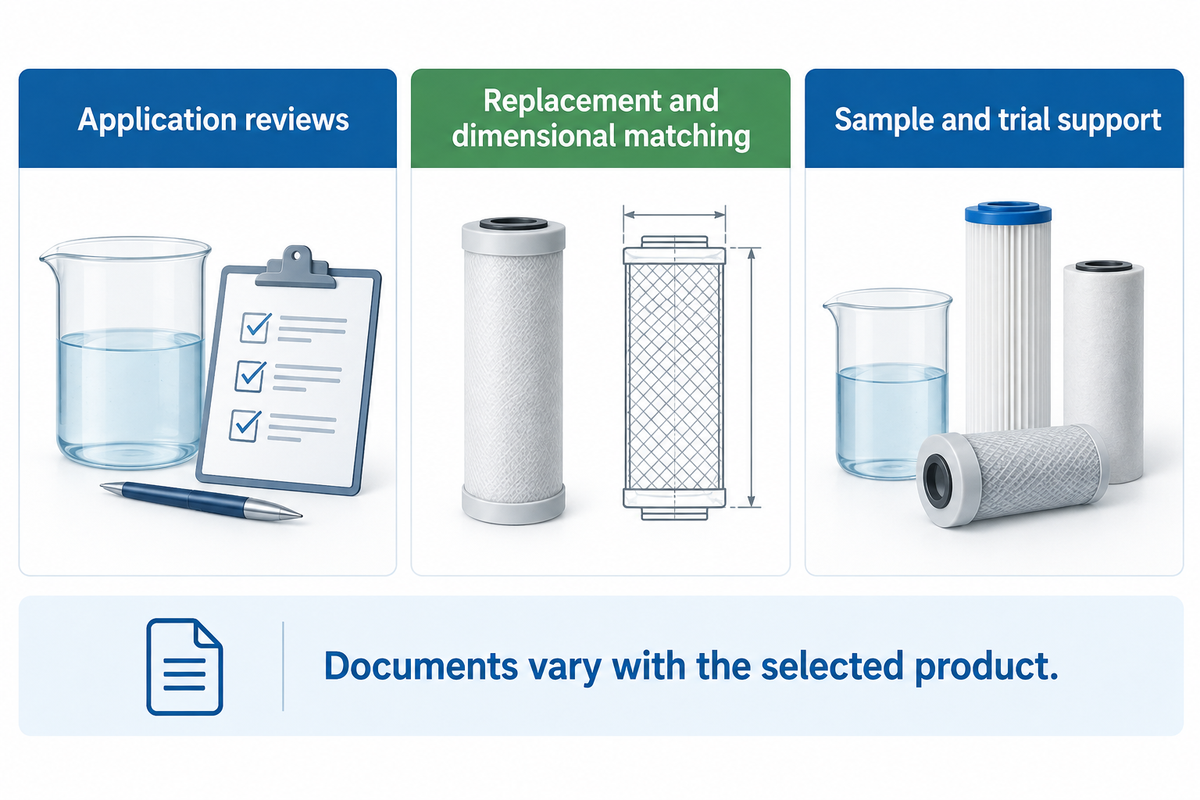
Look for a supplier that can connect the selected element to its technical documentation, replacement dimensions and intended operating conditions. A useful quotation identifies the full configuration and explains the support available for trials and repeat orders. Evaluate that response against the process duty instead of treating an FDA label as the entire specification.
ECOFILTRONE™ is an industrial filtration products supplier in Qingdao, China, with engineering support for industrial waters and processes. We offer membrane, melt-blown, pleated, high flow and string wound filter cartridges, plus industrial liquid filter bags. We provide application reviews, replacement and dimensional matching, sample and trial support, and customized configuration.
We work from the liquid and operating requirements, and confirm product specification and relevant documentation. Available documents vary with the selected product and actual certificate holder. During an order, support includes technical confirmation, datasheets, inspection and shipping coordination. This includes following up on how the product operates after delivery.
When Should Food-Contact Documents Be Rechecked?
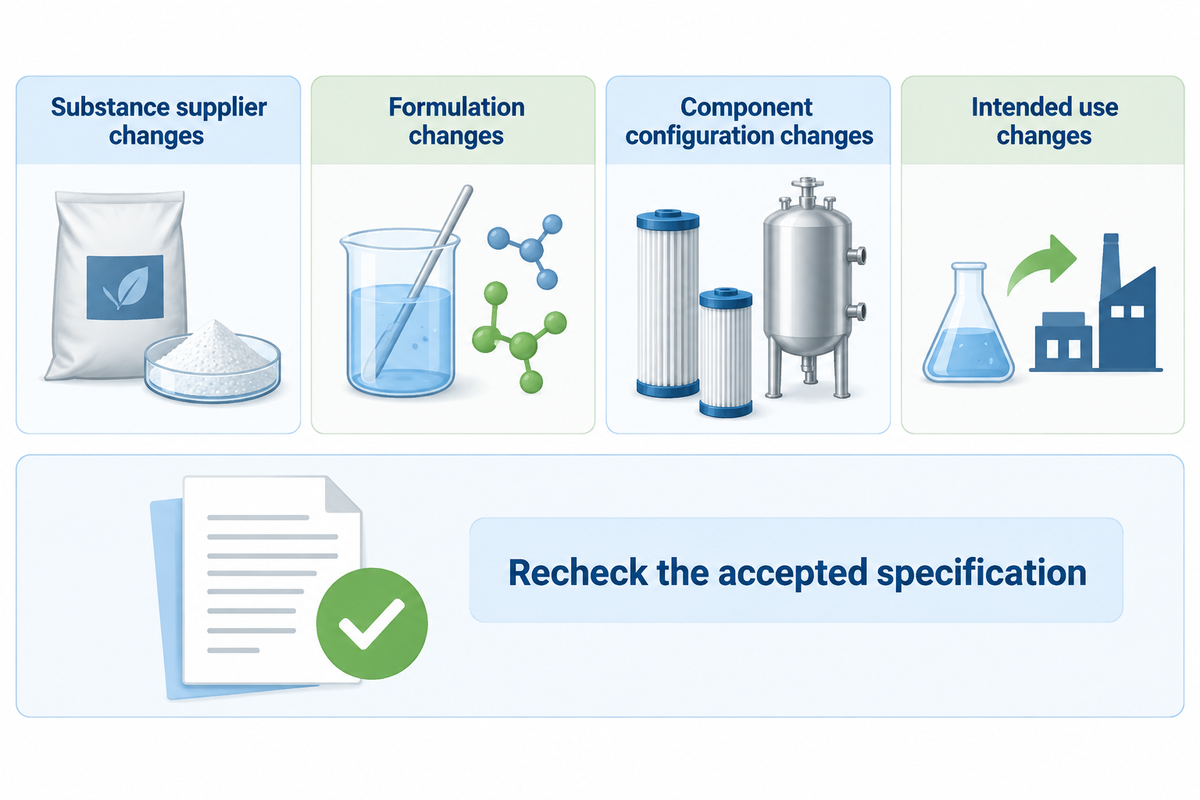
Restart the evaluation when the supplier of the substance, formulation, component configuration, or intended use changes. Maintain the accepted specification and any supporting documents with the order and revision. This aids purchasing in making repeat purchases, and quality in identifying process changes that require a fresh assessment.
A repeated model name may disguise a changed seal or component source. Ask the supplier to identify relevant changes and compare them to the version accepted at your plant. For changes in the cleaning cycle, review chemical compatibility and exposure, along with the food-contact declaration. Follow instructions for the first-use preparation, rather than assuming that a similar model would require the same flushing procedure.
Material authorization is one aspect of product protection. Process controls address harmful substances and handling failures. Keep records that allow affected supplies and/or processes to be traced in the event of a process control deviation or product recall.
Send your operating envelope and details of your current filter elements to our cartridge application review team. They’ll help compare the replacements and identify supporting documentation for the chosen configuration.
Discuss your cartridge and operating conditions
Frequently Asked Questions
What types of filters are used in the pharmaceutical industry?
Pharmaceutical filtration may use a depth cartridge, a membrane cartridge for finer separation, and an appropriate gas filter for vents or compressed gases. The right choice is process and product dependent. A food-contact material claim does not establish suitability for drug production; validated retention, compatibility and integrity testing are required for sterile processing.
How often do cartridge filters need to be replaced?
Replace a cartridge at the first applicable limit in its approved operating procedure: the manufacturer’s differential-pressure limit, a product-quality endpoint, a validated service interval, or a failed integrity test where required. Track conditions from a clean baseline. There is no generally applicable number of days, given differences in solids loading, fluid properties, cleaning exposure and microbial risk.
Where can I buy water filter cartridges?
Industrial users can source filter cartridges from original equipment manufacturers (OEMs), distributors or suppliers focused on a particular process. Consider process duty and existing housing when selecting a cartridge rather than cost. Request media specifications and documentation covering the end connection, seal compound and retention rating. Household-replacement cartridges and industrial process cartridges can be similar in dimensions, but their verified duties and requirements can differ.
Are your filters BPA-free?
Ask ECOFILTRONE for a declaration covering the selected model and relevant components. A BPA-free requirement should be included in the enquiry, alongside the media, end caps, adhesives and seals, so the proposed configuration can be checked.
Which micron rating is best for beer clarification?
The correct rating depends on the load of solid material, degree of clarification needed, and downstream filtration stage. Clarification and microbial stabilization are different jobs: a cartridge that reduces visible haze may not deliver the required organism retention. Work with the filter supplier’s beverage grade and evaluate it with actual beer, flow and temperature. If you need microbial control, define the target organisms and validated retention evidence. Check pressure development and any adverse effect on the product. Document the successful trial conditions.
References & Sources
- FDA: Regulatory status of components of a food-contact material
- Electronic Code of Federal Regulations: 21 CFR Part 177
- Electronic Code of Federal Regulations: 21 CFR 117.40, equipment and utensils
- NSF: NSF/ANSI 42, 53 and 401 filtration-system standards
- FDA: Current good manufacturing practice questions on components and drug products
- Teella et al. (2015): caustic treatment and membrane properties, indexed in PubMed
Product examples: Pall PREcart PP II datasheet, May 2014 and S-F-MB and 21BZUS lists, The Cary Company, checked October 22, 2026. Figures pertaining to the aforementioned products belong to the respective companies.