Get in touch with ECOFILTRONE™ Company




Filter bag sizes describe the physical characteristics of a liquid filtration bag. Common families include #1 and #2, roughly 7 inches across, and the smaller #3 and #4 families, roughly 4 inches across. The micron rating describes another property: particle retention. Mechanical fit is determined by collar construction, length and diameter.
Updated October 2026
At a glance
- #1: commonly described as about 7 × 16–16.5 inches.
- #2: commonly described as about 7 × 32 inches.
- #3 and #4: smaller-diameter families with differing supplier length conventions.
- These are nominal family descriptions. The ordered drawing defines the finished dimensions and sealing interface.
Filter bag sizes identify dimensional families for liquid filtration. Measure the flexible body and rigid collar separately, use matching length reference points, and keep micron rating separate from physical size.
- A flat bag’s width is approximately half its circumference, not its round diameter.
- Exact unit conversion and rounded catalogue dimensions answer different questions.
- More bag area changes loading per unit area; operating conditions determine service life.
Filter bag sizes: what the numbered labels actually tell you
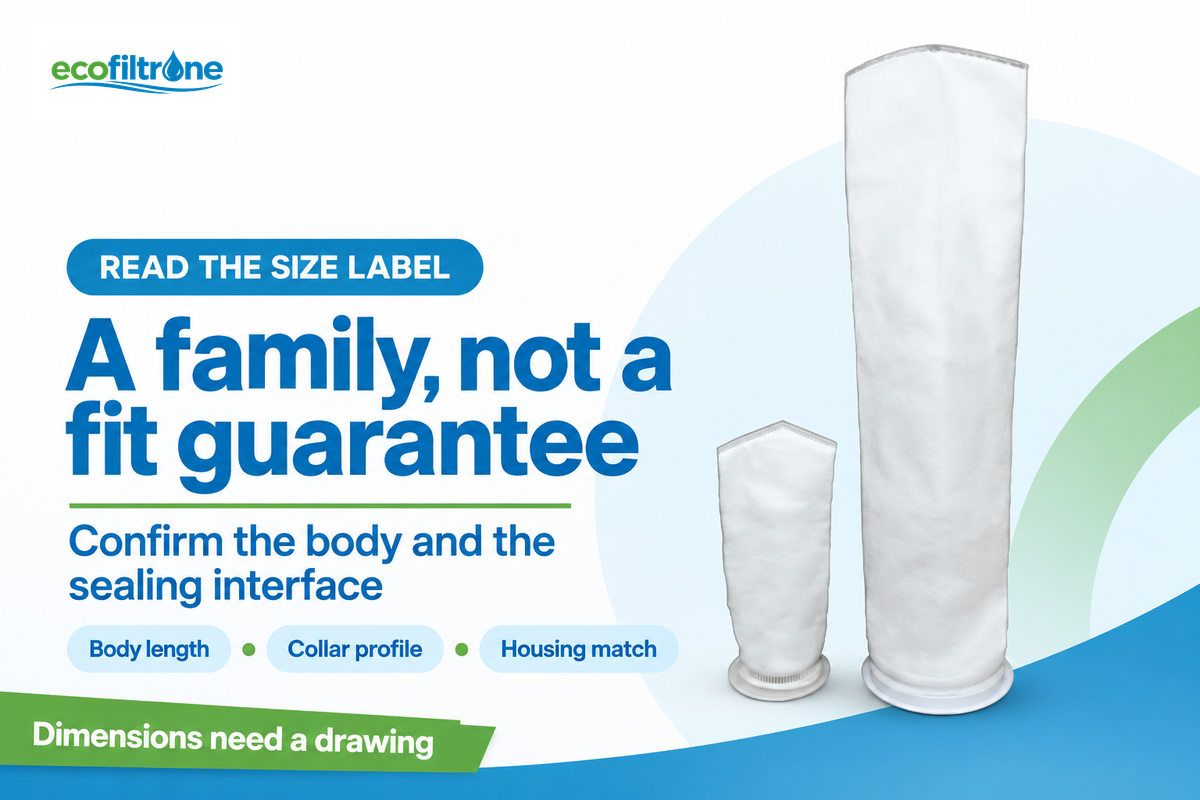
A numbered bag size identifies a dimensional family. A member of Size 2 usually has a longer body than a size 1 with a similar nominal diameter. Sizes 3 and 4 form a smaller family. The numbering helps narrow the search for a replacement, and the collar profile and supporting basket determine how the bag seats.
Industrial filter bags are used inside supported housings for liquid service. The filter bag receives the flow and collects solid debris. Its support basket carries the mechanical load. Industry size labels provide a basic format description; however, different suppliers may use different units (for example, rounded inches, metric dimensions, or finished-bag measurements) to describe that format.
For a maintenance buyer with an unlabelled spare, a flexible body’s approximate diameter and length are good starting points. A long, narrow bag from a dust collector belongs to a different piece of equipment. Pool-filter products and cartridge elements need specific identification methods. Advice concerning cage construction, snap bands, and air-to-cloth ratios should accompany dust collection equipment.
Keep the old part number if it’s legible. Two filter bags can have the same size number but have different sealing rings. Filter bags can be designed with moulded plastic or metal rings. A filter bag needs proper sealing and engagement with the housing and bottom support.
Liquid filter bag dimensions: why supplier charts disagree
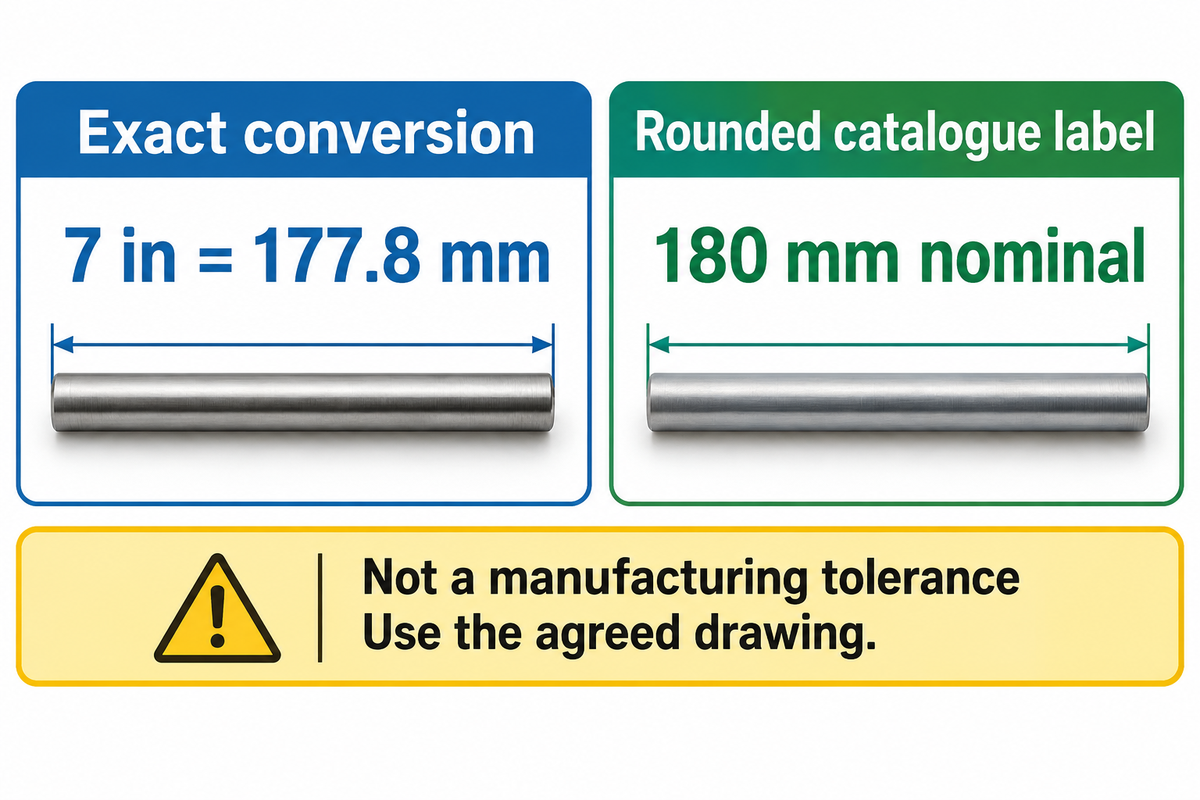
Seven inches converts to exactly 177.8 mm, whereas a catalogue may round a nominal diameter to 180 mm. The 2.2 mm difference is a difference in descriptions and not an allowed manufacturing tolerance. Supplier charts may also measure from a different point or describe a different collar construction within the size family.
The NIST explanation of the inch definition provides the conversion factor. The other aspect of the drawing is a tolerance, which defines the acceptable variation around the specified dimension.
The inch is “exactly equivalent to 25.4 mm”.
3-Column Dimension Translator
The 3-Column Dimension Translator separates an inch description, its mathematical conversion and the measurement question a buyer needs to resolve.
| Inch description | Exact conversion | How to read it |
|---|---|---|
| 4 in diameter | 101.6 mm | A nominal family description may round this value. |
| 4⅛ in diameter | 104.775 mm | A different specified diameter from 4 in. |
| 7 in diameter | 177.8 mm | Separate exact conversion from a rounded metric label. |
| 7¹⁄₁₆ in diameter | 179.3875 mm | Retain the fraction when reading the original dimension. |
| 8 in length | 203.2 mm | Identify whether the endpoint includes the bottom seam. |
| 9 in length | 228.6 mm | An alternative length description is not automatically interchangeable. |
| 14 in length | 355.6 mm | Compare the same top and bottom reference points. |
| 16½ in length | 419.1 mm | Do not round a drawing before comparing its tolerance. |
| 32 in length | 812.8 mm | Length and available basket depth remain separate measurements. |
The conversion gives additional decimal places. Those additional decimal places don’t show that a sewn fabric bag can be manufactured or measured to that degree of precision. If a purchase specification states a dimension in millimetres with an agreed tolerance, consider that dimension as the acceptance basis.
Flat width and diameter: measuring a filter bag correctly
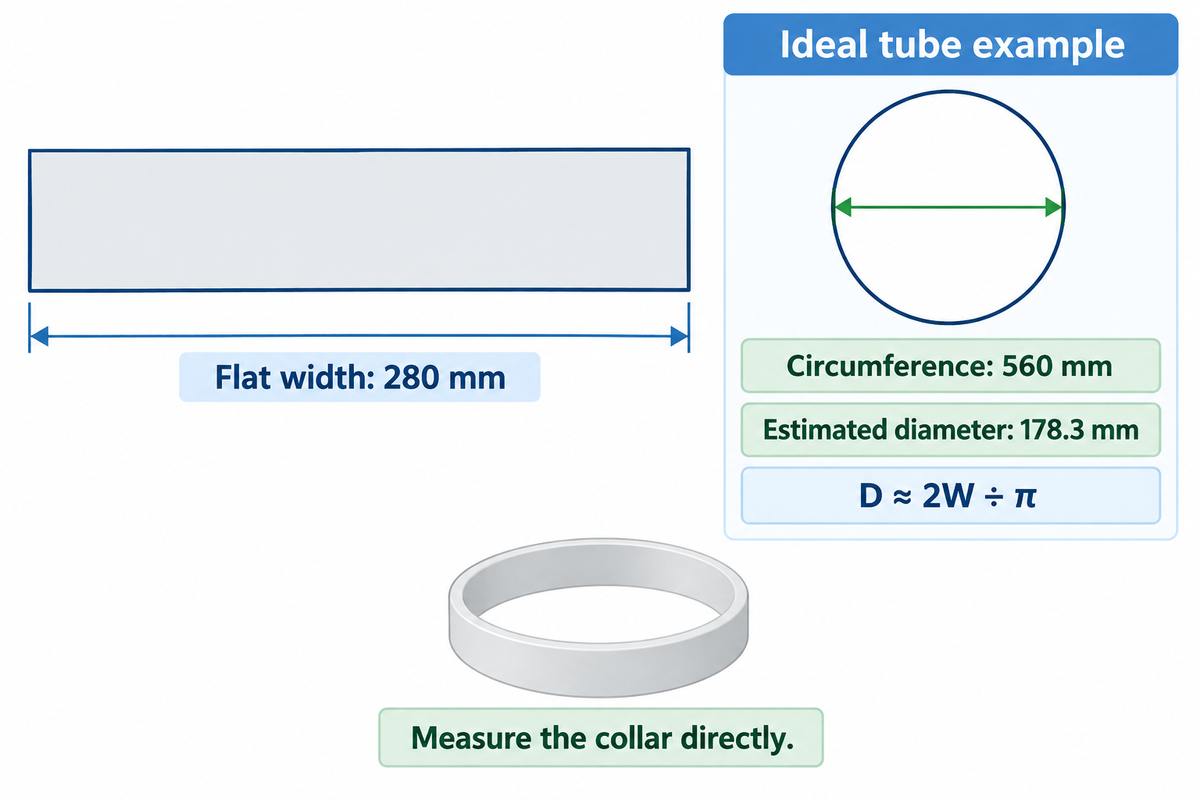
The body of the relaxed, flattened tube has two fabric layers spanning its width. For a simple circular tube, the approximate circumference would be twice that flat width. Divided by pi, that would give an estimated body diameter. The outside diameter and the sealing profile of the rigid collar are determined by measurements rather than calculations from the fabric.
How are filter bag sizes measured?
Measure the width and length of a clean, empty bag’s body, then measure the collar separately. Use an unused sample if possible and indicate if the specimen is new or used. Indicate if it’s wet or dry. Lay the bag’s body flat and keep the tape straight. Mark the ends of the measurement on a photograph.
Comparisons of textiles are dependent on their condition. ASTM D1776/D1776M’s public scope addresses moisture conditioning in test methods that require it. For a replacement measurement, document the condition of the specimen and use the procedure agreed with the supplier. A wet, distorted used bag is useful as identification evidence but makes a poor dimensional master.
- Prepare the specimen. Use a clean removed bag; follow site handling requirements for any process residue.
- Lay out the body. Smooth folds without pulling the fabric into tension.
- Record dimensions. Separate flat width, body length and directly measured collar dimensions.
- Photograph the endpoints. Include the tape and the visible top and bottom reference points.
How are filter bag sizes calculated?
Calculate an ideal tube’s diameter as twice its flat width divided by pi: D ≈ 2W ÷ π. This follows the circumference-to-diameter relationship explained by NASA. Use the same units for width and diameter. Seams, fabric thickness, stretching and gussets change how closely a finished bag follows the model.
Example: A technician lays an unused, ungusseted bag flat and records a body width of 280 mm. Treating the fabric as a thin circular tube gives an estimated circumference of 560 mm. The diameter calculation is 560 ÷ π ≈ 178.3 mm. Ordering a 280 mm diameter bag would confuse the flattened width with the round body diameter. A second specimen with a flat width of 165 mm gives 330 ÷ π ≈ 105.0 mm. Both calculations help identify a likely family; the technician still records the rigid collar directly and compares the marked length with the housing’s specified replacement.
Bag length and collars: choosing clear measurement points
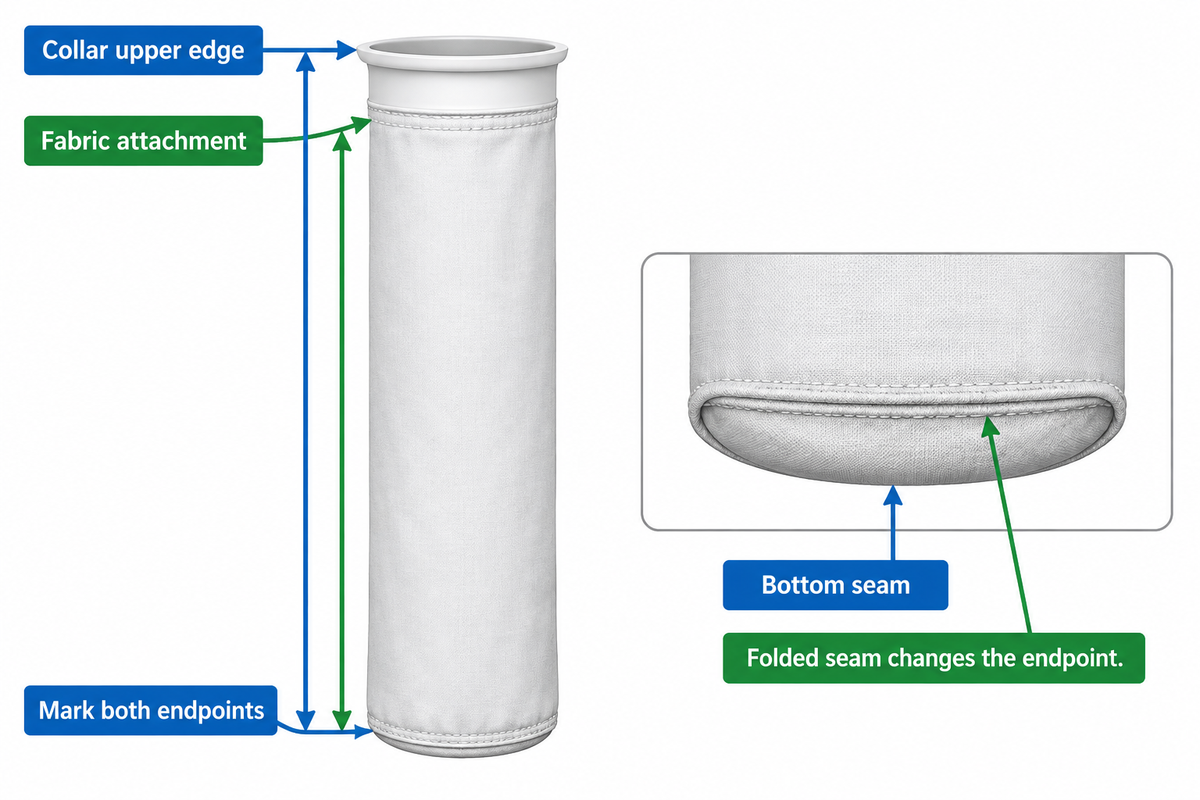
Take measurements between reference points as specified on the drawing. If no drawing is available, photograph the chosen top point and bottom seam and identify both in your report. Flexible-body lengths and usable basket depths can be different despite the same overall lengths measured on samples.
A collar may extend above the fabric with a shaped sealing lip. Starting at the collar’s upper edge gives a different reading compared to starting at the fabric attachment. The same principle applies to the lower edge. A folded seam or shaped bottom also changes the apparent endpoint. Keep all these features visible while taking measurement records.
Basket support matters after installation. In International Filtration News’ bag-filtration guidance, Eaton product manager Wim Callaert explains the role of the basket in supporting the bag. Extra material bunched at the bottom and a short body suspended above its support are different fit problems.
Suppose there’s a case where a drawing measures from the collar top, and a workshop photograph starts where the fabric meets the ring. The purchasing department sees two different lengths and requires a custom bag. Before changing the specification, the technician marks the starting points on the same sample. The difference may be due to the height of the collar rather than to an unusual body. Comparing the marked starting points gives the supplier a drawing reference and avoids asking the production department to reproduce an unclear tape reading. If the body itself is different, a confirmed custom configuration would be the next step.
Size 1 vs size 2: what extra filtration area can change
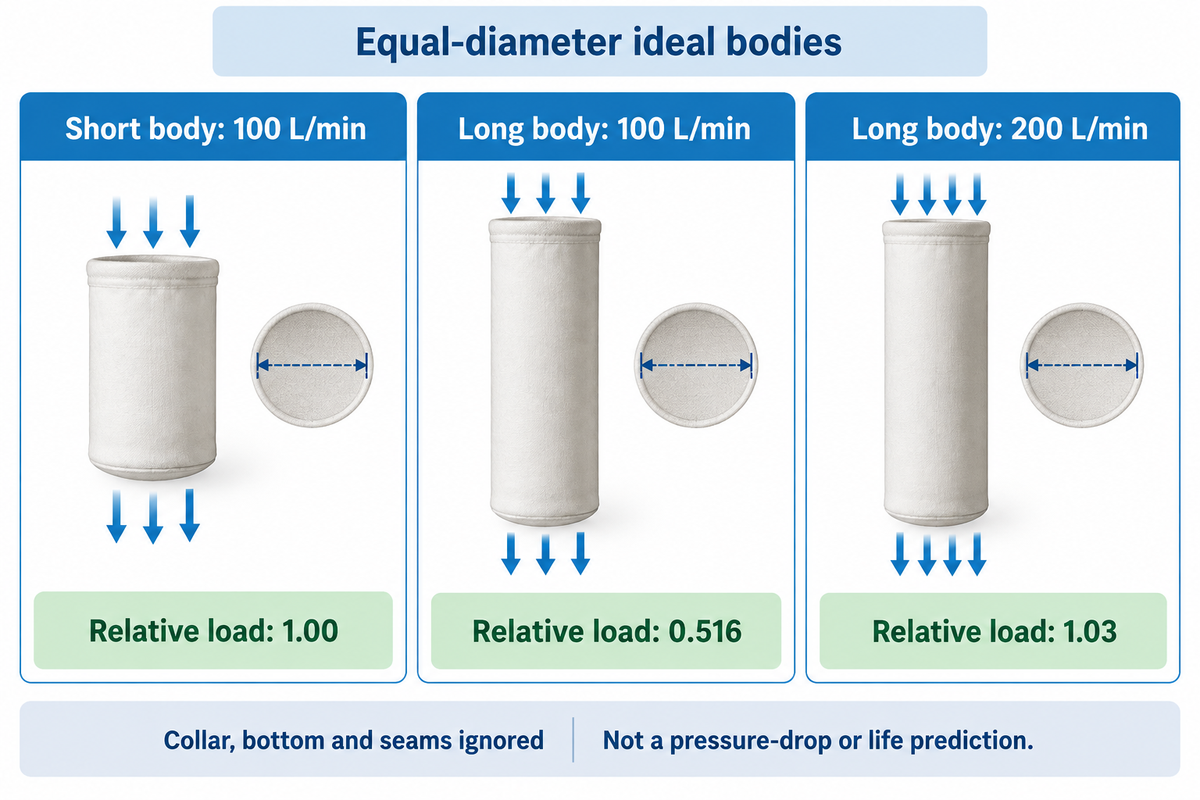
At equal diameter, a longer bag body provides more side area and may reduce flow per unit area when total flow stays constant. The longer body of the bag increases the side area, and a larger bag requires a matching housing and support basket. The service life of the bag changes with solids, media construction and the operating condition rather than length of the bag alone.
Compare area at the same flow
Consider two equal diameter cylindrical bodies of 16.5 inches and 32 inches. Neglect the collar, bottom and seams. The side area ratio is 32/16.5 ≈ 1.94. Manufacturer-stated filtration area may use a different basis for comparison, so use the area of the selected product for hydraulic calculations.
| Case | Total flow | Relative side area | Relative flow per area |
|---|---|---|---|
| Short body, baseline | 100 L/min | 1.00 | 1.00 |
| Long body, same flow | 100 L/min | 1.94 | 0.516 |
| Long body, doubled flow | 200 L/min | 1.94 | 1.03 |
At constant flow, the longer body carries about half the flow per unit area of the shorter body. Increasing flow through the longer body by a factor of two removes its flow-per-area advantage in this example. These are area-loading comparisons, not pressure-drop calculations or replacement-interval predictions.
A plant manager wanting to increase production may favor a longer bag to reduce change-outs. Finance sees a higher unit cost. Quality needs the same particles removed. The useful trial keeps the liquid, media and micron rating consistent, and records actual flow and differential pressure over the batch. If production doubles the flow during the comparison, the result answers a different question from a same-flow trial. Consider handling time and the retained liquid when comparing change-outs, as a larger loaded bag may be more awkward to remove. The housing’s access space may limit bag handling before media area does.
Micron rating and materials: separate choices from bag size
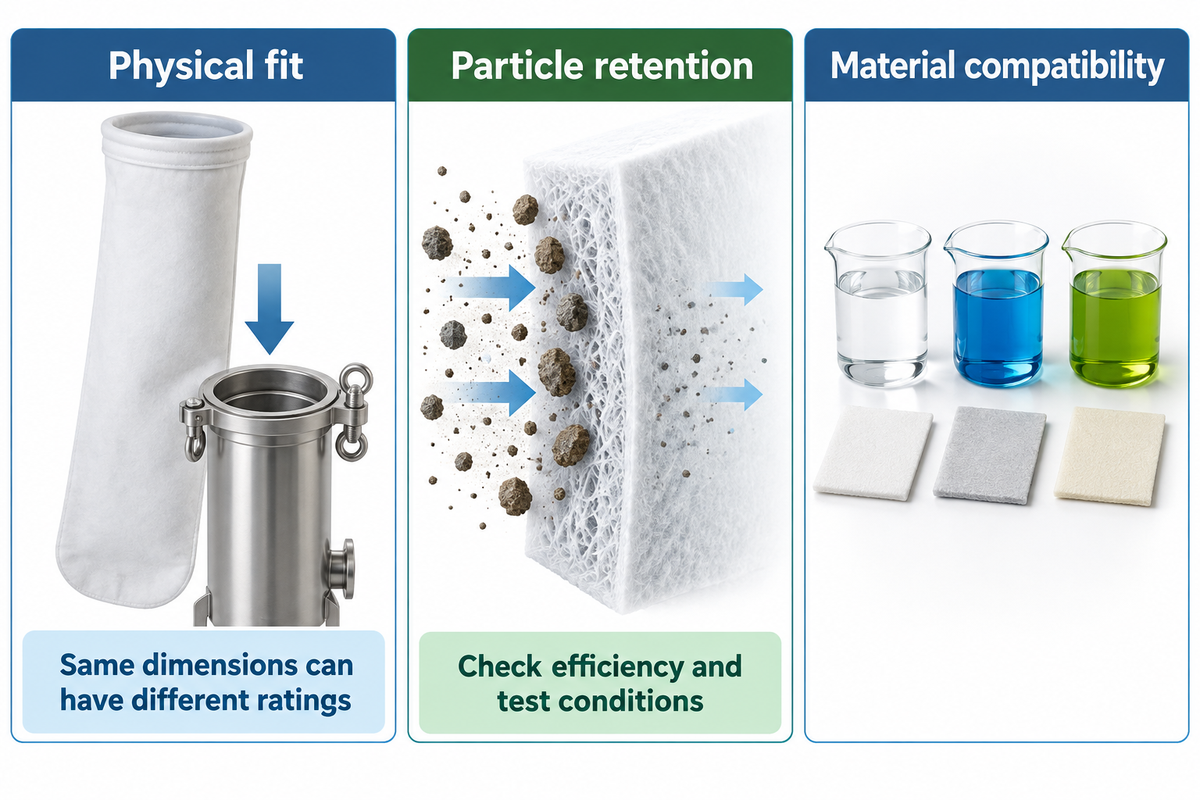
A 50 micron bag can have the same outside dimensions as a 10 micron bag. The micron size refers to particle retention, while the bag size refers to physical fit. Construction of the media and the rating’s test basis determine filtration behavior. Nominal and absolute ratings should be compared based on the stated efficiency and test conditions.
A lower micron label usually means smaller unwanted particles, but a finer filter can load faster with a feed containing a substantial amount of sediment. Compare liquid filter bag retention ratings using the stated efficiency basis. Matching dimensions doesn’t establish sterile filtration performance.
Polypropylene felt and polyester felt use synthetic fibrous structure for depth filtration. Needle-punched filter media contain pathways through the fiber network; a surface glaze is a finish, not a bag-size designation. Nylon monofilament mesh bags use woven structure with defined openings. The weave and the materials used affect the way the media retain solids.
Polyester bags and a polypropylene filter bag may fit the same housing but respond differently to a solvent or high-temperature duty. Polyester selection for industrial applications requires compatibility with the actual liquid and temperature. Chemical processing usually adds varying feed composition to that review. Food and beverage applications also require relevant product and material documentation. Special media, including those intended for oil absorption, address additional process requirements; physical size alone doesn’t add that function.
Ultra-fine filtration may require a different filter element or staged filtration system. A carbon treatment stage can target substances beyond the suspended particles collected by a plain bag. Keep that filtration-process decision separate from the mechanical replacement.
Bag filtration problems: distinguish a dimension error from loading
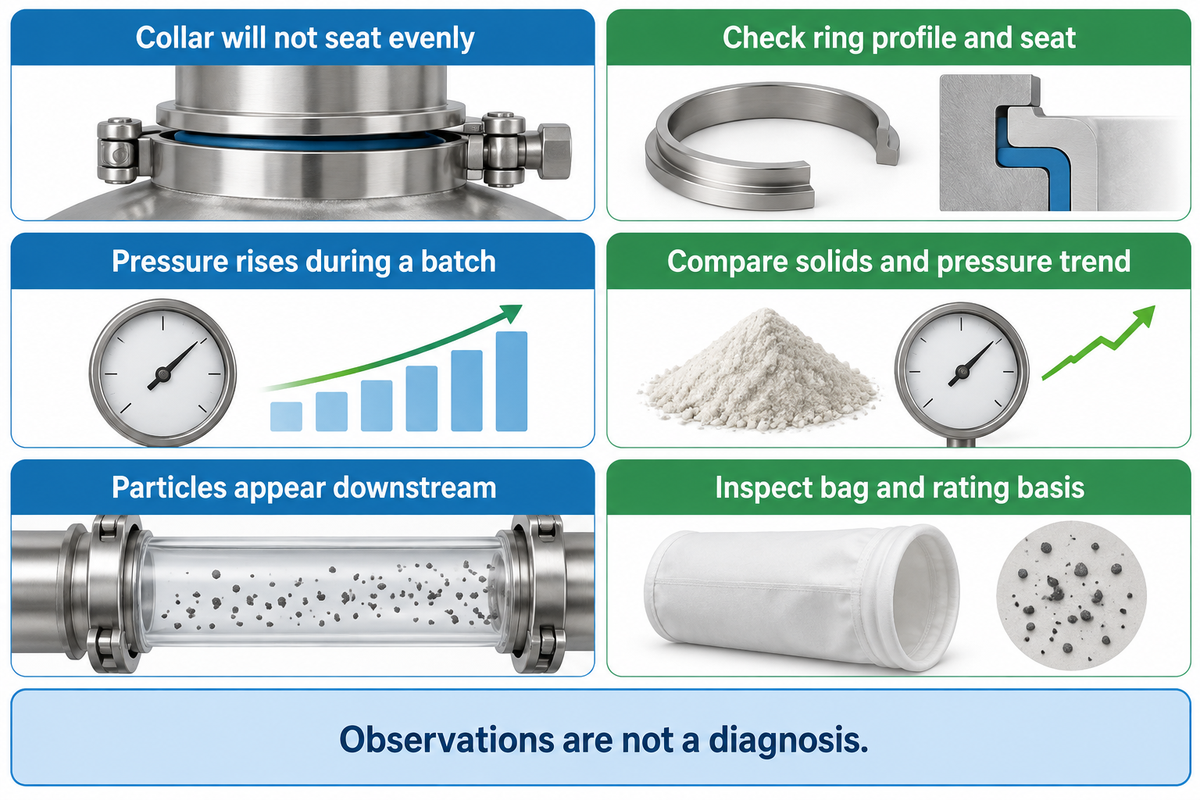
Visible bunching or unsupported fabric may require a fit check; increasing differential pressure during a run also warrants checks of flow, viscosity and contaminant loading. Downstream particles may be due to media selection, damage or bypass. Use several observations before attributing them to a bag number or changing filtration specification.
Record inlet and outlet pressures across the filter under comparable process conditions. Pressure readings at some other flow rate or liquid temperature define other operating points. These observations lead to the following inspection; by themselves, they don’t constitute a diagnosis.
| Observation | Possible category | Useful next check |
|---|---|---|
| Body bunches at the basket bottom | Length or installation | Compare the marked length datum and basket support. |
| Bottom hangs above its support | Body/basket mismatch | Inspect the specified body length and seated position. |
| Collar will not seat evenly | Sealing interface | Compare the ring profile and inspect the seat. |
| High pressure drop immediately | Duty, media or installation | Record flow, liquid temperature and clean-bag condition. |
| Pressure drop rises during a batch | Loading or changed feed | Compare feed solids and the pressure trend. |
| Particles appear downstream | Retention, damage or bypass | Inspect the removed bag and review the rating basis. |
| Damage repeats at one location | Local contact or support | Inspect for a burr, abrasion point or unsupported section. |
| Fabric changes after exposure | Material compatibility | Review chemistry, temperature and media identity. |
| Flow falls despite a similar bag label | Different resistance or system duty | Compare media, viscosity and the pump operating point. |
Before any internal inspection: isolate the equipment, release stored pressure and follow the manufacturer’s procedure and site controls. Don’t open a pressurized housing to measure a bag. OSHA’s hazardous-energy guidance explains why unexpected energy release during servicing requires control. Use the operating limits of the housing and the selected bag and not a generic change-out pressure.
Replacement decisions: standard dimensions, custom bags and next steps
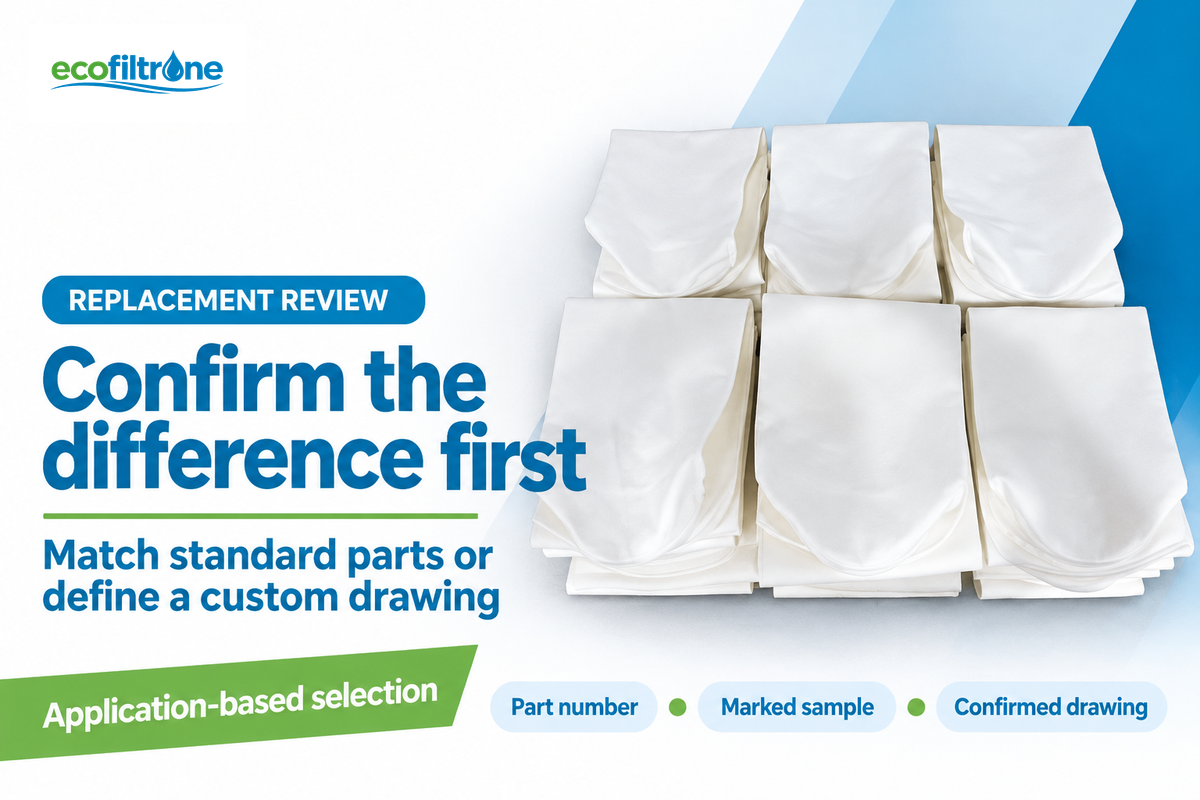
Generally, start with a routine replacement for standard parts, resolve conflicting tape measurements and request custom dimensions only for a confirmed nonstandard body or collar. This supports a case for like-for-like media, retention, and construction when procuring a part for the operating team.
Standard replacement review
- Use the original part number and marked measurements.
- Match the media and retention requirement.
- Compare the collar and supported body construction.
Custom configuration review
- Resolve the confirmed dimensional difference.
- Define the required construction on a drawing.
- Arrange a sample or trial for the intended application.
ECOFILTRONE™ provides industrial liquid filtration consumables with engineering support from Qingdao, China. We carry out application review, filter selection, specification verification and original-equipment replacement matching. For available configurations and size matching support, please see our liquid filter bag size options and matching support.
Send the supplier photographs of the marked sample, the housing identification and details of the operating liquid, along with flow, temperature and retention requirements. Confirm the drawing and tolerance and define the scope of the documentation prior to ordering. Our team can support technical confirmation, inspection coordination and operating-performance follow-up. A cost effective replacement should meet the filtration requirements and suit the planned change-out.
Frequently asked questions
What is micron rating in filter bags?
It describes a particle-retention rating, not the bag’s physical dimensions.
A micron is one millionth of a metre. The number on a filter bag relates to the particle size it’s intended to retain under a stated rating method. Compare nominal and absolute ratings using their efficiency basis and test conditions. Equal micron labels can describe different retention performance across filter media constructions.
Can filter bags be customised?
Yes. Body dimensions and construction can be configured for a specific housing.
Custom bag options may include a different length, diameter, collar or seam construction. Start with a marked drawing and the application requirements, then arrange sample or trial support where appropriate. ECOFILTRONE reviews customized configuration requests against the operating conditions. The agreed specification should define both mechanical fit and the required filtration performance.
Are polypropylene filter bags suitable for chemical applications?
Yes, for compatible chemicals within the selected product’s operating limits.
Polypropylene is one of the material options used in industrial filtration, but suitability changes with chemical identity, concentration and temperature. Include the actual liquid composition in the review, especially for mixed solvents or changing process streams. Bag dimensions don’t determine chemical resistance. The collar, seams and other exposed components also need compatible materials.
What are the different types of bag filters?
For liquids, common types include felt, mesh and specialised multilayer bags.
Felt uses a fibrous depth structure, while monofilament mesh retains particles at woven openings. Other constructions address particular retention or absorption needs. Industrial water treatment and paint or coating processes can require different media even when the housing size is identical.
Why do size 3 bags have different listed lengths?
Suppliers may use the same family label for different finished-bag dimensions.
Size 3 commonly appears in the smaller-diameter family, but catalogues can describe its length with different conventions. Rounded unit labels are one explanation; different body or collar constructions are another. Read the specified measurement endpoints before treating the difference as a tolerance. For a replacement, compare a marked sample with the applicable drawing rather than assuming that the shared number makes every variant interchangeable. The housing seat and support basket must suit the selected construction.
Can a size 2 bag replace a size 1 bag?
Only in equipment designed to support the longer bag and its sealing construction.
Similar nominal diameters don’t make the longer body fit a shorter basket. Bunching extra fabric changes the installation. Use the housing manufacturer’s intended bag format, or review a compatible housing change when additional filtration area is needed for the duty.
Does a larger filter bag always last longer?
No. Media, loading and operating duty also determine the replacement interval.
More area can reduce flow and solids loading per unit area when the total duty stays the same. Higher production flow or a more concentrated feed can consume that advantage. A finer medium may also clog sooner, despite the larger body. Compare bags under equivalent conditions and use the selected product’s change-out criteria. Include bag handling, retained liquid and downtime in the comparison so a lower replacement frequency doesn’t hide a more difficult maintenance task.
Turn your measurements into a replacement review

Share a marked photograph of the bag and collar, the housing identification and your operating conditions. ECOFILTRONE can help find the filter bag configuration for your application, review replacement matching and arrange sample or trial support. Our filtration solutions focus on the required process result and the equipment you operate.
The example geometries compare dimensions and loading under the assumptions given. They’re calculations and not measurements from a customer site.
References & Sources
- NIST: SI Units, Length. Exact inch-to-millimetre definition.
- NASA Science: Cosmic Piece of Pi. Circle circumference and diameter relationship.
- ASTM D1776/D1776M-20(2024): Standard Practice for Conditioning and Testing Textiles. Public scope on specimen conditioning.
- International Filtration News: Criteria to Consider When Choosing Bag Filtration Technology, Part I. By Wim Callaert, identified as an Eaton senior product manager.
- OSHA: Control of Hazardous Energy. Servicing and maintenance energy-control principles.