Get in touch with ECOFILTRONE™ Company



Condensate polishing filtration is the treatment of returned steam condensate utilizing particle filtration, as well as ion exchange where applicable. Particle filters remove suspended contaminants; resin beds remove dissolved ions. Assess both particle and chemistry results and balance them with the operating history.
An increasing differential pressure and a sodium excursion require different investigations. A good starting point is the mechanism doing the work. This can be a particle filter, an ion-exchange bed, or a precoat filter-demineralizer. This manual provides a way to connect mechanisms to observations made in power generation systems and industrial steam circuits.
Key takeaways
- Separate particle capture from dissolved-ion removal before judging performance.
- Match inlet and outlet results to the same process event, allowing for established sample and analyzer delays.
- Keep startup and steady-load records separate, including treatment-chemical changes.
- Compare service-run costs using accepted condensate volume under comparable duty.
What does condensate polishing filtration remove?
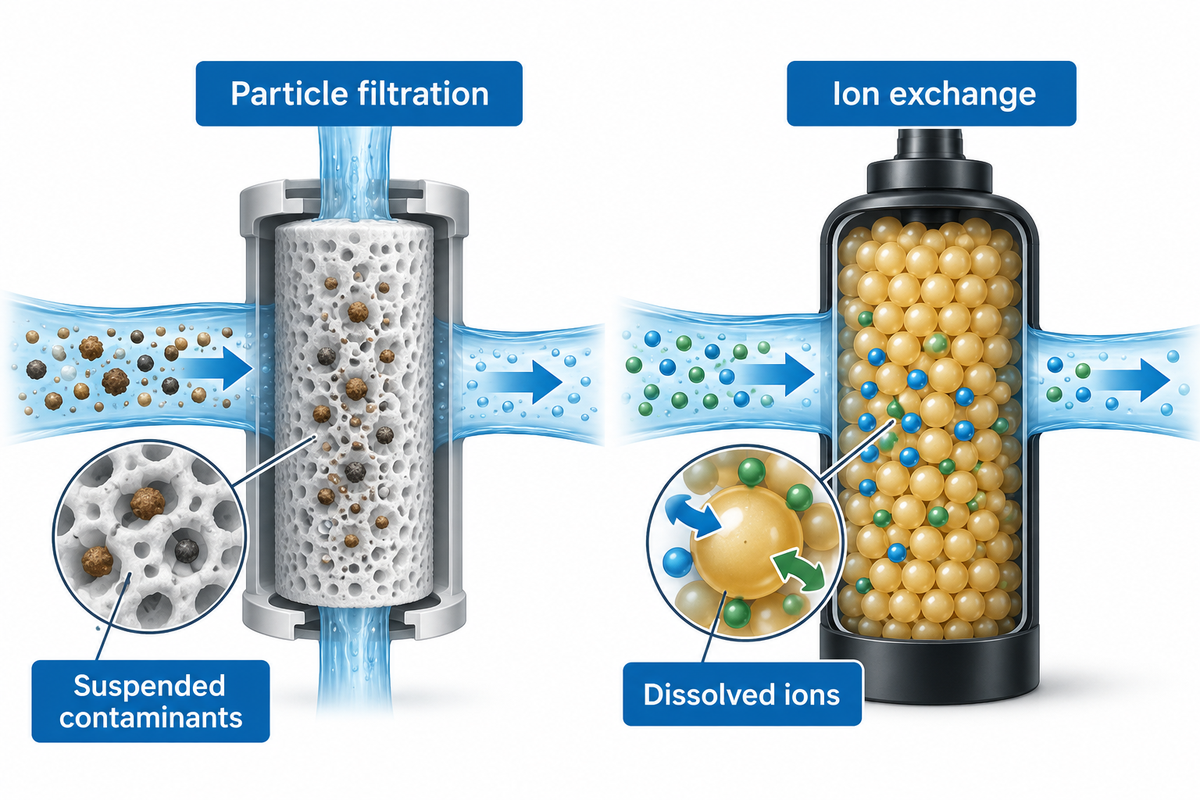
Condensate polishing removes suspended corrosion products through filtration and dissolved impurities through ion exchange, according to the installed equipment. Regular particulate cartridges remove particles; they don’t remove ions. A condensate polishing system may combine these functions, so its performance must be checked against both particle and chemistry requirements.
In its technical handbook, Veolia distinguishes particulate removal from soluble-contaminant exchange. That separation helps explain why clear-looking water can still contain an ionic contaminant, and why acceptable conductivity can coexist with transported corrosion particles. “Final polishing” describes the treatment position, but doesn’t describe how the separation is accomplished.
Is condensate water pure water?
Steam condensate can have low dissolved solids, but it can pick up impurities as it passes through the return circuit. Corrosion products, condenser leakage or contaminated process returns can change condensate quality. Judge returned water against the plant’s chemistry program and measurements, and not against its appearance or the fact that it originally was in the steam.
Here, condensate means water condensed from steam and returned through the condensate system in a steam-water cycle. Different treatment questions are involved with hydrocarbon condensate, compressed-air condensate and air-conditioning drain water.
How contaminants reach the boiler and turbine
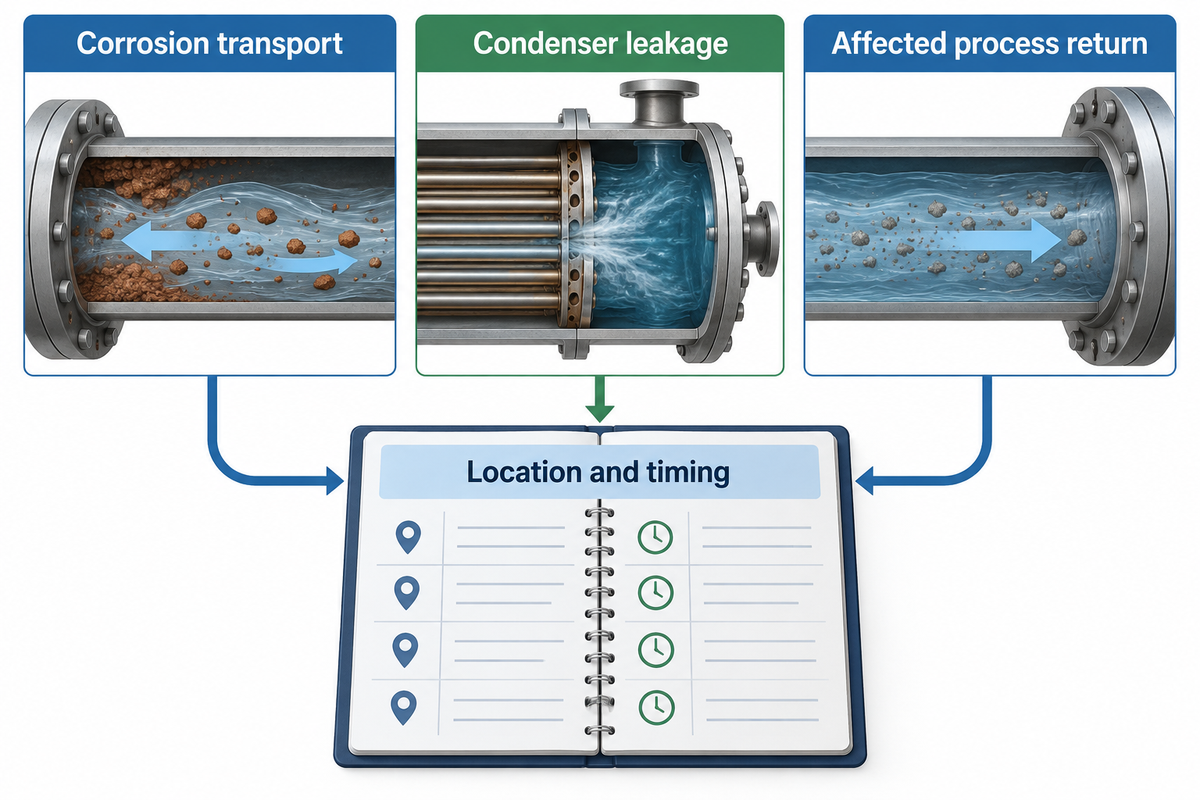
Contamination reaches the treatment train via internal corrosion transport, condenser leakage or an affected return-condensate source. Each route alters what the investigation needs to establish. Particle loading points to solids transport and retention; an ionic excursion requires a look at chemistry and ingress. A filter symptom becomes useful when connected to the location and timing of the contamination.
Corrosion products are transported with the circulating water. Their transport matters to boiler feed, boiler water cleanliness and downstream steam-generating equipment. IAPWS discusses the relationship between corrosion-product transport, operating conditions and deposits in its heat-recovery steam-generator guidance. Combined cycle power plants therefore need startup context as well as normal-load observations.
A condenser leak introduces a different question: which constituents of cooling water could have entered the steam cycle? A process return problem requires identification of the affected industrial processes. Raw water quality, the makeup-water treatment system and history of returned condensate are inter-related input streams, but aren’t interchangeable samples.
Returning suitable condensate retains useful heat and reduces replacement-water consumption, as described in the U.S. Department of Energy’s condensate-return tip sheet. That value is lost if the condensate returned isn’t suitable for the receiving system. It doesn’t justify returning an off-spec stream.
Cartridge filters, deep beds and precoat polishing systems
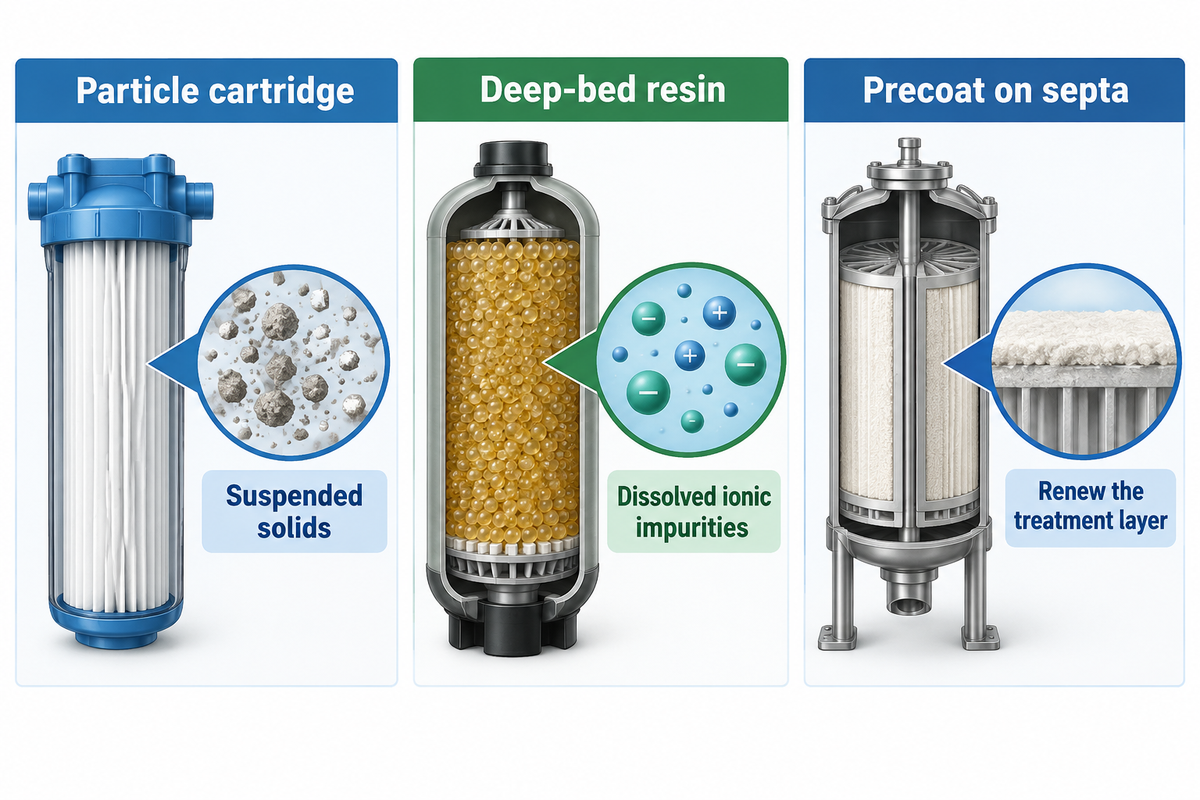
Disposable cartridges retain particles. Deep bed ion exchange removes dissolved ions. Precoat filter-demineralizers apply a deposited treatment layer on supporting septa. These architectures differ in service and regeneration arrangements. Know the installed architecture before assessing run length, replacement parts or a pressure trend; similar looking components can differ in function.
What types of filtration are used in condensate polishing?
Condensate filtration systems can use disposable particle cartridges, reusable supporting septa with a precoat, or particle removal alongside deep bed systems. Ion exchange resin provides an opportunity for chemical separation.
| Arrangement | Main function | Service implication |
|---|---|---|
| Particulate cartridge filtration | Captures suspended solids in or on the filter medium | Track particle retention and pressure trend; cartridge replacement does not restore ion-exchange capacity |
| Deep-bed resin polishing | Cation and anion exchange remove dissolved ionic impurities; the bed can also retain particles | Review ionic leakage, resin condition and the installed resin regeneration arrangement |
| Precoat filter-demineralization | A deposited layer, including powdered ion exchange resins where specified, performs treatment on septa | Distinguish precoat removal and renewal from replacement or inspection of the supporting septum |
Ovivo describes prefilters and mixed-bed plant arrangements; Graver Technologies describes bead resins, powdered products and septa. These are their own commercial technology descriptions. Mixed bed ion exchange and a precoat arrangement shouldn’t be treated as the same assembly.
A micron number alone doesn’t provide sufficient information, specifically the test basis and retention claim. Read how filter micron ratings are interpreted before comparing elements. The nominal-versus-absolute distinction still needs the supplier’s actual performance documentation.
Read particle and chemistry signals together
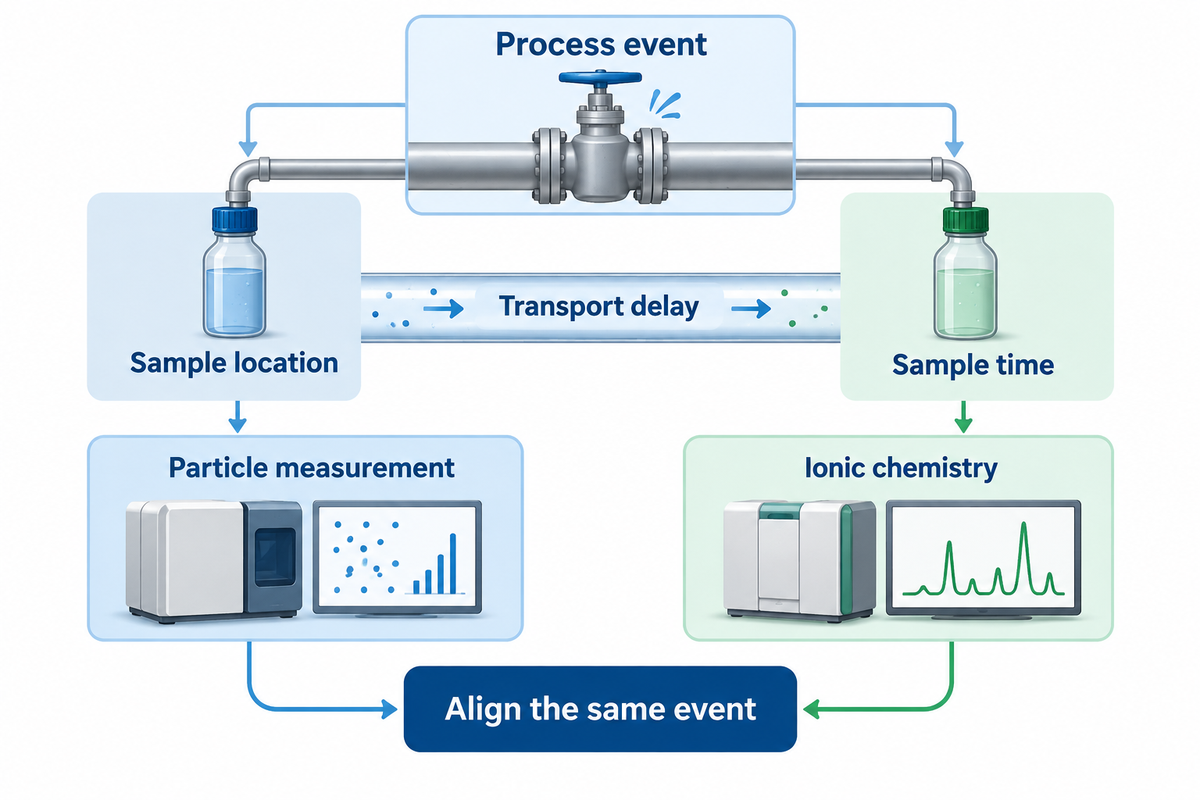
Pressure, particle, and ionic measurements must be read together with each result associated with a known sample point and process event. IAPWS identifies condensate-polisher outlet monitoring separately from general feedwater monitoring. For a parallel arrangement, keep the individual outlet identities before interpreting a combined header.
The 2024 IAPWS instrumentation guidance, particularly section 4.3.1, discusses conductivity after cation exchange and sodium monitoring at polisher outlets in the applicable plant context. Sodium helps assess cation-side leakage; conductivity after cation exchange is sensitive to anionic contamination. Neither reading measures particulate iron.
ASTM D6504’s public scope explains the anionic-contamination basis of cation conductivity, including sensitivity to chloride contamination. The measurement does not determine a particular contaminant by itself, and the measurement does not separately determine dissolved carbon dioxide. Silica and other chemistry measurements are appropriate for the record, if required by the plant’s steam cycle chemistry program.
Event-Aligned Condensate Record
Use this record to bring operations, chemistry, and quality-assurance observations into alignment. Transport of samples and analyzer response can place the result displayed on the record after the occurrence of the event being measured. ASTM D5540’s public significance section addresses sample conditioning, transport delay and the different requirements of particulate collection. Use the site’s established delay treatment rather than assuming that simultaneous clock readings represent the same water.
| Record category | What to retain | Decision it supports |
|---|---|---|
| Process event | Startup stage, stable load, return-source change or chemistry change; event time | Separates changes in duty from changes in media performance |
| Equipment identity | Operating bed or filter, parallel-stream identity and current media | Identifies which treatment stream changed |
| Sample location | Inlet, individual outlet or mixed header; sampling method | Defines what each result represents before comparing streams |
| Event alignment | Sample time, established transport delay and analyzer response | Establishes whether paired readings refer to the same event |
| Hydraulic condition | Flow, temperature and differential pressure at the recorded duty | Supports a like-for-like pressure comparison |
| Particle measurement | Particle-count or turbidity method, units and any established metal correlation | Separates an observed proxy from an iron-analysis result |
| Metal analysis | Method and units; total or dissolved iron; copper where metallurgy requires it | Keeps the measured metal fraction and metallurgy visible |
| Ionic chemistry | Sodium, cation conductivity and other measurements required by the plant program | Tracks ionic leakage separately from particle retention |
| Acceptance and disposition | Existing acceptance basis, service interval and recorded water disposition | Distinguishes accepted volume from off-spec service |
Total iron and dissolved iron answer different questions. In their 2021 article, Brad Buecker, Ken Kuruc and Frank Murphy write: A common mistake made by some plant personnel is only testing for soluble iron in condensate and feedwater streams.
These authors are from the plant and the water industry, and the comment isn’t a result of an ECOFILTRONE test. Their iron-monitoring discussion explains why particle transport and sampling windows matter.
Iron alone also leaves a gap in metallurgy. The official IAPWS corrosion-sampling description addresses iron and copper. Include copper measurements if copper-containing materials are in the circuit. Retain the sampling basis and method for each metal.
Why startup needs a separate operating record
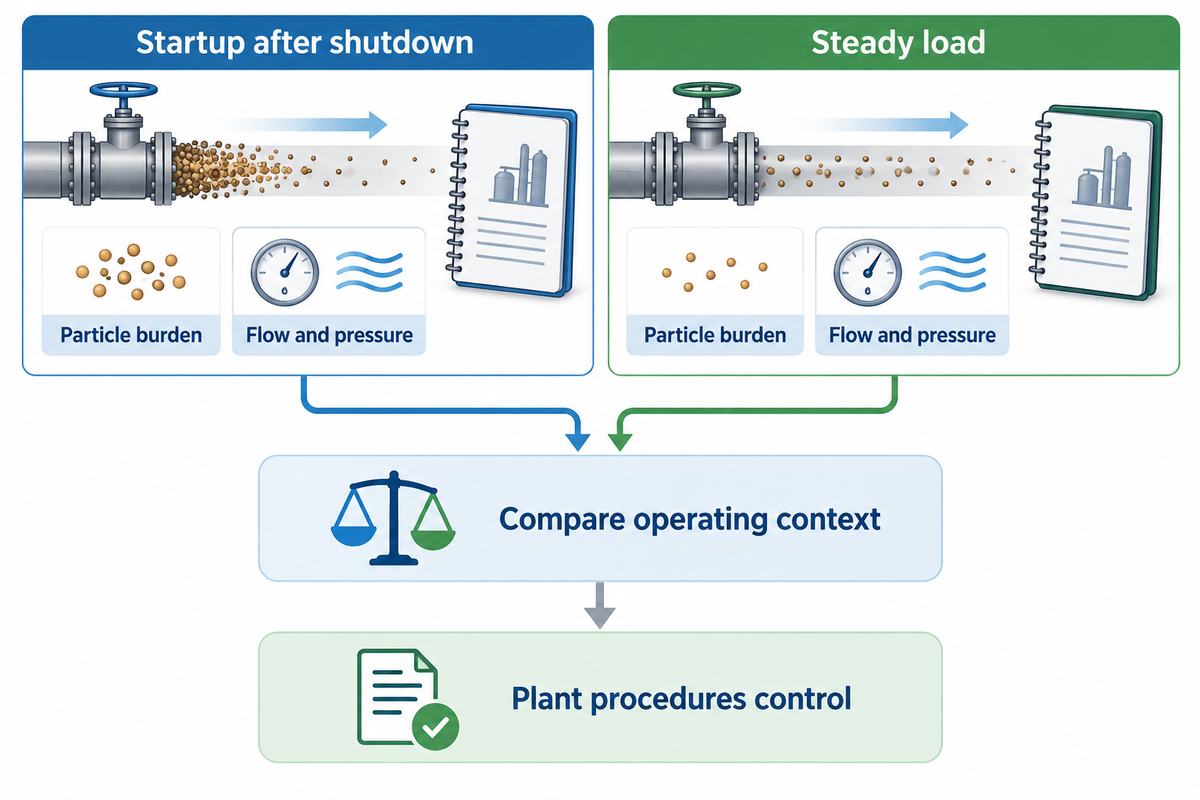
Startup can transport corrosion products differently from a steady-load operation, making calendar days a poor basis for comparing service runs. Keep the startup interval, flow history, and measured particle burden visible. A run that captures a transient solids load can reach its service endpoint sooner than a stable-load run without demonstrating worse retention performance.
The Nordic IAPWS collaborative-project description explains how steady-state sampling can underestimate transient transport. It describes particle-count or turbidity proxies correlated to membrane-collected iron under defined sampling conditions. A proxy requires an established relationship to the measured fraction of iron; it is not automatically a total-iron or dissolved-iron measurement.
Illustrative startup situation: Two service records show different run lengths: one begins after a shutdown and includes a particle excursion, and the other begins at stable load. Place event-aligned inlet and outlet results, along with flow and differential pressure, to understand the reason for difference, prior to concluding it’s due to filter quality. Keep the plant’s existing startup acceptance and operating procedures in control.
A manufacturer-reported case from Graver describes a 750 MW air-cooled condensate application where ionic quality was satisfactory, but control of iron was inadequate. The Graver bulletin is of assistance for making this distinction. Its reported element results and cleaning reduction are specific supplier case claims, not independent validation or ECOFILTRONE performance.
Separation of operating modes is useful in fossil power and combined cycle plants. Colleen M. Layman and Lisa L. Bennett’s 2008 POWER article presents several plant-specific arrangements. Historical examples should be described in the context of the plant in which they occurred.
Diagnose pressure rise, breakthrough and resin carryover
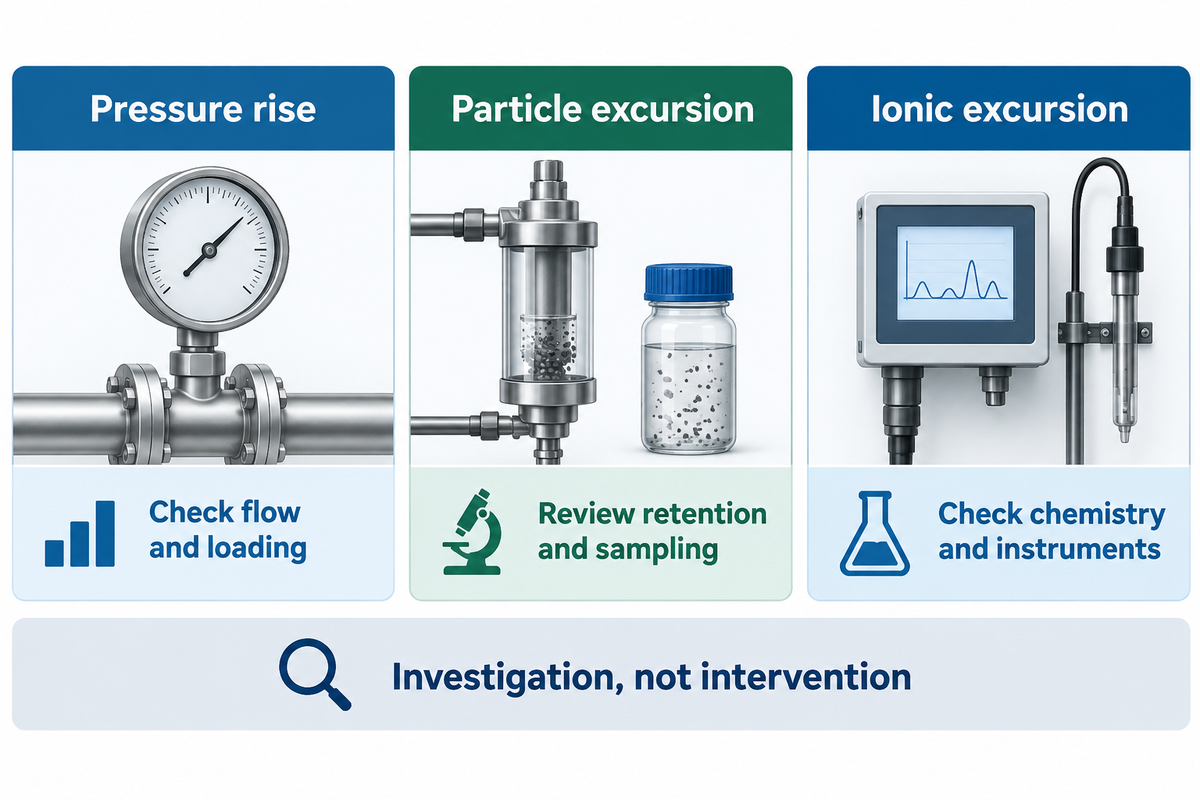
A pressure or quality excursion should help narrow competing causes, after which an appropriate observation should be sought. Rising differential pressure can accompany captured solids, while ionic breakthrough can occur without a matching pressure rise. There are several possible causes for the observed result other than the specified ones, including instrument problems or resin condition and distribution. The next evidence should be able to distinguish the different causal factors before an equipment fault is attributed.
Signal-to-Mechanism Fault Table
| Observed pattern | Possible explanation | Next evidence and owner |
|---|---|---|
| Pressure rises; outlet particles stay controlled | Solids loading or a change in hydraulic duty | Operations compares flow, temperature, inlet burden and pressure trend at comparable duty |
| Outlet particle result rises with little pressure change | Retention, bypass/sealing, distribution or sampling problem | Quality and engineering compare event-aligned inlet/outlet methods and approved inspection records |
| Sodium or cation conductivity changes; particle result stays stable | Ionic ingress, exchange-performance change or measurement problem | Chemistry checks instrument status, individual outlets and the relevant ingress history |
| Resin-like particles appear downstream | Resin fines, retention-component or precoat-related problem | The equipment/resin specialist reviews particle identity and installed retention architecture |
| Run shortens after a treatment-chemical change | Changed loading or chemical/resin compatibility | Chemistry and the resin supplier review the exact formulation, resin and change history |
The table combines published mechanisms and potential causes with editorial suggestions. Veolia’s handbook provides a number of possible causes for poor effluent and short runs; a symptom of poor effluent quality may not necessarily be caused by a failed component.
Chemical compatibility should also be considered. In a 2018 study, Cao Jie and colleagues tested specific polishing resins with dodecylamine and an ethanolamine/dodecylamine combination. Resin-dependent fouling of the tested resins was reported under those experimental conditions. That supports reviewing treatment changes, rather than treating every amine or every resin as having the same compatibility.
A sodium excursion with stable particles may point to a chemical issue, and stable chemistry with an excursion in outlet particles may indicate an issue with sampling and/or flow path. Both examples describe an investigation, not permission to open hot equipment, change valves or regenerate resin.
Backwashing, resin regeneration, and precoat renewal are various operations controlled by the attached equipment and approved procedures. Substituting a general cleaning instruction for that distinction may leave the actual fault uncorrected.
Compare service-run cost using accepted condensate volume
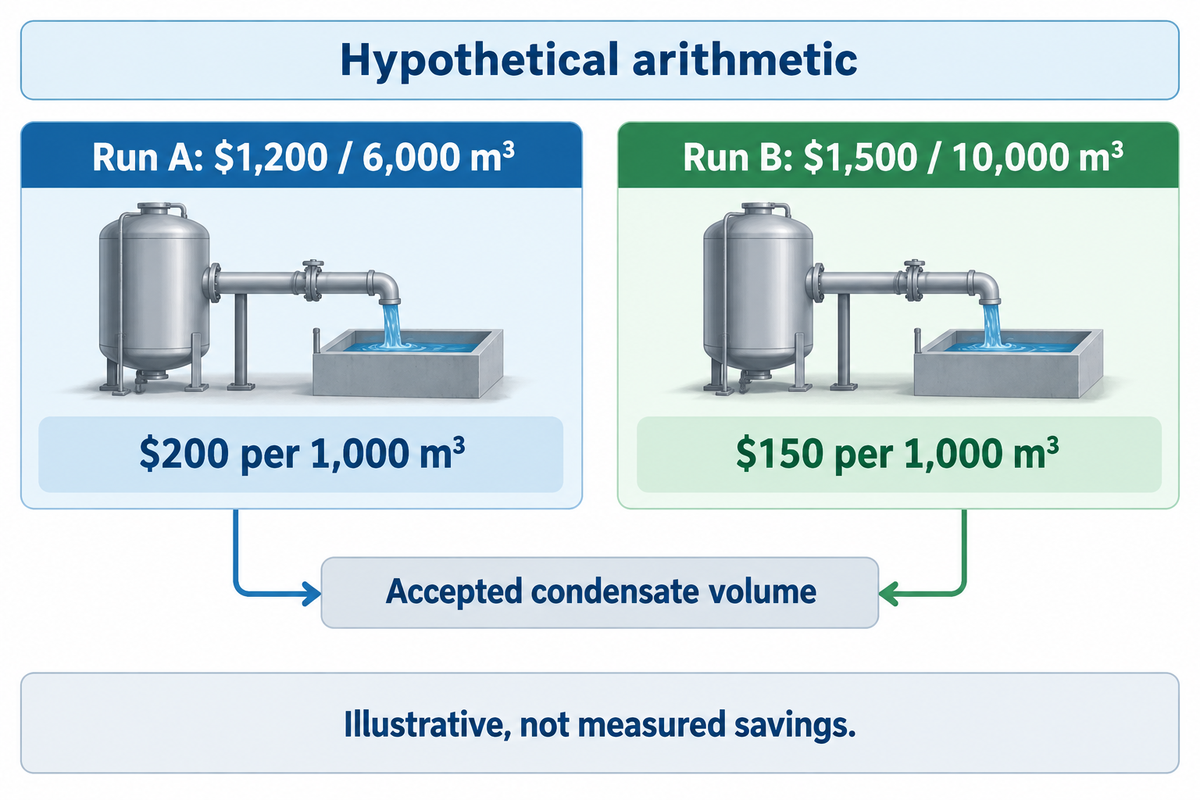
Compare the service-run cost per accepted condensate volume where duty, acceptance criteria, and accounting limits are equivalent. Purchase price alone leaves out the work and resources used during service. The denominator should count water meeting the same plant acceptance basis, with off-spec intervals treated consistently; equal gross throughput does not establish equal useful service.
The EPA’s drinking-water cost methodology separates flow, water quality and cost components. Energy and operation and maintenance changes are embedded in DOE’s water-management planning. These are general accounting principles, not condensate polishing price benchmarks.
Condensate Service-Run Cost Comparison
Cost per 1,000 m³ accepted = recorded run cost ÷ accepted condensate volume in m³ × 1,000
Hypothetical arithmetic: Run A costs $1,200 and provides 6,000 m³ of accepted condensate: $200 per 1,000 m³. Run B costs $1,500 and provides 10,000 m³: $150 per 1,000 m³. All figures are illustrative, not supplier quotations or measured savings.
Finance and operations should agree which costs are included: consumables, recorded labor, applicable utilities and waste handling, using the same boundary for both runs. Avoid counting one loss (cost) twice. If startup burden or inlet quality differs, explain that difference before ranking the runs.
The acceptance record is the hidden bottleneck. Misaligned samples or an undefined off-spec interval make accepted volume uncertain, which can reverse an apparent price advantage. This service-run comparison is a screening calculation. Full lifecycle analysis also requires capital, replacement timing and other project-specific inputs.
Who supplies condensate polishing systems, resins and filters?
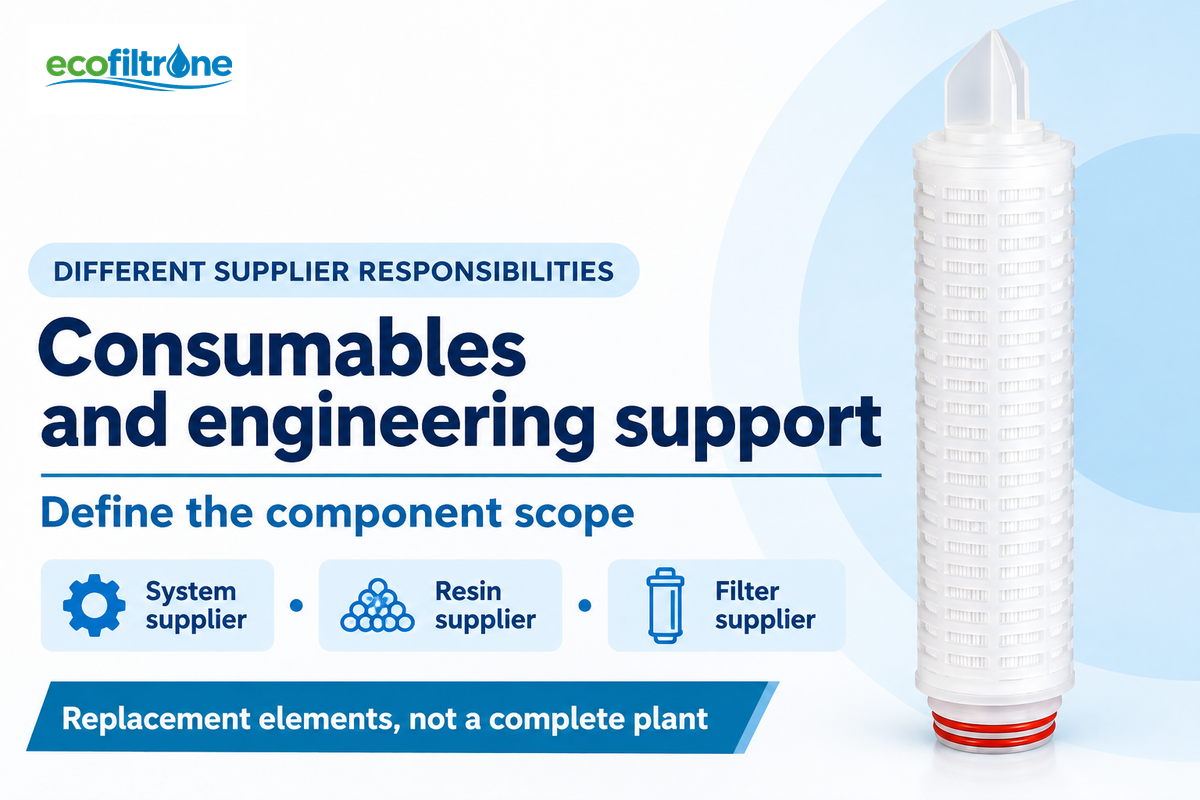
Complete-system suppliers, resin suppliers and filtration-consumables suppliers address different areas of condensate treatment. Match the supplier’s responsibility to the identified need: polishing equipment and integration, exchange media and chemistry, or replacement filtration elements. A consumables quote shouldn’t be misinterpreted as responsibility for the entire water treatment equipment.
Ovivo’s referenced page is for complete condensate polishing facilities. Graver Technologies’s page is for its resin and septa product families. The treatment solutions and technology mentioned in the page belong to these suppliers.
ECOFILTRONE™, based in Qingdao, is a supplier of filtration-consumables with engineering support for industrial water treatment and process filtration. Its condensate-related role centers on reviewing operating requirements and replacement consumables. For application review, specification verification and replacement matching, see condensate particulate-filtration support. The most useful handover is a record of recent operations, the installed component specification, and the problem to resolve.
Turn the operating record into the next decision
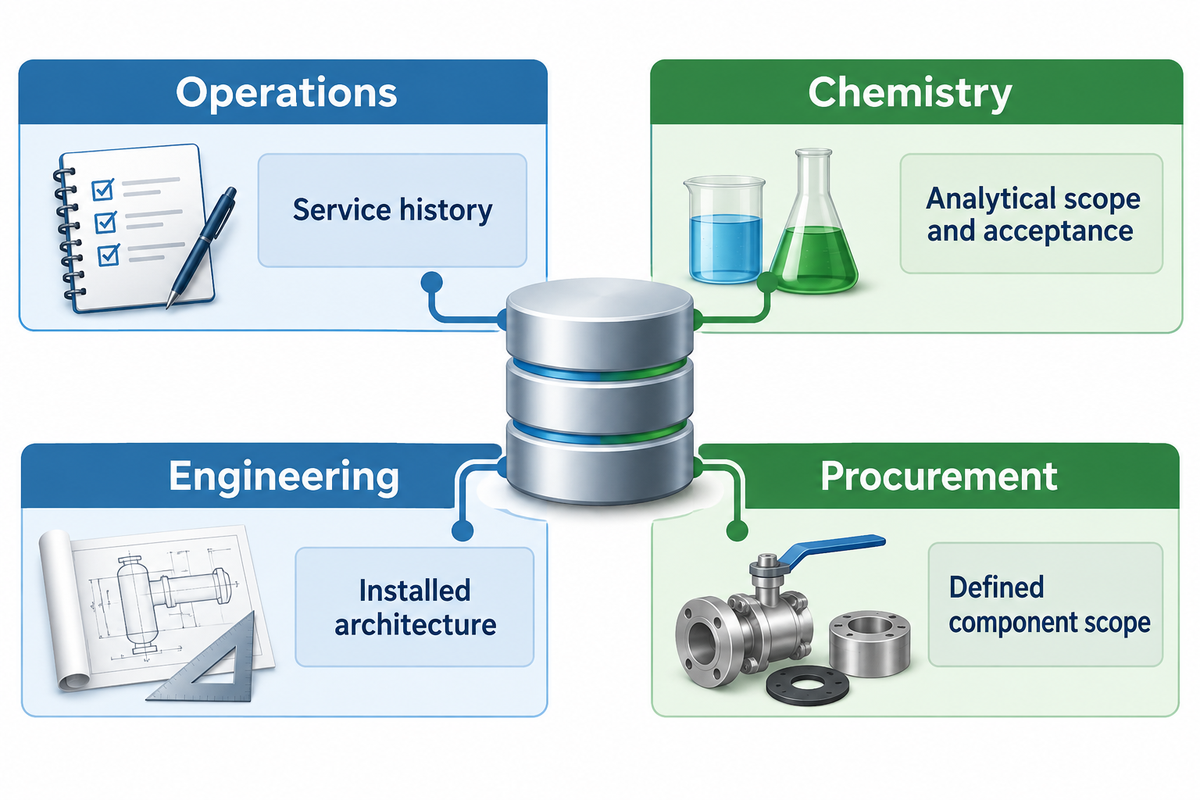
Agree the basis of measurement, event and responsible equipment before changing the filtration arrangement. Operations supplies the service history; chemistry confirms analytical scope and acceptance; engineering identifies the installed architecture; procurement compares a clearly defined component scope. A trial becomes informative when those teams use the same starting conditions and a documented endpoint.
For high-purity condensate and high-pressure steam systems, keep the existing plant water chemistry program and approved equipment procedures in control. Ask the responsible specialists to resolve unknown metallurgy, sampling delay, chemical compatibility or acceptance criteria before treating the record as a comparison.
Need a review of a replacement filtration element? Discuss your condensate operating conditions with ECOFILTRONE™. The review will be based on the current element identification, flow and temperature history, pressure trend, and quality results.
Frequently Asked Questions
What is the purpose of a condensate polishing unit?
A condensate polishing unit helps control contaminants in returned steam condensate before the water continues through the steam-water cycle. Its particle-removal and dissolved-ion-removal functions depend on the installed architecture. The practical purpose is to maintain the required condensate quality while reducing the transport of unwanted material into downstream equipment. Performance therefore needs both relevant chemistry results and particle observations.
How does ion exchange resin help in condensate polishing?
Ion exchange resin provides ionic purification by exchanging ions with the water. Cation and anion resins perform different exchange functions and can be used together in mixed-bed polishing. The resin’s operating capacity, condition and compatibility with the treatment chemistry affect service. Ordinary particle cartridges perform a different separation task, so replacing a cartridge doesn’t restore an exhausted resin bed.
How often should condensate polishing filters or resins be replaced or regenerated?
Replace particle filters at their approved retention, pressure or condition endpoints; regenerate or replace resin according to its approved chemistry and capacity criteria. Resin service also depends on fouling and the installed regeneration arrangements. Startup burden and treatment changes can alter the interval. Compare similar duty before interpreting a shorter run as poor media performance, and keep cartridge replacement separate from resin regeneration.
Which industries benefit from condensate polishing?
Power stations and industrial facilities returning steam condensate can benefit where their water-quality requirements call for polishing. Relevant industrial applications include process plants with steam systems; the treatment need depends on return contamination and receiving-equipment requirements.
What makes condensate filters and polishers economical?
Useful service comes from meeting the required water purity with an appropriate treatment mechanism and a manageable service burden. Compare consumables, recorded labor, applicable utilities and waste handling over accepted output under similar conditions. Retaining suitable condensate also preserves heat and reduces replacement-water demand. A cheaper element can produce a higher run cost if accepted output is lower, but that relationship must be demonstrated by the operating record. The hypothetical example above shows the arithmetic only. A capital project needs a wider lifecycle assessment, and an apparent saving shouldn’t override the plant’s chemistry acceptance or equipment procedures. Finance, operations and chemistry need the same cost boundary and acceptance basis.
What does CPU stand for in thermal power plants?
In this water-treatment context, CPU means condensate polishing unit. The abbreviation identifies the unit’s purpose; the equipment drawing and media description establish whether it uses cartridges, resin beds or a precoat arrangement.
Related Reading
- Pleated filter cartridges: construction and service considerations
- High-temperature pleated filter service considerations
- High-flow filter replacement cross-reference guide
- Glass-fiber high-flow filter cartridge guide
References & Sources
- IAPWS, Instrumentation for Monitoring and Control of Cycle Chemistry, TGD2-09(2024), and condensate-polisher outlet monitoring.
- IAPWS, HRSG High Pressure Evaporator Sampling for Internal Deposit Identification and Determining the Need to Chemical Clean, TGD7-16, used for transport and operating-context discussion.
- IAPWS Corrosion Product Sampling and Analysis for Fossil and Combined Cycle Plants, TGD6-13(2014) (SCOPE OF THE COPPER/IRON SECTION)
- ASTM D5540-13(2021), Flow Control and Temperature Control for On-Line Water Sampling and Analysis, Public Scope and Significance.
- ASTM D6504-11(2024), On-Line Determination of Cation Conductivity in High Purity Water, Public Scope and Significance.
- Nordic IAPWS, Round Robin and Collaborative Project for Corrosion Products (TRANSITORY MONITORING AND CONDITIONAL PROXY INTERPRETATION)
- Brad Buecker, Ken Kuruc and Frank Murphy, Iron Monitoring in Industrial Steam Generating Systems, Water Technology (2021)
- Colleen M. Layman and Lisa L. Bennett, Condensate Polishers Add Operating Reliability and Flexibility, POWER 2008.
- Cao Jie et al., Compatibility of Condensate Polishing Resin with Dodecylamine in Nuclear Power Plant, Atomic Energy Science and Technology 52(9), 2018, 1569–1575; public abstract.
- U.S. EPA, Drinking Water Treatment Technology Unit Cost Models (GENERAL COST-MODEL BOUNDARIES)
- U.S. DOE, Best Management Practice #1: Water Management Planning (OPERATING COST INPUTS)
- U.S. DOE, Return Condensate to the Boiler, Steam Tip Sheet 8, Condensate recovery context.
Commercial Supplier Inputs used for their own mechanisms and external case (Handbook of Veolia’s Ion-exchange Resins, Ovivo’s description of condensate-polishing, Graver Technologies’s condensate-polishing products, Graver’s Air-Cooled condenser Filter Bulletin): Veolia ion-exchange handbook; Ovivo condensate-polishing description; Graver Technologies condensate-polishing products; Graver air-cooled-condenser filter bulletin.