Get in touch with ECOFILTRONE™ Company




Updated October 2026 · By DD
Pall Ultipleat High Flow Replacement Cartridges are alternative elements matched to a specific HFU cartridge and housing. Analyze the full code, retention test and operating limits. Evaluate pressure and outlet quality separately, then compare cost per accepted volume.
Start with the symptom or decision.
Read the original grade and seal code and review candidates before a final selection is made. Analyze pressure at stated flow and temperature. Treat outlet quality as a separate result. Calculate cost against water or process liquid that meets the accepted limits.
ECOFILTRONE™ supplies industrial filtration products and offers application review, replacement matching and technical assistance. The Pall specifications discussed herein are applicable to Pall products. A replacement filter has its own construction, operating limits and application requirements. Pall and Ultipleat are trademarks of Pall Corporation.
Quick specifications: original Pall rating examples, October 2021
2 µm at 99%UY020, footnote 6
4.5 µmUY045 table rating
90 µmUY1000, footnote 7
Identify the Ultipleat High Flow Family
The Pall Ultipleat High Flow series is a large diameter, coreless, single-open-ended cartridge family with an inside-to-outside flow pattern. Pall’s October 2021 literature provides information on crescent-shaped pleat geometry and other media options. Family identity is important because high flow filter housings and replacement interfaces are designed to particular cartridge arrangements as compared to a universal high-flow connection.
In the original Pall Ultipleat® High Flow range, polypropylene, glass fiber and other media grades have different descriptions and operating boundaries. The terms pleated cartridge and high-flow pleated describe construction, neither defines a complete HFU series part number. A filter element from another large flow family can have a different sealing interface, despite similarity in design.
The original Ultipleat® High Flow filter uses its pleat geometry to put in more filtration area within the cartridge envelope. Effective area distributes loading, but media structure and retention also affect performance. For high flow rate applications, the advantage of a larger element must be evaluated at the required quality and operating conditions.
A high flow filter cartridge used as a water filter element in RO pretreatment performs a different duty from a conventional membrane separation stage. The pleated filter captures suspended particles; the downstream RO process addresses dissolved constituents. Keep the functional distinction when analyzing a Pall high flow installation.
For comparison with other cartridge families, our industrial high-flow cartridge range separates the major product streams. Keep the family choice separate when analyzing the operating conditions for a Pall filter cartridge.
A worn label that still shows HFU660UY045J provides more useful identity information than “60-inch PP filter.” Its length code, UY045 grade and J seal can be compared individually with the original ordering table. Photograph the remaining label; the missing suffix is hard to identify once the element has left the site.
Family takeaway: Pall lists the nominal size of the original 660 at 60” long and 6” in diameter. Those dimensions identify a size class. Seal geometry, seating position and the exact mating housing still control the mode of installation, therefore the full code should be used to describe the product rather than substituting dimensions.
Read HFU Codes and Original Rating Exceptions
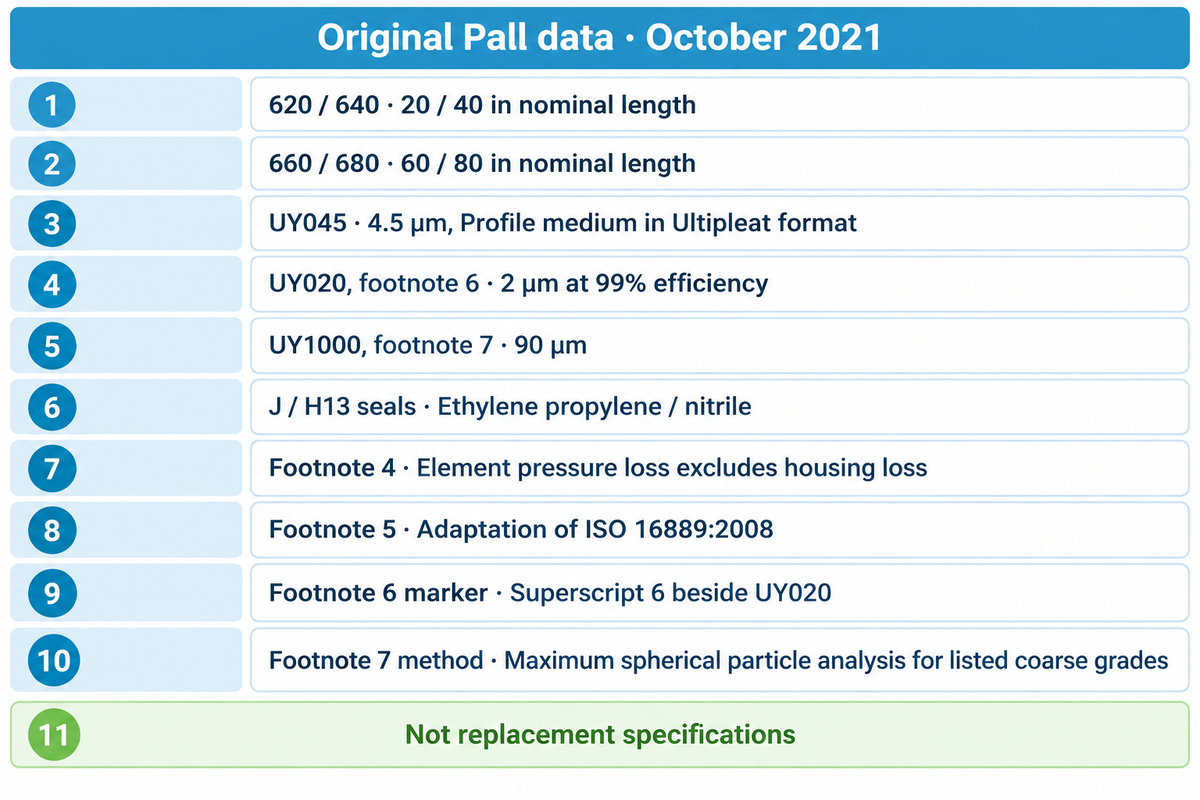
Interpret an HFU code as a combination of size, medium grade and seal selection. The removal rating depends on the micron size as well as the efficiency and test basis. Pall’s original table includes footnote exceptions, therefore, interpreting the general table heading for each row can change the interpretation of a filtration specification.
HFU Footnote Index
HFU Footnote Index links the original part-code details to the rating and operating notes that modify their interpretation.
| Original identifier | Pall October 2021 description | Practical reading |
|---|---|---|
| 620 / 640 | 20 / 40 in nominal length | Retain the size code with the full part number. |
| 660 / 680 | 60 / 80 in nominal length | Length alone leaves the seal and medium unspecified. |
| UY045 | 4.5 µm, Profile medium in Ultipleat format | Keep the stated 4.5 µm grade when comparing test results. |
| UY020, footnote 6 | 2 µm at 99% efficiency | An explicit exception to the general 99.98% heading. |
| UY1000, footnote 7 | 90 µm | Read the coarse-grade evaluation note with this row. |
| J / H13 seals | Ethylene propylene / nitrile | The letters specify different elastomer selections. |
| Footnote 4 | Element pressure loss excludes housing loss | Housing gauge readings include a different measurement boundary. |
| Footnote 5 | Adaptation of ISO 16889:2008 | Preserve the stated procedure and edition. |
| Footnote 6 marker | Superscript 6 beside UY020 | The footnote marker is separate from the grade code. |
| Footnote 7 method | Maximum spherical particle analysis for listed coarse grades | A headline efficiency label needs this qualification. |
Source: Pall PIUHFENg, October 2021, ordering table and footnotes, pages 2–3. The entries describe the original cartridges, rather than replacement specifications.
According to the Walkerton Clean Water Centre, there’s considerable variation in the interpretation of nominal and absolute ratings among manufacturers and test conditions. A comparison therefore needs particle size, filtration efficiency, challenge material and operating conditions. “Absolute” should be read in relation to the numerical efficiency and test method rather than taking it to mean 100% removal. See its filter-rating explanation.
Rating takeaway: Pall’s UY020 row states 2 µm at 99%, while UY045 lists 4.5 µm under the general heading. A proposed 2 µm replacement needs its own efficiency and test conditions. A smaller printed micron number can describe a different challenge result, rather than a directly comparable improvement.
Separate Housing Fit from Filtration Performance
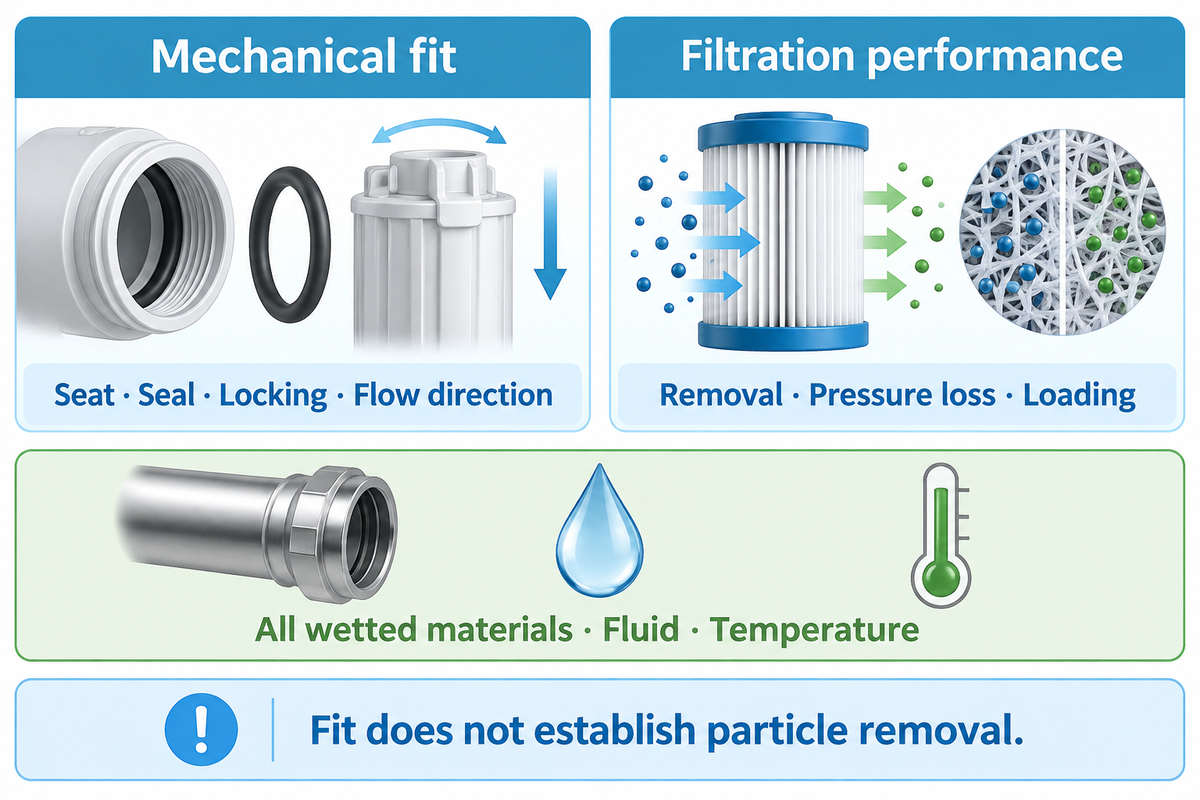
Evaluate mechanical fit and liquid filtration performance separately. Mechanical fit covers the seating interface, seal dimensions and compression, locking arrangement and flow direction. Performance covers removal at the right particle size, pressure loss and loading behavior. Fluid compatibility includes all wetted materials, including the seal and end-cap assembly.
NSF’s consumer guidance on replacement cartridges illustrates how slight dimensional differences can allow water to bypass a cartridge that appears to fit. The household water example illustrates the bypass mechanism; different requirements exist for industrial applications and their respective housing and material requirements. An EPDM seal description would require the relevant fluid and temperature conditions.
Internal leakage around a seal can bypass otherwise suitable media. A compatible assembly therefore needs an appropriate material and contact geometry. Filter replacement planning should treat these two elements separately.
Example:A maintenance buyer receives a candidate labeled “HFU660, 5 micron, EPDM.” The existing order is HFU660UY045J. The original code specifies a polypropylene filter of that nominal length, but the candidate’s medium, grade and seal interface still need to be assessed. Procurement can hold the candidate on the shortlist while Engineering compares the mating dimensions and the rating method. Quality staff define the outlet requirement before a trial begins. If the candidate seats properly but the particle counts are still unacceptable, the fit result is still useful, and the next examination is to determine the cause by looking at retention, bypass or sample contamination. A short trial can establish performance for that tested duty; a second liquid or a hotter operating point needs its own application review.
You can find more media comparisons in the PP high-flow controlled-trial guide. Neither a vertical installation, nor a compact housing, removes the requirement to match the sealing arrangement.
Fit takeaway: A nominal 60 in element in the original 6 in family still needs the right seat and seal interface. Procurement can hold on to the size elements for identification, and engineering can resolve material contact and tolerances. The final fit decision, however, is independent of the required particle-removal result.
Interpret Flow and Differential Pressure
Differential pressure is the difference between the absolute pressure upstream of the measurement and the absolute pressure downstream of the measurement. It should be interpreted at the flow rate and fluid temperatures. An increase may be caused by filter loading or changes in hydraulic conditions. A decrease may be helpful in troubleshooting only if the throughput is stable and the quality of the outlet stream is acceptable.
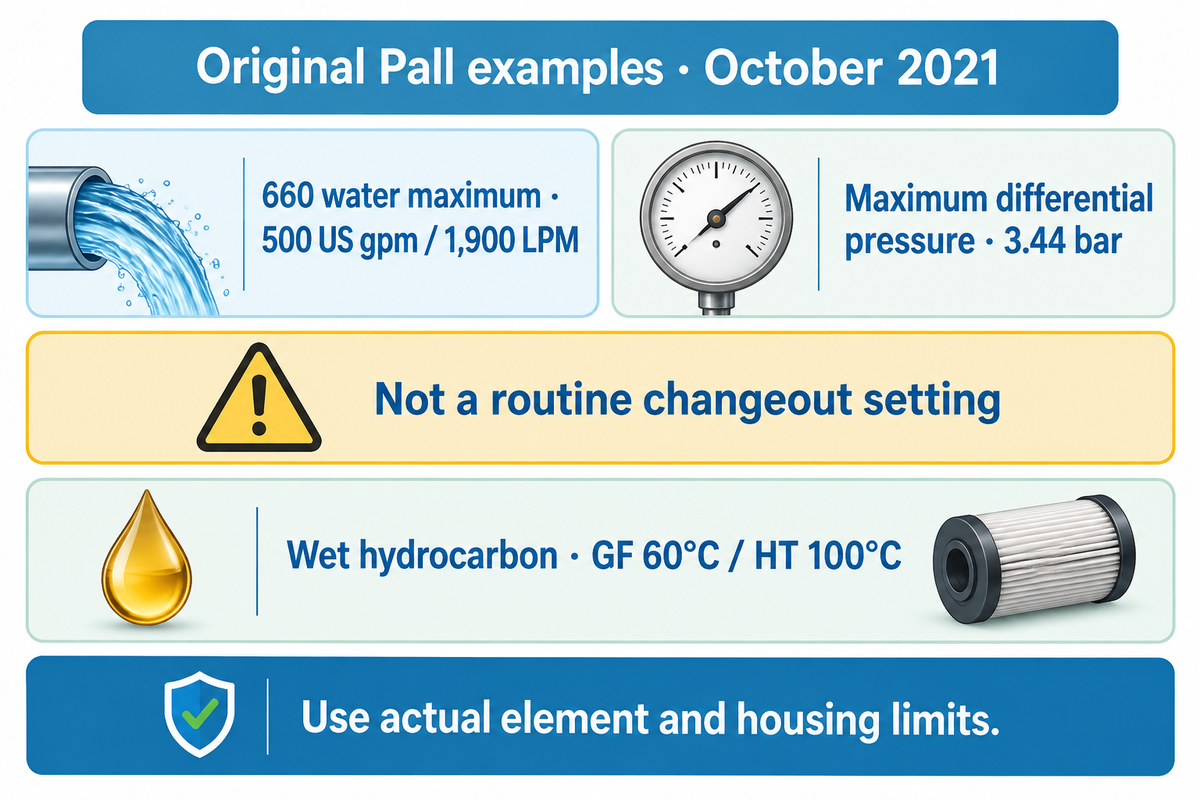
Pall’s original 660 row puts the max water flow at 500 US gpm, or 1,900 LPM. The same literature accounts for element pressure loss and housing contribution. Treat those as original water-service values and use the selected replacement’s curves and complete housing analysis for its proposed duty. High flow rates in a brochure are different from an economical design flow with the required operating margin.
The operating table shows a max differential pressure of 3.44 bar at stated conditions. This is a max boundary and not a routine changeout setting. Its wet-hydrocarbon footnote limits GF medium to 60°C and HT medium to 100°C. Fluid, temperature and medium must be read together. See our hot liquid cartridge guidance for an explanation of the combined operating point.
Example: An industrial water treatment line shows a higher pressure difference on a cold morning, immediately after a new cartridge is installed. The operator also shows a higher pump setting than the last shift. Replacing the filter would remove evidence without separating those changes. The process engineer, first, takes readings at the established reference flow, and notes the liquid temperature. Maintenance then checks the gauge pair and approved valve positions. An excess loss at similar conditions, then, requires an investigation under the site’s isolation procedure. That investigation can differentiate increased feed contamination from a flow-distribution or installation problem. Outlet sampling is continued during the check; reducing resistance alone isn’t the objective of the operation.
Pressure takeaway: A 500 US gpm original water-flow figure and a 3.44 bar original maximum differential pressure answer different questions. Neither answer is a replacement Trial Setpoint. Choose the operating flow and changeout criteria from the actual element/housing limits, required quality and approved site procedure before the line returns to service.
Diagnose Early Clogging, Low Flow and Particle Breakthrough
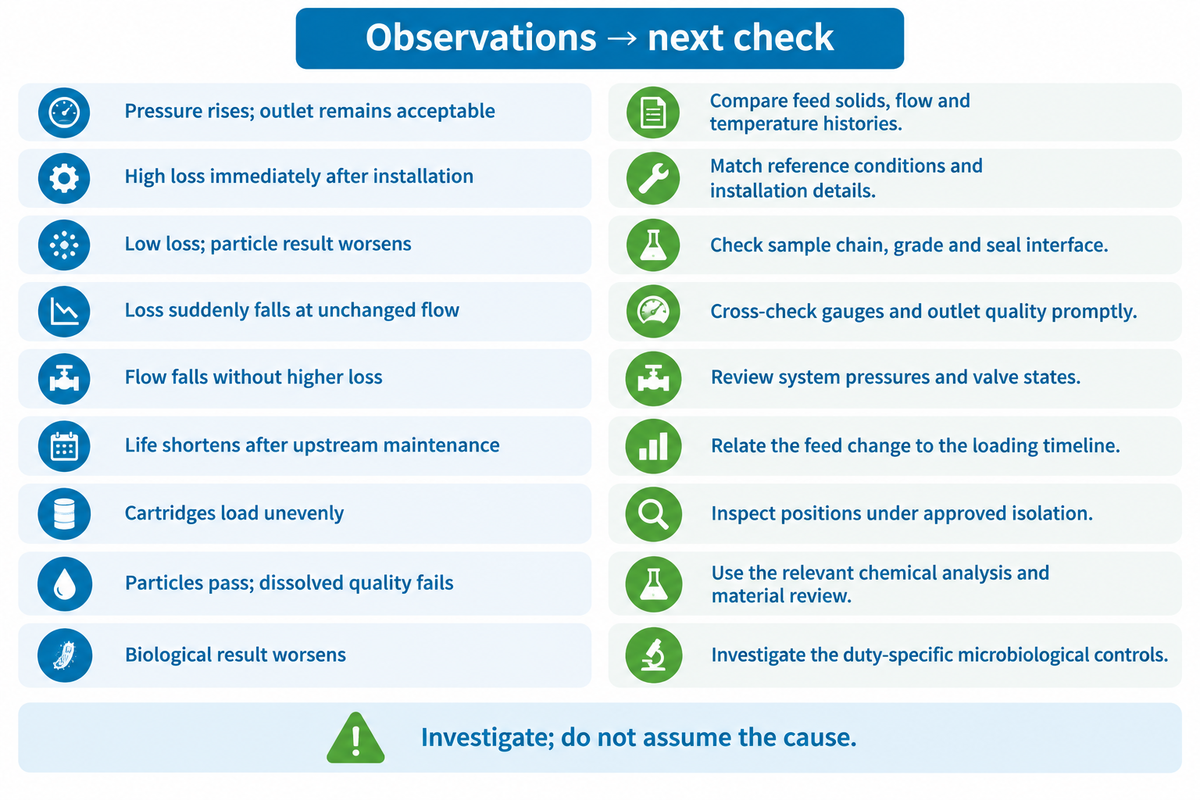
Separate the hydraulic symptom from the quality symptom before determining the corrective action. Rising pressure loss, falling flow and deteriorating outlet quality can have different causes. The Pressure, Quality Split Map below groups observations by the next discriminating check. It is a reasoning aid for maintenance and process teams, rather than a diagnosis of a particular cartridge.
Pressure, Quality Split Map
Pressure, Quality Split Map groups hydraulic and outlet observations so the next check can distinguish competing causes.
| Observation | Possible explanation | Discriminating check |
|---|---|---|
| Pressure rises; outlet remains acceptable | Solids loading or changed hydraulic duty | Compare feed solids, flow and temperature histories. |
| High loss immediately after installation | Different flow, wrong element arrangement or obstruction | Match reference conditions and installation details. |
| Low loss; particle result worsens | Bypass, different retention or sampling error | Check sample chain, grade and seal interface. |
| Loss suddenly falls at unchanged flow | Measurement fault, changed flow path or element damage | Cross-check gauges and outlet quality promptly. |
| Flow falls without higher loss | Pump, supply or another restriction | Review system pressures and valve states. |
| Life shortens after upstream maintenance | Debris release or altered pretreatment | Relate the feed change to the loading timeline. |
| Cartridges load unevenly | Flow maldistribution, different elements or seating | Inspect positions under approved isolation. |
| Particles pass; dissolved quality fails | Different contaminant class or material-contact issue | Use the relevant chemical analysis and material review. |
| Biological result worsens | Feed change, growth or handling contamination | Investigate the duty-specific microbiological controls. |
Editorial synthesis of the rating guidance, NSF replacement guidance and the application studies linked here. Each row lists competing possibilities; actual cause follows from measurements and inspection.
A hidden bottleneck is accepting a cartridge because the pump works less hard while the outlet passes more unwanted material. Pressure and quality can improve together, but each must be measured. RO membrane differential pressure also has a different boundary from cartridge housing differential pressure; Edward Sylvester’s RO monitoring discussion concerns the membrane system.
When cartridges require frequent changes, attention is warranted upstream. In a 2022 Water Technology article, Brad Buecker and Katie Perryman describe a historical application where upstream microfiltration extended downstream cartridge change intervals from 2–3 weeks to 2–3 months. The authors say that the old SDI records were unavailable. This application was a reported pretreatment example, not a Pall replacement trial or an ECOFILTRONE project.
Where microbiological quality matters, include its relevant measurements. Dehwah and colleagues’ 2019 seawater pretreatment study reported microbial regrowth within the studied cartridge-filter stage. A particle rating therefore meets a different requirement from microbial control. Cartridge washing, sanitisation and reverse-flow procedures must be carried out in line with the instructions for the exact assembly.
Compare Cost per Accepted Cubic Metre
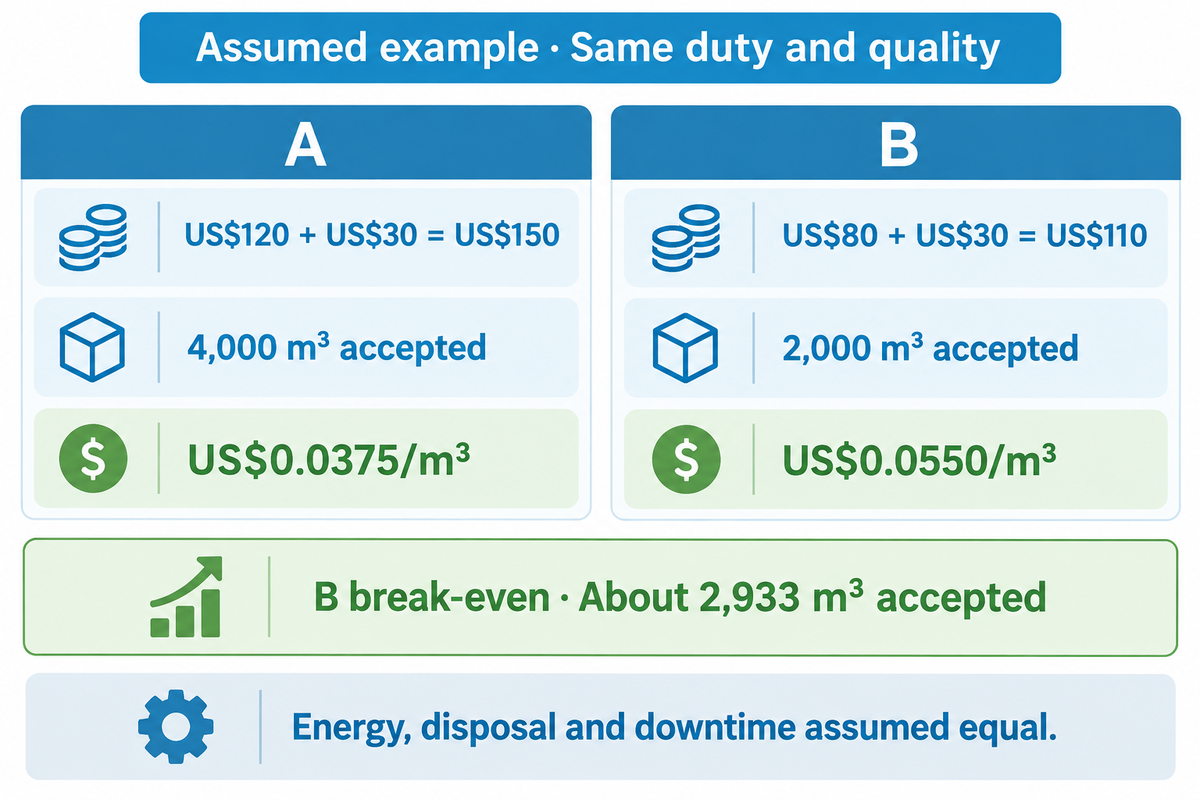
Divide the attributable filtration cost by the volume that meets the agreed process-quality criteria. Define the criteria, sampling points and sampling frequency, and then compare cartridges. Add costs for cartridge purchases and handling, measured energy and downtime, and disposal costs where they differ. A lower purchase price can result in a lower or higher cost for the accepted volume.
Farhat and colleagues’ 2020 desalination study compared seven commercial high-flow cartridge types using production quantity, quality and cost. Its published abstract also links the replacement endpoint to energy cost. That approach helps procurement and finance compare useful output while quality staff control what qualifies for the denominator.
Example, assumed inputs: A plant compares two candidates on the same water duty. Candidate A costs US$120 per element and US$30 to handle each change; it produces 4,000 m³ of accepted water. Candidate B costs US$80 plus the same US$30 handling charge and produces 2,000 m³ of accepted water. Both satisfy the same sampling and quality requirements. Energy, disposal and downtime are equal in this simplified comparison. Procurement initially prefers B because it saves US$40 per purchase. Finance instead compares the combined US$150 and US$110 charges against their respective accepted volumes. The resulting ranking changes because the cheaper element is replaced more often for the same useful output.
- Candidate A: US$150 ÷ 4,000 m³ = US$0.0375/m³.
- Candidate B: US$110 ÷ 2,000 m³ = US$0.0550/m³.
- B’s break-even accepted volume: US$110 ÷ US$0.0375/m³ = approximately 2,933 m³.
Only treated water meeting the defined acceptance limits is considered in that denominator. For RO pretreatment, it may be necessary to go beyond one fouling indicator. Nadreen and colleagues’ 2026 Red Sea multimedia-filtration study, for example, noted poor correlations between SDI and direct particle or microbial counts. Its scope was upstream multimedia filtration, not HFU elements; the practical lesson is to select measurements for the contaminants and downstream duty.
Key takeaway
At US$110 per change, candidate B needs about 2,933 m³ of accepted output to match A’s assumed US$0.0375/m³. Add unequal energy, labour, disposal or downtime costs before choosing the lower-cost option.
Decide Whether to Keep, Trial or Reject a Replacement
Hold on to a currently adequate cartridge if documented performance meets the operating need. Trial a replacement if the interface and application requirements are resolved, but performance needs to be assessed under representative conditions. Reject a candidate with an unresolved incompatible interface, unsuitable wetted material or operating limits below the required duty. These are first-line purchasing decisions and not certification categories.
Trials follow a reliable method. This includes a series of:
1. Clean pressure loss and subsequent loading.
2. Useful volume and the required quality measurements.
3. Feed variability.
The study by Afkhami and others on household water revealed different behaviours of turbidity-removal with filter loading and different feed waters. Its particular cleaning methods and test endpoints belong to that study; an industrial high flow filter needs its own approved operating instructions.
One technical confirmation list before the order
- Confirm the complete part number, housing identity and mating dimensions.
- Inquire after the proposed grade’s efficiency, test method and flow conditions.
- Verify compatibility of the medium, end caps and seals with the fluid at operating temperature.
- Confirm applicable pressure/temperature limits, flow direction and installation instructions.
- Agreement on acceptance criteria, sampling plan and review responsibility is required prior to the trial.
- Request the product-specific material and compliance documents required by the application, with the actual certificate holder identified.
Our guide to high flow qualification records provides information on how to control the resulting test and approval history. Maximizing holding capacity, or using fewer filters, is appropriate only if the complete filtration systems assessment supports the requirement.
Track Changes That Affect the Next Cartridge Order
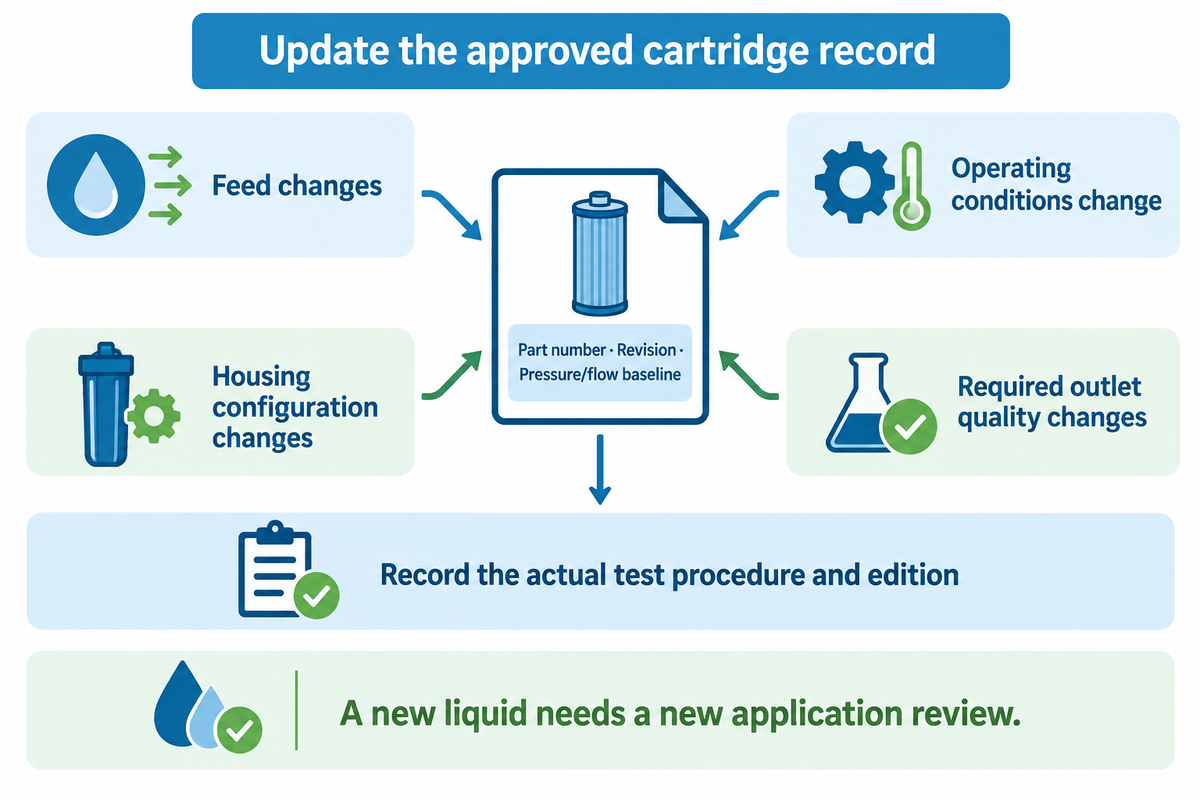
Update the cartridge record when the feed, operating conditions, housing configuration or required outlet quality changes. Maintain the approved part number and revision with pressure/flow baseline for the record. That history makes the next order a repeat of a defined application rather than an assumption that every high flow replacement will behave the same way.
“Keep a logbook to record water test results, equipment maintenance, and repairs.”
Standard editions need a date, as well. ISO 16889:2022 specifies a multi-pass method for hydraulic-fluid-power filter elements. Pall’s October 2021 literature describes an adaptation of the 2008 edition. Record the procedure actually used for each result; a newer edition number belongs with testing performed and reported on that basis.
A change from water filtration to a chemical process liquid requires a new compatibility and hydraulic review, even if the same housing remains installed. Wastewater reuse and seawater desalination also have different incoming loads and outgoing requirements. Long service life is an application result rather than a fixed attribute of the high flow filtration label.
ECOFILTRONE™ supports filter selection, specification review and replacement matching for industrial filtration applications. For a specific cartridge inquiry, go to our Pall Ultipleat replacement model selection and quotation page, fill in the complete code and operating details and send us the request.
Discuss an HFU replacement application
Frequently Asked Questions
What does the J suffix mean in an original HFU code?
Pall’s October 2021 ordering table identifies J as ethylene propylene.
The table separately lists H13 as nitrile and gives U-cup variants their own entries. Preserve the full seal designation when comparing an original code with a candidate cartridge. Matching the elastomer name is one part of the review; mating geometry, compression and compatibility with the actual process fluid at temperature remain separate requirements for the proposed assembly.
Is every Ultipleat High Flow grade rated at 99.98%?
No. Pall’s original UY020 footnote states 2 µm at 99% efficiency.
The general table heading therefore needs to be read with the row-specific notes. Several listed coarse grades also have a separate evaluation-method qualification. During a comparison, retain the particle size, efficiency and test basis together. A replacement’s printed micron value needs the same accompanying information before its filtration efficiency can be compared with the required duty.
Can a 6-inch-diameter cartridge be selected from diameter alone?
No. Nominal diameter identifies a size class; the housing interface determines fit.
Pall’s original literature lists a nominal 152.4 mm diameter. A dimensional drawing also needs the sealing and seating details relevant to the actual housing. Similar outside dimensions can coexist with different seal compression or locking features. Keep the original part number and housing information together so a filter cartridge replacement is assessed as a complete installed arrangement.
Does low differential pressure mean the filter is working well?
Low differential pressure needs acceptable outlet quality and the required flow alongside it.
A low reading can reflect low resistance, reduced flow, bypass or a measurement problem. Compare both pressure points under recorded conditions and interpret the required outlet tests separately.
Can a pleated high-flow cartridge be washed and reused?
Reuse only when the exact cartridge and housing instructions permit the proposed cleaning procedure.
Pleat construction by itself is not a cleaning specification. A chemical wash can affect the medium, bonds or seals, while reverse flow changes the mechanical loading direction. Some filtration studies describe successful cleaning for their own tested elements and household-water conditions; those procedures belong to those assemblies. For an industrial replacement, permitted cleaning chemistry, temperature, pressure direction and the post-cleaning acceptance tests need to be defined before reuse. Single-use instructions remain applicable unless the responsible manufacturer supplies a suitable alternative procedure.
What is the fairest way to compare cartridge prices?
Compare attributable cost per accepted volume at the same required quality.
Include purchase and changeout costs, then unequal energy, disposal and downtime. Keep the feed conditions and acceptance definition comparable.
References & Sources
- Walkerton Clean Water Centre, small-system nominal and absolute ratings, 2015.
- 2022 edition of the ISO, hydraulic filter multi-pass method: public abstract and edition record.
- Farhat et al., cartridge selection and replacement economics, Desalination, 2020: public abstract and article preview.
- Nadreen et al., seawater multimedia pretreatment monitoring, Water Research, 2026: abstract. Authors include KAUST and ACWA researchers.
- Dehwah et al., microbial assembly and seawater pretreatment, 2019: university-hosted abstract.
- Afkhami et al., household cartridge-filter study, 2021: university-hosted abstract.
- Saha, Hawkins and Lessl, University of Georgia mechanical-filtration guidance, reviewed 2026.
- NSF, consumer replacement-cartridge guidance.
- Buecker and Perryman, Water Technology, June 2022. Signed application discussion with ChemTreat affiliations.
- Edward Sylvester Jr., Water Technology, December 2015. ChemTreat- affiliated discussion of RO system indicators.