Get in touch with ECOFILTRONE™ Company



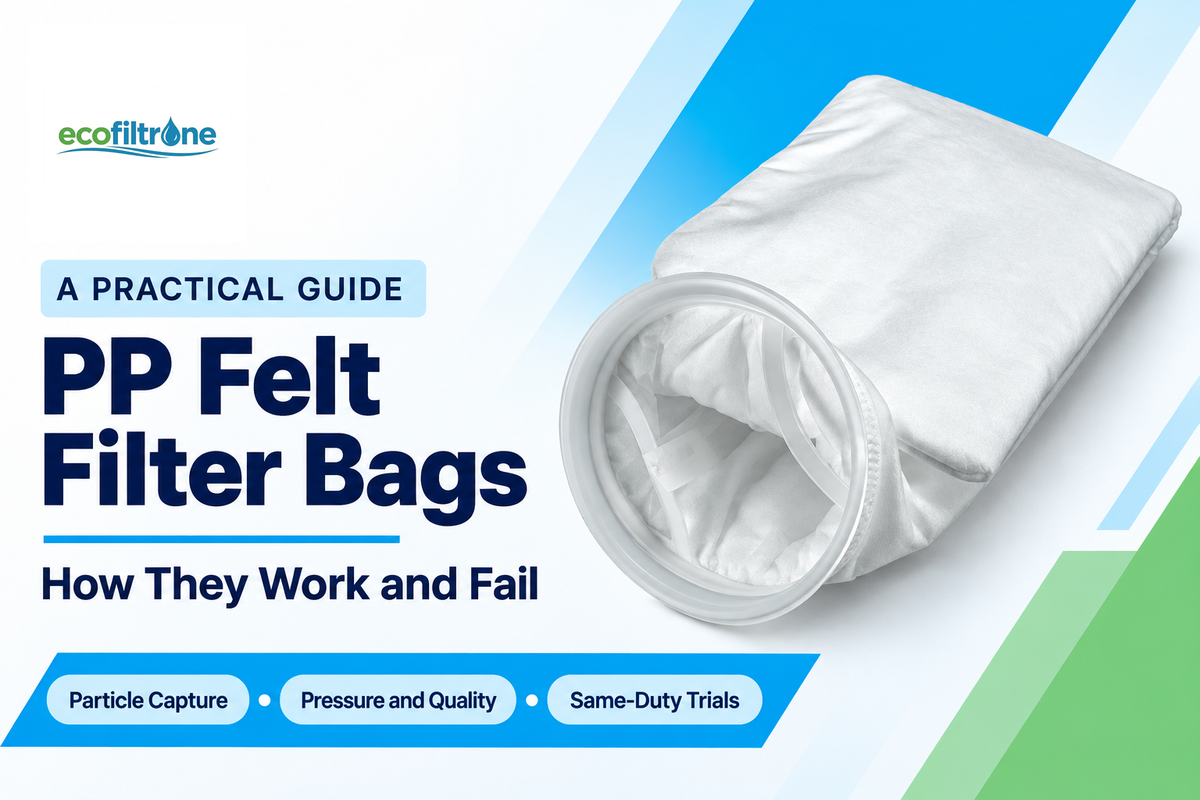
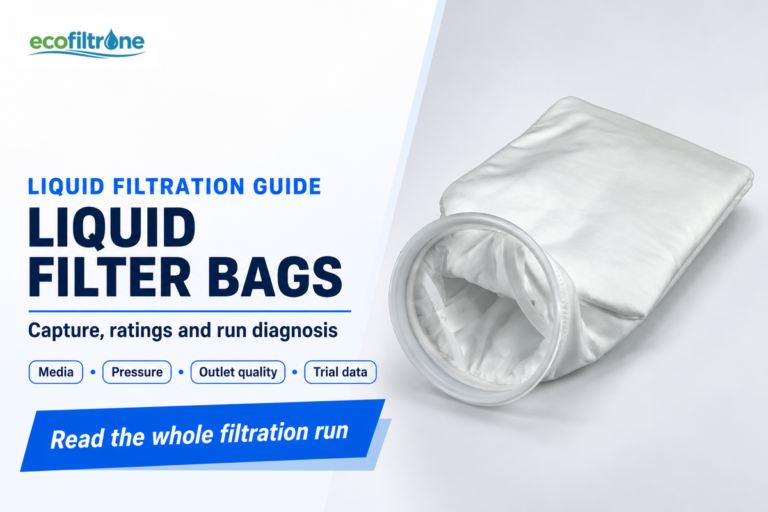
PP Felt Filter Bags clean industrial liquids using a polypropylene fiber web. An optimal selection links the required outlet quality to the bag rating, the liquid duty and the assembled hardware. The same connections explain why a bag plugs early, leaks or appears to run forever.
PP Felt Filter Bags use a fibrous depth medium for particle removal. A nominal micron rating describes a grade, while measured efficiency describes capture under stated conditions. Read pressure together with flow and filtrate quality.
Quick operating checks
- Low differential pressure can coexist with poor particle removal.
- Equal nominal micron labels can describe different retention performance.
- A welded seam and a correctly seated housing seal solve different leakage paths.
- A useful trial records accepted liquid volume, not just hours before changeout.
Updated October 2026. By XCX.
How PP Felt Filter Bags Capture Particles
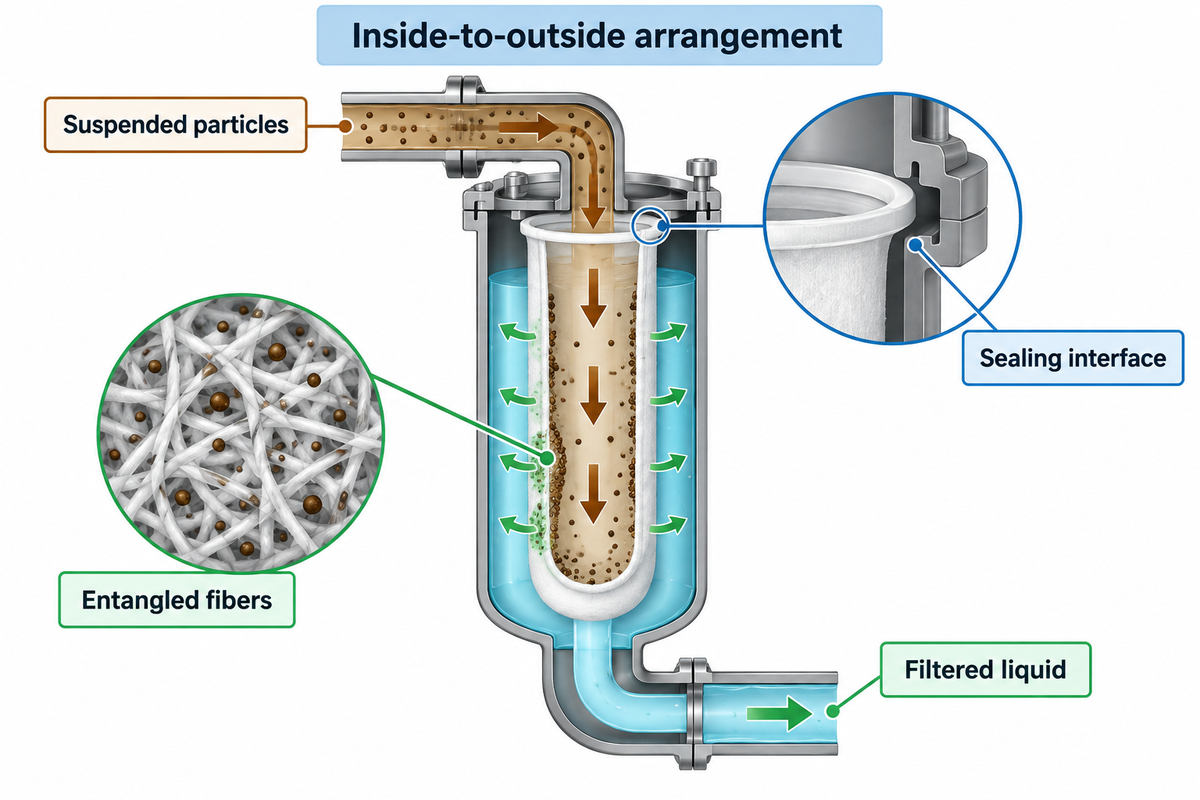
Polypropylene felt captures suspended material using a web of entangled fibers. Particles accumulate on the surface and within the media, rather than encountering a uniform screen opening. Thus, needle felt is useful for particulate clarification, but the required capture result comes from the liquid being processed and the finished bag.
How does a bag filter work?
A liquid bag filter directs flow through a supported filter bag inside a compatible housing. Filtered liquid leaves the assembly and the medium retains the suspended particles. In a conventional inside-to-outside arrangement, dirt remains in the bag. The sealing interface must prevent unfiltered liquid from taking a short cut around the medium.
EDANA’s manufacturing explanation states that the web becomes entangled when needles pass through it. Manufacturers construct a felt bag from that media, add the required ring or flange, and join its seams. Fiber selection, web structure and finishing all belong to the construction; a polymer name alone isn’t a complete filter specification.
The American Filtration and Separations Society glossary defines depth filtration as capture that occurs within and on the surface of the matrix. Dirt-holding capacity describes the amount that’s retained before the agreed operational endpoint. A large dirt load can quickly blind an exposed surface, particularly if the contaminant forms a compressible deposit.
Example: an operator uses a polypropylene felt bag ahead of a process-water spray bar. Removing suspended grit can protect passages, but dissolved salts aren’t removed and continue downstream. After a bag change, the spray pattern improved, but a conductivity reading didn’t change. Replacing the bag with a finer grade is the wrong response to the unchanged conductivity: particle clarification and dissolved-ion removal are different treatment tasks. The operator correctly separated the two acceptance checks, i.e. passage protection for the bag stage and the relevant water-treatment measurement for dissolved material. A felt filter belongs in the treatment train that addresses its target and isn’t a complete purification system.
To remove 10 µm particles, the useful follow-up is a measurement of the outlet at working flow. A visibly dirty bag or clear-looking process water doesn’t indicate 10 µm capture. Record what the downstream equipment needs protected. Use an appropriate test to measure that population.
Micron Ratings: Choose Retention, Not Just a Number
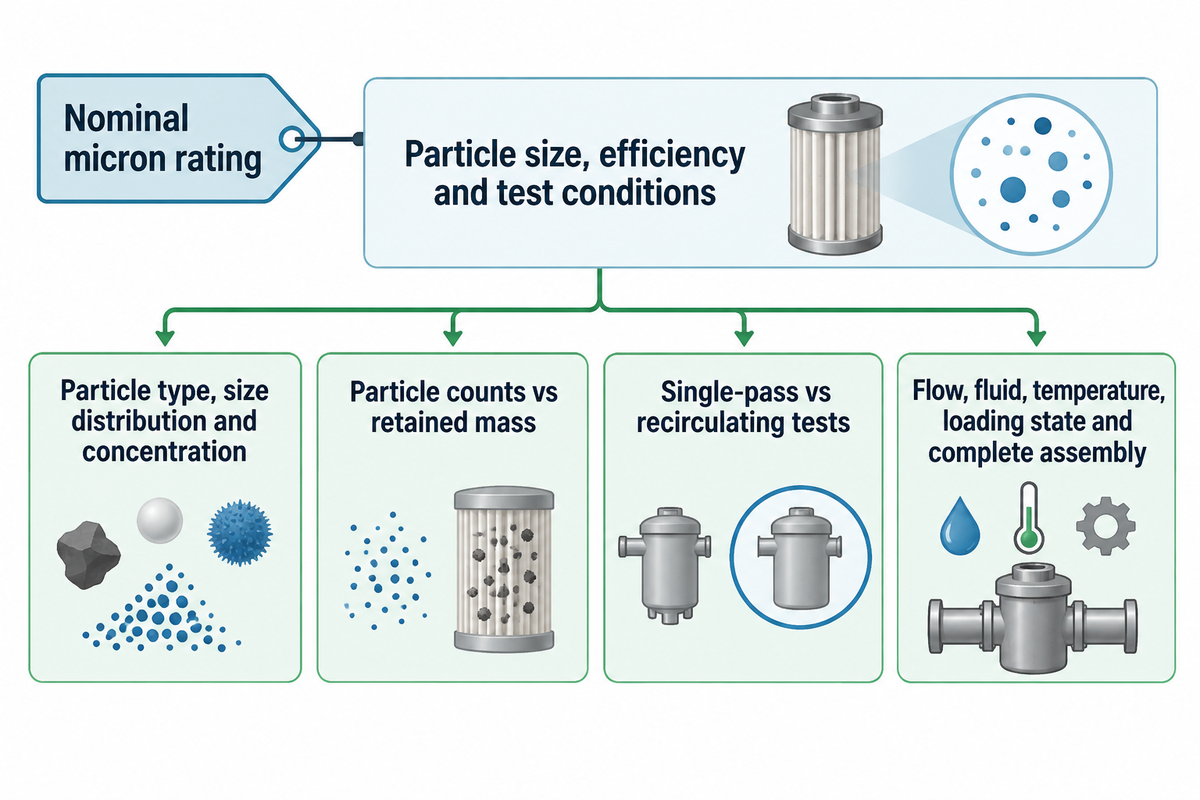
A nominal micron rating denotes a filter grade without a universal capture percentage. Compare the particle size, efficiency and test conditions. Choose the grade that satisfies the outlet requirement at a workable operating duty.
One micrometer, written as µm, is equal to one millionth of a meter. Using the NIST metric-prefix definitions, 10 µm equals 0.01 mm and 100 µm equals 0.1 mm. Length is described. A polypropylene felt filter bag isn’t transformed into a screen with the same holes.
AFS describes nominal ratings as manufacturer-indicated values that often differ between manufacturers. For a reliable efficiency comparison, the particle size needs to be considered. Test conditions need to be taken into account. Hard spheres, irregular particles and deformable gels don’t always behave in a similar manner. Answering different questions is what distinguishes a particle-count and gravimetric analysis.
- Identify nominal or defined-efficiency performance and the particle size being discussed.
- Record particle type, size distribution and concentration.
- Distinguish particle counts from retained mass and single-pass from recirculating tests.
- Retain flow, fluid, temperature, loading state and complete assembly details.
Therefore, in a procurement comparison of two 10 µm products, ensure the outlet acceptance requirement is kept constant. A bag that provides an unsatisfactory outlet can show an attractive run length because it captures less. Equally, a bag that doesn’t satisfy the requirement for process flow isn’t a successful replacement merely because its initial sample is cleaner.
For a nominal 1 micron filter bag, keep the 1 µm grade separate from the required efficiency at that size. A defined test result and a satisfactory outlet sample help in arriving at a decision. The label alone leaves both capture and useful throughput unresolved, so the next step is a matched-duty comparison.
Chemical Compatibility and Temperature Need a Duty Window
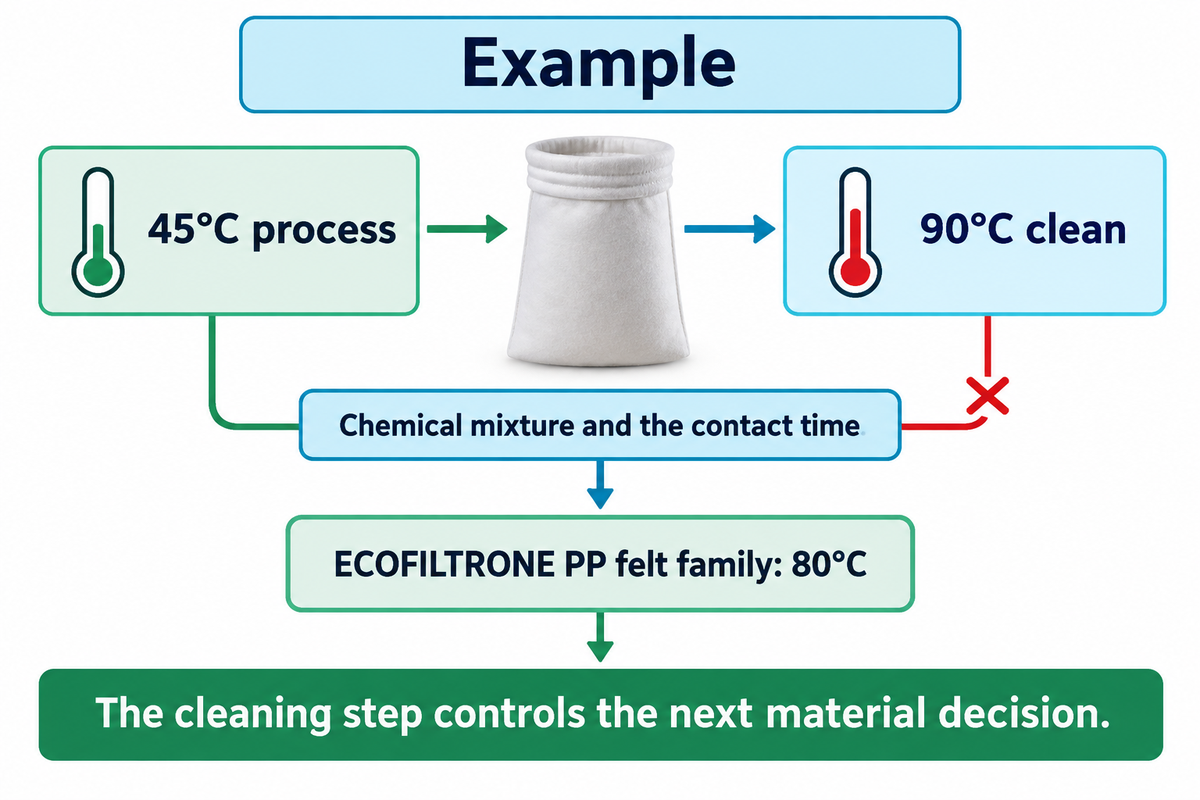
PP felt remains a candidate only when its complete wetted construction suits the process and cleaning exposure. Define composition, concentration, normal and peak temperatures, contact time and mechanical conditions together. A temperature maximum or a broad chemical compatibility statement can’t describe every combination of those conditions.
ASTM D543-21 assesses the responses of plastics to chemical reagents. Its public significance section relates useful comparisons to reagent concentration, exposure duration, temperature and stress. For example, short exposure and continuous immersion can produce different material responses.
“Base the selection of test conditions on the manner and duration of contact with reagents”
ECOFILTRONE gives a maximum operating temperature of 80°C for its PP felt family, with nominal 0.5-400 µm options. For the purposes of this report, 80°C will be taken as the published temperature limit of this family of products for evaluating offered construction. The liquid, ring material, seam and cleaning cycle must also fit the duty. Chemical resistance applies to the exposed assembly as well as the felt media.
Example: A maintenance team filters a water-based resin mixture at 45°C and schedules a 90°C cleaning cycle. The production temperature falls below the published 80°C PP reference; the cleaning exposure doesn’t. Therefore, the cleaning exposure would be unacceptable. Buying a finer bag leaves this mismatch unchanged. The team records production, shutdown and cleaning conditions separately, and changes the cleaning arrangement or selects a different suitable construction before the trial. Chemically resistant media can still face an unsuitable temperature, seal material or exposure duration. Keeping these exposures separate avoids releasing a replacement on the basis of normal operating temperature alone.
Assuming a 45°C process and 90°C clean, the cleaning step controls the next material decision. Repeating a compatibility check at 45°C would leave the hotter exposure unanswered. Record both temperatures, the chemical mixture and the contact time before comparing a different bag construction.
PP Felt, Polyester Felt and Nylon Mesh: What Changes?
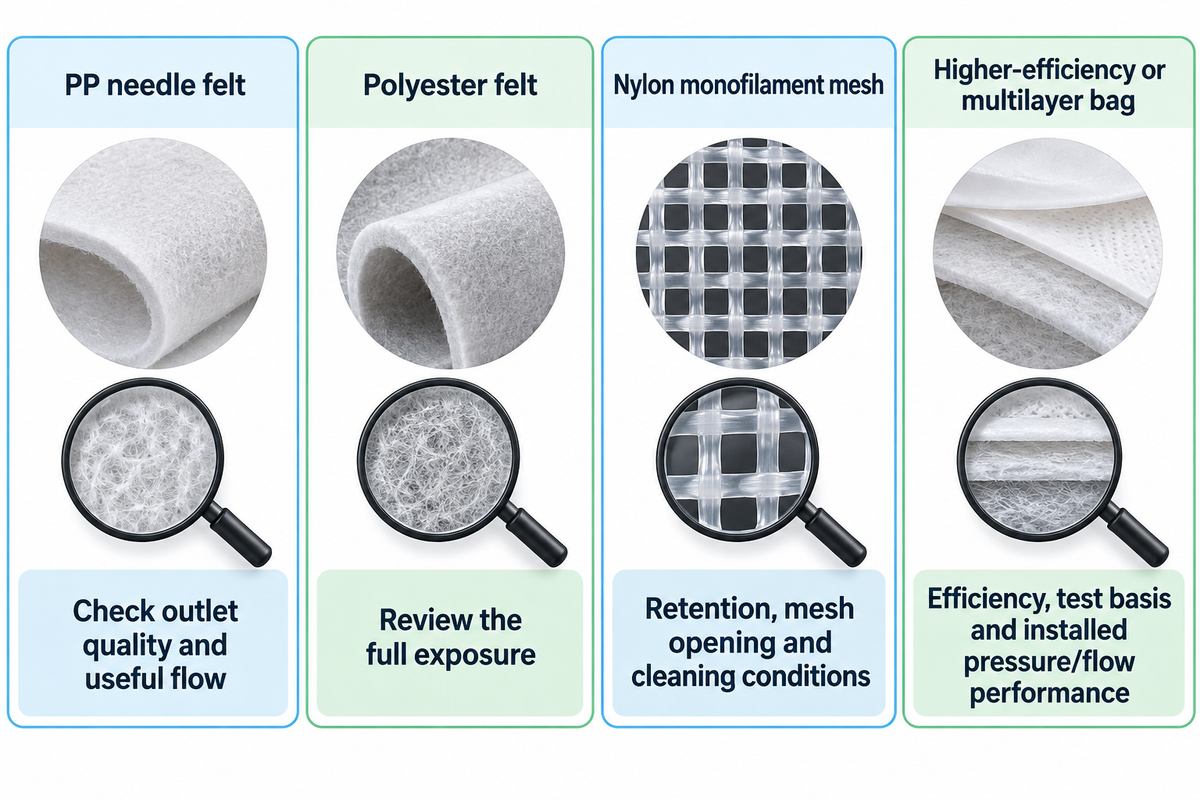
Select a different medium when the mechanism of capture or exposure needs to change. Polypropylene and polyester are material choices; felt and woven mesh describe different structures. A greater efficiency bag presents a different construction option. Compare the offered item against the same requirement instead of assigning one material an overall win.
| Route | Useful question | Decision before substitution |
|---|---|---|
| PP needle felt | Does the specified PP construction meet the particle and liquid duty? | Retain it when outlet quality and useful flow both pass. |
| Polyester felt | Does a different polymer better suit the temperature or chemistry? | Review the full exposure; carry over neither PP limits nor cleaning assumptions. |
| Nylon monofilament mesh | Does the duty suit woven-screen capture? | Compare retention, mesh opening and cleaning conditions for that item. |
| Higher-efficiency or multilayer bag | Is a more tightly defined retention result needed? | Compare the stated efficiency, test basis and installed pressure/flow performance. |
A polyester felt option changes the material choice. A nylon mesh construction changes the capture structure, as well. Standard-size filter bags aren’t automatically interchangeable, even when their micron labels match.
The discussion by Chris Rau, then Division Engineering Manager at Eaton, in Processing Magazine covers liquid filtration in the context of operating costs and process requirements with respect to bag, cartridge and self-cleaning systems. Useful comparisons include maintenance, lost liquid and downtime. Different filtration solutions can work in stages when bulk loading and final cleanliness require different jobs.
For a 10 µm downstream requirement, first separate a material mismatch from a loading problem; changing PP to polyester felt addresses a polymer question. An upstream coarse stage can address a solids-loading issue. The same 10 µm label on both wouldn’t make those solutions equivalent.
Installation Starts With the Seal and Support Basket
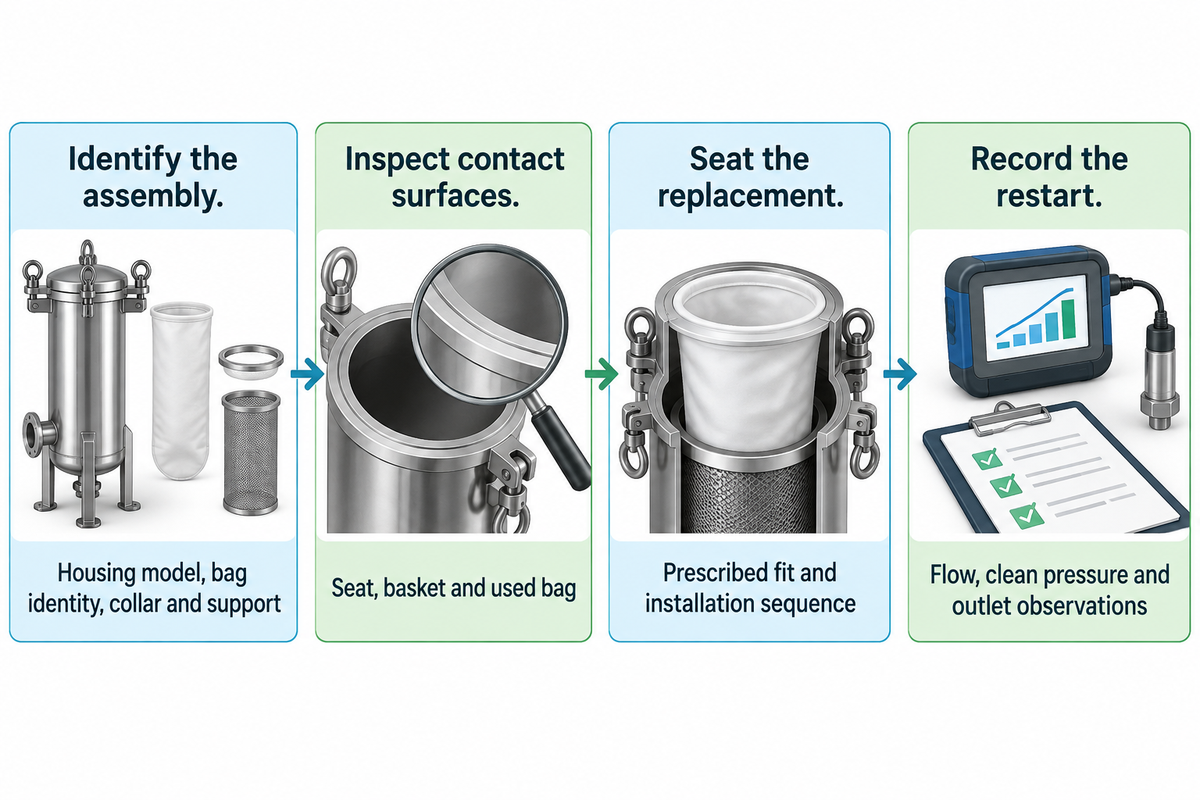
Felt liquid filter bags need the right sealing interface and support as well as the right medium. Match ring style, seat and basket to the offered item; filter housings use different interfaces. A weld closes a seam; it doesn’t close a separate gap around a poorly seated collar.
Use the housing manufacturer’s isolation, depressurization and replacement procedure before inspecting the internals. Seat damage, a folded collar, an unsupported bag or a sharp basket edge can all create a fault that a smaller micron rating won’t resolve. A repeated hole in the same position is a reason to inspect the contacting hardware, not simply order another grade.
- Identify the assembly. Record the housing model, bag identity, collar and support arrangement.
- Inspect contact surfaces. Follow the isolated-equipment procedure and examine the seat, basket and used bag for a repeating damage pattern.
- Seat the replacement. Use the prescribed fit and installation sequence rather than forcing an approximate ring match.
- Record the restart. Retain flow, clean pressure and outlet observations with the bag identity.
Instrument connections belong in that assembly record. A historical EPA/NSF verification statement attributed poor removal in one bag-and-cartridge filter train to a faulty differential-pressure gauge that bypassed feed into filtered water. That poor removal illustrates a path beyond the bag seam; it is not a claim that every gauge has that connection or risk.
The size designation alone doesn’t resolve the sealing profile. Use the ECOFILTRONE bag size references, along with the housing and collar information. A replacement bag with the correct length but the wrong sealing contact is still the wrong installed item.
Read Differential Pressure Together With Filtrate Quality
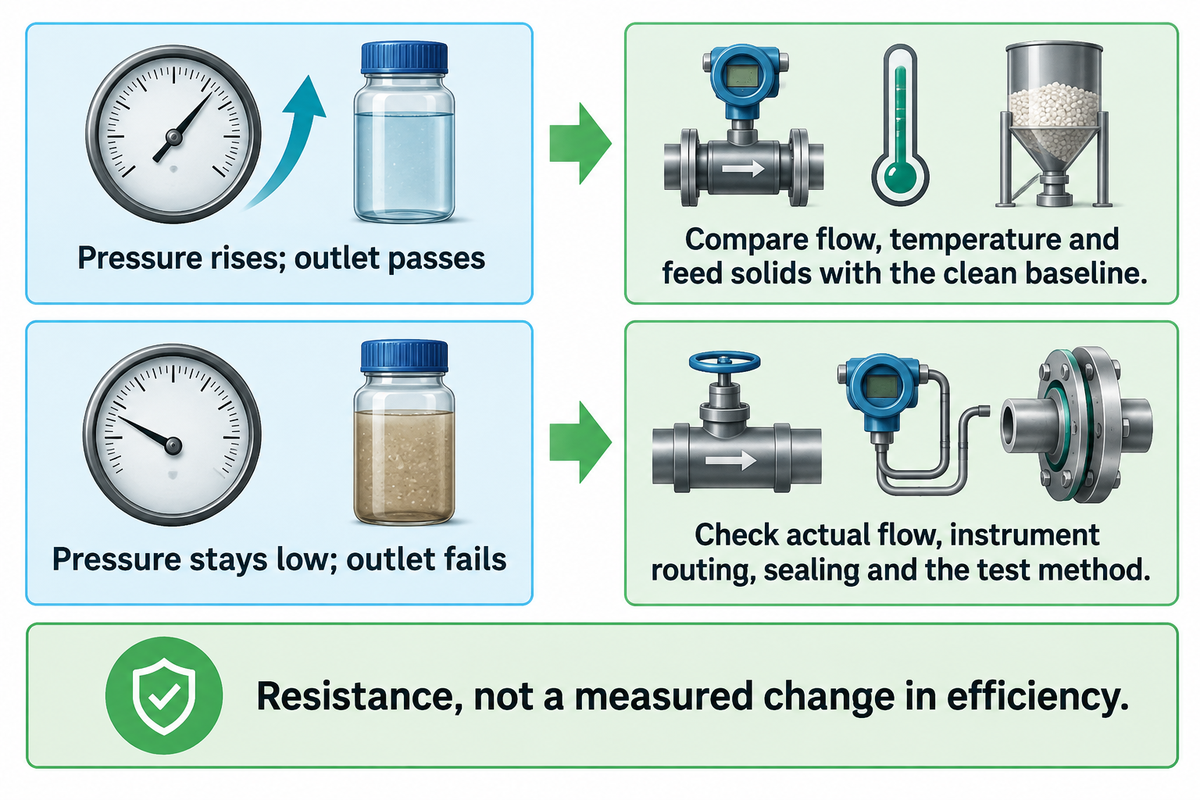
Differential pressure measures the resistance between two measurement points. It doesn’t measure the removal efficiency of particles. Read the differential pressure gauge at the working flow and liquid condition. A trend analysis should include a representative outlet test.
For gauges reading the same reference, calculate ΔP as inlet pressure minus outlet pressure. Example: 2.4 bar inlet and 2.0 bar outlet give 0.4 bar across the measured assembly. A later 0.6 bar reading needs its accompanying flow and temperature before it can be compared. Housing resistance is included if the measurement spans the housing.
Jim Elsey’s Pumps & Systems article on strainer location emphasizes knowing clean and loaded pressure behavior and recording changes. Maintain the same discipline for measurement without transferring a strainer’s pressure limit. Rosedale’s clean-pressure chart specifies a number 2 bag and water at 1 cP and 68°F (20°C). A wastewater or viscous resin duty needs its own fluid and operating conditions.
9-Symptom Pressure-Clarity Fault Atlas
The 9-Symptom Pressure-Clarity Fault Atlas couples operating observations with competing causes and the next check before changing a bag specification.
| Observed symptom | Possible explanation | Next useful check |
|---|---|---|
| Pressure rises; outlet passes | Accumulated captured material or changed liquid resistance | Compare flow, temperature and feed solids with the clean baseline. |
| Pressure rises; outlet fails | Loading plus breakthrough, bypass or media damage | Repeat the outlet test, then inspect the isolated assembly and used bag. |
| Pressure stays low; outlet fails | Coarse retention, a bypass path or a misleading measurement | Check actual flow, instrument routing, sealing and the test method. |
| Pressure falls suddenly; outlet worsens | Rupture, a changed flow path or lost system flow | Check flow and gauge behavior; inspect for damage under the shutdown procedure. |
| Pressure is high from startup | Restrictive construction, cold/viscous liquid or assembly restriction | Compare initial conditions and fit before blaming captured dirt. |
| Short runs follow a feed change | Higher solids load or a different contaminant character | Compare paired feed samples and changes in production chemistry. |
| Outlet varies after restart | Unstable sampling, retained material release or an assembly change | Record startup samples separately from established operation. |
| Fibers appear downstream | Media migration, handling damage or another upstream fiber source | Identify the material and inspect bag condition and surface finish. |
| Only one sample looks poor | A process upset or a contaminated/unrepresentative sample | Repeat with clean containers and defined sampling points before changing grade. |
Outlet measurements need quality control too. The EPA/NSF statement’s sampling results declined one removal calculation because a control sample container showed suspected contamination. Clean containers, consistent sample points and the appropriate laboratory method help distinguish a filtration problem from a sampling problem. Visual clarity is useful context, not a particle count.
Gels add another branch. Soft particles can deform. Deposits can compress or blind the media. Increasing pressure to recover flow may change the result of capture rather than restoring it. Record a gel-containing feed separately, and compare another construction only after the liquid duty and outlet measurement have been determined.
A 0.4 bar baseline and 0.6 bar later reading show a change in resistance, not a measured change in efficiency. Record both pressure and outlet values with flow and temperature. The site’s calculator for differential pressure can help with the math; the operating record can help with the interpretation.
Changeout, Cleaning and the Limits of Reuse
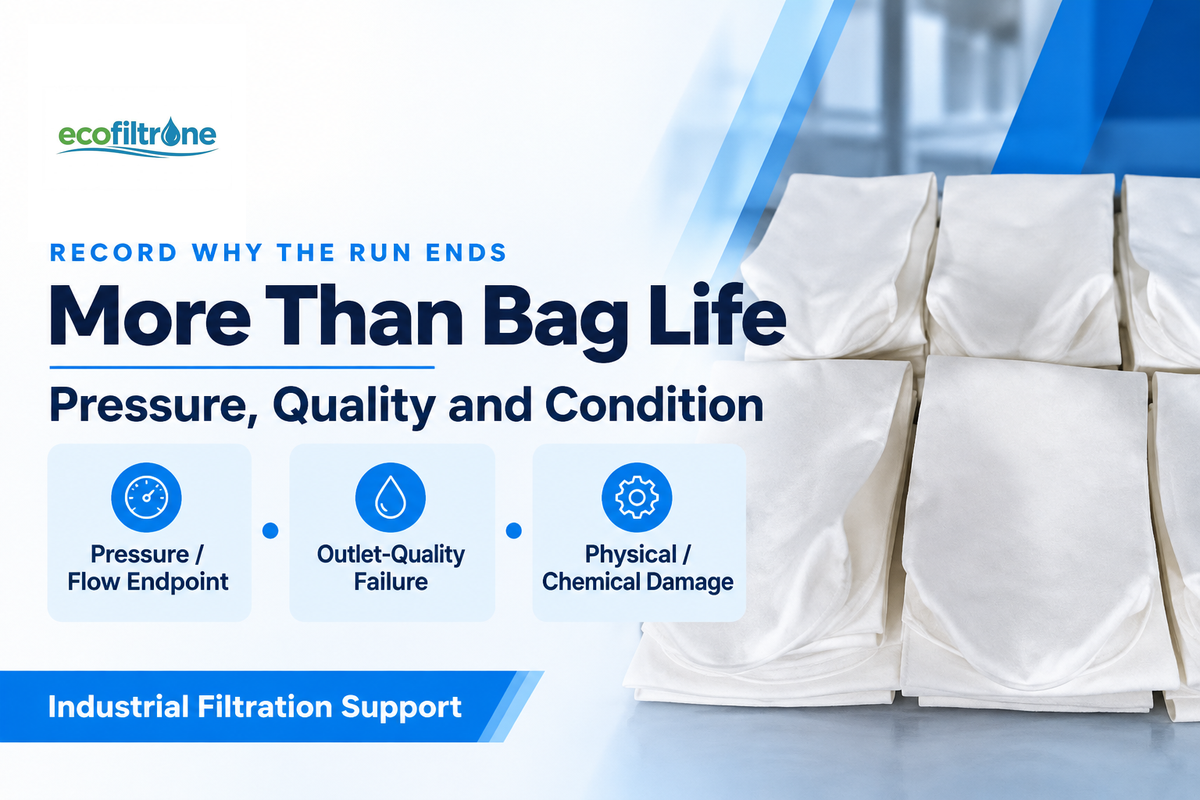
End a run when the documented assembly or duty limit is reached, or when the accepted outlet result is lost, whichever occurs first. Pressure history, along with flow and quality, supports the decision. A calendar interval alone may miss changes in loading, chemistry, and the condition of the filter.
Should PP felt filter bags be washed?
Replace ordinary disposable PP felt bags rather than assuming washing restores their original retention. Cleaning can leave embedded contamination, alter fiber structure or damage the seam and seal. Reusing a construction is appropriate only with a suitable cleaning procedure and a post-clean acceptance check for the same liquid duty.
Cleaning recovery isn’t the same as surface finishing. Suppliers glaze or singe selected felt media to control loose surface fibers, and the finish doesn’t determine the dirt holding capacity or turn a loaded depth medium into a washable screen. Finished construction and media migration remain separate checks after handling. The Processing article states that some bag designs can be cleaned, which makes the offered construction’s procedure essential to that choice.
A maintenance record should identify three removal reasons: the agreed pressure/flow endpoint, an outlet-quality failure, or physical/chemical damage. Combining them into one “bag life” average conceals the reason for failure. A bag described as having extended life still needs to deliver the required filtrate during that life.
After a 10 µm bag is washed, a lower clean pressure reading by itself doesn’t permit using the bag for a 10 µm duty again. Embedded deposits and altered flow paths affect the next run differently. Keep the specified replacement route unless the offered construction includes a cleaning method and an accepted post-clean performance check.
Run a Same-Duty Trial Before Changing Your Specification
Use a same-duty trial when an uncertain replacement or process change requires a measured decision. Hold the outlet acceptance condition and comparable process conditions fixed, and note what else changed. A repeat purchase of an established specification doesn’t automatically require a new trial, but a change of liquid or construction can.
The 2012 EPA-hosted NSF bag-and-cartridge challenge protocol illustrates why a complete assembly, specified feed and observations at different loading states matter. Drinking water challenge criteria satisfy a particular application. The industrial comparison below uses the discipline of controlled conditions rather than copying those regulatory test requirements.
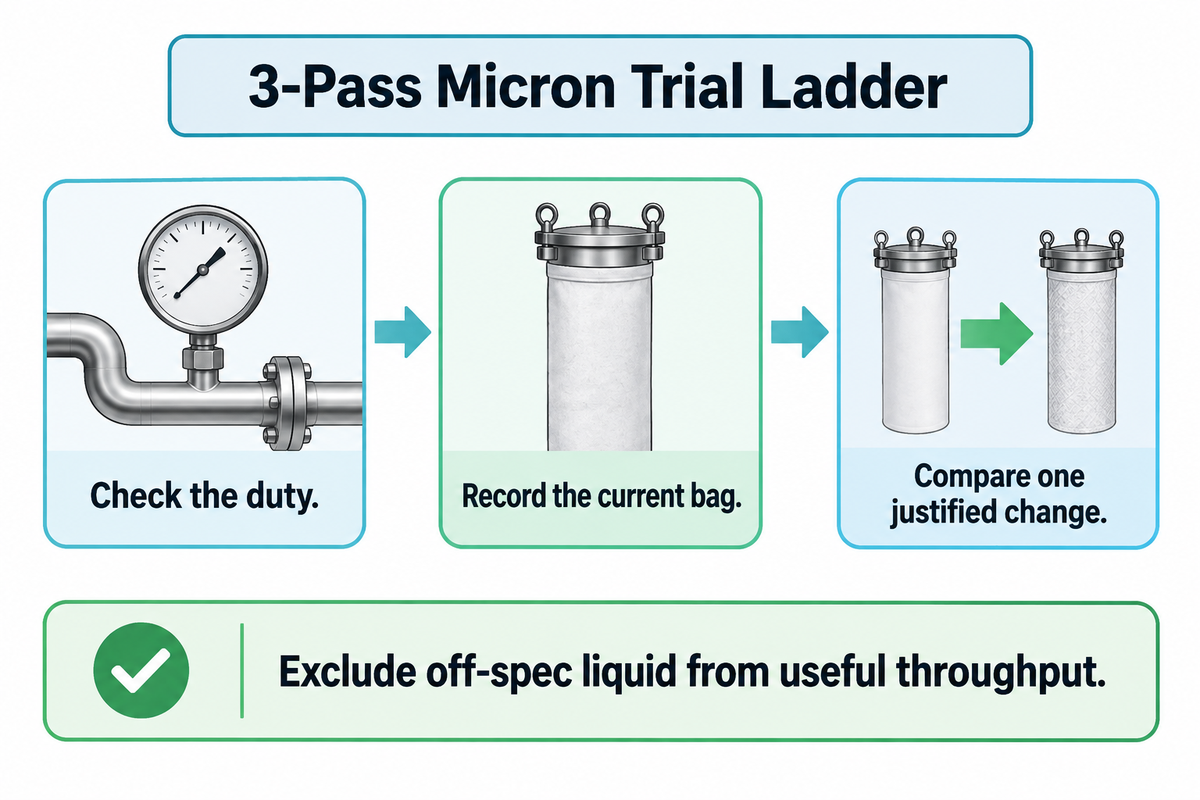
3-Pass Micron Trial Ladder
The 3-Pass Micron Trial Ladder evaluates the duty, records the current bag and compares one justified change against the same outlet requirement.
- Check the duty. Establish the target contaminant, accepted outlet test, required flow and documented stop rule.
- Record the current bag. Capture a clean baseline and loaded-run observations with bag identity and representative samples.
- Compare one justified change. Change the grade or construction for a stated reason, then compare accepted output and removal reason.
| Factor | Current bag record | Candidate record and decision |
|---|---|---|
| Bag and lot identity | Part, rating, media, ring and lot | Identify the one intended change; retain lot traceability. |
| Assembly | Housing, support, sealing and instrument connections | Resolve assembly differences before comparing media. |
| Feed | Liquid, chemistry and representative solids | Explain any feed change instead of crediting the bag. |
| Flow | Useful process flow and its variation | Compare at the required duty; record reduced delivery. |
| Temperature and viscosity | Working temperature and fluid condition | Separate a liquid-resistance change from loading. |
| Pressure | Clean baseline and loaded trend at defined points | Use the same reference and documented stop rule. |
| Outlet measurement | Method, sampling point, container and control handling | Repeat an anomalous result before diagnosing breakthrough. |
| Accepted output | Volume meeting the outlet criterion | Exclude off-spec liquid from useful throughput. |
| Endpoint and repeat | Removal reason, damage and independent run identity | Separate loading stages from repeat runs; expand batch coverage when needed. |
Example: both candidates must supply 40 L/min and meet the same outlet test. Bag A reaches its agreed endpoint after 3 hours with all sampled output accepted: 40 L/min × 180 min = 7,200 L. Bag B runs for 4 hours and its last hour of the test is out of spec. Its total output is 40 × 240 = 9,600 L; accepted output is 40 × 180 = 7,200 L. The extra hour doesn’t increase accepted throughput. Operations records the flow and time, the quality team owns the outlet decision, and procurement compares replacements on the same accepted-output basis rather than buying the apparently longer run.
Independent repeats address a different question from observations within one run. The historical EPA/NSF statement expressly limited production-lot conclusions because few elements were tested. Record repeat and lot coverage when the purchase decision needs consistency across supply batches; one successful run describes that tested duty and assembly.
At 40 L/min, one accepted hour equals 2,400 L. Excluding one off-spec hour therefore changes a reported 9,600 L run into 7,200 L of useful output. Keep that accepted-volume calculation beside the outlet results, the stopping reason and the bag identity so each purchasing comparison uses the same basis.
What to Send When You Need Technical Review
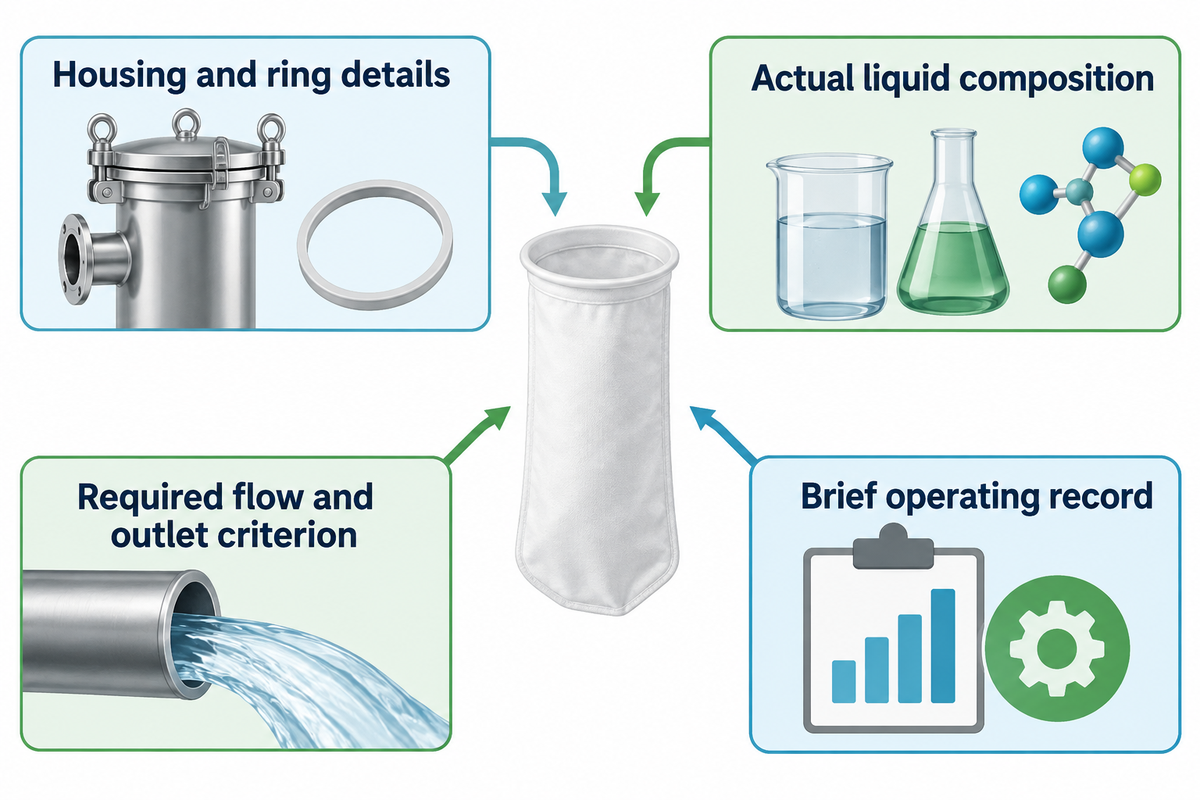
A good liquid-related handoff includes information about the failed/proposed bag, the current liquid duty, and a brief operating record. Send evidence that separates fit, retention and process changes. ECOFILTRONE supports application review, replacement matching, specification verification and trial support for industrial filtration consumables.
Confirm the housing and ring details, actual liquid composition, normal/peak/cleaning temperatures, required flow and outlet criterion. Add paired feed/outlet results, clean and final pressure, accepted volume, removal reason and used-bag photographs. Ask for the offered construction’s retention evidence and any product- and application-specific material or compliance documents. For food-contact duties, include the intended-use conditions described by FDA in that document review.
For product-family configuration and an application enquiry, visit our solution page: PP Felt Filter Bags. A clearly recorded failure pattern will help our engineering team review the next change without repeating an ineffective micron substitution.
Key takeaway
A successful PP felt run meets the outlet requirement at useful flow. Keep rating, assembly, pressure and sample-quality evidence together before changing the bag.
Frequently Asked Questions
How are PP felt filter bags made?
Polypropylene fibers are bonded into felt, then converted into a finished bag.
Needle punching mechanically entangles the web’s fibers. Cutting and joining form the bag, with the specified top ring or flange and seam construction. Surface finishing is a separate production choice. A finished item therefore combines the media with its sealing and support requirements. Two bags made from polypropylene can have different web structures and rating bases, so identical material names don’t make them equivalent replacements.
Is a polypropylene water filter safe?
Polypropylene alone is not enough to select a safe water-treatment filter.
Use a bag suited to the specified industrial liquid and particle-removal task. Drinking-water and food-contact duties also require the relevant finished-product and intended-use assessment. The FDA food-contact inventory identifies substances and authorized use conditions; a polymer name is not a product approval. A particle bag is not a complete water purifier, and it should not be selected to control every dissolved substance or microorganism.
Are PP felt filter bags recyclable?
A used industrial bag needs a waste-specific decision before recycling.
Start with the whole used item: felt, ring, seam and captured process material. Clean polypropylene resin and contaminated industrial media are different receiving streams. Keep used liquid bag filters within the site’s documented handling route and identify the retained liquid and solids. A receiving facility can then decide whether it accepts that construction and contamination. Don’t mix an unreviewed used bag into a clean-plastic recycling collection.
Does a 1 micron filter bag remove everything larger than 1 micron?
No; a nominal micron label is not complete-removal performance.
A nominal 1 µm bag can pass some larger particles. The required comparison includes efficiency, challenge conditions and the installed outlet result, rather than a universal cutoff inferred from the label.
When should I consider a multilayer bag or cartridge?
Consider another construction when a suitable, correctly fitted felt bag misses the required duty.
First separate bulk loading, deformable particles and an inadequate retention result. An upstream coarse stage can reduce bulk solids reaching a finer stage. A different construction can address another retention requirement, but its material, seal and housing still need to suit the liquid and working conditions. Compare the outlet result and useful flow against the current bag before selecting the route. Include the sampling method so a contaminated container doesn’t trigger an unnecessary equipment change. If the duty needs more tightly defined capture, review the offered efficiency and test basis rather than treating the words high-efficiency liquid filter bags as a measured result. A cartridge is another format with several media types, not one universal filtration level.
Discuss your filtration duty with ECOFILTRONE
The fault atlas and trial ladder are editorial methods constructed from public technical references. Numerical examples use assumed operating inputs. Product selection still uses the offered construction and the plant’s accepted operating and quality criteria.
References & Sources
- How are nonwovens made? EDANA.
- Filtration + Separation Glossary of Terminology American Filtration and Separations Society.
- Metric (SI) Prefixes National Institute of Standards and Technology.
- Standard Practices for Evaluating the Resistance of Plastics to Chemical Reagents ASTM International, D543-21.
- 2 Filter Types Every Liquid Processor Needs to Know About Chris Rau, then Division Engineering Manager at Eaton, Processing Magazine, 2014.
- ETV Joint Verification Statement: Rosedale Bag and Rigid Cartridge Filter System United States Environmental Protection Agency and NSF International, 2001.
- Best Practices for Strainer Location Jim Elsey, Pumps & Systems, 2019.
- Generic Protocol for the Product Specific Challenge Testing of Bag and Cartridge Filter Systems NSF International, EPA archive, 2012.
- Inventory of Food Contact Substances Listed in 21 CFR United States Food and Drug Administration.