Get in touch with ECOFILTRONE™ Company



Updated October 2026
3M High Flow Replacement Cartridges cover several different filtration contexts. An industrial process-water element and a sealed beverage water filter cartridge may share some familiar letters while treating different contaminants and using different connections. Start with the complete original model and housing, and compare the filtration function.
3M High Flow Replacement Cartridges should be compared by original family, housing interface and treatment duty. Separate industrial HF/HFM, industrial 700/740 and beverage products before interpreting micron ratings, flow or service life.
Quick guide
- Identify: complete original cartridge and housing model.
- Compare: interface geometry, retention basis and actual fluid conditions.
- Observe: flow, differential pressure and the required outlet quality together.
- Decide: use matched-duty trial records and cost per accepted volume.
Key points
- A lower pressure drop can accompany reduced flow; it isn’t automatically better filtration.
- A nominal size match leaves sealing geometry and retention performance to be resolved.
- Carbon adsorption can reach its treatment endpoint without an obvious flow decline.
- Original-brand specifications and certification scopes stay with the named product and configuration.
Which 3M High Flow cartridge family do you have?
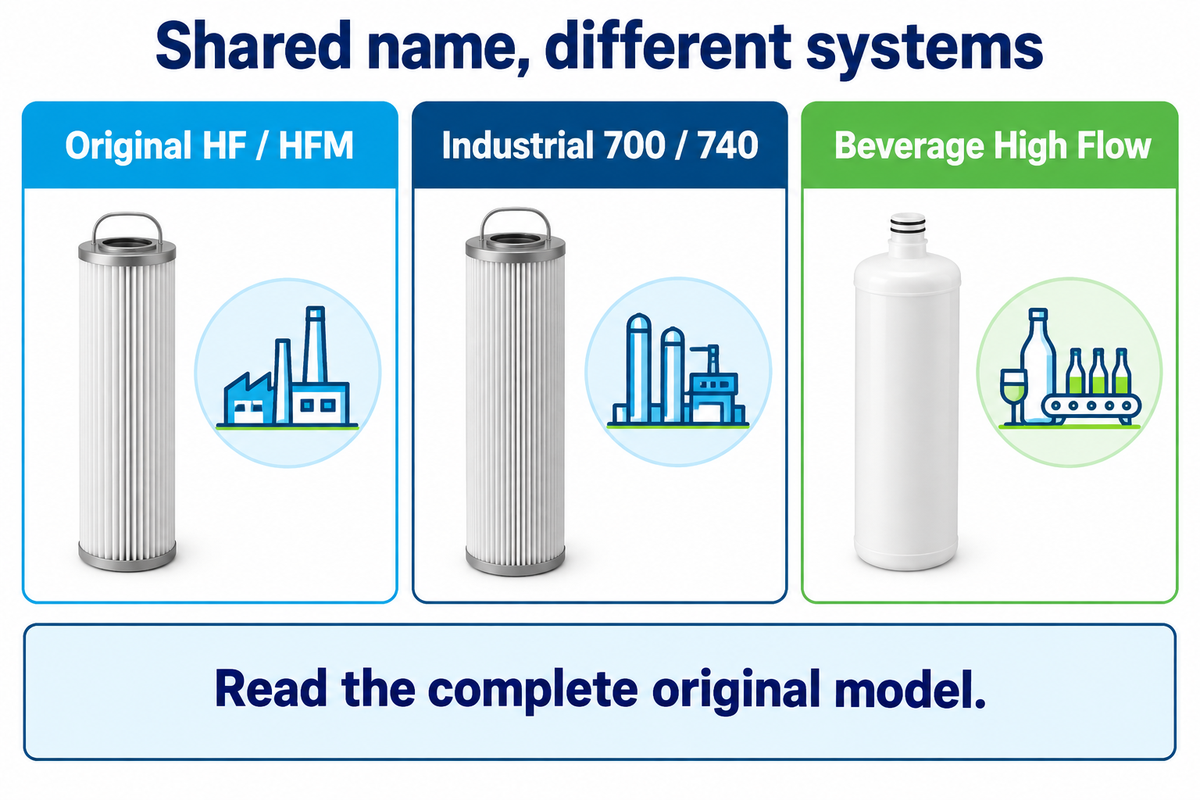
Identify the family from the complete original part number and installed system model. Industrial HF/HFM, industrial 700/740 and commercial-water High Flow products cover different markets. A shared diameter, the letters HF, or a supplier’s series name leave important differences in connection and treatment duty unresolved.
Three-Family Name Check
Prior to replacement comparisons, the Three-Family Name Check separates original industrial HF/HFM, industrial 700/740, and beverage products.
| Label or feature | What the clue means | Next distinction |
|---|---|---|
| High Flow | A shared name across industrial and commercial-water products | Use the complete original model, not the family name alone |
| Original HF / HFM | Industrial High Flow; HF and depth-media HFM are documented together | Separate the original manufacturer’s HFM from a supplier’s HFM series |
| HF60 versus HF60PP… | A beverage model and an industrial part-number pattern can start alike | Read the full suffix and the installed system identity |
| 700 / 740 | A separate industrial cartridge family | Read the 740 interface and grade; do not substitute HF specifications |
| 40 in length | A nominal length class found in different families | Compare drawing datums and installed engagement |
| 6.5 in outside diameter | A size shared by documented HF/HFM and 740 products | Diameter leaves the end connection unresolved |
| 226 connection | An interface listed for original 740 configurations | Match the actual seal and seat geometry |
| 5 micron label | A particle-size value with an unstated or stated efficiency basis | Distinguish nominal and absolute grade definitions |
| Capacity in US gallons | Often a beverage contaminant-reduction service-cycle claim | Read the contaminant, flow and approved head/manifold |
Original 3M High Flow Series HF and HFM documentation describes industrial particle filtration. Original 740 documentation belongs to the separate 700 series filter cartridge family. A replacement vendor may use HFM as its own range name; that label should be read against the vendor’s drawing and the original model rather than being translated into an original-brand cross-reference.
Some 3M water filtration products include High Flow Series replacement cartridge models for beverage foodservice water quality. Some combine a membrane and activated carbon block for particulate and chlorine taste and odor reduction. Their Sanitary Quick Change connection, often abbreviated SQC, belongs to that commercial-water system. An encapsulated cartridge design allows the complete sealed assembly to be exchanged.
High Flow Series systems connect commercial-water elements to specified heads or manifolds. Original beverage literature describes the fast and easy cartridge change-outs. The sealed, quick-change assembly eliminates the need for a filter wrench; industrial housing access is in accordance with the instructions.
The NSF High Flow Series directory ties beverage claims to particular elements and heads or manifolds. Its listed HF90 chlorine-reduction duty is 54,000 US gallons at 5 gpm. The directory expressly separates such capacity claims from mechanical filtration service life. Those values aren’t an industrial replacement-cartridge life prediction.
For an industrial plant, the most useful first distinction is the original interface and particle-removal duty. For a beverage operator, the approved system combination and contaminant-reduction service cycle also matter. A 40 in industrial element and an HF40 beverage water filter are different products despite the similar number.
How does an industrial high flow filter cartridge work?
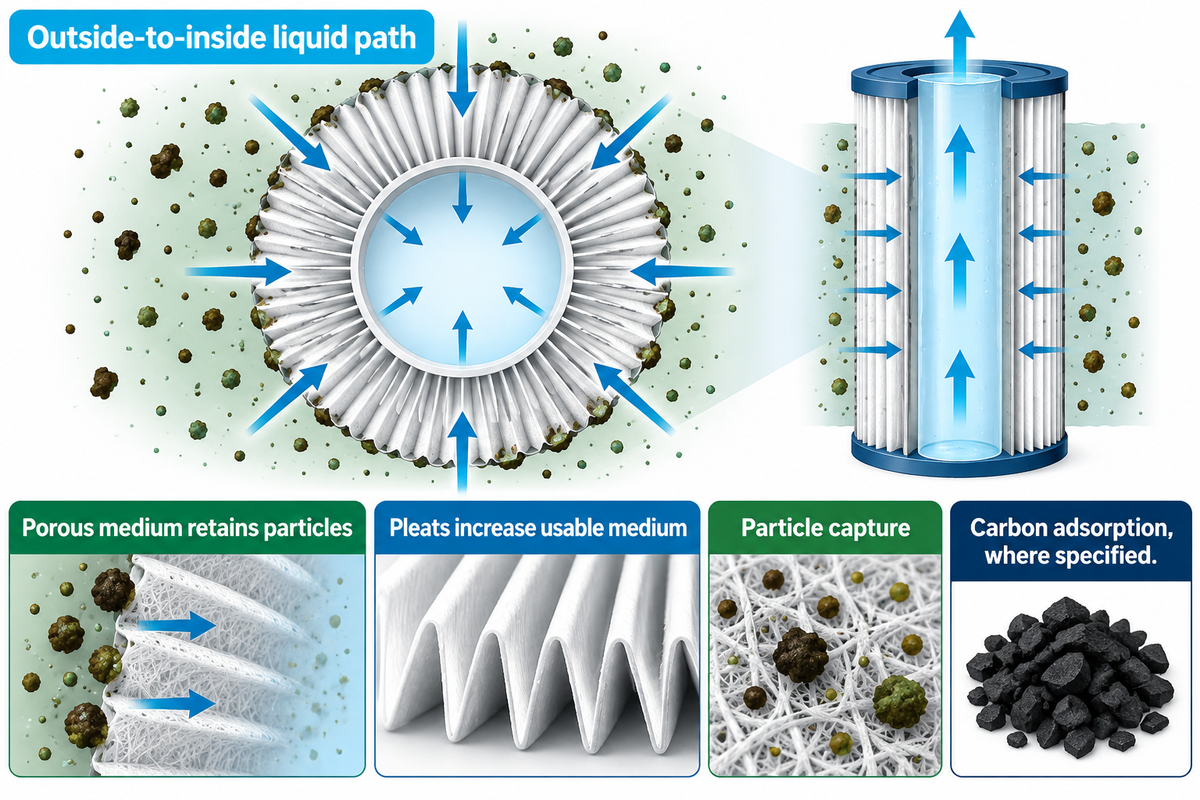
An industrial high flow filter cartridge passes liquid through a porous medium and retains particles. In an element, a liquid passes through a porous medium while retaining particles at the surface or within its depth. In an element, pleating places more usable medium inside. The cartridge’s connection must match the housing.
How do 3M High Flow Replacement Cartridges work?
Documented original industrial HF/HFM and 700/740 cartridges use an outside-to-inside liquid path. Original HF uses a different medium arrangement from depth-media HFM. In both, the choice of cartridge concerns the contaminant as well as the cartridge envelope. Equivalent geometry leaves retention and loading behavior separate.
At constant total flow, more effective surface area reduces the flow carried by each unit of medium. Pleat spacing and support determine how much of the folded material is usable. Thus, a large advertised area can coexist with a restrictive connection or an unsuitable medium. A water filtration system includes the housing and the piping, as well as the element.
NSF’s explanation of filter replacement discusses mechanical capture versus adsorption. In this filtration technology, pores can become partially obstructed by captured sediment, and flow can be slowed. Adsorptive sites can become occupied while water passes. These serve a different function from dissolved-salt separation by reverse osmosis.
For construction of a medium compare the roles of polypropylene pleated filter media with the loading behavior described in our glass-fiber cartridge guide. A nominal 5 micron choice should follow the particle target, rather than assume that all media with that nominal label behave similarly.
Why does a matching size not prove a working replacement?
A successful replacement filter requires a compatible filtration behavior as well as a mechanical interface. Nominal length and outside diameter describe only a part of the assembly. Other things, such as the location of the seal, end engagement and wetted materials, play a role in the final assembly. The retention grade and fluid conditions of the service play a role in whether a mechanically compatible element can perform the process function.
Will a replacement cartridge work in the existing housing?
Yes, when its complete interface matches the specified housing and the cartridge meets the application’s operating requirements. Original HF and HFM alternatives can share the original family’s seating arrangement, while original 740 uses its own documented interface. Compatibility should be resolved at the exact model and drawing level before a candidate moves to a plant trial.
Original HF/HFM literature describes a twist-to-lock seating mechanism and a nominal 3 in core. The original 740 family lists a 226 O-ring connection. Both document a nominal 6.5 in outside diameter. The common diameter doesn’t turn those different end arrangements into the same connection. ECOFILTRONE’s separately named replacement ranges require their own model-level matching.
NSF warns that a similar-looking replacement in a water-treatment housing can still leave a path around the cartridge when dimensions differ. That consumer-system example explains the sealing mechanism; it isn’t a failure-rate claim about industrial aftermarket products. The same distinction makes a drawing more useful than a photograph of two apparently equal-length cartridges.
Example: A maintenance buyer receives two quotes for an item marked 40 in and 5 micron. One supplier identifies the housing seat and provides a dimensioned end drawing, while the other provides only a photo of the part and an overall length. The first quote is more of a candidate; however, it’s still necessary to ascertain the retention basis and fluid compatibility prior to a trial. Purchasing can resolve missing interface information before the shutdown; operations preserves the installed housing identity. Familiar handles and/or lower prices don’t resolve connection issues. As a result, it was decided to perform the interface comparison before purchasing an undefined part and using production time to discover the difference.
The 222 and 226 end-cap guide gives connection terminology. Treat a 40 in designation as a size class; use the drawing’s measurement datums for the installed assembly. A change-out feature reduces handling effort, while a complete interface defines the fit.
What do micron ratings and test results actually establish?
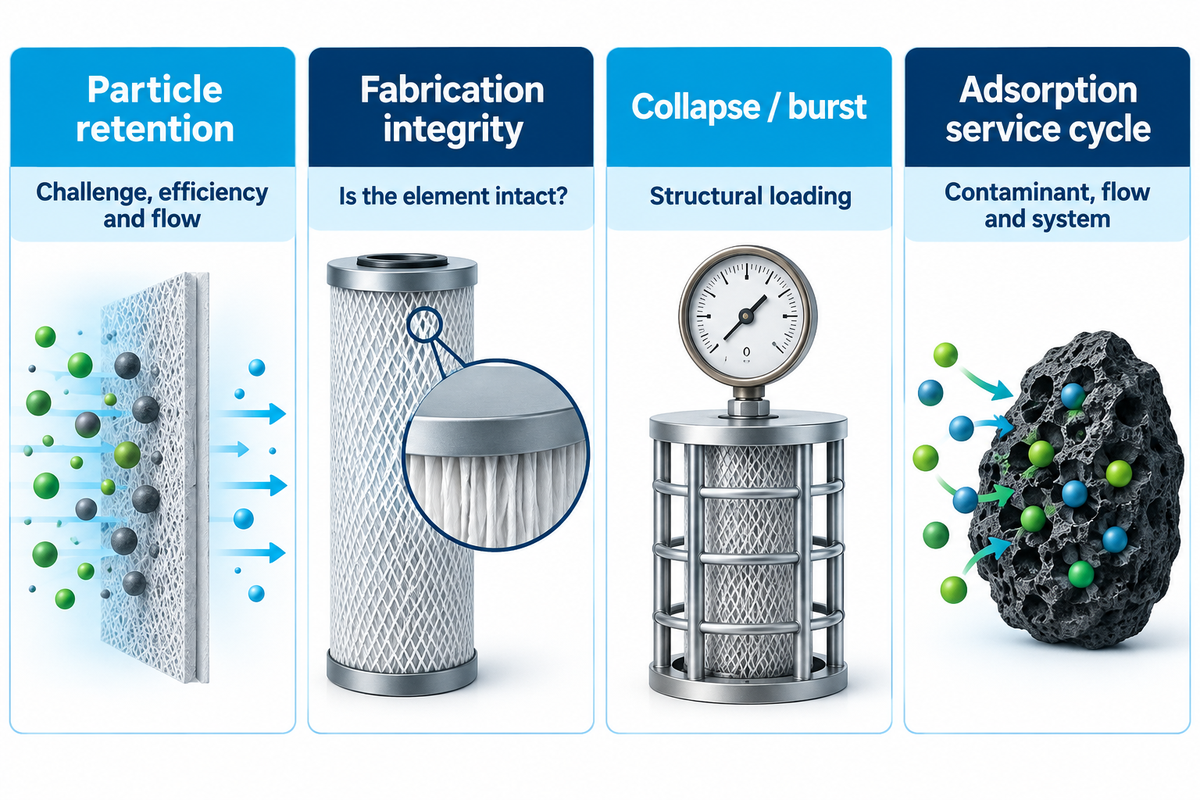
A micron rating indicates particle size under a specified retention basis. Test results become comparable when their efficiency definition, challenge and conditions are also understood. Fabrication integrity, structural endurance and contaminant-reduction capacity address different questions; therefore, one test result shouldn’t be substituted for another during replacement evaluation.
| Result | Question answered | Comparison basis |
|---|---|---|
| Particle-retention result | How much of a stated particle challenge is retained? | Particle size, efficiency definition, challenge and flow conditions |
| Fabrication-integrity / bubble-point result | Is the element intact under the named method? | Wetting fluid, construction and method-specific acceptance criteria |
| Collapse / burst result | What differential-pressure loading can the structure withstand in the test? | Pressure direction, fluid, temperature and test procedure |
| Adsorption service-cycle claim | How long can a specified contaminant-reduction duty continue? | Contaminant challenge, rated flow and specified system configuration |
The original HF/HFM ordering guide identifies a 5 µm nominal depth-media grade, also stated as 70 µm absolute. Those definitions state different retention bases and aren’t contradictory to each other. A quotation that states only 5 micron omits information that a quality engineer needs to assess the offered grade.
ISO 2942:2018 specifies a fabrication-integrity and first-bubble-point method for hydraulic fluid-power filter elements. The public abstract explicitly distinguishes the integrity information from retention performance.
“cannot be used to estimate filtration rating, efficiency or retention capacity”
Third-party reports should identify the tested model and the stated method. A method used for hydraulic elements needs its own applicable construction and test conditions. Naming the standard does not turn an industrial water cartridge into a tested hydraulic element. Similarly, ISO 2941:2009 addresses collapse/burst pressure rating in hydraulic filter elements; that mechanical question differs from particle removal.
Example: a count-based trial measures 10,000 particles upstream and 10 downstream in the same stated size class. Removal is (10,000 − 10) ÷ 10,000 × 100 = 99.9%. If the downstream count is 100, removal is 99%. The second result passes ten times as many particles in that class. Even though both results may carry the same micron label, their outcomes are different. Quality staff would also compare particle challenges, sample volumes, and flow conditions before interpreting the two runs the same way. This arithmetic illustrates retention interpretation; a separate integrity result answers a different question about the element’s construction.
The filter micron rating terminology is developed in the rating guide. The label is based on a percentage and test basis at a 5 µm threshold. A smaller nominal number alone doesn’t set a process quality target.
How should flow rate and differential pressure be read together?
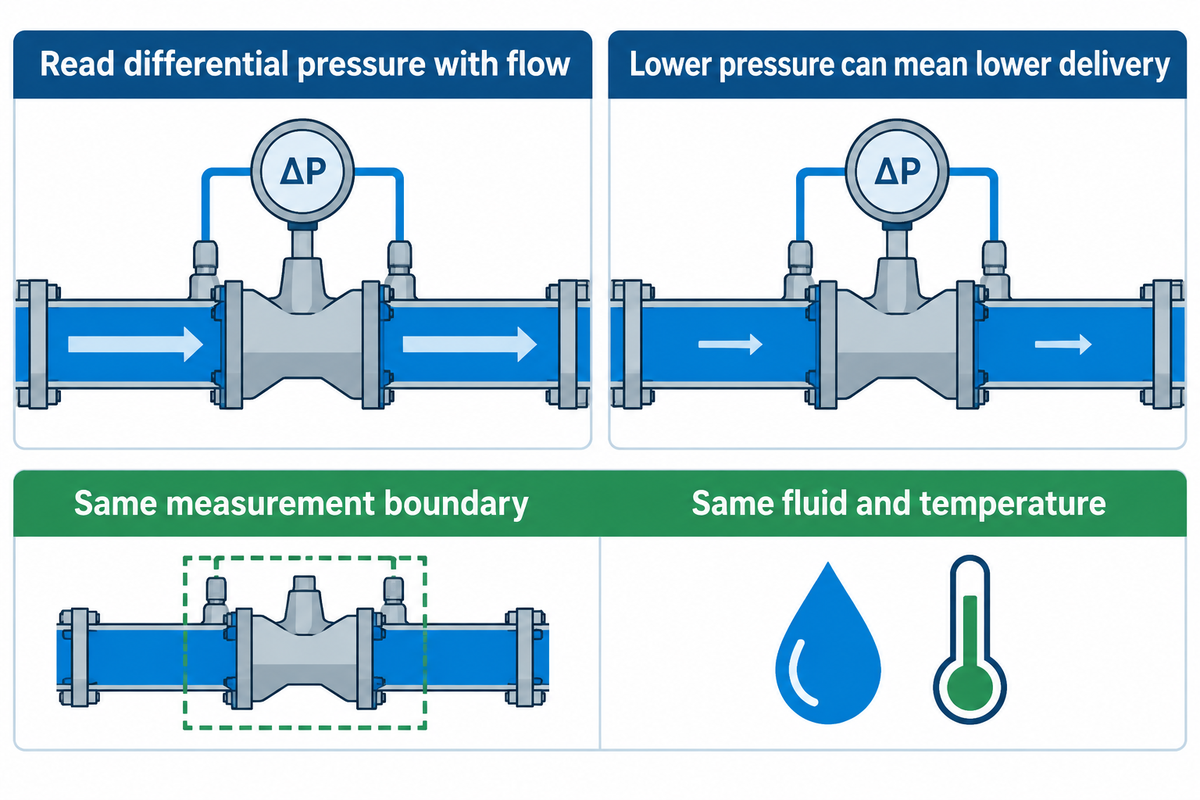
Interpret differential pressure alongside measured flow and fluid conditions. A lower reading may reflect reduced delivery rather than an improved cartridge because pressure loss changes with resistance and operating duty. Compare the same measurement boundary, fluid and temperature, and distinguish cartridge differential-pressure limits from the housing’s pressure rating.
Differential pressure is the pressure upstream minus the pressure downstream across the stated measurement boundary. Inlet pressure is measured by a single inlet gauge. Pressure taps across a vessel include assembly losses; a cartridge-only clean water curve describes a tighter boundary.
For the original 3M™ High Flow Series HF/HFM family, the manufacturer’s guide recommends a changeout differential of 35 psid, and a maximum forward differential of 50 psid at 20°C. As with the changeout differential, the forward differential has a different purpose. They’re original-family specifications, not universal settings for 3M High Flow Replacement Cartridges from a different supplier.
35 psidOriginal HF/HFM recommended changeout
50 psidOriginal HF/HFM maximum forward differential
20°CTemperature attached to those original values
| Observed comparison | Possible constraint | Record that separates it |
|---|---|---|
| Lower ΔP with lower m³/h | Reduced delivery rather than lower resistance | Flow and pressure at the same operating duty |
| Higher ΔP after water cools | Changed fluid conditions as well as loading | Temperature and the applicable clean-water curve |
| Longer interval after upstream treatment changes | Lower contaminant load reaching the cartridge | Feed-quality and pretreatment records |
| Stable flow but lost carbon-treatment duty | Adsorption endpoint rather than visible clogging | The model’s rated service cycle and treatment-performance result |
Consider a 0.30 bar pressure loss at 80 m³/h, followed by a 0.20 bar pressure loss at 50 m³/h. Lower pressure losses have arrived with lower flow rates; that pair can’t isolate a cartridge benefit. A directly matched comparison at 80 m³/h would help answer the hydraulic question. Temperature of the fluid, the valve state and the condition of the feed should also be included.
Replacement timing also deserves consideration from an economic perspective. Farhat and colleagues’ desalination study considers the costs associated with rising pressure loss under different electricity tariffs. The plant-specific findings from their study suggest looking at energy and output together rather than stretching every run to the element’s structural limit.
What do faults after a cartridge change tell you?
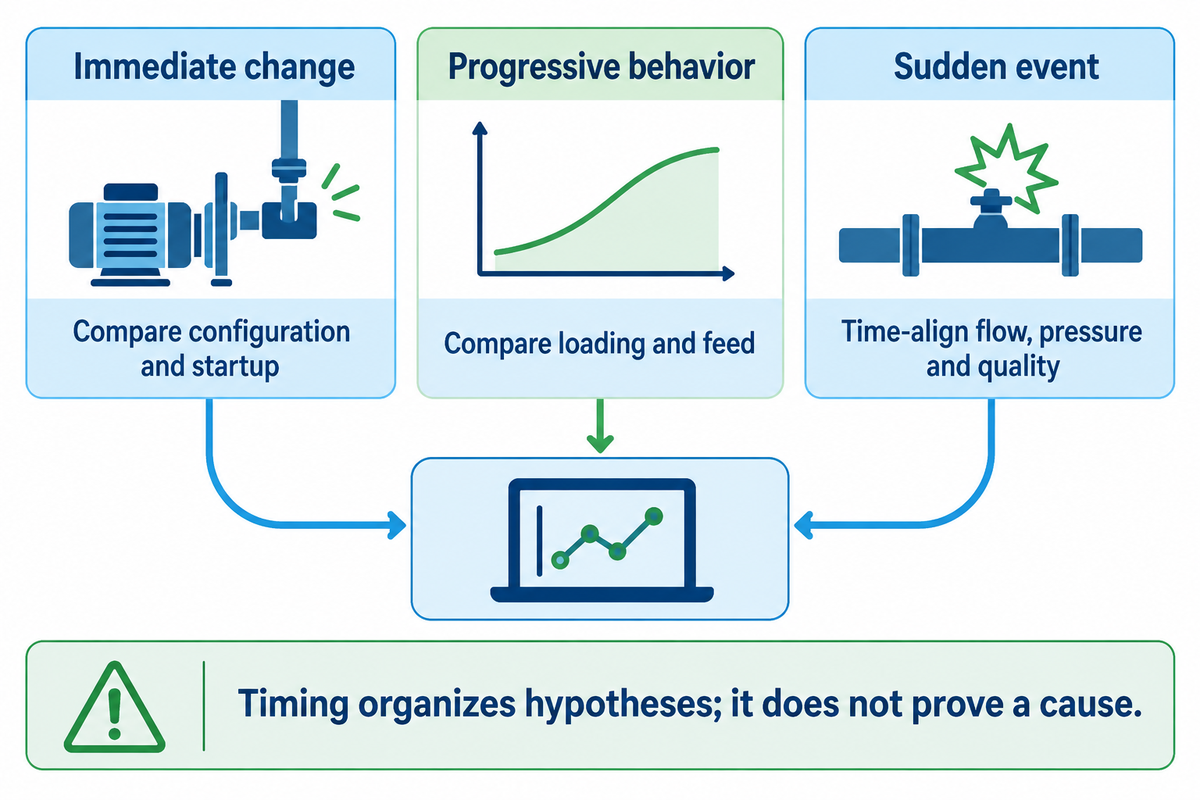
Fault timing generally helps organize the next observations, but it doesn’t identify a cause. An immediate change suggests comparison to both the installed configuration and the startup condition. Progressive behavior suggests comparison to loading and feed conditions. A sudden event calls for a time-synchronous record of the process, plus measurements of flow and quality.
Changeout Fault Timeline
The Changeout Fault Timeline groups symptoms by when they occur and provides alternative possibilities and observations that can separate them.
| Timing and symptom | Competing explanations | Observation to compare |
|---|---|---|
| Immediately: high pressure loss | Wrong grade, greater resistance, changed valve state or flow | Clean baseline at the same measured duty |
| Immediately: low delivery | System restriction, valve position or changed pump duty | Flow, upstream/downstream pressure and operating state |
| Immediately: poorer particle result | Different retention grade, sealing problem or sampling contamination | Model/grade record, seating record and comparable samples |
| Progressive: rising ΔP at steady duty | Accumulating solids or changing feed/fluid conditions | Temperature, feed quality and cumulative accepted volume |
| Progressive: shorter runs | More incoming solids or a different replacement’s loading behavior | Upstream-treatment history and matched-duty run records |
| Suddenly: lower ΔP after an event | Lower flow, a bypass path, element damage or measurement change | Independent flow and quality readings; authorized inspection |
| Suddenly: higher ΔP | Feed upset, transient loading, changed flow or measurement error | Event log against pressure and feed-quality timestamps |
| Quality change with little ΔP change | Different retention or an adsorptive endpoint in carbon systems | The actual treatment target and relevant test |
| Erratic readings | Unsteady duty, instrument/impulse-line behavior or an intermittent process event | Time-aligned flow, pressure and operating-state data |
Production shouldn’t accept a batch merely for low pressure, nor reject a batch solely because a symptom appeared after the change, e.g. an upset. Before/after comparisons require the same basis of sampling and the recorded operating state. Inspection of equipment should follow the site’s authorized maintenance procedure and the housing instructions.
A named published example shows why the upstream history matters. In the pretreatment case described in Brad Buecker’s 2022 article, cartridge replacement intervals changed from every two to three weeks to every two to three months after upstream microfiltration was introduced. The change concerned the treatment train, rather than proof that a different cartridge lasted longer.
Carbon-treatment duty adds another endpoint. NSF describes adsorption exhaustion as less visually obvious than clogged pores and falling flow. A beverage cartridge’s stable pressure trend therefore shouldn’t extend its rated contaminant-reduction service cycle. For an industrial particle filter, the relevant quality endpoint is the one agreed for that actual process.
How can a plant trial support a replacement decision?
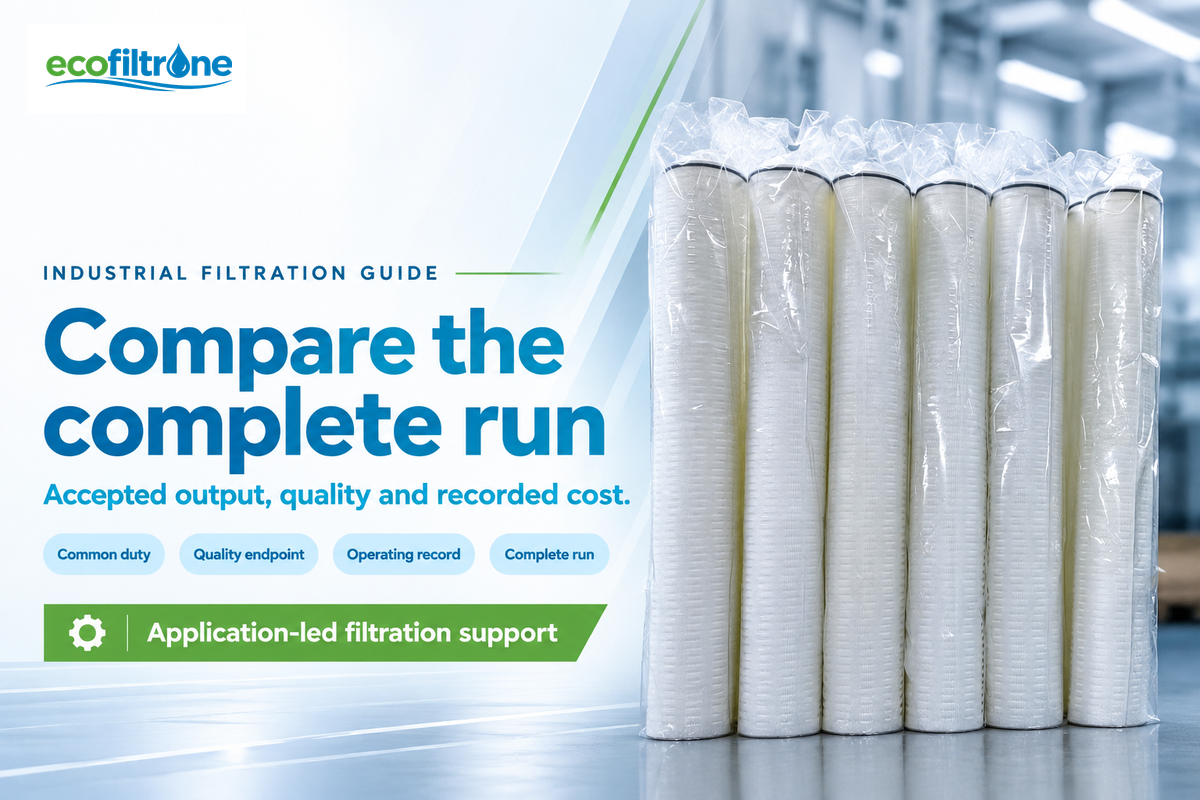
Trials should compare candidates under a common duty and record the volume that meets the agreed quality requirement. Operators need practical flow and pressure records; similarly, quality personnel need comparable filtered water results. Procurement and finance need the full run cost and accepted output, as opposed to just the cartridge price.
The 2020 Farhat et al study reported seven types of cartridge at a full-scale desalination plant, with cartridge-filtration costs of 1.22 to 1.70 eurocents/m³ alongside variations in produced volumes and final product quality. These historical data enable understanding of the reasons why plant-specific data on produced volume and quality influence purchasing decisions.
- Define the common duty. Record the installed system and the fluid, flow range and feed condition being compared.
- Agree the quality endpoint. Use the actual process requirement and a consistent sampling method.
- Keep the operating record. Link cumulative accepted volume to pressure, flow and changes in upstream treatment.
- Review the complete run. Compare accepted output, intervention history and cost before the next order decision.
Example: candidate A costs $120 per element plus $30 per change and delivers 10,000 m³ of accepted water per run. Its defined comparison cost is $150 ÷ 10,000 = $0.015/m³. Candidate B costs $90 plus the same $30 per change but delivers 6,000 m³: $120 ÷ 6,000 = $0.020/m³. In this example, B has the lower element cost and the higher cost on an accepted-volume basis. Energy, disposal and downtime would be added where measured; they’re excluded from both sides of this example. A quality failure changes the accepted volume denominator, so total pumped water isn’t automatically the right purchasing comparison.
Reliability records should include all unplanned changeouts as well as full run intervals. A commercial review can then resolve the real tradeoff among a lower-cost element, more frequent interventions, and a different acceptable run length. Related construction context for this decision is given in ECOFILTRONE’s depth-cartridge guide . A different medium should, however, always be judged against the same required output quality.
Industry outlook: what should buyers retain when supplier names and standards change?
Keep the identity of the complete model, document revisions, and the actual certificate holder and scope. Business names and standard editions may change while equipment in service remains the same. A purchase record should keep the original product reference separate from the offered replacement, its drawing, and the qualification which applies to that item.
Thermo Fisher Scientific announced completion of its acquisition of Solventum’s Purification and Filtration business on September 2, 2025. The transaction excluded Drinking Water Filtration. Thus, 3M and CUNO legacy references should be read in the correct product context; a changed business name doesn’t define an aftermarket cartridge’s interface.
ISO 9001:2026 was published on September 16, 2026. It concerns the quality management system of an organization. Arrangements of certification bodies cover the organization’s transition; the new edition does not connect a new product-performance result to a cartridge.
NSF listing scopes also differ. The NSF directory’s material-only component example distinguishes component material requirements from the listed system’s treatment claims. That unrelated listing illustrates the distinction; it isn’t a certificate for the products discussed here. The Centers for Disease Control and Prevention’s water-filter guidance likewise directs readers to the specific product’s certified removal claims.
Customer needs set the acceptance endpoint: particle control for a process stream or specified contaminant reduction for a beverage system. A distributor’s quotation should identify the proposed element against the installed system. For a technical inquiry provide complete original cartridge and housing models, proposed replacement drawing, fluid conditions and required outlet quality. Confirm the seal interface and the test basis. If certification is required, identify the certificate holder and model, the system combined with the proposed element, and the claim covered.
ECOFILTRONE™ is an industrial filtration product supplier located in Qingdao, China. We assist with application evaluation and selection, replacement matching, and customized configuration. For a defined candidate and commercial follow-up, use our 3M High Flow replacement cartridge solutions page. Manufacturer names identify replacement references; ECOFILTRONE is an independent supplier.
Key takeaway
A 40 in size label starts the comparison. The original family, complete interface and measured process duty determine whether a replacement candidate can move forward.
Discuss the installed system
Send the original model, housing details and operating conditions for replacement-matching support.
Frequently Asked Questions
How often should I replace my 3M cartridge?
Use the exact model’s service criteria and the process-quality requirement.
How the replacement interval is determined
For industrial particle filtration, track differential pressure at a comparable duty, flow delivery and outlet quality. The original cartridge’s recommended changeout condition differs from its maximum structural rating. Beverage carbon products also have specified contaminant-reduction service cycles. Follow the installed system’s applicable instructions and the plant’s operating procedure; a calendar interval from another cartridge family isn’t transferable.
Can a used industrial high flow cartridge be repaired?
Replace a damaged disposable element; use a documented regeneration procedure only for an element designed for reuse.
Why a repair is a separate qualification question
Patching medium or altering an end cap changes the flow path, seal or particle barrier. A repaired appearance supplies no comparable retention result. The correct route for an abnormal disposable element is removal from service under the plant’s procedure and investigation with the supplier. Cleaning permission for a purpose-built reusable filter doesn’t transfer to a disposable pleated cartridge.
Can high flow replacement cartridges be recycled?
Some material streams may be recoverable, but the captured contamination determines the disposal route.
What controls end-of-life handling
A polypropylene construction label doesn’t describe everything left in a used element. Residual process chemicals and captured solids affect handling and whether a recycler can accept the material. Keep used cartridges within the site’s waste-management process and the receiving facility’s acceptance criteria. Clean packaging and contaminated filter media may require different collection routes; neither universal recyclability nor ordinary-bin disposal should be assumed.
What is NSF certification?
NSF certification covers the named product or system against specified requirements.
Read the scope as well as the mark
For water filtration products, identify whether the listing covers material requirements, a component or a particular system’s contaminant-reduction performance. A brand name or a mark alone leaves those distinctions unresolved.
Where are replacement cartridges manufactured?
They’re supplied from different manufacturing facilities; the offered product’s manufacturer and lot records identify its origin.
Separate supplier location from product origin
ECOFILTRONE is based in Qingdao, China. A supplier address and a cartridge’s production origin are different records. Use the agreed product documentation for the specific order.
Related reading
- ECOFILTRONE high flow cartridge range
- Nominal and absolute micron-rating terminology
- Polypropylene pleated cartridge construction
References & Sources
- High Flow Series certified product and configuration listings, NSF.
- Changing Water Filters, NSF.
- ISO 2942:2018 public abstract, International Organization for Standardization.
- ISO 2941:2009 public abstract, International Organization for Standardization.
- Farhat et al., Cartridge filter selection and replacement, Desalination 473 (2020), TU Delft Research Portal.
- High-purity water treatment: Using membranes to protect membranes (2022), Brad Buecker, Water Technology.
- ISO 9001:2026, International Organization for Standardization.
- Example of system claims and material-only component scope, NSF.
- About Choosing Home Water Filters, Centers for Disease Control and Prevention.