Get in touch with ECOFILTRONE™ Company



The main types of filter cartridges for liquids include melt blown, string wound, pleated, membrane and activated carbon elements. High flow designs handle larger duties, while resin and metal elements serve more specific purposes. Several names overlap: One cartridge can be pleated, membrane-based, and designed for a high flow housing.
Quick selection reference
Suspended solids: start with sediment media. Dissolved contaminants: choose a treatment mechanism that targets the substance. Replacement orders: match the complete housing interface and operating duty.
Updated October 2026
Use this manual to recognize a type of cartridge filter, understand the distinctions between filter media, and analyze a replacement element beyond its shape. The process examples are concerned with water treatment applications and process liquids; pool, air and domestic water systems have their own requirements.
Types of filter cartridges describe construction, media or format. Melt blown and wound elements commonly capture sediment; membranes provide defined retention, while carbon adsorbs selected contaminants. Match the removal duty before choosing a housing-compatible element.
Key points
- Pleated and depth are overlapping descriptions.
- A micron rating needs a capture efficiency and test basis.
- Carbon exhaustion and particle clogging require different replacement signals.
- Longer runtime can reduce changeouts while increasing pressure-related energy cost.
Cartridge filter types at a glance
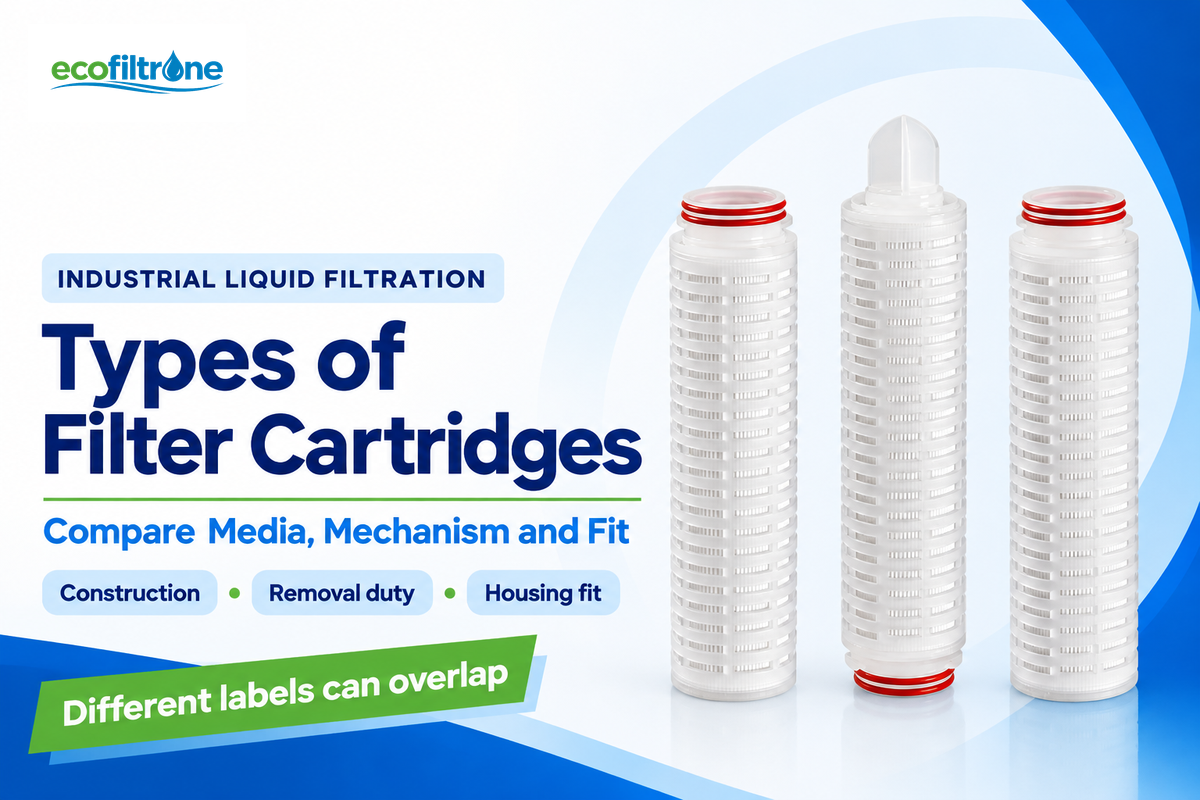
A cartridge filter holds a replaceable filter element. Construction describes the assembly of the media; material describes the media that comes in contact with the liquid; and mechanism describes how the contaminants are removed. Analyzing these attributes helps distinguish a different filter design from a different treatment function. Before analyzing prices, the quoted construction, materials and removal mechanisms should be compared.
| Label | What the name describes | Typical starting duty | Selection detail |
|---|---|---|---|
| Melt blown / spun | Fibers formed into a porous body | Suspended sediment | Density profile and tested retention |
| String wound | Yarn wound around a support core | Process-liquid prefiltration | Yarn, core and winding construction |
| Pleated fibrous | Folded sheets of fibrous media | Particle capture or polishing | Surface or depth loading design |
| Pleated membrane | Membrane sheets arranged in pleats | Fine, defined retention | Membrane grade and validation |
| High flow | Format intended for larger flow duties | Industrial water or process service | Flow curve and housing interface |
| Carbon block | Activated carbon in a formed block | Selected dissolved-contaminant reduction | Adsorption capacity and contact time |
| Granular activated carbon | Carbon granules contained in an element | Adsorption duties | Media quantity and flow distribution |
| Ion-exchange resin | Resin held in a cartridge | Specified dissolved-ion removal | Resin chemistry and usable capacity |
| Metal mesh / sintered metal | Metal filtering structure | Compatible process separation duties | Alloy, pore structure and cleaning method |
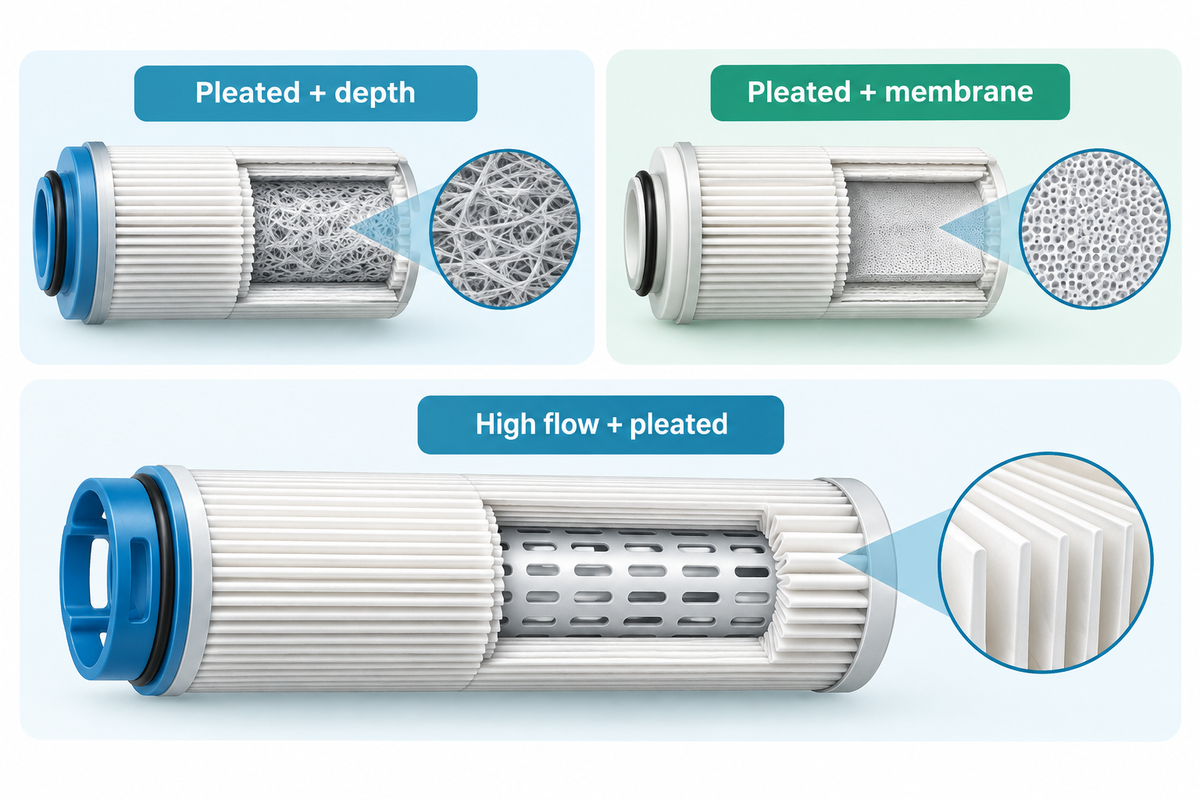
3-Pair Cartridge Overlap Grid
The 3-Pair Cartridge Overlap Grid analyzes if two labels describe different attributes of the same element.
| Pair | Can both apply? | How to read the specification |
|---|---|---|
| Pleated + depth | Yes | Pleats describe shape; a fibrous multilayer medium can capture particles through its thickness. |
| Pleated + membrane | Yes | A membrane can be folded to place more area within the cartridge. |
| High flow + pleated | Yes | The format and area support the hydraulic duty; the media still determine retention. |
For example, the 2010 pleated multilayer patent publication describes depth media formed into pleats. This document lists 3M Innovative Properties as assignee. This example of construction is separate from ECOFILTRONE’s product literature.
What are cartridge filters used for?
Cartridge filters are used to remove specific contaminants from a liquid, protect downstream equipment, or polish a process stream. A sediment element removes suspended solids, while an adsorptive element removes contaminants through adsorption. Applications of filter cartridges depend on the medium and the required outlet quality.
In a water filtration system, an upstream sediment filter can protect a later filter stage. However, a filter bed and a cartridge are separate pieces of equipment, even if both filter water. UGA Extension discusses the basics of mechanical filtration mechanisms and contaminant loading.
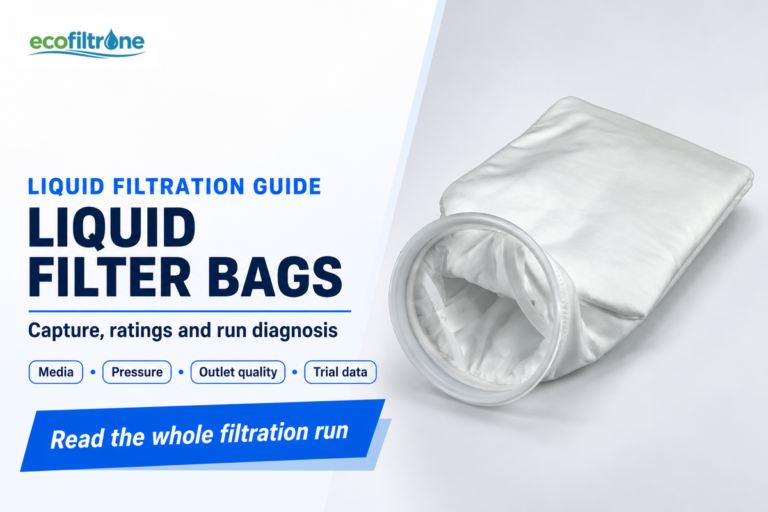
Liquid filter bags are another replaceable medium, supported in a basket. Bag housing and a cartridge housing use different supports and sealing. Consider required retention and loading when choosing a system; neither system is universally better.
Melt blown and string wound depth filters
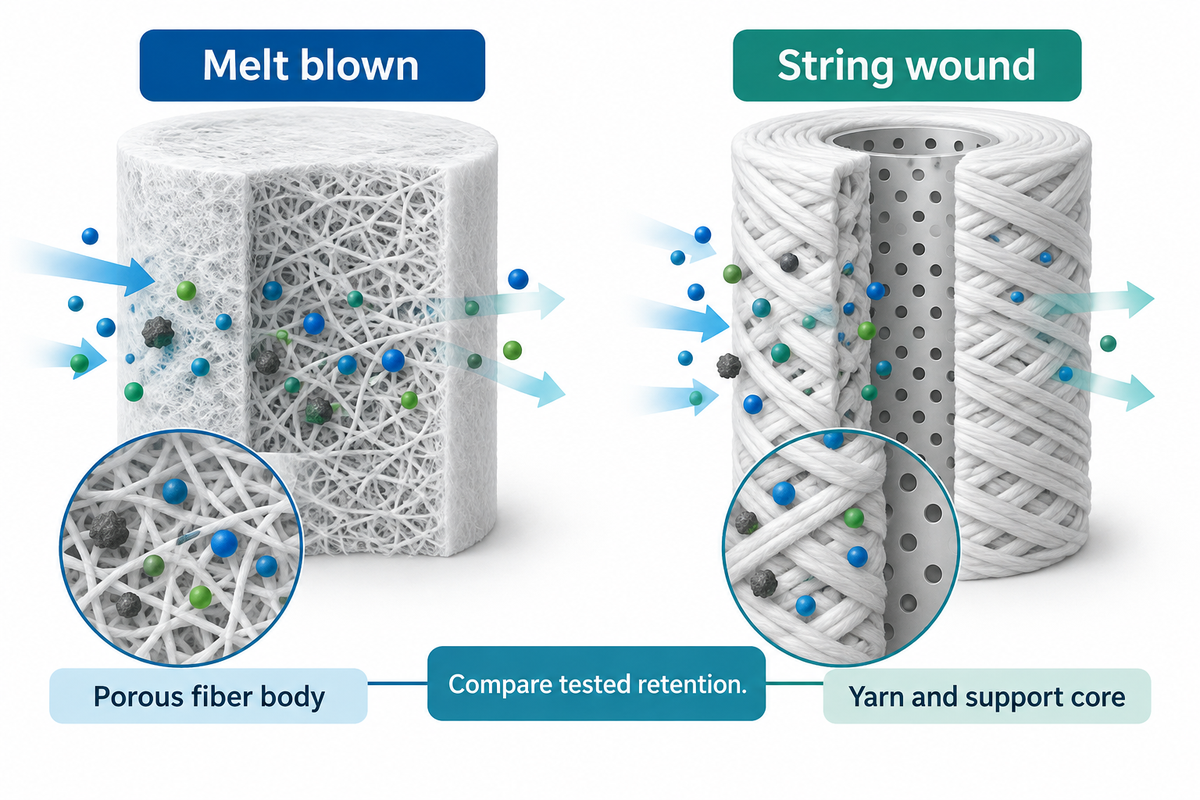
Melt blown and string wound filter cartridges are common choices for suspended sediment. Both can provide depth capture, but their retention and loading are based on actual construction, and not family name alone.
Spun filter cartridges commonly use polypropylene fibers. In some designs, pore structure varies in different regions of the wall, so larger particles may load in the upstream region. String wound elements also use a different manufacturing method.
Suppose a plant receives a batch with much more suspended material than normal. Replacing its element with a finer grade may shorten the next operating run. A larger effective filtering area or an upstream solids removal stage could address the problem more directly. This example addresses increased solids loading rather than establishing that every depth filter outlasts every pleated cartridge.
For the first comparison, hold liquid, flow and outlet quality requirements constant, and compare pressure drop and useful run time. A low cost initially becomes unattractive with higher maintenance requirements. Our depth media selection and validation guide provides further detail on this comparison.
Disposable sediment cartridge filters are normally replaced when their operating endpoint is reached. Cleaning belongs to a product-specific procedure. A white external appearance following rinsing says little about the internal fiber structure.
Pleated filter cartridges: shape and media
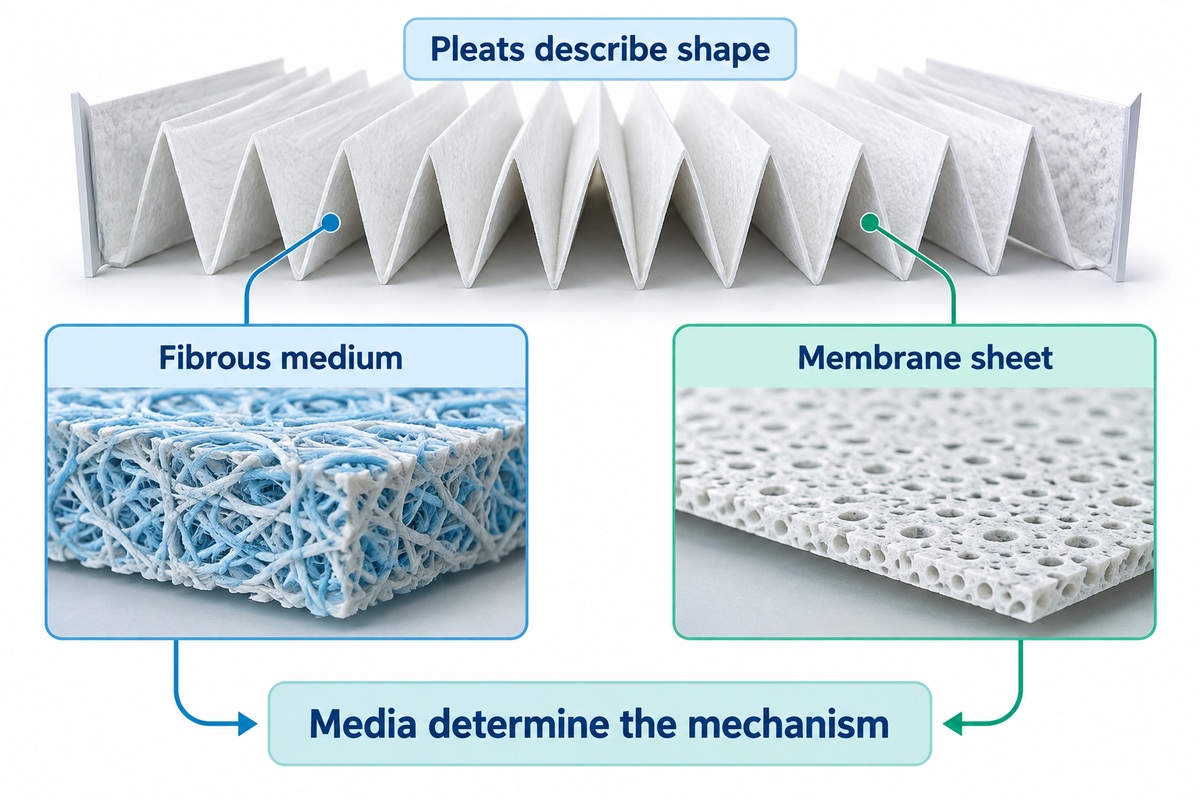
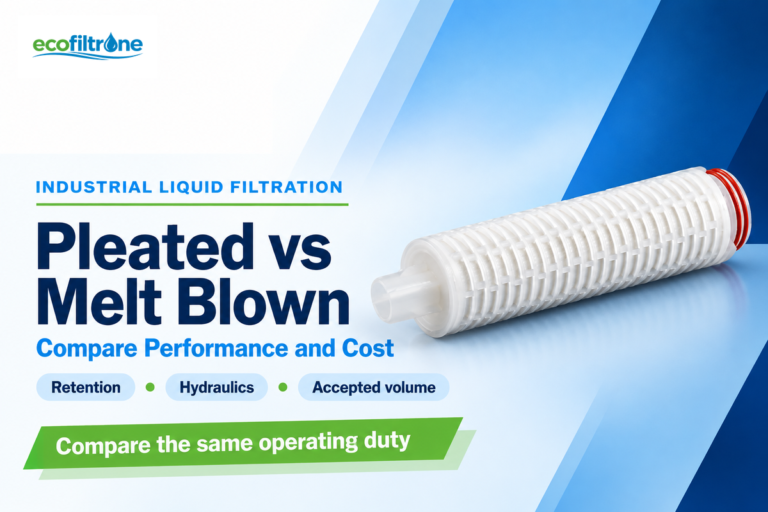
Pleated filter cartridges contain a sheet folded into a compact cylindrical shape. Folding increases the area that can fit in a space, like an accordion. Polypropylene fibers and membrane sheets can both be pleated, so the filtration mechanism isn’t identifiable from the folded appearance.
A surface filter retains much of its material close to a barrier surface. A depth-loading construction uses more of a porous medium. A pleated element can contain a depth-loading medium. Comparing “pleated vs. depth-loading” does, in effect, address two different attributes.
Pleated polypropylene fibers are a candidate for particle polishing. A membrane cartridge is a different case if a retention grade is required downstream. The number of visible pleats doesn’t establish whether that requirement is met.
A purchasing team may want to evaluate the trade-offs of switching a PP element for a similar looking membrane. That substitution may change the flow resistance, wetted materials, and handling requirements, all at the same time. Be aware of all trade-offs. See our polypropylene pleated cartridge configurations for the available product paths.
Membrane filter cartridges and retention limits
All membrane filter cartridges use a porous membrane as the primary retention layer. Materials used in construction include polyethersulfone, PTFE and nylon. Wetting and chemical compatibility play a big role. A membrane filter is often on the shortlist when a process requires retention behavior and the liquid and operating conditions are within the unit’s limits.
Material selection includes support layers, end caps and seals. A PTFE filter selected for a compatible solvent presents a very different wetting problem from an aqueous-duty membrane. Product-specific wetting instructions and fluid compatibility belong with the exact grade, rather than with the material abbreviation alone.
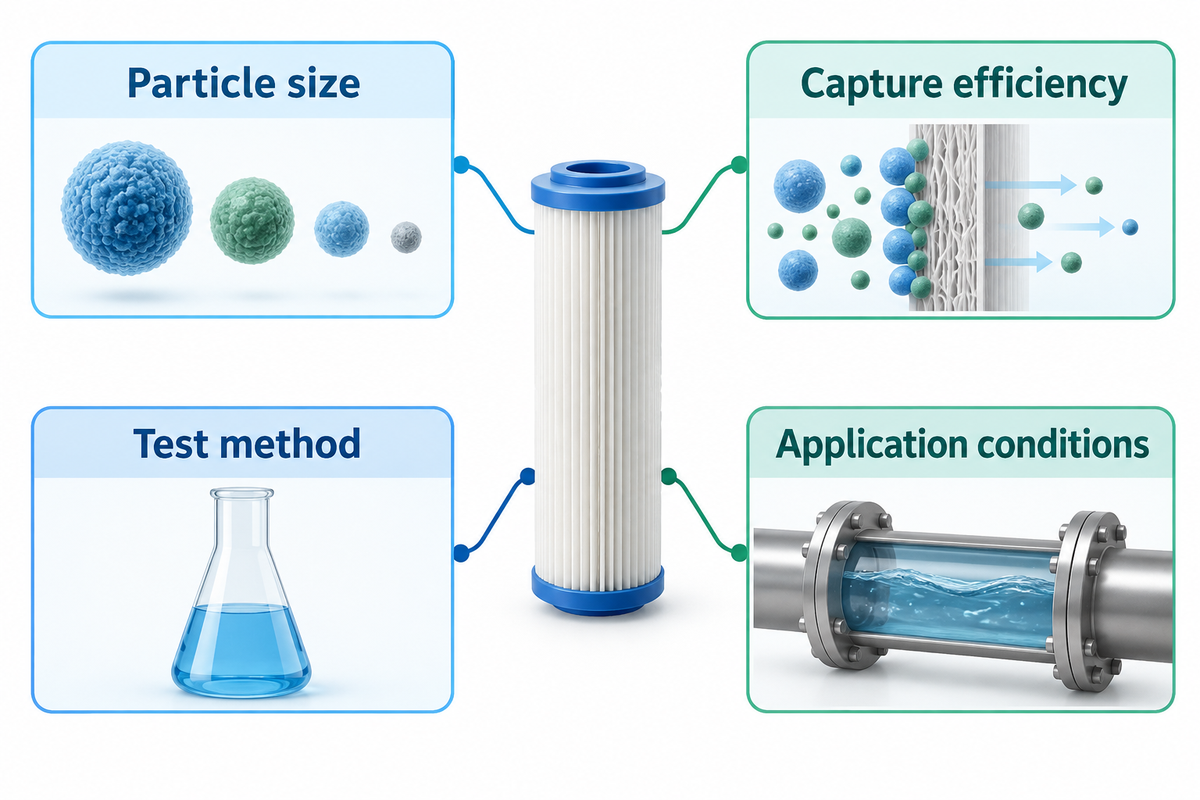
1 micrometre means a size of 0.001 mm. The cartridge rating still needs tested capture efficiency. For microbiological applications, particulate efficiency and bacterial retention tests address different questions. ASTM F838-20 describes a test method for a bacterial challenge under standard conditions. The performance of a product/process is defined by studies directed at the evaluation of the relevant application.
Nominal and absolute ratings should be interpreted against the supplier’s stated efficiency and test conditions. Labels alone don’t determine equivalent performance. Request the particle size, capture efficiency and test method together; then assess if the evidence meets the process acceptance criteria.
Reverse osmosis is another membrane process used for the separation of dissolved solids. An ordinary sediment or microfiltration cartridge upstream of a reverse osmosis unit has a completely different role. Follow the membrane cartridge performance boundaries when separating these duties.
Carbon and other specialty water filter cartridges
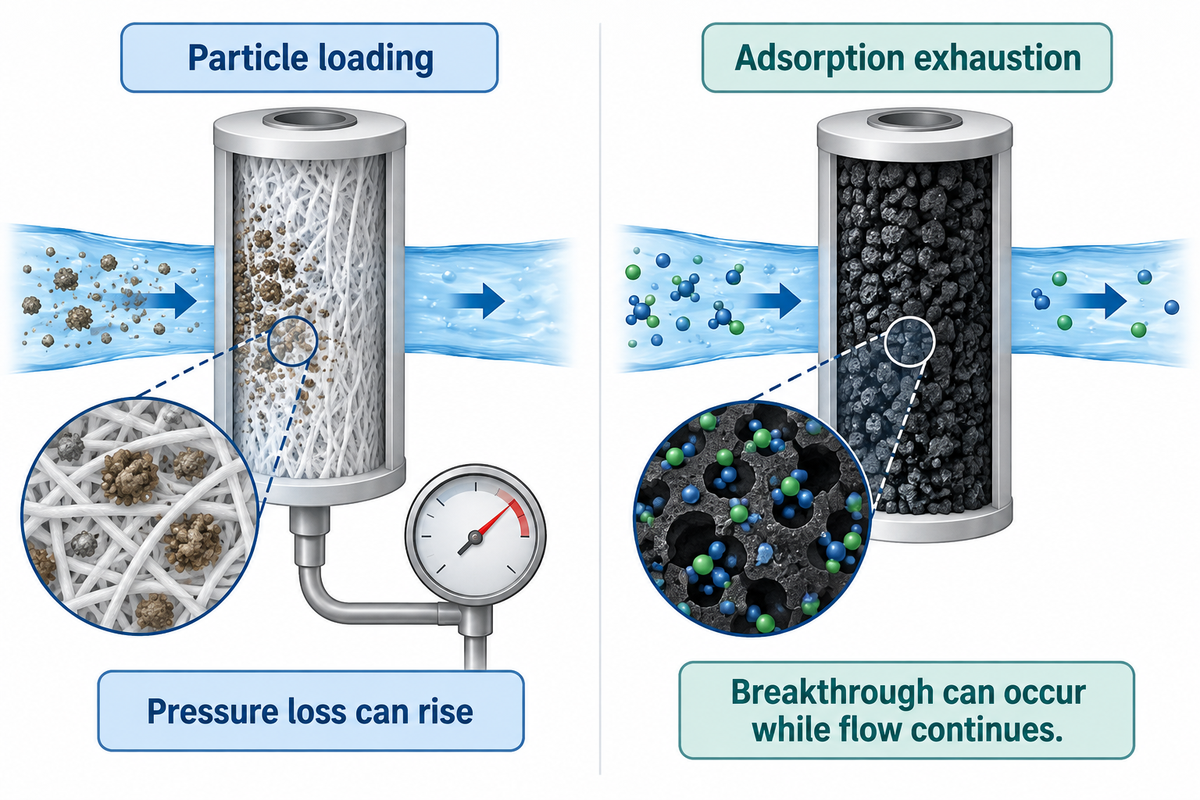
Activated carbon cartridges adsorb selected contaminants and resin cartridges exchange selected ions. Ion exchange treatment mechanisms can resolve duties that a sediment element can’t. Carbon block filters and Granular Carbon elements also vary in their contact conditions and the adsorption capacity.
What is the difference between a sediment cartridge and a carbon cartridge?
Sediment cartridges capture suspended solids mechanically and a carbon cartridge adsorbs contaminants to remove them from water. The treatment of target contaminants can determine the replacement signal. Clearer water after sediment filtration may still contain dissolved contaminants.
The U.S. Environmental Protection Agency’s treatment overview identifies activated-carbon adsorption, ion exchange, and reverse osmosis. For hardness removal, cation exchange resin removes calcium and magnesium through ion exchange. Carbon filters are a different option, and aren’t a general replacement for softening.
Particle loading
- Suspended solids accumulate in the element.
- Increasing pressure loss can limit usable flow.
- Outlet quality still belongs in the changeout decision.
Adsorption exhaustion
- Available adsorption capacity becomes occupied.
- Contaminants can break through while flow remains acceptable.
- Treatment performance and service capacity guide replacement.
“Knowing when breakthrough will occur and when to replace the cartridge is a major problem with AC treatment.”
The distinction is important because maintenance teams may rely on pressure readings to indicate replacement. Normal water flow can coexist with spent adsorption capacity. The downstream treatment design has to account for changes in water chemistry if a process employs chlorine removal.
KDF filters, ceramic elements, and other specialty media are found in household catalogs. Each of these is for a specific treatment claim and system design. They shouldn’t be used to replace industrial particulate media, just because their cartridges are of similar size. Mineral water, well water and municipal feed also present different treatment objectives. Start with the substances that a process actually needs to remove.
High flow cartridges and replacement housing fit
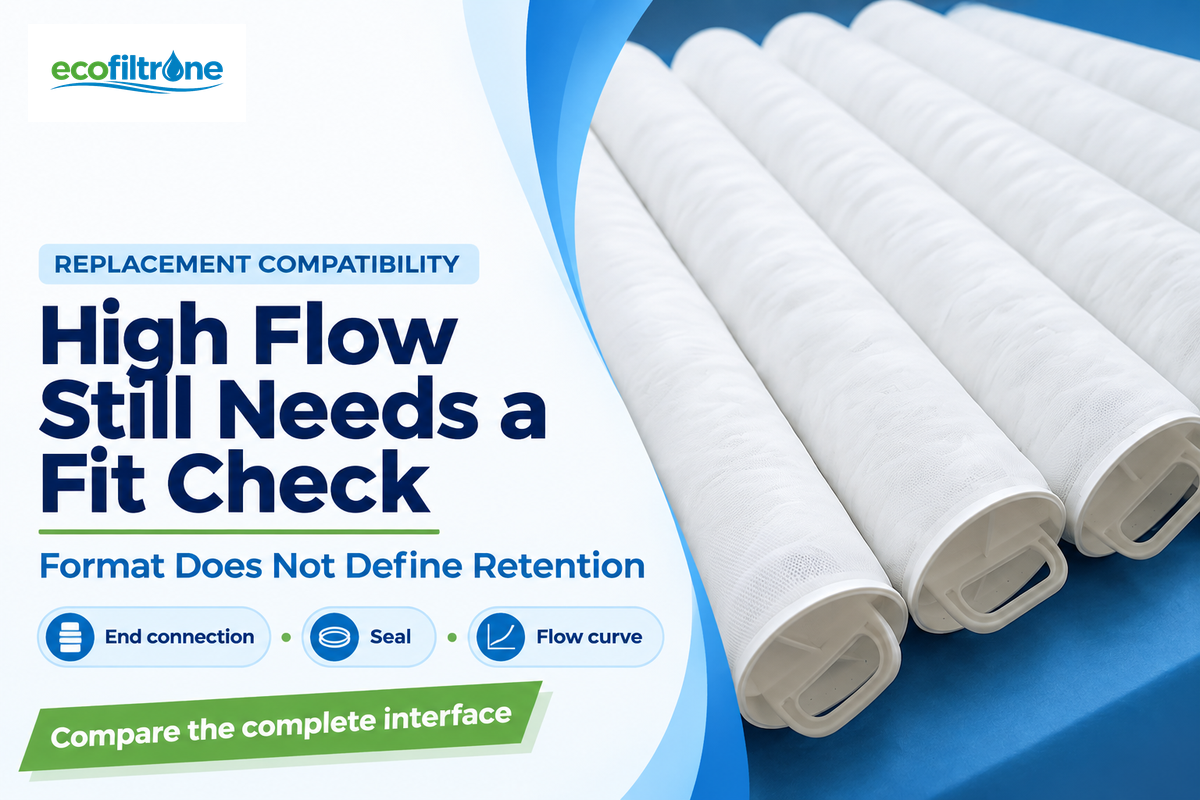
High flow cartridges pack a large filtering area into a format built to handle greater liquid flow. These permit a reduction in the number of elements in a satisfactory housing. The permitted flow still follows the medium, liquid viscosity and pressure-loss curve. Retention remains a separate product characteristic.
A high-flow label, therefore, describes a hydraulic format rather than a different type of filtration mechanism. A standard cartridge and a larger element can use the same medium while requiring different hardware. Our high-flow cartridge options group such product families.
How are water filter cartridges measured?
Water filter cartridges are defined by their effective length, outside diameter and the dimensions of their end connections and sealing surfaces. Nominal length alone isn’t adequate for replacement matching. A drawing also shows the locating features, core opening and compression or engagement required within the cartridge filter housing.
For instance, a nominal 10-inch label doesn’t include all dimensions for the seat. A DOE element has two open ends; a SOE cartridge has one open end and a closed opposite end. Connection style doesn’t dictate filter material precision. Sealing arrangement stops flow from bypassing the intended path.
The replacement cartridge guidance from NSF highlights the importance of sealing. In that consumer-water context, compatible cartridge filter housings also need suitable contact materials. For the above seals to work as designed, the correct combination of seals, hardware and wetted materials is required, in addition to apparent fit.
Industrial replacements depend heavily on comparison of existing and proposed drawings to avoid ordering an element that seats incorrectly. Our guide to end-cap and seal matching covers this interface review.
Industrial filter cartridge selection by duty
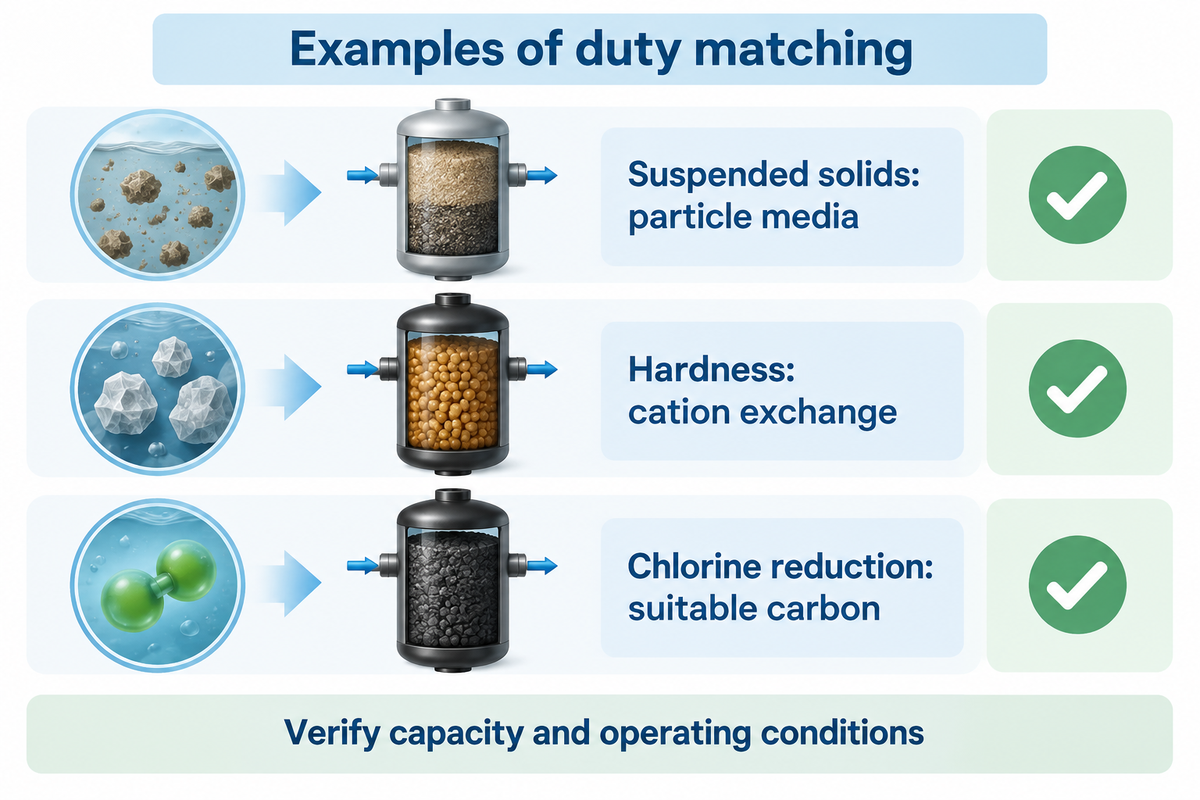
To select the right filter, start with the contaminant and downstream requirement. A depth candidate would address a different problem than a dissolved-ion treatment cartridge. Flow and chemistry would further refine the candidate. See the table for considerations for types of industrial cartridge filters.
| Duty | Candidate to compare | Hidden constraint | Who owns the next input? |
|---|---|---|---|
| Variable suspended sediment | Melt blown or wound depth | Feed-load peaks can dominate runtime | Operations: record feed changes |
| Stable particle polishing | Pleated fibrous medium | Required efficiency may differ from the micron label | Quality: define outlet acceptance |
| Fine membrane duty | Appropriate membrane grade | Upstream fouling can consume useful area | Process engineer: review prefiltration |
| Large water throughput | High flow format | Housing losses and viscosity can limit flow | Engineering: match duty to curves |
| Chlorine-reduction duty | Suitable activated carbon | Capacity and contact time control treatment | Quality: define treatment endpoint |
| Hardness removal | Suitable cation-exchange resin | Resin capacity is separate from particle retention | Process engineer: quantify ion load |
| Hot or aggressive liquid | Compatible complete construction | Seals or supports can limit the assembly | Engineering: document full exposure |
| Frequent shutdowns | Better loading capacity or pretreatment | Lower unit price can raise labor cost | Maintenance and purchasing: compare run records |
| Repeated replacement orders | Approved configuration | A changed end cap or seal can defeat interchangeability | Procurement: control the ordered configuration |
Consider two different operating scenarios. A sudden increase in solids requires a review of the feed and upstream treatment. A more viscous, cold batch may increase pressure loss even if there’s no increase in retained solids. Treating both scenarios as if the filter is too fine may result in selecting the wrong cartridge replacement.
The final filter before reverse osmosis membranes is part of the larger pretreatment train. Upstream separation and consistent feed help the cartridge do its job. Our guide to cartridge filtration before reverse osmosis explains this.
Stainless steel filter cartridges may be candidates if a specific alloy and a cleanable construction suit the process. How the element is cleaned, what’s removed and what’s left behind are part of the design. Not all elements with a metallic body are suitable for use with hot process fluids.
Cartridge replacement cost and service life
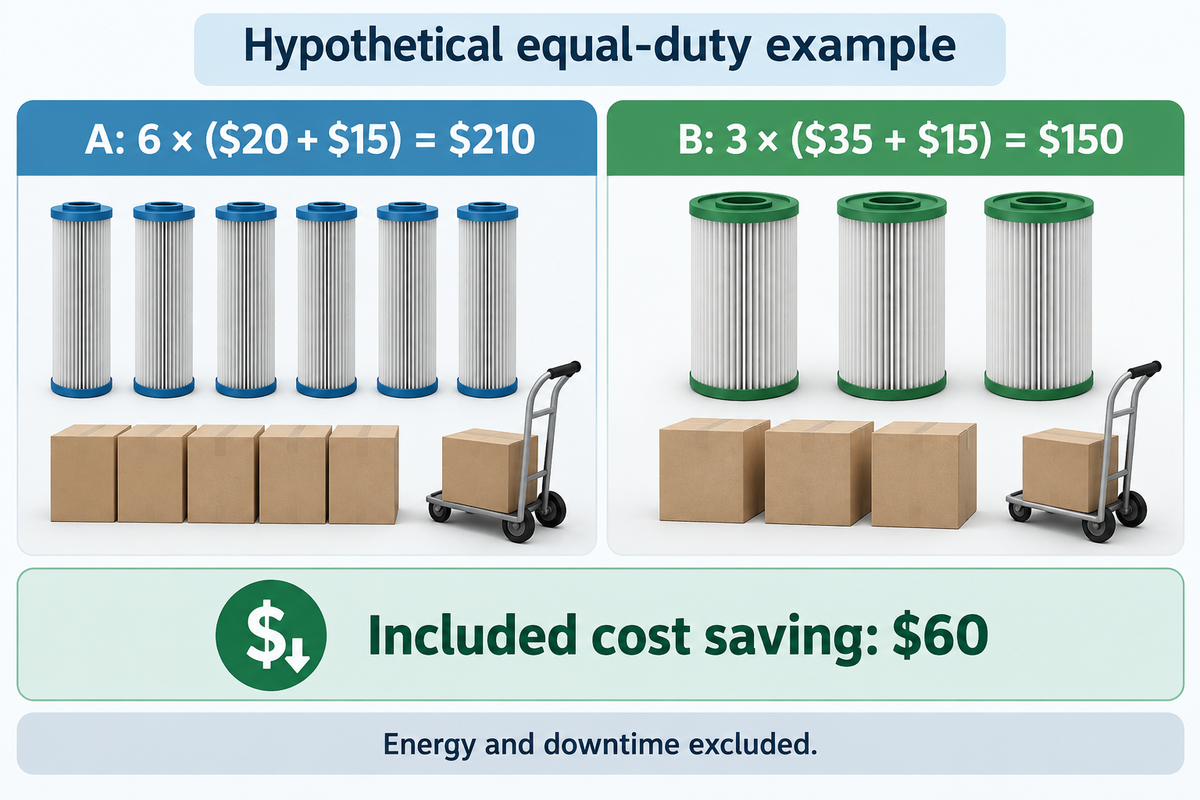
Cartridge and changeout costs should be compared for the same service duty. A more expensive element may cost less over the service life if it provides more useful runtime. Discarded element costs, lost production, and energy costs may impact the outcome of the purchase. Compare both elements under the same service conditions to choose the right cartridge.
For this cost comparison, a single cartridge position is operated for 600 hours. Both candidates meet the same requirements for outlet quality and flow. Assume A costs $20 and lasts 100 hours, while B costs $35 and lasts 200 hours. Allow $15 for handling and disposal per cartridge consumed, treating the first installed element consistently. These are examples, and the numbers are for instructional purposes only.
| Included item | Cartridge A | Cartridge B |
|---|---|---|
| Purchase cost per element | $20 | $35 |
| Useful runtime per element | 100 hours | 200 hours |
| Elements consumed in 600 hours | 6 | 3 |
| Handling and disposal per element | $15 | $15 |
| Cartridge plus handling total | 6 × ($20 + $15) = $210 | 3 × ($35 + $15) = $150 |
| Included cost per operating hour | $0.35/hour | $0.25/hour |
In this hypothetical example, B saves $60, or about 28.6% of A’s included cost. The higher unit price is balanced by fewer consumed elements. With these inputs, the long-run break-even runtime ratio is ($35 + $15) ÷ ($20 + $15) = 1.43. For a restricted operating window, round cartridge quantities up rather than buying less than a whole element.
Energy and downtime are absent in this example and aren’t represented by a zero. In a 2020 full-scale desalination study, Farhat and others assessed seven cartridge types and analyzed electricity tariffs when optimizing replacement. They illustrated how increasing pressure loss can justify an earlier replacement under some energy conditions.
Simultaneously logging outlet quality, pressure loss, flow, temperature, and runtime is good practice. Useful life ends when the applicable acceptance or changeout criterion is met. For an adsorptive element, the acceptance criteria include treatment capacity; for particle media, pressure loss alone may not indicate damage, for example, a bypass path.
Replacement filter cartridge enquiry checklist
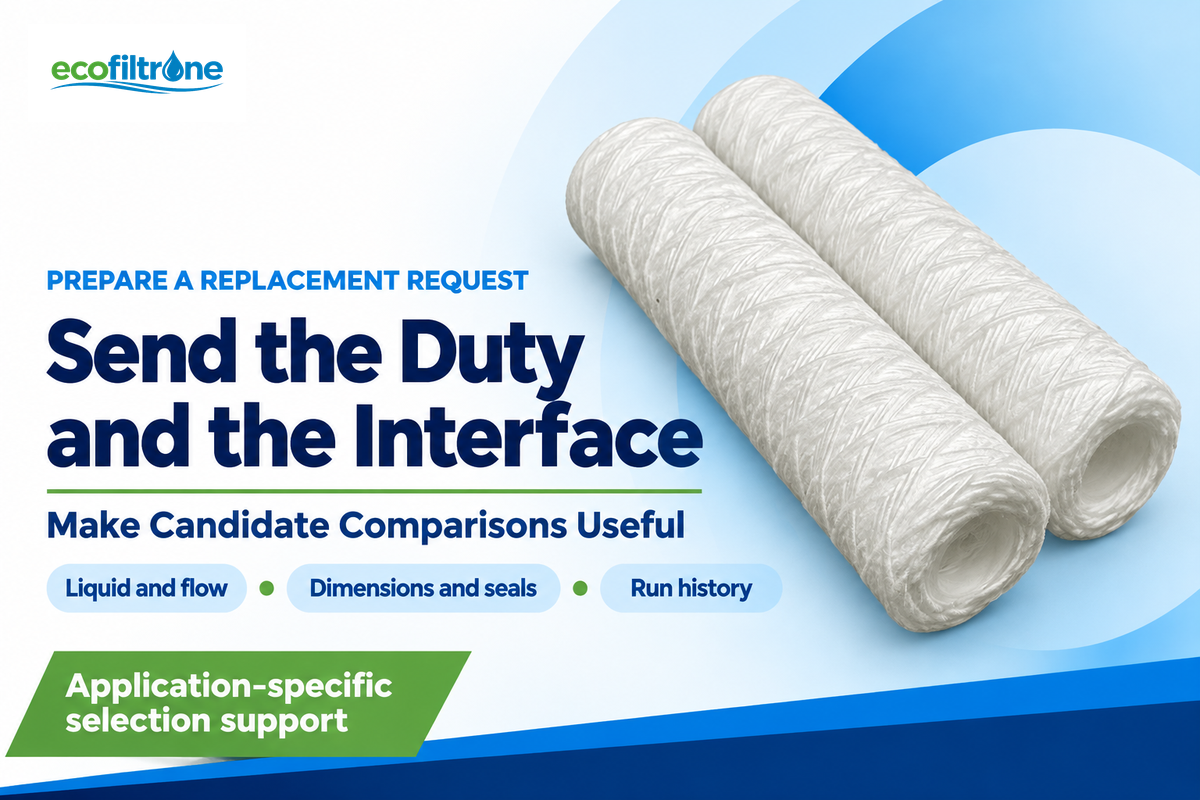
Send the liquid duty and installed interface with a replacement request. ECOFILTRONE, an industrial liquid filtration supplier, provides support on product selection, replacement and other service requests. A detailed initial request helps engineering compare candidates against the same operating requirement.
Quote measured operating ranges rather than a generic standard water description.
| Parameter | Operating range to provide | Why it matters | How to verify |
|---|---|---|---|
| Liquid and temperature | Composition and minimum/maximum °C | Media and seal compatibility | Process sheet and exposure conditions |
| Flow and viscosity | Normal/peak m³/h; viscosity at operating temperature | Hydraulic sizing | Flow record and viscosity data |
| Pressure | Line pressure and clean/terminal differential pressure in bar | Operating margin and changeout | Existing gauges and approved limits |
| Retention target | Particle size in µm and required efficiency | Comparable filtration duty | Test method and outlet acceptance |
| Installed element | Effective length, diameters and seats in mm | Mechanical fit | Model number, drawing and photographs |
| Run history | Operating hours and changeout cause | Baseline for a trial | Maintenance and quality records |
| Documents | Application-specific requirements | Product and certificate scope | Exact model, material and actual certificate holder |
Our core portfolio includes high flow, pleated, membrane, melt blown, and string wound elements, as well as industrial liquid filter bags. Prior to order, we review the application and specification. Upon order, we coordinate the provision of technical confirmation and/or inspection. After delivery, we review the element operating performance.
- Describe the duty. Send the operating information and existing element.
- Agree on a candidate. Resolve interface, media and document requirements.
- Compare the sample. Use the agreed acceptance criteria before repeat supply.
Discuss your cartridge requirement
Filter cartridge questions
When replacement parts are requested, functions, fits and service procedures determine the options. Similar looking parts can perform different treatment functions. Use the installed model and the operating requirements to determine the options and compare the complete specification before ordering.
Are all water filter cartridges the same?
No. Similar dimensions can hide different treatment functions.
Two cartridges can share a nominal length and still differ in filter media, retention efficiency, end connections, seals and flow direction. A sediment element also performs a different job from a carbon or resin cartridge. Compare the required treatment function and the complete product specification before treating either cartridge as an interchangeable replacement for the installed system.
Can I reuse or clean a filter cartridge?
Only when the exact cartridge has a supported cleaning procedure.
A cartridge that looks clean may have damaged media, altered retention or contaminated seals. Many disposable depth elements are intended for replacement. The permitted cleaning conditions, inspection requirements and post-cleaning performance belong to the product instructions. Reusing an element without that procedure can change the performance of the cartridge filter system even when flow initially improves.
Can I use a filter cartridge from a different brand in my system?
Yes, when the alternative meets the complete replacement specification.
A brand cross-reference begins the comparison. Dimensions, end configuration, seal material, flow direction, support hardware and operating limits all matter. Retention evidence must also suit the process duty. Matching the housing is only one part of selecting a replacement filter cartridge; the liquid, cleaning method and required outlet quality can rule out an otherwise similar alternative.
Are UV lamps and sleeves considered replacement cartridges?
No. They are components of ultraviolet treatment equipment.
A UV lamp and its protective sleeve don’t capture particles through porous media. Their replacement follows the ultraviolet equipment’s model and service instructions. They may appear beside replacement water filter parts in a catalog, but perform a different function.
How do I know when a cartridge filter needs replacing?
Replace it when its applicable operating or treatment limit is reached.
Differential pressure can indicate particle loading, but it doesn’t cover every failure mode. An adsorptive medium can lose treatment capacity before pressure rises substantially. Record outlet quality, flow, differential pressure and operating hours alongside the supplier’s changeout criteria. Investigate unusually short runs for feed changes, undersizing or bypass rather than assuming a finer or more expensive element will solve them. The replacement endpoint should remain consistent throughout a comparison trial.
Do all reverse osmosis systems use the same replacement filters?
No. System interfaces and treatment stages differ.
Reverse-osmosis systems use different housings, membrane formats, connections and pretreatment arrangements. A sediment cartridge and an RO membrane may both be replaceable parts, but their removal mechanisms differ. The installed model and each element’s function identify the correct replacement path.
Why isn’t a sediment filter typically used as a standalone filter cartridge?
A sediment element alone works only when particle removal meets the entire duty.
A sediment cartridge removes suspended material according to its actual retention performance. Dissolved salts or chemicals can require a different treatment mechanism. Water purification often combines several types of filtration systems because the required water quality involves more than visible clarity. A process needing only particle removal may use a single suitable stage; a water supply with additional treatment targets needs those targets addressed separately.
The illustrative worked example employs stated assumptions. Technical references explain operating principles, mechanism, and selection rationale; product specification and documentation define the configured product for the defined application.
References & Sources
- Pleated multi-layer filter media and cartridge patent publication US20100089819A1, listed assignee 3M Innovative Properties, 2010.
- Mechanical Filtration: Methods and Devices University of Georgia Extension.
- ASTM F838-20 ASTM International, public scope and significance.
- Overview of Drinking Water Treatment Technologies U.S. Environmental Protection Agency.
- Home Water Treatment Using Activated Carbon Michael Kamrin and co-authors, hosted by Purdue Extension, 1991.
- Changing Water Filters NSF.
- Cartridge filter selection and replacement: Optimization of produced water quantity, quality, and cost Farhat and colleagues, Desalination, 2020; public abstract hosted by TU Delft.