Get in touch with ECOFILTRONE™ Company



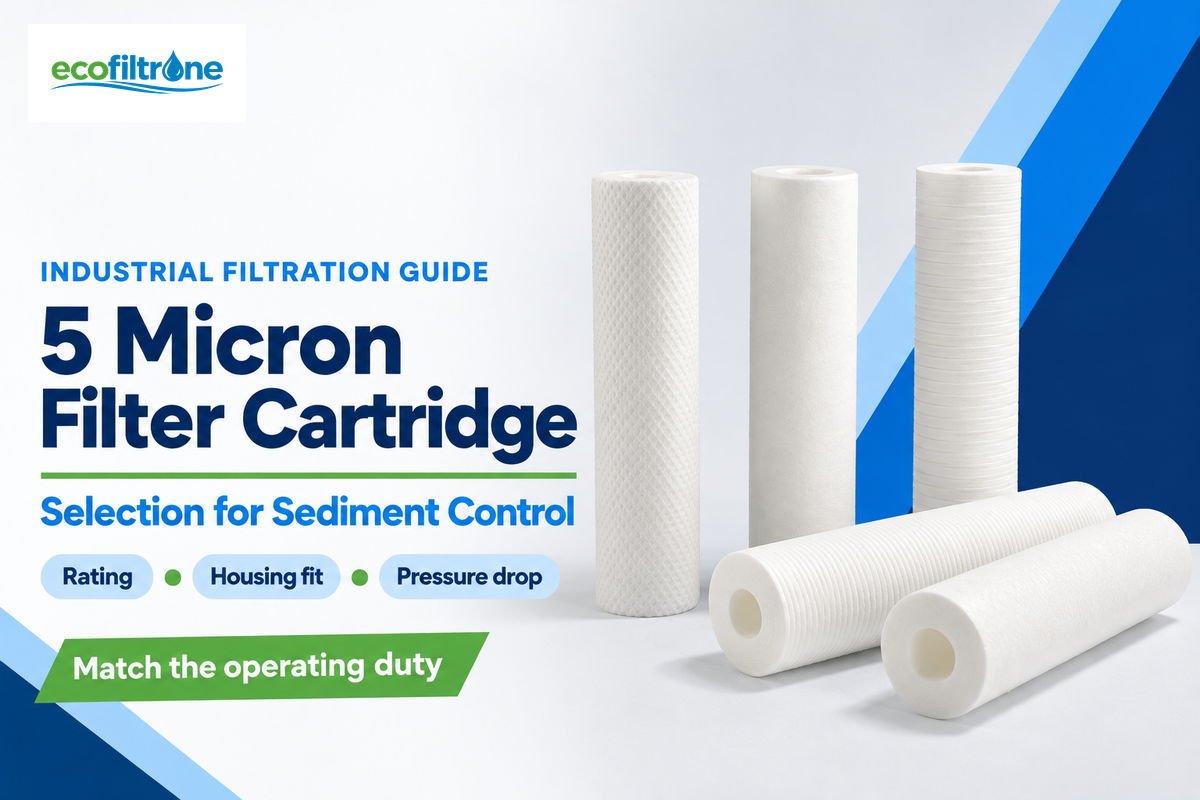
A 5 micron filter cartridge removes suspended particles according to its stated retention rating. Choose the construction around the liquid, solids load and housing already in service. Even a replacement that fits the length but changes the seal, efficiency or clean pressure drop can produce a different result.
A 5 micron filter cartridge is a sediment-control element with a 5 µm rating. Selection also requires a stated capture efficiency, suitable materials and a matching housing interface. Use the process requirement to choose the final grade.
Quick selection facts
- Rating scale: 5 µm equals 0.005 mm; retention efficiency is a separate specification.
- Common constructions: melt-blown depth, string wound and pleated sediment media.
- Fit: actual length, outside diameter, end configuration and seal must match the housing.
- Operating record: flow, temperature, clean differential pressure and outlet quality establish the starting condition.
Updated October 2026 · Industrial water and process filtration
Key points
- Choosing a smaller micron number can increase maintenance without solving the actual contamination problem.
- Published pressure drops are comparable only at matched test conditions.
- Pleated construction doesn’t automatically mean a cartridge is washable.
- Upstream solids capture reduces the burden reaching the final element; membrane fouling needs its own assessment.
5 micron sediment filtration: what the label tells you
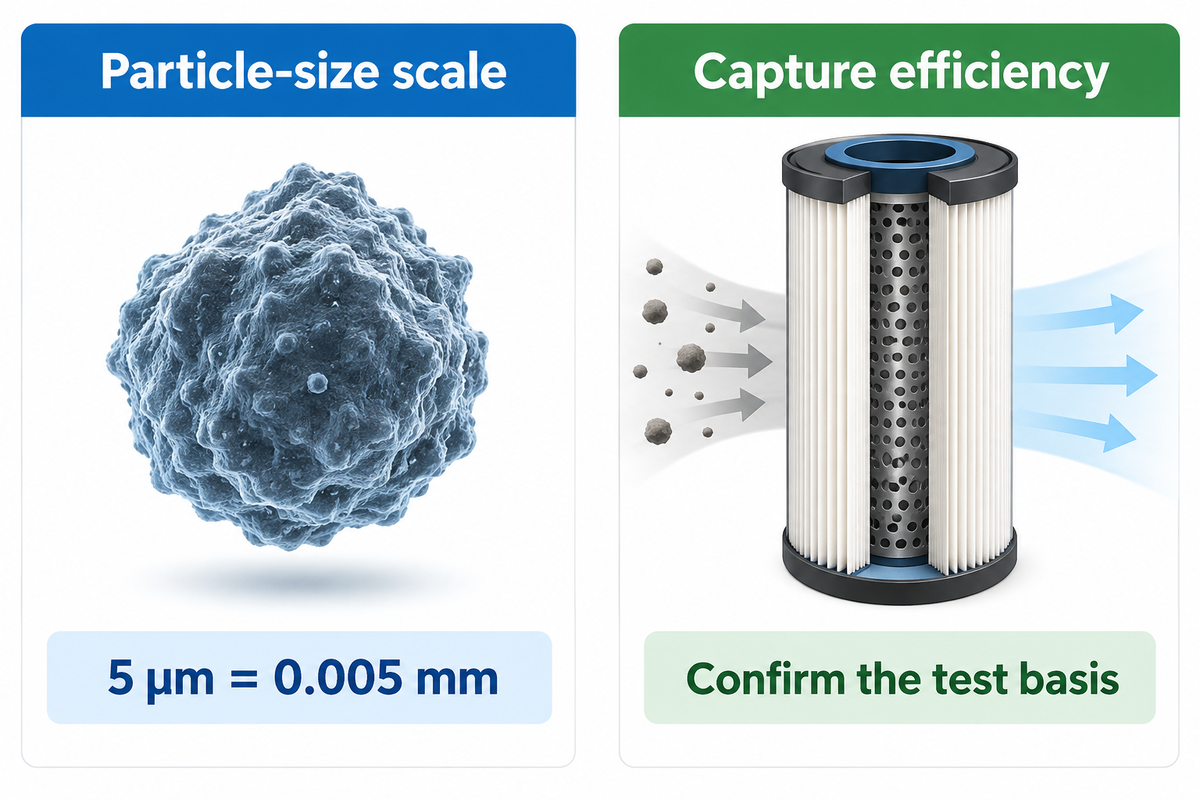
The five micron rating is referring to a particle size of 0.005 mm, not the length of a water filter cartridge. Capture efficiency is the percentage of a given particle challenge that an element retains. Read both fields to determine the sediment filter best suited for process protection or equipment pretreatment.
Micro (μ) in the NIST metric-prefix table is equivalent to 1/1,000,000. Filtration performance is more complex. The AFS glossary states that nominal ratings are assigned differently by manufacturers. An element with an absolute rating also requires the test basis and efficiency to be stated along with the rating.
What will a 5 micron filter catch?
A five-micron sediment cartridge can remove rust fragments, sand, and some silt within its specified retention range from the process fluid. Fine particles below that range may pass through. Dissolved salts are carried with the water and can’t be removed by a sediment element.
For example, as seen in well water, the treatment for visible orange solids and for dissolved iron is different. Physical filtration can collect precipitated solids after an upstream process has produced them. Merely reducing the micron number won’t turn dissolved material into filterable solids. The University of Nebraska, Lincoln’s sediment-filtration guide makes this distinction in water treatment.
Use the existing filter micron rating and retention efficiency guide for rating terminology. For replacement decisions, keep the capture performance for the given element.
5 micron vs 1, 10 and 20 micron filters
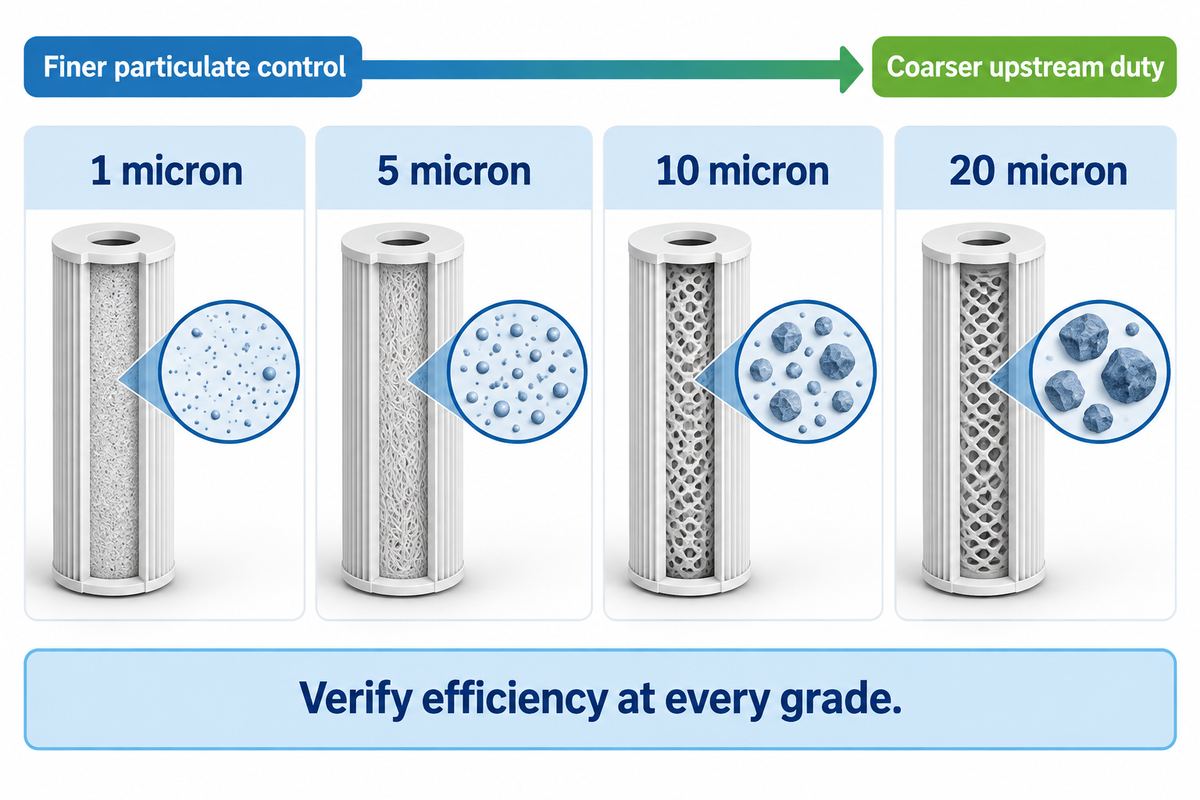
1 micron should be selected if finer control over particulate is required; 10 or 20 microns could be acceptable if larger solids predominate. The 5 micron sediment filter sits between these examples. Which example is acceptable depends on the retention efficiency of the filtration, the available filtration area and the particle size distribution of the incoming stream.
Which is better, 5 microns or 10 microns?
Five microns is a better choice when the downstream process requires capture that’s finer than the proposed 10 micron element. The 10 micron element may be appropriate for an upstream solids removal stage. In both cases, assess the retention efficiency and hydraulic duty, and compare to the element being replaced; changing the label doesn’t preserve process protection.
Picture a utility water line with an outlet that looks cloudy after a tank cleaning event. Operators installed a finer element (replacement filter) because the outlet looked cloudy. The new element quickly reached its pressure limitation, and the gritty feed continued. Investigating the event separates the gritty feed excursion from the fine-particle requirement. Maintain the final grade needed by the equipment and consider if an upstream element can remove the coarse fraction. If the feed consists mostly of fine particles smaller than the coarse element captures, adding the element brings very little solids relief. This is a selection scenario, not a measured customer result.
Legacy GE technical guidance on prefiltration and cartridge filtration talks about staged capture and cautions against assuming smaller is better. The performance figures associated with those products are for those products only; they aren’t performance figures for ECOFILTRONE™.
Melt blown, string wound or pleated sediment cartridges
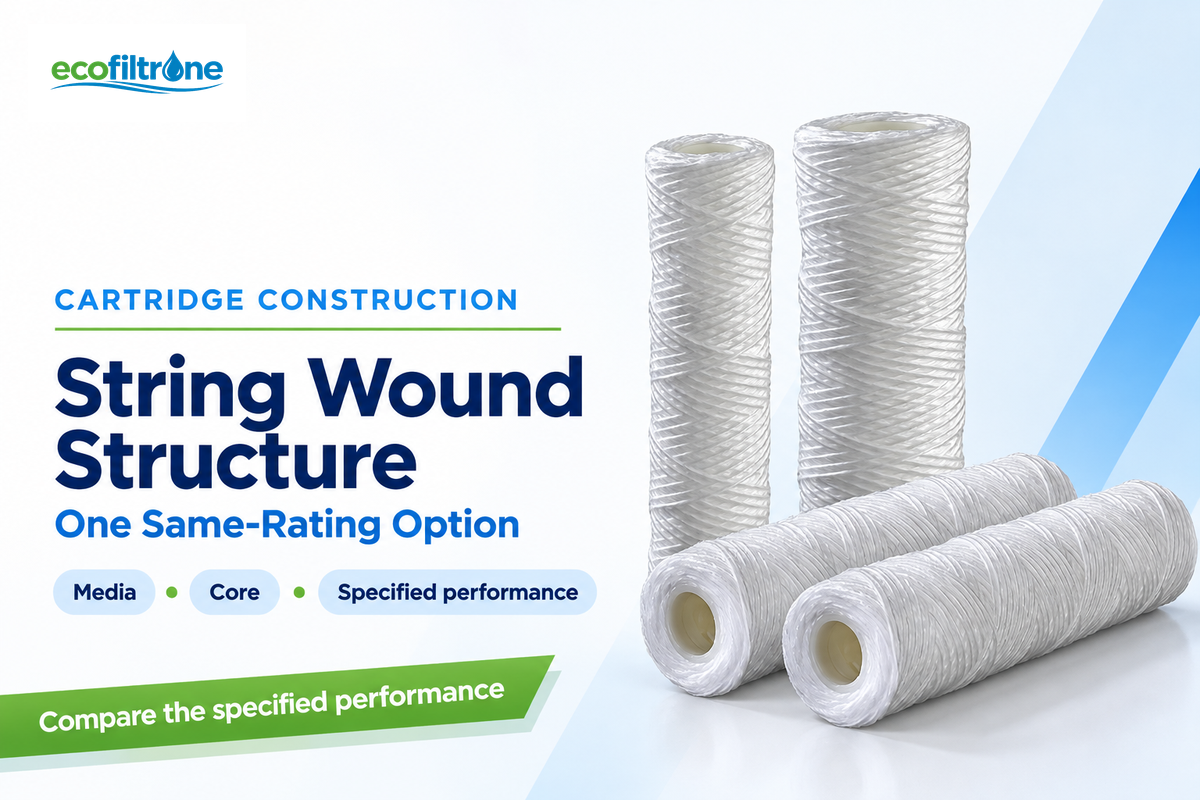
Melt-blown depth cartridges are a starting candidate for disposable sediment duty, string wound elements offer a wound-fiber structure around a support core, and pleated cartridges provide folded filtration area. Depending on the liquid and loading pattern, select among these constructions. The same five-micron label can appear on elements with different dimensions and operating limits.
Depth media capture particles through the thickness of the material. Gradient density can distribute the loading through that thickness. In a string wound element, the yarn and the support core contribute to the chemical compatibility. Each pleat provides an increased media area within a given envelope, and the useful area also depends on support and how the folds load.
The following Five-Micron Fit Ledger compares published examples of Pentair Pentek models. Read each column independently to decipher the complete specification. These are values listed by the manufacturer for specific models and don’t compare filtration families.
| Field | P5 | WP5BB97P | DGD-5005 |
|---|---|---|---|
| Rating basis | Nominal 5 µm | Nominal 5 µm | Nominal 5 µm |
| Construction | Spun polypropylene depth | Wound polypropylene | Dual-gradient polypropylene depth |
| Maximum outside diameter | 2.38 in | 4.50 in | 4.50 in |
| Maximum length | 9.88 in | 9.88 in | 9.88 in |
| Lower listed temperature | 40 °F | 40 °F | 40 °F |
| Upper listed temperature | 145 °F | 165 °F | 145 °F |
| Published test flow | 5 gpm | 20 gpm | 10 gpm |
| Initial pressure drop at that flow | 0.2 psi | <3 psi | <1 psi |
| Supplier part number | 155014-43 | 355214-43 | 155357-43 |
Sources: Pentair’s P-series datasheet, WP-BB datasheet and DGD datasheet. Due to variations in test flows, the pressure-drop row does not compare hydraulic performance. These documents cover the residential product line; for acceptance in industry, it is necessary to confirm the duty limits of the selected configuration.
The DGD document’s NSF/ANSI 42 statement concerns material requirements. NSF explains that certification claims vary by product; material conformity and a tested particulate-reduction claim are different items.
For a washable 5-micron pleated sediment option use the explicit cleaning procedure. The UGA Extension’s mechanical-filtration bulletin distinguishes reusable synthetic media from non-reusable pleated paper in household systems. Industrial cleaning also has to preserve seals, media integrity and the required outlet quality. Explore depth filter cartridge constructions when a disposable element fits the maintenance plan.
Cartridge size and housing fit: 10 inch and 20 inch
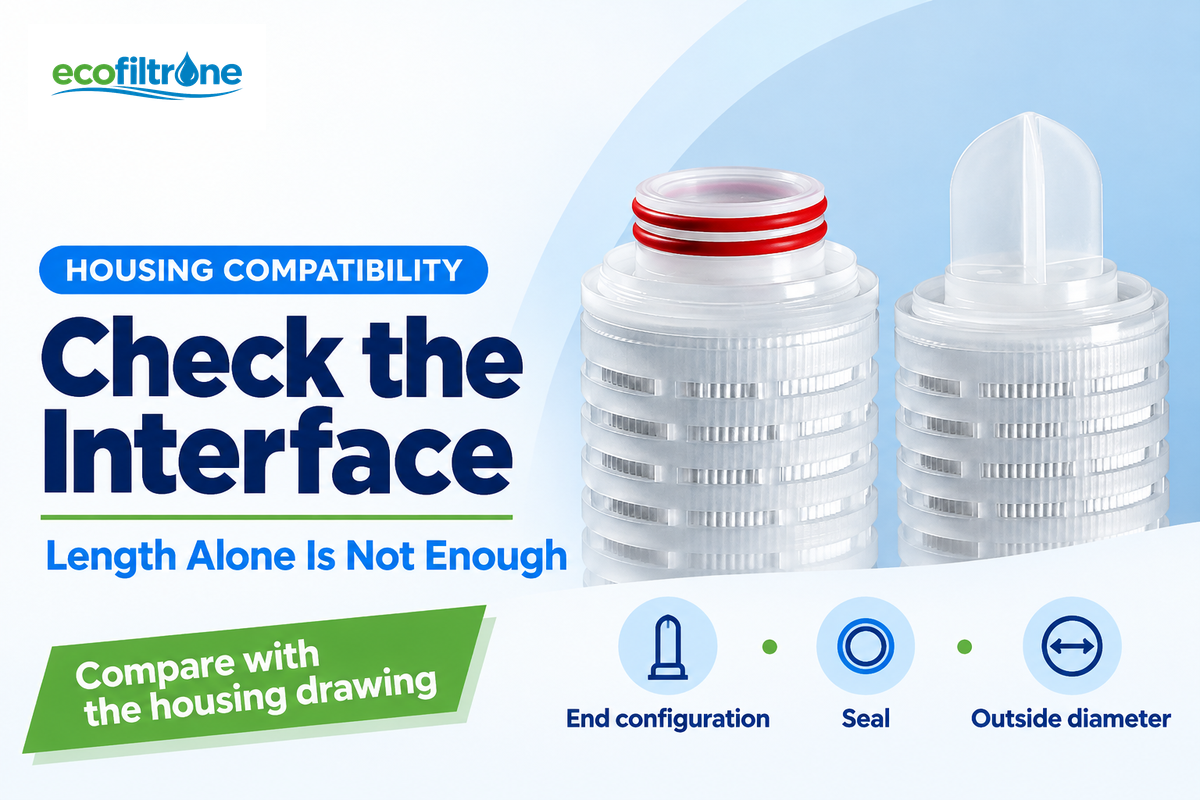
Elements in a size family are identified as such by the nominal length and 10-inch label. Nominal 10-inch and 20-inch labels identify a size family; actual dimensions and the sealing arrangement determine housing fit. Within the same size family, outside diameter can vary substantially. To ensure the process fluid passes through the media, the end geometry of the element must be matched to the filter housing seat.
Labels such as 10 x 2.5 and 10×2.5 describe a common compact format. Actual drawings control element length, diameter, and compression. Canisters of wider dimension take a different cartridge envelope. Industrial plug-in ends, double-open ends and supported sealing interfaces add further distinctions.
A buyer wishing to replace a ten-inch element from an old invoice finds that both elements state a nominal rating of five microns and a length of ten inches. However, one of the cartridges is intended for a much wider sump. In both cases, the buyer has successfully matched the rating and length label fields of the element, but has failed to consider the physical interface. Elements can be the same nominal diameter, but a different end-cap can lead to an unloaded seal. Photos, overall length, and the housing model help answer separate questions; however, no item can take the place of the others. It’s important to keep a copy of the element identification for the previous installation to help define the initial configuration for the next element purchased.
Temperature compatibility extends beyond the polypropylene media to the core, adhesive or weld, gasket and housing. The lower rated component of the assembly controls the assembly. For configured ends and materials, the pleated filter cartridge range is a useful next step.
Flow and pressure drop: size the filtration area
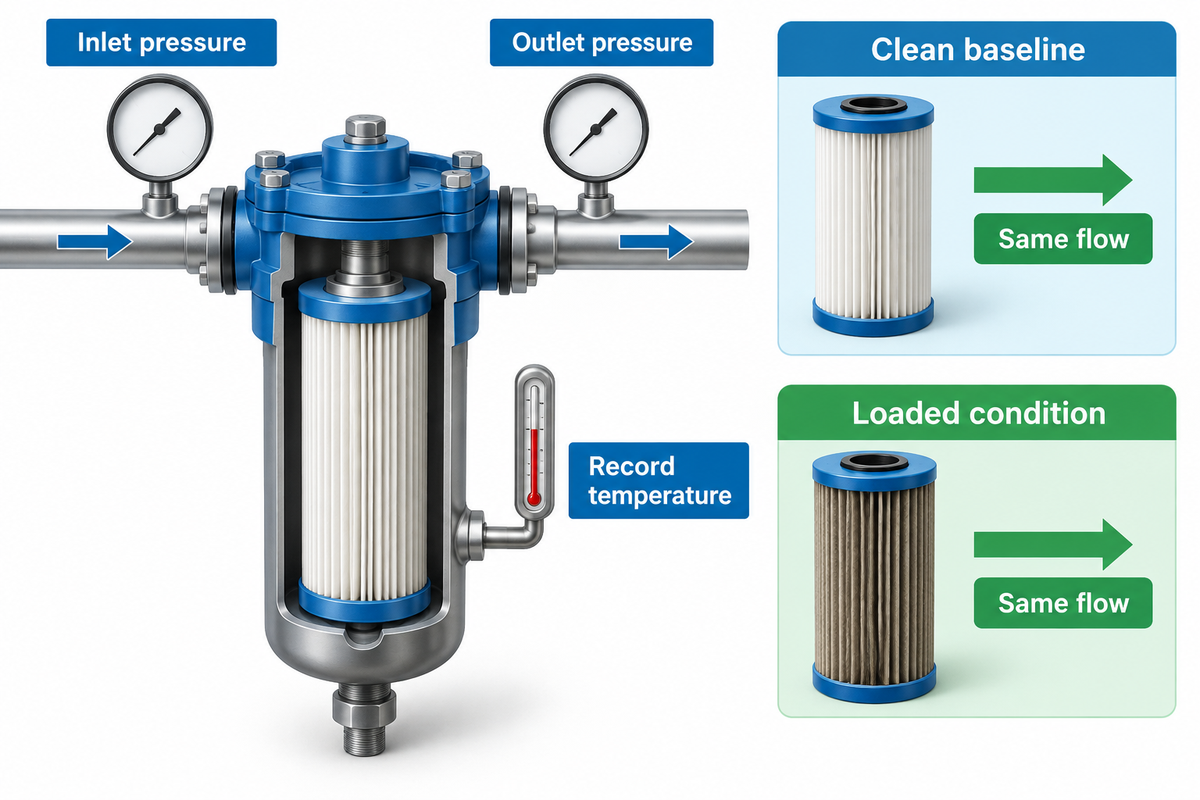
Size filtration area at the required flow and permitted pressure loss, and compare the clean and loaded conditions at the same duty. Hydraulic restriction can be addressed by increasing cartridge count or changing format, without changing the final micron grade. A headline flow rating requires its liquid, temperature and test configuration to be specified alongside it.
Differential pressure is the inlet pressure minus the outlet pressure of the filter assembly being tested. Feed pressure is a different measurement. For example, a retailer’s flow at 60 psi doesn’t mean the cartridge loses 60 psi, nor does it provide a clean differential pressure curve.
In the study of wound cartridge hydraulics by Viccione and colleagues, head loss increased with flow in a simulated domestic circuit. The test method doesn’t provide an industrial ranking of pleated, wound and melt-blown media. The practical comparison is a curve for each candidate under the same liquid conditions.
Record the clean pressure loss of a newly commissioned element at a stable operating flow. Observe again at the same flow as the element loads. Temperature and pump speed can change the flow conditions and the hydraulic duty of the system. Both changes impact the measurement prior to arrival of additional sediment. Compatible seals and media need to be suitable to the coldest and hottest operating conditions.
High-demand commercial water lines may require additional filtration area. High flow filter cartridges for larger housings provide another format to assess when element count and changeout labor become major factors. Keep the required retention performance the same when doing this comparison.
Reverse osmosis prefiltration: divide the sediment load
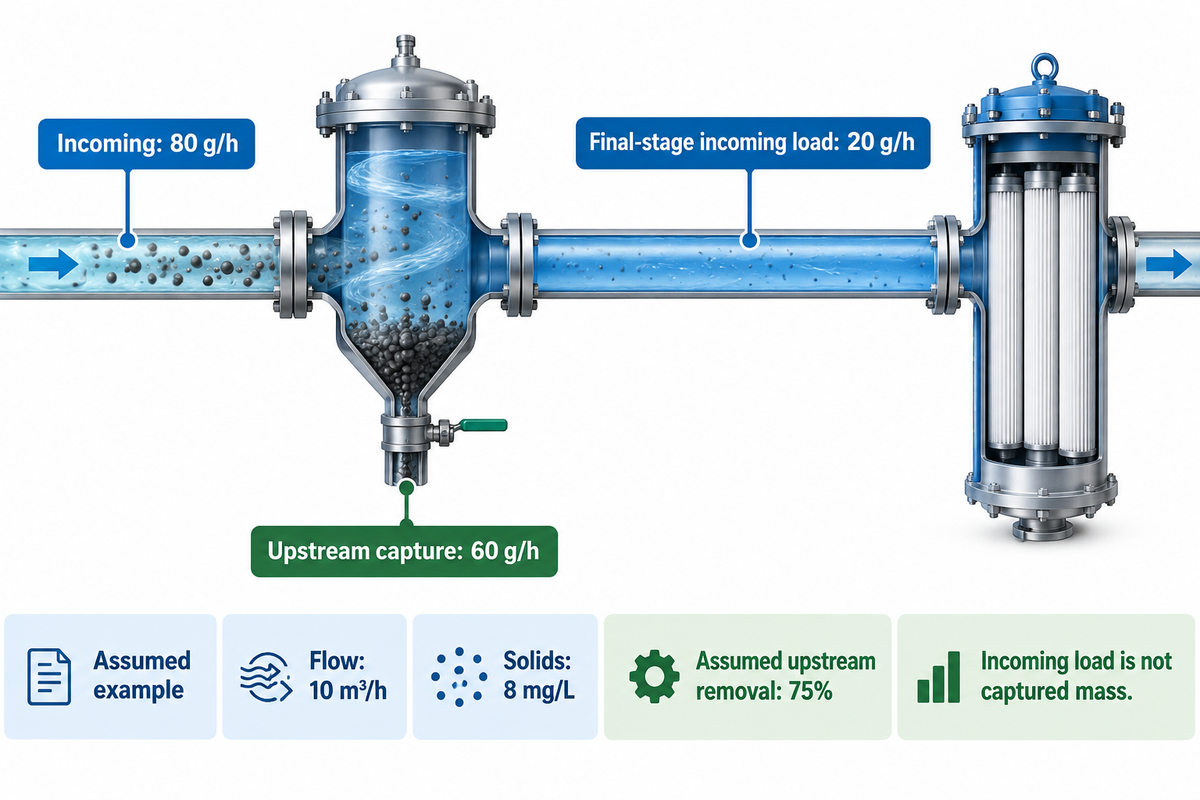
Allow bulk solids removal upstream, and use the final cartridge for the remaining particulate duty specified for the reverse osmosis system. The useful quantity for loading estimation is solids mass flow rate for each stage. Staged water filtration systems need feed measurements. The capture of a meaningful share of the feed by a coarse element helps remove solids before the final stage.
Worked example: split the incoming solids load
Assumed inputs: flow of 10 m³/h, suspended solids of 8 mg/L, and upstream removal of 75% by mass.
- Convert flow: 10 m³/h × 1,000 L/m³ = 10,000 L/h.
- Incoming solids: 10,000 L/h × 8 mg/L = 80,000 mg/h = 80 g/h.
- Upstream capture: 80 g/h × 0.75 = 60 g/h.
- Load reaching the final stage: 80 − 60 = 20 g/h.
The result is incoming mass at the final stage. Its captured mass also depends on its retention characteristics and the remaining particle distribution.
For this case, an operations manager can compare the burden of upstream stage maintenance with the reduction of solids reaching the final cartridge. Finance, however, needs actual element consumption and labor hours before a savings estimate can be made. Dividing a catalog number for dirt capacity by the calculated load wouldn’t account for differences in test dust, terminal pressure and retained fraction. The test record would need to align test conditions with industrial operating conditions. The record of process conditions would demonstrate actual operation, as opposed to straight line extrapolation into promised operating hours.
ASTM D4189-23 describes the silt density index as a test that is influenced by characteristics of the solids and the conditions of the test. Removing 75% of the suspended solids does not necessarily reduce the silt density index or membrane fouling by the same amount. In the case of membranes, the supplier’s feed-quality criteria should be considered alongside the solids balance.
“The SDI may vary as a function of water temperature”
Use the worksheet to evaluate an actual RO pretreatment cartridge duty with measured feed conditions and the existing upstream treatment sequence.
Replacement timing: diagnose a fast-clogging filter
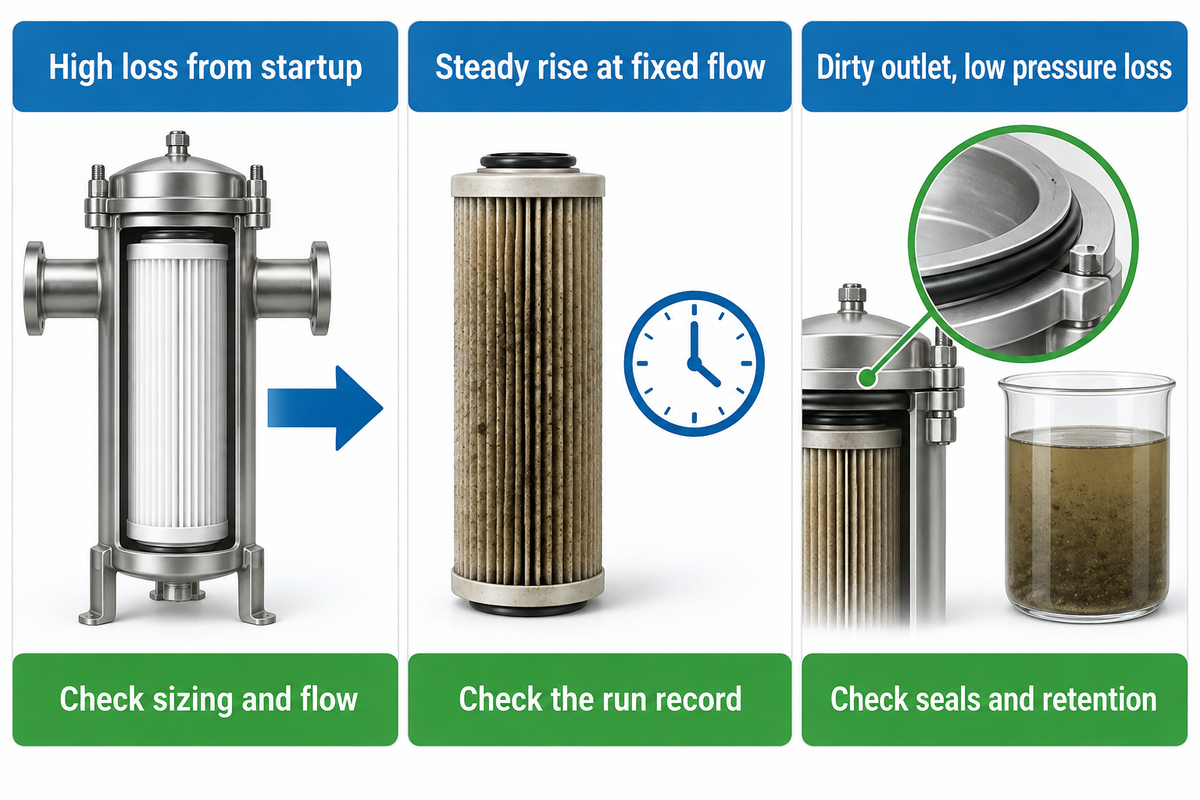
Per the changeout criteria, replace a sediment element. If the quality of the outlet deteriorates and/or the required flow can’t be maintained, investigate the element sooner. Investigating elements at calendar intervals isn’t sufficient, as feed excursions and duty changes occur outside of scheduled intervals. The current reading should be compared to a clean baseline at a matched flow. Record the observations upstream. A replacement sediment element may clog quickly after a feed excursion even if the original size was appropriate.
In a water-treatment discussion, a user reported losing flow within days of installing a sediment element. Quick loss of flow warrants checking feed conditions and comparing the current pressure reading with the original clean pressure reading. The following matrix separates checks that get bundled into “the cartridge clogged.”
| Observed change | First comparison | Next decision |
|---|---|---|
| High pressure loss from startup | Clean curve, actual flow, installed count | Review sizing and installation before blaming dirt capacity |
| Steady pressure rise at fixed flow | Run record and inlet solids, including turbidity | Plan changeout against the specified limit |
| Sudden rise after upstream maintenance | Feed sample and maintenance event | Investigate carryover before changing the final grade |
| Higher reading after a flow increase | Previous reading at the same flow | Separate hydraulic change from loading |
| Restriction during colder operation | Fluid temperature and viscosity | Revisit the cold operating point |
| Dirty outlet with low pressure loss | Seal fit, element condition, inlet/outlet samples | Investigate bypass or unsuitable retention |
| Short runs after changing supplier | Rating basis, dimensions and media | Compare the complete replacement specification |
| Cleaning restores flow but outlet worsens | Cleaning permission and performance checks | Remove the element from the reuse plan |
| Acceptable outlet but excessive changeout labor | Installed area and upstream burden | Compare additional area or upstream capture |
This is an observation-to-action method as opposed to a fault finding method based on the reading of a single gauge. Follow the plant’s maintenance procedures for any inspection. Collapse-pressure limits describe structural failure limits; they aren’t routine changeout targets.
Filter cartridge price: compare like-for-like offers
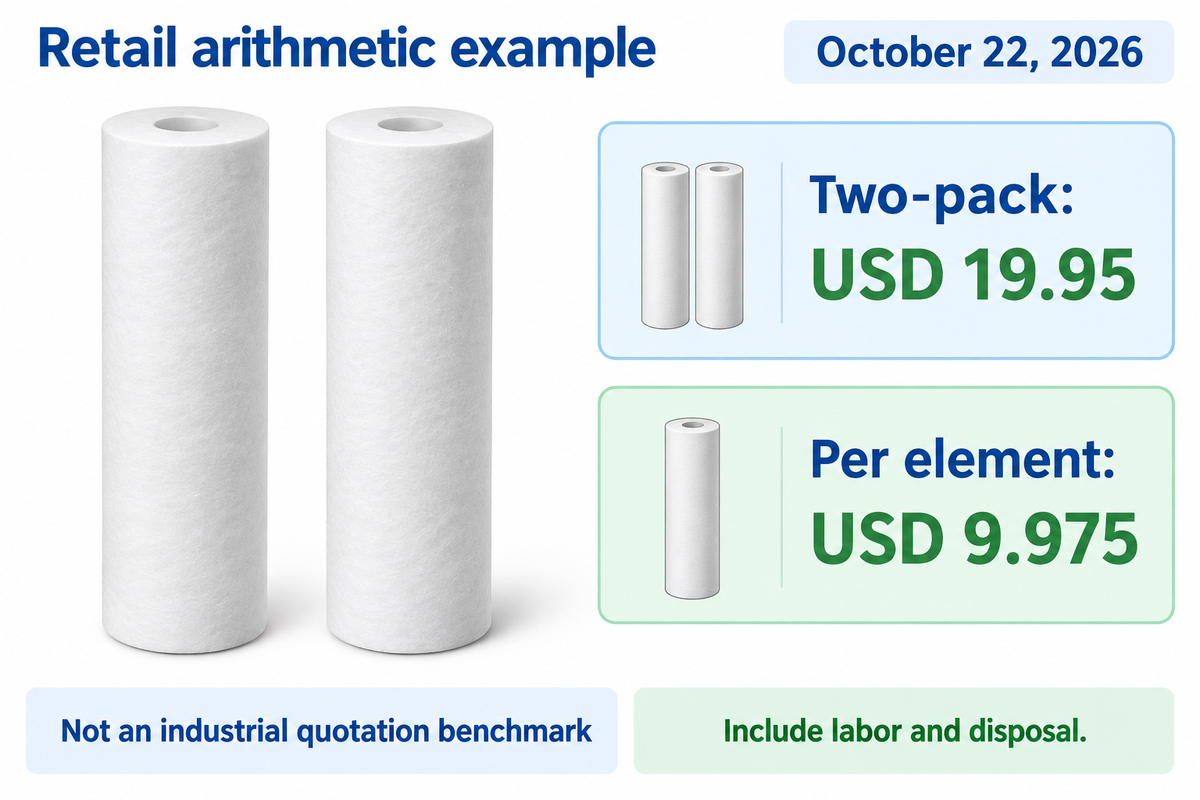
A filter cartridge price may be quoted per pack. Before comparing offers, normalize the price per element and use the same technical specification. Separate the cost of the element from freight, tax, and replacement labor. Accepting a lower unit price only makes economic sense if the accepted replacement performs its duty and doesn’t create additional rejected output or unplanned changeouts.
One compact retail example shows why the unit matters: RV Water Filter Store’s RV-SED5 offer listed a two-pack at USD 19.95 for a one-time purchase on October 22, 2026. That’s USD 9.975 per element before other charges. Its subscription price was different. This offer for RV water filtration is used for arithmetic and has no role as a benchmark quotation for industry.
Procurement should compare the same length, end configuration, media and rating basis on both quotes. Warranty coverage needs to specify the covered product and operating conditions. Brand names on a replacement list can identify an intended fit; they don’t eliminate the need for a model-specific comparison.
Keep track of cartridges consumed, volume treated to meet process requirements, maintenance hours and disposal charges for operating tests. If a candidate offers longer life, this should be noted at comparable feed and flow conditions. Cleaner-looking outlet water by itself isn’t an indicator of measured retention.
Supplier matching: prepare a usable replacement request
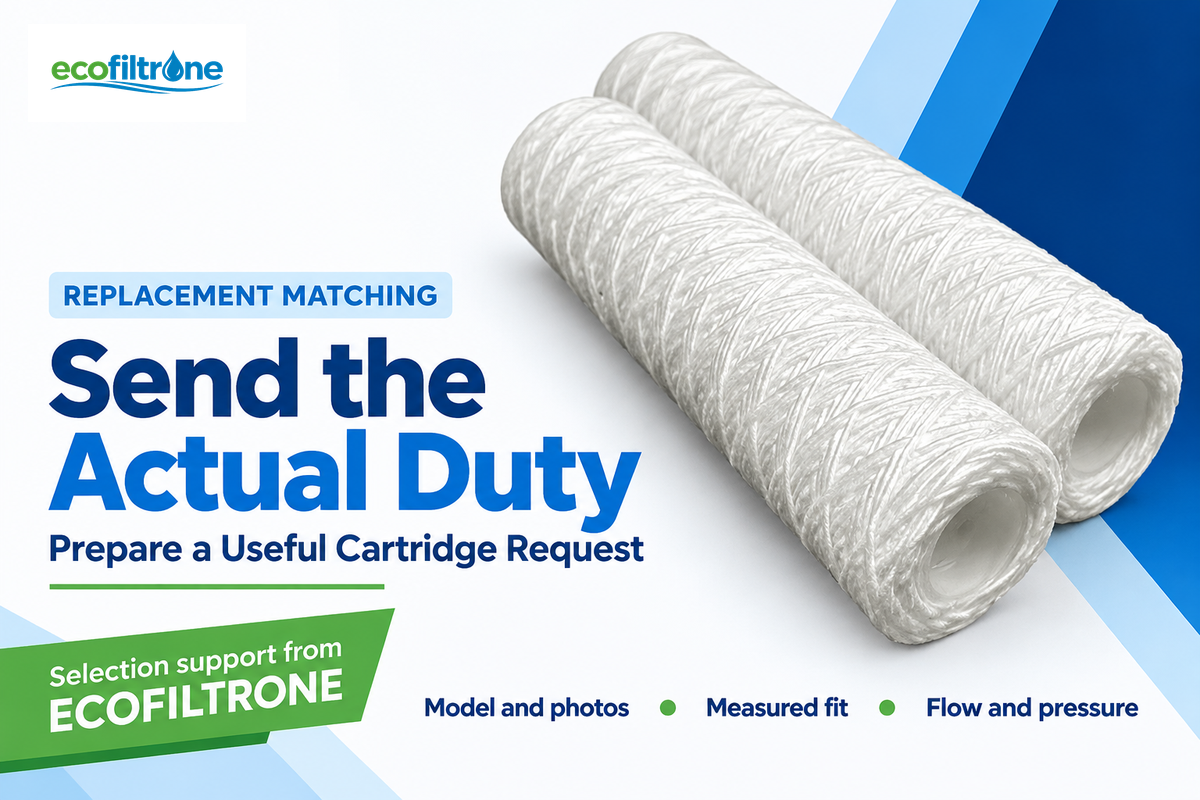
The best replacement requests incorporate existing element identity, measured fit and operating duty. ECOFILTRONE™ supplies industrial filtration consumables and offers application review, specification verification and replacement matching support. Send the requested information to us so the proposed cartridge can be assessed against the housing and the process requirement.
Details for a cartridge match
- Existing model, label photograph and photographs of both ends.
- Measured length, outside diameter, seal material and housing model.
- Liquid composition, operating temperature and required flow per housing.
- Installed element count, clean pressure loss and changeout criterion.
- Current rating basis, required outlet quality and the observed replacement problem.
- Upstream treatment sequence, feed changes and any cleaning or sanitization exposure.
Our Qingdao-based team provides sample/trial evaluation for replacements and supports configured replacements and custom filtration requirements. We can provide technical confirmation in the form of drawings and/or datasheets and review operating conditions, performance and differential pressure. We assess compliance and certification documents against the specified product and actual certificate holder.
Request a 5 micron cartridge match
5 micron water filter questions
Is a 5 micron filter good?
A 5 micron water filter is useful for sediment duty when its retention performance and hydraulic capacity meet the process requirement.
Suitable applications may include a pre-filter before another treatment stage or particulate control for equipment. The required outlet quality comes first. Feedwater containing mostly dissolved impurities needs a different treatment function, while a heavy solids load may justify upstream sediment removal. Match the actual element to those conditions instead of treating five microns as a general water-quality grade.
What is the size of a micron filter?
A micron is one micrometre, equal to one thousandth of a millimetre; it describes a particle-size scale.
Physical cartridge dimensions are separate. Compact sediment water filters and larger industrial elements can carry the same micron rating while having different lengths, outside diameters and ends. Use the housing drawing for those measurements. Nominal ten-inch labeling doesn’t specify the seal geometry, and a five-micron rating doesn’t specify the element diameter.
Is a 5 micron filter better than a 25 micron filter?
Five microns is the finer candidate, while a 25-micron element can suit a coarser upstream capture duty.
The two positions solve different loading problems. Keep the final rating needed by the downstream process, then assess whether larger particles can be removed earlier. Retention efficiency still matters on each element. Comparing a nominal rating from one supplier with an absolute rating from another requires their test information before the numbers can guide a replacement.
Can I clean and reuse a 5 micron cartridge?
Reuse is appropriate only for a cartridge designed and approved for cleaning in the intended process.
Some synthetic pleated products allow rinsing; disposable depth elements and pleated paper follow different instructions. Use the specified cleaner and cleaning limits. Restored flow alone doesn’t establish restored particle retention, seal condition or acceptable process hygiene.
Does a 5 micron sediment filter replace carbon filtration?
A sediment filter captures suspended solids; activated carbon performs its specified adsorption or chemical-reduction duty.
Carbon block media can also have a micron rating, but its chlorine-reduction capability is a separate performance claim. The same distinction applies in a whole house water system, an appliance feed or industrial water filtration. Choose each stage for the impurity it must address. Five-micron labeling isn’t a virus-removal claim. Where a water filtration system needs particulate capture and a specified chemical reduction, maintain both functions with appropriate elements. The sediment replacement water filter can’t take over the carbon duty merely because it fits the same housing.
Our perspective
ECOFILTRONE™ supports industrial customers with cartridge selection and replacement matching. The model comparisons here use identified third-party specifications; the solids-load example uses stated assumptions. We use these distinctions to prepare a useful technical discussion around the actual installation.
Related filtration resources
References & Sources
- Metric (SI) Prefixes NIST.
- Filtration and Separation Glossary American Filtration and Separations Society.
- Drinking Water Treatment: Sediment Filtration University of Nebraska, Lincoln, household guidance, revised 2013.
- Mechanical Filtration Methods and Devices University of Georgia Extension, reviewed April 2026.
- ASTM D4189-23: Silt Density Index of Water public scope and significance.
- NSF/ANSI 42, 53 and 401 filtration standards NSF.
- Wound-cartridge hydraulic performance study public research abstract, simulated domestic circuit.