Get in touch with ECOFILTRONE™ Company


Updated October 2026
Application essentials
- Seven water duties: incoming supply, cooling, boiler service, membrane pretreatment, washing, product contact and reuse.
- Particle removal, dissolved-contaminant control and disinfection perform different jobs.
- Assess the filter at its operating flow and assess the water at its destination.
Industrial Water Filtration Applications are the uses of filtration to remove undesirable materials from water in industrial processes. Common examples are protecting cooling devices, preparing membrane feed, improving rinse water and polishing water. The required result comes from the process receiving the water: a clean spray nozzle and a boiler need different things from the same supply. Clean water for one duty can still need treatment for the next.
Industrial Water Filtration Applications cover seven practical water duties. Match the contaminant to the treatment process, then measure the result at the use point. A particle filter alone doesn’t remove dissolved salts or provide complete microbial control.
Water is essential to manufacturing. The U.S. Department of Energy provides examples of heating, cooling, washing, and rinsing. Each of these has a different failure effect. Changes in incoming water supplies can affect several operations at once. A plugged cooling passage interrupts heat removal; a contaminated final rinse can spoil a surface that was already clean.
Industrial Water Filtration Applications by Water Duty
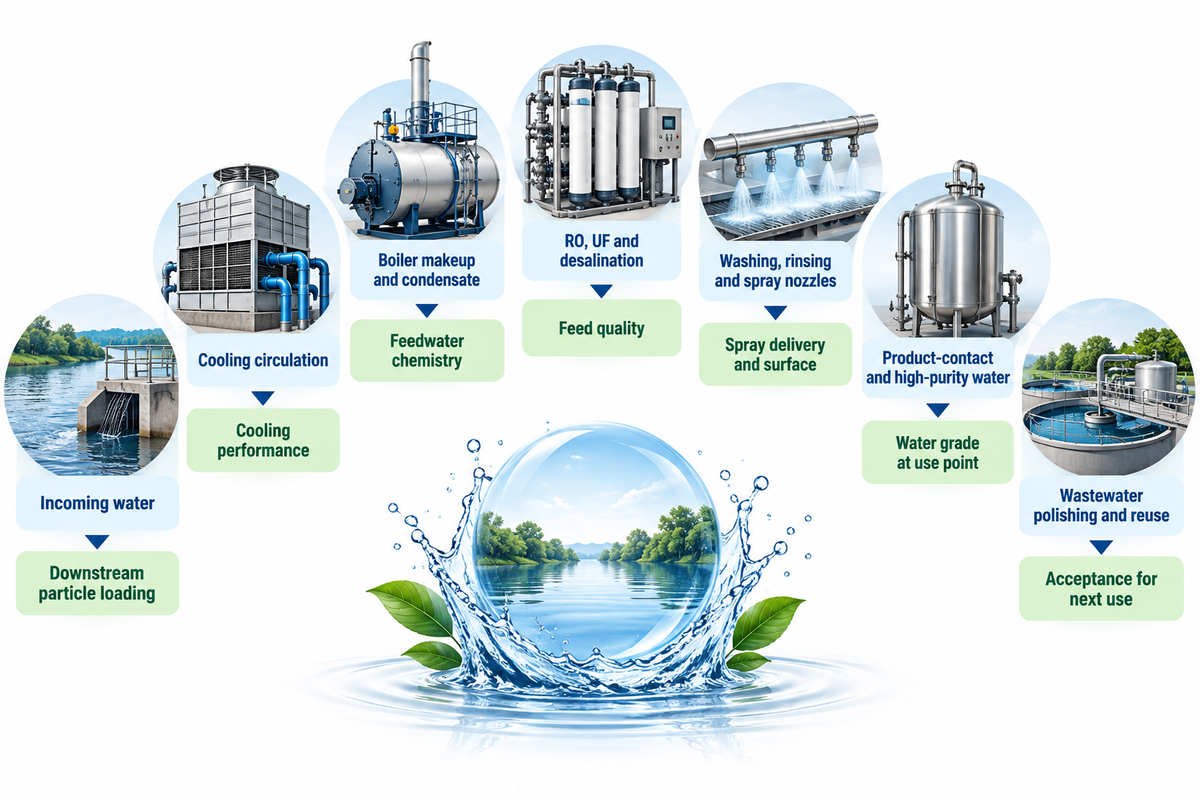
Industrial water filtration covers seven broad duties, such as incoming water protection and wastewater polishing. Consider the material being processed and the effects of interfering with the service. Filtration can reduce suspended contamination, while hardness, dissolved salts or microbial hazards may require additional treatment. The table separates these duties.
| Water duty | Particle-control role | Result to assess | Other treatment considerations |
|---|---|---|---|
| Incoming industrial water | Intercept sediment entering from the source or distribution pipework. | Downstream particle loading and continuity of supply. | Source chemistry and seasonal changes. |
| Cooling circulation | Remove suspended material that can foul heat-transfer surfaces. | Solids loading alongside cooling performance. | Scale, corrosion and microbial management. |
| Boiler makeup and condensate | Control particulate contamination where the system design calls for it. | Required feedwater chemistry and equipment condition. | Hardness, dissolved gases and other chemistry controls. |
| RO, UF and desalination pretreatment | Reduce particle loading before a sensitive downstream stage. | Feed quality and downstream membrane operation. | Chemical compatibility, fouling mechanisms and pretreatment design. |
| Washing, rinsing and spray nozzles | Limit particles that block passages or mark surfaces. | Spray delivery and the cleaned or rinsed surface. | Dissolved residues, detergent carryover and required rinse chemistry. |
| Product-contact and high-purity water | Provide the specified particle barrier within a controlled treatment train. | The product-specific water grade at its use point. | Microbial control, dissolved impurities and hygienic distribution. |
| Wastewater polishing and reuse | Reduce remaining suspended material before a defined next use. | Acceptance for that destination and residual-stream handling. | Dissolved pollutants, exposure routes and applicable local requirements. |
Manufacturing, cooling, and others are different reuse duties, as mentioned in the resources of the U.S. Environmental Protection Agency.
Cooling water needs particular care. CDC cooling-tower guidance identifies sediment and biofilm, temperature, water age and disinfectant residual as factors in Legionella growth. Wet open- and closed-circuit towers can release aerosols. A side-stream filter controls suspended solids within the water management programme; it doesn’t replace that programme. See the cooling tower side-stream filtration application for the consumable-filter role.
Food contact water adds a distribution requirement. For applicable U.S. food facilities, 21 CFR 117.37 outlines sanitary water quality and the control of backflow or cross-connections between wastewater and food water piping. Water quality is critical at a product contact rinse because contamination can reach the product. A sample drawn from the filter answers a question different from whether downstream pipework protects the product.
Try the 2-Destination Water Test
State one incoming stream and name two destinations. Write the defect each destination must avoid, then identify the property that could cause it. This short comparison demonstrates a missing treatment function prior to micron rating becoming the primary basis of the purchase specification.
Destination A: a wash nozzle
A suspended particle can obstruct the nozzle. Particle filtration can address that obstruction, while rinse chemistry still affects the washed surface.
Destination B: boiler makeup
The same particle barrier leaves dissolved hardness in the water. Boiler makeup therefore needs its own chemistry treatment and acceptance criteria.
For RO pretreatment, the destination is the downstream membrane and not the cartridge housing. The arrangement of the pretreatment must also consider the requirements of the membrane feed as well as the particles captured by the cartridge.
What Does an Industrial Water Filter Remove?
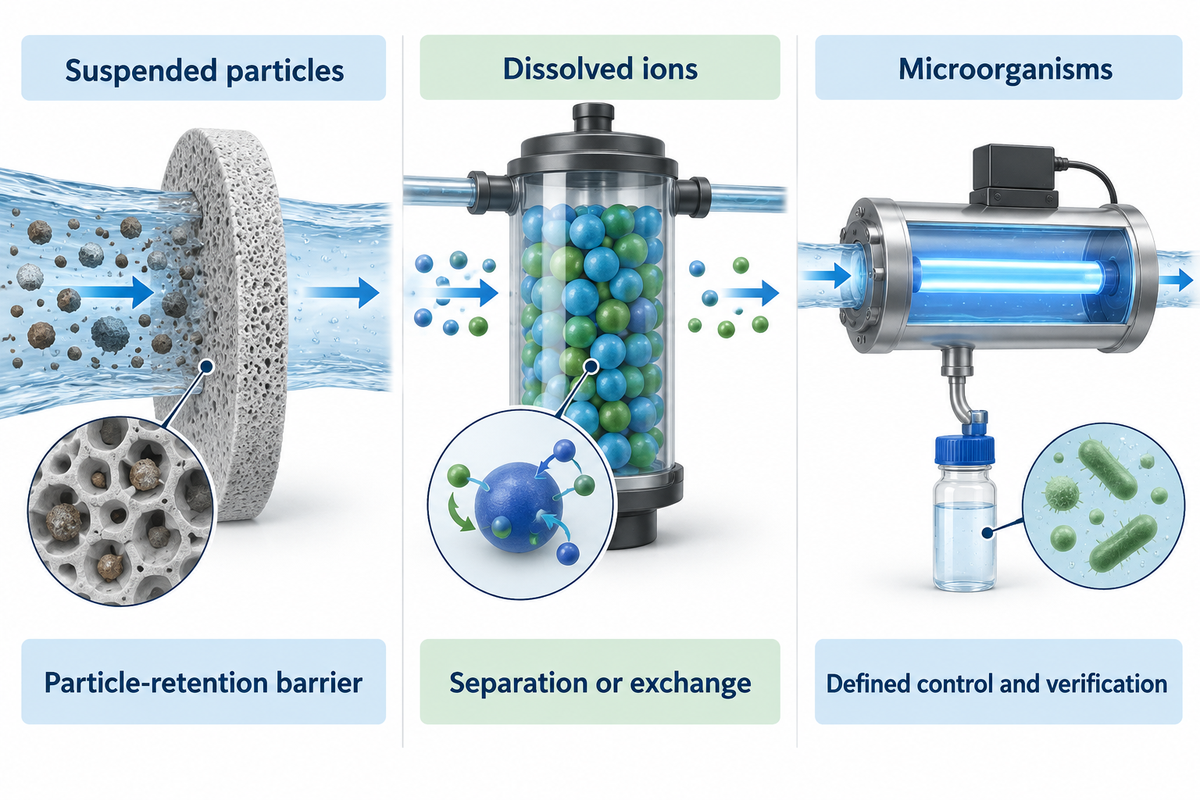
Conventional particulate filter technology removes particulate matter within its retention limits. For dissolved ions, a separation or exchange process is required. Control of microorganisms requires a defined treatment and a verification process. Cartridges made of activated carbon or ion exchange resin perform functions different from conventional particle cartridges, even if they have the same external configuration.
The EPA’s Industrial Wastewater Treatment Technology Database lists bag and cartridge filtration, granular media, adsorption, ion exchange, reverse osmosis and disinfection as distinct treatment technologies. The common types of industrial water filter in the comparison perform different separation jobs. Selecting a type of filtration system starts with the contaminant’s form and the required removal mechanism.
What do I need to remove from my water supply?
Identify the problem material: suspended solids, dissolved substances, or a biological contaminant. A sediment filter isn’t the same as a water softener. Hard water can remain clear because the hardness-forming ions are dissolved; ordinary mechanical filtration will leave those ions in solution. A particle medium allows water to pass while retaining particles within its tested capability.
| Treatment or filter group | Main function | Practical distinction |
|---|---|---|
| Screens and strainers | Intercept debris above the opening size. | Useful protection before finer filtration stages. |
| Bag filters | Retain suspended particles in a fabric or other suitable medium. | The bag, seal and housing form the working assembly. |
| Depth cartridges | Capture particles within the filter media. | Retention and loading behaviour require product-specific evidence. |
| Pleated particulate cartridges | Provide a folded particle-retention medium. | Effective area and loading behaviour depend on construction. |
| Granular media and sand filters | Separate suspended solids through a media bed. | Bed operation and cleaning affect performance. |
| Activated carbon filters | Adsorb suitable dissolved substances. | Capacity and contact conditions differ from a particle barrier. |
| Ion exchange and softening | Exchange selected dissolved ions. | Resin chemistry determines the target ions. |
| Ultrafiltration | Separate material according to membrane properties. | An ultrafiltration membrane is not a general desalination barrier. |
| Reverse osmosis | Separate suitable dissolved solutes through a pressure-driven membrane. | A reverse osmosis system includes feed and concentrate-management requirements. |
| Disinfection | Control target microorganisms under specified conditions. | Chemical treatment and systems using ultraviolet light have different operating controls. |
“Side stream filtration does not remove dissolved particles.”
A carbon filter is a different type of water filter from an ordinary particulate cartridge. A carbon media adsorbent bed is a different treatment from an ordinary particle media bed. The grade for pure water defines which impurities from water must be removed. The receiving process determines the analytical limits for that purified water.
Where Filtration Fits in Industrial Water Treatment
Industrial water filtration solutions should be applied where particle control supports the next process. They can also provide upstream protection for a unit, or polish the final product of a process, or serve a different circulation loop. Water filtration technologies integrate these functions with the source water and point of discharge. As such, equipment used in a given plant may vary from the next.
For example, plants that filter water from a variable raw water source may require the removal of bulk solids before a finer cartridge filter. A downstream RO system has an additional dissolved-solute separation duty. The EPA treatment descriptions distinguish these mechanisms; adding more filtration stages of the same particle media doesn’t add an ion removal mechanism.
Can I Integrate Industrial Water Filtration Systems with Existing Systems?
Yes. Industrial water filtration systems can be integrated where their flow, materials and limits match the existing water systems. The connection must also preserve the downstream treatment duty and allow safe servicing. Adding a system to remove debris can change the pressure available farther down the line.
Consider a plant that uses municipal water and has a polishing cartridge upstream of a sensitive wash line. The cartridge may capture trace debris in the line but may also use up some of the pressure available to the nozzles. Integration succeeds only if the line receives the required water flow throughout the filter run. Well water may provide a different starting point since its dissolved and suspended loads may vary.
Media behavior plays an important role in this configuration. More information on the behavior of particulate media can be found in a PP pleated cartridge guide. Different industrial filtration technologies still need a compatible housing and a service arrangement suitable for the liquid.
Industrial filtration systems take a combination of approaches which may include separation, chemistry control and monitoring. Water purification for a high-purity duty usually involves several functions; ordinary particle filters are designed for their specified particulate-retention task. Advanced filtration systems may also automate several functions. However, instruments don’t remove the need to determine what’s being treated. A treatment train supplying water for cleaning has a different endpoint from one producing highly purified water for electronics. Industrial and commercial operations may share a common source while requiring very different outlet grades.
How Do Water Flow, Pressure and Quality Work Together?
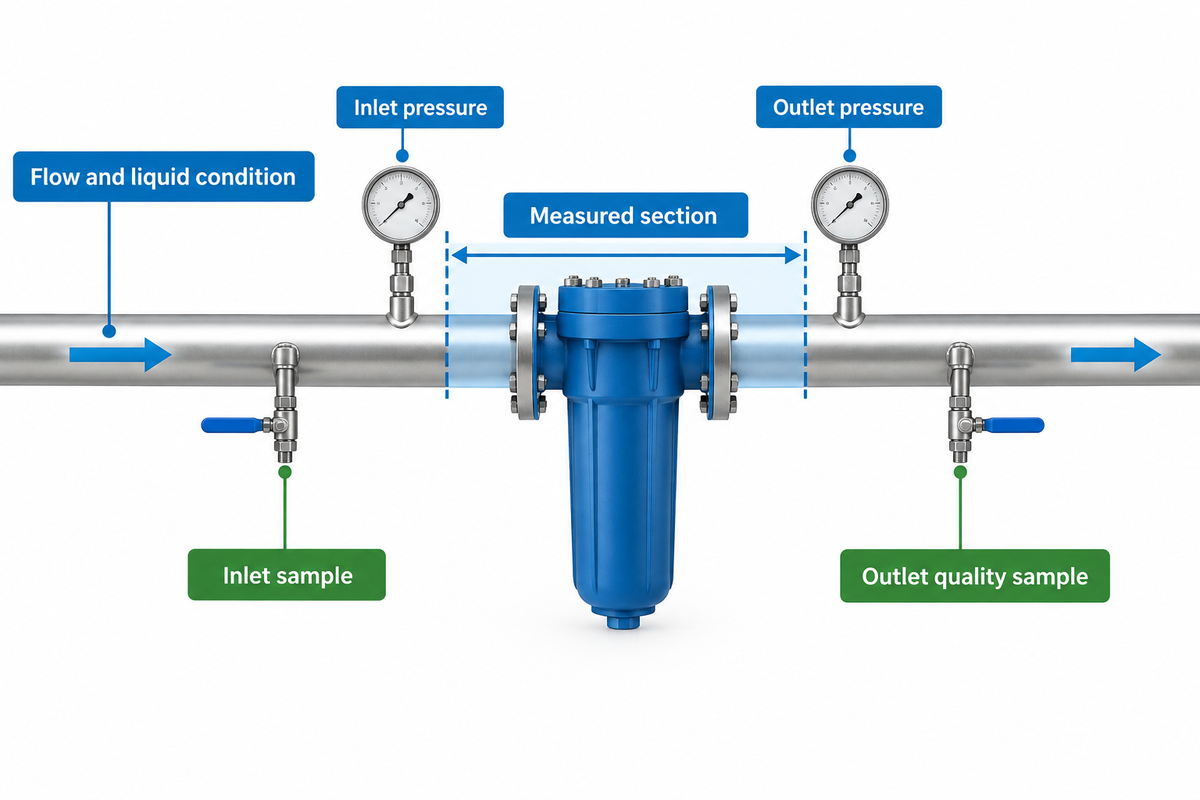
A pressure difference across a measured section describes the hydraulic condition. Testing the water that leaves it measures outlet quality. Read both, along with flow and liquid condition. A low pressure difference may be caused by low flow, a clean element or an unintended bypass. It isn’t a substitute for the required result in water quality.
Inlet gauges report inlet pressure. Filter differentials require measurements on both sides of the defined assembly. Losses through pipework or valves between those locations are included in the measurement. Comparisons become misleading when one run has extra pipe resistance and the other doesn’t.
Record design flow, terminal pressure drop and feed/filtrate sampling conditions for an industrial comparison. Challenge-test conditions and criteria for a specific drinking water verification programme are described in EPA’s archived bag and cartridge challenge test protocol.
- Locate the measurements. Identify the filter inlet, outlet and protected use point.
- Record the operating state. Include flow, liquid temperature, valve position and whether the element is new or loaded.
- Compare water samples. Use the same relevant method at inlet and outlet during the same operating period.
- Connect the result to production. Check whether the receiving operation gets the required water at that flow.
For trending, a change in pump speed needs a new reference for flow; a change in the source of water needs a new reference for feed quality. Unacceptable particles downstream indicate failed particle control even with low pressure loss.
The element’s differential-pressure capability and the housing’s pressure rating describe different constraints. Servicing the assembly requires adherence to the site’s isolation, depressurization and servicing procedure. A trend chart can’t provide authority for servicing the assembly.
Which Water Quality Measurement Fits the Problem?
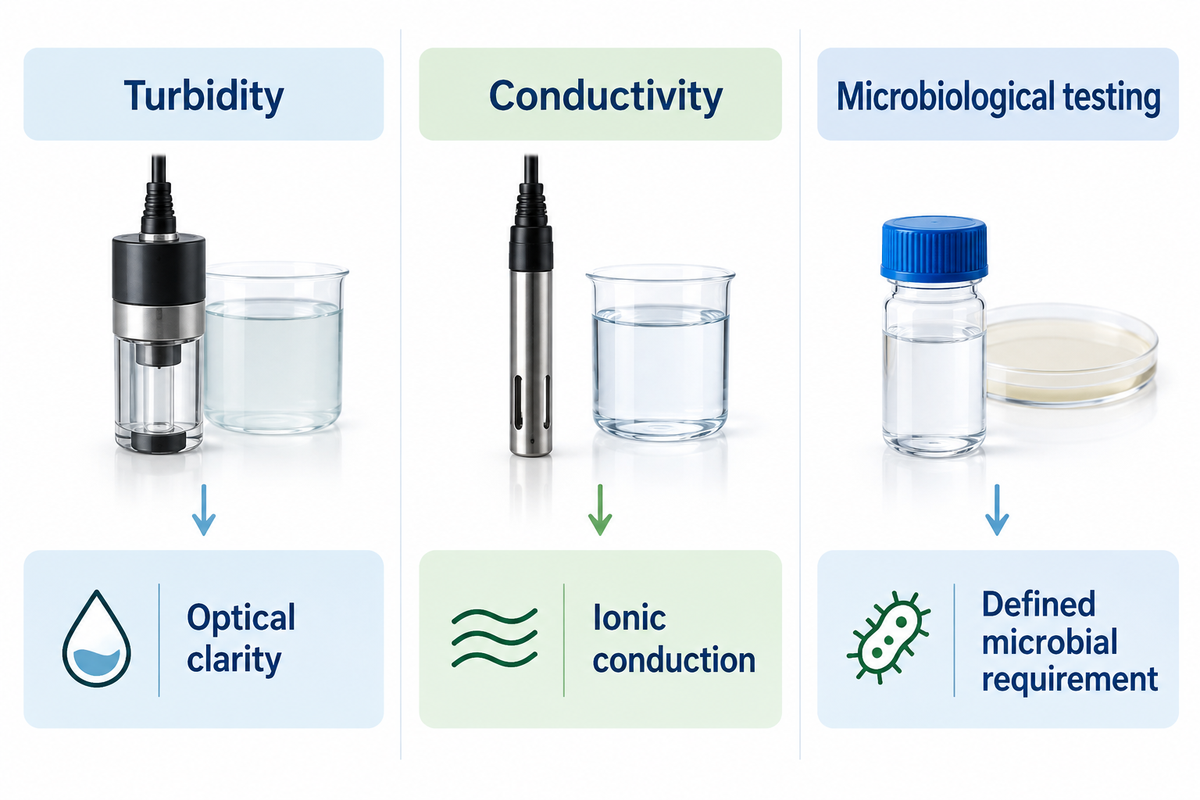
For an acceptance decision, pair the method with the failure mechanism, sampling location and intended water use.
The U.S. Geological Survey defines turbidity as the scattering of light and measures it in Nephelometric Turbidity Units (NTU). In their explanation of conductivity, they discuss effects of ions dissolved in water. Clear water can still contain dissolved substances. A clear water sample doesn’t indicate the water is safe to drink.
| Measurement | Useful question | Interpretation boundary |
|---|---|---|
| Turbidity | Has the optical clarity changed? | NTU is not a particle mass or dissolved-salt concentration. |
| Total suspended solids | How much suspended mass does the defined method retain? | Equal mass can contain different particle-size distributions. |
| Particle count and size | Are particles in the process-sensitive size range present? | The instrument’s size range and counting method matter. |
| Conductivity | Has ionic conduction changed? | It does not identify every dissolved substance. |
| Dissolved-solids testing | What dissolved-solids quantity does the specified method report? | A conductivity-based estimate uses a conversion relationship. |
| Hardness | Are hardness-forming ions relevant to the process? | A particle-rating change does not soften the water. |
| Microbiological testing | Does the sample meet the defined microbial requirement? | Sampling, handling and the target organism are integral to the result. |
| SDI | What fouling-related indication does this defined method provide? | Use the test within its stated water-sample scope. |
| Temperature | Are operating and test conditions comparable? | Temperature affects process behaviour and some measurement comparisons. |
Use the silt density index method in ASTM D4189-23 for relatively low-turbidity water below 1.0 NTU. The method excludes effluents from most reverse osmosis and ultrafiltration systems. Limitations of the SDI method include the need to check comparability of SDI results due to varying water temperatures and membrane filter manufacturers.
When the feed changes, take a concurrent inlet and filter outlet sample for comparison. A sample taken after storage shows what happened later. If the filter outlet meets its target but the use-point sample does not, the tank or distribution system needs investigation. The filter micron rating explanation can help define a rated performance and help explain how it’s tested.
Troubleshoot Short Filter Runs and Cloudy Water
Typically, short runs result from many causes such as an increased solids load and/or unsuitable retention. Other causes of cloudy outlet water may be damaged media, a bypass around the filter, or contamination after filtration. Long-term pressure and quality trends should be evaluated for the same operating period.
Outlet water results are compared to the associated inlet water results. A difference from the earlier inlet-water baseline can indicate that the feed became harder to treat. Compare outlet results with the associated inlet condition to assess whether the feed became harder to treat, using the separate feed and filtrate sampling described in the EPA challenge-testing protocol.
| Observed change | Possible explanation | Next useful check |
|---|---|---|
| Faster pressure rise after a source change | Higher suspended loading or different particles. | Compare inlet solids and flow with the previous run. |
| Poor particle result with little pressure rise | Retention mismatch, bypass or damaged media. | Review inlet/outlet particle results; inspect installation under the service procedure. |
| Clear water but high conductivity | Dissolved-ion target not addressed by the particle stage. | Assess the dissolved-solute treatment, not just cartridge fineness. |
| Good outlet sample, poor tank sample | A later contamination source or noncomparable sampling. | Repeat representative sampling at both locations. |
| Low use-point flow with changed pump conditions | A system change as well as possible filter resistance. | Read pressure locations, flow and valve state together. |
How long will the filter last until it needs to be cleaned or replaced?
A filter run ends when the applicable quality, operating or service limit is reached, rather than running a specified number of months. Record the water volume accepted and the reason the run ended. Disposable elements are replaced; only filters designed for cleaning should be cleaned under their specified procedure.
Consider three situations. Runoff containing sediment shortens a sediment water filter run. A clear water source still fails to meet a requirement for a dissolved salt because the treatment function was selected incorrectly. Water passing the filter meets its particle target, but later storage introduces a new problem. Each calls for a different response; buying a finer cartridge would address only some of these mechanisms.
What Are Filtration Costs per Accepted Water Volume?
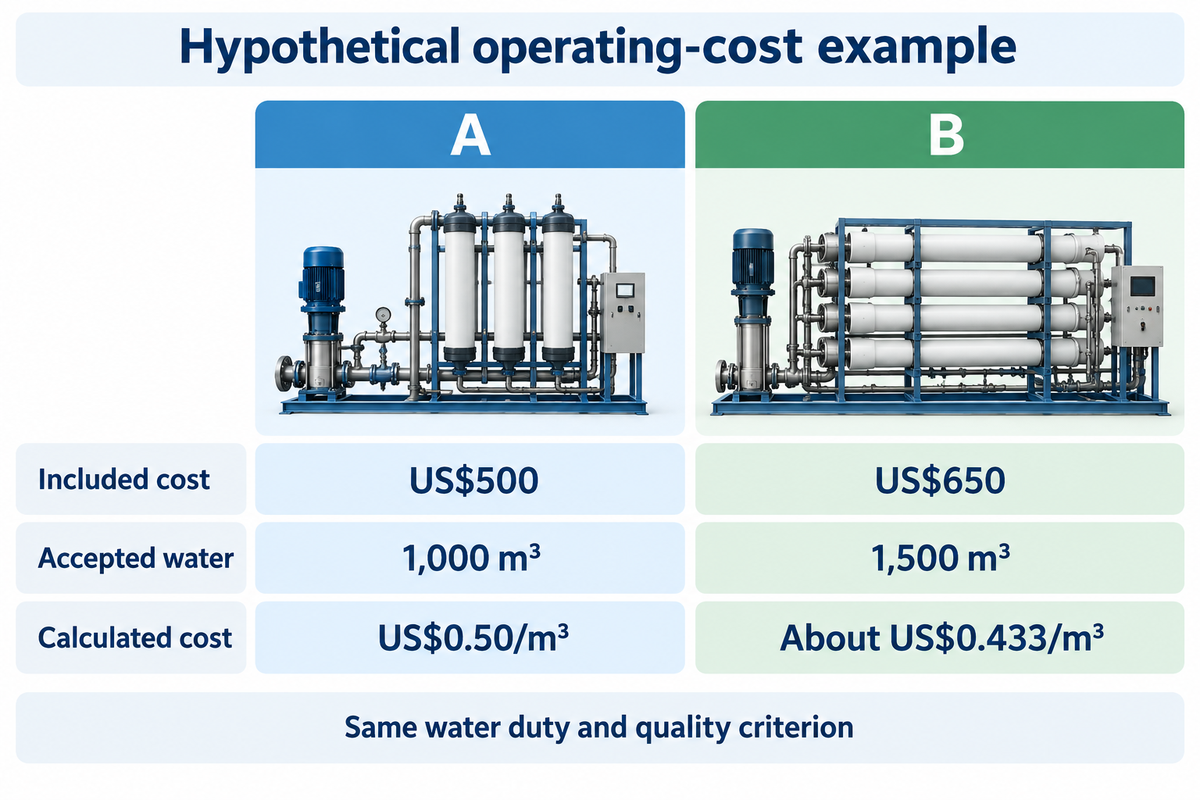
Filtration cost per accepted volume includes the operating cost divided by the volume meeting the same water quality requirement. Include consumables, changeout labour and other costs associated with water treatment inside the defined boundary. The element price misses the rejected output and service time. Both options require the same basis of accounting.
Use a narrower cost boundary for consumable filtration than for a complete wastewater treatment facility. The Department of Energy’s manufacturing water resources emphasize water-use costs. A Water Technology contribution by Aquacycl’s Luiza Moreno separates capital and operating expenses.
Large volumes of water amplify a small unit-cost difference, so record water usage alongside changeout expense.
Assumed inputs: Two options, Serving the Same Water Duty and Quality Criterion. Included costs are consumables, changeout labor, attributable energy, testing, and waste handling. No costs are duplicated. The figures shown are hypothetical accounting inputs.
| Option | Included cost | Accepted water | Calculated cost |
|---|---|---|---|
| A | US$500 | 1,000 m³ | US$0.50/m³ |
| B | US$650 | 1,500 m³ | About US$0.433/m³ |
Using the hypothetical inputs shown, B has the higher included cost and lower cost per accepted cubic meter. A complete investment decision would account for purchase, installation, and financing of the equipment.
Count water once. RO concentrate is a separate process stream, not automatically a failed batch of filtered product. Where rejected water creates a disposal expense, include the recorded expense without adding the same loss again as a second production penalty. Planned changeout during a normal shutdown is different from an unplanned production stop.
Working with an Industrial Filtration Supplier
A filtration supplier can help match a consumable to specific industrial filtration needs and provide a feasible replacement proposal. ECOFILTRONE™ provides industrial liquid filtration products with engineering services from Qingdao, China. Our consumables cover duties defined by operating conditions. Our work involves review of application, verification of specifications, and identification of replacement. We offer sample or trial support for the recommended arrangement.
Our products are high flow filter cartridges, pleated filter cartridges and membrane filter cartridges. Melt blown and string wound cartridges, and industrial liquid filter bags, provide other options within the range of water filtration consumables. The Industrial Water Filtration Applications page links these products with application and replacement needs.
For an application review, provide the source, target contaminant, flow range, temperature and existing interface. Confirm the proposed materials and housing compatibility, and check the related product documentation. Certification documents must match the actual certificate holder, product and scope; an ISO 9001 management-system certificate is a different claim from product-specific approval for food or pharmaceutical service.
Why Water Reuse Changes the Filtration Question
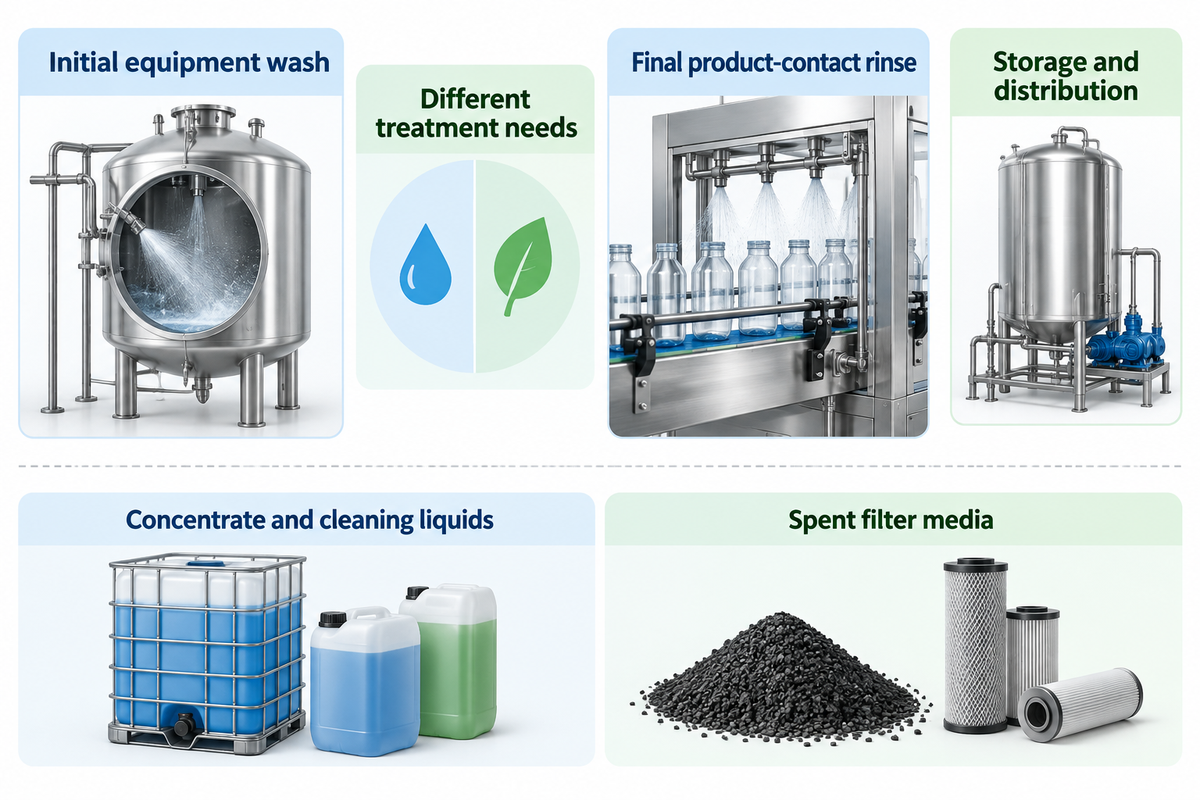
Reuse of treated water sends it to another duty. Water treated for one cooling or cleaning service may need further treatment for contact with a product. The receiving process, exposure pathway and distribution system matter alongside the quality leaving the filter.
U.S. initiatives include the use of recycled water for industrial and data center cooling and decision support for food and beverage reuse. The EPA released Water Reuse Action Plan 2.0 on April 16, 2026. Treatment and permitting requirements relevant to use depend on the jurisdiction.
Control of suspended solids may make a rinse stream suitable for an initial equipment wash, while dissolved residues may limit the number of equipment wash cycles. Moving the same water to a final product contact rinse creates a different water treatment need.
Maintaining water quality also includes storage and distribution. Reuse planning therefore follows the stream through its next use and accounts for concentrate, cleaning liquids and spent filter media. Recovery of water shifts the material to other streams which also require management.
The wastewater filtration and reuse application covers the consumable-filter role. The EPA industrial reuse resource hub provides separate material for manufacturing, cooling and other end uses.
Frequently Asked Questions
How Do Commercial Water Filters Compare to Home Water Filters?
Commercial and industrial filters are assessed against their process duty, operating flow and consequence of poor outlet water.
Commercial water filters may supply drinking water or equipment for commercial use, while an industrial water filter can protect a manufacturing process. Commercial water treatment for a beverage outlet also has a different endpoint from cooling-tower particle control. Home products often emphasize the taste of water or a certified drinking-water reduction claim. Industrial buyers also consider contaminant loading, materials and service access. Requirements for safe drinking water differ from protection of a process nozzle. A commercial water filtration comparison therefore needs the intended use and complete configuration, rather than a household brand ranking.
Where will the water filter be installed?
Install the filter at the stage where its particle-control duty protects the next process.
Upstream treatment, downstream sensitivity and the available pressure determine the suitable connection. The water filter system also needs monitoring and safe maintenance access. A sample point directly after the filter distinguishes its performance from later storage or distribution changes. Installation design must preserve the required flow to the receiving operation throughout the planned service interval.
Do You Offer Replacement Cartridge Filters?
ECOFILTRONE supplies replacement cartridge candidates and industrial liquid filter bags with application and matching support.
Our core cartridge families include high flow, pleated, membrane, melt blown and string wound products. Replacement matching uses the existing interface and the operating duty together. A cartridge that fits physically still needs suitable retention, material compatibility and operating limits. Product datasheets and any compliance documents should correspond to the configuration being supplied for that application.
What are the 7 methods of water treatment?
Treatment can combine coagulation, flocculation, sedimentation, filtration, adsorption, ion exchange and disinfection.
Reverse osmosis is another option for suitable dissolved-contaminant duties. There is no universal seven-stage industrial recipe. Source water, required use and contaminant targets determine the necessary processes. Common types of water treatment systems combine several functions rather than repeat a single filtration mechanism.
What is the highest rated water filtration system?
The useful rating is demonstrated performance for the required contaminant under the intended operating conditions.
Compare the test method, flow, loading and complete treatment configuration. A highly rated drinking-water product may address a different problem from a process-water filter. Industrial buyers need the outlet requirement linked to repeatable performance and a practical maintenance limit. The best system for your application must keep supplying the required quality of water as the feed and filter loading change. Consistent water quality requires suitable treatment and control of changes in the incoming stream. A single pore-size number is insufficient for comparing different treatment functions.
Does clear water mean the filtration duty is complete?
Clear water can still contain dissolved contaminants or microbial hazards.
A visually clear sample answers only part of the water-quality question. The required industrial use determines which additional tests matter. Potable water, process water and high-purity water have different acceptance requirements; appearance alone cannot distinguish their suitability.
What are the labor and downtime costs for filter or cartridge replacement?
Replacement costs include servicing labour and any production loss actually caused by the changeout.
Count isolation, safe depressurization, element handling, waste handling, restart and quality confirmation using recorded labour rates and elapsed time. Keep these costs separate from consumable purchase price. A verified standby path can let production continue, while a single-path installation may need a shutdown. Planned servicing during an existing stop should not be charged again as a separate lost-production event. Annual estimates should use observed changeout frequency and accepted output rather than a generic monthly replacement schedule.
Need help matching a filtration consumable to your water duty? Share the water source, target contaminant, operating flow and existing element details with ECOFILTRONE. Our team can review the application, discuss replacement candidates and support specification confirmation or a sample trial. Include the required outlet result so the discussion starts with the process requirement.
Examples of applications describe operating situations and aren’t based on actual customer installations. The cost estimate is based on the assumed parameters stated. Water treatment for health-sensitive or regulated uses requires the applicable system controls and validation for that use.
References & Sources
- Water, U.S. Department of Energy, Better Plants.
- Water Reuse for Industrial Applications Resources, U.S. Environmental Protection Agency.
- Controlling Legionella in Cooling Towers, U.S. Centers for Disease Control and Prevention.
- 21 CFR 117.37: Sanitary Facilities and Controls, Electronic Code of Federal Regulations.
- Industrial Wastewater Treatment Technology Database: Treatment Technology Descriptions, U.S. Environmental Protection Agency.
- Water-Efficient Technology Opportunity: Side Stream Filtration for Cooling Towers, U.S. Department of Energy.
- Generic Protocol for the Product Specific Challenge Testing of Bag and Cartridge Filter Systems, U.S. Environmental Protection Agency, archived Environmental Technology Verification programme.
- Turbidity and Water, U.S. Geological Survey.
- Conductivity (Electrical Conductance) and Water, U.S. Geological Survey.
- ASTM D4189-23: Standard Test Method for Silt Density Index (SDI) of Water, ASTM International, public scope and significance.
- The Costs of Industrial Wastewater Treatment Options, Water Technology, June 24, 2025; Luiza Moreno, Marketing Specialist at Aquacycl.
- Water Reuse Action Plan 2.0, U.S. Environmental Protection Agency.