Get in touch with ECOFILTRONE™ Company



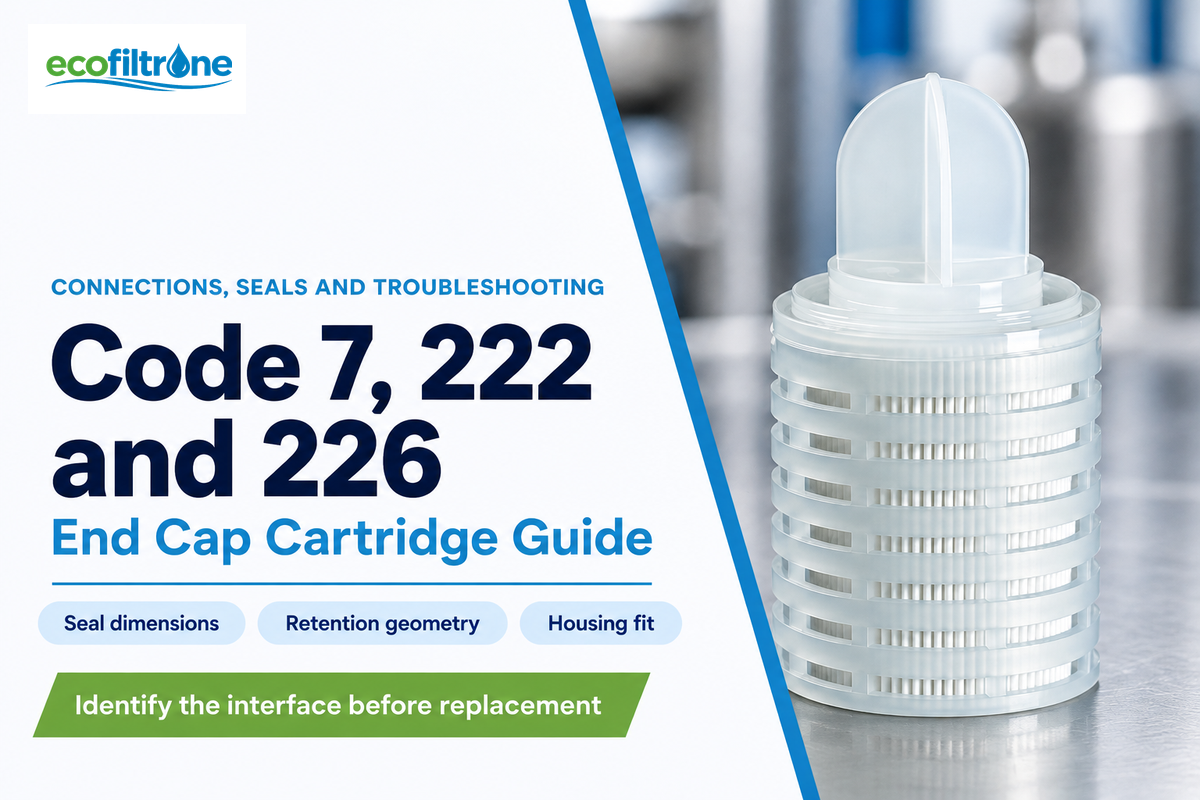
Code 7, 222 and 226 End Cap Cartridges describe connection choices that must match a filter housing. A helpful distinction is made between the size of the O-ring, the locking arrangement and the shape of the closed end. A replacement decision is much easier with these features separate from each other.
A cartridge can slide into a vessel and still leave the wrong sealing contact, inadequate retention or an unsuitable cleaning exposure. This guide explains how to interpret names, check dimensions and look into a troublesome changeout. Product configurations and replacement enquiries are dealt with on our Code 7, 222 and 226 end cap cartridge solution page.
Code 7, 222 and 226 End Cap Cartridges identify parts of a housing connection. Read the supplier’s complete end-fitting description, then match the seal, retention features and opposite end to the approved housing drawing.
What do Code 7, 222 and 226 actually describe?
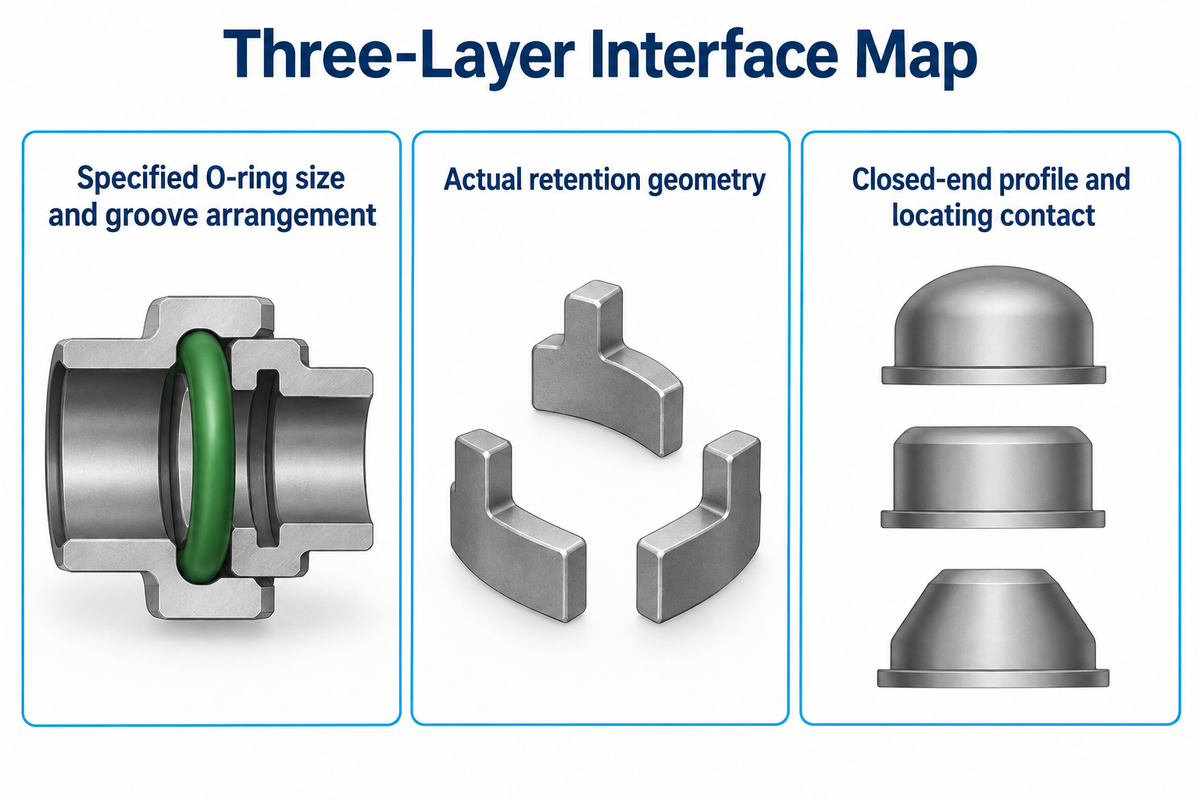
A complete end fitting in a cartridge is often described by Code 7, while 222 and 226 identify O-ring size families at open connections. The connector provides a sealing contact and the closed end may be flat, recessed or take the shape of a fin.
Consider the Three-Layer Interface Map: record the seal designation first, mechanical retention second and opposite-end form third. The description “226 bayonet/fin” fulfills all three layers. “226 filter” leaves retention details and closed end geometry unresolved. The map illustrates physical features rather than ordering cartridges. For the seal-dimension layer, ISO 3601-1 covers O-ring inside diameters, cross-sections, tolerances and designation codes; the supplier catalog still defines the complete cartridge fitting.
Manufacturer coding varies. R&F Solutions relates Code 3 to 222/flat, Code 8 to 222/fin and Code 7 to 226/fin plus bayonet. Critical Process Filtration’s own ordering table uses other numbers for its configurations. Translate an old part number through its original catalog before reviewing a new supplier’s drawing.
| Label or feature | What to record | Next comparison |
|---|---|---|
| 222 end cap | Specified O-ring size and groove arrangement | Adapter and socket drawing |
| 226 connection | Specified seal family at the open end | Actual retention geometry |
| Code 7 | Supplier and complete catalog description | Both end-fitting drawings |
| Bayonet | Lug shape, engagement path and stop | Mating slots and locked position |
| Fin end | Closed-end profile and locating contact | Housing support and clearance |
| Flat cap | Closed-end face and support arrangement | Installed seating length |
| Recessed end | Recess depth and contacting hardware | Support engagement |
| DOE | Two open ends with specified seals, including flat gaskets or internal O-rings | Sealing, compression and seating hardware |
| SOE | Single open end and closed opposite end | Socket seal plus axial support |
DOE and SOE: double open end versus single open end
A double open end cartridge is open at both ends. Many DOE cartridges use axial gasket compression, whereas common SOE designs seal radially in a socket. These types of filter connections load seals differently. The housing design determines loading. A fin on a pleated cartridge locates against its support; it is a separate feature from the open-end bayonet.
222 and 226 O-ring connections: sealing vs retention
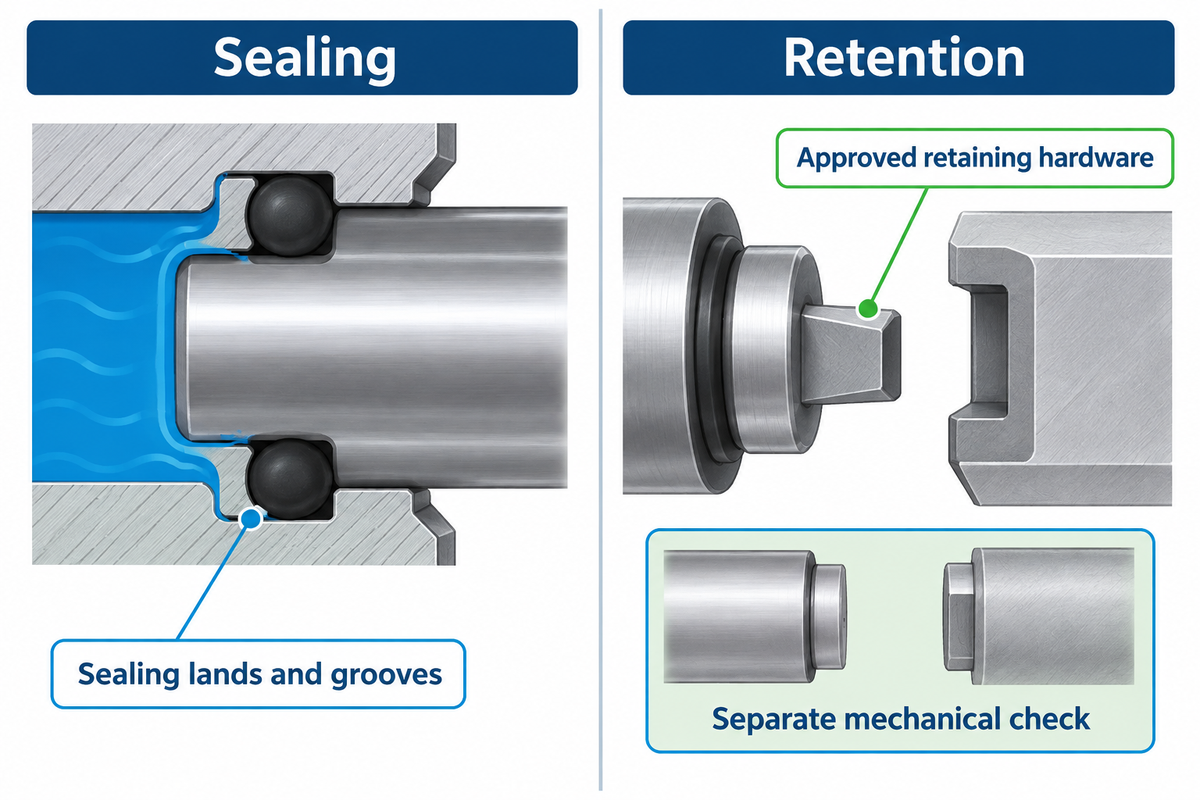
Sealing stops fluid from crossing the cartridge-to-housing interface; retention holds the element in its intended position. Common 222 and 226 filter cartridge connections perform these functions in different ways. Confirm the sealing lands and grooves, and then check the locking tabs or other approved retaining hardware as a separate mechanical check. ISO 3601-2 addresses O-ring housing dimensions, using housing to mean the groove or cavity and mating surface. Cartridge retention remains a separate equipment-interface check.
Does every 226 cartridge have locking tabs?
No. Critical Process Filtration lists a “2-226 (No Tabs) / Flat Cap” configuration and also lists 2-222 three-tab versions. Catalog examples encourage inspection even for labels that look familiar. Compare lug count, dimensions, and the profile of mating slots; the larger O-ring family doesn’t choose the locking mechanism.
Positive engagement can help mechanical stability in the housing designed for it. The fin at the other end may also serve to provide alignment or support by means of a separate contact. Neither feature changes the strength of the filter media, core or end-cap joint. A stainless steel pleated filter and a polymer cartridge therefore need their own complete operating specifications. Treat two elements as interchangeable only after the complete interface and application review.
Assume an old cartridge uses a fin support and the replacement has a flat closed end. Both open connectors may appear similar, yet the support may contact at a different position. Reusing the old support without checking the drawing could leave axial movement or prevent full seating. Resolve the support prior to placing the replacement in service.
Read the dimensions without guessing from the code
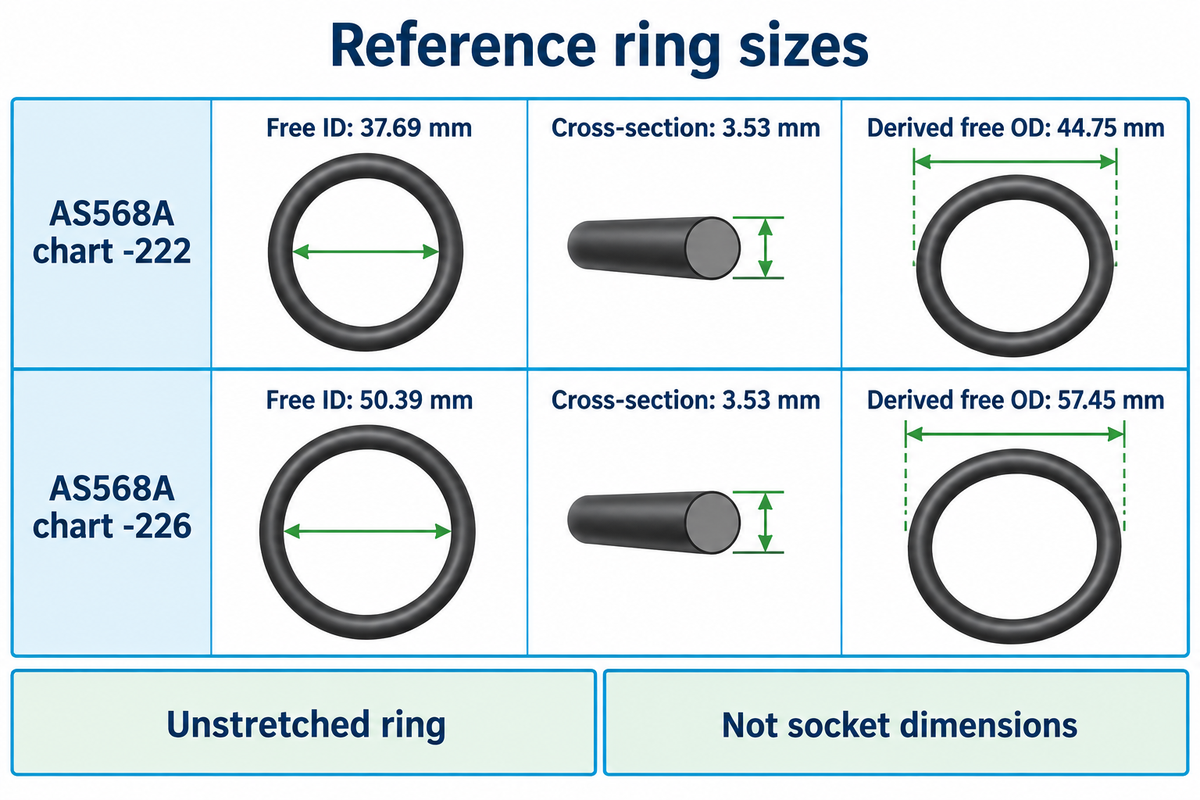
The designations 222 and 226 are sizes not decimal inch adapter diameters. Separate the free-state O-ring inside diameter from its cross-section, calculated outside diameter and installed geometry. A standardized O-ring provides a starting point for identification; a cartridge groove and housing socket require their own dimensions and tolerances.
ISO 3601-1 covers ring dimensions and designation codes. SAE’s AS568F scope likewise distinguishes inside diameter, cross-section and tolerances. The following reference values are published in ESP International’s reproduction of the Parker AS568A size chart for standard AN shrinkage materials.
| Reference size | Free ID | Cross-section | Derived free OD |
|---|---|---|---|
| AS568A chart -222 | 37.69 mm / 1.484 in | 3.53 mm / 0.139 in | 44.75 mm |
| AS568A chart -226 | 50.39 mm / 1.984 in | 3.53 mm / 0.139 in | 57.45 mm |
Nominal O-ring size versus installed dimensions
For the -222 example, free OD = ID + twice the cross-section: 37.69 + 2 × 3.53 = 44.75 mm. The -226 example gives 50.39 + 2 × 3.53 = 57.45 mm. Those calculated values describe an unstretched ring. Stretching the ring over an adapter and compressing it in a socket changes the installed geometry.
The chart can be used to identify an error and then the specific drawing is reviewed for acceptance. The nominal fractional description, the rounded metric reference and a measured used seal answer different questions. Current AS568F tolerances must come from the specified standard and compound documentation, rather than from arithmetic on this historical reference chart.
Dimension takeaway: The reference -226 ring has a free ID of 50.39 mm, compared to 37.69 mm for the -222 ring. This difference identifies a larger O-ring family. It doesn’t provide a socket bore, adapter land diameter or a permitted squeeze; record these values from the approved interface drawing.
Check both ends and the housing before changing a cartridge
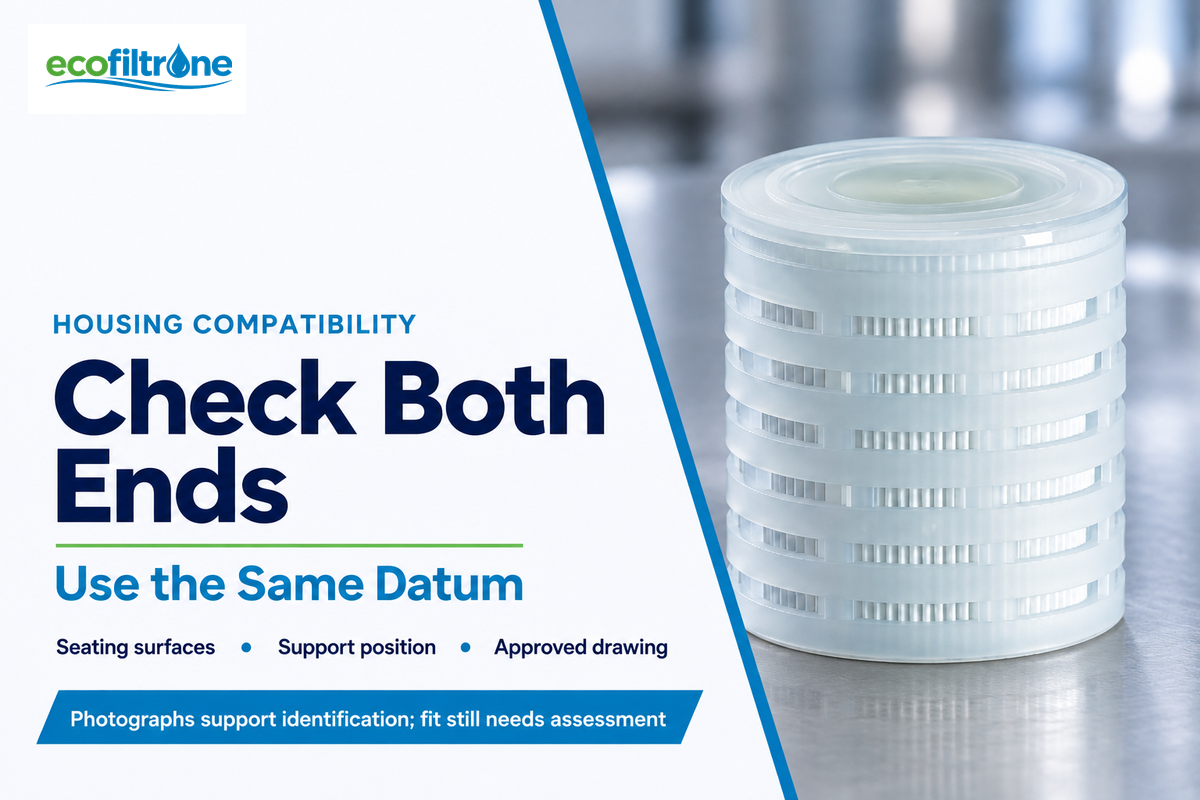
A cartridge fit check starts with the actual seating surfaces of the cartridge and ends with the cartridge’s retained operating position. Compare the open Adapter, seal grooves and the opposite end with the housing drawing. Include the installed length reference and support contact so that closing the vessel cannot conceal an incomplete engagement.
What measurements are needed to copy an existing 222 or 226 cartridge?
Record adapter land diameters, O-ring ID and cross-section, groove width and depth, spacing between grooves, insertion shoulder and seating depth. Add lug geometry where fitted, overall length, body diameter and the closed-end profile. Identify the datum used for each axial measurement; a length measured between seating faces differs from a length measured from the fin tip.
ISO 3601-2:2025 uses “housing” for the ring’s groove or cavity and mating surface. In filter work, the same word also describes the pressure vessel. Keep those meanings separate on the inspection sheet. A seal-gland calculation addresses local contact; the vessel drawing also controls supports, closure clearance and flow routing.
Imagine a water treatment team receiving a nominal 10-inch cartridge replacement. Its inspection sheet records a 254 mm overall measurement from the fin tip, while the existing drawing uses the shoulder as its length datum. That apparent match cannot settle the seating question. The team remeasures both parts from the same datum and checks the approved support position before release. If the vessel model is unknown, photographs and a used sample help reconstruct the interface, but an approved drawing or qualified fit assessment is still needed.
Replacements are held for clarification if an unknown datum is identified during procurement. Don’t use vessel closure force to compress a misaligned or incorrectly sized element into position; use the assembly compression specified by the housing manufacturer. Assembly steps, permitted lubricants and engagement checks should follow the equipment procedure. Broader media choices are covered in our pleated filter cartridges range.
Match the seal compound to the full operating cycle
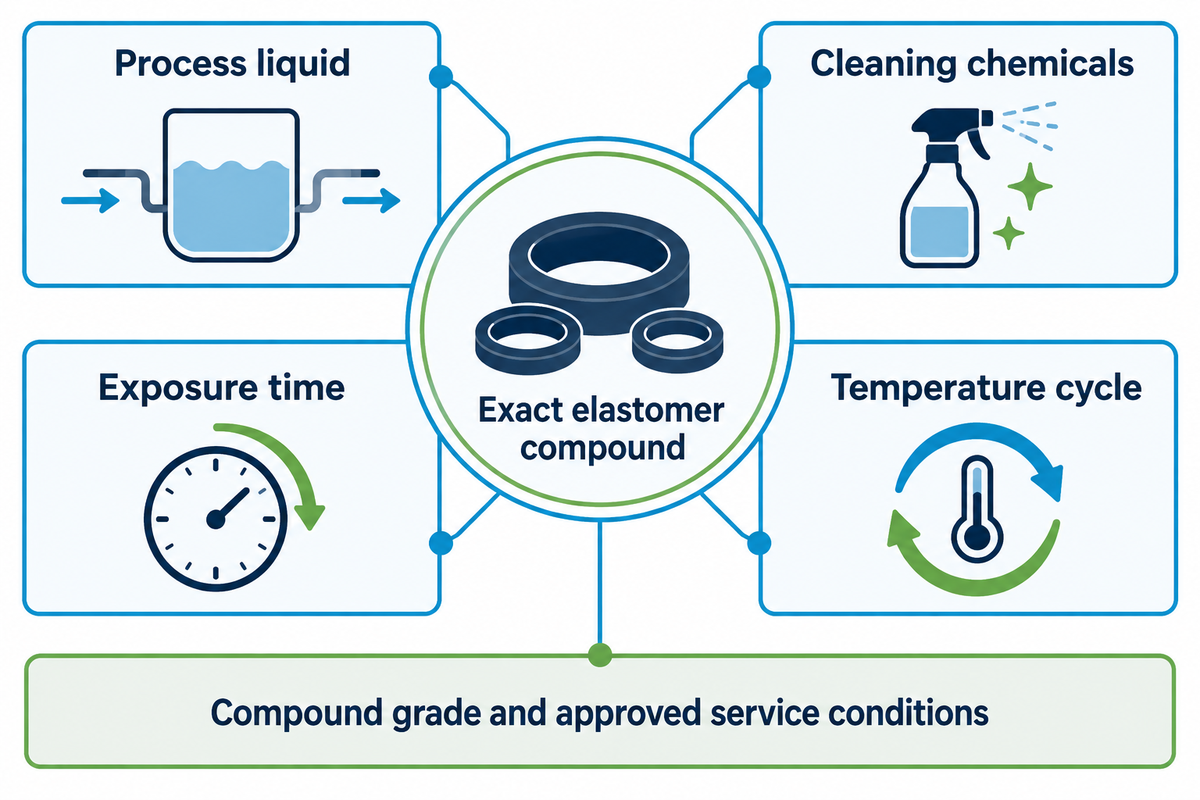
Seal compatibility requires the actual elastomer compound and its exposure conditions, including the process liquid, cleaning chemicals and temperature cycle. EPDM, silicone and FKM describe material families with different formulations. Define the compound grade and approved service conditions, then review every sanitization and cleaning stage.
A Viton designation is resolved to the FKM grade, and a universal chemical resistance guarantee doesn’t apply. Color can be a part of an approved controlled identification system, but only if the supplier documents the system. It cannot replace a compound code, hardness specification or traceable material record.
“Only materials which are in universal usage are specified; other compounds are available and can be used.”
The next step is to reach an agreement on the properties and testing methods to be applied to a given case. ISO 1817:2026 describes comparing rubber properties before and after immersion in liquids. Thus, a compatibility review should identify the liquid formulation and the basis of exposure, and should not rely on the end cap code.
Which end cap is best for chemical liquids?
Use the complete wetted construction for the required chemical duty. Review the seal, adapter, end cap joint, and medium together. A PP pleated filter cartridge uses a different filter medium from a PES membrane cartridge. Pleated polypropylene and PES can share a connector while requiring different chemical and cleaning assessments. PVDF or a PTFE pleated medium adds another material choice; neither selects the seal automatically.
Consider a beverage line whose cartridge works during production but leaks after cleaning. The useful comparison includes the concentration of chemicals, exposure time and temperature reached at the seal. A hypothetical record might show 20 °C process water followed by a 70 °C cleaning step. Those temperatures indicate the examples; they aren’t considered approved limits. The buyer asks the supplier to confirm the actual compound and complete cartridge construction for both stages before approving a substitute.
PES membrane and PTFE pleated filter media
Hydrophilic PTFE and PES membrane grades also require application specific wetting and performance instructions for related material selection. For related material selection, see our membrane filter cartridge options and high-temperature pleated filter cartridges. Keep filtration and pre-filtration applications tied to their own acceptance criteria, including pure water or beverage industries duties.
Why a cartridge can fit and still fail
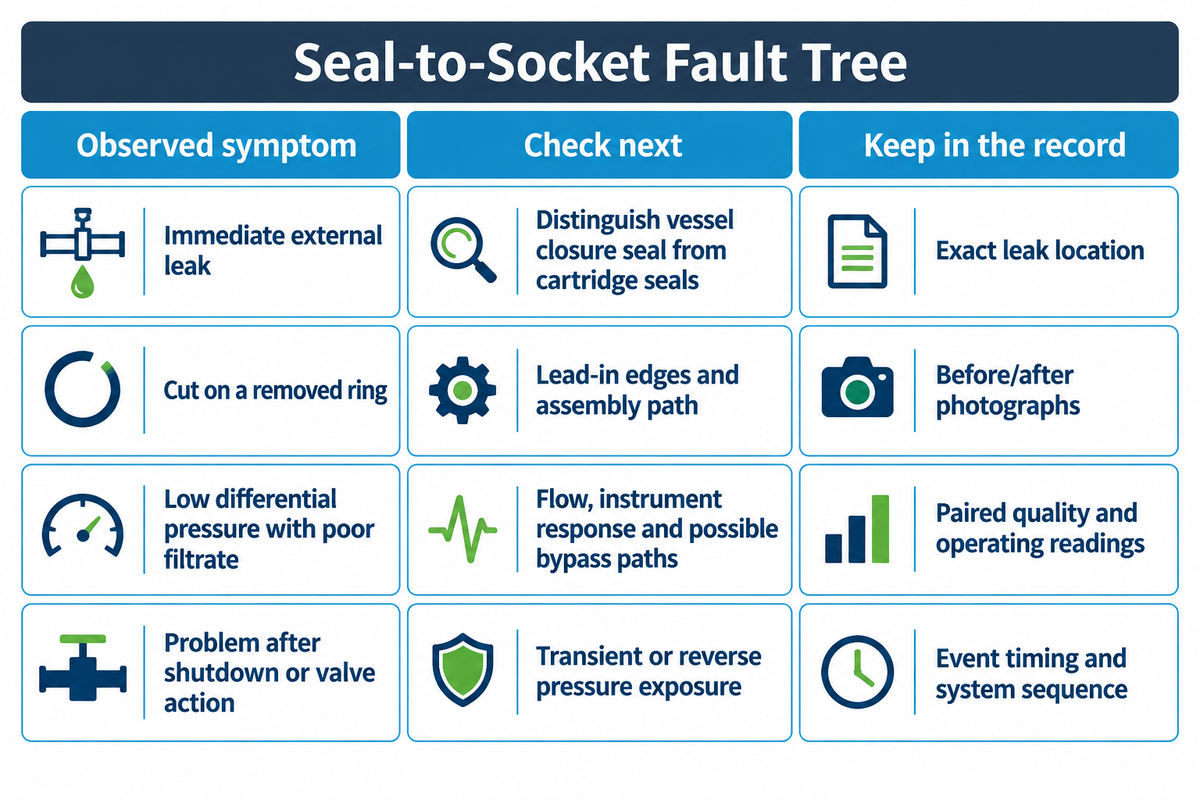
A cartridge that fits can still have seal damage, use of incorrect materials, poor retention, or filtration problems in other parts of the system. Start with symptoms and operating history. The Seal-to-Socket Fault Tree below separates observations from plausible mechanisms so that a visible leak or changed pressure drop does not become a premature diagnosis.
Filtration system checks after a changeout
According to the failure mode guide by Parker, potential modes of failure for O-ring include installation cuts, permanent compression set, chemical swelling or shrinkage, or extrusion. A damaged seal can have several contributing causes. Take photos of the seal before installation and after removal. That helps separate a defect in a delivery shipment from damage caused during assembly or service.
ISO 3601-3 addresses surface-imperfection acceptance separately. Agree the applicable acceptance specification and inspection method with the supplier. Visible damage deserves investigation, but a photograph alone cannot establish the origin or timing of every defect.
| Observed symptom | Check next | Keep in the record |
|---|---|---|
| Immediate external leak | Distinguish vessel closure seal from cartridge seals | Exact leak location |
| Cut on a removed ring | Lead-in edges and assembly path | Before/after photographs |
| Swollen or shrunken seal | Compound and complete chemical exposure | Batch and cleaning history |
| Permanently flattened section | Compression history, groove and temperature | Removed seal and service cycle |
| Chewed downstream edge | Extrusion clearance and pressure direction | Drawing plus pressure history |
| Unexpected movement | Retention engagement and support position | Locked-position inspection |
| Low differential pressure with poor filtrate | Flow, instrument response and possible bypass paths | Paired quality and operating readings |
| High differential pressure | Loading, viscosity, flow and flow direction | Comparable temperature and flow data |
| Problem after shutdown or valve action | Transient or reverse pressure exposure | Event timing and system sequence |
The FDA’s 1993 high-purity water-system inspection guide states that filter “ballooning” occurs due to rapid closure of a downstream valve which causes a reversal of the pressure. This is an example of a transient failure path for further investigation. The example provides no reverse-pressure ratings for 222 or 226 O-rings connectors, or cartridges.
When discussing a system using a filter for the cooling of DI-water on Eng-Tips, the operator stated that after shutting off the pumps, leaks were visible. The high range gauge was reported to have poor resolution and was of limited use at the low end. The seal and cover were replaced. That account suggests useful questions about measurement and change control; it does not isolate a proven cause.
Inspect internal parts only after the system has been safely isolated, depressurized and prepared under the equipment procedure. An operating reading paired with an applicable filtrate quality or integrity method can be used to evaluate performance acceptance; differential pressure measures hydraulic resistance and does not locate every flow path through a filtration system.
Industry outlook: an acceptance record for the next changeout
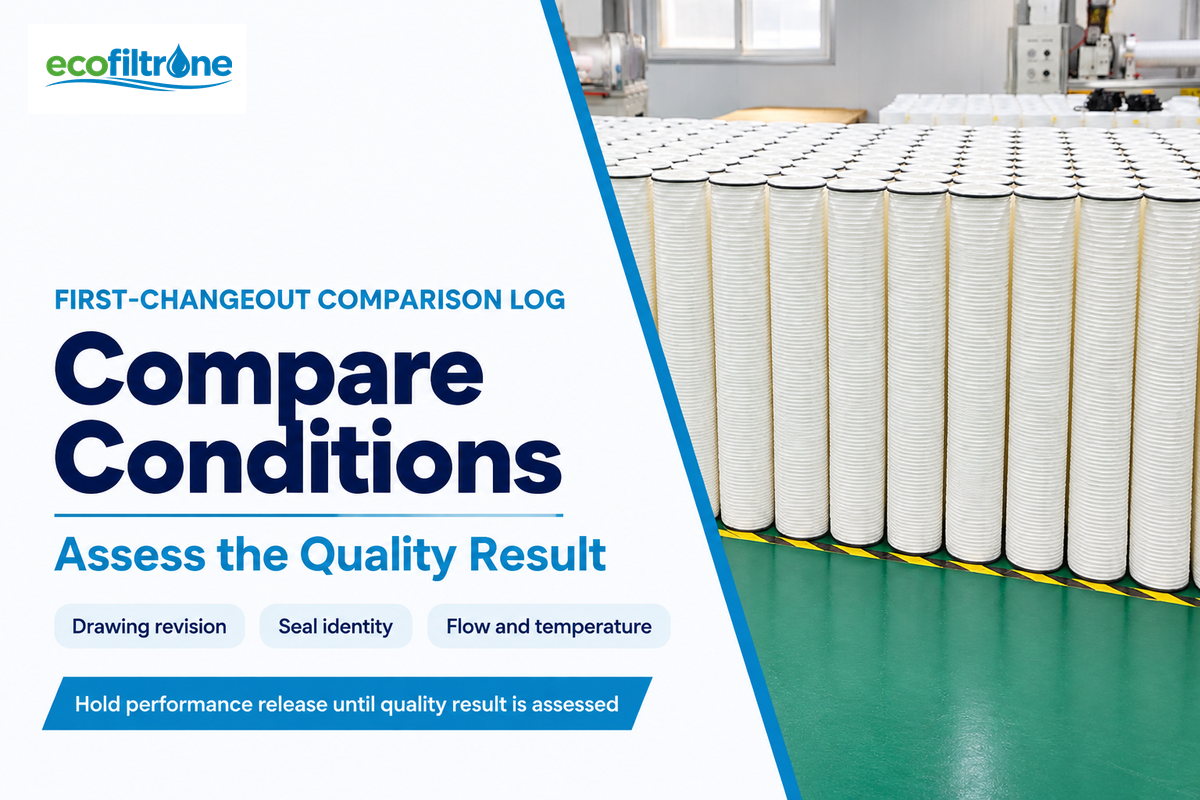
Choosing the right replacement begins with determining the approved interface, material and operating conditions. Build a First-Changeout Comparison Log that links the part revision to the housing drawing and records conditions before and after installation. Keep approval basis documents, such as supplier records and cited standards, available to the next team performing maintenance to ensure a repeatable decision.
Document control has specific current checkpoints: ISO 3601-2:2025 was published in November 2025, ISO 1817:2026 in August 2026, and SAE AS568F was reaffirmed in January 2026. Review the editions named in a specification when it is revised. A new edition calls for a scoped review; it does not automatically require replacing every approved cartridge.
Pleated filter cartridge reliability: compare operating conditions
An example for a decision at a water-treatment changeout is shown below. All the data shown are hypothetical, and no pass limit is set. No pass limit is assigned: the responsible team must compare the observations with the actual approved process criteria. Comparing flow and temperature with differential pressure is more informative than a lone pressure reading.
| Record item | Before changeout | First replacement observation |
|---|---|---|
| Approved interface | Drawing revision retained with old part | Same datum and support position checked |
| Seal identity | Compound and batch recorded | New compound and batch matched to approval |
| Water flow rate | 10 L/min | 10 L/min |
| Water temperature | 20 °C | 20 °C |
| Differential pressure | 0.30 bar | 0.12 bar |
| Quality observation | Plant’s approved method and baseline retained | First result pending |
| Disposition | Changeout due under site procedure | Hold performance release until quality result is assessed |
The pressure drop in the example above may have several explanations, including a clean element or an unintended flow path. Retain the quality result before declaring the process and seal adequate. If multiple variables changed, all should be listed; otherwise, the next investigation may erroneously give credit to the seal or the medium alone. Traceable records support replacement reliability by keeping those distinctions available at the next changeout.
ECOFILTRONE™ supports application review, replacement matching and specification confirmation. For a focused review, provide the housing model, drawings or photographs of both ends, the existing part number and the operating cycle. For media-specific background, read our PP pleated filter cartridges guide or glass fiber pleated filter cartridges guide.
Frequently asked questions
Does a 226 end cap have a higher pressure rating than a 222?
Connection codes define no universal pressure limits. Use the limits for the finished cartridge and its specified housing, as well as applicable temperature and forward or reverse differential pressure limits. Locking geometry addresses retention; pressure capability is a function of the medium, core, joints, and local seal design.
Does every 226 cartridge have a fin end?
No. A fin is an opposite-end feature, and 226 commonly identifies the open connection seal family. Different closed-end forms appear in manufacturer’s guides. Confirm the full description and support geometry rather than infer the closed end from the ring designation.
Can a DOE cartridge replace a 222 or 226 SOE cartridge?
This is only authorized by the housing manufacturer if the complete alternate arrangement and required hardware are approved. A flat-gasket DOE arrangement loads and locates its seals differently from a radial-O-ring SOE arrangement. Changing from radial O-ring sealing to flat gasket compression requires verifying the seating faces, supports and assembled length.
How often should these cartridges be changed?
Setting an interval relies on the application, cartridge limits and the site’s operating procedures. Track loading, differential pressure, filtrate quality and cleaning exposure. Even a non-critical duty needs an agreed changeout basis. An end-cap code alone does not set a service life or a fixed calendar interval.
Can O-ring color identify the seal material?
Color codes help identify materials as described in a documented coding system by supplier. Across suppliers, request the compound designation and batch traceability. EPDM, silicone and FKM formulations may share a color, and a used seal can change appearance after exposure. For replacement matching, keep the specified dimensions and hardness with the material record. A slightly larger used ring may have swollen, stretched or been the wrong original part; compare it with the approved specification before copying it.
Does Code 7 establish sterile filtration performance?
No. Sterile filtration requires a validated filter and process controls that are specific to the application. The connection describes an interface option. Retention performance, integrity-test method, installation and sterilization conditions require their own documented basis for the selected cartridge.
Need help identifying a replacement connection?
The Technical scope for dimensions in the named size chart is for reference only; changeout readings are a hypothetical teaching example. Final fit and operating acceptance follow the approved cartridge, housing and application documentation. Product-specific material and compliance documents should be checked for the actual item and certificate holder.
References & Sources
- ISO 3601-1:2012, ring dimensions, tolerances and designations.
- SAE AS568F, size standard, reaffirmed January 2026.
- ISO 3601-2:2025, seal housing dimensions.
- ISO 3601-5:2015, selected elastomeric material specifications.
- ISO 1817:2026, effect of liquids on rubber.
- ISO 3601-3:2005, quality acceptance criteria.
- FDA, High Purity Water System inspection guide, historical 1993 observations.