
Get in touch with ECOFILTRONE™ Company


High Flow vs Standard Cartridges for Industrial Water

By DD · Updated October 2026
In a high flow filter vs standard cartridge comparison, high-flow elements can reduce handling with large banks; standard cartridges can remain economical at modest flow with a suitable existing housing. Compare both at a matched particle removal, usable flow and complete replacement cost.
A high flow cartridge typically combines a large body with a large filtration area. A “standard” cartridge describes a format, not one filter material. Both formats can use pleated media. Comparing a large pleated element with a small string wound cartridge alters two things: format and media.
Quick decision
- Match retention efficiency and outlet quality before comparing cartridge counts.
- Use design flow at the actual viscosity and pressure drop, rather than the catalogue maximum.
- Include draining, restart, replacement frequency and housing conversion in the business case.
- Keep the current bank when a conversion adds cost without removing the operating constraint.
Quick specs to compare
Duty: industrial liquid filtration · Rating: micron size plus efficiency and test method · Flow: m³/h per element at stated conditions · Compatibility: connection, seal and flow direction · Cost basis: complete bank changes per year.
Format and media: what changes in a high-flow filter
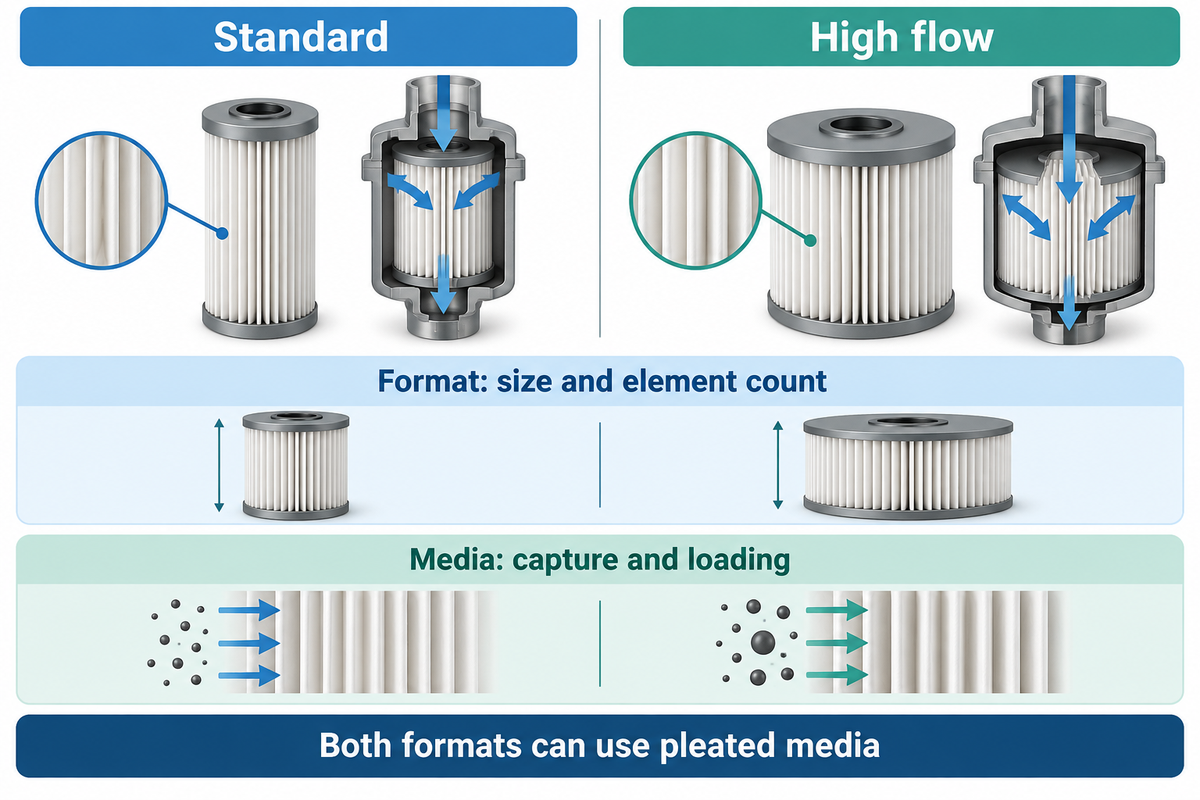
With a high-flow format, the main change is how much filtering area and liquid capacity can be accommodated in one replaceable element. Media selection controls what contaminants are captured and how the element loads. For an existing polypropylene pleated bank, compare a larger pleated element first; changing to a different medium makes the cause of any improvement difficult to identify.
This is like opening more lanes through the same checkpoint: more area can accommodate more liquid, but the capture requirement still sets what may pass. A high-flow filter cartridge can decrease the number of individual elements in a housing, while a conventional bank offers smaller and lighter units and an established supply route.
Pall states their Ultipleat High Flow cartridge uses a pleated design to hold contaminants inside the element. On the 3M High Flow HF/HFM product page, they describe surface-filtration HF media and thick HFM media for deformable contaminants. These designs are specific to each family, so a universal high-flow design shouldn’t be assumed.
What is the function of a cartridge filter?
A cartridge filter uses particle-removal media to remove suspended particles as liquid flows through the replaceable media. In industrial water treatment, it can protect downstream equipment or provide a polishing function. Media type, retention rating, seals and operating conditions affect particle capture. Ordinary particle-filter media won’t remove dissolved salts; salt removal requires a suitable process such as reverse osmosis.
When treating oily water, one must determine if the goal is particulate removal, free-oil separation or treatment of an emulsion. A method suited to the form of the contaminant must be selected. For particulate filtration, compare pleated media or melt-blown and wound elements and select based on the type of contaminant, not the media’s appearance.
Match particle removal before comparing flow
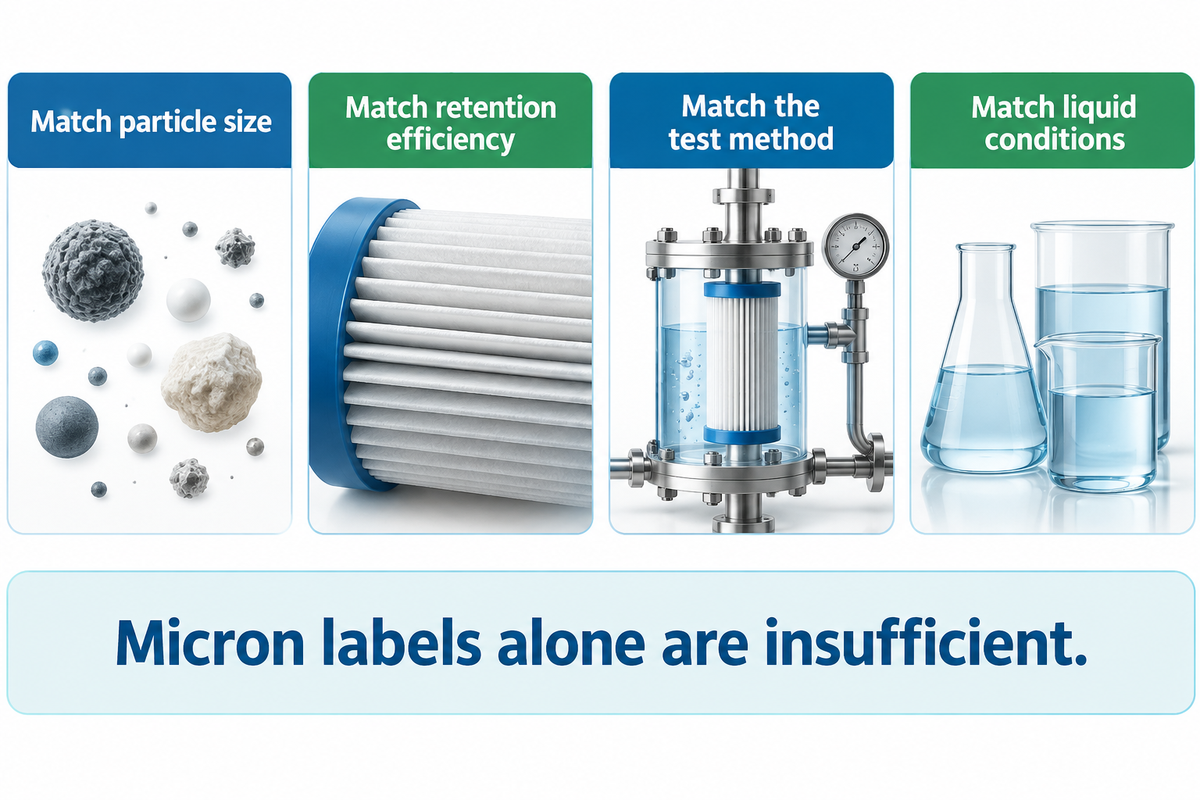
Cartridges should be compared at the same required particle removal efficiency, not simply at the same micron rating. An absolute rated 5 micron element may provide different outlet quality from a nominal rated 5 micron element. Consider the size of the particles, the capture efficiency, the test method and liquid conditions. Put all these conditions on one specification before you look at a lower element count.
For example, a quotation for a 1 micron cartridge would require an efficiency statement at that size. “Absolute” should be followed by a documented test definition, and “nominal” should be followed by the supplier’s stated removal definition. Neither describes the complete test on its own. We go over the difference between absolute and nominal ratings in the article filter micron rating.
Using a less expensive cartridge bank can result in expense down the line if more particulate reaches the downstream process. Conversely, over-specifying removal can consume pressure margin and replacement stock. The accepted outlet condition should be defined by the quality manager, and offers should be compared against it by the procurement team.
Biological control calls for a unique treatment strategy. In the study on seawater desalination, Jamieson and colleagues’ research on aggregate-associated organisms showed that pretreatment could leave biological fouling precursors downstream. In this context, a change of cartridge format should be considered a physical-filtration change, and biological performance assessed separately where appropriate.
Size the cartridge bank at the actual flow rate
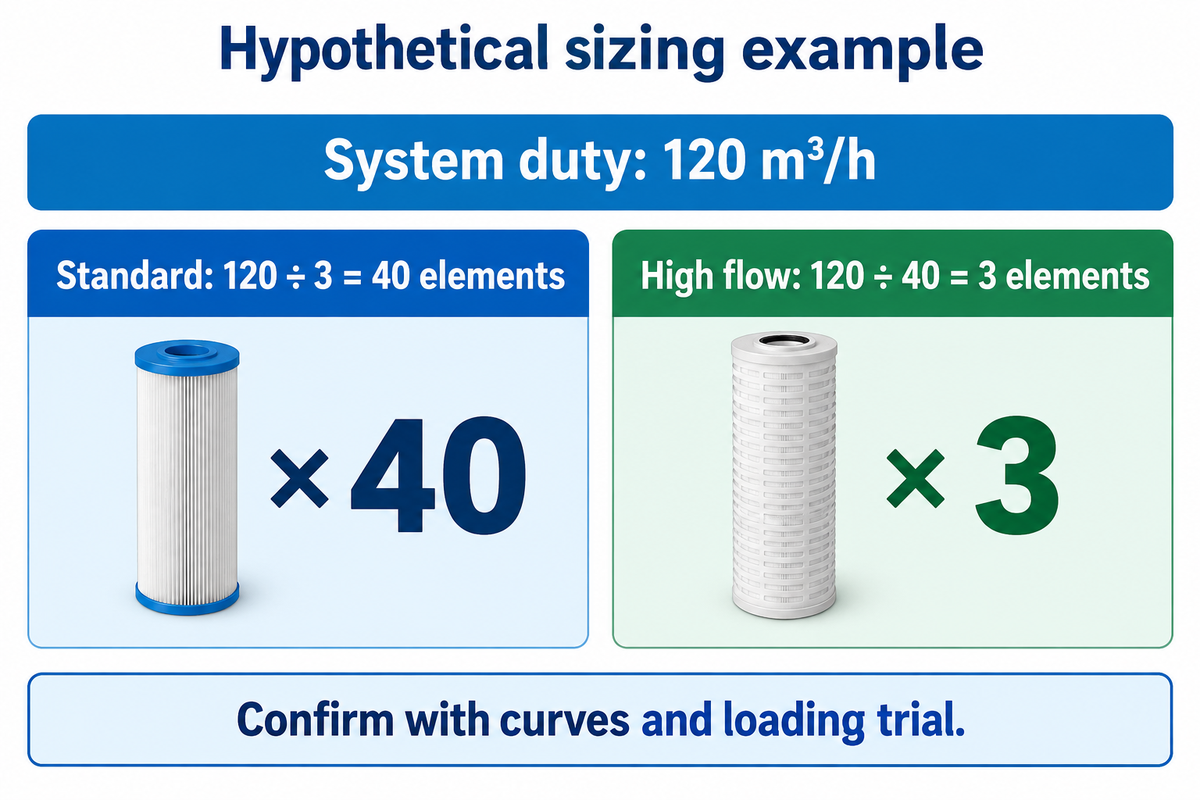
A cartridge bank is sized by dividing the required system flow by the qualified design flow of each element and rounding up. The element value is dependent on the allowed fluid temperature and viscosity, the permitted pressure loss and retention. The catalogue gives the stated limits for the operating point. The operating point should be defined using the pressure-drop curve and annual running cost, within the stated catalogue limits.
For a worked example, assume a water duty of 120 m³/h and qualified design flows of 3 m³/h per standard element and 40 m³/h per high flow element. With these inputs, 120 ÷ 3 = 40 standard elements and 120 ÷ 40 = 3 high flow elements are selected. Actual selection requires candidate cartridges’ curves and loading trial.
The published HF/HFM page gives max design flows of 85, 350 and 500 US gpm for 10, 40 and 60 inch lengths, respectively. That shows the importance of cartridge length. Those family-specific max design flows shouldn’t replace the qualified 40 m³/h assumption in the example.
How do I know what size cartridge filter I need?
Start with the required peak flow, accepted particle removal, and the available differential pressure. Select a compatible cartridge family having an element pressure drop curve at the operating liquid viscosity. Establish flow/element and check the resulting bank against housing limits and required standby capacity. Confirm the selection by loading trial.
Three elements in one vessel don’t provide three independently available trains. If maintenance takes the vessel offline, its entire capacity is lost. A process that needs to run continuously has to have a mechanism for isolation and a reserve capacity sufficient to handle the changeover. Large flow makes the lost capacity during a changeout especially important. Include a reserve capacity in the quoted price before taking credit for a smaller footprint.
Check housing, seals and maintenance clearance
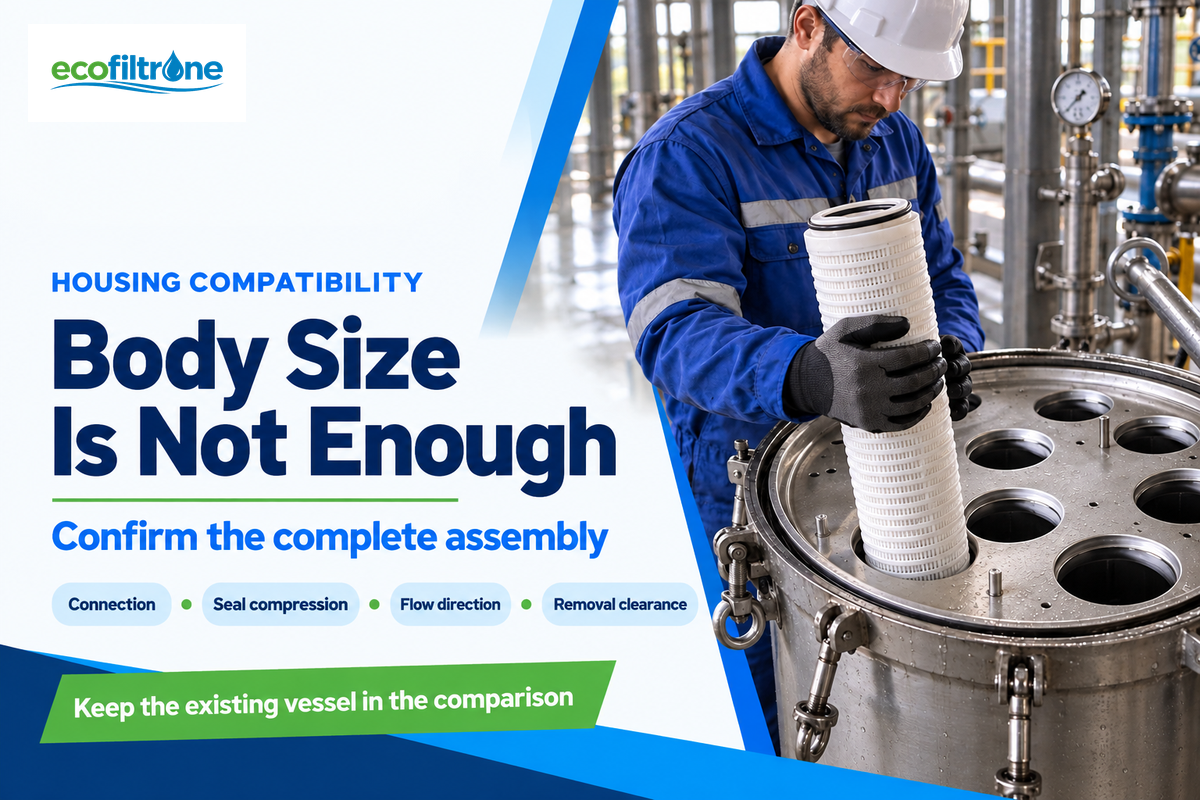
A high-flow conversion usually requires a housing designed for the chosen cartridge family, with the correct support and connection, and flow in the right direction. Merely matching body size of the old cartridge isn’t sufficient. An existing standard-cartridge vessel should remain in the comparison until the cost of replacing the housing, piping changes, and the required maintenance space have been evaluated.
Direction of flow provides a simple means to check compatibility: Pall’s referenced Ultipleat family of cartridges retains dirt internally, while the referenced HF/HFM family operates outside to inside. Interchangeability of the two families requires matching connection geometry, and seal compression in addition to direction of flow. An OEM filter replacement must also match the specific housing interface and operating envelope.
| Decision check | Standard bank | High-flow candidate | Acceptance basis |
|---|---|---|---|
| Particle removal | Current grade and outlet result | Proposed grade and efficiency | Same process acceptance target |
| Peak flow | Measured bank flow | Qualified element flow × count | Required m³/h at actual conditions |
| Clean pressure loss | Baseline at matched flow | Curve and trial measurement | Available pump head |
| Loaded operation | Existing end-of-cycle behavior | Trial pressure and outlet quality | Approved replacement trigger |
| Connection | Installed end-cap interface | Drawing-specific interface | Seal compression and positive seating |
| Flow direction | Existing vessel routing | Inside-out or outside-in family | Correct inlet and outlet arrangement |
| Chemical compatibility | Media, seal and support materials | All wetted materials | Process and cleaning-fluid exposure |
| Maintenance access | Current withdrawal space | Wet-element handling and clearance | Safe access within the plant layout |
| Availability | Flow remaining during isolation | Flow remaining during isolation | Required production continuity |
Temperature and pressure limits are part of the complete assembly. A high-temperature media option doesn’t increase the allowable pressure of a vessel and a high-pressure housing doesn’t increase the differential-pressure limit of the cartridge. Match both before selecting a seal or approving a drawing. Use the existing model and dimensions to match the existing housing connection.
Compare pressure drop over a complete operating cycle
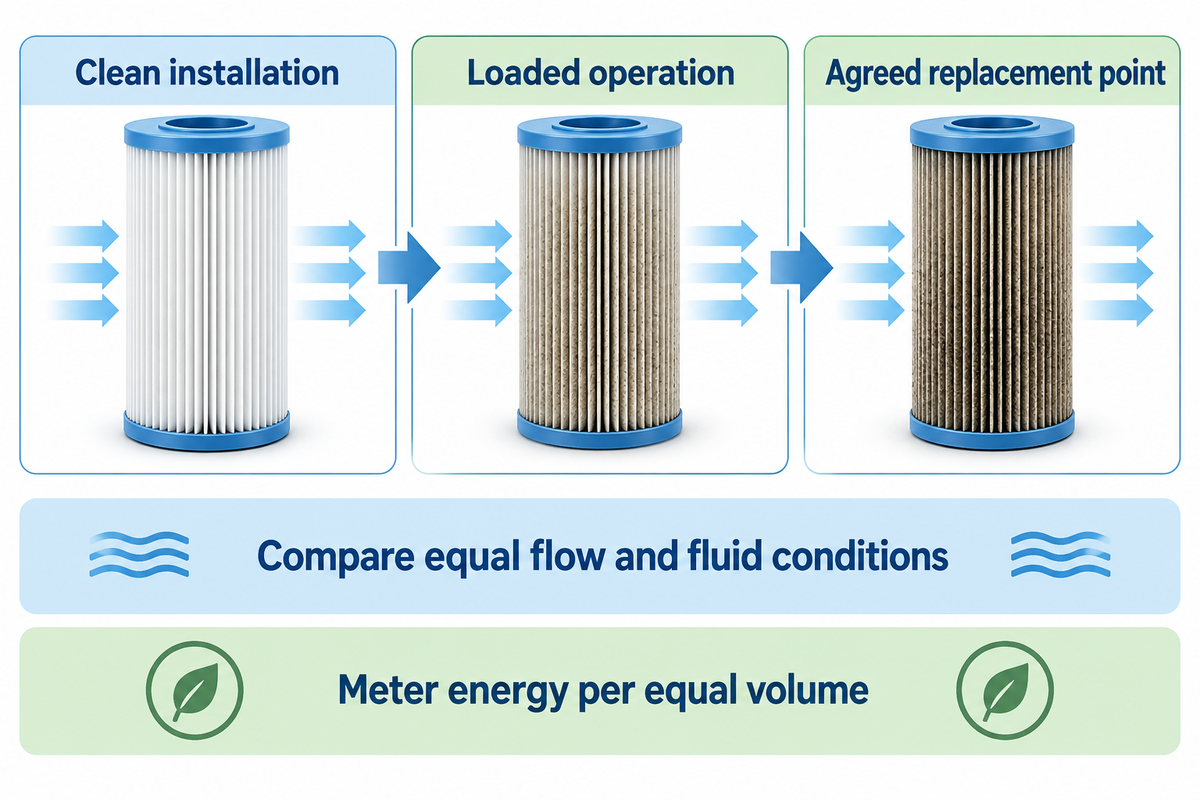
Compare pressure drop at equal flow and fluid conditions from the initial, clean installation, through the agreed replacement point. A lower initial reading is useful, but it’s the pressure rise curve and the volume of filtered fluid that determine the operating period. Pump and valve control dictate how resistance changes electrical consumption. Compare metered energy at equal flow.
ISO 3968:2017, confirmed in 2023, addresses differential pressure versus flow characteristics for hydraulic-fluid filters. Its applicability is limited to hydraulic filter testing. Water-filtration curves require stated liquid, temperature and cartridge grade. To compare water-filtration, obtain curves for the actual liquid and cartridge grade.
At a fixed pump speed, change in resistance can shift the operating point and increase flow. A control valve may then take up part of the available head. The Australian Government’s motors and variable-speed drives guide outlines the difference between throttling and speed control. Compare electrical input for equal volume, when assigning an energy saving to the retrofit.
Rapid pressure rise also requires a feed side check. The premature clogging of filters guide by Global Filter identifies solids, fluid conditions and media selection as diagnostic factors. With compressible contamination blinding the surface, a change in media or addition of upstream separation may be of greater value than increasing body diameter.
Count changeout work and the real filtration bottleneck
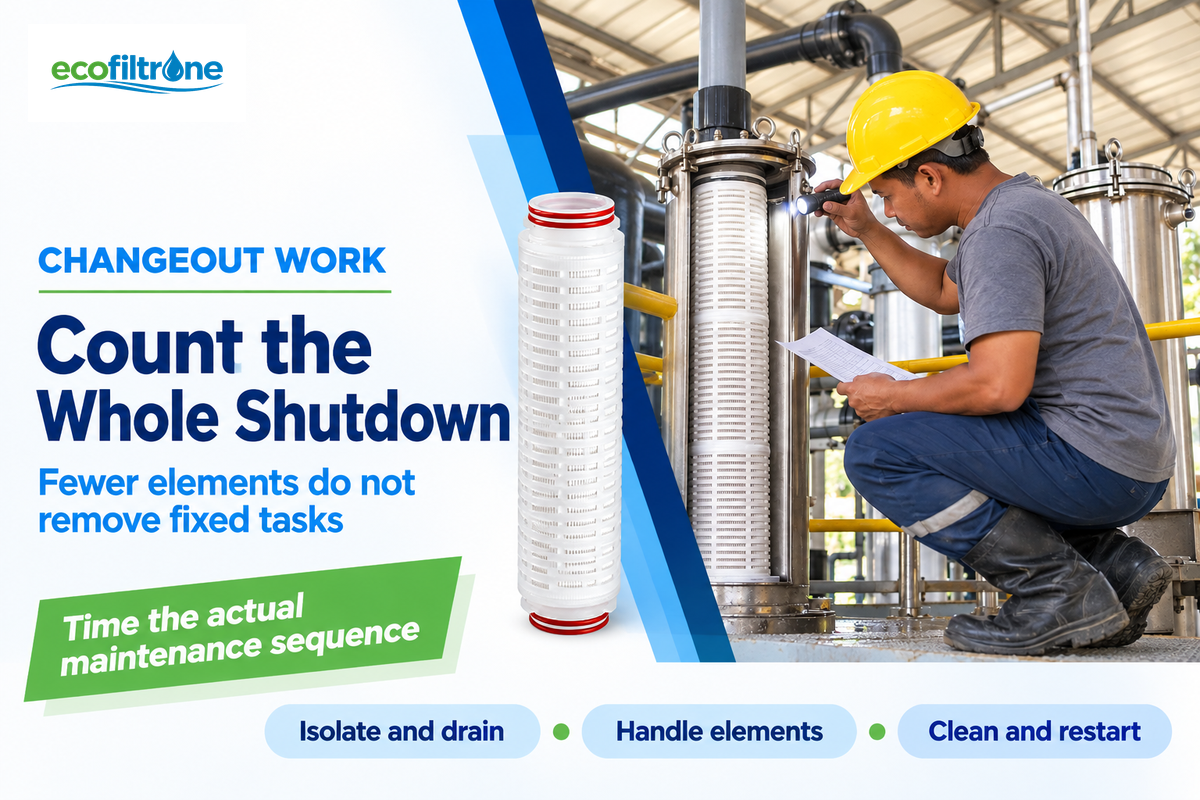
Lower element counts can speed up change outs, but total changeout time includes many other factors, such as isolation, depressurization, draining, opening, cleaning, and restart. Account for these fixed tasks separately when performing time studies for element replacement. For a plant with lengthy draining or flushing, a smaller element count may save less downtime than expected, even when the cartridge-handling step becomes much shorter.
A good maintenance record follows equipment consequence, as well as pressure. In an Eng-Tips discussion of replacement scheduling, an operator linked reduced cooling-water flow to cabinet temperature. That’s a site-specific story, but it illustrates the point that a replacement trigger should reflect the protected process, not the calendar alone.
Let’s say the fixed shutdown work takes 30 minutes. At 2 minutes per element, handling 40 elements gives a total of 30 + 40 × 2 = 110 minutes. At 6 minutes per larger element, three elements give 30 + 3 × 6 = 48 minutes. This shows the effect of handling larger elements, but assumes no difference in fixed work or flushing.
Matched-Duty Bottleneck Map
The Matched-Duty Bottleneck Map shows the operating symptom for each constraint, and points to the constraint a conversion must actually remove. This can aid in choosing to retain the bank, change the media, or test a different format.
| Application type / operating pattern | Likely constraint to investigate | Useful next comparison |
|---|---|---|
| Many elements; stable outlet quality | Repeated handling work | Time a high-flow changeout |
| Long vessel draining time | Fixed shutdown work | Isolation and drainage arrangement |
| Low flow; infrequent replacement | Small available annual saving | Retain installed standard housing |
| High clean pressure loss | Viscosity, grade or insufficient area | Matched curves and area allocation |
| Rapid surface blinding | Compressible solids or media mismatch | Depth loading or upstream separation |
| Outlet particles after restart | Seating, bypass or process disturbance | Connection inspection and outlet sampling |
| Seasonally variable feed | Solids load changes | Throughput per comparable loading period |
| No spare filtration train | Availability during maintenance | Isolatable capacity at required flow |
| Lower pressure loss; unchanged power | Pump and valve control | Metered energy per delivered volume |
Wet weight, lifting access and disposal all play a role in the decision the maintenance supervisor makes. Easy installation on a bench can become awkward inside a crowded plant room. Consider the withdrawal path and element handling method in the trial rather than relying on an element count to predict labor.
Calculate annual cost before buying the conversion
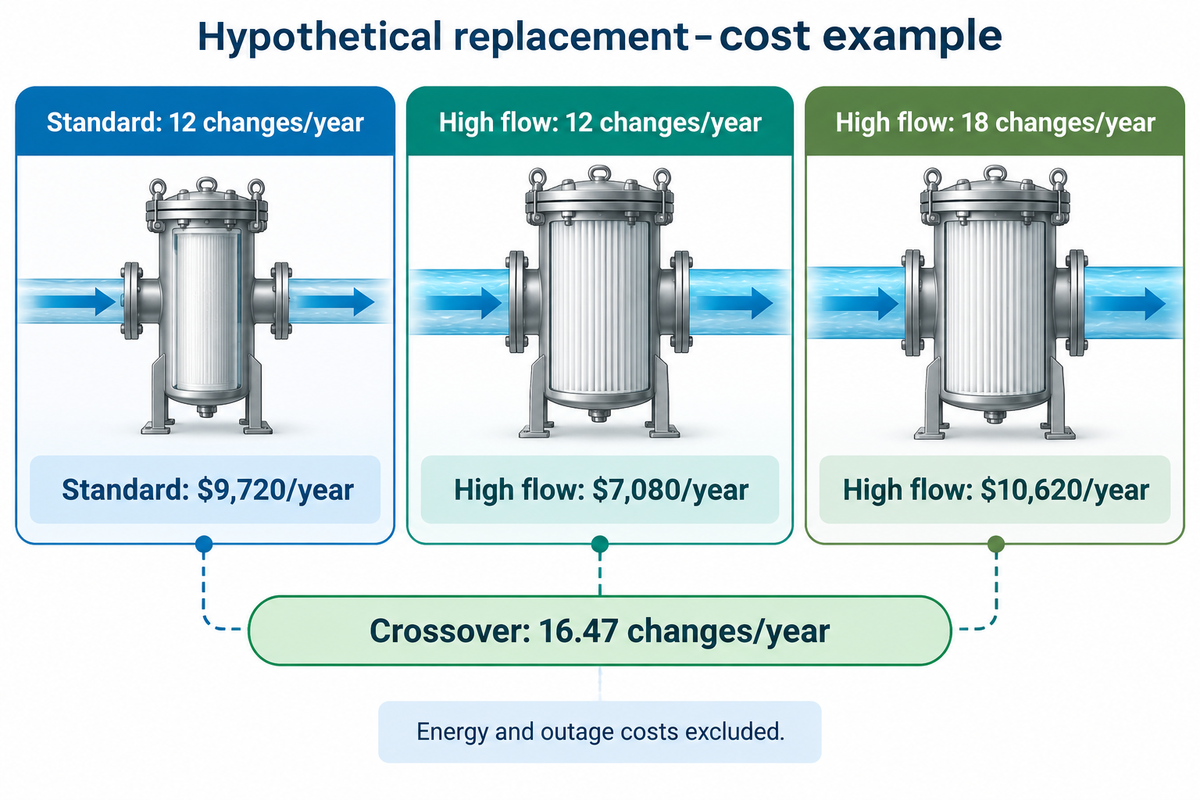
Compare the annual cost of complete bank replacements, paid labor, disposal, and measured energy, and add conversion cost, separately. Service life can outweigh the difference in unit price. A high-flow bank that costs less per change can still cost more per year if it reaches its replacement point substantially sooner under the same accepted filtration duty.
“At high energy cost, it may be more economical to replace cartridge elements more often”
That study researched high-flow cartridge alternatives in desalination pretreatment. Replacement timing and pumping cost interact in a way that’s instructive here. Below is a worked example that uses hypothetical prices and replacement intervals, and isn’t based on any supplier quotations, or on the study referenced above.
Cycle-Cost Crossover
The term “Cycle-Cost Crossover” applies to this example and refers to the situation where a high-flow bank is replaced at such a frequency that it costs the same as the fixed annual replacement cost of a standard bank.
Assume the 40-element standard bank uses cartridges priced at $18 each, with 2 paid labor-hours at $30/hour and $30 disposal per complete change. Assume three high-flow cartridges at $180 each, with 1 paid labor-hour at the same rate and $20 disposal. Paid labor-hours are separate estimating inputs from the elapsed shutdown example above.
Standard-bank change cost is (40 × $18) + (2 × $30) + $30 = $810. High-flow change cost is (3 × $180) + (1 × $30) + $20 = $590. At an assumed 12 changes/year for both banks, annual replacement cost is $9,720 versus $7,080, a difference of $2,640/year before energy and outage costs.
Given the standard bank is fixed at 12 changes/year, crossover occurs at $9,720 ÷ $590 = 16.47 high-flow changes/year. At 18 complete changes, the high-flow bank costs $10,620/year, or $900/year more than the standard bank. Replacement frequency is therefore a purchasing variable, not a detail to settle after installation.
For a longer view, assume a $6,000 installed conversion cost, split here into $4,500 equipment and $1,500 installation. Hold both banks at the 12-change annual case. The following table separates the calculable subtotal from costs that need plant measurements.
Five-year cost comparison under the stated assumptions
| Cost item | Keep standard bank | Convert to high flow |
|---|---|---|
| Purchase price | $0 incremental; existing housing retained | $4,500 assumed equipment |
| Installation & commissioning | $0 incremental in this scenario | $1,500 assumed |
| Energy, 5 years | Measure; excluded from subtotal | Measure; excluded from subtotal |
| Maintenance & spares, 5 years | $48,600 replacement labor, elements and disposal | $35,400 replacement labor, elements and disposal |
| Downtime risk, 5 years | Price locally; excluded from subtotal | Price locally; excluded from subtotal |
Calculated five-year subtotal: $48,600 standard versus $41,400 high flow, a $7,200 difference. Simple payback: $6,000 ÷ $2,640/year = 2.27 years.
This undiscounted subtotal doesn’t include energy, loss in production, taxes, financing, residual value, and other unpriced maintenance. NIST’s economic analysis guidance discusses why a simple payback misses costs and benefits beyond the recovery period. Finance should use the plant’s investment horizon and discount rate for the final decision.
Choose the system by duty and supplier evidence

Retain standard cartridges if the existing bank meets outlet quality, capacity, and maintenance needs at an acceptable annual cost. Trial high flow if repeated handling, space, or flow is a constraint. Choose the supplier based on documented element fit and performance, with retention, operating conditions and replacement support written into the offer.
For a RO pretreatment expansion, the process engineer may prioritize capacity within the available pressure budget. A low-flow side stream with infrequent changes may favor the standard housing. A variable-solids process may benefit first from a different filter material or upstream treatment. Our application-specific filtration duties help place these decisions in context.
Polypropylene and polyester, for example, need assessment of compatibility with liquids and cleaning chemicals. Membrane, melt-blown and string wound constructions provide different loadings and retention. These kinds of filter products address different duties within the industrial filtration field. A “high-performance” label should resolve into a testable requirement such as outlet particle count, delivered volume or pressure loss.
A good filter captures the target impurity while meeting the flow requirement. Deciding which option filters better means agreeing to that target first. For an aftermarket replacement, require the same fit and acceptance basis as for the original element. Relatively high cartridge consumption may warrant an upgrade, but it warrants examining the feed and media choice as well.
High flow filtration performance should be assessed at the process outlet, where the effect on the protected equipment becomes visible.
Copy these inputs into the enquiry so competing suppliers price the same duty. Fill in the actual site values or operating ranges for the fields below.
| Parameter | Value or range to provide | Why it matters | How to verify |
|---|---|---|---|
| Flow | Minimum, normal and peak m³/h | Sets duty and bank count | Plant flow record and candidate curve |
| Particle removal | Required µm and removal efficiency % | Aligns outlet quality | Test method and acceptance result |
| Liquid temperature | Operating and cleaning range, °C | Affects materials and viscosity | Process record and compatibility review |
| Pressure | System pressure and permitted differential, bar | Separates vessel and element limits | Drawings and product datasheets |
| Viscosity | At operating temperatures, mPa·s | Changes pressure loss | Fluid data or measurement |
| Housing fit | Length, diameter and clearance, mm | Controls seating and removal | Drawing, connection details and trial fit |
| Replacement duty | Current changes/year and m³/change | Sets annual consumption | Maintenance and throughput records |
ECOFILTRONE™ offers industrial filtration consumables from Qingdao, China, with engineering support. We assess replacement needs, match replacements and provide engineering support for application review and customized requirements. We work with your team to review datasheets, drawings and trial requirements for the applicable product. Requested material or compliance documents should identify the applicable product and actual certificate holder; a company quality-system certificate is a different document from a product-performance test.
Plan a trial before changing the filtration system
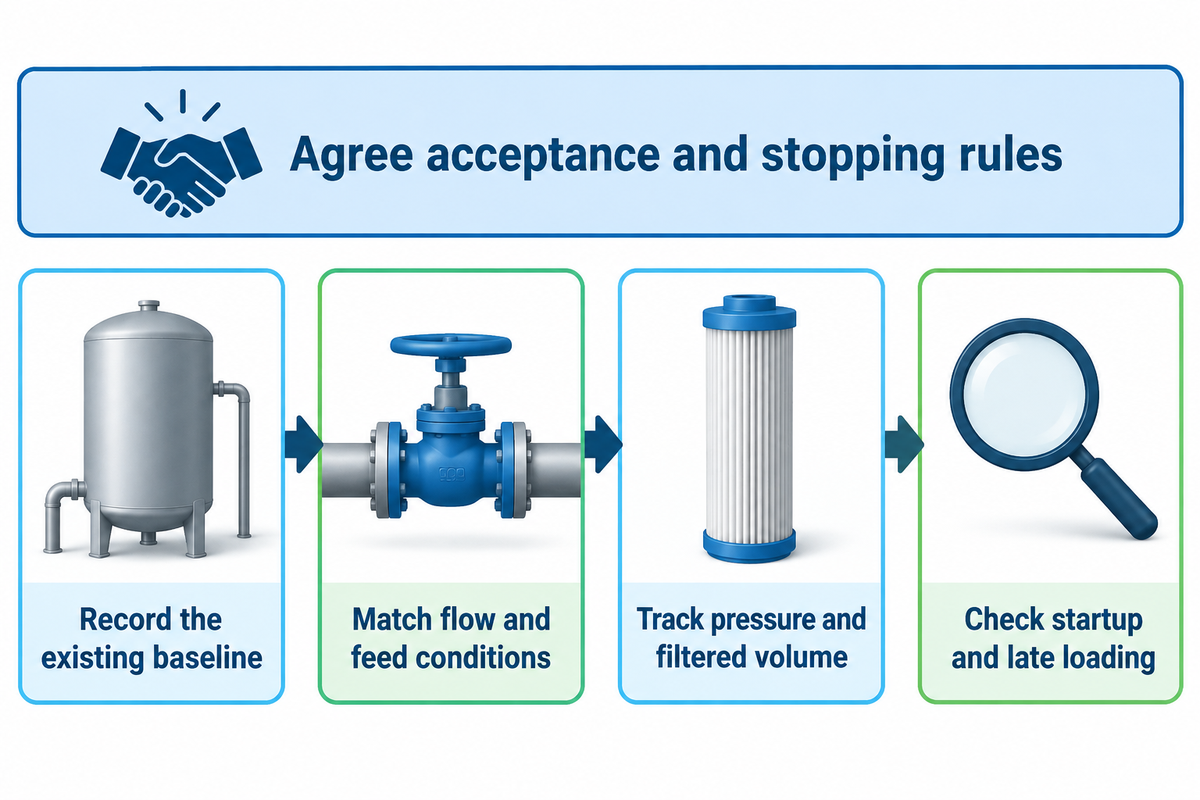
Record and save a baseline for comparison. Run the candidate against the baseline at matched flow, feed conditions, and outlet acceptance criteria. While running, monitor and track differential pressure, filtered volume, replacement work and outlet product quality. Do this for all phases of operation including starting up and late loading. A seating problem or a performance change near replacement may not be evidenced by a sample taken during steady state.
Start with the current bank’s normal operating conditions, and use the approved replacement trigger. Record inlet and outlet pressures, flow and temperature at the same time. During the trial, if a different solids load is identified, compare those periods separately rather than projecting the calendar service life directly.
The discussion of cartridge isolation, redundancy and performance monitoring for drinking-water service within the EPA’s LT2 Enhanced Surface Water Treatment Rule Toolbox Guidance Manual addresses performance monitoring, and includes a measurement limitation at low turbidity. For an industrial trial, select a measurement method that can resolve the actual outlet acceptance target; the manual’s regulatory setting should not be treated as a universal industrial requirement.
Agree who records outlet results, what ends the trial and how rejected performance is addressed, prior to the purchase order. The quality manager signs off the filtrate, and the supervisor signs off the changeout method, while procurement adjusts the cost case based on observed replacements. A conversion earns its place based on those conditions.
Frequently asked questions
What is a high flow filter?
Read the answer
A high flow filter is a cartridge system designed to pass a comparatively large liquid flow through each element, commonly using a larger pleated cartridge. The term describes format and capacity rather than a universal retention grade. Element size, media, flow direction and housing connection still vary between product families and applications.
What is the flow rate of a 5 micron filter?
Read the answer
A 5 micron filter’s flow rate comes from its design and pressure-drop curve, not the micron number alone. Cartridge length, diameter, media area, liquid viscosity and allowed pressure loss all matter. Use the selected product’s curve at the operating conditions, then check outlet quality and loading behavior before fixing the bank size.
What is the absolute rating in water treatment?
Read the answer
An absolute rating states particle retention at a specified size under a defined test basis, normally with a stated efficiency. For purchasing, request that efficiency and test method alongside the micron value. Compare products using the same basis, since an absolute label alone doesn’t describe every liquid condition or operating limit.
Which is finer, 30 micron or 100 micron?
Read the answer
A 30 micron rating is finer than 100 micron. Compare retention efficiency and test basis as well when selecting actual filter cartridges.
What is the best water filter cartridge?
Read the answer
The best water filter cartridge meets the required outlet quality at an acceptable operating cost in the installed system. For industrial water, start with contaminant type, retention efficiency, flow and material compatibility. Then compare pressure loss, measured service life and replacement work. A high flow water filter may suit a large bank with frequent handling, while standard cartridges may suit modest flow or an existing vessel that already performs well. Trial results should decide between otherwise comparable offers.
Compare your existing bank with a matched alternative
Send ECOFILTRONE your liquid, flow, cartridge rating, housing model and recent changeout record. We can review replacement matching and trial requirements against your operating conditions. Explore our high-flow cartridge configurations, then use the enquiry form to discuss the connection, materials and performance documents needed for your application.
References & Sources
- Farhat et al. (2020), cartridge selection and replacement economics, Desalination 473, 114172.
- ISO 3968:2017, hydraulic-filter pressure and flow characterization.
- Jamieson et al. (2022), aggregate-associated organisms in desalination pretreatment.
- Australian Government, motors and variable-speed drives.
- NIST, economic analysis and payback limitations.
- US EPA, LT2 Toolbox Guidance Manual, cartridge-filtration sections.
Filtration selection brief
Bring the operating details that shape the next conversation
Record what is known from the line or process. A complete specification is not required to start.
Useful inputs
- Fluid and processFluid name, process stage, and any compatibility concern.
- Filtration targetRequired result, existing rating, or the issue to solve.
- Flow and run timeTypical flow range, batch size, or expected service interval.
- Installation conditionsHousing or connection details, temperature, pressure, and available space.
Next step
Send the details you have
Use the inquiry form to start a focused discussion and add drawings or photos when they help explain the installation.
Start an inquiry