Get in touch with ECOFILTRONE™ Company

Food and beverage filtration purifies or separates material from a liquid to meet a production goal. That goal might be the removal of large, visible particles; the clarification of wine; the protection of a downstream membrane; or the control of a particular microorganism. Those tasks require different filtration technologies and different measurements. A clear sample and a quick run provide only part of the production answer.
Food and beverage filtration works by matching a separation mechanism to a defined process target. Clarity, microbial control and released output are separate outcomes. Evaluate the beverage through filtration, packaging and the applicable storage period.
Quick Specs: Define the Duty
- Stream: ingredient water, product liquid or a separate utility.
- Separation: suspended particles, selected microbes or a system-level dissolved-solute duty.
- Product endpoint: acceptable composition, appearance and the applicable microbiological criteria.
- Operating endpoint: accepted batch volume, run time and the specified changeout condition.
Key points
- Low turbidity can coexist with poor wine filterability.
- A particle rating is different from a microbial process outcome.
- Product quality must survive the intended downstream handling.
- Faster filtration pays only when it changes a useful cost or production constraint.
What does food and beverage filtration actually change?
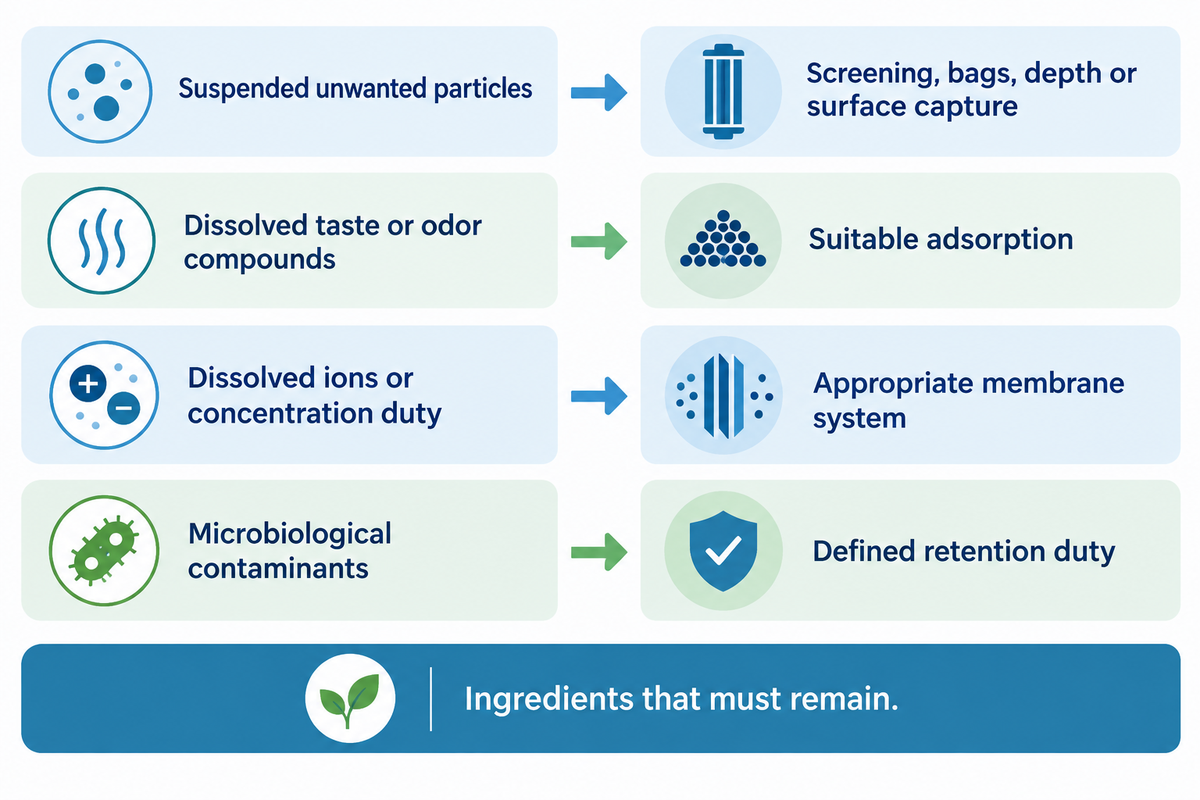
Filtration determines which components remain in a process stream. Mechanical capture can remove suspended solids, while adsorption and high-pressure membrane separation achieve other functions. Start with the unwanted material and the ingredients that must remain. For food or beverage production, a cleaner-looking liquid is useful only when it also retains the intended product characteristics.
Water filtration illustrates this. The CDC explains that different water filters have different functions: Some address chemical contaminants, some address particular germs, and some mainly affect taste and odor. Its drinking-water guidance gives a mechanism distinction, rather than a beverage processing recipe. Bacteria and viruses also present different removal challenges.
A filtration system must be aligned to that particular goal. Different filtration systems remove different contaminants; their names alone won’t define the product duty.
| Target | Mechanism to investigate | Product question |
|---|---|---|
| Suspended unwanted particles | Screening, bags, depth or surface capture | Which particles should leave, and which wanted solids should remain? |
| Dissolved taste or odor compounds | Suitable adsorption or other specified treatment | Could treatment also alter the intended flavor? |
| Dissolved ions or concentration duty | Appropriate membrane system or other solute-specific process | Which fraction is the product, and where do solutes go? |
| Microbiological contaminants | Defined retention duty within the processor’s control system | Which organism and product conditions define success? |
The mechanism distinctions draw on the EPA’s explanation of adsorption, ion exchange and high-pressure membranes. For example, a carbon filter can adsorb certain compounds; a mechanical cartridge doesn’t acquire that capability simply because it’s in the same housing. A requirement to remove chlorine therefore differs from a requirement to reduce sediment.
A beverage blending team can often identify the difference before addressing the equipment. Ingredient water might need treatment for chlorine taste, while the finished drink needs removal of accidental insoluble debris. Treating both of these as fine filtration can alter the incorrect part of the recipe. Establish the water purification and product-liquid objectives and place them in the correct treatment trains.
How do filtration mechanisms differ?
Depth filtration captures material in a porous structure; surface retention captures at a separating interface. Membrane filtration includes several separation duties including systems for concentration and fractionation. These descriptions are in the context of mechanism and process layout. A cartridge filter, membrane filter and crossflow installation can’t be equated purely on the basis of a shared micron designation.
In dead-end operation, the main feed passes toward and through the medium while retained material accumulates. In crossflow operation, feed also moves along the membrane surface and the system manages permeate and a retained stream. Synder’s 2013 food and beverage industry article describes separation, concentration and clarification as distinct membrane tasks. The product stream matters as much as the equipment name.
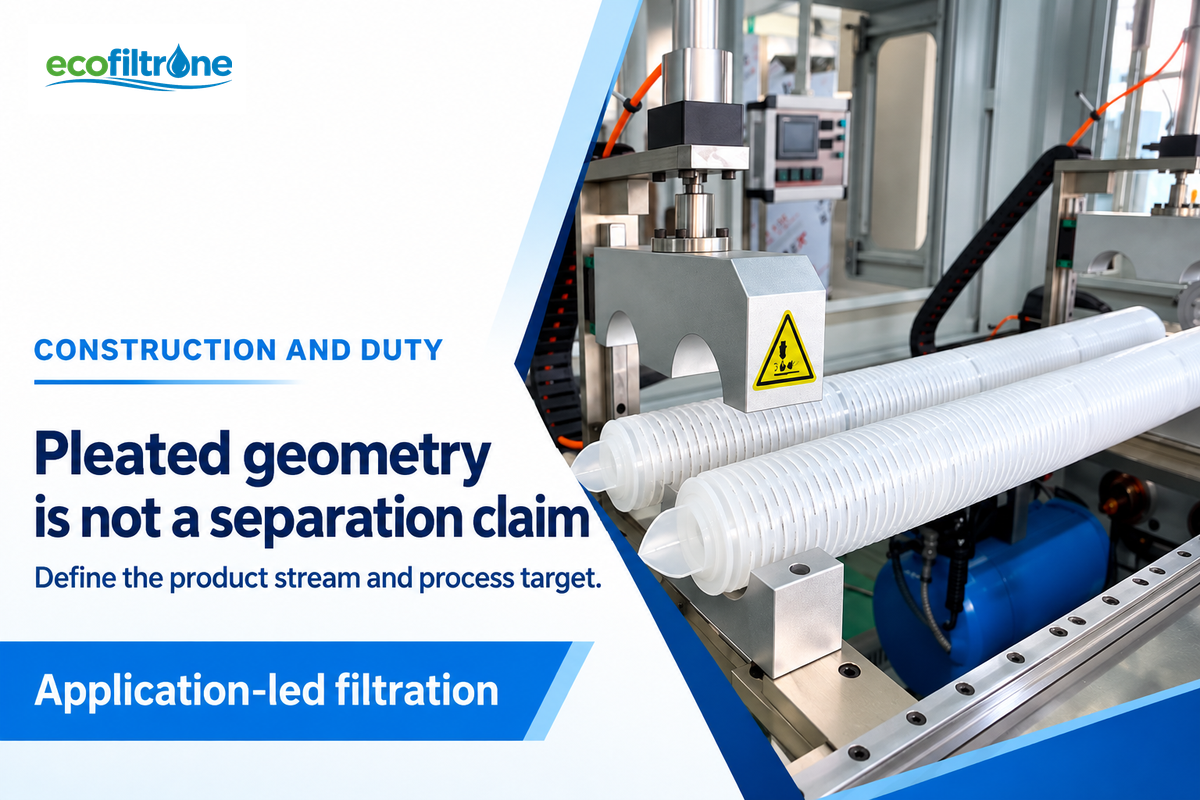
Filter construction adds another dimension. Pleated geometry packages media area; melt-blown describes a way of making fibrous media. Prefiltration can reduce loading on a later stage, but extra stages also introduce additional contact surfaces, preparation and retained liquid. Several filtration stages are desirable when each solves a defined problem.
Common applications of filtration in food include ingredient-water treatment and product polishing. Filtration equipment and pre-filtration stages should be compared within the same separation task, with the collected product stream defined.
Take a hypothetical syrup operation comparing a cartridge polishing stage with a membrane concentration system. The polishing stage addresses unwanted particles, keeping the recipe in the collected liquid. The concentration system purposely redistributes water and solutes between the streams. Higher flow through one machine would not make it an equivalent substitute for the other: the final products serve different purposes.
A 2013 study by Ines Ben Hassan and colleagues looked at prepared yeast and bacterial suspensions in ceramic crossflow microfiltration. In this study, the behavior of concentration and deposit affected the resistance. That experiment explains a fouling mechanism in its model system; beverage manufacturing still involves its own formulation, equipment and operating history.
Keep utility boundaries explicit. Air filtration, gas treatment, and culinary steam have different duties from liquid filtration. A specification for steam filtration shouldn’t be copied into a beverage-liquid order. The same separation of duties applies to point-of-use ingredient water and non-contact process water used elsewhere in food production.
Why does clarity not prove microbial control?
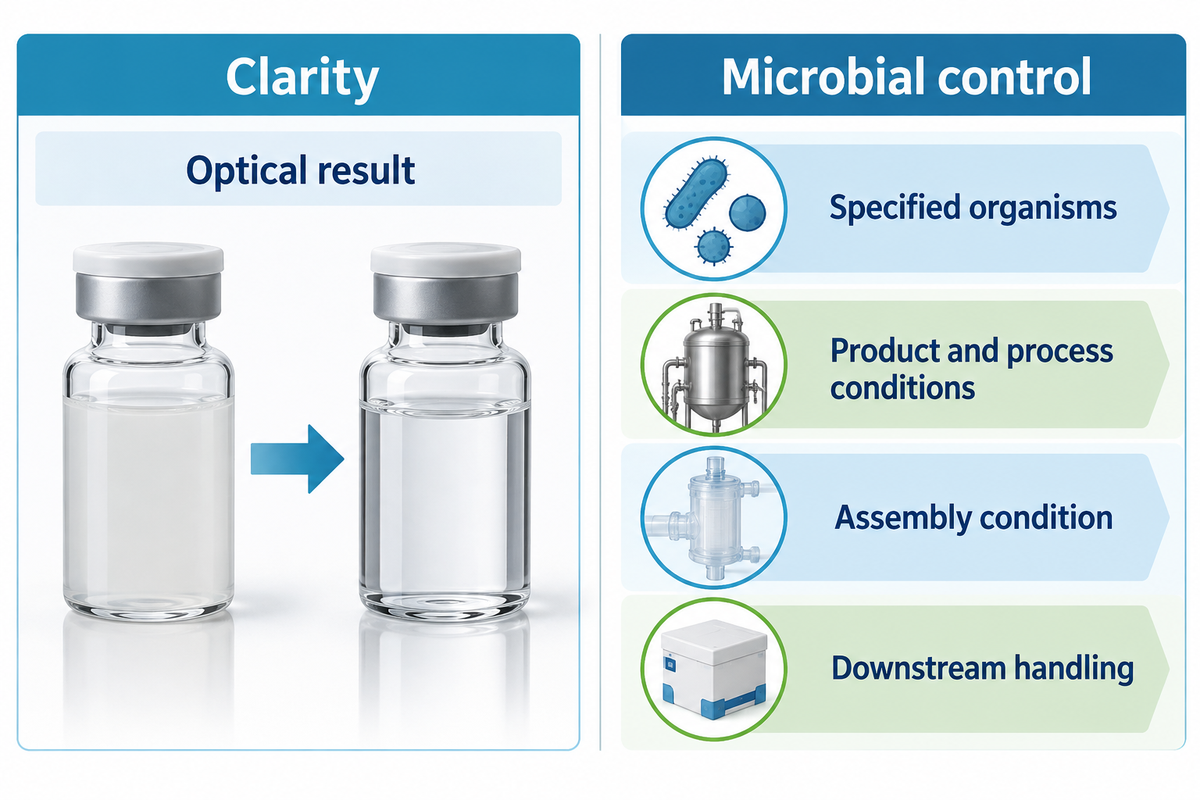
Clarity describes an optical result; microbial control concerns specified organisms under defined product and process conditions. A visually clear beverage can still contain organisms that matter to its intended use or shelf life. A filtration stage intended for appearance would require a different acceptance criterion from a stage that has a microbiological control function.
The Australian Wine Research Institute’s filtration guidance notes that low wine turbidity doesn’t guarantee easy filtration. Colloidal material can obstruct a medium even when the wine is clear. Turbidity, filterability and microbial measurements address different issues.
There are three concerns in the hypothetical wine-bottling trial. Production favors a candidate that finishes the trial without an interruption. Quality control is worried about the required microbial endpoint. And the winemaker wants to ensure the intended sensory profile. A clear bottle won’t address all three of these concerns. The trial requires separate observations for run performance, microbiological criteria, and product attributes. If an element runs longer only because it has a different retention duty, that longer run is not an equal-quality improvement. The useful decision is whether the complete process meets the agreed beverage objective, rather than which sample looks brighter at the end of filtration.
A 0.2 micron label isn’t a universal beverage instruction for sterility. The fluid, defined retention challenge, assembly condition and downstream handling matter. Removal figures such as 99.98% or 99.999% also need the named challenge and test basis; a percentage for particles isn’t automatically a percentage for a target organism.
Filters are designed for stated duties. General polishing isn’t the same as defined retention for spoilage organisms, and the filtration process remains one part of the product safety system.
Regulatory paths differ by beverage and activity. In the United States, 21 CFR 117.5 sets specific Subparts C and G exclusions for activities subject to and complying with juice Part 120, and for alcoholic beverages at facilities meeting its stated conditions. Those exclusions are separate from the control-level validation exceptions in 117.160. The applicable food safety system remains the processor’s responsibility.
How should a beverage filtration trial be designed?
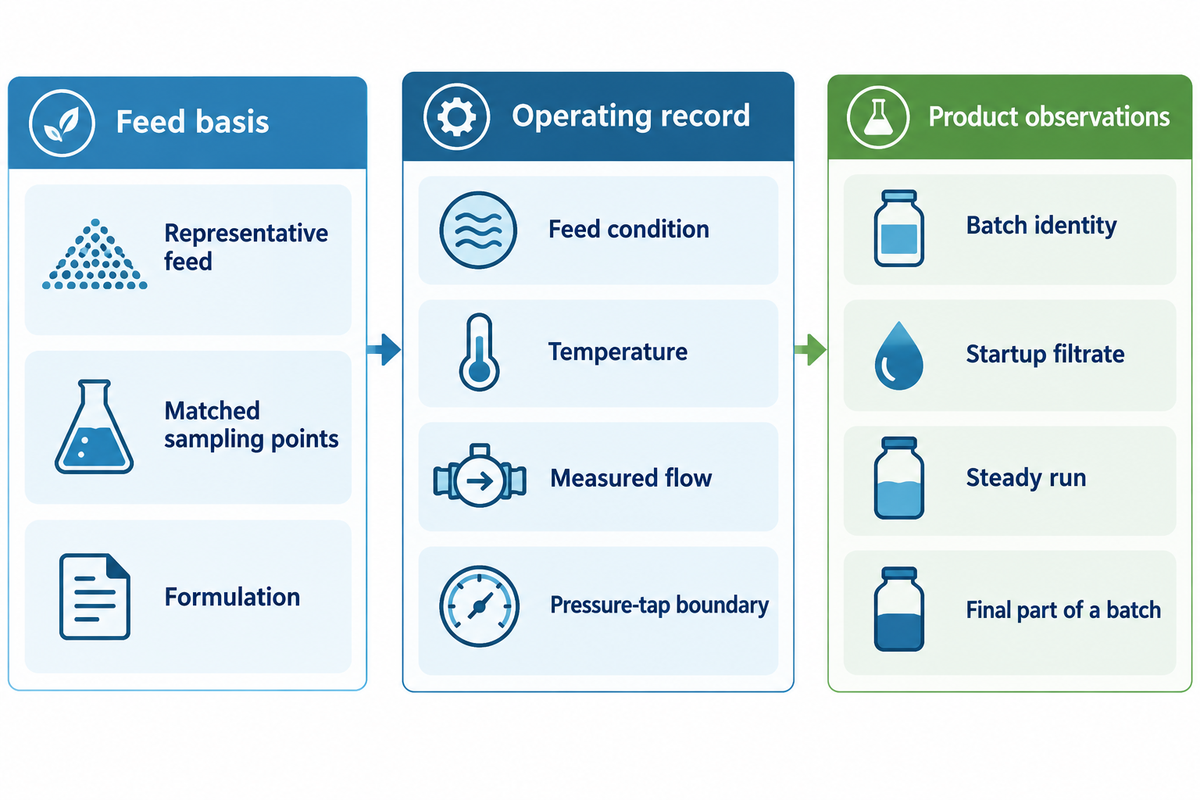
Design the trial to assess separate product, operating and downstream acceptance endpoints for the candidates being compared. Use representative feed, matched sampling points and a recorded operating basis. The comparison should assess the burden of meeting the beverage specification. A candidate that alters the product or the retention responsibility should be assessed in a different comparison.
The most helpful initial record describes the formulation, feed condition, desired retained material, temperature, measured flow, pressure-tap boundary, and the identity of the batch. It also indicates when samples were taken. Startup filtrate, a steady run and the final part of a batch can differ, so an isolated sample should not stand in for the whole run.
It links the measurement to the product acceptance test in beverage production processes. Beer brewing, wine bottling and syrup preparation should retain their own product objectives rather than share an assumed polishing recipe.
“It is important to do pilot tests for food and beverage applications.”
That manufacturer-written guidance is useful because food and beverage products differ in formulation and separation duty. A pilot should reproduce the decision being made. A clean-water flow measurement answers a hydraulic question; it does not replace a trial with the intended process liquid.
Let’s say a brewery wants to do a polishing trial before packaging. The production team wants to complete their batch within the shift, and the brewer wants to maintain the intended character. Both candidates receive the same feed from the same defined batch basis. The record includes any feed changes, rather than assuming the beer is constant. Samples represent startup, steady state operation and the agreed endpoint. The brewer compares product attributes, operations records flow and interruptions, and quality applies the brewery’s relevant microbiological and release criteria. This imaginary trial separates throughput from product acceptance. A useful beer production comparison also records the handling after the filter, because a successful transfer is only one part of the packaged-beer process.
The guidance offered by the AWRI wine work is also relevant. Its guidance describes different filterability methods and reports mixed sensory observations across the wines studied, rather than a universal “no flavor change” result. For a membrane-specific discussion of recovery and wetting, see the PES membrane cartridge guide. Separate detailed material questions from the full beverage trial.
For covered juice processes, 21 CFR 120.24 relates the relevant control to shelf life under normal and moderate abuse storage, with stated exceptions and processing and packaging limits. Thus, in this context, an immediate filter-outlet sample is different from the full product endpoint.
What changes between the filter outlet and the packaged beverage?
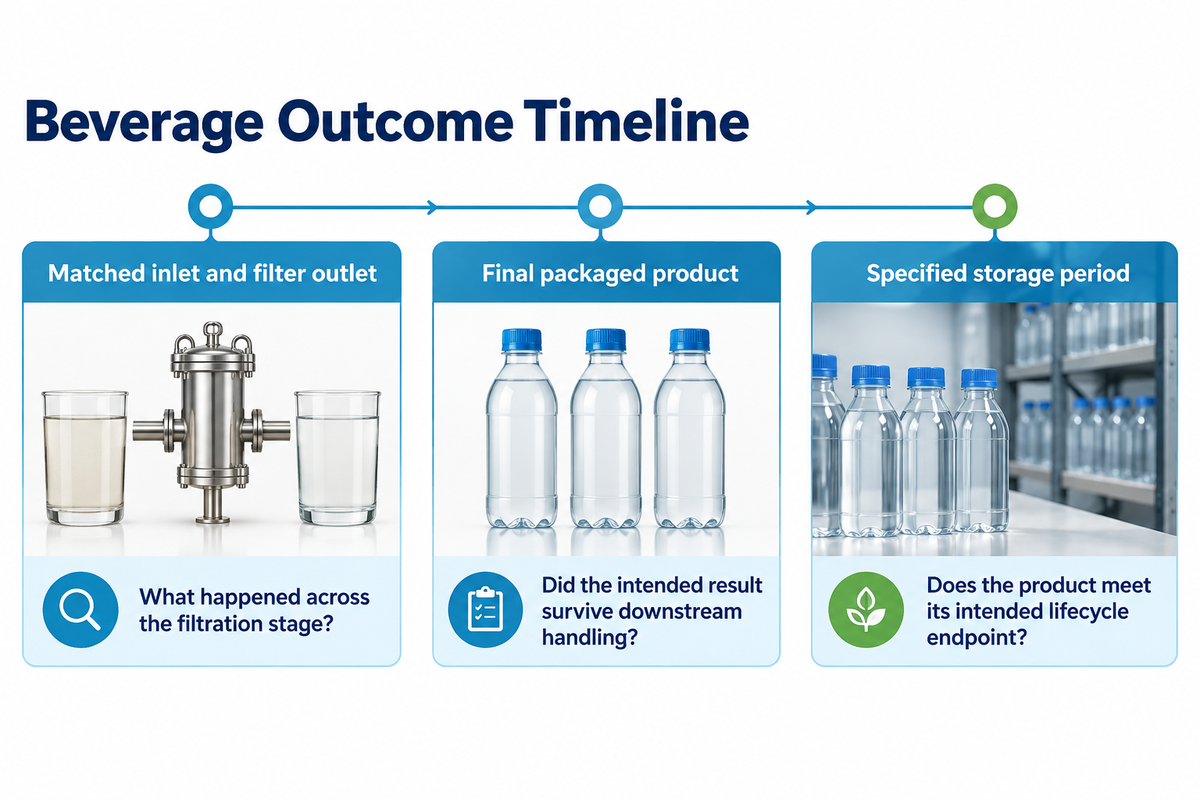
Sampling location and time change which production question a result addresses. Outlet measurements describe the stream leaving filtration; package samples address subsequent processing; and storage assessments describe defined changes over time. The Beverage Outcome Timeline logically separates these endpoints from one another so the production, quality and commercial teams don’t misinterpret a successful transfer as the release of a finished product.
Beverage Outcome Timeline
| Point in the process | Useful observation | Decision it informs |
|---|---|---|
| Matched inlet and filter outlet | Defined particle or turbidity change, composition and relevant microbial measurement | What happened across the filtration stage? |
| Final packaged product | Applicable package-level quality and microbiological criteria | Did the intended result survive downstream handling? |
| Specified storage period | Relevant stability, sensory and microbiological outcomes under the defined conditions | Does the product meet its intended lifecycle endpoint? |
Basis: AWRI’s separate wine-quality and filtration measures and the scoped juice requirements in 120.24. The required methods and criteria are part of the specific product and process.
When an outlet result is acceptable but a package result differs, the next investigation includes everything between those sampling points. Replacing a cartridge can conceal a filling or handling issue. Poor outlet quality necessitates looking at filtration before addressing storage. The timeline locates the question; it doesn’t assign a cause from a single result.
Pressure readings are another operating context. Increased pressure can occur with increased flow. However, changed viscosity can also impact pressure. Read pressure in conjunction with the liquid condition and measured flow, taking into account the equipment’s operating limits. The comments in the PP pleated cartridge guide and the Ben Hassan study provide more information.
In food and beverage processing, this distinction prevents a common management disagreement: operations reports a completed run, while quality is still assessing the final process outcome. Both reports can be correct. A shared timeline makes the remaining work visible without assigning the filter responsibility for every contamination risk downstream.
Distinguishing the end point of the filtration in the food plant from packaging and storage helps assign the next investigation to the correct part of the production sequence.
How much does filtration cost per released litre?
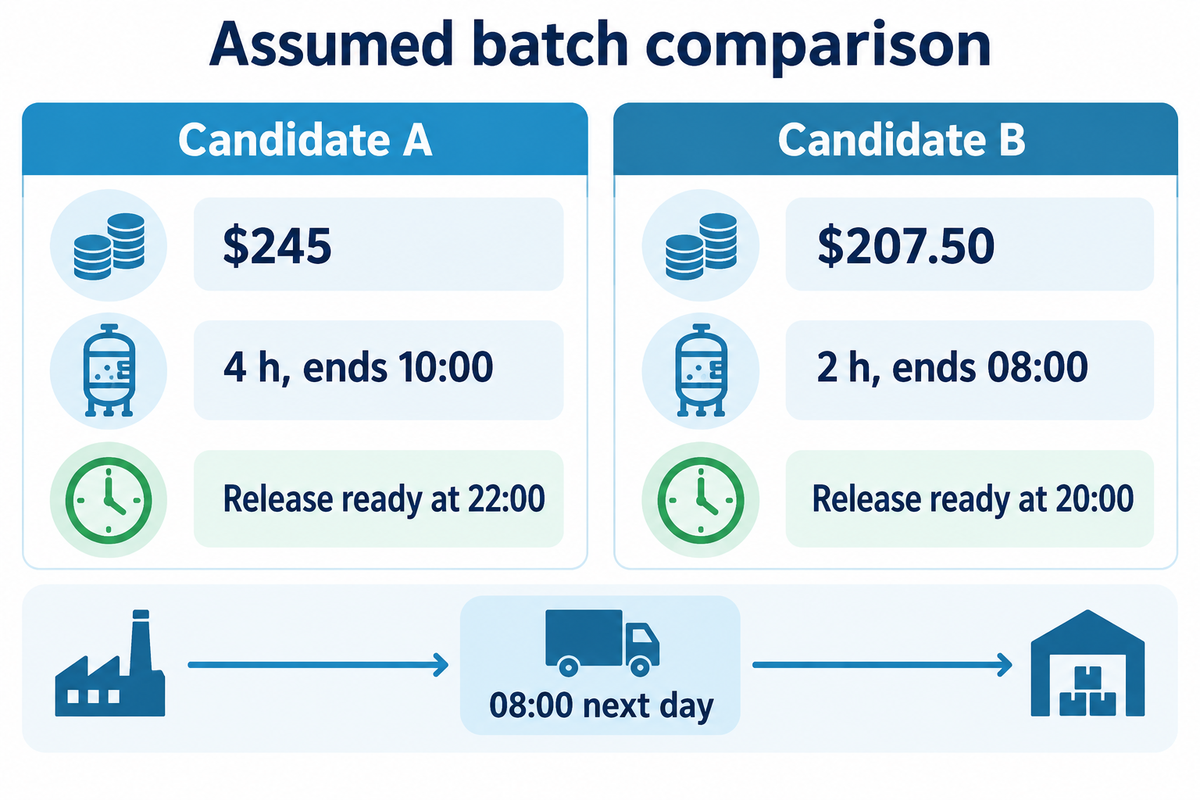
Divide the defined filtration-related burden by the volume accepted, under the same scope of product quality. Keep the burden, cost and result, separately from the production schedule. Faster runs can result in the same dispatch outcome if, for example, the test time is rigidly scheduled or if tank occupancy or a rigid collection time window controls the batch. The Batch Release Clock and Cost Test compares the two outcomes.
Changed costs and revenues, including yield and quality, are considered in the partial-budget method described by Iowa State University. Wisconsin Extension distinguishes cash comparisons from a full economic analysis and includes relevant non-cash and opportunity costs.
Batch Release Clock and Cost Test
Assumed inputs: Both candidates receive 10,000 L of the same beverage, and both satisfy the full agreed acceptance criteria. Candidate A releases 9,900 L, and Candidate B releases 9,950 L. Unrecoverable product is valued at an incremental ingredient cost of $1/L. Both runs start at 06:00, release testing begins after filtration, and the only dispatch collection is at 08:00 the following day.
| Input or result | Candidate A | Candidate B |
|---|---|---|
| Element spend for the run | $120 | $145 |
| Incremental changeout labor at $25/h | 1 h = $25 | 0.5 h = $12.50 |
| Unrecoverable product | 100 L × $1/L = $100 | 50 L × $1/L = $50 |
| Defined operating burden | $245 | $207.50 |
| Burden per released litre | $245 ÷ 9,900 = $0.02475/L | $207.50 ÷ 9,950 = $0.02085/L |
| Filtration duration | 4 h, ends 10:00 | 2 h, ends 08:00 |
| Assumed 12 h test hold after filtration | Release ready at 22:00 | Release ready at 20:00 |
| First available dispatch | 08:00 next day | 08:00 next day |
B’s element spend is $25 higher, but its assumed product loss and changeout labor are lower. The resulting defined burden is $37.50 lower. If ingredient loss had no incremental value, A would cost $145 and B $157.50. With these assumed loss quantities, the equal-total-burden ingredient value is $12.50 ÷ 50 L = $0.25/L. This is a sensitivity threshold for total batch burden, rather than an equal-unit-cost threshold.
The clock shows a different constraint. Candidate B saves two hours of filtration and becomes release ready two hours earlier than Candidate A, but Candidate B doesn’t catch up to an earlier dispatch. Tank reuse may have value if the released capacity is used by a qualified batch downstream. If the released capacity isn’t used, converting time directly to sales would be misleading.
Include
- Use the same acceptance scope.
- Value only the defined incremental losses.
- Track the controlling release and dispatch times.
Avoid
- Count lost ingredients again inside a full feed-cost charge.
- Price the same downtime twice as labor and lost sales.
- Call processed volume released volume before acceptance.
This narrow comparison excludes unchanged overhead, capital, energy, cleaning and other items. Include any costs that change between the two candidates, and make a broad business decision based on that. A rejected batch has no released-volume denominator. When the accepted volume is zero, unit cost is undefined. A cheap run can’t compensate for failed product quality standards.
What documents turn a filter claim into usable evidence?
Documentation for usability connects the selected assembly to the intended food contact and defines the performance requirement. It provides the supplied model and revision, wetted materials, contact conditions and test methodology. Food contact suitability, particle retention, and process release are distinct requirements and should be documented accordingly.
The FDA’s food-type and conditions-of-use tables show why the liquid and contact conditions matter. Its explanation of authorization pathways distinguishes company- and intended-use-specific food contact notifications from other pathways, including threshold-of-regulation exemptions. “FDA compliant” without a material and intended-use context is an incomplete purchasing description.
For a technical handoff, the exact model and wetted assembly are required in addition to the food type, contact time and temperature, issuer or certificate holder, and the revision of the document. Which test defines the retention statement and which reuse or preparation procedure applies to that assembly should also be determined. These are factors to consider together rather than a request for every single certificate.
When evaluating ECOFILTRONE™, Donaldson or another provider, a buyer has to keep that intended-use basis across the offers. Materials that meet one exposure condition may need a different evaluation for another formulation or a different cleaning cycle. Supplier identity alone doesn’t answer the performance factors of a selected grade.
ECOFILTRONE™ provides industrial filtration consumables along with engineering support for selection, replacement and customized requirements. Its filtration products include high flow, pleated, membrane, melt-blown and string-wound cartridges and liquid filter bags. For model-specific filtration solutions for food processing, use the food and beverage filtration application support page. That’s the page for specification review and supply request.
What is changing in food and beverage filtration decisions?
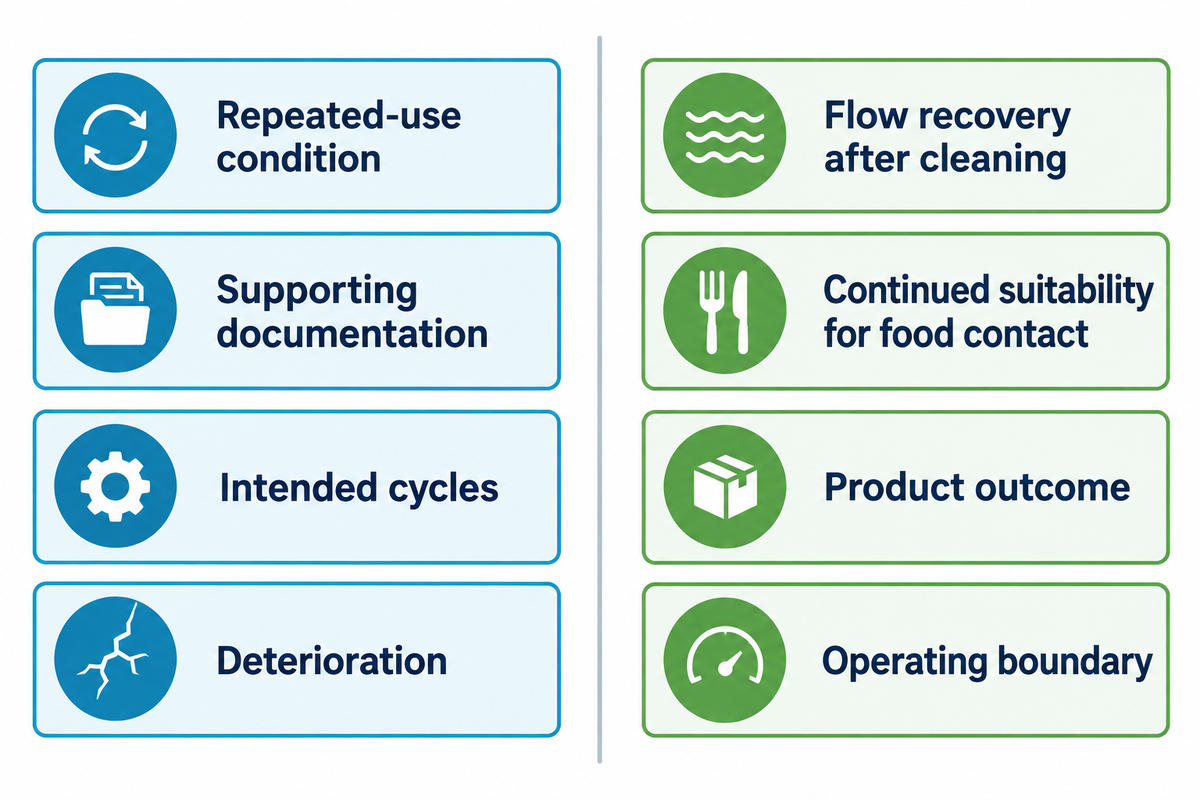
For covered plastic food-contact applications, repeated-use condition and supporting documentation deserve attention alongside the initial material description. EU Regulation 2025/351, which amends EU rules for plastic food-contact materials and articles, should also be reviewed. It’s more important to consider how the intended use, preparation and deterioration of a reusable article are addressed, rather than if a supplier provides a general sustainability label.
The original 2025/351 regulation amends provisions concerning repeated-use plastic articles, including migration behavior under intended cycles, instructions concerning deterioration, and supporting documentation. The scope of the plastics regulations is of interest. It should not be treated as a requirement that every liquid filter is reusable, or as permission to clean every cartridge.
If reuse is considered, the sequence of exposures that a plastic article is intended to undergo must be linked with the article and the approved method of use. Flow recovery after cleaning is one thing, and continued suitability of the article for food contact is another. The economics are of great importance when cleaning takes time and resources, and when the next batch is made to wait. A sustainable food production objective therefore needs both the product outcome and the operating boundary, not just a count of discarded elements.
In May 2026, the FAO drew attention to food safety aspects of recycled and alternative food-contact materials. The announcement discusses potential migration risks and differences between regulatory approaches. It is a reason to keep material identity and intended use visible when an article changes; it is not evidence that a particular filter contains recycled material.
For food and beverage manufacturers, the useful response is a controlled technical record: what changed in the article, which exposures apply and whether the same end product endpoint is still achieved. Filtration offers a solution to a defined separation task. Resource efficiency is an additional performance criterion, with its own input and output quantities and measures.
Key takeaway
Match the filtration mechanism to the unwanted material, follow beverage quality through packaging and storage, then compare operating burden and the batch-release clock. A faster filter is valuable when the released product and the downstream schedule can use the improvement.
Frequently Asked Questions
What is food and beverage filtration?
Read the answer
Food and beverage filtration separates selected material from a process stream to meet a defined production or quality objective. A particle stage may reduce suspended solids, while other technologies serve different separation duties. The useful result depends on the fluid, filter construction and operating conditions. Clarity, throughput and microbial control require separate evidence.
Which equipment is used for filtration?
Read the answer
Food plants may use screens, bags, depth elements, pleated cartridges and membrane systems at different process points. These are broad equipment categories, not interchangeable performance specifications. Selection depends on what must be retained, what must remain in the product and how the plant measures success. The installed housing and complete assembly also matter.
What cannot be filtered out of water?
Read the answer
A mechanical particle cartridge doesn’t automatically remove dissolved salts, sugars or every dissolved chemical. It also doesn’t establish universal microbial protection. Other water treatment mechanisms may be needed for the specific contaminant. Evaluate the whole treatment train and its documented performance, rather than assuming that a smaller particle rating solves every problem.
What types of filtration are used in food and beverage processing?
Read the answer
Depth capture, surface retention and membrane separation are common mechanisms. Adsorption and other treatments can accompany them for separate duties.
Does a 0.2 micron filter make every beverage sterile?
Read the answer
No. A pore marking alone doesn’t establish a validated sterile process for every beverage. The relevant outcome concerns the exact filter, organism challenge, fluid and operating conditions, together with the processor’s sanitation and downstream handling. An application intended for microbial stabilization needs a defined process and acceptance criteria. A food-contact declaration addresses a different question and isn’t a substitute for the required microbial-control work.
Why can a filter show low pressure drop but poor clarity?
Read the answer
Pressure drop measures hydraulic resistance. Poor clarity requires a separate investigation of retention, flow path, feed and sampling.
Why filter water for foods and beverages?
Read the answer
Ingredient-water treatment addresses the water characteristics required by a recipe and production process. Particle capture, taste-and-odor treatment and dissolved-contaminant treatment are separate duties. Bottled water, blending water and non-contact utility water can have different endpoints. Define the intended use before choosing the treatment train; a single water filter doesn’t perform every task needed across food and beverage production.
Discuss Your Beverage Filtration Duty
Bring the fluid description, separation target, operating conditions and required product endpoint to ECOFILTRONE™. We offer filtration solutions to help with specification review, replacement matching and customized configuration. Start with the duty and the complete assembly so the technical support discussion addresses the process your team needs to run.
The process scenarios describe alternative decisions and not results from ECOFILTRONE customer trials. Product-specific technical, material and compliance documents are supplied according to the selected product and intended application.
References & Sources
- CDC, About Choosing Home Water Filters: drinking-water mechanism boundaries.
- EPA, Reducing PFAS in Drinking Water with Treatment Technologies, originally published 2018: adsorption and membrane distinctions.
- Ben Hassan et al., Membranes, 2013, DOI 10.3390/membranes3020044: model-suspension crossflow fouling.
- Australian Wine Research Institute, pre-packaging filtration guidance: wine filterability and product observations.
- Synder Filtration, Travis Radford, 2013: application-specific membrane and pilot context.
- 21 CFR 117.5, 117.160 and 120.24, current text read October 2026: scoped US process requirements.
- Iowa State and Wisconsin Extension: partial-budget scope and sensitivity.
- FDA food-contact guidance and use-condition tables: authorization and intended-contact context.
- EU Regulation 2025/351; FAO May 2026 food-contact materials announcement: scoped procurement context.
Source links appear beside the relevant discussion.