Get in touch with ECOFILTRONE™ Company


+
+
Industrial Standard
Condensate Polishing Filtration
Condensate Polishing Filtration by ECOFILTRONE™
ECOFILTRONE supplies replacement filter cartridges and application support for condensate pretreatment, suspended-solids control, and boiler feed water service. Factors such as the contaminant type and level, flow and service temperature, installed housing and the element being replaced are all considered when the proper element is recommended.
Scope at a glance
We physically filter suspended solids, copper oxide and iron oxide, corrosion products, metallic debris and other particulates which may include resin fines. Dissolved-ion removal, ion-exchange resin service, backwashing, and complete condensate polishing systems are outside our product scope.
Send the models or drawings, end connections, flow, temperature, and pressure. Missing fit or operating data is flagged before production confirmation.
Custom MOQ: 100 units
Trial path: Free sample; buyer pays freight
Fast Track: RFQ response within 24 hours
Inventory: In-stock products in 4–5 days
Sampling: Custom samples in 7 days
Scaling: Custom production in 14 days
RFQ Response
Within 24 hours
Stock Lead Time
4–5 days
Custom Sample
7 days
Custom Production
14 days
POLISH
Condensate Polishing Filter Applications & System Position
A system used to polish condensate may employ physical filtration alongside cation and anion exchange. † Our element is located on the physical-filtration side, where it targets retained particles rather than dissolved ions.
The first selection decision is the form of contamination. A micron rating is not a substitute for chemistry control: it cannot correct a dissolved impurity or regenerate a resin bed.
01 / 06
Filter Media & Cartridge Selection for Condensate Duty
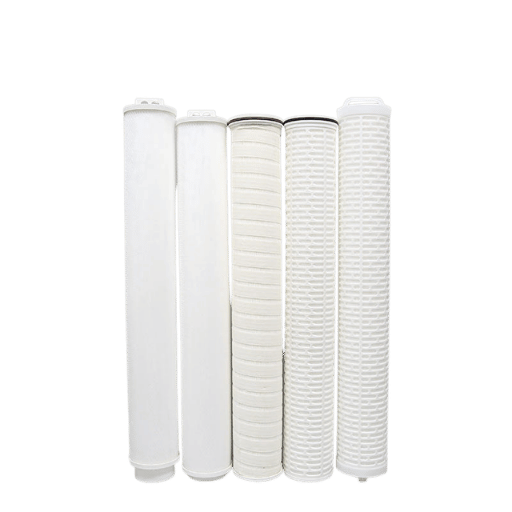
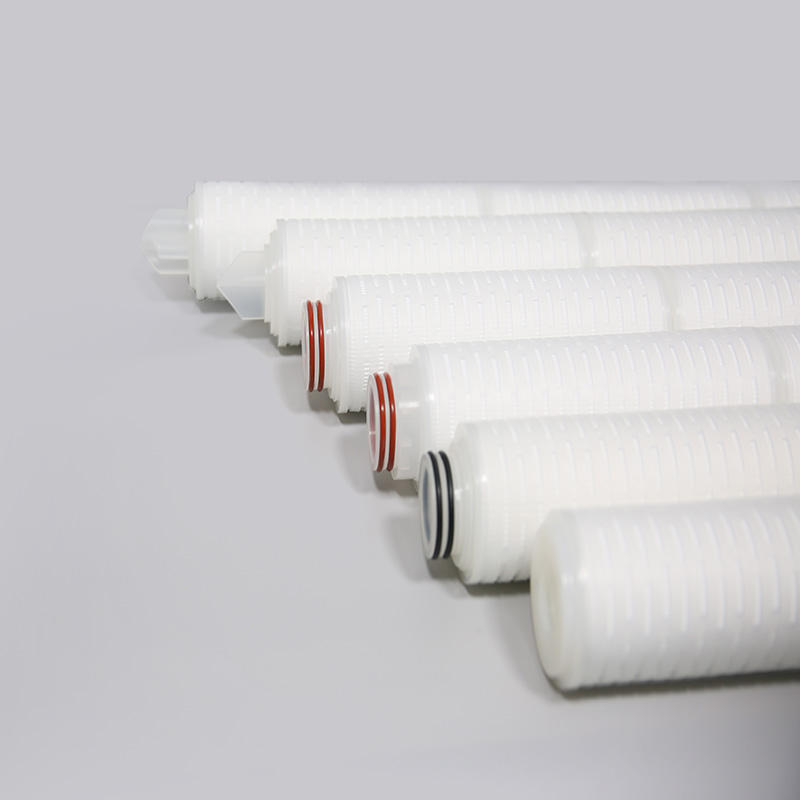
The duty and operating conditions of the system dictate which media should be used, and not the name of the product. Polypropylene, glass-fiber, high-temperature, depth, and stainless-steel media cover different combinations of particle size, temperature, fluid chemistry, and cleaning expectations.
| Duty or condition | Candidate structure | Available ECOFILTRONE family | Required validation input |
|---|---|---|---|
| Fine particles at large flow | High-flow pleated | PP or glass-fiber high-flow | Flow, temperature, clean and terminal differential pressure, particle loading, housing model |
| Standard cartridge housing | 69 mm pleated element | PP or glass-fiber pleated | Length, end code, gasket, micron target, contaminant profile |
| Duty up to the 120 °C family ceiling | High-temperature high-flow or pleated | 0.5–20 µm high-temperature family | Normal and maximum temperature, pressure, duration, seal material |
| Graded depth loading | Melt-blown or string-wound | Product-specific configuration | Dirt loading, required rating convention, current change-out pattern |
| Cleaning or metal construction requirement | Stainless-steel option | Product-specific review | Cleaning method, temperature, corrosion compatibility, housing fit |
| OEM replacement | Match the installed element | Pall, 3M/CUNO, Parker, or Pentair reference review | Model, drawing, dimensions, interface, seal, media, flow direction, duty |
Rating convention comes before the micron number
“1 µm” is incomplete unless the specification states the rating basis and media construction. The same nominal rating does not necessarily mean the same result for retention. The latest datasheet should be provided before comparing elements.
Why temperature is a family-level decision
- Standard PP and glass-fiber families in the confirmed portfolio have an 80 °C maximum-temperature line.
- The confirmed high-temperature high-flow and high-temperature pleated families have a 120 °C maximum-temperature line.
- A higher-temperature label does not always mean the cartridge fits the housing; length, OD, end interface, seal, flow direction, and pressure still require review.
- Chemistry data is used to check material compatibility and scope. It is not used to promise conductivity or dissolved-solids removal.
Standard pleated
- 5–40 in
- 69 mm OD
- DOE, 222, 226, Code 7
Use the full end code, cap geometry, seal material, and housing drawing to confirm the interface.
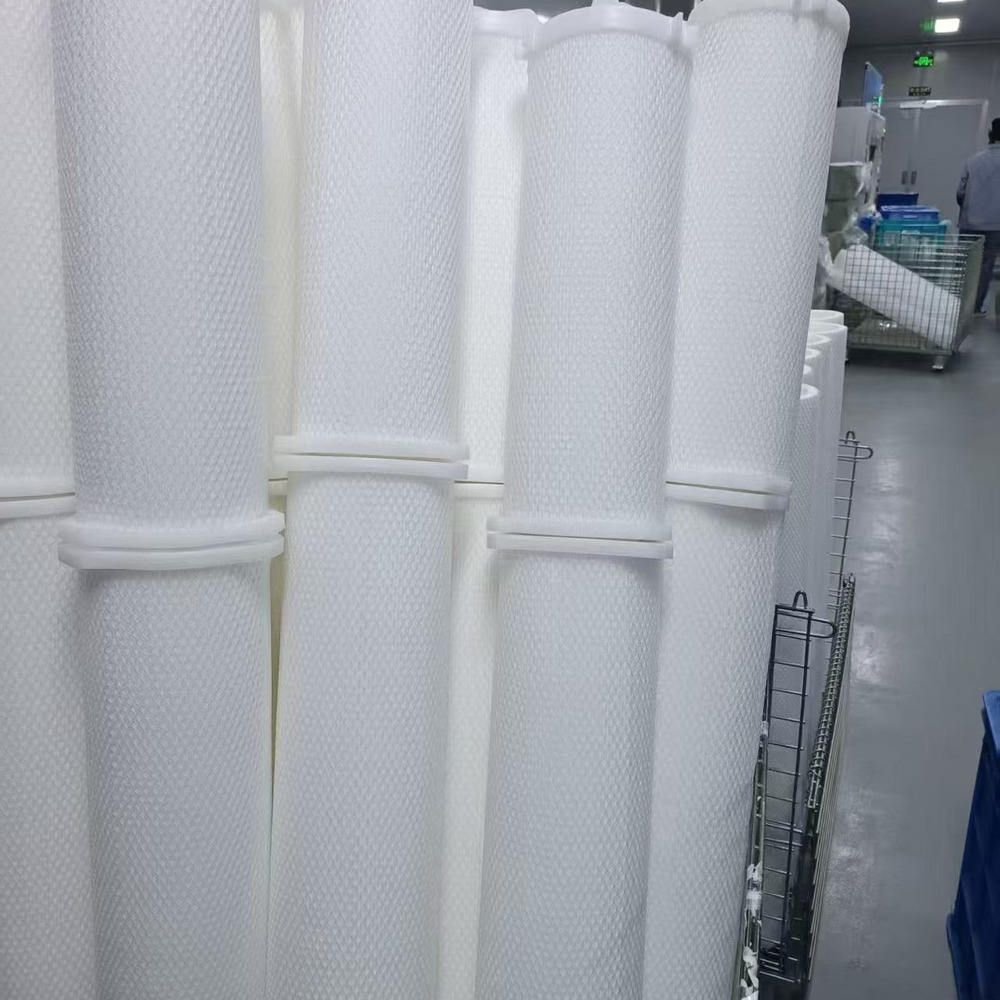
High-flow
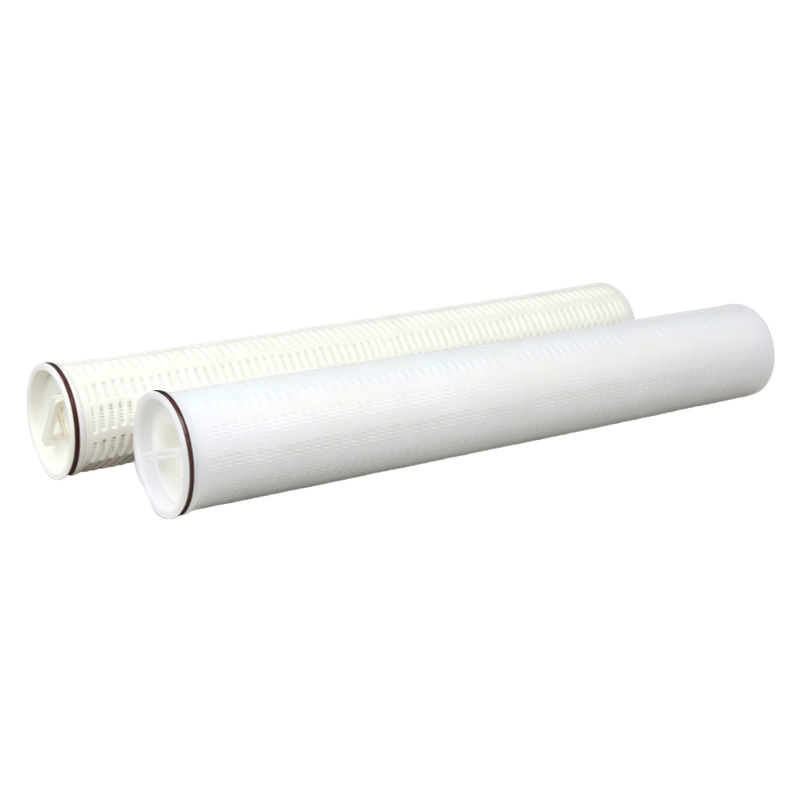
- 20 in, 40 in, 60 in
- 154 mm OD
Confirm the single-open-end and handle configuration, flow direction, support structure, and installed element count.
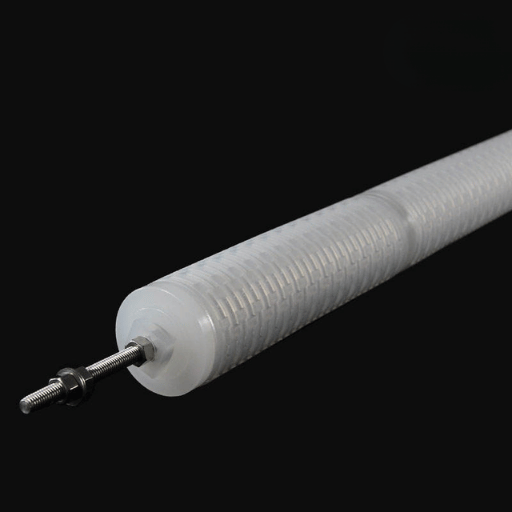
High-temperature
- 1026 mm, 1524 mm, 1540 mm
- 152 mm OD
Confirm the exact housing interface and seal against the normal and maximum operating condition.
Trial Water Sampling
Agree on representative water sampling for the trial; ASTM D3370 addresses sampling of flowing process water.
Six checks before a candidate is named
1
First, identify the incumbent. Send the manufacturer, full model code, datasheet, and a clear photo of both ends.
2
Next, verify geometry. Record overall length, nominal OD, inner interface, cap and handle details, seal location, and element quantity.
3
Then, confirm construction. Compare media, support, core, cage, adhesive or thermal bond, gasket, and flow direction.
4
Also, qualify the duty. Provide fluid, contaminant, rating convention, flow, temperature, pressure, and clean/terminal differential pressure.
5
Before release, define acceptance. State the documents, dimensional checks, integrity or performance evidence, and trial observations required for release.
6
Finally, run the trial path. Approve a sample or trial order before a custom-volume production release.
Condensate Polishing Filter Cartridge Specifications
Each confirmed product family is kept separate in the table. It is a configuration envelope for quotation review, not a universal performance table. Element count, flow, pressure drop, filtration efficiency, chemical compatibility, and service life require product-specific data.
| Product family | Micron rating | Length | Nominal OD | Connection or configuration | Maximum temperature |
|---|---|---|---|---|---|
| High-flow PP | 0.3–100 µm | 20/40/60 in | 154 mm | SOE/handle family | 80 °C |
| High-flow glass fiber | 0.3–100 µm | 20/40/60 in | 154 mm | SOE/handle family | 80 °C |
| High-temperature high-flow | 0.5–20 µm | 1026/1524/1540 mm | 152 mm | Confirm per housing | 120 °C |
| Pleated PP | 0.1–100 µm | 5–40 in | 69 mm | DOE/222/226/Code 7 | 80 °C |
| Pleated glass fiber | 0.45/1/3/5/10/20 µm | 5–40 in | 69 mm | Confirm per housing | 80 °C |
| High-temperature pleated | 0.5–20 µm | 1026/1524/1540 mm | 152 mm | Confirm per housing | 120 °C |
Configuration note
Final media, micron rating, seal, flow direction, element count, and documentation are confirmed against the operating condition and housing. Do not combine the widest range from one family with the temperature or connection of another.
Trial Sampling Basis
For a trial, define sampling points and timing using an agreed water-sampling method such as ASTM D3370; the dimensions and limits above come from ECOFILTRONE product confirmation.
Pricing, Samples & Production Lead Times
The pricing of a condensate filter is a function of the media, micron rating, dimensions, end connections, gaskets, quantity, custom tooling, testing, documentation, packaging, and freight. Send the element in service and the process condition to get a quote for the element rather than a price band.
01
ECOFILTRONE Commercial Terms
02
Lead-Time Planning
03
Price Drivers Buyers Can Control
ECOFILTRONE Commercial Terms
Order Point
Confirmed Term
Release Condition
RFQ Response
Within 24 hours
Application and replacement data reviewed by the sales and engineering team
In-stock standard products
4–5 days
Stock and final specification confirmed in the quotation
Custom sample
7 days
Drawing and configuration approved
Custom production
14 days
Technical confirmation and order release complete
Custom-product MOQ
100 units
Standard-product MOQ is confirmed by product
Sample and trial
Free sample; buyer pays freight
Trial orders are accepted
Payment
30% deposit and 70% before shipment
Final scope appears in the written quotation
Lead-Time Planning
The 14-day custom-production schedule is faster than the peer range observed during research, so capacity and material availability must be reconfirmed in every quotation.
Freight and destination transit are separate from the production schedule.
Price Drivers Buyers Can Control
- Provide the complete incumbent model and dimensions to avoid a second fit-review cycle.
- Separate the required rating from an assumed micron number so the correct media and test scope can be quoted.
- State the normal order quantity, annual demand, and whether the 100-unit custom MOQ applies.
- Identify product-specific datasheets, drawings, material certificates, or compliance documents before order release.
- Use a sample or trial order when the current element lacks a reliable drawing or operating history.
Inspection, Documentation & Performance Follow-Up
Quality control is for the confirmed product requirement and order scope. Equipment and production lines vary by cartridge family, so inspection is tied to the released drawing, material configuration, and acceptance plan.
Order-control sequence
1. Pre-sales review
Our team checks the application boundary, filter selection, specification, OEM reference, custom configuration, and sample or trial plan.
2. Technical confirmation
We freeze the product family, dimensions, interfaces, material stack, rating language, and required documents before production.
3. Production follow-up
We coordinate pleating, membrane-cartridge assembly, melt-blown extrusion, string winding, end-cap welding or bonding, and final cartridge assembly according to the chosen family.
4. Inspection & release
Dimensional, integrity, flow, and filtration-performance verification is performed according to the product requirement.
5. Packing & shipping
We coordinate protective packing, marks, documents, and dispatch against the confirmed order.
6. Operating follow-up
We review installation compatibility, differential-pressure trend, service-life observations, troubleshooting evidence, and configuration changes.
Production and inspection capability
- Production line categories used across the relevant manufacturing facilities include pleating, membrane-cartridge assembly, melt-blown extrusion, string winding, filter-bag cutting and sewing, end-cap welding or bonding, and cartridge assembly.
- ECOFILTRONE inspection follows the released product requirement for dimensions, integrity, flow, and filtration performance.
- ECOFILTRONE production follow-up ties the selected family, material configuration, drawing, and document scope to the order record.
Documents by order scope
Product-specific datasheets, drawings, material certificates, and applicable compliance documents are supplied according to the confirmed order scope. The actual certificate holder and product applicability are checked before a document is promised.
Differential pressure as evidence, not a verdict
- Compare the current reading with the clean baseline at a comparable flow and temperature.
- Check whether a condenser leak, startup corrosion release, resin carryover, pump change, valve position, or flow increase changed the loading condition.
- Review water quality and particle evidence alongside pressure. Conductivity or silica excursions can point to a chemistry problem that a cartridge cannot fix.
- Use the agreed terminal condition and validation plan for that configuration; the page does not publish a universal change-out threshold.
- A rising differential pressure does not always mean the media failed; it can reflect a flow change, startup release, loading spike, or incorrect baseline comparison.
From Operating Data to a Confirmed Filter Configuration
The mistake usually made is focusing on microns only. The key difference in our review is the order of the decisions: scope first, physical fit second, operating envelope third, and performance validation last.
STEP 01
Locate the duty. Identify condensate return, polisher prefilter, particulate resin-fines guard, or boiler feed water filter duty in a fossil, combined-cycle, or industrial plant.
STEP 02
Classify the problem. Separate suspended oxide, crud, debris, and particulate contamination from conductivity, silica, sodium, chloride, ammonia, dissolved solids, and other water treatment concerns.
STEP 03
Capture the operating envelope. Provide normal/design flow, normal/maximum temperature, operating pressure, clean and terminal differential pressure, and startup or upset conditions.
STEP 04
Describe the contaminant. Add particle type, estimated size and loading, frequency, analytical data, and whether oil, carbon, acid, caustic, or treatment chemical exposure is possible.
STEP 05
Verify the installed interface. Supply the current model, housing drawing, element dimensions, end connection, seal, flow direction, and quantity; identify any precoat, resin bed, backwash, or regeneration interface.
STEP 06
Release the filter decision. We return a written media, structure, micron, length, temperature-class, fit, sample, and document recommendation and flag unresolved inputs before production.
Specification-ready RFQ checklist
| Input group | Send this evidence | Decision it supports |
|---|---|---|
| Installed hardware | Brand/model, drawing, photos, housing, dimensions, interface, seal, flow direction, quantity | Physical compatibility and candidate family |
| Process condition | Fluid, application position, flow, pressure, temperature, startup/upset state | Construction and operating envelope |
| Contamination | Iron/copper oxide, crud, debris, resin fines, particle size/loading, sample or analysis | Media structure and rating shortlist |
| Chemistry context | Conductivity, silica, sodium/chloride, pH, ammonia or amine treatment when available | Scope and material-compatibility route |
| Operating history | Clean/terminal DP, service duration, change-out reason, removed-element condition | Trial design and troubleshooting plan |
| Commercial release | Quantity, destination, schedule, document list, inspection and acceptance requirements | Quotation, lead time, packing, and order controls |
Application Limits & Alternative Treatment Routes
Cartridge filtration is not a substitute for water chemistry or system-level polishing. The following route-outs protect the plant from solving the wrong problem with a disposable element.
| Situation | Why a Standard Cartridge is Not the Answer | Next Route |
|---|---|---|
| Dissolved ions, silica, sodium/chloride ingress, or conductivity excursion | Particle media does not perform ion removal or demineralization. | Have the plant water-chemistry team or system supplier review ion exchange, membrane, purification, and chemistry control. |
| Exhausted resin, cation/anion imbalance, external regeneration, or separation fault | A cartridge does not regenerate, rinse, or restore mixed-bed resin. | Review the condensate polishing system, resin charge, regeneration plant, and operating procedure. |
| Precoat septum, reusable backwash element, wastewater, or spent-resin duty | These are system-level functions with distinct equipment and waste interfaces. | Use the original condensate polishing unit or specialist system supplier. |
| Temperature above the selected polymer family | PP or glass-fiber component limits cannot be borrowed from the 120 °C family. | Review the verified high-temperature or metal construction and seal system. |
| Situation | Why a Standard Cartridge is Not the Answer | Next Route |
|---|---|---|
| Unknown resin fines or variable startup crud | Loading and pressure behavior are not predictable from a nominal micron value. | Collect DP/loading history and use a sample or trial plan. |
| Housing or interface uncertainty | Matching the micron number does not prove fit, sealing, or flow direction. | Complete the dimensional and interface check before ordering. |
| Oil, hydrocarbon, or unusual organic contamination | The fluid may belong to compressed-air condensate or another process context and may challenge polymer compatibility. | Confirm fluid identity and run a material-compatibility review. |
| Nuclear or safety-class service | Ordinary industrial product data cannot establish nuclear qualification or equivalence. | Use the approved safety-class procurement and qualification route. |
Condensate Polishing Filtration Evaluation Tools
01
Condensate Filtration Scope Gate
Separate a particulate cartridge request from a water-chemistry or complete-system request before preparing an inquiry.
Access Scope Gate →
02
Replacement RFQ Completeness Checker
Mark only the data groups you can supply. Each complete group contributes 10 percentage points; the score measures inquiry completeness.
Access Checker →
03
Differential-Pressure Evidence Triage
Compare two differential-pressure readings in the same unit and choose which operating evidence to collect. This tool sets no replacement threshold.
Access Evidence Triage →
Condensate Polishing Filter FAQs
What is the role of cartridge filtration in a condensate polishing system?
A cartridge provides a physical barrier for suspended contaminants at a defined stage. A complete condensate polishing system may also use a cation resin, anion resin, mixed bed, precoat, conductivity control, and regeneration equipment, none of which is supplied by the cartridge itself.
Which contaminants can condensate filter cartridges remove?
Selection may target suspended iron oxide, copper oxide, corrosion products, metallic debris, startup crud, and confirmed particulate resin fines. Removal depends on the media, rating convention, loading, flow, temperature, and validated configuration; dissolved impurities remain outside cartridge scope.
What micron rating should be specified for iron oxide and corrosion products?
There is no universal micron value for every power plant or steam cycle. Provide the particle profile, target retention basis, flow rate, clean and terminal differential pressure, current filter result, and downstream objective so the 0.1–100 µm confirmed portfolio can be narrowed without treating a nominal rating as an absolute one.
How do PP, glass-fiber and high-temperature cartridges differ?
The confirmed standard PP and glass-fiber families carry an 80 °C maximum-temperature line, while the two high-temperature families carry a 120 °C line. Media compatibility, dimensions, seal, support construction, and rating still need product-specific confirmation.
When is a high-flow cartridge preferable to a standard pleated cartridge?
It becomes a candidate when the installed high-flow housing, required element count, dimensions, interface, and operating flow support that format. ECOFILTRONE offers 20/40/60 in high-flow families at nominal 154 mm OD, but the housing review comes before the selection.
Can a cartridge remove dissolved ions or correct conductivity?
No. Ion exchange, cation and anion control, silica and sodium removal, resin regeneration, and total dissolved solids management belong to water chemistry and condensate polisher system design, not physical cartridge filtration.
Where is a resin-fines filter installed?
That depends on the existing resin bed, vessel, outlet arrangement, carryover mechanism, and downstream equipment. We review a guard cartridge only when the material is confirmed as particulate and the housing interface is defined; we do not represent a disposable cartridge as a resin trap, precoat septum, or backwashable polisher.
How should clean and terminal differential pressure be used?
Record both values at comparable flow and temperature, then review the trend with water quality, contaminant load, startup events, and the removed element. Differential pressure is not a substitute for upstream and downstream particle measurements.† Differential pressure is one control signal, not a standalone proof of efficiency, filter life, or cost savings.
What determines condensate filter service life?
Particle loading, size distribution, media area and structure, rating, flow, temperature, pressure, startup crud, chemistry events, and the chosen change-out criterion all matter. We use the current element record and trial data instead of publishing a universal life claim.
Can ECOFILTRONE match an installed Pall, 3M/CUNO, Parker or Pentair element?
ECOFILTRONE reviews those model references for dimensional and configuration matching. Send the full model, drawing or clear photos, length, OD, interface, seal, media, rating, flow direction, and operating condition; the result remains a candidate replacement until fit and trial validation are complete.
What data is required for a condensate filter quotation?
Send plant context, application position, contaminant class, flow, temperature, pressure, clean/terminal DP, chemistry context, current model and housing, dimensions, connection, seal, micron requirement, quantity, destination, and acceptance documents. We return the RFQ response within 24 hours and identify any missing decision input.
Are samples and trial orders available?
Yes. A free sample is available with freight paid by the buyer, trial orders are accepted, and a custom sample is prepared in 7 days after the configuration is approved.
What are the lead time, MOQ, payment and document terms?
In-stock standard products ship in 4–5 days; custom production is scheduled for 14 days; and the custom-product MOQ is 100 units. Payment is 30% deposit and 70% before shipment, while product-specific datasheets, drawings, material certificates, and applicable compliance documents are confirmed in the order scope.
Does ECOFILTRONE supply ion-exchange, regeneration, backwash or nuclear-grade systems?
No. The offer is limited to non-nuclear industrial liquid-filter cartridges, replacement matching, custom configuration, sample or trial support, inspection, and performance follow-up for particulate duty.