Get in touch with ECOFILTRONE™ Company


[ ECFB SERIES SPECIFICATIONS ]
Liquid Filter Bag Sizes #1–#4: Dimensions and Fit
Filter bag sizes narrow the replacement search, but the number on the bag is only the first check. ECOFILTRONE matches the body diameter, usable length, ring or collar, basket seat and operating duty before a production specification is released.
Quote reply within 24 hours
Free samples; customer pays freight
Stock orders in 4–5 days
Custom samples in 7 days
Send these four fit details
Size #1 to #4 Selection
The ECFB product family covers the four filter bag size searches that users perform most often. Each size is a physical product format; micron rating, filter media, ring style and process capacity are specified separately. The same size number is not always interchangeable; there is the risk of a mismatch, and the wrong length can delay installation even when diameter matches.
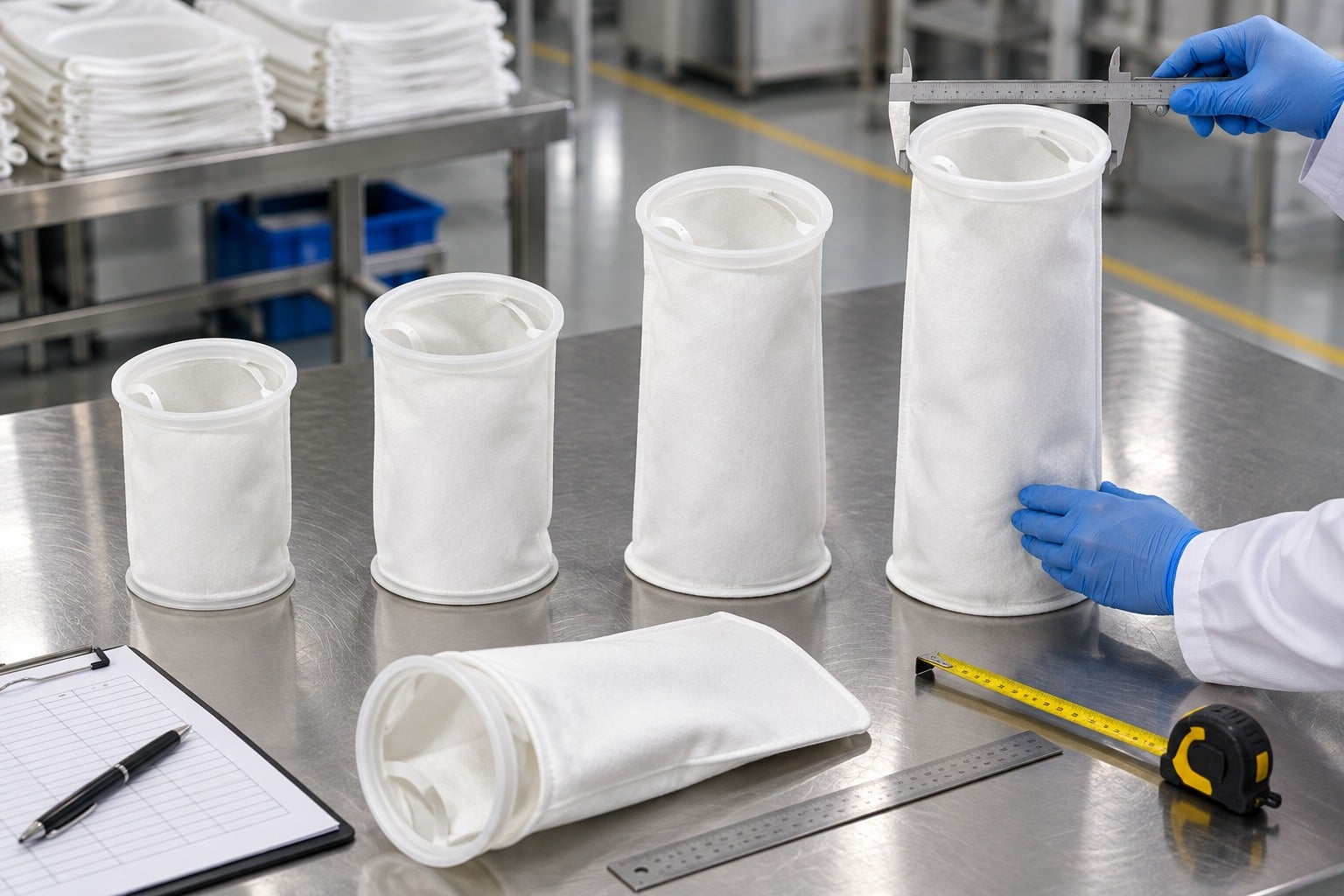
Primary fit evidence: US5840188A shows the bag ring engaging the housing and basket interface, so a size number cannot prove the seal by itself.
Nominal 7 × 16.5 in format for a compatible short basket. Confirm the seat and usable depth before ordering.
Nominal 7 × 32 in liquid filter bag format. It shares a body diameter with #1 but needs the longer basket.
Size #3 is a compact ECFB bag format. Use the catalog value rather than assuming every four-inch label has the same finished dimension.
Size #4 is a longer compact format at about 4 × 15 in. Ring geometry and bottom construction still need a housing check.
FLUID // MATRIX
Specification Input Phase
Media and Fluid Compatibility Inputs
Material selection starts with the liquid, not the maximum temperature line alone.
ECOFILTRONE supplies PP PET and NYLON filter media, then reviews the chemical identity, concentration, exposure time, viscosity, particle load, cleaning method and operating temperature. Polyester selection is confirmed against the actual fluid and cleaning cycle.
[ ! ] ISO 3968:2017 : Treats differential pressure versus flow as a separate evaluation; this page therefore does not infer hydraulic performance from material or size alone.

01
Common Service Environments
We manufacture liquid filter bags for each bag filter design used across the filtration industry.
These bag filters serve industrial water treatment, oil and chemical service, food and beverage processing, and paint and coating production. The table below presents felt, polyester and nylon inputs; a temperature line is not a substitute for chemical compatibility review. A lower micron number is not always safer; the risk increases because the wrong material or rating can cause an increase in pressure drop or loss of strength, and the flow-versus-retention trade-off remains part of the Duty Check.
ECFB material
Construction route
Max Temp
Duty information still required
MAT Polypropylene (PP)
Polypropylene felt or selected fabric construction
80°C
Fluid chemistry, concentration, time, viscosity and cleaning chemical
MAT PET polyester
Polyester felt filter media
120°C
Solvent exposure, process temperature, solids and required retention
MAT Nylon
Nylon mesh for surface filtration
160°C
pH, temperature duration, cleaning cycle and particle-size target
02
Rating basis belongs on the RFQ
A micron number is incomplete if the rating basis and target efficiency are not stated. Absolute rating, particle removal and a nominal micron number must not be equated.
- State the downstream cleanliness or retention target.
- Identify whether the media is felt depth filtration or mesh surface retention.
- Supply a particle distribution or a used-bag sample when the current rating is unknown.
Ring and Bottom Construction for Housing Fit
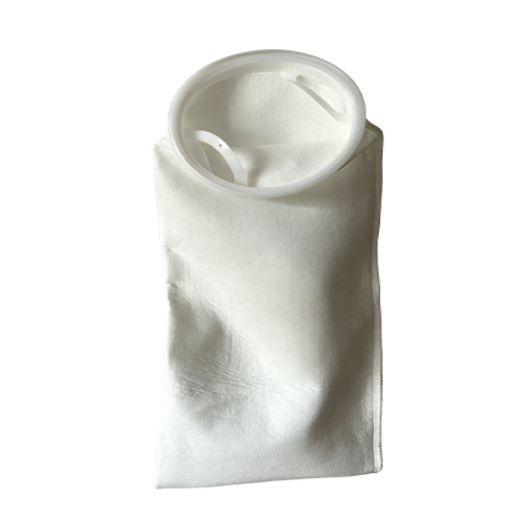
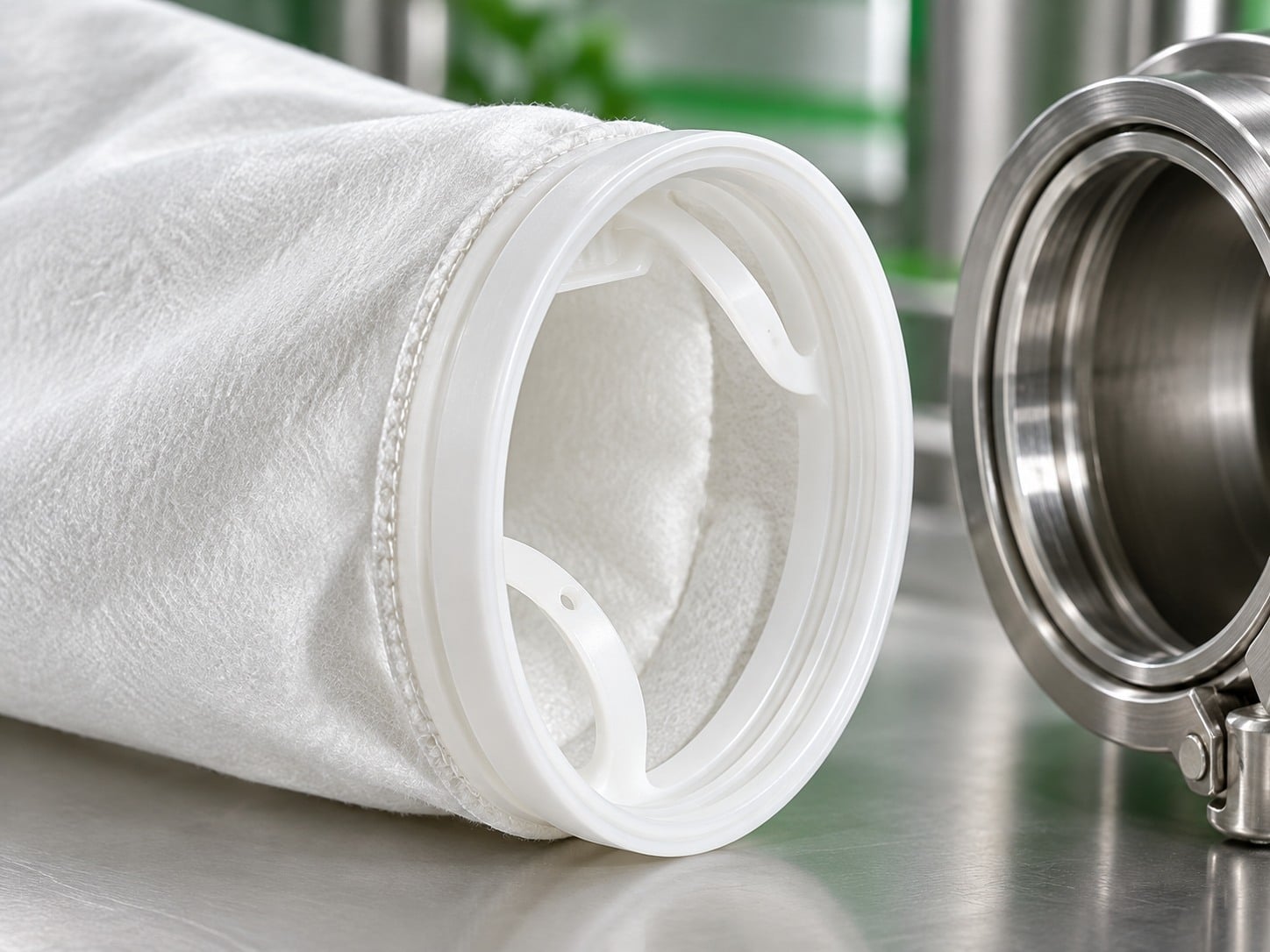
The sealing interface is a system of parts: bag mouth, ring or flange, housing, support basket and a seat. Even a filter bag with the correct diameter can leave a bypass path when the ring style or seat geometry is wrong. Same-number bags are not interchangeable until this interface is checked.
US5840188A describes the seal as an interaction between the ring lip, housing faces and basket flange, which is the mechanical boundary used here.
Send Your Ring Photos for Engineering Review
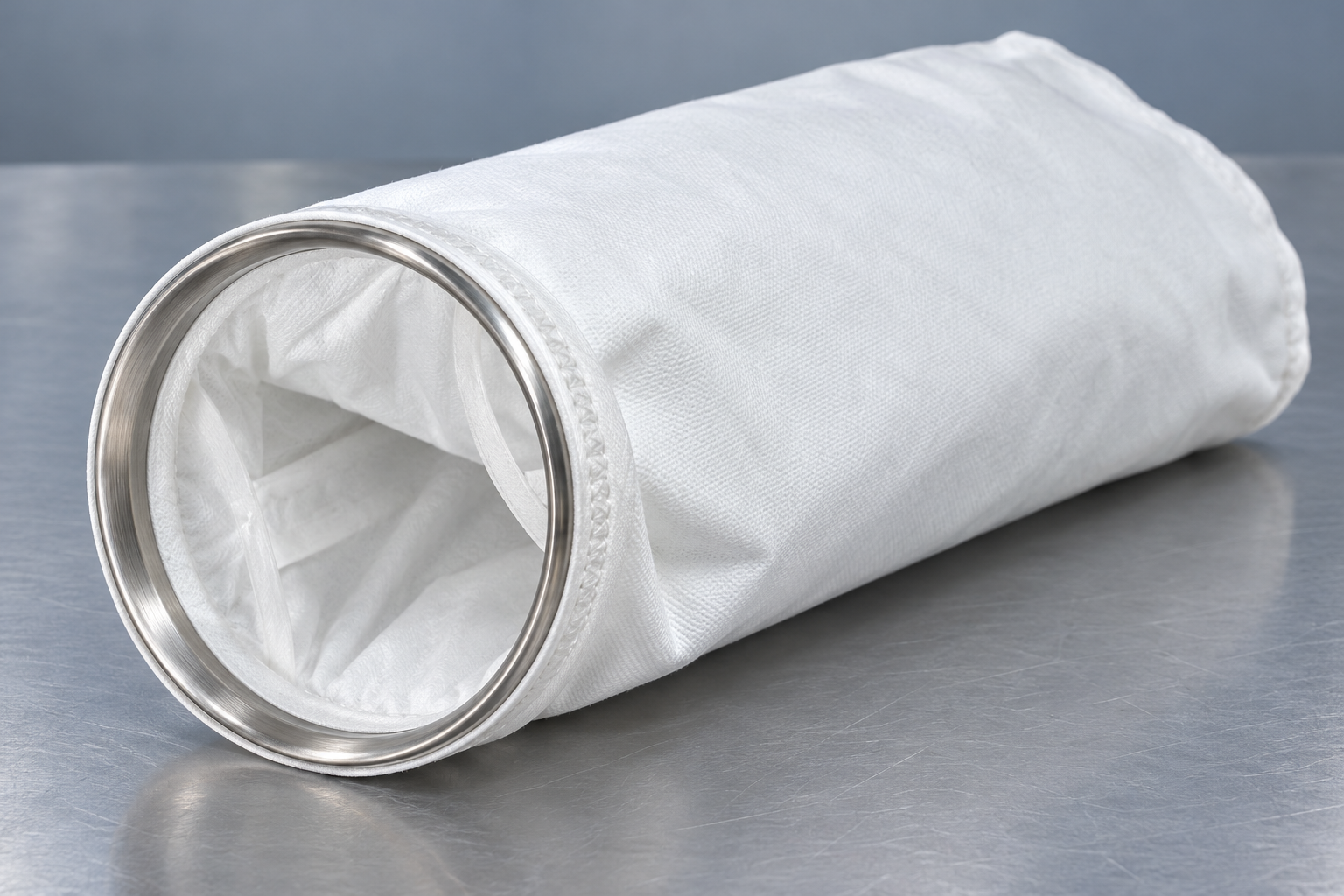
Stainless-steel ring
A rigid metal ring must sit on the intended ledge and remain supported by the basket. Send the ring outside diameter, section shape and a side photo.
- Check the flat seat or retaining arrangement.
- Confirm contact-fluid and temperature requirements.
- Record any housing weld or deformation near the seat.
PP seal ring
A molded polypropylene ring depends on the intended groove and compression path. Its profile cannot be inferred from “plastic ring” on an old purchase order.
- Photograph the top and side profile.
- Measure the widest outside point.
- Confirm the basket flange does not block seating.
The mechanical size match is complete only when diameter, usable length, ring geometry, and basket or sealing-seat fit are checked together.
| Observed issue | Likely fit check | Action before reorder |
|---|---|---|
| Bag bunches at the bottom | Usable length exceeds basket depth | Measure ring-to-bottom length and basket depth |
| Fluid appears around the top | Ring, flange or seat mismatch | Send ring profile and clean-seat photos |
| Bag body collapses or twists | Diameter or basket support mismatch | Measure basket inside diameter and inspect support |
| Old bag is stretched | Used fabric no longer represents the released size | Use housing dimensions, part records and an unused sample if available |
Filter Bag Size Chart and ECFB Specifications
This chart reports values from the ECOFILTRONE catalog rather than re-labeling data from another manufacturer’s flow or filter-area data. The inch dimensions are nominal buying references. Metric dimensions will control ECFB product discussions. The chart is dimensional; ISO 3968:2017 is the separate reference for differential-pressure-versus-flow evaluation.
| Specification | ECFB value | Selection note |
|---|---|---|
| Size #1 | Ø180 × 420 mm | About 7.09 × 16.54 in; short 180 mm body family |
| Size #2 | Ø180 × 810 mm | About 7.09 × 31.89 in; common 7 × 32 label |
| Size #3 | Ø105 × 230 mm | About 4.13 × 9.06 in; use ECFB metric value |
| Size #4 | Ø102 × 380 mm | About 4.02 × 14.96 in; common 4 × 15 label |
| ECFB pore-size availability | 0.5–400 µm | Available range, not one efficiency statement for every media design |
| Seal ring options | Stainless steel or PP | Match the ring style and housing seat |
| PP maximum temperature | 80°C | Catalogue maximum; chemical compatibility remains fluid-specific |
| PET maximum temperature | 120°C | Catalogue maximum; verify concentration and exposure time |
| Nylon maximum temperature | 160°C | Catalogue maximum; verify liquid and cleaning conditions |
| PP differential pressure | 2.0 bar at 20°C; 1.0 bar at 80°C | Maximum operating differential pressure in the ECFB catalogue |
| PET differential pressure | 2.0 bar at 20°C; 1.0 bar at 120°C | Maximum operating differential pressure in the ECFB catalogue |
| Nylon differential pressure | 2.0 bar at 20°C; 1.0 bar at 80°C | Maximum operating differential pressure in the ECFB catalogue |
Mechanical Fit
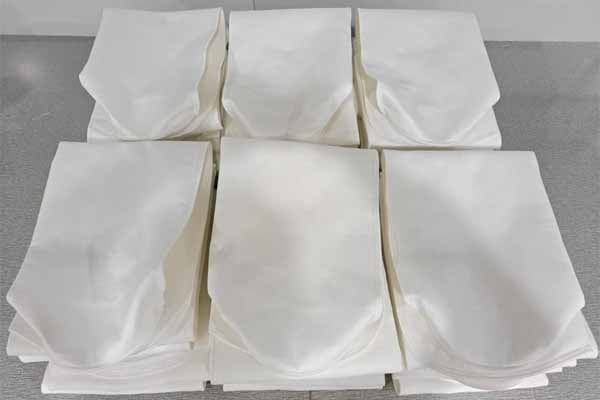
Step 01. Dimensional Validation
The 4-Point Mechanical Fit Check
- Diameter: measure the bag body and basket inside diameter.
- Usable length: measure from the seating face to the supported bottom.
- Ring or collar geometry: identify material, profile, outside dimension and retaining style.
- Basket and seat: check the flange, groove, support and bottom clearance.
The Duty Check

Step 02. Process Evaluation
The Duty Check
- Liquid identity, concentration and operating temperature
- Viscosity or specific gravity
- Required flow rate and batch or continuous service
- Solids loading and variability
- Target particle retention and micron rating basis
- Clean and terminal differential pressure
- Cleaning chemical and exposure time
- Required technical or compliance documents
Pricing, Lead Times and Order Terms
The price of a filter bag changes with media, bag size, micron requirement, ring, seam and bottom construction, quantity, packaging and document scope. An engineer-reviewed quotation is returned within 24 hours after the core specification is clear. The cheapest unit price is not always the best operating choice when a mismatch causes bypass, short runs or an extra shutdown.
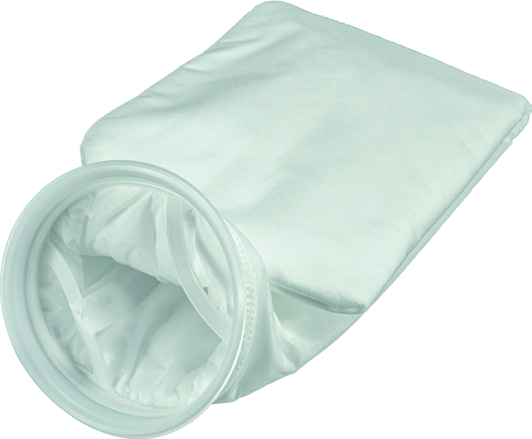
Quotation Factors
Cost & Risk Variables Assessment
| Input | Why it changes cost or risk | Fastest way to confirm |
|---|---|---|
| Media and micron rating | Fabric, felt weight, mesh opening and rating basis change the product construction | Send current specification or downstream retention target |
| Size and ring style | Standard and custom geometry use different material and setup | Send four fit measurements plus ring photos |
| Quantity and trial scope | Sample, trial and production batches carry different setup and packing work | State trial quantity and annual demand |
| Inspection and documents | The required checks and records must be planned before production | List acceptance criteria on the RFQ |
Production & Lead Times
Estimated Fulfillment Schedule
| Order stage | Commitment |
|---|---|
| Stock order | 4–5 days After product and order confirmation |
| Custom sample | 7 days After technical confirmation |
| Custom bulk order | 14 days After technical confirmation |
Terms & Conditions
Payment & MOQ Requirements
- Free samples are available; the customer pays freight.
- Trial orders are accepted for standard products.
- Our custom minimum order quantity is 100 pieces.
- Payment is T/T: 30% deposit, 70% before shipment.
Total cost without a made-up saving
The unit price is only one factor in the final decision. Consider bags per month, labor minutes per change, disposal costs, planned downtime and other losses when considering the impact on your plant.
VERIFICATION
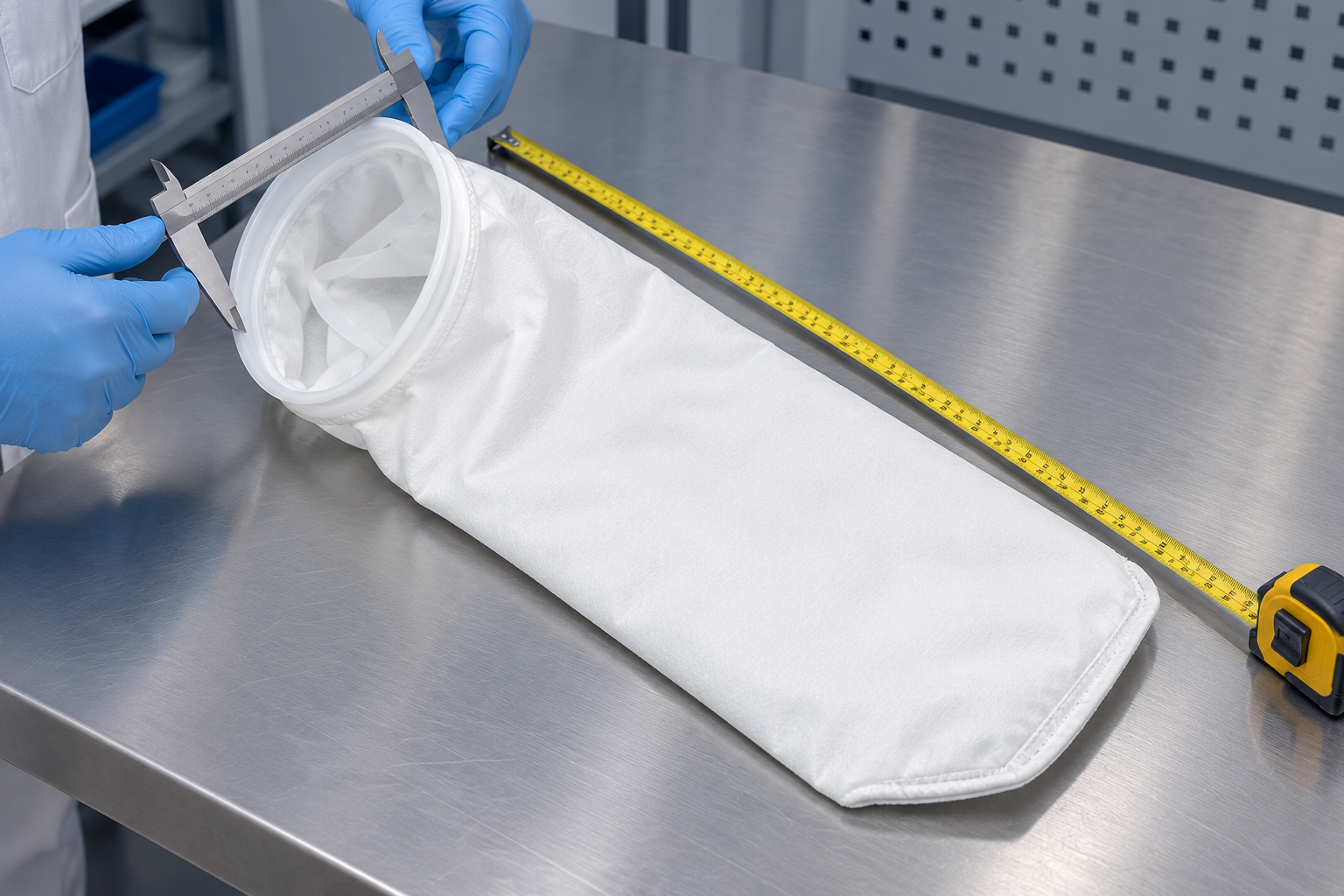
Specification Verification and Inspection
Our factory produces filter bags with dedicated cutting and sewing lines. Released-product checks follow the agreed specification while dimensions, integrity, hydraulic behavior and filtration performance remain separate evidence classes.
Order-level verification
Specification review
size, ring, filter media, micron basis and operating duty are recorded before production.
Dimensional check
the ordered diameter, length and interface dimensions are checked against the released requirement.
Integrity & construction
seams, bottom construction, ring attachment and visible fabric condition are inspected according to the product requirement.
Flow or filtration
where required, the method and acceptance criterion are agreed for the exact product and order.
Evidence classes stay separate
An integrity observation cannot determine a filtration-efficiency percentage. A dimensional pass cannot confirm chemical compatibility and a clean-flow check cannot substitute a particle-retention test.
Define the acceptance record
State the required method, acceptance limit, sample plan and report format on the RFQ. The engineering team then verifies what can be supplied for that product prior to releasing the order.
Documents by verified scope
DOC 01
Product-specific technical data is provided on request after scope verification.
DOC 02
Material certificates are provided on request when available for the selected product.
DOC 03
The applicable compliance documents are provided after the product and document holder are verified.
DOC 04
Inspection, packing and shipping records are coordinated for each order.
From Housing Measurements to Confirmed Fit
01
Send the installed reference.
Include the old bag, part number, housing plate, basket measurements and clear ring photos.
02
Complete the mechanical check.
The comparison will be made on diameter, usable length, geometry of rings/flanges, and fit of baskets/sealing seats.
03
Define the duty.
Engineering review includes liquid chemistry, temperature and viscosity, flow, solids, micron basis and clean/terminal differential pressure.
04
Receive the written specification.
Construction, commercial terms and required documents are included in the quotation or drawing.
05
Run a sample or trial.
Free samples are available with customer freight; trial orders are accepted for standard products.
06
Release production and follow performance.
Production, inspection, packing and shipping are coordinated before delivery; after-sales support covers installation, differential-pressure review and troubleshooting.
RFQ File Set
Mechanical evidence
- Old part number or purchase record
- Diameter and usable length
- Ring profile and material
- Housing and basket photographs
Process evidence
- Fluid and chemical concentration
- Temperature, flow rate and viscosity
- Solids and target particle retention
- Pressure limits and document needs
A Size #2 Trial for an Industrial Water Line
An industrial-water customer in Saudi Arabia operated five housings and needed a stronger replacement path for an existing bag. ECOFILTRONE prepared a PP felt Size #2 product—a size 2 filter bag at 50 µm, nominal 7 × 32 in (often written 7 x 32), with a reinforced bottom.
Original ECFB catalogue source used for the published media, size, temperature and differential-pressure values.
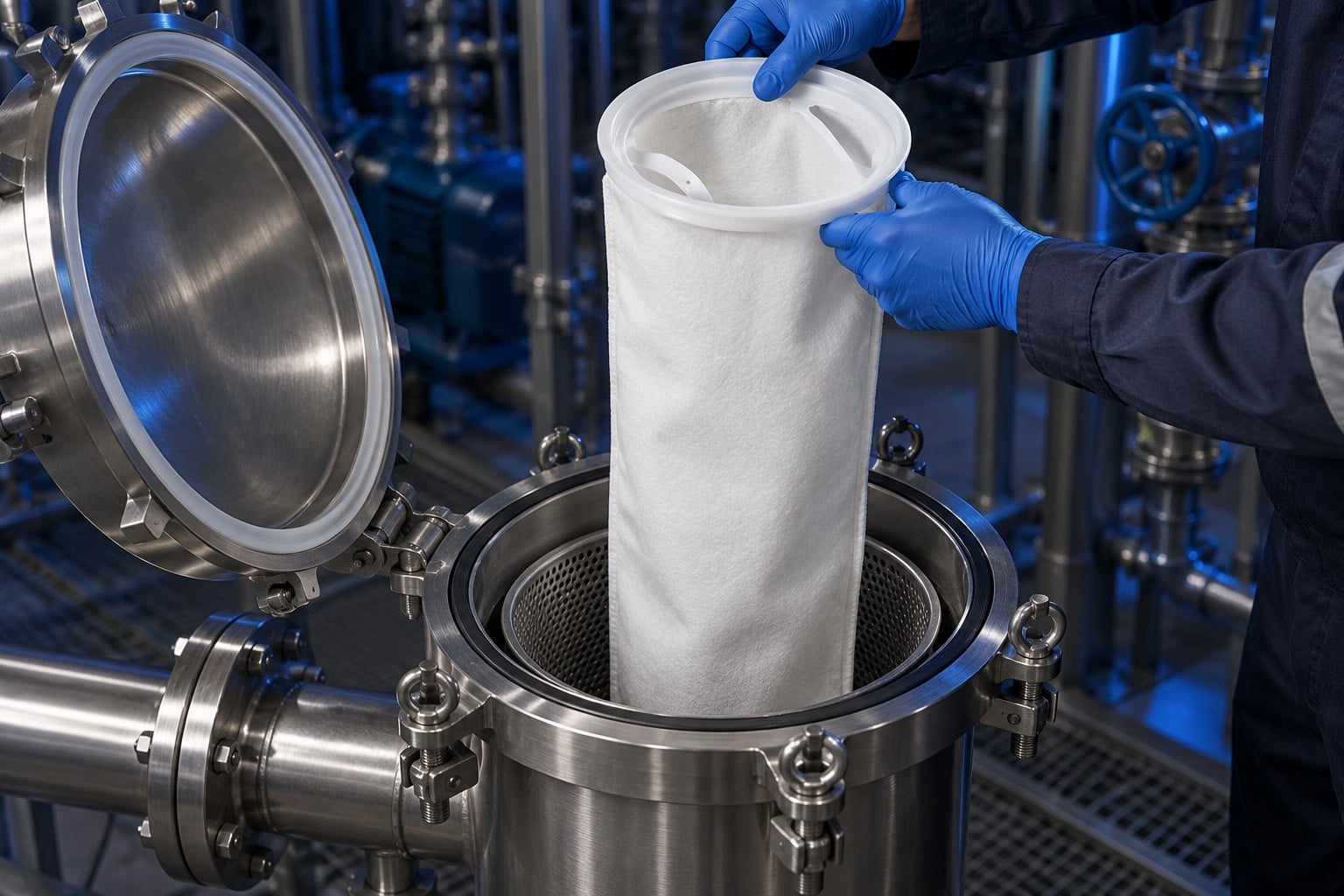
SIZE #2 HOUSING · 50 µm
Recorded sequence
- 5 housings in the customer’s line
- 8-piece trial order
- About 9 days with no complaint about bag strength
- 200-piece follow-on order
Make your trial measurable
- Record clean and terminal differential pressure.
- Record flow, filtered volume and change time.
- Define the particle-removal or downstream-quality endpoint.
- Inspect the ring, seam and bottom after removal.
SYS.INFO // MATRIX
When a Standard Size Number Is Not Enough
A standard label helps route the inquiry, but it does not close every engineering decision. Use the next action in this matrix when the installed evidence or duty falls outside the simple chart.
01/06
Capacity is a duty result
A GPM or m³/h value copied from another product does not establish ECFB flow capacity; capacity depends on the media, micron rating, fluid, viscosity, solids, available area, pressure limit and housing design.
ISO 3968:2017
Is the referenced boundary for evaluating differential pressure against flow under defined test conditions.
Advanced Filter Bag Engineering Tools
Filter Bag Changeout Cost Estimator
Use your own operating figures to separate bag spend, labor, disposal and downtime. Currency is intentionally unlabeled so every input and result stays in the same currency; the tool does not promise savings or predict service life.
Filter Bag Duty Check Builder
Build a completeness check for an engineering review. Blank fields remain visible in the result, and the tool never converts a complete form into an automatic media, micron or compliance recommendation.
ECFB Filter Bag Size Match Checker
Enter the measured bag-body diameter and usable length in millimetres. The checker identifies the nearest ECFB #1–#4 catalogue format and shows the dimensional difference; it does not certify the ring, basket seat or operating duty.
FAQ / ECFB
Liquid Filter Bag Size FAQs
VERIFIED DATA
What are the standard sizes of liquid filter bags?
ECOFILTRONE publishes four ECFB formats on this page: #1 at Ø180 × 420 mm, #2 at Ø180 × 810 mm, #3 at Ø105 × 230 mm and #4 at Ø102 × 380 mm. The dimensions of a #2 filter bag therefore use the longer 810 mm body, but its ring and housing seat still require verification.
Why can a Size #2 filter bag still bypass?
The 7 × 32 label describes the bag envelope, not the full sealing interface. A mismatched ring, flange, housing seat or unsupported basket can leave a path around otherwise correct filter media.
Why did differential pressure rise before the bag looked full?
Rising differential pressure is not automatically a material defect. Check flow, viscosity, solids loading, micron selection and basket condition before blaming the bag; colder or more viscous fluid can raise pressure loss without a material failure.
For a formal hydraulic comparison, ISO 3968:2017 evaluates differential pressure versus flow under defined test conditions.
Are Size #1 and Size #2 filter bags interchangeable?
No. Their body diameter is similar, but Size #2 is much longer. A short bag in a long basket or a long bag in a short basket will not receive the intended support.
What is the ECFB Size #3 dimension?
The ECFB catalogue lists Size #3 at Ø105 × 230 mm.
What is the ECFB Size #4 dimension?
The ECFB catalogue lists Size #4 at Ø102 × 380 mm, about 4.02 × 14.96 in. Ring style and basket depth remain part of the fit review.
Does a 5 micron filter bag always give better filtration?
No. A 5 micron choice must match the required retention, rating basis, solids load, viscosity, flow and allowable pressure drop. A finer selection can shorten the run without improving the downstream result that matters.
Can you match an existing steel ring or PP ring?
Yes, after dimensional verification. Send the ring material, outside dimension, profile photos, housing model information and basket-seat view so the replacement design is not based on the name alone.
What affects the price of a filter bag, and what is needed for a quote?
Send quantity, bag size, diameter, usable length, ring style, filter media, micron rating, fluid, temperature, flow rate, viscosity, solids, pressure limits and required documents. ECOFILTRONE returns the quote within 24 hours once the core specification is clear.
Can I request a free sample or trial order?
Yes. Free samples are provided with freight paid by the customer, and trial orders are accepted for standard products. Custom samples are scheduled in 7 days after technical confirmation.
What does an integrity check prove?
It can address the defined construction or test endpoint, but it does not automatically prove micron efficiency, chemical compatibility or service life. Put each required acceptance criterion and report on the order specification.