Get in touch with ECOFILTRONE™ Company


Sterile Filtration Cartridge Candidates for Pharmaceutical Processes
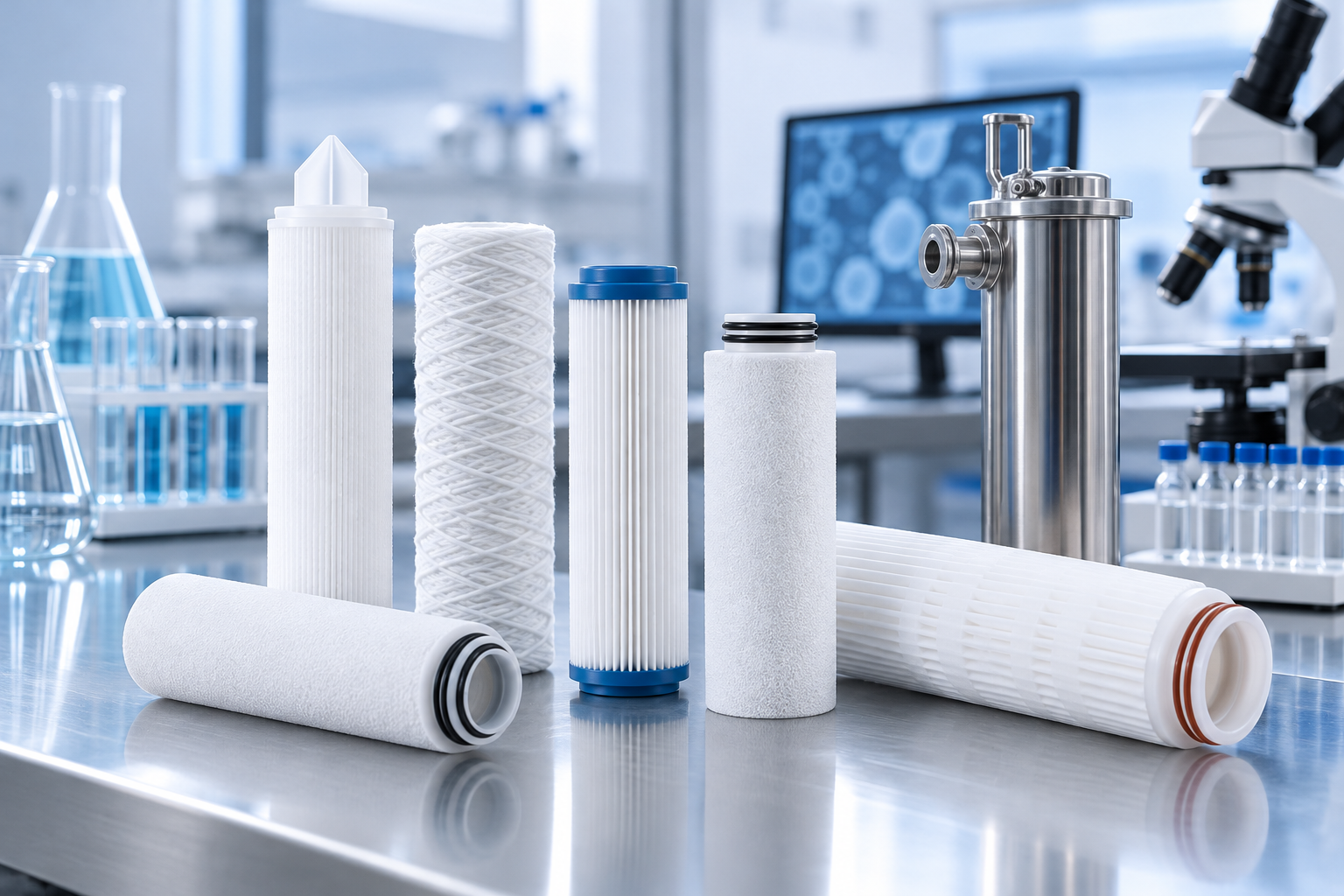
ECOFILTRONE™ supports buyers in the pharmaceutical industry with PES, PTFE, PVDF and Nylon 66 membrane cartridge families, application review and replacement matching. Our sterile filtration screening covers the exact cartridge, fluid or gas, housing, operating envelope and documentation need before a configuration is proposed.
A listed membrane and pore rating define a candidate, not a validated sterilizing-grade filter for every process. The final decision has to be tied to the chosen model, actual process stream, installation and required validation evidence.
Timeline
Quotation response within 24 hours
Materials
PES · PVDF · PTFE · Nylon 66
Availability
Samples and trial orders
Compliance
Product-specific document review
Sterile Filtration Cartridge Candidate Screening at a Glance
01 / SPEC
Membrane families
Candidate screening includes PES, PVDF, PTFE and Nylon 66 cartridge families against the defined process condition.
02 / PROCESS
Application review
Our review covers the process point, stream composition, rating, temperature, pressure, flow and cleaning or sterilization conditions.
03 / VERIFY
Replacement matching
Before we confirm a replacement candidate, we check the model number, dimensions, interface, seal, flow direction and operating conditions.
04 / SUPPORT
Sample route
Free samples are available for suitable products, with freight paid by the customer. Trial orders are also accepted.
05 / CONFIG
Configuration support
Specification verification and configuration adjustments based on our technicians’ input are part of our service, along with technical confirmation before production. Useful filtration solutions identify the disclosed process duty and validation conditions instead of relying on a generic material label or pore rating alone.
06 / RECORDS
Document check
Datasheets, drawings, material documents and applicable compliance files are checked for the selected product and actual certificate holder.
The pore-size-only shortcut
Unlike a pore-defined shortlist, the trade-off is more input before quotation while the housing, stream and validation conditions stay visible and assumptions decrease during qualification. Pore ratings are not interchangeable with process validation.
A filter review starts with the process objective and full operating conditions. A familiar pore rating is useful input, but it cannot replace compatibility, capacity and validation questions.
Process Evaluation
Pharmaceutical Process Points and Filtration Objectives
A pharmaceutical filtration system can contain several duties that call for different filter structures and evidence. Our process-point review separates particle control, bioburden reduction, membrane filtration, vent service and a claimed sterilizing step.
Prefiltration
Particle or bioburden reduction upstream can protect a finer membrane filter from early fouling. Feed quality, particle load, flow and the downstream goal determine whether a depth filtration or pleated cartridge stage belongs in the train. This stage can help control contamination and reduce a contaminant burden prior to the next filter.
Process liquids
Buffers, process water, and product intermediates require case-by-case review. Composition, pH, solvent content, temperature, adsorption concern and allowable differential pressure guide the candidate membrane.
Final membrane step
A final step that is intended to remove bacteria requires the sharpest claim boundary. The ability to remove bacteria must be demonstrated under the defined challenge conditions. A filter validation plan calls for model- and process-specific bacterial retention evidence, a correlated integrity test and defined operating limits.
Gas and vent service
A gas or vent duty changes the wetting, condensate, flow and pressure questions. PTFE can be included in the candidate set, but the identity of the gas, humidity, cycle and housing still require review.
Pharmaceutical water
A purification system support point for purified water or water for injection must be assessed within the context of the overall microbial control strategy. Temperature, sanitization, circulation, flow and point-of-use function affect the selection.
Installed replacements
Hardware and end connection of the replacement cartridge filter must be considered together with the seal and flow direction to assess any effect on the qualified process; non-pharmaceutical high-flow filter elements stay outside this pharmaceutical page, while regulated or validated process impact still requires its own approval.
Sterile Filtration Qualification Matrix
Process point
Candidate route
Inputs still required
Decision boundary
Upstream prefiltration
Depth or pleated family before a finer stage
Particle load, bioburden, flow, pressure and downstream target
Prefiltration does not establish the final retention claim
Pharmaceutical liquid step
PES, PVDF or Nylon 66 after compatibility review
Composition, pH, solvents, temperature, rating, housing and document need
Candidate media are not a process prescription
Claimed sterilizing step
A specific membrane cartridge after qualification
Actual product or justified surrogate, organism, challenge conditions, integrity method and limit
Validation must follow the specified filter and process
Gas or vent duty
PTFE candidate after gas and wetting review
Gas identity, humidity, condensate, flow, pressure, cycle and housing
Liquid and gas ratings are not interchangeable conclusions
Purified water or WFI support
Candidate based on the defined system role
Water quality, temperature, sanitization, circulation, flow and required records
A cartridge cannot stand in for system-level control
Existing cartridge replacement
Dimensional and material comparison
Current model, drawing or sample, interfaces, seals and qualified-process impact
No direct-replacement claim before technical confirmation
Standards define a process-specific task
ASTM E3469-26 describes bacterial-challenge validation under actual worst-case or justified conditions for the specified membrane. USP<1229.4> treats microorganism removal as dependent on the bioburden, solution, filtration conditions and filter.
The risk of a false match rises because a catalog rating cannot represent every process variable.
ECOFILTRONE uses these sources and FDA aseptic-processing guidance as review inputs, not as certification of a candidate cartridge.
Membrane Media for Pharmaceutical Filtration
Membrane chemistry affects wetting behavior, chemical compatibility, flow, adsorption and fouling; these effects narrow the specification to the disclosed stream and duty.
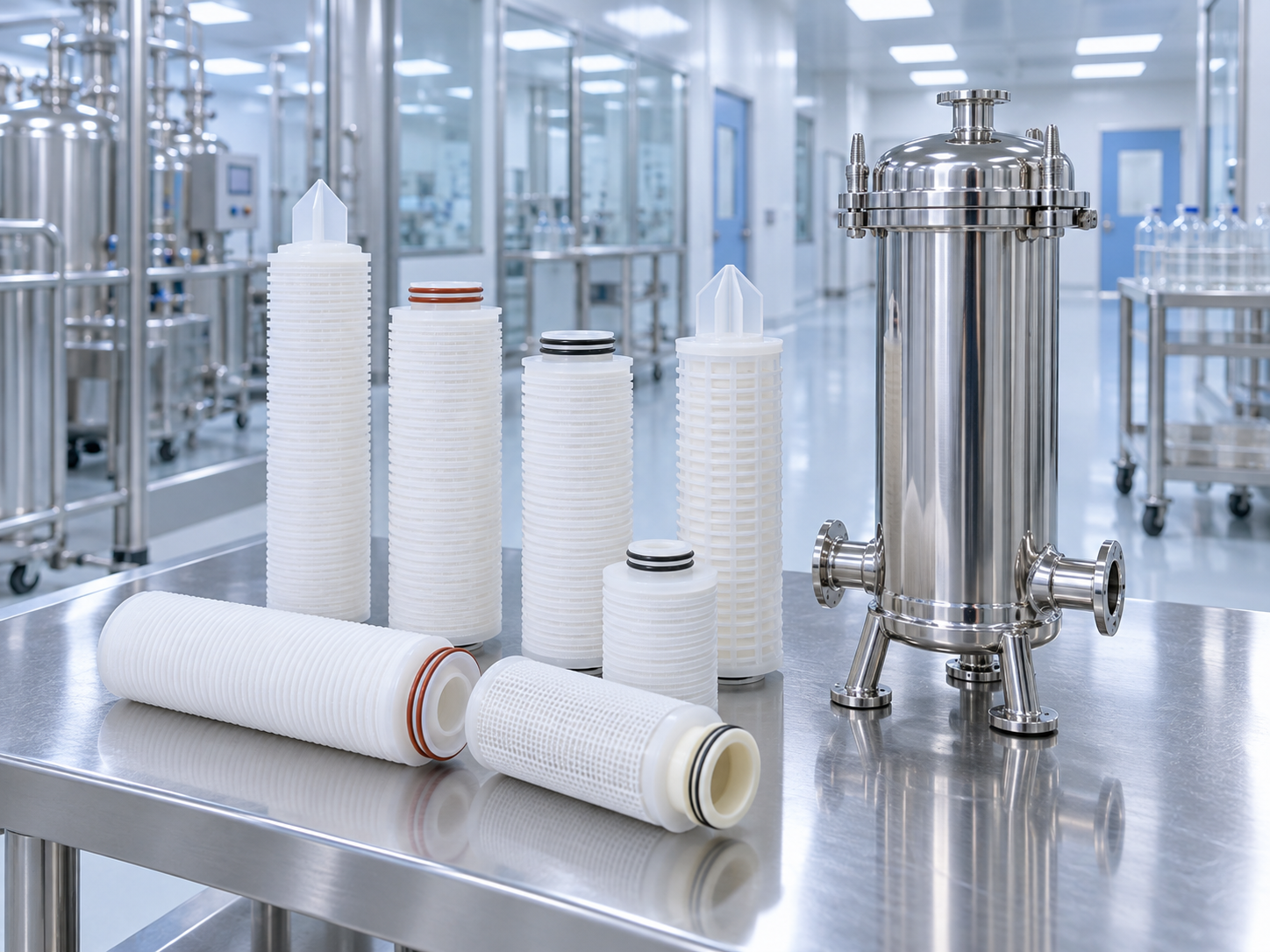
Confirmed PES series span 0.04–1.2 µm, 5–40 in lengths, 69 mm outer diameter and a maximum stated temperature of 80°C. A PES candidate still needs fluid compatibility, adsorption, throughput and qualification review for the exact pharmaceutical process.
Useful input for aqueous liquid screening
- Check protein or active-product interaction
- Bind rating and temperature to the selected series
Confirmed PVDF ratings are 0.1, 0.22, 0.45 and 0.65 µm, with 5–40 in lengths, 69 mm outer diameter and 80°C maximum stated temperature. The 0.22 µm option remains a product specification, not a universal bacterial retention statement.
Evaluation criteria
- Review the formulation and solvent content
- Assess binding, fouling and recovery in trials
- Confirm the intended integrity method for the model
Confirmed PTFE series span 0.01–10 µm, 5–40 in lengths and 69 mm outer diameter, with stated maximum temperatures of 80–100°C by series. Liquid and gas uses must be separated during selection because wetting state and service conditions change the filtration process.
Evaluation criteria
- Identify liquid, gas or vent duty
- State humidity, condensate and cleaning conditions
- Confirm the series-specific temperature limit
Confirmed Nylon membrane cartridge ratings are 0.22, 0.45, 0.65 and 1.2 µm, with 5–40 in lengths, 69 mm outer diameter and 80°C maximum stated temperature. Chemical compatibility and possible product interaction must be checked against the actual formulation.
Evaluation criteria
- Provide composition, pH and solvents
- Define normal and maximum temperature
- Use sample data to check recovery where needed
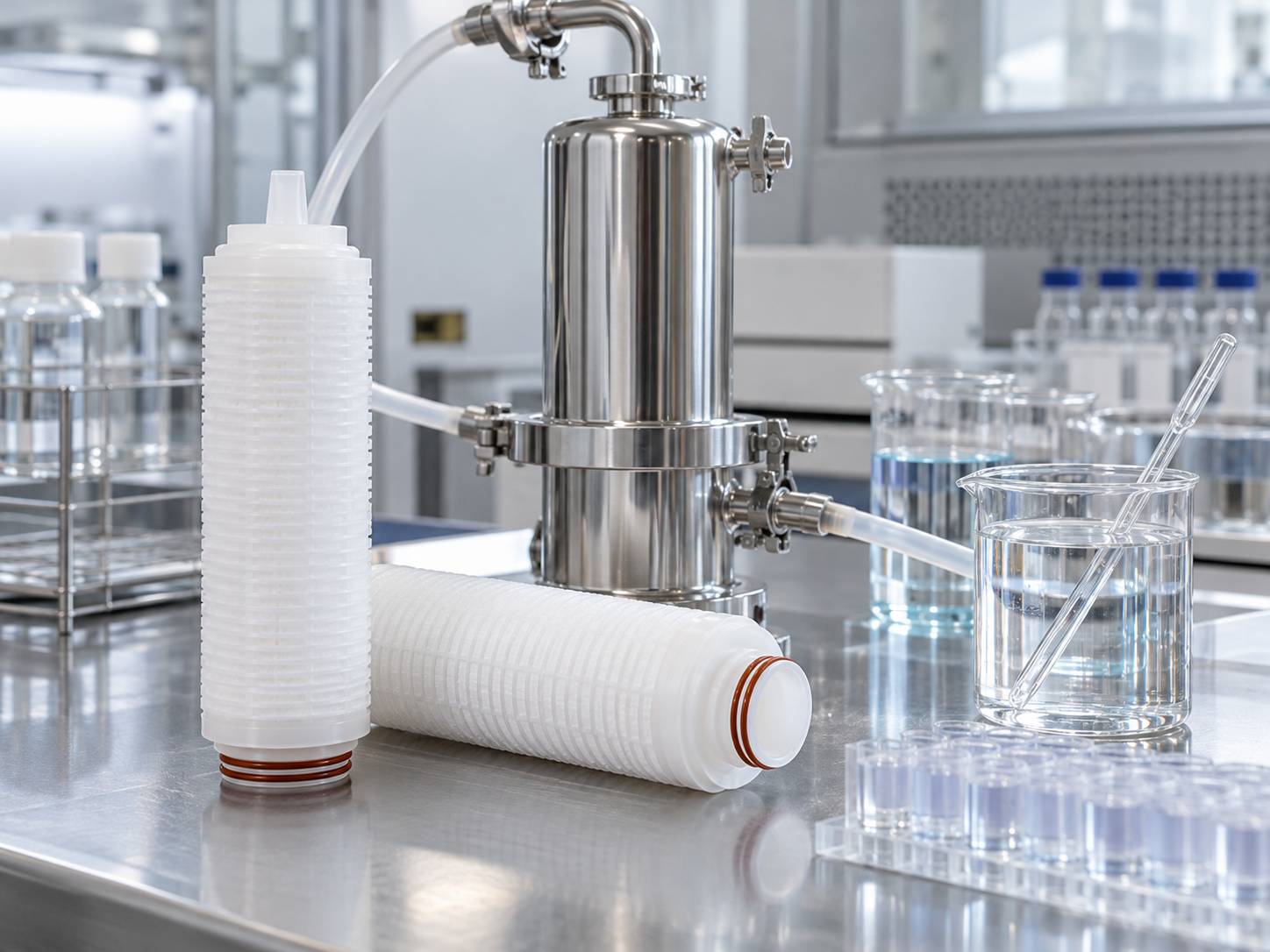
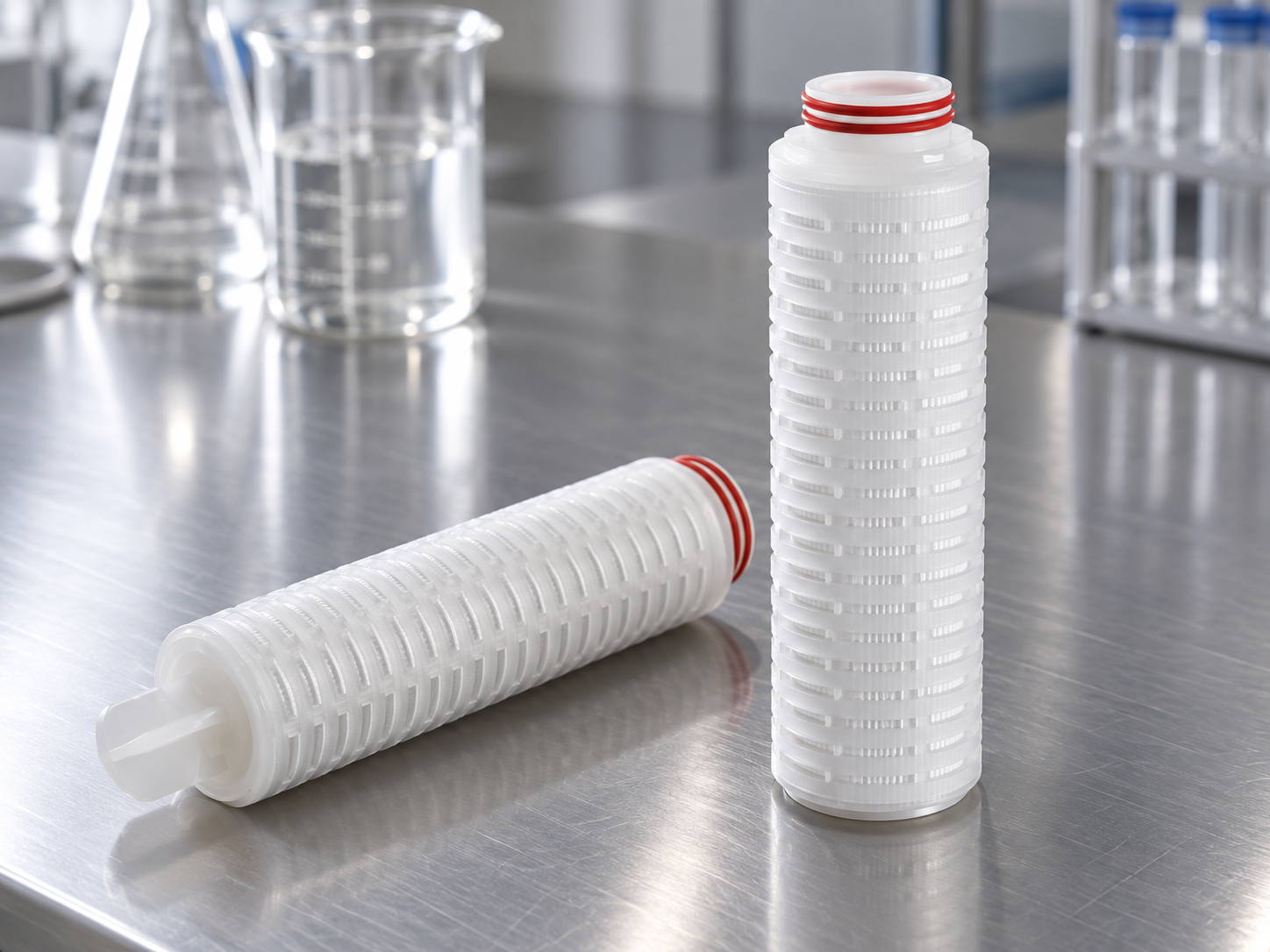
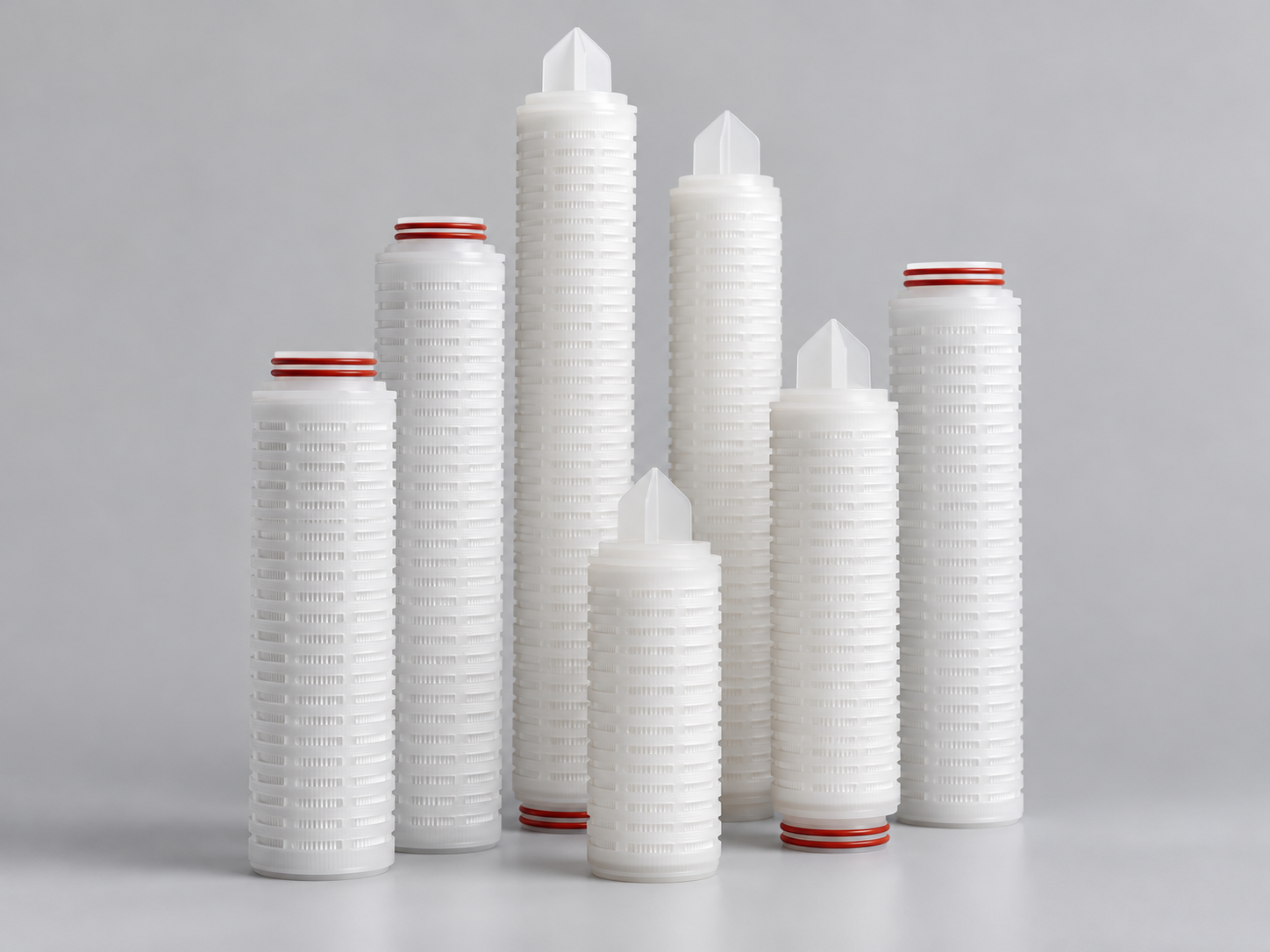
Equal ratings can produce different process results
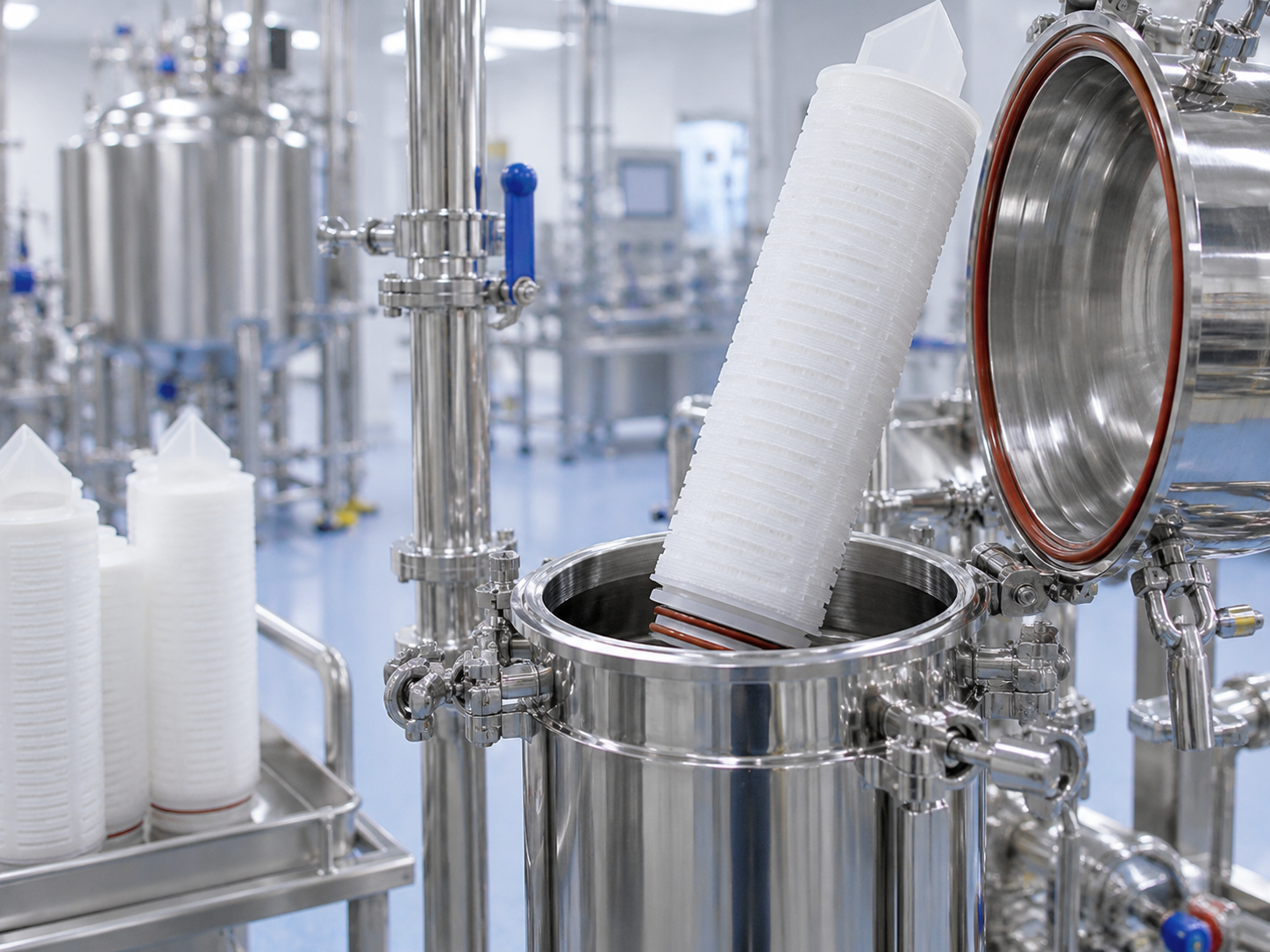
A peer-reviewed comparison of 0.22 µm PES and PVDF filters found differences in permeability, fouling, capacity and protein adsorption even though both filters passed bacterial challenge testing. Nominal pore size alone does not ensure throughput, product recovery, and application suitability.
Technical basis: peer-reviewed filter comparison.Cartridge Formats, Interfaces and Sealing Options
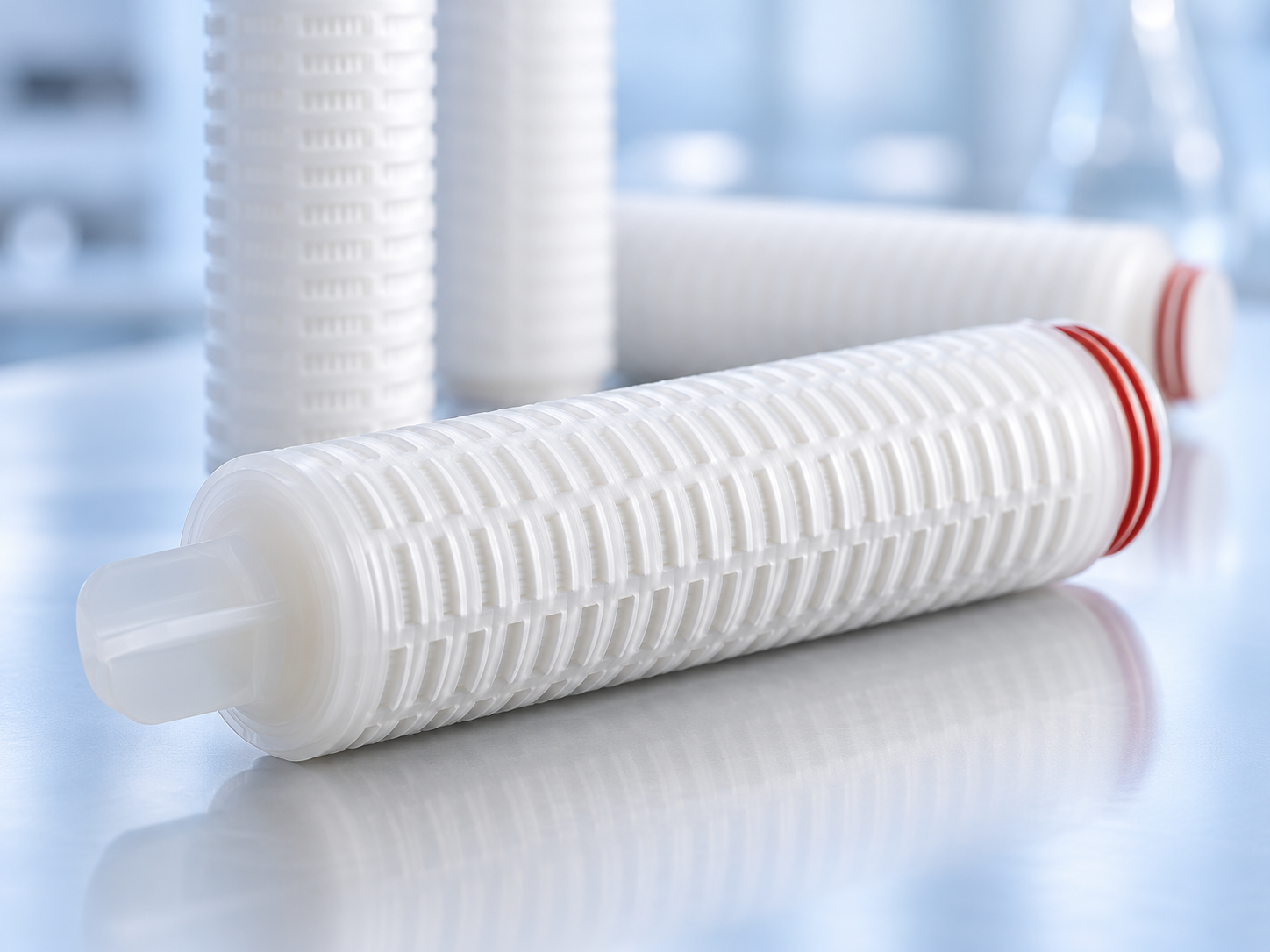
The cartridge configuration needs to fit the process direction and membrane duty for the installed housing. A drawing, current model or physical sample supplies the configured dimensions and connection details for our check; ASTM E3469-26 addresses microbial-retention validation under specified conditions, not dimensional interchangeability.
Configuration item
Information to send
Reason for the check
Overall length
Nominal length and measured total length
Prevents interference or incomplete seating in the housing
Outer diameter
Drawing dimension or measured cartridge diameter
Checks clearance, support and housing fit
End connection
End-cap form, adapter detail and locating features
Confirms mechanical engagement and flow path
Seal
Current seal material, geometry and product-contact requirement
Supports chemical and temperature compatibility review
Flow direction
Housing drawing and installed orientation
Checks that support and connection details match service
Hardware materials
Required core, cage and end-cap materials
Prevents an assumed polypropylene or other material from entering the specification
Capsule or open cartridge
Current assembly form and piping connection
Separates a single-use capsule filter request from a replacement open cartridge
Seal documentation
State whether silicone or another elastomer is required
Keeps the seal claim tied to the selected configuration
Replacement status follows written technical confirmation
A similar outer size does not establish interchangeability. We verify the proposed configuration against the drawing, model or sample and record the accepted specification before production.
Request a Specific Engineering Match ReviewCartridge Specifications and Application Data to Confirm
The table below is a candidate-screening reference for confirmed product families. It does not give every pore rating and temperature for every construction, so the quotation and datasheet need to identify the series chosen while ASTM E3469-26 keeps process-specific validation conditions separate from this screening table.
| Specification | Confirmed family value | Selection note |
|---|---|---|
| PES rating range | 0.04–1.2 µm | Availability and duty checked by series |
| PES cartridge length | 5–40 in | Total configured length confirmed on drawing |
| PES outer diameter | 69 mm | Housing fit still requires interface details |
| PES maximum stated temperature | 80°C | Operating and cycle conditions reviewed separately |
| PVDF discrete ratings | 0.1 / 0.22 / 0.45 / 0.65 µm | 0.22 µm is retained exactly as documented |
| PVDF cartridge size | 5–40 in · 69 mm OD | Connection and seal added after review |
| PVDF maximum stated temperature | 80°C | Compatibility and cycle exposure must fit |
| PTFE rating range | 0.01–10 µm | Liquid and gas series reviewed separately |
| PTFE cartridge size | 5–40 in · 69 mm OD | Housing and flow direction confirmed |
| PTFE maximum stated temperature | 80–100°C by series | The selected series controls the limit |
| Nylon discrete ratings | 0.22 / 0.45 / 0.65 / 1.2 µm | Fluid interaction assessed before selection |
| Nylon cartridge size | 5–40 in · 69 mm OD | Configured dimensions confirmed in writing |
| Nylon maximum stated temperature | 80°C | Normal and maximum conditions required |
| Custom configuration MOQ | 100 pieces | Final configuration and date stated in quotation |
Sterile Process Qualification Match Brief
Current element and housing
- Brand, model, drawing or physical sample
- Total length, outer diameter and end connections
- Seal material and geometry
- Housing model, flow direction and installed orientation
Process stream
- Liquid or gas identity and product-contact status
- Composition, pH, solvents and particle condition
- Incoming bioburden where relevant
- Adsorption, extractables or recovery concerns
Operating envelope
- Normal and maximum temperature and pressure
- Flow, clean differential pressure and change-out limit
- Maximum filtration volume, time and contact duration
- Batch or continuous operation and grow-through controls
Cycle and evidence need
- Cleaning, sanitization or sterilization method
- Cycle temperature, duration and intended count
- Target retention or particle-control objective
- Required drawing, material, integrity or compliance documents
Quotation, Samples, MOQ and Lead Times
Price follows the membrane, dimensions, connection, seal, quantity, document scope and any custom work. A written quotation is issued after the application and specification inputs are sufficient for our review.
Commercial Facts for Project Planning
Stage
Confirmed term
Start point and scope
Quotation response
Within 24 hours
Starts after sufficient application and specification data are received
Stock products
4–5 days
Starts after order and specification confirmation; transit is separate
Customized sample
7 days
Starts after technical confirmation
Custom bulk order
14 days
Starts after technical confirmation; the specific date is confirmed in the quotation
Customized configuration MOQ
100 pieces
Applies to custom configurations
Sample support
Free sample; customer pays freight
Subject to product suitability and confirmation
Trial order
Accepted
Used for suitable products before a larger order
Payment
30% deposit · 70% before shipment
Paid by T/T and recorded in the quotation
We prepare a custom sample in 7 days after technical confirmation. Free samples remain available for suitable products, with freight paid by the customer.
The 4-5 day, 7 day and 14 day commitments are for the stated preparation or production phase from the defined confirmation point. Shipping and delivery, customs clearance and other transit are quoted or coordinated separately.
Inputs That Move the Quotation
Membrane and rating
The product family is established by the series and the pore rating and duty.
Connection and seal
End configuration, hardware and elastomer requirements define the build.
Quantity and schedule
The order volume, sample requirements and required date affect the production plan.
Document scope
Drawings, material records and applicable compliance requests must be stated before quotation.
Product-Specific Inspection and Documentation
Equipment for inspection and production varies by product line and production facility. Our inspection scope uses dimensional, integrity, flow and filtration-performance checks according to the requirements of the selected product.
Order and Inspection Route
Freeze the specification.
We confirm membrane, rating, dimensions, connection, seal, quantity and the stated process conditions.
01Set inspection scope.
The order record specifies the required dimensional and performance checks.
02Complete production follow-up.
We track assembly, inspection, packaging and the confirmed production schedule.
03Review the requested documents.
We verify that the datasheets, drawings, material or compliance files match the selected item and certificate holder.
04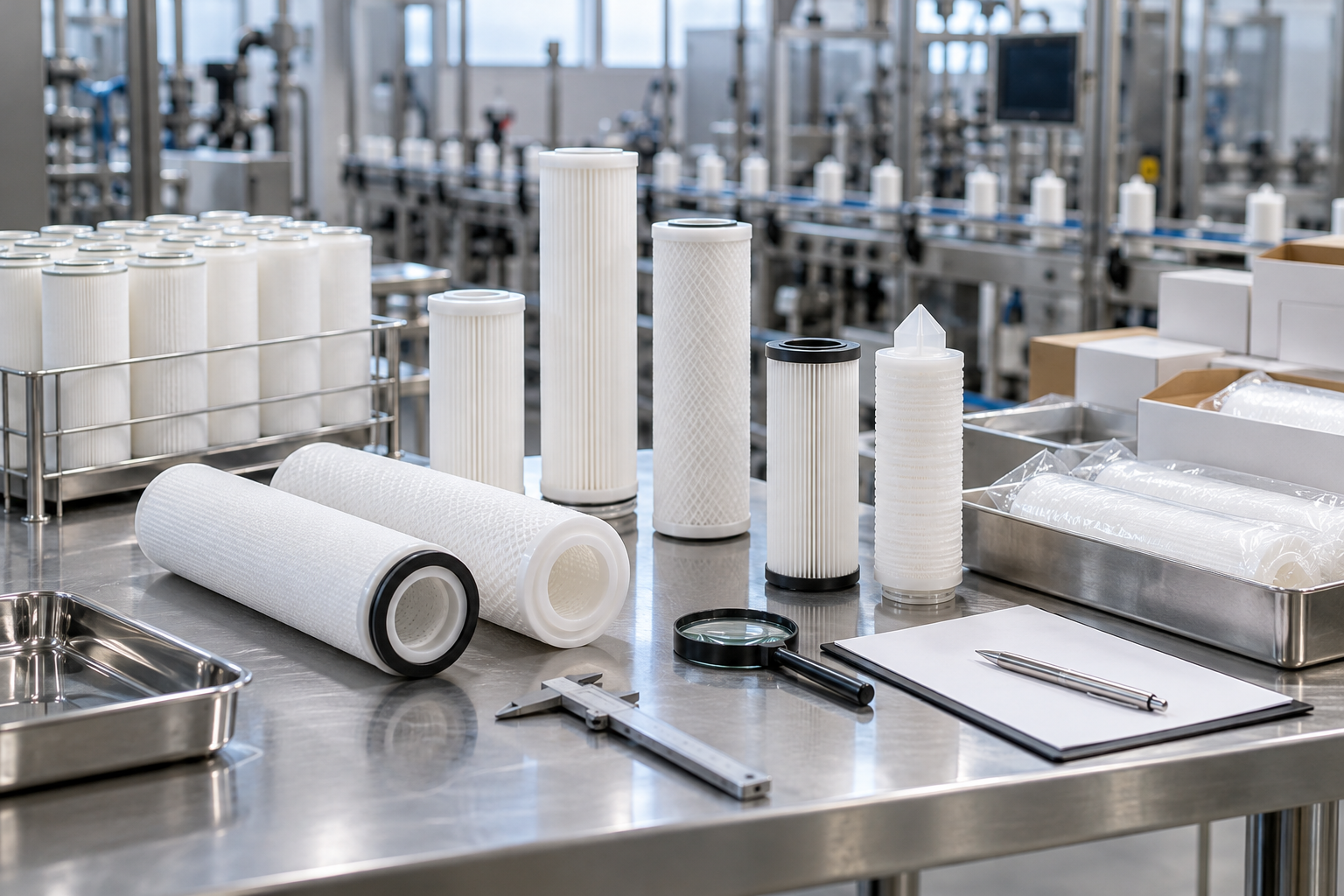
Evidence Layers Are Not Interchangeable
Evidence layer
What we can coordinate
What the buyer still evaluates
Production inspection
Product-required dimensional, routine integrity, flow and filtration-performance verification
Whether the inspection set fits the qualified-process controls
Product data
Datasheet, drawing and configured specification for the selected cartridge
Fit with the actual formulation, cycle and installed filtration system
Material and compliance files
Applicable documents after product and certificate-holder verification
Acceptance against target-market regulatory requirements and the internal quality system
Validation-linked evidence
Product-specific information when a correlated method and acceptance limit are available
Process validation, sterility assurance and release decisions
From Application Review to Operating Follow-Up
1
STEP 01
Send the process brief. Share the current cartridge, housing, stream, operating range, process objective and document list.
2
STEP 02
Review candidate families. We compare membrane, rating, configuration and compatibility questions and answers and, when its scope applies, treat FDA aseptic-processing guidance as a review input rather than cartridge certification.
3
STEP 03
Confirm the technical specification. We provide the datasheet or a drawing, and record the selected configuration, prior to processing the order.
4
STEP 04
Sample or trial routes may be used when the buyer can evaluate fit, flow, pressure behavior, product recovery and product handling before scale-up.
5
STEP 05
Follow the production and inspection. We coordinate the confirmed build, inspection, packaging and shipment.
6
STEP 06
Review operating status. After installation, we can discuss compatibility, differential pressure, service life, troubleshooting and filtration configuration changes.
Selection Inputs and the Decision They Support
| Input | Decision supported | Common risk if omitted |
|---|---|---|
| Fluid or gas composition | Membrane and seal compatibility | Swelling, wetting failure or product interaction |
| Particle and bioburden condition | Prefilter need and retention strategy | Early blockage or an unsupported final-step assumption |
| Flow, pressure and volume | Area, capacity and change-out review | High differential pressure or short service life |
| Temperature and cycle | Material and construction limits | Loss of fit or performance after repeated exposure |
| Product recovery concern | Adsorption and trial plan | Unmeasured loss across the filter |
| Required documents | Product and order evidence package | A late compliance gap after configuration is frozen |
Evidence Required Before a Sterilizing-Grade Claim
The term “sterilizing-grade filter” relates to a defined filter and process, not to a membrane family in the abstract. Official and consensus sources separate filter qualification, product/process validation, routine integrity control and filter sterilization.

Specified filter
Identify the exact membrane, construction, configuration, sterilization history and integrity method. Similar materials or ratings do not justify an immediate conclusion.
Actual product or justified surrogate
Use the actual formulation, or an adequately justified surrogate, that represents the relevant worst case. Record pH, viscosity, ionic conditions, surface effects and other relevant properties that may affect retention or flow.
Challenge and correlation
Define the target microorganism and challenge conditions. Record the bacterial retention result, its correlation with a nondestructive integrity test and the test's acceptance limit.
Operating envelope
Cover maximum time, volume, contact duration, temperature, differential pressure, flux, incoming bioburden and any microorganism grow-through risk.
Compatibility and product quality
Assess chemical compatibility, adsorption, particle release and the effect of repeated cleaning or sterilization cycles. Evaluate product recovery and extractables and leachables.
Installation and routine controls
State the housing, wetting state, flow direction, pre-use/post-use integrity checks, monitored parameters and response to an out-of-limit result.
Virus-removal duties, vaccine processes and biologic streams containing particles intended to remain in the product need their own process and validation route. This page does not assign those objectives to the standard sterile filter cartridge screening path.
The PDA Technical Report No. 26, revised 2025, organizes these topics as separate qualification, process-design, validation, integrity-testing and sterilization tasks.
Use the replacement match brief to couple cartridge details and operating conditions to the documents your quality team needs.
Build Your Evidence Brief
Assessment Criteria
When a Cartridge Is Not Yet Ready to Specify
A quick turnaround is useful only when inputs to the decision are clear enough to avoid a false match. These conditions warrant an intermediate assessment before a cartridge is frozen.
Situation
Why the decision is premature
Next action
Only a pore rating is known
Material, area, housing and validation basis remain undefined
Send the process duty and current cartridge details
Formulation or solvent content is undisclosed
Chemical compatibility and product interaction cannot be assessed
Provide composition, pH, temperature and contact time under confidentiality arrangements managed by the buyer
Housing and interface are unknown
A nominal length or diameter cannot confirm mechanical fit
Provide a model, drawing, measurements or sample
Required retention claim is unclear
Particle control, bioburden reduction and sterilizing filtration have different evidence needs
Define the process objective and quality acceptance criteria
Virus removal or intentional particles are involved
The objective falls outside a default cartridge route
Start a dedicated process and validation assessment
Pharmaceutical and Sterile Filtration Tools
Membrane Candidate Screener
Evaluate and select the optimal membrane material based on fluid characteristics, retention requirements, and processing conditions.
Launch Screener →
Procurement Timeline Planner
Map confirmed response and production windows based on your exact order route. Keep freight and transit outside the production milestone.
Launch Planner →
Replacement Cartridge Match Brief Builder
Generate accurate cross-reference briefs for OEM filter replacements. Ensure direct structural and performance equivalency for your existing housings.
Build Match Brief →
Sterile Filtration Cartridge FAQs
Sterile filtration describes a process objective or application area. A sterilizing-grade filter claim requires evidence for the specified filter and process, including bacterial retention and a correlated integrity test under defined conditions.
No. A 0.22 micron (µm) rating can identify a candidate membrane; however, validation needs to address the filter, microorganism, product or surrogate, time, temperature, pressure, and other worst case conditions. Industry material may also use 0.2 µm as category language, however, ECOFILTRONE confirmed PVDF and Nylon 66 values on this page are 0.22 µm.
They vary in wetting behavior, chemical compatibility, flow, adsorption, fouling and temperature range. The useful comparison starts with the actual liquid or gas, then checks the series-specific rating, construction and document set.
Not from pore size alone. Published comparison data show that equal-rated PES and PVDF filters can differ in permeability, capacity, fouling and protein adsorption, while housing fit, seal material and validation status add further differences.
Provide the full formulation or gas identity, concentration, pH, solvents, normal and maximum temperature, contact time, pressure and cleaning or sterilization exposure. Also say if product binding, extractables, leachables or recovery is of concern.
PTFE enters the candidate set when hydrophobic behavior and gas service fit the duty. The review still needs gas identity, humidity, condensate risk, flow, pressure, maximum temperature, cycle conditions and the exact PTFE series.
Use a representative trial that measures feed, filtrate and system hold-up while keeping the actual membrane, area, contact time and operating conditions visible. Recovery is affected by adsorption and retained liquid, so a pore rating alone cannot provide an estimate.
Particle load, incoming bioburden, viscosity, flow, differential pressure, temperature, volume, filtration time and prefilter arrangement can all matter. Track clean pressure and the agreed change-out condition during a sample or trial order.
For a cartridge filter match, send the current model or sample, 5–40 in nominal length where applicable, measured total length, outer diameter, end connection, seal, flow direction and housing. Include the stream, rating, temperature, pressure and cycle. Add the required validation or material documents.
Datasheets and drawings are supplied during technical confirmation, and applicable material or compliance files can follow after we check the selected product and actual certificate holder. Integrity information is tied to the product requirement; a routine result is not presented as process validation.
Yes, free samples are available for suitable products and the customer pays the freight. Trial orders are accepted, and a customized sample is prepared in 7 days after technical confirmation.
Customized configurations start at 100 pieces. Standard payment is 30% deposit and 70% balance before shipment by T/T, with the order terms recorded in the quotation.
Stock products are prepared in 4–5 days after order and specification confirmation, while custom bulk orders are scheduled for 14 days after technical confirmation, with the exact date confirmed in the quotation; transit time is separate.
After installation, we support compatibility questions, follow operating performance, and review differential pressure and service life. Troubleshooting and adjustment of the filtration configuration are also supported. Share the recorded flow, pressure, temperature and change-out history so the discussion is tied to actual service.